The Great Gatsby Theme
Presented by : Janvi Nakum
Presentation: 1
M.A. Sem : 2
Paper no : 106
Topic : The Twentieth Century
Roll no : 11
Enrollment No : 4069206420210020
Email id : janvinakum360@gmail.com
Submitted To : S. B. Garadi Department of English,
MKBU
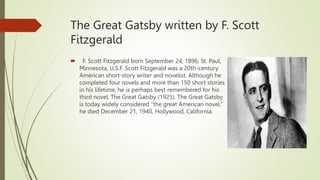
The Great Gatsby written by F. Scott
Fitzgerald
 F. Scott Fitzgerald born September 24, 1896, St. Paul,
Minnesota, U.S.F. Scott Fitzgerald was a 20th-century
American short-story writer and novelist. Although he
completed four novels and more than 150 short stories
in his lifetime, he is perhaps best remembered for his
third novel, The Great Gatsby (1925). The Great Gatsby
is today widely considered “the great American novel.”
he died December 21, 1940, Hollywood, California.
About the Novel
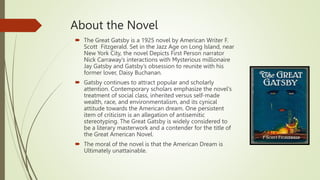
 The Great Gatsby is a 1925 novel by American Writer F.
Scott Fitzgerald. Set in the Jazz Age on Long Island, near
New York City, the novel Depicts First Person narrator
Nick Carraway’s interactions with Mysterious millionaire
Jay Gatsby and Gatsby’s obsession to reunite with his
former lover, Daisy Buchanan.
 Gatsby continues to attract popular and scholarly
attention. Contemporary scholars emphasize the novel's
treatment of social class, inherited versus self-made
wealth, race, and environmentalism, and its cynical
attitude towards the American dream. One persistent
item of criticism is an allegation of antisemitic
stereotyping. The Great Gatsby is widely considered to
be a literary masterwork and a contender for the title of
the Great American Novel.
 The moral of the novel is that the American Dream is
Ultimately unattainable.
Theme
 The Decline of the American Dream in the 1920s
 The Hollowness of the upper Class
 Class
 The American Dream
 Love and Marriage
The Decline of the American Dream in
the 1920s
 On the surface, The Great Gatsby is a story of the thwarted love between a man
and a woman. The main theme of the novel, However, encompasses a much larger,
less romantic Scope.
 Though all of its action takes place over a mere few months during the summer of
1922 and is set in a circumscribed geographical area in the vicinity of Long Island,
New York, The Great Gatsby is a highly symbolic meditation on 1920s America as a
whole, in particular the disintegration of the American dream in an era of
unprecedented prosperity and material excess.
 When World War I ended in 1918, the generation of young Americans who had
fought the war became intensely disillusioned, as the brutal carnage that they had
just faced made the Victorian social morality of early-twentieth-century America.
American aristocracy—families with old wealth—scorned the newly rich industrialists and
speculators. Additionally, the passage of the Eighteenth Amendment in 1919, which banned the sale
of alcohol, created a thriving underworld designed to satisfy the massive demand for bootleg liquor
among rich and poor alike.
Fitzgerald positions the characters of The Great Gatsby as emblems of these social trends. Nick and
Gatsby, both of whom fought in World War I, exhibit the newfound cosmopolitanism and cynicism
that resulted from the war. The various social climbers and ambitious speculators who attend
Gatsby’s parties evidence the greedy scramble for wealth. The clash between “old money” and “new
money” manifests itself in the novel’s symbolic geography: East Egg represents the established
aristocracy, West Egg the self-made rich. Meyer Wolfsheim and Gatsby’s fortune symbolize the rise
of organized crime and bootlegging.
Additionally, places and objects in The Great Gatsby have meaning only because characters instill
them with meaning: the eyes of Doctor T. J. Eckleburg best exemplify this idea. In Nick’s mind, the
ability to create meaningful symbols constitutes a central component of the American dream, as
early Americans invested their new nation with their own ideals and values. Nick compares the green
bulk of America rising from the ocean to the green light at the end of Daisy’s dock.
The Hollowness of the Upper Class
 One of the major topics Explored in The Great Gatsby is the Sociology of wealth,
Specifically, how the newly minted millionaires of the 1920s differ from and relate
to the old aristocracy of the country’s richest Families.
 In the novel West Egg And its denizens represent the newly rich, while East Egg and
denizens, especially Daisy and Tom, Represent the old aristocracy.
 Gatsby , for Example, live in monstrously ornate mansion in the west egg.
 In contrast , the old aristocracy possesses grace, taste, subtlety, and elegance by
the Buchanan's tasteful home and flowing white dresses of daisy and Jordan
Baker.
 East Eggers prove themselves careless, inconsiderate bullies to ease their who are
so used to the money’s ability to ease their minds that they never worry about
hurting others.
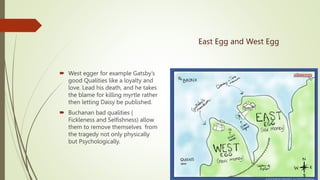
East Egg and West Egg
 West egger for example Gatsby’s
good Qualities like a loyalty and
love. Lead his death, and he takes
the blame for killing myrtle rather
then letting Daisy be published.
 Buchanan bad qualities (
Fickleness and Selfishness) allow
them to remove themselves from
the tragedy not only physically
but Psychologically.
Class
 In the monied World of The Great Gatsby, class influences all Aspects of life and
especially love. Myrtle mentions this with regard to her husband, George whom she
mistook for someone of better “breeding” and hence greater prospects: “ I thought
he knew something about breeding, but he wasn’t fit to lick my Shoe.
 “Similarly, Gatsby’s pursuit of daisy is bound up with class. At the end of the book ,
class dynamics dictate which one will never come to be Daisy and Gatsby.
 In the final chapter , Nick calls Tom and Daisy “ Careless people” who “Smashed up
things and …. Let other people clean up the mess they had made.”
The American Dream
 The American Dream is one of the major themes in The Great Gatsby. The life of Jay
Gatsby himself is an Embodiment of the American Dream, as he’s a poor farm boy
who changes his name and reinvents himself to become wealthy and successful, at
least financially.
 His story is a 1920s jazz age take on the classic rags to riches story, transitioning
from a simple life where money is scarce to the riches and extravagance that
become possible once one has money.
Love and Marriage
 The ideals of love and marriage are profoundly strained in The Great Gatsby, a book that
centers on two loveless marriages: the union between Tom and Daisy Buchanan and
between George and Myrtle Wilson. In both cases, the marriages seem to be unions of
convenience or advantage than actual love. Myrtle explains that she married George
because she thought he was “a gentleman,” suggesting she hoped he’d raise her class
status. Daisy nearly backed out of her marriage to Tom the day before her wedding, and
Tom had an affair within a year of the wedding, but the couple is well-suited because of
their shared class and desire for fun and material possessions. Even Gatsby’s all-
consuming passion for Daisy seems more of a desire to possess something unattainable
than actual love. Nick, meanwhile, dates Jordan Baker throughout the book, and though
their relationship has its moments of warmth and kindness, both parties generally seem
lukewarm and emotionally distant. “I wasn’t actually in love,” Nick recalls, “but I felt a
sort of tender curiosity.” Such “tender curiosity” may be the closest thing to love in the
entire novel.
Reference
 https://www.SparkNotes.com/lit/gatsby/themes/
 https://en.wikipedia.org/wiki/The_Great_Gatsby
 https://www.britannica.com/biography/F-Scott-Fitzgerald
Thank you

F. scott

  • 1.
  • 2.
    Presented by :Janvi Nakum Presentation: 1 M.A. Sem : 2 Paper no : 106 Topic : The Twentieth Century Roll no : 11 Enrollment No : 4069206420210020 Email id : janvinakum360@gmail.com Submitted To : S. B. Garadi Department of English, MKBU
  • 3.
    The Great Gatsbywritten by F. Scott Fitzgerald  F. Scott Fitzgerald born September 24, 1896, St. Paul, Minnesota, U.S.F. Scott Fitzgerald was a 20th-century American short-story writer and novelist. Although he completed four novels and more than 150 short stories in his lifetime, he is perhaps best remembered for his third novel, The Great Gatsby (1925). The Great Gatsby is today widely considered “the great American novel.” he died December 21, 1940, Hollywood, California.
  • 4.
    About the Novel The Great Gatsby is a 1925 novel by American Writer F. Scott Fitzgerald. Set in the Jazz Age on Long Island, near New York City, the novel Depicts First Person narrator Nick Carraway’s interactions with Mysterious millionaire Jay Gatsby and Gatsby’s obsession to reunite with his former lover, Daisy Buchanan.  Gatsby continues to attract popular and scholarly attention. Contemporary scholars emphasize the novel's treatment of social class, inherited versus self-made wealth, race, and environmentalism, and its cynical attitude towards the American dream. One persistent item of criticism is an allegation of antisemitic stereotyping. The Great Gatsby is widely considered to be a literary masterwork and a contender for the title of the Great American Novel.  The moral of the novel is that the American Dream is Ultimately unattainable.
  • 5.
    Theme  The Declineof the American Dream in the 1920s  The Hollowness of the upper Class  Class  The American Dream  Love and Marriage
  • 6.
    The Decline ofthe American Dream in the 1920s  On the surface, The Great Gatsby is a story of the thwarted love between a man and a woman. The main theme of the novel, However, encompasses a much larger, less romantic Scope.  Though all of its action takes place over a mere few months during the summer of 1922 and is set in a circumscribed geographical area in the vicinity of Long Island, New York, The Great Gatsby is a highly symbolic meditation on 1920s America as a whole, in particular the disintegration of the American dream in an era of unprecedented prosperity and material excess.  When World War I ended in 1918, the generation of young Americans who had fought the war became intensely disillusioned, as the brutal carnage that they had just faced made the Victorian social morality of early-twentieth-century America.
  • 7.
    American aristocracy—families withold wealth—scorned the newly rich industrialists and speculators. Additionally, the passage of the Eighteenth Amendment in 1919, which banned the sale of alcohol, created a thriving underworld designed to satisfy the massive demand for bootleg liquor among rich and poor alike. Fitzgerald positions the characters of The Great Gatsby as emblems of these social trends. Nick and Gatsby, both of whom fought in World War I, exhibit the newfound cosmopolitanism and cynicism that resulted from the war. The various social climbers and ambitious speculators who attend Gatsby’s parties evidence the greedy scramble for wealth. The clash between “old money” and “new money” manifests itself in the novel’s symbolic geography: East Egg represents the established aristocracy, West Egg the self-made rich. Meyer Wolfsheim and Gatsby’s fortune symbolize the rise of organized crime and bootlegging. Additionally, places and objects in The Great Gatsby have meaning only because characters instill them with meaning: the eyes of Doctor T. J. Eckleburg best exemplify this idea. In Nick’s mind, the ability to create meaningful symbols constitutes a central component of the American dream, as early Americans invested their new nation with their own ideals and values. Nick compares the green bulk of America rising from the ocean to the green light at the end of Daisy’s dock.
  • 8.
    The Hollowness ofthe Upper Class  One of the major topics Explored in The Great Gatsby is the Sociology of wealth, Specifically, how the newly minted millionaires of the 1920s differ from and relate to the old aristocracy of the country’s richest Families.  In the novel West Egg And its denizens represent the newly rich, while East Egg and denizens, especially Daisy and Tom, Represent the old aristocracy.  Gatsby , for Example, live in monstrously ornate mansion in the west egg.  In contrast , the old aristocracy possesses grace, taste, subtlety, and elegance by the Buchanan's tasteful home and flowing white dresses of daisy and Jordan Baker.  East Eggers prove themselves careless, inconsiderate bullies to ease their who are so used to the money’s ability to ease their minds that they never worry about hurting others.
  • 9.
    East Egg andWest Egg  West egger for example Gatsby’s good Qualities like a loyalty and love. Lead his death, and he takes the blame for killing myrtle rather then letting Daisy be published.  Buchanan bad qualities ( Fickleness and Selfishness) allow them to remove themselves from the tragedy not only physically but Psychologically.
  • 10.
    Class  In themonied World of The Great Gatsby, class influences all Aspects of life and especially love. Myrtle mentions this with regard to her husband, George whom she mistook for someone of better “breeding” and hence greater prospects: “ I thought he knew something about breeding, but he wasn’t fit to lick my Shoe.  “Similarly, Gatsby’s pursuit of daisy is bound up with class. At the end of the book , class dynamics dictate which one will never come to be Daisy and Gatsby.  In the final chapter , Nick calls Tom and Daisy “ Careless people” who “Smashed up things and …. Let other people clean up the mess they had made.”
  • 11.
    The American Dream The American Dream is one of the major themes in The Great Gatsby. The life of Jay Gatsby himself is an Embodiment of the American Dream, as he’s a poor farm boy who changes his name and reinvents himself to become wealthy and successful, at least financially.  His story is a 1920s jazz age take on the classic rags to riches story, transitioning from a simple life where money is scarce to the riches and extravagance that become possible once one has money.
  • 12.
    Love and Marriage The ideals of love and marriage are profoundly strained in The Great Gatsby, a book that centers on two loveless marriages: the union between Tom and Daisy Buchanan and between George and Myrtle Wilson. In both cases, the marriages seem to be unions of convenience or advantage than actual love. Myrtle explains that she married George because she thought he was “a gentleman,” suggesting she hoped he’d raise her class status. Daisy nearly backed out of her marriage to Tom the day before her wedding, and Tom had an affair within a year of the wedding, but the couple is well-suited because of their shared class and desire for fun and material possessions. Even Gatsby’s all- consuming passion for Daisy seems more of a desire to possess something unattainable than actual love. Nick, meanwhile, dates Jordan Baker throughout the book, and though their relationship has its moments of warmth and kindness, both parties generally seem lukewarm and emotionally distant. “I wasn’t actually in love,” Nick recalls, “but I felt a sort of tender curiosity.” Such “tender curiosity” may be the closest thing to love in the entire novel.
  • 13.
  • 14.