
Chapter:  Views of Earth Table of Contents Section 3:  Maps Section 1:  Landforms Section 2:  Viewpoints
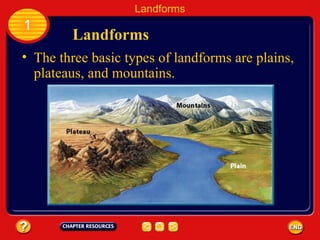
The three basic types of landforms are plains, plateaus, and mountains.   Landforms Landforms 1
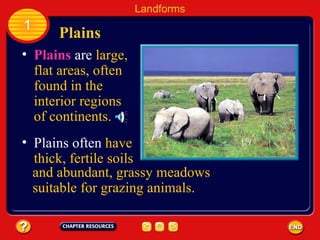
Plains   are  large, flat areas, often found in the interior regions of continents. Plains Landforms 1 Plains often  have thick, fertile soils and abundant, grassy meadows suitable for grazing animals.
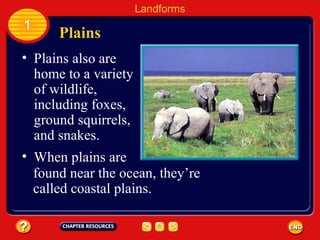
Plains Landforms 1 Plains also are home to a variety of wildlife, including foxes, ground squirrels, and snakes. When plains are found near the ocean, they’re called coastal plains.
A coastal plain is often called a lowland because it is lower in elevation, or distance above sea level, than the land around it. Coastal Plains Landforms 1
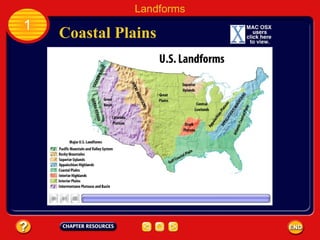
The Atlantic Coastal Plain is a good example of this type of landform. Coastal Plains Landforms 1 This area has low rolling hills, swamps, and marshes.
Coastal Plains Landforms 1
The Atlantic Coastal Plain began forming about 70 million years ago as sediment began accumulating on the ocean floor. Coastal Plains Landforms 1 Sea level eventually dropped, and the seafloor was exposed. The costal plain is the result of sedimentation. As a result, the coastal plain was born.
The  central portion  of the United States is comprised largely of interior plains.   Interior Plains Landforms 1 A large part of the interior plains is known as the Great Plains. It is a flat, grassy, dry area with few trees. The Great Plains consist of nearly horizontal layers of sedimentary rocks.
Plateaus   are flat, raised areas of land made up of nearly horizontal rocks that have been uplifted by forces within Earth. Plateaus Landforms 1 They are different from plains in that their edges rise steeply from the land around them.
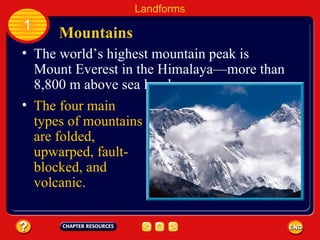
The world’s highest mountain peak is Mount Everest in the Himalaya — more than 8,800 m above sea level.   Mountains Landforms 1 The four main types of mountains are folded, upwarped, fault-blocked, and volcanic.
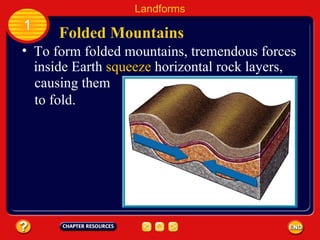
The Appalachian Mountains and the Rocky Mountains in Canada are comprised of folded rock layers.  Folded Mountains Landforms 1 In   folded mountains ,   the rock layers are folded like a rug that has been pushed up against a wall.
Folded Mountains Landforms 1 To form folded mountains, tremendous forces inside Earth  squeeze  horizontal rock layers,  causing them to fold.
The southern Rocky Mountains in Colorado and New Mexico are upwarped mountains.   Upwarped Mountains Landforms 1 High peaks and sharp ridges are common to this type of mountain.
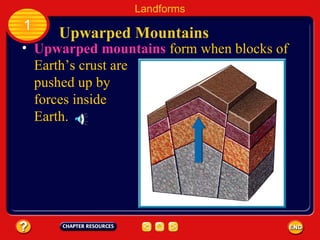
Upwarped Mountains Landforms 1 Upwarped mountains   form when blocks of  Earth’s crust are pushed up by forces inside Earth.
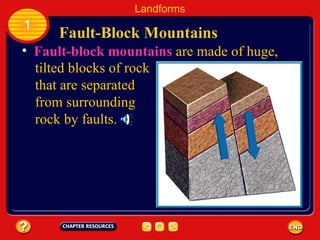
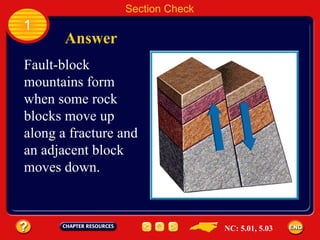
Fault-Block Mountains Landforms 1 Fault-block mountains   are made of huge,  tilted blocks of rock that are separated from surrounding rock by faults.
These faults are large fractures in rock along which mostly vertical movement has occurred. Fault-Block Mountains Landforms 1 When these mountains formed, one block was pushed up, while the adjacent block dropped down. This mountain-building process produces majestic peaks and steep slopes.
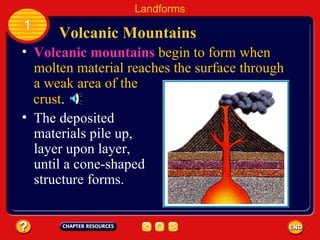
Volcanic Mountains Landforms 1 The deposited materials pile up, layer upon layer, until a cone-shaped structure forms. Volcanic mountains   begin to form when molten material reaches the surface through a weak area of the  crust .
Section Check 1 Question 1 ________ are flat, raised areas of land with horizontal rocks that were uplifted. A. Coastal plains B. Interior plains C. Mountains D. Plateaus NC: 5.01, 5.03
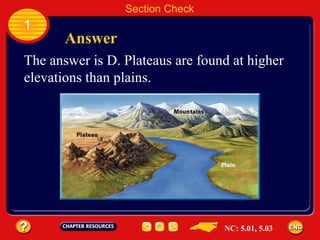
1 Section Check Answer The answer is D. Plateaus are found at higher elevations than plains. NC: 5.01, 5.03
Section Check 1 Question 2 When molten material reaches Earth’s surface through a weak area, _______ mountains begin to form. A. fault-block B. folded C. upwarped D. volcani c NC: 5.01, 5.03
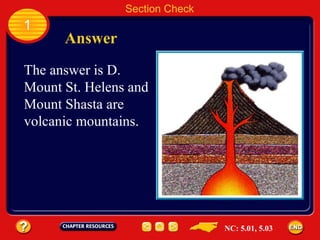
1 Section Check Answer The answer is D. Mount St. Helens and Mount Shasta are volcanic mountains. NC: 5.01, 5.03
Section Check 1 Question 3 Describe the difference between the formation of folded mountains and fault-block mountains. NC: 5.01, 5.03
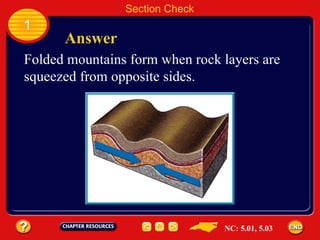
1 Section Check Answer Folded mountains form when rock layers are squeezed from opposite sides. NC: 5.01, 5.03
1 Section Check Answer Fault-block mountains form when some rock blocks move up along a fracture and an adjacent block moves down. NC: 5.01, 5.03

Chapter 2:1 Views of Earth- Landforms

  • 1.
  • 2.
    Chapter: Viewsof Earth Table of Contents Section 3: Maps Section 1: Landforms Section 2: Viewpoints
  • 3.
    The three basictypes of landforms are plains, plateaus, and mountains. Landforms Landforms 1
  • 4.
    Plains are large, flat areas, often found in the interior regions of continents. Plains Landforms 1 Plains often have thick, fertile soils and abundant, grassy meadows suitable for grazing animals.
  • 5.
    Plains Landforms 1Plains also are home to a variety of wildlife, including foxes, ground squirrels, and snakes. When plains are found near the ocean, they’re called coastal plains.
  • 6.
    A coastal plainis often called a lowland because it is lower in elevation, or distance above sea level, than the land around it. Coastal Plains Landforms 1
  • 7.
    The Atlantic CoastalPlain is a good example of this type of landform. Coastal Plains Landforms 1 This area has low rolling hills, swamps, and marshes.
  • 8.
  • 9.
    The Atlantic CoastalPlain began forming about 70 million years ago as sediment began accumulating on the ocean floor. Coastal Plains Landforms 1 Sea level eventually dropped, and the seafloor was exposed. The costal plain is the result of sedimentation. As a result, the coastal plain was born.
  • 10.
    The centralportion of the United States is comprised largely of interior plains. Interior Plains Landforms 1 A large part of the interior plains is known as the Great Plains. It is a flat, grassy, dry area with few trees. The Great Plains consist of nearly horizontal layers of sedimentary rocks.
  • 11.
    Plateaus are flat, raised areas of land made up of nearly horizontal rocks that have been uplifted by forces within Earth. Plateaus Landforms 1 They are different from plains in that their edges rise steeply from the land around them.
  • 12.
    The world’s highestmountain peak is Mount Everest in the Himalaya — more than 8,800 m above sea level. Mountains Landforms 1 The four main types of mountains are folded, upwarped, fault-blocked, and volcanic.
  • 13.
    The Appalachian Mountainsand the Rocky Mountains in Canada are comprised of folded rock layers. Folded Mountains Landforms 1 In folded mountains , the rock layers are folded like a rug that has been pushed up against a wall.
  • 14.
    Folded Mountains Landforms1 To form folded mountains, tremendous forces inside Earth squeeze horizontal rock layers, causing them to fold.
  • 15.
    The southern RockyMountains in Colorado and New Mexico are upwarped mountains. Upwarped Mountains Landforms 1 High peaks and sharp ridges are common to this type of mountain.
  • 16.
    Upwarped Mountains Landforms1 Upwarped mountains form when blocks of Earth’s crust are pushed up by forces inside Earth.
  • 17.
    Fault-Block Mountains Landforms1 Fault-block mountains are made of huge, tilted blocks of rock that are separated from surrounding rock by faults.
  • 18.
    These faults arelarge fractures in rock along which mostly vertical movement has occurred. Fault-Block Mountains Landforms 1 When these mountains formed, one block was pushed up, while the adjacent block dropped down. This mountain-building process produces majestic peaks and steep slopes.
  • 19.
    Volcanic Mountains Landforms1 The deposited materials pile up, layer upon layer, until a cone-shaped structure forms. Volcanic mountains begin to form when molten material reaches the surface through a weak area of the crust .
  • 20.
    Section Check 1Question 1 ________ are flat, raised areas of land with horizontal rocks that were uplifted. A. Coastal plains B. Interior plains C. Mountains D. Plateaus NC: 5.01, 5.03
  • 21.
    1 Section CheckAnswer The answer is D. Plateaus are found at higher elevations than plains. NC: 5.01, 5.03
  • 22.
    Section Check 1Question 2 When molten material reaches Earth’s surface through a weak area, _______ mountains begin to form. A. fault-block B. folded C. upwarped D. volcani c NC: 5.01, 5.03
  • 23.
    1 Section CheckAnswer The answer is D. Mount St. Helens and Mount Shasta are volcanic mountains. NC: 5.01, 5.03
  • 24.
    Section Check 1Question 3 Describe the difference between the formation of folded mountains and fault-block mountains. NC: 5.01, 5.03
  • 25.
    1 Section CheckAnswer Folded mountains form when rock layers are squeezed from opposite sides. NC: 5.01, 5.03
  • 26.
    1 Section CheckAnswer Fault-block mountains form when some rock blocks move up along a fracture and an adjacent block moves down. NC: 5.01, 5.03