Using Nouns in SentencesChapter 2
Using Nouns in SentencesNouns are words that name people, places, things, events, and ideas. It is hard to write or talk about anything without using a noun. Look around and you will see thousands of nouns.In Chapter 2, you will learn about nouns. Each lesson tells about different kinds of nouns. You will learn how they are used in everyday speech and writing.
Goals for LearningTo recognize nouns in sentences, and to identify and use compound and collective nounsTo identify and use common and proper nouns, and to capitalize proper nounsTo identify and use abstract and concrete nounsTo identify nouns as singular or plural, and to spell plural nounsTo spell plural nouns that have irregular forms, and to spell the plural form of proper nouns, numbers, dates, and lettersTo tell the difference between plural nouns and possessive nouns
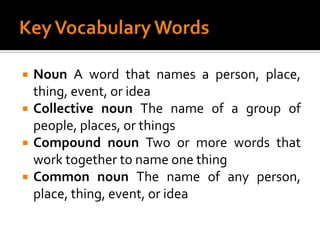
Key Vocabulary WordsNoun A word that names a person, place, thing, event, or ideaCollective noun The name of a group of people, places, or thingsCompound noun Two or more words that work together to name one thingCommon noun The name of any person, place, thing, event, or idea
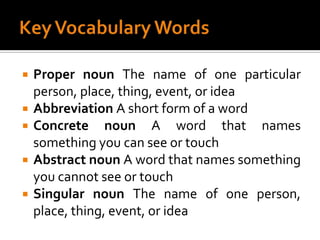
Key Vocabulary WordsProper noun The name of one particular person, place, thing, event, or ideaAbbreviation A short form of a wordConcrete noun A word that names something you can see or touchAbstract noun A word that names something you cannot see or touchSingular noun The name of one person, place, thing, event, or idea
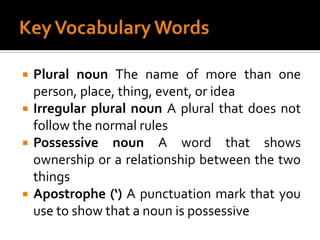
Key Vocabulary WordsPlural noun The name of more than one person, place, thing, event, or ideaIrregular plural noun A plural that does not follow the normal rulesPossessive noun A word that shows ownership or a relationship between the two thingsApostrophe (‘) A punctuation mark that you use to show that a noun is possessive
What Is a Noun?Lesson 2-1
ObjectivesTo identify nounsTo identify collective nounsTo identify compound nouns
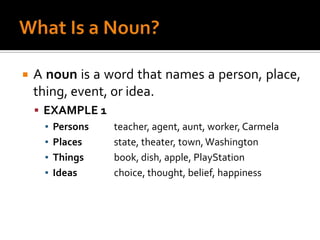
What Is a Noun?A noun is a word that names a person, place, thing, event, or idea.EXAMPLE 1Persons	teacher, agent, aunt, worker, CarmelaPlaces	state, theater, town, WashingtonThings	book, dish, apple, PlayStationIdeas		choice, thought, belief, happiness
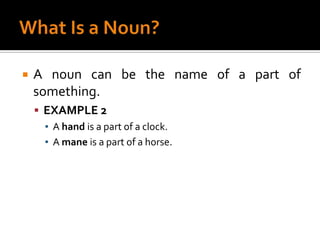
What Is a Noun?A noun can be the name of a part of something.EXAMPLE 2A hand is a part of a clock.A mane is a part of a horse.
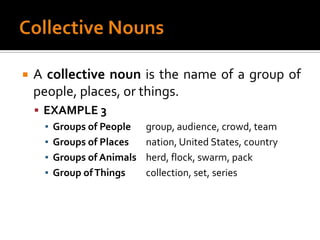
Collective NounsA collective noun is the name of a group of people, places, or things.EXAMPLE 3Groups of People	group, audience, crowd, teamGroups of Places	nation, United States, countryGroups of Animals	herd, flock, swarm, packGroup of Things	collection, set, series
Compound NounsA compound noun is two or more words that work together to name one thing. Some compound nouns are written as one word.EXAMPLE 4fire + fighter = firefighterback + yard = backyard
Compound NounsSome compound nouns use a hyphen between the words. A hyphen is a short dash between parts of a word.EXAMPLE 5mid-Julymother-in-law
Compound NounsSome compound nouns look like two words. In these compound nouns, the words work together to name on person, place, thing, event, or idea.EXAMPLE 6White Houseice creamThomas Jeffersonswim team
Common and Proper NounsLesson 2-2
ObjectivesTo identify and use common nouns and proper nounsTo capitalize proper nounsTo capitalize abbreviations of proper nounsTo capitalize and punctuate titles
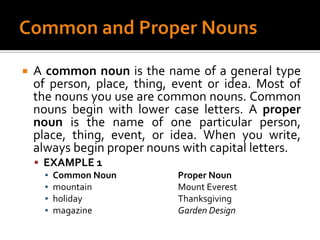
Common and Proper NounsA common noun is the name of a general type of person, place, thing, event or idea. Most of the nouns you use are common nouns. Common nouns begin with lower case letters. A proper noun is the name of one particular person, place, thing, event, or idea. When you write, always begin proper nouns with capital letters.EXAMPLE 1Common Noun		Proper Nounmountain			Mount Everestholiday			Thanksgivingmagazine			Garden Design
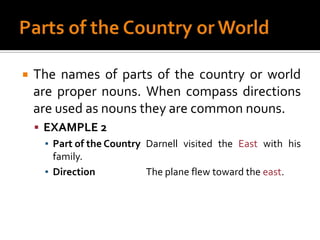
Parts of the Country or WorldThe names of parts of the country or world are proper nouns. When compass directions are used as nouns they are common nouns.EXAMPLE 2Part of the Country	Darnell visited the East with his family.Direction		The plane flew toward the east.
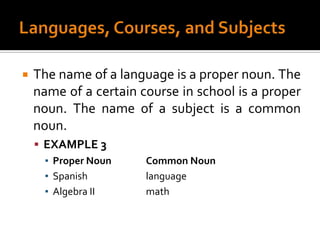
Languages, Courses, and SubjectsThe name of a language is a proper noun. The name of a certain course in school is a proper noun. The name of a subject is a common noun.EXAMPLE 3Proper Noun		Common NounSpanish		languageAlgebra II		math
Abbreviations of Proper NounsAn abbreviation is a short form of a word. If the word is a proper noun, capitalize its abbreviation. Titles like Doctor and Mister are proper nouns. They are usually abbreviated.EXAMPLE 4Proper Noun		AbbreviationMaryland		MDDoctor Turner		Dr. TurnerFranklin Street		Franklin St.Most of the words in an address are proper nouns.
TitlesCapitalize the first word of a title. Also capitalize each important word. Underline the title of a movie, book, magazine, opera, or play. If you are using a computer to write, use italics instead of underlining. Put quotation marks around the title of a song, poem, or short story.EXAMPLE 5Song		“America, the Beautiful”Book		The Red Pony or The Red PonyShort Story	“To Build a Fire”
Abstract and Concrete NounsLesson 2-3
ObjectivesTo identify and use concrete nounsTo identify and use abstract nouns
Abstract and Concrete NounsNouns can be abstract or concrete. A concrete noun is a word that names something you can see or touch. An abstract noun is a word that names something you cannot see or touch. You can think about it or talk about it.
Abstract and Concrete NounsEXAMPLE 1Concrete Noun		Abstract Nounmoney			priceclock				minutecollege			educationsports car			typepaper				assignmentAbstract nouns can be difficult to identify. If a noun names something you cannot see or touch, it is an abstract noun.
Singular and Plural NounsLesson 2-4
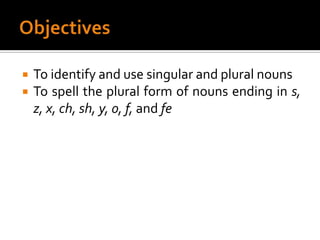
ObjectivesTo identify and use singular and plural nounsTo spell the plural form of nouns ending in s, z, x, ch, sh, y, o, f, and fe
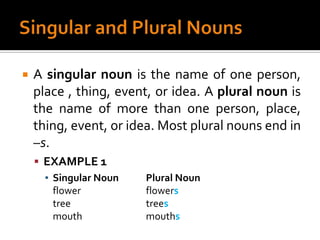
Singular and Plural NounsA singular noun is the name of one person, place , thing, event, or idea. A plural noun is the name of more than one person, place, thing, event, or idea. Most plural nouns end in –s.EXAMPLE 1Singular Noun	Plural Nounflower			flowerstree			treesmouth		mouths
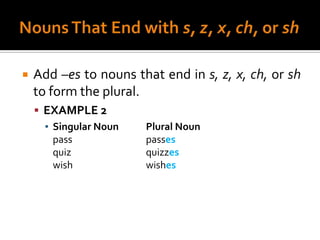
Nouns That End with s, z, x, ch, or shAdd –esto nouns that end in s, z, x, ch, or shto form the plural.EXAMPLE 2Singular Noun	Plural Nounpass			passesquiz			quizzeswish			wishes
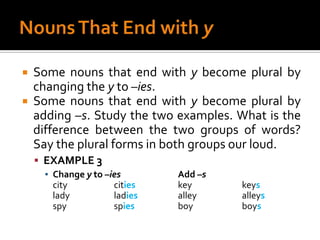
Nouns That End with ySome nouns that end with y become plural by changing the y to –ies.Some nouns that end with y become plural by adding –s. Study the two examples. What is the difference between the two groups of words? Say the plural forms in both groups our loud.EXAMPLE 3Change y to –iesAdd –scity		cities		key		keyslady		ladies		alley		alleysspy		spies		boy		boys
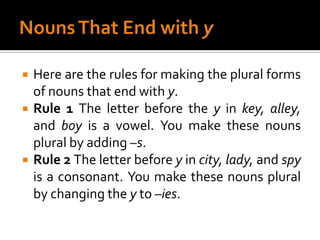
Nouns That End with yHere are the rules for making the plural forms of nouns that end with y.Rule 1 The letter before the y in key, alley, and boy is a vowel. You make these nouns plural by adding –s.Rule 2 The letter before y in city, lady, and spy is a consonant. You make these nouns plural by changing the y to –ies.
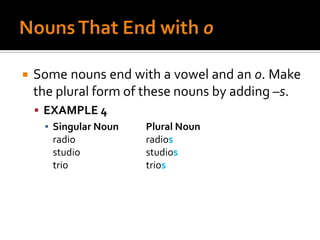
Nouns That End with oSome nouns end with a vowel and an o. Make the plural form of these nouns by adding –s.EXAMPLE 4Singular Noun	Plural Nounradio			radiosstudio			studiostrio			trios
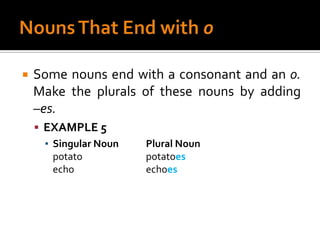
Nouns That End with oSome nouns end with a consonant and an o. Make the plurals of these nouns by adding      –es.EXAMPLE 5Singular Noun	Plural Nounpotato		potatoesecho			echoes
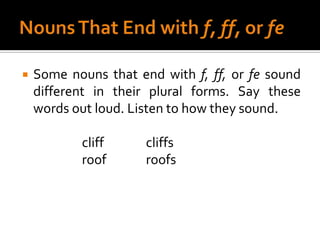
Nouns That End with f, ff, or feSome nouns that end with f, ff, or fesound different in their plural forms. Say these words out loud. Listen to how they sound.		cliff		cliffs		roof		roofs
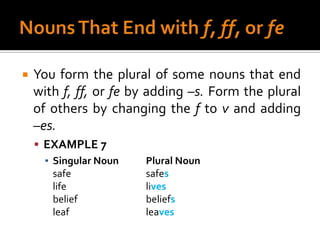
Nouns That End with f, ff, or feYou form the plural of some nouns that end with f, ff, or feby adding –s. Form the plural of others by changing the f to v and adding    –es.EXAMPLE 7Singular Noun	Plural Nounsafe			safeslife			livesbelief			beliefsleaf			leaves
More About Plural NounsLesson 2-5
ObjectivesTo spell irregular plural nounsTo form plural proper nounsTo form plural numbers, dates, and letters
Irregular Plural NounsSome plural nouns do not follow the regular rules. They are called irregular plural nouns. For example, in very few cases the singular and plural forms of a noun are the same.EXAMPLE 1Singular Noun	Plural Nounone deer		a herd of deerone sheep		many sheepa trout		a school of trout
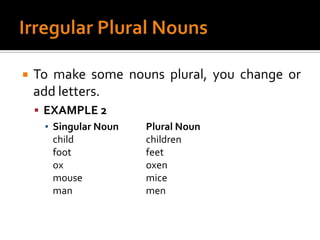
Irregular Plural NounsTo make some nouns plural, you change or add letters.EXAMPLE 2Singular Noun	Plural Nounchild			childrenfoot			feetox			oxenmouse		miceman			men
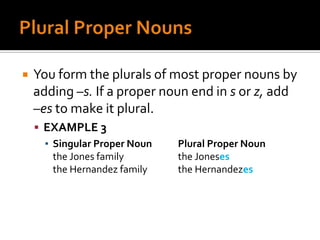
Plural Proper NounsYou form the plurals of most proper nouns by adding –s. If a proper noun end in s or z, add  –esto make it plural.EXAMPLE 3Singular Proper Noun	Plural Proper Nounthe Jones family		the Jonesesthe Hernandez family	the Hernandezes
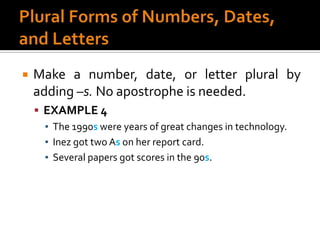
Plural Forms of Numbers, Dates, and LettersMake a number, date, or letter plural by adding –s. No apostrophe is needed.EXAMPLE 4The 1990s were years of great changes in technology.Inez got two As on her report card.Several papers got scores in the 90s.
Possessive NounsLesson 2-6
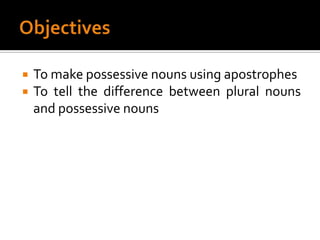
ObjectivesTo make possessive nouns using apostrophesTo tell the difference between plural nouns and possessive nouns
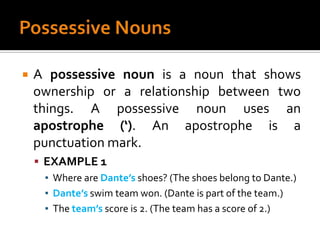
Possessive NounsA possessive noun is a noun that shows ownership or a relationship between two things. A possessive noun uses an apostrophe (‘). An apostrophe is a punctuation mark.EXAMPLE 1Where are Dante’s shoes? (The shoes belong to Dante.)Dante’s swim team won. (Dante is part of the team.)The team’s score is 2. (The team has a score of 2.)
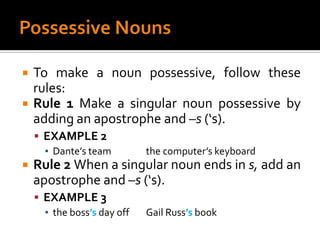
Possessive NounsTo make a noun possessive, follow these rules:Rule 1 Make a singular noun possessive by adding an apostrophe and –s (‘s).EXAMPLE 2Dante’s team		the computer’s keyboardRule 2 When a singular noun ends in s, add an apostrophe and –s (‘s).EXAMPLE 3the boss’s day off	Gail Russ’s book
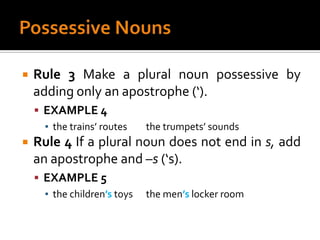
Possessive NounsRule 3 Make a plural noun possessive by adding only an apostrophe (‘).EXAMPLE 4the trains’ routes	the trumpets’ soundsRule 4 If a plural noun does not end in s, add an apostrophe and –s (‘s).EXAMPLE 5the children’s toys	the men’s locker room
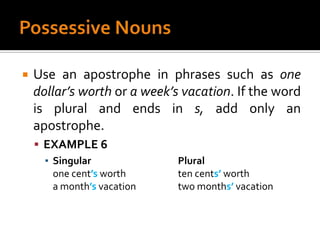
Possessive NounsUse an apostrophe in phrases such as one dollar’s worth or a week’s vacation. If the word is plural and ends in s, add only an apostrophe.EXAMPLE 6Singular			Pluralone cent’s worth		ten cents’ wortha month’s vacation		two months’ vacation
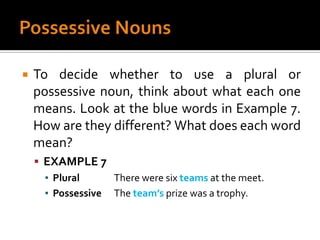
Possessive NounsTo decide whether to use a plural or possessive noun, think about what each one means. Look at the blue words in Example 7. How are they different? What does each word mean?EXAMPLE 7Plural		There were six teams at the meet.Possessive	The team’s prize was a trophy.

Chapter 2 using nouns in sentences

  • 1.
    Using Nouns inSentencesChapter 2
  • 2.
    Using Nouns inSentencesNouns are words that name people, places, things, events, and ideas. It is hard to write or talk about anything without using a noun. Look around and you will see thousands of nouns.In Chapter 2, you will learn about nouns. Each lesson tells about different kinds of nouns. You will learn how they are used in everyday speech and writing.
  • 3.
    Goals for LearningTorecognize nouns in sentences, and to identify and use compound and collective nounsTo identify and use common and proper nouns, and to capitalize proper nounsTo identify and use abstract and concrete nounsTo identify nouns as singular or plural, and to spell plural nounsTo spell plural nouns that have irregular forms, and to spell the plural form of proper nouns, numbers, dates, and lettersTo tell the difference between plural nouns and possessive nouns
  • 4.
    Key Vocabulary WordsNounA word that names a person, place, thing, event, or ideaCollective noun The name of a group of people, places, or thingsCompound noun Two or more words that work together to name one thingCommon noun The name of any person, place, thing, event, or idea
  • 5.
    Key Vocabulary WordsPropernoun The name of one particular person, place, thing, event, or ideaAbbreviation A short form of a wordConcrete noun A word that names something you can see or touchAbstract noun A word that names something you cannot see or touchSingular noun The name of one person, place, thing, event, or idea
  • 6.
    Key Vocabulary WordsPluralnoun The name of more than one person, place, thing, event, or ideaIrregular plural noun A plural that does not follow the normal rulesPossessive noun A word that shows ownership or a relationship between the two thingsApostrophe (‘) A punctuation mark that you use to show that a noun is possessive
  • 7.
    What Is aNoun?Lesson 2-1
  • 8.
    ObjectivesTo identify nounsToidentify collective nounsTo identify compound nouns
  • 9.
    What Is aNoun?A noun is a word that names a person, place, thing, event, or idea.EXAMPLE 1Persons teacher, agent, aunt, worker, CarmelaPlaces state, theater, town, WashingtonThings book, dish, apple, PlayStationIdeas choice, thought, belief, happiness
  • 10.
    What Is aNoun?A noun can be the name of a part of something.EXAMPLE 2A hand is a part of a clock.A mane is a part of a horse.
  • 11.
    Collective NounsA collectivenoun is the name of a group of people, places, or things.EXAMPLE 3Groups of People group, audience, crowd, teamGroups of Places nation, United States, countryGroups of Animals herd, flock, swarm, packGroup of Things collection, set, series
  • 12.
    Compound NounsA compoundnoun is two or more words that work together to name one thing. Some compound nouns are written as one word.EXAMPLE 4fire + fighter = firefighterback + yard = backyard
  • 13.
    Compound NounsSome compoundnouns use a hyphen between the words. A hyphen is a short dash between parts of a word.EXAMPLE 5mid-Julymother-in-law
  • 14.
    Compound NounsSome compoundnouns look like two words. In these compound nouns, the words work together to name on person, place, thing, event, or idea.EXAMPLE 6White Houseice creamThomas Jeffersonswim team
  • 15.
    Common and ProperNounsLesson 2-2
  • 16.
    ObjectivesTo identify anduse common nouns and proper nounsTo capitalize proper nounsTo capitalize abbreviations of proper nounsTo capitalize and punctuate titles
  • 17.
    Common and ProperNounsA common noun is the name of a general type of person, place, thing, event or idea. Most of the nouns you use are common nouns. Common nouns begin with lower case letters. A proper noun is the name of one particular person, place, thing, event, or idea. When you write, always begin proper nouns with capital letters.EXAMPLE 1Common Noun Proper Nounmountain Mount Everestholiday Thanksgivingmagazine Garden Design
  • 18.
    Parts of theCountry or WorldThe names of parts of the country or world are proper nouns. When compass directions are used as nouns they are common nouns.EXAMPLE 2Part of the Country Darnell visited the East with his family.Direction The plane flew toward the east.
  • 19.
    Languages, Courses, andSubjectsThe name of a language is a proper noun. The name of a certain course in school is a proper noun. The name of a subject is a common noun.EXAMPLE 3Proper Noun Common NounSpanish languageAlgebra II math
  • 20.
    Abbreviations of ProperNounsAn abbreviation is a short form of a word. If the word is a proper noun, capitalize its abbreviation. Titles like Doctor and Mister are proper nouns. They are usually abbreviated.EXAMPLE 4Proper Noun AbbreviationMaryland MDDoctor Turner Dr. TurnerFranklin Street Franklin St.Most of the words in an address are proper nouns.
  • 21.
    TitlesCapitalize the firstword of a title. Also capitalize each important word. Underline the title of a movie, book, magazine, opera, or play. If you are using a computer to write, use italics instead of underlining. Put quotation marks around the title of a song, poem, or short story.EXAMPLE 5Song “America, the Beautiful”Book The Red Pony or The Red PonyShort Story “To Build a Fire”
  • 22.
    Abstract and ConcreteNounsLesson 2-3
  • 23.
    ObjectivesTo identify anduse concrete nounsTo identify and use abstract nouns
  • 24.
    Abstract and ConcreteNounsNouns can be abstract or concrete. A concrete noun is a word that names something you can see or touch. An abstract noun is a word that names something you cannot see or touch. You can think about it or talk about it.
  • 25.
    Abstract and ConcreteNounsEXAMPLE 1Concrete Noun Abstract Nounmoney priceclock minutecollege educationsports car typepaper assignmentAbstract nouns can be difficult to identify. If a noun names something you cannot see or touch, it is an abstract noun.
  • 26.
    Singular and PluralNounsLesson 2-4
  • 27.
    ObjectivesTo identify anduse singular and plural nounsTo spell the plural form of nouns ending in s, z, x, ch, sh, y, o, f, and fe
  • 28.
    Singular and PluralNounsA singular noun is the name of one person, place , thing, event, or idea. A plural noun is the name of more than one person, place, thing, event, or idea. Most plural nouns end in –s.EXAMPLE 1Singular Noun Plural Nounflower flowerstree treesmouth mouths
  • 29.
    Nouns That Endwith s, z, x, ch, or shAdd –esto nouns that end in s, z, x, ch, or shto form the plural.EXAMPLE 2Singular Noun Plural Nounpass passesquiz quizzeswish wishes
  • 30.
    Nouns That Endwith ySome nouns that end with y become plural by changing the y to –ies.Some nouns that end with y become plural by adding –s. Study the two examples. What is the difference between the two groups of words? Say the plural forms in both groups our loud.EXAMPLE 3Change y to –iesAdd –scity cities key keyslady ladies alley alleysspy spies boy boys
  • 31.
    Nouns That Endwith yHere are the rules for making the plural forms of nouns that end with y.Rule 1 The letter before the y in key, alley, and boy is a vowel. You make these nouns plural by adding –s.Rule 2 The letter before y in city, lady, and spy is a consonant. You make these nouns plural by changing the y to –ies.
  • 32.
    Nouns That Endwith oSome nouns end with a vowel and an o. Make the plural form of these nouns by adding –s.EXAMPLE 4Singular Noun Plural Nounradio radiosstudio studiostrio trios
  • 33.
    Nouns That Endwith oSome nouns end with a consonant and an o. Make the plurals of these nouns by adding –es.EXAMPLE 5Singular Noun Plural Nounpotato potatoesecho echoes
  • 34.
    Nouns That Endwith f, ff, or feSome nouns that end with f, ff, or fesound different in their plural forms. Say these words out loud. Listen to how they sound. cliff cliffs roof roofs
  • 35.
    Nouns That Endwith f, ff, or feYou form the plural of some nouns that end with f, ff, or feby adding –s. Form the plural of others by changing the f to v and adding –es.EXAMPLE 7Singular Noun Plural Nounsafe safeslife livesbelief beliefsleaf leaves
  • 36.
    More About PluralNounsLesson 2-5
  • 37.
    ObjectivesTo spell irregularplural nounsTo form plural proper nounsTo form plural numbers, dates, and letters
  • 38.
    Irregular Plural NounsSomeplural nouns do not follow the regular rules. They are called irregular plural nouns. For example, in very few cases the singular and plural forms of a noun are the same.EXAMPLE 1Singular Noun Plural Nounone deer a herd of deerone sheep many sheepa trout a school of trout
  • 39.
    Irregular Plural NounsTomake some nouns plural, you change or add letters.EXAMPLE 2Singular Noun Plural Nounchild childrenfoot feetox oxenmouse miceman men
  • 40.
    Plural Proper NounsYouform the plurals of most proper nouns by adding –s. If a proper noun end in s or z, add –esto make it plural.EXAMPLE 3Singular Proper Noun Plural Proper Nounthe Jones family the Jonesesthe Hernandez family the Hernandezes
  • 41.
    Plural Forms ofNumbers, Dates, and LettersMake a number, date, or letter plural by adding –s. No apostrophe is needed.EXAMPLE 4The 1990s were years of great changes in technology.Inez got two As on her report card.Several papers got scores in the 90s.
  • 42.
  • 43.
    ObjectivesTo make possessivenouns using apostrophesTo tell the difference between plural nouns and possessive nouns
  • 44.
    Possessive NounsA possessivenoun is a noun that shows ownership or a relationship between two things. A possessive noun uses an apostrophe (‘). An apostrophe is a punctuation mark.EXAMPLE 1Where are Dante’s shoes? (The shoes belong to Dante.)Dante’s swim team won. (Dante is part of the team.)The team’s score is 2. (The team has a score of 2.)
  • 45.
    Possessive NounsTo makea noun possessive, follow these rules:Rule 1 Make a singular noun possessive by adding an apostrophe and –s (‘s).EXAMPLE 2Dante’s team the computer’s keyboardRule 2 When a singular noun ends in s, add an apostrophe and –s (‘s).EXAMPLE 3the boss’s day off Gail Russ’s book
  • 46.
    Possessive NounsRule 3Make a plural noun possessive by adding only an apostrophe (‘).EXAMPLE 4the trains’ routes the trumpets’ soundsRule 4 If a plural noun does not end in s, add an apostrophe and –s (‘s).EXAMPLE 5the children’s toys the men’s locker room
  • 47.
    Possessive NounsUse anapostrophe in phrases such as one dollar’s worth or a week’s vacation. If the word is plural and ends in s, add only an apostrophe.EXAMPLE 6Singular Pluralone cent’s worth ten cents’ wortha month’s vacation two months’ vacation
  • 48.
    Possessive NounsTo decidewhether to use a plural or possessive noun, think about what each one means. Look at the blue words in Example 7. How are they different? What does each word mean?EXAMPLE 7Plural There were six teams at the meet.Possessive The team’s prize was a trophy.