
10 TIPS on USING NOUNS
Grammar Rules and Tips for using Nouns
What is a Noun?
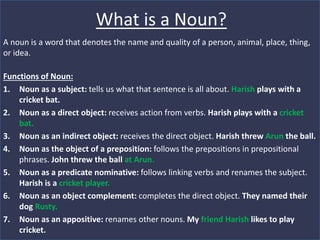
A noun is a word that denotes the name and quality of a person, animal, place, thing,
or idea.
Functions of Noun:
1. Noun as a subject: tells us what that sentence is all about. Harish plays with a
cricket bat.
2. Noun as a direct object: receives action from verbs. Harish plays with a cricket
bat.
3. Noun as an indirect object: receives the direct object. Harish threw Arun the ball.
4. Noun as the object of a preposition: follows the prepositions in prepositional
phrases. John threw the ball at Arun.
5. Noun as a predicate nominative: follows linking verbs and renames the subject.
Harish is a cricket player.
6. Noun as an object complement: completes the direct object. They named their
dog Rusty.
7. Noun as an appositive: renames other nouns. My friend Harish likes to play
cricket.
Types of Nouns
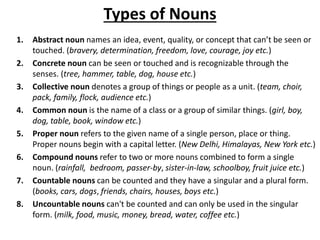
1. Abstract noun names an idea, event, quality, or concept that can’t be seen or
touched. (bravery, determination, freedom, love, courage, joy etc.)
2. Concrete noun can be seen or touched and is recognizable through the
senses. (tree, hammer, table, dog, house etc.)
3. Collective noun denotes a group of things or people as a unit. (team, choir,
pack, family, flock, audience etc.)
4. Common noun is the name of a class or a group of similar things. (girl, boy,
dog, table, book, window etc.)
5. Proper noun refers to the given name of a single person, place or thing.
Proper nouns begin with a capital letter. (New Delhi, Himalayas, New York etc.)
6. Compound nouns refer to two or more nouns combined to form a single
noun. (rainfall, bedroom, passer-by, sister-in-law, schoolboy, fruit juice etc.)
7. Countable nouns can be counted and they have a singular and a plural form.
(books, cars, dogs, friends, chairs, houses, boys etc.)
8. Uncountable nouns can't be counted and can only be used in the singular
form. (milk, food, music, money, bread, water, coffee etc.)
Types of Nouns
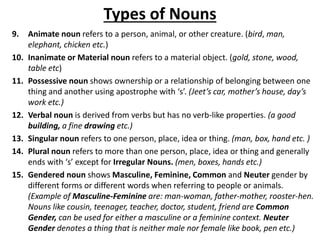
9. Animate noun refers to a person, animal, or other creature. (bird, man,
elephant, chicken etc.)
10. Inanimate or Material noun refers to a material object. (gold, stone, wood,
table etc)
11. Possessive noun shows ownership or a relationship of belonging between one
thing and another using apostrophe with ‘s’. (Jeet’s car, mother’s house, day’s
work etc.)
12. Verbal noun is derived from verbs but has no verb-like properties. (a good
building, a fine drawing etc.)
13. Singular noun refers to one person, place, idea or thing. (man, box, hand etc. )
14. Plural noun refers to more than one person, place, idea or thing and generally
ends with ‘s’ except for Irregular Nouns. (men, boxes, hands etc.)
15. Gendered noun shows Masculine, Feminine, Common and Neuter gender by
different forms or different words when referring to people or animals.
(Example of Masculine-Feminine are: man-woman, father-mother, rooster-hen.
Nouns like cousin, teenager, teacher, doctor, student, friend are Common
Gender, can be used for either a masculine or a feminine context. Neuter
Gender denotes a thing that is neither male nor female like book, pen etc.)
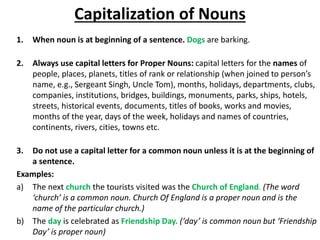
Capitalization of Nouns
1. When noun is at beginning of a sentence. Dogs are barking.
2. Always use capital letters for Proper Nouns: capital letters for the names of
people, places, planets, titles of rank or relationship (when joined to person’s
name, e.g., Sergeant Singh, Uncle Tom), months, holidays, departments, clubs,
companies, institutions, bridges, buildings, monuments, parks, ships, hotels,
streets, historical events, documents, titles of books, works and movies,
months of the year, days of the week, holidays and names of countries,
continents, rivers, cities, towns etc.
3. Do not use a capital letter for a common noun unless it is at the beginning of
a sentence.
Examples:
a) The next church the tourists visited was the Church of England. (The word
‘church’ is a common noun. Church Of England is a proper noun and is the
name of the particular church.)
b) The day is celebrated as Friendship Day. (‘day’ is common noun but ‘Friendship
Day’ is proper noun)
Tips on using Nouns
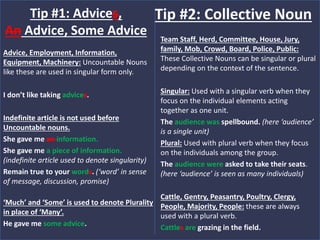
Advice, Employment, Information,
Equipment, Machinery: Uncountable Nouns
like these are used in singular form only.
I don’t like taking advices.
Indefinite article is not used before
Uncountable nouns.
She gave me an information.
She gave me a piece of information.
(indefinite article used to denote singularity)
Remain true to your words. (‘word’ in sense
of message, discussion, promise)
‘Much’ and ‘Some’ is used to denote Plurality
in place of ‘Many’.
He gave me some advice.
Tip #1: Advices,
An Advice, Some Advice Team Staff, Herd, Committee, House, Jury,
family, Mob, Crowd, Board, Police, Public:
These Collective Nouns can be singular or plural
depending on the context of the sentence.
Singular: Used with a singular verb when they
focus on the individual elements acting
together as one unit.
The audience was spellbound. (here ‘audience’
is a single unit)
Plural: Used with plural verb when they focus
on the individuals among the group.
The audience were asked to take their seats.
(here ‘audience’ is seen as many individuals)
Cattle, Gentry, Peasantry, Poultry, Clergy,
People, Majority, People: these are always
used with a plural verb.
Cattles are grazing in the field.
Tip #2: Collective Noun
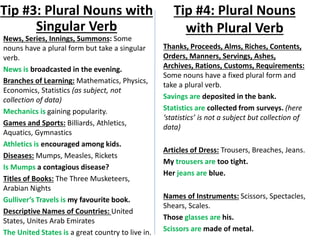
News, Series, Innings, Summons: Some
nouns have a plural form but take a singular
verb.
News is broadcasted in the evening.
Branches of Learning: Mathematics, Physics,
Economics, Statistics (as subject, not
collection of data)
Mechanics is gaining popularity.
Games and Sports: Billiards, Athletics,
Aquatics, Gymnastics
Athletics is encouraged among kids.
Diseases: Mumps, Measles, Rickets
Is Mumps a contagious disease?
Titles of Books: The Three Musketeers,
Arabian Nights
Gulliver’s Travels is my favourite book.
Descriptive Names of Countries: United
States, Unites Arab Emirates
The United States is a great country to live in.
Tip #3: Plural Nouns with
Singular Verb
Tip #4: Plural Nouns
with Plural Verb
Thanks, Proceeds, Alms, Riches, Contents,
Orders, Manners, Servings, Ashes,
Archives, Rations, Customs, Requirements:
Some nouns have a fixed plural form and
take a plural verb.
Savings are deposited in the bank.
Statistics are collected from surveys. (here
‘statistics’ is not a subject but collection of
data)
Articles of Dress: Trousers, Breaches, Jeans.
My trousers are too tight.
Her jeans are blue.
Names of Instruments: Scissors, Spectacles,
Shears, Scales.
Those glasses are his.
Scissors are made of metal.
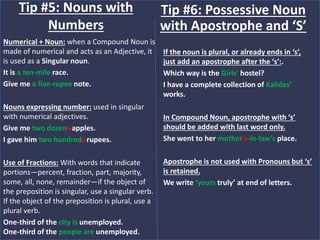
Numerical + Noun: when a Compound Noun is
made of numerical and acts as an Adjective, it
is used as a Singular noun.
It is a ten-mile race.
Give me a five-rupee note.
Nouns expressing number: used in singular
with numerical adjectives.
Give me two dozens apples.
I gave him two hundreds rupees.
Use of Fractions: With words that indicate
portions—percent, fraction, part, majority,
some, all, none, remainder—if the object of
the preposition is singular, use a singular verb.
If the object of the preposition is plural, use a
plural verb.
One-third of the city is unemployed.
One-third of the people are unemployed.
Tip #5: Nouns with
Numbers
If the noun is plural, or already ends in ‘s’,
just add an apostrophe after the ‘s’:.
Which way is the Girls’ hostel?
I have a complete collection of Kalidas’
works.
In Compound Noun, apostrophe with ‘s’
should be added with last word only.
She went to her mother’s-in-law’s place.
Apostrophe is not used with Pronouns but ‘s’
is retained.
We write ‘yours truly’ at end of letters.
Tip #6: Possessive Noun
with Apostrophe and ‘S’
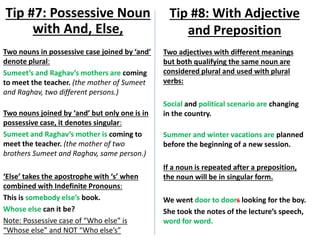
Two nouns in possessive case joined by ‘and’
denote plural:
Sumeet’s and Raghav’s mothers are coming
to meet the teacher. (the mother of Sumeet
and Raghav, two different persons.)
Two nouns joined by ‘and’ but only one is in
possessive case, it denotes singular:
Sumeet and Raghav’s mother is coming to
meet the teacher. (the mother of two
brothers Sumeet and Raghav, same person.)
‘Else’ takes the apostrophe with ‘s’ when
combined with Indefinite Pronouns:
This is somebody else’s book.
Whose else can it be?
Note: Possessive case of “Who else” is
“Whose else” and NOT “Who else’s”
Tip #7: Possessive Noun
with And, Else,
Tip #8: With Adjective
and Preposition
Two adjectives with different meanings
but both qualifying the same noun are
considered plural and used with plural
verbs:
Social and political scenario are changing
in the country.
Summer and winter vacations are planned
before the beginning of a new session.
If a noun is repeated after a preposition,
the noun will be in singular form.
We went door to doors looking for the boy.
She took the notes of the lecture’s speech,
word for word.
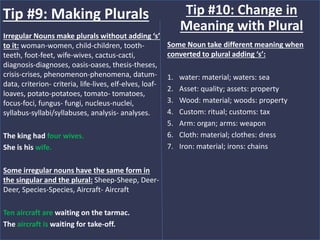
Irregular Nouns make plurals without adding ‘s’
to it: woman-women, child-children, tooth-
teeth, foot-feet, wife-wives, cactus-cacti,
diagnosis-diagnoses, oasis-oases, thesis-theses,
crisis-crises, phenomenon-phenomena, datum-
data, criterion- criteria, life-lives, elf-elves, loaf-
loaves, potato-potatoes, tomato- tomatoes,
focus-foci, fungus- fungi, nucleus-nuclei,
syllabus-syllabi/syllabuses, analysis- analyses.
The king had four wives.
She is his wife.
Some irregular nouns have the same form in
the singular and the plural: Sheep-Sheep, Deer-
Deer, Species-Species, Aircraft- Aircraft
Ten aircraft are waiting on the tarmac.
The aircraft is waiting for take-off.
Tip #9: Making Plurals
Some Noun take different meaning when
converted to plural adding ‘s’:
1. water: material; waters: sea
2. Asset: quality; assets: property
3. Wood: material; woods: property
4. Custom: ritual; customs: tax
5. Arm: organ; arms: weapon
6. Cloth: material; clothes: dress
7. Iron: material; irons: chains
Tip #10: Change in
Meaning with Plural
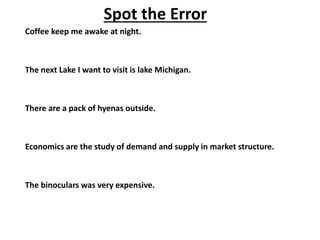
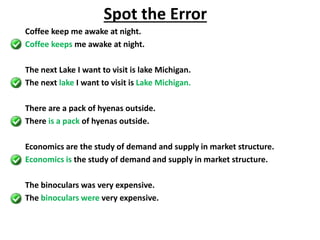
Spot the Errors
Coffee keep me awake at night.
The next Lake I want to visit is lake Michigan.
There are a pack of hyenas outside.
Economics are the study of demand and supply in market structure.
The binoculars was very expensive.
Spot the Error
Coffee keep me awake at night.
Coffee keeps me awake at night.
The next Lake I want to visit is lake Michigan.
The next lake I want to visit is Lake Michigan.
There are a pack of hyenas outside.
There is a pack of hyenas outside.
Economics are the study of demand and supply in market structure.
Economics is the study of demand and supply in market structure.
The binoculars was very expensive.
The binoculars were very expensive.
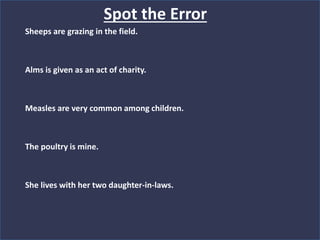
Spot the Error
Sheeps are grazing in the field.
Alms is given as an act of charity.
Measles are very common among children.
The poultry is mine.
She lives with her two daughter-in-laws.
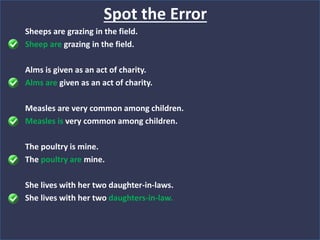
Spot the Error
Sheeps are grazing in the field.
Sheep are grazing in the field.
Alms is given as an act of charity.
Alms are given as an act of charity.
Measles are very common among children.
Measles is very common among children.
The poultry is mine.
The poultry are mine.
She lives with her two daughter-in-laws.
She lives with her two daughters-in-law.
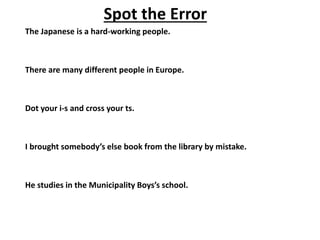
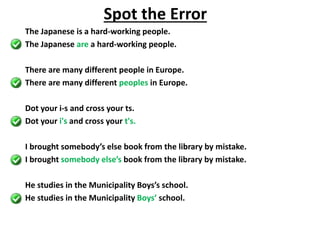
Spot the Error
The Japanese is a hard-working people.
There are many different people in Europe.
Dot your i-s and cross your ts.
I brought somebody’s else book from the library by mistake.
He studies in the Municipality Boys’s school.
Spot the Error
The Japanese is a hard-working people.
The Japanese are a hard-working people.
There are many different people in Europe.
There are many different peoples in Europe.
Dot your i-s and cross your ts.
Dot your i's and cross your t's.
I brought somebody’s else book from the library by mistake.
I brought somebody else’s book from the library by mistake.
He studies in the Municipality Boys’s school.
He studies in the Municipality Boys’ school.
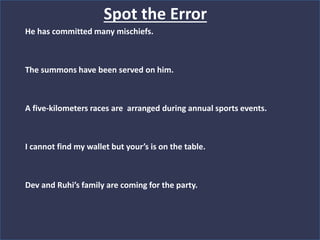
Spot the Error
He has committed many mischiefs.
The summons have been served on him.
A five-kilometers races are arranged during annual sports events.
I cannot find my wallet but your’s is on the table.
Dev and Ruhi’s family are coming for the party.
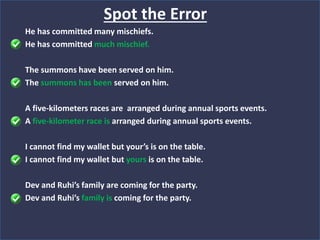
Spot the Error
He has committed many mischiefs.
He has committed much mischief.
The summons have been served on him.
The summons has been served on him.
A five-kilometers races are arranged during annual sports events.
A five-kilometer race is arranged during annual sports events.
I cannot find my wallet but your’s is on the table.
I cannot find my wallet but yours is on the table.
Dev and Ruhi’s family are coming for the party.
Dev and Ruhi’s family is coming for the party.
Spot the Error
About Us
LearningPundits helps Job Seekers make great CVs,
master English Grammar and Vocabulary , ace
Aptitude Tests , speak fluently in a Group Discussion
and perform well in Interviews.
We also conduct weekly online contests on
Aptitude and English. Job Seekers can also apply for
jobs on LearningPundits.
You can read more about Tips on Using Nouns.

Tips on Using Nouns

  • 1.
    10 TIPS onUSING NOUNS Grammar Rules and Tips for using Nouns
  • 2.
    What is aNoun? A noun is a word that denotes the name and quality of a person, animal, place, thing, or idea. Functions of Noun: 1. Noun as a subject: tells us what that sentence is all about. Harish plays with a cricket bat. 2. Noun as a direct object: receives action from verbs. Harish plays with a cricket bat. 3. Noun as an indirect object: receives the direct object. Harish threw Arun the ball. 4. Noun as the object of a preposition: follows the prepositions in prepositional phrases. John threw the ball at Arun. 5. Noun as a predicate nominative: follows linking verbs and renames the subject. Harish is a cricket player. 6. Noun as an object complement: completes the direct object. They named their dog Rusty. 7. Noun as an appositive: renames other nouns. My friend Harish likes to play cricket.
  • 3.
    Types of Nouns 1.Abstract noun names an idea, event, quality, or concept that can’t be seen or touched. (bravery, determination, freedom, love, courage, joy etc.) 2. Concrete noun can be seen or touched and is recognizable through the senses. (tree, hammer, table, dog, house etc.) 3. Collective noun denotes a group of things or people as a unit. (team, choir, pack, family, flock, audience etc.) 4. Common noun is the name of a class or a group of similar things. (girl, boy, dog, table, book, window etc.) 5. Proper noun refers to the given name of a single person, place or thing. Proper nouns begin with a capital letter. (New Delhi, Himalayas, New York etc.) 6. Compound nouns refer to two or more nouns combined to form a single noun. (rainfall, bedroom, passer-by, sister-in-law, schoolboy, fruit juice etc.) 7. Countable nouns can be counted and they have a singular and a plural form. (books, cars, dogs, friends, chairs, houses, boys etc.) 8. Uncountable nouns can't be counted and can only be used in the singular form. (milk, food, music, money, bread, water, coffee etc.)
  • 4.
    Types of Nouns 9.Animate noun refers to a person, animal, or other creature. (bird, man, elephant, chicken etc.) 10. Inanimate or Material noun refers to a material object. (gold, stone, wood, table etc) 11. Possessive noun shows ownership or a relationship of belonging between one thing and another using apostrophe with ‘s’. (Jeet’s car, mother’s house, day’s work etc.) 12. Verbal noun is derived from verbs but has no verb-like properties. (a good building, a fine drawing etc.) 13. Singular noun refers to one person, place, idea or thing. (man, box, hand etc. ) 14. Plural noun refers to more than one person, place, idea or thing and generally ends with ‘s’ except for Irregular Nouns. (men, boxes, hands etc.) 15. Gendered noun shows Masculine, Feminine, Common and Neuter gender by different forms or different words when referring to people or animals. (Example of Masculine-Feminine are: man-woman, father-mother, rooster-hen. Nouns like cousin, teenager, teacher, doctor, student, friend are Common Gender, can be used for either a masculine or a feminine context. Neuter Gender denotes a thing that is neither male nor female like book, pen etc.)
  • 5.
    Capitalization of Nouns 1.When noun is at beginning of a sentence. Dogs are barking. 2. Always use capital letters for Proper Nouns: capital letters for the names of people, places, planets, titles of rank or relationship (when joined to person’s name, e.g., Sergeant Singh, Uncle Tom), months, holidays, departments, clubs, companies, institutions, bridges, buildings, monuments, parks, ships, hotels, streets, historical events, documents, titles of books, works and movies, months of the year, days of the week, holidays and names of countries, continents, rivers, cities, towns etc. 3. Do not use a capital letter for a common noun unless it is at the beginning of a sentence. Examples: a) The next church the tourists visited was the Church of England. (The word ‘church’ is a common noun. Church Of England is a proper noun and is the name of the particular church.) b) The day is celebrated as Friendship Day. (‘day’ is common noun but ‘Friendship Day’ is proper noun)
  • 6.
  • 7.
    Advice, Employment, Information, Equipment,Machinery: Uncountable Nouns like these are used in singular form only. I don’t like taking advices. Indefinite article is not used before Uncountable nouns. She gave me an information. She gave me a piece of information. (indefinite article used to denote singularity) Remain true to your words. (‘word’ in sense of message, discussion, promise) ‘Much’ and ‘Some’ is used to denote Plurality in place of ‘Many’. He gave me some advice. Tip #1: Advices, An Advice, Some Advice Team Staff, Herd, Committee, House, Jury, family, Mob, Crowd, Board, Police, Public: These Collective Nouns can be singular or plural depending on the context of the sentence. Singular: Used with a singular verb when they focus on the individual elements acting together as one unit. The audience was spellbound. (here ‘audience’ is a single unit) Plural: Used with plural verb when they focus on the individuals among the group. The audience were asked to take their seats. (here ‘audience’ is seen as many individuals) Cattle, Gentry, Peasantry, Poultry, Clergy, People, Majority, People: these are always used with a plural verb. Cattles are grazing in the field. Tip #2: Collective Noun
  • 8.
    News, Series, Innings,Summons: Some nouns have a plural form but take a singular verb. News is broadcasted in the evening. Branches of Learning: Mathematics, Physics, Economics, Statistics (as subject, not collection of data) Mechanics is gaining popularity. Games and Sports: Billiards, Athletics, Aquatics, Gymnastics Athletics is encouraged among kids. Diseases: Mumps, Measles, Rickets Is Mumps a contagious disease? Titles of Books: The Three Musketeers, Arabian Nights Gulliver’s Travels is my favourite book. Descriptive Names of Countries: United States, Unites Arab Emirates The United States is a great country to live in. Tip #3: Plural Nouns with Singular Verb Tip #4: Plural Nouns with Plural Verb Thanks, Proceeds, Alms, Riches, Contents, Orders, Manners, Servings, Ashes, Archives, Rations, Customs, Requirements: Some nouns have a fixed plural form and take a plural verb. Savings are deposited in the bank. Statistics are collected from surveys. (here ‘statistics’ is not a subject but collection of data) Articles of Dress: Trousers, Breaches, Jeans. My trousers are too tight. Her jeans are blue. Names of Instruments: Scissors, Spectacles, Shears, Scales. Those glasses are his. Scissors are made of metal.
  • 9.
    Numerical + Noun:when a Compound Noun is made of numerical and acts as an Adjective, it is used as a Singular noun. It is a ten-mile race. Give me a five-rupee note. Nouns expressing number: used in singular with numerical adjectives. Give me two dozens apples. I gave him two hundreds rupees. Use of Fractions: With words that indicate portions—percent, fraction, part, majority, some, all, none, remainder—if the object of the preposition is singular, use a singular verb. If the object of the preposition is plural, use a plural verb. One-third of the city is unemployed. One-third of the people are unemployed. Tip #5: Nouns with Numbers If the noun is plural, or already ends in ‘s’, just add an apostrophe after the ‘s’:. Which way is the Girls’ hostel? I have a complete collection of Kalidas’ works. In Compound Noun, apostrophe with ‘s’ should be added with last word only. She went to her mother’s-in-law’s place. Apostrophe is not used with Pronouns but ‘s’ is retained. We write ‘yours truly’ at end of letters. Tip #6: Possessive Noun with Apostrophe and ‘S’
  • 10.
    Two nouns inpossessive case joined by ‘and’ denote plural: Sumeet’s and Raghav’s mothers are coming to meet the teacher. (the mother of Sumeet and Raghav, two different persons.) Two nouns joined by ‘and’ but only one is in possessive case, it denotes singular: Sumeet and Raghav’s mother is coming to meet the teacher. (the mother of two brothers Sumeet and Raghav, same person.) ‘Else’ takes the apostrophe with ‘s’ when combined with Indefinite Pronouns: This is somebody else’s book. Whose else can it be? Note: Possessive case of “Who else” is “Whose else” and NOT “Who else’s” Tip #7: Possessive Noun with And, Else, Tip #8: With Adjective and Preposition Two adjectives with different meanings but both qualifying the same noun are considered plural and used with plural verbs: Social and political scenario are changing in the country. Summer and winter vacations are planned before the beginning of a new session. If a noun is repeated after a preposition, the noun will be in singular form. We went door to doors looking for the boy. She took the notes of the lecture’s speech, word for word.
  • 11.
    Irregular Nouns makeplurals without adding ‘s’ to it: woman-women, child-children, tooth- teeth, foot-feet, wife-wives, cactus-cacti, diagnosis-diagnoses, oasis-oases, thesis-theses, crisis-crises, phenomenon-phenomena, datum- data, criterion- criteria, life-lives, elf-elves, loaf- loaves, potato-potatoes, tomato- tomatoes, focus-foci, fungus- fungi, nucleus-nuclei, syllabus-syllabi/syllabuses, analysis- analyses. The king had four wives. She is his wife. Some irregular nouns have the same form in the singular and the plural: Sheep-Sheep, Deer- Deer, Species-Species, Aircraft- Aircraft Ten aircraft are waiting on the tarmac. The aircraft is waiting for take-off. Tip #9: Making Plurals Some Noun take different meaning when converted to plural adding ‘s’: 1. water: material; waters: sea 2. Asset: quality; assets: property 3. Wood: material; woods: property 4. Custom: ritual; customs: tax 5. Arm: organ; arms: weapon 6. Cloth: material; clothes: dress 7. Iron: material; irons: chains Tip #10: Change in Meaning with Plural
  • 12.
  • 13.
    Coffee keep meawake at night. The next Lake I want to visit is lake Michigan. There are a pack of hyenas outside. Economics are the study of demand and supply in market structure. The binoculars was very expensive. Spot the Error
  • 14.
    Coffee keep meawake at night. Coffee keeps me awake at night. The next Lake I want to visit is lake Michigan. The next lake I want to visit is Lake Michigan. There are a pack of hyenas outside. There is a pack of hyenas outside. Economics are the study of demand and supply in market structure. Economics is the study of demand and supply in market structure. The binoculars was very expensive. The binoculars were very expensive. Spot the Error
  • 15.
    Sheeps are grazingin the field. Alms is given as an act of charity. Measles are very common among children. The poultry is mine. She lives with her two daughter-in-laws. Spot the Error
  • 16.
    Sheeps are grazingin the field. Sheep are grazing in the field. Alms is given as an act of charity. Alms are given as an act of charity. Measles are very common among children. Measles is very common among children. The poultry is mine. The poultry are mine. She lives with her two daughter-in-laws. She lives with her two daughters-in-law. Spot the Error
  • 17.
    The Japanese isa hard-working people. There are many different people in Europe. Dot your i-s and cross your ts. I brought somebody’s else book from the library by mistake. He studies in the Municipality Boys’s school. Spot the Error
  • 18.
    The Japanese isa hard-working people. The Japanese are a hard-working people. There are many different people in Europe. There are many different peoples in Europe. Dot your i-s and cross your ts. Dot your i's and cross your t's. I brought somebody’s else book from the library by mistake. I brought somebody else’s book from the library by mistake. He studies in the Municipality Boys’s school. He studies in the Municipality Boys’ school. Spot the Error
  • 19.
    He has committedmany mischiefs. The summons have been served on him. A five-kilometers races are arranged during annual sports events. I cannot find my wallet but your’s is on the table. Dev and Ruhi’s family are coming for the party. Spot the Error
  • 20.
    He has committedmany mischiefs. He has committed much mischief. The summons have been served on him. The summons has been served on him. A five-kilometers races are arranged during annual sports events. A five-kilometer race is arranged during annual sports events. I cannot find my wallet but your’s is on the table. I cannot find my wallet but yours is on the table. Dev and Ruhi’s family are coming for the party. Dev and Ruhi’s family is coming for the party. Spot the Error
  • 21.
    About Us LearningPundits helpsJob Seekers make great CVs, master English Grammar and Vocabulary , ace Aptitude Tests , speak fluently in a Group Discussion and perform well in Interviews. We also conduct weekly online contests on Aptitude and English. Job Seekers can also apply for jobs on LearningPundits. You can read more about Tips on Using Nouns.

Editor's Notes

  • #2 VO: 10 Tips on using adverbs
  • #3 VO:
  • #4 VO:
  • #5 VO:
  • #6 VO:
  • #7 VO:
  • #8 VO:
  • #9 VO:
  • #10 VO:
  • #11 VO:
  • #12 VO:
  • #13 VO: Each of the following sentences will contain a mistake in the usage of Nouns. See if you can spot that mistake.
  • #14 VO: Can you spot the errors in these 5 sentences? Please pause the video here to see if you can spot all 5 errors.
  • #15 VO: The sentence Coffee keep me awake at night– is wrong because ‘Coffee’ is an uncountable Noun hence the following verb should be in singular form. So the correct answer is Coffee keeps me awake at night. The next Lake I want to visit is Lake Michigan– is incorrect because ‘lake’ is common noun so it will not start with a capital letter but ‘Lake Michigan’ is a proper noun so here ‘Lake’ will begin with a capital letter. The correct answer is The next lake I want to visit is Lake Michigan. There are a pack of hyenas outside-- is incorrect because here ‘pack’ is a collective noun that denotes a single unit so the verb will be in singular form. The correct answer is There is a pack of hyenas outside. The sentence Economics are the study of  demand and supply in market structure– is incorrect because although subjects like ‘economics, mathematics’ are plural nouns, they take singular verbs. So the correct answer is Economics is the study of  demand and supply in market structure. The binoculars was very expensive – is incorrect because ‘binoculars’ is a plural noun that refer to things that have two parts so the verb should be in plural form. The correct answer is The binoculars were very expensive.
  • #16 VO: Can you spot the errors in these 5 sentences? Please pause the video here to see if you can spot all 5 errors.
  • #17 VO: Sheeps are grazing on the field-- is incorrect because ‘sheep’ is one of the nouns that remain same in plural form also. So the correct answer is Sheep are grazing on the field. The sentence Alms is given as an act of charity– is incorrect because nouns like ‘Alms, riches, savings’ are always used as plural nouns. So the correct answer is Alms are given as an act of charity. Measles are very common among children- is wrong because although names of diseases like ‘measles, mumps, rickets’ end with ‘s’, they denote singular form and take a singular verb. So the correct answer is Measles is very common among children. The poultry is mine– is incorrect because certain collective nouns like poultry, cattle, gentry always take a plural verb. So the correct answer is The poultry are mine. She lives with her two daughter-in-laws– is incorrect because Compound Noun generally forms its plural by adding -s to the principal word, which is ‘daughter’ here. So the correct answer is She lives with her two daughters-in-law.
  • #18 VO: Can you spot the errors in these 5 sentences? Please pause the video here to see if you can spot all 5 errors.
  • #19 VO: The Japanese is a hard-working people– is incorrect because here ‘Japanese’ represent an entire race, and nation so the verb will be in plural form. The correct answer is The Japanese are hard-working people. The sentence There are many different people in Europe– is incorrect because here ‘people’ will in plural form of ‘peoples’ as we are referring to multiple groups. So the correct answer is There are many different peoples in Europe. Dot your i-s and cross your ts– is incorrect because letters, figures and other symbols are made plural by adding an apostrophe and ‘s’. So the correct way to is Dot your i's and cross your t's. The sentence I brought somebody’s else book from library by mistake– is incorrect because ‘Else’ takes the apostrophe with ‘s’ when combined with Indefinite Pronouns. So the correct answer is I brought somebody else’s book from library by mistake. He studies in the Municipality Boys’s school– is incorrect because when the noun is Plural, and ends in s, the Possessive Case is formed by adding only an apostrophe and ‘s’ is omitted. So the correct answer is He studies in the Municipality Boys’ school.
  • #20 VO: Can you spot the errors in these 5 sentences? Please pause the video here to see if you can spot all 5 errors.
  • #21 VO: The sentence He has committed many mischiefs– is incorrect because ‘mischief’ is uncountable noun so it will always be in singular form and to make plural we use either ‘some’ or ‘much’. So the correct answer is He has committed much mischief. The summons have been served on him--is incorrect because though the noun ‘summons’ ends with ‘s’ like a plural, it is considered singular, just like ‘news, series, innings’, so the correct answer would be The summons has been served on him. The sentence A five-kilometers races are arranged during annual sports events– is incorrect because when a Compound Noun is made of a numerical and acts as an Adjective, it is used as Singular. So the correct answer is A five-kilometer race is arranged during annual sports events. I cannot find my wallet but your’s is on the table– is wrong because apostrophes are not used with possessive pronouns and only the ‘s’ form is used. So the correct way to express it is I cannot find my wallet but yours is on the table The sentence Dev and Ruhi’s family are coming for the party—is incorrect because when two nouns joined by ‘and’ but only one is in possessive case, it denotes singular. So the correct answer is Dev and Ruhi’s family is coming for the party.