Boolean Algebra and Sets
Set Theory
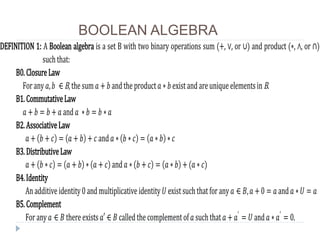
DEFINITION 1: A Boolean algebra is a set B with two binary operations sum (+, ∨, or ∪) and product (∗, ∧, or ∩)
suchthat:
B0.ClosureLaw
Forany 𝑎, 𝑏 ⋲B,thesum 𝑎 + 𝑏 andtheproduct 𝑎 ∗ 𝑏 existandareuniqueelementsinB.
B1.CommutativeLaw
𝑎 + 𝑏 = 𝑏 + 𝑎 and 𝑎 ∗ 𝑏 = 𝑏 ∗ 𝑎
B2.AssociativeLaw
𝑎 + 𝑏 + 𝑐) = 𝑎 + 𝑏)+ 𝑐 and 𝑎 ∗ 𝑏 ∗ 𝑐) = 𝑎 ∗ 𝑏)∗ 𝑐
B3.DistributiveLaw
𝑎 + 𝑏 ∗ 𝑐) = 𝑎 + 𝑏)∗ 𝑎 + 𝑐)and 𝑎 ∗ 𝑏 + 𝑐) = 𝑎 ∗ 𝑏)+(𝑎 ∗ 𝑐)
B4.Identity
Anadditiveidentity0andmultiplicativeidentity 𝑈 existsuchthatforany 𝑎 ⋲ 𝐵, 𝑎 +0 = 𝑎 and 𝑎 ∗ 𝑈 = 𝑎
B5.Complement
Forany 𝑎 ⋲ 𝐵 thereexists 𝑎′⋲ 𝐵 calledthecomplementof 𝑎 suchthat 𝑎 + 𝑎′
= 𝑈 and 𝑎 ∗ 𝑎′
= 0.
BOOLEAN ALGEBRA
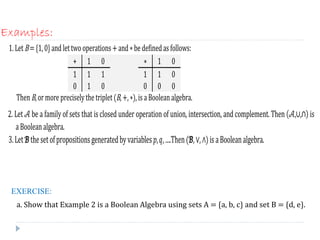
1.LetB={1,0} andlettwooperations+and∗bedefinedasfollows:
+ 1 0 ∗ 1 0
1 1 1 1 1 0
0 1 0 0 0 0
ThenB,ormorepreciselythetriplet(B,+,∗),isaBooleanalgebra.
2. Let 𝒜 be a family of sets that is closed under operation of union, intersection, and complement. Then 𝒜,∪,∩) is
aBooleanalgebra.
3.Let 𝓑thesetofpropositionsgeneratedbyvariables 𝑝, 𝑞,….Then(𝓑,∨,∧)isaBooleanalgebra.
EXERCISE:
Examples:
a. Show that Example 2 is a Boolean Algebra using sets A = {a, b, c} and set B = {d, e}.
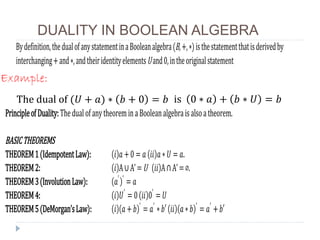
Bydefinition,thedualofanystatementinaBooleanalgebra(B,+,∗)isthestatementthatisderivedby
interchanging+and∗,andtheiridentityelementsUand0,intheoriginalstatement
DUALITY IN BOOLEAN ALGEBRA
Example:
𝑈 + 𝑎) ∗ 𝑏 + 0 = 𝑏 0 ∗ 𝑎 + 𝑏 ∗ 𝑈 = 𝑏The dual of is
PrincipleofDuality:ThedualofanytheoreminaBooleanalgebraisalsoatheorem.
BASICTHEOREMS
THEOREM1(IdempotentLaw): 𝑖) 𝑎 +0 = 𝑎 𝑖𝑖) 𝑎∗ 𝑈 = 𝑎.
THEOREM2: 𝑖)A∪A’=U 𝑖𝑖)A∩A’=⌀.
THEOREM3(InvolutionLaw): 𝑎′)′
= 𝑎
THEOREM4: 𝑖) 𝑈′
= 0 𝑖𝑖)0′
= 𝑈
THEOREM5 DeMorgan’sLaw): 𝑖) 𝑎 + 𝑏)′
= 𝑎′
∗ 𝑏′ 𝑖𝑖) 𝑎∗ 𝑏)′
= 𝑎′
+ 𝑏′
Proof
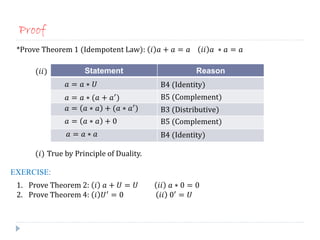
*Prove Theorem 1 (Idempotent Law): 𝑖 𝑎 + 𝑎 = 𝑎 𝑖𝑖 𝑎 ∗ 𝑎 = 𝑎
Statement Reason𝑖𝑖)
𝑖) True by Principle of Duality.
EXERCISE:
1. Prove Theorem 2: 𝑖 𝑎 + 𝑈 = 𝑈 𝑖𝑖 𝑎 ∗ 0 = 0
2. Prove Theorem 4: 𝑖 𝑈′
= 0 𝑖𝑖 0′
= 𝑈
𝑎 = 𝑎 ∗ 𝑈 B4 Identity)
𝑎 = 𝑎 ∗ 𝑎 + 𝑎′) B5 Complement)
𝑎 = 𝑎 ∗ 𝑎 + 𝑎 ∗ 𝑎′) B3 Distributive)
𝑎 = 𝑎 ∗ 𝑎 + 0 B5 Complement)
𝑎 = 𝑎 ∗ 𝑎 B4 Identity)
ORDER IN BOOLEAN ALGEBRA
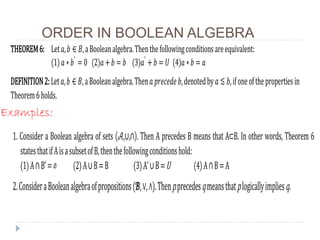
THEOREM6: Let 𝑎, 𝑏 ⋲ 𝐵,aBooleanalgebra.Thenthefollowingconditionsareequivalent:
(1) 𝑎 ∗ 𝑏′
= 0 (2)𝑎 + 𝑏 = 𝑏 (3)𝑎′
+ 𝑏 = 𝑈 (4)𝑎 ∗ 𝑏 = 𝑎
DEFINITION2:Let 𝑎,𝑏 ⋲ 𝐵,aBooleanalgebra.Then 𝑎 𝑝𝑟𝑒𝑐𝑒𝑑𝑒 𝑏,denotedby 𝑎 ≲ 𝑏,ifoneofthepropertiesin
Theorem6holds.
Examples:
1. Consider a Boolean algebra of sets 𝒜,∪,∩). Then A precedes B means that A⊂B. In other words, Theorem 6
statesthatifAisasubsetofB,thenthefollowingconditionshold:
1)A∩B’=⌀ 2)A∪B=B 3)A’∪B=U 4)A∩B=A
2.ConsideraBooleanalgebraofpropositions(𝓑,∨,∧).Thenpprecedesqmeansthatplogicallyimpliesq.
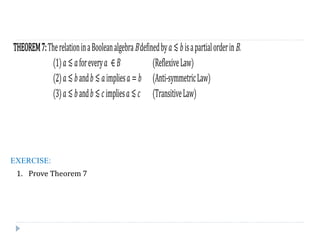
THEOREM7:TherelationinaBooleanalgebraBdefinedby 𝑎 ≲ 𝑏isapartialorderinB.
(1) 𝑎 ≲ 𝑎forevery 𝑎 ⋲ 𝐵 (ReflexiveLaw)
(2) 𝑎 ≲ 𝑏and 𝑏 ≲ 𝑎implies 𝑎 = 𝑏 (Anti-symmetricLaw)
(3) 𝑎 ≲ 𝑏and 𝑏 ≲ 𝑐implies 𝑎 ≲ 𝑐 (TransitiveLaw)
EXERCISE:
1. Prove Theorem 7
SWITCHING CIRCUITS DESIGNS
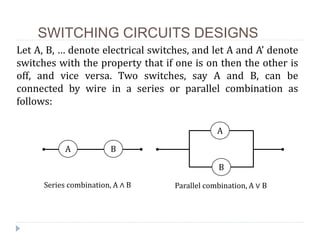
Let A, B, … denote electrical switches, and let A and A’ denote
switches with the property that if one is on then the other is
off, and vice versa. Two switches, say A and B, can be
connected by wire in a series or parallel combination as
follows:
A B
A
B
Series combination, A ∧ B Parallel combination, A ∨ B
A Boolean switching circuit design means an arrangement of
wires and switches that can be constructed by repeated use
of series and parallel combinations; hence it can be
described by the use of connectives ∧ and ∨.
A
B
A’
C
A’
B
A B’
Circuit 2) A ∧ B’) ∨ [ A ∨ C) ∧ B]
Circuit 1) A ∧ B ∨ A’)
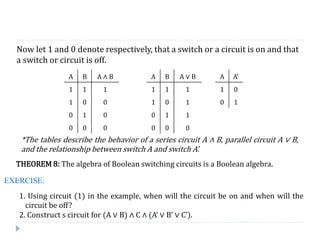
A B A ∧ B A B A ∨ B A A'
1 1 1 1 1 1 1 0
1 0 0 1 0 1 0 1
0 1 0 0 1 1
0 0 0 0 0 0
Now let 1 and 0 denote respectively, that a switch or a circuit is on and that
a switch or circuit is off.
*The tables describe the behavior of a series circuit A ∧ B, parallel circuit A ∨ B,
and the relationship between switch A and switch A’.
THEOREM 8: The algebra of Boolean switching circuits is a Boolean algebra.
EXERCISE:
1. Using circuit (1) in the example, when will the circuit be on and when will the
circuit be off?
2. Construct s circuit for (A ∨ B) ∧ C ∧ A’ ∨ B’ ∨ C’).
Reference:
Lipschuts, S. (2005). Schaums outline of theory and problem of set theory and
related topics. New York: McGraw-Hill Publishing Inc.
Thank you for listening.
Raymund T. de la Cruz
MAEd - Mathematics

Report on set theory

  • 1.
    Boolean Algebra andSets Set Theory
  • 2.
    DEFINITION 1: ABoolean algebra is a set B with two binary operations sum (+, ∨, or ∪) and product (∗, ∧, or ∩) suchthat: B0.ClosureLaw Forany 𝑎, 𝑏 ⋲B,thesum 𝑎 + 𝑏 andtheproduct 𝑎 ∗ 𝑏 existandareuniqueelementsinB. B1.CommutativeLaw 𝑎 + 𝑏 = 𝑏 + 𝑎 and 𝑎 ∗ 𝑏 = 𝑏 ∗ 𝑎 B2.AssociativeLaw 𝑎 + 𝑏 + 𝑐) = 𝑎 + 𝑏)+ 𝑐 and 𝑎 ∗ 𝑏 ∗ 𝑐) = 𝑎 ∗ 𝑏)∗ 𝑐 B3.DistributiveLaw 𝑎 + 𝑏 ∗ 𝑐) = 𝑎 + 𝑏)∗ 𝑎 + 𝑐)and 𝑎 ∗ 𝑏 + 𝑐) = 𝑎 ∗ 𝑏)+(𝑎 ∗ 𝑐) B4.Identity Anadditiveidentity0andmultiplicativeidentity 𝑈 existsuchthatforany 𝑎 ⋲ 𝐵, 𝑎 +0 = 𝑎 and 𝑎 ∗ 𝑈 = 𝑎 B5.Complement Forany 𝑎 ⋲ 𝐵 thereexists 𝑎′⋲ 𝐵 calledthecomplementof 𝑎 suchthat 𝑎 + 𝑎′ = 𝑈 and 𝑎 ∗ 𝑎′ = 0. BOOLEAN ALGEBRA
  • 3.
    1.LetB={1,0} andlettwooperations+and∗bedefinedasfollows: + 10 ∗ 1 0 1 1 1 1 1 0 0 1 0 0 0 0 ThenB,ormorepreciselythetriplet(B,+,∗),isaBooleanalgebra. 2. Let 𝒜 be a family of sets that is closed under operation of union, intersection, and complement. Then 𝒜,∪,∩) is aBooleanalgebra. 3.Let 𝓑thesetofpropositionsgeneratedbyvariables 𝑝, 𝑞,….Then(𝓑,∨,∧)isaBooleanalgebra. EXERCISE: Examples: a. Show that Example 2 is a Boolean Algebra using sets A = {a, b, c} and set B = {d, e}.
  • 4.
    Bydefinition,thedualofanystatementinaBooleanalgebra(B,+,∗)isthestatementthatisderivedby interchanging+and∗,andtheiridentityelementsUand0,intheoriginalstatement DUALITY IN BOOLEANALGEBRA Example: 𝑈 + 𝑎) ∗ 𝑏 + 0 = 𝑏 0 ∗ 𝑎 + 𝑏 ∗ 𝑈 = 𝑏The dual of is PrincipleofDuality:ThedualofanytheoreminaBooleanalgebraisalsoatheorem. BASICTHEOREMS THEOREM1(IdempotentLaw): 𝑖) 𝑎 +0 = 𝑎 𝑖𝑖) 𝑎∗ 𝑈 = 𝑎. THEOREM2: 𝑖)A∪A’=U 𝑖𝑖)A∩A’=⌀. THEOREM3(InvolutionLaw): 𝑎′)′ = 𝑎 THEOREM4: 𝑖) 𝑈′ = 0 𝑖𝑖)0′ = 𝑈 THEOREM5 DeMorgan’sLaw): 𝑖) 𝑎 + 𝑏)′ = 𝑎′ ∗ 𝑏′ 𝑖𝑖) 𝑎∗ 𝑏)′ = 𝑎′ + 𝑏′
  • 5.
    Proof *Prove Theorem 1(Idempotent Law): 𝑖 𝑎 + 𝑎 = 𝑎 𝑖𝑖 𝑎 ∗ 𝑎 = 𝑎 Statement Reason𝑖𝑖) 𝑖) True by Principle of Duality. EXERCISE: 1. Prove Theorem 2: 𝑖 𝑎 + 𝑈 = 𝑈 𝑖𝑖 𝑎 ∗ 0 = 0 2. Prove Theorem 4: 𝑖 𝑈′ = 0 𝑖𝑖 0′ = 𝑈 𝑎 = 𝑎 ∗ 𝑈 B4 Identity) 𝑎 = 𝑎 ∗ 𝑎 + 𝑎′) B5 Complement) 𝑎 = 𝑎 ∗ 𝑎 + 𝑎 ∗ 𝑎′) B3 Distributive) 𝑎 = 𝑎 ∗ 𝑎 + 0 B5 Complement) 𝑎 = 𝑎 ∗ 𝑎 B4 Identity)
  • 6.
    ORDER IN BOOLEANALGEBRA THEOREM6: Let 𝑎, 𝑏 ⋲ 𝐵,aBooleanalgebra.Thenthefollowingconditionsareequivalent: (1) 𝑎 ∗ 𝑏′ = 0 (2)𝑎 + 𝑏 = 𝑏 (3)𝑎′ + 𝑏 = 𝑈 (4)𝑎 ∗ 𝑏 = 𝑎 DEFINITION2:Let 𝑎,𝑏 ⋲ 𝐵,aBooleanalgebra.Then 𝑎 𝑝𝑟𝑒𝑐𝑒𝑑𝑒 𝑏,denotedby 𝑎 ≲ 𝑏,ifoneofthepropertiesin Theorem6holds. Examples: 1. Consider a Boolean algebra of sets 𝒜,∪,∩). Then A precedes B means that A⊂B. In other words, Theorem 6 statesthatifAisasubsetofB,thenthefollowingconditionshold: 1)A∩B’=⌀ 2)A∪B=B 3)A’∪B=U 4)A∩B=A 2.ConsideraBooleanalgebraofpropositions(𝓑,∨,∧).Thenpprecedesqmeansthatplogicallyimpliesq.
  • 7.
    THEOREM7:TherelationinaBooleanalgebraBdefinedby 𝑎 ≲𝑏isapartialorderinB. (1) 𝑎 ≲ 𝑎forevery 𝑎 ⋲ 𝐵 (ReflexiveLaw) (2) 𝑎 ≲ 𝑏and 𝑏 ≲ 𝑎implies 𝑎 = 𝑏 (Anti-symmetricLaw) (3) 𝑎 ≲ 𝑏and 𝑏 ≲ 𝑐implies 𝑎 ≲ 𝑐 (TransitiveLaw) EXERCISE: 1. Prove Theorem 7
  • 8.
    SWITCHING CIRCUITS DESIGNS LetA, B, … denote electrical switches, and let A and A’ denote switches with the property that if one is on then the other is off, and vice versa. Two switches, say A and B, can be connected by wire in a series or parallel combination as follows: A B A B Series combination, A ∧ B Parallel combination, A ∨ B
  • 9.
    A Boolean switchingcircuit design means an arrangement of wires and switches that can be constructed by repeated use of series and parallel combinations; hence it can be described by the use of connectives ∧ and ∨. A B A’ C A’ B A B’ Circuit 2) A ∧ B’) ∨ [ A ∨ C) ∧ B] Circuit 1) A ∧ B ∨ A’)
  • 10.
    A B A∧ B A B A ∨ B A A' 1 1 1 1 1 1 1 0 1 0 0 1 0 1 0 1 0 1 0 0 1 1 0 0 0 0 0 0 Now let 1 and 0 denote respectively, that a switch or a circuit is on and that a switch or circuit is off. *The tables describe the behavior of a series circuit A ∧ B, parallel circuit A ∨ B, and the relationship between switch A and switch A’. THEOREM 8: The algebra of Boolean switching circuits is a Boolean algebra. EXERCISE: 1. Using circuit (1) in the example, when will the circuit be on and when will the circuit be off? 2. Construct s circuit for (A ∨ B) ∧ C ∧ A’ ∨ B’ ∨ C’).
  • 11.
    Reference: Lipschuts, S. (2005).Schaums outline of theory and problem of set theory and related topics. New York: McGraw-Hill Publishing Inc. Thank you for listening. Raymund T. de la Cruz MAEd - Mathematics