Solving Multi-Step
Equations
by: Mike Kowalski
Click for next slideClick for next slide
Learning Objectives and
Standards
To be able to solve multi-step linear equations,
and be able to explain the reasoning behind
the process used.
CCSS: HSA-REI.A.1: Explain each step in
solving a simple equation as following from the
equality of numbers asserted at the previous
step, starting from the assumption that the
original equation has a solution. Construct a
viable argument to justify a solution method.Click for next slideClick for next slide
Table of Contents
Warm up
Properties of Equality
Solving Strategies
Time to Balance!
Google form
References
Click for next slideClick for next slide
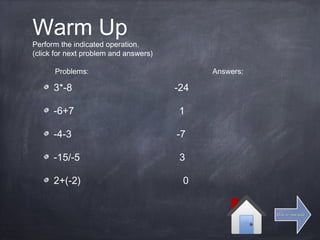
Warm Up
Perform the indicated operation.
(click for next problem and answers)
Problems: Answers:
3*-8 -24
-6+7 1
-4-3 -7
-15/-5 3
2+(-2) 0
Click for next slideClick for next slide
Warm Up
How’d you do?
If you got most right move on to the next slide.
If you need a little more practice check out
this video or this one.
Click for next slideClick for next slide
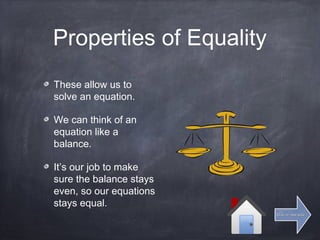
Properties of Equality
These allow us to
solve an equation.
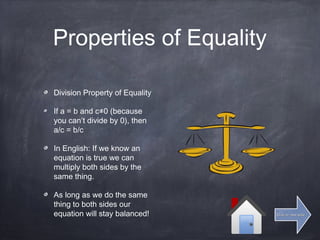
We can think of an
equation like a
balance.
It’s our job to make
sure the balance stays
even, so our equations
stays equal.
Click for next slideClick for next slide
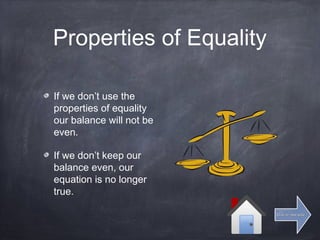
Properties of Equality
If we don’t use the
properties of equality
our balance will not be
even.
If we don’t keep our
balance even, our
equation is no longer
true.
Click for next slideClick for next slide
Properties of Equality
These are the properties we
are going to use today:
Addition Property of
Equality
Subtraction Property of
Equality
Multiplication Property of
Equality
Division Property of Equality Click for next slideClick for next slide
Properties of Equality
Addition Property of
Equality
If a = b then a + c = b + c
In English: If we know an
equation is true we can add
the same thing to both
sides.
As long as we do the same
thing to both sides our
equation will stay balanced! Click for next slideClick for next slide
Properties of Equality
Subtraction Property of
Equality
If a = b then a - c = b - c
In English: If we know an
equation is true we can
subtract the same thing
from both sides.
As long as we do the same
thing to both sides our
equation will stay balanced! Click for next slideClick for next slide
Properties of Equality
Multiplication Property of
Equality
If a = b then a*c =
b*c
In English: If we know an
equation is true we can
multiply both sides by the
same thing.
As long as we do the same
thing to both sides our
equation will stay balanced! Click for next slideClick for next slide
Properties of Equality
Division Property of Equality
If a = b and c≠0 (because
you can’t divide by 0), then
a/c = b/c
In English: If we know an
equation is true we can
multiply both sides by the
same thing.
As long as we do the same
thing to both sides our
equation will stay balanced! Click for next slideClick for next slide
Properties of Equality
Now that we know the
Properties of Equality
we can put them to
work.
Click for next slideClick for next slide
Solving Strategies
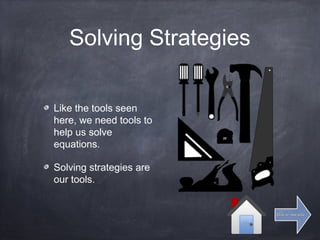
Like the tools seen
here, we need tools to
help us solve
equations.
Solving strategies are
our tools.
Click for next slideClick for next slide
Solving Strategies
To solve an equation
our goal is to get the
variable by itself.
To do that we are
going to use the
properties of equality
discussed earlier and
some of these solving
strategies.
Click for next slideClick for next slide
Solving Strategies
One strategy is to get the
variable on one side of the
equal sign first.
You may not have to do this
for every equation, but it’s a
good thing to check.
Variables can be moved from
one side of an equation to
another by using the addition
and subtraction properties of
equality.
Click for next slideClick for next slide
Solving Strategies
Once the variable is on one
side a good strategy to use is to
eliminate numbers in the
equation by working the order
of operations backwards.
Do you remember the order of
operations?
PEMDAS which stands for
Parenthesis, Exponents,
Multiply, Divide, Add, and
Subtract!
See this video for more
Click for next slideClick for next slide
Solving Strategies
So if we wanted to eliminate pieces
from our equations using the order of
operations backwards the first thing I
should get rid of is addition and
subtraction.
We can do that using the addition and
subtraction properties of equality.
In order to eliminate addition from my
equation I’m going to have to use the
subtraction property of equality.
In order to eliminate subtraction from
my problem I’m going to have to use
the addition property of equality.
Click for next slideClick for next slide
Solving Strategies
The next thing we can focus on
eliminating is multiplication or
division.
We can do that using the
multiplication and division properties
of equality.
In order to eliminate multiplication
from my equation I’m going to have
to use the division property of
equality.
In order to eliminate division from
my problem I’m going to have to use
the multiplication property of
equality.
Click for next slideClick for next slide
Solving Strategies
Remember when you’re
using these strategies and
the properties of equality, it’s
all about balance!
If we don’t do the same thing
to both sides, we’re not
keeping our equation
balanced.
If our equation doesn’t stay
balanced, we won’t end up
with the right answer.
Click for next slideClick for next slide
Time to Balance!
Click for next slideClick for next slide
Time to Balance!
For this part we are going to try to
solve an equation while keeping our
scale balanced.
You are going to need to click on the
bullet you think is the correct step in
order to solve the equation.
If you make the correct choice you
will be directed to the next step.
If you make an incorrect choice you
will need to go back and try again.
Ready to balance?!?
Click for next slideClick for next slide
Time to Balance!
Solve the following
equation: 5x +
3 = 3x -7
I would subtract 3 from the left side
I would divide both sides by 5
I would subtract 3x from both sides
Time to Balance!
Oops!
You forgot to do the same
thing on both sides.
Remember the subtraction
property of equality says we
must subtract the same
thing from both sides of the
equation.
Click the arrow to take you
back to the problem.
Back to the problemBack to the problem
Time to Balance!
Oops!
You forgot our solving
strategies.
We want to collect our
variable on one side of
the equation first.
Click the arrow to take
you back to the
problem.
Back to the problemBack to the problem
Time to Balance!
Nice job! You used the
subtraction property of equality
to get your variable on one side
of the equation.
Now for the next step.
Continue solving 2x + 3 = -7
I would divide both sides by 2
I would subtract 3 from both
sides
I would add three to both sides
Time to Balance!
Oops!
You forgot our solving
strategies.
We want to work the order of
operation backwards.
We need to take care of
addition and subtraction
before division.
Click the arrow to take you
back to the problem.
Back to the problemBack to the problem
Time to Balance!
Oops!
In order to solve we need
to undo what’s in our
problem.
Since there’s already a + 3
in the problem to get rid of
it we would need to do the
opposite.
Click the arrow to take you
back to the problem.
Back to the problemBack to the problem
Time to Balance!
Nice job! You used the
subtraction property of equality
to eliminate the +3
Now for the next step.
Continue solving 2x = -10
I would divide both sides by 2
I would divide the left side by 2
I would divide both sides by -10
Time to Balance!
Oops!
You forgot to do the same
thing on both sides.
Remember the division
property of equality says
we need to divide both
sides by the same thing.
Click the arrow to take you
back to the problem.
Back to the problemBack to the problem
Time to Balance!
Oops!
If we’re trying to get the
variable by itself we need to
focus on the side of the
equation with the variable.
Since the -10 is already on the
other side of the equation shift
your focus back to the other
side and see if there’s
something you can do.
Click the arrow to take you
back to the problem.
Back to the problemBack to the problem
Time to Balance!
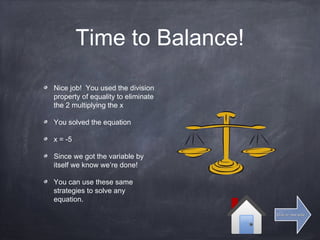
Nice job! You used the division
property of equality to eliminate
the 2 multiplying the x
You solved the equation
x = -5
Since we got the variable by
itself we know we’re done!
You can use these same
strategies to solve any
equation.
Click for next slideClick for next slide
Google Form
Now that you’ve seen the properties of
equality in action it’s your turn to try them out.
Solve the problems on this Google Form to
practice using the properties of equality to
solve equations.
Once you’re done click submit so your results
can be collected.
Click for next slideClick for next slide
You made it!
Thanks for using my
interactive powerpoint.
I hope you learned a
lot about solving
equations.
Layla’s tuckered out
from all this solving.
Time for a nap.
References
All images provided by openclipart.org
All video links provided by Khan Academy

Kowalski project

  • 1.
    Solving Multi-Step Equations by: MikeKowalski Click for next slideClick for next slide
  • 2.
    Learning Objectives and Standards Tobe able to solve multi-step linear equations, and be able to explain the reasoning behind the process used. CCSS: HSA-REI.A.1: Explain each step in solving a simple equation as following from the equality of numbers asserted at the previous step, starting from the assumption that the original equation has a solution. Construct a viable argument to justify a solution method.Click for next slideClick for next slide
  • 3.
    Table of Contents Warmup Properties of Equality Solving Strategies Time to Balance! Google form References Click for next slideClick for next slide
  • 4.
    Warm Up Perform theindicated operation. (click for next problem and answers) Problems: Answers: 3*-8 -24 -6+7 1 -4-3 -7 -15/-5 3 2+(-2) 0 Click for next slideClick for next slide
  • 5.
    Warm Up How’d youdo? If you got most right move on to the next slide. If you need a little more practice check out this video or this one. Click for next slideClick for next slide
  • 6.
    Properties of Equality Theseallow us to solve an equation. We can think of an equation like a balance. It’s our job to make sure the balance stays even, so our equations stays equal. Click for next slideClick for next slide
  • 7.
    Properties of Equality Ifwe don’t use the properties of equality our balance will not be even. If we don’t keep our balance even, our equation is no longer true. Click for next slideClick for next slide
  • 8.
    Properties of Equality Theseare the properties we are going to use today: Addition Property of Equality Subtraction Property of Equality Multiplication Property of Equality Division Property of Equality Click for next slideClick for next slide
  • 9.
    Properties of Equality AdditionProperty of Equality If a = b then a + c = b + c In English: If we know an equation is true we can add the same thing to both sides. As long as we do the same thing to both sides our equation will stay balanced! Click for next slideClick for next slide
  • 10.
    Properties of Equality SubtractionProperty of Equality If a = b then a - c = b - c In English: If we know an equation is true we can subtract the same thing from both sides. As long as we do the same thing to both sides our equation will stay balanced! Click for next slideClick for next slide
  • 11.
    Properties of Equality MultiplicationProperty of Equality If a = b then a*c = b*c In English: If we know an equation is true we can multiply both sides by the same thing. As long as we do the same thing to both sides our equation will stay balanced! Click for next slideClick for next slide
  • 12.
    Properties of Equality DivisionProperty of Equality If a = b and c≠0 (because you can’t divide by 0), then a/c = b/c In English: If we know an equation is true we can multiply both sides by the same thing. As long as we do the same thing to both sides our equation will stay balanced! Click for next slideClick for next slide
  • 13.
    Properties of Equality Nowthat we know the Properties of Equality we can put them to work. Click for next slideClick for next slide
  • 14.
    Solving Strategies Like thetools seen here, we need tools to help us solve equations. Solving strategies are our tools. Click for next slideClick for next slide
  • 15.
    Solving Strategies To solvean equation our goal is to get the variable by itself. To do that we are going to use the properties of equality discussed earlier and some of these solving strategies. Click for next slideClick for next slide
  • 16.
    Solving Strategies One strategyis to get the variable on one side of the equal sign first. You may not have to do this for every equation, but it’s a good thing to check. Variables can be moved from one side of an equation to another by using the addition and subtraction properties of equality. Click for next slideClick for next slide
  • 17.
    Solving Strategies Once thevariable is on one side a good strategy to use is to eliminate numbers in the equation by working the order of operations backwards. Do you remember the order of operations? PEMDAS which stands for Parenthesis, Exponents, Multiply, Divide, Add, and Subtract! See this video for more Click for next slideClick for next slide
  • 18.
    Solving Strategies So ifwe wanted to eliminate pieces from our equations using the order of operations backwards the first thing I should get rid of is addition and subtraction. We can do that using the addition and subtraction properties of equality. In order to eliminate addition from my equation I’m going to have to use the subtraction property of equality. In order to eliminate subtraction from my problem I’m going to have to use the addition property of equality. Click for next slideClick for next slide
  • 19.
    Solving Strategies The nextthing we can focus on eliminating is multiplication or division. We can do that using the multiplication and division properties of equality. In order to eliminate multiplication from my equation I’m going to have to use the division property of equality. In order to eliminate division from my problem I’m going to have to use the multiplication property of equality. Click for next slideClick for next slide
  • 20.
    Solving Strategies Remember whenyou’re using these strategies and the properties of equality, it’s all about balance! If we don’t do the same thing to both sides, we’re not keeping our equation balanced. If our equation doesn’t stay balanced, we won’t end up with the right answer. Click for next slideClick for next slide
  • 21.
    Time to Balance! Clickfor next slideClick for next slide
  • 22.
    Time to Balance! Forthis part we are going to try to solve an equation while keeping our scale balanced. You are going to need to click on the bullet you think is the correct step in order to solve the equation. If you make the correct choice you will be directed to the next step. If you make an incorrect choice you will need to go back and try again. Ready to balance?!? Click for next slideClick for next slide
  • 23.
    Time to Balance! Solvethe following equation: 5x + 3 = 3x -7 I would subtract 3 from the left side I would divide both sides by 5 I would subtract 3x from both sides
  • 24.
    Time to Balance! Oops! Youforgot to do the same thing on both sides. Remember the subtraction property of equality says we must subtract the same thing from both sides of the equation. Click the arrow to take you back to the problem. Back to the problemBack to the problem
  • 25.
    Time to Balance! Oops! Youforgot our solving strategies. We want to collect our variable on one side of the equation first. Click the arrow to take you back to the problem. Back to the problemBack to the problem
  • 26.
    Time to Balance! Nicejob! You used the subtraction property of equality to get your variable on one side of the equation. Now for the next step. Continue solving 2x + 3 = -7 I would divide both sides by 2 I would subtract 3 from both sides I would add three to both sides
  • 27.
    Time to Balance! Oops! Youforgot our solving strategies. We want to work the order of operation backwards. We need to take care of addition and subtraction before division. Click the arrow to take you back to the problem. Back to the problemBack to the problem
  • 28.
    Time to Balance! Oops! Inorder to solve we need to undo what’s in our problem. Since there’s already a + 3 in the problem to get rid of it we would need to do the opposite. Click the arrow to take you back to the problem. Back to the problemBack to the problem
  • 29.
    Time to Balance! Nicejob! You used the subtraction property of equality to eliminate the +3 Now for the next step. Continue solving 2x = -10 I would divide both sides by 2 I would divide the left side by 2 I would divide both sides by -10
  • 30.
    Time to Balance! Oops! Youforgot to do the same thing on both sides. Remember the division property of equality says we need to divide both sides by the same thing. Click the arrow to take you back to the problem. Back to the problemBack to the problem
  • 31.
    Time to Balance! Oops! Ifwe’re trying to get the variable by itself we need to focus on the side of the equation with the variable. Since the -10 is already on the other side of the equation shift your focus back to the other side and see if there’s something you can do. Click the arrow to take you back to the problem. Back to the problemBack to the problem
  • 32.
    Time to Balance! Nicejob! You used the division property of equality to eliminate the 2 multiplying the x You solved the equation x = -5 Since we got the variable by itself we know we’re done! You can use these same strategies to solve any equation. Click for next slideClick for next slide
  • 33.
    Google Form Now thatyou’ve seen the properties of equality in action it’s your turn to try them out. Solve the problems on this Google Form to practice using the properties of equality to solve equations. Once you’re done click submit so your results can be collected. Click for next slideClick for next slide
  • 34.
    You made it! Thanksfor using my interactive powerpoint. I hope you learned a lot about solving equations. Layla’s tuckered out from all this solving. Time for a nap.
  • 35.
    References All images providedby openclipart.org All video links provided by Khan Academy