MEDIA AND CYBER OR
DIGITAL LITERACY
Lesson 6
OBJECTIVES
• Develop a working understanding of Media and Cyber
or Digital Literacy and how they relate to one another;
• Appreciate the importance of developing Media and
Cyber/Digital Literacy both in ourselves and one
another in the information age; and
• Realize that practical steps must be taken to develop
these literacies early in children and cannot wait “until
they are older”.
MEDIA LITERACY
•Media literacy
- is the ability to identify different types of
media and understand the messages they are
communicating, including who is the intended
audience and what is the motivation behind
the message.
MEDIA LITERACY
•Media literacy
-exact type of media varies--- television,
radio, newspapers, magazines, books,
handouts, flyers, etc. But what they all have in
common is that they were all created by
someone, and that someone had a reason for
creating them.
WHAT MEDIA LITERACY IS NOT
•The following is a list of actions that are often
mistaken for being representative of media
literacy:
•Criticizing the media is not, in and of itself,
media literacy. However, being media literate
sometimes requires that one indeed criticize
what one sees and hears.
WHAT MEDIA LITERACY IS NOT
•Merely producing media is not media literacy
although part of being media literate is the
ability to produce media.
•Teaching with media (videos, presentations,
etc.) does not equal media literacy. An
education in media literacy must also include
teaching about media.
WHAT MEDIA LITERACY IS NOT
• Viewing media and analyzing it from a single
perspective is not media literacy. True media
literacy requires both the ability and willingness to
view and analyze media from multiple positions
and perspectives.
• Media literacy does not simply mean knowing
what and what not to watch; it does mean “watch
carefully, think critically.”
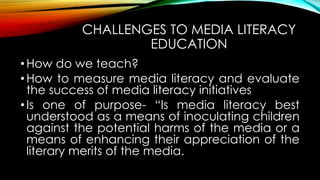
CHALLENGES TO MEDIA LITERACY
EDUCATION
•How do we teach?
•How to measure media literacy and evaluate
the success of media literacy initiatives
•Is one of purpose- “Is media literacy best
understood as a means of inoculating children
against the potential harms of the media or a
means of enhancing their appreciation of the
literary merits of the media.
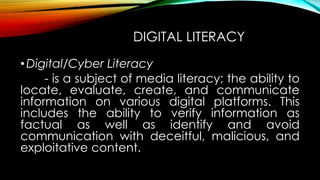
DIGITAL LITERACY
•Digital/Cyber Literacy
- is a subject of media literacy; the ability to
locate, evaluate, create, and communicate
information on various digital platforms. This
includes the ability to verify information as
factual as well as identify and avoid
communication with deceitful, malicious, and
exploitative content.
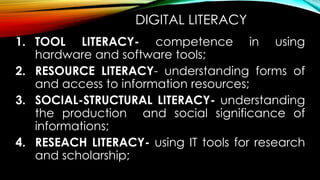
DIGITAL LITERACY
1. TOOL LITERACY- competence in using
hardware and software tools;
2. RESOURCE LITERACY- understanding forms of
and access to information resources;
3. SOCIAL-STRUCTURAL LITERACY- understanding
the production and social significance of
informations;
4. RESEACH LITERACY- using IT tools for research
and scholarship;
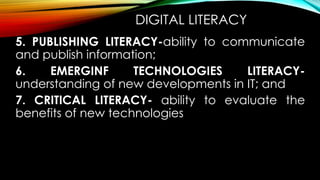
DIGITAL LITERACY
5. PUBLISHING LITERACY-ability to communicate
and publish information;
6. EMERGINF TECHNOLOGIES LITERACY-
understanding of new developments in IT; and
7. CRITICAL LITERACY- ability to evaluate the
benefits of new technologies
CHALLENGES TO DIGITAL LITERACY
EDUCATION
•How it should be taught
•How it can be measured and evaluate?
•Should it be taught for the protection of the
students in their consumption of information or
should it be to develop their appreciation for
digital media?
INFORMATION LITERACY
•Information Literacy
- is a subset of media literacy; the ability to
locate, access, and evaluate information from
a variety of media sources.
•Of outmost importance to both literacies
(media and digital) is the ability to analyze
and think critically about what is being
communicated. This means making value
judgements about the message, and goes
beyond simply comprehending the what is
being said.
MASS MEDIA
Mass media also referred as mass communication
may be defined as a special kind of social
communication characterized by a unique
audience, communication experience, and
communicator.
The term media comes from Latin, meaning
“middle”, suggesting that media serves to connect
people.
Mass media occur as communications technology
(newspaper, then radio, and television) spreads
information on a mass scale.
16
FUNCTIONS OF MEDIA
• Warning
• Companionship
• Status Conferral
• Agenda Setting
• Reality Construction
• Surveillance
• Socialization and
Education
• Propaganda
• Mainstreaming
• Entertainment
• Advertising
17
18
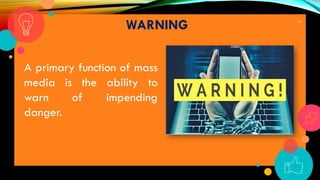
WARNING
A primary function of mass
media is the ability to
warn of impending
danger.
19
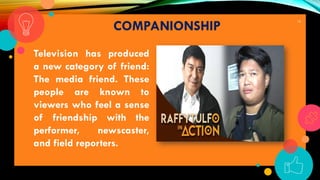
COMPANIONSHIP
Television has produced
a new category of friend:
The media friend. These
people are known to
viewers who feel a sense
of friendship with the
performer, newscaster,
and field reporters.
20
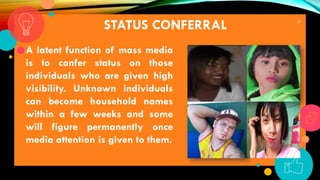
STATUS CONFERRAL
A latent function of mass media
is to confer status on those
individuals who are given high
visibility. Unknown individuals
can become household names
within a few weeks and some
will figure permanently once
media attention is given to them.
21
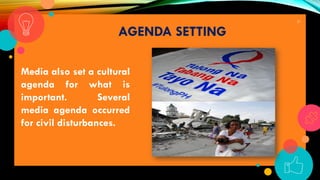
AGENDA SETTING
Media also set a cultural
agenda for what is
important. Several
media agenda occurred
for civil disturbances.
22
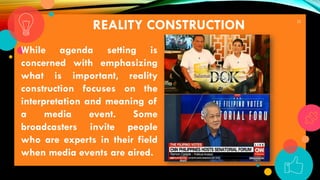
REALITY CONSTRUCTION
While agenda setting is
concerned with emphasizing
what is important, reality
construction focuses on the
interpretation and meaning of
a media event. Some
broadcasters invite people
who are experts in their field
when media events are aired.
23
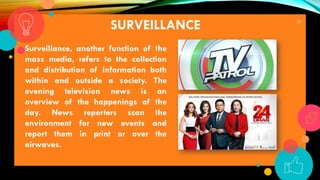
SURVEILLANCE
Surveillance, another function of the
mass media, refers to the collection
and distribution of information both
within and outside a society. The
evening television news is an
overview of the happenings of the
day. News reporters scan the
environment for new events and
report them in print or over the
airwaves.
24
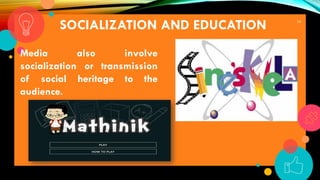
SOCIALIZATION AND EDUCATION
Media also involve
socialization or transmission
of social heritage to the
audience.
25
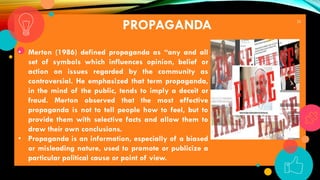
PROPAGANDA
• Merton (1986) defined propaganda as “any and all
set of symbols which influences opinion, belief or
action on issues regarded by the community as
controversial. He emphasized that term propaganda,
in the mind of the public, tends to imply a deceit or
fraud. Merton observed that the most effective
propaganda is not to tell people how to feel, but to
provide them with selective facts and allow them to
draw their own conclusions.
• Propaganda is an information, especially of a biased
or misleading nature, used to promote or publicize a
particular political cause or point of view.
26
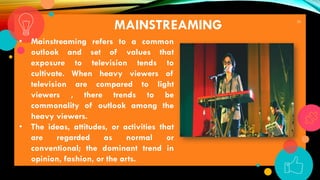
MAINSTREAMING
• Mainstreaming refers to a common
outlook and set of values that
exposure to television tends to
cultivate. When heavy viewers of
television are compared to light
viewers , there trends to be
commonality of outlook among the
heavy viewers.
• The ideas, attitudes, or activities that
are regarded as normal or
conventional; the dominant trend in
opinion, fashion, or the arts.
27
ENTERTAINMENT
The function of television is
the purposeful development
of programming for the sole
function of providing
entertainment for viewers.
Any artistic, cultural, or
educational value is
secondary.
28
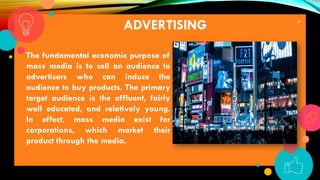
ADVERTISING
The fundamental economic purpose of
mass media is to sell an audience to
advertisers who can induce the
audience to buy products. The primary
target audience is the affluent, fairly
well educated, and relatively young.
In effect, mass media exist for
corporations, which market their
product through the media.
29
MEDIA ETHICS
o Accuracy
o Objectivity
o Fairness and Balance
o Truth
o Integrity of Sources
o Avoiding Conflict of Interest
30
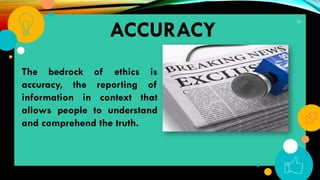
ACCURACY
The bedrock of ethics is
accuracy, the reporting of
information in context that
allows people to understand
and comprehend the truth.
31
HOW TO SPOT FAKE NEWS?
Consider the Source: Think about the actual source of
the news. A local blog will not be as trustworthy as a
major academic journal. What does the source stand
for? What are their objectives?
Supporting Sources: Look at the sources cited in the
article. Are they themselves credible? Do they even
exist?
32
Multiple Sources: Don’t just rely on a single article. The more you read
from various sources, the more likely you can draw accurate conclusions.
Also consider diverse sources and perspectives, for example, news from
different countries or authors with different backgrounds.
Check the Author: Who is the author? Research them to see if they are a
credible author, their reputation in the community, whether they have a
specific agenda, or if the person posting is a real person. Are they
authoring within their field of expertise?
Check the Date: Make sure that the date is recent and that it is not an older
story simply rehashed.
HOW TO SPOT FAKE NEWS?
33
HOW TO SPOT FAKE NEWS?
Comments: Even if the article, video, or post is legitimate, be careful of
comments posted in response. Quite often links or comments posted in
response can be auto-generated by bots or by people hired to put out
bad, confusing, or false information.
Check Your Biases: Be objective. Could your own biases influence your
response to the article? A problem that we humans often run into is
that we only read sources that simply confirm what we already believe
in. Challenge yourself by reading other sources you normally would
not review.
34
Check the Funding: Even legitimate publications have sponsors and
advertisers who can influence an article or source. Check to see if the
article is funded, and if so by whom.
Repost carefully: Fake news relies on believers to repost, retweet, or
otherwise forward false information. If you’re uncertain as to the
authenticity of an article, think twice or hold off on sharing it with
others.
HOW TO SPOT FAKE NEWS?
35
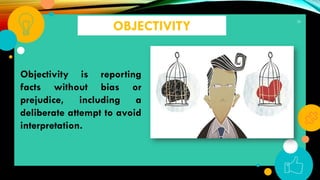
OBJECTIVITY
Objectivity is reporting
facts without bias or
prejudice, including a
deliberate attempt to avoid
interpretation.
36
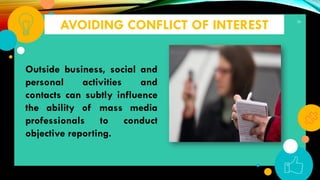
AVOIDING CONFLICT OF INTEREST
Outside business, social and
personal activities and
contacts can subtly influence
the ability of mass media
professionals to conduct
objective reporting.
37
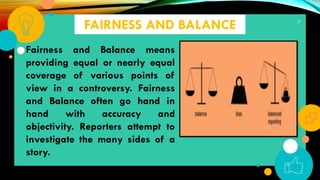
FAIRNESS AND BALANCE
Fairness and Balance means
providing equal or nearly equal
coverage of various points of
view in a controversy. Fairness
and Balance often go hand in
hand with accuracy and
objectivity. Reporters attempt to
investigate the many sides of a
story.
38
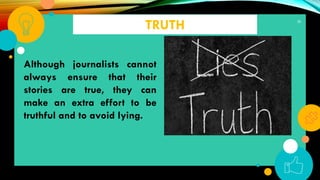
TRUTH
Although journalists cannot
always ensure that their
stories are true, they can
make an extra effort to be
truthful and to avoid lying.
39
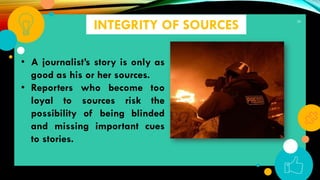
INTEGRITY OF SOURCES
• A journalist’s story is only as
good as his or her sources.
• Reporters who become too
loyal to sources risk the
possibility of being blinded
and missing important cues
to stories.

Prof_Ed-2-Lesson-6-Media-and-Cyber-or-Digital-Literacy.pdf

  • 1.
    MEDIA AND CYBEROR DIGITAL LITERACY Lesson 6
  • 2.
    OBJECTIVES • Develop aworking understanding of Media and Cyber or Digital Literacy and how they relate to one another; • Appreciate the importance of developing Media and Cyber/Digital Literacy both in ourselves and one another in the information age; and • Realize that practical steps must be taken to develop these literacies early in children and cannot wait “until they are older”.
  • 3.
    MEDIA LITERACY •Media literacy -is the ability to identify different types of media and understand the messages they are communicating, including who is the intended audience and what is the motivation behind the message.
  • 4.
    MEDIA LITERACY •Media literacy -exacttype of media varies--- television, radio, newspapers, magazines, books, handouts, flyers, etc. But what they all have in common is that they were all created by someone, and that someone had a reason for creating them.
  • 5.
    WHAT MEDIA LITERACYIS NOT •The following is a list of actions that are often mistaken for being representative of media literacy: •Criticizing the media is not, in and of itself, media literacy. However, being media literate sometimes requires that one indeed criticize what one sees and hears.
  • 6.
    WHAT MEDIA LITERACYIS NOT •Merely producing media is not media literacy although part of being media literate is the ability to produce media. •Teaching with media (videos, presentations, etc.) does not equal media literacy. An education in media literacy must also include teaching about media.
  • 7.
    WHAT MEDIA LITERACYIS NOT • Viewing media and analyzing it from a single perspective is not media literacy. True media literacy requires both the ability and willingness to view and analyze media from multiple positions and perspectives. • Media literacy does not simply mean knowing what and what not to watch; it does mean “watch carefully, think critically.”
  • 8.
    CHALLENGES TO MEDIALITERACY EDUCATION •How do we teach? •How to measure media literacy and evaluate the success of media literacy initiatives •Is one of purpose- “Is media literacy best understood as a means of inoculating children against the potential harms of the media or a means of enhancing their appreciation of the literary merits of the media.
  • 9.
    DIGITAL LITERACY •Digital/Cyber Literacy -is a subject of media literacy; the ability to locate, evaluate, create, and communicate information on various digital platforms. This includes the ability to verify information as factual as well as identify and avoid communication with deceitful, malicious, and exploitative content.
  • 10.
    DIGITAL LITERACY 1. TOOLLITERACY- competence in using hardware and software tools; 2. RESOURCE LITERACY- understanding forms of and access to information resources; 3. SOCIAL-STRUCTURAL LITERACY- understanding the production and social significance of informations; 4. RESEACH LITERACY- using IT tools for research and scholarship;
  • 11.
    DIGITAL LITERACY 5. PUBLISHINGLITERACY-ability to communicate and publish information; 6. EMERGINF TECHNOLOGIES LITERACY- understanding of new developments in IT; and 7. CRITICAL LITERACY- ability to evaluate the benefits of new technologies
  • 12.
    CHALLENGES TO DIGITALLITERACY EDUCATION •How it should be taught •How it can be measured and evaluate? •Should it be taught for the protection of the students in their consumption of information or should it be to develop their appreciation for digital media?
  • 13.
    INFORMATION LITERACY •Information Literacy -is a subset of media literacy; the ability to locate, access, and evaluate information from a variety of media sources.
  • 14.
    •Of outmost importanceto both literacies (media and digital) is the ability to analyze and think critically about what is being communicated. This means making value judgements about the message, and goes beyond simply comprehending the what is being said.
  • 15.
    MASS MEDIA Mass mediaalso referred as mass communication may be defined as a special kind of social communication characterized by a unique audience, communication experience, and communicator. The term media comes from Latin, meaning “middle”, suggesting that media serves to connect people. Mass media occur as communications technology (newspaper, then radio, and television) spreads information on a mass scale. 16
  • 16.
    FUNCTIONS OF MEDIA •Warning • Companionship • Status Conferral • Agenda Setting • Reality Construction • Surveillance • Socialization and Education • Propaganda • Mainstreaming • Entertainment • Advertising 17
  • 17.
    18 WARNING A primary functionof mass media is the ability to warn of impending danger.
  • 18.
    19 COMPANIONSHIP Television has produced anew category of friend: The media friend. These people are known to viewers who feel a sense of friendship with the performer, newscaster, and field reporters.
  • 19.
    20 STATUS CONFERRAL A latentfunction of mass media is to confer status on those individuals who are given high visibility. Unknown individuals can become household names within a few weeks and some will figure permanently once media attention is given to them.
  • 20.
    21 AGENDA SETTING Media alsoset a cultural agenda for what is important. Several media agenda occurred for civil disturbances.
  • 21.
    22 REALITY CONSTRUCTION While agendasetting is concerned with emphasizing what is important, reality construction focuses on the interpretation and meaning of a media event. Some broadcasters invite people who are experts in their field when media events are aired.
  • 22.
    23 SURVEILLANCE Surveillance, another functionof the mass media, refers to the collection and distribution of information both within and outside a society. The evening television news is an overview of the happenings of the day. News reporters scan the environment for new events and report them in print or over the airwaves.
  • 23.
    24 SOCIALIZATION AND EDUCATION Mediaalso involve socialization or transmission of social heritage to the audience.
  • 24.
    25 PROPAGANDA • Merton (1986)defined propaganda as “any and all set of symbols which influences opinion, belief or action on issues regarded by the community as controversial. He emphasized that term propaganda, in the mind of the public, tends to imply a deceit or fraud. Merton observed that the most effective propaganda is not to tell people how to feel, but to provide them with selective facts and allow them to draw their own conclusions. • Propaganda is an information, especially of a biased or misleading nature, used to promote or publicize a particular political cause or point of view.
  • 25.
    26 MAINSTREAMING • Mainstreaming refersto a common outlook and set of values that exposure to television tends to cultivate. When heavy viewers of television are compared to light viewers , there trends to be commonality of outlook among the heavy viewers. • The ideas, attitudes, or activities that are regarded as normal or conventional; the dominant trend in opinion, fashion, or the arts.
  • 26.
    27 ENTERTAINMENT The function oftelevision is the purposeful development of programming for the sole function of providing entertainment for viewers. Any artistic, cultural, or educational value is secondary.
  • 27.
    28 ADVERTISING The fundamental economicpurpose of mass media is to sell an audience to advertisers who can induce the audience to buy products. The primary target audience is the affluent, fairly well educated, and relatively young. In effect, mass media exist for corporations, which market their product through the media.
  • 28.
    29 MEDIA ETHICS o Accuracy oObjectivity o Fairness and Balance o Truth o Integrity of Sources o Avoiding Conflict of Interest
  • 29.
    30 ACCURACY The bedrock ofethics is accuracy, the reporting of information in context that allows people to understand and comprehend the truth.
  • 30.
    31 HOW TO SPOTFAKE NEWS? Consider the Source: Think about the actual source of the news. A local blog will not be as trustworthy as a major academic journal. What does the source stand for? What are their objectives? Supporting Sources: Look at the sources cited in the article. Are they themselves credible? Do they even exist?
  • 31.
    32 Multiple Sources: Don’tjust rely on a single article. The more you read from various sources, the more likely you can draw accurate conclusions. Also consider diverse sources and perspectives, for example, news from different countries or authors with different backgrounds. Check the Author: Who is the author? Research them to see if they are a credible author, their reputation in the community, whether they have a specific agenda, or if the person posting is a real person. Are they authoring within their field of expertise? Check the Date: Make sure that the date is recent and that it is not an older story simply rehashed. HOW TO SPOT FAKE NEWS?
  • 32.
    33 HOW TO SPOTFAKE NEWS? Comments: Even if the article, video, or post is legitimate, be careful of comments posted in response. Quite often links or comments posted in response can be auto-generated by bots or by people hired to put out bad, confusing, or false information. Check Your Biases: Be objective. Could your own biases influence your response to the article? A problem that we humans often run into is that we only read sources that simply confirm what we already believe in. Challenge yourself by reading other sources you normally would not review.
  • 33.
    34 Check the Funding:Even legitimate publications have sponsors and advertisers who can influence an article or source. Check to see if the article is funded, and if so by whom. Repost carefully: Fake news relies on believers to repost, retweet, or otherwise forward false information. If you’re uncertain as to the authenticity of an article, think twice or hold off on sharing it with others. HOW TO SPOT FAKE NEWS?
  • 34.
    35 OBJECTIVITY Objectivity is reporting factswithout bias or prejudice, including a deliberate attempt to avoid interpretation.
  • 35.
    36 AVOIDING CONFLICT OFINTEREST Outside business, social and personal activities and contacts can subtly influence the ability of mass media professionals to conduct objective reporting.
  • 36.
    37 FAIRNESS AND BALANCE Fairnessand Balance means providing equal or nearly equal coverage of various points of view in a controversy. Fairness and Balance often go hand in hand with accuracy and objectivity. Reporters attempt to investigate the many sides of a story.
  • 37.
    38 TRUTH Although journalists cannot alwaysensure that their stories are true, they can make an extra effort to be truthful and to avoid lying.
  • 38.
    39 INTEGRITY OF SOURCES •A journalist’s story is only as good as his or her sources. • Reporters who become too loyal to sources risk the possibility of being blinded and missing important cues to stories.