MANAGEMENT INFORMATION
SYSTEMS (MIS)
Management Information Systems (MIS)
• Provide decision-making support for routine, structured
decisions
• Closely linked to and fed by TPS
INFORMATION SYSTEMS
• Information Systems are becoming the foundation of business models and
processes
• They allow for the distribution of knowledge
IT AND IS
• What is Information Technology?
• Any form of technology used by people to handle information.
• What are Information Systems?
• Integrated components processing, storing and disseminating information in an
organisation.
• Interdisciplinary study of systems that provide information to users in organisations.
INFORMATION AND DATA
• Information
• Clusters of facts meaningful and useful to human beings in processes such as making
decisions
• Data
• Streams of raw facts representing events such as business transactions – meaningless
without structure
EXPERIENCES OF IT AND IS
• Examples of IT
• Hardware (PC, UNIX server)
• Software (e-mail, Internet, Windows, Word)
• Consumer devices (mobiles, train times)
• Examples of IS
• File systems, databases, e-mail servers / clients
• e-commerce
• SAP, student records
MANAGEMENT INFORMATION SYSTEMS
• MIS
• The study of information systems focusing on their use in business and management.
• Approaches
• Technical
• Behavioural
• Sociotechnical
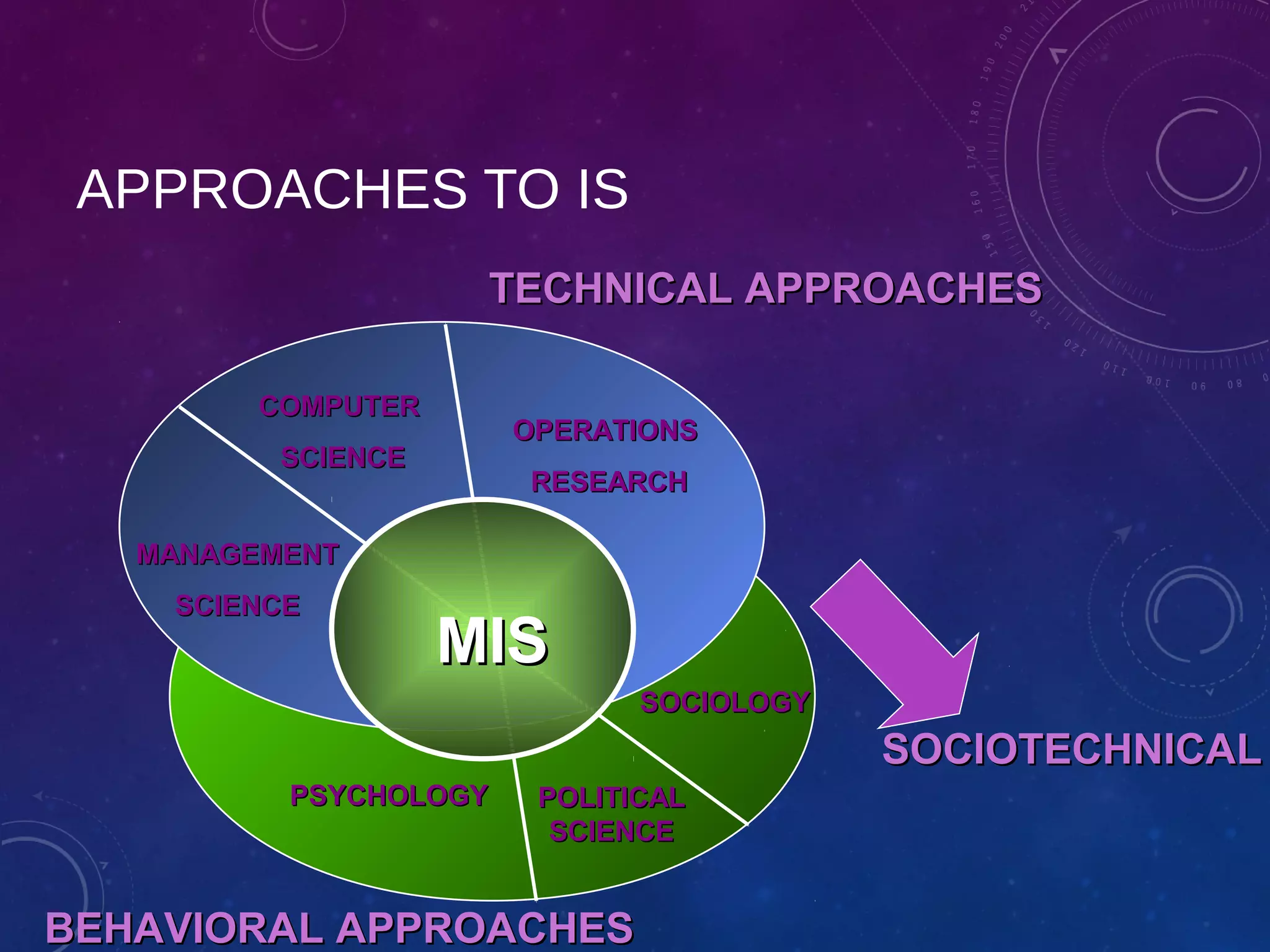
APPROACHES TO IS
SOCIOLOGYSOCIOLOGY
POLITICALPOLITICAL
SCIENCESCIENCE
PSYCHOLOGYPSYCHOLOGY
COMPUTERCOMPUTER
SCIENCESCIENCE
OPERATIONSOPERATIONS
RESEARCHRESEARCH
MANAGEMENTMANAGEMENT
SCIENCESCIENCE
TECHNICAL APPROACHESTECHNICAL APPROACHES
MISMIS
BEHAVIORAL APPROACHESBEHAVIORAL APPROACHES
SOCIOTECHNICALSOCIOTECHNICAL
WHY IS “IS” IMPORTANT?
• For an organisation to survive and prosper
• More locations (networking, Internet)
• New products and services
• Improve jobs and work flows:
• Efficiency
• Cost
• Ethical and social issues
WHY IS “IS” IMPORTANT?
• Worldwide changes:
• Global economy
• Knowledge- or information-based society
• Business enterprise
• Digital firm
GLOBAL ECONOMY
• Growing percentage of economy relies upon import and export
• Need to operate globally
• IS can provide global trading infrastructure
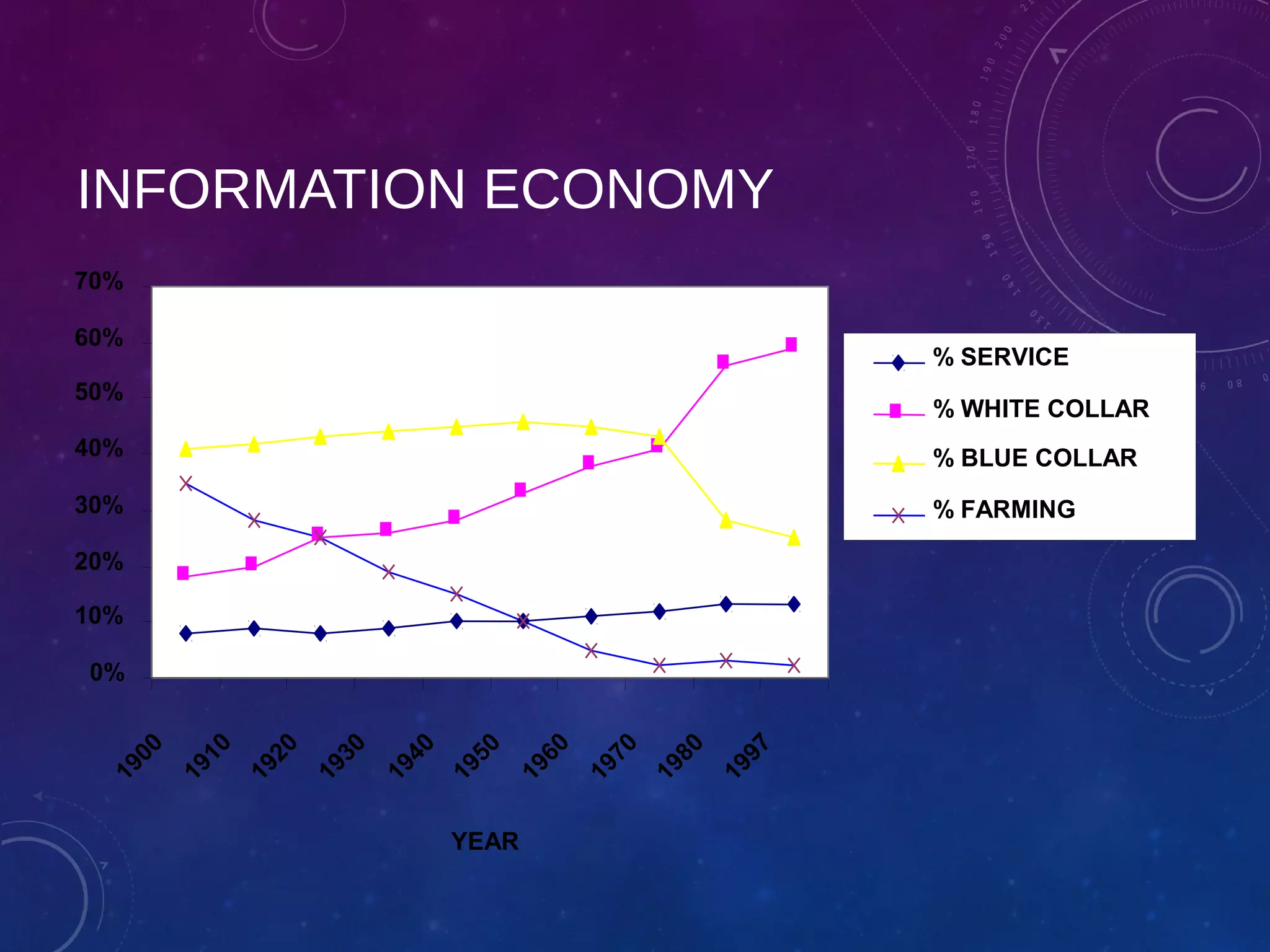
INFORMATION ECONOMY
0%
10%
20%
30%
40%
50%
60%
70%
1900
1910
1920
1930
1940
1950
1960
1970
1980
1997
YEAR
% SERVICE
% WHITE COLLAR
% BLUE COLLAR
% FARMING
CHANGES TO SOCIETY
• Change of employment profiles:
• Less farming
• Less ‘blue collar’ – manufacturing
• Increased service
• Increased ‘white collar’ – office-based
• USA: 55% of work force are in knowledge- or information-based activities
• Shift of manufacture to low-wage countries
BUSINESS ENTERPRISE
• Change from hierarchical organisations
• Now flat, decentralised
• Relies on instant information
• Flexibility with customer focus, with increasing importance
DIGITAL FIRM
• An organisation where:
• Nearly all relationships with customers, suppliers and employees is digital
• Business processes accomplished through digital networks
• Flexible
• Dependent upon on IT
MANAGEMENT INFORMATION
SYSTEMS (MIS)
• Terminology Confusion
• MIS = the study of information technology
in business settings
• But, MIS is also term to refer to class of
systems used to support operational and
tactical decision making
A MODEL FOR PROBLEM
SOLVING
• Decision Making Phase
• Intelligence gathering
• Design
• Choice
• Implementation
• Monitoring
DECISION MAKING
• A step in problem solving
• Intelligence gathering
• Definition of problem
• Data gathered on scope
• Constraints identified
• Design phase
• Alternatives identified and assessed
• Choice
• Selection of an alternative
STRUCTURED VS.
UNSTRUCTURED
PROBLEMS
• Structured problems lend themselves to
programmed decisions
• The implication is that a repeatable process
can be employed and these can be
automated
• Unstructured problems require
unprogrammed decisions
UNSTRUCTURED
PROBLEMS
• Can be addressed (or partially addressed) with
Decision Support Systems
STRUCTURED
PROBLEMS
• Can be addressed by an MIS
• Three decision models or techniques
• Optimization
• Find the best solution
• Satisficing
• Find a solution which meets certain criteria
• Heuristics
• Rule-based solution generation
GOALS OF AN MIS
• Provide managers with information
• Regular, routine operations
• Control, organize and plan better
TYPICAL INPUTS AND
OUTPUTS
• Inputs: Information from the TPS
• Outputs: hard and softcopy reports
• Scheduled reports
• On-demand reports
• Key-indicator (business fundamentals)
• Exception reports
FUNCTIONAL PERSPECTIVES OF MIS
• Financial MIS
• Will integrate information from multiple
sources
• Functions
• Costing
• P&L reporting
• Auditing
• Funds management
FUNCTIONAL PERSPECTIVES OF MIS
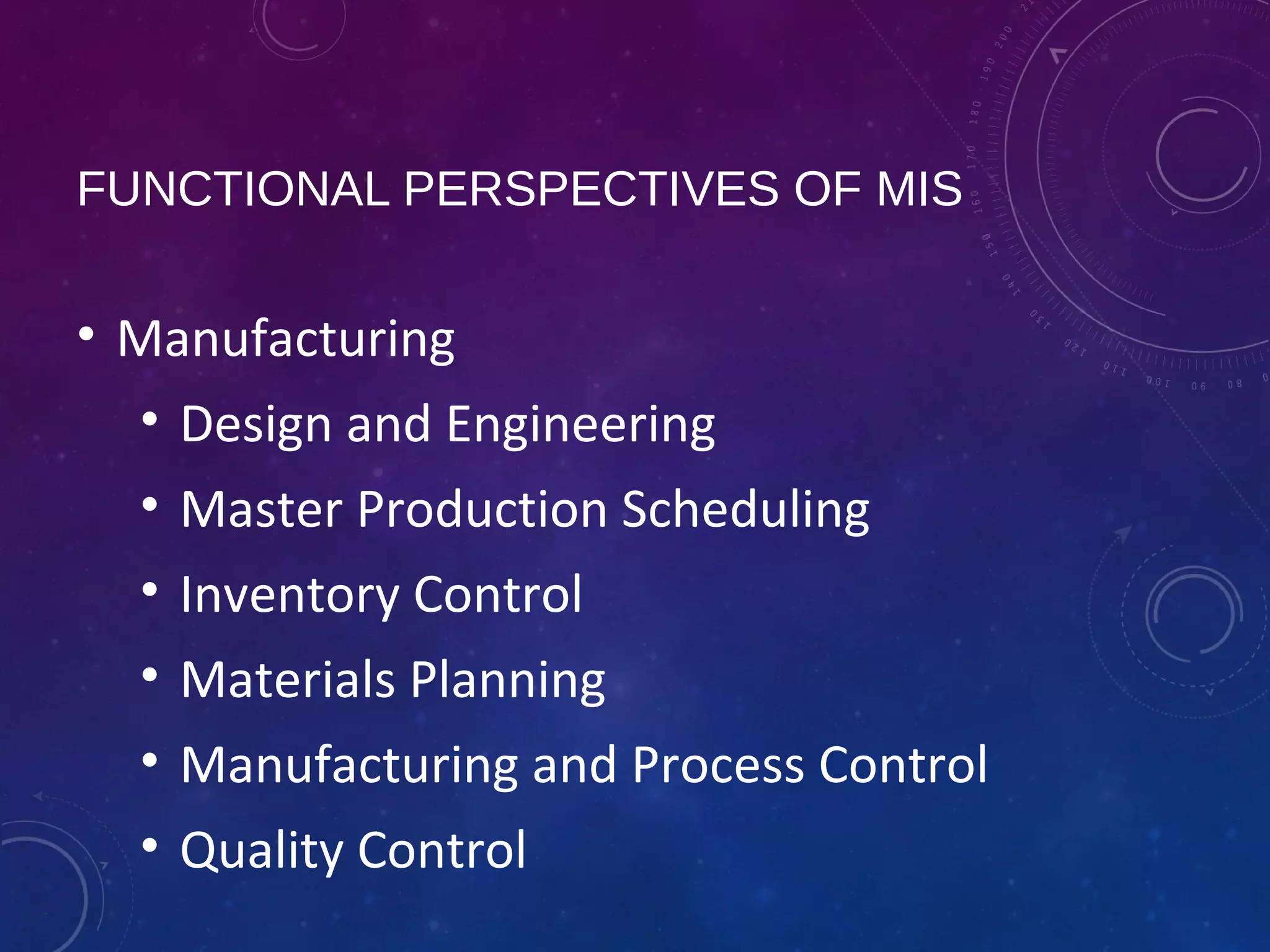
• Manufacturing
• Design and Engineering
• Master Production Scheduling
• Inventory Control
• Materials Planning
• Manufacturing and Process Control
• Quality Control
FUNCTIONAL PERSPECTIVES OF MIS
• Marketing
• Market research
• Web-based market research
• Pricing
FUNCTIONAL PERSPECTIVES OF MIS
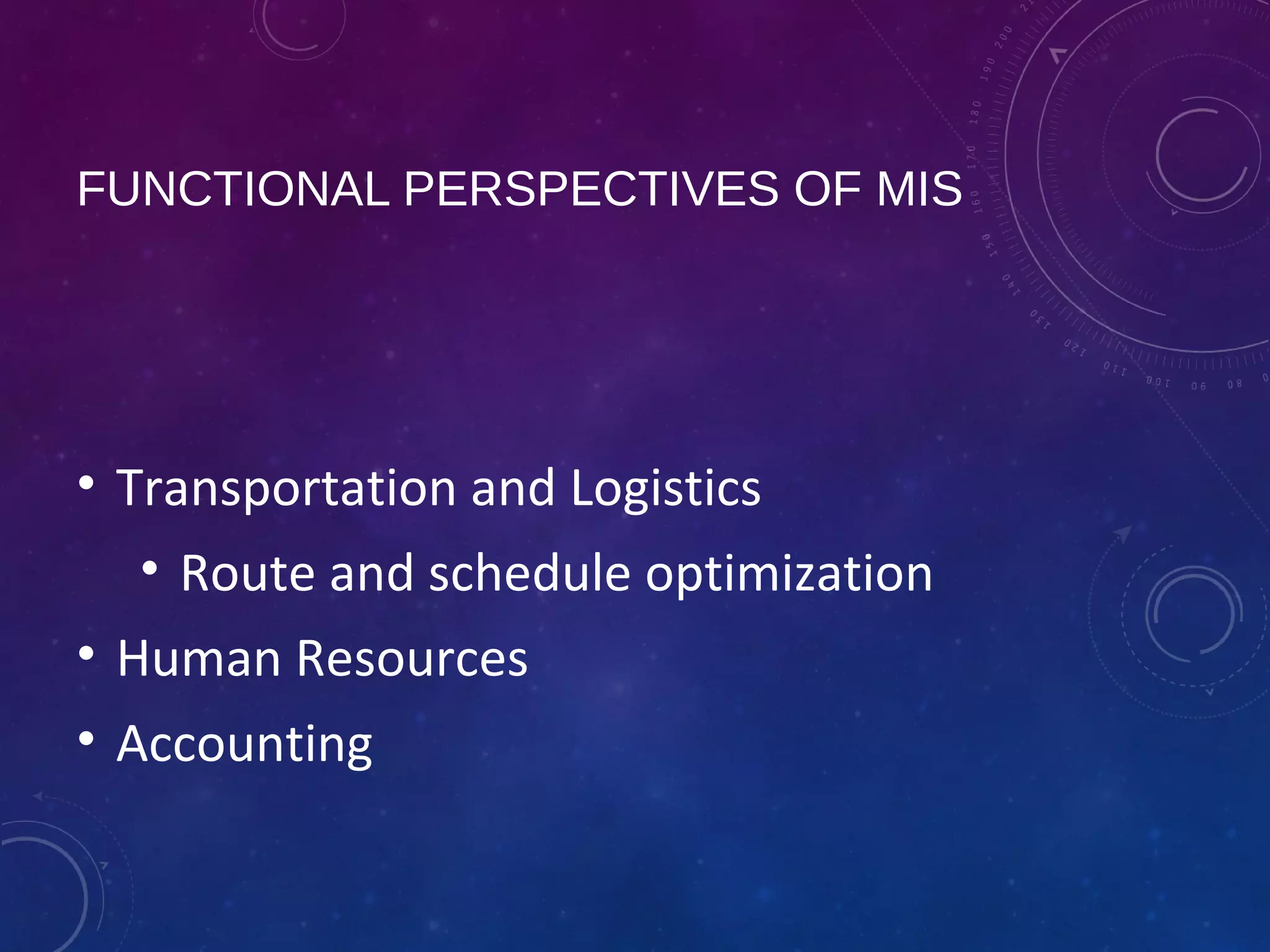
• Transportation and Logistics
• Route and schedule optimization
• Human Resources
• Accounting
DECISION SUPPORT
SYSTEMS (DSS)
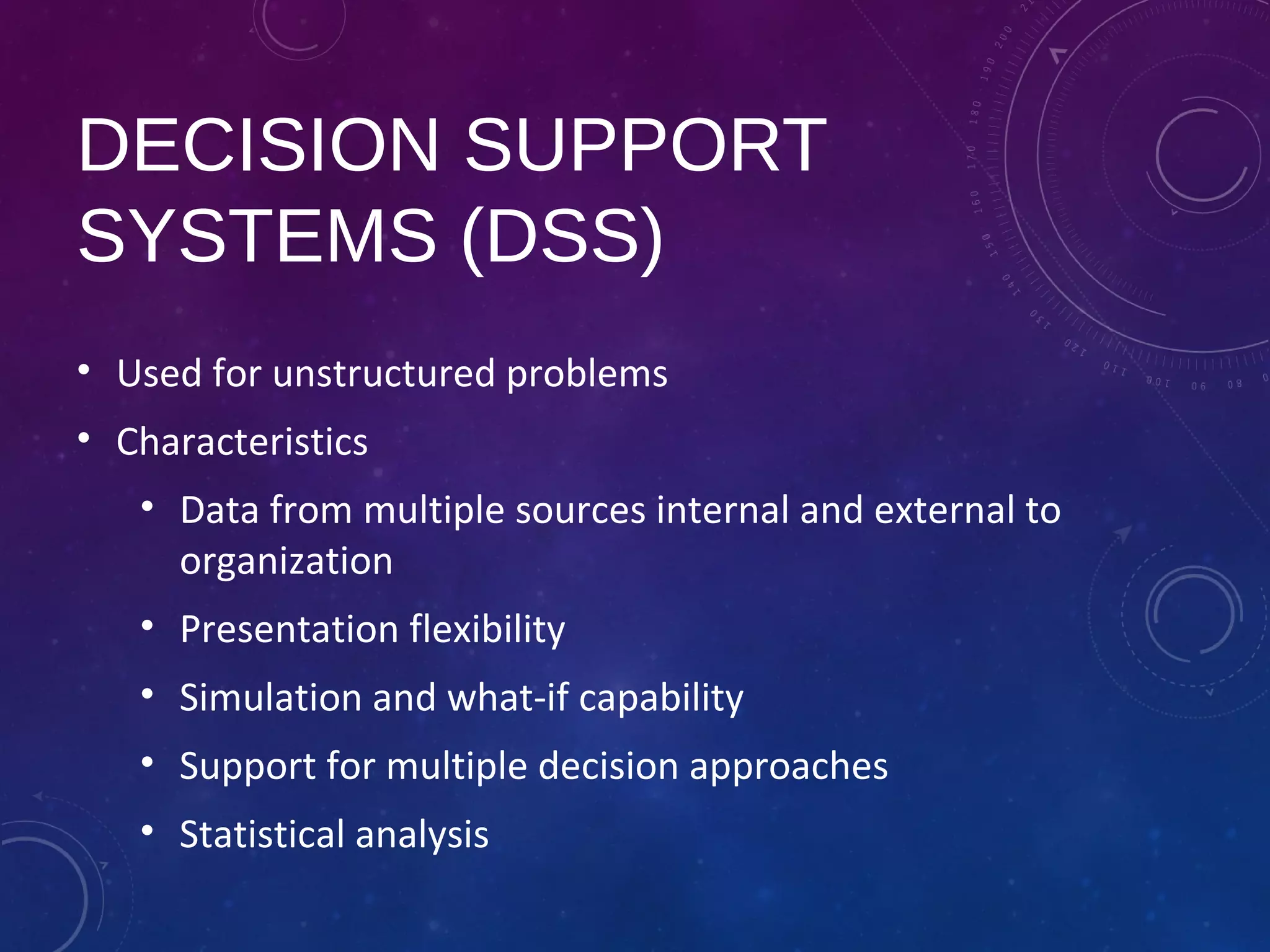
• Used for unstructured problems
• Characteristics
• Data from multiple sources internal and external to
organization
• Presentation flexibility
• Simulation and what-if capability
• Support for multiple decision approaches
• Statistical analysis
COMPONENTS OF A DSS
• Model management software
• Provides a variety of solution models
• Financial, statistical, graphical, project
management
• Dialogue Manager
• Allows user interaction with DSS
GROUP DECISION MAKING SYSTEMS
• Very interesting field
• How can information technology improve how
decisions are made by groups?
GROUP DECISION MAKING SYSTEMS
• Applications
• Where time is critical
• Where participants are geographically dispersed
• Where authority obstructs communication
• Military
• Business
• Government
GROUP DECISION MAKING SYSTEMS
• Common characteristics
• Meeting moderation/facilitation
• Signed and anonymous comments
• Structured deliberations
• Presentation period
• Comment period
• Automated collation of comments
• “Voting”
• Face-to-face and remote
EXECUTIVE INFORMATION SYSTEMS (EIS)
• What information does a chief executive of
board member require?
EXECUTIVE INFORMATION SYSTEMS (EIS)
• High level with drill down
• Key business and industry data
• Structured and unstructured information
• Structured: MTD orders
• Unstructured: Industry newsfeed
• Graphical

MIS ( Management Information System ) | DEFINITION, IMPORTANCE & BENIFITS

  • 1.
    MANAGEMENT INFORMATION SYSTEMS (MIS) ManagementInformation Systems (MIS) • Provide decision-making support for routine, structured decisions • Closely linked to and fed by TPS
  • 2.
    INFORMATION SYSTEMS • InformationSystems are becoming the foundation of business models and processes • They allow for the distribution of knowledge
  • 3.
    IT AND IS •What is Information Technology? • Any form of technology used by people to handle information. • What are Information Systems? • Integrated components processing, storing and disseminating information in an organisation. • Interdisciplinary study of systems that provide information to users in organisations.
  • 4.
    INFORMATION AND DATA •Information • Clusters of facts meaningful and useful to human beings in processes such as making decisions • Data • Streams of raw facts representing events such as business transactions – meaningless without structure
  • 5.
    EXPERIENCES OF ITAND IS • Examples of IT • Hardware (PC, UNIX server) • Software (e-mail, Internet, Windows, Word) • Consumer devices (mobiles, train times) • Examples of IS • File systems, databases, e-mail servers / clients • e-commerce • SAP, student records
  • 6.
    MANAGEMENT INFORMATION SYSTEMS •MIS • The study of information systems focusing on their use in business and management. • Approaches • Technical • Behavioural • Sociotechnical
  • 7.
  • 8.
    WHY IS “IS”IMPORTANT? • For an organisation to survive and prosper • More locations (networking, Internet) • New products and services • Improve jobs and work flows: • Efficiency • Cost • Ethical and social issues
  • 9.
    WHY IS “IS”IMPORTANT? • Worldwide changes: • Global economy • Knowledge- or information-based society • Business enterprise • Digital firm
  • 10.
    GLOBAL ECONOMY • Growingpercentage of economy relies upon import and export • Need to operate globally • IS can provide global trading infrastructure
  • 11.
  • 12.
    CHANGES TO SOCIETY •Change of employment profiles: • Less farming • Less ‘blue collar’ – manufacturing • Increased service • Increased ‘white collar’ – office-based • USA: 55% of work force are in knowledge- or information-based activities • Shift of manufacture to low-wage countries
  • 13.
    BUSINESS ENTERPRISE • Changefrom hierarchical organisations • Now flat, decentralised • Relies on instant information • Flexibility with customer focus, with increasing importance
  • 14.
    DIGITAL FIRM • Anorganisation where: • Nearly all relationships with customers, suppliers and employees is digital • Business processes accomplished through digital networks • Flexible • Dependent upon on IT
  • 15.
    MANAGEMENT INFORMATION SYSTEMS (MIS) •Terminology Confusion • MIS = the study of information technology in business settings • But, MIS is also term to refer to class of systems used to support operational and tactical decision making
  • 16.
    A MODEL FORPROBLEM SOLVING • Decision Making Phase • Intelligence gathering • Design • Choice • Implementation • Monitoring
  • 17.
    DECISION MAKING • Astep in problem solving • Intelligence gathering • Definition of problem • Data gathered on scope • Constraints identified • Design phase • Alternatives identified and assessed • Choice • Selection of an alternative
  • 18.
    STRUCTURED VS. UNSTRUCTURED PROBLEMS • Structuredproblems lend themselves to programmed decisions • The implication is that a repeatable process can be employed and these can be automated • Unstructured problems require unprogrammed decisions
  • 19.
    UNSTRUCTURED PROBLEMS • Can beaddressed (or partially addressed) with Decision Support Systems
  • 20.
    STRUCTURED PROBLEMS • Can beaddressed by an MIS • Three decision models or techniques • Optimization • Find the best solution • Satisficing • Find a solution which meets certain criteria • Heuristics • Rule-based solution generation
  • 21.
    GOALS OF ANMIS • Provide managers with information • Regular, routine operations • Control, organize and plan better
  • 22.
    TYPICAL INPUTS AND OUTPUTS •Inputs: Information from the TPS • Outputs: hard and softcopy reports • Scheduled reports • On-demand reports • Key-indicator (business fundamentals) • Exception reports
  • 23.
    FUNCTIONAL PERSPECTIVES OFMIS • Financial MIS • Will integrate information from multiple sources • Functions • Costing • P&L reporting • Auditing • Funds management
  • 24.
    FUNCTIONAL PERSPECTIVES OFMIS • Manufacturing • Design and Engineering • Master Production Scheduling • Inventory Control • Materials Planning • Manufacturing and Process Control • Quality Control
  • 25.
    FUNCTIONAL PERSPECTIVES OFMIS • Marketing • Market research • Web-based market research • Pricing
  • 26.
    FUNCTIONAL PERSPECTIVES OFMIS • Transportation and Logistics • Route and schedule optimization • Human Resources • Accounting
  • 27.
    DECISION SUPPORT SYSTEMS (DSS) •Used for unstructured problems • Characteristics • Data from multiple sources internal and external to organization • Presentation flexibility • Simulation and what-if capability • Support for multiple decision approaches • Statistical analysis
  • 28.
    COMPONENTS OF ADSS • Model management software • Provides a variety of solution models • Financial, statistical, graphical, project management • Dialogue Manager • Allows user interaction with DSS
  • 29.
    GROUP DECISION MAKINGSYSTEMS • Very interesting field • How can information technology improve how decisions are made by groups?
  • 30.
    GROUP DECISION MAKINGSYSTEMS • Applications • Where time is critical • Where participants are geographically dispersed • Where authority obstructs communication • Military • Business • Government
  • 31.
    GROUP DECISION MAKINGSYSTEMS • Common characteristics • Meeting moderation/facilitation • Signed and anonymous comments • Structured deliberations • Presentation period • Comment period • Automated collation of comments • “Voting” • Face-to-face and remote
  • 32.
    EXECUTIVE INFORMATION SYSTEMS(EIS) • What information does a chief executive of board member require?
  • 33.
    EXECUTIVE INFORMATION SYSTEMS(EIS) • High level with drill down • Key business and industry data • Structured and unstructured information • Structured: MTD orders • Unstructured: Industry newsfeed • Graphical

Editor's Notes

  • #3 Business process examples: Developing a new product, Generating and fulfilling an order, Hiring staff. Distribution of knowledge – example of UniS Intranet. Contains information for staff and students, library services, research applications, job vacancies.
  • #4 Information Systems: interrelated components working together to collect, process, store, and disseminate information to support decision making, coordination, control, analysis, and visualization in an organization Information Technology: the foundation upon which IS are built.
  • #5 For example, think of data as a set of marks given for an exam, whereas information is how these marks are turned in a degree. This could be further explored with how a set of degree marks (data) can be used to determine the total number of people gaining a 1st class.
  • #6 IT infrastructure is the foundation upon which IS are built.
  • #7 Traditionally MIS was concerned with managers. Now covers business / organisations in a broader sense.
  • #8 MIS is the multi-disciplinary study of how IS can be used in business and management. This involves both technical and behavioural approaches. Laudon & Laudon text focuses on sociotechnical approach – the combination of both. The premise is that for businesses to prosper, that there is increasing reliance on IS. IS involve implementing business rules and Standard Operating Procedures, etc. Businesses must also adapt to IS – they should review the organisational structure and adapt rules with IS in mind.
  • #9 The emergence of the Internet is providing new business models, such as e-business and e-commerce. Furthermore, this trend is increasing, especially with the Grid initiatives. For example, buterfly.net – online gaming, to a greater extent than already exists. Such global IT infrastructure is eliminating technical, geographic and cost carriers for global organisations. Future developments include the Access Grid, in which global collaborations are facilitated. Some organisations are solely based on IS. For example e-commerce web sites. More traditional examples include companies that have adopted IS to run their business, such as IBM. Digital links include e-commerce, e-business and business-to-business (b2b).
  • #14 Hierarchical business organisations had people in specific roles working to specific Standard Operating Procedures. In order to be flexible and competitive, businesses now have more flattened structures where people have more general roles, relying on the access to (near) instant information to fulfil the role they are performing at any given time. For example, a task force set up to produce a proposal for work, learning about the opportunity and targeting the customer’s needs. For example, such flatter organisations have been implemented by AT&T, IBM and General Motors, removing approximately 30000 middle managers. This, of course, brings in ethical considerations.
  • #15 Provision of information / assets on a digital network and allowing workflow to be re-organised and management information available (almost) instantly. Such communication can also include inter-organisation networks (Extranets). CISCO provides an example of this approach and are close to being a ‘digital firm’. “Window on Organisations – CISCO Systems: A Digital Firm in the Making” p7. UniS has many legacy practices, a very hierarchical structure, but still employs some of these digital ideas to improve efficiency. Other examples include the implementation of mass customisation – how mass produced products can be customised (tailored for a specific customer) without incurring significant extra cost or implementation. For example, Levi’s custom jeans, tailored via computers in a shop, or the way in which CDs can be put together with specific tracks in a shop.