CHAPTER 7
AUDIT PLANNING AND ANALYTICAL
PROCEDURES
PRESENTATION OUTLINE
I. Defining Audit Evidence
II. Types of Audit Evidence
III. Audit Documentation
I. DEFINING AUDIT EVIDENCE
A. Audit Evidence Decisions
B. Persuasiveness of Audit Evidence
C. Competence Considerations
A. AUDIT EVIDENCE DECISIONS
Audit procedures to use – specific procedures
should be spelled out for instruction during the audit.
Sample size – how many items should be tested for
each audit procedure.
Items to select – determine which items in the
population should be selected.
Timing – timing can vary from early in the
accounting period to long after it has ended.
B. PERSUASIVENESS OF AUDIT EVIDENCE
Audit evidence is any information used by the auditor to
determine whether the information being audited is
stated in accordance with established criteria. Two
determinants of persuasiveness of evidence are:
Competence – the degree to which evidence can be
considered trustworthy.
Sufficiency – amount of evidence is enough to form a
reasonable opinion.
C. COMPETENCE CONSIDERATIONS
Relevance – must pertain to the audit objective being
tested.
Independence – evidence from outside the client is a
stronger form of evidence
Effectiveness of client internal controls – good internal
controls can mean better information.
Auditor direct knowledge – auditor determinations are
stronger that client comments.
Qualifications – individual is a qualified source.
Degree of objectivity – objective evidence is stronger
than subjective evidence.
Timeliness – balance sheet account evidence is better
when it is collected around the date of the financial
statement. Income statement evidence should sample
entire period.
II. TYPES OF AUDIT EVIDENCE
A. Physical
examination
B. Confirmations
C. Documentation
D. Analytical
Procedures
E. Inquiries of the
Client
F. Reperformance
G. Observation
A. PHYSICAL EXAMINATION
• Inspection or count by the
auditor of a tangible
asset.
• Different from examining
documentation is that the
asset has inherent value.
B. CONFIRMATIONS
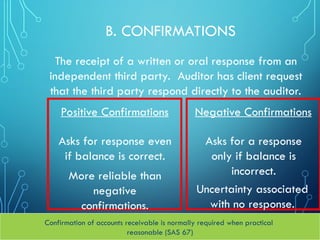
Positive Confirmations Negative Confirmations
Asks for response even
if balance is correct.
Asks for a response
only if balance is
incorrect.
More reliable than
negative
confirmations.
Uncertainty associated
with no response.
The receipt of a written or oral response from an
independent third party. Auditor has client request
that the third party respond directly to the auditor.
Confirmation of accounts receivable is normally required when practical
reasonable (SAS 67)
B. CONFIRMATIONS (CONTINUED)
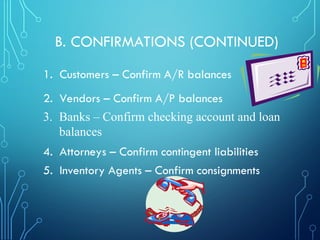
1. Customers – Confirm A/R balances
2. Vendors – Confirm A/P balances
3. Banks – Confirm checking account and loan
balances
4. Attorneys – Confirm contingent liabilities
5. Inventory Agents – Confirm consignments
C. DOCUMENTATION
1. Types of Documents
2. Document Vouching
3. Document Tracing
1. TYPES OF DOCUMENTS
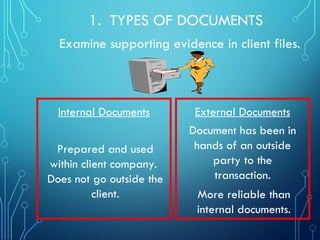
Internal Documents External Documents
Examine supporting evidence in client files.
Prepared and used
within client company.
Does not go outside the
client.
Document has been in
hands of an outside
party to the
transaction.
More reliable than
internal documents.
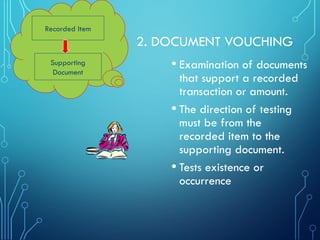
2. DOCUMENT VOUCHING
• Examination of documents
that support a recorded
transaction or amount.
• The direction of testing
must be from the
recorded item to the
supporting document.
• Tests existence or
occurrence
Recorded Item
Supporting
Document
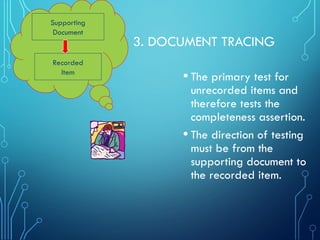
3. DOCUMENT TRACING
• The primary test for
unrecorded items and
therefore tests the
completeness assertion.
• The direction of testing
must be from the
supporting document to
the recorded item.
Supporting
Document
Recorded
Item
D. ANALYTICAL PROCEDURES
Audits studies relationships among data. Unusual
fluctuations occur when significant difference are
not expected but do exist or when significant
differences are expected but do not exist.
Required during the planning and completion
phases on all audits.
E. INQUIRIES OF THE CLIENT
• Auditor obtains
information from the
client in response to
questions.
• Although much evidence
is obtained through
inquiry, it can not be
regarded as conclusive
and may be biased in
the client’s favor.
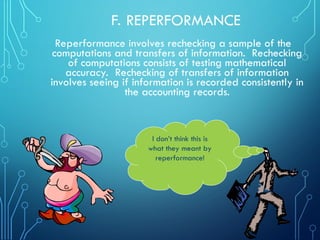
F. REPERFORMANCE
Reperformance involves rechecking a sample of the
computations and transfers of information. Rechecking
of computations consists of testing mathematical
accuracy. Rechecking of transfers of information
involves seeing if information is recorded consistently in
the accounting records.
I don’t think this is
what they meant by
reperformance!
H. OBSERVATION
• Auditor witnesses the physical activities of the client.
• Differs from physical examination because physical
examination counts assets, while observation focuses on
client activities.
III. AUDIT DOCUMENTATION
A. Working Papers Files
B. Typical Working Paper Format
C. Storage of Working Papers
D. Ownership of Working Papers
The Sarbanes-Oxley Act requires auditors of public companies to prepare
and maintain audit working papers for a period of no less than 7 years.
Audit documentation is the principal record of auditing
procedures applied, evidence obtained, and
conclusions reached by the auditor.
A. WORKING PAPERS FILES
Permanent File Current File
Working papers provide the principal record that the
audit has conformed to GAAS. Also provide
information for deciding on the proper report.
Information that is
relevant for multiple
years on recurring
engagements.
(See examples on
page 178)
Information relevant
for a given audit client
for a particular audit
year.
(See examples on
pages 178-182)
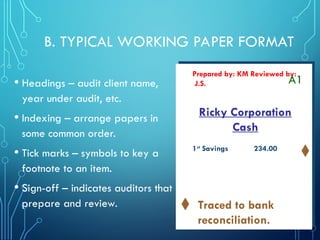
B. TYPICAL WORKING PAPER FORMAT
• Headings – audit client name,
year under audit, etc.
• Indexing – arrange papers in
some common order.
• Tick marks – symbols to key a
footnote to an item.
• Sign-off – indicates auditors that
prepare and review.
Ricky Corporation
Cash
Prepared by: KM Reviewed by:
J.S. A1
1st
Savings 234.00
Traced to bank
reconciliation.
C. STORAGE OF WORKING PAPERS
• Working papers of
continuing clients are
maintained indefinitely.
• Check with legal
counsel before
discarding any working
papers.
D. OWNERSHIP OF WORKING
PAPERS
• The working papers are the auditor’s property, not the
clients.
• In most cases, an auditor can not reveal information in the
working papers without the client’s permission.
SUMMARY
I. Audit Evidence and Persuasiveness
II. Types of Audit Evidence
III. Working Paper Format, Storage,
and Ownership

AUDIT PLANNING AND PROCEDURES [Autosaved].ppt

  • 1.
    CHAPTER 7 AUDIT PLANNINGAND ANALYTICAL PROCEDURES
  • 2.
    PRESENTATION OUTLINE I. DefiningAudit Evidence II. Types of Audit Evidence III. Audit Documentation
  • 3.
    I. DEFINING AUDITEVIDENCE A. Audit Evidence Decisions B. Persuasiveness of Audit Evidence C. Competence Considerations
  • 4.
    A. AUDIT EVIDENCEDECISIONS Audit procedures to use – specific procedures should be spelled out for instruction during the audit. Sample size – how many items should be tested for each audit procedure. Items to select – determine which items in the population should be selected. Timing – timing can vary from early in the accounting period to long after it has ended.
  • 5.
    B. PERSUASIVENESS OFAUDIT EVIDENCE Audit evidence is any information used by the auditor to determine whether the information being audited is stated in accordance with established criteria. Two determinants of persuasiveness of evidence are: Competence – the degree to which evidence can be considered trustworthy. Sufficiency – amount of evidence is enough to form a reasonable opinion.
  • 6.
    C. COMPETENCE CONSIDERATIONS Relevance– must pertain to the audit objective being tested. Independence – evidence from outside the client is a stronger form of evidence Effectiveness of client internal controls – good internal controls can mean better information. Auditor direct knowledge – auditor determinations are stronger that client comments. Qualifications – individual is a qualified source. Degree of objectivity – objective evidence is stronger than subjective evidence. Timeliness – balance sheet account evidence is better when it is collected around the date of the financial statement. Income statement evidence should sample entire period.
  • 7.
    II. TYPES OFAUDIT EVIDENCE A. Physical examination B. Confirmations C. Documentation D. Analytical Procedures E. Inquiries of the Client F. Reperformance G. Observation
  • 8.
    A. PHYSICAL EXAMINATION •Inspection or count by the auditor of a tangible asset. • Different from examining documentation is that the asset has inherent value.
  • 9.
    B. CONFIRMATIONS Positive ConfirmationsNegative Confirmations Asks for response even if balance is correct. Asks for a response only if balance is incorrect. More reliable than negative confirmations. Uncertainty associated with no response. The receipt of a written or oral response from an independent third party. Auditor has client request that the third party respond directly to the auditor. Confirmation of accounts receivable is normally required when practical reasonable (SAS 67)
  • 10.
    B. CONFIRMATIONS (CONTINUED) 1.Customers – Confirm A/R balances 2. Vendors – Confirm A/P balances 3. Banks – Confirm checking account and loan balances 4. Attorneys – Confirm contingent liabilities 5. Inventory Agents – Confirm consignments
  • 11.
    C. DOCUMENTATION 1. Typesof Documents 2. Document Vouching 3. Document Tracing
  • 12.
    1. TYPES OFDOCUMENTS Internal Documents External Documents Examine supporting evidence in client files. Prepared and used within client company. Does not go outside the client. Document has been in hands of an outside party to the transaction. More reliable than internal documents.
  • 13.
    2. DOCUMENT VOUCHING •Examination of documents that support a recorded transaction or amount. • The direction of testing must be from the recorded item to the supporting document. • Tests existence or occurrence Recorded Item Supporting Document
  • 14.
    3. DOCUMENT TRACING •The primary test for unrecorded items and therefore tests the completeness assertion. • The direction of testing must be from the supporting document to the recorded item. Supporting Document Recorded Item
  • 15.
    D. ANALYTICAL PROCEDURES Auditsstudies relationships among data. Unusual fluctuations occur when significant difference are not expected but do exist or when significant differences are expected but do not exist. Required during the planning and completion phases on all audits.
  • 16.
    E. INQUIRIES OFTHE CLIENT • Auditor obtains information from the client in response to questions. • Although much evidence is obtained through inquiry, it can not be regarded as conclusive and may be biased in the client’s favor.
  • 17.
    F. REPERFORMANCE Reperformance involvesrechecking a sample of the computations and transfers of information. Rechecking of computations consists of testing mathematical accuracy. Rechecking of transfers of information involves seeing if information is recorded consistently in the accounting records. I don’t think this is what they meant by reperformance!
  • 18.
    H. OBSERVATION • Auditorwitnesses the physical activities of the client. • Differs from physical examination because physical examination counts assets, while observation focuses on client activities.
  • 19.
    III. AUDIT DOCUMENTATION A.Working Papers Files B. Typical Working Paper Format C. Storage of Working Papers D. Ownership of Working Papers The Sarbanes-Oxley Act requires auditors of public companies to prepare and maintain audit working papers for a period of no less than 7 years. Audit documentation is the principal record of auditing procedures applied, evidence obtained, and conclusions reached by the auditor.
  • 20.
    A. WORKING PAPERSFILES Permanent File Current File Working papers provide the principal record that the audit has conformed to GAAS. Also provide information for deciding on the proper report. Information that is relevant for multiple years on recurring engagements. (See examples on page 178) Information relevant for a given audit client for a particular audit year. (See examples on pages 178-182)
  • 21.
    B. TYPICAL WORKINGPAPER FORMAT • Headings – audit client name, year under audit, etc. • Indexing – arrange papers in some common order. • Tick marks – symbols to key a footnote to an item. • Sign-off – indicates auditors that prepare and review. Ricky Corporation Cash Prepared by: KM Reviewed by: J.S. A1 1st Savings 234.00 Traced to bank reconciliation.
  • 22.
    C. STORAGE OFWORKING PAPERS • Working papers of continuing clients are maintained indefinitely. • Check with legal counsel before discarding any working papers.
  • 23.
    D. OWNERSHIP OFWORKING PAPERS • The working papers are the auditor’s property, not the clients. • In most cases, an auditor can not reveal information in the working papers without the client’s permission.
  • 24.
    SUMMARY I. Audit Evidenceand Persuasiveness II. Types of Audit Evidence III. Working Paper Format, Storage, and Ownership

Editor's Notes

  • #12 Documentation is never as reliable as confirmations.
  • #20 Temporary file may include audit program, working trial balance, lead and detailed schedules.
  • #24 Physical, Representations by 3rd Parties, Mathematical, Documentation, Representations by Client Personnel, Data Interrelationships. Analytical, Observation and Inquiry, Tests of Transactions, Tests of Balances Tests of Controls, Substantive Testing Physical examination, Confirmation, Vouching, Tracing, Reperformance, Observation, Reconciliation, Inquiry, Inspection, Analytical procedures Permanent and current files