AUDITING
Commerce
Guruji
THE LEARNING
APP
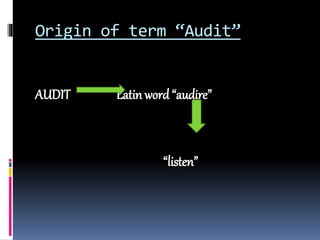
Origin of term “Audit”
AUDIT Latin word“audire”
“listen”
DEFINITION OF AUDIT
 ICAI defines Auditing as- “auditing is the accumulation and
evaluation of evidence about information to determine and
report on the degree of correspondence between the
information and established criteria”.
 “A systematic and independent examination of data,
statement, records, operation and performances (financial or
otherwise) of an enterprise for a stated purpose. In any
auditing situation, the auditor perceives and recognizes the
proposition before him for examination, collects evidence,
evaluates the same and on this basis formulates his judgment
which is communicated through his audit report’
 According to SA 200 on- “Basic Principles Governing an Audit”-
An audit is independent examination of financial information
of any entity, whether profit oriented or not, and irrespective
of its size or legal form, when such examination is conducted
with a view to expressing an opinion thereon
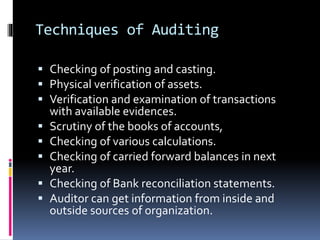
Techniques of Auditing
 Checking of posting and casting.
 Physical verification of assets.
 Verification and examination of transactions
with available evidences.
 Scrutiny of the books of accounts,
 Checking of various calculations.
 Checking of carried forward balances in next
year.
 Checking of Bank reconciliation statements.
 Auditor can get information from inside and
outside sources of organization.
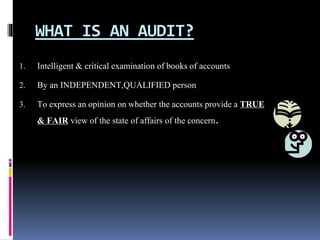
WHAT IS AN AUDIT?
1. Intelligent & critical examination of books of accounts
2. By an INDEPENDENT,QUALIFIED person
3. To express an opinion on whether the accounts provide a TRUE
& FAIR view of the state of affairs of the concern.
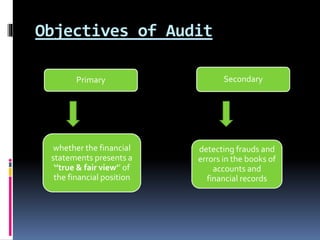
Objectives of Audit
Primary Secondary
detecting frauds and
errors in the books of
accounts and
financial records
whether the financial
statements presents a
‘’true & fair view’’ of
the financial position
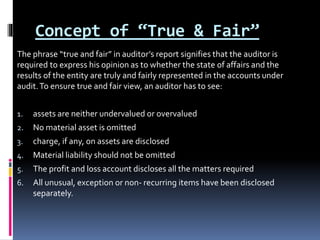
Concept of “True & Fair”
The phrase “true and fair” in auditor’s report signifies that the auditor is
required to express his opinion as to whether the state of affairs and the
results of the entity are truly and fairly represented in the accounts under
audit.To ensure true and fair view, an auditor has to see:
1. assets are neither undervalued or overvalued
2. No material asset is omitted
3. charge, if any, on assets are disclosed
4. Material liability should not be omitted
5. The profit and loss account discloses all the matters required
6. All unusual, exception or non- recurring items have been disclosed
separately.
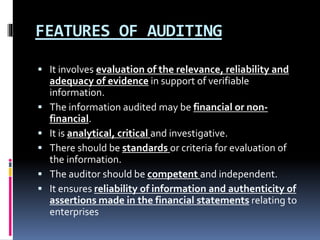
FEATURES OF AUDITING
 It involves evaluation of the relevance, reliability and
adequacy of evidence in support of verifiable
information.
 The information audited may be financial or non-
financial.
 It is analytical, critical and investigative.
 There should be standards or criteria for evaluation of
the information.
 The auditor should be competent and independent.
 It ensures reliability of information and authenticity of
assertions made in the financial statements relating to
enterprises
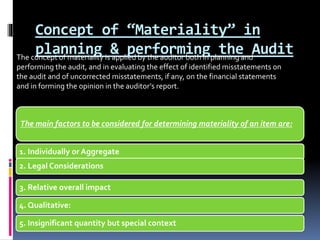
Concept of “Materiality” in
planning & performing the Audit
The main factors to be considered for determining materiality of an item are:
1. Individually or Aggregate
2. Legal Considerations
3. Relative overall impact
4. Qualitative:
5. Insignificant quantity but special context
The concept of materiality is applied by the auditor both in planning and
performing the audit, and in evaluating the effect of identified misstatements on
the audit and of uncorrected misstatements, if any, on the financial statements
and in forming the opinion in the auditor’s report.
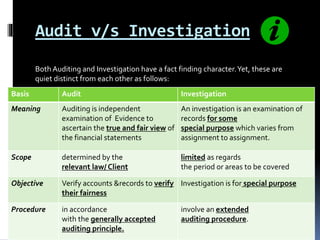
Audit v/s Investigation
Both Auditing and Investigation have a fact finding character.Yet, these are
quiet distinct from each other as follows:
Basis Audit Investigation
Meaning Auditing is independent
examination of Evidence to
ascertain the true and fair view of
the financial statements
An investigation is an examination of
records for some
special purpose which varies from
assignment to assignment.
Scope determined by the
relevant law/ Client
limited as regards
the period or areas to be covered
Objective Verify accounts &records to verify
their fairness
Investigation is for special purpose
Procedure in accordance
with the generally accepted
auditing principle.
involve an extended
auditing procedure.
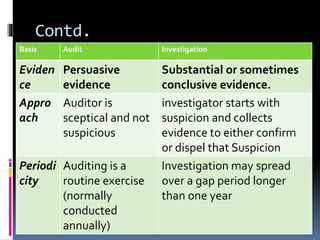
Contd.
Basis Audit Investigation
Eviden
ce
Persuasive
evidence
Substantial or sometimes
conclusive evidence.
Appro
ach
Auditor is
sceptical and not
suspicious
investigator starts with
suspicion and collects
evidence to either confirm
or dispel that Suspicion
Periodi
city
Auditing is a
routine exercise
(normally
conducted
annually)
Investigation may spread
over a gap period longer
than one year
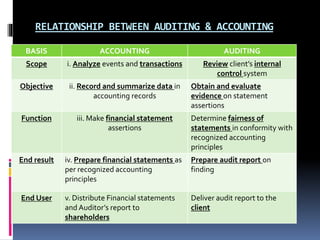
RELATIONSHIP BETWEEN AUDITING & ACCOUNTING
BASIS ACCOUNTING AUDITING
Scope i. Analyze events and transactions Review client’s internal
control system
Objective ii. Record and summarize data in
accounting records
Obtain and evaluate
evidence on statement
assertions
Function iii. Make financial statement
assertions
Determine fairness of
statements in conformity with
recognized accounting
principles
End result iv. Prepare financial statements as
per recognized accounting
principles
Prepare audit report on
finding
End User v. Distribute Financial statements
and Auditor’s report to
shareholders
Deliver audit report to the
client
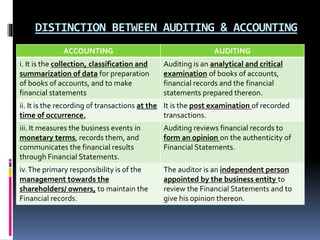
DISTINCTION BETWEEN AUDITING & ACCOUNTING
ACCOUNTING AUDITING
i. It is the collection, classification and
summarization of data for preparation
of books of accounts, and to make
financial statements
Auditing is an analytical and critical
examination of books of accounts,
financial records and the financial
statements prepared thereon.
ii. It is the recording of transactions at the
time of occurrence.
It is the post examination of recorded
transactions.
iii. It measures the business events in
monetary terms, records them, and
communicates the financial results
through Financial Statements.
Auditing reviews financial records to
form an opinion on the authenticity of
Financial Statements.
iv.The primary responsibility is of the
management towards the
shareholders/ owners, to maintain the
Financial records.
The auditor is an independent person
appointed by the business entity to
review the Financial Statements and to
give his opinion thereon.
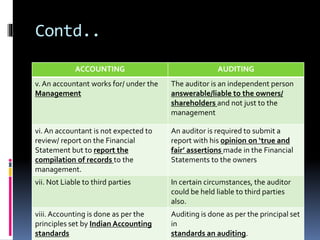
Contd..
ACCOUNTING AUDITING
v. An accountant works for/ under the
Management
The auditor is an independent person
answerable/liable to the owners/
shareholders and not just to the
management
vi. An accountant is not expected to
review/ report on the Financial
Statement but to report the
compilation of records to the
management.
An auditor is required to submit a
report with his opinion on ‘true and
fair’ assertions made in the Financial
Statements to the owners
vii. Not Liable to third parties In certain circumstances, the auditor
could be held liable to third parties
also.
viii.Accounting is done as per the
principles set by Indian Accounting
standards
Auditing is done as per the principal set
in
standards an auditing.
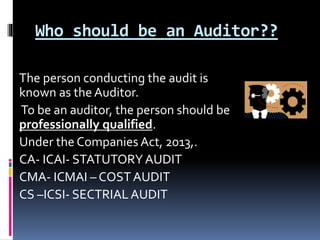
Who should be an Auditor??
The person conducting the audit is
known as the Auditor.
To be an auditor, the person should be
professionally qualified.
Under the Companies Act, 2013,.
CA- ICAI- STATUTORYAUDIT
CMA- ICMAI – COSTAUDIT
CS –ICSI- SECTRIALAUDIT
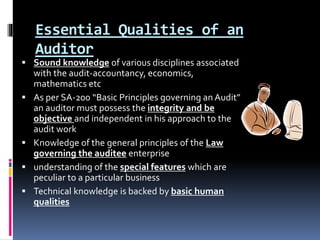
Essential Qualities of an
Auditor
 Sound knowledge of various disciplines associated
with the audit-accountancy, economics,
mathematics etc
 As per SA-200 “Basic Principles governing an Audit”
an auditor must possess the integrity and be
objective and independent in his approach to the
audit work
 Knowledge of the general principles of the Law
governing the auditee enterprise
 understanding of the special features which are
peculiar to a particular business
 Technical knowledge is backed by basic human
qualities
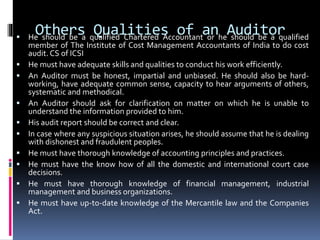
Others Qualities of an Auditor He should be a qualified Chartered Accountant or he should be a qualified
member of The Institute of Cost Management Accountants of India to do cost
audit. CS of ICSI
 He must have adequate skills and qualities to conduct his work efficiently.
 An Auditor must be honest, impartial and unbiased. He should also be hard-
working, have adequate common sense, capacity to hear arguments of others,
systematic and methodical.
 An Auditor should ask for clarification on matter on which he is unable to
understand the information provided to him.
 His audit report should be correct and clear.
 In case where any suspicious situation arises, he should assume that he is dealing
with dishonest and fraudulent peoples.
 He must have thorough knowledge of accounting principles and practices.
 He must have the know how of all the domestic and international court case
decisions.
 He must have thorough knowledge of financial management, industrial
management and business organizations.
 He must have up-to-date knowledge of the Mercantile law and the Companies
Act.
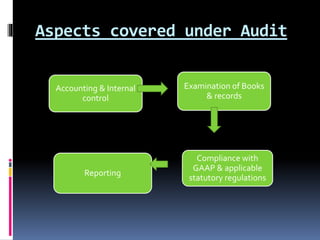
Aspects covered under Audit
Accounting & Internal
control
Examination of Books
& records
Compliance with
GAAP & applicable
statutory regulations
Reporting
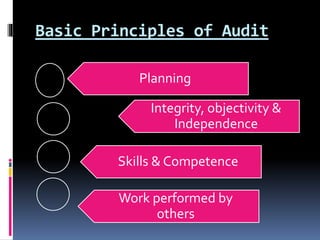
Basic Principles of Audit
Planning
Work performed by
others
Integrity, objectivity &
Independence
Skills & Competence
Contd..
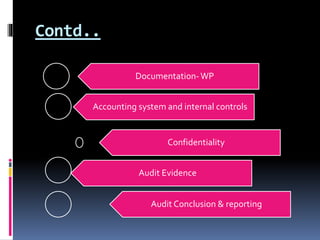
Documentation-WP
Confidentiality
Accounting system and internal controls
Audit Evidence
Audit Conclusion & reporting
Basic Principles of Audit
 SA 200 issued by ICAI gives the following basic principles that govern the auditor’s
responsibilities whenever an audit is carried out:
 (i) Integrity, objectivity and independence:- The auditor should be straight-
forward, honest, sincere and free form any influence on his audit work.
 (ii) Confidentiality:- He should not disclose the client’s information to anybody
without the client’s permission or under any regulatory requirement.
 (iii) Skills and competence:- The audit should be performed and audit report be
prepared by adequately trained, experienced and competent person.
 (iv) Work performed by others:- The auditor should carefully supervise the work
performed by others (such as his subordinates, other auditors, experts etc.) as
remains responsible for the work delegated by him to his assistants, other auditors
or experts.
 (v) Documentation:- Proper working papers should be maintained by the auditor
to evidence the audit work
 vi) Planning:-The auditor should obtain the knowledge
about client’s business to determine the nature, timing and
the extent of the audit procedures.
 vii) Audit evidence:-The auditor should obtain sufficient
appropriate audit evidence through performing the
compliance and substantive procedures.
 viii)Accounting system and internal controls:- An
understanding of the accounting system and the related
internal controls help in determining the nature, timing and
extent of other audit procedures.
 ix) Audit conclusions and reporting:- On the basis of
conclusions drawn from the audit evidence obtained the
auditor should give unqualified report or qualified report or
adverse report or the disclaimer repor
https://play.google.com/store/apps/details?id=com.commerce
guruji
https://www.slideshare.net/BIBEKKUMARPRAJAPATI
https://www.commerceguruji.com/
https://www.youtube.com/feed/my_videos

IGNOU -AUDITING ECO 12

  • 1.
  • 2.
  • 3.
    Origin of term“Audit” AUDIT Latin word“audire” “listen”
  • 4.
    DEFINITION OF AUDIT ICAI defines Auditing as- “auditing is the accumulation and evaluation of evidence about information to determine and report on the degree of correspondence between the information and established criteria”.  “A systematic and independent examination of data, statement, records, operation and performances (financial or otherwise) of an enterprise for a stated purpose. In any auditing situation, the auditor perceives and recognizes the proposition before him for examination, collects evidence, evaluates the same and on this basis formulates his judgment which is communicated through his audit report’  According to SA 200 on- “Basic Principles Governing an Audit”- An audit is independent examination of financial information of any entity, whether profit oriented or not, and irrespective of its size or legal form, when such examination is conducted with a view to expressing an opinion thereon
  • 5.
    Techniques of Auditing Checking of posting and casting.  Physical verification of assets.  Verification and examination of transactions with available evidences.  Scrutiny of the books of accounts,  Checking of various calculations.  Checking of carried forward balances in next year.  Checking of Bank reconciliation statements.  Auditor can get information from inside and outside sources of organization.
  • 6.
    WHAT IS ANAUDIT? 1. Intelligent & critical examination of books of accounts 2. By an INDEPENDENT,QUALIFIED person 3. To express an opinion on whether the accounts provide a TRUE & FAIR view of the state of affairs of the concern.
  • 7.
    Objectives of Audit PrimarySecondary detecting frauds and errors in the books of accounts and financial records whether the financial statements presents a ‘’true & fair view’’ of the financial position
  • 8.
    Concept of “True& Fair” The phrase “true and fair” in auditor’s report signifies that the auditor is required to express his opinion as to whether the state of affairs and the results of the entity are truly and fairly represented in the accounts under audit.To ensure true and fair view, an auditor has to see: 1. assets are neither undervalued or overvalued 2. No material asset is omitted 3. charge, if any, on assets are disclosed 4. Material liability should not be omitted 5. The profit and loss account discloses all the matters required 6. All unusual, exception or non- recurring items have been disclosed separately.
  • 9.
    FEATURES OF AUDITING It involves evaluation of the relevance, reliability and adequacy of evidence in support of verifiable information.  The information audited may be financial or non- financial.  It is analytical, critical and investigative.  There should be standards or criteria for evaluation of the information.  The auditor should be competent and independent.  It ensures reliability of information and authenticity of assertions made in the financial statements relating to enterprises
  • 10.
    Concept of “Materiality”in planning & performing the Audit The main factors to be considered for determining materiality of an item are: 1. Individually or Aggregate 2. Legal Considerations 3. Relative overall impact 4. Qualitative: 5. Insignificant quantity but special context The concept of materiality is applied by the auditor both in planning and performing the audit, and in evaluating the effect of identified misstatements on the audit and of uncorrected misstatements, if any, on the financial statements and in forming the opinion in the auditor’s report.
  • 11.
    Audit v/s Investigation BothAuditing and Investigation have a fact finding character.Yet, these are quiet distinct from each other as follows: Basis Audit Investigation Meaning Auditing is independent examination of Evidence to ascertain the true and fair view of the financial statements An investigation is an examination of records for some special purpose which varies from assignment to assignment. Scope determined by the relevant law/ Client limited as regards the period or areas to be covered Objective Verify accounts &records to verify their fairness Investigation is for special purpose Procedure in accordance with the generally accepted auditing principle. involve an extended auditing procedure.
  • 12.
    Contd. Basis Audit Investigation Eviden ce Persuasive evidence Substantialor sometimes conclusive evidence. Appro ach Auditor is sceptical and not suspicious investigator starts with suspicion and collects evidence to either confirm or dispel that Suspicion Periodi city Auditing is a routine exercise (normally conducted annually) Investigation may spread over a gap period longer than one year
  • 13.
    RELATIONSHIP BETWEEN AUDITING& ACCOUNTING BASIS ACCOUNTING AUDITING Scope i. Analyze events and transactions Review client’s internal control system Objective ii. Record and summarize data in accounting records Obtain and evaluate evidence on statement assertions Function iii. Make financial statement assertions Determine fairness of statements in conformity with recognized accounting principles End result iv. Prepare financial statements as per recognized accounting principles Prepare audit report on finding End User v. Distribute Financial statements and Auditor’s report to shareholders Deliver audit report to the client
  • 14.
    DISTINCTION BETWEEN AUDITING& ACCOUNTING ACCOUNTING AUDITING i. It is the collection, classification and summarization of data for preparation of books of accounts, and to make financial statements Auditing is an analytical and critical examination of books of accounts, financial records and the financial statements prepared thereon. ii. It is the recording of transactions at the time of occurrence. It is the post examination of recorded transactions. iii. It measures the business events in monetary terms, records them, and communicates the financial results through Financial Statements. Auditing reviews financial records to form an opinion on the authenticity of Financial Statements. iv.The primary responsibility is of the management towards the shareholders/ owners, to maintain the Financial records. The auditor is an independent person appointed by the business entity to review the Financial Statements and to give his opinion thereon.
  • 15.
    Contd.. ACCOUNTING AUDITING v. Anaccountant works for/ under the Management The auditor is an independent person answerable/liable to the owners/ shareholders and not just to the management vi. An accountant is not expected to review/ report on the Financial Statement but to report the compilation of records to the management. An auditor is required to submit a report with his opinion on ‘true and fair’ assertions made in the Financial Statements to the owners vii. Not Liable to third parties In certain circumstances, the auditor could be held liable to third parties also. viii.Accounting is done as per the principles set by Indian Accounting standards Auditing is done as per the principal set in standards an auditing.
  • 16.
    Who should bean Auditor?? The person conducting the audit is known as the Auditor. To be an auditor, the person should be professionally qualified. Under the Companies Act, 2013,. CA- ICAI- STATUTORYAUDIT CMA- ICMAI – COSTAUDIT CS –ICSI- SECTRIALAUDIT
  • 17.
    Essential Qualities ofan Auditor  Sound knowledge of various disciplines associated with the audit-accountancy, economics, mathematics etc  As per SA-200 “Basic Principles governing an Audit” an auditor must possess the integrity and be objective and independent in his approach to the audit work  Knowledge of the general principles of the Law governing the auditee enterprise  understanding of the special features which are peculiar to a particular business  Technical knowledge is backed by basic human qualities
  • 18.
    Others Qualities ofan Auditor He should be a qualified Chartered Accountant or he should be a qualified member of The Institute of Cost Management Accountants of India to do cost audit. CS of ICSI  He must have adequate skills and qualities to conduct his work efficiently.  An Auditor must be honest, impartial and unbiased. He should also be hard- working, have adequate common sense, capacity to hear arguments of others, systematic and methodical.  An Auditor should ask for clarification on matter on which he is unable to understand the information provided to him.  His audit report should be correct and clear.  In case where any suspicious situation arises, he should assume that he is dealing with dishonest and fraudulent peoples.  He must have thorough knowledge of accounting principles and practices.  He must have the know how of all the domestic and international court case decisions.  He must have thorough knowledge of financial management, industrial management and business organizations.  He must have up-to-date knowledge of the Mercantile law and the Companies Act.
  • 19.
    Aspects covered underAudit Accounting & Internal control Examination of Books & records Compliance with GAAP & applicable statutory regulations Reporting
  • 20.
    Basic Principles ofAudit Planning Work performed by others Integrity, objectivity & Independence Skills & Competence
  • 21.
    Contd.. Documentation-WP Confidentiality Accounting system andinternal controls Audit Evidence Audit Conclusion & reporting
  • 22.
    Basic Principles ofAudit  SA 200 issued by ICAI gives the following basic principles that govern the auditor’s responsibilities whenever an audit is carried out:  (i) Integrity, objectivity and independence:- The auditor should be straight- forward, honest, sincere and free form any influence on his audit work.  (ii) Confidentiality:- He should not disclose the client’s information to anybody without the client’s permission or under any regulatory requirement.  (iii) Skills and competence:- The audit should be performed and audit report be prepared by adequately trained, experienced and competent person.  (iv) Work performed by others:- The auditor should carefully supervise the work performed by others (such as his subordinates, other auditors, experts etc.) as remains responsible for the work delegated by him to his assistants, other auditors or experts.  (v) Documentation:- Proper working papers should be maintained by the auditor to evidence the audit work
  • 23.
     vi) Planning:-Theauditor should obtain the knowledge about client’s business to determine the nature, timing and the extent of the audit procedures.  vii) Audit evidence:-The auditor should obtain sufficient appropriate audit evidence through performing the compliance and substantive procedures.  viii)Accounting system and internal controls:- An understanding of the accounting system and the related internal controls help in determining the nature, timing and extent of other audit procedures.  ix) Audit conclusions and reporting:- On the basis of conclusions drawn from the audit evidence obtained the auditor should give unqualified report or qualified report or adverse report or the disclaimer repor
  • 24.