Unit – 1: Introduction to Auditing
Meaning of Auditing
Auditing simply means verification and examination of accounts.
Definition of Auditing
In the words of R.B. Bose, “Audit may be said to be the verification of the
accuracy and correctness of the books of accounts by an independent person
qualified for the job and not in any way connected with the preparation of
such accounts.”
Advantages of Auditing
1. Verification of Books and statement
2. Detection and prevention of errors and frauds
3. Moral check
4. Independent opinion
5. Protects the interest of shareholders
6. Check on directors
7. Valuable advice
8. Advantage for general public
9. Useful for tax department
10.Information about economic condition
Disadvantages of Auditing
1. Costly
2. Rely on experts
3. Impossibility of checking all transactions
4. Unsuitable for small concern
5. Chances of fraud
Relationship of audit with other disciplines
1. Accounting
An auditor has to review and evaluate the financial statements by
providing an opinion. Therefore, he should have a thorough knowledge of
accounting concepts and principles.
2. Mathematics and Statistics
Auditor deals with financial data and the amount that appears in
financial statements. Hence, it requires knowledge of the calculation
procedure involved in computing various items, for example., depreciation,
provision for bad debts, tax, etc.
The auditor is also expected to have knowledge of statistical sampling
to make meaningful conclusions.
3. Economics
Auditor requires knowledge regarding business and economic environment affecting
the client. Thus, economic concepts are required to perform auditing in a meaningful
way.
4. Law
Audit of a business concern has to be undertaken with respect to conformity with law.
Thus, an auditor should have sound knowledge of laws affecting the client.
5. Computer Information System
In recent times, clients maintain their accounts in computer information system. Thus,
working knowledge on computer is required for auditors to conduct audit in an
effective way.
6. Financial Management
Auditor to understand and evaluate the financial statements in a better way should
have knowledge of financial techniques.
7. Behavioural Science
Auditor has to deal with many personnel to conduct the audit efficiently.
Hence, he should have the tact of getting along with people.
Preparation before the commencement of new audit
1. Receiving appointment letter
2. Communication with the existing auditor
3. Acceptance of appointment
4. Ascertaining the scope of audit
5. Knowledge about the organisation
6. Knowledge about accounting system
7. Knowledge of technical details
8. Complete list of Principal officers
9. Obervation of the previous auditor’s report
10. Instructions to the client
Working Papers
Audit working papers refer to the audit papers which record the audit
evidence resulting from the audit work performed to provide support for the
auditor’s opinion including the representation. They are the direct aid in the
planning, performance, and supervision of the audit.
Audit Notebook - An audit notebook is a book which is maintained by the
audit staff in which a large variety of matters observed during the course of
the audit are recorded. It contains information that requires further
clarification and explanation.
Audit Programme
According to Arthur W. Holmes, “An audit programme is a flexible planned
procedure of examination”.
Qualities of an Auditor
1. An author should know completely and thoroughly the principles of book
keeping and accounting.
2. He should have knowledge of commercial laws, companies act and other
relevant laws relating to accounting.
3. He should be conscious and accurate in judgment, resourcefulness, self-control,
and diligence.
4. He should not bound to be approach his work with the foregone conclusion that
is something wrong.
5. He should be very vigilant and honest
6. He should not sign any documents which in his opinion not give a true and fair
state of affairs.
7. He must have the ability to prepare the reports clearly and correctly
8. He should have the honesty in maintaining secrecy about his client.
Audit Planning means developing a general strategy and a detailed
approach for the expected nature, timing, and extent of the audit.
An Audit Strategy is a step in the auditing process that sets the scope,
timing, and direction of audits.
An audit engagement is an independent and systematic examination of
a company's financial records, systems, and controls by a qualified
professional known as an auditor.
Audit documentation refers to written records created during the time
of auditing, including working papers, notes, and other related
documentation.
Audit evidence is all the information, whether obtained from audit
procedures or other sources, that is used by the auditor in arriving at the
conclusions on which the auditor's opinion is based.
Written Representation
A written representation is a statement by management provided to the
auditor to confirm certain matters or to support other audit evidence.
Module No.2: Risk Assessment and Internal Control
Audit Risk
The risk that the auditor expresses an inappropriate audit opinion when the financial
statements are materially misstated.
Assessment of Risk
The identification and assessment of risks of material misstatement are at the core of
every audit, particularly obtaining an understanding of the entity's system of internal
control and assessing control risk.
Module 3: Verification and valuation of assets and liabilities
Definition of Verification
According to Spicer and Pegler, “Verification of assets implies an inquiry
into the value, ownership and title, existence and possession and presence of
any charge on the assets”.
Objectives of Verification
1. Existence
2. Ownership
3. Free from encumbrance
4. Proper valuation
5. Proper recording
Verification and valuation of different items of assets
1. Land and Buildings
2. Plant and Machinery
3. Investments
4. Stock-in-trade
Liabilities
5. Bills Payable
6. Sundry Creditors
7. Contingent Liabilities
Meaning of Valuation
Valuation is an act of determining the value of assets and liabilities
and critical examination of these values on the basis of normally
accepted accounting standards.
Objectives of Valuation
1. It determines the fair value of the assets
2. Critical examination of the assets
3. Made by the authorized officer
4. Use proper methods of valuation
5. Certificate of correctness
Rights and Powers of an auditor
1. Right to access the books of accounts
2. Right to obtain information and explanation
3. Right to comment on the inadequacy of the accounting system
4. Right to receive notices and other communications
5. Right to have legal, technical or expert advice
6. Right to receive remuneration
7. Right to be indemnified
8. Right to sign the audit report
9. Right to make representation
10. Right to refuse to start the audit work
Duties and responsibilities of a company auditor
1. Statutory duties
No. of shares & Debentures
Loans & Advances
Report
Preserve & Reproduce
P&L a/c & B/S
2. Contractual duties
3. Duties imposed by the court
4. Duties arising out of professional ethics
Liabilities of a company auditor
1. Civil Liabilities
Civil liability of an auditor for Negligence
Civil liability of an auditor for misfeasance
2. Criminal Liabilities
Criminal Liabilities of an Auditor under the Companies Act (2, 5000) P, W
Criminal Liabilities of an Auditor under the Indian Penal Code
Criminal Liabilities of an Auditor under the IT Act
Criminal Liabilities of an Auditor under the CA act
Audit Procedures for NGO/ Charitable Institutions/ Govt.
companies/ Local bodies (Municipality, Port Trust, Township)
1. Understanding the organization
2. Assessing risk and materiality
3. Financial reporting and accountability
4. Compliance with regulatory requirements
5. Review of supporting documentation
6. Review of board minutes
7. Internal control testing
8. Audit findings and recommendations
Educational institutions - Incomes
1. He should verify the receipts on terms fees (carbon copies of receipts,
register, cash book, pass book)
2. He should also verify other charges collected
3. He should see the concessions and free ships
4. He should vouch the incomes from endowments
Expenditures
5. He should vouch the amount of salaries paid
6. He should see whether any increment given
7. He should see the income tax has deducted
8. He should vouch the items of capital expenditure
Audit of Insurance companies
1. The auditor should check the premiums received (policy register,
premium register, counterfoils, cash book)
2. He should see that outstanding premiums are recoverable
3. He should check the claims paid (claims paid, counterfoils, cash book,
correspondence)
4. He should see that the claims admitted but not paid
5. He should check the commissions paid to agents
6. He should see that outstanding commissions
7. He should also see that the rate of commission does not exceed
8. He should check the expenses of management
9. He should ascertain the market value of the investments
Audit Procedures for co-operative societies
1. Understanding the co-operative society
2. Assessing risk and materiality
3. Financial reporting and accountability
4. Internal controls and governance
5. Review of supporting documentation
6. Evaluation of cooperative governance
7. Audit findings and recommendations
8. Communication with co-operative members
Audit Procedures for Hotel
1. Understanding the hotel operations
2. Assessing risk and materiality
3. Revenue recognition and control
4. Financial reporting and accounting
5. Internal controls and risk management
6. Compliance with hospitality regulations
7. Customer experience and service quality
8. Review of supporting documentation
9. Audit findings and recommendations
Audit Procedures for Hospitals
1. Understanding the hospital operations
2. Assessing risk and materiality
3. Revenue recognition and billing
4. Financial reporting and accounting
5. Internal controls and data security
6. Compliance with healthcare regulations
7. Quality of patient care and clinical processes
8. Review of supporting documentation
9. Audit findings and recommendations
Audit Procedures for Clubs
1. Understanding club operations
2. Assessing risk and materiality
3. Membership management and revenue
4. Financial reporting and accounting
5. Internal controls and governance
6. Compliance with club bylaws
7. Event and activity management
8. Review of supporting documentation
9. Audit findings and recommendations
Audit Procedures for Banks
1. Understanding bank operations
2. Assessing risk and materiality
3. Financial reporting and accounting
4. Internal controls and risk management
5. Compliance with banking regulations
6. Loan portfolio review
7. Review of supporting documentation
8. Audit findings and recommendations
9. Internal control testing
Module – 5
Audit Report - Meaning
An audit report is a statement through which an auditor submits his findings
and expresses his opinion on the state of affairs of the company’s business.
Elements of audit report
1. Whether he has obtained all the information and explanations.
2. Whether proper returns adequate for the purpose of audit
3. Whether proper books of accounts as required by law
4. Whether the company’s B/S and P/L account exhibits a true and fair
view.
5. Whether any other statements have been included as required by the
central Govt.
Types of Audit Report
1. Clean report or Unqualified report
2. Qualified report
Meaning of Professional Ethics
Professional ethics refers to the behavior of a member of a professional body
towards the other members of his profession and towards the members of the
public
Professional Ethics
1. Practicing member prohibited from allowing any person to
practice in his name.
2. Practicing member prohibited to accept any part of the profits
of the professional workers
3. Practicing member prohibited to enter into partnership with any
person other than a practicing member
4. Practicing member prohibited from advertising his professional
attainments or services
5. Practicing member prohibited from accepting an appointment as
auditor of a company whether the requirements of the
Companies Act
6. Practicing member prohibited from accepting a position
previously held by another CA without communicating with him.
7. Practicing member prohibited from disclosing information
acquired in the course of his professional engagement to any person
other than his client.
8. Practicing member should discloses a material fact known to him.
9. Practicing member should keep moneys of his client in a separate
banking account.
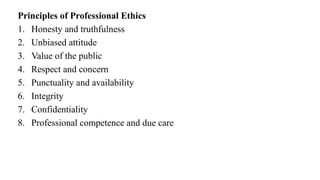
Principles of Professional Ethics
1. Honesty and truthfulness
2. Unbiased attitude
3. Value of the public
4. Respect and concern
5. Punctuality and availability
6. Integrity
7. Confidentiality
8. Professional competence and due care
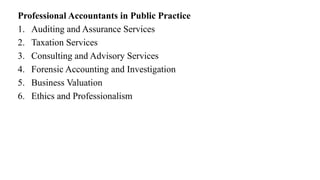
Professional Accountants in Public Practice
1. Auditing and Assurance Services
2. Taxation Services
3. Consulting and Advisory Services
4. Forensic Accounting and Investigation
5. Business Valuation
6. Ethics and Professionalism
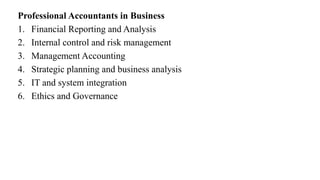
Professional Accountants in Business
1. Financial Reporting and Analysis
2. Internal control and risk management
3. Management Accounting
4. Strategic planning and business analysis
5. IT and system integration
6. Ethics and Governance

Principles & Practices of Auditing.pptx1

  • 1.
    Unit – 1:Introduction to Auditing Meaning of Auditing Auditing simply means verification and examination of accounts. Definition of Auditing In the words of R.B. Bose, “Audit may be said to be the verification of the accuracy and correctness of the books of accounts by an independent person qualified for the job and not in any way connected with the preparation of such accounts.”
  • 4.
    Advantages of Auditing 1.Verification of Books and statement 2. Detection and prevention of errors and frauds 3. Moral check 4. Independent opinion 5. Protects the interest of shareholders 6. Check on directors 7. Valuable advice 8. Advantage for general public 9. Useful for tax department 10.Information about economic condition
  • 5.
    Disadvantages of Auditing 1.Costly 2. Rely on experts 3. Impossibility of checking all transactions 4. Unsuitable for small concern 5. Chances of fraud
  • 6.
    Relationship of auditwith other disciplines 1. Accounting An auditor has to review and evaluate the financial statements by providing an opinion. Therefore, he should have a thorough knowledge of accounting concepts and principles. 2. Mathematics and Statistics Auditor deals with financial data and the amount that appears in financial statements. Hence, it requires knowledge of the calculation procedure involved in computing various items, for example., depreciation, provision for bad debts, tax, etc. The auditor is also expected to have knowledge of statistical sampling to make meaningful conclusions.
  • 7.
    3. Economics Auditor requiresknowledge regarding business and economic environment affecting the client. Thus, economic concepts are required to perform auditing in a meaningful way. 4. Law Audit of a business concern has to be undertaken with respect to conformity with law. Thus, an auditor should have sound knowledge of laws affecting the client. 5. Computer Information System In recent times, clients maintain their accounts in computer information system. Thus, working knowledge on computer is required for auditors to conduct audit in an effective way. 6. Financial Management Auditor to understand and evaluate the financial statements in a better way should have knowledge of financial techniques.
  • 8.
    7. Behavioural Science Auditorhas to deal with many personnel to conduct the audit efficiently. Hence, he should have the tact of getting along with people.
  • 9.
    Preparation before thecommencement of new audit 1. Receiving appointment letter 2. Communication with the existing auditor 3. Acceptance of appointment 4. Ascertaining the scope of audit 5. Knowledge about the organisation 6. Knowledge about accounting system 7. Knowledge of technical details 8. Complete list of Principal officers 9. Obervation of the previous auditor’s report 10. Instructions to the client
  • 10.
    Working Papers Audit workingpapers refer to the audit papers which record the audit evidence resulting from the audit work performed to provide support for the auditor’s opinion including the representation. They are the direct aid in the planning, performance, and supervision of the audit. Audit Notebook - An audit notebook is a book which is maintained by the audit staff in which a large variety of matters observed during the course of the audit are recorded. It contains information that requires further clarification and explanation. Audit Programme According to Arthur W. Holmes, “An audit programme is a flexible planned procedure of examination”.
  • 11.
    Qualities of anAuditor 1. An author should know completely and thoroughly the principles of book keeping and accounting. 2. He should have knowledge of commercial laws, companies act and other relevant laws relating to accounting. 3. He should be conscious and accurate in judgment, resourcefulness, self-control, and diligence. 4. He should not bound to be approach his work with the foregone conclusion that is something wrong. 5. He should be very vigilant and honest 6. He should not sign any documents which in his opinion not give a true and fair state of affairs. 7. He must have the ability to prepare the reports clearly and correctly 8. He should have the honesty in maintaining secrecy about his client.
  • 12.
    Audit Planning meansdeveloping a general strategy and a detailed approach for the expected nature, timing, and extent of the audit. An Audit Strategy is a step in the auditing process that sets the scope, timing, and direction of audits. An audit engagement is an independent and systematic examination of a company's financial records, systems, and controls by a qualified professional known as an auditor. Audit documentation refers to written records created during the time of auditing, including working papers, notes, and other related documentation. Audit evidence is all the information, whether obtained from audit procedures or other sources, that is used by the auditor in arriving at the conclusions on which the auditor's opinion is based.
  • 13.
    Written Representation A writtenrepresentation is a statement by management provided to the auditor to confirm certain matters or to support other audit evidence.
  • 14.
    Module No.2: RiskAssessment and Internal Control Audit Risk The risk that the auditor expresses an inappropriate audit opinion when the financial statements are materially misstated. Assessment of Risk The identification and assessment of risks of material misstatement are at the core of every audit, particularly obtaining an understanding of the entity's system of internal control and assessing control risk.
  • 15.
    Module 3: Verificationand valuation of assets and liabilities Definition of Verification According to Spicer and Pegler, “Verification of assets implies an inquiry into the value, ownership and title, existence and possession and presence of any charge on the assets”. Objectives of Verification 1. Existence 2. Ownership 3. Free from encumbrance 4. Proper valuation 5. Proper recording
  • 16.
    Verification and valuationof different items of assets 1. Land and Buildings 2. Plant and Machinery 3. Investments 4. Stock-in-trade Liabilities 5. Bills Payable 6. Sundry Creditors 7. Contingent Liabilities
  • 17.
    Meaning of Valuation Valuationis an act of determining the value of assets and liabilities and critical examination of these values on the basis of normally accepted accounting standards. Objectives of Valuation 1. It determines the fair value of the assets 2. Critical examination of the assets 3. Made by the authorized officer 4. Use proper methods of valuation 5. Certificate of correctness
  • 18.
    Rights and Powersof an auditor 1. Right to access the books of accounts 2. Right to obtain information and explanation 3. Right to comment on the inadequacy of the accounting system 4. Right to receive notices and other communications 5. Right to have legal, technical or expert advice 6. Right to receive remuneration 7. Right to be indemnified 8. Right to sign the audit report 9. Right to make representation 10. Right to refuse to start the audit work
  • 19.
    Duties and responsibilitiesof a company auditor 1. Statutory duties No. of shares & Debentures Loans & Advances Report Preserve & Reproduce P&L a/c & B/S 2. Contractual duties 3. Duties imposed by the court 4. Duties arising out of professional ethics
  • 20.
    Liabilities of acompany auditor 1. Civil Liabilities Civil liability of an auditor for Negligence Civil liability of an auditor for misfeasance 2. Criminal Liabilities Criminal Liabilities of an Auditor under the Companies Act (2, 5000) P, W Criminal Liabilities of an Auditor under the Indian Penal Code Criminal Liabilities of an Auditor under the IT Act Criminal Liabilities of an Auditor under the CA act
  • 21.
    Audit Procedures forNGO/ Charitable Institutions/ Govt. companies/ Local bodies (Municipality, Port Trust, Township) 1. Understanding the organization 2. Assessing risk and materiality 3. Financial reporting and accountability 4. Compliance with regulatory requirements 5. Review of supporting documentation 6. Review of board minutes 7. Internal control testing 8. Audit findings and recommendations
  • 22.
    Educational institutions -Incomes 1. He should verify the receipts on terms fees (carbon copies of receipts, register, cash book, pass book) 2. He should also verify other charges collected 3. He should see the concessions and free ships 4. He should vouch the incomes from endowments Expenditures 5. He should vouch the amount of salaries paid 6. He should see whether any increment given 7. He should see the income tax has deducted 8. He should vouch the items of capital expenditure
  • 23.
    Audit of Insurancecompanies 1. The auditor should check the premiums received (policy register, premium register, counterfoils, cash book) 2. He should see that outstanding premiums are recoverable 3. He should check the claims paid (claims paid, counterfoils, cash book, correspondence) 4. He should see that the claims admitted but not paid 5. He should check the commissions paid to agents 6. He should see that outstanding commissions 7. He should also see that the rate of commission does not exceed 8. He should check the expenses of management 9. He should ascertain the market value of the investments
  • 24.
    Audit Procedures forco-operative societies 1. Understanding the co-operative society 2. Assessing risk and materiality 3. Financial reporting and accountability 4. Internal controls and governance 5. Review of supporting documentation 6. Evaluation of cooperative governance 7. Audit findings and recommendations 8. Communication with co-operative members
  • 25.
    Audit Procedures forHotel 1. Understanding the hotel operations 2. Assessing risk and materiality 3. Revenue recognition and control 4. Financial reporting and accounting 5. Internal controls and risk management 6. Compliance with hospitality regulations 7. Customer experience and service quality 8. Review of supporting documentation 9. Audit findings and recommendations
  • 26.
    Audit Procedures forHospitals 1. Understanding the hospital operations 2. Assessing risk and materiality 3. Revenue recognition and billing 4. Financial reporting and accounting 5. Internal controls and data security 6. Compliance with healthcare regulations 7. Quality of patient care and clinical processes 8. Review of supporting documentation 9. Audit findings and recommendations
  • 27.
    Audit Procedures forClubs 1. Understanding club operations 2. Assessing risk and materiality 3. Membership management and revenue 4. Financial reporting and accounting 5. Internal controls and governance 6. Compliance with club bylaws 7. Event and activity management 8. Review of supporting documentation 9. Audit findings and recommendations
  • 28.
    Audit Procedures forBanks 1. Understanding bank operations 2. Assessing risk and materiality 3. Financial reporting and accounting 4. Internal controls and risk management 5. Compliance with banking regulations 6. Loan portfolio review 7. Review of supporting documentation 8. Audit findings and recommendations 9. Internal control testing
  • 29.
    Module – 5 AuditReport - Meaning An audit report is a statement through which an auditor submits his findings and expresses his opinion on the state of affairs of the company’s business. Elements of audit report 1. Whether he has obtained all the information and explanations. 2. Whether proper returns adequate for the purpose of audit 3. Whether proper books of accounts as required by law 4. Whether the company’s B/S and P/L account exhibits a true and fair view. 5. Whether any other statements have been included as required by the central Govt.
  • 30.
    Types of AuditReport 1. Clean report or Unqualified report 2. Qualified report Meaning of Professional Ethics Professional ethics refers to the behavior of a member of a professional body towards the other members of his profession and towards the members of the public
  • 31.
    Professional Ethics 1. Practicingmember prohibited from allowing any person to practice in his name. 2. Practicing member prohibited to accept any part of the profits of the professional workers 3. Practicing member prohibited to enter into partnership with any person other than a practicing member 4. Practicing member prohibited from advertising his professional attainments or services 5. Practicing member prohibited from accepting an appointment as auditor of a company whether the requirements of the Companies Act
  • 32.
    6. Practicing memberprohibited from accepting a position previously held by another CA without communicating with him. 7. Practicing member prohibited from disclosing information acquired in the course of his professional engagement to any person other than his client. 8. Practicing member should discloses a material fact known to him. 9. Practicing member should keep moneys of his client in a separate banking account.
  • 33.
    Principles of ProfessionalEthics 1. Honesty and truthfulness 2. Unbiased attitude 3. Value of the public 4. Respect and concern 5. Punctuality and availability 6. Integrity 7. Confidentiality 8. Professional competence and due care
  • 34.
    Professional Accountants inPublic Practice 1. Auditing and Assurance Services 2. Taxation Services 3. Consulting and Advisory Services 4. Forensic Accounting and Investigation 5. Business Valuation 6. Ethics and Professionalism
  • 35.
    Professional Accountants inBusiness 1. Financial Reporting and Analysis 2. Internal control and risk management 3. Management Accounting 4. Strategic planning and business analysis 5. IT and system integration 6. Ethics and Governance