Chapter 2
    The Likelihood Approach


報告者:胡 元
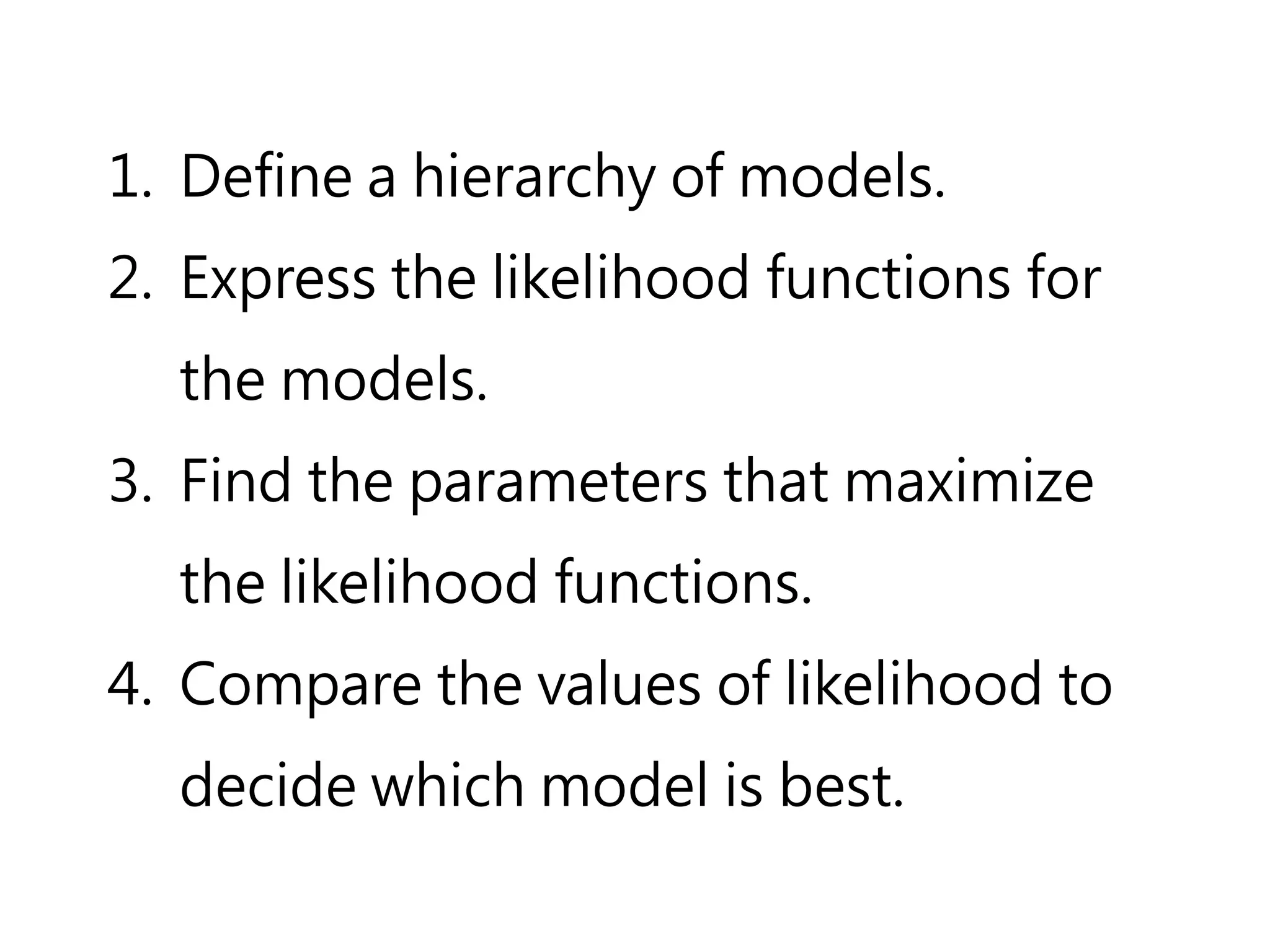
1. Define a hierarchy of models.
2. Express the likelihood functions for
  the models.
3. Find the parameters that maximize
  the likelihood functions.
4. Compare the values of likelihood to
  decide which model is best.
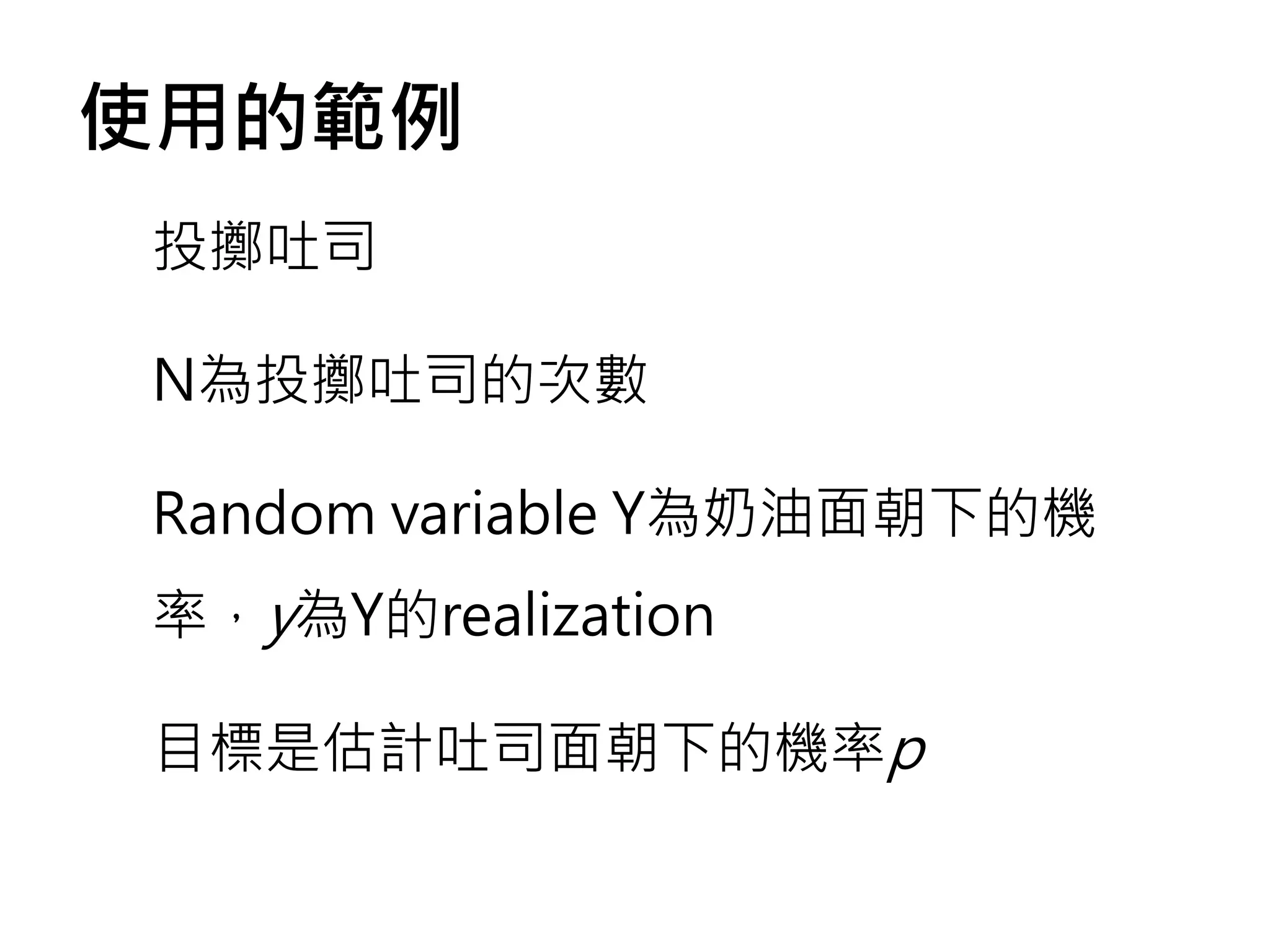
使用的範例
投擲吐司

N為投擲吐司的次數

Random variable Y為奶油面朝下的機
率,y為Y的realization

目標是估計吐司面朝下的機率p
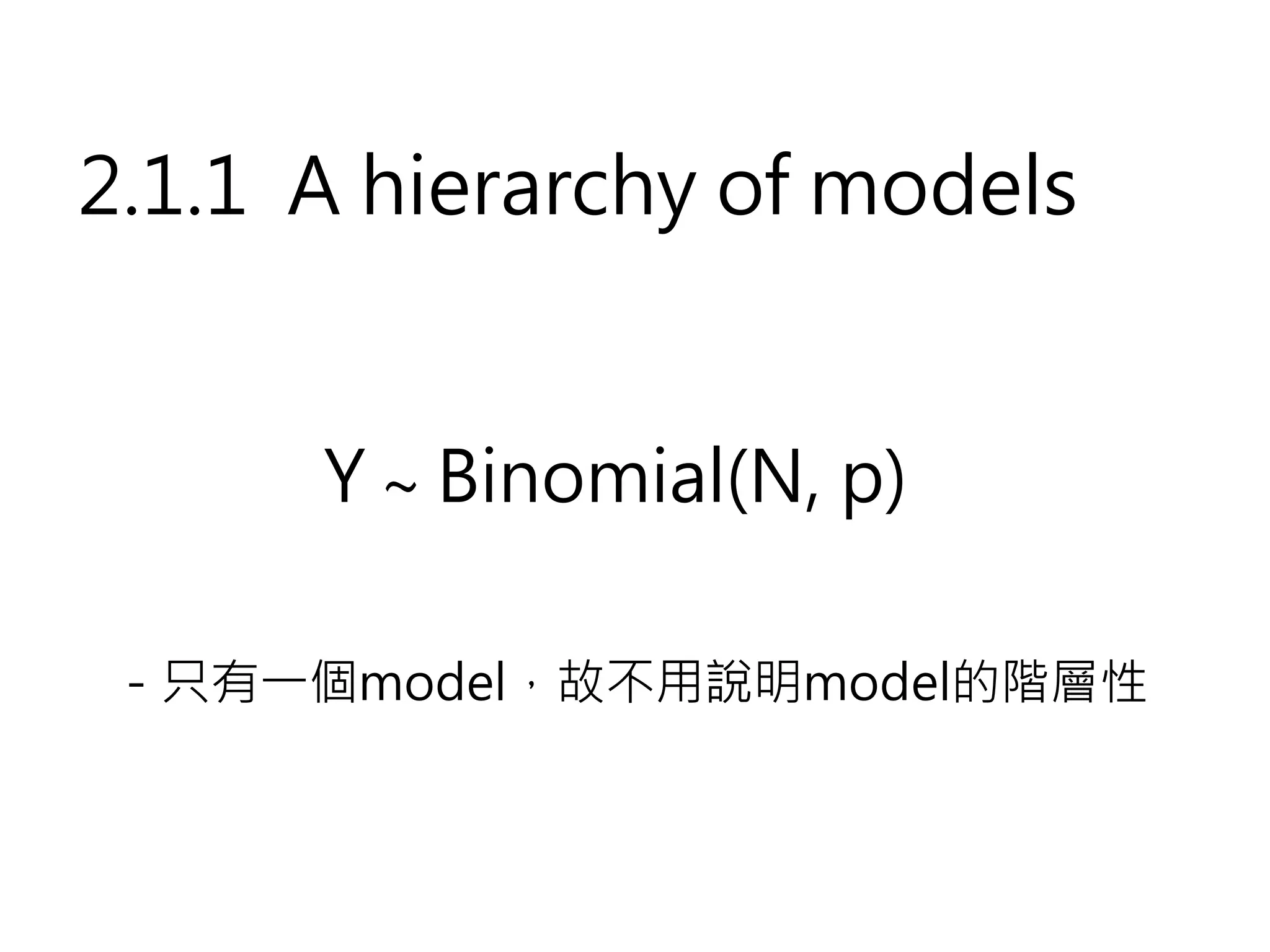
2.1.1 A hierarchy of models


      Y ∼ Binomial(N, p)

-只有一個model,故不用說明model的階層性
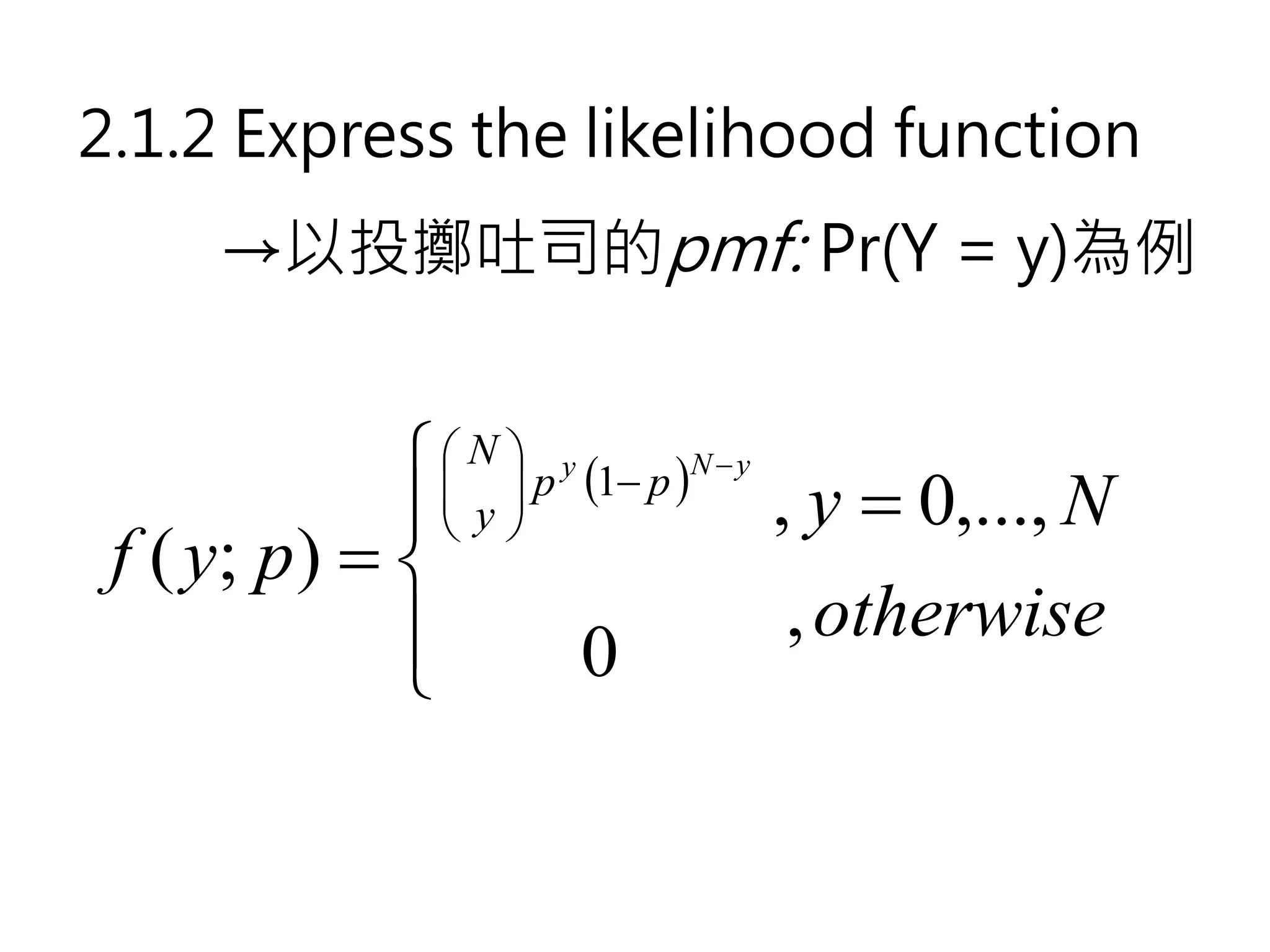
2.1.2 Express the likelihood function
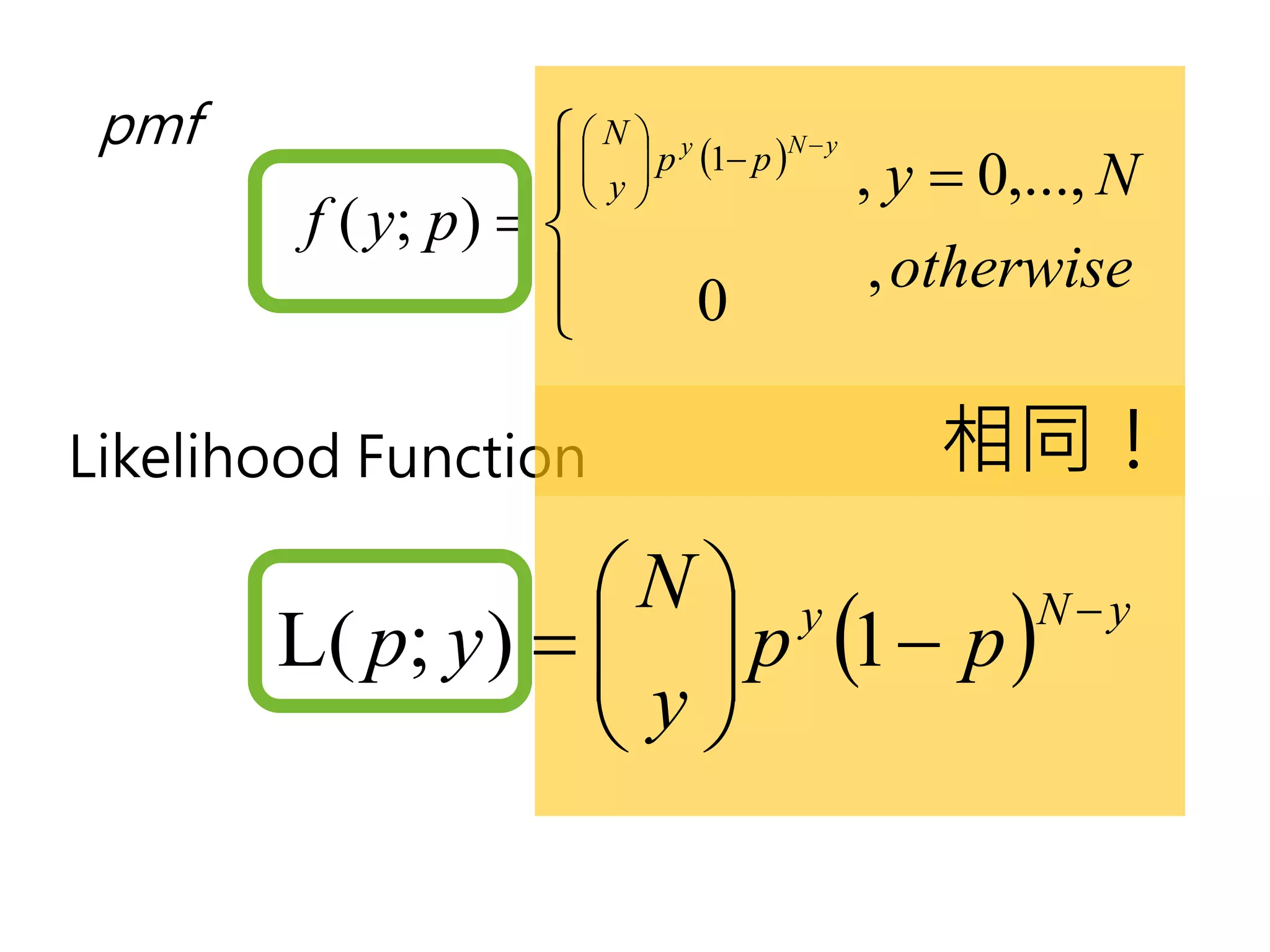
     →以投擲吐司的pmf: Pr(Y = y)為例


                 N y
                    p (1− p )N − y
                                       , y = 0,..., N
                  y
                   
 f ( y; p ) = 
                                       , otherwise
                         0
pmf                   N  p y (1− p )N − y , y = 0,..., N
                        
                      y 
                        
        f ( y; p ) = 
                                              , otherwise
                                0

Likelihood Function                            相同!
                   N y
       L( p; y ) =   p (1 − p )
                                 N−y
                    y
                    
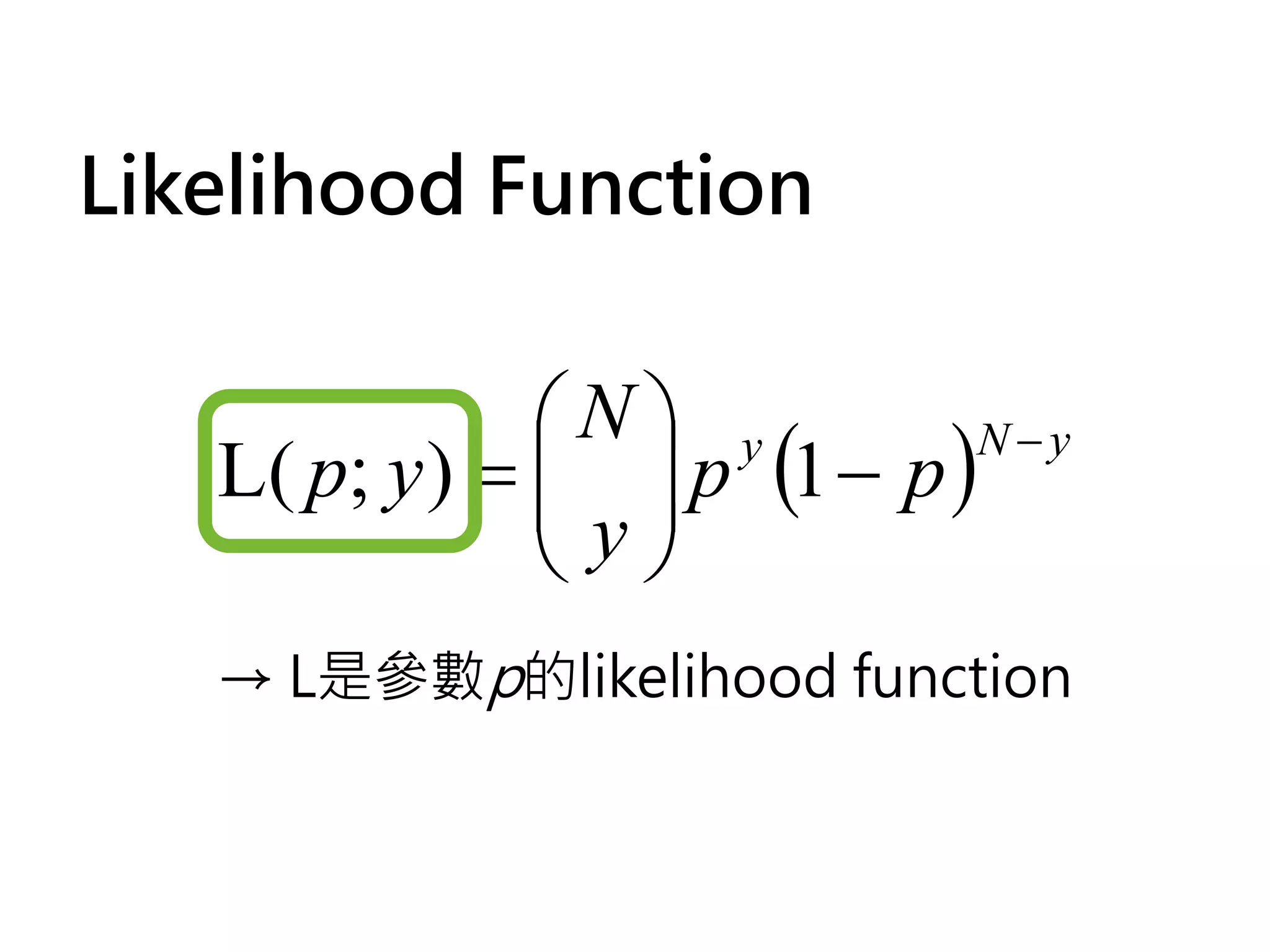
Likelihood Function

               N y
   L( p; y ) =   p (1 − p )
                             N−y
                y
                
   → L是參數p的likelihood function
Likelihood Function

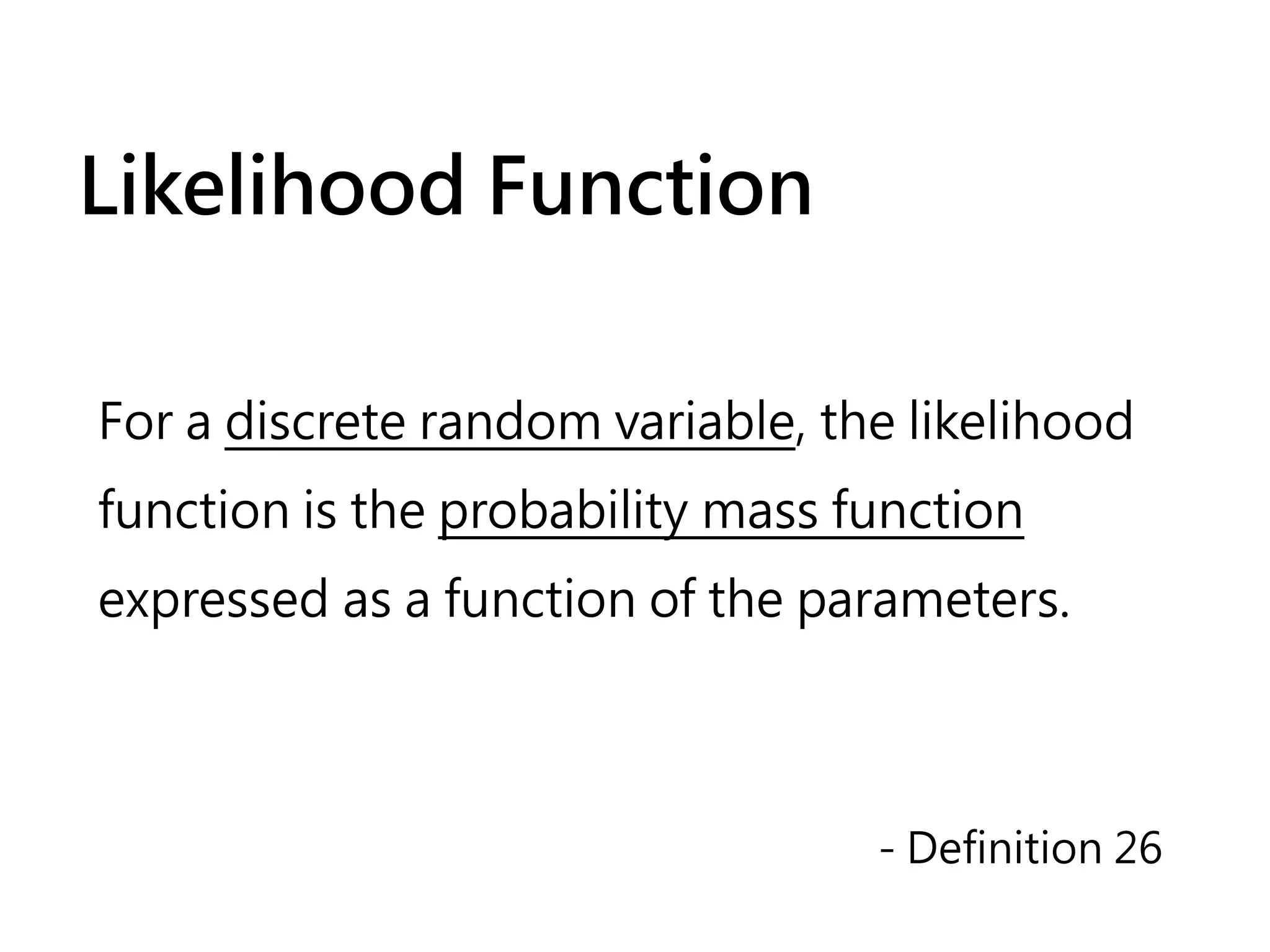
For a discrete random variable, the likelihood
function is the probability mass function
expressed as a function of the parameters.


                                  - Definition 26
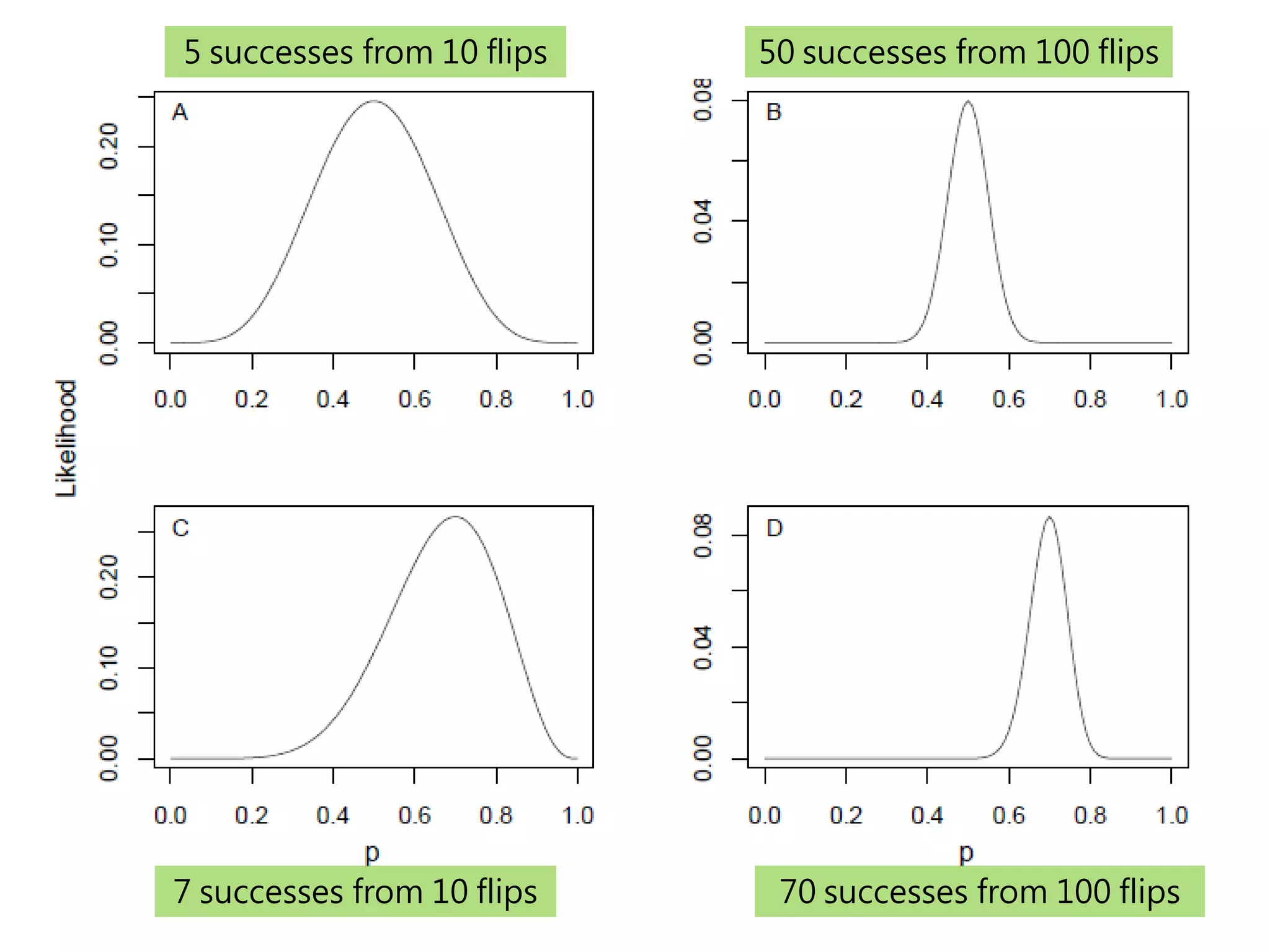
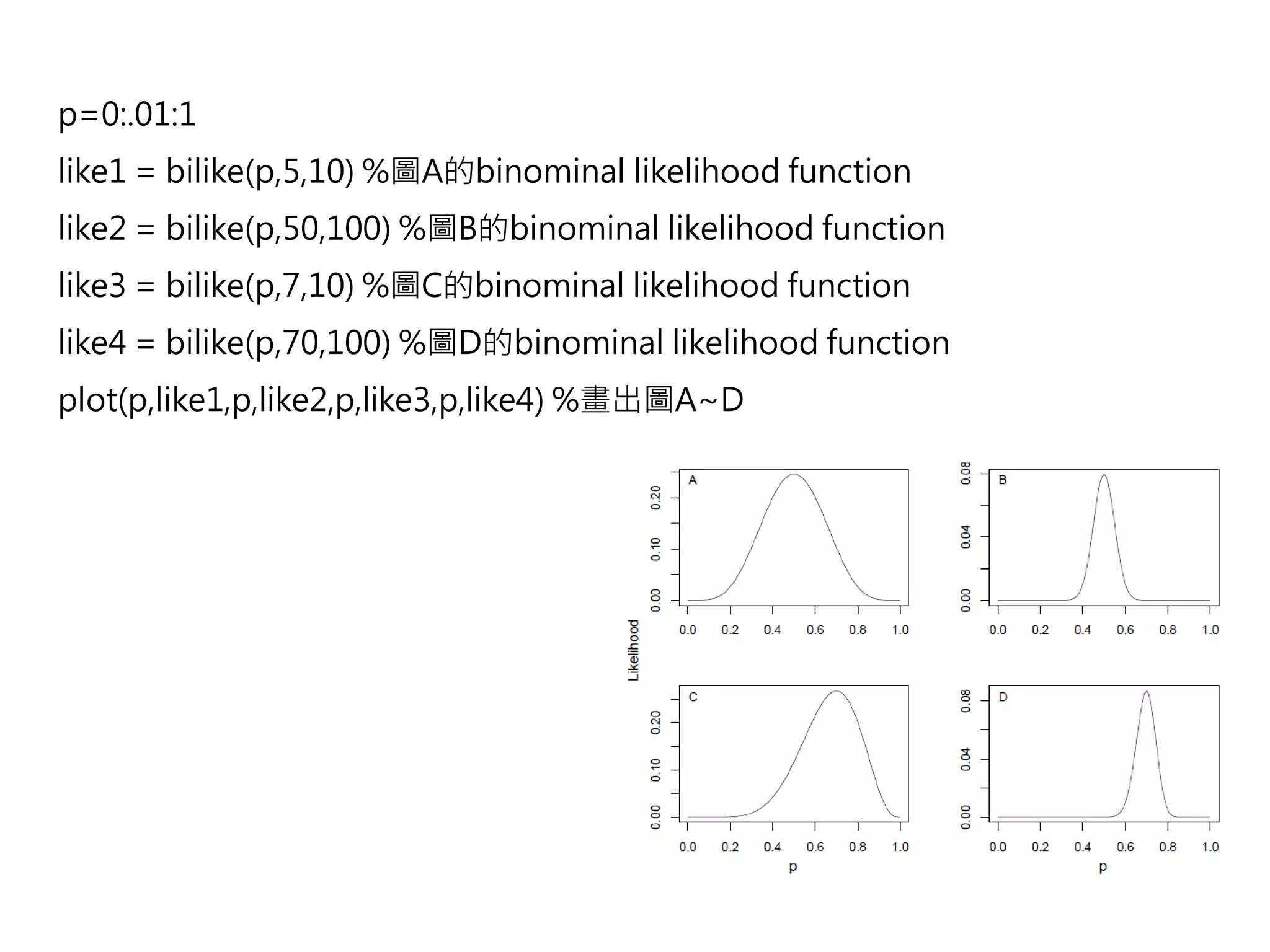
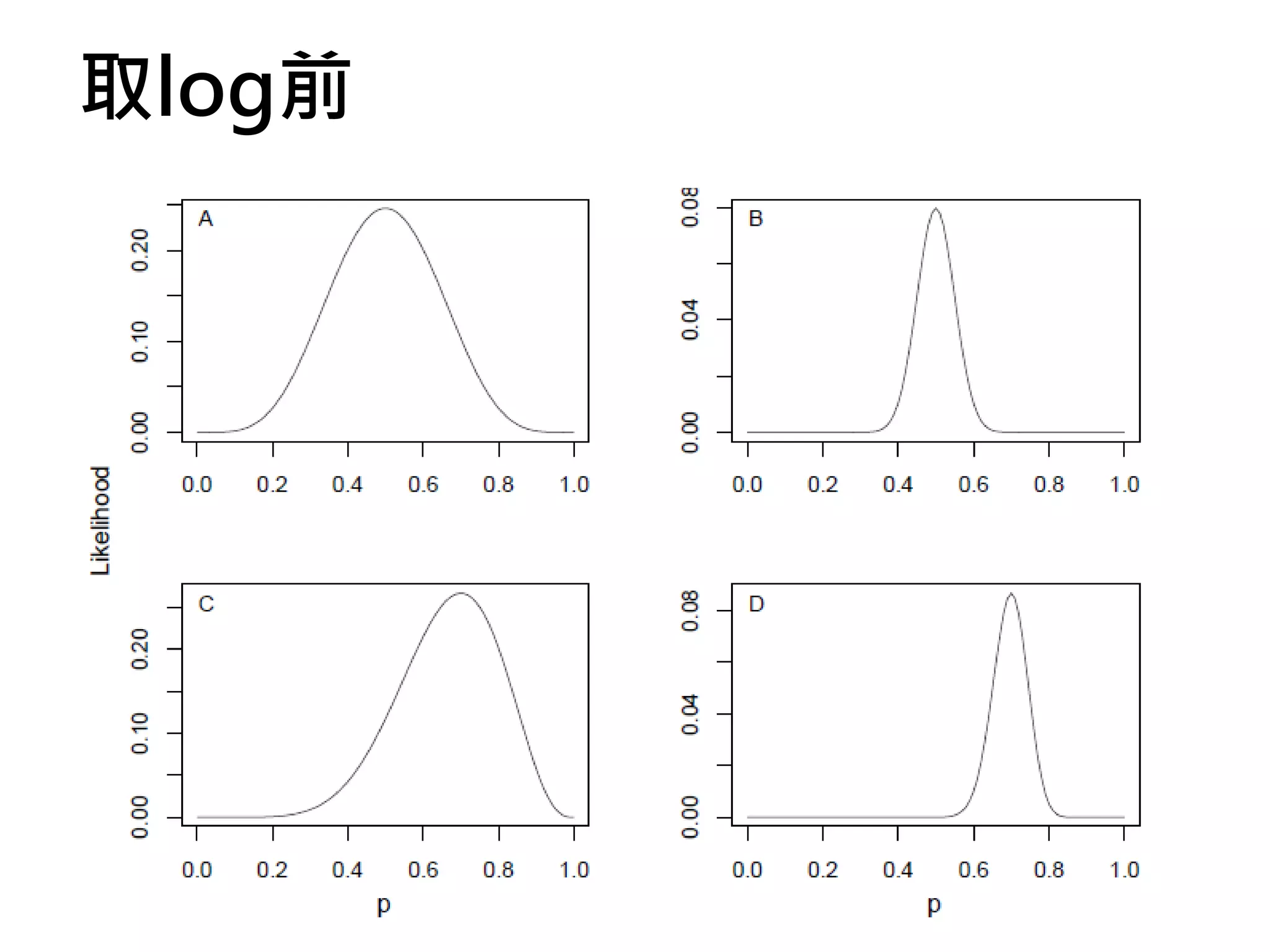
5 successes from 10 flips   50 successes from 100 flips


7 successes from 10 flips    70 successes from 100 flips
p=0:.01:1
like1 = bilike(p,5,10) %圖A的binominal likelihood function
like2 = bilike(p,50,100) %圖B的binominal likelihood function
like3 = bilike(p,7,10) %圖C的binominal likelihood function
like4 = bilike(p,70,100) %圖D的binominal likelihood function
plot(p,like1,p,like2,p,like3,p,like4) %畫出圖A~D
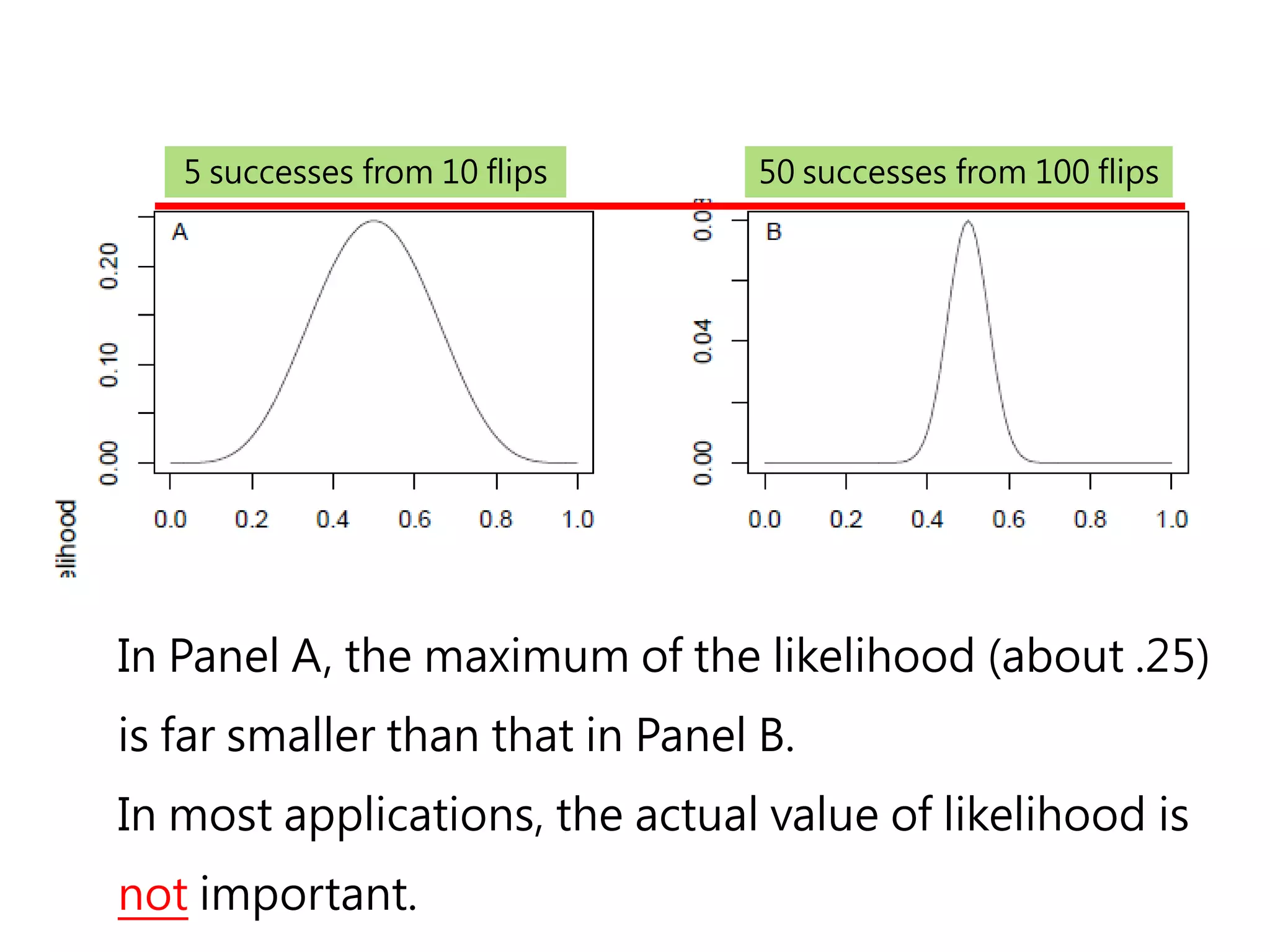
5 successes from 10 flips      50 successes from 100 flips


In Panel A, the maximum of the likelihood (about .25)
is far smaller than that in Panel B.
In most applications, the actual value of likelihood is
not important.
• 對二項分配來說,likelihood受p和Bernoulli trials
 數N所影響。

• 對估計來說,重要的是likelihood function的形狀
  和高峰所在的位置(下面有更詳細的討論)。

• 對模型比較來說,likelihood value的不同才重要。
1. Define a hierarchy of models.
2. Express the likelihood functions for
  the models.
3. Find the parameters that maximize
  the likelihood functions.
4. Compare the values of likelihood to
  decide which model is best.
2.1.3 Find the parameters that
   maximize the likelihood
Maximum Likelihood Estimate

A maximum likelihood (ML) estimate is the
parameter value that maximizes the likelihood
function for a given set of data.


                           - Definition 27(與前提)
得到maximum likelihood estimators
(MLEs)的兩種基本方法

  (1) 使用微積分

  (2) 使用數值方法( numerical method ) 來
    找到能最大化likelihood的參數
使用兩種方法前,最大化likelihood需:

取likelihood的自然對數(natural logarithm )
做為主要使用的函數。
The first step in maximizing a likelihood is to use the
natural logarithm of the likelihood (the log likelihood,
denoted by l) as the main function of interest.
取log前
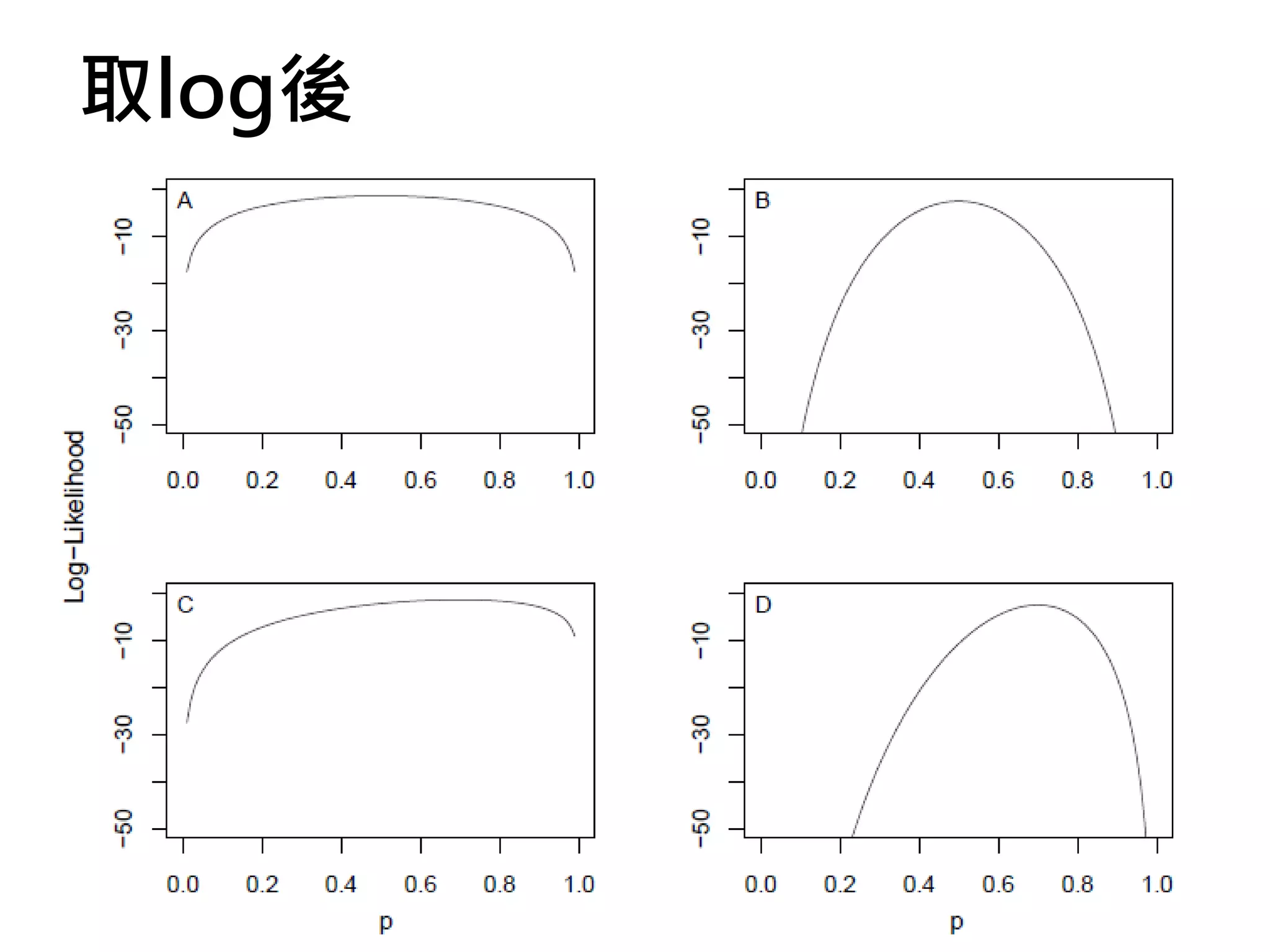
取log後
如何取binomial的log
 l ( p;y ) = log[L( p; y )]               N y
                              L( p; y ) =   p (1 − p )
                                                        N−y
                                           y
                                           
        N  y       N−y 
 = log   p (1 − p ) 
         y
                       
      N
                    ( )       (
 = log  + log p + log (1 − p )
       y
                   y            N−y
                                             )
       
      N
 = log  + y log p + ( N − y ) log(1 − p )
       y
       
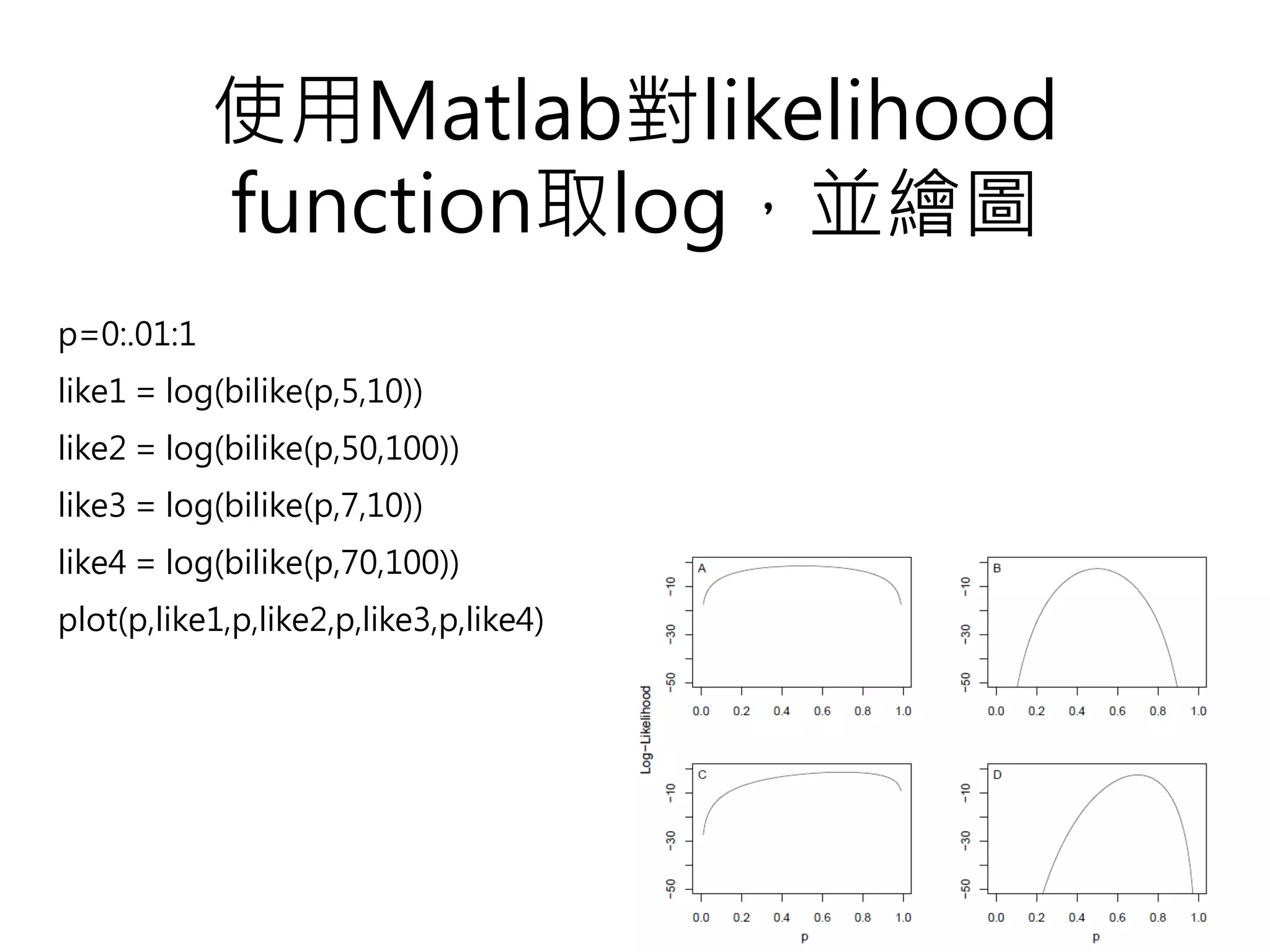
使用Matlab對likelihood
            function取log,並繪圖
p=0:.01:1
like1 = log(bilike(p,5,10))
like2 = log(bilike(p,50,100))
like3 = log(bilike(p,7,10))
like4 = log(bilike(p,70,100))
plot(p,like1,p,like2,p,like3,p,like4)
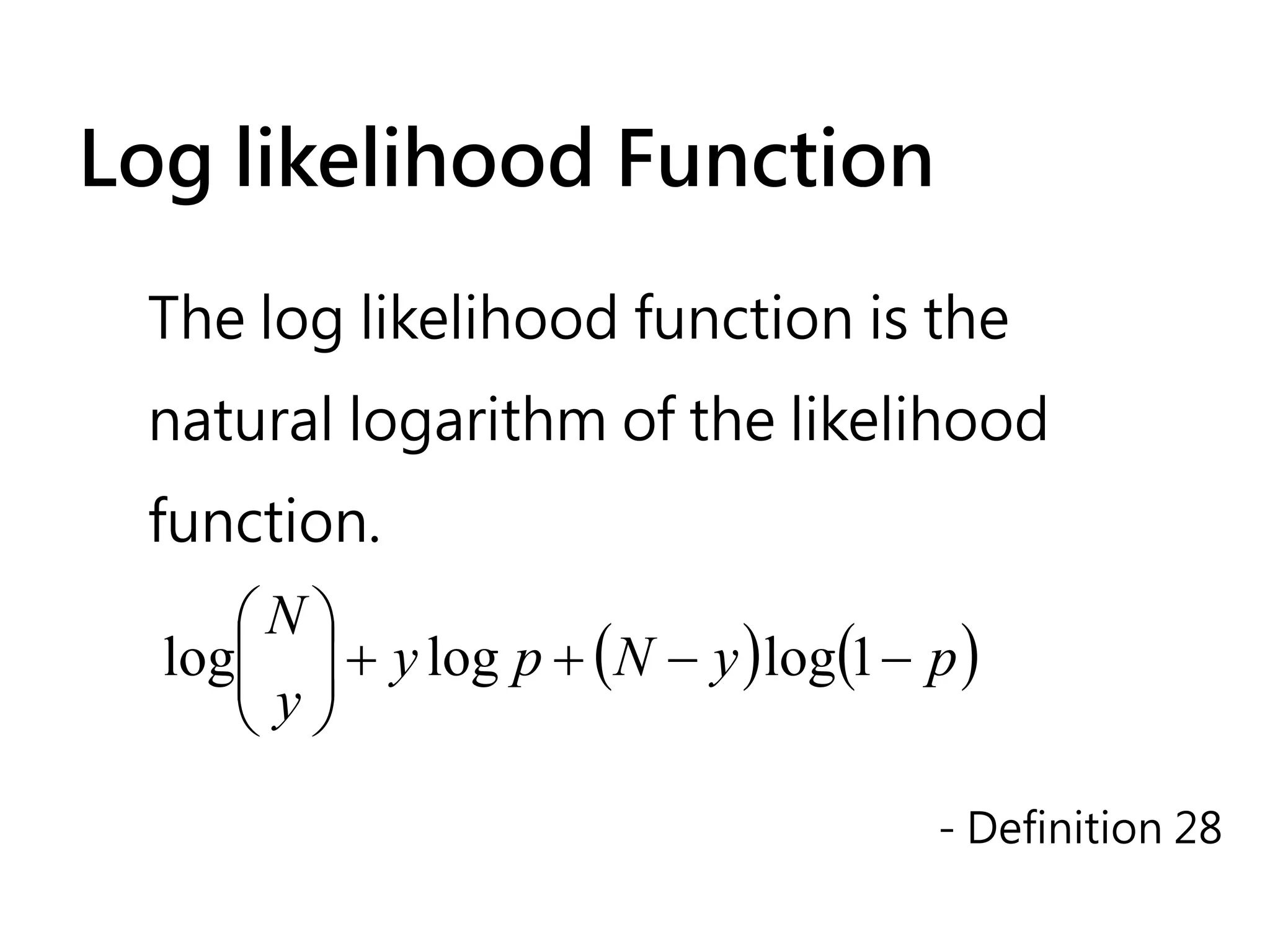
Log likelihood Function

 The log likelihood function is the
 natural logarithm of the likelihood
 function.
     N
  log  + y log p + ( N − y ) log(1 − p )
      y
      
                                       - Definition 28
Log likelihood Function
 對兩種方法都很有用。
有了log likelihood function,接下來要算
   Maximum Likelihood Estimate
2.1.4 Calculus Methods
to find MLEs
  The calculus methods are limited in their
  application and many problems must be
  solved with numerical methods.
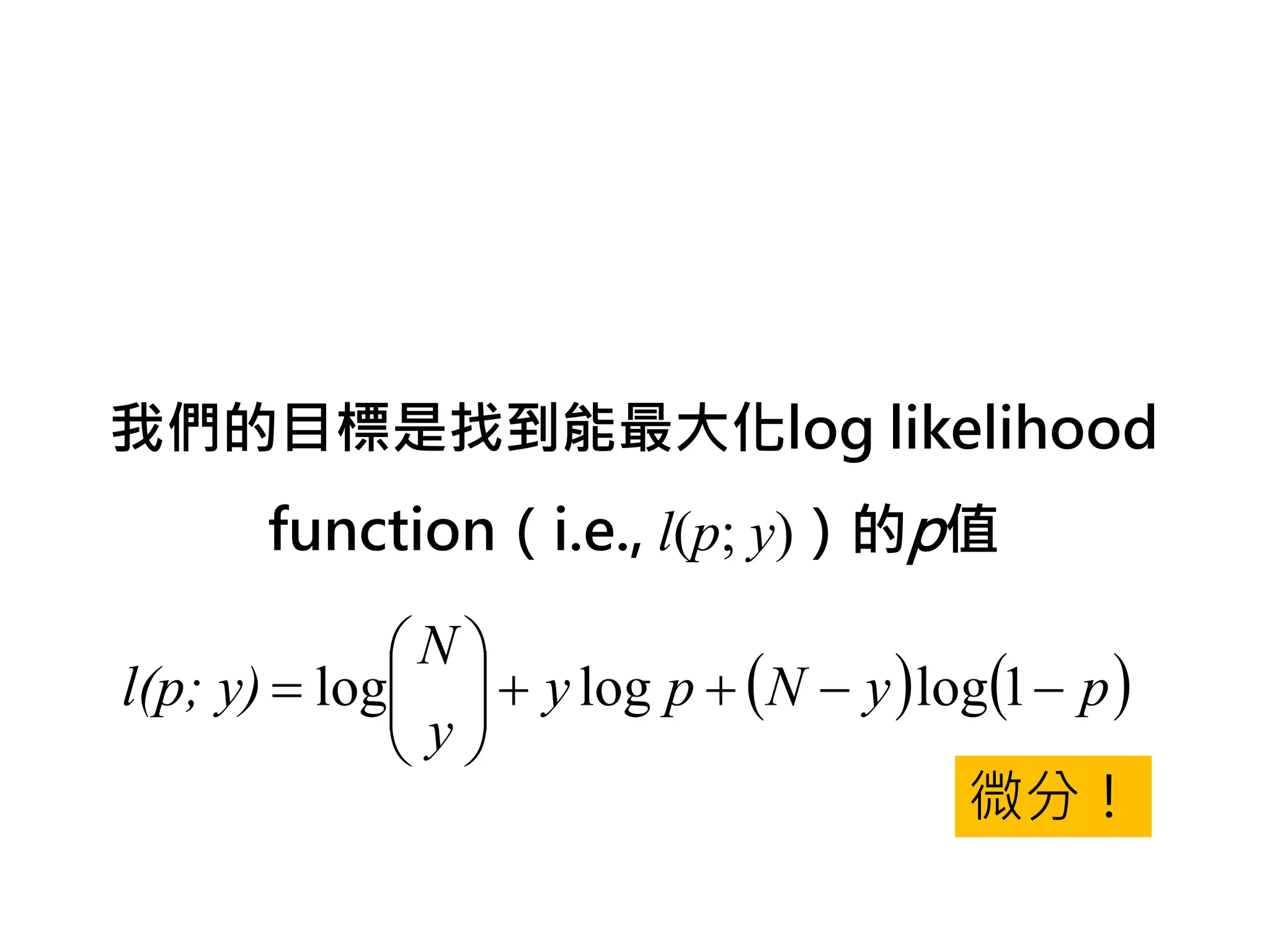
我們的目標是找到能最大化log likelihood
       function(i.e., l(p; y))的p值

             N
l(p; y) = log  + y log p + ( N − y ) log(1 − p )
              y
              
                                         微分!
Step 1. 對p進行微分
 ∂l ( p; y ) ∂   N                                    
            =    log  + y log p + (N − y ) log(1 − p )
     ∂p       ∂p   y 
                                                       
    ∂   N  ∂              ∂
 =    log  + [ y log p ] + [( N − y ) log(1 − p )]
   ∂p   y  ∂p
                            ∂p
     y N−y
 = 0+ −
     p 1− p
   y N−y
 = -
   p 1− p
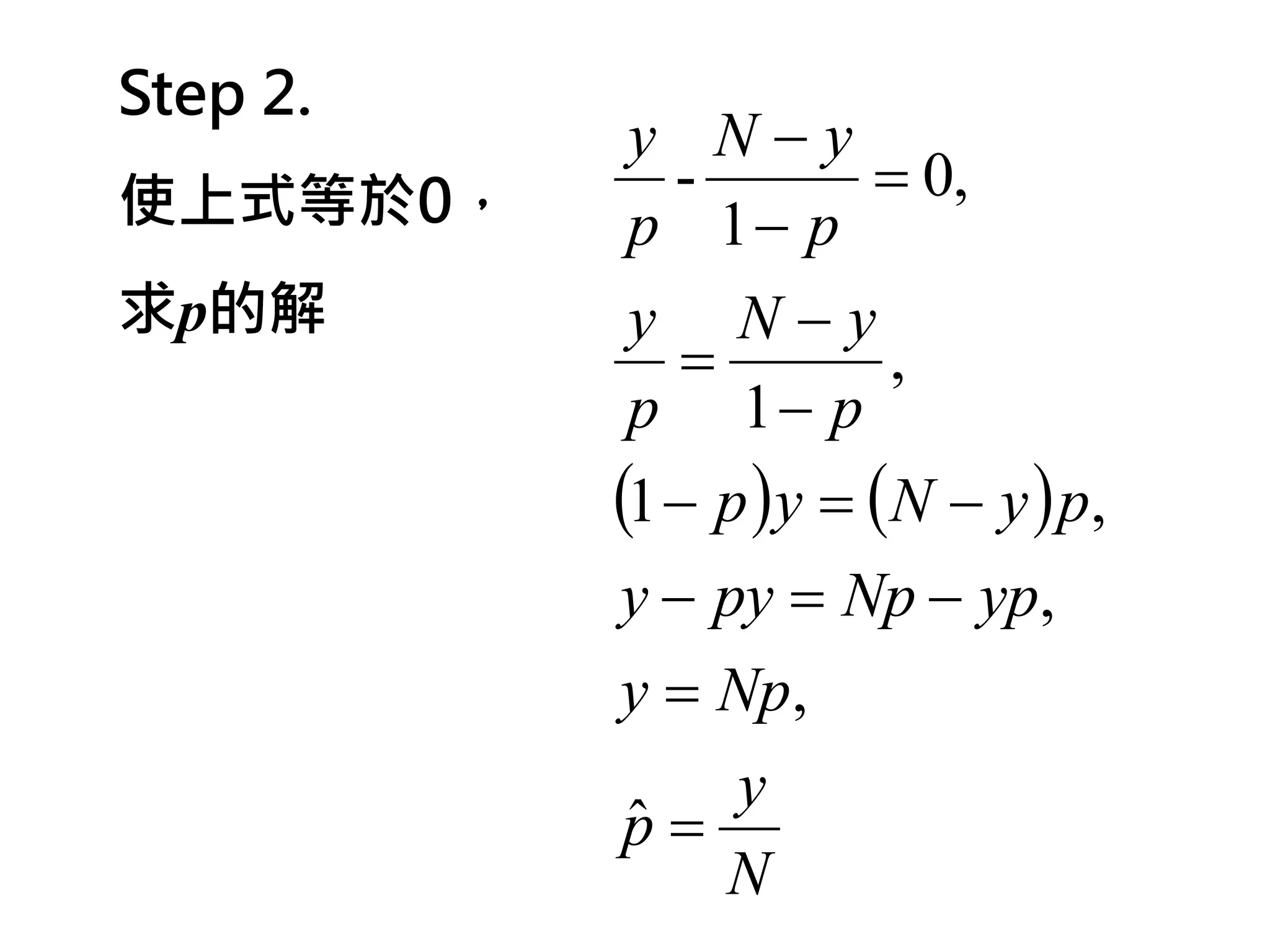
Step 2.
           y N−y
使上式等於0,      -         = 0,
           p 1− p
求p的解       y N−y
              =         ,
           p 1− p
          (1 − p ) y = (N − y ) p,
           y − py = Np − yp,
          y = Np,
             y
          p=
          ˆ
             N
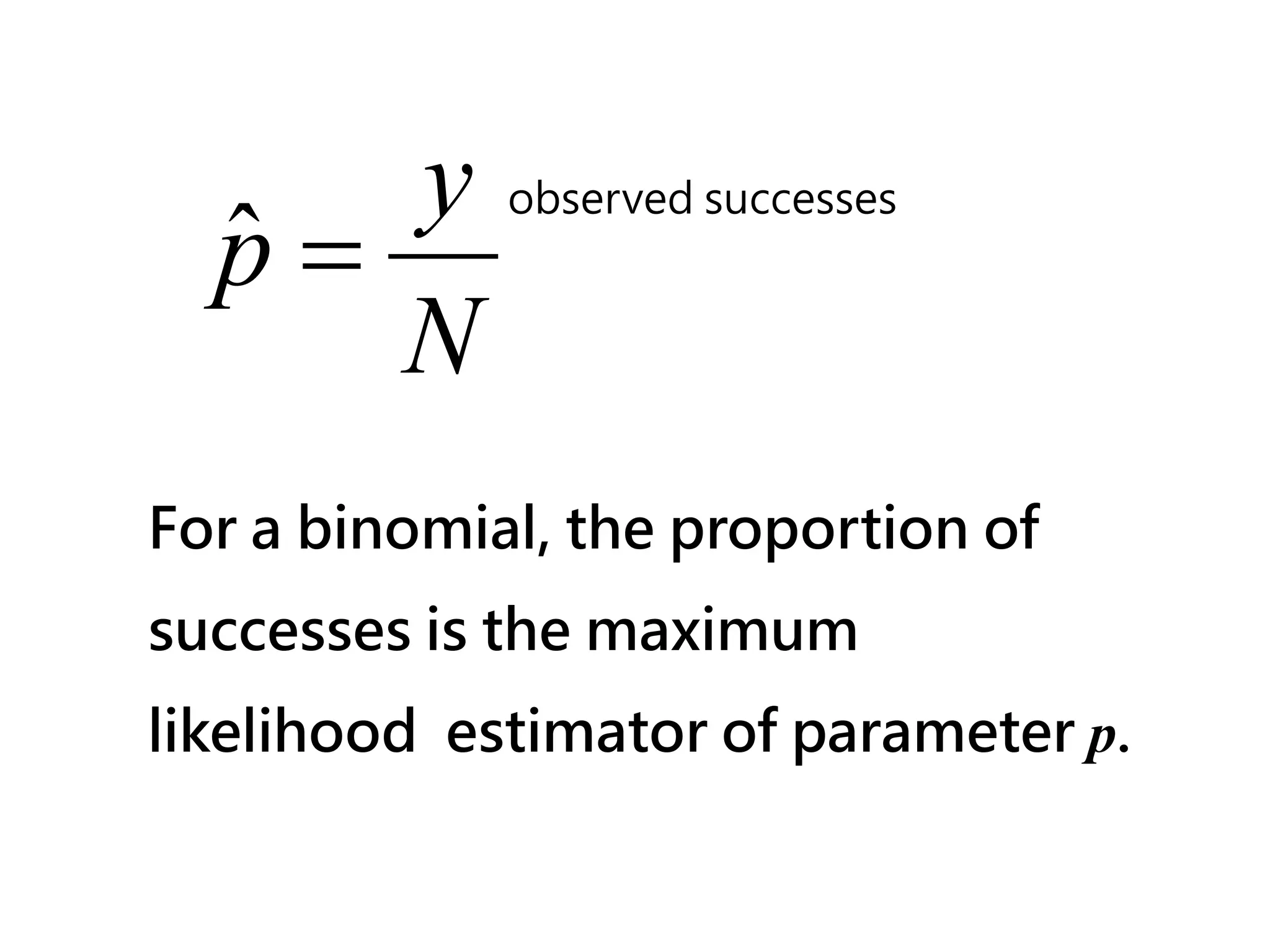
y
  p=
             observed successes
  ˆ
     N
For a binomial, the proportion of
successes is the maximum
likelihood estimator of parameter p.
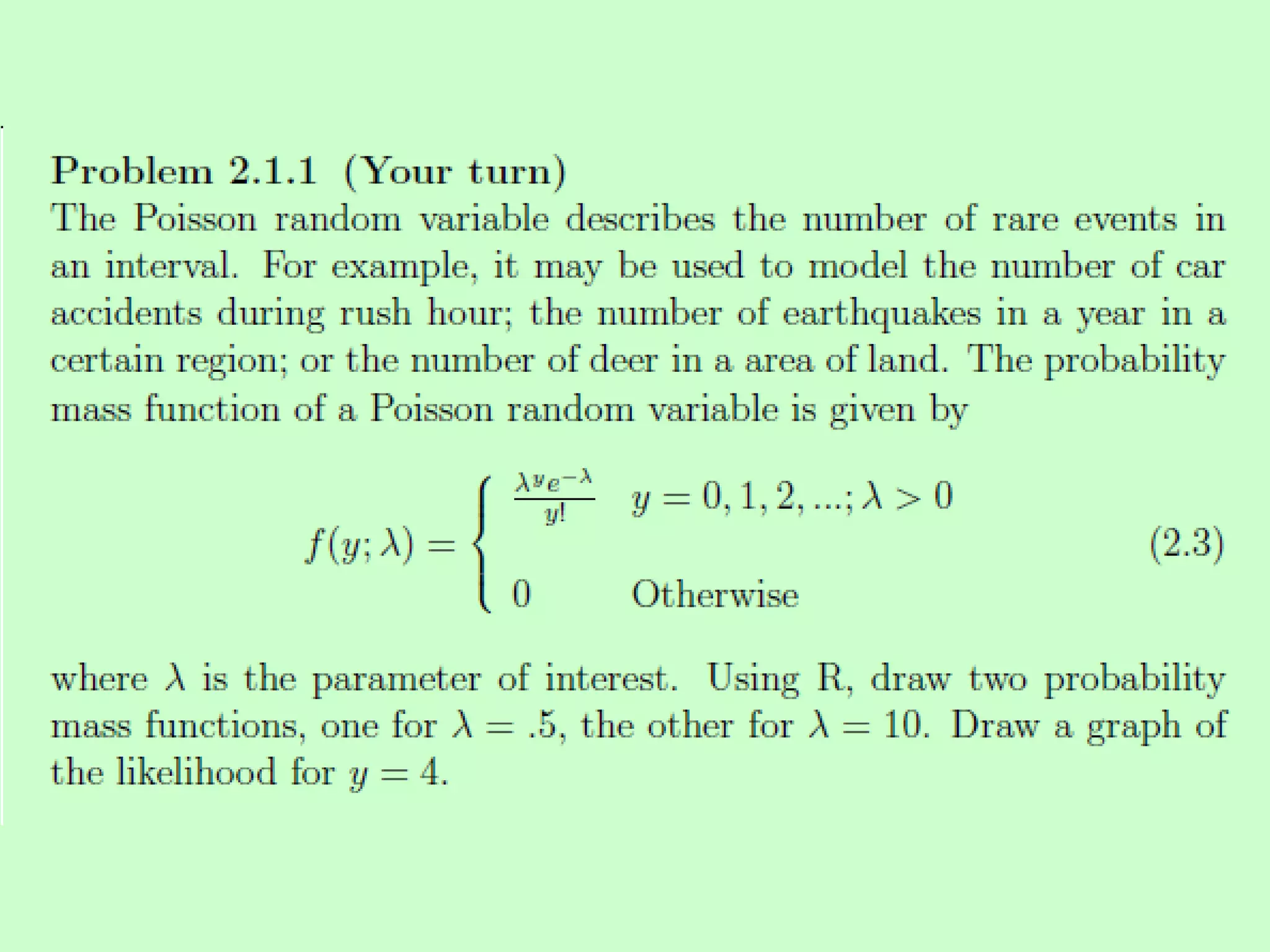
Problem 2.1.2 (Your Turn)
Using calculus methods, derive the
maximum likelihood estimator of
parameter λ in the Poisson distribution
(see Eq. 2.3).

Chapter 2 2.1.4

  • 1.
    Chapter 2 The Likelihood Approach 報告者:胡 元
  • 2.
    1. Define ahierarchy of models. 2. Express the likelihood functions for the models. 3. Find the parameters that maximize the likelihood functions. 4. Compare the values of likelihood to decide which model is best.
  • 3.
  • 4.
    2.1.1 A hierarchyof models Y ∼ Binomial(N, p) -只有一個model,故不用說明model的階層性
  • 5.
    2.1.2 Express thelikelihood function →以投擲吐司的pmf: Pr(Y = y)為例  N y   p (1− p )N − y , y = 0,..., N   y   f ( y; p ) =   , otherwise  0
  • 6.
    pmf   N  p y (1− p )N − y , y = 0,..., N    y    f ( y; p ) =   , otherwise  0 Likelihood Function 相同! N y L( p; y ) =   p (1 − p ) N−y  y  
  • 7.
    Likelihood Function N y L( p; y ) =   p (1 − p ) N−y  y   → L是參數p的likelihood function
  • 8.
    Likelihood Function For adiscrete random variable, the likelihood function is the probability mass function expressed as a function of the parameters. - Definition 26
  • 9.
    5 successes from10 flips 50 successes from 100 flips 7 successes from 10 flips 70 successes from 100 flips
  • 10.
    p=0:.01:1 like1 = bilike(p,5,10)%圖A的binominal likelihood function like2 = bilike(p,50,100) %圖B的binominal likelihood function like3 = bilike(p,7,10) %圖C的binominal likelihood function like4 = bilike(p,70,100) %圖D的binominal likelihood function plot(p,like1,p,like2,p,like3,p,like4) %畫出圖A~D
  • 11.
    5 successes from10 flips 50 successes from 100 flips In Panel A, the maximum of the likelihood (about .25) is far smaller than that in Panel B. In most applications, the actual value of likelihood is not important.
  • 12.
    • 對二項分配來說,likelihood受p和Bernoulli trials 數N所影響。 • 對估計來說,重要的是likelihood function的形狀 和高峰所在的位置(下面有更詳細的討論)。 • 對模型比較來說,likelihood value的不同才重要。
  • 14.
    1. Define ahierarchy of models. 2. Express the likelihood functions for the models. 3. Find the parameters that maximize the likelihood functions. 4. Compare the values of likelihood to decide which model is best.
  • 15.
    2.1.3 Find theparameters that maximize the likelihood
  • 16.
    Maximum Likelihood Estimate Amaximum likelihood (ML) estimate is the parameter value that maximizes the likelihood function for a given set of data. - Definition 27(與前提)
  • 17.
    得到maximum likelihood estimators (MLEs)的兩種基本方法 (1) 使用微積分 (2) 使用數值方法( numerical method ) 來 找到能最大化likelihood的參數
  • 18.
    使用兩種方法前,最大化likelihood需: 取likelihood的自然對數(natural logarithm ) 做為主要使用的函數。 Thefirst step in maximizing a likelihood is to use the natural logarithm of the likelihood (the log likelihood, denoted by l) as the main function of interest.
  • 19.
  • 20.
  • 21.
    如何取binomial的log l (p;y ) = log[L( p; y )] N y L( p; y ) =   p (1 − p ) N−y  y    N  y N−y  = log   p (1 − p )   y    N ( ) ( = log  + log p + log (1 − p )  y y N−y )   N = log  + y log p + ( N − y ) log(1 − p )  y  
  • 22.
    使用Matlab對likelihood function取log,並繪圖 p=0:.01:1 like1 = log(bilike(p,5,10)) like2 = log(bilike(p,50,100)) like3 = log(bilike(p,7,10)) like4 = log(bilike(p,70,100)) plot(p,like1,p,like2,p,like3,p,like4)
  • 23.
    Log likelihood Function The log likelihood function is the natural logarithm of the likelihood function. N log  + y log p + ( N − y ) log(1 − p )  y   - Definition 28
  • 24.
    Log likelihood Function 對兩種方法都很有用。
  • 25.
  • 26.
    2.1.4 Calculus Methods tofind MLEs The calculus methods are limited in their application and many problems must be solved with numerical methods.
  • 27.
    我們的目標是找到能最大化log likelihood function(i.e., l(p; y))的p值 N l(p; y) = log  + y log p + ( N − y ) log(1 − p )  y   微分!
  • 28.
    Step 1. 對p進行微分 ∂l ( p; y ) ∂   N   = log  + y log p + (N − y ) log(1 − p ) ∂p ∂p   y     ∂   N  ∂ ∂ = log  + [ y log p ] + [( N − y ) log(1 − p )] ∂p   y  ∂p   ∂p y N−y = 0+ − p 1− p y N−y = - p 1− p
  • 29.
    Step 2. y N−y 使上式等於0, - = 0, p 1− p 求p的解 y N−y = , p 1− p (1 − p ) y = (N − y ) p, y − py = Np − yp, y = Np, y p= ˆ N
  • 30.
    y p= observed successes ˆ N For a binomial, the proportion of successes is the maximum likelihood estimator of parameter p.
  • 31.
    Problem 2.1.2 (YourTurn) Using calculus methods, derive the maximum likelihood estimator of parameter λ in the Poisson distribution (see Eq. 2.3).