Copyright © 2012 by Pearson Education, Inc.
CHAPTER 16: BEYOND THE SIMPLE SENTENCE: COORDINATION


Copyright © 2012 by Pearson Education, Inc.
CHAPTER OUTLINE AND LEARNING OBJECTIVES

In this chapter, you will learn to:
 identify and apply sentence-combining techniques
   that rely on coordinating conjunctions and conjunctive
   adverbs.


 Copyright © 2012 by Pearson Education, Inc.
AVOIDING SIMPLE SENTENCES
   A group of words containing a subject and a verb is
    called a clause.
   When that group makes sense by itself, it is called a
    sentence or an independent clause.
   The kind of sentence that is one independent clause
    is called a simple sentence.


Copyright © 2012 by Pearson Education, Inc.
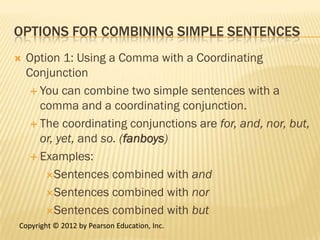
OPTIONS FOR COMBINING SIMPLE SENTENCES
   Option 1: Using a Comma with a Coordinating
    Conjunction
      You can combine two simple sentences with a
       comma and a coordinating conjunction.
      The coordinating conjunctions are for, and, nor, but,
       or, yet, and so. (fanboys)
      Examples:

        Sentences combined with and

        Sentences combined with nor

        Sentences combined with but
Copyright © 2012 by Pearson Education, Inc.
OPTIONS FOR COMBINING SIMPLE SENTENCES
       Sentences   combined with yet
        Sentences combined with so

   Where Does the Comma Go?
     The comma goes before the coordinating
      conjunction.
     The comma goes before the new idea, the second
      independent clause.
     It goes where the first independent clause ends.

     The comma is used when the coordinating
      conjunction joins two independent clauses.
Copyright © 2012 by Pearson Education, Inc.
OPTIONS FOR COMBINING SIMPLE SENTENCES
   Placing the Comma by Using Subject-Verb (S-V)
    Patterns
      Four patterns of the simple sentence:


                            S            V
                           SS            V
                            S           VV
                           SS           VV
Copyright © 2012 by Pearson Education, Inc.
OPTIONS FOR COMBINING SIMPLE SENTENCES

     When    you combine two simple sentences, the
       pattern changes to SVSV.
      This is called a compound sentence.
         Use the comma in front of the coordinating
           conjunction.
   Option 2: Using a Semicolon Between Two Simple
    Sentences
      If you want to join two related simple sentences
       without a coordinating conjunction, you can
       combine them with a semicolon.
Copyright © 2012 by Pearson Education, Inc.
OPTIONS FOR COMBINING SIMPLE SENTENCES

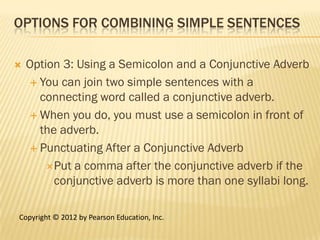
   Option 3: Using a Semicolon and a Conjunctive Adverb
      You can join two simple sentences with a
       connecting word called a conjunctive adverb.
      When you do, you must use a semicolon in front of
       the adverb.
      Punctuating After a Conjunctive Adverb

        Put a comma after the conjunctive adverb if the
          conjunctive adverb is more than one syllabi long.

Copyright © 2012 by Pearson Education, Inc.
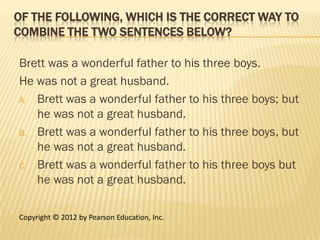
OF THE FOLLOWING, WHICH IS THE CORRECT WAY TO
COMBINE THE TWO SENTENCES BELOW?

Brett was a wonderful father to his three boys.
He was not a great husband.
A. Brett was a wonderful father to his three boys; but
   he was not a great husband.
B. Brett was a wonderful father to his three boys, but
   he was not a great husband.
C. Brett was a wonderful father to his three boys but
   he was not a great husband.

Copyright © 2012 by Pearson Education, Inc.
OF THE FOLLOWING, WHICH IS THE CORRECT WAY TO
COMBINE THE TWO SENTENCES BELOW?
Brett was a wonderful father to his three boys.
He was not a great husband.
A. Brett was a wonderful father to his three boys; but he
   was not a great husband.
B. Brett was a wonderful father to his three boys, but he
   was not a great husband.
C. Brett was a wonderful father to his three boys but he
   was not a great husband.
Identify and apply sentence-combining techniques that
rely on coordinating conjunctions and conjunctive
adverbs.
Copyright © 2012 by Pearson Education, Inc.
OF THE FOLLOWING, WHICH IS THE CORRECT WAY TO
COMBINE THE TWO SENTENCES BELOW?

I grilled the steak.
She baked the potatoes.
A. I grilled the steak; she baked the potatoes.

B.    I grilled the steak, she baked the potatoes.
C. I grilled the steak she baked the potatoes.


Copyright © 2012 by Pearson Education, Inc.
OF THE FOLLOWING, WHICH IS THE CORRECT WAY TO
COMBINE THE TWO SENTENCES BELOW?

I grilled the steak.
She baked the potatoes.
A. I grilled the steak; she baked the potatoes.

B.    I grilled the steak, she baked the potatoes.
C. I grilled the steak she baked the potatoes.


Identify and apply sentence-combining techniques
that rely on coordinating conjunctions and conjunctive
adverbs.
Copyright © 2012 by Pearson Education, Inc.

Chapter 16

  • 1.
    Copyright © 2012by Pearson Education, Inc.
  • 2.
    CHAPTER 16: BEYONDTHE SIMPLE SENTENCE: COORDINATION Copyright © 2012 by Pearson Education, Inc.
  • 3.
    CHAPTER OUTLINE ANDLEARNING OBJECTIVES In this chapter, you will learn to:  identify and apply sentence-combining techniques that rely on coordinating conjunctions and conjunctive adverbs. Copyright © 2012 by Pearson Education, Inc.
  • 4.
    AVOIDING SIMPLE SENTENCES  A group of words containing a subject and a verb is called a clause.  When that group makes sense by itself, it is called a sentence or an independent clause.  The kind of sentence that is one independent clause is called a simple sentence. Copyright © 2012 by Pearson Education, Inc.
  • 5.
    OPTIONS FOR COMBININGSIMPLE SENTENCES  Option 1: Using a Comma with a Coordinating Conjunction  You can combine two simple sentences with a comma and a coordinating conjunction.  The coordinating conjunctions are for, and, nor, but, or, yet, and so. (fanboys)  Examples: Sentences combined with and Sentences combined with nor Sentences combined with but Copyright © 2012 by Pearson Education, Inc.
  • 6.
    OPTIONS FOR COMBININGSIMPLE SENTENCES Sentences combined with yet Sentences combined with so  Where Does the Comma Go?  The comma goes before the coordinating conjunction.  The comma goes before the new idea, the second independent clause.  It goes where the first independent clause ends.  The comma is used when the coordinating conjunction joins two independent clauses. Copyright © 2012 by Pearson Education, Inc.
  • 7.
    OPTIONS FOR COMBININGSIMPLE SENTENCES  Placing the Comma by Using Subject-Verb (S-V) Patterns  Four patterns of the simple sentence: S V SS V S VV SS VV Copyright © 2012 by Pearson Education, Inc.
  • 8.
    OPTIONS FOR COMBININGSIMPLE SENTENCES  When you combine two simple sentences, the pattern changes to SVSV.  This is called a compound sentence. Use the comma in front of the coordinating conjunction.  Option 2: Using a Semicolon Between Two Simple Sentences  If you want to join two related simple sentences without a coordinating conjunction, you can combine them with a semicolon. Copyright © 2012 by Pearson Education, Inc.
  • 9.
    OPTIONS FOR COMBININGSIMPLE SENTENCES  Option 3: Using a Semicolon and a Conjunctive Adverb  You can join two simple sentences with a connecting word called a conjunctive adverb.  When you do, you must use a semicolon in front of the adverb.  Punctuating After a Conjunctive Adverb Put a comma after the conjunctive adverb if the conjunctive adverb is more than one syllabi long. Copyright © 2012 by Pearson Education, Inc.
  • 10.
    OF THE FOLLOWING,WHICH IS THE CORRECT WAY TO COMBINE THE TWO SENTENCES BELOW? Brett was a wonderful father to his three boys. He was not a great husband. A. Brett was a wonderful father to his three boys; but he was not a great husband. B. Brett was a wonderful father to his three boys, but he was not a great husband. C. Brett was a wonderful father to his three boys but he was not a great husband. Copyright © 2012 by Pearson Education, Inc.
  • 11.
    OF THE FOLLOWING,WHICH IS THE CORRECT WAY TO COMBINE THE TWO SENTENCES BELOW? Brett was a wonderful father to his three boys. He was not a great husband. A. Brett was a wonderful father to his three boys; but he was not a great husband. B. Brett was a wonderful father to his three boys, but he was not a great husband. C. Brett was a wonderful father to his three boys but he was not a great husband. Identify and apply sentence-combining techniques that rely on coordinating conjunctions and conjunctive adverbs. Copyright © 2012 by Pearson Education, Inc.
  • 12.
    OF THE FOLLOWING,WHICH IS THE CORRECT WAY TO COMBINE THE TWO SENTENCES BELOW? I grilled the steak. She baked the potatoes. A. I grilled the steak; she baked the potatoes. B. I grilled the steak, she baked the potatoes. C. I grilled the steak she baked the potatoes. Copyright © 2012 by Pearson Education, Inc.
  • 13.
    OF THE FOLLOWING,WHICH IS THE CORRECT WAY TO COMBINE THE TWO SENTENCES BELOW? I grilled the steak. She baked the potatoes. A. I grilled the steak; she baked the potatoes. B. I grilled the steak, she baked the potatoes. C. I grilled the steak she baked the potatoes. Identify and apply sentence-combining techniques that rely on coordinating conjunctions and conjunctive adverbs. Copyright © 2012 by Pearson Education, Inc.

Editor's Notes

  • #4 Review chapter objectives.
  • #5 Discuss simple sentences
  • #6 Discuss Option 1 for combining simple sentences.
  • #7 Discuss options for combining simple sentences.
  • #8 Discuss the four patterns of the simple sentence.
  • #9 Discuss the compound sentence.Discuss Option 2 for combining simple sentences.
  • #10 Discuss Option 3 for combining simple sentences.