





Simple/Compound
   Sentences &
  Conjunctions
Simple Sentence
Simple Sentence
•   A simple sentence is a sentence that
    expresses ONLY ONE complete
    thought.
Simple Sentence
•   A simple sentence is a sentence that
    expresses ONLY ONE complete
    thought.
• The subject or predicate may be
    simple or compound.
Simple Sentence
•   A simple sentence is a sentence that
    expresses ONLY ONE complete
    thought.
• The subject or predicate may be
    simple or compound.
 • EX: Mr. Alfonso went shopping at
     Arden Fair Mall.
Compound Sentence
Compound Sentence

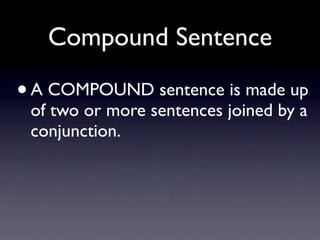
• A COMPOUND sentence is made up
 of two or more sentences joined by a
 conjunction.
Compound Sentence

• A COMPOUND sentence is made up
 of two or more sentences joined by a
 conjunction.
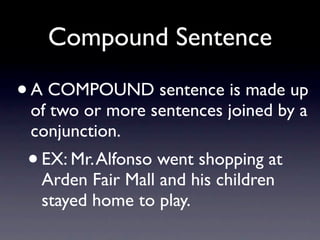
 •   EX: Mr. Alfonso went shopping at
     Arden Fair Mall and his children
     stayed home to play.
Coordinating
Conjunctions
Coordinating
         Conjunctions
• Joins words or groups of words that
 have EQUAL importance in a sentence
Coordinating
         Conjunctions
• Joins words or groups of words that
 have EQUAL importance in a sentence
• “Diego AND Irene are in-line skating”
Coordinating
         Conjunctions
• Joins words or groups of words that
 have EQUAL importance in a sentence
• “Diego AND Irene are in-line skating”
• Coordinating Conjunctions include:
Coordinating
         Conjunctions
• Joins words or groups of words that
 have EQUAL importance in a sentence
• “Diego AND Irene are in-line skating”
• Coordinating Conjunctions include:
  • and, but, or, nor, yet, and for.
“and”
“and”
• Use “and” if you’re joining a group of words
  together that have equal importance.
“and”
• Use “and” if you’re joining a group of words
  together that have equal importance.
 • EX: I bought apples, oranges, and bananas.
“and”
• Use “and” if you’re joining a group of words
  together that have equal importance.
 • EX: I bought apples, oranges, and bananas.
• Use “and if you’re joining two sentences
  together.
“and”
• Use “and” if you’re joining a group of words
  together that have equal importance.
 • EX: I bought apples, oranges, and bananas.
• Use “and if you’re joining two sentences
  together.
 • EX: I bought groceries and Valerie bought
   clothes.
“or”
“or”

• Use “or” to indicate choice.
“or”

• Use “or” to indicate choice.
 • EX: Buying a car, I had to choose
   from Honda, Nissan or Toyota.
“or”

• Use “or” to indicate choice.
 • EX: Buying a car, I had to choose
     from Honda, Nissan or Toyota.
 •   EX: She wasn’t sure if she should
     purchase red, yellow, or green.
“but”
“but”
• Use “but” to indicate the intention of
  something happening and ends up not
  happening.
“but”
• Use “but” to indicate the intention of
  something happening and ends up not
  happening.
 •   EX: He decided to ask Riley to dance,
     but chickened out at the last moment.
“but”
• Use “but” to indicate the intention of
  something happening and ends up not
  happening.
 •   EX: He decided to ask Riley to dance,
     but chickened out at the last moment.
 • EX: Mindy wore her blue hat to work,
     but decided to wear a scarf instead.
Conjunctions

Conjunctions

  • 2.
    Simple/Compound Sentences & Conjunctions
  • 3.
  • 4.
    Simple Sentence • A simple sentence is a sentence that expresses ONLY ONE complete thought.
  • 5.
    Simple Sentence • A simple sentence is a sentence that expresses ONLY ONE complete thought. • The subject or predicate may be simple or compound.
  • 6.
    Simple Sentence • A simple sentence is a sentence that expresses ONLY ONE complete thought. • The subject or predicate may be simple or compound. • EX: Mr. Alfonso went shopping at Arden Fair Mall.
  • 7.
  • 8.
    Compound Sentence • ACOMPOUND sentence is made up of two or more sentences joined by a conjunction.
  • 9.
    Compound Sentence • ACOMPOUND sentence is made up of two or more sentences joined by a conjunction. • EX: Mr. Alfonso went shopping at Arden Fair Mall and his children stayed home to play.
  • 10.
  • 11.
    Coordinating Conjunctions • Joins words or groups of words that have EQUAL importance in a sentence
  • 12.
    Coordinating Conjunctions • Joins words or groups of words that have EQUAL importance in a sentence • “Diego AND Irene are in-line skating”
  • 13.
    Coordinating Conjunctions • Joins words or groups of words that have EQUAL importance in a sentence • “Diego AND Irene are in-line skating” • Coordinating Conjunctions include:
  • 14.
    Coordinating Conjunctions • Joins words or groups of words that have EQUAL importance in a sentence • “Diego AND Irene are in-line skating” • Coordinating Conjunctions include: • and, but, or, nor, yet, and for.
  • 15.
  • 16.
    “and” • Use “and”if you’re joining a group of words together that have equal importance.
  • 17.
    “and” • Use “and”if you’re joining a group of words together that have equal importance. • EX: I bought apples, oranges, and bananas.
  • 18.
    “and” • Use “and”if you’re joining a group of words together that have equal importance. • EX: I bought apples, oranges, and bananas. • Use “and if you’re joining two sentences together.
  • 19.
    “and” • Use “and”if you’re joining a group of words together that have equal importance. • EX: I bought apples, oranges, and bananas. • Use “and if you’re joining two sentences together. • EX: I bought groceries and Valerie bought clothes.
  • 20.
  • 21.
    “or” • Use “or”to indicate choice.
  • 22.
    “or” • Use “or”to indicate choice. • EX: Buying a car, I had to choose from Honda, Nissan or Toyota.
  • 23.
    “or” • Use “or”to indicate choice. • EX: Buying a car, I had to choose from Honda, Nissan or Toyota. • EX: She wasn’t sure if she should purchase red, yellow, or green.
  • 24.
  • 25.
    “but” • Use “but”to indicate the intention of something happening and ends up not happening.
  • 26.
    “but” • Use “but”to indicate the intention of something happening and ends up not happening. • EX: He decided to ask Riley to dance, but chickened out at the last moment.
  • 27.
    “but” • Use “but”to indicate the intention of something happening and ends up not happening. • EX: He decided to ask Riley to dance, but chickened out at the last moment. • EX: Mindy wore her blue hat to work, but decided to wear a scarf instead.