chapter  15 Speaking to Persuade
Persuasion Creating, reinforcing, changing people's beliefs or actions
Ethics & Persuasion Ethical goals Ethical methods
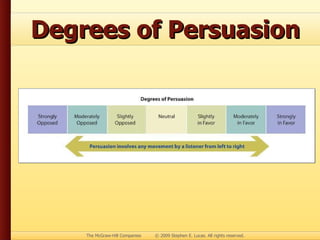
Degrees of Persuasion
Mental Dialogue with Audience Mental give & take between speaker and listener
Target Audience Portion of audience speaker most wants to persuade
Persuasive Speeches Questions of fact Questions of value Questions of policy
Question of Fact Truth or falsity of assertion
Question of Fact Specific Purpose: To persuade my audience that an earthquake of 9.0 or above on the Richter scale will hit California in the next ten years.
Question of Fact California is overdue for a major earthquake. Many geological signs indicate that a major earthquake may happen soon. Experts agree that a major earthquake could hit California any day.
Question of Value Question about worth, rightness of idea or action
Question of Value Specific Purpose: To persuade my audience that capital punishment is morally and legally wrong.
Question of Value Capital punishment violates the biblical commandment “Thou shalt not kill.” Capital punishment violates the constitutional ban on “cruel and unusual punishment.”
Question of Policy Whether course of action should or should not be taken
Speeches on Questions of Policy Passive agreement Immediate action
Passive Agreement Convince audience policy is desirable  Don’t encourage action to support policy
Passive Agreement “ To persuade my audience there should be stricter safety standards on amusement-park rides.”
Immediate Action Convince audience to act in support of policy
Immediate Action “ To persuade my audience to become literacy tutors.”
Basic Issues of Policy Speeches Need Plan Practicality
Need Is there a problem that requires change from current policy?
Plan What is speaker’s plan to solve the problem with current policy?
Practicality Will speaker’s plan solve problem?  Will speaker’s plan create new problems?
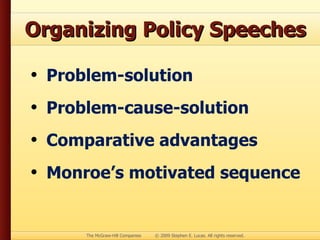
Organizing Policy Speeches Problem-solution Problem-cause-solution Comparative advantages Monroe’s motivated sequence
Problem-Solution Main Point I: Documents existence of problem. Main Point II: Presents solution to problem.
Problem-Solution Specific Purpose: To persuade my audience that the use of antibacterial chemicals in household products is creating health and environmental problems.
Problem-Solution The use of antibacterial chemicals in household products is a serious problem. Solving these problems requires a combination of government and consumer action.
Problem-Cause-Solution Main Point I: Documents existence of problem Main Point II: Analyzes causes of problem Main Point III: Presents solution to problem
Problem-Cause-Solution Specific Purpose: To persuade my audience that the age for full motor-vehicle driving privileges should be raised to 18.
Problem-Cause-Solution Accidents and death involving teenage drivers is a serious national problem. There are four main causes of the problem. We can solve these problems by raising the age for full driving privileges to 18.
Comparative Advantages Each main point explains why speaker's solution is preferable to other solutions
Comparative Advantages Order Specific Purpose: To persuade my audience that automakers should emphasize developing hydrogen fuel-cell cars more than gas-electric cars.
Comparative Advantages Order Unlike hybrid cars, hydrogen cars run entirely without gasoline. Unlike hybrid cars, hydrogen cars do not emit any air-polluting exhaust.
Monroe’s Motivated Sequence Five-step sequence for organizing speeches that seek immediate action
Monroe’s Motivated Sequence Attention: Gain attention Need: Show need for change Satisfaction: Provide solution to need
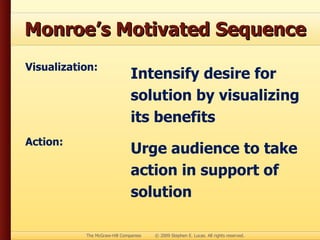
Monroe’s Motivated Sequence Visualization: Intensify desire for solution by visualizing its benefits Action: Urge audience to take action in support of solution

Chapter 15 - Speaking to Persuade