
Religion and Sociology
Ch. 14, Sec. 1
pp. 464-466
What is Religion?
Religion is a unified system of beliefs
and practices concerned with sacred
things, exists in every known society
Sacred-meaning transcends immediate
existence, holy
Profane-normal, commonplace
Sacred can become profane and vice
versa
How do sociologists use
religion?
Sociologists avoid spiritual side of
religion; too complicated and
abstract to evaluate
Study social dimensions of
religion
Religion’s influence on society
Must put aside own belief system
Theoretical Perspectives
and Religion
Ch. 14, Sec. 2
pp. 467-473
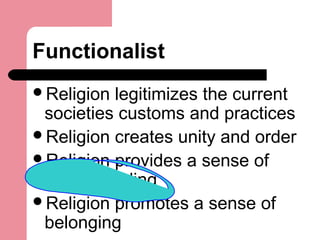
Functionalist
Religion legitimizes the current
societies customs and practices
Religion creates unity and order
Religion provides a sense of
understanding
Religion promotes a sense of
belonging
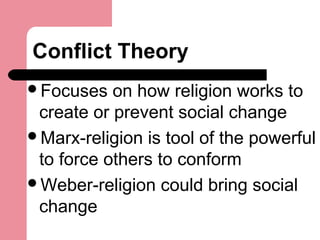
Conflict Theory
Focuses on how religion works to
create or prevent social change
Marx-religion is tool of the powerful
to force others to conform
Weber-religion could bring social
change
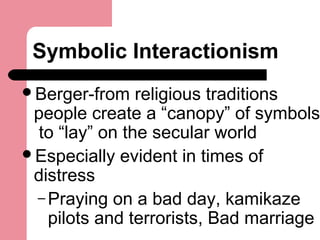
Symbolic Interactionism
Berger-from religious traditions
people create a “canopy” of symbols
to “lay” on the secular world
Especially evident in times of
distress
– Praying on a bad day, kamikaze
pilots and terrorists, Bad marriage
Religious Organization
and Religiosity
Ch. 14, Sec. 3
pp. 475-480
Thursday
Start Here
Religious Organizations
4 Types of Organizations
*according to sociologists
– Church
– Denomination
– Sect
– Cult
Church
A life encompassing religious
organization to which all members
of a society belong
Exists when religion and state are
mixed
Denomination
One of several religious
organizations accepted as
legitimate
Membership is voluntary
Competition for members
Often accept norms and values of
secular state and society
Sect
Religious organization created to
reform the “parent/main” group
Members generally believe the main
group is losing some traditions and
attempts to keep them
Amish, Assemblies of God, Pilgrims
Cult
Characteristics are not drawn
from a previous group, new belief
Extremes are most visible (Waco
Branch Davidians, Heaven’s Gate,
Uganda)
Many are more conventional
(Scientology, Unification)
 As a class, Read p. 476-477
 On a separate sheet of paper, write down
why teenagers are more likely to be singled
out to join a cult. (3-5 minutes) Complete
sentences and thoughts.
 After you write your paragraph, get together
with a person next to you and compare your
answers (3-5 minutes)
Thursday
END Here
Religiosity
Glock/Stark identified 5 dimensions
by which people express their
religious interests and convictions
– Beliefs-what someone considers to
be true
– Ritual-a religious practice members
are expected to perform
Dimensions of Religiosity
– Intellectual Dimension-knowing the
scripture and religious aspects of
human existence
– Experience-feelings attached to
religious expression
Dimensions of Religiosity
– Consequences-decisions and
commitments people make based
on their beliefs, rituals, knowledge,
or experience
– Consequences can be:
Public: opposing abortion
Private: sexual abstinence
Religion in the
United States
Ch. 14, Sec. 4
pp. 481-488
Development in the U.S.
First immigrants to U.S. sought
religious freedom
Founding fathers, although
religious, recognized the
importance of a secularized gov’t
not associated with religion
Secularization in the U.S.
Many believe that religion is no
longer as important in U.S. Society
America does appear to be
religious when compared to other
industrial countries
96% of population believe in a
“higher power”
Religious Preferences in
the U.S.
58% are Protestant
– Baptist, Methodist, Lutheran are
largest
– 300 denominations and sects
25% are Catholic, but are the
largest single denomination
Fundamentalism
Membership in groups who resist
secularization and practice
traditional beliefs and rituals is
increasing
Fundamentalism exists in all
religions
Protestant Fundamentalism
Politically conservative
Began in 19th
century over spread
of scientific beliefs like Darwinism
and the teachings of Marx
Rejected movement away from
traditional teachings to an
emphasis on social service
Protestant Fundamentalism
While mainstream denominations
(Methodist, Lutheran, Presbyterian)
are losing members….
Fundamentalists are growing
(Mormons, Assembly of God,
Baptists, Jehovah Witnesses)
Fundamentalist Beliefs
Believe in literal truth of the
scriptures
Belief that world is out of control
and lost its morals
Do not accommodate to
mainstream society like mainline
denominations
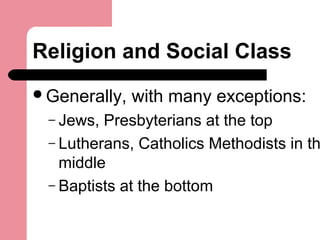
Religion and Social Class
Generally, with many exceptions:
– Jews, Presbyterians at the top
– Lutherans, Catholics Methodists in th
middle
– Baptists at the bottom
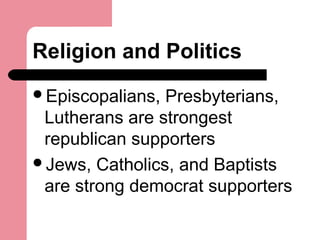
Religion and Politics
Episcopalians, Presbyterians,
Lutherans are strongest
republican supporters
Jews, Catholics, and Baptists
are strong democrat supporters
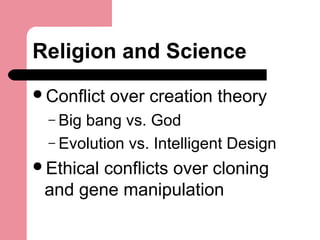
Religion and Science
Conflict over creation theory
– Big bang vs. God
– Evolution vs. Intelligent Design
Ethical conflicts over cloning
and gene manipulation

Chapter 14 religion

  • 1.
    Religion and Sociology Ch.14, Sec. 1 pp. 464-466
  • 2.
    What is Religion? Religionis a unified system of beliefs and practices concerned with sacred things, exists in every known society Sacred-meaning transcends immediate existence, holy Profane-normal, commonplace Sacred can become profane and vice versa
  • 3.
    How do sociologistsuse religion? Sociologists avoid spiritual side of religion; too complicated and abstract to evaluate Study social dimensions of religion Religion’s influence on society Must put aside own belief system
  • 4.
  • 5.
    Functionalist Religion legitimizes thecurrent societies customs and practices Religion creates unity and order Religion provides a sense of understanding Religion promotes a sense of belonging
  • 6.
    Conflict Theory Focuses onhow religion works to create or prevent social change Marx-religion is tool of the powerful to force others to conform Weber-religion could bring social change
  • 7.
    Symbolic Interactionism Berger-from religioustraditions people create a “canopy” of symbols to “lay” on the secular world Especially evident in times of distress – Praying on a bad day, kamikaze pilots and terrorists, Bad marriage
  • 8.
    Religious Organization and Religiosity Ch.14, Sec. 3 pp. 475-480 Thursday Start Here
  • 9.
    Religious Organizations 4 Typesof Organizations *according to sociologists – Church – Denomination – Sect – Cult
  • 10.
    Church A life encompassingreligious organization to which all members of a society belong Exists when religion and state are mixed
  • 11.
    Denomination One of severalreligious organizations accepted as legitimate Membership is voluntary Competition for members Often accept norms and values of secular state and society
  • 12.
    Sect Religious organization createdto reform the “parent/main” group Members generally believe the main group is losing some traditions and attempts to keep them Amish, Assemblies of God, Pilgrims
  • 13.
    Cult Characteristics are notdrawn from a previous group, new belief Extremes are most visible (Waco Branch Davidians, Heaven’s Gate, Uganda) Many are more conventional (Scientology, Unification)
  • 14.
     As aclass, Read p. 476-477  On a separate sheet of paper, write down why teenagers are more likely to be singled out to join a cult. (3-5 minutes) Complete sentences and thoughts.  After you write your paragraph, get together with a person next to you and compare your answers (3-5 minutes) Thursday END Here
  • 15.
    Religiosity Glock/Stark identified 5dimensions by which people express their religious interests and convictions – Beliefs-what someone considers to be true – Ritual-a religious practice members are expected to perform
  • 16.
    Dimensions of Religiosity –Intellectual Dimension-knowing the scripture and religious aspects of human existence – Experience-feelings attached to religious expression
  • 17.
    Dimensions of Religiosity –Consequences-decisions and commitments people make based on their beliefs, rituals, knowledge, or experience – Consequences can be: Public: opposing abortion Private: sexual abstinence
  • 18.
    Religion in the UnitedStates Ch. 14, Sec. 4 pp. 481-488
  • 19.
    Development in theU.S. First immigrants to U.S. sought religious freedom Founding fathers, although religious, recognized the importance of a secularized gov’t not associated with religion
  • 20.
    Secularization in theU.S. Many believe that religion is no longer as important in U.S. Society America does appear to be religious when compared to other industrial countries 96% of population believe in a “higher power”
  • 21.
    Religious Preferences in theU.S. 58% are Protestant – Baptist, Methodist, Lutheran are largest – 300 denominations and sects 25% are Catholic, but are the largest single denomination
  • 22.
    Fundamentalism Membership in groupswho resist secularization and practice traditional beliefs and rituals is increasing Fundamentalism exists in all religions
  • 23.
    Protestant Fundamentalism Politically conservative Beganin 19th century over spread of scientific beliefs like Darwinism and the teachings of Marx Rejected movement away from traditional teachings to an emphasis on social service
  • 24.
    Protestant Fundamentalism While mainstreamdenominations (Methodist, Lutheran, Presbyterian) are losing members…. Fundamentalists are growing (Mormons, Assembly of God, Baptists, Jehovah Witnesses)
  • 25.
    Fundamentalist Beliefs Believe inliteral truth of the scriptures Belief that world is out of control and lost its morals Do not accommodate to mainstream society like mainline denominations
  • 26.
    Religion and SocialClass Generally, with many exceptions: – Jews, Presbyterians at the top – Lutherans, Catholics Methodists in th middle – Baptists at the bottom
  • 27.
    Religion and Politics Episcopalians,Presbyterians, Lutherans are strongest republican supporters Jews, Catholics, and Baptists are strong democrat supporters
  • 28.
    Religion and Science Conflictover creation theory – Big bang vs. God – Evolution vs. Intelligent Design Ethical conflicts over cloning and gene manipulation