World Religions An introduction to seeing the similarities and differences
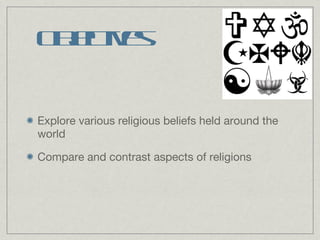
Objectives Explore various religious beliefs held around the world Compare and contrast aspects of religions
Vocabulary animism  - the belief that natural objects possess a soul or spirit. shamanism  - belief in an unseen world of gods, demons and ancestral spirits responsive only to a shaman. theism  - belief in the existence of a God or gods. religion  - a personal set or system of religious attitudes, beliefs and practices. theocracy  - a government ruled by or subject to religious authority.
In the beginning... The most basic, primitive form of religious belief is found in  animism . Some primitive societies in Africa and South America are animistic. Contact with the natural world is most important - respect for nature Native American tribes - many included Shamans.  Animism with a person who understands and guides access to these spirits is  shamanism.
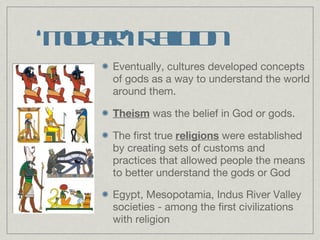
‘ Modern’ Religion Eventually, cultures developed concepts of gods as a way to understand the world around them. Theism  was the belief in God or gods. The first true  religions  were established by creating sets of customs and practices that allowed people the means to better understand the gods or God Egypt, Mesopotamia, Indus River Valley societies - among the first civilizations with religion
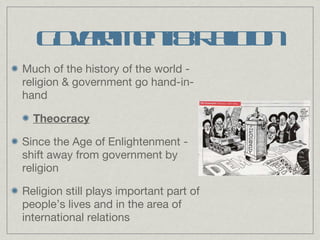
Government & Religion Much of the history of the world - religion & government go hand-in-hand Theocracy Since the Age of Enlightenment - shift away from government by religion Religion still plays important part of people’s lives and in the area of international relations
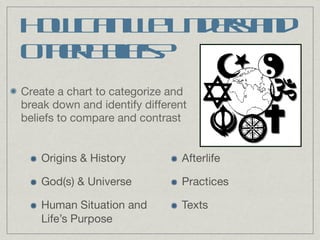
How Can We Understand Other Beliefs? Create a chart to categorize and break down and identify different beliefs to compare and contrast
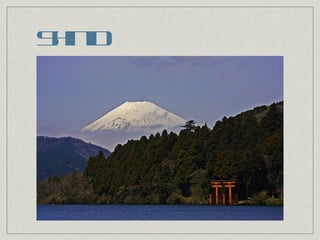
Shinto
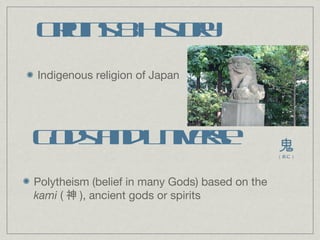
Origins & History Indigenous religion of Japan Gods and Universe Polytheism (belief in many Gods) based on the  kami  ( 神 ), ancient gods or spirits 鬼 (おに)
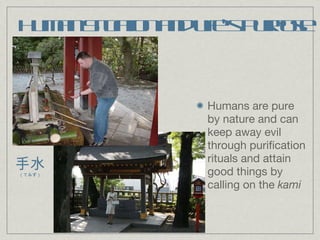
Human Situation and Life’s Purpose Humans are pure by nature and can keep away evil through purification rituals and attain good things by calling on the  kami 手水 (てみず)
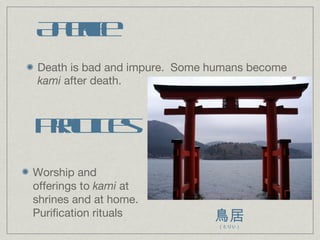
Afterlife Death is bad and impure.  Some humans become  kami  after death. Practices Worship and offerings to  kami  at shrines and at home.  Purification rituals 鳥居 (とりい)
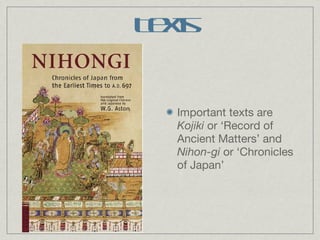
Texts Important texts are  Kojiki  or ‘Record of Ancient Matters’ and  Nihon-gi  or ‘Chronicles of Japan’
Buddhism
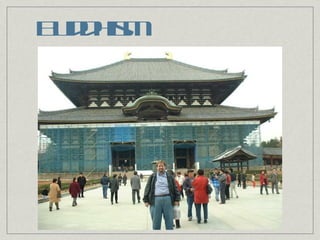
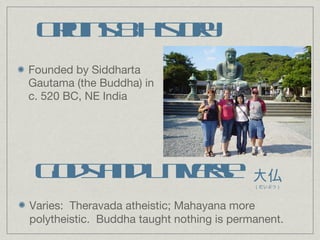
Origins & History Founded by Siddharta Gautama (the Buddha) in c. 520 BC, NE India Gods and Universe Varies:  Theravada atheistic; Mahayana more polytheistic.  Buddha taught nothing is permanent. 大仏 (だいぶつ)
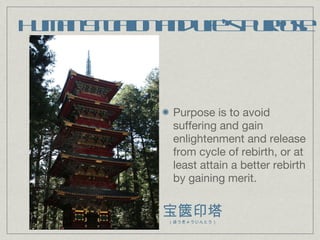
Human Situation and Life’s Purpose Purpose is to avoid suffering and gain enlightenment and release from cycle of rebirth, or at least attain a better rebirth by gaining merit. 宝篋印塔 (ほうきょういんとう)
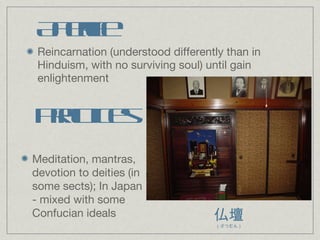
Afterlife Reincarnation (understood differently than in Hinduism, with no surviving soul) until gain enlightenment Practices Meditation, mantras, devotion to deities (in some sects); In Japan - mixed with some Confucian ideals 仏壇 (ぶつだん)
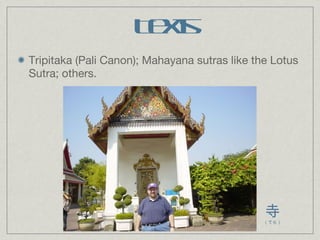
Texts Tripitaka (Pali Canon); Mahayana sutras like the Lotus Sutra; others. 寺 (てら)
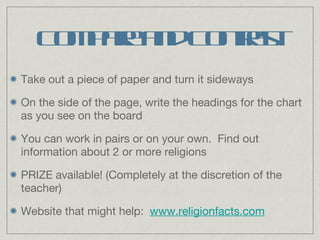
Compare and Contrast Take out a piece of paper and turn it sideways On the side of the page, write the headings for the chart as you see on the board You can work in pairs or on your own.  Find out information about 2 or more religions PRIZE available! (Completely at the discretion of the teacher) Website that might help:  www.religionfacts.com
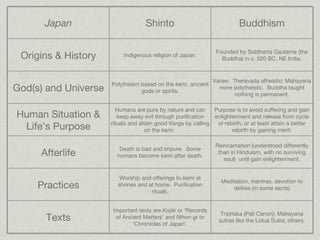
Japan Shinto Buddhism Origins & History Indigenous religion of Japan. Founded by Siddharta Gautama (the Buddha) in c. 520 BC, NE India. God(s) and Universe Polytheism based on the  kami , ancient gods or spirits. Varies:  Theravada atheistic; Mahayana more polytheistic.  Buddha taught nothing is permanent. Human Situation & Life’s Purpose Humans are pure by nature and can keep away evil through purification rituals and attain good things by calling on the  kami .  Purpose is to avoid suffering and gain enlightenment and release from cycle of rebirth, or at least attain a better rebirth by gaining merit. Afterlife Death is bad and impure.  Some humans become  kami  after death. Reincarnation (understood differently than in Hinduism, with no surviving soul)  until gain enlightenment. Practices Worship and offerings to  kami  at shrines and at home.  Purification rituals. Meditation, mantras, devotion to deities (in some sects) Texts Important texts are  Kojiki  or ‘Records of Ancient Matters’ and  Nihon-gi  or ‘Chronicles of Japan’. Tripitaka (Pali Canon); Mahayana sutras like the Lotus Sutra; others.

World Religion Lecture

  • 1.
    World Religions Anintroduction to seeing the similarities and differences
  • 2.
    Objectives Explore variousreligious beliefs held around the world Compare and contrast aspects of religions
  • 3.
    Vocabulary animism - the belief that natural objects possess a soul or spirit. shamanism - belief in an unseen world of gods, demons and ancestral spirits responsive only to a shaman. theism - belief in the existence of a God or gods. religion - a personal set or system of religious attitudes, beliefs and practices. theocracy - a government ruled by or subject to religious authority.
  • 4.
    In the beginning...The most basic, primitive form of religious belief is found in animism . Some primitive societies in Africa and South America are animistic. Contact with the natural world is most important - respect for nature Native American tribes - many included Shamans. Animism with a person who understands and guides access to these spirits is shamanism.
  • 5.
    ‘ Modern’ ReligionEventually, cultures developed concepts of gods as a way to understand the world around them. Theism was the belief in God or gods. The first true religions were established by creating sets of customs and practices that allowed people the means to better understand the gods or God Egypt, Mesopotamia, Indus River Valley societies - among the first civilizations with religion
  • 6.
    Government & ReligionMuch of the history of the world - religion & government go hand-in-hand Theocracy Since the Age of Enlightenment - shift away from government by religion Religion still plays important part of people’s lives and in the area of international relations
  • 7.
    How Can WeUnderstand Other Beliefs? Create a chart to categorize and break down and identify different beliefs to compare and contrast
  • 8.
  • 9.
    Origins & HistoryIndigenous religion of Japan Gods and Universe Polytheism (belief in many Gods) based on the kami ( 神 ), ancient gods or spirits 鬼 (おに)
  • 10.
    Human Situation andLife’s Purpose Humans are pure by nature and can keep away evil through purification rituals and attain good things by calling on the kami 手水 (てみず)
  • 11.
    Afterlife Death isbad and impure. Some humans become kami after death. Practices Worship and offerings to kami at shrines and at home. Purification rituals 鳥居 (とりい)
  • 12.
    Texts Important textsare Kojiki or ‘Record of Ancient Matters’ and Nihon-gi or ‘Chronicles of Japan’
  • 13.
  • 14.
    Origins & HistoryFounded by Siddharta Gautama (the Buddha) in c. 520 BC, NE India Gods and Universe Varies: Theravada atheistic; Mahayana more polytheistic. Buddha taught nothing is permanent. 大仏 (だいぶつ)
  • 15.
    Human Situation andLife’s Purpose Purpose is to avoid suffering and gain enlightenment and release from cycle of rebirth, or at least attain a better rebirth by gaining merit. 宝篋印塔 (ほうきょういんとう)
  • 16.
    Afterlife Reincarnation (understooddifferently than in Hinduism, with no surviving soul) until gain enlightenment Practices Meditation, mantras, devotion to deities (in some sects); In Japan - mixed with some Confucian ideals 仏壇 (ぶつだん)
  • 17.
    Texts Tripitaka (PaliCanon); Mahayana sutras like the Lotus Sutra; others. 寺 (てら)
  • 18.
    Compare and ContrastTake out a piece of paper and turn it sideways On the side of the page, write the headings for the chart as you see on the board You can work in pairs or on your own. Find out information about 2 or more religions PRIZE available! (Completely at the discretion of the teacher) Website that might help: www.religionfacts.com
  • 19.
    Japan Shinto BuddhismOrigins & History Indigenous religion of Japan. Founded by Siddharta Gautama (the Buddha) in c. 520 BC, NE India. God(s) and Universe Polytheism based on the kami , ancient gods or spirits. Varies: Theravada atheistic; Mahayana more polytheistic. Buddha taught nothing is permanent. Human Situation & Life’s Purpose Humans are pure by nature and can keep away evil through purification rituals and attain good things by calling on the kami . Purpose is to avoid suffering and gain enlightenment and release from cycle of rebirth, or at least attain a better rebirth by gaining merit. Afterlife Death is bad and impure. Some humans become kami after death. Reincarnation (understood differently than in Hinduism, with no surviving soul) until gain enlightenment. Practices Worship and offerings to kami at shrines and at home. Purification rituals. Meditation, mantras, devotion to deities (in some sects) Texts Important texts are Kojiki or ‘Records of Ancient Matters’ and Nihon-gi or ‘Chronicles of Japan’. Tripitaka (Pali Canon); Mahayana sutras like the Lotus Sutra; others.