27 Amendments
â—Ź Principles related to representative democracy are
reflected in the articles and amendments of the U.S.
Constitution and provide structure for the
government of the United States.
Learning Target #1
â—Ź I can relate one of the arguments over the need for a
bill of rights to the wording of one of the first 10
Amendments to the U.S. Constitution.
Create Mnemonic Devices to Learn
Them!
http://www.youtube.com/watch?v=o0BMTIErN8U&safety
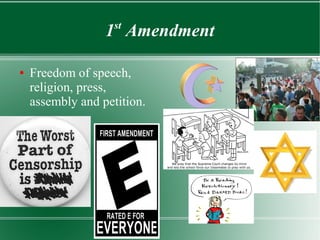
1st
Amendment
â—Ź Freedom of speech,
religion, press,
assembly and petition.
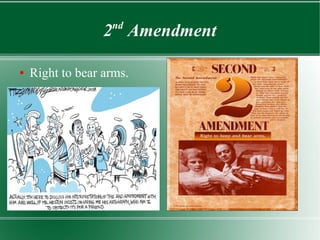
2nd
Amendment
â—Ź Right to bear arms.
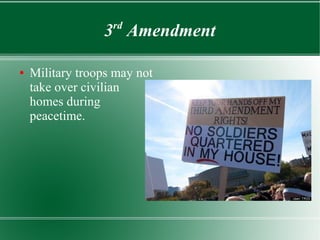
3rd
Amendment
â—Ź Military troops may not
take over civilian
homes during
peacetime.
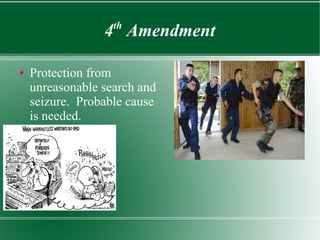
4th
Amendment
â—Ź Protection from
unreasonable search and
seizure. Probable cause
is needed.
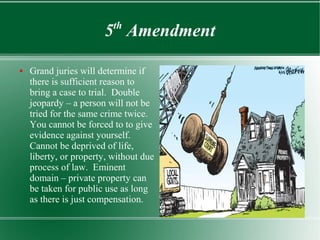
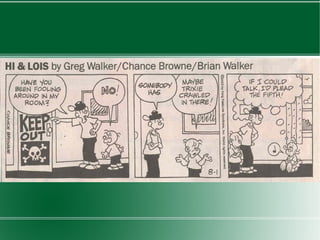
5th
Amendment
â—Ź Grand juries will determine if
there is sufficient reason to
bring a case to trial. Double
jeopardy – a person will not be
tried for the same crime twice.
You cannot be forced to to give
evidence against yourself.
Cannot be deprived of life,
liberty, or property, without due
process of law. Eminent
domain – private property can
be taken for public use as long
as there is just compensation.
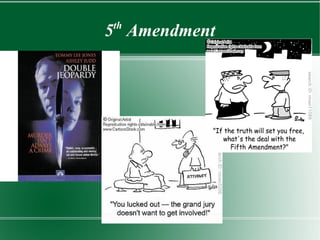
5th
Amendment
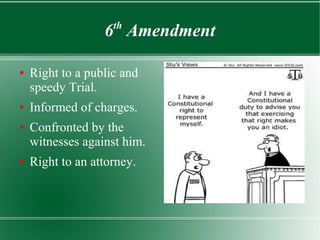
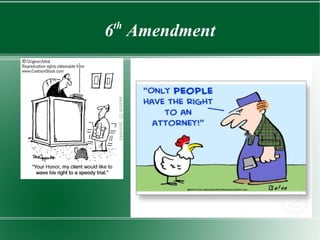
6th
Amendment
â—Ź Right to a public and
speedy Trial.
â—Ź Informed of charges.
â—Ź Confronted by the
witnesses against him.
â—Ź Right to an attorney.
6th
Amendment
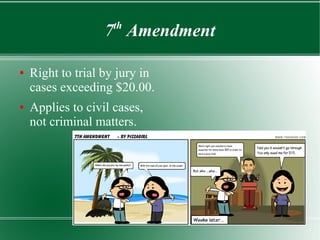
7th
Amendment
â—Ź Right to trial by jury in
cases exceeding $20.00.
â—Ź Applies to civil cases,
not criminal matters.
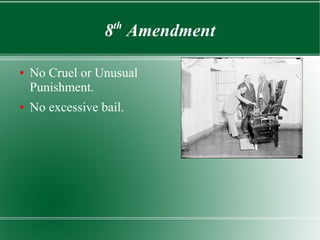
8th
Amendment
â—Ź No Cruel or Unusual
Punishment.
â—Ź No excessive bail.
9th
Amendment
â—Ź People have other civic
rights that may not be
specifically mentioned
in the Constitution.
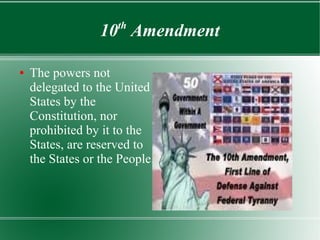
10th
Amendment
â—Ź The powers not
delegated to the United
States by the
Constitution, nor
prohibited by it to the
States, are reserved to
the States or the People.
Bill of Rights Game
http://www.texaslre.org/BOR/billofrights.html
Learning Target #2
â—Ź
I can summarize how the 13th
-15th
Amendments
addressed the aftermath of slavery and the Civil
War.
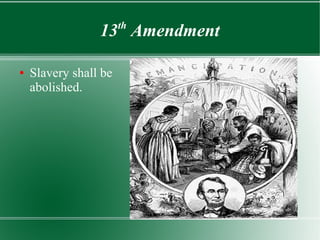
13th
Amendment
â—Ź Slavery shall be
abolished.
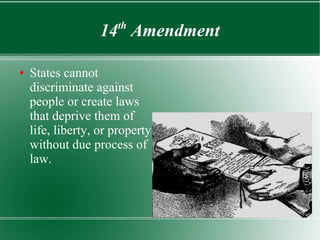
14th
Amendment
â—Ź States cannot
discriminate against
people or create laws
that deprive them of
life, liberty, or property
without due process of
law.
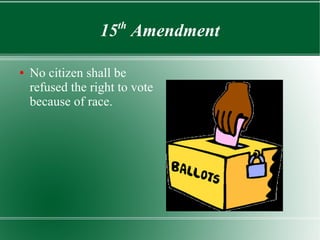
15th
Amendment
â—Ź No citizen shall be
refused the right to vote
because of race.
Learning Target #3
â—Ź
I can summarize how the 16th
-19th
Amendments
addressed the calls for reform during the Progressive
Era.
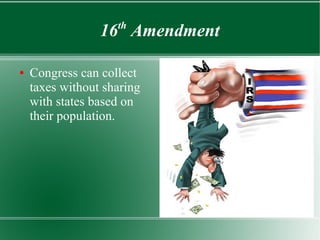
16th
Amendment
â—Ź Congress can collect
taxes without sharing
with states based on
their population.
17th
Amendment
â—Ź People directly elect 2
Senators for their state.
â—Ź Rob Portman
â—Ź Sherrod Brown
18th
Amendment
â—Ź It is illegal to
manufacture, sell, and
transport alcoholic
beverages.
19th
Amendment
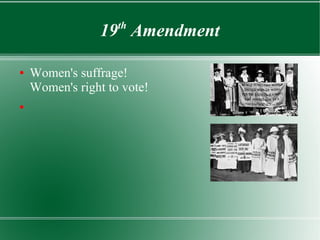
â—Ź Women's suffrage!
Women's right to vote!
â—Ź
Learning Target #4
â—Ź I can cite evidence to show that the Constitution of
the United States has been repeatedly amended to
extend suffrage to disenfranchised groups.
â—Ź Review 15 and 19!
http://www.youtube.com/watch?v=-uPcthZL2RE&safety_mode=true&persist_safety_mode=1&saf
Women's suffrage
24th
Amendment
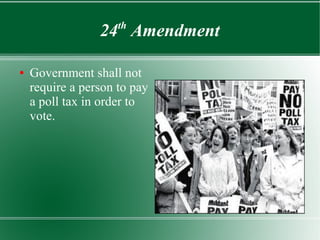
â—Ź Government shall not
require a person to pay
a poll tax in order to
vote.
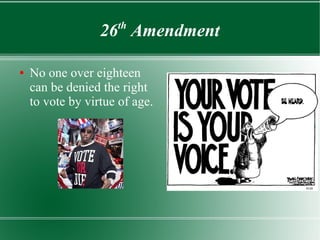
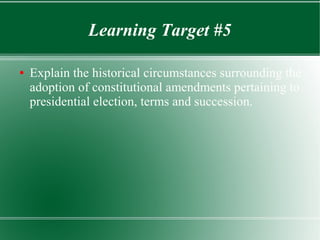
26th
Amendment
â—Ź No one over eighteen
can be denied the right
to vote by virtue of age.
Learning Target #5
â—Ź Explain the historical circumstances surrounding the
adoption of constitutional amendments pertaining to
presidential election, terms and succession.
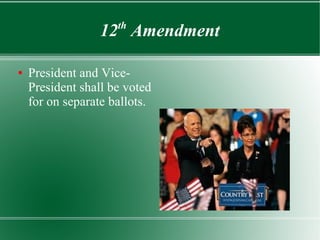
12th
Amendment
â—Ź President and Vice-
President shall be voted
for on separate ballots.
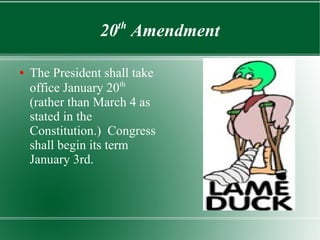
20th
Amendment
â—Ź The President shall take
office January 20th
(rather than March 4 as
stated in the
Constitution.) Congress
shall begin its term
January 3rd.
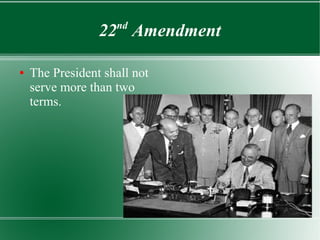
22nd
Amendment
â—Ź The President shall not
serve more than two
terms.
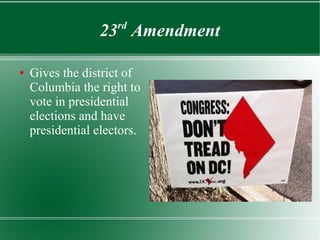
23rd
Amendment
â—Ź Gives the district of
Columbia the right to
vote in presidential
elections and have
presidential electors.
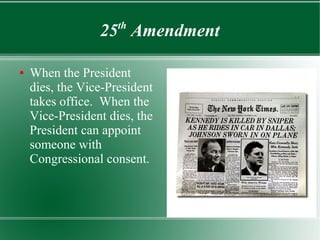
25th
Amendment
â—Ź When the President
dies, the Vice-President
takes office. When the
Vice-President dies, the
President can appoint
someone with
Congressional consent.
Learning Target #6
â—Ź Describe the unique circumstances surrounding the
adoption of Amendments 11, 21 and 27.
11th
Amendment
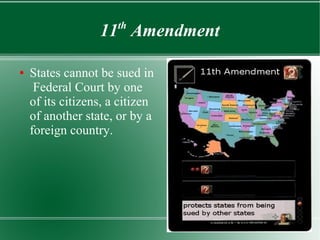
â—Ź States cannot be sued in
Federal Court by one
of its citizens, a citizen
of another state, or by a
foreign country.
21st
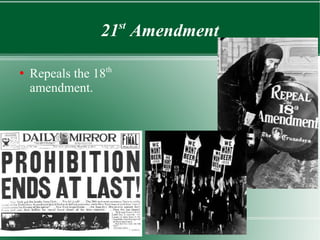
Amendment
â—Ź
Repeals the 18th
amendment.
27th
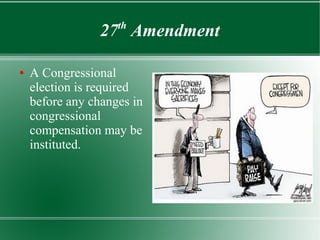
Amendment
â—Ź A Congressional
election is required
before any changes in
congressional
compensation may be
instituted.
Make a Song!
â—Ź You will be assigned a
learning target from the
lesson.
â—Ź You are to turn those
amendments/terms into
a SONG/Rhyme for
memorization.
â—Ź Be sure to include all
amendments in your
section.
â—Ź Be sure to include the
historical significance.
â—Ź Be sure to analyze the
amendments role in the
Constitution. (theme)
Informal Amendment
Informal amendment is the process by which over time
many changes have been made in the Constitution which
have not involved any changes in its written word.
Informal Amendment
The informal amendment process can take place by:
(1) the passage of basic legislation by Congress;
(2) actions taken by the President;
(3) key decisions of the Supreme Court;
(4) the activities of political parties; and
(5) custom.
Executive Action and Court Decisions
Executive Action
Presidential actions have produced
a number of important informal
amendments, such as the use of the
military under the power of
commander in chief.
An executive agreement is a pact
made by the President directly with
the head of a foreign state.
Court Decisions
The nation’s courts, most
importantly the United States
Supreme Court, interpret and apply
the Constitution in many cases they
hear.
Informal Amendment and Executive
Agreement
1. An informal amendment can be established by
(a) actions taken by the President.
(b) custom.
(c) key decisions of the Supreme Court.
(d) all of the above.
2. An executive agreement is
(a) a promise from the President to the legislature.
(b) a pact made by the President directly with the head of a foreign state.
(c) a decision made by the President and his cabinet members.
(d) the contract the President signs when he accepts the office.
Electoral College
â—Ź The group that makes the formal selection of the
nation's President, from what the Framers intended
into a “rubber stamp” for each State's popular vote
in Presidential elections.
â—Ź We will learn more about this topic later.
Custom vs. Constitution
â—Ź 15 Executive departments make up the Cabinet, an
advisory body to the President.
â—Ź Part of custom, not in the Constitution.

27 Amendments