
The legislative
process
Session aim
To give you the knowledge you need to understand
the basics of the legislative process and how
interested parties can influence it.
• Where does legislation come from?
• How is legislation scrutinised?
• Questions.
About me...
Joined the House of Commons in 2006 as Second
Clerk to the Trade and Industry Committee.
Spent a year on secondment to the Scottish
Parliament’s Health and Sport Committee.
Worked on the Public Administration and Treasury
Select Committees.
Two years as Parliamentary Adviser to the Foreign
and Commonwealth Office.
Now work in the Public Bill Office.
What types of legislation are
there?
• There many types of
legislation. Today we
will be focusing on:
• Primary legislation –
Bills and Acts of
Parliament.
• Public legislation –
Legislation that extends
to everyone.
Where does legislation come from?
• Either:
• Government Bill presented by a Minister.
• Or:
• Private Member’s Bill (PMB) presented by a
Member of either House (some PMBs are
Government supported).
Where does legislation come from?
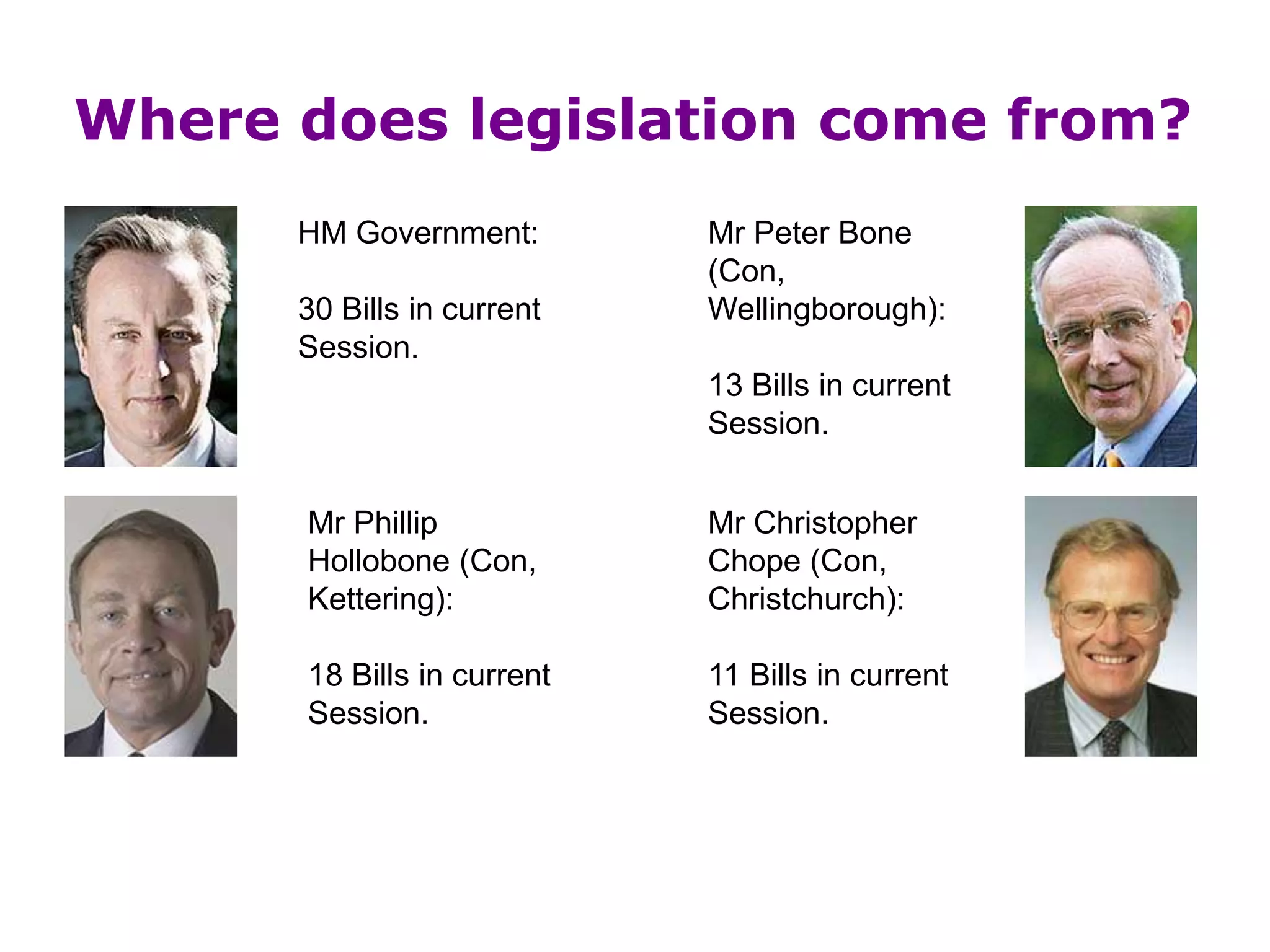
HM Government:
30 Bills in current
Session.
Mr Phillip
Hollobone (Con,
Kettering):
18 Bills in current
Session.
Mr Peter Bone
(Con,
Wellingborough):
13 Bills in current
Session.
Mr Christopher
Chope (Con,
Christchurch):
11 Bills in current
Session.
Where does legislation
come from?
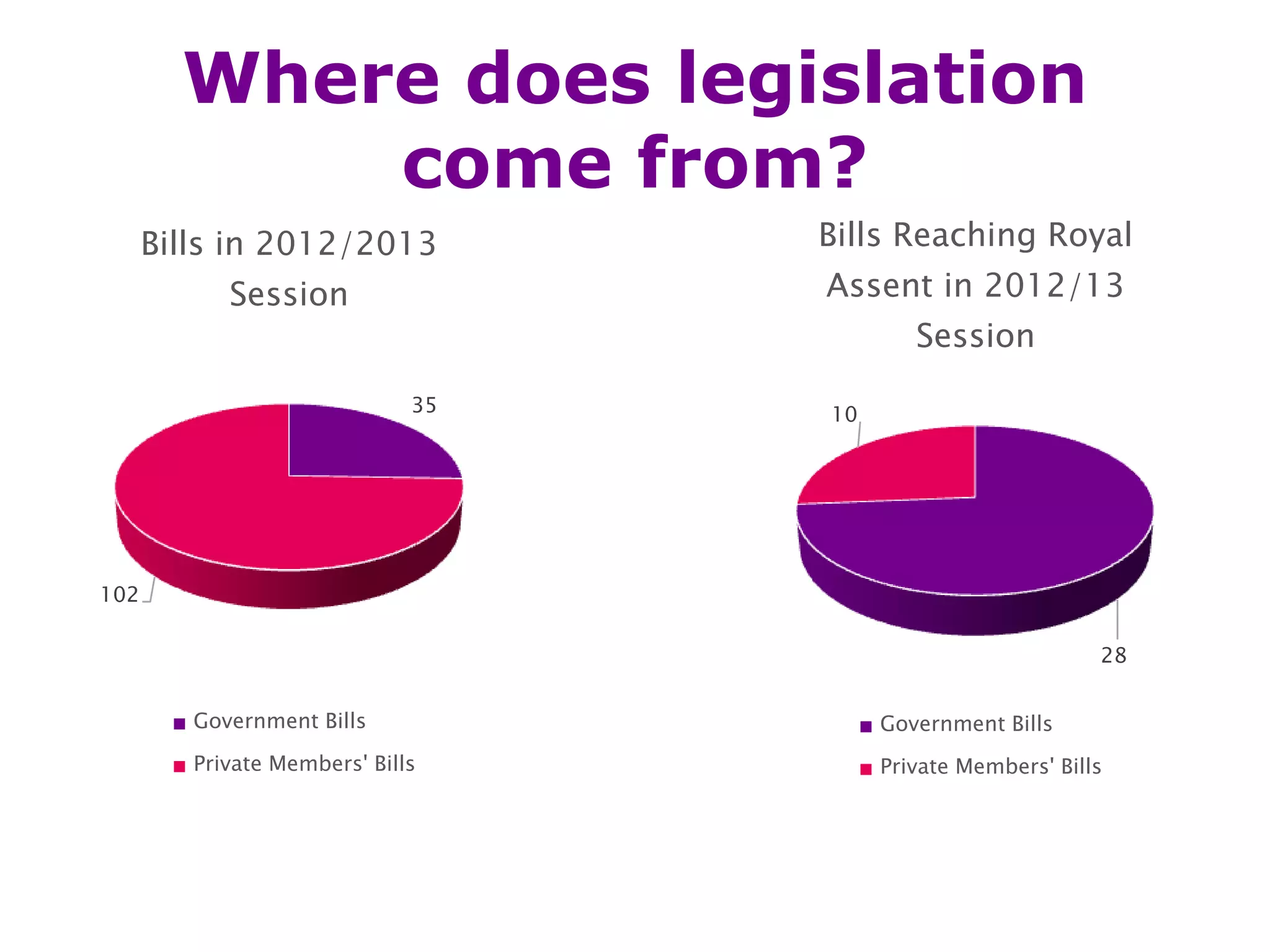
35
102
Bills in 2012/2013
Session
Government Bills
Private Members' Bills
28
10
Bills Reaching Royal
Assent in 2012/13
Session
Government Bills
Private Members' Bills
What is the purpose of
legislation?
 To make policy changes that require
changes in statute.
 To consolidate or update existing law.
 To make a political statement.
 To push a particular cause.
 To require the Government to account for
its actions.
How to influence legislation –
Government
• For a bill to get into the Government’s program it
needs “collective agreement”.
• Most Government legislation is preceded by some
form of consultation:
o Green Paper (discussion document).
o White Paper.
• Sometimes a draft Bill may be examined by a
Joint Committee of both Houses of Parliament.
How to influence legislation
– Private Members
 There is no limit (yet!) on the number of
bills a Member can introduce.
 Only bills that have all-party support have
any chance of becoming law.
 However, debate on a private member’s bill
can raise the profile of an issue.
 The Government has to adopt a position in
respect of all PMBs.
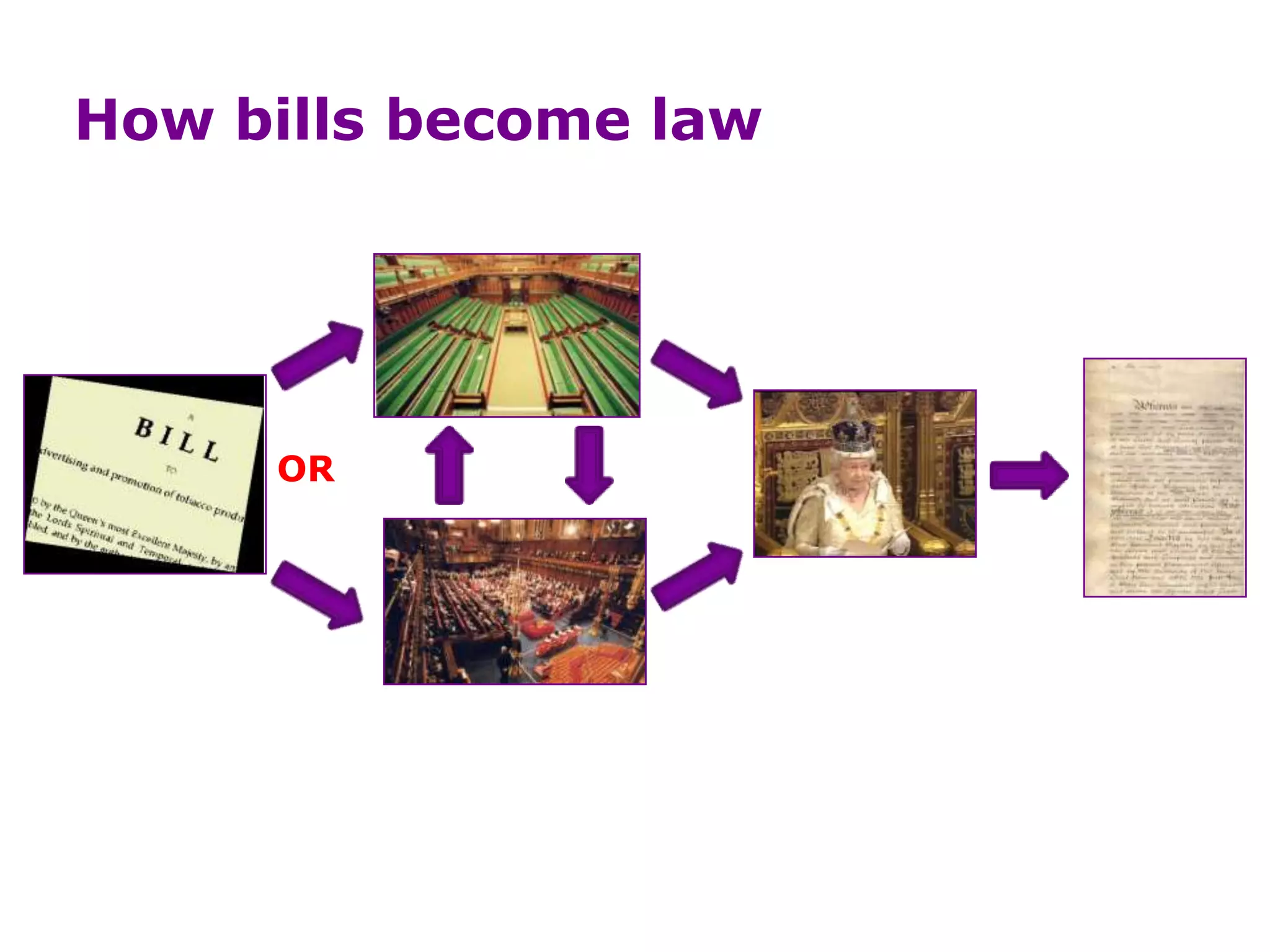
How bills become law
OR
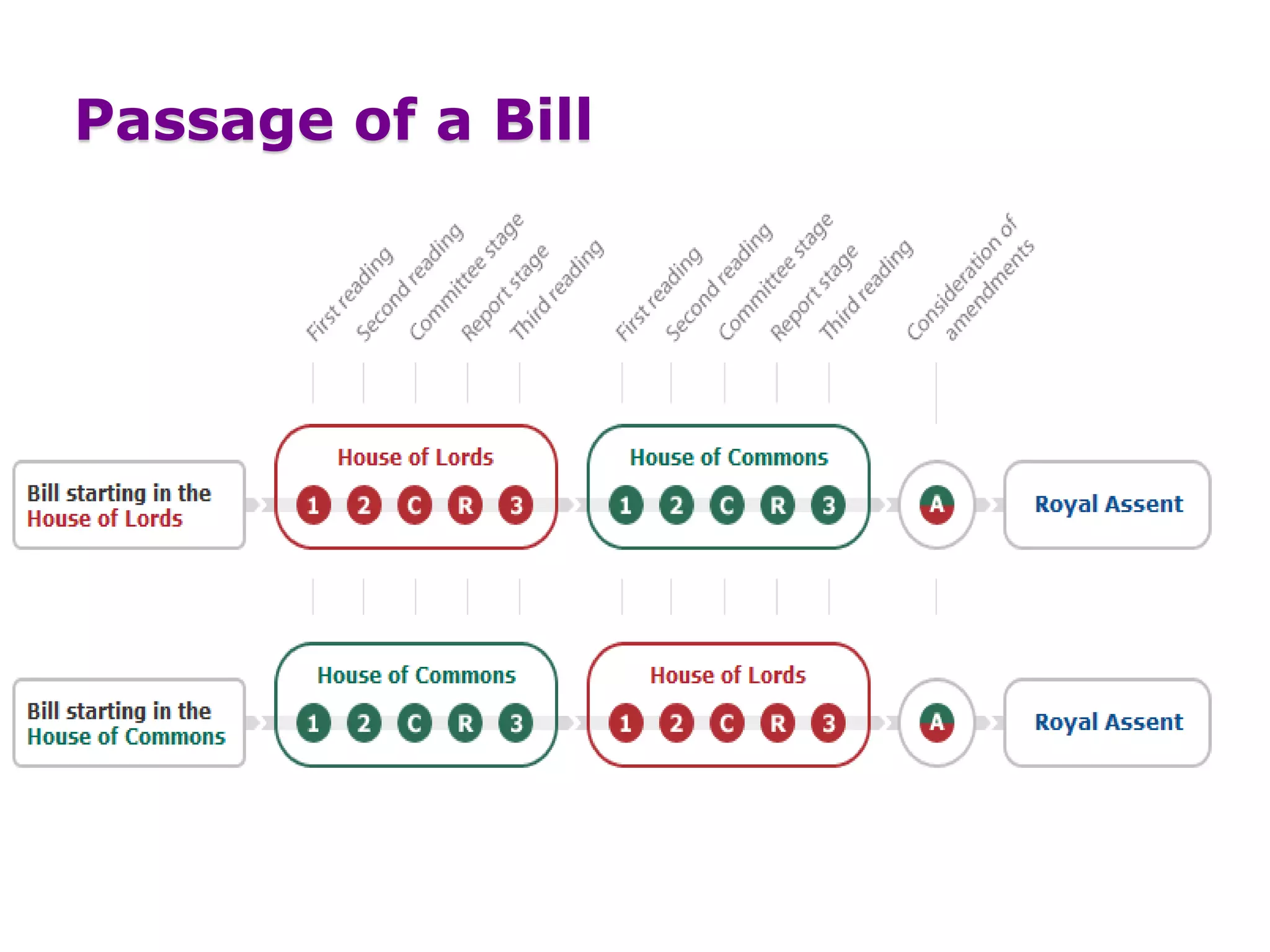
Passage of a Bill
How to influence legislation
- Lords and Commons
 Different focus:
◦ Lords on detail, Commons on principle,
◦ Commons privileged when it comes to money, and
◦ Government majority in Commons, not in the Lords.
 Successful backbench amendments rare in Commons, but a
number of recent ones – e.g. TV Licensing and Care Bill.
 Two thirds of Government defeats in the Lords lead to either
compromise or Government backing down.
 Just because an amendment is not successful does not mean
it has not influenced policy.
End of a Session – what difference does
it make?
 For most Private Members’
Bills this is the end of the
line.
 Some Government Bills
“carry over”.
 Otherwise, need to get
Lords and Commons to
agree before the end of the
Session.
 This can lead to all night
“ping pong”.
House of Commons presentation

House of Commons presentation

  • 1.
  • 2.
    Session aim To giveyou the knowledge you need to understand the basics of the legislative process and how interested parties can influence it. • Where does legislation come from? • How is legislation scrutinised? • Questions.
  • 3.
    About me... Joined theHouse of Commons in 2006 as Second Clerk to the Trade and Industry Committee. Spent a year on secondment to the Scottish Parliament’s Health and Sport Committee. Worked on the Public Administration and Treasury Select Committees. Two years as Parliamentary Adviser to the Foreign and Commonwealth Office. Now work in the Public Bill Office.
  • 4.
    What types oflegislation are there? • There many types of legislation. Today we will be focusing on: • Primary legislation – Bills and Acts of Parliament. • Public legislation – Legislation that extends to everyone.
  • 5.
    Where does legislationcome from? • Either: • Government Bill presented by a Minister. • Or: • Private Member’s Bill (PMB) presented by a Member of either House (some PMBs are Government supported).
  • 6.
    Where does legislationcome from? HM Government: 30 Bills in current Session. Mr Phillip Hollobone (Con, Kettering): 18 Bills in current Session. Mr Peter Bone (Con, Wellingborough): 13 Bills in current Session. Mr Christopher Chope (Con, Christchurch): 11 Bills in current Session.
  • 7.
    Where does legislation comefrom? 35 102 Bills in 2012/2013 Session Government Bills Private Members' Bills 28 10 Bills Reaching Royal Assent in 2012/13 Session Government Bills Private Members' Bills
  • 8.
    What is thepurpose of legislation?  To make policy changes that require changes in statute.  To consolidate or update existing law.  To make a political statement.  To push a particular cause.  To require the Government to account for its actions.
  • 9.
    How to influencelegislation – Government • For a bill to get into the Government’s program it needs “collective agreement”. • Most Government legislation is preceded by some form of consultation: o Green Paper (discussion document). o White Paper. • Sometimes a draft Bill may be examined by a Joint Committee of both Houses of Parliament.
  • 10.
    How to influencelegislation – Private Members  There is no limit (yet!) on the number of bills a Member can introduce.  Only bills that have all-party support have any chance of becoming law.  However, debate on a private member’s bill can raise the profile of an issue.  The Government has to adopt a position in respect of all PMBs.
  • 11.
  • 12.
  • 13.
    How to influencelegislation - Lords and Commons  Different focus: ◦ Lords on detail, Commons on principle, ◦ Commons privileged when it comes to money, and ◦ Government majority in Commons, not in the Lords.  Successful backbench amendments rare in Commons, but a number of recent ones – e.g. TV Licensing and Care Bill.  Two thirds of Government defeats in the Lords lead to either compromise or Government backing down.  Just because an amendment is not successful does not mean it has not influenced policy.
  • 14.
    End of aSession – what difference does it make?  For most Private Members’ Bills this is the end of the line.  Some Government Bills “carry over”.  Otherwise, need to get Lords and Commons to agree before the end of the Session.  This can lead to all night “ping pong”.

Editor's Notes

  • #8 75% of the 137 Bills considered by the Commons in the 2012/13 Session were PMBs.But only 10% of PMBs received Royal Assent during the Session.And of those, 9 out of 10 were ‘handout’ bills drafted by the Government.By contrast, 80% of Government Bills received Royal Assent.However, sometimes a PMB will inspire a Government Bill, or obtain support in a future session.