GENDER STRATIFICATION
 SOCIOLOGISTS MAKE AN
IMPORTANT DISTINCTION
BETWEEN SEX AND GENDER.
SEX
 Ascribed status – You are born male or
 female

 The physical and biological differences between
  men and women.
 Sex differences are made evident by physical
  distinctions in anatomical, chromosomal,
  hormonal, and physiological characteristics.
GENDER
 Achieved Status – Learned through the
 socialization process

 The social, psychological, and cultural attributes of
  masculinity and femininity that are based, in part,
  on biological differences
 An important factor in shaping individuals self
  image and social identity
RELIGIOUS VIEWS
Patriarchal Ideology
 The belief that men are superior to women and
  should control all important aspects of society.

 Almost all societies and religions held this view
 historically and many still do.
BIOLOGICAL VIEWS
Ethnologists
 Observed that sexual differences in behavior exist
  throughout much of the nonhuman animal world,
  including primates.

Sociobiologists
 Believe that much of human social behavior has a
  genetic basis
BIOLOGICAL VIEWS

Gender-based biology
 Identifies the biological and physiological
  differences between men and women as well as
  differences in responses to drugs.
Gender and Physiological Differences

 The study of gender roles should take into account
 relative size and muscle development, longevity,
 susceptibility to disease and physical disorders.
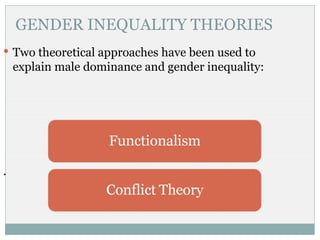
GENDER INEQUALITY THEORIES
 Two theoretical approaches have been used to
    explain male dominance and gender inequality:


.
FUNCTIONALIST VIEW

 Talcott Parsons and Robert Bales (1955) applied
 functionalist theory to the modern family.

 Argued that the division of labor and role
 differentiation by sex are universal principles of
 family organization and are functional to the
 modern family.

 Believe that the family functions best when the
 father assumes the instrumental role and the
 mother assumes the expressive role.
Instrumental role
    Focuses on relationships between the family and
  the outside world.
    Involves supporting and protecting the family.

 Expressive role
     Focuses on relationships within the family and
    requires her to provide the love and emotional
    support needed to sustain the family
CONFLICT THEORY VIEW
Men have the better position in society and
 hold onto it through social processes

Gender-Role Socialization
 Lifelong process whereby people learn the values,
  attitudes, motivations, and behavior considered
  appropriate to each sex according to their culture.
CHILDHOOD SOCIALIZATION
 Parents carry in their minds images of what girls
    and boys are like.

 How they should behave, and what they should
    be in later life.

 Parents respond differently to girls and boys
    right from the beginning.

Three ways women experience discrimination in
             the business world
 During the hiring process
   When women are given jobs with lower occupational
    prestige than men who have equivalent qualifications
    receive

 Through unequal wage policies
   Women receive less pay than men for equivalent work


 In the awarding of promotions
   Women find it more difficult than men to move up the
    career ladder

Chapter 11

  • 1.
  • 2.
     SOCIOLOGISTS MAKEAN IMPORTANT DISTINCTION BETWEEN SEX AND GENDER.
  • 3.
    SEX Ascribed status– You are born male or female  The physical and biological differences between men and women.  Sex differences are made evident by physical distinctions in anatomical, chromosomal, hormonal, and physiological characteristics.
  • 4.
    GENDER  Achieved Status– Learned through the socialization process  The social, psychological, and cultural attributes of masculinity and femininity that are based, in part, on biological differences  An important factor in shaping individuals self image and social identity
  • 5.
    RELIGIOUS VIEWS Patriarchal Ideology The belief that men are superior to women and should control all important aspects of society.  Almost all societies and religions held this view historically and many still do.
  • 6.
    BIOLOGICAL VIEWS Ethnologists  Observedthat sexual differences in behavior exist throughout much of the nonhuman animal world, including primates. Sociobiologists  Believe that much of human social behavior has a genetic basis
  • 7.
    BIOLOGICAL VIEWS Gender-based biology Identifies the biological and physiological differences between men and women as well as differences in responses to drugs.
  • 8.
    Gender and PhysiologicalDifferences  The study of gender roles should take into account relative size and muscle development, longevity, susceptibility to disease and physical disorders.
  • 9.
    GENDER INEQUALITY THEORIES Two theoretical approaches have been used to explain male dominance and gender inequality: .
  • 10.
    FUNCTIONALIST VIEW  TalcottParsons and Robert Bales (1955) applied functionalist theory to the modern family.  Argued that the division of labor and role differentiation by sex are universal principles of family organization and are functional to the modern family.  Believe that the family functions best when the father assumes the instrumental role and the mother assumes the expressive role.
  • 11.
    Instrumental role  Focuses on relationships between the family and the outside world.  Involves supporting and protecting the family.   Expressive role  Focuses on relationships within the family and requires her to provide the love and emotional support needed to sustain the family
  • 12.
    CONFLICT THEORY VIEW Menhave the better position in society and hold onto it through social processes Gender-Role Socialization  Lifelong process whereby people learn the values, attitudes, motivations, and behavior considered appropriate to each sex according to their culture.
  • 13.
    CHILDHOOD SOCIALIZATION  Parentscarry in their minds images of what girls and boys are like.  How they should behave, and what they should be in later life.  Parents respond differently to girls and boys right from the beginning. 
  • 14.
    Three ways womenexperience discrimination in the business world  During the hiring process  When women are given jobs with lower occupational prestige than men who have equivalent qualifications receive  Through unequal wage policies  Women receive less pay than men for equivalent work  In the awarding of promotions  Women find it more difficult than men to move up the career ladder