Public Speaking Planning the Message
The listenable speech Understood  by listeners Oral-based language Structure with clear signposts Phrases that tell listener what’s next (transitions!) Information that flows cohesively Consistency
How can YOU deliver a listenable speech? Confidence Excellent nonverbal behaviors Logical structure Style consistency  Encourage listeners to be involved
Piece of (chocolate) cake…
7 Steps Topic Central idea Research to develop central idea Finalize central idea, purpose and goal that adapts to the listeners and setting of the presentation Formulate and organize body to achieve goal Prepare for the presentation / delivery Polish the introduction and conclusion
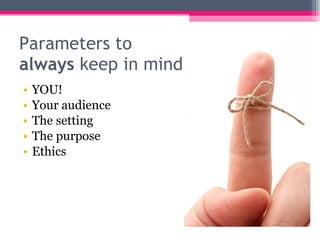
Parameters to  always  keep in mind YOU! Your audience The setting The purpose Ethics
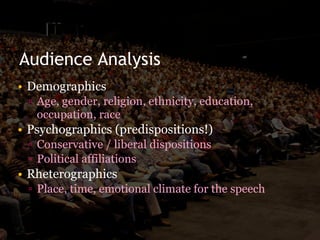
Audience Analysis Demographics Age, gender, religion, ethnicity, education, occupation, race Psychographics (predispositions!) Conservative / liberal dispositions Political affiliations Rheterographics Place, time, emotional climate for the speech
Applying your analysis Topic selection Must be specific and relevant to audience Language selection Be clear, be clever, be relevant Central idea Is your goal to inform or persuade? What arguments will you use to accomplish this goal with  this  audience?
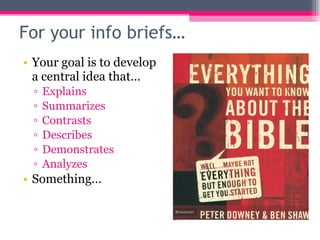
For your info briefs… Your goal is to develop a central idea that… Explains Summarizes Contrasts Describes Demonstrates Analyzes Something…
The extemporaneous speech Gives you the advantage of… Talking points  (vs. impromptu) Notes / outline  (vs. memorized) Quotations, illustrations and statistics from research (vs. impromptu) Planning for a more spontaneous and natural oral presentation  (vs. manuscript / memorized)
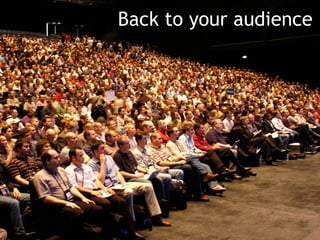
Back to your audience
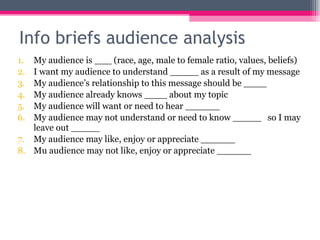
Info briefs audience analysis My audience is ___ (race, age, male to female ratio, values, beliefs) I want my audience to understand _____ as a result of my message My audience’s relationship to this message should be ____ My audience already knows ____ about my topic My audience will want or need to hear ______ My audience may not understand or need to know _____  so I may leave out _____ My audience may like, enjoy or appreciate ______ Mu audience may not like, enjoy or appreciate ______

Chapter 11 - Public Speaking Planning The Message

  • 1.
  • 2.
    The listenable speechUnderstood by listeners Oral-based language Structure with clear signposts Phrases that tell listener what’s next (transitions!) Information that flows cohesively Consistency
  • 3.
    How can YOUdeliver a listenable speech? Confidence Excellent nonverbal behaviors Logical structure Style consistency Encourage listeners to be involved
  • 4.
  • 5.
    7 Steps TopicCentral idea Research to develop central idea Finalize central idea, purpose and goal that adapts to the listeners and setting of the presentation Formulate and organize body to achieve goal Prepare for the presentation / delivery Polish the introduction and conclusion
  • 6.
    Parameters to always keep in mind YOU! Your audience The setting The purpose Ethics
  • 7.
    Audience Analysis DemographicsAge, gender, religion, ethnicity, education, occupation, race Psychographics (predispositions!) Conservative / liberal dispositions Political affiliations Rheterographics Place, time, emotional climate for the speech
  • 8.
    Applying your analysisTopic selection Must be specific and relevant to audience Language selection Be clear, be clever, be relevant Central idea Is your goal to inform or persuade? What arguments will you use to accomplish this goal with this audience?
  • 9.
    For your infobriefs… Your goal is to develop a central idea that… Explains Summarizes Contrasts Describes Demonstrates Analyzes Something…
  • 10.
    The extemporaneous speechGives you the advantage of… Talking points (vs. impromptu) Notes / outline (vs. memorized) Quotations, illustrations and statistics from research (vs. impromptu) Planning for a more spontaneous and natural oral presentation (vs. manuscript / memorized)
  • 11.
    Back to youraudience
  • 12.
    Info briefs audienceanalysis My audience is ___ (race, age, male to female ratio, values, beliefs) I want my audience to understand _____ as a result of my message My audience’s relationship to this message should be ____ My audience already knows ____ about my topic My audience will want or need to hear ______ My audience may not understand or need to know _____ so I may leave out _____ My audience may like, enjoy or appreciate ______ Mu audience may not like, enjoy or appreciate ______