Getting the Best
Surround Around
The Challenge:
       Distribution

• Now you have your Ambisonic content,
  how do you get people to hear it?
In the ‘Old Days’:

• Only 2-channel mass-media existed
• Stereo compatibility required
• Special decoder needed at home to listen
• Nobody bought them and manufacturers
  did not build them into audio gear
Today – More options


• People have multichannel digital systems
• But they still don’t have decoders
Possibilities?
for distributing Ambisonic recordings
Possibilities?
   for distributing Ambisonic recordings

• MLP can carry B-Format and offer flags
  for DVD-Audio, HD discs
Possibilities?
     for distributing Ambisonic recordings

• MLP can carry B-Format and offer flags
  for DVD-Audio, HD discs
 •   …sorry, not very many people can play them.
Possibilities?
     for distributing Ambisonic recordings

• MLP can carry B-Format and offer flags
  for DVD-Audio, HD discs
 •   …sorry, not very many people can play them.

• Downloadable Ambisonic files
  and software players
Possibilities?
     for distributing Ambisonic recordings

• MLP can carry B-Format and offer flags
  for DVD-Audio, HD discs
 •   …sorry, not very many people can play them.

• Downloadable Ambisonic files
  and software players
 •   …here or on the way – but not yet widespread.
Possibilities?
     for distributing Ambisonic recordings

• MLP can carry B-Format and offer flags
  for DVD-Audio, HD discs
 •   …sorry, not very many people can play them.

• Downloadable Ambisonic files
  and software players
 •   …here or on the way – but not yet widespread.

 •   Ogg/FLAC project – support for Ambisonics?
Goals
for distributing Ambisonic recordings
Goals
   for distributing Ambisonic recordings


• Method must be available now, today.
Goals
   for distributing Ambisonic recordings


• Method must be available now, today.
• Everyone (with a surround system)
  can listen.
Goals
   for distributing Ambisonic recordings


• Method must be available now, today.
• Everyone (with a surround system)
  can listen.
• Easy and cheap to originate content.
The Answer…
 Decoding in the studio
The Answer…
          Decoding in the studio


• Decode Ambisonics to speaker feeds.
The Answer…
          Decoding in the studio


• Decode Ambisonics to speaker feeds.
• Place the speaker feeds signals on a
  conventional multichannel medium
  (eg DVD).
The Answer…
          Decoding in the studio


• Decode Ambisonics to speaker feeds.
• Place the speaker feeds signals on a
  conventional multichannel medium
  (eg DVD).
• This is called…
G-Format
    Decoding Ambisonics in the studio


                  G

…to 5.1-compatible multichannel surround.
G-Format
 Advantages
G-Format
                Advantages


• Anyone can play it (if you choose popular
  encoding and distribution formats).
G-Format
                Advantages


• Anyone can play it (if you choose popular
  encoding and distribution formats).
• Producer controls the decoding process.
G-Format
                Advantages


• Anyone can play it (if you choose popular
  encoding and distribution formats).
• Producer controls the decoding process.
• High quality decoder can be used,
  correctly configured.
G-Format
 Challenges
G-Format
                 Challenges

• Lose the ability to render for your replay
  array (a primary Ambisonic benefit).
G-Format
                   Challenges

• Lose the ability to render for your replay
  array (a primary Ambisonic benefit).
  •   With some caveats, decode can be reversible.
G-Format
                   Challenges

• Lose the ability to render for your replay
  array (a primary Ambisonic benefit).
  •   With some caveats, decode can be reversible.

• What array do you decode to?
G-Format
                   Challenges

• Lose the ability to render for your replay
  array (a primary Ambisonic benefit).
  •   With some caveats, decode can be reversible.

• What array do you decode to?
• Decoder target array and listener array
  may be different.
G-Format
                   Challenges

• Lose the ability to render for your replay
  array (a primary Ambisonic benefit).
  •   With some caveats, decode can be reversible.

• What array do you decode to?
• Decoder target array and listener array
  may be different.
• Possible risk of audio and/or localisation
  degradation if lossy compression used.
G-Format
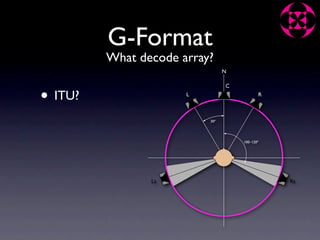
           What decode array?
                                  N


•
                                  C

    ITU?                L                    R


                            30º


                                      100–120º


                  Ls                             Rs
G-Format
                What decode array?
                                          N


•
                                          C

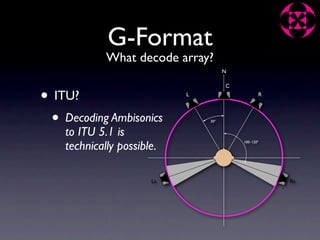
    ITU?                        L                    R


    •   Decoding Ambisonics         30º


        to ITU 5.1 is
        technically possible.
                                              100–120º


                          Ls                             Rs
G-Format
           What decode array?
                                  N


•
                                  C

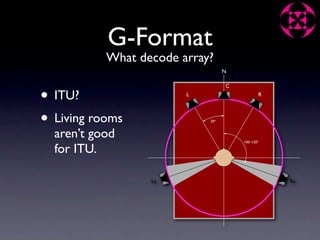
  ITU?                  L                    R


• Living rooms              30º


  aren’t good                         100–120º

  for ITU.

                  Ls                             Rs
G-Format
            What decode array?
                                   N


•
                                   C

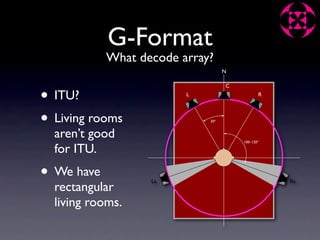
  ITU?                   L                    R


• Living rooms               30º


  aren’t good                          100–120º

  for ITU.
• We have          Ls                             Rs
  rectangular
  living rooms.
G-Format
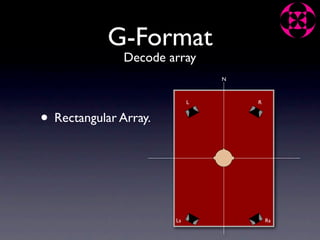
               Decode array
                                N


                            L       R


• Rectangular Array.


                       Ls               Rs
G-Format
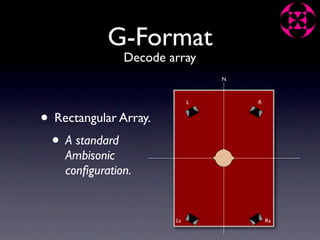
               Decode array
                                N


                            L       R


• Rectangular Array.
 • A standard
    Ambisonic
    configuration.


                       Ls               Rs
G-Format
               Decode array

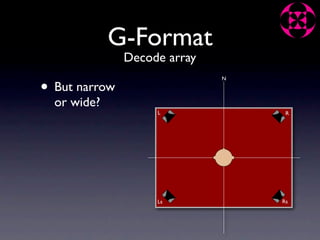
• But narrow
                              N


  or wide?
                    L              R


                    Ls            Rs
G-Format
               Decode array

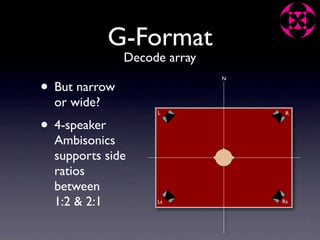
• But narrow
                              N


  or wide?
                    L              R


• 4-speaker
  Ambisonics
  supports side
  ratios
  between
  1:2 & 2:1         Ls            Rs
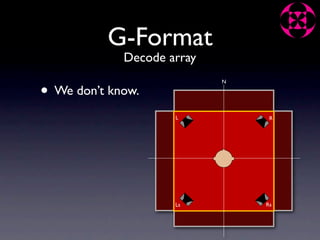
G-Format
             Decode array

• We don’t know.
                            N


                     L           R


                     Ls         Rs
G-Format
                   Decode array

• We don’t know.
                                  N


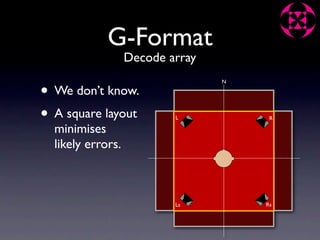
• A square layout          L           R

  minimises
  likely errors.


                           Ls         Rs
G-Format
                   Decode array

• We don’t know.
                                  N


• A square layout          L           R

  minimises
  likely errors.
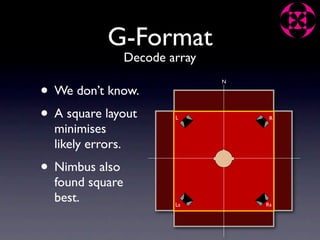
• Nimbus also
  found square
  best.                    Ls         Rs
G-Format
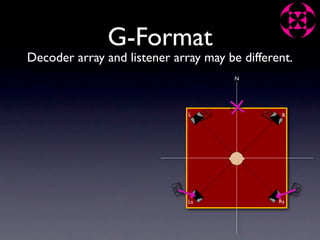
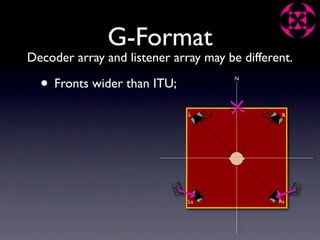
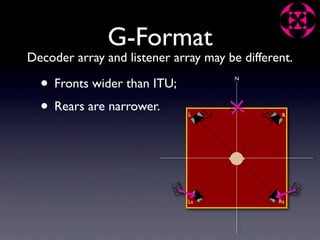
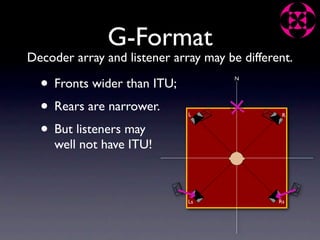
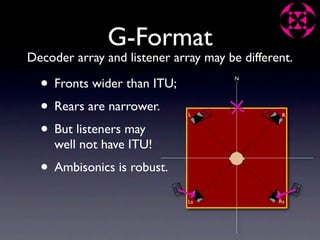
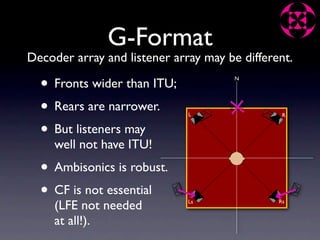
Decoder array and listener array may be different.
                                       N


                              L                 R


                              Ls               Rs
G-Format
Decoder array and listener array may be different.

  • Fronts wider than ITU;             N


                              L                 R


                              Ls               Rs
G-Format
Decoder array and listener array may be different.

  • Fronts wider than ITU;             N


  • Rears are narrower.       L                 R


                              Ls               Rs
G-Format
Decoder array and listener array may be different.

  • Fronts wider than ITU;             N


  • Rears are narrower.       L                 R


  • But listeners may
     well not have ITU!


                              Ls               Rs
G-Format
Decoder array and listener array may be different.

  • Fronts wider than ITU;             N


  • Rears are narrower.       L                 R


  • But listeners may
     well not have ITU!
  • Ambisonics is robust.
                              Ls               Rs
G-Format
Decoder array and listener array may be different.

  • Fronts wider than ITU;             N


  • Rears are narrower.       L                 R


  • But listeners may
     well not have ITU!
  • Ambisonics is robust.
  • CF is not essential
     (LFE not needed          Ls               Rs


     at all!).
G-Format Sources
  B-Format or 2-ch UHJ?
G-Format Sources
           B-Format or 2-ch UHJ?
• Very little B-format originally
  (No multitrack mastering capability)
G-Format Sources
            B-Format or 2-ch UHJ?
• Very little B-format originally
  (No multitrack mastering capability)
  •   This is now changing.
G-Format Sources
            B-Format or 2-ch UHJ?
• Very little B-format originally
  (No multitrack mastering capability)
  •   This is now changing.

• UHJ recordings are very common.
G-Format Sources
            B-Format or 2-ch UHJ?
• Very little B-format originally
  (No multitrack mastering capability)
  •   This is now changing.

• UHJ recordings are very common.
 • How would they stand up against
      modern multichannel?
G-Format Sources
            B-Format or 2-ch UHJ?
• Very little B-format originally
  (No multitrack mastering capability)
  •   This is now changing.

• UHJ recordings are very common.
 • How would they stand up against
      modern multichannel?
  • Nimbus showed SFM recordings work.
      What about Ambisonic mixes?
What decoder?
What decoder?
• Decode needed to be done in software.
What decoder?
• Decode needed to be done in software.
• Several decoders available on-line
  (see www.ambisonic.net → tools).
What decoder?
• Decode needed to be done in software.
• Several decoders available on-line
  (see www.ambisonic.net → tools).
• We chose Ambisonic.exe written by
  Rhonda Wilson at Meridian Audio.
What decoder?
• Decode needed to be done in software.
• Several decoders available on-line
  (see www.ambisonic.net → tools).
• We chose Ambisonic.exe written by
  Rhonda Wilson at Meridian Audio.
 • Originally created for Nimbus.
What decoder?
• Decode needed to be done in software.
• Several decoders available on-line
  (see www.ambisonic.net → tools).
• We chose Ambisonic.exe written by
  Rhonda Wilson at Meridian Audio.
 • Originally created for Nimbus.
 • UHJ and B-Format capability.
What decoder?
• Decode needed to be done in software.
• Several decoders available on-line
  (see www.ambisonic.net → tools).
• We chose Ambisonic.exe written by
  Rhonda Wilson at Meridian Audio.
 • Originally created for Nimbus.
 • UHJ and B-Format capability.
 • Decodes to a rectangle (2:1 – 1:2).
Release coding & media
       Requirements
Release coding & media
             Requirements

 • Available now.
Release coding & media
             Requirements

 • Available now.
  • Not a future system.
Release coding & media
              Requirements

 • Available now.
  • Not a future system.
  • Thus not surround downloads
     (ie must be a ‘packaged medium’).
Release coding & media
              Requirements

 • Available now.
  • Not a future system.
  • Thus not surround downloads
     (ie must be a ‘packaged medium’).
 • Widely supported.
Release coding & media
              Requirements

 • Available now.
  • Not a future system.
  • Thus not surround downloads
     (ie must be a ‘packaged medium’).
 • Widely supported.
  • Must be popular and widespread.
Release coding & media
              Requirements

 • Available now.
  • Not a future system.
  • Thus not surround downloads
     (ie must be a ‘packaged medium’).
 • Widely supported.
  • Must be popular and widespread.
  • Thus not SACD, DVD-A.
Release coding
Two choices: Dolby Digital & dts


• Dolby Digital:
Release coding
Two choices: Dolby Digital & dts


• Dolby Digital:
 • Extremely widespread,
Release coding
Two choices: Dolby Digital & dts


• Dolby Digital:
 • Extremely widespread,
 • Cheap encoder.
Release coding
Two choices: Dolby Digital & dts


• Dolby Digital:
 • Extremely widespread,
 • Cheap encoder.
 • Compatible with Ambisonics?
Release coding
Two choices: Dolby Digital & dts


• dts:
Release coding
Two choices: Dolby Digital & dts


• dts:
 • Very widespread,
Release coding
Two choices: Dolby Digital & dts


• dts:
 • Very widespread,
 • Cheap encoder.
Release coding
Two choices: Dolby Digital & dts


• dts:
 • Very widespread,
 • Cheap encoder.
 • Compatible with Ambisonics.
Release coding
Two choices: Dolby Digital & dts


 • dts chosen.
Release medium
       Two choices: DVD & CD

• DVD-Video:
Release medium
         Two choices: DVD & CD

• DVD-Video:
 • Authoring application required as well as
    surround encoder.
Release medium
         Two choices: DVD & CD

• DVD-Video:
 • Authoring application required as well as
    surround encoder.
 • Images required (even if rudimentary).
Release medium
           Two choices: DVD & CD

• DVD-Video:
 • Authoring application required as well as
    surround encoder.
 • Images required (even if rudimentary).
 • Time required to build menu structure
    etc.
Release medium
      Two choices: DVD & CD

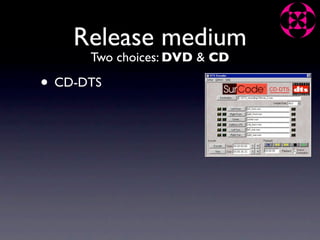
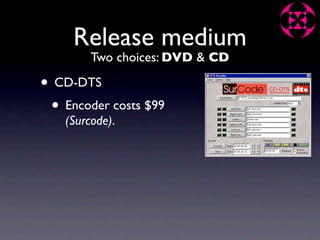
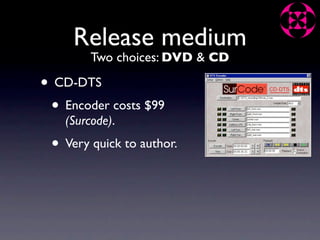
• CD-DTS
Release medium
         Two choices: DVD & CD

• CD-DTS
 • Encoder costs $99
    (Surcode).
Release medium
         Two choices: DVD & CD

• CD-DTS
 • Encoder costs $99
    (Surcode).
 • Very quick to author.
Release medium
         Two choices: DVD & CD

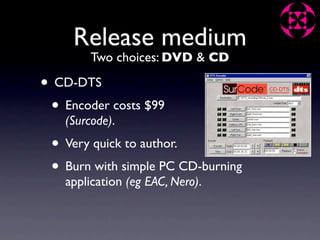
• CD-DTS
 • Encoder costs $99
    (Surcode).
 • Very quick to author.
 • Burn with simple PC CD-burning
    application (eg EAC, Nero).
Release medium
         Two choices: DVD & CD

• CD-DTS
 • Encoder costs $99
    (Surcode).
 • Very quick to author.
 • Burn with simple PC CD-burning
    application (eg EAC, Nero).
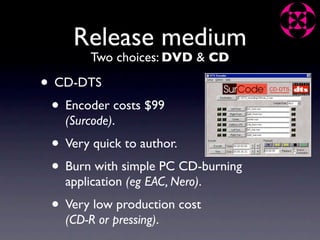
 • Very low production cost
    (CD-R or pressing).
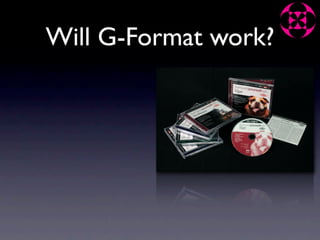
Will G-Format work?
Will G-Format work?
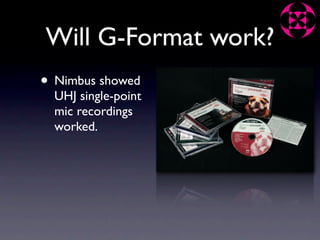
• Nimbus showed
  UHJ single-point
  mic recordings
  worked.
Will G-Format work?
• Nimbus showed
  UHJ single-point
  mic recordings
  worked.
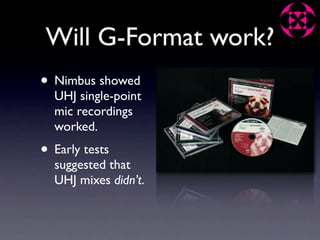
• Early tests
  suggested that
  UHJ mixes didn’t.
Will G-Format work?
• Nimbus showed
  UHJ single-point
  mic recordings
  worked.
• Early tests
  suggested that
  UHJ mixes didn’t.
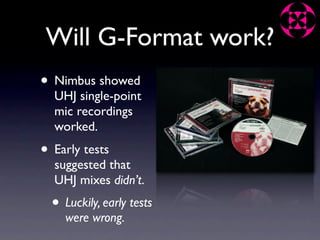
  • Luckily, early tests
     were wrong.
First test disc
First test disc
• Started with the first Ambisonic
  mixes ever made…
First test disc
• Started with the first Ambisonic
  mixes ever made…
• …KPM Music Library tracks
  mixed to UHJ for the Cunard hi-fi
  show in 1981.
First test disc
• Started with the first Ambisonic
  mixes ever made…
• …KPM Music Library tracks
  mixed to UHJ for the Cunard hi-fi
  show in 1981.
• Sourced initially from cassette.
First test disc
• Started with the first Ambisonic
  mixes ever made…
• …KPM Music Library tracks
  mixed to UHJ for the Cunard hi-fi
  show in 1981.
• Sourced initially from cassette.
• Success!
Initial results
  Planar B-Format
Initial results
             Planar B-Format


• B-Format test recordings from
  www.ambisonia.com.
Initial results
              Planar B-Format


• B-Format test recordings from
  www.ambisonia.com.
• Mixture of SFM and digital mixes.
Initial results
              Planar B-Format


• B-Format test recordings from
  www.ambisonia.com.
• Mixture of SFM and digital mixes.
• Extremely impressive results.
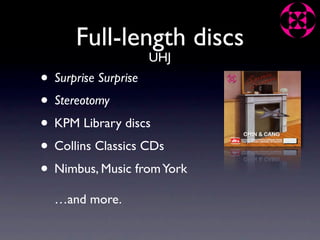
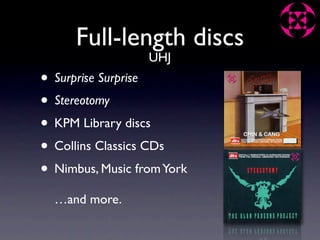
Full-length discs
                  UHJ
• Surprise Surprise
• Stereotomy
• KPM Library discs
• Collins Classics CDs
• Nimbus, Music from York
  …and more.
Full-length discs
                  UHJ
• Surprise Surprise
• Stereotomy
• KPM Library discs
• Collins Classics CDs
• Nimbus, Music from York
  …and more.
Full-length discs
                  UHJ
• Surprise Surprise
• Stereotomy
• KPM Library discs
• Collins Classics CDs
• Nimbus, Music from York
  …and more.
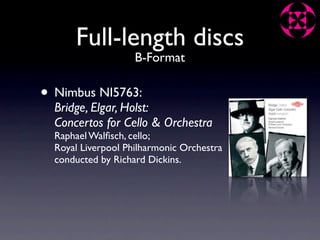
Full-length discs
                    B-Format

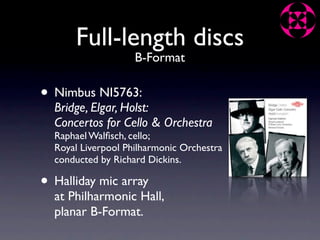
• Nimbus NI5763:
  Bridge, Elgar, Holst:
  Concertos for Cello & Orchestra
  Raphael Walfisch, cello;
  Royal Liverpool Philharmonic Orchestra
  conducted by Richard Dickins.
Full-length discs
                    B-Format

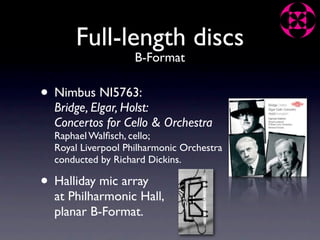
• Nimbus NI5763:
  Bridge, Elgar, Holst:
  Concertos for Cello & Orchestra
  Raphael Walfisch, cello;
  Royal Liverpool Philharmonic Orchestra
  conducted by Richard Dickins.

• Halliday mic array
  at Philharmonic Hall,
  planar B-Format.
Full-length discs
                    B-Format

• Nimbus NI5763:
  Bridge, Elgar, Holst:
  Concertos for Cello & Orchestra
  Raphael Walfisch, cello;
  Royal Liverpool Philharmonic Orchestra
  conducted by Richard Dickins.

• Halliday mic array
  at Philharmonic Hall,
  planar B-Format.
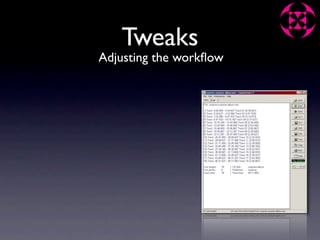
Tweaks
Adjusting the workflow
Tweaks
          Adjusting the workflow

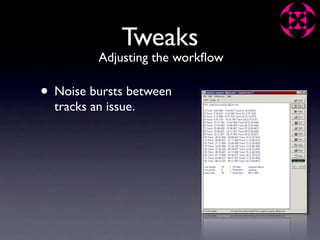
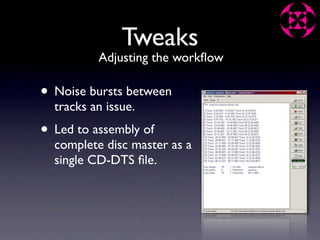
• Noise bursts between
  tracks an issue.
Tweaks
          Adjusting the workflow

• Noise bursts between
  tracks an issue.
• Led to assembly of
  complete disc master as a
  single CD-DTS file.
Tweaks
          Adjusting the workflow

• Noise bursts between
  tracks an issue.
• Led to assembly of
  complete disc master as a
  single CD-DTS file.
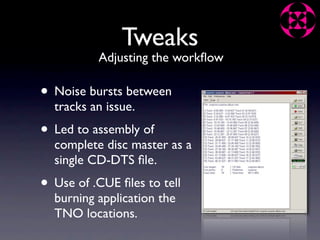
• Use of .CUE files to tell
  burning application the
  TNO locations.
Final workflow
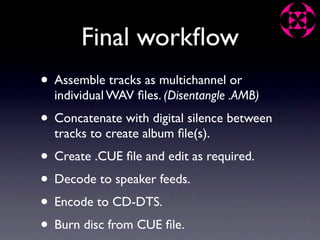
• Assemble tracks as multichannel or
  individual WAV files. (Disentangle .AMB)
• Concatenate with digital silence between
  tracks to create album file(s).
• Create .CUE file and edit as required.
• Decode to speaker feeds.
• Encode to CD-DTS.
• Burn disc from CUE file.
What to do next…
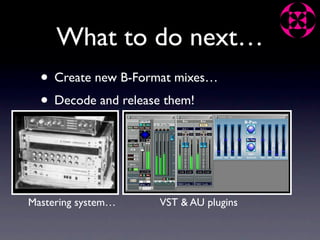
      • Create new B-Format mixes…
      • Decode and release them!


•
    Mastering system…   VST & AU plugins
The opportunity
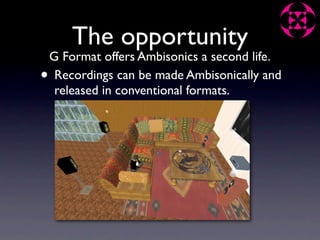
    G Format offers Ambisonics a second life.
•    Recordings can be made Ambisonically and
     released in conventional formats.
The opportunity
    G Format offers Ambisonics a second life.
•    Recordings can be made Ambisonically and
     released in conventional formats.
The opportunity
    G Format offers Ambisonics a second life.
•    Recordings can be made Ambisonically and
     released in conventional formats.


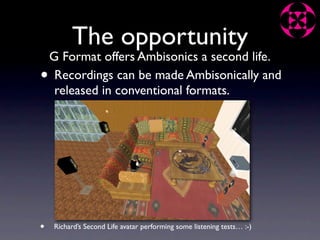
•   Richard’s Second Life avatar performing some listening tests… :-)
The End

Spatial Sound 4: Getting the Best Surround Around

  • 1.
  • 2.
    The Challenge: Distribution • Now you have your Ambisonic content, how do you get people to hear it?
  • 3.
    In the ‘OldDays’: • Only 2-channel mass-media existed • Stereo compatibility required • Special decoder needed at home to listen • Nobody bought them and manufacturers did not build them into audio gear
  • 4.
    Today – Moreoptions • People have multichannel digital systems • But they still don’t have decoders
  • 5.
  • 6.
    Possibilities? for distributing Ambisonic recordings • MLP can carry B-Format and offer flags for DVD-Audio, HD discs
  • 7.
    Possibilities? for distributing Ambisonic recordings • MLP can carry B-Format and offer flags for DVD-Audio, HD discs • …sorry, not very many people can play them.
  • 8.
    Possibilities? for distributing Ambisonic recordings • MLP can carry B-Format and offer flags for DVD-Audio, HD discs • …sorry, not very many people can play them. • Downloadable Ambisonic files and software players
  • 9.
    Possibilities? for distributing Ambisonic recordings • MLP can carry B-Format and offer flags for DVD-Audio, HD discs • …sorry, not very many people can play them. • Downloadable Ambisonic files and software players • …here or on the way – but not yet widespread.
  • 10.
    Possibilities? for distributing Ambisonic recordings • MLP can carry B-Format and offer flags for DVD-Audio, HD discs • …sorry, not very many people can play them. • Downloadable Ambisonic files and software players • …here or on the way – but not yet widespread. • Ogg/FLAC project – support for Ambisonics?
  • 11.
  • 12.
    Goals for distributing Ambisonic recordings • Method must be available now, today.
  • 13.
    Goals for distributing Ambisonic recordings • Method must be available now, today. • Everyone (with a surround system) can listen.
  • 14.
    Goals for distributing Ambisonic recordings • Method must be available now, today. • Everyone (with a surround system) can listen. • Easy and cheap to originate content.
  • 15.
  • 16.
    The Answer… Decoding in the studio • Decode Ambisonics to speaker feeds.
  • 17.
    The Answer… Decoding in the studio • Decode Ambisonics to speaker feeds. • Place the speaker feeds signals on a conventional multichannel medium (eg DVD).
  • 18.
    The Answer… Decoding in the studio • Decode Ambisonics to speaker feeds. • Place the speaker feeds signals on a conventional multichannel medium (eg DVD). • This is called…
  • 19.
    G-Format Decoding Ambisonics in the studio G …to 5.1-compatible multichannel surround.
  • 20.
  • 21.
    G-Format Advantages • Anyone can play it (if you choose popular encoding and distribution formats).
  • 22.
    G-Format Advantages • Anyone can play it (if you choose popular encoding and distribution formats). • Producer controls the decoding process.
  • 23.
    G-Format Advantages • Anyone can play it (if you choose popular encoding and distribution formats). • Producer controls the decoding process. • High quality decoder can be used, correctly configured.
  • 24.
  • 25.
    G-Format Challenges • Lose the ability to render for your replay array (a primary Ambisonic benefit).
  • 26.
    G-Format Challenges • Lose the ability to render for your replay array (a primary Ambisonic benefit). • With some caveats, decode can be reversible.
  • 27.
    G-Format Challenges • Lose the ability to render for your replay array (a primary Ambisonic benefit). • With some caveats, decode can be reversible. • What array do you decode to?
  • 28.
    G-Format Challenges • Lose the ability to render for your replay array (a primary Ambisonic benefit). • With some caveats, decode can be reversible. • What array do you decode to? • Decoder target array and listener array may be different.
  • 29.
    G-Format Challenges • Lose the ability to render for your replay array (a primary Ambisonic benefit). • With some caveats, decode can be reversible. • What array do you decode to? • Decoder target array and listener array may be different. • Possible risk of audio and/or localisation degradation if lossy compression used.
  • 30.
    G-Format What decode array? N • C ITU? L R 30º 100–120º Ls Rs
  • 31.
    G-Format What decode array? N • C ITU? L R • Decoding Ambisonics 30º to ITU 5.1 is technically possible. 100–120º Ls Rs
  • 32.
    G-Format What decode array? N • C ITU? L R • Living rooms 30º aren’t good 100–120º for ITU. Ls Rs
  • 33.
    G-Format What decode array? N • C ITU? L R • Living rooms 30º aren’t good 100–120º for ITU. • We have Ls Rs rectangular living rooms.
  • 34.
    G-Format Decode array N L R • Rectangular Array. Ls Rs
  • 35.
    G-Format Decode array N L R • Rectangular Array. • A standard Ambisonic configuration. Ls Rs
  • 36.
    G-Format Decode array • But narrow N or wide? L R Ls Rs
  • 37.
    G-Format Decode array • But narrow N or wide? L R • 4-speaker Ambisonics supports side ratios between 1:2 & 2:1 Ls Rs
  • 38.
    G-Format Decode array • We don’t know. N L R Ls Rs
  • 39.
    G-Format Decode array • We don’t know. N • A square layout L R minimises likely errors. Ls Rs
  • 40.
    G-Format Decode array • We don’t know. N • A square layout L R minimises likely errors. • Nimbus also found square best. Ls Rs
  • 41.
    G-Format Decoder array andlistener array may be different. N L R Ls Rs
  • 42.
    G-Format Decoder array andlistener array may be different. • Fronts wider than ITU; N L R Ls Rs
  • 43.
    G-Format Decoder array andlistener array may be different. • Fronts wider than ITU; N • Rears are narrower. L R Ls Rs
  • 44.
    G-Format Decoder array andlistener array may be different. • Fronts wider than ITU; N • Rears are narrower. L R • But listeners may well not have ITU! Ls Rs
  • 45.
    G-Format Decoder array andlistener array may be different. • Fronts wider than ITU; N • Rears are narrower. L R • But listeners may well not have ITU! • Ambisonics is robust. Ls Rs
  • 46.
    G-Format Decoder array andlistener array may be different. • Fronts wider than ITU; N • Rears are narrower. L R • But listeners may well not have ITU! • Ambisonics is robust. • CF is not essential (LFE not needed Ls Rs at all!).
  • 47.
    G-Format Sources B-Format or 2-ch UHJ?
  • 48.
    G-Format Sources B-Format or 2-ch UHJ? • Very little B-format originally (No multitrack mastering capability)
  • 49.
    G-Format Sources B-Format or 2-ch UHJ? • Very little B-format originally (No multitrack mastering capability) • This is now changing.
  • 50.
    G-Format Sources B-Format or 2-ch UHJ? • Very little B-format originally (No multitrack mastering capability) • This is now changing. • UHJ recordings are very common.
  • 51.
    G-Format Sources B-Format or 2-ch UHJ? • Very little B-format originally (No multitrack mastering capability) • This is now changing. • UHJ recordings are very common. • How would they stand up against modern multichannel?
  • 52.
    G-Format Sources B-Format or 2-ch UHJ? • Very little B-format originally (No multitrack mastering capability) • This is now changing. • UHJ recordings are very common. • How would they stand up against modern multichannel? • Nimbus showed SFM recordings work. What about Ambisonic mixes?
  • 53.
  • 54.
    What decoder? • Decodeneeded to be done in software.
  • 55.
    What decoder? • Decodeneeded to be done in software. • Several decoders available on-line (see www.ambisonic.net → tools).
  • 56.
    What decoder? • Decodeneeded to be done in software. • Several decoders available on-line (see www.ambisonic.net → tools). • We chose Ambisonic.exe written by Rhonda Wilson at Meridian Audio.
  • 57.
    What decoder? • Decodeneeded to be done in software. • Several decoders available on-line (see www.ambisonic.net → tools). • We chose Ambisonic.exe written by Rhonda Wilson at Meridian Audio. • Originally created for Nimbus.
  • 58.
    What decoder? • Decodeneeded to be done in software. • Several decoders available on-line (see www.ambisonic.net → tools). • We chose Ambisonic.exe written by Rhonda Wilson at Meridian Audio. • Originally created for Nimbus. • UHJ and B-Format capability.
  • 59.
    What decoder? • Decodeneeded to be done in software. • Several decoders available on-line (see www.ambisonic.net → tools). • We chose Ambisonic.exe written by Rhonda Wilson at Meridian Audio. • Originally created for Nimbus. • UHJ and B-Format capability. • Decodes to a rectangle (2:1 – 1:2).
  • 60.
    Release coding &media Requirements
  • 61.
    Release coding &media Requirements • Available now.
  • 62.
    Release coding &media Requirements • Available now. • Not a future system.
  • 63.
    Release coding &media Requirements • Available now. • Not a future system. • Thus not surround downloads (ie must be a ‘packaged medium’).
  • 64.
    Release coding &media Requirements • Available now. • Not a future system. • Thus not surround downloads (ie must be a ‘packaged medium’). • Widely supported.
  • 65.
    Release coding &media Requirements • Available now. • Not a future system. • Thus not surround downloads (ie must be a ‘packaged medium’). • Widely supported. • Must be popular and widespread.
  • 66.
    Release coding &media Requirements • Available now. • Not a future system. • Thus not surround downloads (ie must be a ‘packaged medium’). • Widely supported. • Must be popular and widespread. • Thus not SACD, DVD-A.
  • 67.
    Release coding Two choices:Dolby Digital & dts • Dolby Digital:
  • 68.
    Release coding Two choices:Dolby Digital & dts • Dolby Digital: • Extremely widespread,
  • 69.
    Release coding Two choices:Dolby Digital & dts • Dolby Digital: • Extremely widespread, • Cheap encoder.
  • 70.
    Release coding Two choices:Dolby Digital & dts • Dolby Digital: • Extremely widespread, • Cheap encoder. • Compatible with Ambisonics?
  • 71.
    Release coding Two choices:Dolby Digital & dts • dts:
  • 72.
    Release coding Two choices:Dolby Digital & dts • dts: • Very widespread,
  • 73.
    Release coding Two choices:Dolby Digital & dts • dts: • Very widespread, • Cheap encoder.
  • 74.
    Release coding Two choices:Dolby Digital & dts • dts: • Very widespread, • Cheap encoder. • Compatible with Ambisonics.
  • 75.
    Release coding Two choices:Dolby Digital & dts • dts chosen.
  • 76.
    Release medium Two choices: DVD & CD • DVD-Video:
  • 77.
    Release medium Two choices: DVD & CD • DVD-Video: • Authoring application required as well as surround encoder.
  • 78.
    Release medium Two choices: DVD & CD • DVD-Video: • Authoring application required as well as surround encoder. • Images required (even if rudimentary).
  • 79.
    Release medium Two choices: DVD & CD • DVD-Video: • Authoring application required as well as surround encoder. • Images required (even if rudimentary). • Time required to build menu structure etc.
  • 80.
    Release medium Two choices: DVD & CD • CD-DTS
  • 81.
    Release medium Two choices: DVD & CD • CD-DTS • Encoder costs $99 (Surcode).
  • 82.
    Release medium Two choices: DVD & CD • CD-DTS • Encoder costs $99 (Surcode). • Very quick to author.
  • 83.
    Release medium Two choices: DVD & CD • CD-DTS • Encoder costs $99 (Surcode). • Very quick to author. • Burn with simple PC CD-burning application (eg EAC, Nero).
  • 84.
    Release medium Two choices: DVD & CD • CD-DTS • Encoder costs $99 (Surcode). • Very quick to author. • Burn with simple PC CD-burning application (eg EAC, Nero). • Very low production cost (CD-R or pressing).
  • 85.
  • 86.
    Will G-Format work? •Nimbus showed UHJ single-point mic recordings worked.
  • 87.
    Will G-Format work? •Nimbus showed UHJ single-point mic recordings worked. • Early tests suggested that UHJ mixes didn’t.
  • 88.
    Will G-Format work? •Nimbus showed UHJ single-point mic recordings worked. • Early tests suggested that UHJ mixes didn’t. • Luckily, early tests were wrong.
  • 89.
  • 90.
    First test disc •Started with the first Ambisonic mixes ever made…
  • 91.
    First test disc •Started with the first Ambisonic mixes ever made… • …KPM Music Library tracks mixed to UHJ for the Cunard hi-fi show in 1981.
  • 92.
    First test disc •Started with the first Ambisonic mixes ever made… • …KPM Music Library tracks mixed to UHJ for the Cunard hi-fi show in 1981. • Sourced initially from cassette.
  • 93.
    First test disc •Started with the first Ambisonic mixes ever made… • …KPM Music Library tracks mixed to UHJ for the Cunard hi-fi show in 1981. • Sourced initially from cassette. • Success!
  • 94.
    Initial results Planar B-Format
  • 95.
    Initial results Planar B-Format • B-Format test recordings from www.ambisonia.com.
  • 96.
    Initial results Planar B-Format • B-Format test recordings from www.ambisonia.com. • Mixture of SFM and digital mixes.
  • 97.
    Initial results Planar B-Format • B-Format test recordings from www.ambisonia.com. • Mixture of SFM and digital mixes. • Extremely impressive results.
  • 98.
    Full-length discs UHJ • Surprise Surprise • Stereotomy • KPM Library discs • Collins Classics CDs • Nimbus, Music from York …and more.
  • 99.
    Full-length discs UHJ • Surprise Surprise • Stereotomy • KPM Library discs • Collins Classics CDs • Nimbus, Music from York …and more.
  • 100.
    Full-length discs UHJ • Surprise Surprise • Stereotomy • KPM Library discs • Collins Classics CDs • Nimbus, Music from York …and more.
  • 101.
    Full-length discs B-Format • Nimbus NI5763: Bridge, Elgar, Holst: Concertos for Cello & Orchestra Raphael Walfisch, cello; Royal Liverpool Philharmonic Orchestra conducted by Richard Dickins.
  • 102.
    Full-length discs B-Format • Nimbus NI5763: Bridge, Elgar, Holst: Concertos for Cello & Orchestra Raphael Walfisch, cello; Royal Liverpool Philharmonic Orchestra conducted by Richard Dickins. • Halliday mic array at Philharmonic Hall, planar B-Format.
  • 103.
    Full-length discs B-Format • Nimbus NI5763: Bridge, Elgar, Holst: Concertos for Cello & Orchestra Raphael Walfisch, cello; Royal Liverpool Philharmonic Orchestra conducted by Richard Dickins. • Halliday mic array at Philharmonic Hall, planar B-Format.
  • 104.
  • 105.
    Tweaks Adjusting the workflow • Noise bursts between tracks an issue.
  • 106.
    Tweaks Adjusting the workflow • Noise bursts between tracks an issue. • Led to assembly of complete disc master as a single CD-DTS file.
  • 107.
    Tweaks Adjusting the workflow • Noise bursts between tracks an issue. • Led to assembly of complete disc master as a single CD-DTS file. • Use of .CUE files to tell burning application the TNO locations.
  • 108.
    Final workflow • Assembletracks as multichannel or individual WAV files. (Disentangle .AMB) • Concatenate with digital silence between tracks to create album file(s). • Create .CUE file and edit as required. • Decode to speaker feeds. • Encode to CD-DTS. • Burn disc from CUE file.
  • 109.
    What to donext… • Create new B-Format mixes… • Decode and release them! • Mastering system… VST & AU plugins
  • 110.
    The opportunity G Format offers Ambisonics a second life. • Recordings can be made Ambisonically and released in conventional formats.
  • 111.
    The opportunity G Format offers Ambisonics a second life. • Recordings can be made Ambisonically and released in conventional formats.
  • 112.
    The opportunity G Format offers Ambisonics a second life. • Recordings can be made Ambisonically and released in conventional formats. • Richard’s Second Life avatar performing some listening tests… :-)
  • 113.

Editor's Notes

  • #2 Intro slide. On screen as early as possible.\nLeft click adds points/advances slide. Right-click removes points/goes to previous slide.\n
  • #3 \n
  • #4 \n
  • #5 \n
  • #6 Other methods of Ambisonic distro: not appropriate for one reason or another. 4 points (two main). MLP = Meridian Lossless Packing.\n
  • #7 Other methods of Ambisonic distro: not appropriate for one reason or another. 4 points (two main). MLP = Meridian Lossless Packing.\n
  • #8 Other methods of Ambisonic distro: not appropriate for one reason or another. 4 points (two main). MLP = Meridian Lossless Packing.\n
  • #9 Other methods of Ambisonic distro: not appropriate for one reason or another. 4 points (two main). MLP = Meridian Lossless Packing.\n
  • #10 Other methods of Ambisonic distro: not appropriate for one reason or another. 4 points (two main). MLP = Meridian Lossless Packing.\n
  • #11 Here’s what we were looking for as an alternative. Three points\n
  • #12 Here’s what we were looking for as an alternative. Three points\n
  • #13 Here’s what we were looking for as an alternative. Three points\n
  • #14 The solution we chose. Named on next slide. 3 points. When final point comes up, say “We call this...” and advance slide...\n
  • #15 The solution we chose. Named on next slide. 3 points. When final point comes up, say “We call this...” and advance slide...\n
  • #16 The solution we chose. Named on next slide. 3 points. When final point comes up, say “We call this...” and advance slide...\n
  • #17 Say, “G FORMAT”\nJust the one item\n
  • #18 So here are the advantages of this approach... 3 points\n
  • #19 So here are the advantages of this approach... 3 points\n
  • #20 So here are the advantages of this approach... 3 points\n
  • #21 ...and here are the drawbacks. 5 points (first has a sub): you may be able to get B-Format back from G, then decode Ambisonically and get this benefit back. Needs reversible shelf filters. \n
  • #22 ...and here are the drawbacks. 5 points (first has a sub): you may be able to get B-Format back from G, then decode Ambisonically and get this benefit back. Needs reversible shelf filters. \n
  • #23 ...and here are the drawbacks. 5 points (first has a sub): you may be able to get B-Format back from G, then decode Ambisonically and get this benefit back. Needs reversible shelf filters. \n
  • #24 ...and here are the drawbacks. 5 points (first has a sub): you may be able to get B-Format back from G, then decode Ambisonically and get this benefit back. Needs reversible shelf filters. \n
  • #25 ...and here are the drawbacks. 5 points (first has a sub): you may be able to get B-Format back from G, then decode Ambisonically and get this benefit back. Needs reversible shelf filters. \n
  • #26 This section addresses the challenges one by one. First, the decode array: why we chose four-square. One point plus sub\n
  • #27 This section addresses the challenges one by one. First, the decode array: why we chose four-square. One point plus sub\n
  • #28 Why ITU was not what we chose. 3 points. “ITU” stays up from last slide.\n
  • #29 Why ITU was not what we chose. 3 points. “ITU” stays up from last slide.\n
  • #30 Why ITU was not what we chose. 3 points. “ITU” stays up from last slide.\n
  • #31 Rectangular array - two points\n
  • #32 Rectangular array - two points\n
  • #33 Aspect rations. Initial question answered on next slide. 2 points\n
  • #34 Aspect rations. Initial question answered on next slide. 2 points\n
  • #35 Aspect rations. Initial question answered on next slide. 2 points\n
  • #36 We don’t know whether the listening room will be narrow or wide: a square target minimises the likely error.\n
  • #37 We don’t know whether the listening room will be narrow or wide: a square target minimises the likely error.\n
  • #38 We don’t know whether the listening room will be narrow or wide: a square target minimises the likely error.\n
  • #39 The difference between target and listener arrays. 5 points!\n
  • #40 The difference between target and listener arrays. 5 points!\n
  • #41 The difference between target and listener arrays. 5 points!\n
  • #42 The difference between target and listener arrays. 5 points!\n
  • #43 The difference between target and listener arrays. 5 points!\n
  • #44 Source material - 5 points. Question of effectiveness of UHJ decodes.\n
  • #45 Source material - 5 points. Question of effectiveness of UHJ decodes.\n
  • #46 Source material - 5 points. Question of effectiveness of UHJ decodes.\n
  • #47 Source material - 5 points. Question of effectiveness of UHJ decodes.\n
  • #48 Source material - 5 points. Question of effectiveness of UHJ decodes.\n
  • #49 Decoder choice. 6 points\n
  • #50 Decoder choice. 6 points\n
  • #51 Decoder choice. 6 points\n
  • #52 Decoder choice. 6 points\n
  • #53 Decoder choice. 6 points\n
  • #54 Decoder choice. 6 points\n
  • #55 Criteria for a release medium and its coding. 6 points.\n
  • #56 Criteria for a release medium and its coding. 6 points.\n
  • #57 Criteria for a release medium and its coding. 6 points.\n
  • #58 Criteria for a release medium and its coding. 6 points.\n
  • #59 Criteria for a release medium and its coding. 6 points.\n
  • #60 Criteria for a release medium and its coding. 6 points.\n
  • #61 Dolby Digital - considerations (4). Discuss that there is some doubt about Dolby’s compatibility with Ambisonics - coupling may impact phase relationships.\n
  • #62 Dolby Digital - considerations (4). Discuss that there is some doubt about Dolby’s compatibility with Ambisonics - coupling may impact phase relationships.\n
  • #63 Dolby Digital - considerations (4). Discuss that there is some doubt about Dolby’s compatibility with Ambisonics - coupling may impact phase relationships.\n
  • #64 Dolby Digital - considerations (4). Discuss that there is some doubt about Dolby’s compatibility with Ambisonics - coupling may impact phase relationships.\n
  • #65 DTS - pro points (4)\n
  • #66 DTS - pro points (4)\n
  • #67 DTS - pro points (4)\n
  • #68 DTS - pro points (4)\n
  • #69 This was our choice. Again, note that Nimbus chose DTS for the DVD-Video zone of their G-Format discs.\n
  • #70 Release medium choices #1: DVD-Video - 4 points. \n
  • #71 Release medium choices #1: DVD-Video - 4 points. \n
  • #72 Release medium choices #1: DVD-Video - 4 points. \n
  • #73 Release medium choices #1: DVD-Video - 4 points. \n
  • #74 CD-DTS considerations - 5 points\n
  • #75 CD-DTS considerations - 5 points\n
  • #76 CD-DTS considerations - 5 points\n
  • #77 CD-DTS considerations - 5 points\n
  • #78 CD-DTS considerations - 5 points\n
  • #79 3 points - refer to early experiments where we had a test version of Stereotomy made for us.\n
  • #80 3 points - refer to early experiments where we had a test version of Stereotomy made for us.\n
  • #81 3 points - refer to early experiments where we had a test version of Stereotomy made for us.\n
  • #82 4 points. Refer to Boots Audio project. Started with UHJ.\n
  • #83 4 points. Refer to Boots Audio project. Started with UHJ.\n
  • #84 4 points. Refer to Boots Audio project. Started with UHJ.\n
  • #85 4 points. Refer to Boots Audio project. Started with UHJ.\n
  • #86 Then some B Format sources - even better.\n
  • #87 Then some B Format sources - even better.\n
  • #88 Then some B Format sources - even better.\n
  • #89 Then we processed some complete discs and refined the workflow. Details are in the paper. All points come up at once; click to display Surprise album cover and again for Stereotomy\n
  • #90 Then we processed some complete discs and refined the workflow. Details are in the paper. All points come up at once; click to display Surprise album cover and again for Stereotomy\n
  • #91 Then we were very kindly offered an original B-Format Nimbus recording to try. Thanks to Crac Downes at Nimbus. You can hear some of this in the Council Room demos. 2 points. \n
  • #92 Then we were very kindly offered an original B-Format Nimbus recording to try. Thanks to Crac Downes at Nimbus. You can hear some of this in the Council Room demos. 2 points. \n
  • #93 Then we were very kindly offered an original B-Format Nimbus recording to try. Thanks to Crac Downes at Nimbus. You can hear some of this in the Council Room demos. 2 points. \n
  • #94 Further development of workflow to allow processing of one (series of) files. 3 points. Noise bursts due to dts decoder de-muting.\n
  • #95 Further development of workflow to allow processing of one (series of) files. 3 points. Noise bursts due to dts decoder de-muting.\n
  • #96 Further development of workflow to allow processing of one (series of) files. 3 points. Noise bursts due to dts decoder de-muting.\n
  • #97 6 points. Covered in much more detail in the paper. “Disentangle” means to turn multichannel WAV files into individual mono files as our apps don’t work with the former.\n
  • #98 What we intend to do next.\n
  • #99 This page is a little joke. Second Life is ‘the’ virtual world with over 5 million ‘residents’.\n
  • #100 This page is a little joke. Second Life is ‘the’ virtual world with over 5 million ‘residents’.\n
  • #101 \n