Chapter 10 Notes
• Section 1 and 2
• Section 3 and 4
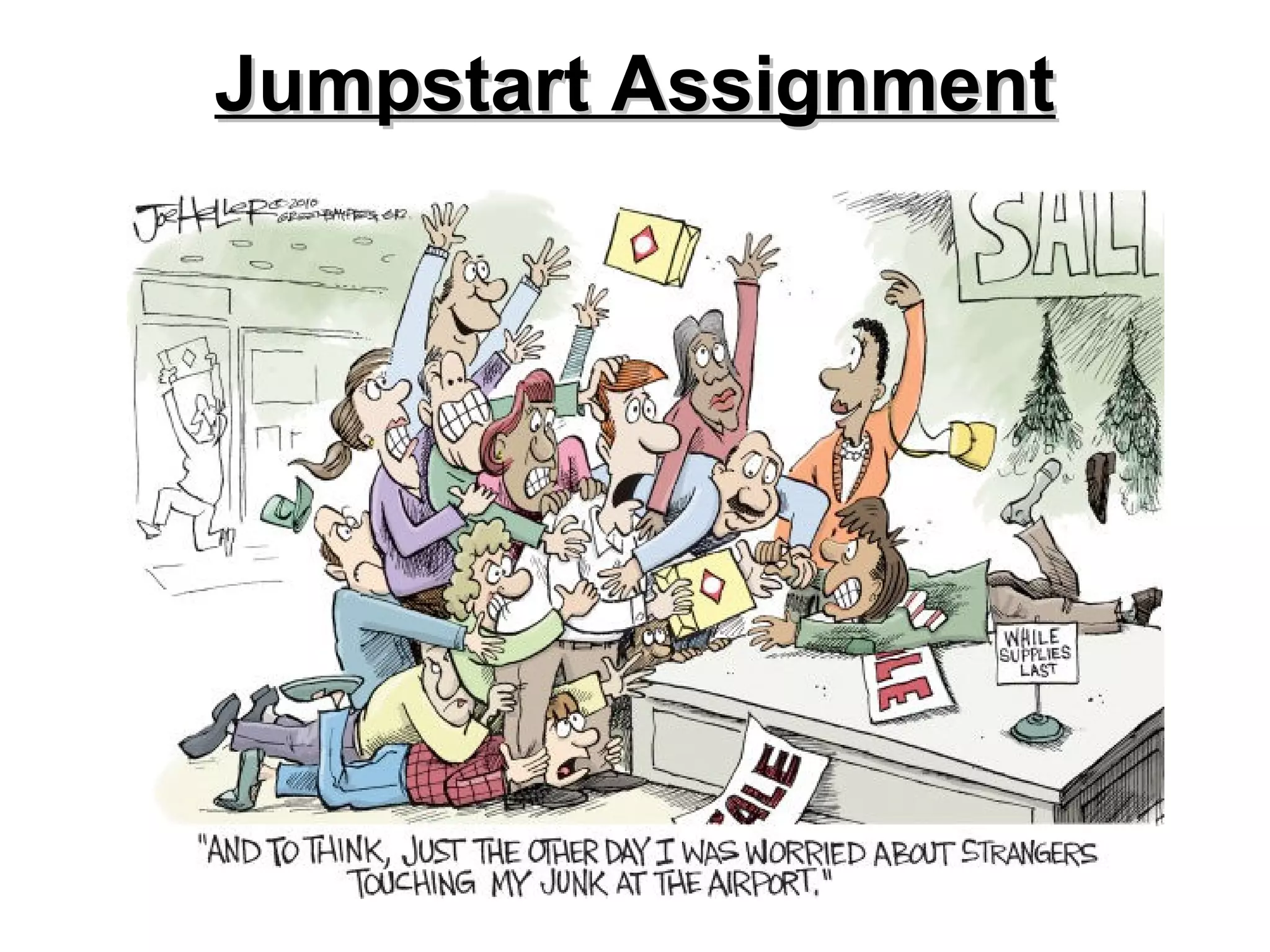
Jumpstart AssignmentJumpstart Assignment
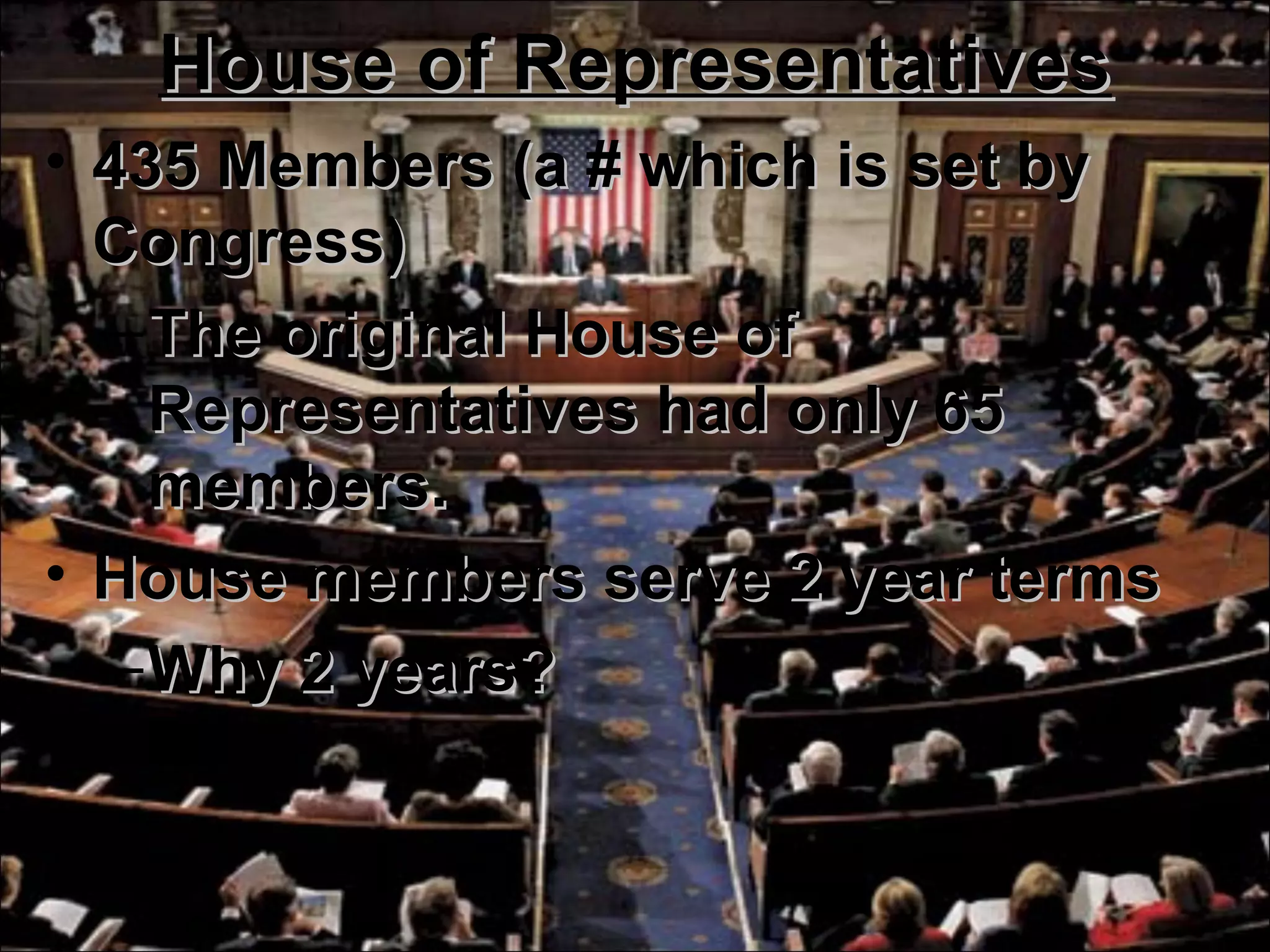
House of RepresentativesHouse of Representatives
• 435 Members (a # which is set by435 Members (a # which is set by
Congress)Congress)
–The original House ofThe original House of
Representatives had only 65Representatives had only 65
members.members.
• House members serve 2 year termsHouse members serve 2 year terms
–Why 2 years?Why 2 years?
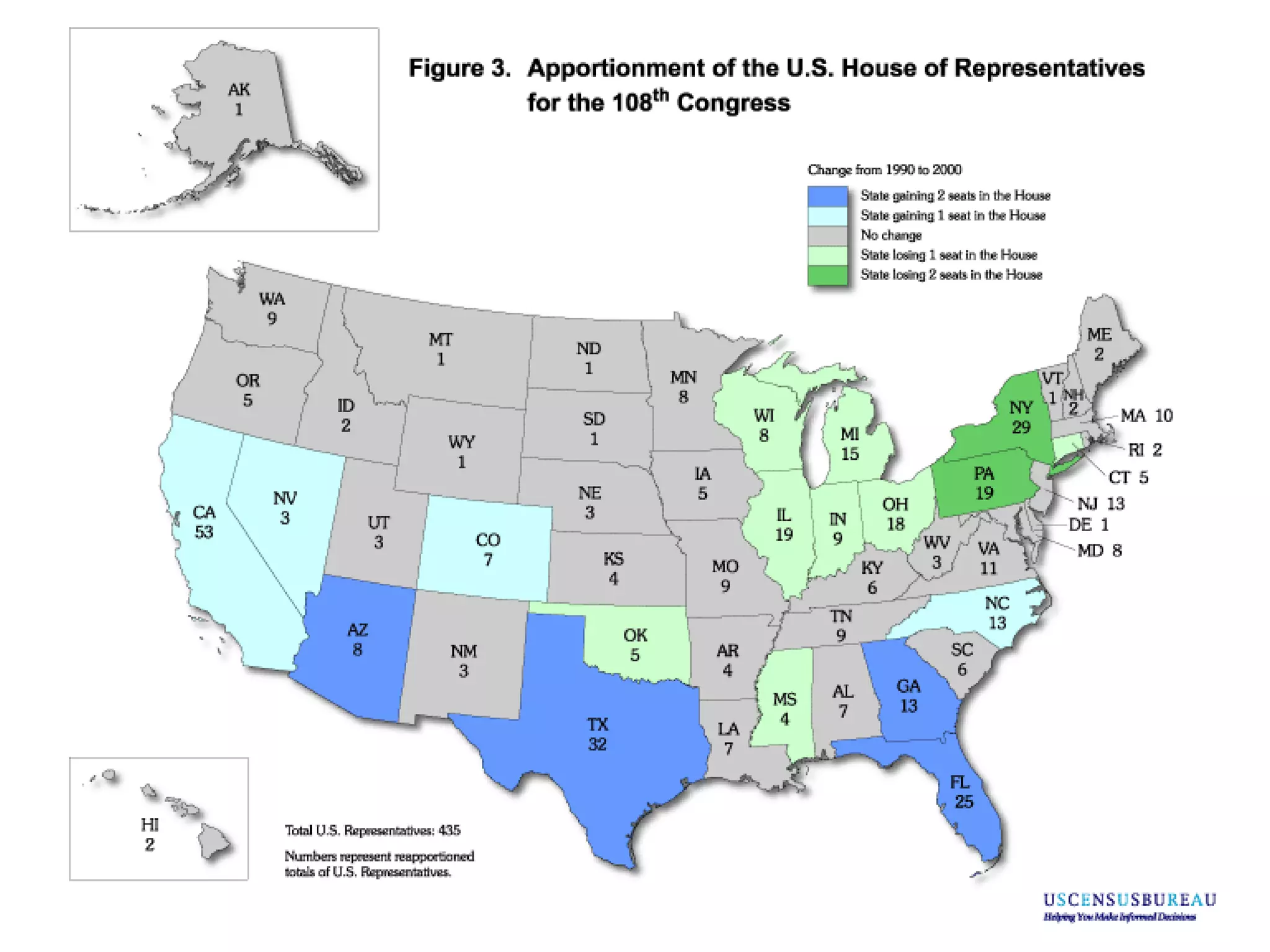
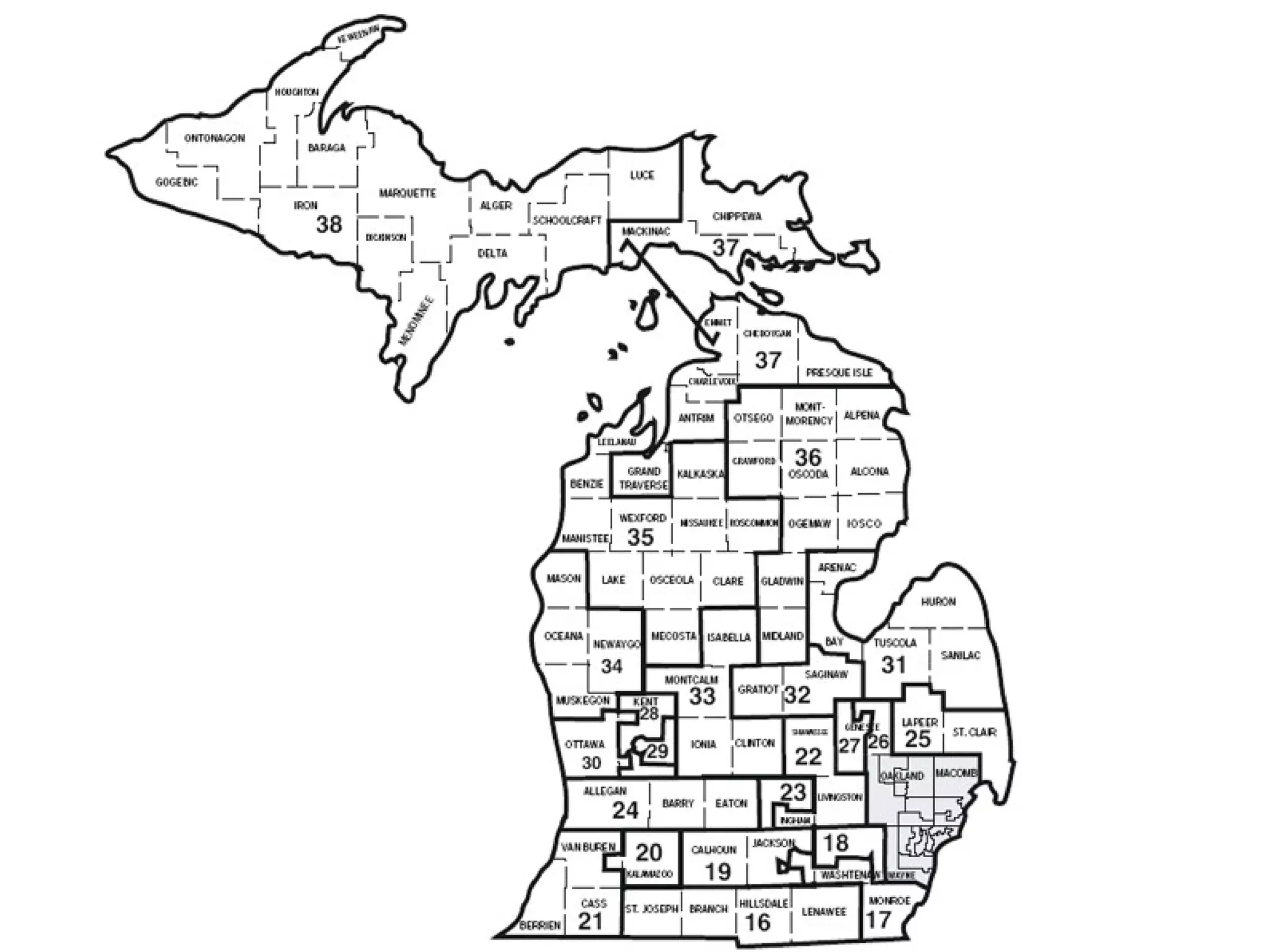
House Apportionment
• Reps. areReps. are apportionedapportioned based on statebased on state
pop.pop.
• They areThey are reapportionedreapportioned every 10 yearsevery 10 years
based on the national census.based on the national census.
• TheThe Reapportionment Act of 1929Reapportionment Act of 1929 setset
the “permanent” size of the House atthe “permanent” size of the House at
435435
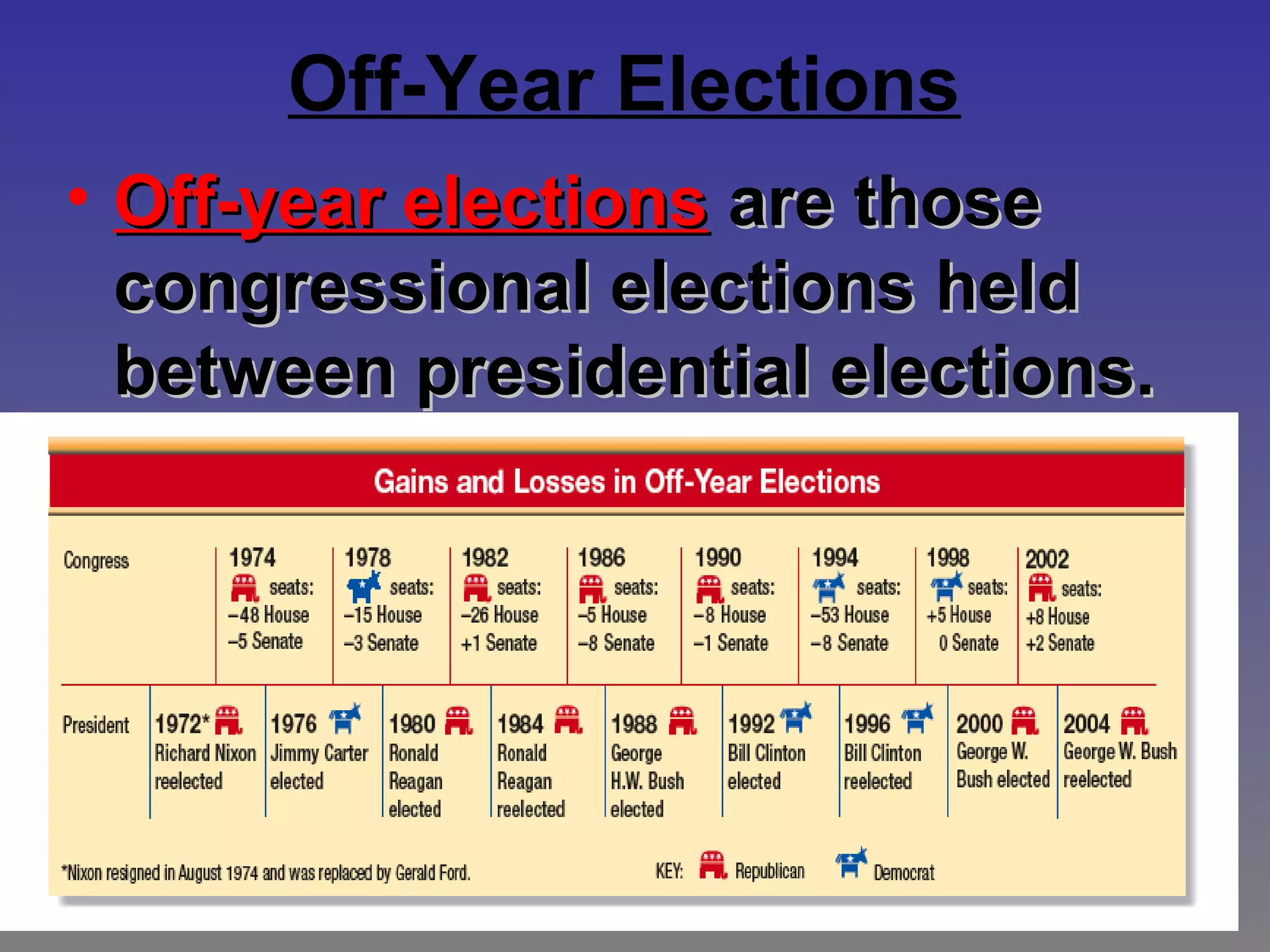
Off-Year Elections
• Off-year electionsOff-year elections are thoseare those
congressional elections heldcongressional elections held
between presidential elections.between presidential elections.
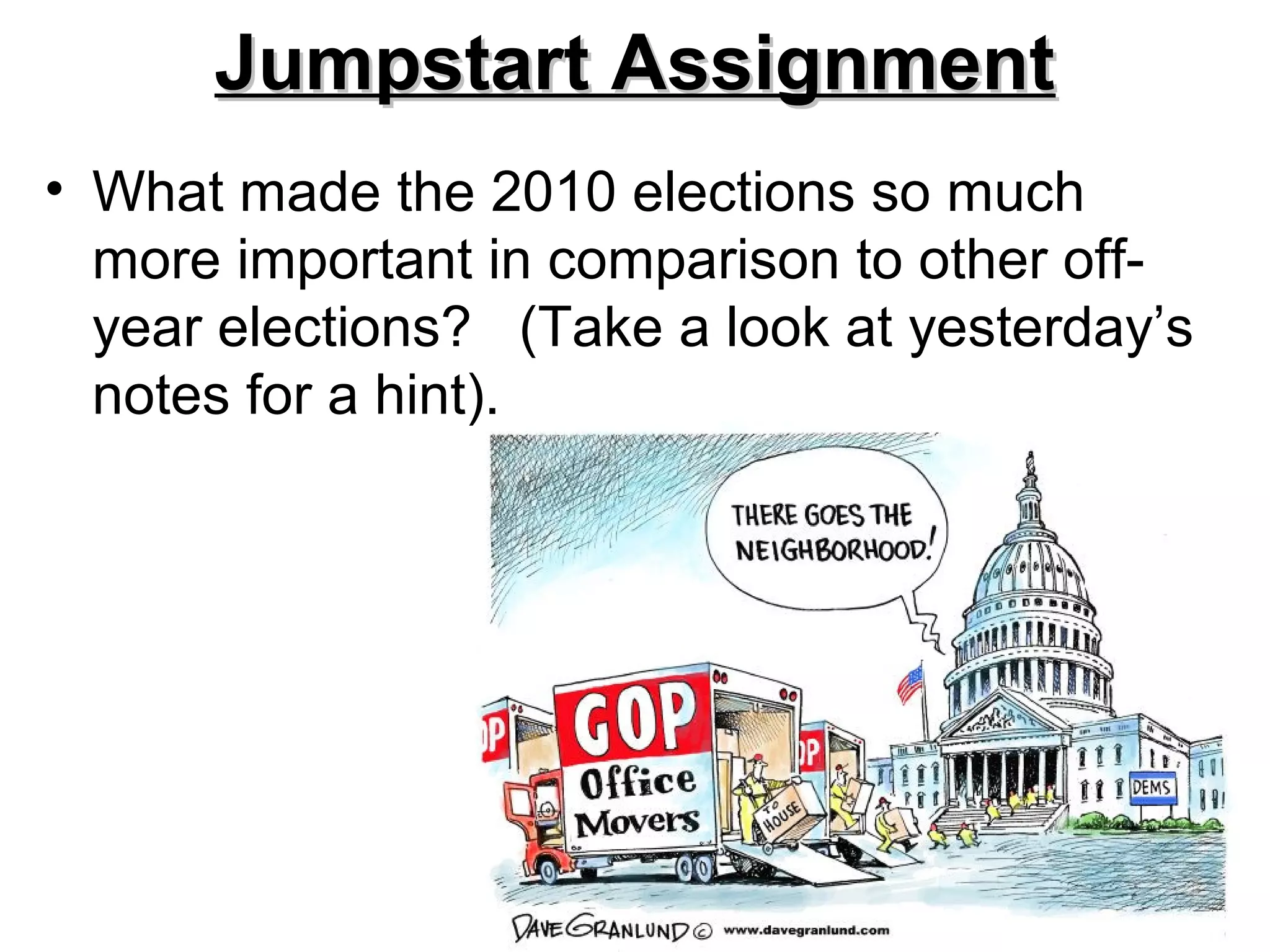
Jumpstart AssignmentJumpstart Assignment
• What made the 2010 elections so much
more important in comparison to other off-
year elections? (Take a look at yesterday’s
notes for a hint).
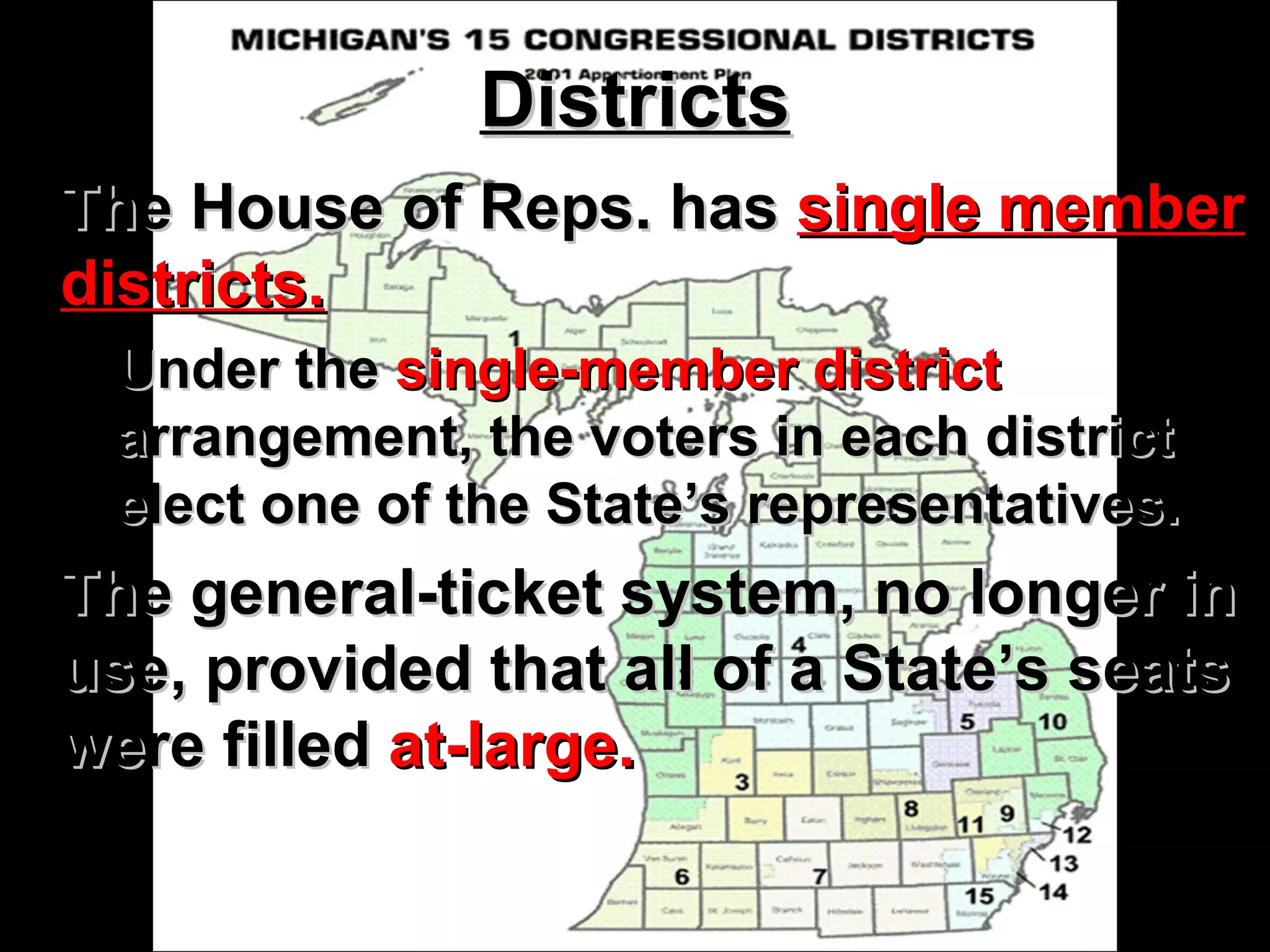
DistrictsDistricts
• The House of Reps. hasThe House of Reps. has single membersingle member
districts.districts.
– Under theUnder the single-member districtsingle-member district
arrangement, the voters in each districtarrangement, the voters in each district
elect one of the State’s representatives.elect one of the State’s representatives.
• The general-ticket system, no longer inThe general-ticket system, no longer in
use, provided that all of a State’s seatsuse, provided that all of a State’s seats
were filledwere filled at-large.at-large.
GerrymanderingGerrymandering
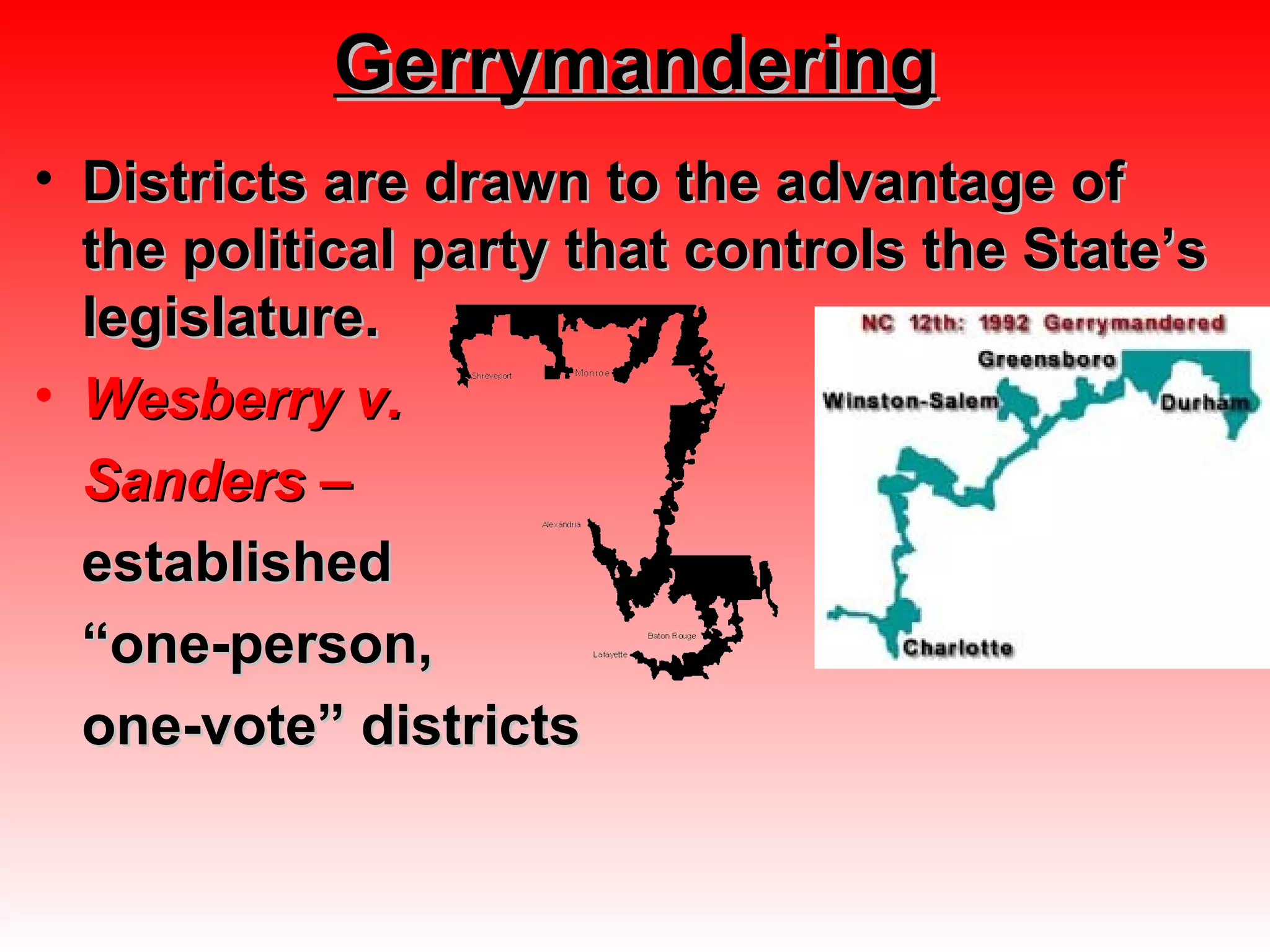
• Districts are drawn to the advantage ofDistricts are drawn to the advantage of
the political party that controls the State’sthe political party that controls the State’s
legislature.legislature.
• Wesberry v.Wesberry v.
Sanders –Sanders –
establishedestablished
““one-person,one-person,
one-vote” districtsone-vote” districts
QualificationsQualifications
• 25 years old25 years old
• Citizen for 7 yrs.Citizen for 7 yrs.
• Inhabitant of the state where he/she isInhabitant of the state where he/she is
electedelected
• The realities of politics also require someThe realities of politics also require some
informal qualificationsinformal qualifications, such as party, such as party
identification, name familiarity, gender,identification, name familiarity, gender,
ethnic characteristics, and politicalethnic characteristics, and political
experience.experience.
Jumpstart AssignmentJumpstart Assignment
• How should a member of CongressHow should a member of Congress
make a decision on a vote, basedmake a decision on a vote, based
on views of the people, their ownon views of the people, their own
consciences, or based on theirconsciences, or based on their
political parties view? Explain yourpolitical parties view? Explain your
answer.answer.
Today’s AgendaToday’s Agenda
• JumpstartJumpstart
• ““Profiles in Courage”Profiles in Courage”
• Notes:Notes: Ch. 10, Section 3 and 4Ch. 10, Section 3 and 4
• Comparing the House and SenateComparing the House and Senate
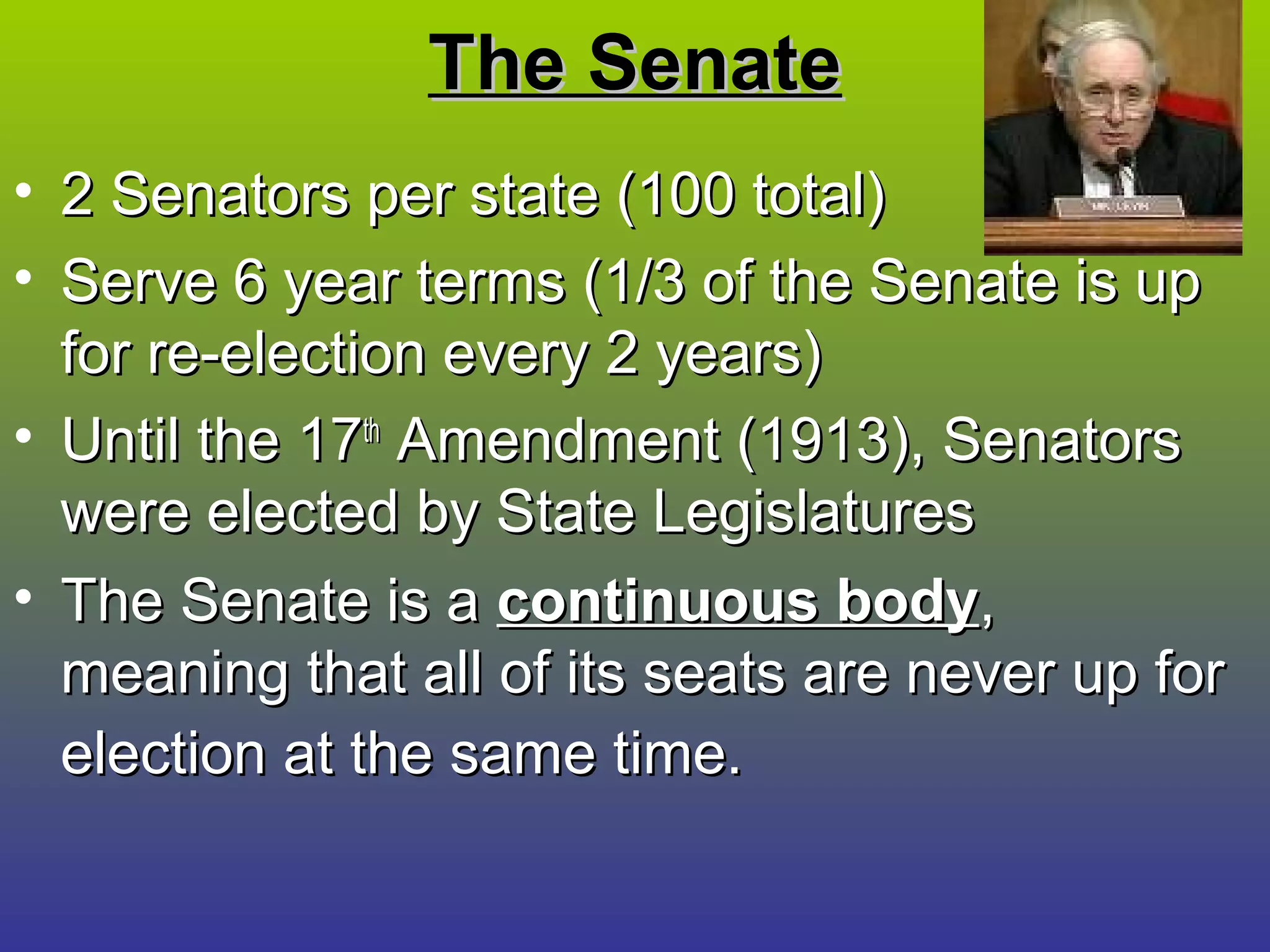
The SenateThe Senate
• 2 Senators per state (100 total)2 Senators per state (100 total)
• Serve 6 year terms (1/3 of the Senate is upServe 6 year terms (1/3 of the Senate is up
for re-election every 2 years)for re-election every 2 years)
• Until the 17Until the 17thth
Amendment (1913), SenatorsAmendment (1913), Senators
were elected by State Legislatureswere elected by State Legislatures
• The Senate is aThe Senate is a continuous bodycontinuous body,,
meaning that all of its seats are never up formeaning that all of its seats are never up for
election at the same time.election at the same time.
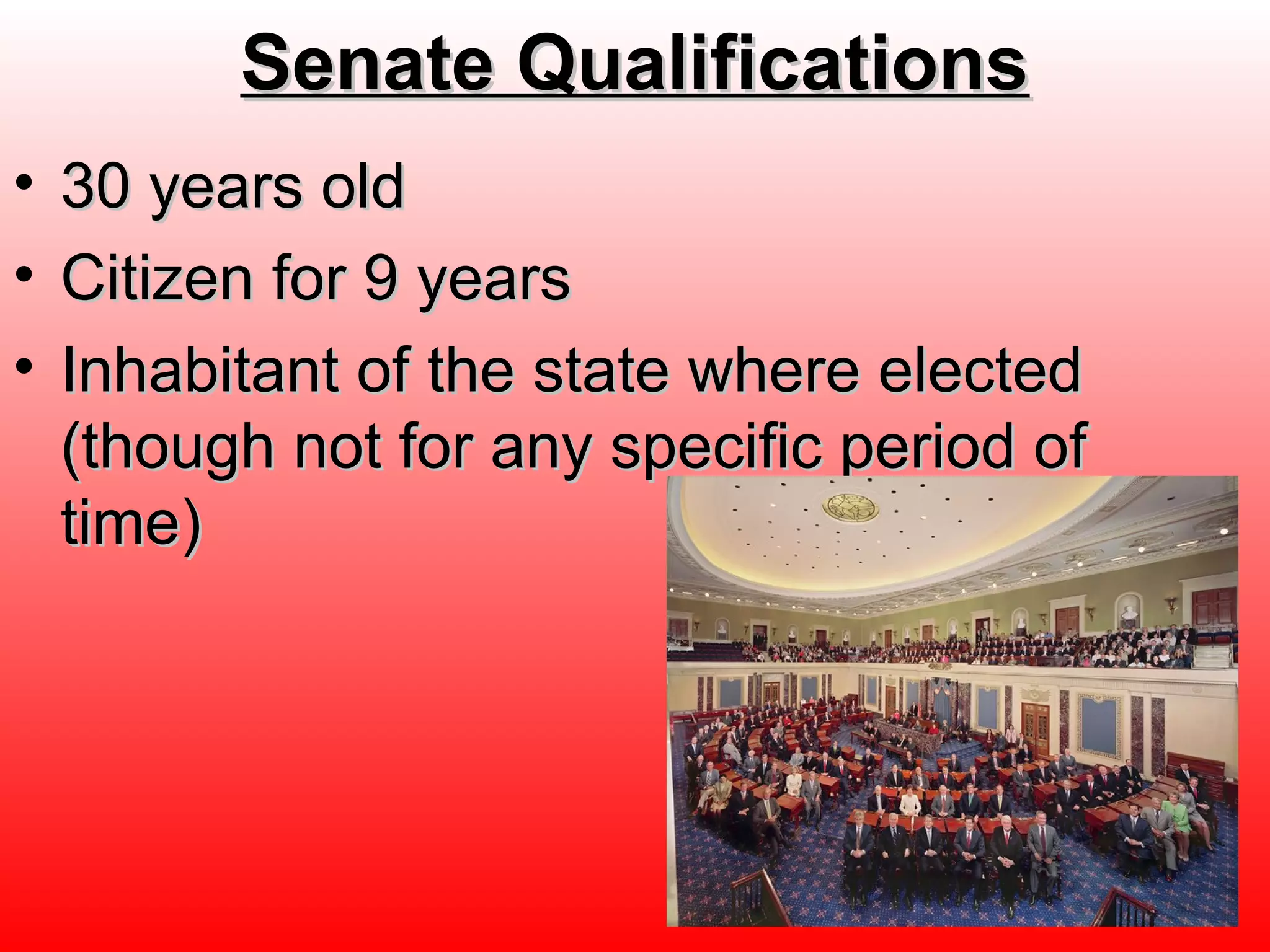
Senate QualificationsSenate Qualifications
• 30 years old30 years old
• Citizen for 9 yearsCitizen for 9 years
• Inhabitant of the state where electedInhabitant of the state where elected
(though not for any specific period of(though not for any specific period of
time)time)
Job of Congress Members
1)1) Work in committee to screen proposedWork in committee to screen proposed
lawslaws
– Oversight FunctionOversight Function – a way to– a way to
check agencies of the Executivecheck agencies of the Executive
BranchBranch
2)2) Represent the people (constituents)Represent the people (constituents)
3)3) Law MakingLaw Making
4)4) Serving their constituentsServing their constituents
Voting OptionsVoting Options
• TrusteesTrustees – believe that each question they– believe that each question they
face must be decided on its meritface must be decided on its merit
• DelegatesDelegates – see themselves as agents of the– see themselves as agents of the
people they representpeople they represent
• PartisansPartisans – lawmakers who see their– lawmakers who see their
allegiance to their political party as being theallegiance to their political party as being the
most importantmost important
• PoliticosPoliticos – attempt to combine all three– attempt to combine all three
CompensationCompensation
• HouseHouse and Senateand Senate - $169, 600- $169, 600
• Pay is set by CongressPay is set by Congress
• TheThe franking privilegefranking privilege allows members ofallows members of
Congress to mail letters and other materialsCongress to mail letters and other materials
postage-freepostage-free
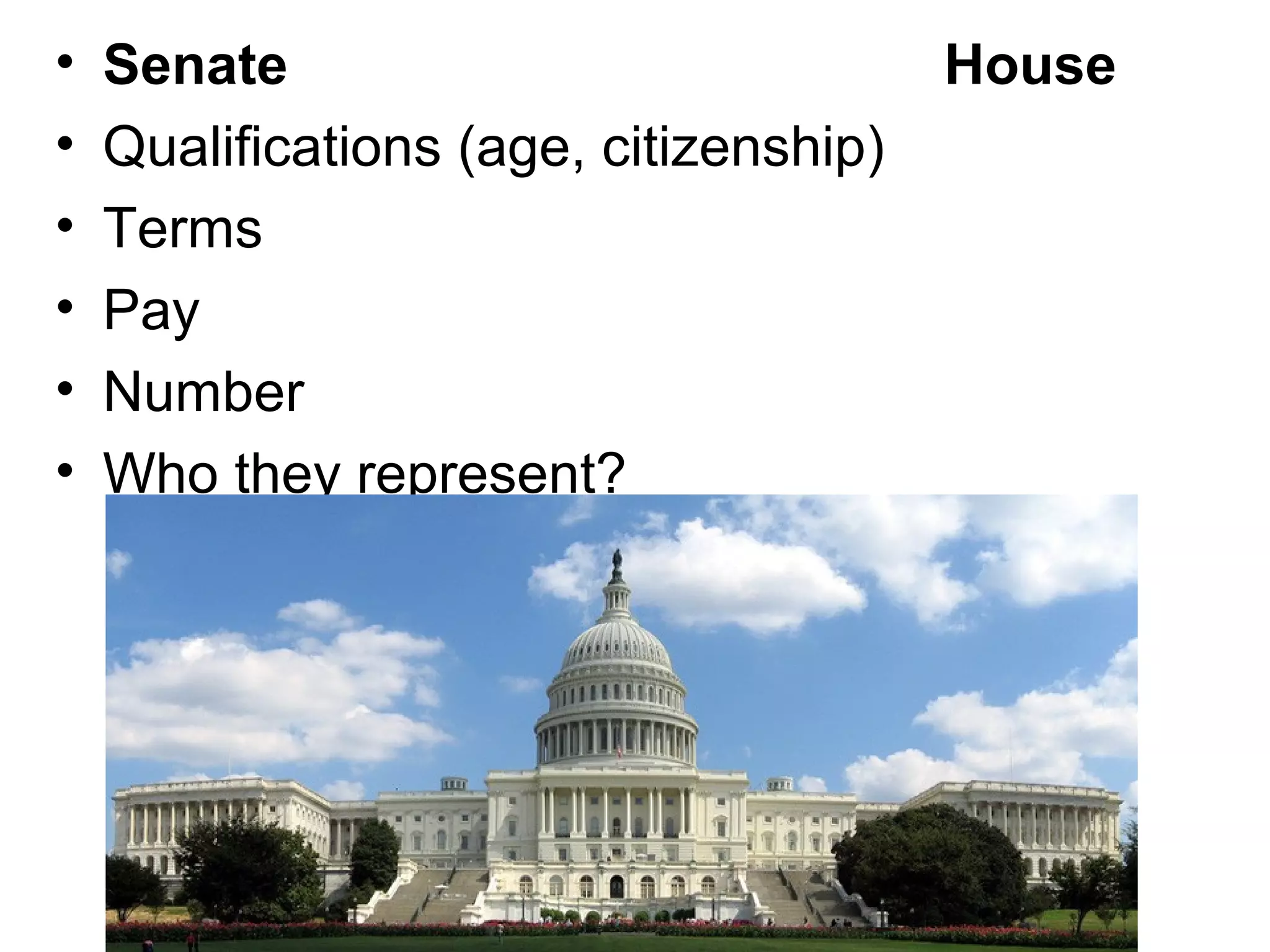
Roles of Congress
• Senate House
• Qualifications (age, citizenship)
• Terms
• Pay
• Number
• Who they represent?

Chapter 10 notes

  • 1.
    Chapter 10 Notes •Section 1 and 2 • Section 3 and 4
  • 2.
  • 3.
    House of RepresentativesHouseof Representatives • 435 Members (a # which is set by435 Members (a # which is set by Congress)Congress) –The original House ofThe original House of Representatives had only 65Representatives had only 65 members.members. • House members serve 2 year termsHouse members serve 2 year terms –Why 2 years?Why 2 years?
  • 4.
    House Apportionment • Reps.areReps. are apportionedapportioned based on statebased on state pop.pop. • They areThey are reapportionedreapportioned every 10 yearsevery 10 years based on the national census.based on the national census. • TheThe Reapportionment Act of 1929Reapportionment Act of 1929 setset the “permanent” size of the House atthe “permanent” size of the House at 435435
  • 6.
    Off-Year Elections • Off-yearelectionsOff-year elections are thoseare those congressional elections heldcongressional elections held between presidential elections.between presidential elections.
  • 7.
    Jumpstart AssignmentJumpstart Assignment •What made the 2010 elections so much more important in comparison to other off- year elections? (Take a look at yesterday’s notes for a hint).
  • 8.
    DistrictsDistricts • The Houseof Reps. hasThe House of Reps. has single membersingle member districts.districts. – Under theUnder the single-member districtsingle-member district arrangement, the voters in each districtarrangement, the voters in each district elect one of the State’s representatives.elect one of the State’s representatives. • The general-ticket system, no longer inThe general-ticket system, no longer in use, provided that all of a State’s seatsuse, provided that all of a State’s seats were filledwere filled at-large.at-large.
  • 9.
    GerrymanderingGerrymandering • Districts aredrawn to the advantage ofDistricts are drawn to the advantage of the political party that controls the State’sthe political party that controls the State’s legislature.legislature. • Wesberry v.Wesberry v. Sanders –Sanders – establishedestablished ““one-person,one-person, one-vote” districtsone-vote” districts
  • 11.
    QualificationsQualifications • 25 yearsold25 years old • Citizen for 7 yrs.Citizen for 7 yrs. • Inhabitant of the state where he/she isInhabitant of the state where he/she is electedelected • The realities of politics also require someThe realities of politics also require some informal qualificationsinformal qualifications, such as party, such as party identification, name familiarity, gender,identification, name familiarity, gender, ethnic characteristics, and politicalethnic characteristics, and political experience.experience.
  • 12.
    Jumpstart AssignmentJumpstart Assignment •How should a member of CongressHow should a member of Congress make a decision on a vote, basedmake a decision on a vote, based on views of the people, their ownon views of the people, their own consciences, or based on theirconsciences, or based on their political parties view? Explain yourpolitical parties view? Explain your answer.answer.
  • 13.
    Today’s AgendaToday’s Agenda •JumpstartJumpstart • ““Profiles in Courage”Profiles in Courage” • Notes:Notes: Ch. 10, Section 3 and 4Ch. 10, Section 3 and 4 • Comparing the House and SenateComparing the House and Senate
  • 14.
    The SenateThe Senate •2 Senators per state (100 total)2 Senators per state (100 total) • Serve 6 year terms (1/3 of the Senate is upServe 6 year terms (1/3 of the Senate is up for re-election every 2 years)for re-election every 2 years) • Until the 17Until the 17thth Amendment (1913), SenatorsAmendment (1913), Senators were elected by State Legislatureswere elected by State Legislatures • The Senate is aThe Senate is a continuous bodycontinuous body,, meaning that all of its seats are never up formeaning that all of its seats are never up for election at the same time.election at the same time.
  • 15.
    Senate QualificationsSenate Qualifications •30 years old30 years old • Citizen for 9 yearsCitizen for 9 years • Inhabitant of the state where electedInhabitant of the state where elected (though not for any specific period of(though not for any specific period of time)time)
  • 16.
    Job of CongressMembers 1)1) Work in committee to screen proposedWork in committee to screen proposed lawslaws – Oversight FunctionOversight Function – a way to– a way to check agencies of the Executivecheck agencies of the Executive BranchBranch 2)2) Represent the people (constituents)Represent the people (constituents) 3)3) Law MakingLaw Making 4)4) Serving their constituentsServing their constituents
  • 17.
    Voting OptionsVoting Options •TrusteesTrustees – believe that each question they– believe that each question they face must be decided on its meritface must be decided on its merit • DelegatesDelegates – see themselves as agents of the– see themselves as agents of the people they representpeople they represent • PartisansPartisans – lawmakers who see their– lawmakers who see their allegiance to their political party as being theallegiance to their political party as being the most importantmost important • PoliticosPoliticos – attempt to combine all three– attempt to combine all three
  • 18.
    CompensationCompensation • HouseHouse andSenateand Senate - $169, 600- $169, 600 • Pay is set by CongressPay is set by Congress • TheThe franking privilegefranking privilege allows members ofallows members of Congress to mail letters and other materialsCongress to mail letters and other materials postage-freepostage-free
  • 19.
  • 20.
    • Senate House •Qualifications (age, citizenship) • Terms • Pay • Number • Who they represent?