Better Maps for Illinois
Peter S. Wattson
Redistricting Conference
Paul Simon Public Policy Institute
Springfield, Illinois
April 30, 2013
Introduction
▪ The Facts of Life
▪ The Need for Limits
▪ Protecting Minorities
▪ Partisan Gerrymandering
The Facts of Life
Gerrymandering
▪ Packing
▪ Cracking
▪ Creating a Gerrymander
The Need for Limits
▪ People
▸ Who draws the plans
▪ Process
▸ Data that may be used
▸ Review by others
▪ Principles
▸ Districts that result
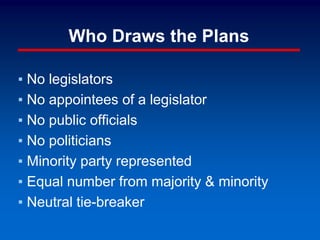
Who Draws the Plans
▪ No legislators
▪ No appointees of a legislator
▪ No public officials
▪ No politicians
▪ Minority party represented
▪ Equal number from majority & minority
▪ Neutral tie-breaker
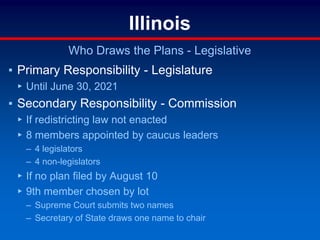
Illinois
Who Draws the Plans - Legislative
▪ Primary Responsibility - Legislature
▸ Until June 30, 2021
▪ Secondary Responsibility - Commission
▸ If redistricting law not enacted
▸ 8 members appointed by caucus leaders
– 4 legislators
– 4 non-legislators
▸ If no plan filed by August 10
▸ 9th member chosen by lot
– Supreme Court submits two names
– Secretary of State draws one name to chair
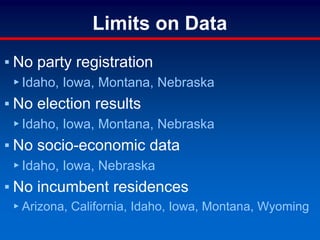
Limits on Data
▪ No party registration
▸ Idaho, Iowa, Montana, Nebraska
▪ No election results
▸ Idaho, Iowa, Montana, Nebraska
▪ No socio-economic data
▸ Idaho, Iowa, Nebraska
▪ No incumbent residences
▸ Arizona, California, Idaho, Iowa, Montana, Wyoming
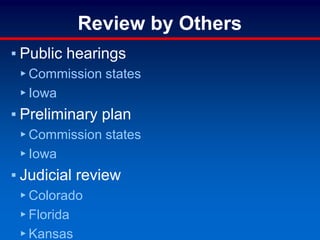
Review by Others
▪ Public hearings
▸ Commission states
▸ Iowa
▪ Preliminary plan
▸ Commission states
▸ Iowa
▪ Judicial review
▸ Colorado
▸ Florida
▸ Kansas
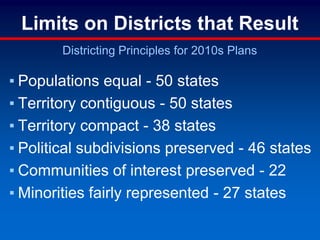
Limits on Districts that Result
Districting Principles for 2010s Plans
▪ Populations equal - 50 states
▪ Territory contiguous - 50 states
▪ Territory compact - 38 states
▪ Political subdivisions preserved - 46 states
▪ Communities of interest preserved - 22
▪ Minorities fairly represented - 27 states
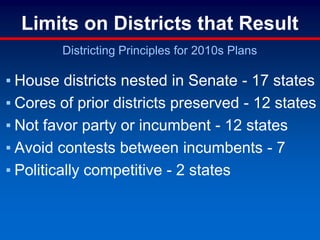
Limits on Districts that Result
Districting Principles for 2010s Plans
▪ House districts nested in Senate - 17 states
▪ Cores of prior districts preserved - 12 states
▪ Not favor party or incumbent - 12 states
▪ Avoid contests between incumbents - 7
▪ Politically competitive - 2 states
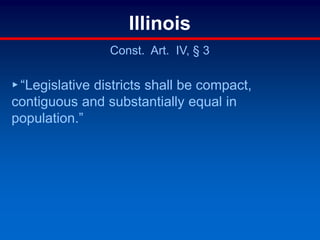
Illinois
Const. Art. IV, § 3
▸“Legislative districts shall be compact,
contiguous and substantially equal in
population.”
Protecting Racial and
Language Minorities
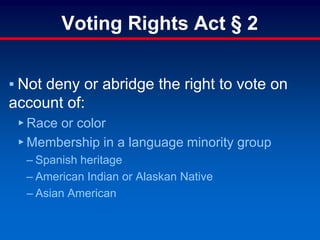
Voting Rights Act § 2
▪ Not deny or abridge the right to vote on
account of:
▸ Race or color
▸ Membership in a language minority group
– Spanish heritage
– American Indian or Alaskan Native
– Asian American
Voting Rights Act § 2
▪ No Discriminatory Effect
▪ Thornburg v. Gingles - Three Preconditions
▸ Minority Population Sufficiently Large and
Geographically Compact
▸ Minority is Politically Cohesive
▸ Bloc Voting by White Majority Usually Defeats
Minority’s Preferred Candidate
▪ Totality of the Circumstances
▪ Draw Districts the Minority has a Fair Chance
to Win
Drawing Minority Districts
An Effective Voting Majority
▪ A realistic opportunity to elect
▸ More than a simple majority?
– 65%?
– Packing?
▸ Less than a simple majority?
– Crossover districts
– Coalition districts
▪ Ten years of election history
▸ Endogenous elections (same office)
▸ Exogenous elections (other offices)
▸ Biracial contests
Voting Rights Act § 5
▪ “Covered Jurisdictions”
▪ Preclearance
▸ U.S. Department of Justice
▸ U.S. District Court for District of Columbia
▪ Do Not Retrogress
▸ Ability to Elect a Candidate of Choice
▪ Do Not Intend to Discriminate
▪ You Need Not Maximize the Number of
Majority-Minority Districts
14th Amendment
Equal Protection Clause
▪ You May Consider Race in Drawing Districts
▪ Avoid Drawing a Racial Gerrymander
Racial Gerrymanders
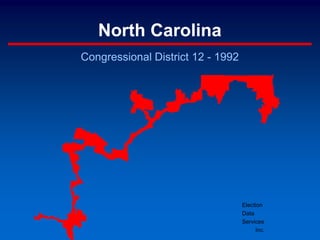
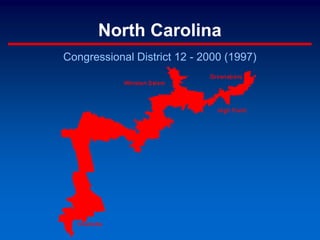
▪ Don’t Draw Districts With Bizarre Shapes
North Carolina
Congressional District 12 - 1992
Election
Data
Services
Inc.
“Reapportionment is one area in which
appearances do matter.”
O’Connor, J., Shaw v. Reno (1993)
Redistricting is one area in which
appearances do matter
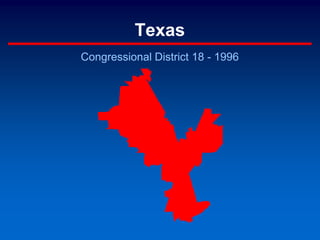
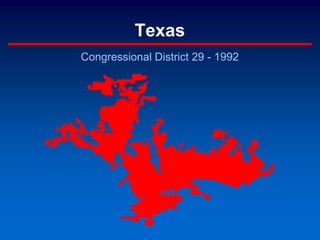
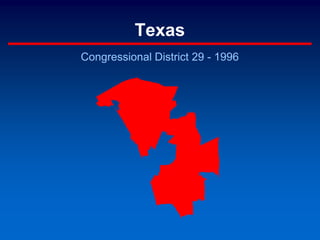
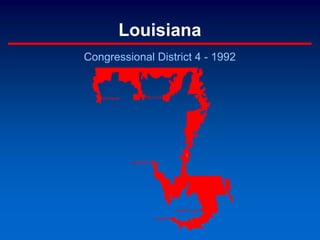
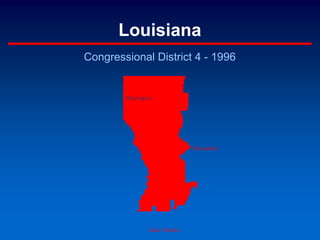
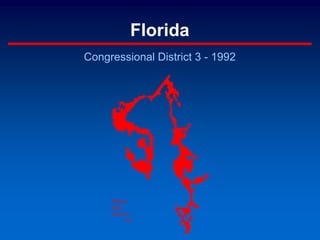
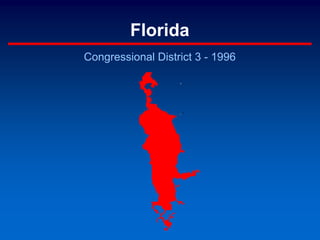
Racial Gerrymanders
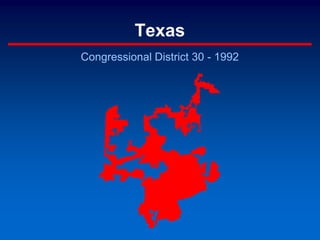
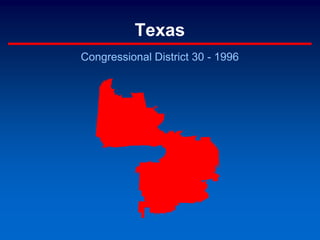
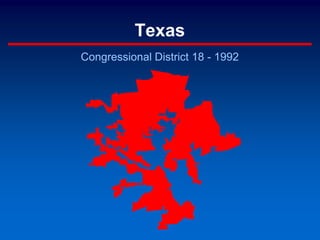
▪ Draw Districts that are “Reasonably Compact”
Texas
Congressional District 30 - 1992
Texas
Congressional District 30 - 1996
Texas
Congressional District 18 - 1992
Texas
Congressional District 18 - 1996
Texas
Congressional District 29 - 1992
Texas
Congressional District 29 - 1996
Louisiana
Congressional District 4 - 1992
Louisiana
Congressional District 4 - 1996
Florida
Congressional District 3 - 1992
Election
Data
Services
Inc.
Florida
Congressional District 3 - 1996
North Carolina
Congressional District 12 - 2000 (1997)
Racial Gerrymanders
▪ Don’t Let Race Be Your Dominant Motive
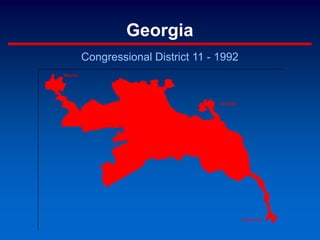
Georgia
Congressional District 11 - 1992
Atlanta
Augusta
Savannah
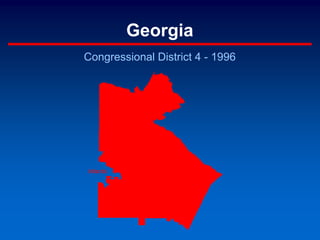
Georgia
Congressional District 4 - 1996
Racial Gerrymanders
▪ Don’t Use Race as a Proxy for Political
Affiliation
Traditional Districting Principles
▪ Contiguous Territory
▪ Compact
▪ Preserve Political Subdivisions
▪ Preserve Communities of Interest
▪ Protect Incumbents
▸ Preserve Cores of Prior Districts
▸ Avoid Contests Between Incumbents
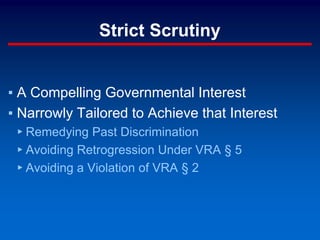
Strict Scrutiny
▪ A Compelling Governmental Interest
▪ Narrowly Tailored to Achieve that Interest
▸ Remedying Past Discrimination
▸ Avoiding Retrogression Under VRA § 5
▸ Avoiding a Violation of VRA § 2
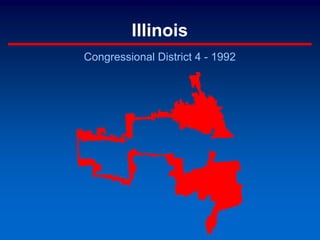
Illinois
Congressional District 4 - 1992
Partisan Gerrymandering
Can It Be Proved?
▪ Davis v. Bandemer (1986)
▸ Intentional discrimination against an identifiable
group
▸ Discriminatory effect
– “electoral system . . . will consistently degrade . . . a group
of voters’ influence on the political process as a whole”
Partisan Gerrymandering
Can It Be Proved?
▪ Vieth v. Jubelier (2004)
▸ Stevens
– Partisan purposes predominated over traditional districting
principles
▸ Souter
– Paid no heed to traditional districting principles where
drawing boundaries around party’s voters
▸ Breyer
– Traditional districting principles not followed
– Party with minority of votes statewide wins a majority of
seats
Partisan Gerrymandering
Can It Be Proved?
▪ LULAC v. Perry (2006)
▸ Plaintiffs
– Mid-decade redistricting was invalid because its sole
objective was partisan gain
Florida
Fair Districts Amendment (2010)
▪ Tier-One Principles
▸ Not favor or disfavor political party or incumbent
▸ Not discriminate against racial or language
minorities
▸ Contiguous territory
▪ Tier-Two Principles
▸ Equal population
▸ Compact territory
▸ Use existing political and geographic boundaries
Florida
In re: Senate Resolution of Legislative Apportionment 1176
(2012)
▪ Numbering scheme rejected
▸ Favored incumbents
▪ 8 Senate districts rejected
▸ Violation of tier-two principles
– Not compact
– Did not use existing political or geographic boundaries
▸ Was evidence of intent to violate tier-one principles
– 8 of 8 to favor incumbent
– 4 of 8 to favor a political party
Better Maps for Illinois
Peter S. Wattson
Redistricting Conference
Paul Simon Public Policy Institute
Springfield, Illinois
April 30, 2013
How to Draw Redistricting Plans That Will Stand Up in Court
http://paulsimoninstitute.org/

Better Maps for Illinois

  • 1.
    Better Maps forIllinois Peter S. Wattson Redistricting Conference Paul Simon Public Policy Institute Springfield, Illinois April 30, 2013
  • 2.
    Introduction ▪ The Factsof Life ▪ The Need for Limits ▪ Protecting Minorities ▪ Partisan Gerrymandering
  • 3.
    The Facts ofLife Gerrymandering ▪ Packing ▪ Cracking ▪ Creating a Gerrymander
  • 4.
    The Need forLimits ▪ People ▸ Who draws the plans ▪ Process ▸ Data that may be used ▸ Review by others ▪ Principles ▸ Districts that result
  • 5.
    Who Draws thePlans ▪ No legislators ▪ No appointees of a legislator ▪ No public officials ▪ No politicians ▪ Minority party represented ▪ Equal number from majority & minority ▪ Neutral tie-breaker
  • 6.
    Illinois Who Draws thePlans - Legislative ▪ Primary Responsibility - Legislature ▸ Until June 30, 2021 ▪ Secondary Responsibility - Commission ▸ If redistricting law not enacted ▸ 8 members appointed by caucus leaders – 4 legislators – 4 non-legislators ▸ If no plan filed by August 10 ▸ 9th member chosen by lot – Supreme Court submits two names – Secretary of State draws one name to chair
  • 7.
    Limits on Data ▪No party registration ▸ Idaho, Iowa, Montana, Nebraska ▪ No election results ▸ Idaho, Iowa, Montana, Nebraska ▪ No socio-economic data ▸ Idaho, Iowa, Nebraska ▪ No incumbent residences ▸ Arizona, California, Idaho, Iowa, Montana, Wyoming
  • 8.
    Review by Others ▪Public hearings ▸ Commission states ▸ Iowa ▪ Preliminary plan ▸ Commission states ▸ Iowa ▪ Judicial review ▸ Colorado ▸ Florida ▸ Kansas
  • 9.
    Limits on Districtsthat Result Districting Principles for 2010s Plans ▪ Populations equal - 50 states ▪ Territory contiguous - 50 states ▪ Territory compact - 38 states ▪ Political subdivisions preserved - 46 states ▪ Communities of interest preserved - 22 ▪ Minorities fairly represented - 27 states
  • 10.
    Limits on Districtsthat Result Districting Principles for 2010s Plans ▪ House districts nested in Senate - 17 states ▪ Cores of prior districts preserved - 12 states ▪ Not favor party or incumbent - 12 states ▪ Avoid contests between incumbents - 7 ▪ Politically competitive - 2 states
  • 11.
    Illinois Const. Art. IV,§ 3 ▸“Legislative districts shall be compact, contiguous and substantially equal in population.”
  • 12.
  • 13.
    Voting Rights Act§ 2 ▪ Not deny or abridge the right to vote on account of: ▸ Race or color ▸ Membership in a language minority group – Spanish heritage – American Indian or Alaskan Native – Asian American
  • 14.
    Voting Rights Act§ 2 ▪ No Discriminatory Effect ▪ Thornburg v. Gingles - Three Preconditions ▸ Minority Population Sufficiently Large and Geographically Compact ▸ Minority is Politically Cohesive ▸ Bloc Voting by White Majority Usually Defeats Minority’s Preferred Candidate ▪ Totality of the Circumstances ▪ Draw Districts the Minority has a Fair Chance to Win
  • 15.
    Drawing Minority Districts AnEffective Voting Majority ▪ A realistic opportunity to elect ▸ More than a simple majority? – 65%? – Packing? ▸ Less than a simple majority? – Crossover districts – Coalition districts ▪ Ten years of election history ▸ Endogenous elections (same office) ▸ Exogenous elections (other offices) ▸ Biracial contests
  • 16.
    Voting Rights Act§ 5 ▪ “Covered Jurisdictions” ▪ Preclearance ▸ U.S. Department of Justice ▸ U.S. District Court for District of Columbia ▪ Do Not Retrogress ▸ Ability to Elect a Candidate of Choice ▪ Do Not Intend to Discriminate ▪ You Need Not Maximize the Number of Majority-Minority Districts
  • 17.
    14th Amendment Equal ProtectionClause ▪ You May Consider Race in Drawing Districts ▪ Avoid Drawing a Racial Gerrymander
  • 18.
    Racial Gerrymanders ▪ Don’tDraw Districts With Bizarre Shapes
  • 19.
    North Carolina Congressional District12 - 1992 Election Data Services Inc.
  • 20.
    “Reapportionment is onearea in which appearances do matter.” O’Connor, J., Shaw v. Reno (1993)
  • 21.
    Redistricting is onearea in which appearances do matter
  • 22.
    Racial Gerrymanders ▪ DrawDistricts that are “Reasonably Compact”
  • 23.
  • 24.
  • 25.
  • 26.
  • 27.
  • 28.
  • 29.
  • 30.
  • 31.
    Florida Congressional District 3- 1992 Election Data Services Inc.
  • 32.
  • 33.
  • 34.
    Racial Gerrymanders ▪ Don’tLet Race Be Your Dominant Motive
  • 35.
    Georgia Congressional District 11- 1992 Atlanta Augusta Savannah
  • 36.
  • 37.
    Racial Gerrymanders ▪ Don’tUse Race as a Proxy for Political Affiliation
  • 38.
    Traditional Districting Principles ▪Contiguous Territory ▪ Compact ▪ Preserve Political Subdivisions ▪ Preserve Communities of Interest ▪ Protect Incumbents ▸ Preserve Cores of Prior Districts ▸ Avoid Contests Between Incumbents
  • 39.
    Strict Scrutiny ▪ ACompelling Governmental Interest ▪ Narrowly Tailored to Achieve that Interest ▸ Remedying Past Discrimination ▸ Avoiding Retrogression Under VRA § 5 ▸ Avoiding a Violation of VRA § 2
  • 40.
  • 41.
    Partisan Gerrymandering Can ItBe Proved? ▪ Davis v. Bandemer (1986) ▸ Intentional discrimination against an identifiable group ▸ Discriminatory effect – “electoral system . . . will consistently degrade . . . a group of voters’ influence on the political process as a whole”
  • 42.
    Partisan Gerrymandering Can ItBe Proved? ▪ Vieth v. Jubelier (2004) ▸ Stevens – Partisan purposes predominated over traditional districting principles ▸ Souter – Paid no heed to traditional districting principles where drawing boundaries around party’s voters ▸ Breyer – Traditional districting principles not followed – Party with minority of votes statewide wins a majority of seats
  • 43.
    Partisan Gerrymandering Can ItBe Proved? ▪ LULAC v. Perry (2006) ▸ Plaintiffs – Mid-decade redistricting was invalid because its sole objective was partisan gain
  • 44.
    Florida Fair Districts Amendment(2010) ▪ Tier-One Principles ▸ Not favor or disfavor political party or incumbent ▸ Not discriminate against racial or language minorities ▸ Contiguous territory ▪ Tier-Two Principles ▸ Equal population ▸ Compact territory ▸ Use existing political and geographic boundaries
  • 45.
    Florida In re: SenateResolution of Legislative Apportionment 1176 (2012) ▪ Numbering scheme rejected ▸ Favored incumbents ▪ 8 Senate districts rejected ▸ Violation of tier-two principles – Not compact – Did not use existing political or geographic boundaries ▸ Was evidence of intent to violate tier-one principles – 8 of 8 to favor incumbent – 4 of 8 to favor a political party
  • 46.
    Better Maps forIllinois Peter S. Wattson Redistricting Conference Paul Simon Public Policy Institute Springfield, Illinois April 30, 2013 How to Draw Redistricting Plans That Will Stand Up in Court http://paulsimoninstitute.org/