PARTIES & ELECTIONS
Prepared by:
Patrycja Pociecha
&
Monika Polak
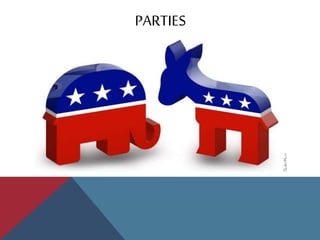
PARTIES
PoliticalParties - An organized group with shared goals
and ideals thatjoins togetherto run candidates for
office and exercise political and electoral power.
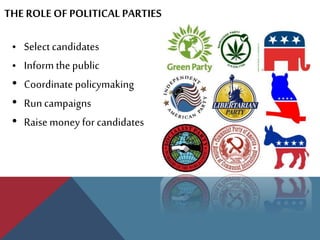
THE ROLE OFPOLITICAL PARTIES
• Selectcandidates
• Inform thepublic
• Coordinate policymaking
• Runcampaigns
• Raisemoney for candidates
AMERICA’S TWO PARTY SYSTEM
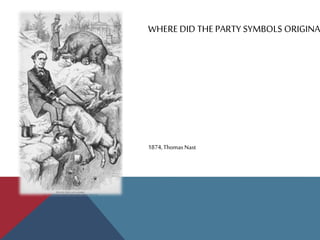
WHERE DID THE PARTY SYMBOLS ORIGINA
1874,Thomas Nast
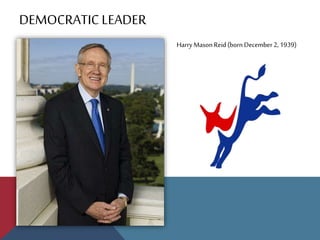
DEMOCRATICLEADER
HarryMasonReid(born December2,1939)
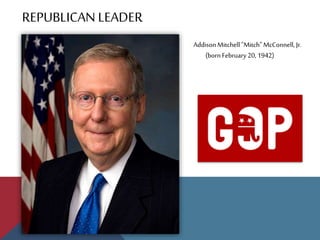
REPUBLICAN LEADER
AddisonMitchell "Mitch"McConnell, Jr.
(bornFebruary20,1942)
THIRD PARTIES INA
TWO-PARTY SYSTEM (MINOR PARTIES)
• Usually form in opposition to one
orboth major parties
• Bring attention toimportant
public issues ignored by the major
parties
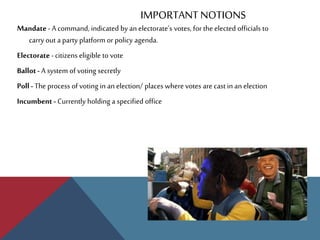
IMPORTANT NOTIONS
Mandate - A command, indicated by an electorate’s votes, for the elected officials to
carry out a party platform or policy agenda.
Electorate - citizens eligible to vote
Ballot- A system of voting secretly
Poll- The process of voting in an election/ places where votes are cast in an election
Incumbent - Currently holding a specified office
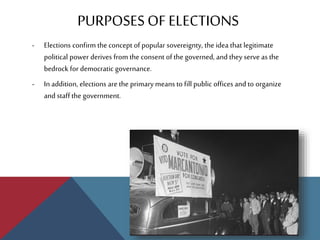
PURPOSESOFELECTIONS
- Elections confirm the concept of popular sovereignty, the idea that legitimate
political power derives from the consent of the governed, and they serve as the
bedrock for democratic governance.
- In addition, elections are the primary means to fill public offices and to organize
and staff the government.
TYPES OFELECTIONS
-PRIMARY ELECTIONS
-GENERAL ELECTIONS
-INITIATIVE AND REFERENDUM
-RECALL
PRIMARY ELECTIONS
closed primaries-A primary electionin which
only aparty’s registeredvotersare eligibleto
casta ballot.
open primaries-A primaryelectionin which
partymembers,independents,and sometimes
membersoftheother party are
allowedtoparticipate
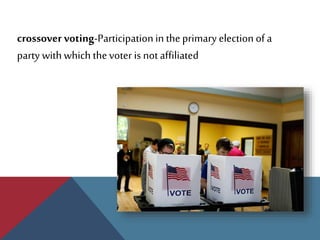
crossover voting-Participationin theprimary election of a
party withwhich thevoter is notaffiliated
runoff primary-A second primary electionbetweenthe
two candidates receiving the greatestnumber of votes in
thefirst primary.
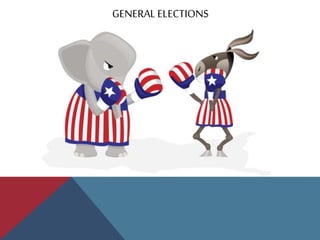
GENERAL ELECTIONS
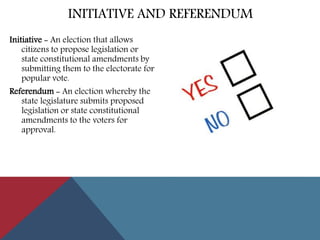
Initiative - An election that allows
citizens to propose legislation or
state constitutional amendments by
submitting them to the electorate for
popular vote.
Referendum - An election whereby the
state legislature submits proposed
legislation or state constitutional
amendments to the voters for
approval.
INITIATIVE AND REFERENDUM
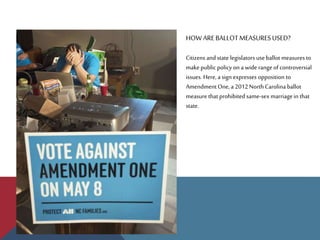
HOW AREBALLOTMEASURESUSED?
Citizens and state legislators useballot measuresto
makepublic policy on a wide range of controversial
issues. Here, a sign expresses opposition to
AmendmentOne, a 2012North Carolina ballot
measure that prohibited same-sex marriagein that
state.
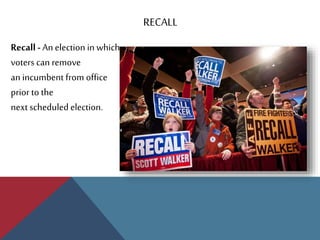
RECALL
Recall - An election in which
voters can remove
an incumbent from office
prior to the
next scheduled election.
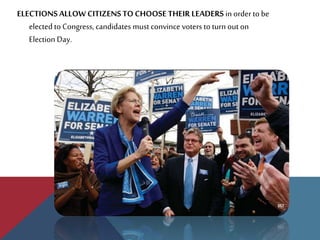
ELECTIONS ALLOW CITIZENSTOCHOOSE THEIR LEADERS in orderto be
elected to Congress, candidates mustconvince voters to turn outon
Election Day.
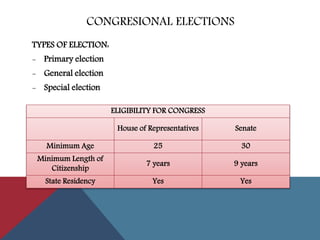
CONGRESIONAL ELECTIONS
TYPES OF ELECTION:
- Primary election
- General election
- Special election
ELIGIBILITY FOR CONGRESS
House of Representatives Senate
Minimum Age 25 30
Minimum Length of
Citizenship
7 years 9 years
State Residency Yes Yes
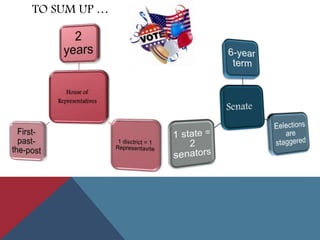
TO SUM UP …
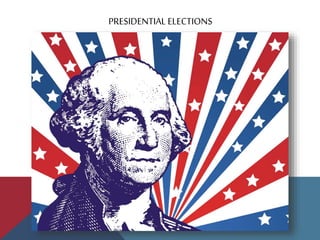
PRESIDENTIAL ELECTIONS
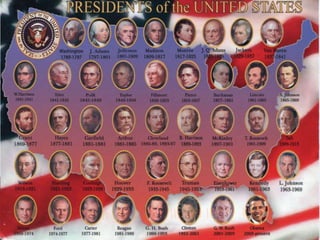
HOW MANYPRESIDENTS OF U.S. CANYOU NAME?
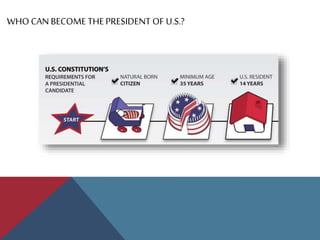
WHO CAN BECOME THEPRESIDENT OF U.S.?
THEPRESIDENTIAL ELECTION PROCESS
- Winner-take-allprimary
- Proportional representation primary
- Caucus
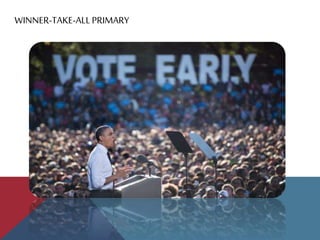
WINNER-TAKE-ALLPRIMARY
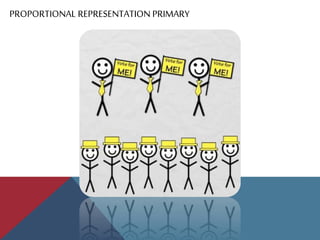
PROPORTIONAL REPRESENTATION PRIMARY
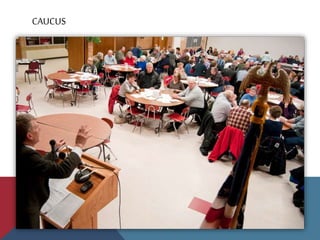
CAUCUS
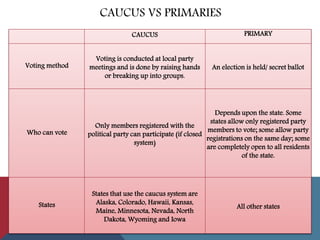
CAUCUS VS PRIMARIES
CAUCUS PRIMARY
Voting method
Voting is conducted at local party
meetings and is done by raising hands
or breaking up into groups.
An election is held/ secret ballot
Who can vote
Only members registered with the
political party can participate (if closed
system)
Depends upon the state. Some
states allow only registered party
members to vote; some allow party
registrations on the same day; some
are completely open to all residents
of the state.
States
States that use the caucus system are
Alaska, Colorado, Hawaii, Kansas,
Maine, Minnesota, Nevada, North
Dakota, Wyoming and Iowa
All other states
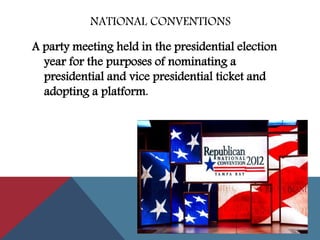
NATIONAL CONVENTIONS
A party meeting held in the presidential election
year for the purposes of nominating a
presidential and vice presidential ticket and
adopting a platform.
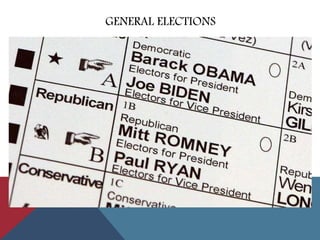
GENERAL ELECTIONS
ELECTORAL COLLEGE
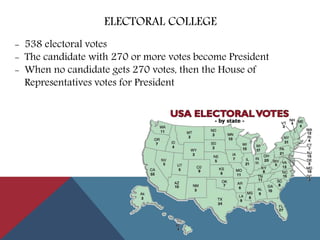
ELECTORAL COLLEGE
- 538 electoral votes
- The candidate with 270 or more votes become President
- When no candidate gets 270 votes, then the House of
Representatives votes for President
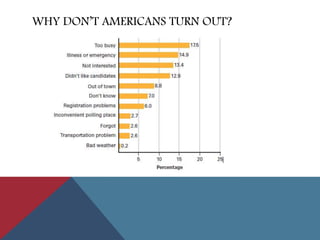
WHY DON’T AMERICANS TURN OUT?
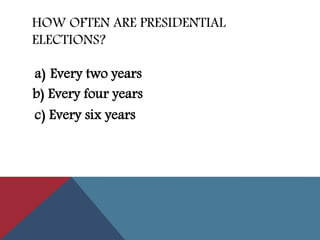
HOW OFTEN ARE PRESIDENTIAL
ELECTIONS?
a) Every two years
c) Every six years
b) Every four years
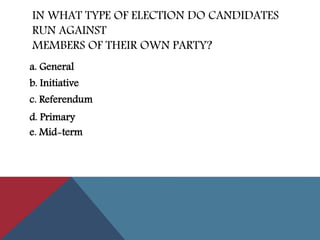
IN WHAT TYPE OF ELECTION DO CANDIDATES
RUN AGAINST
MEMBERS OF THEIR OWN PARTY?
a. General
b. Initiative
c. Referendum
e. Mid-term
d. Primary
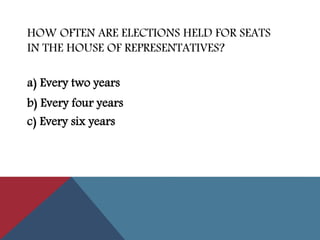
HOW OFTEN ARE ELECTIONS HELD FOR SEATS
IN THE HOUSE OF REPRESENTATIVES?
b) Every four years
c) Every six years
a) Every two years
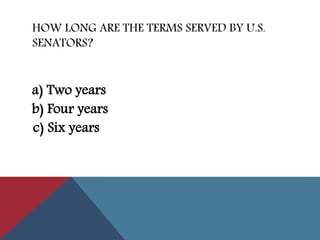
HOW LONG ARE THE TERMS SERVED BY U.S.
SENATORS?
a) Two years
b) Four years
c) Six years
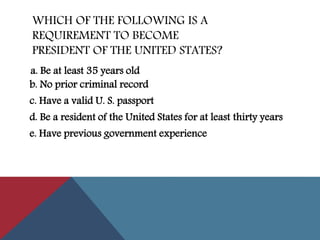
WHICH OF THE FOLLOWING IS A
REQUIREMENT TO BECOME
PRESIDENT OF THE UNITED STATES?
b. No prior criminal record
c. Have a valid U. S. passport
d. Be a resident of the United States for at least thirty years
e. Have previous government experience
a. Be at least 35 years old
IN THE UNITED STATES, GENERAL ELECTIONS
FOR PRESIDENT ALWAYS TAKE PLACE DURING
WHAT MONTH?
a) January
b) July
c) NovemberNovember
HOW MANY TERMS CAN A PRESIDENT SERVE?
a) As many as he wants
b) Three terms
c) Two termsTwo terms
FULFIL THE GAP…
Presidental Elections are example of __________
Democracy.
________ - places where votes are cast in an election
________ - A system of voting secretly
Indirect
Polls
Ballot
EPIC RAP BATTLE OF HISTORY
THANK YOU FOR YOUR ATTENTION
AND… 

Parties & elections final ultimate

  • 1.
    PARTIES & ELECTIONS Preparedby: Patrycja Pociecha & Monika Polak
  • 2.
  • 3.
    PoliticalParties - Anorganized group with shared goals and ideals thatjoins togetherto run candidates for office and exercise political and electoral power.
  • 4.
    THE ROLE OFPOLITICALPARTIES • Selectcandidates • Inform thepublic • Coordinate policymaking • Runcampaigns • Raisemoney for candidates
  • 5.
  • 6.
    WHERE DID THEPARTY SYMBOLS ORIGINA 1874,Thomas Nast
  • 7.
  • 8.
  • 10.
    THIRD PARTIES INA TWO-PARTYSYSTEM (MINOR PARTIES) • Usually form in opposition to one orboth major parties • Bring attention toimportant public issues ignored by the major parties
  • 11.
    IMPORTANT NOTIONS Mandate -A command, indicated by an electorate’s votes, for the elected officials to carry out a party platform or policy agenda. Electorate - citizens eligible to vote Ballot- A system of voting secretly Poll- The process of voting in an election/ places where votes are cast in an election Incumbent - Currently holding a specified office
  • 12.
    PURPOSESOFELECTIONS - Elections confirmthe concept of popular sovereignty, the idea that legitimate political power derives from the consent of the governed, and they serve as the bedrock for democratic governance. - In addition, elections are the primary means to fill public offices and to organize and staff the government.
  • 13.
    TYPES OFELECTIONS -PRIMARY ELECTIONS -GENERALELECTIONS -INITIATIVE AND REFERENDUM -RECALL
  • 14.
  • 15.
    closed primaries-A primaryelectionin which only aparty’s registeredvotersare eligibleto casta ballot. open primaries-A primaryelectionin which partymembers,independents,and sometimes membersoftheother party are allowedtoparticipate
  • 16.
    crossover voting-Participationin theprimaryelection of a party withwhich thevoter is notaffiliated
  • 17.
    runoff primary-A secondprimary electionbetweenthe two candidates receiving the greatestnumber of votes in thefirst primary.
  • 18.
  • 19.
    Initiative - Anelection that allows citizens to propose legislation or state constitutional amendments by submitting them to the electorate for popular vote. Referendum - An election whereby the state legislature submits proposed legislation or state constitutional amendments to the voters for approval. INITIATIVE AND REFERENDUM
  • 20.
    HOW AREBALLOTMEASURESUSED? Citizens andstate legislators useballot measuresto makepublic policy on a wide range of controversial issues. Here, a sign expresses opposition to AmendmentOne, a 2012North Carolina ballot measure that prohibited same-sex marriagein that state.
  • 21.
    RECALL Recall - Anelection in which voters can remove an incumbent from office prior to the next scheduled election.
  • 22.
    ELECTIONS ALLOW CITIZENSTOCHOOSETHEIR LEADERS in orderto be elected to Congress, candidates mustconvince voters to turn outon Election Day.
  • 23.
    CONGRESIONAL ELECTIONS TYPES OFELECTION: - Primary election - General election - Special election ELIGIBILITY FOR CONGRESS House of Representatives Senate Minimum Age 25 30 Minimum Length of Citizenship 7 years 9 years State Residency Yes Yes
  • 25.
  • 26.
  • 27.
    HOW MANYPRESIDENTS OFU.S. CANYOU NAME?
  • 29.
    WHO CAN BECOMETHEPRESIDENT OF U.S.?
  • 30.
  • 31.
    - Winner-take-allprimary - Proportionalrepresentation primary - Caucus
  • 32.
  • 33.
  • 34.
  • 35.
    CAUCUS VS PRIMARIES CAUCUSPRIMARY Voting method Voting is conducted at local party meetings and is done by raising hands or breaking up into groups. An election is held/ secret ballot Who can vote Only members registered with the political party can participate (if closed system) Depends upon the state. Some states allow only registered party members to vote; some allow party registrations on the same day; some are completely open to all residents of the state. States States that use the caucus system are Alaska, Colorado, Hawaii, Kansas, Maine, Minnesota, Nevada, North Dakota, Wyoming and Iowa All other states
  • 36.
    NATIONAL CONVENTIONS A partymeeting held in the presidential election year for the purposes of nominating a presidential and vice presidential ticket and adopting a platform.
  • 37.
  • 38.
  • 39.
    ELECTORAL COLLEGE - 538electoral votes - The candidate with 270 or more votes become President - When no candidate gets 270 votes, then the House of Representatives votes for President
  • 40.
  • 41.
    HOW OFTEN AREPRESIDENTIAL ELECTIONS? a) Every two years c) Every six years b) Every four years
  • 42.
    IN WHAT TYPEOF ELECTION DO CANDIDATES RUN AGAINST MEMBERS OF THEIR OWN PARTY? a. General b. Initiative c. Referendum e. Mid-term d. Primary
  • 43.
    HOW OFTEN AREELECTIONS HELD FOR SEATS IN THE HOUSE OF REPRESENTATIVES? b) Every four years c) Every six years a) Every two years
  • 44.
    HOW LONG ARETHE TERMS SERVED BY U.S. SENATORS? a) Two years b) Four years c) Six years
  • 45.
    WHICH OF THEFOLLOWING IS A REQUIREMENT TO BECOME PRESIDENT OF THE UNITED STATES? b. No prior criminal record c. Have a valid U. S. passport d. Be a resident of the United States for at least thirty years e. Have previous government experience a. Be at least 35 years old
  • 46.
    IN THE UNITEDSTATES, GENERAL ELECTIONS FOR PRESIDENT ALWAYS TAKE PLACE DURING WHAT MONTH? a) January b) July c) NovemberNovember
  • 47.
    HOW MANY TERMSCAN A PRESIDENT SERVE? a) As many as he wants b) Three terms c) Two termsTwo terms
  • 48.
    FULFIL THE GAP… PresidentalElections are example of __________ Democracy. ________ - places where votes are cast in an election ________ - A system of voting secretly Indirect Polls Ballot
  • 49.
    EPIC RAP BATTLEOF HISTORY
  • 50.
    THANK YOU FORYOUR ATTENTION AND… 