Chapter 2Defining Business EthicsMcGraw-Hill
     A large company was hiring a new CEO. The four leading candidates worked inside the company so the board decided to ask each candidate a very basic question. The comptroller was brought in. "How much is 2 plus 2?" "This must be a trick question, but the answer is 4. It will always be 4." They brought in the head of research and development, an engineer by training. "How much is 2 plus 2?" "That depends on whether it is a positive 2 or a negative 2. It could be 4, zero or minus 4." They brought in the head of marketing. "The way I figure it, 2 plus 2 is 22." Finally, they brought in legal counsel. "How much is 2 plus 2?" they asked. He looked furtively at each board member. "How much do you want it to be?"Tom Selleck, Commencement Speech, Pepperdine University, 2000.2-2
Defining Business EthicsBusiness Ethics – application of standards of moral behavior to business situationsTwo Distinct Perspectives:A Descriptive summation of the customs, attitudes, and rules that are observed within a business. As such, we are simply documenting what is happening.A Normative (or Prescriptive) evaluation of the degree to which the observed customs, attitudes, and rules can be said to be ethical. Here we are more interested in recommending what shouldbe happening2-3
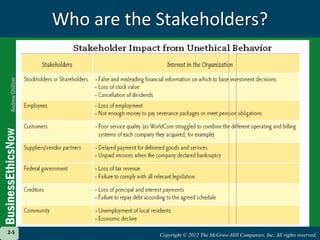
Who are the Stakeholders?Stakeholders are those with a share or interest in a business enterprise.2-4
Who are the Stakeholders?2-5
An Ethical Crisis: Is Business Ethics an Oxymoron?Corporate GovernanceThe system by which business corporations are directed and controlled.OxymoronThe combination of two contradictory terms, such as “deafening silence” or “jumbo shrimp.”2-6
An Ethical Crisis: Is Business Ethics an Oxymoron?Code of ethicsA company’s written standards of ethical behavior that are designed to guide managers and employees in making the decisions and choices they face every day.2-7
A Code of Ethics	The Ethics Resource Center (ERC) defines a Code of Ethics as:    "..a central guide to support day-to-day decision making at work. It clarifies the cornerstones of your organization – its mission, values and principles – helping your managers, employees and stakeholders understand how these cornerstones translate into everyday decisions, behaviors and actions. While some may believe codes are designed to limit one’s actions, the best codes are actually structured to liberate and empower people to make more effective decisions with greater confidence." 2-8
History of Business Ethics2-9
History of Business Ethics2-10
Doing The Right ThingWhen employees observe unethical behavior the extent of guidance available to them is often nothing more than a series of clichés:Consult the Company Code of EthicsDo what’s right for the Organizations StakeholdersDo what’s legalDo what you think is best (‘use your best judgment’)Do the right thing.2-11
Resolving Ethical Business DilemmasRecognize the type of conflict you are dealing withTruth versus Loyaltyo	Do you tell the truth or remain loyal to the person or organization that is asking you not to reveal that truth?Short-Term versus Long-Termo	Does your decision have a short-term consequence or a longer-term consequence?Justice versus Mercyo	Do you perceive this issue as a question of dispensing Justice or Mercy? (and which one are you more comfortable with?).Individual versus Communityo	Will your choice impact one individual or a wider group or community?2-12
Resolving an Ethical DilemmaThree Resolution Principles:‘Ends-Based’- which decision would provide the greatest good for the greatest number of people?
‘Rules-Based’- what would happen if everyone made the same decision as you?
‘The Golden Rule’ – ‘do unto others as you would have them do unto you’.2-13

Chapter 2 review

  • 1.
  • 2.
    A large company was hiring a new CEO. The four leading candidates worked inside the company so the board decided to ask each candidate a very basic question. The comptroller was brought in. "How much is 2 plus 2?" "This must be a trick question, but the answer is 4. It will always be 4." They brought in the head of research and development, an engineer by training. "How much is 2 plus 2?" "That depends on whether it is a positive 2 or a negative 2. It could be 4, zero or minus 4." They brought in the head of marketing. "The way I figure it, 2 plus 2 is 22." Finally, they brought in legal counsel. "How much is 2 plus 2?" they asked. He looked furtively at each board member. "How much do you want it to be?"Tom Selleck, Commencement Speech, Pepperdine University, 2000.2-2
  • 3.
    Defining Business EthicsBusinessEthics – application of standards of moral behavior to business situationsTwo Distinct Perspectives:A Descriptive summation of the customs, attitudes, and rules that are observed within a business. As such, we are simply documenting what is happening.A Normative (or Prescriptive) evaluation of the degree to which the observed customs, attitudes, and rules can be said to be ethical. Here we are more interested in recommending what shouldbe happening2-3
  • 4.
    Who are theStakeholders?Stakeholders are those with a share or interest in a business enterprise.2-4
  • 5.
    Who are theStakeholders?2-5
  • 6.
    An Ethical Crisis:Is Business Ethics an Oxymoron?Corporate GovernanceThe system by which business corporations are directed and controlled.OxymoronThe combination of two contradictory terms, such as “deafening silence” or “jumbo shrimp.”2-6
  • 7.
    An Ethical Crisis:Is Business Ethics an Oxymoron?Code of ethicsA company’s written standards of ethical behavior that are designed to guide managers and employees in making the decisions and choices they face every day.2-7
  • 8.
    A Code ofEthics The Ethics Resource Center (ERC) defines a Code of Ethics as: "..a central guide to support day-to-day decision making at work. It clarifies the cornerstones of your organization – its mission, values and principles – helping your managers, employees and stakeholders understand how these cornerstones translate into everyday decisions, behaviors and actions. While some may believe codes are designed to limit one’s actions, the best codes are actually structured to liberate and empower people to make more effective decisions with greater confidence." 2-8
  • 9.
  • 10.
  • 11.
    Doing The RightThingWhen employees observe unethical behavior the extent of guidance available to them is often nothing more than a series of clichés:Consult the Company Code of EthicsDo what’s right for the Organizations StakeholdersDo what’s legalDo what you think is best (‘use your best judgment’)Do the right thing.2-11
  • 12.
    Resolving Ethical BusinessDilemmasRecognize the type of conflict you are dealing withTruth versus Loyaltyo Do you tell the truth or remain loyal to the person or organization that is asking you not to reveal that truth?Short-Term versus Long-Termo Does your decision have a short-term consequence or a longer-term consequence?Justice versus Mercyo Do you perceive this issue as a question of dispensing Justice or Mercy? (and which one are you more comfortable with?).Individual versus Communityo Will your choice impact one individual or a wider group or community?2-12
  • 13.
    Resolving an EthicalDilemmaThree Resolution Principles:‘Ends-Based’- which decision would provide the greatest good for the greatest number of people?
  • 14.
    ‘Rules-Based’- what wouldhappen if everyone made the same decision as you?
  • 15.
    ‘The Golden Rule’– ‘do unto others as you would have them do unto you’.2-13