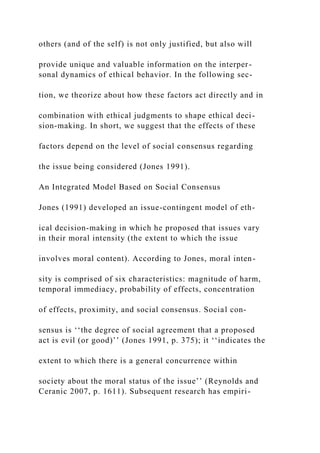
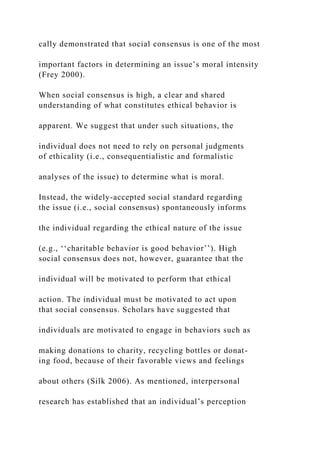
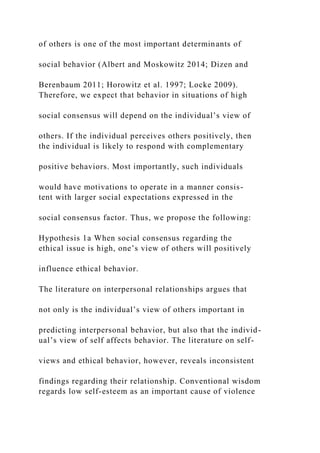
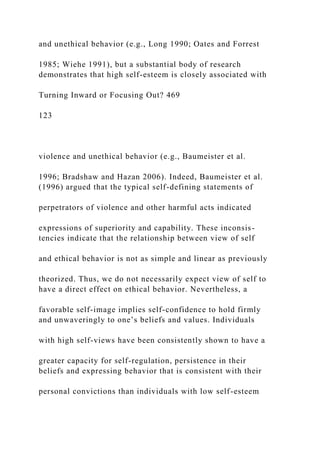
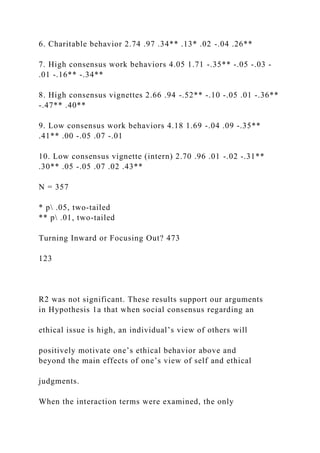
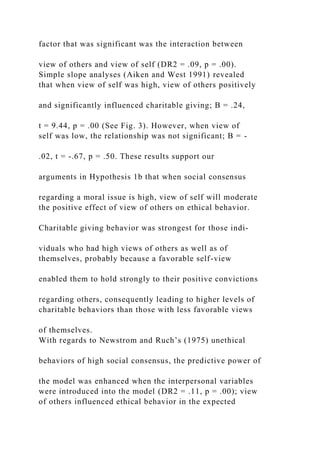
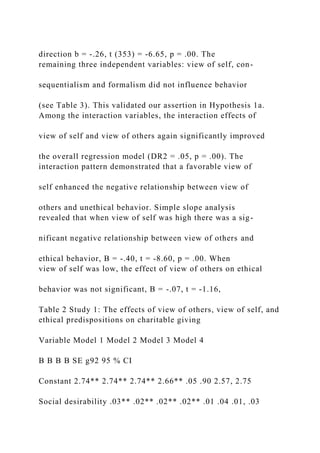
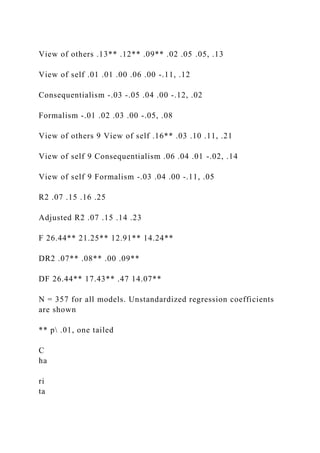
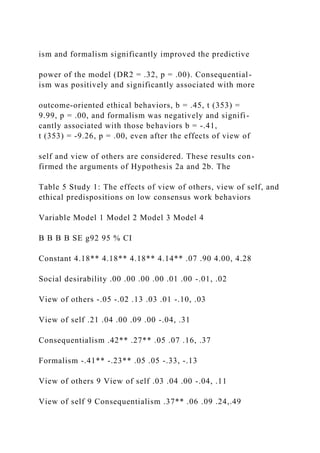
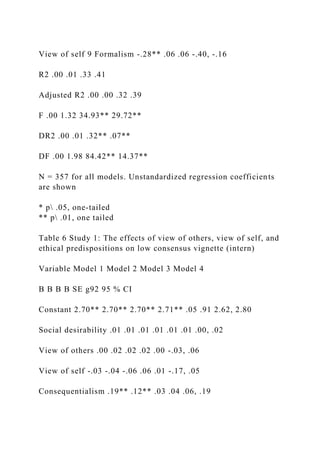
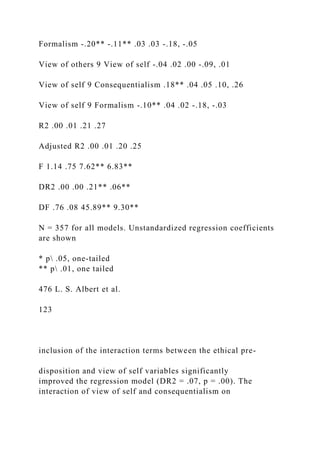
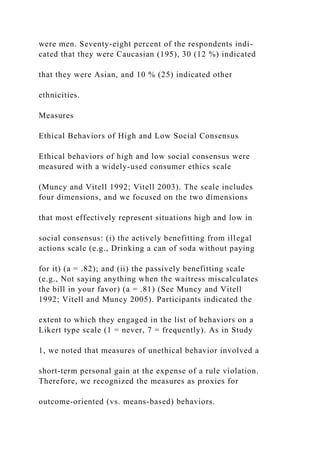
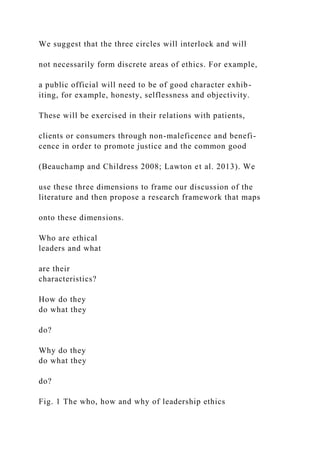
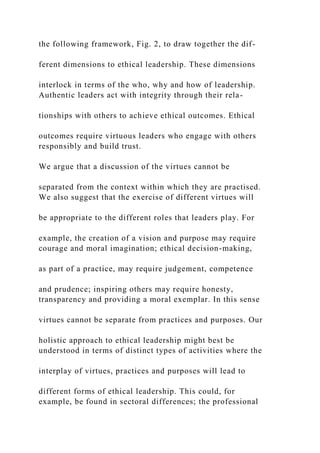
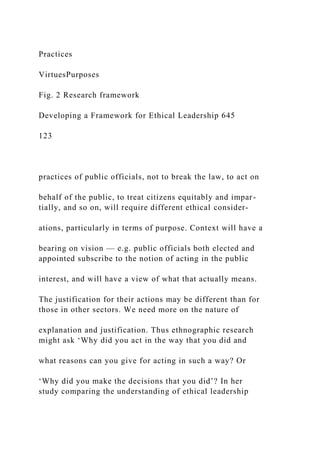
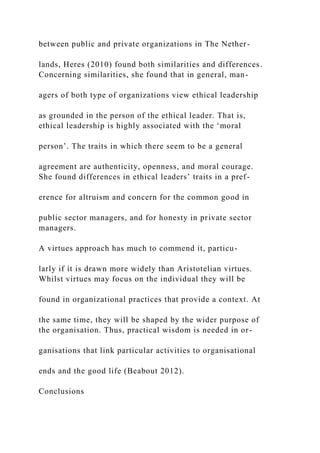
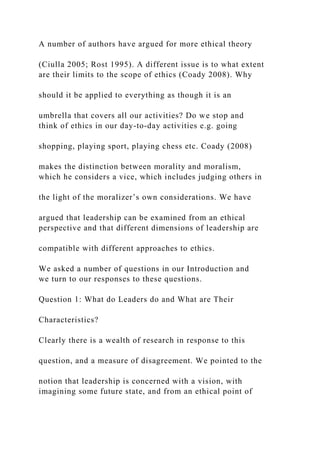
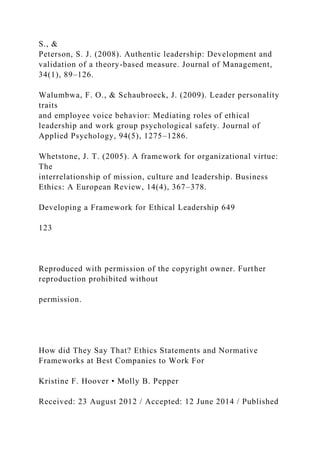
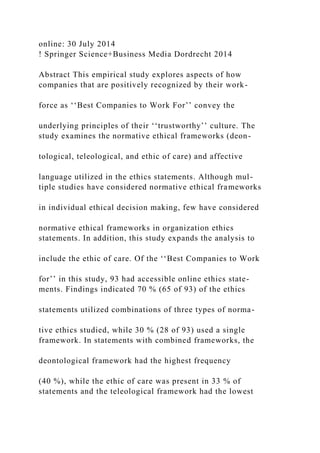
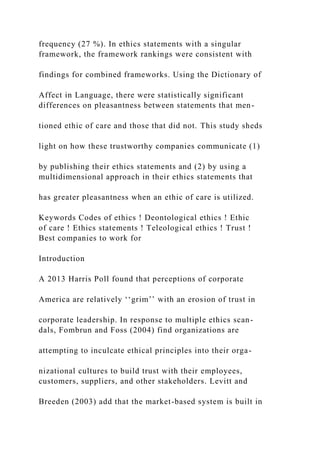
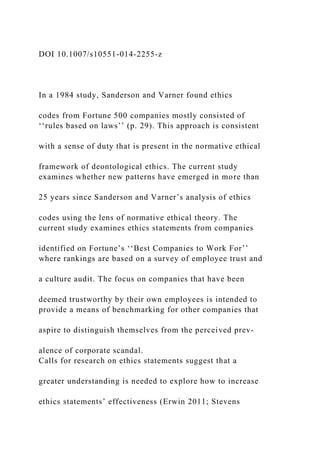
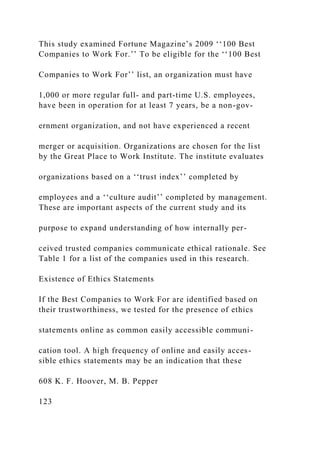
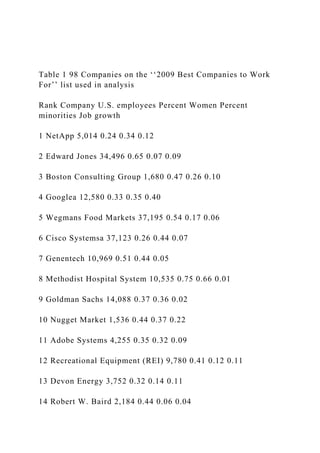
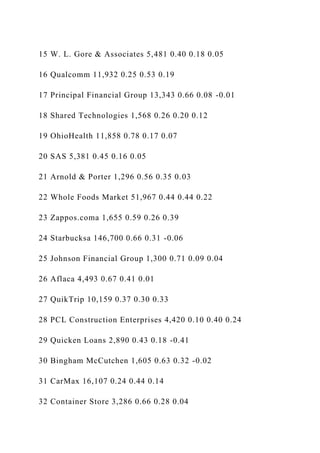
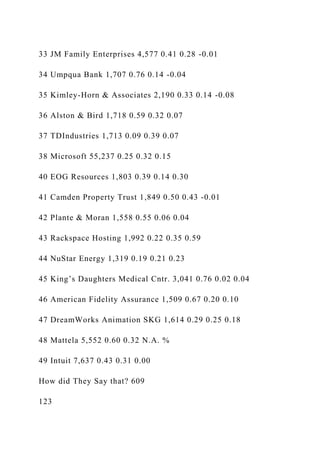
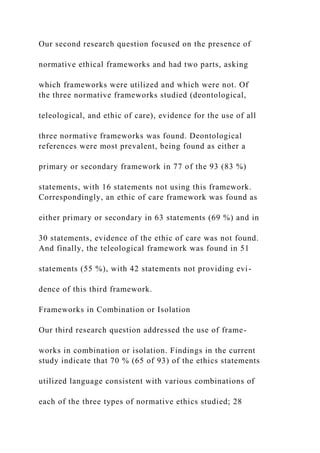
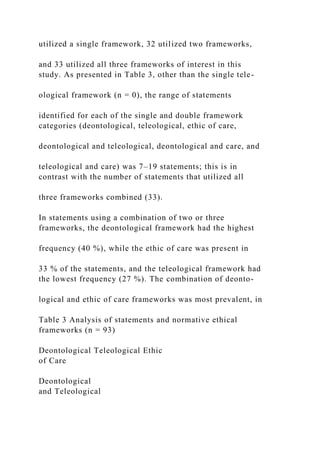
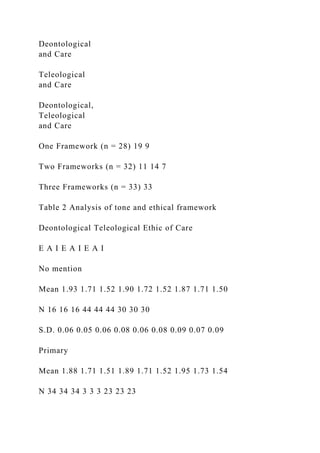
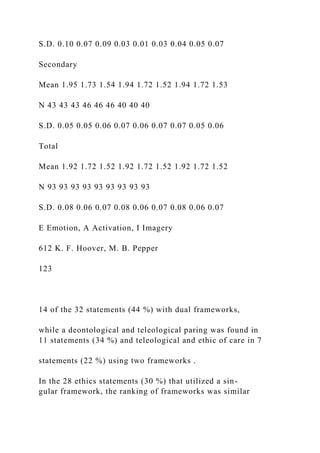
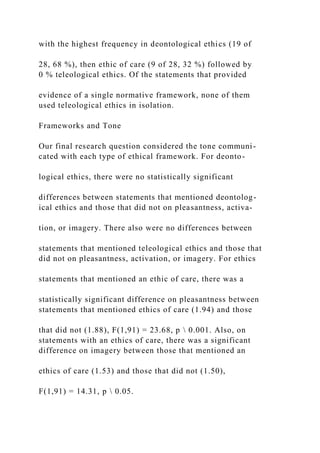
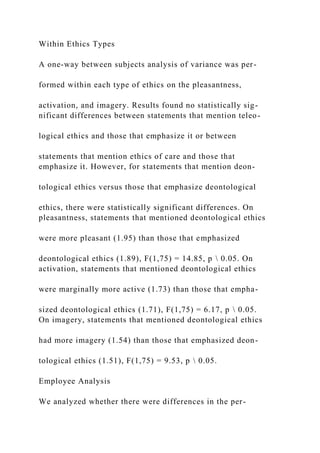
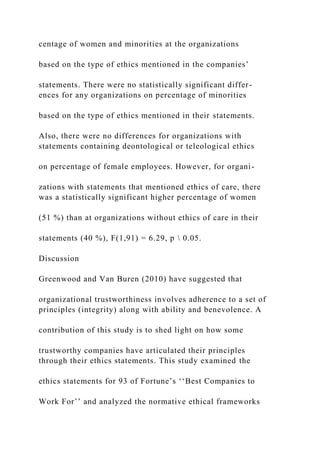
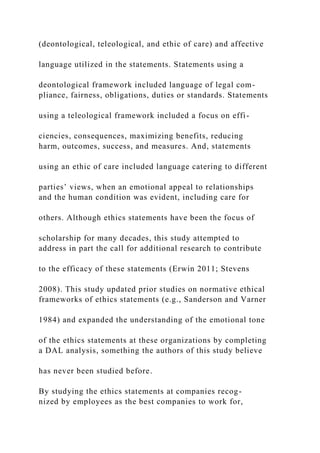
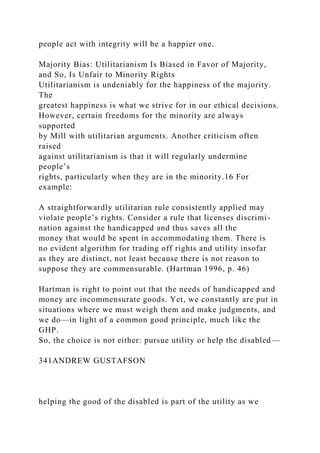
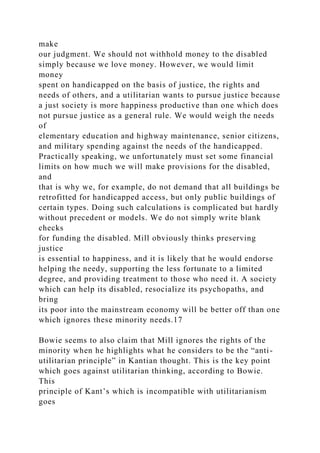
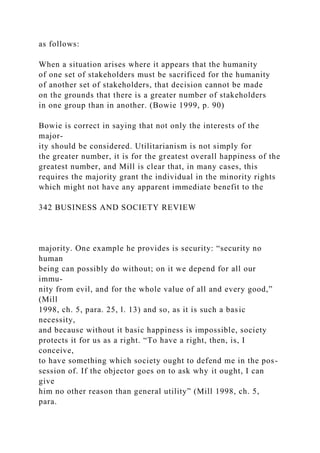
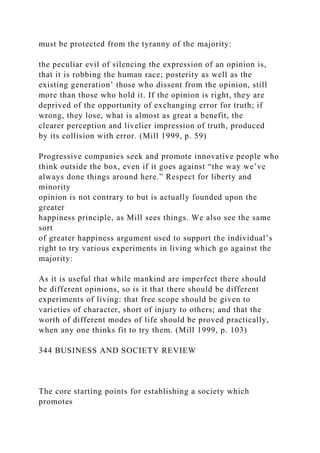
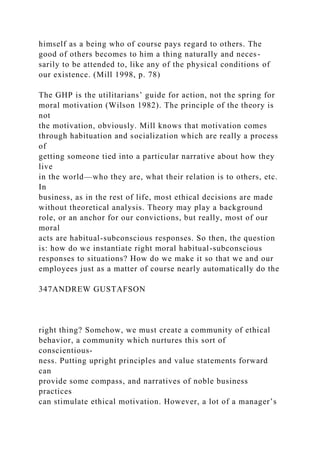
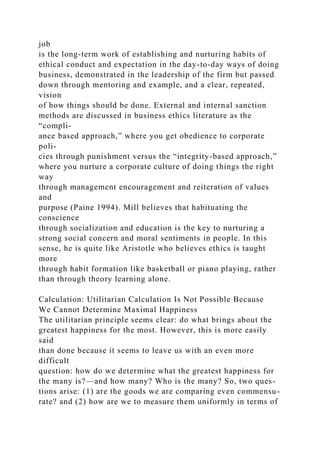
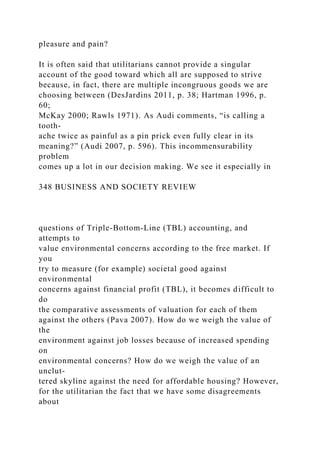
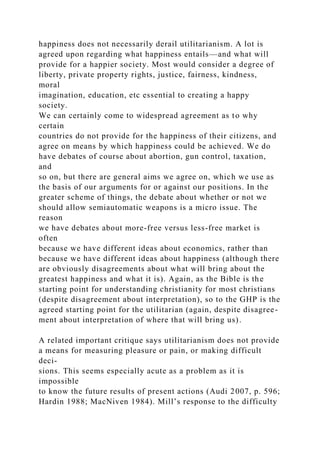
13 Leadership Ethics
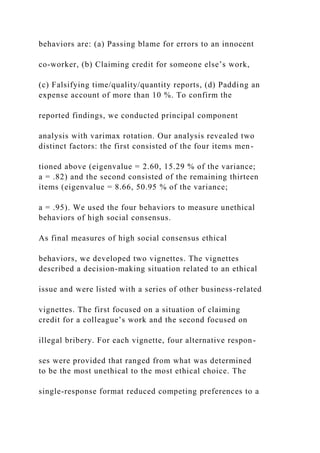
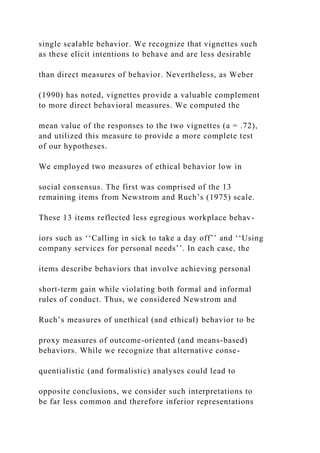
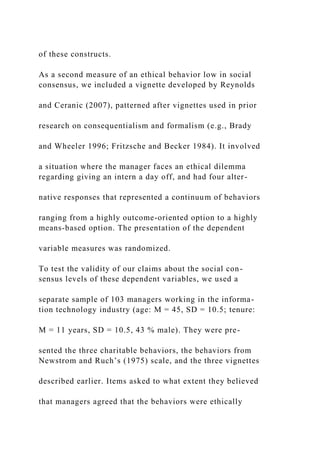
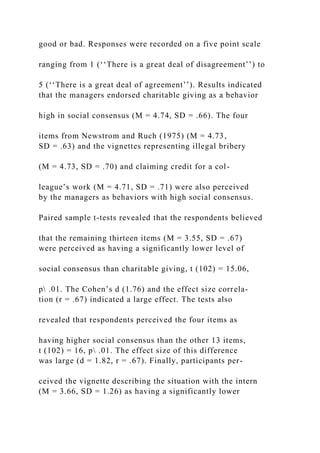
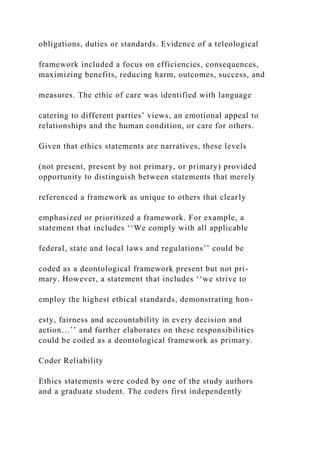
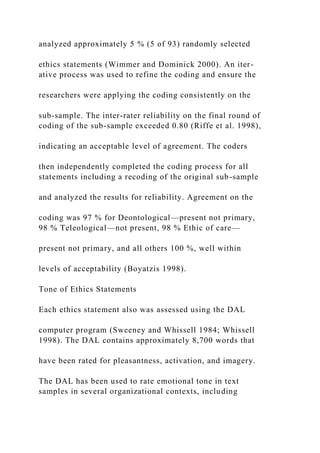
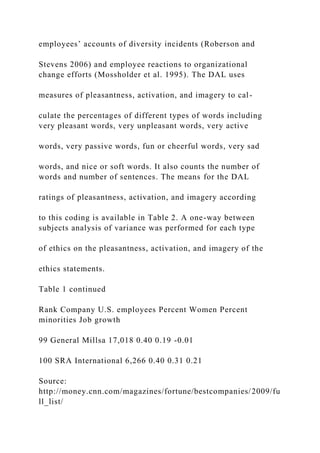
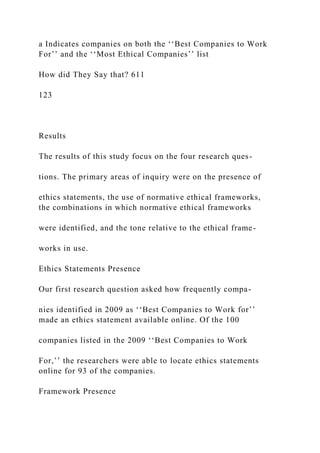
Description
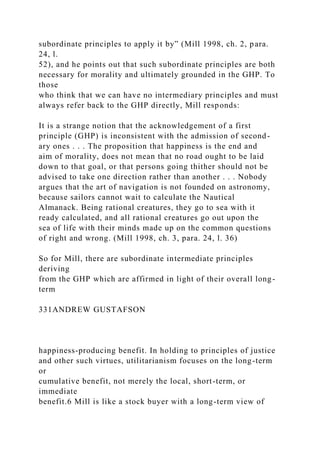
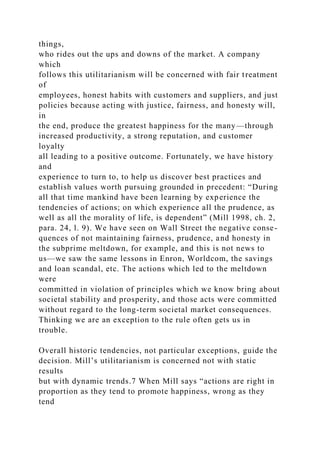
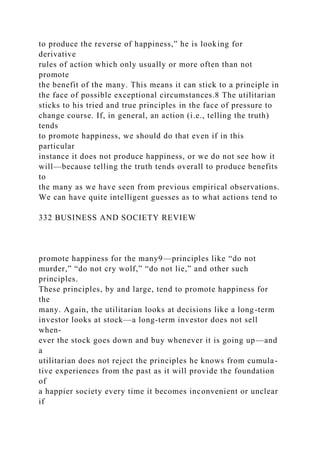
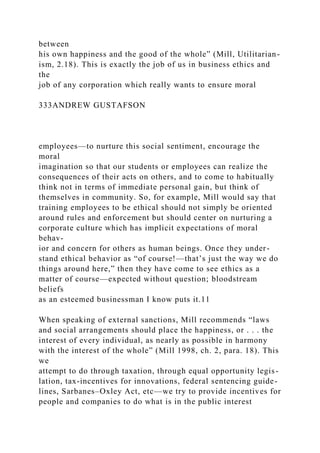
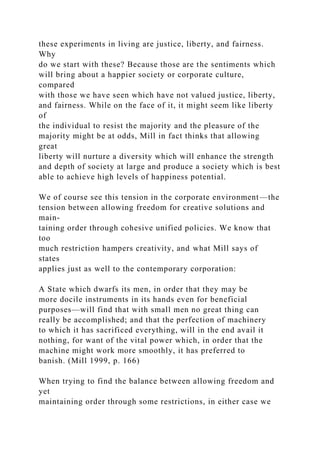
This chapter is different from many of the other chapters in this
book. Most of the other chapters focus on one unified leadership
theory or approach (e.g., trait approach, path–goal theory, or
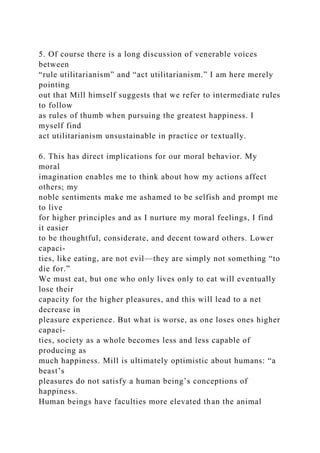
transformational leadership), whereas this chapter is
multifaceted and presents a broad set of ethical viewpoints. The
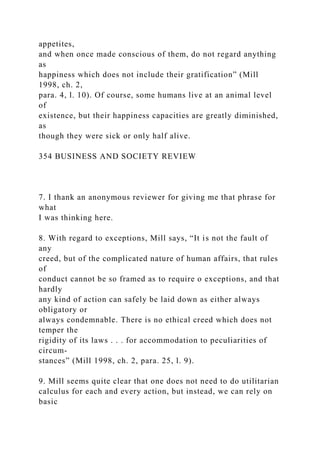
chapter is intended not as an “ethical leadership theory,” but
rather as a guide to some of the ethical issues that arise in
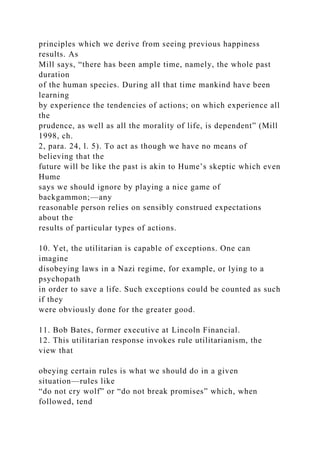
leadership situations.
Probably since our cave-dwelling days, human beings have been
concerned with the ethics of our leaders. Our history books are
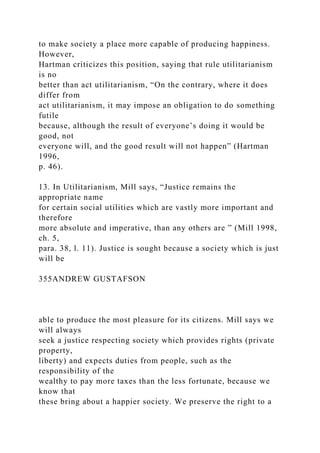
replete with descriptions of good kings and bad kings, great
empires and evil empires, and strong presidents and weak
presidents. But despite a wealth of biographical accounts of
great leaders and their morals, very little research has been
published on the theoretical foundations of leadership ethics.
There have been many studies on business ethics in general
since the early 1970s, but these studies have been only
tangentially related to leadership ethics. Even in the literature
of management, written primarily for practitioners, there are
very few books on leadership ethics. This suggests that
theoretical formulations in this area are still in their infancy.
One of the earliest writings that specifically focused on
leadership ethics appeared as recently as 1996. It was a set of
working papers generated from a small group of leadership
scholars, brought together by the W. K. Kellogg Foundation.
These scholars examined how leadership theory and practice
could be used to build a more caring and just society. The ideas
of the Kellogg group are now published in a volume
titled Ethics, the Heart of Leadership (Ciulla, 1998).
Ethical Leadership
Interest in the nature of ethical leadership has continued to
grow, particularly because of the many recent scandals in
corporate America and the political realm. On the academic
front, there has also been a strong interest in exploring the
nature of ethical leadership (see Aronson, 2001; Ciulla, 2001,
2003; Johnson, 2011; Kanungo, 2001; Price, 2008; Trevino,
Brown, & Hartman, 2003).
Ethics Defined
From the perspective of Western tradition, the development of
ethical theory dates back to Plato (427–347 b.c.) and Aristotle
(384–322 b.c.). The word ethics has its roots in the Greek
word ethos, which translates to “customs,” “conduct,” or
“character.” Ethics is concerned with the kinds of values and
morals an individual or a society finds desirable or appropriate.
Furthermore, ethics is concerned with the virtuousness of
individuals and their motives. Ethical theory provides a system
of rules or principles that guide us in making decisions about
what is right or wrong and good or bad in a particular situation.
It provides a basis for understanding what it means to be a
morally decent human being.
In regard to leadership, ethics is concerned with what leaders do
and who leaders are. It has to do with the nature of leaders’
behavior, and with their virtuousness. In any decision-making
situation, ethical issues are either implicitly or explicitly
involved. The choices leaders make and how they respond in a
given circumstance are informed and directed by their ethics.
A leader’s choices are also influenced by their moral
development. The most widely recognized theory advanced to
explain how people think about moral issues is Kohlberg’s
stages of moral development. Kohlberg (1984) presented a
series of dilemmas (the most famous of which is “the Heinz
dilemma”) to groups of young children who he then interviewed
about the reasoning behind their choices regarding the
dilemmas. From these data he created a classification system of
moral reasoning that was divided into six stages: Stage 1—
Obedience and Punishment, Stage 2—Individualism and
Exchange, Stage 3—Interpersonal Accord and Conformity,
Stage 4—Maintaining the Social Order, Stage 5—Social
Contract and Individual Rights, and Stage 6—Universal
Principles (see Table 13.1). Kohlberg further classified the first
two stages as preconventional morality, the second two as
conventional morality, and the last two as postconventional
morality.
Ethics Introduction
Level 1. Preconventional Morality
When an individual is at the preconventional morality level, he
or she tends to judge the morality of an action by its direct
consequences. There are two stages that fall within
preconventional morality:
Stage 1—Obedience and Punishment. At this stage, the
individual is egocentric and sees morality as external to self.
Rules are fixed and handed down by authority. Obeying rules is
important because it means avoiding punishment. For example,
a child reasons it is bad to steal because the consequence will
be to go to jail.
Stage 2—Individualism and Exchange. At this stage, the
individual makes moral decisions based on self-interest. An
action is right if it serves the individual. Everything is relative,
so each person is free to do his or her own thing. People do not
identify with the values of the community (Crain, 1985) but are
willing to exchange favors. For example, an individual might
say, “I’ll do a favor for you, if you do a favor for me.”
Level 2. Conventional Morality
Those who are at this level judge the morality of actions by
comparing them to society’s views and expectations. Authority
is internalized but not questioned, and reasoning is based on the
norms of the group to which the person belongs. Kohlberg
identified two stages at the conventional morality level:
Stage 3—Interpersonal Accord and Conformity. At this stage,
the individual makes moral choices based on conforming to the
expectations of others and trying to behave like a “good”
person. It is important to be “nice” and live up to the
community standard of niceness. For example, a student says, “I
am not going to cheat because that is not what a good student
does.”
Stage 4—Maintaining the Social Order. At this stage, the
individual makes moral decisions in ways that show concern for
society as a whole. In order for society to function, it is
important that people obey the laws, respect authority, and
support the rules of the community. For example, a person does
not run a red light in the middle of the night when no other cars
are around because it is important to maintain and support the
traffic laws of the community.
Level 3. Postconventional Morality
At this level of morality, also known as the principled level,
individuals have developed their own personal set of ethics and
morals that guide their behavior. Postconventional moralists
live by their own ethical principles—principles that typically
include such basic human rights as life, liberty, and justice.
There are two stages that Kohlberg identified as part of the
postconventional morality level:
Stage 5—Social Contract and Individual Rights. At this stage,
the individual makes moral decisions based on a social contract
and his or her views on what a good society should be like. A
good society supports values such as liberty and life, and fair
procedures for changing laws (Crain, 1985), but recognizes that
groups have different opinions and values. Societal laws are
important, but people need to agree on them. For example, if a
boy is dying of cancer and his parents do not have money to pay
for his treatment, the state should step in and pay for it.
Ethical Dilemmas
Stage 6—Universal Principles. At this stage, the individual’s
moral reasoning is based on internalized universal principles of
justice that apply to everyone. Decisions that are made need to
respect the viewpoints of all parties involved. People follow
their internal rules of fairness, even if they conflict with laws.
An example of this stage would be a civil rights activist who
believes a commitment to justice requires a willingness to
disobey unjust laws.
Kohlberg’s model of moral development has been criticized for
focusing exclusively on justice values, for being sex-biased
since it is derived from an all-male sample, for being culturally
biased since it is based on a sample from an individualist
culture, and for advocating a postconventional morality where
people place their own principles above those of the law or
society (Crain, 1985). Regardless of these criticisms, this model
is seminal to developing an understanding of what forms the
basis for individuals’ ethical leadership.
Ethical Theories
For the purposes of studying ethics and leadership, ethical
theories can be thought of as falling within two broad domains:
theories about leaders’ conduct and theories about
leaders’ character (Table 13.2). Stated another way, ethical
theories when applied to leadership are about both the actions
of leaders and who they are as people. Throughout the chapter,
our discussions about ethics and leadership will always fall
within one of these two domains: conduct or character.
Consequences
Ethical theories that deal with the conduct of leaders are in turn
divided into two kinds: theories that stress the consequences of
leaders’ actions and those that emphasize
the duty or rules governing leaders’ actions (see Table 13.2).
Teleological theories, from the Greek word telos, meaning
“ends” or “purposes,” try to answer questions about right and
wrong by focusing on whether a person’s conduct will produce
desirable consequences. From the teleological perspective, the
question “What is right?” is answered by looking at results or
outcomes. In effect, the consequences of an individual’s actions
determine the goodness or badness of a particular behavior.
In assessing consequences, there are three different approaches
to making decisions regarding moral conduct (Figure
13.1): ethical egoism, utilitarianism, and altruism. Ethical
egoism states that a person should act so as to create the
greatest good for her- or himself. A leader with this orientation
would take a job or career that she or he selfishly enjoys
(Avolio & Locke, 2002). Self-interest is an ethical stance
closely related to transactional leadership theories (Bass &
Steidlmeier, 1999). Ethical egoism is common in some business
contexts in which a company and its employees make decisions
to achieve its goal of maximizing profits. For example, a
midlevel, upward-aspiring manager who wants her team to be
the best in the company could be described as acting out of
ethical egoism.
Figure 13.1 Ethical Theories Based on Self-Interest Versus
Interest for Others
A second teleological approach, utilitarianism, states that we
should behave so as to create the greatest good for the greatest
number. From this viewpoint, the morally correct action is the
action that maximizes social benefits while minimizing social
costs (Schumann, 2001). When the U.S. government allocates a
large part of the federal budget for preventive health care rather
than for catastrophic illnesses, it is acting from a utilitarian
perspective, putting money where it will have the best result for
the largest number of citizens.
Closely related to utilitarianism, and opposite of ethical egoism,
is a third teleological approach, altruism. Altruism is an
approach that suggests that actions are moral if their primary
purpose is to promote the best interests of others. From this
perspective, a leader may be called on to act in the interests of
others, even when it runs contrary to his or her own self-
interests (Bowie, 1991). Authentic transformational leadership
(Chapter 8) is based on altruistic principles (Bass &
Steidlmeier, 1999; Kanungo & Mendonca, 1996) and altruism is
pivotal to exhibiting servant leadership (Chapter 10). The
strongest example of altruist ethics can be found in the work of
Mother Teresa, who devoted her life to helping the poor.
Quite different from looking at which actions will produce
which outcomes, deontological theory is derived from the Greek
word deos, which means “duty.” Whether a given action is
ethical rests not only with its consequences (teleological), but
also with whether the action itself is good. Telling the truth,
keeping promises, being fair, and respecting others are all
examples of actions that are inherently good, independent of the
consequences. The deontological perspective focuses on the
actions of the leader and his or her moral obligations and
responsibilities to do the right thing. A leader’s actions are
moral if the leader has a moral right to do them, if the actions
do not infringe on others’ rights, and if the actions further the
moral rights of others (Schumann, 2001).
In the late 1990s, the president of the United States, Bill
Clinton, was brought before Congress for misrepresenting under
oath an affair he had maintained with a White House intern. For
his actions, he was impeached by the U.S. House of
Representatives, but then was acquitted by the U.S. Senate. At
one point during the long ordeal, the president appeared on
national television and, in what is now a famous speech,
declared his innocence. Because subsequent hearings provided
information that suggested that he may have lied during this
television speech, many Americans felt President Clinton had
violated his duty and responsibility (as a person, leader, and
president) to tell the truth. From a deontological perspective, it
could be said that he failed his ethical responsibility to do the
right thing—to tell the truth.
Whereas teleological and deontological theories approach ethics
by looking at the behavior or conduct of a leader, a second set
of theories approaches ethics from the viewpoint of a leader’s
character (see Table 13.2). These theories are called virtue-
based theories; they focus on who leaders are as people. In this
perspective, virtues are rooted in the heart of the individual and
in the individual’s disposition (Pojman, 1995). Furthermore, it
is believed that virtues and moral abilities are not innate but can
be acquired and learned through practice. People can be taught
by their families and communities to be morally appropriate
human beings.
Approaches to Ethical Leadership
With their origin traced back in the Western tradition to the
ancient Greeks and the works of Plato and Aristotle, virtue
theories are experiencing a resurgence in popularity. The Greek
term associated with these theories is aretaic, which means
“excellence” or “virtue.” Consistent with Aristotle, current
advocates of virtue-based theory stress that more attention
should be given to the development and training of moral values
(Velasquez, 1992). Rather than telling people what
to do, attention should be directed toward telling people what
to be, or helping them to become more virtuous.
What, then, are the virtues of an ethical person? There are
many, all of which seem to be important. Based on the writings
of Aristotle, a moral person demonstrates the virtues of courage,
temperance, generosity, self-control, honesty, sociability,
modesty, fairness, and justice (Velasquez, 1992). For Aristotle,
virtues allowed people to live well in communities. Applying
ethics to leadership and management, Velasquez has suggested
that managers should develop virtues such as perseverance,
public-spiritedness, integrity, truthfulness, fidelity,
benevolence, and humility.
In essence, virtue-based ethics is about being and becoming a
good, worthy human being. Although people can learn and
develop good values, this theory maintains that virtues are
present in one’s disposition. When practiced over time, from
youth to adulthood, good values become habitual, and part of
the people themselves. By telling the truth, people become
truthful; by giving to the poor, people become benevolent; by
being fair to others, people become just. Our virtues are derived
from our actions, and our actions manifest our virtues
(Frankena, 1973; Pojman, 1995).
Centrality of Ethics to Leadership
As discussed in Chapter 1, leadership is a process whereby the
leader influences others to reach a common goal.
The influence dimension of leadership requires the leader to
have an impact on the lives of those being led. To make a
change in other people carries with it an enormous ethical
burden and responsibility. Because leaders usually have more
power and control than followers, they also have more
responsibility to be sensitive to how their leadership affects
followers’ lives.
Integrity Drives Growth
Whether in group work, organizational pursuits, or community
projects, leaders engage followers and utilize them in their
efforts to reach common goals. In all these situations, leaders
have the ethical responsibility to treat followers with dignity
and respect—as human beings with unique identities. This
“respect for people” demands that leaders be sensitive to
followers’ own interests, needs, and conscientious concerns
(Beauchamp & Bowie, 1988). Although all of us have an ethical
responsibility to treat other people as unique human beings,
leaders have a special responsibility, because the nature of their
leadership puts them in a special position in which they have a
greater opportunity to influence others in significant ways.
Ethics is central to leadership, and leaders help to establish and
reinforce organizational values. Every leader has a distinct
philosophy and point of view. “All leaders have an agenda, a
series of beliefs, proposals, values, ideas, and issues that they
wish to ‘put on the table’” (Gini, 1998, p. 36). The values
promoted by the leader have a significant impact on the values
exhibited by the organization (see Carlson & Perrewe, 1995;
Schminke, Ambrose, & Noel, 1997; Trevino, 1986). Again,
because of their influence, leaders play a major role in
establishing the ethical climate of their organizations.
In short, ethics is central to leadership because of the nature of
the process of influence, the need to engage followers in
accomplishing mutual goals, and the impact leaders have on the
organization’s values.
The following section provides a discussion of some of the work
of prominent leadership scholars who have addressed issues
related to ethics and leadership. Although many additional
viewpoints exist, those presented are representative of the
predominant thinking in the area of ethics and leadership today.
Heifetz’s Perspective on Ethical Leadership
Based on his work as a psychiatrist and his observations and
analysis of many world leaders (e.g., President Lyndon Johnson,
Mohandas Gandhi, and Margaret Sanger), Ronald Heifetz (1994)
has formulated a unique approach to ethical leadership. His
approach emphasizes how leaders help followers to confront
conflict and to address conflict by effecting changes. Heifetz’s
perspective is related to ethical leadership because it deals with
values: the values of workers and the values of the
organizations and communities in which they work. According
to Heifetz, leadership involves the use of authority to help
followers deal with the conflicting values that emerge in rapidly
changing work environments and social cultures. It is an ethical
perspective because it speaks directly to the values of workers.
Ethical Norms
For Heifetz (1994), leaders must use authority to mobilize
people to face tough issues. As was discussed in the chapter on
adaptive leadership (Chapter 11), it is up to the leader to
provide a “holding environment” in which there is trust,
nurturance, and empathy. In a supportive context, followers can
feel safe to confront hard problems. Specifically, leaders use
authority to get people to pay attention to the issues, to act as a
reality test regarding information, to manage and frame issues,
to orchestrate conflicting perspectives, and to facilitate decision
making (Heifetz, 1994, p. 113). The leader’s duties are to assist
the follower in struggling with change and personal growth.
Burns’s Perspective on Ethical Leadership
As discussed in Chapter 8, Burns’s theory of transformational
leadership places a strong emphasis on followers’ needs, values,
and morals. Transformational leadership involves attempts by
leaders to move followers to higher standards of moral
responsibility. This emphasis sets transformational leadership
apart from most other approaches to leadership because it
clearly states that leadership has a moral dimension (see Bass &
Steidlmeier, 1999).
Similar to that of Heifetz, Burns’s (1978) perspective argues
that it is important for leaders to engage themselves with
followers and help them in their personal struggles regarding
conflicting values. The resulting connection raises the level of
morality in both the leader and the follower.
The origins of Burns’s position on leadership ethics are rooted
in the works of such writers as Abraham Maslow, Milton
Rokeach, and Lawrence Kohlberg (Ciulla, 1998). The influence
of these writers can be seen in how Burns emphasizes the
leader’s role in attending to the personal motivations and moral
development of the follower. For Burns, it is the responsibility
of the leader to help followers assess their own values and
needs in order to raise them to a higher level of functioning, to
a level that will stress values such as liberty, justice, and
equality (Ciulla, 1998).
Burns’s position on leadership as a morally uplifting process
has not been without its critics. It has raised many questions:
How do you choose what a better set of moral values is? Who is
to say that some decisions represent higher moral ground than
others? If leadership, by definition, entails raising individual
moral functioning, does this mean that the leadership of corrupt
leaders is not actually leadership? Notwithstanding these very
legitimate questions, Burns’s perspective is unique in that it
makes ethics the central characteristic of the leadership process.
His writing has placed ethics at the forefront of scholarly
discussions of what leadership means and how leadership should
be carried out.
Teaching Ethical Leadership
The Dark Side of Leadership
Although Burns (1978) placed ethics at the core of leadership,
there still exists a dark side of leadership that exemplifies
leadership that is unethical and destructive. It is what we
defined in Chapter 8(“Transformational Leadership”)
as pseudotransformational leadership. The dark side of
leadership is the destructive and toxic side of leadership in that
a leader uses leadership for personal ends. Lipman-Blumen
(2005) suggests that toxic leaders are characterized by
destructive behaviors such as leaving their followers worse off
than they found them, violating the basic human rights of
others, and playing to their basest fears. Furthermore, Lipman-
Blumen identifies many dysfunctional personal characteristics
destructive leaders demonstrate including lack of integrity,
insatiable ambition, arrogance, and reckless disregard for their
actions. The same characteristics and behaviors that distinguish
leaders as special can also be used by leaders to produce
disastrous outcomes (Conger, 1990). Because researchers have
been focused on the positive attributes and outcomes of
effective leadership, until recently, there has been little
attention paid to the dark side of leadership. Nevertheless, it is
important to understand that it exists.
In a meta-analysis of 57 studies of destructive leadership and its
outcomes, Schyns and Schilling (2013) found a strong
relationship between destructive leadership and negative
attitudes in followers toward the leader. Destructive leadership
is also negatively related to followers’ attitudes toward their
jobs and toward their organization as a whole. Furthermore,
Schyns and Schilling found it closely related to negative
affectivity and to the experience of occupational stress.
In an attempt to more clearly define destructive leadership,
Padilla, Hogan, and Kaiser (2007) developed the concept of a
toxic triangle that focuses on the influences of destructive
leaders, susceptible followers, and conducive environments
(see Figure 13.2). As shown in the model, destructive
leaders are characterized by having charisma and a need to use
power and coercion for personal gains. They are also
narcissistic and often attention-getting and self-absorbed.
Destructive leaders often have negative life stories that can be
traced to traumatic childhood events. Perhaps from self-hatred,
they often express an ideology of hate in their rhetoric and
worldview.
The Dark Side of Leadership
As illustrated in Figure 13.2, destructive leadership also
incorporates susceptible followers who have been characterized
as conformers and colluders. Conformers go along with
destructive leaders to satisfy unmet needs such as emptiness,
alienation, or need for community. These followers have low
self-esteem and identify with charismatic leaders in an attempt
to become more desirable. Because they are psychologically
immature, conformers more easily go along with authority and
engage in destructive activity. On the other hand, colluders may
respond to destructive leaders because they are ambitious,
desire status, or see an opportunity to profit. Colluders may also
go along because they identify with the leader’s beliefs and
values, which may be unsocialized such as greed and
selfishness.
Figure 13.2 The Toxic Triangle
SOURCE: Padilla, A., Hogan, R., & Kaiser, R. B. (2007). The
toxic triangle: Destructive leaders, susceptible followers, and
conducive environments. The Leadership Quarterly, 18, 180.
Opportunism and Ethics
Finally, the toxic triangle illustrates that destructive leadership
includes a conducive environment. When the environment is
unstable, the leader is often granted more authority to assert
radical change. When there is a perceived threat, followers
often accept assertive leadership. People are attracted to leaders
who will stand up to the threats they feel in the environment.
Destructive leaders who express compatible cultural values with
followers are more likely to succeed. For example, cultures high
on collectiveness would prefer a leader who promotes
community and group identity. Destructive leadership will also
thrive when the checks and balances of the organization are
weak and the rules of the institution are ineffective.
Although research on the dark side of leadership has been
limited, it is an area critical to our understanding of leadership
that is unethical. Clearly, there is a need for the development of
models, theories, and assessment instruments about the process
of destructive leadership.
Principles of Ethical Leadership
In this section, we turn to a discussion of five principles of
ethical leadership, the origins of which can be traced back to
Aristotle. The importance of these principles has been discussed
in a variety of disciplines, including biomedical ethics
(Beauchamp & Childress, 1994), business ethics (Beauchamp &
Bowie, 1988), counseling psychology (Kitchener, 1984), and
leadership education (Komives, Lucas, & McMahon, 1998), to
name a few. Although not inclusive, these principles provide a
foundation for the development of sound ethical
leadership: respect, service, justice,
honesty, and community (Figure 13.3).
Figure 13.3 Principles of Ethical Leadership
Practical Ethical Theory
Ethical Leaders Respect Others
Philosopher Immanuel Kant (1724–1804) argued that it is our
duty to treat others with respect. To do so means always to treat
others as ends in themselves and never as means to ends. As
Beauchamp and Bowie (1988, p. 37) pointed out, “Persons must
be treated as having their own autonomously established goals
and must never be treated purely as the means to another’s
personal goals.” These writers then suggested that treating
others as ends rather than as means requires that we treat other
people’s decisions and values with respect: Failing to do so
would signify that we were treating them as a means to our own
ends.
Leaders who respect others also allow them to be themselves,
with creative wants and desires. They approach other people
with a sense of their unconditional worth and valuable
individual differences (Kitchener, 1984). Respect includes
giving credence to others’ ideas and confirming them as human
beings. At times, it may require that leaders defer to others. As
Burns (1978) suggested, leaders should nurture followers in
becoming aware of their own needs, values, and purposes, and
assist followers in integrating these with the leader’s needs,
values, and purposes.
Respect for others is a complex ethic that is similar to but goes
deeper than the kind of respect that parents teach little children.
Respect means that a leader listens closely to followers, is
empathic, and is tolerant of opposing points of view. It means
treating followers in ways that confirm their beliefs, attitudes,
and values. When a leader exhibits respect to followers,
followers can feel competent about their work. In short, leaders
who show respect treat others as worthy human beings.
Ethical Leaders Serve Others
Earlier in this chapter, we contrasted two ethical theories, one
based on a concern for self (ethical egoism) and another based
on the interests of others (ethical altruism). The service
principle clearly is an example of altruism. Leaders who serve
are altruistic: They place their followers’ welfare foremost in
their plans. In the workplace, altruistic service behavior can be
observed in activities such as mentoring, empowerment
behaviors, team building, and citizenship behaviors, to name a
few (Kanungo & Mendonca, 1996).
Ethical School Leadership
The leader’s ethical responsibility to serve others is very
similar to the ethical principle in health care of beneficence.
Beneficence is derived from the Hippocratic tradition, which
holds that health professionals ought to make choices that
benefit patients. In a general way, beneficence asserts that
providers have a duty to help others pursue their own legitimate
interests and goals (Beauchamp & Childress, 1994). Like health
professionals, ethical leaders have a responsibility to attend to
others, be of service to them, and make decisions pertaining to
them that are beneficial and not harmful to their welfare.
In the past decade, the service principle has received a great
deal of emphasis in the leadership literature. It is clearly
evident in the writings of Block (1993), Covey (1990), De Pree
(1989), Gilligan (1982), and Kouzes and Posner (1995), all of
whom maintained that attending to others is the primary
building block of moral leadership. Further emphasis on service
can be observed in the work of Senge (1990) in his well-
recognized writing on learning organizations. Senge contended
that one of the important tasks of leaders in learning
organizations is to be the steward (servant) of the vision within
the organization. Being a steward means clarifying and
nurturing a vision that is greater than oneself. This means not
being self-centered, but rather integrating one’s self or vision
with that of others in the organization. Effective leaders see
their own personal vision as an important part of something
larger than themselves—a part of the organization and the
community at large.
The idea of leaders serving others was more deeply explored by
Robert Greenleaf (1970, 1977), who developed the servant
leadership approach. Servant leadership, which is explored in
depth in Chapter 10, has strong altruistic ethical overtones in
how it emphasizes that leaders should be attentive to the
concerns of their followers and should take care of them and
nurture them. In addition, Greenleaf argues that the servant
leader has a social responsibility to be concerned with the have-
nots and should strive to remove inequalities and social
injustices. Greenleaf places a great deal of emphasis on
listening, empathy, and unconditional acceptance of others.
In short, whether it is Greenleaf’s notion of waiting on the
have-nots or Senge’s notion of giving oneself to a larger
purpose, the idea behind service is contributing to the greater
good of others. Recently, the idea of serving the “greater good”
has found an unusual following in the business world. In 2009,
20% of the graduating class of the Harvard Business School,
considered to be one of the premier schools producing today’s
business leaders, took an oath pledging that they will act
responsibly and ethically, and refrain from advancing their own
ambitions at the expense of others. Similarly, Columbia
Business School requires all students to pledge to an honor code
requiring they adhere to truth, integrity, and respect (Wayne,
2009). In practicing the principle of service, these and other
ethical leaders must be willing to be follower centered, must
place others’ interests foremost in their work, and must act in
ways that will benefit others.
Ethical Leaders Are Just
Ethical leaders are concerned about issues of fairness and
justice. They make it a top priority to treat all of their followers
in an equal manner. Justice demands that leaders place issues of
fairness at the center of their decision making. As a rule, no one
should receive special treatment or special consideration except
when his or her particular situation demands it. When
individuals are treated differently, the grounds for different
treatment must be clear and reasonable, and must be based on
moral values.
For example, many of us can remember being involved with
some type of athletic team when we were growing up. The
coaches we liked were those we thought were fair with us. No
matter what, we did not want the coach to treat anyone
differently from the rest. When someone came late to practice
with a poor excuse, we wanted that person disciplined just as
we would have been disciplined. If a player had a personal
problem and needed a break, we wanted the coach to give it,
just as we would have been given a break. Without question, the
good coaches were those who never had favorites and who made
a point of playing everyone on the team. In essence, what we
wanted was that our coach be fair and just.
When resources and rewards or punishments are distributed to
employees, the leader plays a major role. The rules that are used
and how they are applied say a great deal about whether the
leader is concerned about justice and how he or she approaches
issues of fairness.
Rawls (1971) stated that a concern with issues of fairness is
necessary for all people who are cooperating together to
promote their common interests. It is similar to the ethic of
reciprocity, otherwise known as the Golden Rule—“Do unto
others as you would have them do unto you”—variations of
which have appeared in many different cultures throughout the
ages. If we expect fairness from others in how they treat us,
then we should treat others fairly in our dealings with them.
Issues of fairness become problematic because there is always a
limit on goods and resources, and there is often competition for
the limited things available. Because of the real or perceived
scarcity of resources, conflicts often occur between individuals
about fair methods of distribution. It is important for leaders to
clearly establish the rules for distributing rewards. The nature
of these rules says a lot about the ethical underpinnings of the
leader and the organization.
Ethics in Management
Ethics in Nursing
Beauchamp and Bowie (1988) outlined several of the common
principles that serve as guides for leaders in distributing the
benefits and burdens fairly in an organization (Table 13.3).
Although not inclusive, these principles point to the reasoning
behind why leaders choose to distribute things as they do in
organizations. In a given situation, a leader may use a single
principle or a combination of several principles in treating
followers.
To illustrate the principles described in Table 13.3, consider the
following hypothetical example: You are the owner of a small
trucking company that employs 50 drivers. You have just
opened a new route, and it promises to be one that pays well
and has an ideal schedule. Only one driver can be assigned to
the route, but seven drivers have applied for it. Each driver
wants an equal opportunity to get the route. One of the drivers
recently lost his wife to breast cancer and is struggling to care
for three young children (individual need). Two of the drivers
are minorities, and one of them feels strongly that he has
a right to the job. One of the drivers has logged more driving
hours for three consecutive years, and she feels her effort makes
her the logical candidate for the new route. One of the drivers
serves on the National Transportation Safety Board and has a
20-year accident-free driving record (societal contribution).
Two drivers have been with the company since its inception,
and their performance has been meritorious year after year.
As the owner of the company, your challenge is to assign the
new route in a fair way. Although many other factors could
influence your decision (e.g., seniority, wage rate, or employee
health), the principles described in Table 13.3 provide
guidelines for deciding who is to get the new route.
Ethical Leaders Are Honest
When we were children, grown-ups often told us we must
“never tell a lie.” To be good meant we must be truthful. For
leaders the lesson is the same: To be a good leader, one must be
honest.
Developing Leadership Character
The importance of being honest can be understood more clearly
when we consider the opposite of honesty: dishonesty (see Jaksa
& Pritchard, 1988). Dishonesty is a form of lying, a way of
misrepresenting reality. Dishonesty may bring with it many
objectionable outcomes; foremost among those outcomes is the
distrust it creates. When leaders are not honest, others come to
see them as undependable and unreliable. People lose faith in
what leaders say and stand for, and their respect for leaders is
diminished. As a result, the leader’s impact is compromised
because others no longer trust and believe in the leader.
When we relate to others, dishonesty also has a negative impact.
It puts a strain on how people are connected to each other.
When we lie to others, we are in essence saying that we are
willing to manipulate the relationship on our own terms. We are
saying that we do not trust the other person in the relationship
to be able to deal with information we have. In reality, we are
putting ourselves ahead of the relationship by saying that we
know what is best for the relationship. The long-term effect of
this type of behavior is that it weakens relationships. Even when
used with good intentions, dishonesty contributes to the
breakdown of relationships.
But being honest is not just about telling the truth. It has to do
with being open with others and representing reality as fully
and completely as possible. This is not an easy task, however,
because there are times when telling the complete truth can be
destructive or counterproductive. The challenge for leaders is to
strike a balance between being open and candid while
monitoring what is appropriate to disclose in a particular
situation. Many times, there are organizational constraints that
prevent leaders from disclosing information to followers. It is
important for leaders to be authentic, but it is also essential that
they be sensitive to the attitudes and feelings of others. Honest
leadership involves a wide set of behaviors.
Dalla Costa (1998) made the point clearly in his book, The
Ethical Imperative, that being honest means more than not
deceiving. For leaders in organizations, being honest means,
“Do not promise what you can’t deliver, do not misrepresent, do
not hide behind spin-doctored evasions, do not suppress
obligations, do not evade accountability, do not accept that the
‘survival of the fittest’ pressures of business release any of us
from the responsibility to respect another’s dignity and
humanity” (p. 164). In addition, Dalla Costa suggested that it is
imperative that organizations recognize and acknowledge the
necessity of honesty and reward honest behavior within the
organization.
Group Ethical Voice
Ethical Leaders Build Community
In Chapter 1, we defined leadership as a process whereby an
individual influences a group of individuals to achieve a
common goal. This definition has a clear ethical dimension
because it refers to a common goal. A common goal requires
that the leader and followers agree on the direction to be taken
by the group. Leaders need to take into account their own and
followers’ purposes while working toward goals that are
suitable for both of them. This factor, concern for others, is the
distinctive feature that delineates authentic transformational
leaders from pseudotransformational leaders (Bass &
Steidlmeier, 1999) (for more on pseudotransformational
leadership see page 163 in Chapter 8). Concern for the common
good means that leaders cannot impose their will on others.
They need to search for goals that are compatible with
everyone.
Burns (1978) placed this idea at the center of his theory on
transformational leadership. A transformational leader tries to
move the group toward a common good that is beneficial for
both the leaders and the followers. In moving toward mutual
goals, both the leader and the followers are changed. It is this
feature that makes Burns’s theory unique. For Burns, leadership
has to be grounded in the leader–follower relationship. It cannot
be controlled by the leader, such as Hitler’s influence in
Germany. Hitler coerced people to meet his own agenda and
followed goals that did not advance the goodness of humankind.
An ethical leader takes into account the purposes of everyone
involved in the group and is attentive to the interests of the
community and the culture. Such a leader demonstrates an ethic
of caring toward others (Gilligan, 1982) and does not force
others or ignore the intentions of others (Bass & Steidlmeier,
1999).
Rost (1991) went a step farther and suggested that ethical
leadership demands attention to a civic virtue. By this, he meant
that leaders and followers need to attend to more than their own
mutually determined goals. They need to attend to
the community’s goals and purpose. As Burns (1978, p. 429)
wrote, transformational leaders and followers begin to reach out
to wider social collectivities and seek to establish higher and
broader moral purposes. Similarly, Greenleaf (1970) argued that
building community was a main characteristic of servant
leadership. All of our individual and group goals are bound up
in the common good and public interest. We need to pay
attention to how the changes proposed by a leader and followers
will affect the larger organization, the community, and society.
An ethical leader is concerned with the common good, in the
broadest sense.
Ethical Role of Management
Strengths
This chapter discusses a broad set of ideas regarding ethics and
leadership. This general field of study has several strengths.
First, it provides a body of timely research on ethical issues.
There is a high demand for moral leadership in our society
today. Beginning with the Nixon administration in the 1970s
and continuing through Barack Obama’s administration, people
have been insisting on higher levels of moral responsibility
from their leaders. At a time when there seems to be a vacuum
in ethical leadership, this research offers us some direction on
how to think about and practice ethical leadership.
Second, this body of research suggests that ethics ought to be
considered as an integral part of the broader domain of
leadership. Except for servant, transformational, and authentic
leadership, none of the other leadership theories discussed in
this book includes ethics as a dimension of the leadership
process. This chapter suggests that leadership is not an amoral
phenomenon. Leadership is a process of influencing others; it
has a moral dimension that distinguishes it from other types of
influence, such as coercion or despotic control. Leadership
involves values, including showing respect for followers, being
fair to others, and building community. It is not a process that
we can demonstrate without showing our values. When we
influence, we have an effect on others, which means we need to
pay attention to our values and our ethics.
Third, this body of research highlights several principles that
are important to the development of ethical leadership. The
virtues discussed in this research have been around for more
than 2,000 years. They are reviewed in this chapter because of
their significance for today’s leaders.
Criticisms
Although the area of ethics and leadership has many strengths,
it also has some weaknesses. First, it is an area of research in
its early stage of development, and therefore lacks a strong
body of traditional research findings to substantiate it. As was
pointed out at the beginning of the chapter, very little research
has been published on the theoretical foundations of leadership
ethics. Although many studies have been published on business
ethics, these studies have not been directly related to ethical
leadership. The dearth of research on leadership ethics makes
speculation about the nature of ethical leadership difficult.
Until more research studies have been conducted that deal
directly with the ethical dimensions of leadership, theoretical
formulations about the process will remain tentative.
Ethical Issues in Nursing
Another criticism is that leadership ethics today relies primarily
on the writings of just a few people who have written essays
and texts that are strongly influenced by their personal opinions
about the nature of leadership ethics and their view of the
world. Although these writings, such as Heifetz’s and Burns’s,
have stood the test of time, they have not been tested using
traditional quantitative or qualitative research methods. They
are primarily descriptive and anecdotal. Therefore, leadership
ethics lacks the traditional kind of empirical support that
usually accompanies accepted theories of human behavior.
Application
Although issues of morality and leadership are discussed more
often in society today, these discussions have not resulted in a
large number of programs in training and development designed
to teach ethical leadership. Many new programs are oriented
toward helping managers become more effective at work and in
life in general, but these programs do not directly target the
area of ethics and leadership.
Yet the ethics and leadership research in this chapter can be
applied to people at all levels of organizations and in all walks
of life. At a very minimum, it is crucial to state that leadership
involves values, and one cannot be a leader without being aware
of and concerned about one’s own values. Because leadership
has a moral dimension, being a leader demands awareness on
our part of the way our ethics defines our leadership.
Managers and leaders can use the information in this research to
better understand themselves and strengthen their own
leadership. Ethical theories can remind leaders to ask
themselves, “What is the right and fair thing to do?” or “What
would a good person do?” Leaders can use the ethical principles
described in this research as benchmarks for their own behavior.
Do I show respect to others? Do I act with a generous spirit? Do
I show honesty and faithfulness to others? Do I serve the
community? Finally, we can learn from the overriding theme in
this research that the leader–follower relationship is central to
ethical leadership. To be an ethical leader, we must be sensitive
to the needs of others, treat others in ways that are just, and
care for others.
Ethical Case Study
Case Studies
The following section contains three case studies (Cases 13.1,
13.2, and 13.3) in which ethical leadership is needed. Case 13.1
describes a department chair who must choose which student
will get a special assignment. Case 13.2 is concerned with one
manufacturing company’s unique approach to safety standards.
Case 13.3 deals with the ethical issues surrounding how a
human resource service company established the pricing for its
services. At the end of each case, there are questions that point
to the intricacies and complexities of practicing ethical
leadership.
Case 13.1
Choosing a Research Assistant
Dr. Angi Dirks is the chair of the state university’s
organizational psychology department, which has four teaching
assistants (TAs). Angi has just found out that she has received a
grant for research work over the summer and that it includes
money to fund one of the TAs as her research assistant. In
Angi’s mind, the top two candidates are Roberto and Michelle,
who are both available to work over the summer. Roberto, a
foreign student from Venezuela, has gotten very high teaching
evaluations and is well liked by the faculty. Roberto needs a
summer job to help pay for school since it is too expensive for
him to return home for the summer to work. Michelle is also an
exceptional graduate student; she is married and doesn’t
necessarily need the extra income, but she is going to pursue a
PhD, so the extra experience would be beneficial to her future
endeavors.
A third teaching assistant, Carson, commutes to school from a
town an hour away, where he is helping to take care of his aging
grandparents. Carson manages to juggle school, teaching, and
his home responsibilities well, carrying a 4.0 GPA in his
classwork. Angi knows Carson could use the money, but she is
afraid that he has too many other responsibilities to take on the
research project over the summer.
As Angi weighs which TA to offer the position, a faculty
member approaches her about considering the fourth TA,
Analisa. It’s been a tough year with Analisa as a TA. She has
complained numerous times to her faculty mentor and to Angi
that the other TAs treat her differently, and she thinks it’s
because of her race. The student newspaper printed a column
she wrote about “being a speck of brown in a campus of white,”
in which she expressed her frustration with the predominantly
white faculty’s inability to understand the unique perspectives
and experiences of minority students. After the column came
out, the faculty in the department became wary of working with
Analisa, fearing becoming part of the controversy. Their lack of
interaction with her made Analisa feel further alienated.
Angi knows that Analisa is a very good researcher and writer,
and her skills would be an asset to the project. Analisa’s faculty
mentor says that giving the position to her would go a long way
to “smooth things over” between faculty and Analisa and make
Analisa feel included in the department. Analisa knows about
the open position and has expressed interest in it to her faculty
mentor, but hasn’t directly talked to Angi. Angi is afraid that by
not giving it to Analisa, she may stir up more accusations of ill
treatment while at the same time facing accusations from others
that she is giving Analisa preferential treatment.
1. Of the four options available to Angi, which is the most
ethical?
2. Using the principles of distributive justice, who would Angi
choose to become the research assistant?
3. From Heifetz’s perspective, can Angi use this decision to
help her department and faculty face a difficult situation?
Should she?
4. Do you agree with Burns’s perspective that it is Angi’s
responsibility to help followers assess their own values and
needs in order to raise them to a higher level that will stress
values such as liberty, justice, and equality? If so, how can
Angi do that through this situation?
Case 13.2
How Safe Is Safe?
Perfect Plastics Incorporated (PPI) is a small injection molding
plastics company that employs 50 people. The company is 10
years old, has a healthy balance sheet, and does about $4
million a year in sales. The company has a good safety record,
and the insurance company that has PPI’s liability policy has
not had to pay any claims to employees for several years. There
have been no major injuries of any kind since the company
began.
Tom Griffin, the owner, takes great pride in the interior design
and working conditions at PPI. He describes the interior of the
plant as being like a hospital compared with his competitors.
Order, efficiency, and cleanliness are top priorities at PPI. It is
a remarkably well-organized manufacturing company.
PPI has a unique approach to guaranteeing safe working
conditions. Each year, management brings in outside
consultants from the insurance industry and the Occupational
Safety and Health Administration (OSHA) to audit the plant for
unsafe conditions. Each year, the inspections reveal a variety of
concerns, which are then addressed through new equipment,
repairs, and changed work-flow designs. Although the
inspectors continue to find opportunities for improvement, the
overall safety improves each year.
The attorneys for PPI are very opposed to the company’s
approach to safety. The lawyers are vehemently against the
procedure of having outside auditors. If a lawsuit were to be
brought against PPI, the attorneys argue that any previous
issues could be used as evidence of a historical pattern and
knowledge of unsafe conditions. In effect, the audits that PPI
conducts voluntarily could be used by plaintiffs to strengthen a
case against the company.
The president and management recognize the potential downside
of outside audits, but they point out that the periodic reviews
are critical to the ongoing improvement of the safety of
everyone in the plant. The purpose of the audits is to make the
shop a secure place, and that is what has occurred. Management
also points out that PPI employees have responded positively to
the audits and to the changes that result.
Questions
1. As a company, would you describe PPI as having an
identifiable philosophy of moral values? How do its policies
contribute to this philosophy?
2. Which ethical perspective best describes PPI’s approach to
safety issues? Would you say PPI takes a utilitarian-, duty-, or
virtue-based approach?
3. Regarding safety issues, how does management see its
responsibilities toward its employees? How do the attorneys see
their responsibilities toward PPI?
4. Why does it appear that the ethics of PPI and its attorneys are
in conflict?
Case 13.3
Reexamining a Proposal
After working 10 years as the only minority manager in a large
printing company, David Jones decided he wanted to set out on
his own. Because of his experience and prior connections,
David was confident he could survive in the printing business,
but he wondered whether he should buy an existing business or
start a new one. As part of his planning, David contacted a
professional employer organization (PEO), which had a sterling
reputation, to obtain an estimate for human resource services
for a startup company. The estimate was to include costs for
payroll, benefits, workers’ compensation, and other traditional
human resource services. Because David had not yet started his
business, the PEO generated a generic quote applicable to a
small company in the printing industry. In addition, because the
PEO had nothing tangible to quote, it gave David a quote for
human resource services that was unusually high.
In the meantime, David found an existing small company that he
liked, and he bought it. Then he contacted the PEO to sign a
contract for human resource services at the previously quoted
price. David was ready to take ownership and begin his new
venture. He signed the original contract as presented.
After David signed the contract, the PEO reviewed the earlier
proposal in light of the actual figures of the company he had
purchased. This review raised many concerns for management.
Although the goals of the PEO were to provide high-quality
service, be competitive in the marketplace, and make a
reasonable profit, the quote it had provided David appeared to
be much too high. It was not comparable in any way with the
other service contracts the PEO had with other companies of
similar size and function.
During the review, it became apparent that several concerns had
to be addressed. First, the original estimate made the PEO
appear as if it was gouging the client. Although the client had
signed the original contract, was it fair to charge such a high
price for the proposed services? Would charging such high fees
mean that the PEO would lose this client or similar clients in
the future? Another concern was related to the PEO’s support of
minority businesses. For years, the PEO had prided itself on
having strong values about affirmative action and fairness in the
workplace, but this contract appeared to actually hurt and to be
somewhat unfair to a minority client. Finally, the PEO was
concerned with the implications of the contract for the
salesperson who drew up the proposal for David. Changing the
estimated costs in the proposal would have a significant impact
on the salesperson’s commission, which would negatively affect
the morale of others in the PEO’s sales area.
After a reexamination of the original proposal, a new contract
was drawn up for David’s company with lower estimated costs.
Though lower than the original proposal, the new contract
remained much higher than the average contract in the printing
industry. David willingly signed the new contract.
Questions
1. What role should ethics play in the writing of a proposal such
as this? Did the PEO do the ethical thing for David? How much
money should the PEO have tried to make? What would you
have done if you were part of management at the PEO?
2. From a deontological (duty) perspective and a teleological
(consequences) perspective, how would you describe the ethics
of the PEO?
3. Based on what the PEO did for David, how would you
evaluate the PEO on the ethical principles of respect, service,
justice, honesty, and community?
4. How would you assess the ethics of the PEO if you were
David? If you were among the PEO management? If you were
the salesperson? If you were a member of the printing
community?
Leadership Instrument
Ethics and morals often are regarded as very personal, and we
resist having others judge us about them. We also resist judging
others. Perhaps for this reason, very few questionnaires have
been designed to measure ethical leadership. To address this
problem, Craig and Gustafson (1998) developed the Perceived
Leader Integrity Scale (PLIS), which is based on utilitarian
ethical theory. The PLIS attempts to evaluate leaders’ ethics by
measuring the degree to which coworkers see them as acting in
accordance with rules that would produce the greatest good for
the greatest number of people. Craig and Gustafson found PLIS
ratings to be strongly and positively related to subordinates’ job
satisfaction, and negatively related to their desire to quit their
jobs.
Parry and Proctor-Thomson (2002) used the PLIS in a study of
1,354 managers and found that perceived integrity was
positively related to transformational leadership. Leaders who
were seen as transformational were also seen as having more
integrity. In addition, the researchers found that perceived
integrity was positively correlated with leader and
organizational effectiveness.
By taking the PLIS, you can try to assess the ethical integrity of
a leader you know, such as a supervisor or leader of a group or
organization of which you are a member. At the same time, the
PLIS will allow you to apply the ideas we discussed in the
chapter to a real-world setting. By focusing on observers’
impressions, the PLIS represents one way to assess the principle
of ethical leadership.
In addition, the PLIS can be used for feedback to employees in
organizations and as a part of leadership training and
development. Finally, if used as part of an organizational
climate survey, the PLIS could be useful as a way of identifying
areas in an organization that may need an ethics intervention
(Craig & Gustafson, 1998).
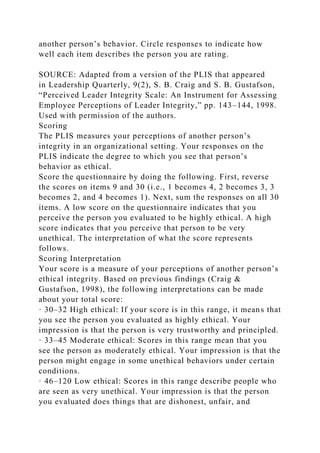
Perceived Leader Integrity Scale (PLIS)
Instructions: The following items concern your perceptions of
another person’s behavior. Circle responses to indicate how
well each item describes the person you are rating.
SOURCE: Adapted from a version of the PLIS that appeared
in Leadership Quarterly, 9(2), S. B. Craig and S. B. Gustafson,
“Perceived Leader Integrity Scale: An Instrument for Assessing
Employee Perceptions of Leader Integrity,” pp. 143–144, 1998.
Used with permission of the authors.
Scoring
The PLIS measures your perceptions of another person’s
integrity in an organizational setting. Your responses on the
PLIS indicate the degree to which you see that person’s
behavior as ethical.
Score the questionnaire by doing the following. First, reverse
the scores on items 9 and 30 (i.e., 1 becomes 4, 2 becomes 3, 3
becomes 2, and 4 becomes 1). Next, sum the responses on all 30
items. A low score on the questionnaire indicates that you
perceive the person you evaluated to be highly ethical. A high
score indicates that you perceive that person to be very
unethical. The interpretation of what the score represents
follows.
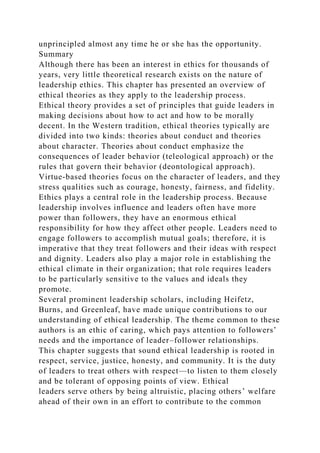
Scoring Interpretation
Your score is a measure of your perceptions of another person’s
ethical integrity. Based on previous findings (Craig &
Gustafson, 1998), the following interpretations can be made
about your total score:
· 30–32 High ethical: If your score is in this range, it means that
you see the person you evaluated as highly ethical. Your
impression is that the person is very trustworthy and principled.
· 33–45 Moderate ethical: Scores in this range mean that you
see the person as moderately ethical. Your impression is that the
person might engage in some unethical behaviors under certain
conditions.
· 46–120 Low ethical: Scores in this range describe people who
are seen as very unethical. Your impression is that the person
you evaluated does things that are dishonest, unfair, and
unprincipled almost any time he or she has the opportunity.
Summary
Although there has been an interest in ethics for thousands of
years, very little theoretical research exists on the nature of
leadership ethics. This chapter has presented an overview of
ethical theories as they apply to the leadership process.
Ethical theory provides a set of principles that guide leaders in
making decisions about how to act and how to be morally
decent. In the Western tradition, ethical theories typically are
divided into two kinds: theories about conduct and theories
about character. Theories about conduct emphasize the
consequences of leader behavior (teleological approach) or the
rules that govern their behavior (deontological approach).
Virtue-based theories focus on the character of leaders, and they
stress qualities such as courage, honesty, fairness, and fidelity.
Ethics plays a central role in the leadership process. Because
leadership involves influence and leaders often have more
power than followers, they have an enormous ethical
responsibility for how they affect other people. Leaders need to
engage followers to accomplish mutual goals; therefore, it is
imperative that they treat followers and their ideas with respect
and dignity. Leaders also play a major role in establishing the
ethical climate in their organization; that role requires leaders
to be particularly sensitive to the values and ideals they
promote.
Several prominent leadership scholars, including Heifetz,
Burns, and Greenleaf, have made unique contributions to our
understanding of ethical leadership. The theme common to these
authors is an ethic of caring, which pays attention to followers’
needs and the importance of leader–follower relationships.
This chapter suggests that sound ethical leadership is rooted in
respect, service, justice, honesty, and community. It is the duty
of leaders to treat others with respect—to listen to them closely
and be tolerant of opposing points of view. Ethical
leaders serve others by being altruistic, placing others’ welfare
ahead of their own in an effort to contribute to the common
good. Justice requires that leaders place fairness at the center of
their decision making, including the challenging task of being
fair to the individual while simultaneously being fair to the
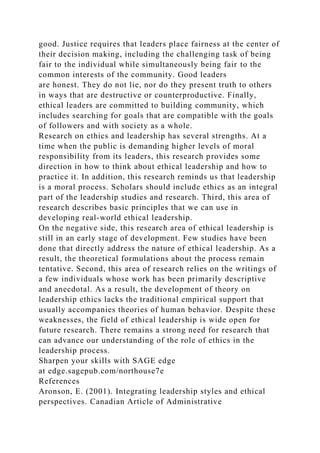
common interests of the community. Good leaders
are honest. They do not lie, nor do they present truth to others
in ways that are destructive or counterproductive. Finally,
ethical leaders are committed to building community, which
includes searching for goals that are compatible with the goals
of followers and with society as a whole.
Research on ethics and leadership has several strengths. At a
time when the public is demanding higher levels of moral
responsibility from its leaders, this research provides some
direction in how to think about ethical leadership and how to
practice it. In addition, this research reminds us that leadership
is a moral process. Scholars should include ethics as an integral
part of the leadership studies and research. Third, this area of
research describes basic principles that we can use in
developing real-world ethical leadership.
On the negative side, this research area of ethical leadership is
still in an early stage of development. Few studies have been
done that directly address the nature of ethical leadership. As a
result, the theoretical formulations about the process remain
tentative. Second, this area of research relies on the writings of
a few individuals whose work has been primarily descriptive
and anecdotal. As a result, the development of theory on
leadership ethics lacks the traditional empirical support that
usually accompanies theories of human behavior. Despite these
weaknesses, the field of ethical leadership is wide open for
future research. There remains a strong need for research that
can advance our understanding of the role of ethics in the
leadership process.
Sharpen your skills with SAGE edge
at edge.sagepub.com/northouse7e
References
Aronson, E. (2001). Integrating leadership styles and ethical
perspectives. Canadian Article of Administrative
Sciences, 18(4), 244–256.
Avolio, B. J., & Locke, E. E. (2002). Contrasting different
philosophies of leader motivation: Altruism versus
egoism. Leadership Quarterly, 13, 169–191.
Bass, B. M., & Steidlmeier, P. (1999). Ethics, character, and
authentic transformational leadership behavior. Leadership
Quarterly, 10(2), 181–217.
Beauchamp, T. L., & Bowie, N. E. (1988). Ethical theory and
business (3rd ed.). Englewood Cliffs, NJ: Prentice Hall.
Beauchamp, T. L., & Childress, J. F. (1994). Principles of
biomedical ethics (4th ed.). New York: Oxford University Press.
Block, P. (1993). Stewardship: Choosing service over self-
interest. San Francisco: Berrett-Koehler.
Bowie, N. E. (1991). Challenging the egoistic
paradigm. Business Ethics Quarterly, 1(1), 1–21.
Burns, J. M. (1978). Leadership. New York: Harper & Row.
Carlson, D. S., & Perrewe, P. L. (1995). Institutionalization of
organizational ethics through transformational
leadership. Article of Business Ethics, 14(10), 829–838.
Ciulla, J. B. (1998). Ethics, the heart of leadership. Westport,
CT: Greenwood.
Ciulla, J. B. (2001). Carving leaders from the warped wood of
humanity. Canadian Article of Administrative
Sciences, 18(4), 313–319.
Ciulla, J. B. (2003). The ethics of leadership. Belmont,
CA: Wadsworth/Thomson Learning.
Conger, J. (1990). The dark side of leadership. Organizational
Dynamics, 19, 44–55.
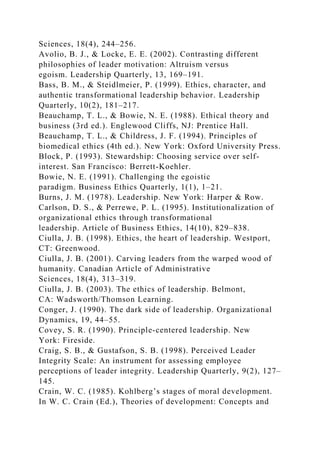
Covey, S. R. (1990). Principle-centered leadership. New
York: Fireside.
Craig, S. B., & Gustafson, S. B. (1998). Perceived Leader
Integrity Scale: An instrument for assessing employee
perceptions of leader integrity. Leadership Quarterly, 9(2), 127–
145.
Crain, W. C. (1985). Kohlberg’s stages of moral development.
In W. C. Crain (Ed.), Theories of development: Concepts and
applications (pp. 118–136). New York: Prentice-Hall.
Dalla Costa, J. (1998). The ethical imperative: Why moral
leadership is good business. Reading, MA: Addison-Wesley.
De Pree, M. (1989). Leadership is an art. New
York: Doubleday.
Frankena, W. (1973). Ethics (2nd ed.). Englewood Cliffs,
NJ: Prentice Hall.
Gilligan, C. (1982). In a different voice: Psychological theory
and women’s development. Cambridge, MA: Harvard University
Press.
Gini, A. (1998). Moral leadership and business ethics. In J.
B. Ciulla (Ed.), Ethics, the heart of leadership (pp. 27–
46). Westport, CT: Greenwood.
Greenleaf, R. K. (1970). The servant as leader. Newton Centre,
MA: Robert K. Greenleaf Center.
Greenleaf, R. K. (1977). Servant leadership: A journey into the
nature of legitimate power and greatness. New York: Paulist.
Heifetz, R. A. (1994). Leadership without easy
answers. Cambridge, MA: Harvard University Press.
Jaksa, J. A., & Pritchard, M. S. (1988). Communication ethics:
Methods of analysis. Belmont, CA: Wadsworth.
Johnson, C. R. (2011). Meeting the ethical challenges of
leadership (4th ed.). Thousand Oaks, CA: Sage.
Kanungo, R. N. (2001). Ethical values of transactional and
transformational leaders. Canadian Article of Administrative
Sciences, 18(4), 257–265.
Kanungo, R. N., & Mendonca, M. (1996). Ethical dimensions of
leadership. Thousand Oaks, CA: Sage.
Kitchener, K. S. (1984). Intuition, critical evaluation, and
ethical principles: The foundation for ethical decisions in
counseling psychology. Counseling Psychologist, 12(3), 43–55.
Kohlberg, L. (1984). Essays on moral development, Vol. 2: The
psychology of moral development. New York: Harper & Row.
Komives, S. R., Lucas, N., & McMahon, T.
R. (1998). Exploring leadership: For college students who want
to make a difference. San Francisco: Jossey-Bass.
Kouzes, J. M., & Posner, B. Z. (1995). The leadership
challenge: How to keep getting extraordinary things done in
organizations (2nd ed.). San Francisco: Jossey-Bass.
Lipman-Blumen, J. (2005). The allure of toxic leaders. New
York: Oxford University Press.
Padilla, A., Hogan, R., & Kaiser, R. B. (2007). The toxic
triangle: Destructive leaders, susceptible followers, and
conducive environments. The Leadership Quarterly, 18, 176–
194.
Parry, K. W., & Proctor-Thomson, S. B. (2002). Perceived
integrity of transformational leaders in organisational
settings. Article of Business Ethics, 35, 75–96.
Pojman, L. P. (1995). Ethical theory: Classical and
contemporary readings (2nd ed.). Belmont, CA: Wadsworth.
Price, T. (2008). Leadership ethics: An introduction. New
York: Cambridge University Press.
Rawls, J. (1971). A theory of justice. Boston: Harvard
University Press.
Rost, J. C. (1991). Leadership for the twenty-first century. New
York: Praeger.
Schminke, M., Ambrose, M. L., & Noel, T. W. (1997). The
effect of ethical frameworks on perceptions of organizational
justice. Academy of Management Article, 40(5), 1190–1207.
Schumann, P. L. (2001). A moral principles framework for
human resource management ethics. Human Resource
Management Review, 11, 93–111.
Schyns, B., & Schilling, J. (2013). How bad are the effects of
bad leaders? A meta-analysis of destructive leadership and its
outcomes. The Leadership Quarterly, 24, 138–158.
Senge, P. M. (1990). The fifth discipline: The art and practice
of the learning organization. New York: Doubleday.
Trevino, L. K. (1986). Ethical decision making in organizations:
A person–situation interactionist model. Academy of
Management Review, 11(3), 601–617.
Trevino, L. K., Brown, M., & Hartman, L. P. (2003). A
qualitative investigation of perceived executive ethical
leadership: Perceptions from inside and outside the executive
suite. Human Relations, 56(1), 5–37.
Velasquez, M. G. (1992). Business ethics: Concepts and
cases (3rd ed.). Englewood Cliffs, NJ: Prentice Hall.
Wayne, L. (2009, May 30). A promise to be ethical in an era of
immorality. The New York Times. Retrieved June 15, 2009,
from http://www.nytimes.com/2009/05/30/business
Turning Inward or Focusing Out? Navigating Theories
of Interpersonal and Ethical Cognitions to Understand Ethical
Decision-Making
Lumina S. Albert • Scott J. Reynolds •
Bulent Turan
Received: 6 February 2014 / Accepted: 21 May 2014 / Published
online: 14 June 2014
! Springer Science+Business Media Dordrecht 2014
Abstract The literature on ethical decision-making is
rooted in a cognitive perspective that emphasizes the role
of moral judgment. Recent research in interpersonal
dynamics, however, has suggested that ethics revolves
around an individual’s perceptions and views of others. We
draw from both literatures to propose and empirically
examine a contingent model. We theorize that whether the
individual relies on cognitions about the ethical issue or
perceptions of others depends on the level of social con-
sensus surrounding the issue. We test our hypotheses in
three studies. Results suggest that not only does social
consensus determine whether an individual relies on ethical
cognitions about the issue or perceptions of others, but also
that an individual’s view of self is an important moderator
in these relationships. We conclude by considering impli-
cations of this research for theory and practice.
Keywords Ethical judgment ! Interpersonal
relationships ! Ethical decision-making ! Ethical behavior !
View of others ! View of self
Introduction
Corporate scandals, such as exaggerating revenue, paying
bribes, facilitating corrupt officials, and mishandling confi-
dential business information, have generated world-wide
interest in unethical behavior (Treviño et al. 2006). Although
many entities, including the United States Securities and
Exchange Commission and the United States Senate, have
exerted pressure on corporations to improve employee
behavior (Pulliam et al. 2010; Thiel et al. 2012), employees
continue to report that they feel pressure to compromise
standards and are experiencing retaliation when they report
misconduct by managers or organizational representatives
(National Business Ethics Survey 2011). Also troublesome
are recent national reports of misconduct by retail customers.
For instance, retailers estimated that holiday return fraud (in
the form of return of stolen merchandise and fraudulent pur-
chases) cost them $3.4 billion (National Retail Survey 2013).
These events highlight the importance of understanding the
determinants and dynamics of ethical decision-making across
both organizational (e.g., Butterfield et al. 2000) and con-
sumer contexts (e.g., Vitell &Muncy 2005; Vitell et al. 2001).
Behavioral ethics researchers have studied direct rela-
tionships between ethical behavior and a variety of ante-
cedent conditions. Some have focused on individual
differences in demographics, personality, and cognitive
ethical development (Treviño et al. 2006). However, a
significant amount of the literature in both organizational
and marketing ethics assumes that decision makers follow
a cognitive and rational approach that revolves around
moral judgments about the issue (e.g., Kohlberg 1981; Rest
1986; Reynolds 2006b; Vitell et al. 1991, 2001; Weber
1990). This substantial trend notwithstanding, some
scholars have suggested that the cognitive approach fails to
fully explain ethical behavior, and have therefore either
L. S. Albert (&)
College of Business, Colorado State University, Fort Collins,
CO 80523-1275, USA
e-mail: [email protected]
S. J. Reynolds
Foster School of Business, University of Washington, Seattle,
WA 98195, USA
e-mail: [email protected]
B. Turan
Department of Psychology, University of Alabama,
Birmingham, AL 35294, USA
e-mail: [email protected]
123
J Bus Ethics (2015) 130:467–484
DOI 10.1007/s10551-014-2236-2
called for or suggested alternative approaches (e.g., Cohen
2010; Haidt 2001; Hannah et al. 2011; Reynolds 2006b;
Vitell et al. 2013; Weaver et al. 2014). In this vein, several
researchers have argued that a central aspect of ethics is a
‘‘consideration of others’’ (e.g., Brass et al. 1998). These
authors emphasize that interpersonal relationships play an
influential role in explaining individual ethical decision-
making (e.g., attachment theory: Albert and Horowitz
2009; social relationships: Bowler and Brass 2006; Brass
et al. 1998; interpersonal dominance: Son Hing et al.
2007). Indeed, research has indicated that one’s percep-
tions of others and intimacy of relationships with others
may be related positively to ethical behavior in specific
relationships (e.g., Brass et al. 1998; Venkataramani and
Dalal 2007; Vetlesen 1994). Additionally, several scholars
have also demonstrated that a lack of consideration for
others elicits unethical behavior, especially if these
behaviors help advance the self-interests of the decision-
maker (Duckitt 2001; Son Hing et al. 2007).
Despite a significant amount of research indicating the
value of cognitive analyses and interpersonal constructs in
explaining ethical behavior, no research has considered
these ideas concurrently. Accordingly, we argue that both
interpersonal and cognitive factors are critical yet contin-
gent factors in the individual ethical decision making
process. Specifically, we propose that whether individuals
rely on cognitive judgments or interpersonal factors
depends on the level of social consensus regarding the
moral issue—the degree of social agreement that the pro-
posed act is good or evil or right or wrong (Jones 1991).
Our results provide evidence that an integrated approach
involving both interpersonal and cognitive principles is not
only justified, but also provides a much more comprehen-
sive explanation of ethical behavior. This research thus
contributes to the literature by extending our understanding
of the cognitive and interpersonal aspects of ethical deci-
sion-making and by highlighting how the nature of the
moral issue can shape individual responses to ethical
situations.
Two Approaches to Ethical Behavior
The Cognitive Approach
Philosophers have studied ethical behavior for centuries,
and most have framed it as a cognitive exercise (Honderich
1995). This long-standing tradition is reflected in the ear-
liest and most widely-regarded theories explaining the
psychology of ethics (Hunt and Vitell 1986; Rest 1986).
For example, Rest’s (1986) four-component model claims
that ethical decision making first begins with ethical
awareness, an acknowledgment that the issue contains
ethical content. Once this recognition has been made, the
individual then makes a judgment about the issue at hand,
establishes an intention to behave ethically, and finally
engages in ethical behavior.
Ethical judgment, considered by many to be the most
critical element in the ethical decision making process
(Kohlberg 1981), has been researched quite thoroughly
(Goolsby and Hunt 1992; Greenberg 2002; Hunt and Vitell
1986; Hunt 1993; Vitell et al. 2001). Two of the most
foundational constructs of the ethical judgment literature
are consequentialism and formalism (Brady and Wheeler
1996). Per Reynolds (2006a), consequentialism is teleo-
logical or ends-based ethical decision making. It empha-
sizes the ‘‘end’’ or the outcome of an act and contends that
the ethical act is that which optimizes or creates the
greatest good or benefit. In contrast, formalism represents
deontological or obligation-based approaches to ethical
decision making. It emphasizes the ‘‘means’’—normative
patterns of behavior and other formal standards as deter-
minants of what is ethical (Brady and Wheeler 1996;
Honderich 1995; Hunt and Vitell 1986; Hunt 1993).
Together these two constructs capture the most funda-
mental of concerns in ethical decision-making, and as a
result, they have been used in numerous settings to explain
a variety of ethical phenomena ranging from perceptions of
justice (Schminke et al. 1997), consumer ethical decisions
(Vitell et al. 2001) and moral awareness (Reynolds 2006a)
to ethical behaviors such as honesty and cheating (Brady
and Wheeler 1996; Reynolds and Ceranic 2007). While
consequentialism and formalism explain a great deal about
ethical decision-making, several scholars have suggested
that an interpersonal approach also has much to add.
An Interpersonal Approach
Research has established that individuals have generalized
stances toward relationships and ‘‘others’’ that are often
spontaneous and unacknowledged (Pietromonaco and
Barrett 2000). As Kahn and Kram (1994) suggest, these
stances are internalized models developed in childhood that
individuals typically carry into adulthood, and which
influence behaviors across interpersonal situations.
According to Bowlby (1969, 1973), individuals develop
these internalized working models based on repeated
interactions with early significant figures that subsequently
serve as cognitive maps for navigating relationships
throughout one’s lifespan. Bowlby posited that these
working models are comprised of two complementary yet
distinct cognitive dimensions: a generalized ‘‘view of
others’’ and an internalized ‘‘view of self’’ (Albert and
Horowitz 2009; Bartholomew and Horowitz 1991; Dizen
and Berenbaum 2011; Kobak and Sceery 1988). While
468 L. S. Albert et al.
123
one’s view of others is formed based on expectations about
the availability and responsiveness of the attachment fig-
ure, one’s model of self reflects stabilized beliefs about the
acceptability and worth of the self. These working models
are thought to be malleable during early development but
once consolidated; they stabilize and influence one’s
behaviors through one’s lifetime (e.g., Kobak and Sceery
1988; Sroufe and Waters 1977).
As ethical behaviors often occur in social contexts
characterized by interpersonal dynamics (Albert and
Horowitz 2009; Brass et al. 1998; Son Hing et al. 2007), it
seems clear that these working models inform and shape
these behaviors. In fact, research in psychology has
established that an individual’s perception of others is one
of the most important determinants of warm and agreeable
behavior (Albert and Moskowitz 2014; Dizen and Beren-
baum 2011; Locke 2009; Mayer et al. 1995; Moskowitz
2010; Wood et al. 2010). Interpersonal theorists assert that
social perceptions will influence how individuals behave in
social situations (Albert and Moskowitz 2014; Horowitz
et al. 1997; Kiesler 1996; Moskowitz 2010). Individuals
who have a tendency to perceive others as hostile, quar-
relsome and unfair prepare to respond in hostile, unfair and
threatening ways themselves (e.g., Albert and Moskowitz
2014; Dodge and Crick 1990; Raine 2008). Likewise,
individuals who perceive others as friendly, compassionate,
agreeable and caring, respond with complementary positive
behaviors (Graziano et al. 2007; Graziano and Tobin
2002).
Baldwin (1992, 1995) suggested that an individual’s
views of others work in combination with his/her view of
self to determine how the individual interprets and
responds to interpersonal information, and that these con-
clusions then guide their behavior. Therefore, we suggest
that an interpersonal approach encompassing views of
others (and of the self) is not only justified, but also will
provide unique and valuable information on the interper-
sonal dynamics of ethical behavior. In the following sec-
tion, we theorize about how these factors act directly and in
combination with ethical judgments to shape ethical deci-
sion-making. In short, we suggest that the effects of these
factors depend on the level of social consensus regarding
the issue being considered (Jones 1991).
An Integrated Model Based on Social Consensus
Jones (1991) developed an issue-contingent model of eth-
ical decision-making in which he proposed that issues vary
in their moral intensity (the extent to which the issue
involves moral content). According to Jones, moral inten-
sity is comprised of six characteristics: magnitude of harm,
temporal immediacy, probability of effects, concentration
of effects, proximity, and social consensus. Social con-
sensus is ‘‘the degree of social agreement that a proposed
act is evil (or good)’’ (Jones 1991, p. 375); it ‘‘indicates the
extent to which there is a general concurrence within
society about the moral status of the issue’’ (Reynolds and
Ceranic 2007, p. 1611). Subsequent research has empiri-
cally demonstrated that social consensus is one of the most
important factors in determining an issue’s moral intensity
(Frey 2000).
When social consensus is high, a clear and shared
understanding of what constitutes ethical behavior is
apparent. We suggest that under such situations, the
individual does not need to rely on personal judgments
of ethicality (i.e., consequentialistic and formalistic
analyses of the issue) to determine what is moral.
Instead, the widely-accepted social standard regarding
the issue (i.e., social consensus) spontaneously informs
the individual regarding the ethical nature of the issue
(e.g., ‘‘charitable behavior is good behavior’’). High
social consensus does not, however, guarantee that the
individual will be motivated to perform that ethical
action. The individual must be motivated to act upon
that social consensus. Scholars have suggested that
individuals are motivated to engage in behaviors such as
making donations to charity, recycling bottles or donat-
ing food, because of their favorable views and feelings
about others (Silk 2006). As mentioned, interpersonal
research has established that an individual’s perception
of others is one of the most important determinants of
social behavior (Albert and Moskowitz 2014; Dizen and
Berenbaum 2011; Horowitz et al. 1997; Locke 2009).
Therefore, we expect that behavior in situations of high
social consensus will depend on the individual’s view of
others. If the individual perceives others positively, then
the individual is likely to respond with complementary
positive behaviors. Most importantly, such individuals
would have motivations to operate in a manner consis-
tent with larger social expectations expressed in the
social consensus factor. Thus, we propose the following:
Hypothesis 1a When social consensus regarding the
ethical issue is high, one’s view of others will positively
influence ethical behavior.
The literature on interpersonal relationships argues that
not only is the individual’s view of others important in
predicting interpersonal behavior, but also that the individ-
ual’s view of self affects behavior. The literature on self-
views and ethical behavior, however, reveals inconsistent
findings regarding their relationship. Conventional wisdom
regards low self-esteem as an important cause of violence
and unethical behavior (e.g., Long 1990; Oates and Forrest
1985; Wiehe 1991), but a substantial body of research
demonstrates that high self-esteem is closely associated with
Turning Inward or Focusing Out? 469
123
violence and unethical behavior (e.g., Baumeister et al.
1996; Bradshaw and Hazan 2006). Indeed, Baumeister et al.
(1996) argued that the typical self-defining statements of
perpetrators of violence and other harmful acts indicated
expressions of superiority and capability. These inconsis-
tencies indicate that the relationship between view of self
and ethical behavior is not as simple and linear as previously
theorized. Thus, we do not necessarily expect view of self to
have a direct effect on ethical behavior. Nevertheless, a
favorable self-image implies self-confidence to hold firmly
and unwaveringly to one’s beliefs and values. Individuals
with high self-views have been consistently shown to have a
greater capacity for self-regulation, persistence in their
beliefs and expressing behavior that is consistent with their
personal convictions than individuals with low self-esteem
(e.g., Crocker and Major 1989; Leary and Tangney 2003;
McFarlin et al. 1984). This favorable self-view should also
reinforce the individual’s ability to engage in behaviors that
are consistent with his or her interpersonal convictions.
Thus, we propose a moderating effect such that the more
favorable the individual’s view of self, the stronger the
relationship between the individual’s view of others and
ethical behavior.
Hypothesis 1b When social consensus regarding the
ethical issue is high, view of self will moderate the rela-
tionship between view of others and ethical behavior such
that a favorable self-image will enhance the positive rela-
tionship between view of others and ethical behavior.
Of course, social consensus is not always high. By defi-
nition, when social consensus is low, widespread disagree-
ment about the ethical course of action exists and therefore
the ethical status of the behavior is not obvious. In these kinds
of situations, often referred to as ethical dilemmas (Weber
1990), the individual cannot rely on a widely-held opinion
about the matter. Instead, the individual must generate his or
her own cognitive conclusions to arrive at a moral decision.
In other words, the individual is more inclined, perhaps even
required, to rely on his or her consequentialistic and/or for-
malistic analyses about the ethical issue. Thus, we argue that
when social consensus regarding an issue is low, conse-
quentialism and formalism will exert direct main effects on
ethical behavior and that view of others will have no sig-
nificant impact on ethical behavior. Specifically, we expect
that when social consensus is low, consequentialism will be
associated with outcome-oriented behaviors: behaviors that
most effectively generate positive outcomes for those
involved, even if those behaviors violate well-established
rules of conduct. In contrast, we expect that when social
consensus is low, formalism will be most closely associated
with means-based behaviors: behaviors that demonstrate
adherence with moral rules, values and forms of ethical
conduct, even if the actions do not involve positive outcomes
for those involved or if those behaviors generate generally or
personally negative outcomes. These arguments are sum-
marized as follows:
Hypothesis 2a When social consensus regarding the
ethical issue is low, consequentialism will be positively
associated with more outcome-oriented ethical behaviors.
Hypothesis 2b When social consensus regarding the
ethical issue is low, formalism will be positively associated
with more means-based ethical behaviors.
Though we have argued that view of others will not have
an effect on ethical behavior when social consensus is low,
theory and empirical evidence suggest that an individual’s
view of self still plays an important role in this process.
Previous research has documented that individuals often
fail to see an ethical judgment through to ethical behavior
(Reynolds and Ceranic 2007), but a favorable self-image
implies self-confidence to hold on firmly to ethical judg-
ments even in the face of external resistance. Thus, we
suggest that as an individual’s view of self becomes more
positive, the likelihood that he/she will engage in behavior
consistent with his or her ethical judgment will also
increase. These arguments are summarized below, and all
of our hypotheses are illustrated in Figs. 1 and 2:
Hypothesis 2c When social consensus regarding the
ethical behavior is low, view of self will moderate the
relationship between consequentialism and ethical behav-
ior such that a favorable self image will enhance the
positive relationship between consequentialism and out-
come-oriented ethical behavior.
Consequentialism
Formalism
View of Others
View of Self
Ethical Behavior
Fig. 1 The influence of cognitive and interpersonal factors on
ethical
behavior when social consensus is high
470 L. S. Albert et al.
123
Hypothesis 2d When social consensus regarding the
ethical behavior is low, view of self will moderate the
relationship between formalism and ethical behavior such
that a favorable self-image will enhance the positive rela-
tionship between formalism and means-based ethical
behavior.
In the following section, we report three studies that
tested these hypotheses. In the first study, we used multiple
measures of ethical behavior to repeatedly explore the
effects of social consensus, view of others, view of self,
consequentialism, and formalism on ethical behavior. In
the second study, we extended the generalizability of these
results by testing our hypotheses with a consumer measure
of ethical behavior and a different sample. In the third
study, we used a within-subjects design to test these
effects.
Study 1: Method
Sample and Procedure
The sample for the study consisted of 430 individuals
holding managerial positions in different organizations on
the West Coast of the United States. The participants
were recruited from an email list of individuals interested
in receiving online survey announcements maintained by
the work-life office and the school of business of a large
university. With the help of list administrators, we sent a
recruitment email to the group of managers inviting them
to participate anonymously. After participants confirmed
their interest in participating, they received the self-
administered questionnaire package in the mail. Of the
430 employees who received the package, 383 completed
and returned the questionnaires. Of these, 26 question-
naires were excluded from the analyses due to significant
levels of incomplete data or unclear responses. Of the 357
participants in the final sample (83 %), 160 were women
and 197 were men. Sixty two percent (221) indicated that
they were Caucasian, 15 % (54) indicated that they were
Asian, 10 % (36) indicated they were African-American,
and 13 % (46) indicated other ethnicities. Most of the
respondents (56 %) were between 31 and 50 years old,
33 % were younger than 30 years old and 11 % were
more than 50 years old. Each of the participants received
a $5 gift certificate from a retailer for participating in the
study.
Measures
Ethical Behaviors of High and Low Social Consensus
In their review, Treviño et al. (2006) recognized that the
literature has conceptualized ethical behavior in multiple
ways. Generally speaking, some measures of ethical
behavior focus on the individual’s meeting or failing to
meet minimal ethical standards (e.g., stealing, being hon-
est), whereas others have focused on behaviors that exceed
ethical minimums (e.g., charitable giving). In an effort to
capture this variance of social consensus and to provide the
most rigorous tests of our hypotheses, we utilized five
distinct measures of ethical behavior.
To begin, we focused on charitable giving as a measure
of ethical behavior high in social consensus (Reynolds and
Ceranic 2007). We measured charitable giving with three
items. Participants responded on a four-point scale
(1 = never, 4 = many times) to indicate how often they
had volunteered for a good cause (homeless shelters),
donated non-money items (clothes, food, etc.), and donated
money to a charity. The reliability for the three items was
.84.
As a second measure of ethical behavior high in social
consensus, we utilized a segment of Newstrom and Ruch’s
(1975) scale of workplace behaviors. The widely-used
measure (e.g., Ferrell and Weaver 1978; Kidwell et al.
1987; Peterson 2002; Treviño et al. 1998; Weaver and
Treviño 1999) asks respondents to indicate on a Likert type
scale (1 = never, 7 = frequently) the extent to which they
have engaged in 17 different behaviors. Previous research
has consistently demonstrated that four of these items load
on a factor representing behaviors perceived to be overt
unethical behaviors (high social consensus) in which
Consequentialism
Formalism
View of Others
View of Self
Ethical Behavior
Fig. 2 The influence of cognitive and interpersonal factors on
ethical
behavior when social consensus is low
When social consensus is low, what constitutes ethical behavior
is
unclear. In this case, we are arguing that when social consensus
is
low, consequentialism will be associated with more outcome-
oriented
forms of ethical behavior and formalism will be associated with
more
means-based forms of ethical behavior
Turning Inward or Focusing Out? 471
123
managers are least likely to engage (Ferrell and Weaver
1978; George et al. 1999; McCabe et al. 2006). These four
behaviors are: (a) Passing blame for errors to an innocent
co-worker, (b) Claiming credit for someone else’s work,
(c) Falsifying time/quality/quantity reports, (d) Padding an
expense account of more than 10 %. To confirm the
reported findings, we conducted principal component
analysis with varimax rotation. Our analysis revealed two
distinct factors: the first consisted of the four items men-
tioned above (eigenvalue = 2.60, 15.29 % of the variance;
a = .82) and the second consisted of the remaining thirteen
items (eigenvalue = 8.66, 50.95 % of the variance;
a = .95). We used the four behaviors to measure unethical
behaviors of high social consensus.
As final measures of high social consensus ethical
behaviors, we developed two vignettes. The vignettes
described a decision-making situation related to an ethical
issue and were listed with a series of other business-related
vignettes. The first focused on a situation of claiming
credit for a colleague’s work and the second focused on
illegal bribery. For each vignette, four alternative respon-
ses were provided that ranged from what was determined
to be the most unethical to the most ethical choice. The
single-response format reduced competing preferences to a
single scalable behavior. We recognize that vignettes such
as these elicit intentions to behave and are less desirable
than direct measures of behavior. Nevertheless, as Weber
(1990) has noted, vignettes provide a valuable complement
to more direct behavioral measures. We computed the
mean value of the responses to the two vignettes (a = .72),
and utilized this measure to provide a more complete test
of our hypotheses.
We employed two measures of ethical behavior low in
social consensus. The first was comprised of the 13
remaining items from Newstrom and Ruch’s (1975) scale.
These 13 items reflected less egregious workplace behav-
iors such as ‘‘Calling in sick to take a day off’’ and ‘‘Using
company services for personal needs’’. In each case, the
items describe behaviors that involve achieving personal
short-term gain while violating both formal and informal
rules of conduct. Thus, we considered Newstrom and
Ruch’s measures of unethical (and ethical) behavior to be
proxy measures of outcome-oriented (and means-based)
behaviors. While we recognize that alternative conse-
quentialistic (and formalistic) analyses could lead to
opposite conclusions, we consider such interpretations to
be far less common and therefore inferior representations
of these constructs.
As a second measure of an ethical behavior low in social
consensus, we included a vignette developed by Reynolds
and Ceranic (2007), patterned after vignettes used in prior
research on consequentialism and formalism (e.g., Brady
and Wheeler 1996; Fritzsche and Becker 1984). It involved
a situation where the manager faces an ethical dilemma
regarding giving an intern a day off, and had four alter-
native responses that represented a continuum of behaviors
ranging from a highly outcome-oriented option to a highly
means-based option. The presentation of the dependent
variable measures was randomized.
To test the validity of our claims about the social con-
sensus levels of these dependent variables, we used a
separate sample of 103 managers working in the informa-
tion technology industry (age: M = 45, SD = 10.5; tenure:
M = 11 years, SD = 10.5, 43 % male). They were pre-
sented the three charitable behaviors, the behaviors from
Newstrom and Ruch’s (1975) scale, and the three vignettes
described earlier. Items asked to what extent they believed
that managers agreed that the behaviors were ethically
good or bad. Responses were recorded on a five point scale
ranging from 1 (‘‘There is a great deal of disagreement’’) to
5 (‘‘There is a great deal of agreement’’). Results indicated
that the managers endorsed charitable giving as a behavior
high in social consensus (M = 4.74, SD = .66). The four
items from Newstrom and Ruch (1975) (M = 4.73,
SD = .63) and the vignettes representing illegal bribery
(M = 4.73, SD = .70) and claiming credit for a col-
league’s work (M = 4.71, SD = .71) were also perceived
by the managers as behaviors with high social consensus.
Paired sample t-tests revealed that the respondents believed
that the remaining thirteen items (M = 3.55, SD = .67)
were perceived as having a significantly lower level of
social consensus than charitable giving, t (102) = 15.06,
p .01. The Cohen’s d (1.76) and the effect size correla-
tion (r = .67) indicated a large effect. The tests also
revealed that respondents perceived the four items as
having higher social consensus than the other 13 items,
t (102) = 16, p .01. The effect size of this difference
was large (d = 1.82, r = .67). Finally, participants per-
ceived the vignette describing the situation with the intern
(M = 3.66, SD = 1.26) as having a significantly lower
level of social consensus than charitable giving,
t (102) = 8.43, p .01 (d = .94; r = .43). These results
supported our claims about the levels of social consensus
surrounding the six measures.
View of Self
As a measure of view of self, we used Rosenberg’s Self-
Esteem (RSE) scale (Rosenberg 1965). Participants rated
the self-descriptiveness of ten statements (e.g., ‘‘I take a
positive attitude toward myself’’) on a four point scale
(1 = not at all descriptive, 4 = very descriptive). The
reliability alpha for this measure (a = .88) was consistent
with previous research (Robbins et al. 2001).
472 L. S. Albert et al.
123
View of Others
As a measure of view of others, we used a modified
version of the schema assessment of typicality (Burks
et al. 1999). This measure consists of nine pairs of cor-
responding positive (e.g., approachable) and negative
(e.g., cold) terms. Participants indicated which term best
described their perceptions of others (in general). The
mean number of positive characteristics was computed,
and a higher score indicated a more positive view of
others (a = .92).
Consequentialism and Formalism
We used the character traits section of the Measure of
Ethical Viewpoints (Brady and Wheeler 1996) to measure
the extent to which respondents generally preferred con-
sequentialistic or formalistic forms of ethical judgments.
This instrument is based on the assertion that ethical pre-
dispositions are associated with particular character traits
and that individuals consider certain character traits to be
important based on their ethical predispositions. The
instrument lists character traits that respondents rate on a
7-point scale (1 = not important to me, 7 = very impor-
tant to me). Consequentialism was measured using
seven items (‘‘innovative,’’ ‘‘resourceful,’’ ‘‘effective,’’
‘‘influential,’’ ‘‘results oriented,’’ ‘‘productive’’ and ‘‘being
a winner’’) and formalism was measured using six
(‘‘principled,’’ ‘‘dependable,’’ ‘‘trustworthy,’’ ‘‘honest,’’
‘‘noted for integrity’’ and ‘‘law-abiding’’). The reliability
alphas for the measures were .87 for consequentialism and
.88 for formalism. These results are consistent with pre-
vious research (Reynolds 2006a; Reynolds and Ceranic
2007; Schminke et al. 1997).
Control Variable
Even though we solicited anonymous responses, we rec-
ognized that social desirability bias could influence the
participants’ responses. Therefore, we included the Bal-
anced Inventory of Desirable Responding (Paulhus 1984,
1998) as a control for social desirability bias in our anal-
yses. The BIDR measures two constructs: self-deceptive
positivity and impression management. Each of these
constructs was measured by 20 items stated as proposi-
tions, the responses to which were summed to yield an
overall measure of social desirability. Respondents rated
their agreement with each statement on a seven-point scale
and one point was added for each extreme response (6 or 7)
(Paulhus 1998).
Study 1: Results
Means, standard deviations, and correlations of the vari-
ables are presented in Table 1. To test each hypothesis, we
followed the procedures recommended by Aiken and West
(1991). We mean centered the independent variables and
created separate sets of regression models for each of the
dependent variables (Aiken and West 1991). In each
model, the main and interaction effects of the independent
variables were investigated.
Table 2 indicates that the inclusion of the interpersonal
variables significantly improved the regression model for
charitable behavior (DR2 = .08, p = .00). Participants’
views of others positively influenced charitable giving
behavior, b = .13, t (353) = 5.73, p = .00, and view of
self did not significantly predict charitable behavior,
b = .01, t (353) = .11, p = .92. When the ethical judg-
ment variables were entered into the model, the change in
Table 1 Study 1: Means, standard deviations, and correlation
matrix of research variables
Variable M SD 1 2 3 4 5 6 7 8 9
1. View of others 4.71 2.30
2. View of self 2.86 .85 .20**
3. Formalism 4.23 1.67 .07 .10
4. Consequentialism 4.11 1.66 -.02 .08 .11*
5. Social desirability 16.42 8.40 .22** .09 .10 .07
6. Charitable behavior 2.74 .97 .34** .13* .02 -.04 .26**
7. High consensus work behaviors 4.05 1.71 -.35** -.05 -.03 -
.01 -.16** -.34**
8. High consensus vignettes 2.66 .94 -.52** -.10 -.05 .01 -.36**
-.47** .40**
9. Low consensus work behaviors 4.18 1.69 -.04 .09 -.35**
.41** .00 -.05 .07 -.01
10. Low consensus vignette (intern) 2.70 .96 .01 -.02 -.31**
.30** .05 -.05 .07 .02 .43**
N = 357
* p .05, two-tailed
** p .01, two-tailed
Turning Inward or Focusing Out? 473
123
R2 was not significant. These results support our arguments
in Hypothesis 1a that when social consensus regarding an
ethical issue is high, an individual’s view of others will
positively motivate one’s ethical behavior above and
beyond the main effects of one’s view of self and ethical
judgments.
When the interaction terms were examined, the only
factor that was significant was the interaction between
view of others and view of self (DR2 = .09, p = .00).
Simple slope analyses (Aiken and West 1991) revealed
that when view of self was high, view of others positively
and significantly influenced charitable giving; B = .24,
t = 9.44, p = .00 (See Fig. 3). However, when view of
self was low, the relationship was not significant; B = -
.02, t = -.67, p = .50. These results support our
arguments in Hypothesis 1b that when social consensus
regarding a moral issue is high, view of self will moderate
the positive effect of view of others on ethical behavior.
Charitable giving behavior was strongest for those indi-
viduals who had high views of others as well as of
themselves, probably because a favorable self-view
enabled them to hold strongly to their positive convictions
regarding others, consequently leading to higher levels of
charitable behaviors than those with less favorable views
of themselves.
With regards to Newstrom and Ruch’s (1975) unethical
behaviors of high social consensus, the predictive power of
the model was enhanced when the interpersonal variables
were introduced into the model (DR2 = .11, p = .00); view
of others influenced ethical behavior in the expected
direction b = -.26, t (353) = -6.65, p = .00. The
remaining three independent variables: view of self, con-
sequentialism and formalism did not influence behavior
(see Table 3). This validated our assertion in Hypothesis 1a.
Among the interaction variables, the interaction effects of
view of self and view of others again significantly improved
the overall regression model (DR2 = .05, p = .00). The
interaction pattern demonstrated that a favorable view of
self enhanced the negative relationship between view of
others and unethical behavior. Simple slope analysis
revealed that when view of self was high there was a sig-
nificant negative relationship between view of others and
ethical behavior, B = -.40, t = -8.60, p = .00. When
view of self was low, the effect of view of others on ethical
behavior was not significant, B = -.07, t = -1.16,
Table 2 Study 1: The effects of view of others, view of self, and
ethical predispositions on charitable giving
Variable Model 1 Model 2 Model 3 Model 4
B B B B SE g92 95 % CI
Constant 2.74** 2.74** 2.74** 2.66** .05 .90 2.57, 2.75
Social desirability .03** .02** .02** .02** .01 .04 .01, .03
View of others .13** .12** .09** .02 .05 .05, .13
View of self .01 .01 .00 .06 .00 -.11, .12
Consequentialism -.03 -.05 .04 .00 -.12, .02
Formalism -.01 .02 .03 .00 -.05, .08
View of others 9 View of self .16** .03 .10 .11, .21
View of self 9 Consequentialism .06 .04 .01 -.02, .14
View of self 9 Formalism -.03 .04 .00 -.11, .05
R2 .07 .15 .16 .25
Adjusted R2 .07 .15 .14 .23
F 26.44** 21.25** 12.91** 14.24**
DR2 .07** .08** .00 .09**
DF 26.44** 17.43** .47 14.07**
N = 357 for all models. Unstandardized regression coefficients
are shown
** p .01, one tailed
C
ha
ri
ta
bl
e
G
iv
in
g
- View of Self +
View of Others +
View of Others -
3
1
Fig. 3 Study 1: The interaction of view of others and view of
self on
charitable giving behavior
474 L. S. Albert et al.
123
p = .24. These results mirror the results obtained when
charitable behavior was used as the dependent variable.
Similar results were also obtained with regard to the
composite measure of the two vignettes measuring high
social consensus unethical behaviors, claiming credit for
a colleague’s work and illegal bribery. As expected, view
of others influenced unethical behavior (DR2 = .20,
p = .00) (See Table 4) in the expected direction. View of
self and the two ethical judgment variables did not
change the regression model. Finally, the interaction of
view of self and view of others significantly improved
the regression model (DR2 = .05, p = .00). All of these
results support the arguments listed in Hypotheses 1a and
1b.
Table 3 Study 1: The effects of view of others, view of self, and
ethical predispositions on high consensus work behaviors
Variable Model 1 Model 2 Model 3 Model 4
B B B B SE g92 95 % CI
Constant 4.05** 4.05** 4.05** 4.12** .09 .89 3.95, 4.29
Social desirability -.03** -.02** -.02** -.02** .01 .01 -.04, .01
View of others -.26** -.26** -.23** .04 .09 -.30, -.15
View of self .17 .17 .16 .11 .00 -.05, .37
Consequentialism -.02 .03 .06 .01 -.09, .16
Formalism .00 .02 .06 .00 -.10, .14
View of others 9 view of self -.19** .05 .05 -.28, -.10
View of self 9 consequentialism .04 .08 .00 -.11, .19
View of self 9 formalism .10 .07 .01 -.04, .25
R2 .03 .13 .14 .19
Adjusted R2 .02 .13 .12 .17
F 9.31** 18.23** 10.92** 9.93**
DR2 .03* .11** .00 .05**
DF 9.31 22.13** .10 7.31**
N = 357 for all models. Unstandardized regression coefficients
are shown
** p .01, one tailed
Table 4 Study 1: The effects of view of others, view of self, and
ethical predispositions on high consensus vignettes behaviors
Variable Model 1 Model 2 Model 3 Model 4
B B B B SE g92 95 % CI
Constant 2.67** 2.67** 2.67** 2.71** .04 .93 2.63, 2.79
Social desirability -.04** -.03** -.03** -.03** .01 .08 -.04, -.02
View of others -.19** -.19** -.17** .02 .19 -.21, -.13
View of self .03 .03 .03 .05 .00 -.07, .13
Consequentialism .01 .02 .03 .00 -.04, .08
Formalism .00 .01 .03 .00 -.05, .07
View of others 9 view of self -.11** .02 .07 -.15, -.07
View of self 9 consequentialism .02 .04 .01 -.06, .09
View of self 9 formalism .02 .04 .00 -.05, .08
R2 .13 .33 .33 .38
Adjusted R2 .13 .33 .32 .37
F 53.12** 58.62** 35.02** 26.69**
DR2 .13** .20** .00 .05**
DF 53.12** 53.52** .08 8.88**
N = 357 for all models. Unstandardized regression coefficients
are shown
* p .05, one-tailed
** p .01, one tailed
Turning Inward or Focusing Out? 475
123
With regards to work behaviors low in social consensus,
view of self and view of others did not influence ethical
behavior (See Table 5). As expected, both consequential-
ism and formalism significantly improved the predictive
power of the model (DR2 = .32, p = .00). Consequential-
ism was positively and significantly associated with more
outcome-oriented ethical behaviors, b = .45, t (353) =
9.99, p = .00, and formalism was negatively and signifi-
cantly associated with those behaviors b = -.41,
t (353) = -9.26, p = .00, even after the effects of view of
self and view of others are considered. These results con-
firmed the arguments of Hypothesis 2a and 2b. The
Table 5 Study 1: The effects of view of others, view of self, and
ethical predispositions on low consensus work behaviors
Variable Model 1 Model 2 Model 3 Model 4
B B B B SE g92 95 % CI
Constant 4.18** 4.18** 4.18** 4.14** .07 .90 4.00, 4.28
Social desirability .00 .00 .00 .00 .01 .00 -.01, .02
View of others -.05 -.02 .13 .03 .01 -.10, .03
View of self .21 .04 .00 .09 .00 -.04, .31
Consequentialism .42** .27** .05 .07 .16, .37
Formalism -.41** -.23** .05 .05 -.33, -.13
View of others 9 View of self .03 .04 .00 -.04, .11
View of self 9 Consequentialism .37** .06 .09 .24,.49
View of self 9 Formalism -.28** .06 .06 -.40, -.16
R2 .00 .01 .33 .41
Adjusted R2 .00 .00 .32 .39
F .00 1.32 34.93** 29.72**
DR2 .00 .01 .32** .07**
DF .00 1.98 84.42** 14.37**
N = 357 for all models. Unstandardized regression coefficients
are shown
* p .05, one-tailed
** p .01, one tailed
Table 6 Study 1: The effects of view of others, view of self, and
ethical predispositions on low consensus vignette (intern)
Variable Model 1 Model 2 Model 3 Model 4
B B B B SE g92 95 % CI
Constant 2.70** 2.70** 2.70** 2.71** .05 .91 2.62, 2.80
Social desirability .01 .01 .01 .01 .01 .01 .00, .02
View of others .00 .02 .02 .02 .00 -.03, .06
View of self -.03 -.04 -.06 .06 .01 -.17, .05
Consequentialism .19** .12** .03 .04 .06, .19
Formalism -.20** -.11** .03 .03 -.18, -.05
View of others 9 View of self -.04 .02 .00 -.09, .01
View of self 9 Consequentialism .18** .04 .05 .10, .26
View of self 9 Formalism -.10** .04 .02 -.18, -.03
R2 .00 .01 .21 .27
Adjusted R2 .00 .01 .20 .25
F 1.14 .75 7.62** 6.83**
DR2 .00 .00 .21** .06**
DF .76 .08 45.89** 9.30**
N = 357 for all models. Unstandardized regression coefficients
are shown
* p .05, one-tailed
** p .01, one tailed
476 L. S. Albert et al.
123
inclusion of the interaction terms between the ethical pre-
disposition and view of self variables significantly
improved the regression model (DR2 = .07, p = .00). The
interaction of view of self and consequentialism on
behavior was positive and significant, b = .37,
t (353) = 5.73, p = .00 and the interaction of formalism
and view of self on behavior was negative and significant,
b = -.28, t (353) = -4.53, p = .00, thereby validating
the arguments of Hypotheses 2c and 2d. Simple slope
analyses revealed that high self-esteem enhanced the
positive relationship between consequentialism and out-
come-oriented ethical behavior (B = .78, t = -12.9,
p = .00) and the negative relationship between formalism
and outcome-oriented behaviors (B = -.72, t = -11.06,
p = .00), while for low self-esteem individuals, the slopes
were non-significant.
With regard to the vignette depicting an ethical behavior
low in social consensus, the results were consistent with
those of the low social consensus work behaviors. The
main effects of view of self and view of others were not
significant (see Table 6). Both consequentialism and for-
malism influenced ethical behavior in the directions
expected (DR2 = .21, p = .00). The interactions between
the ethical predisposition and view of self variables sig-
nificantly improved the regression model (DR2 = .06,
p = .00). Formalistic judgments are based on an argument
that behaviors that adhere to standards are ethical. When
this ideal was combined with a high view of self, the
resulting behavior was the most means-based. Conversely,
consequentialism provides an argument that the ethical
status of a behavior is determined by the benefit the out-
come may provide. When consequentialism was combined
with a high view of self, it resulted in the highest level of
outcome-oriented behaviors.
The results of Study 1 provided support for our hypoth-
eses. Nevertheless, questions remained about the general-
izability of these findings. To address this issue, we
conducted a second study with a different sample (under-
graduate students), alternative measures of key independent
variables, and a different moral domain (consumer ethics).
Study 2: Method
Sample and Procedure
Participants were 250 undergraduate business students
enrolled in a core business class in a large Western uni-
versity in the US. They completed a survey for which they
received extra-credit applicable to their final course grade
for participation. Of the 250, 135 were women and 115
were men. Seventy-eight percent of the respondents indi-
cated that they were Caucasian (195), 30 (12 %) indicated
that they were Asian, and 10 % (25) indicated other
ethnicities.
Measures
Ethical Behaviors of High and Low Social Consensus
Ethical behaviors of high and low social consensus were
measured with a widely-used consumer ethics scale
(Muncy and Vitell 1992; Vitell 2003). The scale includes
four dimensions, and we focused on the two dimensions
that most effectively represent situations high and low in
social consensus: (i) the actively benefitting from illegal
actions scale (e.g., Drinking a can of soda without paying
for it) (a = .82); and (ii) the passively benefitting scale
(e.g., Not saying anything when the waitress miscalculates
the bill in your favor) (a = .81) (See Muncy and Vitell
1992; Vitell and Muncy 2005). Participants indicated the
extent to which they engaged in the list of behaviors on a
Likert type scale (1 = never, 7 = frequently). As in Study
1, we noted that measures of unethical behavior involved a
short-term personal gain at the expense of a rule violation.
Therefore, we recognized the measures as proxies for
outcome-oriented (vs. means-based) behaviors.
We validated the social consensus factor using a sepa-
rate sample of undergraduate business students (N = 75).
The participants indicated the extent to which they believed
that other students agreed that the behaviors were ethically
good or bad. Responses were recorded on a five point scale
ranging from 1 (‘‘There is a great deal of disagreement’’) to
5 (‘‘There is a great deal of agreement’’). Paired sample
t-tests revealed that the students believed the illegal
behaviors had high social consensus (M = 4.71, SD = .29)
while the passively benefitting scale did not (M = 2.55,
SD = .66), t (86) = 27.9, p = .00. The Cohen’s d (4.24)
and the effect size correlation (r = .90) indicated a large
effect.
View of Self
As a measure of view of self, we used the General Self
Efficacy Scale (Revised) (Chen et al. 2001; Schwarzer and
Jerusalem 1995). Participants rated the self-descriptiveness
of eight statements (e.g., ‘‘I will be able to achieve most of
the goals that I have set for myself’’) on a five point scale
(1 = strongly disagree, 5 = strongly agree; a = .82).
View of Others
As a measure of view of others, we used the Interpersonal
Trust Scale (Rotter 1967). The scale measures an individ-
ual’s general views regarding others. Participants rated their
generalized expectations of others on a five point scale (e.g.,
Turning Inward or Focusing Out? 477
123
‘‘An honor system in which teachers would not be present
during exams would probably result in increased cheating’’;
1 = strongly disagree, 5 = strongly agree; a = .85).
Consequentialism/Formalism
We used the character traits section of the Measure of
Ethical Viewpoints (Brady and Wheeler 1996) to measure
the extent to which respondents preferred consequential-
istic or formalistic forms of ethical judgments.
Controls
As before, we controlled for socially desirable responding
using the Balanced Inventory of Desirable Responding
(Paulhus 1984, 1998).
Study 2: Results
Means, standard deviations, and inter-correlations of the
variables are presented in Table 7. We tested each
hypothesis, using the procedure similar to Study 1.
When the main effects of the interpersonal and judgment
variables on ethical behavior of high social consensus were
investigated, only participants’ views of others significantly
influenced illegal actions, thereby supporting Hypotheses 1a
and 1b (DR2 = .19, p = .00), b = -.71, t (246) = -7.68,
p = .00. Among the interaction terms, the only significant
interaction was that between view of self and view of others
(DR2 = .12, p = .00). Simple slope analyses revealed that
when view of self was high the negative effect of view of
others on illegal actions was the strongest; B = -1.11,
t = -11.07, p = .00. When view of self was low the slope
was negative but significantly less steep; B = -.22, t =
-1.94, p = .05. This finding supports the assertion of
Hypothesis 1b that when social consensus regarding an
ethical issue is high, a favorable view of self enhances the
positive effect of view of others on ethical behavior.
When examining issues of low social consensus, views of
self and others did not influence ethical behaviors. However,
both consequentialism and formalism independently influ-
enced the behaviors in the directions expected (Consequen-
tialism: b = .42, t (244) = 7.36, p = .00; Formalism: b =
-.45, t (244) = -8.71, p = .00) and significantly improved
the predictive power of themodel (DR2 = .27, p = .00). This
validated Hypotheses 2a and 2b. The inclusion of the inter-
action terms between the ethical judgment and self-view
variables significantly improved the regression model
(DR2 = .16,p = .00); Simple slope analyses revealed that the
effects of both consequentialism and formalism were stron-
gest for individualswith the high views of self. For individuals
with high views of self, consequentialism had a significant
positive effect on outcome-oriented behavior (B = .62,
t = 6.64, p = .00) and formalism had a significant negative
effect on these behaviors (B = -.73, t = -10.29, p = .00),
while the slope for individuals with low self-esteem was sta-
tistically non-significant. These results provide support to the
assertions of Hypothesis 2c and 2d.
The results of Studies 1 and 2 provided support for our
hypotheses. Nevertheless, these studies were not without
limitations. Most notably, the studies examined the effects
of social consensus via separate and distinct measures,
which is perhaps not the strongest means for testing these
relationships. To address this issue, we designed a within-
subjects exercise that isolated the effects of social con-
sensus on ethical decision-making.
Study 3: Method
Sample and Procedure
Participants were 93 managers registered on a standing
panel for social scientific research (see www.studyresponse.
Table 7 Study 2: Means, standard deviations, and correlation
matrix of research variables
Variable M SD 1 2 3 4 5 6
1. View of others 3.11 1.02
2. View of self 3.43 1.10 .05
3. Formalism 4.21 2.04 -.02 .10
4. Consequentialism 4.28 1.70 -.07 .15* .30**
5. Social desirability 9.45 5.84 .25** .04 -.07 -.03
6. Illegal behaviors 3.97 1.61 -.46** -.08 .04 -.02 -.16**
7. Passive behaviors 4.32 1.87 .02 .07 -.27** -.40** .10 .10
N = 250
* p .05, two-tailed
** p .01, two-tailed
478 L. S. Albert et al.
123
com for details). Forty were female. Seventy-four were
Caucasian, 13 were Asian, 3 were African-American, 2
were Native-American, and 1 was Hispanic. When asked to
select an age category, 3 selected 22–25 years old, 15
marked 26–30, 34 marked 31–40, 23 marked 41–50, and 15
indicated they were 51 or older. In addition, 63 indicated at
least 10 years of work experience.
Participants were contacted by the panel administrators
and offered the opportunity to participate in this online in-
basket exercise in exchange for $5. Consistent with our
instructions, participants required 26 min, on average, to
complete the exercise.
Design
The designwas a repeatedmeasures experiment. Thewithin-
subjects factorwas social consensus. Participantswere asked
to assume the identity of a manager in a fictitious company
and were presented with several tasks to complete (order
office supplies, read a memo, etc.). One of the exercises was
recommending punishment for employees who had engaged
in specific behaviors. The behaviors were designed to rep-
resent two conditions of social consensus. The behavior high
in social consensus was, ‘‘An employee threatened his
supervisor’s life after a performance review session.’’ The
behavior low in social consensus was, ‘‘An employee spent a
workday afternoon in her cubicle doing her personal income
taxes on her computer.’’ This factor was validated via an
expert panel.We contacted five individualswho research and
teach on the topic of business ethics. We presented a list of 8
behaviors, including the 2 behaviors in this study, to the
panel members and asked them to what extent they believed
society generally agreed about the ethical standing of each
behavior (1 = people are very likely to disagree about
whether this is unethical; 5 = people are very likely to agree
that this is unethical). Data from this group indicated that the
expert panel believed the first behavior (threat) had a high
degree of social consensus (mean = 5.00) while the second
behavior did not (mean = 2.60). These differences were
statistically significant (t = 4.71; p .01) and thus vali-
dated our design. The behaviors were randomly presented to
the participants.
Measures
Ethical Behaviors of High and Low Social Consensus
Ethical behavior was measured as the punishment recom-
mended by the participant for the behavior high in social
consensus and the behavior low in social consensus. For
each behavior, participants could recommend a punishment
of increasing severity: 1 = do nothing, 2 = verbal repri-
mand, 3 = written reprimand, 4 = suspension, 5 = ter-
mination. Punishment is considered to be a second-order
ethical decision in that it is contingent upon the first-order
behavior of another. As the colloquialism ‘‘the punishment
fits the crime’’ suggests, punishment is the punisher’s
behavioral response toward the first-order act (Bedau
2010). More severe punishments, which reflect an unwill-
ingness to accept the violation of the moral rules involved
in the situation, were considered to be ethical behaviors,
and, using the same logic as in Studies 1 and 2, were
considered to be more means-based behaviors. Seven par-
ticipants did not provide answers for both measures, so
ultimately we collected 172 observations for analysis.
Independent Variables
Formalism, consequentialism, view of self, and view of
others were measured with the same scales as in Study 1. In
the case of view of others, the questions were contextu-
alized and referred to the participants’ co-workers, parents/
care-givers, and bosses and leaders. All of the scales
demonstrated reliability and factor loadings comparable to
Study 1.
Table 8 Study 3: Means, standard deviations, and correlation
matrix of research variables
Variable Mean SD 1 2 3 4 5
1. High consensus punishment 4.42 .89 1.00
2. Low consensus punishment 2.86 .94 .09 1.00
3. Formalism 6.27 .74 .52** .15 1.00
4. Consequentialism 5.72 .74 .19 .13 .54** 1.00
5. View of self 3.92 .71 .39** -.14 .30** .17 1.00
6. View of others 5.33 .94 .19 .20 .17 .13 .25*
N = 86
** p .01
* p .05
Turning Inward or Focusing Out? 479
123
Study 3: Results
Means, standard deviations and a correlational matrix of all
of the variables in this study are presented in Table 8. A
paired samples t test of the two measures of the dependent
variable generated a t value of 11.69 (p = .00) indicating a
within-subjects effect. To analyze the nature of this effect,
we conducted a General Linear Model (GLM) repeated
measures analysis. Test of within-subjects effects are
reported in Table 9. Per the table, formalism and view of
others demonstrated significant effects across measures
(H1a and H2b). In other words, the effects of these vari-
ables on the dependent variable varied according to the
factor, social consensus. Similarly, the interaction effects
of view of self/formalism and view of self/view of others
were also similarly significant across measures (H1b and
H2c). To examine the nature of these interaction effects,
we referred to the parameter estimates generated by GLM
analysis for each independent measure. For the behavior
high in social consensus, the interaction of view of self and
view of others significantly predicted the punishment rec-
ommendation (B = .33, p .01) while the interaction of
view of self and formalism did not (B = -.31, p = .13).
As Fig. 4 demonstrates, punishment was harshest when
view of self and view of others were highest. For the issue
low in social consensus, in contrast, the interaction of view
of self and formalism was significant (B = .65, p = .01)
while the interaction of view of self and view of others was
not (B = -.27, p = .07). To our argument, punishment
was harshest when view of self and formalism were both
highest (Fig. 5). Consequentialism was not a significant
factor in any of these models. In hindsight, we recognize
that Brady (1985) argued that formalists are past-oriented
and consequentialists are future-oriented, and that this
exercise emphasized the past (e.g., what someone did) but
provided no information about the future conditions of the
employees (e.g., the consequences for the company of
terminating an employee). In that light, these specific
Table 9 Study 2: Within-subject effects on punishments
Source Mean square F Partial g 2
Factor (Social Consensus High and Low) .34 .63 .01
Factor 9 formalism 7.00 13.09** .14
Factor 9 consequentialism 1.05 1.95 .02
Factor 9 view of self .73 1.36 .02
Factor 9 view of others 7.22 13.49** .15
Factor 9 view of self 9 formalism 5.80 10.84** .12
Factor 9 view of self 9 consequentialism .77 1.44 .02
Factor 9 view of self 9 view of others 6.45 12.06** .13
Error .54
N = 86
Number of observations = 172
** p .01
P
un
is
hm
en
t
- View of Self +
View of Others +
View of Others - 2
0
Fig. 4 Study 3: The interaction of view of others and view of
self on
punishment (high consensus)
P
un
is
hm
en
t
- View of Self +
Formalism +
Formalism -
2
0
Fig. 5 Study 3: The interaction of formalism and view of self on
punishment (low consensus)
480 L. S. Albert et al.
123
results were not surprising. On the whole, then, the results
of Study 3 provided strong support for four of our
hypotheses.
General Discussion
Our objective in this research was to test whether an
integrated model combining principles from ethical cog-
nitive and interpersonal research streams would help
explain ethical behavior more comprehensively. Our
results suggest that individuals rely on both judgments
about the ethical issue and perceptions of others when
facing ethical issues. Results indicate, however, that whe-
ther the individual uses judgments about the issue or view
of others to make ethical decisions depends on whether the
ethical issue involves high social consensus or not. The
results of these studies indicated that when social consen-
sus regarding an issue was high, the individual’s view of
others positively influenced ethical behavior independent
of the influence of cognitive judgments about the issue. In
contrast, when social consensus was low, ethical predis-
positions influenced ethical behavior even after the effects
of view of others were accounted for. Importantly, the
results of all three studies indicate that an individual’s view
of self is a key moderator in these relationships.
Theoretical Implications
From a theoretical perspective, these results make impor-
tant contributions to the discipline of behavioral ethics. To
begin, this research contributes to literatures on ethical
cognition by providing additional evidence of the general
importance of ethical predispositions. It is well established
that ethical judgments are very important to ethical
behavior, but these findings confirm and extend existing
work which suggests that the processes and effects of
ethical judgments are quite nuanced. Clearly, individuals
engage in cognitive analyses of ethical issues, but this
research confirms that social consensus is a critical factor
in activating and shaping the influence of different pro-
cesses. Moreover, this research demonstrates the moder-
ating role that view of self plays in influencing ethical
behaviors of low social consensus.
Additionally, this research contributes to the interper-
sonal research stream by demonstrating the importance of
an individual’s view of others in explaining ethical
behaviors of high social consensus. This research specifi-
cally demonstrates that an unfavorable view of others
causes managers to engage in overt unethical behaviors
prescribed by society as being explicitly wrong. Further, it
clarifies the moderating role that view of self plays in
influencing ethical behaviors of high social consensus.
When considering an issue of high social consensus, a
favorable image of the self seems to intensify the effect of
the individual’s view of others on unethical behaviors,
causing a powerful interaction of characteristics that in its
most extreme form may perhaps reflect a sense of entitle-
ment and superiority above existing social norms. As a
possible example of this effect, managers at Manville
Corporation suppressed evidence that asbestos inhalation
was posing a risk to their own employees (Sims 1992).
Although we can only speculate on the causes for this
specific violation, it is plausible to suggest that overarch-
ingly negative views of others may have combined with
inflated views of self to contribute to this overt ethical
violation.
We further note that given our choice of measures, our
research also contributes to work on self-esteem and
deviant behavior. Perhaps as a matter of tradition, some
have assumed that individuals with low self-views engage
in deviant behavior (e.g., Long 1990; Wiehe 1991). This
study, however, confirms the counter-intuitive findings of
other recent work: Individuals with overly favorable self-
image do engage in deviant and unethical behavior. Our
research clarifies these inconsistencies by suggesting that
view of self does not directly predict deviant behavior.
Instead, it influences the relationship between view of
others and ethical behavior. In the present research, view of
self also interacted with consequentialism and formalism to
magnify their effects on ethical behavior in situations low
in social consensus. Such a finding is important in that it
clarifies the nature of this well-known but misunderstood
relationship.
Limitations and Future Research
This research is not without limitations. First, perhaps our
results are construct-dependent. For example, scholars have
identified numerous constructs to represent the cognitions
associated with ethical decision-making, so future research
should be willing to utilize constructs other than conse-
quentialism and formalism to confirm our results. Second,
the nature of our designs does not allow us to definitively
establish the causal arguments we hypothesize. Granted,
our core constructs are individual traits and it is inherently
difficult to establish causal relationships with such vari-
ables. Nevertheless, future research could focus on designs
that establish causality more definitively than these designs
have allowed. Third, although we employed a wide variety
of measures of ethical behavior including self-reported
direct measures, vignettes, and an in-basket simulation, we
did not capture all of the different variants of ethical
behavior. Future research could utilize more operational-
izations of the dependent variable including direct mea-
sures that are more common in lab studies (e.g., lying) and
Turning Inward or Focusing Out? 481
123
less direct measures that might be identified in field
observations. Future research might also examine multiple
constructs representing core self evaluations (such as self-
confidence, ego-strength, etc.) and evaluations of others to
capture additional variance across these related yet distinct
domains. Of course, no research or stream of research will
ever capture all of the diversity that is reflected in the
concept of ethical behavior, but to the extent that
researchers can focus on meaningful representations of
distinctive elements of the concept, then the merits of our
claims and the generalizability of our results can be
established more fully.
Practical Implications
In our view, this research provides some explanation of
why individuals engage in behaviors that are widely
regarded as unethical. Our research suggests that a negative
view of others, coupled with an overly favorable view of
the self, is associated with behaviors often regarded as self-
serving or even arrogant. In today’s competitive work-
place, achievement and performance are well-rewarded. A
positive self-image seems to correlate positively with self-
confidence, achievement and competence. Consequently,
we might expect to see managers with favorable self-
images receive positive performance evaluations and pro-
motions to positions of power and influence. This increases
the likelihood that these managers will have strong con-
victions about their views of others and their judgments of
ethical situations. Whereas managers with favorable views
of others will likely emphasize their duties and obligations
to others and express their convictions by protecting fair-
ness and justice in their organizations, managers with less
favorable views of others would likely emphasize the
pursuit of their own self-interest at the expense of others
and express their convictions by engaging in unethical
behavior. They may even build an environment that tol-
erates ethical violations more nonchalantly, exert pressure
on subordinates to behave unethically, and possibly culti-
vate an unethical organizational climate (Sweeney et al.
2010). Consequently, behaviors that were traditionally
condemned as ethically reprehensible might become
commonplace in the organization. This research helps us
understand the importance of promoting managers who
regard others favorably and treat others with fairness and
respect. This strengthens calls for improving organizational
evaluation systems to include assessments of managerial
fairness and ethical performance in addition to traditional
evaluations of organizational goal-related performance.
This research also provides several insights regarding ways
of improving ethical behavior in organizations. First,
organizations can devote attention to improving individual
ethical judgments in organizations. To the extent that
employees are improving their cognitive skills, they are
more likely to make sound decisions, particularly in situa-
tions where strong consensus has yet to be achieved. Sec-
ond, this study expounds the importance of social
consensus in understanding, predicting and managing the
ethical behavior of managers. Organizations can conceiv-
ably reduce the ambiguity of important ethical issues by
communicating and establishing the organization’s view of
behaviors that may not engender high social consensus. In
this way, organizations can provide their own consensus
about ethical issues and guide individual behavior through
this individual decision-making path.
Conclusion
Ethical behavior is a complicated phenomenon. Given the
complexity that any ethical issue can entail, it seems rea-
sonable that an individual could respond with comparable
degrees of complexity. In that sense, it seems quite logical
that an individual would utilize different sets of processes
to respond to different ethical issues. For as obvious as that
conclusion might seem, researchers have only begun to
explore explanations that account for multiple processes.
We hope that our research provides a useful example of
how such research can proceed and thereby opens a door
for other similar efforts.
Acknowledgments We thank Leonard. M. Horowitz for his valu-
able help with the development of this research. We are also
grateful
to David Day, Dawn DeTienne, Ray Hogler, Debbie Moskowitz,
Dan
Ganster, Karl Aquino, Mark Baldwin, Kenneth Locke, Alyssa
Gib-
bons, Carolyn Dang and Rosemond Desir for their constructive
sug-
gestions. Jenny Reed and Joshua Bennett provided assistance
for this
research.
References
Aiken, L. S., & West, S. G. (1991). Multiple regression: Testing
and
interpreting interactions. Thousand Oaks, CA: Sage.
Albert, L. S., & Horowitz, L. M. (2009). Attachment styles and
ethical behavior: Their relationship and significance in the
market place. Journal of Business Ethics, 87, 299–316.
Albert, L. S., & Moskowitz, D. S. (2014). Quarrelsomeness in
the
workplace: An exploration of the interpersonal construct within
the organizational context. Organizational Psychology Review,
4(1), 27–48.
Baldwin, M. W. (1992). Relational schemas and the processing
of
social information. Psychological Bulletin, 112, 461–484.
Baldwin, M. W. (1995). Relational schemas and cognition in
close
relationships. Journal of Social and Personal Relationships, 12,
547–552.
Bartholomew, K., & Horowitz, L. M. (1991). Attachment styles
among young adults: A test of a four-category model. Journal of
Personality and Social Psychology, 61, 226–244.
Baumeister, R., Smart, L., & Boden, J. (1996). Relation of
threatened
egotism to violence and aggression: The dark side of self-
esteem.
Psychological Review, 103, 5–33.
482 L. S. Albert et al.
123
Bedau, H. A. (2010). Punishment. Stanford Encyclopedia of
Philos-
ophy, http://plato.stanford.edu/entries/punishment/.
Bowlby, J. (1969). Attachment and loss, Vol. 1: Attachment.
London:
Pimlico.
Bowlby, J. (1973). Attachment and loss, Vol. 2: Separation.
Anger
and anxiety. London: Pimlico.
Bowler, W. M., & Brass, D. J. (2006). Relational correlates of
interpersonal citizenship behavior. A social network
perspective.
Journal of Applied Psychology, 91(1), 70–82.
Bradshaw, C. P., &Hazan, C. (2006). Examining views of self in
relation
to views of others: Implications for research on aggression and
self-
esteem. Journal of Research in Personality, 40, 1209–1218.
Brady, F. N. (1985). A Janus-headed model of ethical theory:
Looking
two ways at business/society issues. Academy of Management
Review, 10(3), 568–576.
Brady, F. N., & Wheeler, G. E. (1996). An empirical study of
ethical
predispositions. Journal of Business Ethics, 15, 927–940.
Brass, D. J., Butterfield, K. D., & Skaggs, B. C. (1998).
Relationships
and unethical behavior: A social network perspective. Academy
of Management Review, 23, 14–31.
Burks, V. S., Laird, R. D., Dodge, K. A., Pettit, G. S., & Bates,
J. E.
(1999). Knowledge structures, social information processing,
and
children’s aggressive behavior. SocialDevelopment, 8(2), 220–
236.
Butterfield, K., Treviño, L. K., & Weaver, G. R. (2000). Moral
awareness in business organizations: Influences of issue-related
and social context factors. Human Relations, 53, 981–1018.
Chen, G., Gully, S. M., & Eden, D. (2001). Validation of a new
general self-efficacy scale. Organizational Research Methods,
4(1), 62–83.
Cohen, T. R. (2010). Moral emotions and unethical bargaining:
The
differential effects of empathy and perspective taking in
deterring deceitful negotiation. Journal of Business Ethics,
94(4), 569–579.
Crocker, J., & Major, B. (1989). Social stigma and self- esteem:
The
self-protective properties of stigma. Psychological Review,
96(4), 608–630.
Dizen, M., & Berenbaum, H. (2011). Perceptions of self and
others.
Emotion, 11(1), 115–126.
Dodge, K. A., & Crick, N. R. (1990). Social information
processing
bases of aggressive behavior in children. Personality and Social
Psychology Bulletin, 53, 1146–1158.
Duckitt, J. (2001). A dual-process cognitive-motivational theory
of
ideology and prejudice. In Advances in Experimental Social
Psychology, 33, 41–113.
Ferrell, O. C., & Weaver, K. M. (1978). Ethical beliefs of
marketing
managers. Journal of Marketing, 42, 69–73.
Frey, B. F. (2000). The impact of moral intensity on decision
making
in a business context. Journal of Business Ethics, 26, 181–195.
Fritzsche, D. J., & Becker, H. (1984). Linking management
behavior
to ethical philosophy- An empirical investigation. Academy of
Management Journal, 27(1), 166–175.
George, E., Milman, C., & Deshpande, S. P. (1999). A
comparison of
ethical practices of Russian and American managers. Interna-
tional Journal of Value-Based Management, 12(2), 129–136.
Goolsby, J. R., & Hunt, S. D. (1992). Cognitive moral
development
and marketing. Journal of Marketing, 56, 55–68.
Graziano, W. G., Bruce, J., Sheese, B. E., & Tobin, R. M.
(2007).
Attraction, personality, and prejudice: Liking none of the
people
most of the time. Journal of Personality and Social Psychology,
93, 565–582.
Graziano, W. G., & Tobin, R. M. (2002). Agreeableness:
Dimension
of personality or social desirability artifact? Journal of Person-
ality, 70, 695–727.
Greenberg, J. (2002). Who stole the money and when?
Individual and
situational determinants of employee theft. Organizational
Behavior and Human Decision Processes, 89(1), 985–1003.
Haidt, J. (2001). The emotional dog and its rational tail: A
social
intuitionist approach to moral judgment. Psychological Review,
108, 814–834.
Hannah, S. T., Avolio, B. J., & May, D. R. (2011). Moral
Maturation
and moral conation: A capacity approach to explaining moral
thought and action. Academy of Management Review, 36,
663–685.
Honderich, T. (1995). The Oxford companion to philosophy.
Oxford,
England: Oxford University Press.
Horowitz, L. M., Dryer, D. C., & Krasnoperova, E. N. (1997).
The
circumplex structure of interpersonal problems. In R. Plutchik
&
H. R. Conte (Eds.), Circumplex models of personality and
emotions (pp. 347–384). Washington DC: American Psycholog-
ical Association.
Hunt, S. D., & Vitell. S. J. (1993). The general theory of
marketing
ethics: A retrospective and revision. Ethics in marketing, edited
by N. C. Smith and J. A. Quelch, 775-84.
Hunt, S. D., & Vitell, S. J. (1986). A general theory of
marketing
ethics. Journal of Macromarketing, 6, 5–15.
Jones, T. M. (1991). Ethical Decision Making by Individuals in
Organizations: An Issue-contingent Model. Academy of Man-
agement Review, 16(2), 366–395.
Kahn, W. A., & Kram, K. E. (1994). Authority at work: Internal
models and their organizational consequences. Academy of
Management Review, 19, 17–50.
Kidwell, J. M., Stevens, R. E., & Bethke, A. L. (1987).
Differences in
ethical perceptions between male and female managers: Myth or
reality? Journal of Business Ethics, 6, 489–493.
Kiesler, D. J. (1996). Contemporary Interpersonal Theory and
Research. New York, NY: Wiley.
Kobak, R. R., & Sceery, A. (1988). Attachment in late
adolescence:
Working models, affect regulation and representations of self
and others. Child Development, 59, 135–146.
Kohlberg, L. (1981). The philosophy of moral development. San
Francisco, CA: Harper & Row.
Leary, M. R., & Tangney, J. P. (2003). Handbook of self and
identity.
New York: Guilford Press.
Locke, K. D. (2009). Aggression, narcissism, self-esteem, and
the
attribution of desirable and humanizing traits to self versus
others. Journal of Research in Personality, 43(1), 99–102.
Long, D. E. (1990). The anatomy of terrorism. New York: Free
Press.
Mayer, R., Davis, J., & Schoorman, F. (1995). An integration
model
of organizational trust. Academy of Management Review, 20,
709–734.
McCabe, C., Ingram, R., & Dato-on, C. M. (2006). The business
of
ethics and gender. Journal of Business Ethics, 64, 101–116.
McFarlin, D. B., Baumeister, R. F., & Blascovich, J. (1984). On
knowing when to quit: Task failure, self-esteem, advice, and
non-productive persistence. Journal of Personality, 52, 138–
155.
Moskowitz, D. S. (2010). Quarrelsomeness in daily life. Journal
of
Personality, 78, 39–66.
Muncy, J. A., & Vitell, S. J. (1992). Consumer ethics: an
investigation
of the ethical beliefs of the final consumer. Journal of Business
Research, 24(4), 297–311.
National Business Ethics Survey (2011).
http://www.ethics.org/nbes/
April 30, 2014.
National Retail Security Survey (2013). http://blog.nrf.com/
September
6, 2013.
Newstrom, J. W. & Ruch, W. A. (1975). Marketing Ethics of
Management and the Management of Ethics, MSU Business
Topics, Winter, 31.
Oates, R. K., & Forrest, D. (1985). Self-esteem and early
background
of abusive mothers. Child Abuse and Neglect, 9, 89–93.
Paulhus, D. L. (1984). Two-component models of socially
desirable
responding. Journal of Personality and Social Psychology, 46,
598–609.
Turning Inward or Focusing Out? 483
123
Paulhus, D. L. (1998). Interpersonal and intrapsychic
adaptiveness of
trait self enhancement: A mixed blessing? Journal of
Personality
and Social Psychology, 74, 1197–1208.
Peterson, D. K. (2002). The relationship between unethical
behavior
and the dimensions of the ethical climate questionnaire. Journal
of Business Ethics, 41, 313–326.
Pietromonaco, P. R., & Barrett, L. F. (2000). The internal
working models concept: What do we really know about the
self in relation to others? Review of General Psychology, 4,
155–175.
Pulliam, S., Scannell, K., Lucchetti, A., & Ng, S. (2010, May
12).
Wall Street probe widens. The Wall Street Journal. Retrieved
April 22, 2014 from http://online.wsj.com/news/articles/
SB10001424052748704247904575240783937399958.
Raine, A. (2008). From genes to brain to antisocial behavior.
Current
Directions in Psychological Science, 17, 323–328.
Rest, J. R. (1986). Moral development: Advances in research
and
theory. New York: Praeger.
Reynolds, S. J. (2006a). Moral awareness and ethical
predispositions:
Investigating the role of individual differences in the
recognition
of moral issues. Journal of Applied Psychology, 91, 233–243.
Reynolds, S. J. (2006b). A neuro-cognitive model of the
decision
making process: Implications for study and practice. Journal of
Applied Psychology, 91, 737–748.
Reynolds, S. J., & Ceranic, T. L. (2007). The effects of moral
judgment and moral identity on moral behavior: An empirical
examination of the moral individual. Journal of Applied
Psychology, 92(6), 1610–1624.
Robbins, R. W., Hendin, H. M., & Trzesniewski, K. H. (2001).
Measuring global self-esteem: Construct validation of a single
item measure and the Rosenberg Self-Esteem scale. Personality
and Social Psychology Bulletin, 27, 151–161.
Rosenberg, M. (1965). Society and the adolescent self-image.
Princeton, NJ: Princeton University Press.
Rotter, J. B. (1967). A new scale for the measurement of
interpersonal
trust. Journal of Personality, 35(4), 651–665.
Schminke, M., Ambrose, M. L., & Noel, T. W. (1997). The
effect of
ethical frameworks on perceptions of organizational justice.
Academy of Management Journal, 40(5), 1190–1208.
Schwarzer, R., & Jerusalem, M. (1995). Generalized self-
efficacy
scale. In J. Weinman, S. Wright, & M. Johnston (Eds.),
Measures in health psychology: A user’s portfolio (pp. 35–38).
Windsor: NFER-Nelson.
Silk, J. B. (2006). Who are more helpful, humans or
chimpanzees?
Science-New York Then Washington, 5765, 1248.
Sims, R. R. (1992). The challenge of ethical behavior in
organiza-
tions. Journal of Business Ethics, 11(7), 114–505.
Son Hing, L. S., Bobocel, D. R., Zanna, M. P., & Mc Bride, M.
V.
(2007). Authoritarian Dynamics and unethical decision making:
High social dominance orientation leaders and high right wing
authoritarian followers. Journal of Personality and Social
Psychology, 92(1), 67–81.
Sroufe, L. A., & Waters, E. (1977). Attachment as an
organizational
construct. Child Development, 48, 1184–1199.
Sweeney, B., Arnold, D., & Pierce, B. (2010). The impact of
perceived ethical culture of the firm and demographic variables
on auditors’ ethical evaluation and intention to act decisions.
Journal of Business Ethics, 93(4), 531–551.
Thiel, C. E., Bagdasarov, Z., Harkrider, L., Johnson, J. F., &
Mumford, M. D. (2012). Leader ethical decision-making in
organizations: Strategies for sensemaking. Journal of Business
Ethics, 107(1), 49–64.
Treviño, L. K., Butterfield, K. D., & McCabe, D. L. (1998). The
ethical context in organizations: Influences on employee atti-
tudes and behaviors. Business Ethics Quarterly, 8(3), 447–476.
Treviño, L. K., Weaver, G. R., & Reynolds, S. J. (2006).
Behavioral
ethics in organizations: A review. Journal of Management, 32,
951–990.
Venkataramani, V., & Dalal, R. S. (2007). Who helps and harms
whom? Relational antecedents of interpersonal helping and
harming in organizations. Journal of Applied Psychology, 92,
952–966.
Vetlesen, A. J. (1994). Perception, empathy and judgment: An
inquiry
into the preconditions of moral performance. University Park,
PA: Pennsylvania State University Press.
Vitell, S. J. (2003). Consumer ethics research: Review,
synthesis and
suggestions for the future. Journal of Business Ethics, 43(1–2),
33–47.
Vitell, S. J., King, R. A., & Singh, J. J. (2013). A special
emphasis
and look at the emotional side of ethical decision-making. AMS
Review, 1–12.
Vitell, S. J., Lumpkin, J. R., & Rawwas, M. Y. A. (1991).
Consumer
ethics: An investigation of the ethical beliefs of elderly
consumers. Journal of Business Ethics, 10(5), 365–375.
Vitell, S. J., & Muncy, J. A. (2005). The Muncy-Vitell
Consumer
Ethics Scale: A Modification and Application. Journal of
Business Ethics, 62, 267–275.
Vitell, S. J., Singhapakdi, A., & Thomas, J. (2001). Consumer
ethics:
an application and empirical testing of the Hunt-Vitell theory of
ethics. Journal of Consumer Marketing, 18(2), 153–178.
Weaver, G. R., Reynolds, S. J., & Brown, M. E. (2014). Moral
intuition connecting current knowledge to future organizational
research and practice. Journal of Management, 40(1), 100–129.
Weaver, G. R., & Treviño, L. K. (1999). Compliance and values
oriented ethics programs: Influences on employees’ attitudes
and
behavior. Business Ethics Quarterly, 9, 315–335.
Weber, J. (1990). Managers’ moral reasoning: Assessing their
response to three moral dilemmas. Human Relations, 43,
687–702.
Wiehe, V. R. (1991). Perilous rivalry: When siblings become
abusive.
Lexington, MA: Health: Lexington Books.
Wood, D., Harms, P., & Vazire, S. (2010). Perceiver effects as
projective tests: What your regard for others say about you.
Journal of Personality and Social Psychology, 99(1), 174–190.
484 L. S. Albert et al.
123
Reproduced with permission of the copyright owner. Further
reproduction prohibited without
permission.
Developing a Framework for Ethical Leadership
Alan Lawton • Iliana Páez
Received: 4 April 2013 / Accepted: 6 June 2014 / Published
online: 29 June 2014
! Springer Science+Business Media Dordrecht 2014
Abstract Interest in ethical leadership from academics
and practitioners has grown enormously in recent years.
This article addresses this literature through a framework
that identifies three interlocking questions. First, who are
ethical leaders and what are their characteristics? Second,
how do ethical leaders do what they do? Third, why do
leaders do as they do and what are the outcomes of ethical
leadership? Different dimensions to ethical leadership are
examined and presented as three interlocking circles; Vir-
tues, Purposes and Practices. This framework presents an
integrated approach to ethical leadership and argues that
future research take this holistic framework and apply it to
different sectors or contexts.
Keywords Ethical leadership ! Ethical theory ! Ethical
practices
Introduction
The ethical dimension of leadership has, increasingly, been
of interest to both the general public and to scholars,
motivated partly by the corporate scandals that have
involved the unethical behaviour of top executives in
leading organizations throughout the world and has gen-
erated responses from both the academic and practitioner
communities (see, for example, the Index of Leadership
Trust developed by the Institute of Leadership and Man-
agement and Management Today). Notwithstanding recent
concerns, the relationship between ethics and leadership
has been explored by management academics for some
time and constituted early definitions of leadership (Bar-
nard 1938; Burns 1978; Selznick 1957). Part of the role of
leadership, it was claimed, included creating the ‘moral
organization’, promoting development in others, and in-
stitutionalising values within the organization’s culture.
More recently, Whetstone (2005) has presented a frame-
work for organizational virtues that is based upon the
relationships between mission, culture and leadership.
There are a number of key issues and questions that
emerge in the literature. For example, what is distinctive
about the ethics of leadership in contrast to other areas of
ethics (Ciulla 2005)? Do leaders stand apart from normal
ethical considerations? Is there something unique about
leadership such that leaders need demonstrate ethical
standards over and above the norm in the way that certain
of the professions might (see Carlisle and Manning 1996)?
Ciulla argues, for example, that what is distinctive is the
concept of vision; ‘Visions are not simple goals, but rather
ways of seeing the future that implicitly or explicitly entail
some notion of the good’ (2005, p. 325). Other areas of
distinctiveness might include their obligations to others,
particularly their followers, as a result of the leaders’
special position in terms of power, status, and authority.
Ciulla also argues that leadership is distinctive because of
its range—moral failure impacts a large number of people.
At the same time, and discussed extensively in the political
science and philosophy literature, do the requirements of
ethics not apply to certain roles such that the judgements of
ethics are, in some sense, deemed inappropriate (see the
discussion of the ‘Dirty Hands’ of politicians introduced by
Walzer and discussed in Coady 2008; Mendus 2009).
A. Lawton (&)
Federation University, Ballarat, Australia
e-mail: [email protected]
I. Páez
Universidad de Los Andes, Bogotá, Colombia
e-mail: [email protected]
123
J Bus Ethics (2015) 130:639–649
DOI 10.1007/s10551-014-2244-2
Second, we are interested in what is the relationship
between being a good leader in a moral sense and being an
effective leader; a simple distinction but one that raises
interesting issues. In the literature, there is often a dis-
tinction between moral excellence and technical excellence
(see Ciulla 2005; Price 2008). A different view suggests
that, depending upon our approach to virtue, the two are
compatible and that Machiavelli’s virtú combines both
virtue and skill (see Macaulay and Lawton 2006). A further
view argues that leadership is about ‘being’ rather ‘than
‘doing’ (Cunliffe 2009). We propose, below, that the dif-
ferent views can be reconciled through the interlocking of
Virtues and Purposes.
Third, how are self-interest, the interests of the organi-
zation and the interests of the wider community recon-
ciled? How are the interests of shareholders and wider
stakeholders balanced? Does a psychological approach to
leadership privilege the individual at the expense of others?
Has there been too much focus on the self such that ethical
leadership becomes unattainable? (Knights and O’Leary
2006). Indeed what is the concept of the self in leadership
studies (Ford 2006)? What is the context within which
ethical leadership takes place (see Knights and O’Leary
2006) and can the concept of a social practice help in
locating that context (see MacIntyre 1985)? We discuss the
concept of a practice below and propose Practices as the
third interlocking circle in our framework.
These are all ‘big’ questions and they have been
addressed in different ways; at this stage it is appropriate to
offer preliminary remarks concerning the nature of lead-
ership and then to outline the scope of the article. We
identify three dimensions to leadership: Leadership in,
leadership of, and leadership for. Leadership in involves
activity; in this context those who lead may be motivated
by the desire to explore new territories (geographical or
otherwise), whether exercised in the practice of science, of
art, music, sport or a whole range of other activities.
Leaders are driven by curiosity and may stretch rules or
conventions to see where their imaginations will take them.
Leading is not being bound by convention, it is being
curious for the sake of it, seeking new challenges; it may
offer its own reward and not necessarily be concerned with
the outcome since that can rarely be predicted. From this
perspective, being recognised as a leader in whatever field
requires peer recognition yet such individuals may not
crave followers or be interested in setting an example to
others. It is likely that such leaders will be concerned with
excellence in that activity and will attract followers. The
pursuit of excellence is compatible with a virtue approach
to ethics.
In contrast, leadership of may include setting an exam-
ple to others, motivating them and inspiring them to follow
in pursuit of some set of goals. It involves engagement in a
set of relationships, and will involve responsibilities to, and
for, others. It will be compatible with a deontological
approach to ethics. Leadership for will involve the pursuit
of some organisational or societal goal; it may be con-
cerned with creating a vision of an ethical purpose. If
leadership is about outcomes then it will be compatible
with a consequentialist approach to ethics.
Thus, this article focuses on a number of key questions;
1. Who are ethical leaders and what are their character-
istics; the article examines key definitions of leader-
ship and ethical character and virtues, including
integrity and authenticity.
2. How do ethical leaders do what they do; this section of
the article examines how leaders treat others and what
are their relationships with others and in what contexts
do these relationships take place.
3. Why do ethical leaders do what they do, for what
purpose; what is the relationship between leadership
and outcomes, both for individuals and the
organization.
Figure 1 captures the relationship between these three
questions; between who, how and why.
We suggest that the three circles will interlock and will
not necessarily form discrete areas of ethics. For example,
a public official will need to be of good character exhib-
iting, for example, honesty, selflessness and objectivity.
These will be exercised in their relations with patients,
clients or consumers through non-maleficence and benefi-
cence in order to promote justice and the common good
(Beauchamp and Childress 2008; Lawton et al. 2013). We
use these three dimensions to frame our discussion of the
literature and then propose a research framework that maps
onto these dimensions.
Who are ethical
leaders and what
are their
characteristics?
How do they
do what they
do?
Why do they
do what they
do?
Fig. 1 The who, how and why of leadership ethics
640 A. Lawton, I. Páez
123
Who are Ethical Leaders and What are Their
Characteristics?
One much-used definition of ethical leadership is the one
offered by Brown and colleagues, which proposes that
ethical leadership is ‘‘the demonstration of normatively
appropriate conduct through personal actions and inter-
personal relationships, and the promotion of such conduct
to followers through two-way communication, reinforce-
ment, and decision-making’’ (Brown, Treviño and Harrison
2005, p. 120). Here, ethical leadership involves some
aspect of personal conduct, deemed ethically appropriate,
in decision-making and developing relations with others,
such that these others are inspired to follow. Yet prior to
the question of what do leaders do, is what kind of person
they are. Much of the literature has focused on the use of a
virtues approach. However, we need to know what we
mean by person—is there a difference between an indi-
vidual qua individual and an individual qua position holder,
in an organisation or otherwise? Thus a distinction has
been made between the moral person and the moral man-
ager (Treviño et al. 2000; Brown and Treviño 2006),
raising the question is the good manager necessarily the
good person and vice versa. According to this account the
ethical leader reflects both the moral person in terms of
individual virtues such as honesty and integrity, and the
moral manager in terms of setting an example, communi-
cating ethical standards and so on. We also introduced
earlier the distinction between moral excellence and tech-
nical excellence; whereas virtue is bound up in ideas of
morality, offering perspectives that shape the way we live,
competence embodies notions of learned skills and tech-
nical efficiency. Competence highlights action rather than
character, as it is ‘‘built around the fundamental principle
of demonstrating capability’’ (Naquin and Holton 2003
p. 25). However, Machiavelli’s virtù, which has been lar-
gely ignored in the literature (see Macaulay and Lawton
2006), may reconcile the two. Virtù was considered, more
generally, as the skills and excellences of leadership
including military prowess and diplomatic sensitivity and
was not a moral construct as such yet still required right
action. ‘‘Machiavelli’s conflation of virtue and skill argu-
ably fits in more comfortably with notions of managerial
(or leadership) competencies, than the more moral char-
acter traits of virtue theory.’’ (Macaulay and Lawton 2006,
p. 704).
Our discussion of leadership ‘in’ suggests that technical
excellence may not necessarily be ethical in character.
Judging technical excellence, or competency, and the
extent to which it is ethical or not, will depend upon the
practice within which it is found and we discuss this below.
At the same time there may be a tension between leader-
ship ‘of’ and leadership ‘for’; if leadership ‘for’ is to ‘make
the trains run on time’ does it matter how this is done?
Thus, our three perspectives on leadership are compatible
with different versions of ethics but do not require ethics.
Virtues
The concept of virtue, derived from Aristotle (1947), has
featured prominently in the discussion of leadership ethics
(Arjoon 2000; Bragues 2006; Cawley et al. 2000; Sarros
et al. 2006). Aristotle identified a number of moral vir-
tues—courage, temperance, pride, good temper, friendli-
ness and truthfulness—that as excellences of character
enabled man (sic) to live the good life. Virtue, both moral
and intellectual, is the means by which we become fully
human because it allows us to achieve our natural end, the
eudaimonic good life. Eudaimonia has been variously
translated as ‘happiness’, ‘bliss’ or ‘well-being’. ‘‘Virtues
are character traits which we need to live humanly flour-
ishingly lives’’ (Oakley and Cocking 2001 p. 18).
Virtues are central to character (Sarros et al. 2006), and
in leadership character is seen as ‘‘moral excellence’’
(Hendrix et al. 2004), and can be developed (Peterson and
Seligman 2003, 2004); Mendonca 2001). Typically, such
virtues include humility, courage, integrity, compassion,
humour, passion; and wisdom (Sarros et al. 2006); honesty,
fairness, kindness (London 1999); or altruism (Engelbrecht
et al. 2005); determination, tolerance, enthusiasm and
responsibility (Guillen and Gonzalez 2001; Solomon
1999); love, forgiveness, and trust (Caldwell and Dixon
2010).
Clearly, there is a danger of providing lists of virtues to
pick-and-mix from. However, two virtues that appear
prominently in the literature are integrity and authenticity.
Integrity
Many authors see integrity as fundamental to ethical
leadership (Brown et al. 2005; Engelbrecht et al. 2005;
Parry and Proctor-Thomson 2002; Heres 2010; Huberts
et al. 2007; Keating et al. 2007; Kolthoff et al. 2010; Re-
sick et al. 2006). Brown and Treviño (2006) assert that
subordinates are accustomed to thinking about their leader
in terms of ethics and integrity.
According to Badaracco and Ellsworth (1991), the word
integrity suggests wholeness, coherence, and a sense of
moral soundness, in which the core values are honesty and
justice. These authors hold that leaders with integrity will
try to keep consistency and coherence between their beliefs
and the way they act. Integrity is also about demonstrating
exemplary moral behaviour (Brenkert 2004), consistent
with laws and codes (Dobel 1999), and in accordance with
moral principles, norms and values (Fijnaut and Huberts
2002).
Developing a Framework for Ethical Leadership 641
123
Integrity is demonstrated in daily behaviour and recog-
nized as a key factor in ethical leadership behaviour (De
Hoogh and Den Hartog 2008; Den Hartog and De Hoogh
2009). It reflects the coherence of the leader in his/her
behaviours by which he/she obtains credibility. Simons
(2002) defined behavioural integrity as ‘‘the perceived
pattern of alignment between an actor’s words and deeds’’
(p. 19). Behaving with integrity entails the ability to
determine the ethically correct course of action in a given
situation (Keating et al. 2007) and the ability to both
determine and engage in morally correct behaviour (Den
Hartog and De Hoogh 2009). Integrity is also considered a
fundamental component of character (Petrick and Quinn
1997), and has been recognized cross-culturally as one of
the pillars of ethical leadership (Resick et al. 2006). A
major research programme, the GLOBE project (Global
Leadership and Organizational Behaviour Effectiveness)
was designed to explore the effects of culture on leader-
ship, organizational effectiveness, economic competitive-
ness of societies, and the human condition of members of
the societies (House et al. 2004), in 62 different societies
during the mid-1990s. The framework for cultural values
was derived from Hofstede’s (1980, 2001) cultural
dimensions viz uncertainty avoidance, power distance,
institutional collectivism, in-group collectivism, gender
egalitarianism, assertiveness, future orientation, perfor-
mance orientation, and humane orientation. Concerning
leadership in general, House and his colleagues found that
charismatic/value-based leadership and integrity attributes
were positively endorsed as contributors of outstanding
leadership by all cultures included in their study (House
et al. 1999).
Integrity is also considered as part of the conscien-
tiousness trait of personality in relation to leadership.
According to Hogan et al. (1994), conscientious individuals
have integrity and generate trust. For (Engelbrecht et al.
2005), integrity implies virtue, honesty and sincerity. Pa-
lanski and Yammarino (2007) identify four behavioural
aspects of integrity: integrity as consistency of words and
actions, integrity as consistency in adversity, integrity as
being true to oneself, and integrity as moral/ethical
behaviour. It is interesting to note that it could be argued
that the first three behaviours may not, in fact, require
ethics at all. They also highlight that integrity is expected
to be accompanied by similar virtues such as authenticity,
honesty, trustworthiness, fairness, and compassion; and
moreover, these other virtues may form a boundary con-
dition for integrity. Accordingly, then, integrity involves
wholeness, consistency, coherence and involves acting in
accordance with principles, norms and values, or in
accordance with laws and codes.
Integrity, then, seems to consist of both a character trait
and behaviour; it is both a possession and an action.
Authenticity
Authenticity is about knowing oneself and acting trans-
parently in accordance with one’s beliefs and values (May
et al. 2003; Avolio et al. 2004). Self-awareness, self-con-
trol and consistency and coherence in behaviours are key
features of the authentic leader (Avolio and Gardner 2005;
Shamir and Eilam 2005). For Luthans and Avolio (2003),
the authentic leader is confident, hopeful, optimistic,
resilient, moral/ethical, future-oriented, and gives priority
to developing associates to be leaders. The authentic lea-
der is true to him/herself and the exhibited behaviour
positively transforms or develops associates into leaders
themselves (p. 243).
Yet the notion of ‘being true to oneself’ may be prob-
lematic. The idea of the one, and consistent, self is usually
taken for granted and yet, at the same time, the notion of
the self as a series of self-contained multiple selves
sometimes in competition with each other may also obtain
(i.e. we move, occasionally uneasily, between different
roles of, for example, father, spouse, brother etc.). Identity
may be fragmented and multiple, containing contradictory
selves and, within organisations, competing discourses (see
Ford 2006).
For (Walumbwa et al. 2008), authentic leadership is
more than being true to oneself, and they developed a
multi-dimensional model of the authentic leadership con-
struct, in which four elements are defined: self-awareness,
relational transparency, internalized moral perspective, and
balanced processing. Their construct built upon previous
definitions of Luthans and Avolio’s (2003), (Gardner et al.
2005) and Ilies et al. (2005), resulting in the following
definition: authentic leadership is a pattern of leader
behaviour that draws upon and promotes both positive
psychological capacities and a positive ethical climate, to
foster greater self-awareness, an internalized moral per-
spective, balanced processing of information, and rela-
tional transparency on the part of leaders working with
followers, fostering positive self-development (p. 94).
Leadership is perceived as relational and the idea of
authenticity transcends the self and, as such, is recog-
nized and legitimated by others. Thus, Shamir and Eilam
(2005) argue that to be an authentic leader it is not
sufficient that the leader has a high sense of self-
awareness and consistency, authenticity emerges from the
narrative process in which others play a constitutive role.
Leadership is co-constructed on an ongoing basis (Fair-
hurst and Grant 2010; Grint 2005). This is distinct from
the possibility of self-centred forms of self-fulfilment that
Taylor identified as part of the post-modern malaise
(Taylor 1991).
On these accounts then, both integrity and authenticity
are about doing, not just being.
642 A. Lawton, I. Páez
123
How do Leaders do What They do and How are Their
Relations with Others Constituted?
For MacIntyre (1985) a virtue requires some prior account of
social and moral life and virtue is a complex, historical and
multi-layered concept. Virtue requires a practice, an account of
what constitutes a moral tradition. The paradigm of human
excellencewilldependuponthecontext—thewarrior(Homer),
the Athenian gentleman (Aristotle) or, more recently, the
sportsman or woman, or the entrepreneur. MacIntyre argues
that we cannot identify, for example, the Homeric virtues until
we have identified the key social roles in Homeric society.
Therefore our concept of leadership comes after our under-
standing of key roles in our society. For MacIntyre, the virtues
are grounded in human practices and consist of internal goods
such that standards of excellence are appropriate to the practice
of, for example, administration, farming, or medicine. External
goods exist outside, and independently, of that practice and
include fame, money, power, and reputation. Virtues are those
qualities that enable us to achieve internal goods. Not all
practices must be good and it is not always clear what makes up
a practice. Is leadership a practice, is business a practice? These
questions are unresolved (Beadle 2008; Moore 2005 but see
Beabout 2012). MacIntyre also distinguishes between a prac-
tice and an institution and he identifies institutions with the
potential to corrupt this practice. Thus medicine is a practice
and a hospital is an institution, education is a practice and a
university is an institution. ‘Without justice, courage and
truthfulness, practices could not resist the corrupting power of
institutions’ (MacIntyre 1985, p. 194). At the same time the
idea that only those involved in a practice can understand and,
therefore, pass judgment on the practice is contestable (Kieran
1995; Moore 2008).
If we assume, for the moment, that leadership constitutes a
practice, what might be the internal goods of leadership? A
concern with how leaders engage with others has been a major
theme in the literature, focusing on both the nature of rela-
tionships with others and the content of that relationship.
Underpinning such relationships is a focus on responsible
leadership (Freeman et al. 2006; Maak and Pless 2006).
According to Enderle (1987), ‘‘when managers put the
question of ethical responsibility seriously, they become more
sensitive to the voices of those who will be affected by their
decisions’’ (p. 658).
Maak and Pless (2006) propose a relational understanding
of the concept of leadership. They define responsible leader-
ship as the art of building and sustaining relationships with all
relevant stakeholders. Relational leaders are described as the
‘weavers’ and facilitators of trusting stakeholder relations
(Howell and Avolio 1992), who have the capacity to assess
complex situations and problems from the perspectives of
different stakeholder and recognise that these stakeholders
may have diverse and conflicting objectives. Such leaders
balance the relationship dynamics aligning the different val-
ues of the various parties in a way that servesthe interest ofall.
A key question is how and where to draw a boundary around
those whom will be affected. The concept of the ‘other’ is
engaging scholars. Knights and O’Leary (2006) argue that
leadership theories tend to be overly focused on the ‘autono-
mous subject of Enlightenment thinking’ and leadership is seen
to be the property of individuals not that of social groups or
institutions, which results in individualistic theories of leader-
ship. These authors build on Levinas work about the ethics of
responsibility,inwhich the notionofthe self isgenerated notby
the self but rather through engagement with the Other, an
engagementthat isdefinedbya sense of responsibility (Levinas
1966). According to Knights and O’Leary, leaders’ ethical
responsibility is in their relations with others.
Similarly, Painter-Morland (2008), for example, argues
that the responsibility to nurture and encourage a relationally
responsive ethical attitude among the members of an orga-
nizationalsystemissharedbyall whoparticipate init.Painter-
Morland holds that leadership is socially construed from
complex interactions between individuals and groups, in
which creating and sustaining relationships of trust is how to
deal with complex organizational systems within dynamic
environments. Not only that, but also concepts such as trust
are important insofar as they may enhance the effectiveness of
the organization. High trust may lead to low transaction
costs—ethical business practices are not only important in
themselves as part of exchange relationships but also for
organizational outcomes. Leadership of, and as we argue
below, leadership for, both find expression within an institu-
tion. Institutions may nurture the relationships between the
leader and their followers and not, as MacIntyre has it, corrupt
the practice of leadership.
However, one of the characteristics of ethical leaders is
a concern with how their decisions affect others (Murphy
and Enderle 1995). When managers take this into account,
they became more sensitive of others needs inside and
outside of the organization. In order to make ethical deci-
sions, leaders require the use of ethical concepts and
principles (Dukerich et al. 1990) in their moral judgments.
At the same time is there something distinctive about the
scope, scale and types of decisions that leaders make?
Decisions by leaders may be far-reaching and wide-rang-
ing, non-routine, complex, with high stakes, and require the
exercise of judgment and not just the application of rules.
Why do Leaders do What They do and What are
the Outcomes of Leadership?
Much of the literature has focused on the relationship
between leadership and effectiveness in bringing about a
number of outcomes. The main foci have been with:
Developing a Framework for Ethical Leadership 643
123
(i) individual outcomes for employees such as
followers’ voice behaviour (Walumbwa and
Schaubroeck 2009), follower job satisfaction,
commitment and perceptions of ethical climate
(Neubert et al. 2009; Rowold et al. 2009),
subordinate’s job performance (Piccolo et al.
2010).
(ii) individual outcomes concerning the leader them-
selves, such as promotability (Rubin et al. 2010).
(iii) group level outcomes such as organizational
citizenship behaviours -OCBs (Mayer et al.
2009), and group counter-productive work
behaviours—CWBs (Detert et al. 2007).
Thus, leaders, acting fairly and with consideration for
others may elicit positive responses in employees’ attitudes
and behaviours (Brown et al. 2005; Brown and Treviño
2006). According to Caldwell and Dixon (2010), leaders
who exhibit love, forgiveness, build relationship with
employees based on trust, and treat them with dignity and
respect, enhance employees’ self-efficacy, as well as,
commitment and loyalty (Cameron et al. 2003) and per-
formance (Cameron et al. 2004).
Kalshoven et al. (2011) build upon the behavioural
perspective of Brown et al. (2005), and developed a new
measure. They suggested, following De Hoogh and Den
Hartog (2008), that ethical leadership is a multi-dimen-
sional construct. That is, it involves different behaviours
that may have different antecedents and outcomes, which
as a whole, describe ethical leadership. Their aim was to
evaluate which types of leader behaviours may be seen as
ethical. Kalshoven (2010) developed the Ethical Leader-
ship at Work (ELW) questionnaire in which seven
dimensions of ethical leadership are developed and tested:
fairness, power sharing, role clarification, people orienta-
tion, integrity, ethical guidance, and concern for sustain-
ability. In line with this multi-dimensional construct, she
found different relationships between the various behav-
iours of ethical leadership and outcomes. For example,
fairness and power sharing were positively related to
employees’ organizational citizenship behaviours (OCBs).
In general, she found that ethical leadership is positively
related to leader effectiveness, trust in the leader, employee
effectiveness, OCBs and satisfaction with the leader. Kal-
shoven also tested for the antecedents of ethical leadership
using the Big Five model of factors of personality (McCrae
and John 1992) finding that conscientiousness and agree-
ableness were the most related to ethical leadership. Thus,
ethical leadership can be understood as a more complex
construct involving a broader set of ethical behaviours.
However, outcomes at the organisational and societal
level have been more difficult to identify. The concept of
purpose is crucial to Aristotle’s account, and yet modern
scholars have, we believe, sought to identify virtues in
organizations at the neglect of a discussion of purpose.
Virtue is the means by which we become fully human
because it allows us to fulfil our particular human end, the
eudaimonic good life. This concept relates to Aristotle’s
teleological belief that something can only be understood
and fulfilled once it has reached its natural end. There is a
purpose to it. The good life can thus be recognized,
understood and, most importantly, attained. Aristotle’s
virtue theory, therefore, necessarily prioritizes the good
over the right, a distinction that remains crucial to virtue
ethics today (Mangini 2000; Oakley and Cocking 2001).
Macaulay and Lawton (2006) hold that not only is virtue
necessary for good governance, but it is also political in a
broader sense, as it cannot be cultivated or practiced out-
side of the polis. Man can only achieve eudaimonia inside
the polis because it is only this particular form of associ-
ation that facilitates the development of his human self.
There have, however, been a limited number of attempts
to link virtue to organisational purpose. Arjoon (2000),
Bragues (2006), and Flynn (2008) offer frameworks to
understand business and leadership ethics from the point of
view of virtue ethics. According to Bragues (2006), the
greatest ethical imperative for business (from an Aristote-
lian point of view) is to give individuals opportunities to
participate in the management of the organisation and to
contemplate wider implications. ‘‘Affording individuals
chances to apply their leadership skills and engage in
philosophic reflection constitutes the most important mis-
sion of Aristotelian business ethics’’ (Bragues 2006, p.355).
Arjoon (2000) developed a meta-theory of business based
on virtue theory which links the concept of virtues, the
common good, and the economy into a unifying and
comprehensive theory of business. According to Arjoon,
leadership falls into the realm of ethics where true lead-
ership is ethical leadership. Arjoon holds that true leaders
should have a clear vision of the common good and the
means to promote it, and that leaders are supposed to lead
people to attain some goal or objective, and this objective,
from a virtue theory perspective, must be the common
good. Finally, Flynn (2008) argues that leadership is
placing business at the service of society. Flynn proposes
that leaders should recognise the psychological, social and
spiritual values, and associated needs, of individual work-
ers and their families, in which the character of the leader is
essential. Clearly, the problem with such views is their
normative character, and it raises a whole host of questions
concerning the extent to which individuals seek purpose
from their work places.
The notion of ethical stewardship has been used in this
context. Ethical stewardship is described as an ‘‘ethically
superior governance model that creates long-term organi-
zational wealth by generating increased employee
644 A. Lawton, I. Páez
123
commitment’’ (Caldwell 2009, p. 161). According to
Caldwell and colleagues, leaders engender commitment
when they build trust and ensure the welfare, growth, and
‘wholeness’ of all stakeholders (Caldwell et al. 2002).
However, we concur with Kempster et al. (2011) that
there has been too little discussion of the relationship
between leadership and organizational purpose. From an
ethical point of view, the focus on the individual agent, and
his or her actions, is appropriate. To examine the ethics of
the organization is more problematic if ethics is to be found
in the processes, and the relationships, through which the
organization achieves its goals. Morality may be said to
establish the conditions, not the goals, of conduct.
Discussion
We recognise, with other scholars, that there have been
neglected areas of ethical leadership research; in particular,
research on antecedents (Kalshoven et al. 2011; Eisenbeiß
and Giessner 2012), purpose (Kempster et al. 2011) or
indeed, ethical theory itself (Ciulla 2005; Rost, 1995).
Different approaches have been taken to the study of eth-
ical leadership and in so doing have raised a number of
fundamental issues. The development of measures to
explore the ethical behaviour of leaders and the subsequent
use of these measures has led to some interesting findings.
Thus, some studies have endorsed the idea that certain
dimensions of ethical leadership are cross-culturally
endorsed (Resick et al. 2011; Den Hartog et al. 1999).
Other studies have found divergence based on the indivi-
dualist-collectivist dimension (Keating et al. 2007; Martin
et al. 2009). Some authors take a non-Western approach to
study the ethical dimension of leadership, for example,
Kemavuthanon and Duberley (2009) who use a Buddhist
view of leadership in a case study in Thailand or Prince
(2005) examining Taoism and leadership. Other scholars
have offered an integrated, holistic approach (Eisenbeiss
2012). Drawing on different religious and ethical traditions
Eisenbeiss (2012) identifies 4 ethical orientations for
leadership; 1) humane orientation, 2) justice orientation, 3)
responsibility and sustainability orientation, and 4) mod-
eration orientation.
However, the question of the universalizability of ethics
is not new and raises key questions concerning the foun-
dation and source of ethical beliefs, values and justifica-
tions of ethical behaviour. Thus studies have moved
beyond a focus on individual attributes and have intro-
duced cultural, political and social norms. This resonates
with our earlier discussion of the relationships between
virtue, the practice and the norms of particular societies.
However, we need to separate questions of fact and value.
Cross-cultural studies demonstrate the existence of
common ethical attributes and also differences; this is not
the same as endorsing a particular set of values. Dworkin
(2012) argues for the unity of value but he distinguishes
between moral judgments within a system of values (first-
order or substantive) and judgments about a system of
values (second-order or meta). We need to be clear about
the kinds of claims that are being made, empirical or
normative, and the extent to which ‘living well’ can be
found within organizational life as those who seek to link
virtue to purpose seek to demonstrate. Can individual
purpose be identified with organizational purpose in much
the same way as individual purpose was embedded within
the Athenian polis?
Clearly, there have been a range of different approaches
adopted and it is difficult to get a sense of research into
ethical leadership as a coherent body of study. We suggest
the following framework, Fig. 2, to draw together the dif-
ferent dimensions to ethical leadership. These dimensions
interlock in terms of the who, why and how of leadership.
Authentic leaders act with integrity through their rela-
tionships with others to achieve ethical outcomes. Ethical
outcomes require virtuous leaders who engage with others
responsibly and build trust.
We argue that a discussion of the virtues cannot be
separated from the context within which they are practised.
We also suggest that the exercise of different virtues will
be appropriate to the different roles that leaders play. For
example, the creation of a vision and purpose may require
courage and moral imagination; ethical decision-making,
as part of a practice, may require judgement, competence
and prudence; inspiring others may require honesty,
transparency and providing a moral exemplar. In this sense
virtues cannot be separate from practices and purposes. Our
holistic approach to ethical leadership might best be
understood in terms of distinct types of activities where the
interplay of virtues, practices and purposes will lead to
different forms of ethical leadership. This could, for
example, be found in sectoral differences; the professional
Practices
VirtuesPurposes
Fig. 2 Research framework
Developing a Framework for Ethical Leadership 645
123
practices of public officials, not to break the law, to act on
behalf of the public, to treat citizens equitably and impar-
tially, and so on, will require different ethical consider-
ations, particularly in terms of purpose. Context will have a
bearing on vision — e.g. public officials both elected and
appointed subscribe to the notion of acting in the public
interest, and will have a view of what that actually means.
The justification for their actions may be different than for
those in other sectors. We need more on the nature of
explanation and justification. Thus ethnographic research
might ask ‘Why did you act in the way that you did and
what reasons can you give for acting in such a way? Or
‘Why did you make the decisions that you did’? In her
study comparing the understanding of ethical leadership
between public and private organizations in The Nether-
lands, Heres (2010) found both similarities and differences.
Concerning similarities, she found that in general, man-
agers of both type of organizations view ethical leadership
as grounded in the person of the ethical leader. That is,
ethical leadership is highly associated with the ‘moral
person’. The traits in which there seem to be a general
agreement are authenticity, openness, and moral courage.
She found differences in ethical leaders’ traits in a pref-
erence for altruism and concern for the common good in
public sector managers, and for honesty in private sector
managers.
A virtues approach has much to commend it, particu-
larly if it is drawn more widely than Aristotelian virtues.
Whilst virtues may focus on the individual they will be
found in organizational practices that provide a context. At
the same time, they will be shaped by the wider purpose of
the organisation. Thus, practical wisdom is needed in or-
ganisations that link particular activities to organisational
ends and the good life (Beabout 2012).
Conclusions
A number of authors have argued for more ethical theory
(Ciulla 2005; Rost 1995). A different issue is to what extent
are their limits to the scope of ethics (Coady 2008). Why
should it be applied to everything as though it is an
umbrella that covers all our activities? Do we stop and
think of ethics in our day-to-day activities e.g. going
shopping, playing sport, playing chess etc. Coady (2008)
makes the distinction between morality and moralism,
which he considers a vice, which includes judging others in
the light of the moralizer’s own considerations. We have
argued that leadership can be examined from an ethical
perspective and that different dimensions of leadership are
compatible with different approaches to ethics.
We asked a number of questions in our Introduction and
we turn to our responses to these questions.
Question 1: What do Leaders do and What are Their
Characteristics?
Clearly there is a wealth of research in response to this
question, and a measure of disagreement. We pointed to the
notion that leadership is concerned with a vision, with
imagining some future state, and from an ethical point of
view this involves some notion of the good life. Rather
than this idealist approach we may take a more pragmatic
view and consider more modest ambitions i.e. in health
organizations this might be ‘do no harm’, in other orga-
nizations it might be ensuring that all employees are treated
with dignity, respect and justice. From these more humble
ambitions might flow the achievement of ‘grander’
ambitions.
We might also consider further the extent to which
leadership is, in MacInytre’s terms, a practice. We cannot
fulfil ourselves through having merely instrumental rela-
tionships. The implications is that leadership has its own
intrinsic rewards irrespective of consequences and these
rewards might be, for example, the sense of playing a part
in the development of others – the professor who sees the
development of their former Research Assistant into a
professor in their own right. If leadership constitutes such a
practice then it may be corrupted by an institution. Our
framework allows for external goods that might consist of,
for example, the public interest, which actually provides a
context for the practice rather than corrupting it.
Question 2: How do They do What They do?
What can leaders be held responsible for? One argument is
that the capacity to take responsibility when and where
needed should be nurtured throughout the organization
irrespective of the existence of a formal organizational
hierarchy. Yet we need to know more about what kinds of
decisions do individuals within organizations and at dif-
ferent levels make? We need more research on the links
between leadership and ethical decision-making (O’Fallon
and Butterfield 2005; Tenbrunsel and Smith-Crowe 2008;
Treviño et al. 2006).
At the same time, discretion requires judgement and
thus an element of leadership where individuals assess,
decide and act in ways that are not predetermined by rules
and regulations but require initiative and responsibility is
important.
Question 3: For What Purpose do They do it?
When assessing the impact of ethical leadership, as distinct
from leadership per se, then we might consider, for
example, personal freedom, human dignity, social har-
mony, or environmental sustainability as indicators of
646 A. Lawton, I. Páez
123
impact? At present the effectiveness of leaders is deter-
mined by organisational factors rather than ethical factors,
notwithstanding the fact that the concept of ethical per-
formance is extremely tricky. At the same time whilst we
might expect our public sector organizations to promote
and pursue an ethical agenda is it enough that businesses
are comply with that agenda? We concur with Mumford
(2011, p. 5) that ‘‘…we need a better taxonomy of the key
outcomes associated with leadership.’’
Acknowledgments We would like to thank the anonymous
reviewers of this article who provided comprehensive and
thought-
provoking feedback on earlier versions of the paper.
References
Aristotle, (1947). Nicomachean ethics. Translated by W.D.
Ross. New
York: Random House.
Arjoon, S. (2000). Virtue theory as a dynamic theory of
business.
Journal of Business Ethics, 28(2), 159–178.
Avolio, B. J., & Gardner, W. L. (2005). Authentic leadership
development: Getting to the root of positive forms of
leadership.
The Leadership Quarterly, 16(3), 315–338.
Avolio, B., Luthans, F., Walumbwa, F.O. (2004). Authentic
leader-
ship: Theory-building for veritable sustained performance.
Working paper. Lincoln: Gallup Leadership Institute, University
of Nebraska.
Badaracco, J. L, Jr, & Ellsworth, R. R. (1991). Leadership,
integrity
and conflict. Journal of Organizational Change Management,
4(4), 46–55.
Barnard, C. (1938). The functions of the executive. Cambridge:
Harvard University Press.
Beabout, G. R. (2012). Management as a domain-relative
practice that
requires and develops practical wisdom. Business Ethics Quar-
terly, 22(2), 405–432.
Beadle, R. (2008). Why business cannot be a practice. Analyse
&
Kritik, 30, 229–241.
Beauchamp, T., & Childress, J. (2008). Principles of biomedical
ethics (6th ed.). Oxford and New York: Oxford University
Press.
Bragues, G. (2006). Seek the good life, not money: The
Aristotelian
approach to business ethics. Journal of Business Ethics, 67(4),
341–357.
Brenkert, G. G. (2004). Corporate integrity and accountability.
Thousand Oaks: Sage Publications.
Brown, M. E., & Treviño, L. K. (2006). Ethical leadership: A
review
and future directions. The Leadership Quarterly, 17(6), 595–
616.
Brown, M. E., Treviño, L. K., & Harrison, D. A. (2005). Ethical
leadership: A social learning perspective for construct develop-
ment and testing. Organizational Behavior and Human Decision
Processes, 97(2), 117–134.
Burns, J. M. (1978). Leadership. New York: Harper & Row.
Caldwell, C. (2009). Identity, self-awareness, and self-
deception:
Ethical implications for leaders and organizations. Journal of
Business Ethics, 90(3), 393–406.
Caldwell, C., Bischoff, S. J., & Karri, R. (2002). The four
umpires: A
paradigm for ethical leadership. Journal of Business Ethics,
36(1/2), 153–163.
Caldwell, C., & Dixon, R. D. (2010). Love, forgiveness, and
trust:
Critical values of the modern leader. Journal of Business Ethics,
93(1), 91–101.
Cameron, K. S., Bright, D., & Caza, A. (2004). Exploring the
relationships between organizational virtuousness and perfor-
mance. The American Behavioral Scientist, 47(6), 766–790.
Cameron, K. S., Dutton, J. E., & Quinn, R. E. (2003). Positive
organizational scholarship: Foundations of a new discipline.
San Francisco: Berrett-Koehler Publishers Inc.
Carlisle, Y. M., & Manning, D. J. (1996). The Domain of
Professional
Business Ethics. Organization, 3(3), 341–360.
Cawley, M. J., Martin, J. E., & Johnson, J. A. (2000). A virtues
approach to personality. Personality and Individual Differences,
28(5), 997–1013.
Ciulla, J. B. (2005). The state of leadership ethics and the work
that
lies before us. Business Ethics: A European Review, 14(4),
323–335.
Coady, C. A. J. (2008). Messy morality: The challenge of
politics.
Oxford: Clarendon Press.
Cunliffe, A. L. (2009). The philosopher leader: On
relationalism,
ethics and reflexivity—A critical perspective to teaching lead-
ership. Management Learning, 40(1), 87–101.
De Hoogh, A. H. B., & Den Hartog, D. N. (2008). Ethical and
despotic leadership, relationships with leader’s social responsi-
bility, top management team effectiveness and subordinates’
optimism: A multi-method study. Leadership Quarterly, 19(3),
297–311.
Den Hartog, D. N., & De Hoogh, A. H. B. (2009). Empowering
behaviour and leader fairness and integrity: Studying
perceptions
of ethical leader behaviour from a levels-of-analysis
perspective.
European Journal of Work and Organizational Psychology,
18(2), 199–230.
Den Hartog, D. N., House, R. J., Hanges, P. J., Ruiz-
Quintanilla, S.
A., Dorfman, P. W., et al. (1999). Culturally specific and cross-
culturally generalizable implicit leadership theories: Are attri-
butes of charismatic/transformational leadership universally
endorsed? The Leadership Quarterly, 10(2), 219–256.
Detert, J. R., Treviño, L. K., Burris, E. R., & Andiappan, M.
(2007).
Managerial modes of influence and counter productivity in
organizations: A longitudinal business-unit-level investigation.
Journal of Applied Psychology, 92(4), 993–1005.
Dobel, J. P. (1999). Public integrity. Baltimore: John Hopkins
University Press.
Dukerich, J. M., Nichols, M. L., Elm, D. R., & Vollrath, D. A.
(1990).
Moral reasoning in groups: Leaders make a difference. Human
Relations, 43(5), 473–493.
Dworkin, R. (2012). Justice for Hedgehogs. Cambridge:
Harvard
University Press.
Eisenbeiss, S. A. (2012). Re-thinking ethical leadership: An
interdis-
ciplinary integrative approach. The Leadership Quarterly, 23(5),
791–808.
Eisenbeiß, S. A., & Giessner, S. R. (2012). The emergence and
maintenance of ethical leadership in organizations: A question
of
embeddedness? Journal of Personnel Psychology, 11(1), 7–19.
Enderle, G. (1987). Some perspectives of managerial ethical
leader-
ship. Journal of Business Ethics, 6(8), 657–663.
Engelbrecht, A. S., van Aswegen, A. S., & Theron, C. C.
(2005). The
effect of ethical values on transformational leadership and
ethical climate in organisations. South African Journal of
Business Management, 36(2), 19–26.
Fairhurst, G. T., & Grant, D. (2010). The social construction of
leadership: A sailing guide. Management Communications
Quarterly, 24(2), 171–210.
Fijnaut, C. J. C. F., & Huberts, L. W. J. C. (2002). Corruption,
integrity and law enforcement. Dordrecht: Kluwer Law
International.
Flynn, G. (2008). The virtuous manager: A vision for leadership
in
business. Journal of Business Ethics, 78(3), 359–372.
Developing a Framework for Ethical Leadership 647
123
Ford, J. (2006). Discourses of leadership: Gender, identity and
contradiction in a UK public sector organization. Leadership,
2(1), 77–99.
Freeman, R. E., Martin, K., Parmar, B., Cording, M. P., &
Werhane,
P. H. (2006). Leading through values and ethical principles. In
R.
J. Burke & C. L. Cooper (Eds.), Inspiring leaders (pp. 149–
174).
Abingdon: Routledge.
Gardner, W. L., Avolio, B. J., Luthans, F., May, D. R., &
Walumbwa,
F. (2005). Can you see the real me? A self-based model of
authentic leader and follower development. The Leadership
Quarterly, 16(3), 343–372.
Grint, K. (2005). Problems, problems, problems: The social
con-
struction of ‘leadership’. Human Relations, 58, 1467–1494.
Guillen, M., & Gonzalez, T. F. (2001). The ethical dimension of
managerial leadership: Two illustrative case studies in TQM.
Journal of Business Ethics, 34(3/4), 175–189.
Hendrix, W. H., Barlow, C. B., & Luedtke, C. J. (2004).
Multimethod
approach for measuring changes in character. Journal of
Research in Character Education, 2(1), 59–80.
Heres, L. (2010). What makes the difference? Ethical leadership
across the public-private continuum. Amsterdam: Faculty of
Social Sciences, Vrije Universitei.
Hofstede, G. (1980). Culture’s consequences. Beverly Hills:
Sage
Publications Inc.
Hofstede, G. (2001). Culture’s consequences: Comparing
values,
behaviors, institutions, and organizations across nations (2nd
ed.). Thousand Oaks: Sage Publications Inc.
Hogan, R., Curphy, G. J., & Hogan, J. (1994). What we know
about
leadership. American Psychologist, 49(6), 493–504.
House, R. J., Hanges, P. J., Javidan, M., Dorfman, P., & Gupta,
V.
(2004). Culture, leadership, and organizations: The GLOBE
study of 62 societies. California: Sage Publications Inc.
House, R., Hanges, P., Ruiz-Quintanilla, S., Dorfman, P.,
Javidan, M.,
Dickson, M., et al. (1999). Cultural influences on leadership
and
organizations: Project GLOBE. In W. Mobley, M. Gessner, & V.
Arnold (Eds.), Advances in global leadership (Vol. 1,
pp. 171–233). Stamford: JAI Press.
Howell, J. M., & Avolio, B. J. (1992). The ethics of charismatic
leadership: Submission or liberation? Academy of Management
Executive, 6(2), 43–52.
Huberts, L. W. J. C., Kaptein, M., & Lasthuizen, K. (2007). A
study
of the impact of three leadership styles on integrity violations
committed by police officers. Policing: An International Journal
of Police Strategies & Management, 30(4), 587–607.
Ilies, R., Morgeson, F. P., & Nahrgang, J. D. (2005). Authentic
leadership and eudaemonic wellbeing: Understanding leader-
follower outcomes. Leadership Quarterly, 16(3), 373–394.
Kalshoven, K. (2010). Ethical leadership: Through the eyes of
employees. Doctoral dissertation. The Netherlands: Faculty of
Economics and Business, University of Amsterdam. ISBN
978-90-9024946-9.
Kalshoven, K., Den Hartog, D. N., & De Hoogh, A. H. B.
(2011).
Ethical leadership at work questionnaire (ELW): Development
and validation of a multidimensional measure. The Leadership
Quarterly, 22(1), 51–69.
Keating, M., Martin, G. S., Resick, C. J., & Dickson, M. W.
(2007). A
comparative study of the endorsement of ethical leadership in
Ireland and the United States. The Irish Journal of Management,
28(1), 5–30.
Kemavuthanon, S., & Duberley, J. (2009). A Buddhist view of
leadership: The case of the OTOP project. Leadership &
Organization Development Journal, 30(8), 737–758.
Kempster, S., Jackson, B., & Conroy, M. (2011). Leadership as
purpose: Exploring the role of purpose in leadership practice.
Leadership, 7(3), 317–334.
Kieran, M. (1995). Applied philosophy and business ethics.
Journal
of Applied Philosophy, 12(2), 175–187.
Knights, D., & O’Leary, M. (2006). Leadership, ethics and
respon-
sibility to the other. Journal of Business Ethics, 67(2), 125–137.
Kolthoff, E., Erakovich, R., & Lasthuizen, K. (2010).
Comparative
analysis of ethical leadership and ethical culture in local
government: The USA, The Netherlands, Montenegro and
Serbia. International Journal of Public Sector Management,
23(7), 596–612.
Lawton, A., Rayner, J., & Lasthuizen, K. (2013). Ethics and
management in the public sector. London and New York:
Routledge.
Levinas, E. (1966). On the Trail of the Other (D J. Hoy, Trans.)
Philosophy Today, 10(1), 34-46.
London, M. (1999). Principled leadership and business
diplomacy: A
practical, values-based direction for management development.
Journal of Management Development, 18(2), 170–192.
Luthans, F., & Avolio, B. (2003). Authentic leadership: A
positive
development approach. In K. S. Cameron, J. E. Dutton, & R.
E. Quinn (Eds.), Positive organizational scholarship. San
Francisco: Berrett-Koehler.
Maak, T., & Pless, N. M. (2006). Responsible leadership in a
stakeholder society: A relational perspective. Journal of Busi-
ness Ethics, 66(1), 99–115.
Macaulay, M., & Lawton, A. (2006). From virtue to
competence:
Changing the principles of public service. Public
Administration
Review, 66(5), 702–710.
MacIntyre, A. (1985). After virtue: A study in moral theory
(2nd ed.).
London: Duckworth.
Mangini, M. (2000). Character and well-being: Towards an
ethic of
character. Philosophy and Social Criticism, 26(2), 79–98.
Martin, G. S., Resick, C. J., Keating, M. A., & Dickson, M. W.
(2009). Ethical leadership across cultures: A comparative
analysis of German and US perspectives. Business Ethics: A
European Review, 18(2), 127–144.
May, D. R., Chan, A. Y., Hodges, T. D., & Avolio, B. J. (2003).
Developing the moral component of authentic leadership.
Organizational Dynamics, 32(3), 247–260.
Mayer, D. M., Kuenzi, M., Greenbaum, R., Bardes, M., &
Salvador,
R. (2009). How low does ethical leadership flow? Test of a
trickle-down model. Organizational Behavior and Human
Decision Processes, 108(1), 1–13.
McCrae, R. R., & John, O. P. (1992). An introduction to the
five-
factor model and its applications. Journal of Personality, 60(2),
175–215.
Mendonca, M. (2001). Preparing for ethical leadership in
organiza-
tions. Canadian Journal of Administrative Sciences, 18(4),
266–276.
Mendus, S. (2009). Politics and Morality. Cambridge: Polity
Press.
Moore, G. (2005). Corporate character: Modern virtue ethics
and the
virtuous corporation. Business Ethics Quarterly, 15(4), 657–
685.
Moore, G. (2008). Re-imaging the morality of management: A
modern virtue ethics approach. Business Ethics Quarterly,
18(4),
483–511.
Mumford, M. D. (2011). A hale farewell: The state of leadership
research. The Leadership Quarterly, 22, 1–7.
Murphy, P. E., & Enderle, G. (1995). Managerial ethical
leadership:
examples do matter. Business Ethics Quarterly, 5(1), 117–128.
Naquin, S. S., & Holton, E. F. (2003). Redefining state
leadership and
management development: A process for competence-based
development. Public Personnel Management, 32(1), 23–46.
Neubert, M. J., Carlson, D. S., Kacmar, K. M., Roberts, J. A., &
Chonko, L. B. (2009). The virtuous influence of ethical
leadership behavior: Evidence from the field. Journal of
Business Ethics, 90(2), 157–170.
648 A. Lawton, I. Páez
123
O’Fallon, M. J., & Butterfield, K. D. (2005). A review of the
empirical ethical decision-making literature: 1996–2003. Jour-
nal of Business Ethics, 59(4), 375–413.
Oakley, J., & Cocking, D. (2001). Virtue ethics and professional
roles. Cambridge: Cambridge University Press.
Painter-Morland, M. (2008). Systemic leadership and the
emergence
of ethical responsiveness. Journal of Business Ethics, 82(2),
509–524.
Palanski, M. E., & Yammarino, F. J. (2007). Integrity and
leadership:
Clearing the conceptual confusion. European Management
Journal, 25(3), 171–184.
Parry, K. W., & Proctor-Thomson, S. B. (2002). Perceived
integrity of
transformational leaders in organisational settings. Journal of
Business Ethics, 35(2), 75–96.
Peterson, C., & Seligman, M. E. P. (2003). Character strengths
before
and after September 11. Psychological Science, 14(4), 381–384.
Peterson, C., & Seligman, M. E. P. (2004). Character strengths
and
virtues: A handbook and classification. New York: Oxford
University Press.
Petrick, J. A., & Quinn, J. F. (1997). Management ethics:
Integrity at
work. Thousand Oaks: Sage Series in Business Ethics.
Piccolo, R. F., Greenbaum, R., Den Hartog, D. N., & Folger, R.
(2010). The relationship between ethical leadership and core job
characteristics. Journal of Organizational Behavior, 31(2/3),
259–278.
Price, T. L. (2008). Leadership ethics: An introduction.
Cambridge:
Cambridge University Press.
Prince, L. (2005). Eating the menu rather than the dinner: Tao
and
leadership. Leadership, 1(1), 105–126.
Resick, C. J., Hanges, P. J., Dickson, M. W., & Mitchelson, J.
K.
(2006). A cross-cultural examination of the endorsement of
ethical leadership. Journal of Business Ethics, 63(4), 345–359.
Resick, C. J., Martin, G. S., Keating, M. A., Dickson, M. W.,
Kwan,
H. K., & Peng, C. (2011). What ethical leadership means to me:
Asian, American and European perspectives. Journal of
Business
Ethics, 101, 435–457.
Rost, J. C. (1995). Leadership: A discussion about ethics.
Business
Ethics Quarterly, 5(1), 129–142.
Rowold, J., Borgmann, L., & Heinitz, K. (2009). Ethical
leadership:
Psychometric properties of a German adaptation of Brown et al.
(2005) Ethical Leadership Scale (ELS-D). Zeitschrift fur
arbeits-
und organizations psychologie, 53(2), 57–69.
Rubin, R. S., Dierdorff, E. C., & Brown, M. E. (2010). Do
ethical
leaders get ahead? Exploring ethical leadership and promotabil-
ity. Business Ethics Quarterly, 20(2), 215–236.
Sarros, J. C., Cooper, B. K., & Hartican, A. M. (2006).
Leadership
and character. Leadership & Organization Development Journal,
27(8), 682–699.
Selznick, P. (1957). Leadership in administration: A
sociological
interpretation. New York: Harper and Row.
Shamir, B., & Eilam, G. (2005). What’s your story? A life-
stories
approach to authentic leadership development. The Leadership
Quarterly, 16(3), 395–417.
Simons, T. (2002). Behavioral integrity: The perceived
alignment
between manager’s words and deeds as a research focus.
Organization Science, 13(1), 18–35.
Solomon, R. (1999). A better way to think about business: How
personal integrity leads to corporate success. Oxford: Oxford
University Press.
Taylor, C. (1991). The ethics of authenticity. Cambridge:
Harvard
University Press.
Tenbrunsel, A. E., & Smith-Crowe, K. (2008). Ethical decision
making: Where we’ve been and where we’re going. The
Academy of Management Annals, 2(1), 545–607.
Treviño, L. K., Hartman, L. P., & Brown, M. (2000). Moral
person
and moral manager: How executives develop a reputation for
ethical leadership. California Management Review, 42(4),
128–142.
Treviño, L. K., Weaver, G. R., & Reynolds, S. J. (2006).
Behavioral
ethics in organizations: A review. Journal of Management,
32(6), 951–990.
Walumbwa, F. O., Avolio, B. J., Gardner, W. L., Wernsing, T.
S., &
Peterson, S. J. (2008). Authentic leadership: Development and
validation of a theory-based measure. Journal of Management,
34(1), 89–126.
Walumbwa, F. O., & Schaubroeck, J. (2009). Leader personality
traits
and employee voice behavior: Mediating roles of ethical
leadership and work group psychological safety. Journal of
Applied Psychology, 94(5), 1275–1286.
Whetstone, J. T. (2005). A framework for organizational virtue:
The
interrelationship of mission, culture and leadership. Business
Ethics: A European Review, 14(4), 367–378.
Developing a Framework for Ethical Leadership 649
123
Reproduced with permission of the copyright owner. Further
reproduction prohibited without
permission.
How did They Say That? Ethics Statements and Normative
Frameworks at Best Companies to Work For
Kristine F. Hoover • Molly B. Pepper
Received: 23 August 2012 / Accepted: 12 June 2014 / Published
online: 30 July 2014
! Springer Science+Business Media Dordrecht 2014
Abstract This empirical study explores aspects of how
companies that are positively recognized by their work-
force as ‘‘Best Companies to Work For’’ convey the
underlying principles of their ‘‘trustworthy’’ culture. The
study examines the normative ethical frameworks (deon-
tological, teleological, and ethic of care) and affective
language utilized in the ethics statements. Although mul-
tiple studies have considered normative ethical frameworks
in individual ethical decision making, few have considered
normative ethical frameworks in organization ethics
statements. In addition, this study expands the analysis to
include the ethic of care. Of the ‘‘Best Companies to Work
for’’ in this study, 93 had accessible online ethics state-
ments. Findings indicated 70 % (65 of 93) of the ethics
statements utilized combinations of three types of norma-
tive ethics studied, while 30 % (28 of 93) used a single
framework. In statements with combined frameworks, the
deontological framework had the highest frequency
(40 %), while the ethic of care was present in 33 % of
statements and the teleological framework had the lowest
frequency (27 %). In ethics statements with a singular
framework, the framework rankings were consistent with
findings for combined frameworks. Using the Dictionary of
Affect in Language, there were statistically significant
differences on pleasantness between statements that men-
tioned ethic of care and those that did not. This study sheds
light on how these trustworthy companies communicate (1)
by publishing their ethics statements and (2) by using a
multidimensional approach in their ethics statements that
has greater pleasantness when an ethic of care is utilized.
Keywords Codes of ethics ! Deontological ethics ! Ethic
of care ! Ethics statements ! Teleological ethics ! Trust !
Best companies to work for
Introduction
A 2013 Harris Poll found that perceptions of corporate
America are relatively ‘‘grim’’ with an erosion of trust in
corporate leadership. In response to multiple ethics scan-
dals, Fombrun and Foss (2004) find organizations are
attempting to inculcate ethical principles into their orga-
nizational cultures to build trust with their employees,
customers, suppliers, and other stakeholders. Levitt and
Breeden (2003) add that the market-based system is built in
large part on trust, making trust a crucial factor in the
economy.
How do corporations effectively express to their stake-
holders the ethical principles of their organizations and (re-
)gain their trust? The current study examines the degree to
which ethics statements use various normative ethical
frameworks in reasoning and tone. Do these statements
speak to rules and legal compliance, similar to ‘‘We obey
the law’’ at Arkansas Children’s Hospital (2010)? Or do the
statements consider outcomes such as being ‘‘a special
company and an exceptional place to work’’ at Gilbane
(2010)? Or maybe the statements have an emotional appeal
to relationships and the human condition: ‘‘Growing pro-
fessionally, having fun with our colleagues, and finding
satisfaction in our work are central to our way of life’’ from
Kimley-Horn and Associates (2010)?
K. F. Hoover (&) ! M. B. Pepper
Gonzaga University, 502 East Boone Avenue, Spokane,
WA 99258, USA
e-mail: [email protected]
M. B. Pepper
e-mail: [email protected]
123
J Bus Ethics (2015) 131:605–617
DOI 10.1007/s10551-014-2255-z
In a 1984 study, Sanderson and Varner found ethics
codes from Fortune 500 companies mostly consisted of
‘‘rules based on laws’’ (p. 29). This approach is consistent
with a sense of duty that is present in the normative ethical
framework of deontological ethics. The current study
examines whether new patterns have emerged in more than
25 years since Sanderson and Varner’s analysis of ethics
codes using the lens of normative ethical theory. The
current study examines ethics statements from companies
identified on Fortune’s ‘‘Best Companies to Work For’’
where rankings are based on a survey of employee trust and
a culture audit. The focus on companies that have been
deemed trustworthy by their own employees is intended to
provide a means of benchmarking for other companies that
aspire to distinguish themselves from the perceived prev-
alence of corporate scandal.
Calls for research on ethics statements suggest that a
greater understanding is needed to explore how to increase
ethics statements’ effectiveness (Erwin 2011; Stevens
2008). Previous studies of ethics codes have explored
communication processes and enforcement (Stevens 1994)
and subject matter (Chatov 1980; Hite et al. 1988; White
and Montgomery 1980). Schwartz (2005) identified six
universal normative values in the content of ethics state-
ments (trustworthiness, respect, responsibility, fairness,
caring, and citizenship) and more recently, Ki and Kim
(2010) studied the espoused values in ethics statements. As
a standalone document, an ethics statement is not likely to
be effective (Cleek and Leonard 1998), however, an ethics
statement is the focal point of an ethics program (Yizraeli
and Shilo 2000).
Given the excess of corporate distrust and the dearth of
research on the utilization of normative ethical frameworks
in ethics statements, the purpose of the study is to expand
our understanding of how trusted companies communicate
ethical rationale. Building on the knowledge of previous
studies, the current study addresses a gap in the literature
regarding the prescriptive nature and tone of ethics state-
ments—and the explicit guidance provided in ‘‘trusted’’
organizations. The sections that follow include relevant
literature on trust, ethics statements, normative ethical
frameworks, and affective tone. The methodology and
results are presented, followed by discussion and implica-
tions for future research.
Literature Review
Although there are several definitions of trust, it has been
generally defined as a positive expectation that another will
not act opportunistically (e.g., Rousseau et al. 1998). When
this ‘‘positive expectation’’ occurs in organizations, it may
be a result of stakeholder knowledge and familiarity with
an organization as communicated in part through ethics
statements.
(Dis-)Trust and Organizational Trustworthiness
Ghoshal et al. (1995) have stated that ‘‘The manager’s
primary task is redefined from institutionalizing control to
embedding trust.’’ It is significant to note that Swift (2001)
articulated two distinct continuums to explain differences
between levels of trust and distrust. In other words,
although an organization may not be distrusted, it may not
necessarily be trusted. Swift’s results suggest that the
opposite of distrust is no distrust, while the opposite of trust
is no trust. This implies that companies not only need to
manage levels of distrust, but also actively work to achieve
trust. Yet, there is a gap in our understanding of the
communication of ‘‘trustworthiness’’ to stakeholders—how
can we better support managers’ ability to embed trust, to
communicate the ‘‘trustworthiness’’ of a company?
Integrity (adherence to a set of principles) along with
ability (competency) and benevolence (a sympathetic
relational orientation) combine to form organizational
trustworthiness (Greenwood and Van Buren 2010).
Greenwood and Van Buren’s (2010) organizational trust-
worthiness construct posits trust as a moral concept in the
organization-stakeholder relationship relying on Hosmer’s
(1995, p. 393) definition such that
Trust is the reliance by one person, group, or firm,
upon a voluntarily accepted duty on the part of
another person, group or firm, to act in a manner that
is ethically justifiable; that is, undertake morally
correct decisions and actions based upon ethical
principles of analysis towards all others engaged in a
joint endeavor or economic exchange.
To some degree, the paucity of the literature on trust and
ethics statements may be due to analysis of trust as an indi-
vidual level variable and ethic statements as part of organiza-
tional culture and an organizational level construct. However,
the concept of an organization as a moral agent has been pre-
sented previously (Collier 1998; Donaldson 1982; Moon et al.
2005; Moore 1999, 2005; Pruzan 2001; Weaver 2006).
In research of ethically exemplary organizations (e.g.
those adhering to ethical principles), Bowen (2004) com-
pleted a case study in the pharmaceutical industry in which
responses from interviews were consistent with an execu-
tive who said ‘‘I always return to the central question
(when facing an ethical dilemma): What would the ethics
statement have us do?’’ Which, when taken with Green-
wood and Van Buren’s definition of trust, might be con-
sistent with asking ‘‘What would the ethics statement have
us do to undertake morally correct decisions and actions
606 K. F. Hoover, M. B. Pepper
123
based upon ethical principles of analysis towards all others
engaged in a joint endeavor or economic exchange?’’ A
shift in this research stream is moving from asking ‘‘what,’’
to questions of ‘‘why’’ and ‘‘how.’’ ‘‘Why do organizations
believe in being ethical?’’ ‘‘How is tone used in commu-
nicating these statements of ethicality?’’ In these shifts, the
questions are no longer focused on the presence or content
of ethics statements, but rather are focused on belief sys-
tems of duty, consequences, or care, for example, as the
principles for justification.
Ethics Statements
An ethics statement is a ‘‘written, distinct, and formal
document which consists of moral standards that help
guide employee or corporate behaviors’’ (Schwartz 2005,
p. 27). Although many professional associations have
created ethics statements, such as the Academy of Man-
agement or the Society of Human Resource Management,
ethics statements at the organizational level can be tailored
to be relevant to an organization’s specific culture and in
such cases, may play a significant role in ethical decision
making (Fisher 2005), as well as be a statement of the core
values and guide for ethical practices (Cleek and Leonard
1998; Higgs-Kleyn and Kapelianis 1999; Wright 1993). In
a study of ethics statements posted online at public rela-
tions firms, 99.2 % (602 of 605) of the ethics statements
were created by the organization and were not the ethics
statement of the respective professional association (Ki and
Kim 2010).
Past research has studied the degree to which companies
have ethics statements. For example, ethics statements
have been found at more than 90 % of large corporations
(Center for Business Ethics 1992), more than 70 % Fortune
1,000 companies (Weaver et al. 1999), and in more than
50 % of the 200 largest companies in the world (Kaptein
2004).
Moving beyond the presence of ethics statements, the
Ethisphere Institute (2013) measures the quality of ethics
statements using the following weighted components:
readability and tone (20 %), risk topics (20 %), tone from
the top (15 %), presentation and style (15 %), non-retali-
ation and reporting (10 %), commitment and values
(10 %), and public availability (5 %). As one of the two
most heavily weighted categories in Ethisphere’s (2013)
ethics statement quality measure, ‘‘readability and tone’’
involves the style and tone of the language used in the
document.
Ethics codes public availability is also measured in the
Ethisphere’s ethics statement quality measure. Laczniak
and Murphy (1985) stated that to encourage greater effi-
cacy of ethics statements, the statements should be
communicated to both employees and external audiences.
Murphy (1995) also found that company web sites are the
most common communication channel for these state-
ments. Websites influence perceptions of organizations by
creating impressions of the organization’s legitimacy,
innovation, and caring (Winter et al. 2003).
Normative Ethical Theories
The field of normative ethics is a subset of philosophy that
addresses questions of how we ought to act. These pre-
scriptive concepts provide a rationale, or reasoning for why
certain decisions or actions are right or wrong. Studying the
‘‘why’’ or rationale provides greater understanding to the
beliefs or motivations of the ethics statements. Although
many studies of ethical decision making have considered
multiple moral frameworks such as utilitarianism, rights,
and justice (Cavanagh et al. 1981; Fritzsche and Becker
1984; Premeaux, 2004; Premeaux and Mondy 1993), or
deontology, utilitarianism, relativism, egoism, and justice
(Reidenbach and Robin 1990), few studies have included
the ethic of care or female ethics in their analysis (Kujala
et al. 2011).
Deontological Ethics
Deontological ethics focus on rules or obligations of indi-
viduals. One of the most widely recognized writers from
this perspective is Immanuel Kant, an 18th century German
philosopher. According to Kant, an individual has a duty to
voluntarily act only in ways such that the actions would be
consistent with the voluntary actions of any other person
and should become universal law. In the deontological
framework, duty is based not on results or consequences,
but rather on doing what is right as a good in and of itself.
Gotsis and Kortezi (2010) argue that deontological ethics
can be used to better manage negative political behavior.
Micewski and Troy (2007) argue that self-regulating
‘‘moral duty’’ should guide executive decision making,
suggesting that corporate leadership should take into
account a duty to employees, investors, and the environ-
ment, transcending profit maximization. Similarly, Jones
et al. (2005) argued that ‘‘business practices under a Kan-
tian regime have only one ultimate reason for being: to
develop the human, rational and moral capacities of people
in and outside the organization’’ (p. 45).
Teleological Ethics
A second seminal ethical approach is teleological, includ-
ing consequentialism. The Greek word telos means goal,
end, or purpose. In the teleological approach to ethics, what
How did They Say that? 607
123
is good is dependent on good results. Utilitarianism, a form
of teleological ethics, is based on the greatest good for the
greatest number (Bentham et al. 1996). Many American
managers have used utilitarianism as a framework for
decision making (Fritzsche and Becker 1984; Premeaux
2004; Premeaux and Mondy 1993), consistent with the
concept of cost-benefit analysis focusing on profitability
(Velasquez 1998). Utilitarianism can be related to the
maximization of economic value (Mertens and Dhillon
1999) and a study of why companies engage in corporate
social responsibility activities found consequential rea-
soning was used to avoid negative outcomes (Arvidsson
2010).
Ethic of Care
A third approach is the ethic of care, first articulated by
Gilligan (1977). This ethical framework is based on emo-
tional, interpersonal connectedness. In a business setting,
an organization might state that the organization values
diversity based on the uniqueness of each individual and
his/her dignity and right to contribute and be a part of the
organization (Harvey and Allard 2005). Of note, the ethic
of care explicitly values the human condition and has a
relational focus. Although much research using the ethic of
care has been accomplished in a breadth of fields from
education, to nursing, to social work, Kujala et al. (2011)
provided one of the first studies to include ethic of care as
an ethical framework in the analysis of managerial moral
decision making.
When studying individual ethical decision making, Hunt
and Vitell (1986) and Ferrell et al. (1989) suggested that
individuals making ethical decisions do not simply work
out of one dominant normative ethical theory. Kujala et al.
(2011) adapted the multidimensional ethics scale (Re-
idenbach and Robin 1988, 1990) to be inclusive of addi-
tional ethical frameworks and found that although
utilitarianism was the dominant moral theory used in
individual ethical decisions making, over time ethical
decision criteria have become more multidimensional to
include the use of care ethics which had not been explicitly
measured previously in this context.
Affective Language
Recently, there have been studies involving emotion in the
workplace (Brief and Weiss 2002; Fisher and Ashkanasy
2000; Seo et al. 2004). Studying affect in language—the
emotional undertones of language—provides insights into
human behavior (Whissell 2011a) and advances the
understanding of texts (Whissell 2011b). Words provide
information about the personality and identity of the person
who wrote or spoke them (e.g., Pennebaker et al. 2003).
Further, particular linguistic features in a text can signal
specific emotional attitudes (Rude et al. 2004). Emotion is
communicated through language (Whissell 1998) even
when the words themselves are not being used to describe
an emotion (Petrone and Whissell 1988). The mere choice
of words can communicate an affective tone. There are
several methods for analyzing the emotional tone or affect
of language, including having human raters examine texts
and make judgments. However, specialized softwares such
as used in this study may detect themes or patterns that
would otherwise go unnoticed (Mossholder et al. 1995).
Method
Process
The purpose of the study was to identify (1) the presence or
absence of ethics statements in ‘‘Best Companies to Work
For,’’ (2) the extent and combination of ethical frameworks
utilized in these ethics statements, and (3) the tone of these
ethics statements. The research involved content analysis
of the ethics statements provided on each company web
site, and application of the Dictionary of Affect in Lan-
guage (DAL) computer program (Sweeney and Whissell
1984; Whissell 1998) to each ethic statement.
Sample
This study examined Fortune Magazine’s 2009 ‘‘100 Best
Companies to Work For.’’ To be eligible for the ‘‘100 Best
Companies to Work For’’ list, an organization must have
1,000 or more regular full- and part-time U.S. employees,
have been in operation for at least 7 years, be a non-gov-
ernment organization, and not have experienced a recent
merger or acquisition. Organizations are chosen for the list
by the Great Place to Work Institute. The institute evaluates
organizations based on a ‘‘trust index’’ completed by
employees and a ‘‘culture audit’’ completed by management.
These are important aspects of the current study and its
purpose to expand understanding of how internally per-
ceived trusted companies communicate ethical rationale. See
Table 1 for a list of the companies used in this research.
Existence of Ethics Statements
If the Best Companies to Work For are identified based on
their trustworthiness, we tested for the presence of ethics
statements online as common easily accessible communi-
cation tool. A high frequency of online and easily acces-
sible ethics statements may be an indication that these
608 K. F. Hoover, M. B. Pepper
123
Table 1 98 Companies on the ‘‘2009 Best Companies to Work
For’’ list used in analysis
Rank Company U.S. employees Percent Women Percent
minorities Job growth
1 NetApp 5,014 0.24 0.34 0.12
2 Edward Jones 34,496 0.65 0.07 0.09
3 Boston Consulting Group 1,680 0.47 0.26 0.10
4 Googlea 12,580 0.33 0.35 0.40
5 Wegmans Food Markets 37,195 0.54 0.17 0.06
6 Cisco Systemsa 37,123 0.26 0.44 0.07
7 Genentech 10,969 0.51 0.44 0.05
8 Methodist Hospital System 10,535 0.75 0.66 0.01
9 Goldman Sachs 14,088 0.37 0.36 0.02
10 Nugget Market 1,536 0.44 0.37 0.22
11 Adobe Systems 4,255 0.35 0.32 0.09
12 Recreational Equipment (REI) 9,780 0.41 0.12 0.11
13 Devon Energy 3,752 0.32 0.14 0.11
14 Robert W. Baird 2,184 0.44 0.06 0.04
15 W. L. Gore & Associates 5,481 0.40 0.18 0.05
16 Qualcomm 11,932 0.25 0.53 0.19
17 Principal Financial Group 13,343 0.66 0.08 -0.01
18 Shared Technologies 1,568 0.26 0.20 0.12
19 OhioHealth 11,858 0.78 0.17 0.07
20 SAS 5,381 0.45 0.16 0.05
21 Arnold & Porter 1,296 0.56 0.35 0.03
22 Whole Foods Market 51,967 0.44 0.44 0.22
23 Zappos.coma 1,655 0.59 0.26 0.39
24 Starbucksa 146,700 0.66 0.31 -0.06
25 Johnson Financial Group 1,300 0.71 0.09 0.04
26 Aflaca 4,493 0.67 0.41 0.01
27 QuikTrip 10,159 0.37 0.30 0.33
28 PCL Construction Enterprises 4,420 0.10 0.40 0.24
29 Quicken Loans 2,890 0.43 0.18 -0.41
30 Bingham McCutchen 1,605 0.63 0.32 -0.02
31 CarMax 16,107 0.24 0.44 0.14
32 Container Store 3,286 0.66 0.28 0.04
33 JM Family Enterprises 4,577 0.41 0.28 -0.01
34 Umpqua Bank 1,707 0.76 0.14 -0.04
35 Kimley-Horn & Associates 2,190 0.33 0.14 -0.08
36 Alston & Bird 1,718 0.59 0.32 0.07
37 TDIndustries 1,713 0.09 0.39 0.07
38 Microsoft 55,237 0.25 0.32 0.15
40 EOG Resources 1,803 0.39 0.14 0.30
41 Camden Property Trust 1,849 0.50 0.43 -0.01
42 Plante & Moran 1,558 0.55 0.06 0.04
43 Rackspace Hosting 1,992 0.22 0.35 0.59
44 NuStar Energy 1,319 0.19 0.21 0.23
45 King’s Daughters Medical Cntr. 3,041 0.76 0.02 0.04
46 American Fidelity Assurance 1,509 0.67 0.20 0.10
47 DreamWorks Animation SKG 1,614 0.29 0.25 0.18
48 Mattela 5,552 0.60 0.32 N.A. %
49 Intuit 7,637 0.43 0.31 0.00
How did They Say that? 609
123
Table 1 continued
Rank Company U.S. employees Percent Women Percent
minorities Job growth
50 Burns & McDonnell 2,840 0.23 0.13 0.16
51 Ernst & Young 26,090 0.49 0.30 0.00
52 Booz Allen Hamilton 19,243 0.38 0.28 0.09
53 Stew Leonard’s 2,219 0.43 0.51 -0.02
54 Erickson Retirement Communities 10,871 0.76 0.45 0.18
55 Salesforce.coma 1,958 0.33 0.26 0.24
56 KPMG 24,442 0.49 0.29 0.07
57 Novo Nordiska 3,053 0.55 0.22 0.11
58 PricewaterhouseCoopers 29,144 0.48 0.27 -0.02
59 Scripps Health 10,374 0.78 0.49 0.06
60 Scottrade 1,946 0.34 0.24 0.25
61 Deloitte 38,903 0.45 0.33 0.07
62 Griffin Hospital 1,143 0.78 0.10 -0.02
64 Millikena 8,150 0.38 0.39 -0.06
65 Texas Instrumentsa 14,379 0.23 0.40 -0.04
66 MITERE 6,420 0.31 0.15 0.06
67 Children’s Healthcare of Atlanta 5,850 0.82 0.44 0.08
68 Southern Ohio Medical Center 2,188 0.82 0.02 0.04
69 National Instruments 2,527 0.27 0.24 0.08
70 Stanley 4,590 0.45 0.36 0.65
71 Men’s Wearhouse 16,477 0.50 0.55 -0.01
72 Nordstrom 49,236 0.72 0.42 -0.08
73 Chesapeake Energy 6,850 0.23 0.12 0.23
74 Alcon Laboratories 7,160 0.48 0.28 0.05
75 Atlantic Health 6,968 0.77 0.42 0.02
76 Lehigh Valley Hosp. & Health Network 8,897 0.81 0.11 0.06
77 Northwest Community Hospital 3,372 0.83 0.27 -0.03
78 Marriott Internationala 124,247 0.55 0.61 0.02
79 Baptist Health South Florida 10,641 0.75 0.74 0.09
80 Bright Horizons 14,437 0.96 0.37 -0.01
81 S.C. Johnson & Sona 3,368 0.39 0.16 -0.01
82 Perkins Coie 1,696 0.59 0.19 0.03
83 eBay 9,089 0.42 0.38 0.09
84 Juniper Networks 3,743 0.22 0.45 0.15
85 Arkansas Children’s Hospital 3,527 0.81 0.29 0.06
86 CH2M HILLa 19,011 0.26 0.17 0.14
87 Orrick Herrington & Sutcliffe 1,609 0.54 0.29 0.08
88 Publix Super Markets 141,314 0.49 0.39 0.03
89 Herman Miller 5,646 0.40 0.20 -0.07
90 FedEx 233,457 0.28 0.43 -0.01
91 Gilbane 2,169 0.26 0.15 0.12
92 Four Seasons Hotels 13,401 0.45 0.65 0.04
93 Valero Energy 16,881 0.38 0.42 -0.04
94 Build-A-Bear Workshop 4,886 0.86 0.29 0.02
95 Kimpton Hotels & Restaurants 6,298 0.44 0.62 0.04
96 T-Mobile 39,822 0.48 0.48 0.12
97 Accenturea 32,318 0.40 0.35 0.07
98 Vanderbilt University 21,041 0.67 0.26 0.05
610 K. F. Hoover, M. B. Pepper
123
organizations find ethics statements add value to their
company. Ethics statements for each company were col-
lected from the respective company web sites. Not all
ethics statements were available. Of the 100 companies on
the ‘‘Best Companies to Work For’’ list, two did not pro-
vide complete information on employees and were exclu-
ded from further consideration. Ethics statements were
located for 93 of the remaining organizations. Researchers
used the search engine on the individual company web sites
and searched the term ‘‘ethics’’ to locate statements, while
allowing for a breadth of titles of these statements,
including credos, codes, statements, and philosophies.
Coding of Ethical Frameworks
Ethics statements were coded for the presence of each ethical
framework, deontological, teleological, and ethic of care. For
eachethicsstatement,eachethicalframeworkwascodedasnot
present, present but not primary, or primary. Analysis of the
ethical frameworks was based on the multidimensional ethics
scale of Kujala et al. (2011). Evidence of a deontological
framework included language of legal compliance, fairness,
obligations, duties or standards. Evidence of a teleological
framework included a focus on efficiencies, consequences,
maximizing benefits, reducing harm, outcomes, success, and
measures. The ethic of care was identified with language
catering to different parties’ views, an emotional appeal to
relationships and the human condition, or care for others.
Given that ethics statements are narratives, these levels
(not present, present by not primary, or primary) provided
opportunity to distinguish between statements that merely
referenced a framework as unique to others that clearly
emphasized or prioritized a framework. For example, a
statement that includes ‘‘We comply with all applicable
federal, state and local laws and regulations’’ could be
coded as a deontological framework present but not pri-
mary. However, a statement that includes ‘‘we strive to
employ the highest ethical standards, demonstrating hon-
esty, fairness and accountability in every decision and
action…’’ and further elaborates on these responsibilities
could be coded as a deontological framework as primary.
Coder Reliability
Ethics statements were coded by one of the study authors
and a graduate student. The coders first independently
analyzed approximately 5 % (5 of 93) randomly selected
ethics statements (Wimmer and Dominick 2000). An iter-
ative process was used to refine the coding and ensure the
researchers were applying the coding consistently on the
sub-sample. The inter-rater reliability on the final round of
coding of the sub-sample exceeded 0.80 (Riffe et al. 1998),
indicating an acceptable level of agreement. The coders
then independently completed the coding process for all
statements including a recoding of the original sub-sample
and analyzed the results for reliability. Agreement on the
coding was 97 % for Deontological—present not primary,
98 % Teleological—not present, 98 % Ethic of care—
present not primary, and all others 100 %, well within
levels of acceptability (Boyatzis 1998).
Tone of Ethics Statements
Each ethics statement also was assessed using the DAL
computer program (Sweeney and Whissell 1984; Whissell
1998). The DAL contains approximately 8,700 words that
have been rated for pleasantness, activation, and imagery.
The DAL has been used to rate emotional tone in text
samples in several organizational contexts, including
employees’ accounts of diversity incidents (Roberson and
Stevens 2006) and employee reactions to organizational
change efforts (Mossholder et al. 1995). The DAL uses
measures of pleasantness, activation, and imagery to cal-
culate the percentages of different types of words including
very pleasant words, very unpleasant words, very active
words, very passive words, fun or cheerful words, very sad
words, and nice or soft words. It also counts the number of
words and number of sentences. The means for the DAL
ratings of pleasantness, activation, and imagery according
to this coding is available in Table 2. A one-way between
subjects analysis of variance was performed for each type
of ethics on the pleasantness, activation, and imagery of the
ethics statements.
Table 1 continued
Rank Company U.S. employees Percent Women Percent
minorities Job growth
99 General Millsa 17,018 0.40 0.19 -0.01
100 SRA International 6,266 0.40 0.31 0.21
Source:
http://money.cnn.com/magazines/fortune/bestcompanies/2009/fu
ll_list/
a Indicates companies on both the ‘‘Best Companies to Work
For’’ and the ‘‘Most Ethical Companies’’ list
How did They Say that? 611
123
Results
The results of this study focus on the four research ques-
tions. The primary areas of inquiry were on the presence of
ethics statements, the use of normative ethical frameworks,
the combinations in which normative ethical frameworks
were identified, and the tone relative to the ethical frame-
works in use.
Ethics Statements Presence
Our first research question asked how frequently compa-
nies identified in 2009 as ‘‘Best Companies to Work for’’
made an ethics statement available online. Of the 100
companies listed in the 2009 ‘‘Best Companies to Work
For,’’ the researchers were able to locate ethics statements
online for 93 of the companies.
Framework Presence
Our second research question focused on the presence of
normative ethical frameworks and had two parts, asking
which frameworks were utilized and which were not. Of
the three normative frameworks studied (deontological,
teleological, and ethic of care), evidence for the use of all
three normative frameworks was found. Deontological
references were most prevalent, being found as either a
primary or secondary framework in 77 of the 93 (83 %)
statements, with 16 statements not using this framework.
Correspondingly, an ethic of care framework was found as
either primary or secondary in 63 statements (69 %) and in
30 statements, evidence of the ethic of care was not found.
And finally, the teleological framework was found in 51
statements (55 %), with 42 statements not providing evi-
dence of this third framework.
Frameworks in Combination or Isolation
Our third research question addressed the use of frame-
works in combination or isolation. Findings in the current
study indicate that 70 % (65 of 93) of the ethics statements
utilized language consistent with various combinations of
each of the three types of normative ethics studied; 28
utilized a single framework, 32 utilized two frameworks,
and 33 utilized all three frameworks of interest in this
study. As presented in Table 3, other than the single tele-
ological framework (n = 0), the range of statements
identified for each of the single and double framework
categories (deontological, teleological, ethic of care,
deontological and teleological, deontological and care, and
teleological and care) was 7–19 statements; this is in
contrast with the number of statements that utilized all
three frameworks combined (33).
In statements using a combination of two or three
frameworks, the deontological framework had the highest
frequency (40 %), while the ethic of care was present in
33 % of the statements, and the teleological framework had
the lowest frequency (27 %). The combination of deonto-
logical and ethic of care frameworks was most prevalent, in
Table 3 Analysis of statements and normative ethical
frameworks (n = 93)
Deontological Teleological Ethic
of Care
Deontological
and Teleological
Deontological
and Care
Teleological
and Care
Deontological,
Teleological
and Care
One Framework (n = 28) 19 9
Two Frameworks (n = 32) 11 14 7
Three Frameworks (n = 33) 33
Table 2 Analysis of tone and ethical framework
Deontological Teleological Ethic of Care
E A I E A I E A I
No mention
Mean 1.93 1.71 1.52 1.90 1.72 1.52 1.87 1.71 1.50
N 16 16 16 44 44 44 30 30 30
S.D. 0.06 0.05 0.06 0.08 0.06 0.08 0.09 0.07 0.09
Primary
Mean 1.88 1.71 1.51 1.89 1.71 1.52 1.95 1.73 1.54
N 34 34 34 3 3 3 23 23 23
S.D. 0.10 0.07 0.09 0.03 0.01 0.03 0.04 0.05 0.07
Secondary
Mean 1.95 1.73 1.54 1.94 1.72 1.52 1.94 1.72 1.53
N 43 43 43 46 46 46 40 40 40
S.D. 0.05 0.05 0.06 0.07 0.06 0.07 0.07 0.05 0.06
Total
Mean 1.92 1.72 1.52 1.92 1.72 1.52 1.92 1.72 1.52
N 93 93 93 93 93 93 93 93 93
S.D. 0.08 0.06 0.07 0.08 0.06 0.07 0.08 0.06 0.07
E Emotion, A Activation, I Imagery
612 K. F. Hoover, M. B. Pepper
123
14 of the 32 statements (44 %) with dual frameworks,
while a deontological and teleological paring was found in
11 statements (34 %) and teleological and ethic of care in 7
statements (22 %) using two frameworks .
In the 28 ethics statements (30 %) that utilized a sin-
gular framework, the ranking of frameworks was similar
with the highest frequency in deontological ethics (19 of
28, 68 %), then ethic of care (9 of 28, 32 %) followed by
0 % teleological ethics. Of the statements that provided
evidence of a single normative framework, none of them
used teleological ethics in isolation.
Frameworks and Tone
Our final research question considered the tone communi-
cated with each type of ethical framework. For deonto-
logical ethics, there were no statistically significant
differences between statements that mentioned deontolog-
ical ethics and those that did not on pleasantness, activa-
tion, or imagery. There also were no differences between
statements that mentioned teleological ethics and those that
did not on pleasantness, activation, or imagery. For ethics
statements that mentioned an ethic of care, there was a
statistically significant difference on pleasantness between
statements that mentioned ethics of care (1.94) and those
that did not (1.88), F(1,91) = 23.68, p  0.001. Also, on
statements with an ethics of care, there was a significant
difference on imagery between those that mentioned an
ethics of care (1.53) and those that did not (1.50),
F(1,91) = 14.31, p  0.05.
Within Ethics Types
A one-way between subjects analysis of variance was per-
formed within each type of ethics on the pleasantness,
activation, and imagery. Results found no statistically sig-
nificant differences between statements that mention teleo-
logical ethics and those that emphasize it or between
statements that mention ethics of care and those that
emphasize it. However, for statements that mention deon-
tological ethics versus those that emphasize deontological
ethics, there were statistically significant differences. On
pleasantness, statements that mentioned deontological ethics
were more pleasant (1.95) than those that emphasized
deontological ethics (1.89), F(1,75) = 14.85, p  0.05. On
activation, statements that mentioned deontological ethics
were marginally more active (1.73) than those that empha-
sized deontological ethics (1.71), F(1,75) = 6.17, p  0.05.
On imagery, statements that mentioned deontological ethics
had more imagery (1.54) than those that emphasized deon-
tological ethics (1.51), F(1,75) = 9.53, p  0.05.
Employee Analysis
We analyzed whether there were differences in the per-
centage of women and minorities at the organizations
based on the type of ethics mentioned in the companies’
statements. There were no statistically significant differ-
ences for any organizations on percentage of minorities
based on the type of ethics mentioned in their statements.
Also, there were no differences for organizations with
statements containing deontological or teleological ethics
on percentage of female employees. However, for organi-
zations with statements that mentioned ethics of care, there
was a statistically significant higher percentage of women
(51 %) than at organizations without ethics of care in their
statements (40 %), F(1,91) = 6.29, p  0.05.
Discussion
Greenwood and Van Buren (2010) have suggested that
organizational trustworthiness involves adherence to a set of
principles (integrity) along with ability and benevolence. A
contribution of this study is to shed light on how some
trustworthy companies have articulated their principles
through their ethics statements. This study examined the
ethics statements for 93 of Fortune’s ‘‘Best Companies to
Work For’’ and analyzed the normative ethical frameworks
(deontological, teleological, and ethic of care) and affective
language utilized in the statements. Statements using a
deontological framework included language of legal com-
pliance, fairness, obligations, duties or standards. Statements
using a teleological framework included a focus on effi-
ciencies, consequences, maximizing benefits, reducing
harm, outcomes, success, and measures. And, statements
using an ethic of care included language catering to different
parties’ views, when an emotional appeal to relationships
and the human condition was evident, including care for
others. Although ethics statements have been the focus of
scholarship for many decades, this study attempted to
address in part the call for additional research to contribute
to the efficacy of these statements (Erwin 2011; Stevens
2008). This study updated prior studies on normative ethical
frameworks of ethics statements (e.g., Sanderson and Varner
1984) and expanded the understanding of the emotional tone
of the ethics statements at these organizations by completing
a DAL analysis, something the authors of this study believe
has never been studied before.
By studying the ethics statements at companies recog-
nized by employees as the best companies to work for,
other organizations too may benefit from these findings.
Increasing our understanding of how ethics statements can
be communicated and constructed may provide better tools
How did They Say that? 613
123
to increase trust, leading to positive outcomes including
more civility (Uslaner 2002) and less negative employee
attitudes and opportunistic behaviors (Ghoshal 2005). If
Swift (2001) has suggested that companies need to actively
work to achieve trust, this study provides guidance that (1)
these trustworthy companies do publish ethics statements
and (2) the ethics statements of these trustworthy compa-
nies are written most commonly with multidimensional
normative ethical frameworks (deontological, teleological,
and/or an ethic of care) and have a more pleasant tone if
they include teleological or ethic of care frameworks.
The finding that 93 of the 100 companies considered for
this study had ethics statements accessible on their web
sites is noteworthy in light of other research findings where
the prevalence of ethics statements on web sites has ranged
from 38.7 % (605 of 1,562) of public relations firms (Ki
and Kim 2010) to more than 90 % of large corporations
(Center for Business Ethics 1992). The sample for the
current study was specifically targeted at organizations that
are recognized by their employees through Fortune as
being one of the ‘‘Best Companies to Work For.’’ The
prevalence of the availability of ethics statements may be
an indication of public commitment to specific values.
While this study in no way purports causality between a
presence of ethics statements and ethical decision making
or ethical behavior, the availability of ethics statements
indicates at least some attention paid to ethics by these
companies.
The findings on the types of ethical framework(s) utilized
in these ethics statements provide historical perspective to
how ethics statements have changed over time. In 1984,
Sanderson and Varner’s study of ethics codes from Fortune
500 companies found that most were based on deontological
ethics. Evidence of a deontological framework included
language of legal compliance, fairness, obligations, duties, or
standards. The results of the current study find that deonto-
logical ethics are at least mentioned in 83 % of the state-
ments studied. However, deontological ethics infrequently
stood alone in the statements. It was the only framework in
20 % of the statements. Interestingly, teleological ethics was
combined with other ethical frameworks in 51 of the state-
ments, but never stood on its own as the only ethical
framework in any of the 93 statements analyzed. Evidence of
a teleological framework included a focus on efficiencies,
consequences, maximizing benefits, reducing harm, out-
comes, success, and measures. There is little to no previous
research available to situate study of ethics statements using
an ethic of care framework. The ethic of care was identified
with language catering to different parties’ views, when an
emotional appeal to relationships and the human condition
was evident, including care for others. Most statements
(70 %) used more than one ethical framework, with the most
common combination being one that used all three ethical
frameworks. However, in the statements that used com-
bined frameworks, the teleological framework had the low-
est frequency (27 %) of use among the three frameworks.
This finding of teleological ethics being the least used in
ethic statements is in sharp contrast to studies of ethical
frameworks used in decision making in which utilitarian-
ism (teleological ethics) were core criteria (Fritzsche and
Becker 1984; Kujala et al. 2011; Premeaux 2004; Preme-
aux and Mondy 1993). The prevalence of combinations of
frameworks is consistent with findings of a multidimen-
sional approach that is found in ethical decision making
(Reidenbach and Robin 1990, 1991). In addition, the ethic
of care as a tool for analyzing ethical decision making is a
newer approach. Kujala et al. (2011) found that while
utilitarianism (a teleological framework) was a primary
decision criterion, a relational ethic (ethic of care) was the
third evaluation criterion utilized in decision making.
The goal of examining the affect in the language of
ethics statements was to examine whether the emotional
undertones of the three ethical frameworks would be dif-
ferent. Based on the results of this study, there is some
evidence that an emphasis on deontological ethics creates a
more negative affective tone in statements and that state-
ments using teleological and ethic of care have more
positive affective tones. The statements that emphasize
deontological ethics were less pleasant, less active, and
contained less imagery than those that mentioned deonto-
logical ethics. It appears that the emphasis on the rules and
obligations of deontological ethics creates a different
affective tone than the mention of it. Though there were no
differences in statements that used a teleological frame-
work compared with those that did not, statements that
used an ethic of care framework were found to use more
pleasant language than those that did not. Given that ethic
of care is based on emotional, interpersonal connectedness,
it is not surprising that statements using the framework
would have a more positive tone than those that do not. If
organizations want to build trust with their stakeholders,
the emotional tone of the ethics statement could signal a
more positive focus on the part of the organization.
Another interesting finding on the ethic of care was
unrelated to the study’s research questions. Fortune Mag-
azine reports on the percentage of women and minorities
working at the organizations on the ‘‘100 Best Companies
to Work For’’ list. Employee diversity has been associated
with an enriched workplace where co-workers broaden one
another’s perspectives, form strong, productive teams, and
bring different ideas to problem resolution (Cox 2001).
Further, more diversity among employees is linked to
increased sales revenue, more customers, and greater rel-
ative profits (Herring 2006). One of the contributions this
study makes is the inclusion of the ethic of care as a nor-
mative ethical theory under consideration. This theory was
614 K. F. Hoover, M. B. Pepper
123
developed in contrast to a prior construct that had been
originally developed with a sample of males. The ethic of
care is considered part of feminist ethics, and as such, this
study reviewed the gender and minority status of employ-
ees for correlations with the use of the ethic of care. In an
employee analysis, a comparison of the three ethical
frameworks and the percentage of women and minorities in
the organizations found only one statistically significant
difference: Organizations with statements that mentioned
ethics of care had a higher percentage of women (51 %)
than organizations without ethics of care in their statements
(40 %). Ethics of care is considered a feminist framework.
While it is impossible to make conclusions about causality
from our study, it is interesting to note that organizations
that use a feminist framework in their ethics statement have
a higher percentage of women employees.
Limitations and Future Research
The most important limitations of the current study are its
relatively small sample size and focus on organizations on
the ‘‘Best Companies to Work For’’ list. Future research
can expand on the findings by examining more organiza-
tions and organizations beyond the Fortune list.
The findings of limited use of a teleological framework
in statements that use a combined (multidimensional)
approach and a singular ethical framework approach calls
for future research using a larger sample and a longitudinal
design. The longitudinal study of Kujala et al. (2011) found
that ethical decision criteria can change over time. This may
raise the question if the use of ethical frameworks in ethics
statements has changed over time as well. Given that man-
agerial ethical decision making has generally relied on
utilitarianism, is the lack of a teleological framework a new
emergence or a relatively stable finding in ethics statements?
What is the impact of the apparent lack of alignment
between utilitarianism in managerial decision making and
the lack of a teleological framework in ethics statements?
Given the prevalence of deontological and ethic of care
frameworks in the current study, future research should
explore the inconsistency between the ethical frameworks in
managerial decision making and in ethics statements.
A further limitation of the current study is that it only
examines ethics statements, it does not connect the state-
ments to the actions of the organizations. Other research
might explore whether ethics statements are part of leading
the way for a new trend in ethical decision making where
using a multidimensional approach, including deontologi-
cal and ethic of care frameworks, may become more pre-
valent over time. It may be that attention given to the
shortcomings of utilitarianism such as increasing inequal-
ities between people, over emphasizing maximization of
wealth, and neglecting other aspects of well-being (Sen
1999) have helped to foster these questions. Findings might
add to the understanding of concerns regarding the effec-
tiveness of ethics statements.
Although findings provide information on how these
companies approach their ethics statements, future research
should also consider the impact of these statements on
ethical decision making and ethical behavior. Given find-
ings about ethical leadership, future research might also
compare the ethical framework of the executive leadership
compared to the ethics statements for alignment. It is also
possible that in addition to ethics statements, these com-
panies may use other types of statements to communicate
their values, such as diversity statements and mission
statements and these could be further explored. To what
degree are the normative frameworks within the mission,
diversity, and ethics statements consistent? The results
from the 100 Best Companies to Work For could also be
replicated with organizations such as those listed on the
100 Best Corporate Citizens, those with high ratings on the
Dow Jones Sustainability Index, the World’s Most Ethical
Companies, and the World’s Most Respected Companies,
and compared and contrasted with a sample of those not
identified on any of the previously mentioned lists, but
perhaps still recognized in other ways.
References
Arkansas Children’s Hospital (2010). Code of conduct.
Retrieved
October 11, 2010, from http://www.archildrens.org/Careers/
ACH-Culture/Code-of-Conduct.aspx.
Arvidsson, S. (2010). Communication of corporate social
reasonabil-
ity: A study of the views of management teams in large
companies. Journal of Business Ethics, 96(3), 339–354.
Bentham, J., Burns, J. H., & Hart, H. L. A. (1996). An
introduction to
the principles of morals and legislation. New York, NY: Oxford
University Press.
Bowen, S. (2004). Organizational factors encouraging ethical
deci-
sion making: An exploration into the case of an exemplar.
Journal of Business Ethics, 52(4), 311–324.
Boyatzis, R. E. (1998). Transforming qualitative information.
Thou-
sand Oaks, CA: Sage Publications.
Brief, A. P., & Weiss, H. M. (2002). Organizational behavior:
Affect
in the workplace. Annual Review of Psychology, 53 , 279–307.
Cavanagh, G. F., Moberg, D. J., & Velasquez, M. (1981). The
ethics
of organizational politics. Academy of Management Review,
6(3), 363–374.
Center for Business Ethics. (1992). Instilling ethical values in
large
corporations. Journal of Business Ethics, 11(11), 863–867.
Chatov, R. (1980). What corporate ethics statements say.
California
Management Review, 22(4), 20–29.
Cleek, M. A., & Leonard, S. L. (1998). Can corporate codes of
ethics
influence behavior? Journal of Business Ethics, 17(6), 619–630.
Collier, J. (1998). Theorizing the ethical organization. Business
Ethics
Quarterly, 8(3), 621–654.
Cox, T. (2001). Creating the multicultural organization: A
strategy
for capturing the power of diversity. San Francisco: Jossey-
Bass.
How did They Say that? 615
123
Donaldson, T. (1982). Corporations and morality. Englewood
Cliffs,
NJ: Prentice-Hall.
Erwin, P. M. (2011). Corporate codes of conduct: The effects of
code
conduct and quality on ethical performance. Journal of Business
Ethics, 99(4), 535–548.
Ethisphere Institute (2013). World’s most ethical Scoring and
methodology. Retrieved September 18, 2013 from http://ethi
sphere.com/worlds-most-ethical/scoring-methodology/.
Ferrell, O. C., Gresham, L. G., & Fraedrich, J. (1989). A
synthesis of
ethical decision models for marketing. Journal of Macromar-
keting, 9(2), 55–64.
Fisher, B. (2005). The ethical foundation of PR: An analysis of
public
relations firms’ codes of ethics. Paper presented at the Interna-
tional Communication Association (New York, NY).
Fisher, C. D., & Ashkanasy, N. M. (2000). The emerging role of
emotions in work life: An introduction. Journal of Organiza-
tional Behavior, 21, 123–129.
Fombrun, C., & Foss, C. (2004). Business ethics: Corporate
responses
to scandal. Corporate Reputation Review, 7, 284–288.
Fritzsche, D. J., & Becker, H. (1984). Linking management
behavior
to ethical philosophy: An empirical investigation. Academy of
Management Journal, 27(1), 166–175.
Ghoshal, S. (2005). Bad management theories are destroying
good
management practices. Academy of Management Review, 21(1),
13–47.
Ghoshal, S., Bartlett, C. A., & Moran, P. (1995). A new
manifesto for
management. Sloan Management Review, 40(3), 9–20.
Gilbane (2010).Core values. Retrieved October 11, 2010 from
http://
www.gilbaneco.com/meetgilbanebuilding/missionandvalues/.
Gilligan, C. (1977). In a different voice: Women’s conceptions
of self
and of morality. Harvard Educational Review, 47(4), 481–517.
Gotsis, G., & Kortezi, Z. (2010). Ethical considerations in
organiza-
tional politics: Expanding the perspective. Journal of Business
Ethics, 93 (4), 497–517.
Greenwood, M., & Van Buren III, H. J. (2010). Trust and
stakeholder
theory: Trustworthiness in the organization-stakeholder
relation-
ship. Journal of Business Ethics, 95(3), 425–438.
Harvey, C. P., & Allard, M. J. (2005). Understanding and
managing
diversity: Readings, cases and exercises. Upper Saddle River,
NJ: Pearson Prentice-Hall.
Herring, C. (2006). Does diversity pay?: Racial composition of
firms
and the business case for diversity. Paper presented at the
annual
meeting of the American Sociological Association, Montreal
Convention Center, Montreal, Quebec, Canada, Aug 11, 2006.
Higgs-Kleyn, N., & Kapelianis, D. (1999). The role of
professional
codes in regulating ethical conduct. Journal of Business Ethics,
19(4), 363–374.
Hite, R. E., Bellizzi, J. A., & Fraser, C. (1988). A content
analysis of
ethical policy statements regarding marketing activities. Journal
of Business Ethics, 7(10), 771–776.
Hosmer, L. T. (1995). Trust: The connecting link between
organi-
zational theory and philosophical ethics. Academy of Manage-
ment Review, 20(2), 379–403.
Hunt, S. D., & Vitell, S. (1986). A general theory of marketing
ethics.
Journal of Macromarketing, 6(1), 5–16.
Jones, C., Parker, M., & ten Bos, R. (2005). For business ethics:
A
critical approach. London, UK: Routledge.
Kaptein, M. (2004). Business codes of multinational firms:
What do
they say? Journal of Business Ethics, 50(1), 13–31.
Ki, E., & Kim, S. (2010). Ethics statements of public relations
firms:
What do they say? Journal of Business Ethics, 91(2), 223–236.
Kimley-Horn and Associates (2010). Our philosophy. Retrieved
October 11, 2010 from http://www.kimley-horn.com/about/our-
philosophy.
Kujala, J., Lamsa, A., & Penttila, K. (2011). Managerial moral
decision-making patterns over time: A multidimensional
approach. Journal of Business Ethics, 100(2), 191–2007.
Laczniak, G. R., & Murphy, P. E. (1985). Marketing ethics.
Lexington, MA: D.C. Heath.
Levitt, A., & Breeden, R. C. (2003). Our ethical erosion (Vol.
A16).
New York, NY: Wall Street Journal.
Mertens, J. F., & Dhillon, A. (1999). Relative utilitarianism.
Econometrica, 67(3), 471–498.
Micewski, E. R., & Troy, C. (2007). Business ethics:
Deontologically
revisited. Journal of Business Ethics, 72(1), 17–25.
Moon, J., Crane, A., & Matten, D. (2005). Can corporations be
citizens?
Corporate citizenship as a metaphor for business participation
in
society. Business Ethics Quarterly, 15(3), 429–453.
Moore, G. (1999). Corporate moral agency: Review and
implications.
Journal of Business Ethics, 21(4), 329–343.
Moore, G. (2005). Corporate character: Modern virtue ethics
and the
virtuous corporation. Business Ethics Quarterly, 15(4), 659–
685.
Mossholder, K. W., Settoon, R. P., Harris, S. G., & Armenakis,
A. A.
(1995). Measuring emotion in open-ended survey responses: An
application of textual data analysis. Journal of Management,
21(2), 335–355.
Murphy, P. E. (1995). Corporate ethics statements: Current
status and
future prospects. Journal of Business Ethics, 14(9), 727–740.
Pennebaker, J., Mehl, M., & Niederhoffer, K. (2003).
Psychological
aspects of natural language use: Our words, ourselves. Annual
Review of Psychology, 54(1), 547–577.
Petrone, B., & Whissell, C. (1988). The dictionary of affective
language as a tool for the assessment of affective tone in a
descriptive task. Perceptual and Motor Skills, 67(3), 789–790.
Premeaux, S. (2004). The current link between management
behavior
and ethical philosophy. Journal of Business Ethics, 51(3),
269–278.
Premeaux, S. R., & Mondy, R. W. (1993). Linking management
behavior to ethical philosophy. Journal of Business Ethics,
12(5), 349–357.
Pruzan, P. (2001). The question of organizational
consciousness: Can
organizations have values, virtues, and visions? Journal of
Ethics, 29(3), 271–284.
Reidenbach, R. E., & Robin, D. P. (1988). Some initial steps
toward
improving the measurement of ethical evaluations of marketing
activities. Journal of Business Ethics, 7(11), 871–879.
Reidenbach, R. E., & Robin, D. P. (1990). Toward the
development
of a multi-dimensional scale for improving evaluations of
business ethics. Journal of Business Ethics, 9(8), 639–653.
Reidenbach, R. E., & Robin, D. P. (1991). A conceptual model
of
corporate moral development. Journal of Business Ethics, 10(4),
273–284.
Riffe, D., Lacy, S., & Fico, F. G. (1998). Analyzing media
messages:
Using quantitative analysis in research. Mahwah, NJ: Erlbaum.
Roberson, Q. M., & Stevens, C. K. (2006). Making sense of
diversity
in the workplace: Organizational justice and language abstrac-
tion in employees’ accounts of diversity-related incidents.
Journal of Applied Psychology, 91(2), 379–391.
Rousseau, D. M., Sitkin, S. B., Burt, R. S., & Camerer, C.
(1998). Not
so different after all: A cross-discipline view of trust. Academy
of
Management Review, 23 (3), 393–404.
Rude, S., Gortner, E., & Pennebaker, J. (2004). Language use of
depressed and depression-vulnerable college students. Cognition
and Emotion, 18(8), 1121–1133.
Sanderson, R., & Varner, I. I. (1984). What’s wrong with
corporate
codes of conduct? Management Accounting, 66, 28–35.
Schwartz, M. S. (2005). Universal moral values for corporate
codes of
ethics. Journal of Business Ethics, 59(1–2), 27–44.
616 K. F. Hoover, M. B. Pepper
123
Sen, A. (1999). Development as freedom. New York, NY:
Knopf.
Seo, M., Barrett, L. F., & Bartunek, J. M. (2004). The role of
affective
experience in work motivation. Academy of Management
Review, 29, 423–439.
Stevens, B. (1994). An analysis of corporate ethical code
studies:
Where do we go from here? Journal of Business Ethics, 13 (1),
63–69.
Stevens, B. (2008). Corporate ethical codes: Effective
instruments for
influencing behavior. Journal of Business Ethics, 78(4), 601–
609.
Sweeney, C., & Whissell, K. (1984). A dictionary of affect in
language. Perceptual and Motor Skills, 59, 695–698.
Swift, T. (2001). Trust, reputation and corporate accountability
to
stakeholders. Business Ethics: A European Review, 10(1), 16–
26.
Uslaner, E. M. (2002). The moral foundations of trust.
Cambridge,
MA: Cambridge University Press.
Velasquez, M. G. (1998). Business ethics: Concepts and cases
(4th
ed.). Englewood Cliffs, NJ: Prentice-Hall.
Weaver, G. R. (2006). Virtue in organizations: Moral identity as
a
foundation for moral agency. Organization Studies, 27(3),
341–368.
Weaver, G. R., Trevino, L. K., & Cochran, P. L. (1999).
Corporate
ethics practices in mid-1990s: An empirical study of Fortune
1000. Journal of Business Ethics, 18(3), 283–294.
Whissell, C. M. (1998). A parsimonious technique for the
analysis of
word-use patterns in English texts and transcripts. Perceptual
and Motor Skills, 86, 595–613.
Whissell, C. M. (2011a). Challenging an authorial attribution:
Vocabulary and emotion in a translation of Goethe’s Faust
attributed to Samuel Taylor Coleridge. Psychological Reports,
108(2), 358–366.
Whissell, C. M. (2011b). Explaining inconsistencies in
Shakespeare’s
character Henry V on the basis of the emotional undertones of
his speeches. Psychological Reports, 108(3), 843–855.
White, B. J., & Montgomery, R. (1980). Corporate codes of
conduct.
California Management Review, 23 (2), 80–87.
Wimmer, R. D., & Dominick, J. R. (2000). Mass media
research: An
introduction (6th ed.). Belmont, CA: Wadsworth.
Winter, S. J., Saunders, C. & Hart, P. (2003). Electronic
window
dressing: Impression management with websites. European
Journal of Information Systems, 12(4), 309–322. http://search.
proquest.com/docview/218758038?accountid=1557.
Wright, D. K. (1993). Enforcement dilemma: Voluntary nature
of
public relations codes. Public Relations Review, 19(1), 13–20.
Yizraeli, D., & Shilo, L. (2000). An ethics program as part of an
organizational culture. Jerusalem: The Center for Business
Research in Israel.
How did They Say that? 617
123
Reproduced with permission of the copyright owner. Further
reproduction prohibited without
permission.
In Defense of a Utilitarian
Business Ethic
ANDREW GUSTAFSON
ABSTRACT
In this article, I suggest and support a utilitarian
approach to business ethics. Utilitarianism is already
widely used as a business ethic approach, although it is
not well developed in the literature. Utilitarianism pro-
vides a guiding framework of decision making rooted in
social benefit which helps direct business toward more
ethical behavior. It is the basis for much of our discus-
sion regarding the failures of Enron, Worldcom, and even
the subprime mess and Wall Street Meltdown. In short,
the negative social consequences are constantly referred
to as proof of the wrongness of these actions and events,
and the positive social consequences of bailouts and
other plans are used as ethical support for those plans to
right the wrongs.
I believe the main cause of the neglect of the utilitarian
approach is because of misguided criticisms. Here, I
defend utilitarianism as a basis for business ethics
against many criticisms found in the business ethics
literature, showing that a business ethics approach
relying on John Stuart Mill’s utilitarianism supports
Andrew Gustafson is an Associate Professor of Business Ethics
and Society, College of
Business Administration, Creighton University, Omaha, NE. E-
mail: andrewgustafson
@creighton.edu.
http://www.andygustafson.net
bs_bs_banner
Business and Society Review 118:3 325–360
© 2013 Center for Business Ethics at Bentley University.
Published by Wiley Periodicals, Inc.,
350 Main Street, Malden, MA 02148, USA, and 9600
Garsington Road, Oxford OX4 2DQ, UK.
principles like justice, is not biased against the minority,
and is more reasonable than other views such as a
Kantian view when dealing with workers and making
other decisions in business. I also explain utilitarian
moral motivation and use satisficing theory to attempt to
defend utilitarian business ethics from questions raised
regarding utilitarian calculus.
1REVITALIZING A UTILITARIAN BUSINESS ETHIC FOR
SOCIAL WELL-BEING
Let us . . . find ourselves, our places and our duties insociety,
and then, gathering courage from this newand broader
understanding of life in all its relations,
address ourselves seriously to the problem of making our-
selves and our neighbors useful, prosperous and happy.
Such is the supreme object of utilitarian economics.
Phelps and Myrick (1922, p. 7)
[T]he utilitarian standard is not the agent’s own greatest
happiness, but the greatest amount of happiness altogether;
and if it might possibly be doubted whether a noble character
is always the happier for its nobleness, there can be no
doubt that it makes other people happier, and that the world
is in general is immensely a gainer by it.
Mill (1998, ch. 2, para. 9, l. 4)
Utilitarianism provides a vision of ethical behavior which holds
the common interests of humanity as of utmost importance when
we make a moral decision. Utilitarianism fits business well if
we
conceive of business as a means of transforming culture and
society, and utilitarianism is the ethical perspective which most
easily helps us to address the ethical relationship and responsi-
bilities between business and society. Surely, nothing is more
powerful than business itself in shaping our cities, our work
environments, our playing environments, our values, desires,
hopes, and imagination. Business provides great goods for
society
through goods and services, jobs, tax revenue, and many
common
outcomes, but it also has wide-ranging effects on a broad spec-
trum of stakeholders. The utilitarian in business asks, how can
326 BUSINESS AND SOCIETY REVIEW
we do business in such a way that it contributes to the greater
good? Drawing here on the utilitarianism of John Stuart Mill,
here
I will first put forward some key features of a utilitarian
business
ethic—that the right actions are the ones which contribute to the
greatest good for the most—and then in the latter part of the
article, respond to some of the typical criticisms of
utilitarianism
in the business ethics literature in hopes of displaying utilitari-
anism’s promise as a guiding vision for ethical business
behavior.
Self-interested profit-maximization cost-benefit analysis is
often
labeled as “utilitarianism,” and that has often been the target of
business ethicists, looking to get business to consider ethical
inter-
ests along with profit. These criticisms are useful and correct,
so
long as they are aimed at economic profit maximization, rather
than the utilitarian ethics approach, but sometimes, the distinc-
tion is not clearly drawn. Utilitarianism as an ethical theory is
quite
different than mere profit maximization, but the confusion is
common. There is, actually, a severe gap in business ethics
litera-
ture regarding a utilitarian ethics approach to business ethics.
Although there have been books in the field of business ethics
written on Kantian business ethics (Bowie 1999), Social
Contract
business ethics (Donaldson and Dunfee 1997; Sacconi 2000),
and
Aristotelian business ethics (Hartman 1996; Morris 1997;
Solomon
1993), no book has dealt with utilitarian ethics and business
ethics
per se. Although there has been some positive attention paid to
the
notion of “utilitarianism” as a basis for business ethics (Brady
1985; Elfstrom 1991; Snoeyenbos and Humber 2002; Starr
1983),
mostly it has been critical (Audi 2005, 2007; Beauchamp and
Bowie 2001; Bowie 1999; Bowie and Simon 1998; Desjardins
2011;
Hartman 1996; McCracken and Shaw 1995; McGee 2008;
McKay
2000; Velasquez 1995; Velasquez et al. 1989).
Ironically, all this criticism comes while we continue to use
greatest good or common good analysis for most of our societal
ethical issues. Considering societal benefit and harm is usually
the basis for much of our discussion regarding the ethical
failures
of Enron, Worldcom, and the subprime mess and recent Wall
Street Meltdown. Taxcheating, welfare or insurance fraud,
racism,
gender discrimination and harassment in the workplace, under-
mining trust, stealing from the company, dishonest
bookkeeping,
and nearly any unethical business practice we can imagine are
argued against and considered wrong in part, at least, because
of
327ANDREW GUSTAFSON
the harm these activities do to the greater good. Utilitarianism
in
this sense is already widely used as an ethical appeal and busi-
ness ethic approach, although it is seldom discussed in the lit-
erature. The negative societal consequences (to investors, the
market, homeowners, employees, the jobless, etc) are constantly
referred to as proof of the wrongness of these actions and
events,
and the positive social consequences of bailouts and other plans
are used as ethical support for those plans to right the wrongs.
When we call on society to shared sacrifice, the reason given is
almost always “for the greater good” which is to say, the
greatest
long-lasting happiness for the most—the prosperity of society
into perpetuity. Yet, when discussed in business ethics litera-
ture, utilitarianism is usually sketched, criticized, and then
dismissed—usually because these “utilitarianisms” are quite
dif-
ferent than Mill’s classical utilitarianism. Here, I will attempt
to
provide a more intelligible view of how Mill’s classic
utilitarianism
can apply to business ethics and respond to a number of the key
criticisms raised against utilitarianism in the business ethics
literature, in hopes of bringing attention and support to the
viability of a developed utilitarian business ethics.
What Mill’s Utilitarianism Is not
It is quite important from the start to realize that many views
are
criticized by the name “utilitarianism,” and we should first
realize
that the classical utilitarianism of Mill is not equivalent to a
number of other theories referred to as utilitarianism—views
which business ethicists are right to criticize. First, as
mentioned,
it is not mere profit maximization, which is from some business
literature. Second, it is not preference utilitarianism—the view
that the source of both morality and ethics in general is based
upon subjective preference.2 (Rabinowicz and Österberg 1996).
Third, it is not a “rational actor” model. (McCracken and Shaw
1995) The rational actor model “utilitarianism” is well defined
by
McCracken and Shaw as holding that (1) humans are rational,
(2)
rational behavior is characterized by preference or value
maximi-
zation, (3) businesses seek to be profit maximizing, (4) the
moral
good is utility, (so therefore) (5) ethical business practice
consists
of maximizing profits within a framework of enlightened, but
not
clearly defined, rules, rights, and obligations.
328 BUSINESS AND SOCIETY REVIEW
This “rational actor model” is ethically problematic, and
McCracken and Shaw are right to point out that “[t]o analyze
business decisions using as a model an individual solely moti-
vated by the maximization of value or of profits, without regard
to
his or her own character, is totally unrealistic. It does not speak
to the role of ‘Nobility,’ ‘Sacrifice,’ ‘Sportsmanship,’
‘heroism,’ and
the like—” (McCracken and Shaw 1995, p. 301). Mill’s utilitari-
anism, fortunately, does address such concepts as heroism,
nobil-
ity, and sacrifice, as we will see. The point here is simply that
Mill’s utilitarianism model is quite different from a simple
profit
maximization model or a simplistic cost-benefit model which is
often referred to as “utilitarian” in the literature.
Mill’s Utilitarianism
It is important to be clear about what Mill’s classic
utilitarianism
entails. When we seek common ethical principles, we really
seek
a common vision of the good, because we want a common
vision
for making decisions which provide at least semi-universal
guid-
ance. Although no ethical theory is without its difficulties, what
an ethical theory provides is some shared common starting
points from which to work out ethical decisions—as an
individual
and as a community. There is not a shared understanding of
application in all cases, but the community shares the common
starting point for making their case. There is, we might say, a
hermeneutics of ethics, whereby the meaning of an ethic for a
particular situation involves interpretation and so, dispute. The
Bible and church tradition are to Christians a shared starting
point—and obviously, not all agrees on the application of that
text/tradition—but there is a shared assumption about where we
should meet to try to come to conclusions. There are hermeneu-
tical differences of interpretation of Scripture, as there are of
the
utilitarian principle, but utilitarians at least share a common
vision for trying to work out ethical answers rooted in a shared
assumption that what we all seek ultimately is to attain the
greatest happiness for the most.
Three key aspects of Mill’s utilitarianism distinguish his ethics
and so, a utilitarian business ethic: (1) it is consequentialist and
has a shared goal of the common good at its heart; (2) it takes
account of long-term consequences or the prosperity of society;
(3)
329ANDREW GUSTAFSON
it entails nurturing moral education in culture by developing
social concern in individuals.
First, Mill’s utilitarianism is a consequentialist ethical theory:
Mill’s utilitarianism is concerned about the welfare of the
many,
rather than just the individual, as he says, “[the utilitarian] stan-
dard is not the agents own greatest happiness, but the greatest
amount of happiness altogether” (Mill 1998, ch. 2, para. 9, l. 4).
It
is not mere egoism and, in fact, calls on an individual to
sacrifice
one’s own happiness on occasion, if it is for the greater
common
good. For Mill’s utilitarianism according to this “Greatest
Happiness
Principle”—“the ultimate end, with reference to and for the
sake of
which all other things are desirable . . . is an existence exempt
as
far as possible from pain, and as rich as possible in enjoyments,
both in point of quantity and quality” (Mill 1998, ch. 2, para.
10, l.
1). Greatest happiness might come by a wide distribution of
hap-
piness to the most, or in some cases, the interests of the many
might be served actually by affording something to the minority
(such as providing fair trial to all, even those who are
apparently
guilty—which maintains a happier society than one which does
not
provide fair trials (Sadam’s Iraq, Syria, North Korea, etc).3
Utilitarianism fits business well, because business often thinks
in terms of utility. However, utilitarianism is not concerned
with
the interest of the individual only, or even of the larger distribu-
tive sum or aggregate of the happiness of individuals (Audi
2007).
Rather, Mill’s utilitarianism is concerned with the happiness of
humanity as a whole—his is a corporate narrative aimed at “cre-
ating bonds between the individual and humanity at large”
(Heydt
2006, p. 105). On this view, “[h]umanity begins to appear as a
‘corporate being’ rather than as a simple aggregate of
individuals,
when one begins to imagine it as having a destiny” (Heydt 2006,
p. 105).4 The difficulty is trying to help people to start to think
of
social utility, not just personal or profit-maximization utility,
and
to realize that we must consider long-term social utility, not just
social utility for this evening. This involves having a vision of
the
good of humanity in mind when making decisions. In the words
of
Mill, the utilitarian conceives of life this way:
So long as they are co-operating, their ends are identified
with those of others; there is at least a temporary feeling that
the interests of others are their own interests. Not only does
330 BUSINESS AND SOCIETY REVIEW
all strengthening of social ties, and all healthy growth of
society, give to each individual a stronger personal interest in
practically consulting the welfare of others; it also leads him
to identify his feelings more and more with their good, or at
least with an ever greater degree of practical consideration
for it. He comes, as though instinctively, to be conscious of
himself as a being who of course pays regard to others. The
good of others becomes to him a thing naturally and neces-
sarily to be attended to, like any of the physical conditions of
our existence. (Mill 1998, ch. 3, para. 1, l. 30)
Such utilitarianism will not answer every single dilemma, but it
does give direction in many situations. Mill believes humans
have
a fellow feeling toward other human beings, and that this
feeling
can be nurtured and trained as one develops a vision of oneself
as
a member of this society of humanity and as we integrate indi-
viduals into a strong culture of concern for others (more of this
on
the succeeding paragraphs).
Second, Mill’s utilitarianism pursues long-term benefit and so
has
rules of morality following from the Greatest Happiness
Principle
(GHP) which provide moral guidance.5 Mill says, “Whatever we
adopt
as the fundamental principle of morality [the GHP], we require
subordinate principles to apply it by” (Mill 1998, ch. 2, para.
24, l.
52), and he points out that such subordinate principles are both
necessary for morality and ultimately grounded in the GHP. To
those
who think that we can have no intermediary principles and must
always refer back to the GHP directly, Mill responds:
It is a strange notion that the acknowledgement of a first
principle (GHP) is inconsistent with the admission of second-
ary ones . . . The proposition that happiness is the end and
aim of morality, does not mean that no road ought to be laid
down to that goal, or that persons going thither should not be
advised to take one direction rather than another . . . Nobody
argues that the art of navigation is not founded on astronomy,
because sailors cannot wait to calculate the Nautical
Almanack. Being rational creatures, they go to sea with it
ready calculated, and all rational creatures go out upon the
sea of life with their minds made up on the common questions
of right and wrong. (Mill 1998, ch. 3, para. 24, l. 36)
So for Mill, there are subordinate intermediate principles
deriving
from the GHP which are affirmed in light of their overall long-
term
331ANDREW GUSTAFSON
happiness-producing benefit. In holding to principles of justice
and other such virtues, utilitarianism focuses on the long-term
or
cumulative benefit, not merely the local, short-term, or
immediate
benefit.6 Mill is like a stock buyer with a long-term view of
things,
who rides out the ups and downs of the market. A company
which
follows this utilitarianism will be concerned with fair treatment
of
employees, honest habits with customers and suppliers, and just
policies because acting with justice, fairness, and honesty will,
in
the end, produce the greatest happiness for the many—through
increased productivity, a strong reputation, and customer
loyalty
all leading to a positive outcome. Fortunately, we have history
and
experience to turn to, to help us discover best practices and
establish values worth pursuing grounded in precedent: “During
all that time mankind have been learning by experience the
tendencies of actions; on which experience all the prudence, as
well as all the morality of life, is dependent” (Mill 1998, ch. 2,
para. 24, l. 9). We have seen on Wall Street the negative conse-
quences of not maintaining fairness, prudence, and honesty in
the subprime meltdown, for example, and this is not news to
us—we saw the same lessons in Enron, Worldcom, the savings
and loan scandal, etc. The actions which led to the meltdown
were
committed in violation of principles which we know bring about
societal stability and prosperity, and those acts were committed
without regard to the long-term societal market consequences.
Thinking we are an exception to the rule often gets us in
trouble.
Overall historic tendencies, not particular exceptions, guide the
decision. Mill’s utilitarianism is concerned not with static
results
but with dynamic trends.7 When Mill says “actions are right in
proportion as they tend to promote happiness, wrong as they
tend
to produce the reverse of happiness,” he is looking for
derivative
rules of action which only usually or more often than not
promote
the benefit of the many. This means it can stick to a principle in
the face of possible exceptional circumstances.8 The utilitarian
sticks to his tried and true principles in the face of pressure to
change course. If, in general, an action (i.e., telling the truth)
tends
to promote happiness, we should do that even if in this
particular
instance it does not produce happiness, or we do not see how it
will—because telling the truth tends overall to produce benefits
to
the many as we have seen from previous empirical observations.
We can have quite intelligent guesses as to what actions tend to
332 BUSINESS AND SOCIETY REVIEW
promote happiness for the many9—principles like “do not
murder,” “do not cry wolf,” “do not lie,” and other such
principles.
These principles, by and large, tend to promote happiness for
the
many. Again, the utilitarian looks at decisions like a long-term
investor looks at stock—a long-term investor does not sell
when-
ever the stock goes down and buy whenever it is going up—and
a
utilitarian does not reject the principles he knows from cumula-
tive experiences from the past as it will provide the foundation
of
a happier society every time it becomes inconvenient or unclear
if
on this specific occasion the benefit will come.10
Third, moral education toward a culture of ethical–social
concern is essential (Gustafson 2009; Heydt 2006). Mill’s
utilitari-
anism relies on education and the development of social ties to
undergird our moral motivation so that we will act according to
the GHP. This is the sort of corporate culture construction
which
we achieve through strategized ethical training and integrity
development, not unlike the model Sharpe-Paine calls the
integrity
approach (in contrast to the compliance approach) (Paine 1994).
Throughout his Utilitarianism and On Liberty, we find Mill
arguing
that without proper socialization and moral education, people
will
not be enabled to pursue the GHP because they will be oblivious
to it and incapable of desiring it. But fortunately, because
humans have fellow feelings, these can be nurtured and trained
toward a strong culture of social concern:
[T]he smallest germs of the feeling are laid hold of an nour-
ished by the contagion of sympathy and the influences of
education; and a complete web of corroborative associations
is woven round it, by the powerful agency of the external
sanctions. This mode of conceiving ourselves and human life,
as civilization goes on, is felt to be more and more natural.
(Mill 1998, ch. 3, para. 1, l. 44)
The first means of encouraging utilitarianism is not legal, but
cultural: “that education and opinion, which have so vast a
power
over human character, should so use that power as to establish
in
the mind of every individual an indissoluble association
between
his own happiness and the good of the whole” (Mill, Utilitarian-
ism, 2.18). This is exactly the job of us in business ethics and
the
job of any corporation which really wants to ensure moral
333ANDREW GUSTAFSON
employees—to nurture this social sentiment, encourage the
moral
imagination so that our students or employees can realize the
consequences of their acts on others, and to come to habitually
think not in terms of immediate personal gain, but think of
themselves in community. So, for example, Mill would say that
training employees to be ethical should not simply be oriented
around rules and enforcement but should center on nurturing a
corporate culture which has implicit expectations of moral
behav-
ior and concern for others as human beings. Once they under-
stand ethical behavior as “of course!—that’s just the way we do
things around here,” then they have come to see ethics as a
matter of course—expected without question; bloodstream
beliefs
as an esteemed businessman I know puts it.11
When speaking of external sanctions, Mill recommends “laws
and social arrangements should place the happiness, or . . . the
interest of every individual, as nearly as possible in harmony
with the interest of the whole” (Mill 1998, ch. 2, para. 18). This
we
attempt to do through taxation, through equal opportunity legis-
lation, tax-incentives for innovations, federal sentencing guide-
lines, Sarbanes–Oxley Act, etc—we try to provide incentives for
people and companies to do what is in the public interest
through
external sanctions. These can of course also be positive incen-
tives, such as awards or ethical responsibility lists published by
organizations or magazines such as Business Ethics Magazine.
However, we know that codes and rules alone do not change
personal or corporate character—culture formation is essential.
With these three principles in mind, we can better see the
possibility of a utilitarian business ethic, and also, see how Mill
can respond to typical criticisms of his position most commonly
brought up in the business ethics literature.
Common Criticisms and Responses
One helpful way to understand the adequacy of a theory is to
hear
its responses to its critics—and there are plenty of opportunities
with regard to this, as was mentioned, as most commentators on
utilitarianism in the business ethics literature have had reserva-
tions about utilizing utilitarianism. Here, I will provide five key
typical criticisms of utilitarianism brought up in the business
ethics literature and respond to each in turn. My goal is to
initiate
334 BUSINESS AND SOCIETY REVIEW
further development of utilitarian business ethics in the field—
not
by criticizing critics, but by distinguishing Mill’s utilitarianism
from other forms of thought which might be criticized by that
label. Common criticisms of utilitarianism found in the business
ethics literature include the following:
1. The Convenience Objection: utilitarianism undermines prin-
ciples such as justice and truth telling, which would make
the keeping of contracts a matter of convenience at best.
2. The Supererogatory Objection: utilitarianism leads to irratio-
nal and futile conclusions which are unworkable and unten-
able in the business place because it asks too much of us.
3. The Majority-bias Objection. utilitarianism is biased against
the minority viewpoint and so is unnecessarily blind both
to the dignity of individuals and to innovation from dissenters.
4. The Motivation Objection: utilitarianism fails to provide
moral
motivation for this social concern it requires.
5. The Calculation Objection: utilitarianism is considered
fatally
flawed insofar as it cannot provide an adequate calculus
system to do the utilitarian calculus, leaving it impotent to
assist in making ethical business decisions.
Here, I aim to show that one can, on the basis of Mill’s utilitari-
anism, respond to these criticisms and that a robust and fruitful
utilitarian theory can be quite able to help us develop a vision
of
business ethics.
Convenience: Utilitarianism Has No Principles: Justice and
Rights Go out the Window
It is often said that utilitarianism cannot adequately provide an
explanation for rights, duties, or justice because it will compro-
mise these for expedient good of the greater happiness for the
majority: “Perhaps the strongest criticism that can be made
against a utilitarian approach is that it completely and totally
ignores rights [of individuals]” (McGee 2008). Utilitarians are
cari-
catured at being willing to do anything, so long as the majority
benefits. For example, it has been said that Oliver North’s
decep-
tive lying about the Iran-Contra affair of the 1980’s was a clear
example of utilitarian reasoning:
North’s method of justifying his acts of deception is a form of
moral reasoning that is called ‘utilitarianism.’ Stripped down
335ANDREW GUSTAFSON
to its essentials, utilitarianism is a moral principle that holds
that the morally right course of action in any situation is the
one that produces the greatest balance of benefits over
harms for everyone affected. So long as a course of action
produces maximum benefits for everyone, utilitarianism does
not care whether the benefits are produced by lies, manipu-
lation, or coercion. (Velasquez et al. 1989)
Here, utilitarianism is characterized as justifying acts of
deception
through lies, manipulation, or coercion. If one considers happi-
ness of the majority above all else, it is said, then a utilitarian
will
give up justice for expediency and will ignore principles and
rights
when it is beneficial to the majority. Hartman likewise claims
that
“[t]he determination always to perform whatever act, or even
whatever sort of act, maximizes happiness will have unhappy
consequences, not least as a result of the breakdown of rules
and
institutions that enable people to trust one another” (Hartman
1996, p. 46). This criticism actually makes the point for
utilitari-
anism! On Mill’s utilitarianism, if in fact an act would have
unhappy consequences—including “the breakdown of rules and
institutions that enable people to trust each other”—then a utili-
tarian should not do that act. Lying and ignoring rights and
otherwise undermining basic stabilizing foundations of society
which make it a happy one are not in line with utilitarianism,
but
quite rejected by a utilitarian ethic.
However, there is still an apparently difficult dilemma for the
utilitarian here: either Mill remains committed to the principle
of
utility when possible exceptions arise, in which case he
acknowl-
edges that sometimes one morally ought to violate such alleged
rights as liberty and freedom, or else the utilitarian remains
com-
mitted to these rights even when they violate the principle of
utility. Mill addresses such concerns when he says, “We are told
that an utilitarian will be apt to make his own particular case an
exception to moral rules, and, when under temptation, will see
an
utility in the breach of a rule, greater than he will see in its
observance” (Mill 1998, ch. 2, para. 25, l. 4). His response is,
first,
to admit that utilitarianism can be misused as a rationalizing
excuse for doing evil—but all moral creeds can be misused.
Second, he points out that there are often “conflicting
situations”
and that “[t]here is no ethical creed which does not temper the
336 BUSINESS AND SOCIETY REVIEW
rigidity of its laws, by giving a certain latitude, under the moral
responsibility of the agent, for accommodation to peculiarities
of
circumstances” (Mill 1998, ch. 2, para. 25, l. 19). In the recent
scenario where a choice had to be made to break previous prom-
ises to united auto workers and help General Motors (GM)
survive
or fulfill those promises and let them go bankrupt, a great many
people agreed with utilitarian thinking that in such a difficult
situation, survival will bring about greater benefit than
fulfilling
promises to the union (New York Times 2005). However, GM
made
those promises in good faith (we trust) not realizing the extraor-
dinary possibility of extinction was coming. These decisions are
quite difficult, with conflicting sides, and as Mill says, “Though
the
application of the standard may be difficult, it is better than
none
at all: . . . only in these cases of conflict between secondary
prin-
ciples is it requisite that first principles should be appealed to”
(Mill 1998, ch. 2, para. 25, l. 28). In normal (nonextraordinary)
situations, a utilitarian does not give up principles which
support
the well-being of society in the light of apparent short-term
goals.
In the literature, this is known as “rule utilitarianism” (Carson
1997; Starr 1983). A utilitarian would say that supporting
higher
pleasures of noble sentiments of fidelity and loyalty for the sake
of
the greater good would outweigh short-term benefits of breaking
trust.12 Preserving rights, duties, and justice is essential to pro-
viding the possibility for the greatest happiness for the many—
and
for maintaining trust in the markets.13 Mill says of justice,
“Justice
remains the appropriate name for certain social utilities which
are
vastly more important, and therefore more absolute and impera-
tive, than any others are as a class” (Mill 1998, p. 107). Honest
business dealings, acting in good faith, fair trials, equality
before
the law, civil rights, etc are all social utilities on Mill’s view
because they provide for a happier society overall, despite
short-
term costs (of keeping this contract, despite its liability). We
can
think of many examples of companies which have sacrificed
integ-
rity and trust for short-term benefits, and in the end, when such
companies as Enron or others collapse, it is impossible to say
that
their breaking of trust led to a greater benefit for the majority
involved, much less that as a general rule breaking trust or
tossing
aside principles of integrity leads to greater happiness.14
Mill’s utilitarianism sees that for society to maintain its
happiness-producing capabilities long term, it must maintain
337ANDREW GUSTAFSON
respect for certain values such as justice, fairness, and civil
(society-granted) rights which require some to sacrifice for the
greater good. Obviously, these are values which a corporation
must preserve to maintain a positive healthy workplace. In addi-
tion, we know now more than ever that market stability requires
a great deal of trust on the part of investors, which in turn
requires upright honest behavior on the part of companies.
So, it is not as though the utilitarian regularly denies these
values and principles for short-term expedient gain. To do so
would be to undermine the most important values in society
which ensure long-term happiness. Why is it wrong to break
contracts? The utilitarian would argue that it is wrong in large
part because breaking contracts tends to undermine faith in
business as an institution, and this would undermine the
happiness-producing capacity of our society at large. When can
we? In extraordinary circumstances. It is obvious that GM’s
deci-
sion to not fulfill contracts with their workers was considered
an
extraordinary act—an anomaly, not one which forever under-
mined trust in GM—because their workers made new contracts
with GM and the financial institutions stepped up to loan to
them
once again after that extraordinary decision to break the
contract.
To say that utilitarians do not really stick to principles because
in
extraordinary circumstances they will sometimes make
exceptions
is like saying that the school superintendant does not care about
the children’s education because he called off school due to
inclement weather. Both require difficult judgment calls, and
both, if done well, will be done in a principled and thoughtful
manner. To characterize these extraordinary exceptions as
random or capricious is quite untrue to classic utilitarianism.
Supererogatory: Utilitarianism When Followed Leads to
Futile Actions
The first criticism we addressed is the concern that the
utilitarian
will not stick to the GHP always, whereas this second criticism
is
concerned that if the utilitarian does, it will result in absurdity.
Utilitarianism asks us to act for the benefit of the many, but
sometimes, such actions seem futile if others are not
correspond-
ingly cooperating. In short, it seems irrational to act on a rule
which assumes others are acting likewise, if they are in fact
not doing so. Hartman provides a great example in which your
338 BUSINESS AND SOCIETY REVIEW
department can finish the project due the next day if all 10 of
you stay late, but everyone goes home at 5 except you.
“Surely,”
says Hartman, “you have no moral obligation to the
organization
to work alone all night if you know your effort will be futile”
(Hartman 1996, p. 46). This is the principle Hartman later
devel-
ops as an “exit” principle—the notion that it is rational, at
certain times, to exit previous agreements (Hartman 1996, p.
170). His point, as I understand it, is a good one: does not
utilitarianism seem to lead to supererogatory acts and have no
limit of obligation? Velasquez brings a similar criticism against
utilitarianism when he says that a “standard utilitarian claim” is
“that businesses and agents in general have the duty to provide
for people’s basic wants right up to the point where the costs
begin to outweigh the benefits . . . For example, so long as cor-
porate assets could provide advertising, pure utilitarians would
say that it would be wrong to use them for such corporate
purposes” (Velasquez 1995, p. 873). Again, utilitarianism on
this
criticism leads to unrealistic expectations and obligations.
In responding to Velasquez first: perhaps some models of
thought would advocate the reallocation of funds as per
Velasquez’ suggestion, but Mill’s utilitarianism does not need a
company to cease to spend money on operations to increase the
fulfillment of other people’s wants, for example, for the
manager to
give all their advertising budget to the local soup kitchen. The
reasons are many. There are multiple promises and good faith
obligations made to investors, stockholders, and other
stakehold-
ers such as employees and suppliers which would all be broken
for the sake of soup, and randomly breaking such contracts in
nonextraordinary circumstances would not be acceptable—a
society where commitments are fulfilled, salaries are paid, jobs
are maintained, tax revenues are produced, and investors are
repaid, and the owners fiduciary interests are maintained will be
a society happier than one where such fidelity and trust is
absent
(on the other hand, if the company was in New Orleans after
Hurricane Katrina and made a corporate decision to divert
special
funds from advertising toward helping with the emergency, it
might very well be considered acceptable). Second, the point of
utilitarianism is not merely to give people what they want or to
provide a communistic equality which brings all down to a
common low level of means. Having concentrated wealth in
339ANDREW GUSTAFSON
institutions such as corporations may lead to more efficient eco-
nomic growth and so, help bring about prosperity to society. An
argument could be made that it is more advantageous to the
well-being and overall happiness of society for the company to
advertise well and increase revenues and grow, provide more
jobs
and dividends and tax revenues for the local community, than
for
the soup kitchen to increase its budget.
We might respond in three ways as utilitarians. First, if it is an
extraordinary circumstance, and in fact the greater good is not
served in staying, then we should not stay, unless an important
socially beneficial principle is preserved. In effect, the
utilitarian
agrees with Hartman’s exit principle: “in a community in which
some people are free riders—the usual state of affairs—it is not
rational to want to want to be a contributor all the time . . . you
ought to want to be the sort of person who contributes until
others clearly show they will not; then you can reciprocate by
withholding your contribution” (Hartman 1996, p. 184). Of
course, in principle, one should always try to fulfill promises
and
obligations, be faithful, loyal, etc. Loyally staying to burn the
midnight oil out of loyalty to the company is admirable, but if it
really is impossible for you to do your work without the others
present, then it may simply be absurd.
Second, it seems that not being able to complete the goal of
the group does not necessarily mean that one has no reason to
complete one’s own responsibilities from a utilitarian
viewpoint.
Utilitarians who see that none of their neighbors recycle are not
excused from recycling, despite the fact that their actions alone
will not make much of a difference. With regard to this “staying
late” example, a utilitarian may say that you do have an
obligation—and your obligation is to stay relatively late, as late
as it would have taken all of you to get finished, granted you
can do your work without the input from the others. In other
words, other people not doing their part does not mean you
have 10 times as much responsibility, or all the responsibility,
but it also does not mean that you are relieved from doing your
part.
Third, there are long-term benefits to the many which come
from sticking to principle apart from the immediate short-term
gain. We can easily see this in research and development
depart-
ments, where many ultimately fruitless projects are pursued in
340 BUSINESS AND SOCIETY REVIEW
hopes that some of them will come to fruition. In football
practice,
third stringers do all the same drills as the starters knowing they
likely will not play Friday night in the game. The point is, the
utilitarian does support practices which are rooted in principles
that are thought to have long-term benefits, but these principles
are always guided by the basic guidance of utility—what will
bring
about the greatest good in the long run.15 A utilitarian upholds
certain principles because of a belief that maintaining the prin-
ciples will produce a society in which happiness production is
more possible and likely. This is exactly the very heart of
integrity
and trust which business depends on. If we do not act on good
faith principles, then business cannot happen, and society
becomes unable to provide basic happiness ultimately. In
cultures
of extreme corruption and no good faith trust, there is no
capacity
for business interaction. If a person is surrounded by lazy irre-
sponsible coworkers, that in itself is no excuse to give up their
own integrity and work ethic because we know a society in
which
people act with integrity will be a happier one.
Majority Bias: Utilitarianism Is Biased in Favor of Majority,
and So, Is Unfair to Minority Rights
Utilitarianism is undeniably for the happiness of the majority.
The
greatest happiness is what we strive for in our ethical decisions.
However, certain freedoms for the minority are always
supported
by Mill with utilitarian arguments. Another criticism often
raised
against utilitarianism is that it will regularly undermine
people’s
rights, particularly when they are in the minority.16 For
example:
A straightforwardly utilitarian rule consistently applied may
violate people’s rights. Consider a rule that licenses discrimi-
nation against the handicapped and thus saves all the
money that would be spent in accommodating them. There is
no evident algorithm for trading off rights and utility insofar
as they are distinct, not least because there is not reason to
suppose they are commensurable. (Hartman 1996, p. 46)
Hartman is right to point out that the needs of handicapped and
money are incommensurate goods. Yet, we constantly are put in
situations where we must weigh them and make judgments, and
we do—in light of a common good principle, much like the
GHP.
So, the choice is not either: pursue utility or help the disabled—
341ANDREW GUSTAFSON
helping the good of the disabled is part of the utility as we
make
our judgment. We should not withhold money to the disabled
simply because we love money. However, we would limit
money
spent on handicapped on the basis of justice, the rights and
needs of others, and a utilitarian wants to pursue justice because
a just society is more happiness productive than one which does
not pursue justice as a general rule. We would weigh the needs
of
elementary education and highway maintenance, senior citizens,
and military spending against the needs of the handicapped.
Practically speaking, we unfortunately must set some financial
limits on how much we will make provisions for the disabled,
and
that is why we, for example, do not demand that all buildings be
retrofitted for handicapped access, but only public buildings of
certain types. Doing such calculations is complicated but hardly
without precedent or models. We do not simply write blank
checks
for funding the disabled. Mill obviously thinks preserving
justice
is essential to happiness, and it is likely that he would endorse
helping the needy, supporting the less fortunate to a limited
degree, and providing treatment to those who need it. A society
which can help its disabled, resocialize its psychopaths, and
bring
its poor into the mainstream economy will be better off than one
which ignores these minority needs.17
Bowie seems to also claim that Mill ignores the rights of the
minority when he highlights what he considers to be the “anti-
utilitarian principle” in Kantian thought. This is the key point
which goes against utilitarian thinking, according to Bowie.
This
principle of Kant’s which is incompatible with utilitarianism
goes
as follows:
When a situation arises where it appears that the humanity
of one set of stakeholders must be sacrificed for the humanity
of another set of stakeholders, that decision cannot be made
on the grounds that there is a greater number of stakeholders
in one group than in another. (Bowie 1999, p. 90)
Bowie is correct in saying that not only the interests of the
major-
ity should be considered. Utilitarianism is not simply for
the greater number, it is for the greatest overall happiness of the
greatest number, and Mill is clear that, in many cases, this
requires the majority grant the individual in the minority rights
which might not have any apparent immediate benefit to the
342 BUSINESS AND SOCIETY REVIEW
majority. One example he provides is security: “security no
human
being can possibly do without; on it we depend for all our
immu-
nity from evil, and for the whole value of all and every good,”
(Mill
1998, ch. 5, para. 25, l. 13) and so, as it is such a basic
necessity,
and because without it basic happiness is impossible, society
protects it for us as a right. “To have a right, then, is, I
conceive,
to have something which society ought to defend me in the pos-
session of. If the objector goes on to ask why it ought, I can
give
him no other reason than general utility” (Mill 1998, ch. 5,
para.
25, l. 1). In some cases, such as when a criminal, politician, or
other person whose security is in danger is protected from angry
protesters, society has police risk their lives for the security of
a
citizen. So, the reasons for protecting the rights of an individual
or
minority group are (1) a society which maintains rights of indi-
vidual or minority will be happier than a society which does not
provide such rights and (2) the pain to the individual or
minority
group outweighs the cost to the majority more often than not (if
the individual does not get fair trial they get lynched. The
majority
pays for this with time/patience and some tax dollars, which,
distributed across the public, are a small cost per person).
So, with respect to Bowie’s point, Mill’s actually agrees that
you
should not ask that the humanity of one set of stakeholders be
sacrificed for the humanity of another group solely on the
grounds that there are more stakeholders in one group than
another (Audi 2007). That would be to ignore the amount of
happiness and quality of the happiness involved. Promoting
indi-
vidual liberties does contribute to the overall happiness capacity
(“utility”) of society at large.
But again and again, we find it claimed that utilitarianism itself
is totalitarian and homogenous, tending to undermine individual
liberty and creativity:
[I]t is a good thing that utilitarianism cannot get off the
ground. It is a good thing that we, and most particularly our
political and economic institutions, respect a variety of con-
ceptions of the good and a variety of kinds of life, rather than
imposing a single one on all within the community. We rightly
grant people autonomy in that sense. (Hartman 1996, p. 61)
While some utilitarian models may quash variety and diversity,
Mill clearly supports the principle of liberty and wants it
because
343ANDREW GUSTAFSON
he thinks a free society is a better pleasure-producing society
(Gustafson 2009). Mill does think that providing protection for
minority behaviors and activities does in fact directly contribute
to
the greater good of society. Mill would support diversity,
affirma-
tive action, and proactive support of women in traditionally
male
workplaces, and males in traditionally female workplaces. He
sees
diversity in general as a great happiness-producing asset to
society. He brings this out most clearly in his On Liberty where
he
provides explicitly utilitarian arguments for supporting the
liberty
of individual dissent against the majority—because it is in the
majority’s best interest to do so. Mill says that “the only
unfailing
and permanent source of improvement is liberty, because by it
there are as many possible independent centres of improvement
as
there are individuals” (Mill 1999, p. 117). For Mill, liberty is
what
provides opportunity for progress in society [or corporate
culture],
and homogeneity is much more dangerous, so individual liberty
must be protected from the tyranny of the majority:
the peculiar evil of silencing the expression of an opinion is,
that it is robbing the human race; posterity as well as the
existing generation’ those who dissent from the opinion, still
more than those who hold it. If the opinion is right, they are
deprived of the opportunity of exchanging error for truth; if
wrong, they lose, what is almost as great a benefit, the
clearer perception and livelier impression of truth, produced
by its collision with error. (Mill 1999, p. 59)
Progressive companies seek and promote innovative people who
think outside the box, even if it goes against “the way we’ve
always done things around here.” Respect for liberty and
minority
opinion is not contrary to but is actually founded upon the
greater
happiness principle, as Mill sees things. We also see the same
sort
of greater happiness argument used to support the individual’s
right to try various experiments in living which go against the
majority:
As it is useful that while mankind are imperfect there should
be different opinions, so is it that there should be different
experiments of living: that free scope should be given to
varieties of character, short of injury to others; and that the
worth of different modes of life should be proved practically,
when any one thinks fit to try them. (Mill 1999, p. 103)
344 BUSINESS AND SOCIETY REVIEW
The core starting points for establishing a society which
promotes
these experiments in living are justice, liberty, and fairness.
Why
do we start with these? Because those are the sentiments which
will bring about a happier society or corporate culture,
compared
with those we have seen which have not valued justice, liberty,
and fairness. While on the face of it, it might seem like liberty
of
the individual to resist the majority and the pleasure of the
majority might be at odds, Mill in fact thinks that allowing
great
liberty will nurture a diversity which will enhance the strength
and depth of society at large and produce a society which is best
able to achieve high levels of happiness potential.
We of course see this tension in the corporate environment—the
tension between allowing freedom for creative solutions and
main-
taining order through cohesive unified policies. We know that
too
much restriction hampers creativity, and what Mill says of
states
applies just as well to the contemporary corporation:
A State which dwarfs its men, in order that they may be
more docile instruments in its hands even for beneficial
purposes—will find that with small men no great thing can
really be accomplished; and that the perfection of machinery
to which it has sacrificed everything, will in the end avail it
nothing, for want of the vital power which, in order that the
machine might work more smoothly, it has preferred to
banish. (Mill 1999, p. 166)
When trying to find the balance between allowing freedom and
yet
maintaining order through some restrictions, in either case we
tend to use utilitarian style arguments to support the policies we
have to support or conversely restrict individual freedoms in the
workplace.
Motivation: Utilitarianism Is Irrational and Impractical
Because We Have No Motivation to Obey the Greatest
Happiness Principle
In the workplace, we often hear about being a “team player,”
but
at times, my being a team player might not lead to much good
for
me but rather might provide more good to others who already
seem to be doing better than me (like my superior). If
utilitarian-
ism asks me to sacrifice for “the team” (the greater happiness),
then what exactly is my motivation for doing so? Bowie asks,
345ANDREW GUSTAFSON
“What would motivate an individual to sacrifice his good for
the
public good even if those who gain are already better off . . .
would
not the less fortunate be extremely bitter at having to sacrifice
even more for the benefit of the more fortunate?” (Bowie and
Simon 1998, p. 51). Two questions are raised here—one about
inequitable sacrifice, and one about motivation to be concerned
about the public good.
First, regarding apparent inequitable sacrifices, we can think of
very practical examples where those who are less fortunate are
sacrificing their good for the public good, and especially for
those
who are already better off. Consider these three examples: (1)
our
military is made up of a disproportionate share of lower income
enlistees than of those who come from wealth, although the
wealthy have more to lose quantitatively if our free country was
overtaken or the markets severely disrupted by terrorism; (2)
oftentimes, the wealthy get tax breaks that middle and lower
income people never could get; and (3) people with middle and
lower incomes pay a great deal of money to help put up
stadiums,
pay athletes and rock stars and others who are already better off
financially. Although it might be argued that there may be a
social
injustice in these examples, there are arguments which seem to
support these types of apparently inequitable situations: (1) the
military provides income, training, and pension to the lower
income enlistee than they could get otherwise; (2) the wealthy
get
tax breaks for investing in construction, job creation, rental
housing, giving away money (Philanthropy), and other sorts of
spending which—it is thought—help the majority. In other
words,
we use utilitarian thinking to provide such tax incentives to the
wealthy because we see the long-term benefits of that spending
for the economy that the majority benefits from. For example,
the
$100 Million Holland Performing Arts center in Omaha was pri-
marily paid for by a private donor, and that donor undoubtedly
got a tax break—and the City of Omaha got a first class
perform-
ing arts center; and (3) people are often willing to pay to
contrib-
ute to the good of someone more wealthy than they are if they
see
a tangible benefit such as being able to have a professional
sports
team or active concert venue in their city. So, it actually seems
that in many cases, those less well off are motivated and willing
to sacrifice their good for the good of the many, even if the
many
seem to be better off to begin with.
346 BUSINESS AND SOCIETY REVIEW
Second, the question of why someone would be concerned
with the public good rather than their own selfish interests is
important, and Mill deals with it a great deal in chapter 3 of
Utilitarianism. One motivator is external sanctions—external
pun-
ishments which we suffer if we act against the majority
interests.
In business, examples of this would be the 1993 sentencing
guidelines, Equal Employment Opportunity Commission man-
dates, Occupational Safety and Health Administration regula-
tions, public shame, community outcry, etc. The second
motivator
is internal, conscience nurtured by education or habitual asso-
ciation, the process by where my happiness begins to be more
and more closely aligned with that of the social good.
Mill says,
So long as they are co-operating, their ends are identified
with those of others; there is at least a temporary feeling that
the interests of others are their own interests. Not only does
all strengthening of social ties, and all healthy growth of
society, give to each individual a stronger personal interest in
practically consulting the welfare of others; it also leads him
to identify his feelings more and more with their good, or at
least with an ever greater degree of practical consideration
for it. He comes, as though instinctively, to be conscious of
himself as a being who of course pays regard to others. The
good of others becomes to him a thing naturally and neces-
sarily to be attended to, like any of the physical conditions of
our existence. (Mill 1998, p. 78)
The GHP is the utilitarians’ guide for action, not the spring for
moral motivation (Wilson 1982). The principle of the theory is
not
the motivation, obviously. Mill knows that motivation comes
through habituation and socialization which are really a process
of
getting someone tied into a particular narrative about how they
live
in the world—who they are, what their relation is to others, etc.
In
business, as in the rest of life, most ethical decisions are made
without theoretical analysis. Theory may play a background
role, or an anchor for our convictions, but really, most of our
moral
acts are habitual-subconscious responses. So then, the question
is: how do we instantiate right moral habitual-subconscious
responses to situations? How do we make it so that we and our
employees just as a matter of course nearly automatically do the
347ANDREW GUSTAFSON
right thing? Somehow, we must create a community of ethical
behavior, a community which nurtures this sort of
conscientious-
ness. Putting upright principles and value statements forward
can
provide some compass, and narratives of noble business
practices
can stimulate ethical motivation. However, a lot of a manager’s
job
is the long-term work of establishing and nurturing habits of
ethical conduct and expectation in the day-to-day ways of doing
business, demonstrated in the leadership of the firm but passed
down through mentoring and example, and a clear, repeated,
vision
of how things should be done. External and internal sanction
methods are discussed in business ethics literature as the
“compli-
ance based approach,” where you get obedience to corporate
poli-
cies through punishment versus the “integrity-based approach,”
where you nurture a corporate culture of doing things the right
way
through management encouragement and reiteration of values
and
purpose (Paine 1994). Mill believes that habituating the
conscience
through socialization and education is the key to nurturing a
strong social concern and moral sentiments in people. In this
sense, he is quite like Aristotle who believes ethics is taught
more
through habit formation like basketball or piano playing, rather
than through theory learning alone.
Calculation: Utilitarian Calculation Is Not Possible Because
We Cannot Determine Maximal Happiness
The utilitarian principle seems clear: do what brings about the
greatest happiness for the most. However, this is more easily
said
than done because it seems to leave us with an even more
difficult
question: how do we determine what the greatest happiness for
the many is?—and how many? Who is the many? So, two ques-
tions arise: (1) are the goods we are comparing even commensu-
rate? and (2) how are we to measure them uniformly in terms of
pleasure and pain?
It is often said that utilitarians cannot provide a singular
account of the good toward which all are supposed to strive
because, in fact, there are multiple incongruous goods we are
choosing between (DesJardins 2011, p. 38; Hartman 1996, p.
60;
McKay 2000; Rawls 1971). As Audi comments, “is calling a
tooth-
ache twice as painful as a pin prick even fully clear in its
meaning?” (Audi 2007, p. 596). This incommensurability
problem
comes up a lot in our decision making. We see it especially in
348 BUSINESS AND SOCIETY REVIEW
questions of Triple-Bottom-Line (TBL) accounting, and
attempts to
value environmental concerns according to the free market. If
you
try to measure (for example) societal good against
environmental
concerns against financial profit (TBL), it becomes difficult to
do
the comparative assessments of valuation for each of them
against the others (Pava 2007). How do we weigh the value of
the
environment against job losses because of increased spending
on
environmental concerns? How do we weigh the value of an
unclut-
tered skyline against the need for affordable housing? However,
for the utilitarian the fact that we have some disagreements
about
happiness does not necessarily derail utilitarianism. A lot is
agreed upon regarding what happiness entails—and what will
provide for a happier society. Most would consider a degree of
liberty, private property rights, justice, fairness, kindness,
moral
imagination, education, etc essential to creating a happy
society.
We can certainly come to widespread agreement as to why
certain
countries do not provide for the happiness of their citizens, and
agree on means by which happiness could be achieved. We do
have debates of course about abortion, gun control, taxation,
and
so on, but there are general aims we agree on, which we use as
the basis of our arguments for or against our positions. In the
greater scheme of things, the debate about whether or not we
should allow semiautomatic weapons is a micro issue. The
reason
we have debates about more-free versus less-free market is
often
because we have different ideas about economics, rather than
because we have different ideas about happiness (although there
are obviously disagreements about what will bring about the
greatest happiness and what it is). Again, as the Bible is the
starting point for understanding christianity for most christians
(despite disagreement about interpretation), so to the GHP is the
agreed starting point for the utilitarian (again, despite disagree-
ment about interpretation of where that will bring us).
A related important critique says utilitarianism does not provide
a means for measuring pleasure or pain, or making difficult
deci-
sions. This seems especially acute as a problem as it is
impossible
to know the future results of present actions (Audi 2007, p. 596;
Hardin 1988; MacNiven 1984). Mill’s response to the difficulty
of
knowing future outcomes would be along these lines I believe:
we
believe the world to have regular causes and effects, and for the
future to resemble the past, and based on generalizations, we
can
349ANDREW GUSTAFSON
make extremely well-grounded guesses as to what our current
actions will bring in terms of communal happiness production,
and
based on those estimates, we can make confident decisions
about
the pleasure production of our actions. Mill makes the following
response to potential critics in Utilitarianism: ”People talk as if
the
commencement of this course of experience had hitherto been
put
off, and as if, at the moment when some man feels tempted to
meddle with the property or life of another, he had to begin
consid-
ering for the first time whether murder and theft are injurious to
human happiness” (Mill 1998, ch. 3, para. 24, l. 1). That we
cannot
know the future is not, for Mill, a significant fault of his theory,
as
the utilitarian’s directive is to aim toward what tends to bring
about
the greatest happiness for the most and subrules which generally
tend toward the greatest happiness are the rules to follow.
But even if we can define pleasure clearly enough and guess
well at future outcomes of our present actions, there is still a
question of how to measure outcomes at all. Beauchamp and
Bowie, for example, ask, “How does a corporate public affairs
officer decide how to distribute limited funds allocated for
chari-
table contributions? If a corporate social audit (an evaluation of
the company’s acts of social responsibility) were attempted,
how
could the auditor measure and compare a corporation’s ethical
assets and liabilities?” (Beauchamp and Bowie 2001, p. 23)
First, as Beauchamp and Bowie point out, this might be a
difficult problem for any theory, and if so, utilitarians may be
no
worse off than other theories would be in light of the
question.18
Secondly, there are audits done of this sort of thing all the time
at
corporate foundations, so it is not as though we have no reason
to believe such audits are possible. They happen.
But as a utilitarian, one approach is to argue that if one cannot
show an auditor that absolute maximal happiness was not calcu-
lable, perhaps a satisfactory happiness was, drawing from the
work
on Happiness Economics and economic work of Herbert Simon
regarding “satisficing” may also provide a means of answering
this
objection (Simon 1947). On this model, instead of achieving the
maximum result, one aims for a satisfying result—one which
will
provide happiness, if not maximal happiness (Byron 2004; Slote
1985, 1989).19 In many cases, it seems that it would be more
rational to achieve a satisfying result resulting in actual
happiness,
rather than not being satisfied until the optimal result occurs.20
350 BUSINESS AND SOCIETY REVIEW
The fact that we are not omniscient should not in itself count
against our ethical theory. Utilitarians may, in certain cases
where
many good options are available, do the best they can to ensure
a
satisfactory choice and leave it at that, particularly when we do
not
know various outcomes. People who sit around all evening until
after the restaurants close trying to analyze which restaurant
experience would bring the greatest pleasure for the majority
are
not fulfilling the greatest utility. Stock analysts who take too
long to
analyze stock might lose their opportunities, and no utility is
served there either. There is a balance which must be
maintained,
or the real utility of the decision may be lost. As the old saying
goes,
one bird in hand is better than two in the bush.21 So with regard
to
Bowie’s example of deciding how to distribute charity money, it
seems that we could show the moral auditor that we acted in
good
faith and responsibly on the utilitarian principle. We might have
decided to give to the project which we thought would help the
most
people, or to the five charities which together would help the
most
people, or to the five neediest charities, or the five best run
charities
(based on reports from agencies who know this sort of thing), or
we
might have decided that in light of our inability to make a clear
distinction of one above another, we split our charity giving
equally
among the many. I do not think any of these decisions could be
considered substantially worse than the others. Auditors in
general
realize that there are various ways to keep track of records, but
as
long as you are following the basic goals and principles, and not
“cooking the books,” there is a spectrum of means of
bookkeeping
which are considered acceptable and upright. In the same way,
an
ethical auditing can take into account that there are multiple
good
things to be done, multiple ways to generally accomplish the
goal—
and the important thing is that one is generally acting on behalf
of
the interest of the many.
How Mill’s Utilitarianism Is Unique
When this defense of Mill is presented, Aristotelians tend to say
that this sounds a lot like Aristotle, and sometimes Kantians say
it sounds like Kant. Mill clearly has some similarities to both
but
is clearly different as well. Of course, Mill’s utilitarianism is
dif-
ferent from egoism. First, for Mill, the greater happiness of the
many is the goal, whereas for the egoist, the only thing that
351ANDREW GUSTAFSON
matters is my personal happiness. On Mill’s view, I should act
to
bring about the greatest happiness. Mill’s utilitarianism is dif-
ferent from Kant for at least three reasons. First, Kant thinks
that instincts guide us toward happiness, and reason tells us
not what will make us happy but what we must do (Kant 2002).
In short, ethics is not about happiness for us or anyone else.
However then, the second point of difference here is that Mill’s
theory does not depend on a concept of a universal reason held
in common by all rational beings. Rather, Mill’s utilitarian
direc-
tive, if ultimately rooted in common desires—as a perusal of
chapter 5 of Utilitarianism, will show. Third, while Kant’s
ethics
is rooted in the commands of reason understood by the autono-
mous individual, Mill’s view of ethics is fundamentally group
centered and others centered. Mill thinks that Kant’s categorical
imperative—that one must only act on such a maxim as one
could make a universal law—is at root a directive based on
happiness because Mill thinks that we must in such a situation
consider the outcome of acting on the maxim to make the judg-
ment (Mill 1998, ch. 1, para. 4, l. 34). How do we decide which
laws should be made universal? By taking the greater good or
happiness into account (says Mill). Mill’s utilitarianism is quite
like Aristotle’s virtue ethics in many respects, including the fact
that some pleasures are higher than others, that moral educa-
tion involves habituation of sentiments, that politics and poetics
play important roles in developing moral feelings to help us act
ethically. However, Mill is different from Aristotle in that Mill
is
social, not merely an enlightened egoist, as Aristotle tends to
be.
Second, Mill does not rely on Greek cultural values. Third, Mill
makes a place for the importance of sympathy for others, a topic
not so central to the Greeks.
CONCLUSION
I hope that the following points have been made sufficiently
clear
in this article:
1. Insofar as principles of justice, fairness, honesty, and integ-
rity, as general rules, provide a foundation for a happier
community than a community without these principles, they
have a secure basis in utilitarianism.
352 BUSINESS AND SOCIETY REVIEW
2. Insofar as utilitarianism does not require supererogatory
(unlimited) altruistic behavior to the point of overgenerosity
without limits, it provides a basis for thoughtfully consider-
ing personal obligations to others, to duties, and to virtues.
3. Insofar as utilitarianism sees diversity and support of indi-
vidual liberty to be the basis of a happier community than
one which would not support liberty, utilitarianism supports
the concerns of minority viewpoints and liberties.
4. Insofar as utilitarianism can consider the relative worth of
individuals and also provide a basis for valuing all individu-
als universally with dignity as well, utilitarianism provides
an ethic for workplace management which really makes
practical sense in decision making.
5. Insofar as utilitarianism provides a vision of a cohesive
social
community as the basis of all decision making, it provides a
real vision of the importance of an ethical corporate culture
as the foundation of ethical behavior in the workplace.
6. Insofar as utilitarianism provides a basic starting point and
framework for determining right action across individual
interests, it provides a useful ethical foundation for business
to make sound ethical decisions while making economic
sense.
Here, in the course of responding to many typical criticisms of
utilitarianism, I have argued that Mill’s utilitarianism can
support
principles of justice and fairness and can support personal
duties
and obligations; it does not repress minorities, does not destroy
individuality, and I addressed the question of treating people as
a
means to an end. Further, I have tried to explain how that
satisficing theory may be utilized to respond to criticisms that
utilitarianism is unable to provide a method of calculating
great-
est pleasure for the greatest number. These responses are meant
as an initial foray into mostly unexplored ethical territory. I
hope
that work will continue to bring Mill’s utilitarianism to bear on
practical business ethics issues.22
NOTES
1. Many thanks to the anonymous reviewers and editor of BSR,
as
well as Pat Werhane’s class at Darden who provided many
thoughtful
353ANDREW GUSTAFSON
responses to this article when I did a seminar on Mill’s
utilitarianism
there, and Pat Werhane, as well as the reviewers of this article
for the
SBE conference a few years back.
2. I am not going to spend time in this article making these
arguments
to distinguish Mill from preference utilitarianism, but I would
simply point
to Mill’s discussion of competent judges (Mill 1998, ch. 2, para.
8, l. 1)
which seems to assume a broadly universal understanding
among human-
ity in general to be able to distinguish higher from lower
pleasures.
3. Audi (2007) provides a nice argument about this question of
dis-
tribution in his “Can Utilitarianism Be Distributive?”
4. It should be noted that Mill does not expect us to actually
think of
that transcendent idea “humanity” when we act ethically toward
someone:
“it is a misapprehension of the utilitarian mode of thought, to
conceive it as
implying that people should fix their minds upon so wide a
generality as
the world, or society at large. The great majority of good
actions are
intended, not for the benefit of the world, but for that of
individuals, of
which the good of the world is made up” (Mill 1998, ch. 3, para.
19, l. 23).
5. Of course there is a long discussion of venerable voices
between
“rule utilitarianism” and “act utilitarianism.” I am here merely
pointing
out that Mill himself suggests that we refer to intermediate rules
to follow
as rules of thumb when pursuing the greatest happiness. I
myself find
act utilitarianism unsustainable in practice or textually.
6. This has direct implications for our moral behavior. My
moral
imagination enables me to think about how my actions affect
others; my
noble sentiments make me ashamed to be selfish and prompt me
to live
for higher principles and as I nurture my moral feelings, I find
it easier
to be thoughtful, considerate, and decent toward others. Lower
capaci-
ties, like eating, are not evil—they are simply not something “to
die for.”
We must eat, but one who only lives only to eat will eventually
lose their
capacity for the higher pleasures, and this will lead to a net
decrease in
pleasure experience. But what is worse, as one loses ones higher
capaci-
ties, society as a whole becomes less and less capable of
producing as
much happiness. Mill is ultimately optimistic about humans: “a
beast’s
pleasures do not satisfy a human being’s conceptions of
happiness.
Human beings have faculties more elevated than the animal
appetites,
and when once made conscious of them, do not regard anything
as
happiness which does not include their gratification” (Mill
1998, ch. 2,
para. 4, l. 10). Of course, some humans live at an animal level
of
existence, but their happiness capacities are greatly diminished,
as
though they were sick or only half alive.
354 BUSINESS AND SOCIETY REVIEW
7. I thank an anonymous reviewer for giving me that phrase for
what
I was thinking here.
8. With regard to exceptions, Mill says, “It is not the fault of
any
creed, but of the complicated nature of human affairs, that rules
of
conduct cannot be so framed as to require o exceptions, and that
hardly
any kind of action can safely be laid down as either always
obligatory or
always condemnable. There is no ethical creed which does not
temper the
rigidity of its laws . . . for accommodation to peculiarities of
circum-
stances” (Mill 1998, ch. 2, para. 25, l. 9).
9. Mill seems quite clear that one does not need to do utilitarian
calculus for each and every action, but instead, we can rely on
basic
principles which we derive from seeing previous happiness
results. As
Mill says, “there has been ample time, namely, the whole past
duration
of the human species. During all that time mankind have been
learning
by experience the tendencies of actions; on which experience all
the
prudence, as well as all the morality of life, is dependent” (Mill
1998, ch.
2, para. 24, l. 5). To act as though we have no means of
believing that the
future will be like the past is akin to Hume’s skeptic which even
Hume
says we should ignore by playing a nice game of
backgammon;—any
reasonable person relies on sensibly construed expectations
about the
results of particular types of actions.
10. Yet, the utilitarian is capable of exceptions. One can
imagine
disobeying laws in a Nazi regime, for example, or lying to a
psychopath
in order to save a life. Such exceptions could be counted as such
if they
were obviously done for the greater good.
11. Bob Bates, former executive at Lincoln Financial.
12. This utilitarian response invokes rule utilitarianism, the
view that
obeying certain rules is what we should do in a given
situation—rules like
“do not cry wolf” or “do not break promises” which, when
followed, tend
to make society a place more capable of producing happiness.
However,
Hartman criticizes this position, saying that rule utilitarianism
is no
better than act utilitarianism, “On the contrary, where it does
differ from
act utilitarianism, it may impose an obligation to do something
futile
because, although the result of everyone’s doing it would be
good, not
everyone will, and the good result will not happen” (Hartman
1996,
p. 46).
13. In Utilitarianism, Mill says, “Justice remains the
appropriate name
for certain social utilities which are vastly more important and
therefore
more absolute and imperative, than any others are ” (Mill 1998,
ch. 5,
para. 38, l. 11). Justice is sought because a society which is just
will be
355ANDREW GUSTAFSON
able to produce the most pleasure for its citizens. Mill says we
will always
seek a justice respecting society which provides rights (private
property,
liberty) and expects duties from people, such as the
responsibility of the
wealthy to pay more taxes than the less fortunate, because we
know that
these bring about a happier society. We preserve the right to a
fair trial
because by and large such a rule establishes a degree of order
and
fairness which then provide the greatest benefit to the many in
the end.
We are willing to sacrifice to preserve these principles because
ultimately,
we know that society will be better for respecting these than it
would
neglecting them.
14. My favorite class examples for the utilitarian argument for
pre-
serving principle is the movie Blackhawk Down in which the
marines
have a pledge to their men: “never leave a man behind” which
they fulfill
regardless of the danger to those attempting the rescue. The
reason that
the pledge is kept, despite risking the loss of more lives, is that
the
morale of the marine community in Mogadishu depended on that
pledge
being kept, despite its costs. It brought about greater happiness
produc-
tion than not sustaining it.
15. Mill, for example, suggests what he calls “experiments in
living”
where people try new and innovative ways of living in the
world, not
because he thinks that every one of those experiments will turn
out to be
a viable way to live, but because constant innovation and the
provocation
of the status quo are of overall value to society. (Mill 1999,
p.103).
16. Bowie, for example, has claimed that utilitarians do not
make
distinctions between desires, and that if we had a majority racist
society,
“the intense desires of the racist majority would count more
than the
more passive desires of the oppressed”—especially if they were
intense,
Bowie says. Bentham does not distinguish desires, but I believe
Mill’s
higher–lower pleasure distinction is clearly meant to
differentiate desires.
I am not going to spend time here developing arguments that
racist
desires correspond to lower pleasures while desires like justice,
fairness,
and kindness are higher, but I think that the argument could be
made
quite easily in response to Bowie.
17. As for minority rights in particular, it should be noted that
Mill
does support the right of the minority over against the majority
in his
book, On Liberty, and he does support individual liberty on the
basis that
preserving liberty for minority opinions in society actually is
beneficial to
the majority: “But the peculiar evil of silencing the expression
of an
opinion is, that it is robbing the human race; posterity as well as
the
existing generation; those who dissent from the opinion still
more than
356 BUSINESS AND SOCIETY REVIEW
those who hold it” (Mill 1999, p. 59). Really, these sorts of
criticisms are
rooted in the broader criticism of Mill that his concern for the
greater
good does not coincide well with his concern for individual
liberties and
rights, particularly of minorities. However, Mill argues that a
society
which does provide individual liberties, supports the minority,
allows
dissenting opinions, etc will be a stronger society more able to
produce
happiness. Mill’s entire argument in On Liberty is that the
principle of
liberty and freedom of dissent and minority concerns must be
preserved
on the basis of utilitarian pleasure. This is clear from chapter 2
of On
Liberty.
18. It is hard to imagine an ethical auditor measuring if one has
achieved perfect balance of the virtues of generosity, prudence,
courage,
modesty, kindness, honesty, etc when one is faced with deciding
toward
which of the many charities to give. It is hard to know how a
Kantian
would answer when asked what the specific maxim was he acted
upon
which he could consider universal when he chose to donate to
United
Way over Salvation Army.
19. Since writing this section, I have discovered Michael Slote’s
chapter “satisficing consequentialism” in Common Sense
Morality and
Consequentialism, (London: Routledge & Kegan Paul, 1985)
35–59. It
provides some thoughtful common sense means of appropriating
satisficing theory to utilitarianism as well. His Beyond
Maximizing
(Harvard University Press, 1989) also develops some of this
line of
thought.
20. We know of this problem in many work situations where a
per-
fectionist has difficulties finishing a project because there is
always “just
one more thing to adjust” to make the project better. In such
cases, we
realize that it is better (and will bring about more happiness) to
achieve
the closer-at-hand satisfying result rather than perpetually put
off the
maximal result.
21. It seems that this is how we often make decisions in
business. We
want to open a new operation in town A, B, or C, and hire
manager 1, 2,
or 3 to run operations. We find that A or B make the most sense
for
various economic and other reasons, and managers 2 and 3 seem
to be
the best qualified and most dependable. What then is the right
decision?
A2, A3, B2, or B3? Is the utilitarian stuck? No. I think that at
this point,
one can just make a decision, and any of these are fine. We have
eliminated a lot of options using utilitarian reasoning. We have
narrowed
it to a pool of satisfying decisions, and any will do. Economists
and those
in business know better than anyone that it is difficult to
determine exact
357ANDREW GUSTAFSON
future outcomes—but this hardly keeps us from making good
guesses
based on previous experience. And we have to work with
vagueness.
Consider Friedman’s shareholder theory: we want to maximize
share-
holder value—but what is our target shareholder? The one who
sells this
evening? Next year? 2 years? 5 Years? 20 Years? The one who
never sells?
The policies which we would enact to ensure highest yield
tonight would
be quite different from those used to aim for highest yields in
20 years.
Yet, we cannot aim at either of these exclusively. We just have
to gener-
ally aim to keep the stock strong and generally healthy. In the
same way,
as utilitarians, we try to provide a satisfactory outcome which
benefits
society as best as we can with our knowledge at hand.
22. Mill’s utilitarianism applied to business ethics really brings
us to
a broader conception of what business ethics is about. It is, on a
utilitarian view, a question of what sort of world and people do
want to
become, in short, what world and what lives will bring about
opportunity
for the most pleasure capacity.
REFERENCES
Audi, R. 2005. “The ethical significance of cost-benefit analysis
in busi-
ness and the professions,” Business and Professional Ethics
Journal
24(3): 3–21.
Audi, R. 2007. “Can utilitarianism be distributive?
Maximization and
distribution as criteria in managerial decisions,” Business
Ethics Quar-
terly 17(4): 593–611.
Beauchamp, T., and Bowie, N. 2001. Ethical Theory and
Business, 6th ed.
Upper Saddle River, NJ: Prentice-Hall.
Bowie, N. 1999. Business Ethics: A Kantian Approach. Malden,
MA:
Blackwell.
Bowie, N., and Simon, R. 1998. The Individual and the Political
Order.
Lanham, MD: Rowman & Littlefield.
Brady, F. N. 1985. “A defense of utilitarian policy processes in
corporate
and public management,” Journal of Business Ethics 4(1): 23–
30.
Byron, M. 2004. Satisficing and Maximizing: Moral Theorists
on Practical
Reason. New York: Cambridge University Press.
Carson, T. L. 1997. “Brandt on utilitarianism and the
foundations of
ethics,” Business Ethics Quarterly 7(1): 87–100.
Desjardins, J. 2011. Introduction to Business Ethics. New York:
McGraw-
Hill.
Donaldson, T., and Dunfee, T. W. 1997. Ties That Bind: A
Social Contracts
Approach to Business Ethics. Cambridge: Harvard Business
School
Press.
358 BUSINESS AND SOCIETY REVIEW
Elfstrom, G. 1991. Moral Issues and Multinational
Corporations. New
York: St. Martins Press.
Gustafson, A. 2009. “J.S. Mill’s communal utilitarian self: A
critique of
gray, anschutz, and woolf’s radically individual
interpretations,” Inter-
national Philosophical Quarterly 49(2): 173–184.
Hardin, R. 1988. Morality Within the Limits of Reason.
Chicago: University
of Chicago Press.
Hartman, E. 1996. Organizational Ethics and the Good Life.
New York:
Oxford University Press.
Heydt, C. 2006. Rethinking Mill’s Ethics: Character and
Aesthetic Educa-
tion. New York: Continuum Press.
Kant, I. 2002. Critique of Practical Reason. Cambridge, MA:
Dover
Publishing.
MacNiven, D. 1984. Bradley’s critiques of utilitarian and
Kantian ethics
idealistic studies: An interdisciplinary. Journal of Philosophy
14(1):
67–83.
McCracken, J., and Shaw, B. 1995. Virtue ethics and
contractarianism:
Towards a reconciliation. Business Ethics Quarterly 5(2): 297–
312.
Mcgee, R. W. 2008. “Applying Ethics to insider trading,”
Journal of Busi-
ness Ethics 77(2): 205–217.
Mckay, R. B. 2000. “Consequential Utilitarianism: Addressing
ethical
deficiencies in the municipal landfill siting process,” Journal of
Busi-
ness Ethics 26(4): 289–306.
Mill, J. S. 1998. Utilitarianism. Edited by R. Crisp. New York:
Oxford
University Press.
Mill, J. S. 1999. On Liberty. Edited by E. Alexander.
Peterborough,
Ontario: Broadview Press.
Morris, T. 1997. If Aristotle Ran General Motors. New York:
Henry Holt &
Co.
New York Times. 2005. “Company’s Smoking Ban Means Off-
Hours, Too,”
Feb. 8.
Paine, L. S. 1994. “Managing for organizational integrity,”
Harvard Busi-
ness Review 72(2): 106–117.
Pava, M. 2007. “A response to getting to the bottom of ‘tripple
bottom
line’,” Business Ethics Quarterly 17(1): 105–110.
Phelps, F. W., and Myrick, J. B. 1922. Utilitarian Economics: A
Series
of 50 Studies in Utilitarianism. Seattle WA: The School of
Utilitarian
Economics.
Rabinowicz, W., and Österberg, J. 1996. “Value based on
preferences: On
two interpretations of preference utilitarianism,” Economics and
Phi-
losophy 12(1): 1–27.
Rawls, J. 1971. A Theory of Justice. Boston: Harvard
University Press.
Sacconi, L. 2000. Contract of the Firm: Economics, Ethics, and
Organisation. New York: Springer.
Simon, H. 1947. Administrative Behavior: A Study of Decision-
Making
Processes in Administrative Organization, 4th ed. New York,
NY: The
Free Press.
359ANDREW GUSTAFSON
Slote, M. 1985. Common Sense Morality and Consequentialism.
London:
Routledge & Kegan Paul.
Slote, M. 1989. Beyond Maximizing. Cambridge, MA: Harvard
University
Press.
Snoeyenbos, M., and Humber, J. 2002. “Utilitarianism and
business
ethics,”in R. E. Frederick, eds, A Companion to Business
Ethics. Cam-
bridge: Blackwell, pp. 17–29.
Solomon, R. 1993. Ethics and Excellence: Cooperation and
Integrity in
Business. New York: Oxford University Press.
Starr, W. C. 1983. “Codes of ethics—towards a rule-utilitarian
Justifica-
tion,” Journal of Business Ethics 2(2): 99–106.
Velasquez, M. 1995. International business ethics: The
aluminum com-
panies in Jamaica. Business Ethics Quarterly 5(4): 865–882.
Velasquez, M., Andre, C., Thomas Shanks, S. J., and Meyer, M.
J. 1989.
“Calculating consequences: The utilitarian approach to ethics,”
Issues in Ethics 2(1).
http://www.scu.edu/ethics/practicing/decision/
calculating.html, accessed July 23, 2013.
Wilson, F. 1982. “Mill’s proof that happiness is the criterion of
morality,”
Journal of Business Ethics 1(1): 59–72.
360 BUSINESS AND SOCIETY REVIEW
Copyright of Business & Society Review (00453609) is the
property of Wiley-Blackwell and
its content may not be copied or emailed to multiple sites or
posted to a listserv without the
copyright holder's express written permission. However, users
may print, download, or email
articles for individual use.

13 Leadership EthicsDescriptionThis chapter is different from .docx

  • 1.
    13 Leadership Ethics Description Thischapter is different from many of the other chapters in this book. Most of the other chapters focus on one unified leadership theory or approach (e.g., trait approach, path–goal theory, or transformational leadership), whereas this chapter is multifaceted and presents a broad set of ethical viewpoints. The chapter is intended not as an “ethical leadership theory,” but rather as a guide to some of the ethical issues that arise in leadership situations. Probably since our cave-dwelling days, human beings have been concerned with the ethics of our leaders. Our history books are replete with descriptions of good kings and bad kings, great empires and evil empires, and strong presidents and weak presidents. But despite a wealth of biographical accounts of great leaders and their morals, very little research has been published on the theoretical foundations of leadership ethics. There have been many studies on business ethics in general since the early 1970s, but these studies have been only tangentially related to leadership ethics. Even in the literature of management, written primarily for practitioners, there are very few books on leadership ethics. This suggests that theoretical formulations in this area are still in their infancy. One of the earliest writings that specifically focused on leadership ethics appeared as recently as 1996. It was a set of working papers generated from a small group of leadership scholars, brought together by the W. K. Kellogg Foundation. These scholars examined how leadership theory and practice could be used to build a more caring and just society. The ideas of the Kellogg group are now published in a volume titled Ethics, the Heart of Leadership (Ciulla, 1998). Ethical Leadership Interest in the nature of ethical leadership has continued to
  • 2.
    grow, particularly becauseof the many recent scandals in corporate America and the political realm. On the academic front, there has also been a strong interest in exploring the nature of ethical leadership (see Aronson, 2001; Ciulla, 2001, 2003; Johnson, 2011; Kanungo, 2001; Price, 2008; Trevino, Brown, & Hartman, 2003). Ethics Defined From the perspective of Western tradition, the development of ethical theory dates back to Plato (427–347 b.c.) and Aristotle (384–322 b.c.). The word ethics has its roots in the Greek word ethos, which translates to “customs,” “conduct,” or “character.” Ethics is concerned with the kinds of values and morals an individual or a society finds desirable or appropriate. Furthermore, ethics is concerned with the virtuousness of individuals and their motives. Ethical theory provides a system of rules or principles that guide us in making decisions about what is right or wrong and good or bad in a particular situation. It provides a basis for understanding what it means to be a morally decent human being. In regard to leadership, ethics is concerned with what leaders do and who leaders are. It has to do with the nature of leaders’ behavior, and with their virtuousness. In any decision-making situation, ethical issues are either implicitly or explicitly involved. The choices leaders make and how they respond in a given circumstance are informed and directed by their ethics. A leader’s choices are also influenced by their moral development. The most widely recognized theory advanced to explain how people think about moral issues is Kohlberg’s stages of moral development. Kohlberg (1984) presented a series of dilemmas (the most famous of which is “the Heinz dilemma”) to groups of young children who he then interviewed about the reasoning behind their choices regarding the dilemmas. From these data he created a classification system of moral reasoning that was divided into six stages: Stage 1— Obedience and Punishment, Stage 2—Individualism and Exchange, Stage 3—Interpersonal Accord and Conformity,
  • 3.
    Stage 4—Maintaining theSocial Order, Stage 5—Social Contract and Individual Rights, and Stage 6—Universal Principles (see Table 13.1). Kohlberg further classified the first two stages as preconventional morality, the second two as conventional morality, and the last two as postconventional morality. Ethics Introduction Level 1. Preconventional Morality When an individual is at the preconventional morality level, he or she tends to judge the morality of an action by its direct consequences. There are two stages that fall within preconventional morality: Stage 1—Obedience and Punishment. At this stage, the individual is egocentric and sees morality as external to self. Rules are fixed and handed down by authority. Obeying rules is important because it means avoiding punishment. For example, a child reasons it is bad to steal because the consequence will be to go to jail. Stage 2—Individualism and Exchange. At this stage, the individual makes moral decisions based on self-interest. An action is right if it serves the individual. Everything is relative, so each person is free to do his or her own thing. People do not identify with the values of the community (Crain, 1985) but are willing to exchange favors. For example, an individual might say, “I’ll do a favor for you, if you do a favor for me.” Level 2. Conventional Morality Those who are at this level judge the morality of actions by comparing them to society’s views and expectations. Authority is internalized but not questioned, and reasoning is based on the norms of the group to which the person belongs. Kohlberg identified two stages at the conventional morality level: Stage 3—Interpersonal Accord and Conformity. At this stage, the individual makes moral choices based on conforming to the expectations of others and trying to behave like a “good”
  • 4.
    person. It isimportant to be “nice” and live up to the community standard of niceness. For example, a student says, “I am not going to cheat because that is not what a good student does.” Stage 4—Maintaining the Social Order. At this stage, the individual makes moral decisions in ways that show concern for society as a whole. In order for society to function, it is important that people obey the laws, respect authority, and support the rules of the community. For example, a person does not run a red light in the middle of the night when no other cars are around because it is important to maintain and support the traffic laws of the community. Level 3. Postconventional Morality At this level of morality, also known as the principled level, individuals have developed their own personal set of ethics and morals that guide their behavior. Postconventional moralists live by their own ethical principles—principles that typically include such basic human rights as life, liberty, and justice. There are two stages that Kohlberg identified as part of the postconventional morality level: Stage 5—Social Contract and Individual Rights. At this stage, the individual makes moral decisions based on a social contract and his or her views on what a good society should be like. A good society supports values such as liberty and life, and fair procedures for changing laws (Crain, 1985), but recognizes that groups have different opinions and values. Societal laws are important, but people need to agree on them. For example, if a boy is dying of cancer and his parents do not have money to pay for his treatment, the state should step in and pay for it. Ethical Dilemmas Stage 6—Universal Principles. At this stage, the individual’s moral reasoning is based on internalized universal principles of justice that apply to everyone. Decisions that are made need to respect the viewpoints of all parties involved. People follow their internal rules of fairness, even if they conflict with laws.
  • 5.
    An example ofthis stage would be a civil rights activist who believes a commitment to justice requires a willingness to disobey unjust laws. Kohlberg’s model of moral development has been criticized for focusing exclusively on justice values, for being sex-biased since it is derived from an all-male sample, for being culturally biased since it is based on a sample from an individualist culture, and for advocating a postconventional morality where people place their own principles above those of the law or society (Crain, 1985). Regardless of these criticisms, this model is seminal to developing an understanding of what forms the basis for individuals’ ethical leadership. Ethical Theories For the purposes of studying ethics and leadership, ethical theories can be thought of as falling within two broad domains: theories about leaders’ conduct and theories about leaders’ character (Table 13.2). Stated another way, ethical theories when applied to leadership are about both the actions of leaders and who they are as people. Throughout the chapter, our discussions about ethics and leadership will always fall within one of these two domains: conduct or character. Consequences Ethical theories that deal with the conduct of leaders are in turn divided into two kinds: theories that stress the consequences of leaders’ actions and those that emphasize the duty or rules governing leaders’ actions (see Table 13.2). Teleological theories, from the Greek word telos, meaning “ends” or “purposes,” try to answer questions about right and wrong by focusing on whether a person’s conduct will produce desirable consequences. From the teleological perspective, the question “What is right?” is answered by looking at results or outcomes. In effect, the consequences of an individual’s actions determine the goodness or badness of a particular behavior. In assessing consequences, there are three different approaches
  • 6.
    to making decisionsregarding moral conduct (Figure 13.1): ethical egoism, utilitarianism, and altruism. Ethical egoism states that a person should act so as to create the greatest good for her- or himself. A leader with this orientation would take a job or career that she or he selfishly enjoys (Avolio & Locke, 2002). Self-interest is an ethical stance closely related to transactional leadership theories (Bass & Steidlmeier, 1999). Ethical egoism is common in some business contexts in which a company and its employees make decisions to achieve its goal of maximizing profits. For example, a midlevel, upward-aspiring manager who wants her team to be the best in the company could be described as acting out of ethical egoism. Figure 13.1 Ethical Theories Based on Self-Interest Versus Interest for Others A second teleological approach, utilitarianism, states that we should behave so as to create the greatest good for the greatest number. From this viewpoint, the morally correct action is the action that maximizes social benefits while minimizing social costs (Schumann, 2001). When the U.S. government allocates a large part of the federal budget for preventive health care rather than for catastrophic illnesses, it is acting from a utilitarian perspective, putting money where it will have the best result for the largest number of citizens. Closely related to utilitarianism, and opposite of ethical egoism, is a third teleological approach, altruism. Altruism is an approach that suggests that actions are moral if their primary purpose is to promote the best interests of others. From this perspective, a leader may be called on to act in the interests of others, even when it runs contrary to his or her own self- interests (Bowie, 1991). Authentic transformational leadership (Chapter 8) is based on altruistic principles (Bass & Steidlmeier, 1999; Kanungo & Mendonca, 1996) and altruism is pivotal to exhibiting servant leadership (Chapter 10). The strongest example of altruist ethics can be found in the work of
  • 7.
    Mother Teresa, whodevoted her life to helping the poor. Quite different from looking at which actions will produce which outcomes, deontological theory is derived from the Greek word deos, which means “duty.” Whether a given action is ethical rests not only with its consequences (teleological), but also with whether the action itself is good. Telling the truth, keeping promises, being fair, and respecting others are all examples of actions that are inherently good, independent of the consequences. The deontological perspective focuses on the actions of the leader and his or her moral obligations and responsibilities to do the right thing. A leader’s actions are moral if the leader has a moral right to do them, if the actions do not infringe on others’ rights, and if the actions further the moral rights of others (Schumann, 2001). In the late 1990s, the president of the United States, Bill Clinton, was brought before Congress for misrepresenting under oath an affair he had maintained with a White House intern. For his actions, he was impeached by the U.S. House of Representatives, but then was acquitted by the U.S. Senate. At one point during the long ordeal, the president appeared on national television and, in what is now a famous speech, declared his innocence. Because subsequent hearings provided information that suggested that he may have lied during this television speech, many Americans felt President Clinton had violated his duty and responsibility (as a person, leader, and president) to tell the truth. From a deontological perspective, it could be said that he failed his ethical responsibility to do the right thing—to tell the truth. Whereas teleological and deontological theories approach ethics by looking at the behavior or conduct of a leader, a second set of theories approaches ethics from the viewpoint of a leader’s character (see Table 13.2). These theories are called virtue- based theories; they focus on who leaders are as people. In this perspective, virtues are rooted in the heart of the individual and in the individual’s disposition (Pojman, 1995). Furthermore, it is believed that virtues and moral abilities are not innate but can
  • 8.
    be acquired andlearned through practice. People can be taught by their families and communities to be morally appropriate human beings. Approaches to Ethical Leadership With their origin traced back in the Western tradition to the ancient Greeks and the works of Plato and Aristotle, virtue theories are experiencing a resurgence in popularity. The Greek term associated with these theories is aretaic, which means “excellence” or “virtue.” Consistent with Aristotle, current advocates of virtue-based theory stress that more attention should be given to the development and training of moral values (Velasquez, 1992). Rather than telling people what to do, attention should be directed toward telling people what to be, or helping them to become more virtuous. What, then, are the virtues of an ethical person? There are many, all of which seem to be important. Based on the writings of Aristotle, a moral person demonstrates the virtues of courage, temperance, generosity, self-control, honesty, sociability, modesty, fairness, and justice (Velasquez, 1992). For Aristotle, virtues allowed people to live well in communities. Applying ethics to leadership and management, Velasquez has suggested that managers should develop virtues such as perseverance, public-spiritedness, integrity, truthfulness, fidelity, benevolence, and humility. In essence, virtue-based ethics is about being and becoming a good, worthy human being. Although people can learn and develop good values, this theory maintains that virtues are present in one’s disposition. When practiced over time, from youth to adulthood, good values become habitual, and part of the people themselves. By telling the truth, people become truthful; by giving to the poor, people become benevolent; by being fair to others, people become just. Our virtues are derived from our actions, and our actions manifest our virtues (Frankena, 1973; Pojman, 1995). Centrality of Ethics to Leadership
  • 9.
    As discussed inChapter 1, leadership is a process whereby the leader influences others to reach a common goal. The influence dimension of leadership requires the leader to have an impact on the lives of those being led. To make a change in other people carries with it an enormous ethical burden and responsibility. Because leaders usually have more power and control than followers, they also have more responsibility to be sensitive to how their leadership affects followers’ lives. Integrity Drives Growth Whether in group work, organizational pursuits, or community projects, leaders engage followers and utilize them in their efforts to reach common goals. In all these situations, leaders have the ethical responsibility to treat followers with dignity and respect—as human beings with unique identities. This “respect for people” demands that leaders be sensitive to followers’ own interests, needs, and conscientious concerns (Beauchamp & Bowie, 1988). Although all of us have an ethical responsibility to treat other people as unique human beings, leaders have a special responsibility, because the nature of their leadership puts them in a special position in which they have a greater opportunity to influence others in significant ways. Ethics is central to leadership, and leaders help to establish and reinforce organizational values. Every leader has a distinct philosophy and point of view. “All leaders have an agenda, a series of beliefs, proposals, values, ideas, and issues that they wish to ‘put on the table’” (Gini, 1998, p. 36). The values promoted by the leader have a significant impact on the values exhibited by the organization (see Carlson & Perrewe, 1995; Schminke, Ambrose, & Noel, 1997; Trevino, 1986). Again, because of their influence, leaders play a major role in establishing the ethical climate of their organizations. In short, ethics is central to leadership because of the nature of the process of influence, the need to engage followers in accomplishing mutual goals, and the impact leaders have on the
  • 10.
    organization’s values. The followingsection provides a discussion of some of the work of prominent leadership scholars who have addressed issues related to ethics and leadership. Although many additional viewpoints exist, those presented are representative of the predominant thinking in the area of ethics and leadership today. Heifetz’s Perspective on Ethical Leadership Based on his work as a psychiatrist and his observations and analysis of many world leaders (e.g., President Lyndon Johnson, Mohandas Gandhi, and Margaret Sanger), Ronald Heifetz (1994) has formulated a unique approach to ethical leadership. His approach emphasizes how leaders help followers to confront conflict and to address conflict by effecting changes. Heifetz’s perspective is related to ethical leadership because it deals with values: the values of workers and the values of the organizations and communities in which they work. According to Heifetz, leadership involves the use of authority to help followers deal with the conflicting values that emerge in rapidly changing work environments and social cultures. It is an ethical perspective because it speaks directly to the values of workers. Ethical Norms For Heifetz (1994), leaders must use authority to mobilize people to face tough issues. As was discussed in the chapter on adaptive leadership (Chapter 11), it is up to the leader to provide a “holding environment” in which there is trust, nurturance, and empathy. In a supportive context, followers can feel safe to confront hard problems. Specifically, leaders use authority to get people to pay attention to the issues, to act as a reality test regarding information, to manage and frame issues, to orchestrate conflicting perspectives, and to facilitate decision making (Heifetz, 1994, p. 113). The leader’s duties are to assist the follower in struggling with change and personal growth. Burns’s Perspective on Ethical Leadership As discussed in Chapter 8, Burns’s theory of transformational leadership places a strong emphasis on followers’ needs, values,
  • 11.
    and morals. Transformationalleadership involves attempts by leaders to move followers to higher standards of moral responsibility. This emphasis sets transformational leadership apart from most other approaches to leadership because it clearly states that leadership has a moral dimension (see Bass & Steidlmeier, 1999). Similar to that of Heifetz, Burns’s (1978) perspective argues that it is important for leaders to engage themselves with followers and help them in their personal struggles regarding conflicting values. The resulting connection raises the level of morality in both the leader and the follower. The origins of Burns’s position on leadership ethics are rooted in the works of such writers as Abraham Maslow, Milton Rokeach, and Lawrence Kohlberg (Ciulla, 1998). The influence of these writers can be seen in how Burns emphasizes the leader’s role in attending to the personal motivations and moral development of the follower. For Burns, it is the responsibility of the leader to help followers assess their own values and needs in order to raise them to a higher level of functioning, to a level that will stress values such as liberty, justice, and equality (Ciulla, 1998). Burns’s position on leadership as a morally uplifting process has not been without its critics. It has raised many questions: How do you choose what a better set of moral values is? Who is to say that some decisions represent higher moral ground than others? If leadership, by definition, entails raising individual moral functioning, does this mean that the leadership of corrupt leaders is not actually leadership? Notwithstanding these very legitimate questions, Burns’s perspective is unique in that it makes ethics the central characteristic of the leadership process. His writing has placed ethics at the forefront of scholarly discussions of what leadership means and how leadership should be carried out. Teaching Ethical Leadership The Dark Side of Leadership
  • 12.
    Although Burns (1978)placed ethics at the core of leadership, there still exists a dark side of leadership that exemplifies leadership that is unethical and destructive. It is what we defined in Chapter 8(“Transformational Leadership”) as pseudotransformational leadership. The dark side of leadership is the destructive and toxic side of leadership in that a leader uses leadership for personal ends. Lipman-Blumen (2005) suggests that toxic leaders are characterized by destructive behaviors such as leaving their followers worse off than they found them, violating the basic human rights of others, and playing to their basest fears. Furthermore, Lipman- Blumen identifies many dysfunctional personal characteristics destructive leaders demonstrate including lack of integrity, insatiable ambition, arrogance, and reckless disregard for their actions. The same characteristics and behaviors that distinguish leaders as special can also be used by leaders to produce disastrous outcomes (Conger, 1990). Because researchers have been focused on the positive attributes and outcomes of effective leadership, until recently, there has been little attention paid to the dark side of leadership. Nevertheless, it is important to understand that it exists. In a meta-analysis of 57 studies of destructive leadership and its outcomes, Schyns and Schilling (2013) found a strong relationship between destructive leadership and negative attitudes in followers toward the leader. Destructive leadership is also negatively related to followers’ attitudes toward their jobs and toward their organization as a whole. Furthermore, Schyns and Schilling found it closely related to negative affectivity and to the experience of occupational stress. In an attempt to more clearly define destructive leadership, Padilla, Hogan, and Kaiser (2007) developed the concept of a toxic triangle that focuses on the influences of destructive leaders, susceptible followers, and conducive environments (see Figure 13.2). As shown in the model, destructive leaders are characterized by having charisma and a need to use power and coercion for personal gains. They are also
  • 13.
    narcissistic and oftenattention-getting and self-absorbed. Destructive leaders often have negative life stories that can be traced to traumatic childhood events. Perhaps from self-hatred, they often express an ideology of hate in their rhetoric and worldview. The Dark Side of Leadership As illustrated in Figure 13.2, destructive leadership also incorporates susceptible followers who have been characterized as conformers and colluders. Conformers go along with destructive leaders to satisfy unmet needs such as emptiness, alienation, or need for community. These followers have low self-esteem and identify with charismatic leaders in an attempt to become more desirable. Because they are psychologically immature, conformers more easily go along with authority and engage in destructive activity. On the other hand, colluders may respond to destructive leaders because they are ambitious, desire status, or see an opportunity to profit. Colluders may also go along because they identify with the leader’s beliefs and values, which may be unsocialized such as greed and selfishness. Figure 13.2 The Toxic Triangle SOURCE: Padilla, A., Hogan, R., & Kaiser, R. B. (2007). The toxic triangle: Destructive leaders, susceptible followers, and conducive environments. The Leadership Quarterly, 18, 180. Opportunism and Ethics Finally, the toxic triangle illustrates that destructive leadership includes a conducive environment. When the environment is unstable, the leader is often granted more authority to assert radical change. When there is a perceived threat, followers often accept assertive leadership. People are attracted to leaders who will stand up to the threats they feel in the environment. Destructive leaders who express compatible cultural values with followers are more likely to succeed. For example, cultures high
  • 14.
    on collectiveness wouldprefer a leader who promotes community and group identity. Destructive leadership will also thrive when the checks and balances of the organization are weak and the rules of the institution are ineffective. Although research on the dark side of leadership has been limited, it is an area critical to our understanding of leadership that is unethical. Clearly, there is a need for the development of models, theories, and assessment instruments about the process of destructive leadership. Principles of Ethical Leadership In this section, we turn to a discussion of five principles of ethical leadership, the origins of which can be traced back to Aristotle. The importance of these principles has been discussed in a variety of disciplines, including biomedical ethics (Beauchamp & Childress, 1994), business ethics (Beauchamp & Bowie, 1988), counseling psychology (Kitchener, 1984), and leadership education (Komives, Lucas, & McMahon, 1998), to name a few. Although not inclusive, these principles provide a foundation for the development of sound ethical leadership: respect, service, justice, honesty, and community (Figure 13.3). Figure 13.3 Principles of Ethical Leadership Practical Ethical Theory Ethical Leaders Respect Others Philosopher Immanuel Kant (1724–1804) argued that it is our duty to treat others with respect. To do so means always to treat others as ends in themselves and never as means to ends. As Beauchamp and Bowie (1988, p. 37) pointed out, “Persons must be treated as having their own autonomously established goals and must never be treated purely as the means to another’s personal goals.” These writers then suggested that treating others as ends rather than as means requires that we treat other people’s decisions and values with respect: Failing to do so would signify that we were treating them as a means to our own
  • 15.
    ends. Leaders who respectothers also allow them to be themselves, with creative wants and desires. They approach other people with a sense of their unconditional worth and valuable individual differences (Kitchener, 1984). Respect includes giving credence to others’ ideas and confirming them as human beings. At times, it may require that leaders defer to others. As Burns (1978) suggested, leaders should nurture followers in becoming aware of their own needs, values, and purposes, and assist followers in integrating these with the leader’s needs, values, and purposes. Respect for others is a complex ethic that is similar to but goes deeper than the kind of respect that parents teach little children. Respect means that a leader listens closely to followers, is empathic, and is tolerant of opposing points of view. It means treating followers in ways that confirm their beliefs, attitudes, and values. When a leader exhibits respect to followers, followers can feel competent about their work. In short, leaders who show respect treat others as worthy human beings. Ethical Leaders Serve Others Earlier in this chapter, we contrasted two ethical theories, one based on a concern for self (ethical egoism) and another based on the interests of others (ethical altruism). The service principle clearly is an example of altruism. Leaders who serve are altruistic: They place their followers’ welfare foremost in their plans. In the workplace, altruistic service behavior can be observed in activities such as mentoring, empowerment behaviors, team building, and citizenship behaviors, to name a few (Kanungo & Mendonca, 1996). Ethical School Leadership The leader’s ethical responsibility to serve others is very similar to the ethical principle in health care of beneficence. Beneficence is derived from the Hippocratic tradition, which holds that health professionals ought to make choices that benefit patients. In a general way, beneficence asserts that
  • 16.
    providers have aduty to help others pursue their own legitimate interests and goals (Beauchamp & Childress, 1994). Like health professionals, ethical leaders have a responsibility to attend to others, be of service to them, and make decisions pertaining to them that are beneficial and not harmful to their welfare. In the past decade, the service principle has received a great deal of emphasis in the leadership literature. It is clearly evident in the writings of Block (1993), Covey (1990), De Pree (1989), Gilligan (1982), and Kouzes and Posner (1995), all of whom maintained that attending to others is the primary building block of moral leadership. Further emphasis on service can be observed in the work of Senge (1990) in his well- recognized writing on learning organizations. Senge contended that one of the important tasks of leaders in learning organizations is to be the steward (servant) of the vision within the organization. Being a steward means clarifying and nurturing a vision that is greater than oneself. This means not being self-centered, but rather integrating one’s self or vision with that of others in the organization. Effective leaders see their own personal vision as an important part of something larger than themselves—a part of the organization and the community at large. The idea of leaders serving others was more deeply explored by Robert Greenleaf (1970, 1977), who developed the servant leadership approach. Servant leadership, which is explored in depth in Chapter 10, has strong altruistic ethical overtones in how it emphasizes that leaders should be attentive to the concerns of their followers and should take care of them and nurture them. In addition, Greenleaf argues that the servant leader has a social responsibility to be concerned with the have- nots and should strive to remove inequalities and social injustices. Greenleaf places a great deal of emphasis on listening, empathy, and unconditional acceptance of others. In short, whether it is Greenleaf’s notion of waiting on the have-nots or Senge’s notion of giving oneself to a larger purpose, the idea behind service is contributing to the greater
  • 17.
    good of others.Recently, the idea of serving the “greater good” has found an unusual following in the business world. In 2009, 20% of the graduating class of the Harvard Business School, considered to be one of the premier schools producing today’s business leaders, took an oath pledging that they will act responsibly and ethically, and refrain from advancing their own ambitions at the expense of others. Similarly, Columbia Business School requires all students to pledge to an honor code requiring they adhere to truth, integrity, and respect (Wayne, 2009). In practicing the principle of service, these and other ethical leaders must be willing to be follower centered, must place others’ interests foremost in their work, and must act in ways that will benefit others. Ethical Leaders Are Just Ethical leaders are concerned about issues of fairness and justice. They make it a top priority to treat all of their followers in an equal manner. Justice demands that leaders place issues of fairness at the center of their decision making. As a rule, no one should receive special treatment or special consideration except when his or her particular situation demands it. When individuals are treated differently, the grounds for different treatment must be clear and reasonable, and must be based on moral values. For example, many of us can remember being involved with some type of athletic team when we were growing up. The coaches we liked were those we thought were fair with us. No matter what, we did not want the coach to treat anyone differently from the rest. When someone came late to practice with a poor excuse, we wanted that person disciplined just as we would have been disciplined. If a player had a personal problem and needed a break, we wanted the coach to give it, just as we would have been given a break. Without question, the good coaches were those who never had favorites and who made a point of playing everyone on the team. In essence, what we wanted was that our coach be fair and just. When resources and rewards or punishments are distributed to
  • 18.
    employees, the leaderplays a major role. The rules that are used and how they are applied say a great deal about whether the leader is concerned about justice and how he or she approaches issues of fairness. Rawls (1971) stated that a concern with issues of fairness is necessary for all people who are cooperating together to promote their common interests. It is similar to the ethic of reciprocity, otherwise known as the Golden Rule—“Do unto others as you would have them do unto you”—variations of which have appeared in many different cultures throughout the ages. If we expect fairness from others in how they treat us, then we should treat others fairly in our dealings with them. Issues of fairness become problematic because there is always a limit on goods and resources, and there is often competition for the limited things available. Because of the real or perceived scarcity of resources, conflicts often occur between individuals about fair methods of distribution. It is important for leaders to clearly establish the rules for distributing rewards. The nature of these rules says a lot about the ethical underpinnings of the leader and the organization. Ethics in Management Ethics in Nursing Beauchamp and Bowie (1988) outlined several of the common principles that serve as guides for leaders in distributing the benefits and burdens fairly in an organization (Table 13.3). Although not inclusive, these principles point to the reasoning behind why leaders choose to distribute things as they do in organizations. In a given situation, a leader may use a single principle or a combination of several principles in treating followers. To illustrate the principles described in Table 13.3, consider the following hypothetical example: You are the owner of a small trucking company that employs 50 drivers. You have just opened a new route, and it promises to be one that pays well
  • 19.
    and has anideal schedule. Only one driver can be assigned to the route, but seven drivers have applied for it. Each driver wants an equal opportunity to get the route. One of the drivers recently lost his wife to breast cancer and is struggling to care for three young children (individual need). Two of the drivers are minorities, and one of them feels strongly that he has a right to the job. One of the drivers has logged more driving hours for three consecutive years, and she feels her effort makes her the logical candidate for the new route. One of the drivers serves on the National Transportation Safety Board and has a 20-year accident-free driving record (societal contribution). Two drivers have been with the company since its inception, and their performance has been meritorious year after year. As the owner of the company, your challenge is to assign the new route in a fair way. Although many other factors could influence your decision (e.g., seniority, wage rate, or employee health), the principles described in Table 13.3 provide guidelines for deciding who is to get the new route. Ethical Leaders Are Honest When we were children, grown-ups often told us we must “never tell a lie.” To be good meant we must be truthful. For leaders the lesson is the same: To be a good leader, one must be honest. Developing Leadership Character The importance of being honest can be understood more clearly when we consider the opposite of honesty: dishonesty (see Jaksa & Pritchard, 1988). Dishonesty is a form of lying, a way of misrepresenting reality. Dishonesty may bring with it many objectionable outcomes; foremost among those outcomes is the distrust it creates. When leaders are not honest, others come to see them as undependable and unreliable. People lose faith in what leaders say and stand for, and their respect for leaders is diminished. As a result, the leader’s impact is compromised because others no longer trust and believe in the leader.
  • 20.
    When we relateto others, dishonesty also has a negative impact. It puts a strain on how people are connected to each other. When we lie to others, we are in essence saying that we are willing to manipulate the relationship on our own terms. We are saying that we do not trust the other person in the relationship to be able to deal with information we have. In reality, we are putting ourselves ahead of the relationship by saying that we know what is best for the relationship. The long-term effect of this type of behavior is that it weakens relationships. Even when used with good intentions, dishonesty contributes to the breakdown of relationships. But being honest is not just about telling the truth. It has to do with being open with others and representing reality as fully and completely as possible. This is not an easy task, however, because there are times when telling the complete truth can be destructive or counterproductive. The challenge for leaders is to strike a balance between being open and candid while monitoring what is appropriate to disclose in a particular situation. Many times, there are organizational constraints that prevent leaders from disclosing information to followers. It is important for leaders to be authentic, but it is also essential that they be sensitive to the attitudes and feelings of others. Honest leadership involves a wide set of behaviors. Dalla Costa (1998) made the point clearly in his book, The Ethical Imperative, that being honest means more than not deceiving. For leaders in organizations, being honest means, “Do not promise what you can’t deliver, do not misrepresent, do not hide behind spin-doctored evasions, do not suppress obligations, do not evade accountability, do not accept that the ‘survival of the fittest’ pressures of business release any of us from the responsibility to respect another’s dignity and humanity” (p. 164). In addition, Dalla Costa suggested that it is imperative that organizations recognize and acknowledge the necessity of honesty and reward honest behavior within the organization. Group Ethical Voice
  • 21.
    Ethical Leaders BuildCommunity In Chapter 1, we defined leadership as a process whereby an individual influences a group of individuals to achieve a common goal. This definition has a clear ethical dimension because it refers to a common goal. A common goal requires that the leader and followers agree on the direction to be taken by the group. Leaders need to take into account their own and followers’ purposes while working toward goals that are suitable for both of them. This factor, concern for others, is the distinctive feature that delineates authentic transformational leaders from pseudotransformational leaders (Bass & Steidlmeier, 1999) (for more on pseudotransformational leadership see page 163 in Chapter 8). Concern for the common good means that leaders cannot impose their will on others. They need to search for goals that are compatible with everyone. Burns (1978) placed this idea at the center of his theory on transformational leadership. A transformational leader tries to move the group toward a common good that is beneficial for both the leaders and the followers. In moving toward mutual goals, both the leader and the followers are changed. It is this feature that makes Burns’s theory unique. For Burns, leadership has to be grounded in the leader–follower relationship. It cannot be controlled by the leader, such as Hitler’s influence in Germany. Hitler coerced people to meet his own agenda and followed goals that did not advance the goodness of humankind. An ethical leader takes into account the purposes of everyone involved in the group and is attentive to the interests of the community and the culture. Such a leader demonstrates an ethic of caring toward others (Gilligan, 1982) and does not force others or ignore the intentions of others (Bass & Steidlmeier, 1999). Rost (1991) went a step farther and suggested that ethical leadership demands attention to a civic virtue. By this, he meant that leaders and followers need to attend to more than their own
  • 22.
    mutually determined goals.They need to attend to the community’s goals and purpose. As Burns (1978, p. 429) wrote, transformational leaders and followers begin to reach out to wider social collectivities and seek to establish higher and broader moral purposes. Similarly, Greenleaf (1970) argued that building community was a main characteristic of servant leadership. All of our individual and group goals are bound up in the common good and public interest. We need to pay attention to how the changes proposed by a leader and followers will affect the larger organization, the community, and society. An ethical leader is concerned with the common good, in the broadest sense. Ethical Role of Management Strengths This chapter discusses a broad set of ideas regarding ethics and leadership. This general field of study has several strengths. First, it provides a body of timely research on ethical issues. There is a high demand for moral leadership in our society today. Beginning with the Nixon administration in the 1970s and continuing through Barack Obama’s administration, people have been insisting on higher levels of moral responsibility from their leaders. At a time when there seems to be a vacuum in ethical leadership, this research offers us some direction on how to think about and practice ethical leadership. Second, this body of research suggests that ethics ought to be considered as an integral part of the broader domain of leadership. Except for servant, transformational, and authentic leadership, none of the other leadership theories discussed in this book includes ethics as a dimension of the leadership process. This chapter suggests that leadership is not an amoral phenomenon. Leadership is a process of influencing others; it has a moral dimension that distinguishes it from other types of influence, such as coercion or despotic control. Leadership involves values, including showing respect for followers, being fair to others, and building community. It is not a process that
  • 23.
    we can demonstratewithout showing our values. When we influence, we have an effect on others, which means we need to pay attention to our values and our ethics. Third, this body of research highlights several principles that are important to the development of ethical leadership. The virtues discussed in this research have been around for more than 2,000 years. They are reviewed in this chapter because of their significance for today’s leaders. Criticisms Although the area of ethics and leadership has many strengths, it also has some weaknesses. First, it is an area of research in its early stage of development, and therefore lacks a strong body of traditional research findings to substantiate it. As was pointed out at the beginning of the chapter, very little research has been published on the theoretical foundations of leadership ethics. Although many studies have been published on business ethics, these studies have not been directly related to ethical leadership. The dearth of research on leadership ethics makes speculation about the nature of ethical leadership difficult. Until more research studies have been conducted that deal directly with the ethical dimensions of leadership, theoretical formulations about the process will remain tentative. Ethical Issues in Nursing Another criticism is that leadership ethics today relies primarily on the writings of just a few people who have written essays and texts that are strongly influenced by their personal opinions about the nature of leadership ethics and their view of the world. Although these writings, such as Heifetz’s and Burns’s, have stood the test of time, they have not been tested using traditional quantitative or qualitative research methods. They are primarily descriptive and anecdotal. Therefore, leadership ethics lacks the traditional kind of empirical support that usually accompanies accepted theories of human behavior. Application Although issues of morality and leadership are discussed more
  • 24.
    often in societytoday, these discussions have not resulted in a large number of programs in training and development designed to teach ethical leadership. Many new programs are oriented toward helping managers become more effective at work and in life in general, but these programs do not directly target the area of ethics and leadership. Yet the ethics and leadership research in this chapter can be applied to people at all levels of organizations and in all walks of life. At a very minimum, it is crucial to state that leadership involves values, and one cannot be a leader without being aware of and concerned about one’s own values. Because leadership has a moral dimension, being a leader demands awareness on our part of the way our ethics defines our leadership. Managers and leaders can use the information in this research to better understand themselves and strengthen their own leadership. Ethical theories can remind leaders to ask themselves, “What is the right and fair thing to do?” or “What would a good person do?” Leaders can use the ethical principles described in this research as benchmarks for their own behavior. Do I show respect to others? Do I act with a generous spirit? Do I show honesty and faithfulness to others? Do I serve the community? Finally, we can learn from the overriding theme in this research that the leader–follower relationship is central to ethical leadership. To be an ethical leader, we must be sensitive to the needs of others, treat others in ways that are just, and care for others. Ethical Case Study Case Studies The following section contains three case studies (Cases 13.1, 13.2, and 13.3) in which ethical leadership is needed. Case 13.1 describes a department chair who must choose which student will get a special assignment. Case 13.2 is concerned with one manufacturing company’s unique approach to safety standards. Case 13.3 deals with the ethical issues surrounding how a human resource service company established the pricing for its
  • 25.
    services. At theend of each case, there are questions that point to the intricacies and complexities of practicing ethical leadership. Case 13.1 Choosing a Research Assistant Dr. Angi Dirks is the chair of the state university’s organizational psychology department, which has four teaching assistants (TAs). Angi has just found out that she has received a grant for research work over the summer and that it includes money to fund one of the TAs as her research assistant. In Angi’s mind, the top two candidates are Roberto and Michelle, who are both available to work over the summer. Roberto, a foreign student from Venezuela, has gotten very high teaching evaluations and is well liked by the faculty. Roberto needs a summer job to help pay for school since it is too expensive for him to return home for the summer to work. Michelle is also an exceptional graduate student; she is married and doesn’t necessarily need the extra income, but she is going to pursue a PhD, so the extra experience would be beneficial to her future endeavors. A third teaching assistant, Carson, commutes to school from a town an hour away, where he is helping to take care of his aging grandparents. Carson manages to juggle school, teaching, and his home responsibilities well, carrying a 4.0 GPA in his classwork. Angi knows Carson could use the money, but she is afraid that he has too many other responsibilities to take on the research project over the summer. As Angi weighs which TA to offer the position, a faculty member approaches her about considering the fourth TA, Analisa. It’s been a tough year with Analisa as a TA. She has complained numerous times to her faculty mentor and to Angi that the other TAs treat her differently, and she thinks it’s because of her race. The student newspaper printed a column she wrote about “being a speck of brown in a campus of white,” in which she expressed her frustration with the predominantly white faculty’s inability to understand the unique perspectives
  • 26.
    and experiences ofminority students. After the column came out, the faculty in the department became wary of working with Analisa, fearing becoming part of the controversy. Their lack of interaction with her made Analisa feel further alienated. Angi knows that Analisa is a very good researcher and writer, and her skills would be an asset to the project. Analisa’s faculty mentor says that giving the position to her would go a long way to “smooth things over” between faculty and Analisa and make Analisa feel included in the department. Analisa knows about the open position and has expressed interest in it to her faculty mentor, but hasn’t directly talked to Angi. Angi is afraid that by not giving it to Analisa, she may stir up more accusations of ill treatment while at the same time facing accusations from others that she is giving Analisa preferential treatment. 1. Of the four options available to Angi, which is the most ethical? 2. Using the principles of distributive justice, who would Angi choose to become the research assistant? 3. From Heifetz’s perspective, can Angi use this decision to help her department and faculty face a difficult situation? Should she? 4. Do you agree with Burns’s perspective that it is Angi’s responsibility to help followers assess their own values and needs in order to raise them to a higher level that will stress values such as liberty, justice, and equality? If so, how can Angi do that through this situation? Case 13.2 How Safe Is Safe? Perfect Plastics Incorporated (PPI) is a small injection molding plastics company that employs 50 people. The company is 10 years old, has a healthy balance sheet, and does about $4 million a year in sales. The company has a good safety record, and the insurance company that has PPI’s liability policy has not had to pay any claims to employees for several years. There have been no major injuries of any kind since the company began.
  • 27.
    Tom Griffin, theowner, takes great pride in the interior design and working conditions at PPI. He describes the interior of the plant as being like a hospital compared with his competitors. Order, efficiency, and cleanliness are top priorities at PPI. It is a remarkably well-organized manufacturing company. PPI has a unique approach to guaranteeing safe working conditions. Each year, management brings in outside consultants from the insurance industry and the Occupational Safety and Health Administration (OSHA) to audit the plant for unsafe conditions. Each year, the inspections reveal a variety of concerns, which are then addressed through new equipment, repairs, and changed work-flow designs. Although the inspectors continue to find opportunities for improvement, the overall safety improves each year. The attorneys for PPI are very opposed to the company’s approach to safety. The lawyers are vehemently against the procedure of having outside auditors. If a lawsuit were to be brought against PPI, the attorneys argue that any previous issues could be used as evidence of a historical pattern and knowledge of unsafe conditions. In effect, the audits that PPI conducts voluntarily could be used by plaintiffs to strengthen a case against the company. The president and management recognize the potential downside of outside audits, but they point out that the periodic reviews are critical to the ongoing improvement of the safety of everyone in the plant. The purpose of the audits is to make the shop a secure place, and that is what has occurred. Management also points out that PPI employees have responded positively to the audits and to the changes that result. Questions 1. As a company, would you describe PPI as having an identifiable philosophy of moral values? How do its policies contribute to this philosophy? 2. Which ethical perspective best describes PPI’s approach to safety issues? Would you say PPI takes a utilitarian-, duty-, or virtue-based approach?
  • 28.
    3. Regarding safetyissues, how does management see its responsibilities toward its employees? How do the attorneys see their responsibilities toward PPI? 4. Why does it appear that the ethics of PPI and its attorneys are in conflict? Case 13.3 Reexamining a Proposal After working 10 years as the only minority manager in a large printing company, David Jones decided he wanted to set out on his own. Because of his experience and prior connections, David was confident he could survive in the printing business, but he wondered whether he should buy an existing business or start a new one. As part of his planning, David contacted a professional employer organization (PEO), which had a sterling reputation, to obtain an estimate for human resource services for a startup company. The estimate was to include costs for payroll, benefits, workers’ compensation, and other traditional human resource services. Because David had not yet started his business, the PEO generated a generic quote applicable to a small company in the printing industry. In addition, because the PEO had nothing tangible to quote, it gave David a quote for human resource services that was unusually high. In the meantime, David found an existing small company that he liked, and he bought it. Then he contacted the PEO to sign a contract for human resource services at the previously quoted price. David was ready to take ownership and begin his new venture. He signed the original contract as presented. After David signed the contract, the PEO reviewed the earlier proposal in light of the actual figures of the company he had purchased. This review raised many concerns for management. Although the goals of the PEO were to provide high-quality service, be competitive in the marketplace, and make a reasonable profit, the quote it had provided David appeared to be much too high. It was not comparable in any way with the other service contracts the PEO had with other companies of similar size and function.
  • 29.
    During the review,it became apparent that several concerns had to be addressed. First, the original estimate made the PEO appear as if it was gouging the client. Although the client had signed the original contract, was it fair to charge such a high price for the proposed services? Would charging such high fees mean that the PEO would lose this client or similar clients in the future? Another concern was related to the PEO’s support of minority businesses. For years, the PEO had prided itself on having strong values about affirmative action and fairness in the workplace, but this contract appeared to actually hurt and to be somewhat unfair to a minority client. Finally, the PEO was concerned with the implications of the contract for the salesperson who drew up the proposal for David. Changing the estimated costs in the proposal would have a significant impact on the salesperson’s commission, which would negatively affect the morale of others in the PEO’s sales area. After a reexamination of the original proposal, a new contract was drawn up for David’s company with lower estimated costs. Though lower than the original proposal, the new contract remained much higher than the average contract in the printing industry. David willingly signed the new contract. Questions 1. What role should ethics play in the writing of a proposal such as this? Did the PEO do the ethical thing for David? How much money should the PEO have tried to make? What would you have done if you were part of management at the PEO? 2. From a deontological (duty) perspective and a teleological (consequences) perspective, how would you describe the ethics of the PEO? 3. Based on what the PEO did for David, how would you evaluate the PEO on the ethical principles of respect, service, justice, honesty, and community? 4. How would you assess the ethics of the PEO if you were David? If you were among the PEO management? If you were the salesperson? If you were a member of the printing community?
  • 30.
    Leadership Instrument Ethics andmorals often are regarded as very personal, and we resist having others judge us about them. We also resist judging others. Perhaps for this reason, very few questionnaires have been designed to measure ethical leadership. To address this problem, Craig and Gustafson (1998) developed the Perceived Leader Integrity Scale (PLIS), which is based on utilitarian ethical theory. The PLIS attempts to evaluate leaders’ ethics by measuring the degree to which coworkers see them as acting in accordance with rules that would produce the greatest good for the greatest number of people. Craig and Gustafson found PLIS ratings to be strongly and positively related to subordinates’ job satisfaction, and negatively related to their desire to quit their jobs. Parry and Proctor-Thomson (2002) used the PLIS in a study of 1,354 managers and found that perceived integrity was positively related to transformational leadership. Leaders who were seen as transformational were also seen as having more integrity. In addition, the researchers found that perceived integrity was positively correlated with leader and organizational effectiveness. By taking the PLIS, you can try to assess the ethical integrity of a leader you know, such as a supervisor or leader of a group or organization of which you are a member. At the same time, the PLIS will allow you to apply the ideas we discussed in the chapter to a real-world setting. By focusing on observers’ impressions, the PLIS represents one way to assess the principle of ethical leadership. In addition, the PLIS can be used for feedback to employees in organizations and as a part of leadership training and development. Finally, if used as part of an organizational climate survey, the PLIS could be useful as a way of identifying areas in an organization that may need an ethics intervention (Craig & Gustafson, 1998). Perceived Leader Integrity Scale (PLIS) Instructions: The following items concern your perceptions of
  • 31.
    another person’s behavior.Circle responses to indicate how well each item describes the person you are rating. SOURCE: Adapted from a version of the PLIS that appeared in Leadership Quarterly, 9(2), S. B. Craig and S. B. Gustafson, “Perceived Leader Integrity Scale: An Instrument for Assessing Employee Perceptions of Leader Integrity,” pp. 143–144, 1998. Used with permission of the authors. Scoring The PLIS measures your perceptions of another person’s integrity in an organizational setting. Your responses on the PLIS indicate the degree to which you see that person’s behavior as ethical. Score the questionnaire by doing the following. First, reverse the scores on items 9 and 30 (i.e., 1 becomes 4, 2 becomes 3, 3 becomes 2, and 4 becomes 1). Next, sum the responses on all 30 items. A low score on the questionnaire indicates that you perceive the person you evaluated to be highly ethical. A high score indicates that you perceive that person to be very unethical. The interpretation of what the score represents follows. Scoring Interpretation Your score is a measure of your perceptions of another person’s ethical integrity. Based on previous findings (Craig & Gustafson, 1998), the following interpretations can be made about your total score: · 30–32 High ethical: If your score is in this range, it means that you see the person you evaluated as highly ethical. Your impression is that the person is very trustworthy and principled. · 33–45 Moderate ethical: Scores in this range mean that you see the person as moderately ethical. Your impression is that the person might engage in some unethical behaviors under certain conditions. · 46–120 Low ethical: Scores in this range describe people who are seen as very unethical. Your impression is that the person you evaluated does things that are dishonest, unfair, and
  • 32.
    unprincipled almost anytime he or she has the opportunity. Summary Although there has been an interest in ethics for thousands of years, very little theoretical research exists on the nature of leadership ethics. This chapter has presented an overview of ethical theories as they apply to the leadership process. Ethical theory provides a set of principles that guide leaders in making decisions about how to act and how to be morally decent. In the Western tradition, ethical theories typically are divided into two kinds: theories about conduct and theories about character. Theories about conduct emphasize the consequences of leader behavior (teleological approach) or the rules that govern their behavior (deontological approach). Virtue-based theories focus on the character of leaders, and they stress qualities such as courage, honesty, fairness, and fidelity. Ethics plays a central role in the leadership process. Because leadership involves influence and leaders often have more power than followers, they have an enormous ethical responsibility for how they affect other people. Leaders need to engage followers to accomplish mutual goals; therefore, it is imperative that they treat followers and their ideas with respect and dignity. Leaders also play a major role in establishing the ethical climate in their organization; that role requires leaders to be particularly sensitive to the values and ideals they promote. Several prominent leadership scholars, including Heifetz, Burns, and Greenleaf, have made unique contributions to our understanding of ethical leadership. The theme common to these authors is an ethic of caring, which pays attention to followers’ needs and the importance of leader–follower relationships. This chapter suggests that sound ethical leadership is rooted in respect, service, justice, honesty, and community. It is the duty of leaders to treat others with respect—to listen to them closely and be tolerant of opposing points of view. Ethical leaders serve others by being altruistic, placing others’ welfare ahead of their own in an effort to contribute to the common
  • 33.
    good. Justice requiresthat leaders place fairness at the center of their decision making, including the challenging task of being fair to the individual while simultaneously being fair to the common interests of the community. Good leaders are honest. They do not lie, nor do they present truth to others in ways that are destructive or counterproductive. Finally, ethical leaders are committed to building community, which includes searching for goals that are compatible with the goals of followers and with society as a whole. Research on ethics and leadership has several strengths. At a time when the public is demanding higher levels of moral responsibility from its leaders, this research provides some direction in how to think about ethical leadership and how to practice it. In addition, this research reminds us that leadership is a moral process. Scholars should include ethics as an integral part of the leadership studies and research. Third, this area of research describes basic principles that we can use in developing real-world ethical leadership. On the negative side, this research area of ethical leadership is still in an early stage of development. Few studies have been done that directly address the nature of ethical leadership. As a result, the theoretical formulations about the process remain tentative. Second, this area of research relies on the writings of a few individuals whose work has been primarily descriptive and anecdotal. As a result, the development of theory on leadership ethics lacks the traditional empirical support that usually accompanies theories of human behavior. Despite these weaknesses, the field of ethical leadership is wide open for future research. There remains a strong need for research that can advance our understanding of the role of ethics in the leadership process. Sharpen your skills with SAGE edge at edge.sagepub.com/northouse7e References Aronson, E. (2001). Integrating leadership styles and ethical perspectives. Canadian Article of Administrative
  • 34.
    Sciences, 18(4), 244–256. Avolio,B. J., & Locke, E. E. (2002). Contrasting different philosophies of leader motivation: Altruism versus egoism. Leadership Quarterly, 13, 169–191. Bass, B. M., & Steidlmeier, P. (1999). Ethics, character, and authentic transformational leadership behavior. Leadership Quarterly, 10(2), 181–217. Beauchamp, T. L., & Bowie, N. E. (1988). Ethical theory and business (3rd ed.). Englewood Cliffs, NJ: Prentice Hall. Beauchamp, T. L., & Childress, J. F. (1994). Principles of biomedical ethics (4th ed.). New York: Oxford University Press. Block, P. (1993). Stewardship: Choosing service over self- interest. San Francisco: Berrett-Koehler. Bowie, N. E. (1991). Challenging the egoistic paradigm. Business Ethics Quarterly, 1(1), 1–21. Burns, J. M. (1978). Leadership. New York: Harper & Row. Carlson, D. S., & Perrewe, P. L. (1995). Institutionalization of organizational ethics through transformational leadership. Article of Business Ethics, 14(10), 829–838. Ciulla, J. B. (1998). Ethics, the heart of leadership. Westport, CT: Greenwood. Ciulla, J. B. (2001). Carving leaders from the warped wood of humanity. Canadian Article of Administrative Sciences, 18(4), 313–319. Ciulla, J. B. (2003). The ethics of leadership. Belmont, CA: Wadsworth/Thomson Learning. Conger, J. (1990). The dark side of leadership. Organizational Dynamics, 19, 44–55. Covey, S. R. (1990). Principle-centered leadership. New York: Fireside. Craig, S. B., & Gustafson, S. B. (1998). Perceived Leader Integrity Scale: An instrument for assessing employee perceptions of leader integrity. Leadership Quarterly, 9(2), 127– 145. Crain, W. C. (1985). Kohlberg’s stages of moral development. In W. C. Crain (Ed.), Theories of development: Concepts and
  • 35.
    applications (pp. 118–136).New York: Prentice-Hall. Dalla Costa, J. (1998). The ethical imperative: Why moral leadership is good business. Reading, MA: Addison-Wesley. De Pree, M. (1989). Leadership is an art. New York: Doubleday. Frankena, W. (1973). Ethics (2nd ed.). Englewood Cliffs, NJ: Prentice Hall. Gilligan, C. (1982). In a different voice: Psychological theory and women’s development. Cambridge, MA: Harvard University Press. Gini, A. (1998). Moral leadership and business ethics. In J. B. Ciulla (Ed.), Ethics, the heart of leadership (pp. 27– 46). Westport, CT: Greenwood. Greenleaf, R. K. (1970). The servant as leader. Newton Centre, MA: Robert K. Greenleaf Center. Greenleaf, R. K. (1977). Servant leadership: A journey into the nature of legitimate power and greatness. New York: Paulist. Heifetz, R. A. (1994). Leadership without easy answers. Cambridge, MA: Harvard University Press. Jaksa, J. A., & Pritchard, M. S. (1988). Communication ethics: Methods of analysis. Belmont, CA: Wadsworth. Johnson, C. R. (2011). Meeting the ethical challenges of leadership (4th ed.). Thousand Oaks, CA: Sage. Kanungo, R. N. (2001). Ethical values of transactional and transformational leaders. Canadian Article of Administrative Sciences, 18(4), 257–265. Kanungo, R. N., & Mendonca, M. (1996). Ethical dimensions of leadership. Thousand Oaks, CA: Sage. Kitchener, K. S. (1984). Intuition, critical evaluation, and ethical principles: The foundation for ethical decisions in counseling psychology. Counseling Psychologist, 12(3), 43–55. Kohlberg, L. (1984). Essays on moral development, Vol. 2: The psychology of moral development. New York: Harper & Row. Komives, S. R., Lucas, N., & McMahon, T. R. (1998). Exploring leadership: For college students who want to make a difference. San Francisco: Jossey-Bass.
  • 36.
    Kouzes, J. M.,& Posner, B. Z. (1995). The leadership challenge: How to keep getting extraordinary things done in organizations (2nd ed.). San Francisco: Jossey-Bass. Lipman-Blumen, J. (2005). The allure of toxic leaders. New York: Oxford University Press. Padilla, A., Hogan, R., & Kaiser, R. B. (2007). The toxic triangle: Destructive leaders, susceptible followers, and conducive environments. The Leadership Quarterly, 18, 176– 194. Parry, K. W., & Proctor-Thomson, S. B. (2002). Perceived integrity of transformational leaders in organisational settings. Article of Business Ethics, 35, 75–96. Pojman, L. P. (1995). Ethical theory: Classical and contemporary readings (2nd ed.). Belmont, CA: Wadsworth. Price, T. (2008). Leadership ethics: An introduction. New York: Cambridge University Press. Rawls, J. (1971). A theory of justice. Boston: Harvard University Press. Rost, J. C. (1991). Leadership for the twenty-first century. New York: Praeger. Schminke, M., Ambrose, M. L., & Noel, T. W. (1997). The effect of ethical frameworks on perceptions of organizational justice. Academy of Management Article, 40(5), 1190–1207. Schumann, P. L. (2001). A moral principles framework for human resource management ethics. Human Resource Management Review, 11, 93–111. Schyns, B., & Schilling, J. (2013). How bad are the effects of bad leaders? A meta-analysis of destructive leadership and its outcomes. The Leadership Quarterly, 24, 138–158. Senge, P. M. (1990). The fifth discipline: The art and practice of the learning organization. New York: Doubleday. Trevino, L. K. (1986). Ethical decision making in organizations: A person–situation interactionist model. Academy of Management Review, 11(3), 601–617. Trevino, L. K., Brown, M., & Hartman, L. P. (2003). A qualitative investigation of perceived executive ethical
  • 37.
    leadership: Perceptions frominside and outside the executive suite. Human Relations, 56(1), 5–37. Velasquez, M. G. (1992). Business ethics: Concepts and cases (3rd ed.). Englewood Cliffs, NJ: Prentice Hall. Wayne, L. (2009, May 30). A promise to be ethical in an era of immorality. The New York Times. Retrieved June 15, 2009, from http://www.nytimes.com/2009/05/30/business Turning Inward or Focusing Out? Navigating Theories of Interpersonal and Ethical Cognitions to Understand Ethical Decision-Making Lumina S. Albert • Scott J. Reynolds • Bulent Turan Received: 6 February 2014 / Accepted: 21 May 2014 / Published online: 14 June 2014 ! Springer Science+Business Media Dordrecht 2014 Abstract The literature on ethical decision-making is rooted in a cognitive perspective that emphasizes the role of moral judgment. Recent research in interpersonal dynamics, however, has suggested that ethics revolves around an individual’s perceptions and views of others. We draw from both literatures to propose and empirically examine a contingent model. We theorize that whether the individual relies on cognitions about the ethical issue or
  • 38.
    perceptions of othersdepends on the level of social con- sensus surrounding the issue. We test our hypotheses in three studies. Results suggest that not only does social consensus determine whether an individual relies on ethical cognitions about the issue or perceptions of others, but also that an individual’s view of self is an important moderator in these relationships. We conclude by considering impli- cations of this research for theory and practice. Keywords Ethical judgment ! Interpersonal relationships ! Ethical decision-making ! Ethical behavior ! View of others ! View of self Introduction Corporate scandals, such as exaggerating revenue, paying bribes, facilitating corrupt officials, and mishandling confi- dential business information, have generated world-wide interest in unethical behavior (Treviño et al. 2006). Although many entities, including the United States Securities and Exchange Commission and the United States Senate, have exerted pressure on corporations to improve employee behavior (Pulliam et al. 2010; Thiel et al. 2012), employees continue to report that they feel pressure to compromise standards and are experiencing retaliation when they report
  • 39.
    misconduct by managersor organizational representatives (National Business Ethics Survey 2011). Also troublesome are recent national reports of misconduct by retail customers. For instance, retailers estimated that holiday return fraud (in the form of return of stolen merchandise and fraudulent pur- chases) cost them $3.4 billion (National Retail Survey 2013). These events highlight the importance of understanding the determinants and dynamics of ethical decision-making across both organizational (e.g., Butterfield et al. 2000) and con- sumer contexts (e.g., Vitell &Muncy 2005; Vitell et al. 2001). Behavioral ethics researchers have studied direct rela- tionships between ethical behavior and a variety of ante- cedent conditions. Some have focused on individual differences in demographics, personality, and cognitive ethical development (Treviño et al. 2006). However, a significant amount of the literature in both organizational and marketing ethics assumes that decision makers follow a cognitive and rational approach that revolves around moral judgments about the issue (e.g., Kohlberg 1981; Rest 1986; Reynolds 2006b; Vitell et al. 1991, 2001; Weber 1990). This substantial trend notwithstanding, some scholars have suggested that the cognitive approach fails to
  • 40.
    fully explain ethicalbehavior, and have therefore either L. S. Albert (&) College of Business, Colorado State University, Fort Collins, CO 80523-1275, USA e-mail: [email protected] S. J. Reynolds Foster School of Business, University of Washington, Seattle, WA 98195, USA e-mail: [email protected] B. Turan Department of Psychology, University of Alabama, Birmingham, AL 35294, USA e-mail: [email protected] 123 J Bus Ethics (2015) 130:467–484 DOI 10.1007/s10551-014-2236-2 called for or suggested alternative approaches (e.g., Cohen 2010; Haidt 2001; Hannah et al. 2011; Reynolds 2006b; Vitell et al. 2013; Weaver et al. 2014). In this vein, several researchers have argued that a central aspect of ethics is a ‘‘consideration of others’’ (e.g., Brass et al. 1998). These authors emphasize that interpersonal relationships play an influential role in explaining individual ethical decision- making (e.g., attachment theory: Albert and Horowitz
  • 41.
    2009; social relationships:Bowler and Brass 2006; Brass et al. 1998; interpersonal dominance: Son Hing et al. 2007). Indeed, research has indicated that one’s percep- tions of others and intimacy of relationships with others may be related positively to ethical behavior in specific relationships (e.g., Brass et al. 1998; Venkataramani and Dalal 2007; Vetlesen 1994). Additionally, several scholars have also demonstrated that a lack of consideration for others elicits unethical behavior, especially if these behaviors help advance the self-interests of the decision- maker (Duckitt 2001; Son Hing et al. 2007). Despite a significant amount of research indicating the value of cognitive analyses and interpersonal constructs in explaining ethical behavior, no research has considered these ideas concurrently. Accordingly, we argue that both interpersonal and cognitive factors are critical yet contin- gent factors in the individual ethical decision making process. Specifically, we propose that whether individuals rely on cognitive judgments or interpersonal factors depends on the level of social consensus regarding the moral issue—the degree of social agreement that the pro- posed act is good or evil or right or wrong (Jones 1991).
  • 42.
    Our results provideevidence that an integrated approach involving both interpersonal and cognitive principles is not only justified, but also provides a much more comprehen- sive explanation of ethical behavior. This research thus contributes to the literature by extending our understanding of the cognitive and interpersonal aspects of ethical deci- sion-making and by highlighting how the nature of the moral issue can shape individual responses to ethical situations. Two Approaches to Ethical Behavior The Cognitive Approach Philosophers have studied ethical behavior for centuries, and most have framed it as a cognitive exercise (Honderich 1995). This long-standing tradition is reflected in the ear- liest and most widely-regarded theories explaining the psychology of ethics (Hunt and Vitell 1986; Rest 1986). For example, Rest’s (1986) four-component model claims that ethical decision making first begins with ethical awareness, an acknowledgment that the issue contains ethical content. Once this recognition has been made, the individual then makes a judgment about the issue at hand,
  • 43.
    establishes an intentionto behave ethically, and finally engages in ethical behavior. Ethical judgment, considered by many to be the most critical element in the ethical decision making process (Kohlberg 1981), has been researched quite thoroughly (Goolsby and Hunt 1992; Greenberg 2002; Hunt and Vitell 1986; Hunt 1993; Vitell et al. 2001). Two of the most foundational constructs of the ethical judgment literature are consequentialism and formalism (Brady and Wheeler 1996). Per Reynolds (2006a), consequentialism is teleo- logical or ends-based ethical decision making. It empha- sizes the ‘‘end’’ or the outcome of an act and contends that the ethical act is that which optimizes or creates the greatest good or benefit. In contrast, formalism represents deontological or obligation-based approaches to ethical decision making. It emphasizes the ‘‘means’’—normative patterns of behavior and other formal standards as deter- minants of what is ethical (Brady and Wheeler 1996; Honderich 1995; Hunt and Vitell 1986; Hunt 1993). Together these two constructs capture the most funda- mental of concerns in ethical decision-making, and as a result, they have been used in numerous settings to explain
  • 44.
    a variety ofethical phenomena ranging from perceptions of justice (Schminke et al. 1997), consumer ethical decisions (Vitell et al. 2001) and moral awareness (Reynolds 2006a) to ethical behaviors such as honesty and cheating (Brady and Wheeler 1996; Reynolds and Ceranic 2007). While consequentialism and formalism explain a great deal about ethical decision-making, several scholars have suggested that an interpersonal approach also has much to add. An Interpersonal Approach Research has established that individuals have generalized stances toward relationships and ‘‘others’’ that are often spontaneous and unacknowledged (Pietromonaco and Barrett 2000). As Kahn and Kram (1994) suggest, these stances are internalized models developed in childhood that individuals typically carry into adulthood, and which influence behaviors across interpersonal situations. According to Bowlby (1969, 1973), individuals develop these internalized working models based on repeated interactions with early significant figures that subsequently serve as cognitive maps for navigating relationships throughout one’s lifespan. Bowlby posited that these
  • 45.
    working models arecomprised of two complementary yet distinct cognitive dimensions: a generalized ‘‘view of others’’ and an internalized ‘‘view of self’’ (Albert and Horowitz 2009; Bartholomew and Horowitz 1991; Dizen and Berenbaum 2011; Kobak and Sceery 1988). While 468 L. S. Albert et al. 123 one’s view of others is formed based on expectations about the availability and responsiveness of the attachment fig- ure, one’s model of self reflects stabilized beliefs about the acceptability and worth of the self. These working models are thought to be malleable during early development but once consolidated; they stabilize and influence one’s behaviors through one’s lifetime (e.g., Kobak and Sceery 1988; Sroufe and Waters 1977). As ethical behaviors often occur in social contexts characterized by interpersonal dynamics (Albert and Horowitz 2009; Brass et al. 1998; Son Hing et al. 2007), it seems clear that these working models inform and shape these behaviors. In fact, research in psychology has established that an individual’s perception of others is one
  • 46.
    of the mostimportant determinants of warm and agreeable behavior (Albert and Moskowitz 2014; Dizen and Beren- baum 2011; Locke 2009; Mayer et al. 1995; Moskowitz 2010; Wood et al. 2010). Interpersonal theorists assert that social perceptions will influence how individuals behave in social situations (Albert and Moskowitz 2014; Horowitz et al. 1997; Kiesler 1996; Moskowitz 2010). Individuals who have a tendency to perceive others as hostile, quar- relsome and unfair prepare to respond in hostile, unfair and threatening ways themselves (e.g., Albert and Moskowitz 2014; Dodge and Crick 1990; Raine 2008). Likewise, individuals who perceive others as friendly, compassionate, agreeable and caring, respond with complementary positive behaviors (Graziano et al. 2007; Graziano and Tobin 2002). Baldwin (1992, 1995) suggested that an individual’s views of others work in combination with his/her view of self to determine how the individual interprets and responds to interpersonal information, and that these con- clusions then guide their behavior. Therefore, we suggest that an interpersonal approach encompassing views of
  • 47.
    others (and ofthe self) is not only justified, but also will provide unique and valuable information on the interper- sonal dynamics of ethical behavior. In the following sec- tion, we theorize about how these factors act directly and in combination with ethical judgments to shape ethical deci- sion-making. In short, we suggest that the effects of these factors depend on the level of social consensus regarding the issue being considered (Jones 1991). An Integrated Model Based on Social Consensus Jones (1991) developed an issue-contingent model of eth- ical decision-making in which he proposed that issues vary in their moral intensity (the extent to which the issue involves moral content). According to Jones, moral inten- sity is comprised of six characteristics: magnitude of harm, temporal immediacy, probability of effects, concentration of effects, proximity, and social consensus. Social con- sensus is ‘‘the degree of social agreement that a proposed act is evil (or good)’’ (Jones 1991, p. 375); it ‘‘indicates the extent to which there is a general concurrence within society about the moral status of the issue’’ (Reynolds and Ceranic 2007, p. 1611). Subsequent research has empiri-
  • 48.
    cally demonstrated thatsocial consensus is one of the most important factors in determining an issue’s moral intensity (Frey 2000). When social consensus is high, a clear and shared understanding of what constitutes ethical behavior is apparent. We suggest that under such situations, the individual does not need to rely on personal judgments of ethicality (i.e., consequentialistic and formalistic analyses of the issue) to determine what is moral. Instead, the widely-accepted social standard regarding the issue (i.e., social consensus) spontaneously informs the individual regarding the ethical nature of the issue (e.g., ‘‘charitable behavior is good behavior’’). High social consensus does not, however, guarantee that the individual will be motivated to perform that ethical action. The individual must be motivated to act upon that social consensus. Scholars have suggested that individuals are motivated to engage in behaviors such as making donations to charity, recycling bottles or donat- ing food, because of their favorable views and feelings about others (Silk 2006). As mentioned, interpersonal research has established that an individual’s perception
  • 49.
    of others isone of the most important determinants of social behavior (Albert and Moskowitz 2014; Dizen and Berenbaum 2011; Horowitz et al. 1997; Locke 2009). Therefore, we expect that behavior in situations of high social consensus will depend on the individual’s view of others. If the individual perceives others positively, then the individual is likely to respond with complementary positive behaviors. Most importantly, such individuals would have motivations to operate in a manner consis- tent with larger social expectations expressed in the social consensus factor. Thus, we propose the following: Hypothesis 1a When social consensus regarding the ethical issue is high, one’s view of others will positively influence ethical behavior. The literature on interpersonal relationships argues that not only is the individual’s view of others important in predicting interpersonal behavior, but also that the individ- ual’s view of self affects behavior. The literature on self- views and ethical behavior, however, reveals inconsistent findings regarding their relationship. Conventional wisdom regards low self-esteem as an important cause of violence
  • 50.
    and unethical behavior(e.g., Long 1990; Oates and Forrest 1985; Wiehe 1991), but a substantial body of research demonstrates that high self-esteem is closely associated with Turning Inward or Focusing Out? 469 123 violence and unethical behavior (e.g., Baumeister et al. 1996; Bradshaw and Hazan 2006). Indeed, Baumeister et al. (1996) argued that the typical self-defining statements of perpetrators of violence and other harmful acts indicated expressions of superiority and capability. These inconsis- tencies indicate that the relationship between view of self and ethical behavior is not as simple and linear as previously theorized. Thus, we do not necessarily expect view of self to have a direct effect on ethical behavior. Nevertheless, a favorable self-image implies self-confidence to hold firmly and unwaveringly to one’s beliefs and values. Individuals with high self-views have been consistently shown to have a greater capacity for self-regulation, persistence in their beliefs and expressing behavior that is consistent with their personal convictions than individuals with low self-esteem
  • 51.
    (e.g., Crocker andMajor 1989; Leary and Tangney 2003; McFarlin et al. 1984). This favorable self-view should also reinforce the individual’s ability to engage in behaviors that are consistent with his or her interpersonal convictions. Thus, we propose a moderating effect such that the more favorable the individual’s view of self, the stronger the relationship between the individual’s view of others and ethical behavior. Hypothesis 1b When social consensus regarding the ethical issue is high, view of self will moderate the rela- tionship between view of others and ethical behavior such that a favorable self-image will enhance the positive rela- tionship between view of others and ethical behavior. Of course, social consensus is not always high. By defi- nition, when social consensus is low, widespread disagree- ment about the ethical course of action exists and therefore the ethical status of the behavior is not obvious. In these kinds of situations, often referred to as ethical dilemmas (Weber 1990), the individual cannot rely on a widely-held opinion about the matter. Instead, the individual must generate his or her own cognitive conclusions to arrive at a moral decision. In other words, the individual is more inclined, perhaps even
  • 52.
    required, to relyon his or her consequentialistic and/or for- malistic analyses about the ethical issue. Thus, we argue that when social consensus regarding an issue is low, conse- quentialism and formalism will exert direct main effects on ethical behavior and that view of others will have no sig- nificant impact on ethical behavior. Specifically, we expect that when social consensus is low, consequentialism will be associated with outcome-oriented behaviors: behaviors that most effectively generate positive outcomes for those involved, even if those behaviors violate well-established rules of conduct. In contrast, we expect that when social consensus is low, formalism will be most closely associated with means-based behaviors: behaviors that demonstrate adherence with moral rules, values and forms of ethical conduct, even if the actions do not involve positive outcomes for those involved or if those behaviors generate generally or personally negative outcomes. These arguments are sum- marized as follows: Hypothesis 2a When social consensus regarding the ethical issue is low, consequentialism will be positively associated with more outcome-oriented ethical behaviors. Hypothesis 2b When social consensus regarding the
  • 53.
    ethical issue islow, formalism will be positively associated with more means-based ethical behaviors. Though we have argued that view of others will not have an effect on ethical behavior when social consensus is low, theory and empirical evidence suggest that an individual’s view of self still plays an important role in this process. Previous research has documented that individuals often fail to see an ethical judgment through to ethical behavior (Reynolds and Ceranic 2007), but a favorable self-image implies self-confidence to hold on firmly to ethical judg- ments even in the face of external resistance. Thus, we suggest that as an individual’s view of self becomes more positive, the likelihood that he/she will engage in behavior consistent with his or her ethical judgment will also increase. These arguments are summarized below, and all of our hypotheses are illustrated in Figs. 1 and 2: Hypothesis 2c When social consensus regarding the ethical behavior is low, view of self will moderate the relationship between consequentialism and ethical behav- ior such that a favorable self image will enhance the positive relationship between consequentialism and out-
  • 54.
    come-oriented ethical behavior. Consequentialism Formalism Viewof Others View of Self Ethical Behavior Fig. 1 The influence of cognitive and interpersonal factors on ethical behavior when social consensus is high 470 L. S. Albert et al. 123 Hypothesis 2d When social consensus regarding the ethical behavior is low, view of self will moderate the relationship between formalism and ethical behavior such that a favorable self-image will enhance the positive rela- tionship between formalism and means-based ethical behavior. In the following section, we report three studies that tested these hypotheses. In the first study, we used multiple measures of ethical behavior to repeatedly explore the
  • 55.
    effects of socialconsensus, view of others, view of self, consequentialism, and formalism on ethical behavior. In the second study, we extended the generalizability of these results by testing our hypotheses with a consumer measure of ethical behavior and a different sample. In the third study, we used a within-subjects design to test these effects. Study 1: Method Sample and Procedure The sample for the study consisted of 430 individuals holding managerial positions in different organizations on the West Coast of the United States. The participants were recruited from an email list of individuals interested in receiving online survey announcements maintained by the work-life office and the school of business of a large university. With the help of list administrators, we sent a recruitment email to the group of managers inviting them to participate anonymously. After participants confirmed their interest in participating, they received the self- administered questionnaire package in the mail. Of the 430 employees who received the package, 383 completed
  • 56.
    and returned thequestionnaires. Of these, 26 question- naires were excluded from the analyses due to significant levels of incomplete data or unclear responses. Of the 357 participants in the final sample (83 %), 160 were women and 197 were men. Sixty two percent (221) indicated that they were Caucasian, 15 % (54) indicated that they were Asian, 10 % (36) indicated they were African-American, and 13 % (46) indicated other ethnicities. Most of the respondents (56 %) were between 31 and 50 years old, 33 % were younger than 30 years old and 11 % were more than 50 years old. Each of the participants received a $5 gift certificate from a retailer for participating in the study. Measures Ethical Behaviors of High and Low Social Consensus In their review, Treviño et al. (2006) recognized that the literature has conceptualized ethical behavior in multiple ways. Generally speaking, some measures of ethical behavior focus on the individual’s meeting or failing to meet minimal ethical standards (e.g., stealing, being hon- est), whereas others have focused on behaviors that exceed
  • 57.
    ethical minimums (e.g.,charitable giving). In an effort to capture this variance of social consensus and to provide the most rigorous tests of our hypotheses, we utilized five distinct measures of ethical behavior. To begin, we focused on charitable giving as a measure of ethical behavior high in social consensus (Reynolds and Ceranic 2007). We measured charitable giving with three items. Participants responded on a four-point scale (1 = never, 4 = many times) to indicate how often they had volunteered for a good cause (homeless shelters), donated non-money items (clothes, food, etc.), and donated money to a charity. The reliability for the three items was .84. As a second measure of ethical behavior high in social consensus, we utilized a segment of Newstrom and Ruch’s (1975) scale of workplace behaviors. The widely-used measure (e.g., Ferrell and Weaver 1978; Kidwell et al. 1987; Peterson 2002; Treviño et al. 1998; Weaver and Treviño 1999) asks respondents to indicate on a Likert type scale (1 = never, 7 = frequently) the extent to which they have engaged in 17 different behaviors. Previous research has consistently demonstrated that four of these items load
  • 58.
    on a factorrepresenting behaviors perceived to be overt unethical behaviors (high social consensus) in which Consequentialism Formalism View of Others View of Self Ethical Behavior Fig. 2 The influence of cognitive and interpersonal factors on ethical behavior when social consensus is low When social consensus is low, what constitutes ethical behavior is unclear. In this case, we are arguing that when social consensus is low, consequentialism will be associated with more outcome- oriented forms of ethical behavior and formalism will be associated with more means-based forms of ethical behavior Turning Inward or Focusing Out? 471 123 managers are least likely to engage (Ferrell and Weaver 1978; George et al. 1999; McCabe et al. 2006). These four
  • 59.
    behaviors are: (a)Passing blame for errors to an innocent co-worker, (b) Claiming credit for someone else’s work, (c) Falsifying time/quality/quantity reports, (d) Padding an expense account of more than 10 %. To confirm the reported findings, we conducted principal component analysis with varimax rotation. Our analysis revealed two distinct factors: the first consisted of the four items men- tioned above (eigenvalue = 2.60, 15.29 % of the variance; a = .82) and the second consisted of the remaining thirteen items (eigenvalue = 8.66, 50.95 % of the variance; a = .95). We used the four behaviors to measure unethical behaviors of high social consensus. As final measures of high social consensus ethical behaviors, we developed two vignettes. The vignettes described a decision-making situation related to an ethical issue and were listed with a series of other business-related vignettes. The first focused on a situation of claiming credit for a colleague’s work and the second focused on illegal bribery. For each vignette, four alternative respon- ses were provided that ranged from what was determined to be the most unethical to the most ethical choice. The single-response format reduced competing preferences to a
  • 60.
    single scalable behavior.We recognize that vignettes such as these elicit intentions to behave and are less desirable than direct measures of behavior. Nevertheless, as Weber (1990) has noted, vignettes provide a valuable complement to more direct behavioral measures. We computed the mean value of the responses to the two vignettes (a = .72), and utilized this measure to provide a more complete test of our hypotheses. We employed two measures of ethical behavior low in social consensus. The first was comprised of the 13 remaining items from Newstrom and Ruch’s (1975) scale. These 13 items reflected less egregious workplace behav- iors such as ‘‘Calling in sick to take a day off’’ and ‘‘Using company services for personal needs’’. In each case, the items describe behaviors that involve achieving personal short-term gain while violating both formal and informal rules of conduct. Thus, we considered Newstrom and Ruch’s measures of unethical (and ethical) behavior to be proxy measures of outcome-oriented (and means-based) behaviors. While we recognize that alternative conse- quentialistic (and formalistic) analyses could lead to opposite conclusions, we consider such interpretations to be far less common and therefore inferior representations
  • 61.
    of these constructs. Asa second measure of an ethical behavior low in social consensus, we included a vignette developed by Reynolds and Ceranic (2007), patterned after vignettes used in prior research on consequentialism and formalism (e.g., Brady and Wheeler 1996; Fritzsche and Becker 1984). It involved a situation where the manager faces an ethical dilemma regarding giving an intern a day off, and had four alter- native responses that represented a continuum of behaviors ranging from a highly outcome-oriented option to a highly means-based option. The presentation of the dependent variable measures was randomized. To test the validity of our claims about the social con- sensus levels of these dependent variables, we used a separate sample of 103 managers working in the informa- tion technology industry (age: M = 45, SD = 10.5; tenure: M = 11 years, SD = 10.5, 43 % male). They were pre- sented the three charitable behaviors, the behaviors from Newstrom and Ruch’s (1975) scale, and the three vignettes described earlier. Items asked to what extent they believed that managers agreed that the behaviors were ethically
  • 62.
    good or bad.Responses were recorded on a five point scale ranging from 1 (‘‘There is a great deal of disagreement’’) to 5 (‘‘There is a great deal of agreement’’). Results indicated that the managers endorsed charitable giving as a behavior high in social consensus (M = 4.74, SD = .66). The four items from Newstrom and Ruch (1975) (M = 4.73, SD = .63) and the vignettes representing illegal bribery (M = 4.73, SD = .70) and claiming credit for a col- league’s work (M = 4.71, SD = .71) were also perceived by the managers as behaviors with high social consensus. Paired sample t-tests revealed that the respondents believed that the remaining thirteen items (M = 3.55, SD = .67) were perceived as having a significantly lower level of social consensus than charitable giving, t (102) = 15.06, p .01. The Cohen’s d (1.76) and the effect size correla- tion (r = .67) indicated a large effect. The tests also revealed that respondents perceived the four items as having higher social consensus than the other 13 items, t (102) = 16, p .01. The effect size of this difference was large (d = 1.82, r = .67). Finally, participants per- ceived the vignette describing the situation with the intern (M = 3.66, SD = 1.26) as having a significantly lower
  • 63.
    level of socialconsensus than charitable giving, t (102) = 8.43, p .01 (d = .94; r = .43). These results supported our claims about the levels of social consensus surrounding the six measures. View of Self As a measure of view of self, we used Rosenberg’s Self- Esteem (RSE) scale (Rosenberg 1965). Participants rated the self-descriptiveness of ten statements (e.g., ‘‘I take a positive attitude toward myself’’) on a four point scale (1 = not at all descriptive, 4 = very descriptive). The reliability alpha for this measure (a = .88) was consistent with previous research (Robbins et al. 2001). 472 L. S. Albert et al. 123 View of Others As a measure of view of others, we used a modified version of the schema assessment of typicality (Burks et al. 1999). This measure consists of nine pairs of cor- responding positive (e.g., approachable) and negative (e.g., cold) terms. Participants indicated which term best
  • 64.
    described their perceptionsof others (in general). The mean number of positive characteristics was computed, and a higher score indicated a more positive view of others (a = .92). Consequentialism and Formalism We used the character traits section of the Measure of Ethical Viewpoints (Brady and Wheeler 1996) to measure the extent to which respondents generally preferred con- sequentialistic or formalistic forms of ethical judgments. This instrument is based on the assertion that ethical pre- dispositions are associated with particular character traits and that individuals consider certain character traits to be important based on their ethical predispositions. The instrument lists character traits that respondents rate on a 7-point scale (1 = not important to me, 7 = very impor- tant to me). Consequentialism was measured using seven items (‘‘innovative,’’ ‘‘resourceful,’’ ‘‘effective,’’ ‘‘influential,’’ ‘‘results oriented,’’ ‘‘productive’’ and ‘‘being a winner’’) and formalism was measured using six (‘‘principled,’’ ‘‘dependable,’’ ‘‘trustworthy,’’ ‘‘honest,’’ ‘‘noted for integrity’’ and ‘‘law-abiding’’). The reliability alphas for the measures were .87 for consequentialism and
  • 65.
    .88 for formalism.These results are consistent with pre- vious research (Reynolds 2006a; Reynolds and Ceranic 2007; Schminke et al. 1997). Control Variable Even though we solicited anonymous responses, we rec- ognized that social desirability bias could influence the participants’ responses. Therefore, we included the Bal- anced Inventory of Desirable Responding (Paulhus 1984, 1998) as a control for social desirability bias in our anal- yses. The BIDR measures two constructs: self-deceptive positivity and impression management. Each of these constructs was measured by 20 items stated as proposi- tions, the responses to which were summed to yield an overall measure of social desirability. Respondents rated their agreement with each statement on a seven-point scale and one point was added for each extreme response (6 or 7) (Paulhus 1998). Study 1: Results Means, standard deviations, and correlations of the vari- ables are presented in Table 1. To test each hypothesis, we followed the procedures recommended by Aiken and West
  • 66.
    (1991). We meancentered the independent variables and created separate sets of regression models for each of the dependent variables (Aiken and West 1991). In each model, the main and interaction effects of the independent variables were investigated. Table 2 indicates that the inclusion of the interpersonal variables significantly improved the regression model for charitable behavior (DR2 = .08, p = .00). Participants’ views of others positively influenced charitable giving behavior, b = .13, t (353) = 5.73, p = .00, and view of self did not significantly predict charitable behavior, b = .01, t (353) = .11, p = .92. When the ethical judg- ment variables were entered into the model, the change in Table 1 Study 1: Means, standard deviations, and correlation matrix of research variables Variable M SD 1 2 3 4 5 6 7 8 9 1. View of others 4.71 2.30 2. View of self 2.86 .85 .20** 3. Formalism 4.23 1.67 .07 .10 4. Consequentialism 4.11 1.66 -.02 .08 .11* 5. Social desirability 16.42 8.40 .22** .09 .10 .07
  • 67.
    6. Charitable behavior2.74 .97 .34** .13* .02 -.04 .26** 7. High consensus work behaviors 4.05 1.71 -.35** -.05 -.03 - .01 -.16** -.34** 8. High consensus vignettes 2.66 .94 -.52** -.10 -.05 .01 -.36** -.47** .40** 9. Low consensus work behaviors 4.18 1.69 -.04 .09 -.35** .41** .00 -.05 .07 -.01 10. Low consensus vignette (intern) 2.70 .96 .01 -.02 -.31** .30** .05 -.05 .07 .02 .43** N = 357 * p .05, two-tailed ** p .01, two-tailed Turning Inward or Focusing Out? 473 123 R2 was not significant. These results support our arguments in Hypothesis 1a that when social consensus regarding an ethical issue is high, an individual’s view of others will positively motivate one’s ethical behavior above and beyond the main effects of one’s view of self and ethical judgments. When the interaction terms were examined, the only
  • 68.
    factor that wassignificant was the interaction between view of others and view of self (DR2 = .09, p = .00). Simple slope analyses (Aiken and West 1991) revealed that when view of self was high, view of others positively and significantly influenced charitable giving; B = .24, t = 9.44, p = .00 (See Fig. 3). However, when view of self was low, the relationship was not significant; B = - .02, t = -.67, p = .50. These results support our arguments in Hypothesis 1b that when social consensus regarding a moral issue is high, view of self will moderate the positive effect of view of others on ethical behavior. Charitable giving behavior was strongest for those indi- viduals who had high views of others as well as of themselves, probably because a favorable self-view enabled them to hold strongly to their positive convictions regarding others, consequently leading to higher levels of charitable behaviors than those with less favorable views of themselves. With regards to Newstrom and Ruch’s (1975) unethical behaviors of high social consensus, the predictive power of the model was enhanced when the interpersonal variables were introduced into the model (DR2 = .11, p = .00); view of others influenced ethical behavior in the expected
  • 69.
    direction b =-.26, t (353) = -6.65, p = .00. The remaining three independent variables: view of self, con- sequentialism and formalism did not influence behavior (see Table 3). This validated our assertion in Hypothesis 1a. Among the interaction variables, the interaction effects of view of self and view of others again significantly improved the overall regression model (DR2 = .05, p = .00). The interaction pattern demonstrated that a favorable view of self enhanced the negative relationship between view of others and unethical behavior. Simple slope analysis revealed that when view of self was high there was a sig- nificant negative relationship between view of others and ethical behavior, B = -.40, t = -8.60, p = .00. When view of self was low, the effect of view of others on ethical behavior was not significant, B = -.07, t = -1.16, Table 2 Study 1: The effects of view of others, view of self, and ethical predispositions on charitable giving Variable Model 1 Model 2 Model 3 Model 4 B B B B SE g92 95 % CI Constant 2.74** 2.74** 2.74** 2.66** .05 .90 2.57, 2.75 Social desirability .03** .02** .02** .02** .01 .04 .01, .03
  • 70.
    View of others.13** .12** .09** .02 .05 .05, .13 View of self .01 .01 .00 .06 .00 -.11, .12 Consequentialism -.03 -.05 .04 .00 -.12, .02 Formalism -.01 .02 .03 .00 -.05, .08 View of others 9 View of self .16** .03 .10 .11, .21 View of self 9 Consequentialism .06 .04 .01 -.02, .14 View of self 9 Formalism -.03 .04 .00 -.11, .05 R2 .07 .15 .16 .25 Adjusted R2 .07 .15 .14 .23 F 26.44** 21.25** 12.91** 14.24** DR2 .07** .08** .00 .09** DF 26.44** 17.43** .47 14.07** N = 357 for all models. Unstandardized regression coefficients are shown ** p .01, one tailed C ha ri ta
  • 71.
    bl e G iv in g - View ofSelf + View of Others + View of Others - 3 1 Fig. 3 Study 1: The interaction of view of others and view of self on charitable giving behavior 474 L. S. Albert et al. 123 p = .24. These results mirror the results obtained when charitable behavior was used as the dependent variable. Similar results were also obtained with regard to the composite measure of the two vignettes measuring high
  • 72.
    social consensus unethicalbehaviors, claiming credit for a colleague’s work and illegal bribery. As expected, view of others influenced unethical behavior (DR2 = .20, p = .00) (See Table 4) in the expected direction. View of self and the two ethical judgment variables did not change the regression model. Finally, the interaction of view of self and view of others significantly improved the regression model (DR2 = .05, p = .00). All of these results support the arguments listed in Hypotheses 1a and 1b. Table 3 Study 1: The effects of view of others, view of self, and ethical predispositions on high consensus work behaviors Variable Model 1 Model 2 Model 3 Model 4 B B B B SE g92 95 % CI Constant 4.05** 4.05** 4.05** 4.12** .09 .89 3.95, 4.29 Social desirability -.03** -.02** -.02** -.02** .01 .01 -.04, .01 View of others -.26** -.26** -.23** .04 .09 -.30, -.15 View of self .17 .17 .16 .11 .00 -.05, .37 Consequentialism -.02 .03 .06 .01 -.09, .16 Formalism .00 .02 .06 .00 -.10, .14
  • 73.
    View of others9 view of self -.19** .05 .05 -.28, -.10 View of self 9 consequentialism .04 .08 .00 -.11, .19 View of self 9 formalism .10 .07 .01 -.04, .25 R2 .03 .13 .14 .19 Adjusted R2 .02 .13 .12 .17 F 9.31** 18.23** 10.92** 9.93** DR2 .03* .11** .00 .05** DF 9.31 22.13** .10 7.31** N = 357 for all models. Unstandardized regression coefficients are shown ** p .01, one tailed Table 4 Study 1: The effects of view of others, view of self, and ethical predispositions on high consensus vignettes behaviors Variable Model 1 Model 2 Model 3 Model 4 B B B B SE g92 95 % CI Constant 2.67** 2.67** 2.67** 2.71** .04 .93 2.63, 2.79 Social desirability -.04** -.03** -.03** -.03** .01 .08 -.04, -.02 View of others -.19** -.19** -.17** .02 .19 -.21, -.13 View of self .03 .03 .03 .05 .00 -.07, .13
  • 74.
    Consequentialism .01 .02.03 .00 -.04, .08 Formalism .00 .01 .03 .00 -.05, .07 View of others 9 view of self -.11** .02 .07 -.15, -.07 View of self 9 consequentialism .02 .04 .01 -.06, .09 View of self 9 formalism .02 .04 .00 -.05, .08 R2 .13 .33 .33 .38 Adjusted R2 .13 .33 .32 .37 F 53.12** 58.62** 35.02** 26.69** DR2 .13** .20** .00 .05** DF 53.12** 53.52** .08 8.88** N = 357 for all models. Unstandardized regression coefficients are shown * p .05, one-tailed ** p .01, one tailed Turning Inward or Focusing Out? 475 123 With regards to work behaviors low in social consensus, view of self and view of others did not influence ethical behavior (See Table 5). As expected, both consequential-
  • 75.
    ism and formalismsignificantly improved the predictive power of the model (DR2 = .32, p = .00). Consequential- ism was positively and significantly associated with more outcome-oriented ethical behaviors, b = .45, t (353) = 9.99, p = .00, and formalism was negatively and signifi- cantly associated with those behaviors b = -.41, t (353) = -9.26, p = .00, even after the effects of view of self and view of others are considered. These results con- firmed the arguments of Hypothesis 2a and 2b. The Table 5 Study 1: The effects of view of others, view of self, and ethical predispositions on low consensus work behaviors Variable Model 1 Model 2 Model 3 Model 4 B B B B SE g92 95 % CI Constant 4.18** 4.18** 4.18** 4.14** .07 .90 4.00, 4.28 Social desirability .00 .00 .00 .00 .01 .00 -.01, .02 View of others -.05 -.02 .13 .03 .01 -.10, .03 View of self .21 .04 .00 .09 .00 -.04, .31 Consequentialism .42** .27** .05 .07 .16, .37 Formalism -.41** -.23** .05 .05 -.33, -.13 View of others 9 View of self .03 .04 .00 -.04, .11 View of self 9 Consequentialism .37** .06 .09 .24,.49
  • 76.
    View of self9 Formalism -.28** .06 .06 -.40, -.16 R2 .00 .01 .33 .41 Adjusted R2 .00 .00 .32 .39 F .00 1.32 34.93** 29.72** DR2 .00 .01 .32** .07** DF .00 1.98 84.42** 14.37** N = 357 for all models. Unstandardized regression coefficients are shown * p .05, one-tailed ** p .01, one tailed Table 6 Study 1: The effects of view of others, view of self, and ethical predispositions on low consensus vignette (intern) Variable Model 1 Model 2 Model 3 Model 4 B B B B SE g92 95 % CI Constant 2.70** 2.70** 2.70** 2.71** .05 .91 2.62, 2.80 Social desirability .01 .01 .01 .01 .01 .01 .00, .02 View of others .00 .02 .02 .02 .00 -.03, .06 View of self -.03 -.04 -.06 .06 .01 -.17, .05 Consequentialism .19** .12** .03 .04 .06, .19
  • 77.
    Formalism -.20** -.11**.03 .03 -.18, -.05 View of others 9 View of self -.04 .02 .00 -.09, .01 View of self 9 Consequentialism .18** .04 .05 .10, .26 View of self 9 Formalism -.10** .04 .02 -.18, -.03 R2 .00 .01 .21 .27 Adjusted R2 .00 .01 .20 .25 F 1.14 .75 7.62** 6.83** DR2 .00 .00 .21** .06** DF .76 .08 45.89** 9.30** N = 357 for all models. Unstandardized regression coefficients are shown * p .05, one-tailed ** p .01, one tailed 476 L. S. Albert et al. 123 inclusion of the interaction terms between the ethical pre- disposition and view of self variables significantly improved the regression model (DR2 = .07, p = .00). The interaction of view of self and consequentialism on
  • 78.
    behavior was positiveand significant, b = .37, t (353) = 5.73, p = .00 and the interaction of formalism and view of self on behavior was negative and significant, b = -.28, t (353) = -4.53, p = .00, thereby validating the arguments of Hypotheses 2c and 2d. Simple slope analyses revealed that high self-esteem enhanced the positive relationship between consequentialism and out- come-oriented ethical behavior (B = .78, t = -12.9, p = .00) and the negative relationship between formalism and outcome-oriented behaviors (B = -.72, t = -11.06, p = .00), while for low self-esteem individuals, the slopes were non-significant. With regard to the vignette depicting an ethical behavior low in social consensus, the results were consistent with those of the low social consensus work behaviors. The main effects of view of self and view of others were not significant (see Table 6). Both consequentialism and for- malism influenced ethical behavior in the directions expected (DR2 = .21, p = .00). The interactions between the ethical predisposition and view of self variables sig- nificantly improved the regression model (DR2 = .06, p = .00). Formalistic judgments are based on an argument that behaviors that adhere to standards are ethical. When
  • 79.
    this ideal wascombined with a high view of self, the resulting behavior was the most means-based. Conversely, consequentialism provides an argument that the ethical status of a behavior is determined by the benefit the out- come may provide. When consequentialism was combined with a high view of self, it resulted in the highest level of outcome-oriented behaviors. The results of Study 1 provided support for our hypoth- eses. Nevertheless, questions remained about the general- izability of these findings. To address this issue, we conducted a second study with a different sample (under- graduate students), alternative measures of key independent variables, and a different moral domain (consumer ethics). Study 2: Method Sample and Procedure Participants were 250 undergraduate business students enrolled in a core business class in a large Western uni- versity in the US. They completed a survey for which they received extra-credit applicable to their final course grade for participation. Of the 250, 135 were women and 115
  • 80.
    were men. Seventy-eightpercent of the respondents indi- cated that they were Caucasian (195), 30 (12 %) indicated that they were Asian, and 10 % (25) indicated other ethnicities. Measures Ethical Behaviors of High and Low Social Consensus Ethical behaviors of high and low social consensus were measured with a widely-used consumer ethics scale (Muncy and Vitell 1992; Vitell 2003). The scale includes four dimensions, and we focused on the two dimensions that most effectively represent situations high and low in social consensus: (i) the actively benefitting from illegal actions scale (e.g., Drinking a can of soda without paying for it) (a = .82); and (ii) the passively benefitting scale (e.g., Not saying anything when the waitress miscalculates the bill in your favor) (a = .81) (See Muncy and Vitell 1992; Vitell and Muncy 2005). Participants indicated the extent to which they engaged in the list of behaviors on a Likert type scale (1 = never, 7 = frequently). As in Study 1, we noted that measures of unethical behavior involved a short-term personal gain at the expense of a rule violation. Therefore, we recognized the measures as proxies for outcome-oriented (vs. means-based) behaviors.
  • 81.
    We validated thesocial consensus factor using a sepa- rate sample of undergraduate business students (N = 75). The participants indicated the extent to which they believed that other students agreed that the behaviors were ethically good or bad. Responses were recorded on a five point scale ranging from 1 (‘‘There is a great deal of disagreement’’) to 5 (‘‘There is a great deal of agreement’’). Paired sample t-tests revealed that the students believed the illegal behaviors had high social consensus (M = 4.71, SD = .29) while the passively benefitting scale did not (M = 2.55, SD = .66), t (86) = 27.9, p = .00. The Cohen’s d (4.24) and the effect size correlation (r = .90) indicated a large effect. View of Self As a measure of view of self, we used the General Self Efficacy Scale (Revised) (Chen et al. 2001; Schwarzer and Jerusalem 1995). Participants rated the self-descriptiveness of eight statements (e.g., ‘‘I will be able to achieve most of the goals that I have set for myself’’) on a five point scale (1 = strongly disagree, 5 = strongly agree; a = .82).
  • 82.
    View of Others Asa measure of view of others, we used the Interpersonal Trust Scale (Rotter 1967). The scale measures an individ- ual’s general views regarding others. Participants rated their generalized expectations of others on a five point scale (e.g., Turning Inward or Focusing Out? 477 123 ‘‘An honor system in which teachers would not be present during exams would probably result in increased cheating’’; 1 = strongly disagree, 5 = strongly agree; a = .85). Consequentialism/Formalism We used the character traits section of the Measure of Ethical Viewpoints (Brady and Wheeler 1996) to measure the extent to which respondents preferred consequential- istic or formalistic forms of ethical judgments. Controls As before, we controlled for socially desirable responding using the Balanced Inventory of Desirable Responding (Paulhus 1984, 1998).
  • 83.
    Study 2: Results Means,standard deviations, and inter-correlations of the variables are presented in Table 7. We tested each hypothesis, using the procedure similar to Study 1. When the main effects of the interpersonal and judgment variables on ethical behavior of high social consensus were investigated, only participants’ views of others significantly influenced illegal actions, thereby supporting Hypotheses 1a and 1b (DR2 = .19, p = .00), b = -.71, t (246) = -7.68, p = .00. Among the interaction terms, the only significant interaction was that between view of self and view of others (DR2 = .12, p = .00). Simple slope analyses revealed that when view of self was high the negative effect of view of others on illegal actions was the strongest; B = -1.11, t = -11.07, p = .00. When view of self was low the slope was negative but significantly less steep; B = -.22, t = -1.94, p = .05. This finding supports the assertion of Hypothesis 1b that when social consensus regarding an ethical issue is high, a favorable view of self enhances the positive effect of view of others on ethical behavior. When examining issues of low social consensus, views of
  • 84.
    self and othersdid not influence ethical behaviors. However, both consequentialism and formalism independently influ- enced the behaviors in the directions expected (Consequen- tialism: b = .42, t (244) = 7.36, p = .00; Formalism: b = -.45, t (244) = -8.71, p = .00) and significantly improved the predictive power of themodel (DR2 = .27, p = .00). This validated Hypotheses 2a and 2b. The inclusion of the inter- action terms between the ethical judgment and self-view variables significantly improved the regression model (DR2 = .16,p = .00); Simple slope analyses revealed that the effects of both consequentialism and formalism were stron- gest for individualswith the high views of self. For individuals with high views of self, consequentialism had a significant positive effect on outcome-oriented behavior (B = .62, t = 6.64, p = .00) and formalism had a significant negative effect on these behaviors (B = -.73, t = -10.29, p = .00), while the slope for individuals with low self-esteem was sta- tistically non-significant. These results provide support to the assertions of Hypothesis 2c and 2d. The results of Studies 1 and 2 provided support for our hypotheses. Nevertheless, these studies were not without limitations. Most notably, the studies examined the effects of social consensus via separate and distinct measures,
  • 85.
    which is perhapsnot the strongest means for testing these relationships. To address this issue, we designed a within- subjects exercise that isolated the effects of social con- sensus on ethical decision-making. Study 3: Method Sample and Procedure Participants were 93 managers registered on a standing panel for social scientific research (see www.studyresponse. Table 7 Study 2: Means, standard deviations, and correlation matrix of research variables Variable M SD 1 2 3 4 5 6 1. View of others 3.11 1.02 2. View of self 3.43 1.10 .05 3. Formalism 4.21 2.04 -.02 .10 4. Consequentialism 4.28 1.70 -.07 .15* .30** 5. Social desirability 9.45 5.84 .25** .04 -.07 -.03 6. Illegal behaviors 3.97 1.61 -.46** -.08 .04 -.02 -.16** 7. Passive behaviors 4.32 1.87 .02 .07 -.27** -.40** .10 .10 N = 250
  • 86.
    * p .05,two-tailed ** p .01, two-tailed 478 L. S. Albert et al. 123 com for details). Forty were female. Seventy-four were Caucasian, 13 were Asian, 3 were African-American, 2 were Native-American, and 1 was Hispanic. When asked to select an age category, 3 selected 22–25 years old, 15 marked 26–30, 34 marked 31–40, 23 marked 41–50, and 15 indicated they were 51 or older. In addition, 63 indicated at least 10 years of work experience. Participants were contacted by the panel administrators and offered the opportunity to participate in this online in- basket exercise in exchange for $5. Consistent with our instructions, participants required 26 min, on average, to complete the exercise. Design The designwas a repeatedmeasures experiment. Thewithin- subjects factorwas social consensus. Participantswere asked to assume the identity of a manager in a fictitious company
  • 87.
    and were presentedwith several tasks to complete (order office supplies, read a memo, etc.). One of the exercises was recommending punishment for employees who had engaged in specific behaviors. The behaviors were designed to rep- resent two conditions of social consensus. The behavior high in social consensus was, ‘‘An employee threatened his supervisor’s life after a performance review session.’’ The behavior low in social consensus was, ‘‘An employee spent a workday afternoon in her cubicle doing her personal income taxes on her computer.’’ This factor was validated via an expert panel.We contacted five individualswho research and teach on the topic of business ethics. We presented a list of 8 behaviors, including the 2 behaviors in this study, to the panel members and asked them to what extent they believed society generally agreed about the ethical standing of each behavior (1 = people are very likely to disagree about whether this is unethical; 5 = people are very likely to agree that this is unethical). Data from this group indicated that the expert panel believed the first behavior (threat) had a high degree of social consensus (mean = 5.00) while the second behavior did not (mean = 2.60). These differences were statistically significant (t = 4.71; p .01) and thus vali-
  • 88.
    dated our design.The behaviors were randomly presented to the participants. Measures Ethical Behaviors of High and Low Social Consensus Ethical behavior was measured as the punishment recom- mended by the participant for the behavior high in social consensus and the behavior low in social consensus. For each behavior, participants could recommend a punishment of increasing severity: 1 = do nothing, 2 = verbal repri- mand, 3 = written reprimand, 4 = suspension, 5 = ter- mination. Punishment is considered to be a second-order ethical decision in that it is contingent upon the first-order behavior of another. As the colloquialism ‘‘the punishment fits the crime’’ suggests, punishment is the punisher’s behavioral response toward the first-order act (Bedau 2010). More severe punishments, which reflect an unwill- ingness to accept the violation of the moral rules involved in the situation, were considered to be ethical behaviors, and, using the same logic as in Studies 1 and 2, were considered to be more means-based behaviors. Seven par- ticipants did not provide answers for both measures, so
  • 89.
    ultimately we collected172 observations for analysis. Independent Variables Formalism, consequentialism, view of self, and view of others were measured with the same scales as in Study 1. In the case of view of others, the questions were contextu- alized and referred to the participants’ co-workers, parents/ care-givers, and bosses and leaders. All of the scales demonstrated reliability and factor loadings comparable to Study 1. Table 8 Study 3: Means, standard deviations, and correlation matrix of research variables Variable Mean SD 1 2 3 4 5 1. High consensus punishment 4.42 .89 1.00 2. Low consensus punishment 2.86 .94 .09 1.00 3. Formalism 6.27 .74 .52** .15 1.00 4. Consequentialism 5.72 .74 .19 .13 .54** 1.00 5. View of self 3.92 .71 .39** -.14 .30** .17 1.00 6. View of others 5.33 .94 .19 .20 .17 .13 .25* N = 86 ** p .01
  • 90.
    * p .05 TurningInward or Focusing Out? 479 123 Study 3: Results Means, standard deviations and a correlational matrix of all of the variables in this study are presented in Table 8. A paired samples t test of the two measures of the dependent variable generated a t value of 11.69 (p = .00) indicating a within-subjects effect. To analyze the nature of this effect, we conducted a General Linear Model (GLM) repeated measures analysis. Test of within-subjects effects are reported in Table 9. Per the table, formalism and view of others demonstrated significant effects across measures (H1a and H2b). In other words, the effects of these vari- ables on the dependent variable varied according to the factor, social consensus. Similarly, the interaction effects of view of self/formalism and view of self/view of others were also similarly significant across measures (H1b and H2c). To examine the nature of these interaction effects, we referred to the parameter estimates generated by GLM
  • 91.
    analysis for eachindependent measure. For the behavior high in social consensus, the interaction of view of self and view of others significantly predicted the punishment rec- ommendation (B = .33, p .01) while the interaction of view of self and formalism did not (B = -.31, p = .13). As Fig. 4 demonstrates, punishment was harshest when view of self and view of others were highest. For the issue low in social consensus, in contrast, the interaction of view of self and formalism was significant (B = .65, p = .01) while the interaction of view of self and view of others was not (B = -.27, p = .07). To our argument, punishment was harshest when view of self and formalism were both highest (Fig. 5). Consequentialism was not a significant factor in any of these models. In hindsight, we recognize that Brady (1985) argued that formalists are past-oriented and consequentialists are future-oriented, and that this exercise emphasized the past (e.g., what someone did) but provided no information about the future conditions of the employees (e.g., the consequences for the company of terminating an employee). In that light, these specific Table 9 Study 2: Within-subject effects on punishments
  • 92.
    Source Mean squareF Partial g 2 Factor (Social Consensus High and Low) .34 .63 .01 Factor 9 formalism 7.00 13.09** .14 Factor 9 consequentialism 1.05 1.95 .02 Factor 9 view of self .73 1.36 .02 Factor 9 view of others 7.22 13.49** .15 Factor 9 view of self 9 formalism 5.80 10.84** .12 Factor 9 view of self 9 consequentialism .77 1.44 .02 Factor 9 view of self 9 view of others 6.45 12.06** .13 Error .54 N = 86 Number of observations = 172 ** p .01 P un is hm en t - View of Self +
  • 93.
    View of Others+ View of Others - 2 0 Fig. 4 Study 3: The interaction of view of others and view of self on punishment (high consensus) P un is hm en t - View of Self + Formalism + Formalism - 2 0 Fig. 5 Study 3: The interaction of formalism and view of self on punishment (low consensus) 480 L. S. Albert et al. 123
  • 94.
    results were notsurprising. On the whole, then, the results of Study 3 provided strong support for four of our hypotheses. General Discussion Our objective in this research was to test whether an integrated model combining principles from ethical cog- nitive and interpersonal research streams would help explain ethical behavior more comprehensively. Our results suggest that individuals rely on both judgments about the ethical issue and perceptions of others when facing ethical issues. Results indicate, however, that whe- ther the individual uses judgments about the issue or view of others to make ethical decisions depends on whether the ethical issue involves high social consensus or not. The results of these studies indicated that when social consen- sus regarding an issue was high, the individual’s view of others positively influenced ethical behavior independent of the influence of cognitive judgments about the issue. In contrast, when social consensus was low, ethical predis- positions influenced ethical behavior even after the effects
  • 95.
    of view ofothers were accounted for. Importantly, the results of all three studies indicate that an individual’s view of self is a key moderator in these relationships. Theoretical Implications From a theoretical perspective, these results make impor- tant contributions to the discipline of behavioral ethics. To begin, this research contributes to literatures on ethical cognition by providing additional evidence of the general importance of ethical predispositions. It is well established that ethical judgments are very important to ethical behavior, but these findings confirm and extend existing work which suggests that the processes and effects of ethical judgments are quite nuanced. Clearly, individuals engage in cognitive analyses of ethical issues, but this research confirms that social consensus is a critical factor in activating and shaping the influence of different pro- cesses. Moreover, this research demonstrates the moder- ating role that view of self plays in influencing ethical behaviors of low social consensus. Additionally, this research contributes to the interper- sonal research stream by demonstrating the importance of an individual’s view of others in explaining ethical
  • 96.
    behaviors of highsocial consensus. This research specifi- cally demonstrates that an unfavorable view of others causes managers to engage in overt unethical behaviors prescribed by society as being explicitly wrong. Further, it clarifies the moderating role that view of self plays in influencing ethical behaviors of high social consensus. When considering an issue of high social consensus, a favorable image of the self seems to intensify the effect of the individual’s view of others on unethical behaviors, causing a powerful interaction of characteristics that in its most extreme form may perhaps reflect a sense of entitle- ment and superiority above existing social norms. As a possible example of this effect, managers at Manville Corporation suppressed evidence that asbestos inhalation was posing a risk to their own employees (Sims 1992). Although we can only speculate on the causes for this specific violation, it is plausible to suggest that overarch- ingly negative views of others may have combined with inflated views of self to contribute to this overt ethical violation. We further note that given our choice of measures, our
  • 97.
    research also contributesto work on self-esteem and deviant behavior. Perhaps as a matter of tradition, some have assumed that individuals with low self-views engage in deviant behavior (e.g., Long 1990; Wiehe 1991). This study, however, confirms the counter-intuitive findings of other recent work: Individuals with overly favorable self- image do engage in deviant and unethical behavior. Our research clarifies these inconsistencies by suggesting that view of self does not directly predict deviant behavior. Instead, it influences the relationship between view of others and ethical behavior. In the present research, view of self also interacted with consequentialism and formalism to magnify their effects on ethical behavior in situations low in social consensus. Such a finding is important in that it clarifies the nature of this well-known but misunderstood relationship. Limitations and Future Research This research is not without limitations. First, perhaps our results are construct-dependent. For example, scholars have identified numerous constructs to represent the cognitions associated with ethical decision-making, so future research
  • 98.
    should be willingto utilize constructs other than conse- quentialism and formalism to confirm our results. Second, the nature of our designs does not allow us to definitively establish the causal arguments we hypothesize. Granted, our core constructs are individual traits and it is inherently difficult to establish causal relationships with such vari- ables. Nevertheless, future research could focus on designs that establish causality more definitively than these designs have allowed. Third, although we employed a wide variety of measures of ethical behavior including self-reported direct measures, vignettes, and an in-basket simulation, we did not capture all of the different variants of ethical behavior. Future research could utilize more operational- izations of the dependent variable including direct mea- sures that are more common in lab studies (e.g., lying) and Turning Inward or Focusing Out? 481 123 less direct measures that might be identified in field observations. Future research might also examine multiple constructs representing core self evaluations (such as self-
  • 99.
    confidence, ego-strength, etc.)and evaluations of others to capture additional variance across these related yet distinct domains. Of course, no research or stream of research will ever capture all of the diversity that is reflected in the concept of ethical behavior, but to the extent that researchers can focus on meaningful representations of distinctive elements of the concept, then the merits of our claims and the generalizability of our results can be established more fully. Practical Implications In our view, this research provides some explanation of why individuals engage in behaviors that are widely regarded as unethical. Our research suggests that a negative view of others, coupled with an overly favorable view of the self, is associated with behaviors often regarded as self- serving or even arrogant. In today’s competitive work- place, achievement and performance are well-rewarded. A positive self-image seems to correlate positively with self- confidence, achievement and competence. Consequently, we might expect to see managers with favorable self- images receive positive performance evaluations and pro- motions to positions of power and influence. This increases
  • 100.
    the likelihood thatthese managers will have strong con- victions about their views of others and their judgments of ethical situations. Whereas managers with favorable views of others will likely emphasize their duties and obligations to others and express their convictions by protecting fair- ness and justice in their organizations, managers with less favorable views of others would likely emphasize the pursuit of their own self-interest at the expense of others and express their convictions by engaging in unethical behavior. They may even build an environment that tol- erates ethical violations more nonchalantly, exert pressure on subordinates to behave unethically, and possibly culti- vate an unethical organizational climate (Sweeney et al. 2010). Consequently, behaviors that were traditionally condemned as ethically reprehensible might become commonplace in the organization. This research helps us understand the importance of promoting managers who regard others favorably and treat others with fairness and respect. This strengthens calls for improving organizational evaluation systems to include assessments of managerial fairness and ethical performance in addition to traditional
  • 101.
    evaluations of organizationalgoal-related performance. This research also provides several insights regarding ways of improving ethical behavior in organizations. First, organizations can devote attention to improving individual ethical judgments in organizations. To the extent that employees are improving their cognitive skills, they are more likely to make sound decisions, particularly in situa- tions where strong consensus has yet to be achieved. Sec- ond, this study expounds the importance of social consensus in understanding, predicting and managing the ethical behavior of managers. Organizations can conceiv- ably reduce the ambiguity of important ethical issues by communicating and establishing the organization’s view of behaviors that may not engender high social consensus. In this way, organizations can provide their own consensus about ethical issues and guide individual behavior through this individual decision-making path. Conclusion Ethical behavior is a complicated phenomenon. Given the complexity that any ethical issue can entail, it seems rea- sonable that an individual could respond with comparable degrees of complexity. In that sense, it seems quite logical
  • 102.
    that an individualwould utilize different sets of processes to respond to different ethical issues. For as obvious as that conclusion might seem, researchers have only begun to explore explanations that account for multiple processes. We hope that our research provides a useful example of how such research can proceed and thereby opens a door for other similar efforts. Acknowledgments We thank Leonard. M. Horowitz for his valu- able help with the development of this research. We are also grateful to David Day, Dawn DeTienne, Ray Hogler, Debbie Moskowitz, Dan Ganster, Karl Aquino, Mark Baldwin, Kenneth Locke, Alyssa Gib- bons, Carolyn Dang and Rosemond Desir for their constructive sug- gestions. Jenny Reed and Joshua Bennett provided assistance for this research. References Aiken, L. S., & West, S. G. (1991). Multiple regression: Testing and interpreting interactions. Thousand Oaks, CA: Sage. Albert, L. S., & Horowitz, L. M. (2009). Attachment styles and ethical behavior: Their relationship and significance in the market place. Journal of Business Ethics, 87, 299–316.
  • 103.
    Albert, L. S.,& Moskowitz, D. S. (2014). Quarrelsomeness in the workplace: An exploration of the interpersonal construct within the organizational context. Organizational Psychology Review, 4(1), 27–48. Baldwin, M. W. (1992). Relational schemas and the processing of social information. Psychological Bulletin, 112, 461–484. Baldwin, M. W. (1995). Relational schemas and cognition in close relationships. Journal of Social and Personal Relationships, 12, 547–552. Bartholomew, K., & Horowitz, L. M. (1991). Attachment styles among young adults: A test of a four-category model. Journal of Personality and Social Psychology, 61, 226–244. Baumeister, R., Smart, L., & Boden, J. (1996). Relation of threatened egotism to violence and aggression: The dark side of self- esteem. Psychological Review, 103, 5–33. 482 L. S. Albert et al. 123 Bedau, H. A. (2010). Punishment. Stanford Encyclopedia of Philos- ophy, http://plato.stanford.edu/entries/punishment/. Bowlby, J. (1969). Attachment and loss, Vol. 1: Attachment.
  • 104.
    London: Pimlico. Bowlby, J. (1973).Attachment and loss, Vol. 2: Separation. Anger and anxiety. London: Pimlico. Bowler, W. M., & Brass, D. J. (2006). Relational correlates of interpersonal citizenship behavior. A social network perspective. Journal of Applied Psychology, 91(1), 70–82. Bradshaw, C. P., &Hazan, C. (2006). Examining views of self in relation to views of others: Implications for research on aggression and self- esteem. Journal of Research in Personality, 40, 1209–1218. Brady, F. N. (1985). A Janus-headed model of ethical theory: Looking two ways at business/society issues. Academy of Management Review, 10(3), 568–576. Brady, F. N., & Wheeler, G. E. (1996). An empirical study of ethical predispositions. Journal of Business Ethics, 15, 927–940. Brass, D. J., Butterfield, K. D., & Skaggs, B. C. (1998). Relationships and unethical behavior: A social network perspective. Academy of Management Review, 23, 14–31. Burks, V. S., Laird, R. D., Dodge, K. A., Pettit, G. S., & Bates, J. E. (1999). Knowledge structures, social information processing, and
  • 105.
    children’s aggressive behavior.SocialDevelopment, 8(2), 220– 236. Butterfield, K., Treviño, L. K., & Weaver, G. R. (2000). Moral awareness in business organizations: Influences of issue-related and social context factors. Human Relations, 53, 981–1018. Chen, G., Gully, S. M., & Eden, D. (2001). Validation of a new general self-efficacy scale. Organizational Research Methods, 4(1), 62–83. Cohen, T. R. (2010). Moral emotions and unethical bargaining: The differential effects of empathy and perspective taking in deterring deceitful negotiation. Journal of Business Ethics, 94(4), 569–579. Crocker, J., & Major, B. (1989). Social stigma and self- esteem: The self-protective properties of stigma. Psychological Review, 96(4), 608–630. Dizen, M., & Berenbaum, H. (2011). Perceptions of self and others. Emotion, 11(1), 115–126. Dodge, K. A., & Crick, N. R. (1990). Social information processing bases of aggressive behavior in children. Personality and Social Psychology Bulletin, 53, 1146–1158. Duckitt, J. (2001). A dual-process cognitive-motivational theory of ideology and prejudice. In Advances in Experimental Social Psychology, 33, 41–113.
  • 106.
    Ferrell, O. C.,& Weaver, K. M. (1978). Ethical beliefs of marketing managers. Journal of Marketing, 42, 69–73. Frey, B. F. (2000). The impact of moral intensity on decision making in a business context. Journal of Business Ethics, 26, 181–195. Fritzsche, D. J., & Becker, H. (1984). Linking management behavior to ethical philosophy- An empirical investigation. Academy of Management Journal, 27(1), 166–175. George, E., Milman, C., & Deshpande, S. P. (1999). A comparison of ethical practices of Russian and American managers. Interna- tional Journal of Value-Based Management, 12(2), 129–136. Goolsby, J. R., & Hunt, S. D. (1992). Cognitive moral development and marketing. Journal of Marketing, 56, 55–68. Graziano, W. G., Bruce, J., Sheese, B. E., & Tobin, R. M. (2007). Attraction, personality, and prejudice: Liking none of the people most of the time. Journal of Personality and Social Psychology, 93, 565–582. Graziano, W. G., & Tobin, R. M. (2002). Agreeableness: Dimension of personality or social desirability artifact? Journal of Person- ality, 70, 695–727. Greenberg, J. (2002). Who stole the money and when? Individual and
  • 107.
    situational determinants ofemployee theft. Organizational Behavior and Human Decision Processes, 89(1), 985–1003. Haidt, J. (2001). The emotional dog and its rational tail: A social intuitionist approach to moral judgment. Psychological Review, 108, 814–834. Hannah, S. T., Avolio, B. J., & May, D. R. (2011). Moral Maturation and moral conation: A capacity approach to explaining moral thought and action. Academy of Management Review, 36, 663–685. Honderich, T. (1995). The Oxford companion to philosophy. Oxford, England: Oxford University Press. Horowitz, L. M., Dryer, D. C., & Krasnoperova, E. N. (1997). The circumplex structure of interpersonal problems. In R. Plutchik & H. R. Conte (Eds.), Circumplex models of personality and emotions (pp. 347–384). Washington DC: American Psycholog- ical Association. Hunt, S. D., & Vitell. S. J. (1993). The general theory of marketing ethics: A retrospective and revision. Ethics in marketing, edited by N. C. Smith and J. A. Quelch, 775-84. Hunt, S. D., & Vitell, S. J. (1986). A general theory of marketing ethics. Journal of Macromarketing, 6, 5–15. Jones, T. M. (1991). Ethical Decision Making by Individuals in
  • 108.
    Organizations: An Issue-contingentModel. Academy of Man- agement Review, 16(2), 366–395. Kahn, W. A., & Kram, K. E. (1994). Authority at work: Internal models and their organizational consequences. Academy of Management Review, 19, 17–50. Kidwell, J. M., Stevens, R. E., & Bethke, A. L. (1987). Differences in ethical perceptions between male and female managers: Myth or reality? Journal of Business Ethics, 6, 489–493. Kiesler, D. J. (1996). Contemporary Interpersonal Theory and Research. New York, NY: Wiley. Kobak, R. R., & Sceery, A. (1988). Attachment in late adolescence: Working models, affect regulation and representations of self and others. Child Development, 59, 135–146. Kohlberg, L. (1981). The philosophy of moral development. San Francisco, CA: Harper & Row. Leary, M. R., & Tangney, J. P. (2003). Handbook of self and identity. New York: Guilford Press. Locke, K. D. (2009). Aggression, narcissism, self-esteem, and the attribution of desirable and humanizing traits to self versus others. Journal of Research in Personality, 43(1), 99–102. Long, D. E. (1990). The anatomy of terrorism. New York: Free Press. Mayer, R., Davis, J., & Schoorman, F. (1995). An integration model
  • 109.
    of organizational trust.Academy of Management Review, 20, 709–734. McCabe, C., Ingram, R., & Dato-on, C. M. (2006). The business of ethics and gender. Journal of Business Ethics, 64, 101–116. McFarlin, D. B., Baumeister, R. F., & Blascovich, J. (1984). On knowing when to quit: Task failure, self-esteem, advice, and non-productive persistence. Journal of Personality, 52, 138– 155. Moskowitz, D. S. (2010). Quarrelsomeness in daily life. Journal of Personality, 78, 39–66. Muncy, J. A., & Vitell, S. J. (1992). Consumer ethics: an investigation of the ethical beliefs of the final consumer. Journal of Business Research, 24(4), 297–311. National Business Ethics Survey (2011). http://www.ethics.org/nbes/ April 30, 2014. National Retail Security Survey (2013). http://blog.nrf.com/ September 6, 2013. Newstrom, J. W. & Ruch, W. A. (1975). Marketing Ethics of Management and the Management of Ethics, MSU Business Topics, Winter, 31. Oates, R. K., & Forrest, D. (1985). Self-esteem and early background
  • 110.
    of abusive mothers.Child Abuse and Neglect, 9, 89–93. Paulhus, D. L. (1984). Two-component models of socially desirable responding. Journal of Personality and Social Psychology, 46, 598–609. Turning Inward or Focusing Out? 483 123 Paulhus, D. L. (1998). Interpersonal and intrapsychic adaptiveness of trait self enhancement: A mixed blessing? Journal of Personality and Social Psychology, 74, 1197–1208. Peterson, D. K. (2002). The relationship between unethical behavior and the dimensions of the ethical climate questionnaire. Journal of Business Ethics, 41, 313–326. Pietromonaco, P. R., & Barrett, L. F. (2000). The internal working models concept: What do we really know about the self in relation to others? Review of General Psychology, 4, 155–175. Pulliam, S., Scannell, K., Lucchetti, A., & Ng, S. (2010, May 12). Wall Street probe widens. The Wall Street Journal. Retrieved April 22, 2014 from http://online.wsj.com/news/articles/ SB10001424052748704247904575240783937399958. Raine, A. (2008). From genes to brain to antisocial behavior.
  • 111.
    Current Directions in PsychologicalScience, 17, 323–328. Rest, J. R. (1986). Moral development: Advances in research and theory. New York: Praeger. Reynolds, S. J. (2006a). Moral awareness and ethical predispositions: Investigating the role of individual differences in the recognition of moral issues. Journal of Applied Psychology, 91, 233–243. Reynolds, S. J. (2006b). A neuro-cognitive model of the decision making process: Implications for study and practice. Journal of Applied Psychology, 91, 737–748. Reynolds, S. J., & Ceranic, T. L. (2007). The effects of moral judgment and moral identity on moral behavior: An empirical examination of the moral individual. Journal of Applied Psychology, 92(6), 1610–1624. Robbins, R. W., Hendin, H. M., & Trzesniewski, K. H. (2001). Measuring global self-esteem: Construct validation of a single item measure and the Rosenberg Self-Esteem scale. Personality and Social Psychology Bulletin, 27, 151–161. Rosenberg, M. (1965). Society and the adolescent self-image. Princeton, NJ: Princeton University Press. Rotter, J. B. (1967). A new scale for the measurement of interpersonal trust. Journal of Personality, 35(4), 651–665. Schminke, M., Ambrose, M. L., & Noel, T. W. (1997). The
  • 112.
    effect of ethical frameworkson perceptions of organizational justice. Academy of Management Journal, 40(5), 1190–1208. Schwarzer, R., & Jerusalem, M. (1995). Generalized self- efficacy scale. In J. Weinman, S. Wright, & M. Johnston (Eds.), Measures in health psychology: A user’s portfolio (pp. 35–38). Windsor: NFER-Nelson. Silk, J. B. (2006). Who are more helpful, humans or chimpanzees? Science-New York Then Washington, 5765, 1248. Sims, R. R. (1992). The challenge of ethical behavior in organiza- tions. Journal of Business Ethics, 11(7), 114–505. Son Hing, L. S., Bobocel, D. R., Zanna, M. P., & Mc Bride, M. V. (2007). Authoritarian Dynamics and unethical decision making: High social dominance orientation leaders and high right wing authoritarian followers. Journal of Personality and Social Psychology, 92(1), 67–81. Sroufe, L. A., & Waters, E. (1977). Attachment as an organizational construct. Child Development, 48, 1184–1199. Sweeney, B., Arnold, D., & Pierce, B. (2010). The impact of perceived ethical culture of the firm and demographic variables on auditors’ ethical evaluation and intention to act decisions. Journal of Business Ethics, 93(4), 531–551. Thiel, C. E., Bagdasarov, Z., Harkrider, L., Johnson, J. F., & Mumford, M. D. (2012). Leader ethical decision-making in
  • 113.
    organizations: Strategies forsensemaking. Journal of Business Ethics, 107(1), 49–64. Treviño, L. K., Butterfield, K. D., & McCabe, D. L. (1998). The ethical context in organizations: Influences on employee atti- tudes and behaviors. Business Ethics Quarterly, 8(3), 447–476. Treviño, L. K., Weaver, G. R., & Reynolds, S. J. (2006). Behavioral ethics in organizations: A review. Journal of Management, 32, 951–990. Venkataramani, V., & Dalal, R. S. (2007). Who helps and harms whom? Relational antecedents of interpersonal helping and harming in organizations. Journal of Applied Psychology, 92, 952–966. Vetlesen, A. J. (1994). Perception, empathy and judgment: An inquiry into the preconditions of moral performance. University Park, PA: Pennsylvania State University Press. Vitell, S. J. (2003). Consumer ethics research: Review, synthesis and suggestions for the future. Journal of Business Ethics, 43(1–2), 33–47. Vitell, S. J., King, R. A., & Singh, J. J. (2013). A special emphasis and look at the emotional side of ethical decision-making. AMS Review, 1–12. Vitell, S. J., Lumpkin, J. R., & Rawwas, M. Y. A. (1991). Consumer ethics: An investigation of the ethical beliefs of elderly consumers. Journal of Business Ethics, 10(5), 365–375.
  • 114.
    Vitell, S. J.,& Muncy, J. A. (2005). The Muncy-Vitell Consumer Ethics Scale: A Modification and Application. Journal of Business Ethics, 62, 267–275. Vitell, S. J., Singhapakdi, A., & Thomas, J. (2001). Consumer ethics: an application and empirical testing of the Hunt-Vitell theory of ethics. Journal of Consumer Marketing, 18(2), 153–178. Weaver, G. R., Reynolds, S. J., & Brown, M. E. (2014). Moral intuition connecting current knowledge to future organizational research and practice. Journal of Management, 40(1), 100–129. Weaver, G. R., & Treviño, L. K. (1999). Compliance and values oriented ethics programs: Influences on employees’ attitudes and behavior. Business Ethics Quarterly, 9, 315–335. Weber, J. (1990). Managers’ moral reasoning: Assessing their response to three moral dilemmas. Human Relations, 43, 687–702. Wiehe, V. R. (1991). Perilous rivalry: When siblings become abusive. Lexington, MA: Health: Lexington Books. Wood, D., Harms, P., & Vazire, S. (2010). Perceiver effects as projective tests: What your regard for others say about you. Journal of Personality and Social Psychology, 99(1), 174–190. 484 L. S. Albert et al. 123
  • 115.
    Reproduced with permissionof the copyright owner. Further reproduction prohibited without permission. Developing a Framework for Ethical Leadership Alan Lawton • Iliana Páez Received: 4 April 2013 / Accepted: 6 June 2014 / Published online: 29 June 2014 ! Springer Science+Business Media Dordrecht 2014 Abstract Interest in ethical leadership from academics and practitioners has grown enormously in recent years. This article addresses this literature through a framework that identifies three interlocking questions. First, who are ethical leaders and what are their characteristics? Second, how do ethical leaders do what they do? Third, why do leaders do as they do and what are the outcomes of ethical leadership? Different dimensions to ethical leadership are examined and presented as three interlocking circles; Vir- tues, Purposes and Practices. This framework presents an integrated approach to ethical leadership and argues that
  • 116.
    future research takethis holistic framework and apply it to different sectors or contexts. Keywords Ethical leadership ! Ethical theory ! Ethical practices Introduction The ethical dimension of leadership has, increasingly, been of interest to both the general public and to scholars, motivated partly by the corporate scandals that have involved the unethical behaviour of top executives in leading organizations throughout the world and has gen- erated responses from both the academic and practitioner communities (see, for example, the Index of Leadership Trust developed by the Institute of Leadership and Man- agement and Management Today). Notwithstanding recent concerns, the relationship between ethics and leadership has been explored by management academics for some time and constituted early definitions of leadership (Bar- nard 1938; Burns 1978; Selznick 1957). Part of the role of leadership, it was claimed, included creating the ‘moral organization’, promoting development in others, and in- stitutionalising values within the organization’s culture.
  • 117.
    More recently, Whetstone(2005) has presented a frame- work for organizational virtues that is based upon the relationships between mission, culture and leadership. There are a number of key issues and questions that emerge in the literature. For example, what is distinctive about the ethics of leadership in contrast to other areas of ethics (Ciulla 2005)? Do leaders stand apart from normal ethical considerations? Is there something unique about leadership such that leaders need demonstrate ethical standards over and above the norm in the way that certain of the professions might (see Carlisle and Manning 1996)? Ciulla argues, for example, that what is distinctive is the concept of vision; ‘Visions are not simple goals, but rather ways of seeing the future that implicitly or explicitly entail some notion of the good’ (2005, p. 325). Other areas of distinctiveness might include their obligations to others, particularly their followers, as a result of the leaders’ special position in terms of power, status, and authority. Ciulla also argues that leadership is distinctive because of its range—moral failure impacts a large number of people. At the same time, and discussed extensively in the political science and philosophy literature, do the requirements of
  • 118.
    ethics not applyto certain roles such that the judgements of ethics are, in some sense, deemed inappropriate (see the discussion of the ‘Dirty Hands’ of politicians introduced by Walzer and discussed in Coady 2008; Mendus 2009). A. Lawton (&) Federation University, Ballarat, Australia e-mail: [email protected] I. Páez Universidad de Los Andes, Bogotá, Colombia e-mail: [email protected] 123 J Bus Ethics (2015) 130:639–649 DOI 10.1007/s10551-014-2244-2 Second, we are interested in what is the relationship between being a good leader in a moral sense and being an effective leader; a simple distinction but one that raises interesting issues. In the literature, there is often a dis- tinction between moral excellence and technical excellence (see Ciulla 2005; Price 2008). A different view suggests that, depending upon our approach to virtue, the two are compatible and that Machiavelli’s virtú combines both virtue and skill (see Macaulay and Lawton 2006). A further
  • 119.
    view argues thatleadership is about ‘being’ rather ‘than ‘doing’ (Cunliffe 2009). We propose, below, that the dif- ferent views can be reconciled through the interlocking of Virtues and Purposes. Third, how are self-interest, the interests of the organi- zation and the interests of the wider community recon- ciled? How are the interests of shareholders and wider stakeholders balanced? Does a psychological approach to leadership privilege the individual at the expense of others? Has there been too much focus on the self such that ethical leadership becomes unattainable? (Knights and O’Leary 2006). Indeed what is the concept of the self in leadership studies (Ford 2006)? What is the context within which ethical leadership takes place (see Knights and O’Leary 2006) and can the concept of a social practice help in locating that context (see MacIntyre 1985)? We discuss the concept of a practice below and propose Practices as the third interlocking circle in our framework. These are all ‘big’ questions and they have been addressed in different ways; at this stage it is appropriate to offer preliminary remarks concerning the nature of lead- ership and then to outline the scope of the article. We
  • 120.
    identify three dimensionsto leadership: Leadership in, leadership of, and leadership for. Leadership in involves activity; in this context those who lead may be motivated by the desire to explore new territories (geographical or otherwise), whether exercised in the practice of science, of art, music, sport or a whole range of other activities. Leaders are driven by curiosity and may stretch rules or conventions to see where their imaginations will take them. Leading is not being bound by convention, it is being curious for the sake of it, seeking new challenges; it may offer its own reward and not necessarily be concerned with the outcome since that can rarely be predicted. From this perspective, being recognised as a leader in whatever field requires peer recognition yet such individuals may not crave followers or be interested in setting an example to others. It is likely that such leaders will be concerned with excellence in that activity and will attract followers. The pursuit of excellence is compatible with a virtue approach to ethics. In contrast, leadership of may include setting an exam- ple to others, motivating them and inspiring them to follow in pursuit of some set of goals. It involves engagement in a set of relationships, and will involve responsibilities to, and
  • 121.
    for, others. Itwill be compatible with a deontological approach to ethics. Leadership for will involve the pursuit of some organisational or societal goal; it may be con- cerned with creating a vision of an ethical purpose. If leadership is about outcomes then it will be compatible with a consequentialist approach to ethics. Thus, this article focuses on a number of key questions; 1. Who are ethical leaders and what are their character- istics; the article examines key definitions of leader- ship and ethical character and virtues, including integrity and authenticity. 2. How do ethical leaders do what they do; this section of the article examines how leaders treat others and what are their relationships with others and in what contexts do these relationships take place. 3. Why do ethical leaders do what they do, for what purpose; what is the relationship between leadership and outcomes, both for individuals and the organization. Figure 1 captures the relationship between these three questions; between who, how and why.
  • 122.
    We suggest thatthe three circles will interlock and will not necessarily form discrete areas of ethics. For example, a public official will need to be of good character exhib- iting, for example, honesty, selflessness and objectivity. These will be exercised in their relations with patients, clients or consumers through non-maleficence and benefi- cence in order to promote justice and the common good (Beauchamp and Childress 2008; Lawton et al. 2013). We use these three dimensions to frame our discussion of the literature and then propose a research framework that maps onto these dimensions. Who are ethical leaders and what are their characteristics? How do they do what they do? Why do they do what they do? Fig. 1 The who, how and why of leadership ethics
  • 123.
    640 A. Lawton,I. Páez 123 Who are Ethical Leaders and What are Their Characteristics? One much-used definition of ethical leadership is the one offered by Brown and colleagues, which proposes that ethical leadership is ‘‘the demonstration of normatively appropriate conduct through personal actions and inter- personal relationships, and the promotion of such conduct to followers through two-way communication, reinforce- ment, and decision-making’’ (Brown, Treviño and Harrison 2005, p. 120). Here, ethical leadership involves some aspect of personal conduct, deemed ethically appropriate, in decision-making and developing relations with others, such that these others are inspired to follow. Yet prior to the question of what do leaders do, is what kind of person they are. Much of the literature has focused on the use of a virtues approach. However, we need to know what we mean by person—is there a difference between an indi- vidual qua individual and an individual qua position holder,
  • 124.
    in an organisationor otherwise? Thus a distinction has been made between the moral person and the moral man- ager (Treviño et al. 2000; Brown and Treviño 2006), raising the question is the good manager necessarily the good person and vice versa. According to this account the ethical leader reflects both the moral person in terms of individual virtues such as honesty and integrity, and the moral manager in terms of setting an example, communi- cating ethical standards and so on. We also introduced earlier the distinction between moral excellence and tech- nical excellence; whereas virtue is bound up in ideas of morality, offering perspectives that shape the way we live, competence embodies notions of learned skills and tech- nical efficiency. Competence highlights action rather than character, as it is ‘‘built around the fundamental principle of demonstrating capability’’ (Naquin and Holton 2003 p. 25). However, Machiavelli’s virtù, which has been lar- gely ignored in the literature (see Macaulay and Lawton 2006), may reconcile the two. Virtù was considered, more generally, as the skills and excellences of leadership including military prowess and diplomatic sensitivity and was not a moral construct as such yet still required right
  • 125.
    action. ‘‘Machiavelli’s conflationof virtue and skill argu- ably fits in more comfortably with notions of managerial (or leadership) competencies, than the more moral char- acter traits of virtue theory.’’ (Macaulay and Lawton 2006, p. 704). Our discussion of leadership ‘in’ suggests that technical excellence may not necessarily be ethical in character. Judging technical excellence, or competency, and the extent to which it is ethical or not, will depend upon the practice within which it is found and we discuss this below. At the same time there may be a tension between leader- ship ‘of’ and leadership ‘for’; if leadership ‘for’ is to ‘make the trains run on time’ does it matter how this is done? Thus, our three perspectives on leadership are compatible with different versions of ethics but do not require ethics. Virtues The concept of virtue, derived from Aristotle (1947), has featured prominently in the discussion of leadership ethics (Arjoon 2000; Bragues 2006; Cawley et al. 2000; Sarros et al. 2006). Aristotle identified a number of moral vir- tues—courage, temperance, pride, good temper, friendli-
  • 126.
    ness and truthfulness—thatas excellences of character enabled man (sic) to live the good life. Virtue, both moral and intellectual, is the means by which we become fully human because it allows us to achieve our natural end, the eudaimonic good life. Eudaimonia has been variously translated as ‘happiness’, ‘bliss’ or ‘well-being’. ‘‘Virtues are character traits which we need to live humanly flour- ishingly lives’’ (Oakley and Cocking 2001 p. 18). Virtues are central to character (Sarros et al. 2006), and in leadership character is seen as ‘‘moral excellence’’ (Hendrix et al. 2004), and can be developed (Peterson and Seligman 2003, 2004); Mendonca 2001). Typically, such virtues include humility, courage, integrity, compassion, humour, passion; and wisdom (Sarros et al. 2006); honesty, fairness, kindness (London 1999); or altruism (Engelbrecht et al. 2005); determination, tolerance, enthusiasm and responsibility (Guillen and Gonzalez 2001; Solomon 1999); love, forgiveness, and trust (Caldwell and Dixon 2010). Clearly, there is a danger of providing lists of virtues to pick-and-mix from. However, two virtues that appear prominently in the literature are integrity and authenticity.
  • 127.
    Integrity Many authors seeintegrity as fundamental to ethical leadership (Brown et al. 2005; Engelbrecht et al. 2005; Parry and Proctor-Thomson 2002; Heres 2010; Huberts et al. 2007; Keating et al. 2007; Kolthoff et al. 2010; Re- sick et al. 2006). Brown and Treviño (2006) assert that subordinates are accustomed to thinking about their leader in terms of ethics and integrity. According to Badaracco and Ellsworth (1991), the word integrity suggests wholeness, coherence, and a sense of moral soundness, in which the core values are honesty and justice. These authors hold that leaders with integrity will try to keep consistency and coherence between their beliefs and the way they act. Integrity is also about demonstrating exemplary moral behaviour (Brenkert 2004), consistent with laws and codes (Dobel 1999), and in accordance with moral principles, norms and values (Fijnaut and Huberts 2002). Developing a Framework for Ethical Leadership 641 123
  • 128.
    Integrity is demonstratedin daily behaviour and recog- nized as a key factor in ethical leadership behaviour (De Hoogh and Den Hartog 2008; Den Hartog and De Hoogh 2009). It reflects the coherence of the leader in his/her behaviours by which he/she obtains credibility. Simons (2002) defined behavioural integrity as ‘‘the perceived pattern of alignment between an actor’s words and deeds’’ (p. 19). Behaving with integrity entails the ability to determine the ethically correct course of action in a given situation (Keating et al. 2007) and the ability to both determine and engage in morally correct behaviour (Den Hartog and De Hoogh 2009). Integrity is also considered a fundamental component of character (Petrick and Quinn 1997), and has been recognized cross-culturally as one of the pillars of ethical leadership (Resick et al. 2006). A major research programme, the GLOBE project (Global Leadership and Organizational Behaviour Effectiveness) was designed to explore the effects of culture on leader- ship, organizational effectiveness, economic competitive- ness of societies, and the human condition of members of the societies (House et al. 2004), in 62 different societies
  • 129.
    during the mid-1990s.The framework for cultural values was derived from Hofstede’s (1980, 2001) cultural dimensions viz uncertainty avoidance, power distance, institutional collectivism, in-group collectivism, gender egalitarianism, assertiveness, future orientation, perfor- mance orientation, and humane orientation. Concerning leadership in general, House and his colleagues found that charismatic/value-based leadership and integrity attributes were positively endorsed as contributors of outstanding leadership by all cultures included in their study (House et al. 1999). Integrity is also considered as part of the conscien- tiousness trait of personality in relation to leadership. According to Hogan et al. (1994), conscientious individuals have integrity and generate trust. For (Engelbrecht et al. 2005), integrity implies virtue, honesty and sincerity. Pa- lanski and Yammarino (2007) identify four behavioural aspects of integrity: integrity as consistency of words and actions, integrity as consistency in adversity, integrity as being true to oneself, and integrity as moral/ethical behaviour. It is interesting to note that it could be argued that the first three behaviours may not, in fact, require
  • 130.
    ethics at all.They also highlight that integrity is expected to be accompanied by similar virtues such as authenticity, honesty, trustworthiness, fairness, and compassion; and moreover, these other virtues may form a boundary con- dition for integrity. Accordingly, then, integrity involves wholeness, consistency, coherence and involves acting in accordance with principles, norms and values, or in accordance with laws and codes. Integrity, then, seems to consist of both a character trait and behaviour; it is both a possession and an action. Authenticity Authenticity is about knowing oneself and acting trans- parently in accordance with one’s beliefs and values (May et al. 2003; Avolio et al. 2004). Self-awareness, self-con- trol and consistency and coherence in behaviours are key features of the authentic leader (Avolio and Gardner 2005; Shamir and Eilam 2005). For Luthans and Avolio (2003), the authentic leader is confident, hopeful, optimistic, resilient, moral/ethical, future-oriented, and gives priority to developing associates to be leaders. The authentic lea- der is true to him/herself and the exhibited behaviour positively transforms or develops associates into leaders
  • 131.
    themselves (p. 243). Yetthe notion of ‘being true to oneself’ may be prob- lematic. The idea of the one, and consistent, self is usually taken for granted and yet, at the same time, the notion of the self as a series of self-contained multiple selves sometimes in competition with each other may also obtain (i.e. we move, occasionally uneasily, between different roles of, for example, father, spouse, brother etc.). Identity may be fragmented and multiple, containing contradictory selves and, within organisations, competing discourses (see Ford 2006). For (Walumbwa et al. 2008), authentic leadership is more than being true to oneself, and they developed a multi-dimensional model of the authentic leadership con- struct, in which four elements are defined: self-awareness, relational transparency, internalized moral perspective, and balanced processing. Their construct built upon previous definitions of Luthans and Avolio’s (2003), (Gardner et al. 2005) and Ilies et al. (2005), resulting in the following definition: authentic leadership is a pattern of leader behaviour that draws upon and promotes both positive
  • 132.
    psychological capacities anda positive ethical climate, to foster greater self-awareness, an internalized moral per- spective, balanced processing of information, and rela- tional transparency on the part of leaders working with followers, fostering positive self-development (p. 94). Leadership is perceived as relational and the idea of authenticity transcends the self and, as such, is recog- nized and legitimated by others. Thus, Shamir and Eilam (2005) argue that to be an authentic leader it is not sufficient that the leader has a high sense of self- awareness and consistency, authenticity emerges from the narrative process in which others play a constitutive role. Leadership is co-constructed on an ongoing basis (Fair- hurst and Grant 2010; Grint 2005). This is distinct from the possibility of self-centred forms of self-fulfilment that Taylor identified as part of the post-modern malaise (Taylor 1991). On these accounts then, both integrity and authenticity are about doing, not just being. 642 A. Lawton, I. Páez 123
  • 133.
    How do Leadersdo What They do and How are Their Relations with Others Constituted? For MacIntyre (1985) a virtue requires some prior account of social and moral life and virtue is a complex, historical and multi-layered concept. Virtue requires a practice, an account of what constitutes a moral tradition. The paradigm of human excellencewilldependuponthecontext—thewarrior(Homer), the Athenian gentleman (Aristotle) or, more recently, the sportsman or woman, or the entrepreneur. MacIntyre argues that we cannot identify, for example, the Homeric virtues until we have identified the key social roles in Homeric society. Therefore our concept of leadership comes after our under- standing of key roles in our society. For MacIntyre, the virtues are grounded in human practices and consist of internal goods such that standards of excellence are appropriate to the practice of, for example, administration, farming, or medicine. External goods exist outside, and independently, of that practice and include fame, money, power, and reputation. Virtues are those qualities that enable us to achieve internal goods. Not all practices must be good and it is not always clear what makes up a practice. Is leadership a practice, is business a practice? These
  • 134.
    questions are unresolved(Beadle 2008; Moore 2005 but see Beabout 2012). MacIntyre also distinguishes between a prac- tice and an institution and he identifies institutions with the potential to corrupt this practice. Thus medicine is a practice and a hospital is an institution, education is a practice and a university is an institution. ‘Without justice, courage and truthfulness, practices could not resist the corrupting power of institutions’ (MacIntyre 1985, p. 194). At the same time the idea that only those involved in a practice can understand and, therefore, pass judgment on the practice is contestable (Kieran 1995; Moore 2008). If we assume, for the moment, that leadership constitutes a practice, what might be the internal goods of leadership? A concern with how leaders engage with others has been a major theme in the literature, focusing on both the nature of rela- tionships with others and the content of that relationship. Underpinning such relationships is a focus on responsible leadership (Freeman et al. 2006; Maak and Pless 2006). According to Enderle (1987), ‘‘when managers put the question of ethical responsibility seriously, they become more sensitive to the voices of those who will be affected by their decisions’’ (p. 658).
  • 135.
    Maak and Pless(2006) propose a relational understanding of the concept of leadership. They define responsible leader- ship as the art of building and sustaining relationships with all relevant stakeholders. Relational leaders are described as the ‘weavers’ and facilitators of trusting stakeholder relations (Howell and Avolio 1992), who have the capacity to assess complex situations and problems from the perspectives of different stakeholder and recognise that these stakeholders may have diverse and conflicting objectives. Such leaders balance the relationship dynamics aligning the different val- ues of the various parties in a way that servesthe interest ofall. A key question is how and where to draw a boundary around those whom will be affected. The concept of the ‘other’ is engaging scholars. Knights and O’Leary (2006) argue that leadership theories tend to be overly focused on the ‘autono- mous subject of Enlightenment thinking’ and leadership is seen to be the property of individuals not that of social groups or institutions, which results in individualistic theories of leader- ship. These authors build on Levinas work about the ethics of responsibility,inwhich the notionofthe self isgenerated notby the self but rather through engagement with the Other, an
  • 136.
    engagementthat isdefinedbya senseof responsibility (Levinas 1966). According to Knights and O’Leary, leaders’ ethical responsibility is in their relations with others. Similarly, Painter-Morland (2008), for example, argues that the responsibility to nurture and encourage a relationally responsive ethical attitude among the members of an orga- nizationalsystemissharedbyall whoparticipate init.Painter- Morland holds that leadership is socially construed from complex interactions between individuals and groups, in which creating and sustaining relationships of trust is how to deal with complex organizational systems within dynamic environments. Not only that, but also concepts such as trust are important insofar as they may enhance the effectiveness of the organization. High trust may lead to low transaction costs—ethical business practices are not only important in themselves as part of exchange relationships but also for organizational outcomes. Leadership of, and as we argue below, leadership for, both find expression within an institu- tion. Institutions may nurture the relationships between the leader and their followers and not, as MacIntyre has it, corrupt the practice of leadership. However, one of the characteristics of ethical leaders is
  • 137.
    a concern withhow their decisions affect others (Murphy and Enderle 1995). When managers take this into account, they became more sensitive of others needs inside and outside of the organization. In order to make ethical deci- sions, leaders require the use of ethical concepts and principles (Dukerich et al. 1990) in their moral judgments. At the same time is there something distinctive about the scope, scale and types of decisions that leaders make? Decisions by leaders may be far-reaching and wide-rang- ing, non-routine, complex, with high stakes, and require the exercise of judgment and not just the application of rules. Why do Leaders do What They do and What are the Outcomes of Leadership? Much of the literature has focused on the relationship between leadership and effectiveness in bringing about a number of outcomes. The main foci have been with: Developing a Framework for Ethical Leadership 643 123 (i) individual outcomes for employees such as followers’ voice behaviour (Walumbwa and
  • 138.
    Schaubroeck 2009), followerjob satisfaction, commitment and perceptions of ethical climate (Neubert et al. 2009; Rowold et al. 2009), subordinate’s job performance (Piccolo et al. 2010). (ii) individual outcomes concerning the leader them- selves, such as promotability (Rubin et al. 2010). (iii) group level outcomes such as organizational citizenship behaviours -OCBs (Mayer et al. 2009), and group counter-productive work behaviours—CWBs (Detert et al. 2007). Thus, leaders, acting fairly and with consideration for others may elicit positive responses in employees’ attitudes and behaviours (Brown et al. 2005; Brown and Treviño 2006). According to Caldwell and Dixon (2010), leaders who exhibit love, forgiveness, build relationship with employees based on trust, and treat them with dignity and respect, enhance employees’ self-efficacy, as well as, commitment and loyalty (Cameron et al. 2003) and per- formance (Cameron et al. 2004). Kalshoven et al. (2011) build upon the behavioural
  • 139.
    perspective of Brownet al. (2005), and developed a new measure. They suggested, following De Hoogh and Den Hartog (2008), that ethical leadership is a multi-dimen- sional construct. That is, it involves different behaviours that may have different antecedents and outcomes, which as a whole, describe ethical leadership. Their aim was to evaluate which types of leader behaviours may be seen as ethical. Kalshoven (2010) developed the Ethical Leader- ship at Work (ELW) questionnaire in which seven dimensions of ethical leadership are developed and tested: fairness, power sharing, role clarification, people orienta- tion, integrity, ethical guidance, and concern for sustain- ability. In line with this multi-dimensional construct, she found different relationships between the various behav- iours of ethical leadership and outcomes. For example, fairness and power sharing were positively related to employees’ organizational citizenship behaviours (OCBs). In general, she found that ethical leadership is positively related to leader effectiveness, trust in the leader, employee effectiveness, OCBs and satisfaction with the leader. Kal- shoven also tested for the antecedents of ethical leadership using the Big Five model of factors of personality (McCrae
  • 140.
    and John 1992)finding that conscientiousness and agree- ableness were the most related to ethical leadership. Thus, ethical leadership can be understood as a more complex construct involving a broader set of ethical behaviours. However, outcomes at the organisational and societal level have been more difficult to identify. The concept of purpose is crucial to Aristotle’s account, and yet modern scholars have, we believe, sought to identify virtues in organizations at the neglect of a discussion of purpose. Virtue is the means by which we become fully human because it allows us to fulfil our particular human end, the eudaimonic good life. This concept relates to Aristotle’s teleological belief that something can only be understood and fulfilled once it has reached its natural end. There is a purpose to it. The good life can thus be recognized, understood and, most importantly, attained. Aristotle’s virtue theory, therefore, necessarily prioritizes the good over the right, a distinction that remains crucial to virtue ethics today (Mangini 2000; Oakley and Cocking 2001). Macaulay and Lawton (2006) hold that not only is virtue necessary for good governance, but it is also political in a broader sense, as it cannot be cultivated or practiced out-
  • 141.
    side of thepolis. Man can only achieve eudaimonia inside the polis because it is only this particular form of associ- ation that facilitates the development of his human self. There have, however, been a limited number of attempts to link virtue to organisational purpose. Arjoon (2000), Bragues (2006), and Flynn (2008) offer frameworks to understand business and leadership ethics from the point of view of virtue ethics. According to Bragues (2006), the greatest ethical imperative for business (from an Aristote- lian point of view) is to give individuals opportunities to participate in the management of the organisation and to contemplate wider implications. ‘‘Affording individuals chances to apply their leadership skills and engage in philosophic reflection constitutes the most important mis- sion of Aristotelian business ethics’’ (Bragues 2006, p.355). Arjoon (2000) developed a meta-theory of business based on virtue theory which links the concept of virtues, the common good, and the economy into a unifying and comprehensive theory of business. According to Arjoon, leadership falls into the realm of ethics where true lead- ership is ethical leadership. Arjoon holds that true leaders
  • 142.
    should have aclear vision of the common good and the means to promote it, and that leaders are supposed to lead people to attain some goal or objective, and this objective, from a virtue theory perspective, must be the common good. Finally, Flynn (2008) argues that leadership is placing business at the service of society. Flynn proposes that leaders should recognise the psychological, social and spiritual values, and associated needs, of individual work- ers and their families, in which the character of the leader is essential. Clearly, the problem with such views is their normative character, and it raises a whole host of questions concerning the extent to which individuals seek purpose from their work places. The notion of ethical stewardship has been used in this context. Ethical stewardship is described as an ‘‘ethically superior governance model that creates long-term organi- zational wealth by generating increased employee 644 A. Lawton, I. Páez 123 commitment’’ (Caldwell 2009, p. 161). According to
  • 143.
    Caldwell and colleagues,leaders engender commitment when they build trust and ensure the welfare, growth, and ‘wholeness’ of all stakeholders (Caldwell et al. 2002). However, we concur with Kempster et al. (2011) that there has been too little discussion of the relationship between leadership and organizational purpose. From an ethical point of view, the focus on the individual agent, and his or her actions, is appropriate. To examine the ethics of the organization is more problematic if ethics is to be found in the processes, and the relationships, through which the organization achieves its goals. Morality may be said to establish the conditions, not the goals, of conduct. Discussion We recognise, with other scholars, that there have been neglected areas of ethical leadership research; in particular, research on antecedents (Kalshoven et al. 2011; Eisenbeiß and Giessner 2012), purpose (Kempster et al. 2011) or indeed, ethical theory itself (Ciulla 2005; Rost, 1995). Different approaches have been taken to the study of eth- ical leadership and in so doing have raised a number of fundamental issues. The development of measures to explore the ethical behaviour of leaders and the subsequent
  • 144.
    use of thesemeasures has led to some interesting findings. Thus, some studies have endorsed the idea that certain dimensions of ethical leadership are cross-culturally endorsed (Resick et al. 2011; Den Hartog et al. 1999). Other studies have found divergence based on the indivi- dualist-collectivist dimension (Keating et al. 2007; Martin et al. 2009). Some authors take a non-Western approach to study the ethical dimension of leadership, for example, Kemavuthanon and Duberley (2009) who use a Buddhist view of leadership in a case study in Thailand or Prince (2005) examining Taoism and leadership. Other scholars have offered an integrated, holistic approach (Eisenbeiss 2012). Drawing on different religious and ethical traditions Eisenbeiss (2012) identifies 4 ethical orientations for leadership; 1) humane orientation, 2) justice orientation, 3) responsibility and sustainability orientation, and 4) mod- eration orientation. However, the question of the universalizability of ethics is not new and raises key questions concerning the foun- dation and source of ethical beliefs, values and justifica- tions of ethical behaviour. Thus studies have moved
  • 145.
    beyond a focuson individual attributes and have intro- duced cultural, political and social norms. This resonates with our earlier discussion of the relationships between virtue, the practice and the norms of particular societies. However, we need to separate questions of fact and value. Cross-cultural studies demonstrate the existence of common ethical attributes and also differences; this is not the same as endorsing a particular set of values. Dworkin (2012) argues for the unity of value but he distinguishes between moral judgments within a system of values (first- order or substantive) and judgments about a system of values (second-order or meta). We need to be clear about the kinds of claims that are being made, empirical or normative, and the extent to which ‘living well’ can be found within organizational life as those who seek to link virtue to purpose seek to demonstrate. Can individual purpose be identified with organizational purpose in much the same way as individual purpose was embedded within the Athenian polis? Clearly, there have been a range of different approaches adopted and it is difficult to get a sense of research into ethical leadership as a coherent body of study. We suggest
  • 146.
    the following framework,Fig. 2, to draw together the dif- ferent dimensions to ethical leadership. These dimensions interlock in terms of the who, why and how of leadership. Authentic leaders act with integrity through their rela- tionships with others to achieve ethical outcomes. Ethical outcomes require virtuous leaders who engage with others responsibly and build trust. We argue that a discussion of the virtues cannot be separated from the context within which they are practised. We also suggest that the exercise of different virtues will be appropriate to the different roles that leaders play. For example, the creation of a vision and purpose may require courage and moral imagination; ethical decision-making, as part of a practice, may require judgement, competence and prudence; inspiring others may require honesty, transparency and providing a moral exemplar. In this sense virtues cannot be separate from practices and purposes. Our holistic approach to ethical leadership might best be understood in terms of distinct types of activities where the interplay of virtues, practices and purposes will lead to different forms of ethical leadership. This could, for example, be found in sectoral differences; the professional
  • 147.
    Practices VirtuesPurposes Fig. 2 Researchframework Developing a Framework for Ethical Leadership 645 123 practices of public officials, not to break the law, to act on behalf of the public, to treat citizens equitably and impar- tially, and so on, will require different ethical consider- ations, particularly in terms of purpose. Context will have a bearing on vision — e.g. public officials both elected and appointed subscribe to the notion of acting in the public interest, and will have a view of what that actually means. The justification for their actions may be different than for those in other sectors. We need more on the nature of explanation and justification. Thus ethnographic research might ask ‘Why did you act in the way that you did and what reasons can you give for acting in such a way? Or ‘Why did you make the decisions that you did’? In her study comparing the understanding of ethical leadership
  • 148.
    between public andprivate organizations in The Nether- lands, Heres (2010) found both similarities and differences. Concerning similarities, she found that in general, man- agers of both type of organizations view ethical leadership as grounded in the person of the ethical leader. That is, ethical leadership is highly associated with the ‘moral person’. The traits in which there seem to be a general agreement are authenticity, openness, and moral courage. She found differences in ethical leaders’ traits in a pref- erence for altruism and concern for the common good in public sector managers, and for honesty in private sector managers. A virtues approach has much to commend it, particu- larly if it is drawn more widely than Aristotelian virtues. Whilst virtues may focus on the individual they will be found in organizational practices that provide a context. At the same time, they will be shaped by the wider purpose of the organisation. Thus, practical wisdom is needed in or- ganisations that link particular activities to organisational ends and the good life (Beabout 2012). Conclusions
  • 149.
    A number ofauthors have argued for more ethical theory (Ciulla 2005; Rost 1995). A different issue is to what extent are their limits to the scope of ethics (Coady 2008). Why should it be applied to everything as though it is an umbrella that covers all our activities? Do we stop and think of ethics in our day-to-day activities e.g. going shopping, playing sport, playing chess etc. Coady (2008) makes the distinction between morality and moralism, which he considers a vice, which includes judging others in the light of the moralizer’s own considerations. We have argued that leadership can be examined from an ethical perspective and that different dimensions of leadership are compatible with different approaches to ethics. We asked a number of questions in our Introduction and we turn to our responses to these questions. Question 1: What do Leaders do and What are Their Characteristics? Clearly there is a wealth of research in response to this question, and a measure of disagreement. We pointed to the notion that leadership is concerned with a vision, with imagining some future state, and from an ethical point of
  • 150.
    view this involvessome notion of the good life. Rather than this idealist approach we may take a more pragmatic view and consider more modest ambitions i.e. in health organizations this might be ‘do no harm’, in other orga- nizations it might be ensuring that all employees are treated with dignity, respect and justice. From these more humble ambitions might flow the achievement of ‘grander’ ambitions. We might also consider further the extent to which leadership is, in MacInytre’s terms, a practice. We cannot fulfil ourselves through having merely instrumental rela- tionships. The implications is that leadership has its own intrinsic rewards irrespective of consequences and these rewards might be, for example, the sense of playing a part in the development of others – the professor who sees the development of their former Research Assistant into a professor in their own right. If leadership constitutes such a practice then it may be corrupted by an institution. Our framework allows for external goods that might consist of, for example, the public interest, which actually provides a context for the practice rather than corrupting it. Question 2: How do They do What They do?
  • 151.
    What can leadersbe held responsible for? One argument is that the capacity to take responsibility when and where needed should be nurtured throughout the organization irrespective of the existence of a formal organizational hierarchy. Yet we need to know more about what kinds of decisions do individuals within organizations and at dif- ferent levels make? We need more research on the links between leadership and ethical decision-making (O’Fallon and Butterfield 2005; Tenbrunsel and Smith-Crowe 2008; Treviño et al. 2006). At the same time, discretion requires judgement and thus an element of leadership where individuals assess, decide and act in ways that are not predetermined by rules and regulations but require initiative and responsibility is important. Question 3: For What Purpose do They do it? When assessing the impact of ethical leadership, as distinct from leadership per se, then we might consider, for example, personal freedom, human dignity, social har- mony, or environmental sustainability as indicators of 646 A. Lawton, I. Páez
  • 152.
    123 impact? At presentthe effectiveness of leaders is deter- mined by organisational factors rather than ethical factors, notwithstanding the fact that the concept of ethical per- formance is extremely tricky. At the same time whilst we might expect our public sector organizations to promote and pursue an ethical agenda is it enough that businesses are comply with that agenda? We concur with Mumford (2011, p. 5) that ‘‘…we need a better taxonomy of the key outcomes associated with leadership.’’ Acknowledgments We would like to thank the anonymous reviewers of this article who provided comprehensive and thought- provoking feedback on earlier versions of the paper. References Aristotle, (1947). Nicomachean ethics. Translated by W.D. Ross. New York: Random House. Arjoon, S. (2000). Virtue theory as a dynamic theory of business. Journal of Business Ethics, 28(2), 159–178. Avolio, B. J., & Gardner, W. L. (2005). Authentic leadership
  • 153.
    development: Getting tothe root of positive forms of leadership. The Leadership Quarterly, 16(3), 315–338. Avolio, B., Luthans, F., Walumbwa, F.O. (2004). Authentic leader- ship: Theory-building for veritable sustained performance. Working paper. Lincoln: Gallup Leadership Institute, University of Nebraska. Badaracco, J. L, Jr, & Ellsworth, R. R. (1991). Leadership, integrity and conflict. Journal of Organizational Change Management, 4(4), 46–55. Barnard, C. (1938). The functions of the executive. Cambridge: Harvard University Press. Beabout, G. R. (2012). Management as a domain-relative practice that requires and develops practical wisdom. Business Ethics Quar- terly, 22(2), 405–432. Beadle, R. (2008). Why business cannot be a practice. Analyse & Kritik, 30, 229–241. Beauchamp, T., & Childress, J. (2008). Principles of biomedical ethics (6th ed.). Oxford and New York: Oxford University Press. Bragues, G. (2006). Seek the good life, not money: The Aristotelian approach to business ethics. Journal of Business Ethics, 67(4), 341–357.
  • 154.
    Brenkert, G. G.(2004). Corporate integrity and accountability. Thousand Oaks: Sage Publications. Brown, M. E., & Treviño, L. K. (2006). Ethical leadership: A review and future directions. The Leadership Quarterly, 17(6), 595– 616. Brown, M. E., Treviño, L. K., & Harrison, D. A. (2005). Ethical leadership: A social learning perspective for construct develop- ment and testing. Organizational Behavior and Human Decision Processes, 97(2), 117–134. Burns, J. M. (1978). Leadership. New York: Harper & Row. Caldwell, C. (2009). Identity, self-awareness, and self- deception: Ethical implications for leaders and organizations. Journal of Business Ethics, 90(3), 393–406. Caldwell, C., Bischoff, S. J., & Karri, R. (2002). The four umpires: A paradigm for ethical leadership. Journal of Business Ethics, 36(1/2), 153–163. Caldwell, C., & Dixon, R. D. (2010). Love, forgiveness, and trust: Critical values of the modern leader. Journal of Business Ethics, 93(1), 91–101. Cameron, K. S., Bright, D., & Caza, A. (2004). Exploring the relationships between organizational virtuousness and perfor- mance. The American Behavioral Scientist, 47(6), 766–790. Cameron, K. S., Dutton, J. E., & Quinn, R. E. (2003). Positive organizational scholarship: Foundations of a new discipline.
  • 155.
    San Francisco: Berrett-KoehlerPublishers Inc. Carlisle, Y. M., & Manning, D. J. (1996). The Domain of Professional Business Ethics. Organization, 3(3), 341–360. Cawley, M. J., Martin, J. E., & Johnson, J. A. (2000). A virtues approach to personality. Personality and Individual Differences, 28(5), 997–1013. Ciulla, J. B. (2005). The state of leadership ethics and the work that lies before us. Business Ethics: A European Review, 14(4), 323–335. Coady, C. A. J. (2008). Messy morality: The challenge of politics. Oxford: Clarendon Press. Cunliffe, A. L. (2009). The philosopher leader: On relationalism, ethics and reflexivity—A critical perspective to teaching lead- ership. Management Learning, 40(1), 87–101. De Hoogh, A. H. B., & Den Hartog, D. N. (2008). Ethical and despotic leadership, relationships with leader’s social responsi- bility, top management team effectiveness and subordinates’ optimism: A multi-method study. Leadership Quarterly, 19(3), 297–311. Den Hartog, D. N., & De Hoogh, A. H. B. (2009). Empowering behaviour and leader fairness and integrity: Studying perceptions of ethical leader behaviour from a levels-of-analysis perspective. European Journal of Work and Organizational Psychology,
  • 156.
    18(2), 199–230. Den Hartog,D. N., House, R. J., Hanges, P. J., Ruiz- Quintanilla, S. A., Dorfman, P. W., et al. (1999). Culturally specific and cross- culturally generalizable implicit leadership theories: Are attri- butes of charismatic/transformational leadership universally endorsed? The Leadership Quarterly, 10(2), 219–256. Detert, J. R., Treviño, L. K., Burris, E. R., & Andiappan, M. (2007). Managerial modes of influence and counter productivity in organizations: A longitudinal business-unit-level investigation. Journal of Applied Psychology, 92(4), 993–1005. Dobel, J. P. (1999). Public integrity. Baltimore: John Hopkins University Press. Dukerich, J. M., Nichols, M. L., Elm, D. R., & Vollrath, D. A. (1990). Moral reasoning in groups: Leaders make a difference. Human Relations, 43(5), 473–493. Dworkin, R. (2012). Justice for Hedgehogs. Cambridge: Harvard University Press. Eisenbeiss, S. A. (2012). Re-thinking ethical leadership: An interdis- ciplinary integrative approach. The Leadership Quarterly, 23(5), 791–808. Eisenbeiß, S. A., & Giessner, S. R. (2012). The emergence and maintenance of ethical leadership in organizations: A question of embeddedness? Journal of Personnel Psychology, 11(1), 7–19.
  • 157.
    Enderle, G. (1987).Some perspectives of managerial ethical leader- ship. Journal of Business Ethics, 6(8), 657–663. Engelbrecht, A. S., van Aswegen, A. S., & Theron, C. C. (2005). The effect of ethical values on transformational leadership and ethical climate in organisations. South African Journal of Business Management, 36(2), 19–26. Fairhurst, G. T., & Grant, D. (2010). The social construction of leadership: A sailing guide. Management Communications Quarterly, 24(2), 171–210. Fijnaut, C. J. C. F., & Huberts, L. W. J. C. (2002). Corruption, integrity and law enforcement. Dordrecht: Kluwer Law International. Flynn, G. (2008). The virtuous manager: A vision for leadership in business. Journal of Business Ethics, 78(3), 359–372. Developing a Framework for Ethical Leadership 647 123 Ford, J. (2006). Discourses of leadership: Gender, identity and contradiction in a UK public sector organization. Leadership, 2(1), 77–99. Freeman, R. E., Martin, K., Parmar, B., Cording, M. P., & Werhane, P. H. (2006). Leading through values and ethical principles. In
  • 158.
    R. J. Burke &C. L. Cooper (Eds.), Inspiring leaders (pp. 149– 174). Abingdon: Routledge. Gardner, W. L., Avolio, B. J., Luthans, F., May, D. R., & Walumbwa, F. (2005). Can you see the real me? A self-based model of authentic leader and follower development. The Leadership Quarterly, 16(3), 343–372. Grint, K. (2005). Problems, problems, problems: The social con- struction of ‘leadership’. Human Relations, 58, 1467–1494. Guillen, M., & Gonzalez, T. F. (2001). The ethical dimension of managerial leadership: Two illustrative case studies in TQM. Journal of Business Ethics, 34(3/4), 175–189. Hendrix, W. H., Barlow, C. B., & Luedtke, C. J. (2004). Multimethod approach for measuring changes in character. Journal of Research in Character Education, 2(1), 59–80. Heres, L. (2010). What makes the difference? Ethical leadership across the public-private continuum. Amsterdam: Faculty of Social Sciences, Vrije Universitei. Hofstede, G. (1980). Culture’s consequences. Beverly Hills: Sage Publications Inc. Hofstede, G. (2001). Culture’s consequences: Comparing values, behaviors, institutions, and organizations across nations (2nd ed.). Thousand Oaks: Sage Publications Inc.
  • 159.
    Hogan, R., Curphy,G. J., & Hogan, J. (1994). What we know about leadership. American Psychologist, 49(6), 493–504. House, R. J., Hanges, P. J., Javidan, M., Dorfman, P., & Gupta, V. (2004). Culture, leadership, and organizations: The GLOBE study of 62 societies. California: Sage Publications Inc. House, R., Hanges, P., Ruiz-Quintanilla, S., Dorfman, P., Javidan, M., Dickson, M., et al. (1999). Cultural influences on leadership and organizations: Project GLOBE. In W. Mobley, M. Gessner, & V. Arnold (Eds.), Advances in global leadership (Vol. 1, pp. 171–233). Stamford: JAI Press. Howell, J. M., & Avolio, B. J. (1992). The ethics of charismatic leadership: Submission or liberation? Academy of Management Executive, 6(2), 43–52. Huberts, L. W. J. C., Kaptein, M., & Lasthuizen, K. (2007). A study of the impact of three leadership styles on integrity violations committed by police officers. Policing: An International Journal of Police Strategies & Management, 30(4), 587–607. Ilies, R., Morgeson, F. P., & Nahrgang, J. D. (2005). Authentic leadership and eudaemonic wellbeing: Understanding leader- follower outcomes. Leadership Quarterly, 16(3), 373–394. Kalshoven, K. (2010). Ethical leadership: Through the eyes of employees. Doctoral dissertation. The Netherlands: Faculty of Economics and Business, University of Amsterdam. ISBN 978-90-9024946-9.
  • 160.
    Kalshoven, K., DenHartog, D. N., & De Hoogh, A. H. B. (2011). Ethical leadership at work questionnaire (ELW): Development and validation of a multidimensional measure. The Leadership Quarterly, 22(1), 51–69. Keating, M., Martin, G. S., Resick, C. J., & Dickson, M. W. (2007). A comparative study of the endorsement of ethical leadership in Ireland and the United States. The Irish Journal of Management, 28(1), 5–30. Kemavuthanon, S., & Duberley, J. (2009). A Buddhist view of leadership: The case of the OTOP project. Leadership & Organization Development Journal, 30(8), 737–758. Kempster, S., Jackson, B., & Conroy, M. (2011). Leadership as purpose: Exploring the role of purpose in leadership practice. Leadership, 7(3), 317–334. Kieran, M. (1995). Applied philosophy and business ethics. Journal of Applied Philosophy, 12(2), 175–187. Knights, D., & O’Leary, M. (2006). Leadership, ethics and respon- sibility to the other. Journal of Business Ethics, 67(2), 125–137. Kolthoff, E., Erakovich, R., & Lasthuizen, K. (2010). Comparative analysis of ethical leadership and ethical culture in local government: The USA, The Netherlands, Montenegro and Serbia. International Journal of Public Sector Management, 23(7), 596–612.
  • 161.
    Lawton, A., Rayner,J., & Lasthuizen, K. (2013). Ethics and management in the public sector. London and New York: Routledge. Levinas, E. (1966). On the Trail of the Other (D J. Hoy, Trans.) Philosophy Today, 10(1), 34-46. London, M. (1999). Principled leadership and business diplomacy: A practical, values-based direction for management development. Journal of Management Development, 18(2), 170–192. Luthans, F., & Avolio, B. (2003). Authentic leadership: A positive development approach. In K. S. Cameron, J. E. Dutton, & R. E. Quinn (Eds.), Positive organizational scholarship. San Francisco: Berrett-Koehler. Maak, T., & Pless, N. M. (2006). Responsible leadership in a stakeholder society: A relational perspective. Journal of Busi- ness Ethics, 66(1), 99–115. Macaulay, M., & Lawton, A. (2006). From virtue to competence: Changing the principles of public service. Public Administration Review, 66(5), 702–710. MacIntyre, A. (1985). After virtue: A study in moral theory (2nd ed.). London: Duckworth. Mangini, M. (2000). Character and well-being: Towards an ethic of character. Philosophy and Social Criticism, 26(2), 79–98.
  • 162.
    Martin, G. S.,Resick, C. J., Keating, M. A., & Dickson, M. W. (2009). Ethical leadership across cultures: A comparative analysis of German and US perspectives. Business Ethics: A European Review, 18(2), 127–144. May, D. R., Chan, A. Y., Hodges, T. D., & Avolio, B. J. (2003). Developing the moral component of authentic leadership. Organizational Dynamics, 32(3), 247–260. Mayer, D. M., Kuenzi, M., Greenbaum, R., Bardes, M., & Salvador, R. (2009). How low does ethical leadership flow? Test of a trickle-down model. Organizational Behavior and Human Decision Processes, 108(1), 1–13. McCrae, R. R., & John, O. P. (1992). An introduction to the five- factor model and its applications. Journal of Personality, 60(2), 175–215. Mendonca, M. (2001). Preparing for ethical leadership in organiza- tions. Canadian Journal of Administrative Sciences, 18(4), 266–276. Mendus, S. (2009). Politics and Morality. Cambridge: Polity Press. Moore, G. (2005). Corporate character: Modern virtue ethics and the virtuous corporation. Business Ethics Quarterly, 15(4), 657– 685. Moore, G. (2008). Re-imaging the morality of management: A modern virtue ethics approach. Business Ethics Quarterly, 18(4),
  • 163.
    483–511. Mumford, M. D.(2011). A hale farewell: The state of leadership research. The Leadership Quarterly, 22, 1–7. Murphy, P. E., & Enderle, G. (1995). Managerial ethical leadership: examples do matter. Business Ethics Quarterly, 5(1), 117–128. Naquin, S. S., & Holton, E. F. (2003). Redefining state leadership and management development: A process for competence-based development. Public Personnel Management, 32(1), 23–46. Neubert, M. J., Carlson, D. S., Kacmar, K. M., Roberts, J. A., & Chonko, L. B. (2009). The virtuous influence of ethical leadership behavior: Evidence from the field. Journal of Business Ethics, 90(2), 157–170. 648 A. Lawton, I. Páez 123 O’Fallon, M. J., & Butterfield, K. D. (2005). A review of the empirical ethical decision-making literature: 1996–2003. Jour- nal of Business Ethics, 59(4), 375–413. Oakley, J., & Cocking, D. (2001). Virtue ethics and professional roles. Cambridge: Cambridge University Press. Painter-Morland, M. (2008). Systemic leadership and the emergence of ethical responsiveness. Journal of Business Ethics, 82(2), 509–524.
  • 164.
    Palanski, M. E.,& Yammarino, F. J. (2007). Integrity and leadership: Clearing the conceptual confusion. European Management Journal, 25(3), 171–184. Parry, K. W., & Proctor-Thomson, S. B. (2002). Perceived integrity of transformational leaders in organisational settings. Journal of Business Ethics, 35(2), 75–96. Peterson, C., & Seligman, M. E. P. (2003). Character strengths before and after September 11. Psychological Science, 14(4), 381–384. Peterson, C., & Seligman, M. E. P. (2004). Character strengths and virtues: A handbook and classification. New York: Oxford University Press. Petrick, J. A., & Quinn, J. F. (1997). Management ethics: Integrity at work. Thousand Oaks: Sage Series in Business Ethics. Piccolo, R. F., Greenbaum, R., Den Hartog, D. N., & Folger, R. (2010). The relationship between ethical leadership and core job characteristics. Journal of Organizational Behavior, 31(2/3), 259–278. Price, T. L. (2008). Leadership ethics: An introduction. Cambridge: Cambridge University Press. Prince, L. (2005). Eating the menu rather than the dinner: Tao and leadership. Leadership, 1(1), 105–126.
  • 165.
    Resick, C. J.,Hanges, P. J., Dickson, M. W., & Mitchelson, J. K. (2006). A cross-cultural examination of the endorsement of ethical leadership. Journal of Business Ethics, 63(4), 345–359. Resick, C. J., Martin, G. S., Keating, M. A., Dickson, M. W., Kwan, H. K., & Peng, C. (2011). What ethical leadership means to me: Asian, American and European perspectives. Journal of Business Ethics, 101, 435–457. Rost, J. C. (1995). Leadership: A discussion about ethics. Business Ethics Quarterly, 5(1), 129–142. Rowold, J., Borgmann, L., & Heinitz, K. (2009). Ethical leadership: Psychometric properties of a German adaptation of Brown et al. (2005) Ethical Leadership Scale (ELS-D). Zeitschrift fur arbeits- und organizations psychologie, 53(2), 57–69. Rubin, R. S., Dierdorff, E. C., & Brown, M. E. (2010). Do ethical leaders get ahead? Exploring ethical leadership and promotabil- ity. Business Ethics Quarterly, 20(2), 215–236. Sarros, J. C., Cooper, B. K., & Hartican, A. M. (2006). Leadership and character. Leadership & Organization Development Journal, 27(8), 682–699. Selznick, P. (1957). Leadership in administration: A sociological
  • 166.
    interpretation. New York:Harper and Row. Shamir, B., & Eilam, G. (2005). What’s your story? A life- stories approach to authentic leadership development. The Leadership Quarterly, 16(3), 395–417. Simons, T. (2002). Behavioral integrity: The perceived alignment between manager’s words and deeds as a research focus. Organization Science, 13(1), 18–35. Solomon, R. (1999). A better way to think about business: How personal integrity leads to corporate success. Oxford: Oxford University Press. Taylor, C. (1991). The ethics of authenticity. Cambridge: Harvard University Press. Tenbrunsel, A. E., & Smith-Crowe, K. (2008). Ethical decision making: Where we’ve been and where we’re going. The Academy of Management Annals, 2(1), 545–607. Treviño, L. K., Hartman, L. P., & Brown, M. (2000). Moral person and moral manager: How executives develop a reputation for ethical leadership. California Management Review, 42(4), 128–142. Treviño, L. K., Weaver, G. R., & Reynolds, S. J. (2006). Behavioral ethics in organizations: A review. Journal of Management, 32(6), 951–990. Walumbwa, F. O., Avolio, B. J., Gardner, W. L., Wernsing, T.
  • 167.
    S., & Peterson, S.J. (2008). Authentic leadership: Development and validation of a theory-based measure. Journal of Management, 34(1), 89–126. Walumbwa, F. O., & Schaubroeck, J. (2009). Leader personality traits and employee voice behavior: Mediating roles of ethical leadership and work group psychological safety. Journal of Applied Psychology, 94(5), 1275–1286. Whetstone, J. T. (2005). A framework for organizational virtue: The interrelationship of mission, culture and leadership. Business Ethics: A European Review, 14(4), 367–378. Developing a Framework for Ethical Leadership 649 123 Reproduced with permission of the copyright owner. Further reproduction prohibited without permission. How did They Say That? Ethics Statements and Normative Frameworks at Best Companies to Work For Kristine F. Hoover • Molly B. Pepper Received: 23 August 2012 / Accepted: 12 June 2014 / Published
  • 168.
    online: 30 July2014 ! Springer Science+Business Media Dordrecht 2014 Abstract This empirical study explores aspects of how companies that are positively recognized by their work- force as ‘‘Best Companies to Work For’’ convey the underlying principles of their ‘‘trustworthy’’ culture. The study examines the normative ethical frameworks (deon- tological, teleological, and ethic of care) and affective language utilized in the ethics statements. Although mul- tiple studies have considered normative ethical frameworks in individual ethical decision making, few have considered normative ethical frameworks in organization ethics statements. In addition, this study expands the analysis to include the ethic of care. Of the ‘‘Best Companies to Work for’’ in this study, 93 had accessible online ethics state- ments. Findings indicated 70 % (65 of 93) of the ethics statements utilized combinations of three types of norma- tive ethics studied, while 30 % (28 of 93) used a single framework. In statements with combined frameworks, the deontological framework had the highest frequency (40 %), while the ethic of care was present in 33 % of statements and the teleological framework had the lowest
  • 169.
    frequency (27 %).In ethics statements with a singular framework, the framework rankings were consistent with findings for combined frameworks. Using the Dictionary of Affect in Language, there were statistically significant differences on pleasantness between statements that men- tioned ethic of care and those that did not. This study sheds light on how these trustworthy companies communicate (1) by publishing their ethics statements and (2) by using a multidimensional approach in their ethics statements that has greater pleasantness when an ethic of care is utilized. Keywords Codes of ethics ! Deontological ethics ! Ethic of care ! Ethics statements ! Teleological ethics ! Trust ! Best companies to work for Introduction A 2013 Harris Poll found that perceptions of corporate America are relatively ‘‘grim’’ with an erosion of trust in corporate leadership. In response to multiple ethics scan- dals, Fombrun and Foss (2004) find organizations are attempting to inculcate ethical principles into their orga- nizational cultures to build trust with their employees, customers, suppliers, and other stakeholders. Levitt and Breeden (2003) add that the market-based system is built in
  • 170.
    large part ontrust, making trust a crucial factor in the economy. How do corporations effectively express to their stake- holders the ethical principles of their organizations and (re- )gain their trust? The current study examines the degree to which ethics statements use various normative ethical frameworks in reasoning and tone. Do these statements speak to rules and legal compliance, similar to ‘‘We obey the law’’ at Arkansas Children’s Hospital (2010)? Or do the statements consider outcomes such as being ‘‘a special company and an exceptional place to work’’ at Gilbane (2010)? Or maybe the statements have an emotional appeal to relationships and the human condition: ‘‘Growing pro- fessionally, having fun with our colleagues, and finding satisfaction in our work are central to our way of life’’ from Kimley-Horn and Associates (2010)? K. F. Hoover (&) ! M. B. Pepper Gonzaga University, 502 East Boone Avenue, Spokane, WA 99258, USA e-mail: [email protected] M. B. Pepper e-mail: [email protected] 123 J Bus Ethics (2015) 131:605–617
  • 171.
    DOI 10.1007/s10551-014-2255-z In a1984 study, Sanderson and Varner found ethics codes from Fortune 500 companies mostly consisted of ‘‘rules based on laws’’ (p. 29). This approach is consistent with a sense of duty that is present in the normative ethical framework of deontological ethics. The current study examines whether new patterns have emerged in more than 25 years since Sanderson and Varner’s analysis of ethics codes using the lens of normative ethical theory. The current study examines ethics statements from companies identified on Fortune’s ‘‘Best Companies to Work For’’ where rankings are based on a survey of employee trust and a culture audit. The focus on companies that have been deemed trustworthy by their own employees is intended to provide a means of benchmarking for other companies that aspire to distinguish themselves from the perceived prev- alence of corporate scandal. Calls for research on ethics statements suggest that a greater understanding is needed to explore how to increase ethics statements’ effectiveness (Erwin 2011; Stevens
  • 172.
    2008). Previous studiesof ethics codes have explored communication processes and enforcement (Stevens 1994) and subject matter (Chatov 1980; Hite et al. 1988; White and Montgomery 1980). Schwartz (2005) identified six universal normative values in the content of ethics state- ments (trustworthiness, respect, responsibility, fairness, caring, and citizenship) and more recently, Ki and Kim (2010) studied the espoused values in ethics statements. As a standalone document, an ethics statement is not likely to be effective (Cleek and Leonard 1998), however, an ethics statement is the focal point of an ethics program (Yizraeli and Shilo 2000). Given the excess of corporate distrust and the dearth of research on the utilization of normative ethical frameworks in ethics statements, the purpose of the study is to expand our understanding of how trusted companies communicate ethical rationale. Building on the knowledge of previous studies, the current study addresses a gap in the literature regarding the prescriptive nature and tone of ethics state- ments—and the explicit guidance provided in ‘‘trusted’’ organizations. The sections that follow include relevant literature on trust, ethics statements, normative ethical
  • 173.
    frameworks, and affectivetone. The methodology and results are presented, followed by discussion and implica- tions for future research. Literature Review Although there are several definitions of trust, it has been generally defined as a positive expectation that another will not act opportunistically (e.g., Rousseau et al. 1998). When this ‘‘positive expectation’’ occurs in organizations, it may be a result of stakeholder knowledge and familiarity with an organization as communicated in part through ethics statements. (Dis-)Trust and Organizational Trustworthiness Ghoshal et al. (1995) have stated that ‘‘The manager’s primary task is redefined from institutionalizing control to embedding trust.’’ It is significant to note that Swift (2001) articulated two distinct continuums to explain differences between levels of trust and distrust. In other words, although an organization may not be distrusted, it may not necessarily be trusted. Swift’s results suggest that the opposite of distrust is no distrust, while the opposite of trust is no trust. This implies that companies not only need to
  • 174.
    manage levels ofdistrust, but also actively work to achieve trust. Yet, there is a gap in our understanding of the communication of ‘‘trustworthiness’’ to stakeholders—how can we better support managers’ ability to embed trust, to communicate the ‘‘trustworthiness’’ of a company? Integrity (adherence to a set of principles) along with ability (competency) and benevolence (a sympathetic relational orientation) combine to form organizational trustworthiness (Greenwood and Van Buren 2010). Greenwood and Van Buren’s (2010) organizational trust- worthiness construct posits trust as a moral concept in the organization-stakeholder relationship relying on Hosmer’s (1995, p. 393) definition such that Trust is the reliance by one person, group, or firm, upon a voluntarily accepted duty on the part of another person, group or firm, to act in a manner that is ethically justifiable; that is, undertake morally correct decisions and actions based upon ethical principles of analysis towards all others engaged in a joint endeavor or economic exchange. To some degree, the paucity of the literature on trust and
  • 175.
    ethics statements maybe due to analysis of trust as an indi- vidual level variable and ethic statements as part of organiza- tional culture and an organizational level construct. However, the concept of an organization as a moral agent has been pre- sented previously (Collier 1998; Donaldson 1982; Moon et al. 2005; Moore 1999, 2005; Pruzan 2001; Weaver 2006). In research of ethically exemplary organizations (e.g. those adhering to ethical principles), Bowen (2004) com- pleted a case study in the pharmaceutical industry in which responses from interviews were consistent with an execu- tive who said ‘‘I always return to the central question (when facing an ethical dilemma): What would the ethics statement have us do?’’ Which, when taken with Green- wood and Van Buren’s definition of trust, might be con- sistent with asking ‘‘What would the ethics statement have us do to undertake morally correct decisions and actions 606 K. F. Hoover, M. B. Pepper 123 based upon ethical principles of analysis towards all others engaged in a joint endeavor or economic exchange?’’ A
  • 176.
    shift in thisresearch stream is moving from asking ‘‘what,’’ to questions of ‘‘why’’ and ‘‘how.’’ ‘‘Why do organizations believe in being ethical?’’ ‘‘How is tone used in commu- nicating these statements of ethicality?’’ In these shifts, the questions are no longer focused on the presence or content of ethics statements, but rather are focused on belief sys- tems of duty, consequences, or care, for example, as the principles for justification. Ethics Statements An ethics statement is a ‘‘written, distinct, and formal document which consists of moral standards that help guide employee or corporate behaviors’’ (Schwartz 2005, p. 27). Although many professional associations have created ethics statements, such as the Academy of Man- agement or the Society of Human Resource Management, ethics statements at the organizational level can be tailored to be relevant to an organization’s specific culture and in such cases, may play a significant role in ethical decision making (Fisher 2005), as well as be a statement of the core values and guide for ethical practices (Cleek and Leonard 1998; Higgs-Kleyn and Kapelianis 1999; Wright 1993). In
  • 177.
    a study ofethics statements posted online at public rela- tions firms, 99.2 % (602 of 605) of the ethics statements were created by the organization and were not the ethics statement of the respective professional association (Ki and Kim 2010). Past research has studied the degree to which companies have ethics statements. For example, ethics statements have been found at more than 90 % of large corporations (Center for Business Ethics 1992), more than 70 % Fortune 1,000 companies (Weaver et al. 1999), and in more than 50 % of the 200 largest companies in the world (Kaptein 2004). Moving beyond the presence of ethics statements, the Ethisphere Institute (2013) measures the quality of ethics statements using the following weighted components: readability and tone (20 %), risk topics (20 %), tone from the top (15 %), presentation and style (15 %), non-retali- ation and reporting (10 %), commitment and values (10 %), and public availability (5 %). As one of the two most heavily weighted categories in Ethisphere’s (2013) ethics statement quality measure, ‘‘readability and tone’’ involves the style and tone of the language used in the
  • 178.
    document. Ethics codes publicavailability is also measured in the Ethisphere’s ethics statement quality measure. Laczniak and Murphy (1985) stated that to encourage greater effi- cacy of ethics statements, the statements should be communicated to both employees and external audiences. Murphy (1995) also found that company web sites are the most common communication channel for these state- ments. Websites influence perceptions of organizations by creating impressions of the organization’s legitimacy, innovation, and caring (Winter et al. 2003). Normative Ethical Theories The field of normative ethics is a subset of philosophy that addresses questions of how we ought to act. These pre- scriptive concepts provide a rationale, or reasoning for why certain decisions or actions are right or wrong. Studying the ‘‘why’’ or rationale provides greater understanding to the beliefs or motivations of the ethics statements. Although many studies of ethical decision making have considered multiple moral frameworks such as utilitarianism, rights, and justice (Cavanagh et al. 1981; Fritzsche and Becker
  • 179.
    1984; Premeaux, 2004;Premeaux and Mondy 1993), or deontology, utilitarianism, relativism, egoism, and justice (Reidenbach and Robin 1990), few studies have included the ethic of care or female ethics in their analysis (Kujala et al. 2011). Deontological Ethics Deontological ethics focus on rules or obligations of indi- viduals. One of the most widely recognized writers from this perspective is Immanuel Kant, an 18th century German philosopher. According to Kant, an individual has a duty to voluntarily act only in ways such that the actions would be consistent with the voluntary actions of any other person and should become universal law. In the deontological framework, duty is based not on results or consequences, but rather on doing what is right as a good in and of itself. Gotsis and Kortezi (2010) argue that deontological ethics can be used to better manage negative political behavior. Micewski and Troy (2007) argue that self-regulating ‘‘moral duty’’ should guide executive decision making, suggesting that corporate leadership should take into account a duty to employees, investors, and the environ-
  • 180.
    ment, transcending profitmaximization. Similarly, Jones et al. (2005) argued that ‘‘business practices under a Kan- tian regime have only one ultimate reason for being: to develop the human, rational and moral capacities of people in and outside the organization’’ (p. 45). Teleological Ethics A second seminal ethical approach is teleological, includ- ing consequentialism. The Greek word telos means goal, end, or purpose. In the teleological approach to ethics, what How did They Say that? 607 123 is good is dependent on good results. Utilitarianism, a form of teleological ethics, is based on the greatest good for the greatest number (Bentham et al. 1996). Many American managers have used utilitarianism as a framework for decision making (Fritzsche and Becker 1984; Premeaux 2004; Premeaux and Mondy 1993), consistent with the concept of cost-benefit analysis focusing on profitability (Velasquez 1998). Utilitarianism can be related to the maximization of economic value (Mertens and Dhillon
  • 181.
    1999) and astudy of why companies engage in corporate social responsibility activities found consequential rea- soning was used to avoid negative outcomes (Arvidsson 2010). Ethic of Care A third approach is the ethic of care, first articulated by Gilligan (1977). This ethical framework is based on emo- tional, interpersonal connectedness. In a business setting, an organization might state that the organization values diversity based on the uniqueness of each individual and his/her dignity and right to contribute and be a part of the organization (Harvey and Allard 2005). Of note, the ethic of care explicitly values the human condition and has a relational focus. Although much research using the ethic of care has been accomplished in a breadth of fields from education, to nursing, to social work, Kujala et al. (2011) provided one of the first studies to include ethic of care as an ethical framework in the analysis of managerial moral decision making. When studying individual ethical decision making, Hunt and Vitell (1986) and Ferrell et al. (1989) suggested that
  • 182.
    individuals making ethicaldecisions do not simply work out of one dominant normative ethical theory. Kujala et al. (2011) adapted the multidimensional ethics scale (Re- idenbach and Robin 1988, 1990) to be inclusive of addi- tional ethical frameworks and found that although utilitarianism was the dominant moral theory used in individual ethical decisions making, over time ethical decision criteria have become more multidimensional to include the use of care ethics which had not been explicitly measured previously in this context. Affective Language Recently, there have been studies involving emotion in the workplace (Brief and Weiss 2002; Fisher and Ashkanasy 2000; Seo et al. 2004). Studying affect in language—the emotional undertones of language—provides insights into human behavior (Whissell 2011a) and advances the understanding of texts (Whissell 2011b). Words provide information about the personality and identity of the person who wrote or spoke them (e.g., Pennebaker et al. 2003). Further, particular linguistic features in a text can signal specific emotional attitudes (Rude et al. 2004). Emotion is
  • 183.
    communicated through language(Whissell 1998) even when the words themselves are not being used to describe an emotion (Petrone and Whissell 1988). The mere choice of words can communicate an affective tone. There are several methods for analyzing the emotional tone or affect of language, including having human raters examine texts and make judgments. However, specialized softwares such as used in this study may detect themes or patterns that would otherwise go unnoticed (Mossholder et al. 1995). Method Process The purpose of the study was to identify (1) the presence or absence of ethics statements in ‘‘Best Companies to Work For,’’ (2) the extent and combination of ethical frameworks utilized in these ethics statements, and (3) the tone of these ethics statements. The research involved content analysis of the ethics statements provided on each company web site, and application of the Dictionary of Affect in Lan- guage (DAL) computer program (Sweeney and Whissell 1984; Whissell 1998) to each ethic statement. Sample
  • 184.
    This study examinedFortune Magazine’s 2009 ‘‘100 Best Companies to Work For.’’ To be eligible for the ‘‘100 Best Companies to Work For’’ list, an organization must have 1,000 or more regular full- and part-time U.S. employees, have been in operation for at least 7 years, be a non-gov- ernment organization, and not have experienced a recent merger or acquisition. Organizations are chosen for the list by the Great Place to Work Institute. The institute evaluates organizations based on a ‘‘trust index’’ completed by employees and a ‘‘culture audit’’ completed by management. These are important aspects of the current study and its purpose to expand understanding of how internally per- ceived trusted companies communicate ethical rationale. See Table 1 for a list of the companies used in this research. Existence of Ethics Statements If the Best Companies to Work For are identified based on their trustworthiness, we tested for the presence of ethics statements online as common easily accessible communi- cation tool. A high frequency of online and easily acces- sible ethics statements may be an indication that these 608 K. F. Hoover, M. B. Pepper 123
  • 185.
    Table 1 98Companies on the ‘‘2009 Best Companies to Work For’’ list used in analysis Rank Company U.S. employees Percent Women Percent minorities Job growth 1 NetApp 5,014 0.24 0.34 0.12 2 Edward Jones 34,496 0.65 0.07 0.09 3 Boston Consulting Group 1,680 0.47 0.26 0.10 4 Googlea 12,580 0.33 0.35 0.40 5 Wegmans Food Markets 37,195 0.54 0.17 0.06 6 Cisco Systemsa 37,123 0.26 0.44 0.07 7 Genentech 10,969 0.51 0.44 0.05 8 Methodist Hospital System 10,535 0.75 0.66 0.01 9 Goldman Sachs 14,088 0.37 0.36 0.02 10 Nugget Market 1,536 0.44 0.37 0.22 11 Adobe Systems 4,255 0.35 0.32 0.09 12 Recreational Equipment (REI) 9,780 0.41 0.12 0.11 13 Devon Energy 3,752 0.32 0.14 0.11 14 Robert W. Baird 2,184 0.44 0.06 0.04
  • 186.
    15 W. L.Gore & Associates 5,481 0.40 0.18 0.05 16 Qualcomm 11,932 0.25 0.53 0.19 17 Principal Financial Group 13,343 0.66 0.08 -0.01 18 Shared Technologies 1,568 0.26 0.20 0.12 19 OhioHealth 11,858 0.78 0.17 0.07 20 SAS 5,381 0.45 0.16 0.05 21 Arnold & Porter 1,296 0.56 0.35 0.03 22 Whole Foods Market 51,967 0.44 0.44 0.22 23 Zappos.coma 1,655 0.59 0.26 0.39 24 Starbucksa 146,700 0.66 0.31 -0.06 25 Johnson Financial Group 1,300 0.71 0.09 0.04 26 Aflaca 4,493 0.67 0.41 0.01 27 QuikTrip 10,159 0.37 0.30 0.33 28 PCL Construction Enterprises 4,420 0.10 0.40 0.24 29 Quicken Loans 2,890 0.43 0.18 -0.41 30 Bingham McCutchen 1,605 0.63 0.32 -0.02 31 CarMax 16,107 0.24 0.44 0.14 32 Container Store 3,286 0.66 0.28 0.04
  • 187.
    33 JM FamilyEnterprises 4,577 0.41 0.28 -0.01 34 Umpqua Bank 1,707 0.76 0.14 -0.04 35 Kimley-Horn & Associates 2,190 0.33 0.14 -0.08 36 Alston & Bird 1,718 0.59 0.32 0.07 37 TDIndustries 1,713 0.09 0.39 0.07 38 Microsoft 55,237 0.25 0.32 0.15 40 EOG Resources 1,803 0.39 0.14 0.30 41 Camden Property Trust 1,849 0.50 0.43 -0.01 42 Plante & Moran 1,558 0.55 0.06 0.04 43 Rackspace Hosting 1,992 0.22 0.35 0.59 44 NuStar Energy 1,319 0.19 0.21 0.23 45 King’s Daughters Medical Cntr. 3,041 0.76 0.02 0.04 46 American Fidelity Assurance 1,509 0.67 0.20 0.10 47 DreamWorks Animation SKG 1,614 0.29 0.25 0.18 48 Mattela 5,552 0.60 0.32 N.A. % 49 Intuit 7,637 0.43 0.31 0.00 How did They Say that? 609 123
  • 188.
    Table 1 continued RankCompany U.S. employees Percent Women Percent minorities Job growth 50 Burns & McDonnell 2,840 0.23 0.13 0.16 51 Ernst & Young 26,090 0.49 0.30 0.00 52 Booz Allen Hamilton 19,243 0.38 0.28 0.09 53 Stew Leonard’s 2,219 0.43 0.51 -0.02 54 Erickson Retirement Communities 10,871 0.76 0.45 0.18 55 Salesforce.coma 1,958 0.33 0.26 0.24 56 KPMG 24,442 0.49 0.29 0.07 57 Novo Nordiska 3,053 0.55 0.22 0.11 58 PricewaterhouseCoopers 29,144 0.48 0.27 -0.02 59 Scripps Health 10,374 0.78 0.49 0.06 60 Scottrade 1,946 0.34 0.24 0.25 61 Deloitte 38,903 0.45 0.33 0.07 62 Griffin Hospital 1,143 0.78 0.10 -0.02 64 Millikena 8,150 0.38 0.39 -0.06
  • 189.
    65 Texas Instrumentsa14,379 0.23 0.40 -0.04 66 MITERE 6,420 0.31 0.15 0.06 67 Children’s Healthcare of Atlanta 5,850 0.82 0.44 0.08 68 Southern Ohio Medical Center 2,188 0.82 0.02 0.04 69 National Instruments 2,527 0.27 0.24 0.08 70 Stanley 4,590 0.45 0.36 0.65 71 Men’s Wearhouse 16,477 0.50 0.55 -0.01 72 Nordstrom 49,236 0.72 0.42 -0.08 73 Chesapeake Energy 6,850 0.23 0.12 0.23 74 Alcon Laboratories 7,160 0.48 0.28 0.05 75 Atlantic Health 6,968 0.77 0.42 0.02 76 Lehigh Valley Hosp. & Health Network 8,897 0.81 0.11 0.06 77 Northwest Community Hospital 3,372 0.83 0.27 -0.03 78 Marriott Internationala 124,247 0.55 0.61 0.02 79 Baptist Health South Florida 10,641 0.75 0.74 0.09 80 Bright Horizons 14,437 0.96 0.37 -0.01 81 S.C. Johnson & Sona 3,368 0.39 0.16 -0.01 82 Perkins Coie 1,696 0.59 0.19 0.03
  • 190.
    83 eBay 9,0890.42 0.38 0.09 84 Juniper Networks 3,743 0.22 0.45 0.15 85 Arkansas Children’s Hospital 3,527 0.81 0.29 0.06 86 CH2M HILLa 19,011 0.26 0.17 0.14 87 Orrick Herrington & Sutcliffe 1,609 0.54 0.29 0.08 88 Publix Super Markets 141,314 0.49 0.39 0.03 89 Herman Miller 5,646 0.40 0.20 -0.07 90 FedEx 233,457 0.28 0.43 -0.01 91 Gilbane 2,169 0.26 0.15 0.12 92 Four Seasons Hotels 13,401 0.45 0.65 0.04 93 Valero Energy 16,881 0.38 0.42 -0.04 94 Build-A-Bear Workshop 4,886 0.86 0.29 0.02 95 Kimpton Hotels & Restaurants 6,298 0.44 0.62 0.04 96 T-Mobile 39,822 0.48 0.48 0.12 97 Accenturea 32,318 0.40 0.35 0.07 98 Vanderbilt University 21,041 0.67 0.26 0.05 610 K. F. Hoover, M. B. Pepper 123
  • 191.
    organizations find ethicsstatements add value to their company. Ethics statements for each company were col- lected from the respective company web sites. Not all ethics statements were available. Of the 100 companies on the ‘‘Best Companies to Work For’’ list, two did not pro- vide complete information on employees and were exclu- ded from further consideration. Ethics statements were located for 93 of the remaining organizations. Researchers used the search engine on the individual company web sites and searched the term ‘‘ethics’’ to locate statements, while allowing for a breadth of titles of these statements, including credos, codes, statements, and philosophies. Coding of Ethical Frameworks Ethics statements were coded for the presence of each ethical framework, deontological, teleological, and ethic of care. For eachethicsstatement,eachethicalframeworkwascodedasnot present, present but not primary, or primary. Analysis of the ethical frameworks was based on the multidimensional ethics scale of Kujala et al. (2011). Evidence of a deontological framework included language of legal compliance, fairness,
  • 192.
    obligations, duties orstandards. Evidence of a teleological framework included a focus on efficiencies, consequences, maximizing benefits, reducing harm, outcomes, success, and measures. The ethic of care was identified with language catering to different parties’ views, an emotional appeal to relationships and the human condition, or care for others. Given that ethics statements are narratives, these levels (not present, present by not primary, or primary) provided opportunity to distinguish between statements that merely referenced a framework as unique to others that clearly emphasized or prioritized a framework. For example, a statement that includes ‘‘We comply with all applicable federal, state and local laws and regulations’’ could be coded as a deontological framework present but not pri- mary. However, a statement that includes ‘‘we strive to employ the highest ethical standards, demonstrating hon- esty, fairness and accountability in every decision and action…’’ and further elaborates on these responsibilities could be coded as a deontological framework as primary. Coder Reliability Ethics statements were coded by one of the study authors and a graduate student. The coders first independently
  • 193.
    analyzed approximately 5% (5 of 93) randomly selected ethics statements (Wimmer and Dominick 2000). An iter- ative process was used to refine the coding and ensure the researchers were applying the coding consistently on the sub-sample. The inter-rater reliability on the final round of coding of the sub-sample exceeded 0.80 (Riffe et al. 1998), indicating an acceptable level of agreement. The coders then independently completed the coding process for all statements including a recoding of the original sub-sample and analyzed the results for reliability. Agreement on the coding was 97 % for Deontological—present not primary, 98 % Teleological—not present, 98 % Ethic of care— present not primary, and all others 100 %, well within levels of acceptability (Boyatzis 1998). Tone of Ethics Statements Each ethics statement also was assessed using the DAL computer program (Sweeney and Whissell 1984; Whissell 1998). The DAL contains approximately 8,700 words that have been rated for pleasantness, activation, and imagery. The DAL has been used to rate emotional tone in text samples in several organizational contexts, including
  • 194.
    employees’ accounts ofdiversity incidents (Roberson and Stevens 2006) and employee reactions to organizational change efforts (Mossholder et al. 1995). The DAL uses measures of pleasantness, activation, and imagery to cal- culate the percentages of different types of words including very pleasant words, very unpleasant words, very active words, very passive words, fun or cheerful words, very sad words, and nice or soft words. It also counts the number of words and number of sentences. The means for the DAL ratings of pleasantness, activation, and imagery according to this coding is available in Table 2. A one-way between subjects analysis of variance was performed for each type of ethics on the pleasantness, activation, and imagery of the ethics statements. Table 1 continued Rank Company U.S. employees Percent Women Percent minorities Job growth 99 General Millsa 17,018 0.40 0.19 -0.01 100 SRA International 6,266 0.40 0.31 0.21 Source: http://money.cnn.com/magazines/fortune/bestcompanies/2009/fu ll_list/
  • 195.
    a Indicates companieson both the ‘‘Best Companies to Work For’’ and the ‘‘Most Ethical Companies’’ list How did They Say that? 611 123 Results The results of this study focus on the four research ques- tions. The primary areas of inquiry were on the presence of ethics statements, the use of normative ethical frameworks, the combinations in which normative ethical frameworks were identified, and the tone relative to the ethical frame- works in use. Ethics Statements Presence Our first research question asked how frequently compa- nies identified in 2009 as ‘‘Best Companies to Work for’’ made an ethics statement available online. Of the 100 companies listed in the 2009 ‘‘Best Companies to Work For,’’ the researchers were able to locate ethics statements online for 93 of the companies. Framework Presence
  • 196.
    Our second researchquestion focused on the presence of normative ethical frameworks and had two parts, asking which frameworks were utilized and which were not. Of the three normative frameworks studied (deontological, teleological, and ethic of care), evidence for the use of all three normative frameworks was found. Deontological references were most prevalent, being found as either a primary or secondary framework in 77 of the 93 (83 %) statements, with 16 statements not using this framework. Correspondingly, an ethic of care framework was found as either primary or secondary in 63 statements (69 %) and in 30 statements, evidence of the ethic of care was not found. And finally, the teleological framework was found in 51 statements (55 %), with 42 statements not providing evi- dence of this third framework. Frameworks in Combination or Isolation Our third research question addressed the use of frame- works in combination or isolation. Findings in the current study indicate that 70 % (65 of 93) of the ethics statements utilized language consistent with various combinations of each of the three types of normative ethics studied; 28
  • 197.
    utilized a singleframework, 32 utilized two frameworks, and 33 utilized all three frameworks of interest in this study. As presented in Table 3, other than the single tele- ological framework (n = 0), the range of statements identified for each of the single and double framework categories (deontological, teleological, ethic of care, deontological and teleological, deontological and care, and teleological and care) was 7–19 statements; this is in contrast with the number of statements that utilized all three frameworks combined (33). In statements using a combination of two or three frameworks, the deontological framework had the highest frequency (40 %), while the ethic of care was present in 33 % of the statements, and the teleological framework had the lowest frequency (27 %). The combination of deonto- logical and ethic of care frameworks was most prevalent, in Table 3 Analysis of statements and normative ethical frameworks (n = 93) Deontological Teleological Ethic of Care Deontological and Teleological
  • 198.
    Deontological and Care Teleological and Care Deontological, Teleological andCare One Framework (n = 28) 19 9 Two Frameworks (n = 32) 11 14 7 Three Frameworks (n = 33) 33 Table 2 Analysis of tone and ethical framework Deontological Teleological Ethic of Care E A I E A I E A I No mention Mean 1.93 1.71 1.52 1.90 1.72 1.52 1.87 1.71 1.50 N 16 16 16 44 44 44 30 30 30 S.D. 0.06 0.05 0.06 0.08 0.06 0.08 0.09 0.07 0.09 Primary Mean 1.88 1.71 1.51 1.89 1.71 1.52 1.95 1.73 1.54 N 34 34 34 3 3 3 23 23 23
  • 199.
    S.D. 0.10 0.070.09 0.03 0.01 0.03 0.04 0.05 0.07 Secondary Mean 1.95 1.73 1.54 1.94 1.72 1.52 1.94 1.72 1.53 N 43 43 43 46 46 46 40 40 40 S.D. 0.05 0.05 0.06 0.07 0.06 0.07 0.07 0.05 0.06 Total Mean 1.92 1.72 1.52 1.92 1.72 1.52 1.92 1.72 1.52 N 93 93 93 93 93 93 93 93 93 S.D. 0.08 0.06 0.07 0.08 0.06 0.07 0.08 0.06 0.07 E Emotion, A Activation, I Imagery 612 K. F. Hoover, M. B. Pepper 123 14 of the 32 statements (44 %) with dual frameworks, while a deontological and teleological paring was found in 11 statements (34 %) and teleological and ethic of care in 7 statements (22 %) using two frameworks . In the 28 ethics statements (30 %) that utilized a sin- gular framework, the ranking of frameworks was similar
  • 200.
    with the highestfrequency in deontological ethics (19 of 28, 68 %), then ethic of care (9 of 28, 32 %) followed by 0 % teleological ethics. Of the statements that provided evidence of a single normative framework, none of them used teleological ethics in isolation. Frameworks and Tone Our final research question considered the tone communi- cated with each type of ethical framework. For deonto- logical ethics, there were no statistically significant differences between statements that mentioned deontolog- ical ethics and those that did not on pleasantness, activa- tion, or imagery. There also were no differences between statements that mentioned teleological ethics and those that did not on pleasantness, activation, or imagery. For ethics statements that mentioned an ethic of care, there was a statistically significant difference on pleasantness between statements that mentioned ethics of care (1.94) and those that did not (1.88), F(1,91) = 23.68, p 0.001. Also, on statements with an ethics of care, there was a significant difference on imagery between those that mentioned an ethics of care (1.53) and those that did not (1.50), F(1,91) = 14.31, p 0.05.
  • 201.
    Within Ethics Types Aone-way between subjects analysis of variance was per- formed within each type of ethics on the pleasantness, activation, and imagery. Results found no statistically sig- nificant differences between statements that mention teleo- logical ethics and those that emphasize it or between statements that mention ethics of care and those that emphasize it. However, for statements that mention deon- tological ethics versus those that emphasize deontological ethics, there were statistically significant differences. On pleasantness, statements that mentioned deontological ethics were more pleasant (1.95) than those that emphasized deontological ethics (1.89), F(1,75) = 14.85, p 0.05. On activation, statements that mentioned deontological ethics were marginally more active (1.73) than those that empha- sized deontological ethics (1.71), F(1,75) = 6.17, p 0.05. On imagery, statements that mentioned deontological ethics had more imagery (1.54) than those that emphasized deon- tological ethics (1.51), F(1,75) = 9.53, p 0.05. Employee Analysis We analyzed whether there were differences in the per-
  • 202.
    centage of womenand minorities at the organizations based on the type of ethics mentioned in the companies’ statements. There were no statistically significant differ- ences for any organizations on percentage of minorities based on the type of ethics mentioned in their statements. Also, there were no differences for organizations with statements containing deontological or teleological ethics on percentage of female employees. However, for organi- zations with statements that mentioned ethics of care, there was a statistically significant higher percentage of women (51 %) than at organizations without ethics of care in their statements (40 %), F(1,91) = 6.29, p 0.05. Discussion Greenwood and Van Buren (2010) have suggested that organizational trustworthiness involves adherence to a set of principles (integrity) along with ability and benevolence. A contribution of this study is to shed light on how some trustworthy companies have articulated their principles through their ethics statements. This study examined the ethics statements for 93 of Fortune’s ‘‘Best Companies to Work For’’ and analyzed the normative ethical frameworks
  • 203.
    (deontological, teleological, andethic of care) and affective language utilized in the statements. Statements using a deontological framework included language of legal com- pliance, fairness, obligations, duties or standards. Statements using a teleological framework included a focus on effi- ciencies, consequences, maximizing benefits, reducing harm, outcomes, success, and measures. And, statements using an ethic of care included language catering to different parties’ views, when an emotional appeal to relationships and the human condition was evident, including care for others. Although ethics statements have been the focus of scholarship for many decades, this study attempted to address in part the call for additional research to contribute to the efficacy of these statements (Erwin 2011; Stevens 2008). This study updated prior studies on normative ethical frameworks of ethics statements (e.g., Sanderson and Varner 1984) and expanded the understanding of the emotional tone of the ethics statements at these organizations by completing a DAL analysis, something the authors of this study believe has never been studied before. By studying the ethics statements at companies recog- nized by employees as the best companies to work for,
  • 204.
    other organizations toomay benefit from these findings. Increasing our understanding of how ethics statements can be communicated and constructed may provide better tools How did They Say that? 613 123 to increase trust, leading to positive outcomes including more civility (Uslaner 2002) and less negative employee attitudes and opportunistic behaviors (Ghoshal 2005). If Swift (2001) has suggested that companies need to actively work to achieve trust, this study provides guidance that (1) these trustworthy companies do publish ethics statements and (2) the ethics statements of these trustworthy compa- nies are written most commonly with multidimensional normative ethical frameworks (deontological, teleological, and/or an ethic of care) and have a more pleasant tone if they include teleological or ethic of care frameworks. The finding that 93 of the 100 companies considered for this study had ethics statements accessible on their web sites is noteworthy in light of other research findings where the prevalence of ethics statements on web sites has ranged
  • 205.
    from 38.7 %(605 of 1,562) of public relations firms (Ki and Kim 2010) to more than 90 % of large corporations (Center for Business Ethics 1992). The sample for the current study was specifically targeted at organizations that are recognized by their employees through Fortune as being one of the ‘‘Best Companies to Work For.’’ The prevalence of the availability of ethics statements may be an indication of public commitment to specific values. While this study in no way purports causality between a presence of ethics statements and ethical decision making or ethical behavior, the availability of ethics statements indicates at least some attention paid to ethics by these companies. The findings on the types of ethical framework(s) utilized in these ethics statements provide historical perspective to how ethics statements have changed over time. In 1984, Sanderson and Varner’s study of ethics codes from Fortune 500 companies found that most were based on deontological ethics. Evidence of a deontological framework included language of legal compliance, fairness, obligations, duties, or standards. The results of the current study find that deonto-
  • 206.
    logical ethics areat least mentioned in 83 % of the state- ments studied. However, deontological ethics infrequently stood alone in the statements. It was the only framework in 20 % of the statements. Interestingly, teleological ethics was combined with other ethical frameworks in 51 of the state- ments, but never stood on its own as the only ethical framework in any of the 93 statements analyzed. Evidence of a teleological framework included a focus on efficiencies, consequences, maximizing benefits, reducing harm, out- comes, success, and measures. There is little to no previous research available to situate study of ethics statements using an ethic of care framework. The ethic of care was identified with language catering to different parties’ views, when an emotional appeal to relationships and the human condition was evident, including care for others. Most statements (70 %) used more than one ethical framework, with the most common combination being one that used all three ethical frameworks. However, in the statements that used com- bined frameworks, the teleological framework had the low- est frequency (27 %) of use among the three frameworks. This finding of teleological ethics being the least used in ethic statements is in sharp contrast to studies of ethical
  • 207.
    frameworks used indecision making in which utilitarian- ism (teleological ethics) were core criteria (Fritzsche and Becker 1984; Kujala et al. 2011; Premeaux 2004; Preme- aux and Mondy 1993). The prevalence of combinations of frameworks is consistent with findings of a multidimen- sional approach that is found in ethical decision making (Reidenbach and Robin 1990, 1991). In addition, the ethic of care as a tool for analyzing ethical decision making is a newer approach. Kujala et al. (2011) found that while utilitarianism (a teleological framework) was a primary decision criterion, a relational ethic (ethic of care) was the third evaluation criterion utilized in decision making. The goal of examining the affect in the language of ethics statements was to examine whether the emotional undertones of the three ethical frameworks would be dif- ferent. Based on the results of this study, there is some evidence that an emphasis on deontological ethics creates a more negative affective tone in statements and that state- ments using teleological and ethic of care have more positive affective tones. The statements that emphasize deontological ethics were less pleasant, less active, and contained less imagery than those that mentioned deonto-
  • 208.
    logical ethics. Itappears that the emphasis on the rules and obligations of deontological ethics creates a different affective tone than the mention of it. Though there were no differences in statements that used a teleological frame- work compared with those that did not, statements that used an ethic of care framework were found to use more pleasant language than those that did not. Given that ethic of care is based on emotional, interpersonal connectedness, it is not surprising that statements using the framework would have a more positive tone than those that do not. If organizations want to build trust with their stakeholders, the emotional tone of the ethics statement could signal a more positive focus on the part of the organization. Another interesting finding on the ethic of care was unrelated to the study’s research questions. Fortune Mag- azine reports on the percentage of women and minorities working at the organizations on the ‘‘100 Best Companies to Work For’’ list. Employee diversity has been associated with an enriched workplace where co-workers broaden one another’s perspectives, form strong, productive teams, and bring different ideas to problem resolution (Cox 2001).
  • 209.
    Further, more diversityamong employees is linked to increased sales revenue, more customers, and greater rel- ative profits (Herring 2006). One of the contributions this study makes is the inclusion of the ethic of care as a nor- mative ethical theory under consideration. This theory was 614 K. F. Hoover, M. B. Pepper 123 developed in contrast to a prior construct that had been originally developed with a sample of males. The ethic of care is considered part of feminist ethics, and as such, this study reviewed the gender and minority status of employ- ees for correlations with the use of the ethic of care. In an employee analysis, a comparison of the three ethical frameworks and the percentage of women and minorities in the organizations found only one statistically significant difference: Organizations with statements that mentioned ethics of care had a higher percentage of women (51 %) than organizations without ethics of care in their statements (40 %). Ethics of care is considered a feminist framework. While it is impossible to make conclusions about causality from our study, it is interesting to note that organizations
  • 210.
    that use afeminist framework in their ethics statement have a higher percentage of women employees. Limitations and Future Research The most important limitations of the current study are its relatively small sample size and focus on organizations on the ‘‘Best Companies to Work For’’ list. Future research can expand on the findings by examining more organiza- tions and organizations beyond the Fortune list. The findings of limited use of a teleological framework in statements that use a combined (multidimensional) approach and a singular ethical framework approach calls for future research using a larger sample and a longitudinal design. The longitudinal study of Kujala et al. (2011) found that ethical decision criteria can change over time. This may raise the question if the use of ethical frameworks in ethics statements has changed over time as well. Given that man- agerial ethical decision making has generally relied on utilitarianism, is the lack of a teleological framework a new emergence or a relatively stable finding in ethics statements? What is the impact of the apparent lack of alignment between utilitarianism in managerial decision making and
  • 211.
    the lack ofa teleological framework in ethics statements? Given the prevalence of deontological and ethic of care frameworks in the current study, future research should explore the inconsistency between the ethical frameworks in managerial decision making and in ethics statements. A further limitation of the current study is that it only examines ethics statements, it does not connect the state- ments to the actions of the organizations. Other research might explore whether ethics statements are part of leading the way for a new trend in ethical decision making where using a multidimensional approach, including deontologi- cal and ethic of care frameworks, may become more pre- valent over time. It may be that attention given to the shortcomings of utilitarianism such as increasing inequal- ities between people, over emphasizing maximization of wealth, and neglecting other aspects of well-being (Sen 1999) have helped to foster these questions. Findings might add to the understanding of concerns regarding the effec- tiveness of ethics statements. Although findings provide information on how these companies approach their ethics statements, future research
  • 212.
    should also considerthe impact of these statements on ethical decision making and ethical behavior. Given find- ings about ethical leadership, future research might also compare the ethical framework of the executive leadership compared to the ethics statements for alignment. It is also possible that in addition to ethics statements, these com- panies may use other types of statements to communicate their values, such as diversity statements and mission statements and these could be further explored. To what degree are the normative frameworks within the mission, diversity, and ethics statements consistent? The results from the 100 Best Companies to Work For could also be replicated with organizations such as those listed on the 100 Best Corporate Citizens, those with high ratings on the Dow Jones Sustainability Index, the World’s Most Ethical Companies, and the World’s Most Respected Companies, and compared and contrasted with a sample of those not identified on any of the previously mentioned lists, but perhaps still recognized in other ways. References Arkansas Children’s Hospital (2010). Code of conduct. Retrieved
  • 213.
    October 11, 2010,from http://www.archildrens.org/Careers/ ACH-Culture/Code-of-Conduct.aspx. Arvidsson, S. (2010). Communication of corporate social reasonabil- ity: A study of the views of management teams in large companies. Journal of Business Ethics, 96(3), 339–354. Bentham, J., Burns, J. H., & Hart, H. L. A. (1996). An introduction to the principles of morals and legislation. New York, NY: Oxford University Press. Bowen, S. (2004). Organizational factors encouraging ethical deci- sion making: An exploration into the case of an exemplar. Journal of Business Ethics, 52(4), 311–324. Boyatzis, R. E. (1998). Transforming qualitative information. Thou- sand Oaks, CA: Sage Publications. Brief, A. P., & Weiss, H. M. (2002). Organizational behavior: Affect in the workplace. Annual Review of Psychology, 53 , 279–307. Cavanagh, G. F., Moberg, D. J., & Velasquez, M. (1981). The ethics of organizational politics. Academy of Management Review, 6(3), 363–374. Center for Business Ethics. (1992). Instilling ethical values in large corporations. Journal of Business Ethics, 11(11), 863–867. Chatov, R. (1980). What corporate ethics statements say.
  • 214.
    California Management Review, 22(4),20–29. Cleek, M. A., & Leonard, S. L. (1998). Can corporate codes of ethics influence behavior? Journal of Business Ethics, 17(6), 619–630. Collier, J. (1998). Theorizing the ethical organization. Business Ethics Quarterly, 8(3), 621–654. Cox, T. (2001). Creating the multicultural organization: A strategy for capturing the power of diversity. San Francisco: Jossey- Bass. How did They Say that? 615 123 Donaldson, T. (1982). Corporations and morality. Englewood Cliffs, NJ: Prentice-Hall. Erwin, P. M. (2011). Corporate codes of conduct: The effects of code conduct and quality on ethical performance. Journal of Business Ethics, 99(4), 535–548. Ethisphere Institute (2013). World’s most ethical Scoring and methodology. Retrieved September 18, 2013 from http://ethi sphere.com/worlds-most-ethical/scoring-methodology/. Ferrell, O. C., Gresham, L. G., & Fraedrich, J. (1989). A
  • 215.
    synthesis of ethical decisionmodels for marketing. Journal of Macromar- keting, 9(2), 55–64. Fisher, B. (2005). The ethical foundation of PR: An analysis of public relations firms’ codes of ethics. Paper presented at the Interna- tional Communication Association (New York, NY). Fisher, C. D., & Ashkanasy, N. M. (2000). The emerging role of emotions in work life: An introduction. Journal of Organiza- tional Behavior, 21, 123–129. Fombrun, C., & Foss, C. (2004). Business ethics: Corporate responses to scandal. Corporate Reputation Review, 7, 284–288. Fritzsche, D. J., & Becker, H. (1984). Linking management behavior to ethical philosophy: An empirical investigation. Academy of Management Journal, 27(1), 166–175. Ghoshal, S. (2005). Bad management theories are destroying good management practices. Academy of Management Review, 21(1), 13–47. Ghoshal, S., Bartlett, C. A., & Moran, P. (1995). A new manifesto for management. Sloan Management Review, 40(3), 9–20. Gilbane (2010).Core values. Retrieved October 11, 2010 from http:// www.gilbaneco.com/meetgilbanebuilding/missionandvalues/. Gilligan, C. (1977). In a different voice: Women’s conceptions
  • 216.
    of self and ofmorality. Harvard Educational Review, 47(4), 481–517. Gotsis, G., & Kortezi, Z. (2010). Ethical considerations in organiza- tional politics: Expanding the perspective. Journal of Business Ethics, 93 (4), 497–517. Greenwood, M., & Van Buren III, H. J. (2010). Trust and stakeholder theory: Trustworthiness in the organization-stakeholder relation- ship. Journal of Business Ethics, 95(3), 425–438. Harvey, C. P., & Allard, M. J. (2005). Understanding and managing diversity: Readings, cases and exercises. Upper Saddle River, NJ: Pearson Prentice-Hall. Herring, C. (2006). Does diversity pay?: Racial composition of firms and the business case for diversity. Paper presented at the annual meeting of the American Sociological Association, Montreal Convention Center, Montreal, Quebec, Canada, Aug 11, 2006. Higgs-Kleyn, N., & Kapelianis, D. (1999). The role of professional codes in regulating ethical conduct. Journal of Business Ethics, 19(4), 363–374. Hite, R. E., Bellizzi, J. A., & Fraser, C. (1988). A content analysis of ethical policy statements regarding marketing activities. Journal of Business Ethics, 7(10), 771–776.
  • 217.
    Hosmer, L. T.(1995). Trust: The connecting link between organi- zational theory and philosophical ethics. Academy of Manage- ment Review, 20(2), 379–403. Hunt, S. D., & Vitell, S. (1986). A general theory of marketing ethics. Journal of Macromarketing, 6(1), 5–16. Jones, C., Parker, M., & ten Bos, R. (2005). For business ethics: A critical approach. London, UK: Routledge. Kaptein, M. (2004). Business codes of multinational firms: What do they say? Journal of Business Ethics, 50(1), 13–31. Ki, E., & Kim, S. (2010). Ethics statements of public relations firms: What do they say? Journal of Business Ethics, 91(2), 223–236. Kimley-Horn and Associates (2010). Our philosophy. Retrieved October 11, 2010 from http://www.kimley-horn.com/about/our- philosophy. Kujala, J., Lamsa, A., & Penttila, K. (2011). Managerial moral decision-making patterns over time: A multidimensional approach. Journal of Business Ethics, 100(2), 191–2007. Laczniak, G. R., & Murphy, P. E. (1985). Marketing ethics. Lexington, MA: D.C. Heath. Levitt, A., & Breeden, R. C. (2003). Our ethical erosion (Vol. A16). New York, NY: Wall Street Journal.
  • 218.
    Mertens, J. F.,& Dhillon, A. (1999). Relative utilitarianism. Econometrica, 67(3), 471–498. Micewski, E. R., & Troy, C. (2007). Business ethics: Deontologically revisited. Journal of Business Ethics, 72(1), 17–25. Moon, J., Crane, A., & Matten, D. (2005). Can corporations be citizens? Corporate citizenship as a metaphor for business participation in society. Business Ethics Quarterly, 15(3), 429–453. Moore, G. (1999). Corporate moral agency: Review and implications. Journal of Business Ethics, 21(4), 329–343. Moore, G. (2005). Corporate character: Modern virtue ethics and the virtuous corporation. Business Ethics Quarterly, 15(4), 659– 685. Mossholder, K. W., Settoon, R. P., Harris, S. G., & Armenakis, A. A. (1995). Measuring emotion in open-ended survey responses: An application of textual data analysis. Journal of Management, 21(2), 335–355. Murphy, P. E. (1995). Corporate ethics statements: Current status and future prospects. Journal of Business Ethics, 14(9), 727–740. Pennebaker, J., Mehl, M., & Niederhoffer, K. (2003). Psychological aspects of natural language use: Our words, ourselves. Annual Review of Psychology, 54(1), 547–577.
  • 219.
    Petrone, B., &Whissell, C. (1988). The dictionary of affective language as a tool for the assessment of affective tone in a descriptive task. Perceptual and Motor Skills, 67(3), 789–790. Premeaux, S. (2004). The current link between management behavior and ethical philosophy. Journal of Business Ethics, 51(3), 269–278. Premeaux, S. R., & Mondy, R. W. (1993). Linking management behavior to ethical philosophy. Journal of Business Ethics, 12(5), 349–357. Pruzan, P. (2001). The question of organizational consciousness: Can organizations have values, virtues, and visions? Journal of Ethics, 29(3), 271–284. Reidenbach, R. E., & Robin, D. P. (1988). Some initial steps toward improving the measurement of ethical evaluations of marketing activities. Journal of Business Ethics, 7(11), 871–879. Reidenbach, R. E., & Robin, D. P. (1990). Toward the development of a multi-dimensional scale for improving evaluations of business ethics. Journal of Business Ethics, 9(8), 639–653. Reidenbach, R. E., & Robin, D. P. (1991). A conceptual model of corporate moral development. Journal of Business Ethics, 10(4), 273–284. Riffe, D., Lacy, S., & Fico, F. G. (1998). Analyzing media messages:
  • 220.
    Using quantitative analysisin research. Mahwah, NJ: Erlbaum. Roberson, Q. M., & Stevens, C. K. (2006). Making sense of diversity in the workplace: Organizational justice and language abstrac- tion in employees’ accounts of diversity-related incidents. Journal of Applied Psychology, 91(2), 379–391. Rousseau, D. M., Sitkin, S. B., Burt, R. S., & Camerer, C. (1998). Not so different after all: A cross-discipline view of trust. Academy of Management Review, 23 (3), 393–404. Rude, S., Gortner, E., & Pennebaker, J. (2004). Language use of depressed and depression-vulnerable college students. Cognition and Emotion, 18(8), 1121–1133. Sanderson, R., & Varner, I. I. (1984). What’s wrong with corporate codes of conduct? Management Accounting, 66, 28–35. Schwartz, M. S. (2005). Universal moral values for corporate codes of ethics. Journal of Business Ethics, 59(1–2), 27–44. 616 K. F. Hoover, M. B. Pepper 123 Sen, A. (1999). Development as freedom. New York, NY: Knopf. Seo, M., Barrett, L. F., & Bartunek, J. M. (2004). The role of affective
  • 221.
    experience in workmotivation. Academy of Management Review, 29, 423–439. Stevens, B. (1994). An analysis of corporate ethical code studies: Where do we go from here? Journal of Business Ethics, 13 (1), 63–69. Stevens, B. (2008). Corporate ethical codes: Effective instruments for influencing behavior. Journal of Business Ethics, 78(4), 601– 609. Sweeney, C., & Whissell, K. (1984). A dictionary of affect in language. Perceptual and Motor Skills, 59, 695–698. Swift, T. (2001). Trust, reputation and corporate accountability to stakeholders. Business Ethics: A European Review, 10(1), 16– 26. Uslaner, E. M. (2002). The moral foundations of trust. Cambridge, MA: Cambridge University Press. Velasquez, M. G. (1998). Business ethics: Concepts and cases (4th ed.). Englewood Cliffs, NJ: Prentice-Hall. Weaver, G. R. (2006). Virtue in organizations: Moral identity as a foundation for moral agency. Organization Studies, 27(3), 341–368. Weaver, G. R., Trevino, L. K., & Cochran, P. L. (1999).
  • 222.
    Corporate ethics practices inmid-1990s: An empirical study of Fortune 1000. Journal of Business Ethics, 18(3), 283–294. Whissell, C. M. (1998). A parsimonious technique for the analysis of word-use patterns in English texts and transcripts. Perceptual and Motor Skills, 86, 595–613. Whissell, C. M. (2011a). Challenging an authorial attribution: Vocabulary and emotion in a translation of Goethe’s Faust attributed to Samuel Taylor Coleridge. Psychological Reports, 108(2), 358–366. Whissell, C. M. (2011b). Explaining inconsistencies in Shakespeare’s character Henry V on the basis of the emotional undertones of his speeches. Psychological Reports, 108(3), 843–855. White, B. J., & Montgomery, R. (1980). Corporate codes of conduct. California Management Review, 23 (2), 80–87. Wimmer, R. D., & Dominick, J. R. (2000). Mass media research: An introduction (6th ed.). Belmont, CA: Wadsworth. Winter, S. J., Saunders, C. & Hart, P. (2003). Electronic window dressing: Impression management with websites. European Journal of Information Systems, 12(4), 309–322. http://search. proquest.com/docview/218758038?accountid=1557. Wright, D. K. (1993). Enforcement dilemma: Voluntary nature of public relations codes. Public Relations Review, 19(1), 13–20.
  • 223.
    Yizraeli, D., &Shilo, L. (2000). An ethics program as part of an organizational culture. Jerusalem: The Center for Business Research in Israel. How did They Say that? 617 123 Reproduced with permission of the copyright owner. Further reproduction prohibited without permission. In Defense of a Utilitarian Business Ethic ANDREW GUSTAFSON ABSTRACT In this article, I suggest and support a utilitarian approach to business ethics. Utilitarianism is already widely used as a business ethic approach, although it is not well developed in the literature. Utilitarianism pro- vides a guiding framework of decision making rooted in social benefit which helps direct business toward more ethical behavior. It is the basis for much of our discus- sion regarding the failures of Enron, Worldcom, and even the subprime mess and Wall Street Meltdown. In short, the negative social consequences are constantly referred
  • 224.
    to as proofof the wrongness of these actions and events, and the positive social consequences of bailouts and other plans are used as ethical support for those plans to right the wrongs. I believe the main cause of the neglect of the utilitarian approach is because of misguided criticisms. Here, I defend utilitarianism as a basis for business ethics against many criticisms found in the business ethics literature, showing that a business ethics approach relying on John Stuart Mill’s utilitarianism supports Andrew Gustafson is an Associate Professor of Business Ethics and Society, College of Business Administration, Creighton University, Omaha, NE. E- mail: andrewgustafson @creighton.edu. http://www.andygustafson.net bs_bs_banner Business and Society Review 118:3 325–360 © 2013 Center for Business Ethics at Bentley University. Published by Wiley Periodicals, Inc., 350 Main Street, Malden, MA 02148, USA, and 9600 Garsington Road, Oxford OX4 2DQ, UK. principles like justice, is not biased against the minority, and is more reasonable than other views such as a Kantian view when dealing with workers and making other decisions in business. I also explain utilitarian moral motivation and use satisficing theory to attempt to defend utilitarian business ethics from questions raised regarding utilitarian calculus.
  • 225.
    1REVITALIZING A UTILITARIANBUSINESS ETHIC FOR SOCIAL WELL-BEING Let us . . . find ourselves, our places and our duties insociety, and then, gathering courage from this newand broader understanding of life in all its relations, address ourselves seriously to the problem of making our- selves and our neighbors useful, prosperous and happy. Such is the supreme object of utilitarian economics. Phelps and Myrick (1922, p. 7) [T]he utilitarian standard is not the agent’s own greatest happiness, but the greatest amount of happiness altogether; and if it might possibly be doubted whether a noble character is always the happier for its nobleness, there can be no doubt that it makes other people happier, and that the world is in general is immensely a gainer by it. Mill (1998, ch. 2, para. 9, l. 4) Utilitarianism provides a vision of ethical behavior which holds the common interests of humanity as of utmost importance when we make a moral decision. Utilitarianism fits business well if we conceive of business as a means of transforming culture and society, and utilitarianism is the ethical perspective which most easily helps us to address the ethical relationship and responsi- bilities between business and society. Surely, nothing is more powerful than business itself in shaping our cities, our work environments, our playing environments, our values, desires, hopes, and imagination. Business provides great goods for society through goods and services, jobs, tax revenue, and many common
  • 226.
    outcomes, but italso has wide-ranging effects on a broad spec- trum of stakeholders. The utilitarian in business asks, how can 326 BUSINESS AND SOCIETY REVIEW we do business in such a way that it contributes to the greater good? Drawing here on the utilitarianism of John Stuart Mill, here I will first put forward some key features of a utilitarian business ethic—that the right actions are the ones which contribute to the greatest good for the most—and then in the latter part of the article, respond to some of the typical criticisms of utilitarianism in the business ethics literature in hopes of displaying utilitari- anism’s promise as a guiding vision for ethical business behavior. Self-interested profit-maximization cost-benefit analysis is often labeled as “utilitarianism,” and that has often been the target of business ethicists, looking to get business to consider ethical inter- ests along with profit. These criticisms are useful and correct, so long as they are aimed at economic profit maximization, rather than the utilitarian ethics approach, but sometimes, the distinc- tion is not clearly drawn. Utilitarianism as an ethical theory is quite different than mere profit maximization, but the confusion is common. There is, actually, a severe gap in business ethics litera- ture regarding a utilitarian ethics approach to business ethics. Although there have been books in the field of business ethics
  • 227.
    written on Kantianbusiness ethics (Bowie 1999), Social Contract business ethics (Donaldson and Dunfee 1997; Sacconi 2000), and Aristotelian business ethics (Hartman 1996; Morris 1997; Solomon 1993), no book has dealt with utilitarian ethics and business ethics per se. Although there has been some positive attention paid to the notion of “utilitarianism” as a basis for business ethics (Brady 1985; Elfstrom 1991; Snoeyenbos and Humber 2002; Starr 1983), mostly it has been critical (Audi 2005, 2007; Beauchamp and Bowie 2001; Bowie 1999; Bowie and Simon 1998; Desjardins 2011; Hartman 1996; McCracken and Shaw 1995; McGee 2008; McKay 2000; Velasquez 1995; Velasquez et al. 1989). Ironically, all this criticism comes while we continue to use greatest good or common good analysis for most of our societal ethical issues. Considering societal benefit and harm is usually the basis for much of our discussion regarding the ethical failures of Enron, Worldcom, and the subprime mess and recent Wall Street Meltdown. Taxcheating, welfare or insurance fraud, racism, gender discrimination and harassment in the workplace, under- mining trust, stealing from the company, dishonest bookkeeping, and nearly any unethical business practice we can imagine are argued against and considered wrong in part, at least, because of 327ANDREW GUSTAFSON
  • 228.
    the harm theseactivities do to the greater good. Utilitarianism in this sense is already widely used as an ethical appeal and busi- ness ethic approach, although it is seldom discussed in the lit- erature. The negative societal consequences (to investors, the market, homeowners, employees, the jobless, etc) are constantly referred to as proof of the wrongness of these actions and events, and the positive social consequences of bailouts and other plans are used as ethical support for those plans to right the wrongs. When we call on society to shared sacrifice, the reason given is almost always “for the greater good” which is to say, the greatest long-lasting happiness for the most—the prosperity of society into perpetuity. Yet, when discussed in business ethics litera- ture, utilitarianism is usually sketched, criticized, and then dismissed—usually because these “utilitarianisms” are quite dif- ferent than Mill’s classical utilitarianism. Here, I will attempt to provide a more intelligible view of how Mill’s classic utilitarianism can apply to business ethics and respond to a number of the key criticisms raised against utilitarianism in the business ethics literature, in hopes of bringing attention and support to the viability of a developed utilitarian business ethics. What Mill’s Utilitarianism Is not It is quite important from the start to realize that many views are criticized by the name “utilitarianism,” and we should first realize
  • 229.
    that the classicalutilitarianism of Mill is not equivalent to a number of other theories referred to as utilitarianism—views which business ethicists are right to criticize. First, as mentioned, it is not mere profit maximization, which is from some business literature. Second, it is not preference utilitarianism—the view that the source of both morality and ethics in general is based upon subjective preference.2 (Rabinowicz and Österberg 1996). Third, it is not a “rational actor” model. (McCracken and Shaw 1995) The rational actor model “utilitarianism” is well defined by McCracken and Shaw as holding that (1) humans are rational, (2) rational behavior is characterized by preference or value maximi- zation, (3) businesses seek to be profit maximizing, (4) the moral good is utility, (so therefore) (5) ethical business practice consists of maximizing profits within a framework of enlightened, but not clearly defined, rules, rights, and obligations. 328 BUSINESS AND SOCIETY REVIEW This “rational actor model” is ethically problematic, and McCracken and Shaw are right to point out that “[t]o analyze business decisions using as a model an individual solely moti- vated by the maximization of value or of profits, without regard to his or her own character, is totally unrealistic. It does not speak to the role of ‘Nobility,’ ‘Sacrifice,’ ‘Sportsmanship,’ ‘heroism,’ and the like—” (McCracken and Shaw 1995, p. 301). Mill’s utilitari-
  • 230.
    anism, fortunately, doesaddress such concepts as heroism, nobil- ity, and sacrifice, as we will see. The point here is simply that Mill’s utilitarianism model is quite different from a simple profit maximization model or a simplistic cost-benefit model which is often referred to as “utilitarian” in the literature. Mill’s Utilitarianism It is important to be clear about what Mill’s classic utilitarianism entails. When we seek common ethical principles, we really seek a common vision of the good, because we want a common vision for making decisions which provide at least semi-universal guid- ance. Although no ethical theory is without its difficulties, what an ethical theory provides is some shared common starting points from which to work out ethical decisions—as an individual and as a community. There is not a shared understanding of application in all cases, but the community shares the common starting point for making their case. There is, we might say, a hermeneutics of ethics, whereby the meaning of an ethic for a particular situation involves interpretation and so, dispute. The Bible and church tradition are to Christians a shared starting point—and obviously, not all agrees on the application of that text/tradition—but there is a shared assumption about where we should meet to try to come to conclusions. There are hermeneu- tical differences of interpretation of Scripture, as there are of the utilitarian principle, but utilitarians at least share a common vision for trying to work out ethical answers rooted in a shared assumption that what we all seek ultimately is to attain the
  • 231.
    greatest happiness forthe most. Three key aspects of Mill’s utilitarianism distinguish his ethics and so, a utilitarian business ethic: (1) it is consequentialist and has a shared goal of the common good at its heart; (2) it takes account of long-term consequences or the prosperity of society; (3) 329ANDREW GUSTAFSON it entails nurturing moral education in culture by developing social concern in individuals. First, Mill’s utilitarianism is a consequentialist ethical theory: Mill’s utilitarianism is concerned about the welfare of the many, rather than just the individual, as he says, “[the utilitarian] stan- dard is not the agents own greatest happiness, but the greatest amount of happiness altogether” (Mill 1998, ch. 2, para. 9, l. 4). It is not mere egoism and, in fact, calls on an individual to sacrifice one’s own happiness on occasion, if it is for the greater common good. For Mill’s utilitarianism according to this “Greatest Happiness Principle”—“the ultimate end, with reference to and for the sake of which all other things are desirable . . . is an existence exempt as far as possible from pain, and as rich as possible in enjoyments, both in point of quantity and quality” (Mill 1998, ch. 2, para. 10, l. 1). Greatest happiness might come by a wide distribution of
  • 232.
    hap- piness to themost, or in some cases, the interests of the many might be served actually by affording something to the minority (such as providing fair trial to all, even those who are apparently guilty—which maintains a happier society than one which does not provide fair trials (Sadam’s Iraq, Syria, North Korea, etc).3 Utilitarianism fits business well, because business often thinks in terms of utility. However, utilitarianism is not concerned with the interest of the individual only, or even of the larger distribu- tive sum or aggregate of the happiness of individuals (Audi 2007). Rather, Mill’s utilitarianism is concerned with the happiness of humanity as a whole—his is a corporate narrative aimed at “cre- ating bonds between the individual and humanity at large” (Heydt 2006, p. 105). On this view, “[h]umanity begins to appear as a ‘corporate being’ rather than as a simple aggregate of individuals, when one begins to imagine it as having a destiny” (Heydt 2006, p. 105).4 The difficulty is trying to help people to start to think of social utility, not just personal or profit-maximization utility, and to realize that we must consider long-term social utility, not just social utility for this evening. This involves having a vision of the good of humanity in mind when making decisions. In the words of Mill, the utilitarian conceives of life this way: So long as they are co-operating, their ends are identified with those of others; there is at least a temporary feeling that
  • 233.
    the interests ofothers are their own interests. Not only does 330 BUSINESS AND SOCIETY REVIEW all strengthening of social ties, and all healthy growth of society, give to each individual a stronger personal interest in practically consulting the welfare of others; it also leads him to identify his feelings more and more with their good, or at least with an ever greater degree of practical consideration for it. He comes, as though instinctively, to be conscious of himself as a being who of course pays regard to others. The good of others becomes to him a thing naturally and neces- sarily to be attended to, like any of the physical conditions of our existence. (Mill 1998, ch. 3, para. 1, l. 30) Such utilitarianism will not answer every single dilemma, but it does give direction in many situations. Mill believes humans have a fellow feeling toward other human beings, and that this feeling can be nurtured and trained as one develops a vision of oneself as a member of this society of humanity and as we integrate indi- viduals into a strong culture of concern for others (more of this on the succeeding paragraphs). Second, Mill’s utilitarianism pursues long-term benefit and so has rules of morality following from the Greatest Happiness Principle (GHP) which provide moral guidance.5 Mill says, “Whatever we adopt as the fundamental principle of morality [the GHP], we require
  • 234.
    subordinate principles toapply it by” (Mill 1998, ch. 2, para. 24, l. 52), and he points out that such subordinate principles are both necessary for morality and ultimately grounded in the GHP. To those who think that we can have no intermediary principles and must always refer back to the GHP directly, Mill responds: It is a strange notion that the acknowledgement of a first principle (GHP) is inconsistent with the admission of second- ary ones . . . The proposition that happiness is the end and aim of morality, does not mean that no road ought to be laid down to that goal, or that persons going thither should not be advised to take one direction rather than another . . . Nobody argues that the art of navigation is not founded on astronomy, because sailors cannot wait to calculate the Nautical Almanack. Being rational creatures, they go to sea with it ready calculated, and all rational creatures go out upon the sea of life with their minds made up on the common questions of right and wrong. (Mill 1998, ch. 3, para. 24, l. 36) So for Mill, there are subordinate intermediate principles deriving from the GHP which are affirmed in light of their overall long- term 331ANDREW GUSTAFSON happiness-producing benefit. In holding to principles of justice and other such virtues, utilitarianism focuses on the long-term or cumulative benefit, not merely the local, short-term, or immediate benefit.6 Mill is like a stock buyer with a long-term view of
  • 235.
    things, who rides outthe ups and downs of the market. A company which follows this utilitarianism will be concerned with fair treatment of employees, honest habits with customers and suppliers, and just policies because acting with justice, fairness, and honesty will, in the end, produce the greatest happiness for the many—through increased productivity, a strong reputation, and customer loyalty all leading to a positive outcome. Fortunately, we have history and experience to turn to, to help us discover best practices and establish values worth pursuing grounded in precedent: “During all that time mankind have been learning by experience the tendencies of actions; on which experience all the prudence, as well as all the morality of life, is dependent” (Mill 1998, ch. 2, para. 24, l. 9). We have seen on Wall Street the negative conse- quences of not maintaining fairness, prudence, and honesty in the subprime meltdown, for example, and this is not news to us—we saw the same lessons in Enron, Worldcom, the savings and loan scandal, etc. The actions which led to the meltdown were committed in violation of principles which we know bring about societal stability and prosperity, and those acts were committed without regard to the long-term societal market consequences. Thinking we are an exception to the rule often gets us in trouble. Overall historic tendencies, not particular exceptions, guide the decision. Mill’s utilitarianism is concerned not with static results but with dynamic trends.7 When Mill says “actions are right in proportion as they tend to promote happiness, wrong as they tend
  • 236.
    to produce thereverse of happiness,” he is looking for derivative rules of action which only usually or more often than not promote the benefit of the many. This means it can stick to a principle in the face of possible exceptional circumstances.8 The utilitarian sticks to his tried and true principles in the face of pressure to change course. If, in general, an action (i.e., telling the truth) tends to promote happiness, we should do that even if in this particular instance it does not produce happiness, or we do not see how it will—because telling the truth tends overall to produce benefits to the many as we have seen from previous empirical observations. We can have quite intelligent guesses as to what actions tend to 332 BUSINESS AND SOCIETY REVIEW promote happiness for the many9—principles like “do not murder,” “do not cry wolf,” “do not lie,” and other such principles. These principles, by and large, tend to promote happiness for the many. Again, the utilitarian looks at decisions like a long-term investor looks at stock—a long-term investor does not sell when- ever the stock goes down and buy whenever it is going up—and a utilitarian does not reject the principles he knows from cumula- tive experiences from the past as it will provide the foundation of a happier society every time it becomes inconvenient or unclear if
  • 237.
    on this specificoccasion the benefit will come.10 Third, moral education toward a culture of ethical–social concern is essential (Gustafson 2009; Heydt 2006). Mill’s utilitari- anism relies on education and the development of social ties to undergird our moral motivation so that we will act according to the GHP. This is the sort of corporate culture construction which we achieve through strategized ethical training and integrity development, not unlike the model Sharpe-Paine calls the integrity approach (in contrast to the compliance approach) (Paine 1994). Throughout his Utilitarianism and On Liberty, we find Mill arguing that without proper socialization and moral education, people will not be enabled to pursue the GHP because they will be oblivious to it and incapable of desiring it. But fortunately, because humans have fellow feelings, these can be nurtured and trained toward a strong culture of social concern: [T]he smallest germs of the feeling are laid hold of an nour- ished by the contagion of sympathy and the influences of education; and a complete web of corroborative associations is woven round it, by the powerful agency of the external sanctions. This mode of conceiving ourselves and human life, as civilization goes on, is felt to be more and more natural. (Mill 1998, ch. 3, para. 1, l. 44) The first means of encouraging utilitarianism is not legal, but cultural: “that education and opinion, which have so vast a power over human character, should so use that power as to establish in the mind of every individual an indissoluble association
  • 238.
    between his own happinessand the good of the whole” (Mill, Utilitarian- ism, 2.18). This is exactly the job of us in business ethics and the job of any corporation which really wants to ensure moral 333ANDREW GUSTAFSON employees—to nurture this social sentiment, encourage the moral imagination so that our students or employees can realize the consequences of their acts on others, and to come to habitually think not in terms of immediate personal gain, but think of themselves in community. So, for example, Mill would say that training employees to be ethical should not simply be oriented around rules and enforcement but should center on nurturing a corporate culture which has implicit expectations of moral behav- ior and concern for others as human beings. Once they under- stand ethical behavior as “of course!—that’s just the way we do things around here,” then they have come to see ethics as a matter of course—expected without question; bloodstream beliefs as an esteemed businessman I know puts it.11 When speaking of external sanctions, Mill recommends “laws and social arrangements should place the happiness, or . . . the interest of every individual, as nearly as possible in harmony with the interest of the whole” (Mill 1998, ch. 2, para. 18). This we attempt to do through taxation, through equal opportunity legis- lation, tax-incentives for innovations, federal sentencing guide- lines, Sarbanes–Oxley Act, etc—we try to provide incentives for people and companies to do what is in the public interest
  • 239.
    through external sanctions. Thesecan of course also be positive incen- tives, such as awards or ethical responsibility lists published by organizations or magazines such as Business Ethics Magazine. However, we know that codes and rules alone do not change personal or corporate character—culture formation is essential. With these three principles in mind, we can better see the possibility of a utilitarian business ethic, and also, see how Mill can respond to typical criticisms of his position most commonly brought up in the business ethics literature. Common Criticisms and Responses One helpful way to understand the adequacy of a theory is to hear its responses to its critics—and there are plenty of opportunities with regard to this, as was mentioned, as most commentators on utilitarianism in the business ethics literature have had reserva- tions about utilizing utilitarianism. Here, I will provide five key typical criticisms of utilitarianism brought up in the business ethics literature and respond to each in turn. My goal is to initiate 334 BUSINESS AND SOCIETY REVIEW further development of utilitarian business ethics in the field— not by criticizing critics, but by distinguishing Mill’s utilitarianism from other forms of thought which might be criticized by that label. Common criticisms of utilitarianism found in the business ethics literature include the following: 1. The Convenience Objection: utilitarianism undermines prin-
  • 240.
    ciples such asjustice and truth telling, which would make the keeping of contracts a matter of convenience at best. 2. The Supererogatory Objection: utilitarianism leads to irratio- nal and futile conclusions which are unworkable and unten- able in the business place because it asks too much of us. 3. The Majority-bias Objection. utilitarianism is biased against the minority viewpoint and so is unnecessarily blind both to the dignity of individuals and to innovation from dissenters. 4. The Motivation Objection: utilitarianism fails to provide moral motivation for this social concern it requires. 5. The Calculation Objection: utilitarianism is considered fatally flawed insofar as it cannot provide an adequate calculus system to do the utilitarian calculus, leaving it impotent to assist in making ethical business decisions. Here, I aim to show that one can, on the basis of Mill’s utilitari- anism, respond to these criticisms and that a robust and fruitful utilitarian theory can be quite able to help us develop a vision of business ethics. Convenience: Utilitarianism Has No Principles: Justice and Rights Go out the Window It is often said that utilitarianism cannot adequately provide an explanation for rights, duties, or justice because it will compro- mise these for expedient good of the greater happiness for the majority: “Perhaps the strongest criticism that can be made against a utilitarian approach is that it completely and totally ignores rights [of individuals]” (McGee 2008). Utilitarians are cari-
  • 241.
    catured at beingwilling to do anything, so long as the majority benefits. For example, it has been said that Oliver North’s decep- tive lying about the Iran-Contra affair of the 1980’s was a clear example of utilitarian reasoning: North’s method of justifying his acts of deception is a form of moral reasoning that is called ‘utilitarianism.’ Stripped down 335ANDREW GUSTAFSON to its essentials, utilitarianism is a moral principle that holds that the morally right course of action in any situation is the one that produces the greatest balance of benefits over harms for everyone affected. So long as a course of action produces maximum benefits for everyone, utilitarianism does not care whether the benefits are produced by lies, manipu- lation, or coercion. (Velasquez et al. 1989) Here, utilitarianism is characterized as justifying acts of deception through lies, manipulation, or coercion. If one considers happi- ness of the majority above all else, it is said, then a utilitarian will give up justice for expediency and will ignore principles and rights when it is beneficial to the majority. Hartman likewise claims that “[t]he determination always to perform whatever act, or even whatever sort of act, maximizes happiness will have unhappy consequences, not least as a result of the breakdown of rules and institutions that enable people to trust one another” (Hartman 1996, p. 46). This criticism actually makes the point for
  • 242.
    utilitari- anism! On Mill’sutilitarianism, if in fact an act would have unhappy consequences—including “the breakdown of rules and institutions that enable people to trust each other”—then a utili- tarian should not do that act. Lying and ignoring rights and otherwise undermining basic stabilizing foundations of society which make it a happy one are not in line with utilitarianism, but quite rejected by a utilitarian ethic. However, there is still an apparently difficult dilemma for the utilitarian here: either Mill remains committed to the principle of utility when possible exceptions arise, in which case he acknowl- edges that sometimes one morally ought to violate such alleged rights as liberty and freedom, or else the utilitarian remains com- mitted to these rights even when they violate the principle of utility. Mill addresses such concerns when he says, “We are told that an utilitarian will be apt to make his own particular case an exception to moral rules, and, when under temptation, will see an utility in the breach of a rule, greater than he will see in its observance” (Mill 1998, ch. 2, para. 25, l. 4). His response is, first, to admit that utilitarianism can be misused as a rationalizing excuse for doing evil—but all moral creeds can be misused. Second, he points out that there are often “conflicting situations” and that “[t]here is no ethical creed which does not temper the 336 BUSINESS AND SOCIETY REVIEW
  • 243.
    rigidity of itslaws, by giving a certain latitude, under the moral responsibility of the agent, for accommodation to peculiarities of circumstances” (Mill 1998, ch. 2, para. 25, l. 19). In the recent scenario where a choice had to be made to break previous prom- ises to united auto workers and help General Motors (GM) survive or fulfill those promises and let them go bankrupt, a great many people agreed with utilitarian thinking that in such a difficult situation, survival will bring about greater benefit than fulfilling promises to the union (New York Times 2005). However, GM made those promises in good faith (we trust) not realizing the extraor- dinary possibility of extinction was coming. These decisions are quite difficult, with conflicting sides, and as Mill says, “Though the application of the standard may be difficult, it is better than none at all: . . . only in these cases of conflict between secondary prin- ciples is it requisite that first principles should be appealed to” (Mill 1998, ch. 2, para. 25, l. 28). In normal (nonextraordinary) situations, a utilitarian does not give up principles which support the well-being of society in the light of apparent short-term goals. In the literature, this is known as “rule utilitarianism” (Carson 1997; Starr 1983). A utilitarian would say that supporting higher pleasures of noble sentiments of fidelity and loyalty for the sake of the greater good would outweigh short-term benefits of breaking trust.12 Preserving rights, duties, and justice is essential to pro- viding the possibility for the greatest happiness for the many— and
  • 244.
    for maintaining trustin the markets.13 Mill says of justice, “Justice remains the appropriate name for certain social utilities which are vastly more important, and therefore more absolute and impera- tive, than any others are as a class” (Mill 1998, p. 107). Honest business dealings, acting in good faith, fair trials, equality before the law, civil rights, etc are all social utilities on Mill’s view because they provide for a happier society overall, despite short- term costs (of keeping this contract, despite its liability). We can think of many examples of companies which have sacrificed integ- rity and trust for short-term benefits, and in the end, when such companies as Enron or others collapse, it is impossible to say that their breaking of trust led to a greater benefit for the majority involved, much less that as a general rule breaking trust or tossing aside principles of integrity leads to greater happiness.14 Mill’s utilitarianism sees that for society to maintain its happiness-producing capabilities long term, it must maintain 337ANDREW GUSTAFSON respect for certain values such as justice, fairness, and civil (society-granted) rights which require some to sacrifice for the greater good. Obviously, these are values which a corporation must preserve to maintain a positive healthy workplace. In addi- tion, we know now more than ever that market stability requires a great deal of trust on the part of investors, which in turn
  • 245.
    requires upright honestbehavior on the part of companies. So, it is not as though the utilitarian regularly denies these values and principles for short-term expedient gain. To do so would be to undermine the most important values in society which ensure long-term happiness. Why is it wrong to break contracts? The utilitarian would argue that it is wrong in large part because breaking contracts tends to undermine faith in business as an institution, and this would undermine the happiness-producing capacity of our society at large. When can we? In extraordinary circumstances. It is obvious that GM’s deci- sion to not fulfill contracts with their workers was considered an extraordinary act—an anomaly, not one which forever under- mined trust in GM—because their workers made new contracts with GM and the financial institutions stepped up to loan to them once again after that extraordinary decision to break the contract. To say that utilitarians do not really stick to principles because in extraordinary circumstances they will sometimes make exceptions is like saying that the school superintendant does not care about the children’s education because he called off school due to inclement weather. Both require difficult judgment calls, and both, if done well, will be done in a principled and thoughtful manner. To characterize these extraordinary exceptions as random or capricious is quite untrue to classic utilitarianism. Supererogatory: Utilitarianism When Followed Leads to Futile Actions The first criticism we addressed is the concern that the utilitarian will not stick to the GHP always, whereas this second criticism
  • 246.
    is concerned that ifthe utilitarian does, it will result in absurdity. Utilitarianism asks us to act for the benefit of the many, but sometimes, such actions seem futile if others are not correspond- ingly cooperating. In short, it seems irrational to act on a rule which assumes others are acting likewise, if they are in fact not doing so. Hartman provides a great example in which your 338 BUSINESS AND SOCIETY REVIEW department can finish the project due the next day if all 10 of you stay late, but everyone goes home at 5 except you. “Surely,” says Hartman, “you have no moral obligation to the organization to work alone all night if you know your effort will be futile” (Hartman 1996, p. 46). This is the principle Hartman later devel- ops as an “exit” principle—the notion that it is rational, at certain times, to exit previous agreements (Hartman 1996, p. 170). His point, as I understand it, is a good one: does not utilitarianism seem to lead to supererogatory acts and have no limit of obligation? Velasquez brings a similar criticism against utilitarianism when he says that a “standard utilitarian claim” is “that businesses and agents in general have the duty to provide for people’s basic wants right up to the point where the costs begin to outweigh the benefits . . . For example, so long as cor- porate assets could provide advertising, pure utilitarians would say that it would be wrong to use them for such corporate purposes” (Velasquez 1995, p. 873). Again, utilitarianism on this criticism leads to unrealistic expectations and obligations.
  • 247.
    In responding toVelasquez first: perhaps some models of thought would advocate the reallocation of funds as per Velasquez’ suggestion, but Mill’s utilitarianism does not need a company to cease to spend money on operations to increase the fulfillment of other people’s wants, for example, for the manager to give all their advertising budget to the local soup kitchen. The reasons are many. There are multiple promises and good faith obligations made to investors, stockholders, and other stakehold- ers such as employees and suppliers which would all be broken for the sake of soup, and randomly breaking such contracts in nonextraordinary circumstances would not be acceptable—a society where commitments are fulfilled, salaries are paid, jobs are maintained, tax revenues are produced, and investors are repaid, and the owners fiduciary interests are maintained will be a society happier than one where such fidelity and trust is absent (on the other hand, if the company was in New Orleans after Hurricane Katrina and made a corporate decision to divert special funds from advertising toward helping with the emergency, it might very well be considered acceptable). Second, the point of utilitarianism is not merely to give people what they want or to provide a communistic equality which brings all down to a common low level of means. Having concentrated wealth in 339ANDREW GUSTAFSON institutions such as corporations may lead to more efficient eco- nomic growth and so, help bring about prosperity to society. An argument could be made that it is more advantageous to the well-being and overall happiness of society for the company to advertise well and increase revenues and grow, provide more
  • 248.
    jobs and dividends andtax revenues for the local community, than for the soup kitchen to increase its budget. We might respond in three ways as utilitarians. First, if it is an extraordinary circumstance, and in fact the greater good is not served in staying, then we should not stay, unless an important socially beneficial principle is preserved. In effect, the utilitarian agrees with Hartman’s exit principle: “in a community in which some people are free riders—the usual state of affairs—it is not rational to want to want to be a contributor all the time . . . you ought to want to be the sort of person who contributes until others clearly show they will not; then you can reciprocate by withholding your contribution” (Hartman 1996, p. 184). Of course, in principle, one should always try to fulfill promises and obligations, be faithful, loyal, etc. Loyally staying to burn the midnight oil out of loyalty to the company is admirable, but if it really is impossible for you to do your work without the others present, then it may simply be absurd. Second, it seems that not being able to complete the goal of the group does not necessarily mean that one has no reason to complete one’s own responsibilities from a utilitarian viewpoint. Utilitarians who see that none of their neighbors recycle are not excused from recycling, despite the fact that their actions alone will not make much of a difference. With regard to this “staying late” example, a utilitarian may say that you do have an obligation—and your obligation is to stay relatively late, as late as it would have taken all of you to get finished, granted you can do your work without the input from the others. In other words, other people not doing their part does not mean you have 10 times as much responsibility, or all the responsibility,
  • 249.
    but it alsodoes not mean that you are relieved from doing your part. Third, there are long-term benefits to the many which come from sticking to principle apart from the immediate short-term gain. We can easily see this in research and development depart- ments, where many ultimately fruitless projects are pursued in 340 BUSINESS AND SOCIETY REVIEW hopes that some of them will come to fruition. In football practice, third stringers do all the same drills as the starters knowing they likely will not play Friday night in the game. The point is, the utilitarian does support practices which are rooted in principles that are thought to have long-term benefits, but these principles are always guided by the basic guidance of utility—what will bring about the greatest good in the long run.15 A utilitarian upholds certain principles because of a belief that maintaining the prin- ciples will produce a society in which happiness production is more possible and likely. This is exactly the very heart of integrity and trust which business depends on. If we do not act on good faith principles, then business cannot happen, and society becomes unable to provide basic happiness ultimately. In cultures of extreme corruption and no good faith trust, there is no capacity for business interaction. If a person is surrounded by lazy irre- sponsible coworkers, that in itself is no excuse to give up their own integrity and work ethic because we know a society in which
  • 250.
    people act withintegrity will be a happier one. Majority Bias: Utilitarianism Is Biased in Favor of Majority, and So, Is Unfair to Minority Rights Utilitarianism is undeniably for the happiness of the majority. The greatest happiness is what we strive for in our ethical decisions. However, certain freedoms for the minority are always supported by Mill with utilitarian arguments. Another criticism often raised against utilitarianism is that it will regularly undermine people’s rights, particularly when they are in the minority.16 For example: A straightforwardly utilitarian rule consistently applied may violate people’s rights. Consider a rule that licenses discrimi- nation against the handicapped and thus saves all the money that would be spent in accommodating them. There is no evident algorithm for trading off rights and utility insofar as they are distinct, not least because there is not reason to suppose they are commensurable. (Hartman 1996, p. 46) Hartman is right to point out that the needs of handicapped and money are incommensurate goods. Yet, we constantly are put in situations where we must weigh them and make judgments, and we do—in light of a common good principle, much like the GHP. So, the choice is not either: pursue utility or help the disabled— 341ANDREW GUSTAFSON helping the good of the disabled is part of the utility as we
  • 251.
    make our judgment. Weshould not withhold money to the disabled simply because we love money. However, we would limit money spent on handicapped on the basis of justice, the rights and needs of others, and a utilitarian wants to pursue justice because a just society is more happiness productive than one which does not pursue justice as a general rule. We would weigh the needs of elementary education and highway maintenance, senior citizens, and military spending against the needs of the handicapped. Practically speaking, we unfortunately must set some financial limits on how much we will make provisions for the disabled, and that is why we, for example, do not demand that all buildings be retrofitted for handicapped access, but only public buildings of certain types. Doing such calculations is complicated but hardly without precedent or models. We do not simply write blank checks for funding the disabled. Mill obviously thinks preserving justice is essential to happiness, and it is likely that he would endorse helping the needy, supporting the less fortunate to a limited degree, and providing treatment to those who need it. A society which can help its disabled, resocialize its psychopaths, and bring its poor into the mainstream economy will be better off than one which ignores these minority needs.17 Bowie seems to also claim that Mill ignores the rights of the minority when he highlights what he considers to be the “anti- utilitarian principle” in Kantian thought. This is the key point which goes against utilitarian thinking, according to Bowie. This principle of Kant’s which is incompatible with utilitarianism goes
  • 252.
    as follows: When asituation arises where it appears that the humanity of one set of stakeholders must be sacrificed for the humanity of another set of stakeholders, that decision cannot be made on the grounds that there is a greater number of stakeholders in one group than in another. (Bowie 1999, p. 90) Bowie is correct in saying that not only the interests of the major- ity should be considered. Utilitarianism is not simply for the greater number, it is for the greatest overall happiness of the greatest number, and Mill is clear that, in many cases, this requires the majority grant the individual in the minority rights which might not have any apparent immediate benefit to the 342 BUSINESS AND SOCIETY REVIEW majority. One example he provides is security: “security no human being can possibly do without; on it we depend for all our immu- nity from evil, and for the whole value of all and every good,” (Mill 1998, ch. 5, para. 25, l. 13) and so, as it is such a basic necessity, and because without it basic happiness is impossible, society protects it for us as a right. “To have a right, then, is, I conceive, to have something which society ought to defend me in the pos- session of. If the objector goes on to ask why it ought, I can give him no other reason than general utility” (Mill 1998, ch. 5, para.
  • 253.
    25, l. 1).In some cases, such as when a criminal, politician, or other person whose security is in danger is protected from angry protesters, society has police risk their lives for the security of a citizen. So, the reasons for protecting the rights of an individual or minority group are (1) a society which maintains rights of indi- vidual or minority will be happier than a society which does not provide such rights and (2) the pain to the individual or minority group outweighs the cost to the majority more often than not (if the individual does not get fair trial they get lynched. The majority pays for this with time/patience and some tax dollars, which, distributed across the public, are a small cost per person). So, with respect to Bowie’s point, Mill’s actually agrees that you should not ask that the humanity of one set of stakeholders be sacrificed for the humanity of another group solely on the grounds that there are more stakeholders in one group than another (Audi 2007). That would be to ignore the amount of happiness and quality of the happiness involved. Promoting indi- vidual liberties does contribute to the overall happiness capacity (“utility”) of society at large. But again and again, we find it claimed that utilitarianism itself is totalitarian and homogenous, tending to undermine individual liberty and creativity: [I]t is a good thing that utilitarianism cannot get off the ground. It is a good thing that we, and most particularly our political and economic institutions, respect a variety of con- ceptions of the good and a variety of kinds of life, rather than imposing a single one on all within the community. We rightly
  • 254.
    grant people autonomyin that sense. (Hartman 1996, p. 61) While some utilitarian models may quash variety and diversity, Mill clearly supports the principle of liberty and wants it because 343ANDREW GUSTAFSON he thinks a free society is a better pleasure-producing society (Gustafson 2009). Mill does think that providing protection for minority behaviors and activities does in fact directly contribute to the greater good of society. Mill would support diversity, affirma- tive action, and proactive support of women in traditionally male workplaces, and males in traditionally female workplaces. He sees diversity in general as a great happiness-producing asset to society. He brings this out most clearly in his On Liberty where he provides explicitly utilitarian arguments for supporting the liberty of individual dissent against the majority—because it is in the majority’s best interest to do so. Mill says that “the only unfailing and permanent source of improvement is liberty, because by it there are as many possible independent centres of improvement as there are individuals” (Mill 1999, p. 117). For Mill, liberty is what provides opportunity for progress in society [or corporate culture], and homogeneity is much more dangerous, so individual liberty
  • 255.
    must be protectedfrom the tyranny of the majority: the peculiar evil of silencing the expression of an opinion is, that it is robbing the human race; posterity as well as the existing generation’ those who dissent from the opinion, still more than those who hold it. If the opinion is right, they are deprived of the opportunity of exchanging error for truth; if wrong, they lose, what is almost as great a benefit, the clearer perception and livelier impression of truth, produced by its collision with error. (Mill 1999, p. 59) Progressive companies seek and promote innovative people who think outside the box, even if it goes against “the way we’ve always done things around here.” Respect for liberty and minority opinion is not contrary to but is actually founded upon the greater happiness principle, as Mill sees things. We also see the same sort of greater happiness argument used to support the individual’s right to try various experiments in living which go against the majority: As it is useful that while mankind are imperfect there should be different opinions, so is it that there should be different experiments of living: that free scope should be given to varieties of character, short of injury to others; and that the worth of different modes of life should be proved practically, when any one thinks fit to try them. (Mill 1999, p. 103) 344 BUSINESS AND SOCIETY REVIEW The core starting points for establishing a society which promotes
  • 256.
    these experiments inliving are justice, liberty, and fairness. Why do we start with these? Because those are the sentiments which will bring about a happier society or corporate culture, compared with those we have seen which have not valued justice, liberty, and fairness. While on the face of it, it might seem like liberty of the individual to resist the majority and the pleasure of the majority might be at odds, Mill in fact thinks that allowing great liberty will nurture a diversity which will enhance the strength and depth of society at large and produce a society which is best able to achieve high levels of happiness potential. We of course see this tension in the corporate environment—the tension between allowing freedom for creative solutions and main- taining order through cohesive unified policies. We know that too much restriction hampers creativity, and what Mill says of states applies just as well to the contemporary corporation: A State which dwarfs its men, in order that they may be more docile instruments in its hands even for beneficial purposes—will find that with small men no great thing can really be accomplished; and that the perfection of machinery to which it has sacrificed everything, will in the end avail it nothing, for want of the vital power which, in order that the machine might work more smoothly, it has preferred to banish. (Mill 1999, p. 166) When trying to find the balance between allowing freedom and yet maintaining order through some restrictions, in either case we
  • 257.
    tend to useutilitarian style arguments to support the policies we have to support or conversely restrict individual freedoms in the workplace. Motivation: Utilitarianism Is Irrational and Impractical Because We Have No Motivation to Obey the Greatest Happiness Principle In the workplace, we often hear about being a “team player,” but at times, my being a team player might not lead to much good for me but rather might provide more good to others who already seem to be doing better than me (like my superior). If utilitarian- ism asks me to sacrifice for “the team” (the greater happiness), then what exactly is my motivation for doing so? Bowie asks, 345ANDREW GUSTAFSON “What would motivate an individual to sacrifice his good for the public good even if those who gain are already better off . . . would not the less fortunate be extremely bitter at having to sacrifice even more for the benefit of the more fortunate?” (Bowie and Simon 1998, p. 51). Two questions are raised here—one about inequitable sacrifice, and one about motivation to be concerned about the public good. First, regarding apparent inequitable sacrifices, we can think of very practical examples where those who are less fortunate are sacrificing their good for the public good, and especially for those who are already better off. Consider these three examples: (1)
  • 258.
    our military is madeup of a disproportionate share of lower income enlistees than of those who come from wealth, although the wealthy have more to lose quantitatively if our free country was overtaken or the markets severely disrupted by terrorism; (2) oftentimes, the wealthy get tax breaks that middle and lower income people never could get; and (3) people with middle and lower incomes pay a great deal of money to help put up stadiums, pay athletes and rock stars and others who are already better off financially. Although it might be argued that there may be a social injustice in these examples, there are arguments which seem to support these types of apparently inequitable situations: (1) the military provides income, training, and pension to the lower income enlistee than they could get otherwise; (2) the wealthy get tax breaks for investing in construction, job creation, rental housing, giving away money (Philanthropy), and other sorts of spending which—it is thought—help the majority. In other words, we use utilitarian thinking to provide such tax incentives to the wealthy because we see the long-term benefits of that spending for the economy that the majority benefits from. For example, the $100 Million Holland Performing Arts center in Omaha was pri- marily paid for by a private donor, and that donor undoubtedly got a tax break—and the City of Omaha got a first class perform- ing arts center; and (3) people are often willing to pay to contrib- ute to the good of someone more wealthy than they are if they see a tangible benefit such as being able to have a professional sports team or active concert venue in their city. So, it actually seems
  • 259.
    that in manycases, those less well off are motivated and willing to sacrifice their good for the good of the many, even if the many seem to be better off to begin with. 346 BUSINESS AND SOCIETY REVIEW Second, the question of why someone would be concerned with the public good rather than their own selfish interests is important, and Mill deals with it a great deal in chapter 3 of Utilitarianism. One motivator is external sanctions—external pun- ishments which we suffer if we act against the majority interests. In business, examples of this would be the 1993 sentencing guidelines, Equal Employment Opportunity Commission man- dates, Occupational Safety and Health Administration regula- tions, public shame, community outcry, etc. The second motivator is internal, conscience nurtured by education or habitual asso- ciation, the process by where my happiness begins to be more and more closely aligned with that of the social good. Mill says, So long as they are co-operating, their ends are identified with those of others; there is at least a temporary feeling that the interests of others are their own interests. Not only does all strengthening of social ties, and all healthy growth of society, give to each individual a stronger personal interest in practically consulting the welfare of others; it also leads him to identify his feelings more and more with their good, or at least with an ever greater degree of practical consideration for it. He comes, as though instinctively, to be conscious of
  • 260.
    himself as abeing who of course pays regard to others. The good of others becomes to him a thing naturally and neces- sarily to be attended to, like any of the physical conditions of our existence. (Mill 1998, p. 78) The GHP is the utilitarians’ guide for action, not the spring for moral motivation (Wilson 1982). The principle of the theory is not the motivation, obviously. Mill knows that motivation comes through habituation and socialization which are really a process of getting someone tied into a particular narrative about how they live in the world—who they are, what their relation is to others, etc. In business, as in the rest of life, most ethical decisions are made without theoretical analysis. Theory may play a background role, or an anchor for our convictions, but really, most of our moral acts are habitual-subconscious responses. So then, the question is: how do we instantiate right moral habitual-subconscious responses to situations? How do we make it so that we and our employees just as a matter of course nearly automatically do the 347ANDREW GUSTAFSON right thing? Somehow, we must create a community of ethical behavior, a community which nurtures this sort of conscientious- ness. Putting upright principles and value statements forward can provide some compass, and narratives of noble business practices can stimulate ethical motivation. However, a lot of a manager’s
  • 261.
    job is the long-termwork of establishing and nurturing habits of ethical conduct and expectation in the day-to-day ways of doing business, demonstrated in the leadership of the firm but passed down through mentoring and example, and a clear, repeated, vision of how things should be done. External and internal sanction methods are discussed in business ethics literature as the “compli- ance based approach,” where you get obedience to corporate poli- cies through punishment versus the “integrity-based approach,” where you nurture a corporate culture of doing things the right way through management encouragement and reiteration of values and purpose (Paine 1994). Mill believes that habituating the conscience through socialization and education is the key to nurturing a strong social concern and moral sentiments in people. In this sense, he is quite like Aristotle who believes ethics is taught more through habit formation like basketball or piano playing, rather than through theory learning alone. Calculation: Utilitarian Calculation Is Not Possible Because We Cannot Determine Maximal Happiness The utilitarian principle seems clear: do what brings about the greatest happiness for the most. However, this is more easily said than done because it seems to leave us with an even more difficult question: how do we determine what the greatest happiness for the many is?—and how many? Who is the many? So, two ques- tions arise: (1) are the goods we are comparing even commensu- rate? and (2) how are we to measure them uniformly in terms of
  • 262.
    pleasure and pain? Itis often said that utilitarians cannot provide a singular account of the good toward which all are supposed to strive because, in fact, there are multiple incongruous goods we are choosing between (DesJardins 2011, p. 38; Hartman 1996, p. 60; McKay 2000; Rawls 1971). As Audi comments, “is calling a tooth- ache twice as painful as a pin prick even fully clear in its meaning?” (Audi 2007, p. 596). This incommensurability problem comes up a lot in our decision making. We see it especially in 348 BUSINESS AND SOCIETY REVIEW questions of Triple-Bottom-Line (TBL) accounting, and attempts to value environmental concerns according to the free market. If you try to measure (for example) societal good against environmental concerns against financial profit (TBL), it becomes difficult to do the comparative assessments of valuation for each of them against the others (Pava 2007). How do we weigh the value of the environment against job losses because of increased spending on environmental concerns? How do we weigh the value of an unclut- tered skyline against the need for affordable housing? However, for the utilitarian the fact that we have some disagreements about
  • 263.
    happiness does notnecessarily derail utilitarianism. A lot is agreed upon regarding what happiness entails—and what will provide for a happier society. Most would consider a degree of liberty, private property rights, justice, fairness, kindness, moral imagination, education, etc essential to creating a happy society. We can certainly come to widespread agreement as to why certain countries do not provide for the happiness of their citizens, and agree on means by which happiness could be achieved. We do have debates of course about abortion, gun control, taxation, and so on, but there are general aims we agree on, which we use as the basis of our arguments for or against our positions. In the greater scheme of things, the debate about whether or not we should allow semiautomatic weapons is a micro issue. The reason we have debates about more-free versus less-free market is often because we have different ideas about economics, rather than because we have different ideas about happiness (although there are obviously disagreements about what will bring about the greatest happiness and what it is). Again, as the Bible is the starting point for understanding christianity for most christians (despite disagreement about interpretation), so to the GHP is the agreed starting point for the utilitarian (again, despite disagree- ment about interpretation of where that will bring us). A related important critique says utilitarianism does not provide a means for measuring pleasure or pain, or making difficult deci- sions. This seems especially acute as a problem as it is impossible to know the future results of present actions (Audi 2007, p. 596; Hardin 1988; MacNiven 1984). Mill’s response to the difficulty
  • 264.
    of knowing future outcomeswould be along these lines I believe: we believe the world to have regular causes and effects, and for the future to resemble the past, and based on generalizations, we can 349ANDREW GUSTAFSON make extremely well-grounded guesses as to what our current actions will bring in terms of communal happiness production, and based on those estimates, we can make confident decisions about the pleasure production of our actions. Mill makes the following response to potential critics in Utilitarianism: ”People talk as if the commencement of this course of experience had hitherto been put off, and as if, at the moment when some man feels tempted to meddle with the property or life of another, he had to begin consid- ering for the first time whether murder and theft are injurious to human happiness” (Mill 1998, ch. 3, para. 24, l. 1). That we cannot know the future is not, for Mill, a significant fault of his theory, as the utilitarian’s directive is to aim toward what tends to bring about the greatest happiness for the most and subrules which generally tend toward the greatest happiness are the rules to follow. But even if we can define pleasure clearly enough and guess well at future outcomes of our present actions, there is still a
  • 265.
    question of howto measure outcomes at all. Beauchamp and Bowie, for example, ask, “How does a corporate public affairs officer decide how to distribute limited funds allocated for chari- table contributions? If a corporate social audit (an evaluation of the company’s acts of social responsibility) were attempted, how could the auditor measure and compare a corporation’s ethical assets and liabilities?” (Beauchamp and Bowie 2001, p. 23) First, as Beauchamp and Bowie point out, this might be a difficult problem for any theory, and if so, utilitarians may be no worse off than other theories would be in light of the question.18 Secondly, there are audits done of this sort of thing all the time at corporate foundations, so it is not as though we have no reason to believe such audits are possible. They happen. But as a utilitarian, one approach is to argue that if one cannot show an auditor that absolute maximal happiness was not calcu- lable, perhaps a satisfactory happiness was, drawing from the work on Happiness Economics and economic work of Herbert Simon regarding “satisficing” may also provide a means of answering this objection (Simon 1947). On this model, instead of achieving the maximum result, one aims for a satisfying result—one which will provide happiness, if not maximal happiness (Byron 2004; Slote 1985, 1989).19 In many cases, it seems that it would be more rational to achieve a satisfying result resulting in actual happiness, rather than not being satisfied until the optimal result occurs.20
  • 266.
    350 BUSINESS ANDSOCIETY REVIEW The fact that we are not omniscient should not in itself count against our ethical theory. Utilitarians may, in certain cases where many good options are available, do the best they can to ensure a satisfactory choice and leave it at that, particularly when we do not know various outcomes. People who sit around all evening until after the restaurants close trying to analyze which restaurant experience would bring the greatest pleasure for the majority are not fulfilling the greatest utility. Stock analysts who take too long to analyze stock might lose their opportunities, and no utility is served there either. There is a balance which must be maintained, or the real utility of the decision may be lost. As the old saying goes, one bird in hand is better than two in the bush.21 So with regard to Bowie’s example of deciding how to distribute charity money, it seems that we could show the moral auditor that we acted in good faith and responsibly on the utilitarian principle. We might have decided to give to the project which we thought would help the most people, or to the five charities which together would help the most people, or to the five neediest charities, or the five best run charities (based on reports from agencies who know this sort of thing), or
  • 267.
    we might have decidedthat in light of our inability to make a clear distinction of one above another, we split our charity giving equally among the many. I do not think any of these decisions could be considered substantially worse than the others. Auditors in general realize that there are various ways to keep track of records, but as long as you are following the basic goals and principles, and not “cooking the books,” there is a spectrum of means of bookkeeping which are considered acceptable and upright. In the same way, an ethical auditing can take into account that there are multiple good things to be done, multiple ways to generally accomplish the goal— and the important thing is that one is generally acting on behalf of the interest of the many. How Mill’s Utilitarianism Is Unique When this defense of Mill is presented, Aristotelians tend to say that this sounds a lot like Aristotle, and sometimes Kantians say it sounds like Kant. Mill clearly has some similarities to both but is clearly different as well. Of course, Mill’s utilitarianism is dif- ferent from egoism. First, for Mill, the greater happiness of the many is the goal, whereas for the egoist, the only thing that 351ANDREW GUSTAFSON
  • 268.
    matters is mypersonal happiness. On Mill’s view, I should act to bring about the greatest happiness. Mill’s utilitarianism is dif- ferent from Kant for at least three reasons. First, Kant thinks that instincts guide us toward happiness, and reason tells us not what will make us happy but what we must do (Kant 2002). In short, ethics is not about happiness for us or anyone else. However then, the second point of difference here is that Mill’s theory does not depend on a concept of a universal reason held in common by all rational beings. Rather, Mill’s utilitarian direc- tive, if ultimately rooted in common desires—as a perusal of chapter 5 of Utilitarianism, will show. Third, while Kant’s ethics is rooted in the commands of reason understood by the autono- mous individual, Mill’s view of ethics is fundamentally group centered and others centered. Mill thinks that Kant’s categorical imperative—that one must only act on such a maxim as one could make a universal law—is at root a directive based on happiness because Mill thinks that we must in such a situation consider the outcome of acting on the maxim to make the judg- ment (Mill 1998, ch. 1, para. 4, l. 34). How do we decide which laws should be made universal? By taking the greater good or happiness into account (says Mill). Mill’s utilitarianism is quite like Aristotle’s virtue ethics in many respects, including the fact that some pleasures are higher than others, that moral educa- tion involves habituation of sentiments, that politics and poetics play important roles in developing moral feelings to help us act ethically. However, Mill is different from Aristotle in that Mill is social, not merely an enlightened egoist, as Aristotle tends to be. Second, Mill does not rely on Greek cultural values. Third, Mill makes a place for the importance of sympathy for others, a topic not so central to the Greeks.
  • 269.
    CONCLUSION I hope thatthe following points have been made sufficiently clear in this article: 1. Insofar as principles of justice, fairness, honesty, and integ- rity, as general rules, provide a foundation for a happier community than a community without these principles, they have a secure basis in utilitarianism. 352 BUSINESS AND SOCIETY REVIEW 2. Insofar as utilitarianism does not require supererogatory (unlimited) altruistic behavior to the point of overgenerosity without limits, it provides a basis for thoughtfully consider- ing personal obligations to others, to duties, and to virtues. 3. Insofar as utilitarianism sees diversity and support of indi- vidual liberty to be the basis of a happier community than one which would not support liberty, utilitarianism supports the concerns of minority viewpoints and liberties. 4. Insofar as utilitarianism can consider the relative worth of individuals and also provide a basis for valuing all individu- als universally with dignity as well, utilitarianism provides an ethic for workplace management which really makes practical sense in decision making. 5. Insofar as utilitarianism provides a vision of a cohesive social community as the basis of all decision making, it provides a real vision of the importance of an ethical corporate culture
  • 270.
    as the foundationof ethical behavior in the workplace. 6. Insofar as utilitarianism provides a basic starting point and framework for determining right action across individual interests, it provides a useful ethical foundation for business to make sound ethical decisions while making economic sense. Here, in the course of responding to many typical criticisms of utilitarianism, I have argued that Mill’s utilitarianism can support principles of justice and fairness and can support personal duties and obligations; it does not repress minorities, does not destroy individuality, and I addressed the question of treating people as a means to an end. Further, I have tried to explain how that satisficing theory may be utilized to respond to criticisms that utilitarianism is unable to provide a method of calculating great- est pleasure for the greatest number. These responses are meant as an initial foray into mostly unexplored ethical territory. I hope that work will continue to bring Mill’s utilitarianism to bear on practical business ethics issues.22 NOTES 1. Many thanks to the anonymous reviewers and editor of BSR, as well as Pat Werhane’s class at Darden who provided many thoughtful 353ANDREW GUSTAFSON
  • 271.
    responses to thisarticle when I did a seminar on Mill’s utilitarianism there, and Pat Werhane, as well as the reviewers of this article for the SBE conference a few years back. 2. I am not going to spend time in this article making these arguments to distinguish Mill from preference utilitarianism, but I would simply point to Mill’s discussion of competent judges (Mill 1998, ch. 2, para. 8, l. 1) which seems to assume a broadly universal understanding among human- ity in general to be able to distinguish higher from lower pleasures. 3. Audi (2007) provides a nice argument about this question of dis- tribution in his “Can Utilitarianism Be Distributive?” 4. It should be noted that Mill does not expect us to actually think of that transcendent idea “humanity” when we act ethically toward someone: “it is a misapprehension of the utilitarian mode of thought, to conceive it as implying that people should fix their minds upon so wide a generality as the world, or society at large. The great majority of good actions are intended, not for the benefit of the world, but for that of individuals, of which the good of the world is made up” (Mill 1998, ch. 3, para. 19, l. 23).
  • 272.
    5. Of coursethere is a long discussion of venerable voices between “rule utilitarianism” and “act utilitarianism.” I am here merely pointing out that Mill himself suggests that we refer to intermediate rules to follow as rules of thumb when pursuing the greatest happiness. I myself find act utilitarianism unsustainable in practice or textually. 6. This has direct implications for our moral behavior. My moral imagination enables me to think about how my actions affect others; my noble sentiments make me ashamed to be selfish and prompt me to live for higher principles and as I nurture my moral feelings, I find it easier to be thoughtful, considerate, and decent toward others. Lower capaci- ties, like eating, are not evil—they are simply not something “to die for.” We must eat, but one who only lives only to eat will eventually lose their capacity for the higher pleasures, and this will lead to a net decrease in pleasure experience. But what is worse, as one loses ones higher capaci- ties, society as a whole becomes less and less capable of producing as much happiness. Mill is ultimately optimistic about humans: “a beast’s pleasures do not satisfy a human being’s conceptions of happiness. Human beings have faculties more elevated than the animal
  • 273.
    appetites, and when oncemade conscious of them, do not regard anything as happiness which does not include their gratification” (Mill 1998, ch. 2, para. 4, l. 10). Of course, some humans live at an animal level of existence, but their happiness capacities are greatly diminished, as though they were sick or only half alive. 354 BUSINESS AND SOCIETY REVIEW 7. I thank an anonymous reviewer for giving me that phrase for what I was thinking here. 8. With regard to exceptions, Mill says, “It is not the fault of any creed, but of the complicated nature of human affairs, that rules of conduct cannot be so framed as to require o exceptions, and that hardly any kind of action can safely be laid down as either always obligatory or always condemnable. There is no ethical creed which does not temper the rigidity of its laws . . . for accommodation to peculiarities of circum- stances” (Mill 1998, ch. 2, para. 25, l. 9). 9. Mill seems quite clear that one does not need to do utilitarian calculus for each and every action, but instead, we can rely on basic
  • 274.
    principles which wederive from seeing previous happiness results. As Mill says, “there has been ample time, namely, the whole past duration of the human species. During all that time mankind have been learning by experience the tendencies of actions; on which experience all the prudence, as well as all the morality of life, is dependent” (Mill 1998, ch. 2, para. 24, l. 5). To act as though we have no means of believing that the future will be like the past is akin to Hume’s skeptic which even Hume says we should ignore by playing a nice game of backgammon;—any reasonable person relies on sensibly construed expectations about the results of particular types of actions. 10. Yet, the utilitarian is capable of exceptions. One can imagine disobeying laws in a Nazi regime, for example, or lying to a psychopath in order to save a life. Such exceptions could be counted as such if they were obviously done for the greater good. 11. Bob Bates, former executive at Lincoln Financial. 12. This utilitarian response invokes rule utilitarianism, the view that obeying certain rules is what we should do in a given situation—rules like “do not cry wolf” or “do not break promises” which, when followed, tend
  • 275.
    to make societya place more capable of producing happiness. However, Hartman criticizes this position, saying that rule utilitarianism is no better than act utilitarianism, “On the contrary, where it does differ from act utilitarianism, it may impose an obligation to do something futile because, although the result of everyone’s doing it would be good, not everyone will, and the good result will not happen” (Hartman 1996, p. 46). 13. In Utilitarianism, Mill says, “Justice remains the appropriate name for certain social utilities which are vastly more important and therefore more absolute and imperative, than any others are ” (Mill 1998, ch. 5, para. 38, l. 11). Justice is sought because a society which is just will be 355ANDREW GUSTAFSON able to produce the most pleasure for its citizens. Mill says we will always seek a justice respecting society which provides rights (private property, liberty) and expects duties from people, such as the responsibility of the wealthy to pay more taxes than the less fortunate, because we know that these bring about a happier society. We preserve the right to a
  • 276.
    fair trial because byand large such a rule establishes a degree of order and fairness which then provide the greatest benefit to the many in the end. We are willing to sacrifice to preserve these principles because ultimately, we know that society will be better for respecting these than it would neglecting them. 14. My favorite class examples for the utilitarian argument for pre- serving principle is the movie Blackhawk Down in which the marines have a pledge to their men: “never leave a man behind” which they fulfill regardless of the danger to those attempting the rescue. The reason that the pledge is kept, despite risking the loss of more lives, is that the morale of the marine community in Mogadishu depended on that pledge being kept, despite its costs. It brought about greater happiness produc- tion than not sustaining it. 15. Mill, for example, suggests what he calls “experiments in living” where people try new and innovative ways of living in the world, not because he thinks that every one of those experiments will turn out to be a viable way to live, but because constant innovation and the provocation of the status quo are of overall value to society. (Mill 1999,
  • 277.
    p.103). 16. Bowie, forexample, has claimed that utilitarians do not make distinctions between desires, and that if we had a majority racist society, “the intense desires of the racist majority would count more than the more passive desires of the oppressed”—especially if they were intense, Bowie says. Bentham does not distinguish desires, but I believe Mill’s higher–lower pleasure distinction is clearly meant to differentiate desires. I am not going to spend time here developing arguments that racist desires correspond to lower pleasures while desires like justice, fairness, and kindness are higher, but I think that the argument could be made quite easily in response to Bowie. 17. As for minority rights in particular, it should be noted that Mill does support the right of the minority over against the majority in his book, On Liberty, and he does support individual liberty on the basis that preserving liberty for minority opinions in society actually is beneficial to the majority: “But the peculiar evil of silencing the expression of an opinion is, that it is robbing the human race; posterity as well as the existing generation; those who dissent from the opinion still more than
  • 278.
    356 BUSINESS ANDSOCIETY REVIEW those who hold it” (Mill 1999, p. 59). Really, these sorts of criticisms are rooted in the broader criticism of Mill that his concern for the greater good does not coincide well with his concern for individual liberties and rights, particularly of minorities. However, Mill argues that a society which does provide individual liberties, supports the minority, allows dissenting opinions, etc will be a stronger society more able to produce happiness. Mill’s entire argument in On Liberty is that the principle of liberty and freedom of dissent and minority concerns must be preserved on the basis of utilitarian pleasure. This is clear from chapter 2 of On Liberty. 18. It is hard to imagine an ethical auditor measuring if one has achieved perfect balance of the virtues of generosity, prudence, courage, modesty, kindness, honesty, etc when one is faced with deciding toward which of the many charities to give. It is hard to know how a Kantian would answer when asked what the specific maxim was he acted upon which he could consider universal when he chose to donate to United
  • 279.
    Way over SalvationArmy. 19. Since writing this section, I have discovered Michael Slote’s chapter “satisficing consequentialism” in Common Sense Morality and Consequentialism, (London: Routledge & Kegan Paul, 1985) 35–59. It provides some thoughtful common sense means of appropriating satisficing theory to utilitarianism as well. His Beyond Maximizing (Harvard University Press, 1989) also develops some of this line of thought. 20. We know of this problem in many work situations where a per- fectionist has difficulties finishing a project because there is always “just one more thing to adjust” to make the project better. In such cases, we realize that it is better (and will bring about more happiness) to achieve the closer-at-hand satisfying result rather than perpetually put off the maximal result. 21. It seems that this is how we often make decisions in business. We want to open a new operation in town A, B, or C, and hire manager 1, 2, or 3 to run operations. We find that A or B make the most sense for various economic and other reasons, and managers 2 and 3 seem to be the best qualified and most dependable. What then is the right decision?
  • 280.
    A2, A3, B2,or B3? Is the utilitarian stuck? No. I think that at this point, one can just make a decision, and any of these are fine. We have eliminated a lot of options using utilitarian reasoning. We have narrowed it to a pool of satisfying decisions, and any will do. Economists and those in business know better than anyone that it is difficult to determine exact 357ANDREW GUSTAFSON future outcomes—but this hardly keeps us from making good guesses based on previous experience. And we have to work with vagueness. Consider Friedman’s shareholder theory: we want to maximize share- holder value—but what is our target shareholder? The one who sells this evening? Next year? 2 years? 5 Years? 20 Years? The one who never sells? The policies which we would enact to ensure highest yield tonight would be quite different from those used to aim for highest yields in 20 years. Yet, we cannot aim at either of these exclusively. We just have to gener- ally aim to keep the stock strong and generally healthy. In the same way, as utilitarians, we try to provide a satisfactory outcome which benefits society as best as we can with our knowledge at hand.
  • 281.
    22. Mill’s utilitarianismapplied to business ethics really brings us to a broader conception of what business ethics is about. It is, on a utilitarian view, a question of what sort of world and people do want to become, in short, what world and what lives will bring about opportunity for the most pleasure capacity. REFERENCES Audi, R. 2005. “The ethical significance of cost-benefit analysis in busi- ness and the professions,” Business and Professional Ethics Journal 24(3): 3–21. Audi, R. 2007. “Can utilitarianism be distributive? Maximization and distribution as criteria in managerial decisions,” Business Ethics Quar- terly 17(4): 593–611. Beauchamp, T., and Bowie, N. 2001. Ethical Theory and Business, 6th ed. Upper Saddle River, NJ: Prentice-Hall. Bowie, N. 1999. Business Ethics: A Kantian Approach. Malden, MA: Blackwell. Bowie, N., and Simon, R. 1998. The Individual and the Political Order. Lanham, MD: Rowman & Littlefield. Brady, F. N. 1985. “A defense of utilitarian policy processes in
  • 282.
    corporate and public management,”Journal of Business Ethics 4(1): 23– 30. Byron, M. 2004. Satisficing and Maximizing: Moral Theorists on Practical Reason. New York: Cambridge University Press. Carson, T. L. 1997. “Brandt on utilitarianism and the foundations of ethics,” Business Ethics Quarterly 7(1): 87–100. Desjardins, J. 2011. Introduction to Business Ethics. New York: McGraw- Hill. Donaldson, T., and Dunfee, T. W. 1997. Ties That Bind: A Social Contracts Approach to Business Ethics. Cambridge: Harvard Business School Press. 358 BUSINESS AND SOCIETY REVIEW Elfstrom, G. 1991. Moral Issues and Multinational Corporations. New York: St. Martins Press. Gustafson, A. 2009. “J.S. Mill’s communal utilitarian self: A critique of gray, anschutz, and woolf’s radically individual interpretations,” Inter- national Philosophical Quarterly 49(2): 173–184.
  • 283.
    Hardin, R. 1988.Morality Within the Limits of Reason. Chicago: University of Chicago Press. Hartman, E. 1996. Organizational Ethics and the Good Life. New York: Oxford University Press. Heydt, C. 2006. Rethinking Mill’s Ethics: Character and Aesthetic Educa- tion. New York: Continuum Press. Kant, I. 2002. Critique of Practical Reason. Cambridge, MA: Dover Publishing. MacNiven, D. 1984. Bradley’s critiques of utilitarian and Kantian ethics idealistic studies: An interdisciplinary. Journal of Philosophy 14(1): 67–83. McCracken, J., and Shaw, B. 1995. Virtue ethics and contractarianism: Towards a reconciliation. Business Ethics Quarterly 5(2): 297– 312. Mcgee, R. W. 2008. “Applying Ethics to insider trading,” Journal of Busi- ness Ethics 77(2): 205–217. Mckay, R. B. 2000. “Consequential Utilitarianism: Addressing ethical deficiencies in the municipal landfill siting process,” Journal of Busi- ness Ethics 26(4): 289–306.
  • 284.
    Mill, J. S.1998. Utilitarianism. Edited by R. Crisp. New York: Oxford University Press. Mill, J. S. 1999. On Liberty. Edited by E. Alexander. Peterborough, Ontario: Broadview Press. Morris, T. 1997. If Aristotle Ran General Motors. New York: Henry Holt & Co. New York Times. 2005. “Company’s Smoking Ban Means Off- Hours, Too,” Feb. 8. Paine, L. S. 1994. “Managing for organizational integrity,” Harvard Busi- ness Review 72(2): 106–117. Pava, M. 2007. “A response to getting to the bottom of ‘tripple bottom line’,” Business Ethics Quarterly 17(1): 105–110. Phelps, F. W., and Myrick, J. B. 1922. Utilitarian Economics: A Series of 50 Studies in Utilitarianism. Seattle WA: The School of Utilitarian Economics. Rabinowicz, W., and Österberg, J. 1996. “Value based on preferences: On two interpretations of preference utilitarianism,” Economics and Phi- losophy 12(1): 1–27.
  • 285.
    Rawls, J. 1971.A Theory of Justice. Boston: Harvard University Press. Sacconi, L. 2000. Contract of the Firm: Economics, Ethics, and Organisation. New York: Springer. Simon, H. 1947. Administrative Behavior: A Study of Decision- Making Processes in Administrative Organization, 4th ed. New York, NY: The Free Press. 359ANDREW GUSTAFSON Slote, M. 1985. Common Sense Morality and Consequentialism. London: Routledge & Kegan Paul. Slote, M. 1989. Beyond Maximizing. Cambridge, MA: Harvard University Press. Snoeyenbos, M., and Humber, J. 2002. “Utilitarianism and business ethics,”in R. E. Frederick, eds, A Companion to Business Ethics. Cam- bridge: Blackwell, pp. 17–29. Solomon, R. 1993. Ethics and Excellence: Cooperation and Integrity in Business. New York: Oxford University Press. Starr, W. C. 1983. “Codes of ethics—towards a rule-utilitarian
  • 286.
    Justifica- tion,” Journal ofBusiness Ethics 2(2): 99–106. Velasquez, M. 1995. International business ethics: The aluminum com- panies in Jamaica. Business Ethics Quarterly 5(4): 865–882. Velasquez, M., Andre, C., Thomas Shanks, S. J., and Meyer, M. J. 1989. “Calculating consequences: The utilitarian approach to ethics,” Issues in Ethics 2(1). http://www.scu.edu/ethics/practicing/decision/ calculating.html, accessed July 23, 2013. Wilson, F. 1982. “Mill’s proof that happiness is the criterion of morality,” Journal of Business Ethics 1(1): 59–72. 360 BUSINESS AND SOCIETY REVIEW Copyright of Business & Society Review (00453609) is the property of Wiley-Blackwell and its content may not be copied or emailed to multiple sites or posted to a listserv without the copyright holder's express written permission. However, users may print, download, or email articles for individual use.