Chapter-I: Introduction to
Ethics
The term ‘ethics’ has been coined from the Greek
word ‘Ethikos’ which means character. Thus, when
applied to business, this means business with
character.
• There is an another word ‘morality’ considered as synonym
of ethics. The word morality has been derived from the Latin
language ‘moralis’ which means behaviour. Alternatively
speaking, while character is relatively internal, behaviour is
relatively external and character is externalized via
behaviour.
• Ethics is a branch of philosophy. According to dictionary,
ethics means ‘the science of morals in human conduct.
(Thompson 1996;463). One of the meanings to given to it by
another dictionary is: ‘ the principles of conduct governing
an individual or a group (Webster 1986:780)”.
What does ethics mean to you?
MBA First semester students gave following
answers:
• Morality 11 37%
• Conscience 09 30%
• Honesty 06 20%
• Integrity 02 06%
• Responsibility 02 07%
• Total = 30 100%
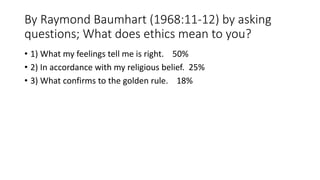
By Raymond Baumhart (1968:11-12) by asking
questions; What does ethics mean to you?
• 1) What my feelings tell me is right. 50%
• 2) In accordance with my religious belief. 25%
• 3) What confirms to the golden rule. 18%
• Deepak Parekh the chairman of HDFC Ltd., postulated a one
line definition of ethics as ‘ don’t do something that you
would be ashamed of, if it becomes public’. And it’s not
difficult.
• To sum up, ethics refers to rules and principles that define
right and wrong conduct. It is the science of morals, moral
principles, and recognized rules of human conduct. In other
words, ethics is doing things in a truthful, righteous, fair and
just manner.
• Swami Vivekananda said, “ Eternal principle of truth is
ethics”.
• “Corporate should work like a honey bee, which takes the
nectar of a flower without the flower losing it’s shape and
fragrance and provides honey for the well-being of the
society”. -Rig veda
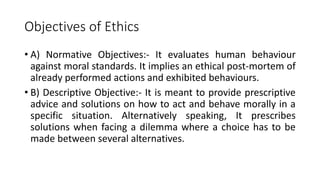
Objectives of Ethics
• A) Normative Objectives:- It evaluates human behaviour
against moral standards. It implies an ethical post-mortem of
already performed actions and exhibited behaviours.
• B) Descriptive Objective:- It is meant to provide prescriptive
advice and solutions on how to act and behave morally in a
specific situation. Alternatively speaking, It prescribes
solutions when facing a dilemma where a choice has to be
made between several alternatives.
Branches Of Ethics
Normative ethics:- It deals with how individuals can decide the correct
moral action that they should take in a given situation of ethical nature.
Meta ethics- This branch of ethics seeks to understand the nature of
ethical properties and judgements such as if true values can be found
and the theory behind moral principles.
Applied ethics- This is the study of applying ethical theories developed
by various philosophers in our everyday life.
Moral ethics- This branch of ethics raises questions like: how people
develop their morality? Why certain aspects of morality differ across
cultures?
• Descriptive ethics- This branch of ethics focusses on application
aspect of ethics. This deals with how people actually conduct in the
real world.
• Ethics and Morality:-
• Ethics means character, and morality means behaviour or conduct.
• Thus ethics is internal, morality is external.
Moral Standards
While defining ethics, we have already mentioned that ethics is the
study of morality, that is, moral judgements about what is right or
wrong and good or bad.
It is noticed that, people all times do not behave as per moral norms
and standards instead, as demonstrated by Vandivier’s case, people
sometimes choose non-moral standards over the moral standards.
One single fact and Different Moral
Judgements
The same fact Moral Standard Moral Judgement
This mushroom is poisonous
I want to stay in good health
I want to attempt suicide
I want to punish my girlfriend
I donot eat this mushroom.
I do eat this mushroom
I put this mushroom in her soup
Characteristics of Moral Standards
1) Generally moral standards deal with matters that we think of
serious consequences for human wellbeing. People for example,
the Indians feel that the matters like rape, murder, stealing, child
abuse, fraud and theft cause serious injuries to the wellbeing of
society. Hence, people hold moral standards against such matters
and condemn these.
It is important to note that our moral standards do not only concern
human wellbeing. In fact, these cover to the wellbeing of other living
beings also and even the mother nature.
• 2) Moral standards cannot simply be established or changed by the
law or authority. Moral standards rests on justifications and reasons
the society feels these good for human wellbeing.
• 3) Moral standards override self-interest:- This means that self-
interest comes after morality.
• 4) Moral standards are based on impartial considerations- Moral
standards are not established to benefit particular members of a
community. Instead these are based on the moral point of view of
ensuring everyone’s interest.
• 5) Moral standards are associated with special moral vocabulary-
When other people act against the moral standards we accept, an
emotion of dissent and condemnation arises in us. In such a case we
feel resentment, disgust. We use vocabulary like ‘ violation of moral
norms’, ‘dishonouring moral obligations’.
In his book ‘Morality’ the great philosopher
Bernard provides a list of ten moral rules.
• A) Don’t kill
• B) Don’t disable
• C) Don’t deprive of pleasure
• D) Keep your promise
• E) Obey the law.
• F) Don’t cause pain.
• G) Don’t deprive of freedom ; deceive- imposing false idea.
• H) Don’t deceive. I) Don’t cheat F) Do your duty.
• https://www.brameshtechanalysis.com/2020/04/the-honesty-
diploma/
Moral development:- Psychologist tried to get an answer to
the question, i.e. where the morality or moral standards come
from and how these change and develop in course of time
when one ages. In this regard, some hold the view that, moral
standards are absorbed during one’s childhood from family,
friends, peers, and society and do not change after that.
Psychological research shows that, just people’s physical,
emotional, and cognitive abilities develop as they mature in
age, similarly their ability to deal with moral issues also
develops and matures as they advance in age.
Kohelberg's stages of Moral development
• The Lawrence Kohelberg (1976) with his 20 years of pioneering
research in the field of morality, has shown that moral values,
standards develop in a sequential order of six identifiable stages. The
researcher grouped these six stages into three levels, each
comprising two stages.
• Level I : Pre-conventional Stages
At this level, the child responds to extremely imposed norms and rules
on him primarily to avoid the punishment.
For ex, if one asks a 6-year old student, whether stealing others
notebook is wrong, the student will reply ‘yes’. If the student is asked
‘Why’ it is wrong; the answer from student will be ‘ my class teacher
punish me’. The reason is that, at this level, the child has not yet
acquired the analytical ability and, therefore, child sees things from his
self-interest only.
In other words, the primary motivation of the child’s behaviour at this
level is self-centred.
• The pre-conventional level comprises following stages:-
1. Punishment and Obedience Orientation- At this stage, the physical
consequences of an act become the only basis to judge an action as
right or wrong. The child responds to the action primarily to avoid
punishment. The child has either no or little awareness of others needs
and desires like his/her own.
2. Instrument and Relativity Orientation:- At this stage, the child
becomes aware that others who care for him also have needs and
desires similar to his/her own. The child, therefore, considers those
actions good and right that can satisfy his/her and others desires and
needs.
• Level II: Conventional Stages
At this level, also called ‘ adolescent level’ one now becomes able to
see situations from others point of view also, of course, only with a
perspective of view point of his/her familiar groups he/she belongs
such as family, friends, peers, community, and nation.
If an adolescent at this stage is asked why something is wrong or why it
is right. The answer will be something like: ‘ What my family has taught
me’, ‘ what my community thinks’, ‘ what we Indians believe’, or the
‘what the law of land says’, this level of moral development is
characterized by the following stages.
3. Interpersonal Concordance Orientation:- At this early conventional
level of moral development, one exhibits good behaviour to satisfy
those for whom one feels loyalty, affection, and trust such as one’s own
family and friends.
• 4. Law and Order orientation:- This is the more mature stage of
conventional level at which one starts to care for his/her surroundings
society and even nation at large.
• Level III: Post conventional stages:-
• At this level, the person no longer follows the norms and rules framed
for him by family and society. Based on one’s own moral standards,
he/she starts questioning, examining and characterized the existing
rules and norms of the society from an impartial points of view
considering everyone’s interest into account. He may answer in terms
of ‘ justice ‘ ‘overall social good’, or ‘human right’.
• This level comprises the following two stages of autonomy and ethical
principles.
• 5. Social Contract Orientation- Knowing that people hold a variety of
personal beliefs and opinions, the person uses fair and transparent
ways so as to arrive at some consensus by agreement and due
process.
• 6. Universal ethical principles Orientation- At this final post-
conventional stage, the person with his/her logical
comprehensiveness defines and decides the moral principles to be
adopted.
• Research on stages of Moral development : -
• 1. People proceed in their moral development through the six stages
in lockstep fashion. People, gradually move up the next level.
• 2. There is no guarantee that one’s moral development will culminate
till the last stage.
• 3. The majority of adult are at stage 4 in their moral development.
According to Kohelberg the moral reasoning of the people at the later
stage of moral development at the later stage are better than the
reasoning of those at earlier stages. This is ascribed to two reasons.
1) People at the later stage i.e i.e elder people acquire more and
better ability to examine the things from a wider, broader, and
deeper perspective than the people at earlier stages i.e younger
people.
2) Experienced people resting at the later stages of moral
development have better way of justifying their decisions and
actions than those are younger sticking at the earlier stages.
(Morality of people develops as they advance in age).
Carol Gilligan’s Theory
• The author claims that there are 2 different approaches to study the
morality of human beings. Male approach and female approach.
• She opines that male approach is inclined to deal with moral issues in
terms of impersonal, impartial, and abstract moral guidelines which
Kohelberg followed in his theory. But, the Gilligan claims that the
female approach looks at moral issues from a different perspective.
• According to her, female see themselves as a part of ‘web’ of
relationships with family and friends. Therefore, while dealing with
moral values, their approach in dealing with moral issues becomes
‘caring’, and ‘being-responsible’ for others so as to sustain the
relationships with whom one is related.
• Moral Reasoning:-
• In simple words, moral reasoning means making moral judgements or
decisions as good or bad after having duly reasoned the things.
• Moral standards Factual information Moral Judgement

Chapter-1-Introduction to Ethics.pptx

  • 1.
    Chapter-I: Introduction to Ethics Theterm ‘ethics’ has been coined from the Greek word ‘Ethikos’ which means character. Thus, when applied to business, this means business with character.
  • 2.
    • There isan another word ‘morality’ considered as synonym of ethics. The word morality has been derived from the Latin language ‘moralis’ which means behaviour. Alternatively speaking, while character is relatively internal, behaviour is relatively external and character is externalized via behaviour. • Ethics is a branch of philosophy. According to dictionary, ethics means ‘the science of morals in human conduct. (Thompson 1996;463). One of the meanings to given to it by another dictionary is: ‘ the principles of conduct governing an individual or a group (Webster 1986:780)”.
  • 3.
    What does ethicsmean to you?
  • 4.
    MBA First semesterstudents gave following answers: • Morality 11 37% • Conscience 09 30% • Honesty 06 20% • Integrity 02 06% • Responsibility 02 07% • Total = 30 100%
  • 5.
    By Raymond Baumhart(1968:11-12) by asking questions; What does ethics mean to you? • 1) What my feelings tell me is right. 50% • 2) In accordance with my religious belief. 25% • 3) What confirms to the golden rule. 18%
  • 6.
    • Deepak Parekhthe chairman of HDFC Ltd., postulated a one line definition of ethics as ‘ don’t do something that you would be ashamed of, if it becomes public’. And it’s not difficult. • To sum up, ethics refers to rules and principles that define right and wrong conduct. It is the science of morals, moral principles, and recognized rules of human conduct. In other words, ethics is doing things in a truthful, righteous, fair and just manner. • Swami Vivekananda said, “ Eternal principle of truth is ethics”.
  • 7.
    • “Corporate shouldwork like a honey bee, which takes the nectar of a flower without the flower losing it’s shape and fragrance and provides honey for the well-being of the society”. -Rig veda
  • 8.
    Objectives of Ethics •A) Normative Objectives:- It evaluates human behaviour against moral standards. It implies an ethical post-mortem of already performed actions and exhibited behaviours. • B) Descriptive Objective:- It is meant to provide prescriptive advice and solutions on how to act and behave morally in a specific situation. Alternatively speaking, It prescribes solutions when facing a dilemma where a choice has to be made between several alternatives.
  • 9.
    Branches Of Ethics Normativeethics:- It deals with how individuals can decide the correct moral action that they should take in a given situation of ethical nature. Meta ethics- This branch of ethics seeks to understand the nature of ethical properties and judgements such as if true values can be found and the theory behind moral principles. Applied ethics- This is the study of applying ethical theories developed by various philosophers in our everyday life. Moral ethics- This branch of ethics raises questions like: how people develop their morality? Why certain aspects of morality differ across cultures?
  • 10.
    • Descriptive ethics-This branch of ethics focusses on application aspect of ethics. This deals with how people actually conduct in the real world. • Ethics and Morality:- • Ethics means character, and morality means behaviour or conduct. • Thus ethics is internal, morality is external.
  • 11.
    Moral Standards While definingethics, we have already mentioned that ethics is the study of morality, that is, moral judgements about what is right or wrong and good or bad. It is noticed that, people all times do not behave as per moral norms and standards instead, as demonstrated by Vandivier’s case, people sometimes choose non-moral standards over the moral standards.
  • 12.
    One single factand Different Moral Judgements The same fact Moral Standard Moral Judgement This mushroom is poisonous This mushroom is poisonous This mushroom is poisonous I want to stay in good health I want to attempt suicide I want to punish my girlfriend I donot eat this mushroom. I do eat this mushroom I put this mushroom in her soup
  • 13.
    Characteristics of MoralStandards 1) Generally moral standards deal with matters that we think of serious consequences for human wellbeing. People for example, the Indians feel that the matters like rape, murder, stealing, child abuse, fraud and theft cause serious injuries to the wellbeing of society. Hence, people hold moral standards against such matters and condemn these. It is important to note that our moral standards do not only concern human wellbeing. In fact, these cover to the wellbeing of other living beings also and even the mother nature.
  • 14.
    • 2) Moralstandards cannot simply be established or changed by the law or authority. Moral standards rests on justifications and reasons the society feels these good for human wellbeing. • 3) Moral standards override self-interest:- This means that self- interest comes after morality. • 4) Moral standards are based on impartial considerations- Moral standards are not established to benefit particular members of a community. Instead these are based on the moral point of view of ensuring everyone’s interest. • 5) Moral standards are associated with special moral vocabulary- When other people act against the moral standards we accept, an emotion of dissent and condemnation arises in us. In such a case we feel resentment, disgust. We use vocabulary like ‘ violation of moral norms’, ‘dishonouring moral obligations’.
  • 15.
    In his book‘Morality’ the great philosopher Bernard provides a list of ten moral rules. • A) Don’t kill • B) Don’t disable • C) Don’t deprive of pleasure • D) Keep your promise • E) Obey the law. • F) Don’t cause pain. • G) Don’t deprive of freedom ; deceive- imposing false idea. • H) Don’t deceive. I) Don’t cheat F) Do your duty. • https://www.brameshtechanalysis.com/2020/04/the-honesty- diploma/
  • 16.
    Moral development:- Psychologisttried to get an answer to the question, i.e. where the morality or moral standards come from and how these change and develop in course of time when one ages. In this regard, some hold the view that, moral standards are absorbed during one’s childhood from family, friends, peers, and society and do not change after that. Psychological research shows that, just people’s physical, emotional, and cognitive abilities develop as they mature in age, similarly their ability to deal with moral issues also develops and matures as they advance in age.
  • 17.
    Kohelberg's stages ofMoral development • The Lawrence Kohelberg (1976) with his 20 years of pioneering research in the field of morality, has shown that moral values, standards develop in a sequential order of six identifiable stages. The researcher grouped these six stages into three levels, each comprising two stages.
  • 18.
    • Level I: Pre-conventional Stages At this level, the child responds to extremely imposed norms and rules on him primarily to avoid the punishment. For ex, if one asks a 6-year old student, whether stealing others notebook is wrong, the student will reply ‘yes’. If the student is asked ‘Why’ it is wrong; the answer from student will be ‘ my class teacher punish me’. The reason is that, at this level, the child has not yet acquired the analytical ability and, therefore, child sees things from his self-interest only. In other words, the primary motivation of the child’s behaviour at this level is self-centred.
  • 20.
    • The pre-conventionallevel comprises following stages:- 1. Punishment and Obedience Orientation- At this stage, the physical consequences of an act become the only basis to judge an action as right or wrong. The child responds to the action primarily to avoid punishment. The child has either no or little awareness of others needs and desires like his/her own. 2. Instrument and Relativity Orientation:- At this stage, the child becomes aware that others who care for him also have needs and desires similar to his/her own. The child, therefore, considers those actions good and right that can satisfy his/her and others desires and needs.
  • 21.
    • Level II:Conventional Stages At this level, also called ‘ adolescent level’ one now becomes able to see situations from others point of view also, of course, only with a perspective of view point of his/her familiar groups he/she belongs such as family, friends, peers, community, and nation. If an adolescent at this stage is asked why something is wrong or why it is right. The answer will be something like: ‘ What my family has taught me’, ‘ what my community thinks’, ‘ what we Indians believe’, or the ‘what the law of land says’, this level of moral development is characterized by the following stages. 3. Interpersonal Concordance Orientation:- At this early conventional level of moral development, one exhibits good behaviour to satisfy those for whom one feels loyalty, affection, and trust such as one’s own family and friends.
  • 22.
    • 4. Lawand Order orientation:- This is the more mature stage of conventional level at which one starts to care for his/her surroundings society and even nation at large. • Level III: Post conventional stages:- • At this level, the person no longer follows the norms and rules framed for him by family and society. Based on one’s own moral standards, he/she starts questioning, examining and characterized the existing rules and norms of the society from an impartial points of view considering everyone’s interest into account. He may answer in terms of ‘ justice ‘ ‘overall social good’, or ‘human right’.
  • 23.
    • This levelcomprises the following two stages of autonomy and ethical principles. • 5. Social Contract Orientation- Knowing that people hold a variety of personal beliefs and opinions, the person uses fair and transparent ways so as to arrive at some consensus by agreement and due process. • 6. Universal ethical principles Orientation- At this final post- conventional stage, the person with his/her logical comprehensiveness defines and decides the moral principles to be adopted.
  • 24.
    • Research onstages of Moral development : - • 1. People proceed in their moral development through the six stages in lockstep fashion. People, gradually move up the next level. • 2. There is no guarantee that one’s moral development will culminate till the last stage. • 3. The majority of adult are at stage 4 in their moral development.
  • 25.
    According to Kohelbergthe moral reasoning of the people at the later stage of moral development at the later stage are better than the reasoning of those at earlier stages. This is ascribed to two reasons. 1) People at the later stage i.e i.e elder people acquire more and better ability to examine the things from a wider, broader, and deeper perspective than the people at earlier stages i.e younger people. 2) Experienced people resting at the later stages of moral development have better way of justifying their decisions and actions than those are younger sticking at the earlier stages. (Morality of people develops as they advance in age).
  • 26.
    Carol Gilligan’s Theory •The author claims that there are 2 different approaches to study the morality of human beings. Male approach and female approach. • She opines that male approach is inclined to deal with moral issues in terms of impersonal, impartial, and abstract moral guidelines which Kohelberg followed in his theory. But, the Gilligan claims that the female approach looks at moral issues from a different perspective. • According to her, female see themselves as a part of ‘web’ of relationships with family and friends. Therefore, while dealing with moral values, their approach in dealing with moral issues becomes ‘caring’, and ‘being-responsible’ for others so as to sustain the relationships with whom one is related.
  • 27.
    • Moral Reasoning:- •In simple words, moral reasoning means making moral judgements or decisions as good or bad after having duly reasoned the things. • Moral standards Factual information Moral Judgement