Discovering Your Potential, Learning Actively, & Living Well By: Sherfield, Montgomery, & Moody
What can college do for you?
Grow more self-sufficient and self-confident Understand more about the world in which you live Become a more involved citizen in social and political issues  Become more open-minded Understand the value of thinking, analyzing, and problem solving 6) Develop your investigative and research skills 7) Develop commanding computer and info literacy skills 8) Manage your personal resources such as time and money 9) Become more proficient of written and oral communication 10) Grow more understanding and broad-minded about different cultures 11) Become a lifelong learner 12) Enter a career field you enjoy 13) Become more financially independent
 
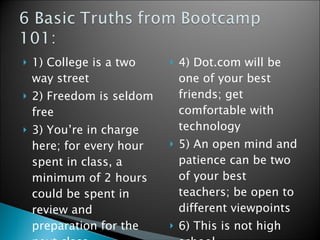
1) College is a two way street 2) Freedom is seldom free 3) You’re in charge here; for every hour spent in class, a minimum of 2 hours could be spent in review and preparation for the next class  4) Dot.com will be one of your best friends; get comfortable with technology  5) An open mind and patience can be two of your best teachers; be open to different viewpoints 6) This is not high school
Identify your greatest strengths Identify things you need to change in your life
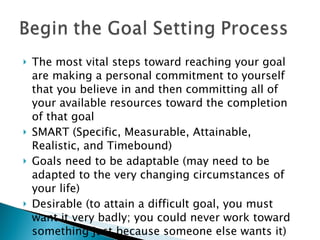
The most vital steps toward reaching your goal are making a personal commitment to yourself that you believe in and then committing all of your available resources toward the completion of that goal SMART (Specific, Measurable, Attainable, Realistic, and Timebound)  Goals need to be adaptable (may need to be adapted to the very changing circumstances of your life) Desirable (to attain a difficult goal, you must want it very badly; you could never work toward something just because someone else wants it)
1) A goal statement with a target date (SMART) 2) Action steps (specific actions) 3) A narrative statement 4) An ‘I deserve it’ statement 5) A personal signature
The narrative statement is about what your goal accomplishment will mean to you and how your life will change when you achieve this goal The “I deserve it” statement is key; many people do not follow through on their goals because deep down, they don’t feel they deserve them The “I deserver it” statement asks you to consider why you deserve this goal  Signing your goal statement shows that you are making a personal commitment When you have accomplished your goal, you will find that the feeling is somewhat addictive
Motivation can change your life! 2 types of motivation:  external and internal  What’s the difference between the two?
Point 1:  Surround yourself with positive, upbeat, happy people Point 2:  Overcome your doubts and fears; success is a great motivator but fear can be too Point 3:  Move out of your comfort zone  Point 4:  Develop a winning, optimistic attitude  Point 5:  Identify and clarify what you value in life and in yourself; most of what you do in life centers on what is truly important to you Point 6:  Take pride in your name and personal character Point 7:  Develop a strong, personal guiding statement Point 8:  Make a commitment to strengthen your self-esteem
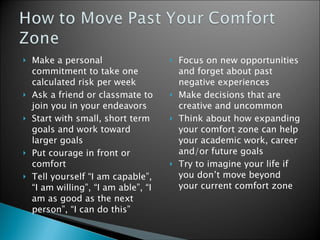
Make a personal commitment to take one calculated risk per week Ask a friend or classmate to join you in your endeavors Start with small, short term goals and work toward larger goals  Put courage in front or comfort Tell yourself “I am capable”, “I am willing”, “I am able”, “I am as good as the next person”, “I can do this” Focus on new opportunities and forget about past negative experiences Make decisions that are creative and uncommon Think about how expanding your comfort zone can help your academic work, career and/or future goals Try to imagine your life if you don’t move beyond your current comfort zone
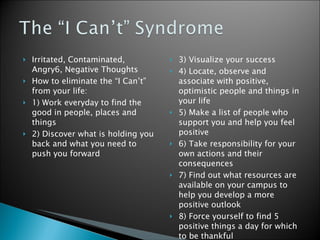
Irritated, Contaminated, Angry6, Negative Thoughts How to eliminate the “I Can’t” from your life:  1) Work everyday to find the good in people, places and things 2) Discover what is holding you back and what you need to push you forward  3) Visualize your success 4) Locate, observe and associate with positive, optimistic people and things in your life 5) Make a list of people who support you and help you feel positive 6) Take responsibility for your own actions and their consequences 7) Find out what resources are available on your campus to help you develop a more positive outlook 8) Force yourself to find 5 positive things a day for which to be thankful
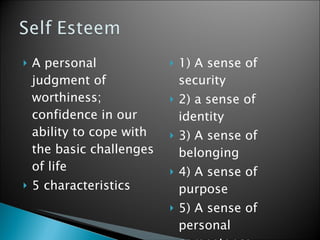
A personal judgment of worthiness; confidence in our ability to cope with the basic challenges of life  5 characteristics  1) A sense of security 2) a sense of identity 3) A sense of belonging 4) A sense of purpose 5) A sense of personal competence
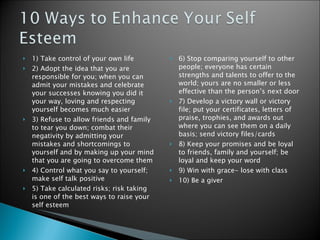
1) Take control of your own life 2) Adopt the idea that you are responsible for you; when you can admit your mistakes and celebrate your successes knowing you did it your way, loving and respecting yourself becomes much easier 3) Refuse to allow friends and family to tear you down; combat their negativity by admitting your mistakes and shortcomings to yourself and by making up your mind that you are going to overcome them  4) Control what you say to yourself; make self talk positive  5) Take calculated risks; risk taking is one of the best ways to raise your self esteem  6) Stop comparing yourself to other people; everyone has certain strengths and talents to offer to the world; yours are no smaller or less effective than the person’s next door 7) Develop a victory wall or victory file; put your certificates, letters of praise, trophies, and awards out where you can see them on a daily basis; send victory files/cards  8) Keep your promises and be loyal to friends, family and yourself; be loyal and keep your word 9) Win with grace- lose with class  10) Be a giver
 
We’ll cover Chapter 2

Chapter 1 Notes 2003

  • 1.
    Discovering Your Potential,Learning Actively, & Living Well By: Sherfield, Montgomery, & Moody
  • 2.
    What can collegedo for you?
  • 3.
    Grow more self-sufficientand self-confident Understand more about the world in which you live Become a more involved citizen in social and political issues Become more open-minded Understand the value of thinking, analyzing, and problem solving 6) Develop your investigative and research skills 7) Develop commanding computer and info literacy skills 8) Manage your personal resources such as time and money 9) Become more proficient of written and oral communication 10) Grow more understanding and broad-minded about different cultures 11) Become a lifelong learner 12) Enter a career field you enjoy 13) Become more financially independent
  • 4.
  • 5.
    1) College isa two way street 2) Freedom is seldom free 3) You’re in charge here; for every hour spent in class, a minimum of 2 hours could be spent in review and preparation for the next class 4) Dot.com will be one of your best friends; get comfortable with technology 5) An open mind and patience can be two of your best teachers; be open to different viewpoints 6) This is not high school
  • 6.
    Identify your greateststrengths Identify things you need to change in your life
  • 7.
    The most vitalsteps toward reaching your goal are making a personal commitment to yourself that you believe in and then committing all of your available resources toward the completion of that goal SMART (Specific, Measurable, Attainable, Realistic, and Timebound) Goals need to be adaptable (may need to be adapted to the very changing circumstances of your life) Desirable (to attain a difficult goal, you must want it very badly; you could never work toward something just because someone else wants it)
  • 8.
    1) A goalstatement with a target date (SMART) 2) Action steps (specific actions) 3) A narrative statement 4) An ‘I deserve it’ statement 5) A personal signature
  • 9.
    The narrative statementis about what your goal accomplishment will mean to you and how your life will change when you achieve this goal The “I deserve it” statement is key; many people do not follow through on their goals because deep down, they don’t feel they deserve them The “I deserver it” statement asks you to consider why you deserve this goal Signing your goal statement shows that you are making a personal commitment When you have accomplished your goal, you will find that the feeling is somewhat addictive
  • 10.
    Motivation can changeyour life! 2 types of motivation: external and internal What’s the difference between the two?
  • 11.
    Point 1: Surround yourself with positive, upbeat, happy people Point 2: Overcome your doubts and fears; success is a great motivator but fear can be too Point 3: Move out of your comfort zone Point 4: Develop a winning, optimistic attitude Point 5: Identify and clarify what you value in life and in yourself; most of what you do in life centers on what is truly important to you Point 6: Take pride in your name and personal character Point 7: Develop a strong, personal guiding statement Point 8: Make a commitment to strengthen your self-esteem
  • 12.
    Make a personalcommitment to take one calculated risk per week Ask a friend or classmate to join you in your endeavors Start with small, short term goals and work toward larger goals Put courage in front or comfort Tell yourself “I am capable”, “I am willing”, “I am able”, “I am as good as the next person”, “I can do this” Focus on new opportunities and forget about past negative experiences Make decisions that are creative and uncommon Think about how expanding your comfort zone can help your academic work, career and/or future goals Try to imagine your life if you don’t move beyond your current comfort zone
  • 13.
    Irritated, Contaminated, Angry6,Negative Thoughts How to eliminate the “I Can’t” from your life: 1) Work everyday to find the good in people, places and things 2) Discover what is holding you back and what you need to push you forward 3) Visualize your success 4) Locate, observe and associate with positive, optimistic people and things in your life 5) Make a list of people who support you and help you feel positive 6) Take responsibility for your own actions and their consequences 7) Find out what resources are available on your campus to help you develop a more positive outlook 8) Force yourself to find 5 positive things a day for which to be thankful
  • 14.
    A personal judgmentof worthiness; confidence in our ability to cope with the basic challenges of life 5 characteristics 1) A sense of security 2) a sense of identity 3) A sense of belonging 4) A sense of purpose 5) A sense of personal competence
  • 15.
    1) Take controlof your own life 2) Adopt the idea that you are responsible for you; when you can admit your mistakes and celebrate your successes knowing you did it your way, loving and respecting yourself becomes much easier 3) Refuse to allow friends and family to tear you down; combat their negativity by admitting your mistakes and shortcomings to yourself and by making up your mind that you are going to overcome them 4) Control what you say to yourself; make self talk positive 5) Take calculated risks; risk taking is one of the best ways to raise your self esteem 6) Stop comparing yourself to other people; everyone has certain strengths and talents to offer to the world; yours are no smaller or less effective than the person’s next door 7) Develop a victory wall or victory file; put your certificates, letters of praise, trophies, and awards out where you can see them on a daily basis; send victory files/cards 8) Keep your promises and be loyal to friends, family and yourself; be loyal and keep your word 9) Win with grace- lose with class 10) Be a giver
  • 16.
  • 17.