PD 102- Chapter 2Persist
What You Need to Know UP FrontSelf management is about investigating and researching ways to be successful at your college from this day forwardThe policies and procedures of colleges vary but it is your responsibility to know what you can expect from your institution and what your institution expects from you; these policies can be found in the college catalog The college professor is charged with much more than classroom instruction (required to do research, write articles and books, attend academic conferences, advise students, and keep current in their ever changing fields of study) Professors are granted something called academic freedom
What You Need to Know UP Front Professors are granted something called academic freedom Academic freedom means that a professor has the right to teach controversial issues, topics, subjects, pieces of literature, scientific theories, religious tenets, and political points of view without the threat of terminationThe grade given by a professor is seldom changeableIf you are truly concerned about your grade, speak to the professorLearn how to accept criticism
What to do when a professor doesn’t speak English well: 1) Sit near the front of the room2) Watch the professor’s mouth when you can3) Follow the professor’s non-verbal communication patterns 4) Use a tape recorder if allowed5) Read the material beforehand so that you will have a general understanding of what is being discussed6) Ask questions when you do not understand the material What to do when a professor Doesn’t speak English well:
Classroom Etiquette & Personal Decorum Bring your materials to class dailyCome preparedTurn in papers, projects and assignments on timeParticipate in classVisit professors during office hoursIf you are late for class, enter quietly; don’t walk in front of the professor; don’t let the door slam; don’t talk on your way in; take the seat nearest the door; make every effort not to be late to class
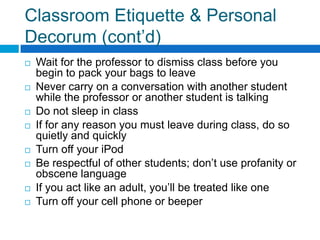
Classroom Etiquette & Personal Decorum (cont’d) Wait for the professor to dismiss class before you begin to pack your bags to leave Never carry on a conversation with another student while the professor or another student is talkingDo not sleep in classIf for any reason you must leave during class, do so quietly and quickly Turn off your iPodBe respectful of other students; don’t use profanity or obscene languageIf you act like an adult, you’ll be treated like oneTurn off your cell phone or beeper
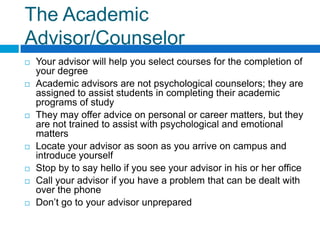
The Academic Advisor/Counselor Your advisor will help you select courses for the completion of your degreeAcademic advisors are not psychological counselors; they are assigned to assist students in completing their academic programs of studyThey may offer advice on personal or career matters, but they are not trained to assist with psychological and emotional mattersLocate your advisor as soon as you arrive on campus and introduce yourselfStop by to say hello if you see your advisor in his or her officeCall your advisor if you have a problem that can be dealt with over the phoneDon’t go to your advisor unprepared
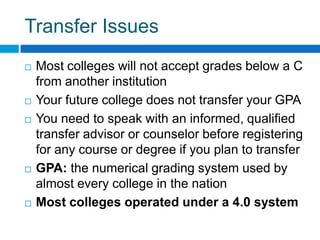
Transfer IssuesMost colleges will not accept grades below a C from another institutionYour future college does not transfer your GPAYou need to speak with an informed, qualified transfer advisor or counselor before registering for any course or degree if you plan to transferGPA: the numerical grading system used by almost every college in the nationMost colleges operated under a 4.0 system
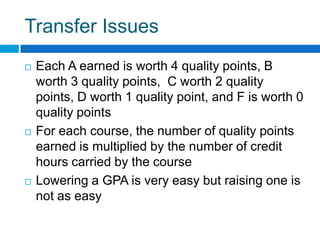
Transfer IssuesEach A earned is worth 4 quality points, B worth 3 quality points,  C worth 2 quality points, D worth 1 quality point, and F is worth 0 quality points For each course, the number of quality points earned is multiplied by the number of credit hours carried by the courseLowering a GPA is very easy but raising one is not as easy
Online ClassesMost online classes allow you to work at your own pace, but most still have stringent deadlines for submitting assignments Distance-learning courses are usually more difficult for the average studentYou need to be a self-starter and highly motivated to complete and do well in these courses
Online Classes (cont’d)When taking an online class, review the course material before you register (helps you make the decision whether to take it online or not), begin before the material, make an appointment to meet the professor as soon as possible, develop a schedule for completing each assignment and stick to it, keep a copy of all work mailed, emailed or delivered to the professor, always mail, email or deliver your assignment on time, try to find someone who is registered for the same course so that you can work together or at least have a phone number to call if you run into a problem, take full advantage of any online orientation or training session, participate in class and in your groups, log in every day even if you do not have an assignment due, if you have computer failure, have a backup plan, work ahead if possible, find out where to go or whom to call on campus should you encounter technical problems
Protecting Yourself On Campus Walk in groups at night or in poorly lit placesDon’t bring valuables to campusProtect your belongings by taking out a renter’s insurance policyWhen walking around campus, walk confidently and not like a victimLock your doorsPark in well-lit areas close to buildingsNever carry a lot of money with youNever leave your book bag unattended
Practicing Fiscal Fitness Are you managing your money or is it managing you?
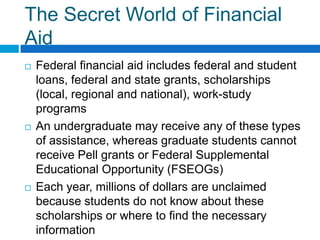
The Secret World of Financial AidFederal financial aid includes federal and student loans, federal and state grants, scholarships (local, regional and national), work-study programsAn undergraduate may receive any of these types of assistance, whereas graduate students cannot receive Pell grants or Federal Supplemental Educational Opportunity (FSEOGs)Each year, millions of dollars are unclaimed because students do not know about these scholarships or where to find the necessary information
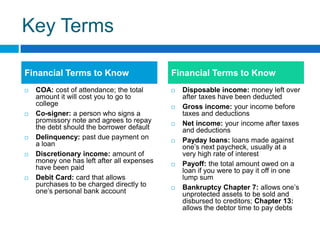
Key TermsCOA: cost of attendance; the total amount it will cost you to go to collegeCo-signer: a person who signs a promissory note and agrees to repay the debt should the borrower defaultDelinquency: past due payment on a loanDiscretionary income: amount of money one has left after all expenses have been paid Debit Card: card that allows purchases to be charged directly to one’s personal bank account Disposable income: money left over after taxes have been deductedGross income: your income before taxes and deductionsNet income: your income after taxes and deductionsPayday loans: loans made against one’s next paycheck, usually at a very high rate of interestPayoff: the total amount owed on a loan if you were to pay it off in one lump sumBankruptcy Chapter 7: allows one’s unprotected assets to be sold and disbursed to creditors; Chapter 13: allows the debtor time to pay debtsFinancial Terms to Know Financial Terms to Know
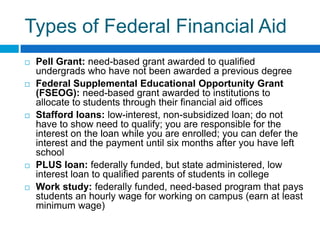
Types of Federal Financial Aid Pell Grant: need-based grant awarded to qualified undergrads who have not been awarded a previous degreeFederal Supplemental Educational Opportunity Grant (FSEOG): need-based grant awarded to institutions to allocate to students through their financial aid officesStafford loans: low-interest, non-subsidized loan; do not have to show need to qualify; you are responsible for the interest on the loan while you are enrolled; you can defer the interest and the payment until six months after you have left schoolPLUS loan: federally funded, but state administered, low interest loan to qualified parents of students in collegeWork study: federally funded, need-based program that pays students an hourly wage for working on campus (earn at least minimum wage)
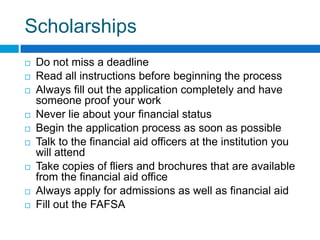
Scholarships Do not miss a deadlineRead all instructions before beginning the processAlways fill out the application completely and have someone proof your workNever lie about your financial statusBegin the application process as soon as possibleTalk to the financial aid officers at the institution you will attendTake copies of fliers and brochures that are available from the financial aid officeAlways apply for admissions as well as financial aidFill out the FAFSA
Student Loans Borrow no more than you absolutely mustTry not to borrow anything but tuition and room and boardGet a job, budget, cut out extras, work in the summers, take fewer credits even though it delays graduation- do everything possible not to borrow more money than you mustIf you have to borrow a great deal of money, ask yourself a few important questions: 1) Am I majoring in a field that is going to pay me enough money to repay these loans and live a desirable lifestyle? 2) Will I ever be able to afford a house? 3) Can I afford to get married and have a family? You will have to repay this money
Prioritizing Your FinancesBorrow no more money than you absolutely have to Keep credit card debt to an absolute minimumYour credit score is the single most important factor in determining your approval for a mortgage, car loan, credit card, insurance and so onTo fully maximize your financial resources, you need to establish a budget and learn to live within your means
B is for Budgeting One of the main reasons to budget is to determine the exact amount of money you need to borrow to finance your college educationPoor planning while in college can easily result in a lower standard of life after you graduate and have to begin paying back enormous loansDeciding how much to borrow will impact your life long after you have completed your degree
Facts About Credit Cards Credit cards are nothing more than high interest loansCarry only one or two credit cards so you can manage your debt and not get in over your headWhen you accept a card, sign it right away and keep records of your credit card numbers and the phone number to contact in case they are lost or stolen; report lost or stolen cards immediately Avoid credit cards that charge an annual feeAvoid the temptation to chargeWhen you pay off a card, celebrate and don’t use that as a reason to charge againPay your credit card payment early enough to avoid late charges, which now average $29.84Call the credit card company and negotiate a better rateAsk yourself, “If I can’t pay this credit card in full this month, what is going to change next month?”
The Pitfalls of Payday Loans, Car Title Loans, and Rent-to-Own ContractsBy using rent-to-own companies, you are paying double and sometimes triple the actual cost of the itemOnly borrow money from a reputable bank or credit union Never get involved in a payday loan or car title loanNot only could you lose your car, you can ruin your credit
Protect Yourself from Identity TheftNever put any personal information in the garbage that has not been shreddedBuy an inexpensive shredder and use itIt is very difficult, if not impossible, to catch identity theftsOrder a credit report once a year to be sure you have no major problems
Next Time…We will discuss Chapters 3 and 4

PD 102 Chapter 2 Notes

  • 1.
  • 2.
    What You Needto Know UP FrontSelf management is about investigating and researching ways to be successful at your college from this day forwardThe policies and procedures of colleges vary but it is your responsibility to know what you can expect from your institution and what your institution expects from you; these policies can be found in the college catalog The college professor is charged with much more than classroom instruction (required to do research, write articles and books, attend academic conferences, advise students, and keep current in their ever changing fields of study) Professors are granted something called academic freedom
  • 3.
    What You Needto Know UP Front Professors are granted something called academic freedom Academic freedom means that a professor has the right to teach controversial issues, topics, subjects, pieces of literature, scientific theories, religious tenets, and political points of view without the threat of terminationThe grade given by a professor is seldom changeableIf you are truly concerned about your grade, speak to the professorLearn how to accept criticism
  • 4.
    What to dowhen a professor doesn’t speak English well: 1) Sit near the front of the room2) Watch the professor’s mouth when you can3) Follow the professor’s non-verbal communication patterns 4) Use a tape recorder if allowed5) Read the material beforehand so that you will have a general understanding of what is being discussed6) Ask questions when you do not understand the material What to do when a professor Doesn’t speak English well:
  • 5.
    Classroom Etiquette &Personal Decorum Bring your materials to class dailyCome preparedTurn in papers, projects and assignments on timeParticipate in classVisit professors during office hoursIf you are late for class, enter quietly; don’t walk in front of the professor; don’t let the door slam; don’t talk on your way in; take the seat nearest the door; make every effort not to be late to class
  • 6.
    Classroom Etiquette &Personal Decorum (cont’d) Wait for the professor to dismiss class before you begin to pack your bags to leave Never carry on a conversation with another student while the professor or another student is talkingDo not sleep in classIf for any reason you must leave during class, do so quietly and quickly Turn off your iPodBe respectful of other students; don’t use profanity or obscene languageIf you act like an adult, you’ll be treated like oneTurn off your cell phone or beeper
  • 7.
    The Academic Advisor/CounselorYour advisor will help you select courses for the completion of your degreeAcademic advisors are not psychological counselors; they are assigned to assist students in completing their academic programs of studyThey may offer advice on personal or career matters, but they are not trained to assist with psychological and emotional mattersLocate your advisor as soon as you arrive on campus and introduce yourselfStop by to say hello if you see your advisor in his or her officeCall your advisor if you have a problem that can be dealt with over the phoneDon’t go to your advisor unprepared
  • 8.
    Transfer IssuesMost collegeswill not accept grades below a C from another institutionYour future college does not transfer your GPAYou need to speak with an informed, qualified transfer advisor or counselor before registering for any course or degree if you plan to transferGPA: the numerical grading system used by almost every college in the nationMost colleges operated under a 4.0 system
  • 9.
    Transfer IssuesEach Aearned is worth 4 quality points, B worth 3 quality points, C worth 2 quality points, D worth 1 quality point, and F is worth 0 quality points For each course, the number of quality points earned is multiplied by the number of credit hours carried by the courseLowering a GPA is very easy but raising one is not as easy
  • 10.
    Online ClassesMost onlineclasses allow you to work at your own pace, but most still have stringent deadlines for submitting assignments Distance-learning courses are usually more difficult for the average studentYou need to be a self-starter and highly motivated to complete and do well in these courses
  • 11.
    Online Classes (cont’d)Whentaking an online class, review the course material before you register (helps you make the decision whether to take it online or not), begin before the material, make an appointment to meet the professor as soon as possible, develop a schedule for completing each assignment and stick to it, keep a copy of all work mailed, emailed or delivered to the professor, always mail, email or deliver your assignment on time, try to find someone who is registered for the same course so that you can work together or at least have a phone number to call if you run into a problem, take full advantage of any online orientation or training session, participate in class and in your groups, log in every day even if you do not have an assignment due, if you have computer failure, have a backup plan, work ahead if possible, find out where to go or whom to call on campus should you encounter technical problems
  • 12.
    Protecting Yourself OnCampus Walk in groups at night or in poorly lit placesDon’t bring valuables to campusProtect your belongings by taking out a renter’s insurance policyWhen walking around campus, walk confidently and not like a victimLock your doorsPark in well-lit areas close to buildingsNever carry a lot of money with youNever leave your book bag unattended
  • 13.
    Practicing Fiscal FitnessAre you managing your money or is it managing you?
  • 14.
    The Secret Worldof Financial AidFederal financial aid includes federal and student loans, federal and state grants, scholarships (local, regional and national), work-study programsAn undergraduate may receive any of these types of assistance, whereas graduate students cannot receive Pell grants or Federal Supplemental Educational Opportunity (FSEOGs)Each year, millions of dollars are unclaimed because students do not know about these scholarships or where to find the necessary information
  • 15.
    Key TermsCOA: costof attendance; the total amount it will cost you to go to collegeCo-signer: a person who signs a promissory note and agrees to repay the debt should the borrower defaultDelinquency: past due payment on a loanDiscretionary income: amount of money one has left after all expenses have been paid Debit Card: card that allows purchases to be charged directly to one’s personal bank account Disposable income: money left over after taxes have been deductedGross income: your income before taxes and deductionsNet income: your income after taxes and deductionsPayday loans: loans made against one’s next paycheck, usually at a very high rate of interestPayoff: the total amount owed on a loan if you were to pay it off in one lump sumBankruptcy Chapter 7: allows one’s unprotected assets to be sold and disbursed to creditors; Chapter 13: allows the debtor time to pay debtsFinancial Terms to Know Financial Terms to Know
  • 16.
    Types of FederalFinancial Aid Pell Grant: need-based grant awarded to qualified undergrads who have not been awarded a previous degreeFederal Supplemental Educational Opportunity Grant (FSEOG): need-based grant awarded to institutions to allocate to students through their financial aid officesStafford loans: low-interest, non-subsidized loan; do not have to show need to qualify; you are responsible for the interest on the loan while you are enrolled; you can defer the interest and the payment until six months after you have left schoolPLUS loan: federally funded, but state administered, low interest loan to qualified parents of students in collegeWork study: federally funded, need-based program that pays students an hourly wage for working on campus (earn at least minimum wage)
  • 17.
    Scholarships Do notmiss a deadlineRead all instructions before beginning the processAlways fill out the application completely and have someone proof your workNever lie about your financial statusBegin the application process as soon as possibleTalk to the financial aid officers at the institution you will attendTake copies of fliers and brochures that are available from the financial aid officeAlways apply for admissions as well as financial aidFill out the FAFSA
  • 18.
    Student Loans Borrowno more than you absolutely mustTry not to borrow anything but tuition and room and boardGet a job, budget, cut out extras, work in the summers, take fewer credits even though it delays graduation- do everything possible not to borrow more money than you mustIf you have to borrow a great deal of money, ask yourself a few important questions: 1) Am I majoring in a field that is going to pay me enough money to repay these loans and live a desirable lifestyle? 2) Will I ever be able to afford a house? 3) Can I afford to get married and have a family? You will have to repay this money
  • 19.
    Prioritizing Your FinancesBorrowno more money than you absolutely have to Keep credit card debt to an absolute minimumYour credit score is the single most important factor in determining your approval for a mortgage, car loan, credit card, insurance and so onTo fully maximize your financial resources, you need to establish a budget and learn to live within your means
  • 20.
    B is forBudgeting One of the main reasons to budget is to determine the exact amount of money you need to borrow to finance your college educationPoor planning while in college can easily result in a lower standard of life after you graduate and have to begin paying back enormous loansDeciding how much to borrow will impact your life long after you have completed your degree
  • 21.
    Facts About CreditCards Credit cards are nothing more than high interest loansCarry only one or two credit cards so you can manage your debt and not get in over your headWhen you accept a card, sign it right away and keep records of your credit card numbers and the phone number to contact in case they are lost or stolen; report lost or stolen cards immediately Avoid credit cards that charge an annual feeAvoid the temptation to chargeWhen you pay off a card, celebrate and don’t use that as a reason to charge againPay your credit card payment early enough to avoid late charges, which now average $29.84Call the credit card company and negotiate a better rateAsk yourself, “If I can’t pay this credit card in full this month, what is going to change next month?”
  • 22.
    The Pitfalls ofPayday Loans, Car Title Loans, and Rent-to-Own ContractsBy using rent-to-own companies, you are paying double and sometimes triple the actual cost of the itemOnly borrow money from a reputable bank or credit union Never get involved in a payday loan or car title loanNot only could you lose your car, you can ruin your credit
  • 23.
    Protect Yourself fromIdentity TheftNever put any personal information in the garbage that has not been shreddedBuy an inexpensive shredder and use itIt is very difficult, if not impossible, to catch identity theftsOrder a credit report once a year to be sure you have no major problems
  • 24.
    Next Time…We willdiscuss Chapters 3 and 4