Resumes Dos and DontsBS 150: Business Writing
DO Be Honest Include the specific months and years of your employmentJust including the years raises a red flag with hiring managersExplain your gaps in employment note; denote them as “personal sabbatical” but indicate what you did during that time
DON’T Brag State the hard facts that illustrate your success but stay away from proclaiming yourself the hottest thing since sliced bread
DO Tailor EACH Resume to the Specific Position The resume is the snapshot of what you bring to the table; the cover letter sells you for the interviewThe resume tells the recruiter or hiring manager why they should read the cover letterNo cookie cutter resumesEach resume should be tailored to the specific job you’re looking to acquire
DON’T Pad Your Resume with Meaningless Content Don’t put college/high school activities or activities that are older than 7 years old on your resumeYou want up-to-date, job-relevant experiences in your resume
Keep the Fonts SimpleUse simple fonts like Arial, Times New Roman, or GeorgiaDon’t use fancy fonts that are hard to readKeep the margins between .5” and 1.0” all the way around
DON’T Underestimate the Importance of Details No typos in your resumeBe sure to include your contact phone number, mailing address, and email addressAlways come to an interview prepared with a reference sheet
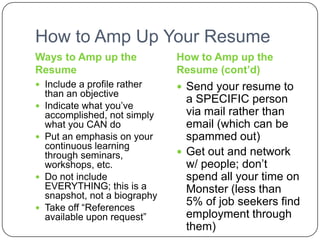
How to Amp Up Your ResumeWays to Amp up the ResumeHow to Amp up the Resume (cont’d) Include a profile rather than an objective Indicate what you’ve accomplished, not simply what you CAN do Put an emphasis on your continuous learning through seminars, workshops, etc. Do not include EVERYTHING; this is a snapshot, not a biography Take off “References available upon request” Send your resume to a SPECIFIC person via mail rather than email (which can be spammed out) Get out and network w/ people; don’t spend all your time on Monster (less than 5% of job seekers find employment through them)
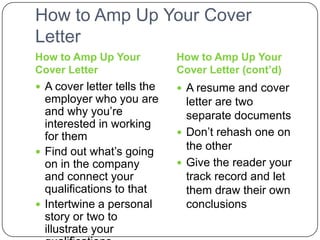
How to Amp Up Your Cover Letter How to Amp Up Your Cover LetterHow to Amp Up Your Cover Letter (cont’d)A cover letter tells the employer who you are and why you’re interested in working for themFind out what’s going on in the company and connect your qualifications to that Intertwine a personal story or two to illustrate your qualifications A resume and cover letter are two separate documentsDon’t rehash one on the other Give the reader your track record and let them draw their own conclusions

Bs 150 Resume Dos And Donts

  • 1.
    Resumes Dos andDontsBS 150: Business Writing
  • 2.
    DO Be HonestInclude the specific months and years of your employmentJust including the years raises a red flag with hiring managersExplain your gaps in employment note; denote them as “personal sabbatical” but indicate what you did during that time
  • 3.
    DON’T Brag Statethe hard facts that illustrate your success but stay away from proclaiming yourself the hottest thing since sliced bread
  • 4.
    DO Tailor EACHResume to the Specific Position The resume is the snapshot of what you bring to the table; the cover letter sells you for the interviewThe resume tells the recruiter or hiring manager why they should read the cover letterNo cookie cutter resumesEach resume should be tailored to the specific job you’re looking to acquire
  • 5.
    DON’T Pad YourResume with Meaningless Content Don’t put college/high school activities or activities that are older than 7 years old on your resumeYou want up-to-date, job-relevant experiences in your resume
  • 6.
    Keep the FontsSimpleUse simple fonts like Arial, Times New Roman, or GeorgiaDon’t use fancy fonts that are hard to readKeep the margins between .5” and 1.0” all the way around
  • 7.
    DON’T Underestimate theImportance of Details No typos in your resumeBe sure to include your contact phone number, mailing address, and email addressAlways come to an interview prepared with a reference sheet
  • 8.
    How to AmpUp Your ResumeWays to Amp up the ResumeHow to Amp up the Resume (cont’d) Include a profile rather than an objective Indicate what you’ve accomplished, not simply what you CAN do Put an emphasis on your continuous learning through seminars, workshops, etc. Do not include EVERYTHING; this is a snapshot, not a biography Take off “References available upon request” Send your resume to a SPECIFIC person via mail rather than email (which can be spammed out) Get out and network w/ people; don’t spend all your time on Monster (less than 5% of job seekers find employment through them)
  • 9.
    How to AmpUp Your Cover Letter How to Amp Up Your Cover LetterHow to Amp Up Your Cover Letter (cont’d)A cover letter tells the employer who you are and why you’re interested in working for themFind out what’s going on in the company and connect your qualifications to that Intertwine a personal story or two to illustrate your qualifications A resume and cover letter are two separate documentsDon’t rehash one on the other Give the reader your track record and let them draw their own conclusions