Social Psychology
Elliot Aronson
University of California, Santa Cruz
Timothy D. Wilson
University of Virginia
Robin M. Akert
Wellesley College
slides by Travis Langley
Henderson State University
6th edition
Chapter 4
Social Perception:
How We Come to
Understand Other People
“Things are seldom as they seem.
Skim milk masquerades as cream.”
– W. S. Gilbert
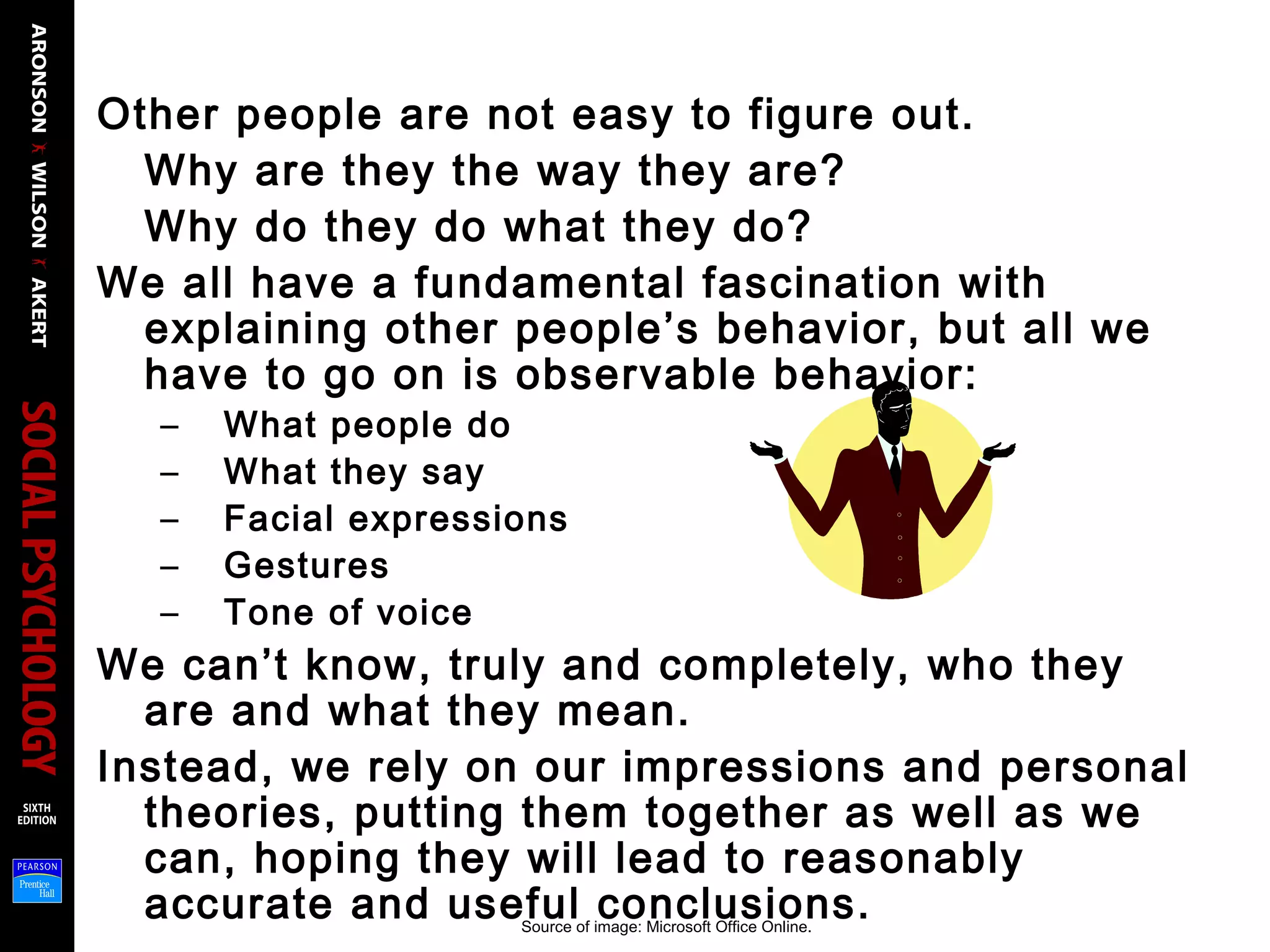
Other people are not easy to figure out.
Why are they the way they are?
Why do they do what they do?
We all have a fundamental fascination with
explaining other people’s behavior, but all we
have to go on is observable behavior:
– What people do
– What they say
– Facial expressions
– Gestures
– Tone of voice
We can’t know, truly and completely, who they
are and what they mean.
Instead, we rely on our impressions and personal
theories, putting them together as well as we
can, hoping they will lead to reasonably
accurate and useful conclusions.Source of image: Microsoft Office Online.
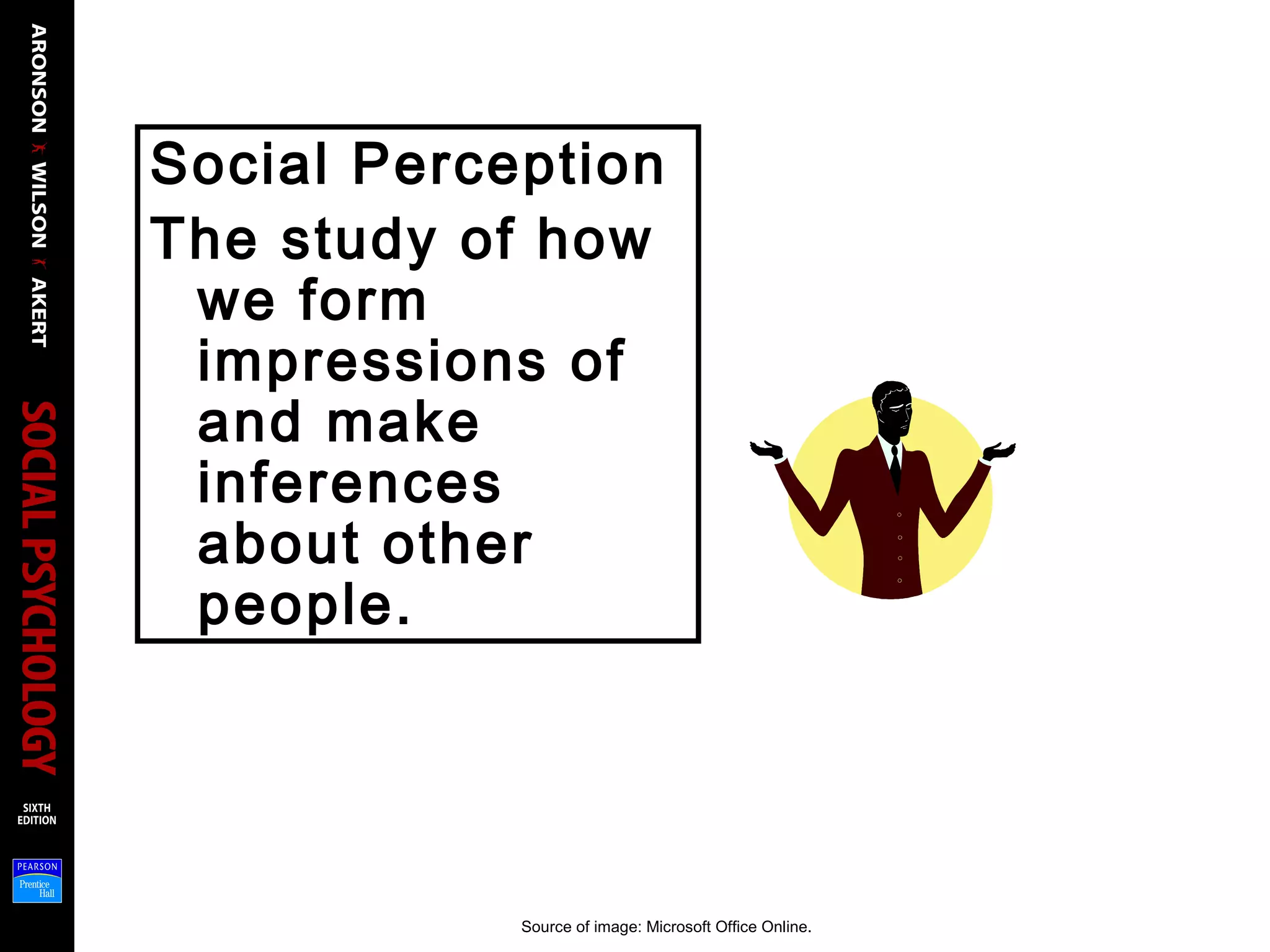
Social PerceptionSocial Perception
The study of how
we form
impressions of
and make
inferences
about other
people.
Source of image: Microsoft Office Online.
Nonverbal Behavior
• What do we know about people
when we first meet them?
• We know what we can see and
hear, and even though we know we
should not judge a book by its
cover, this kind of easily
observable information is crucial to
our first impression.
• With no words at all, we can
communicate volumes.
Source of image: Microsoft Office Online.
Nonverbal Behavior
Nonverbal Communication
The way in which people
communicate, intentionally or
unintentionally, without words.
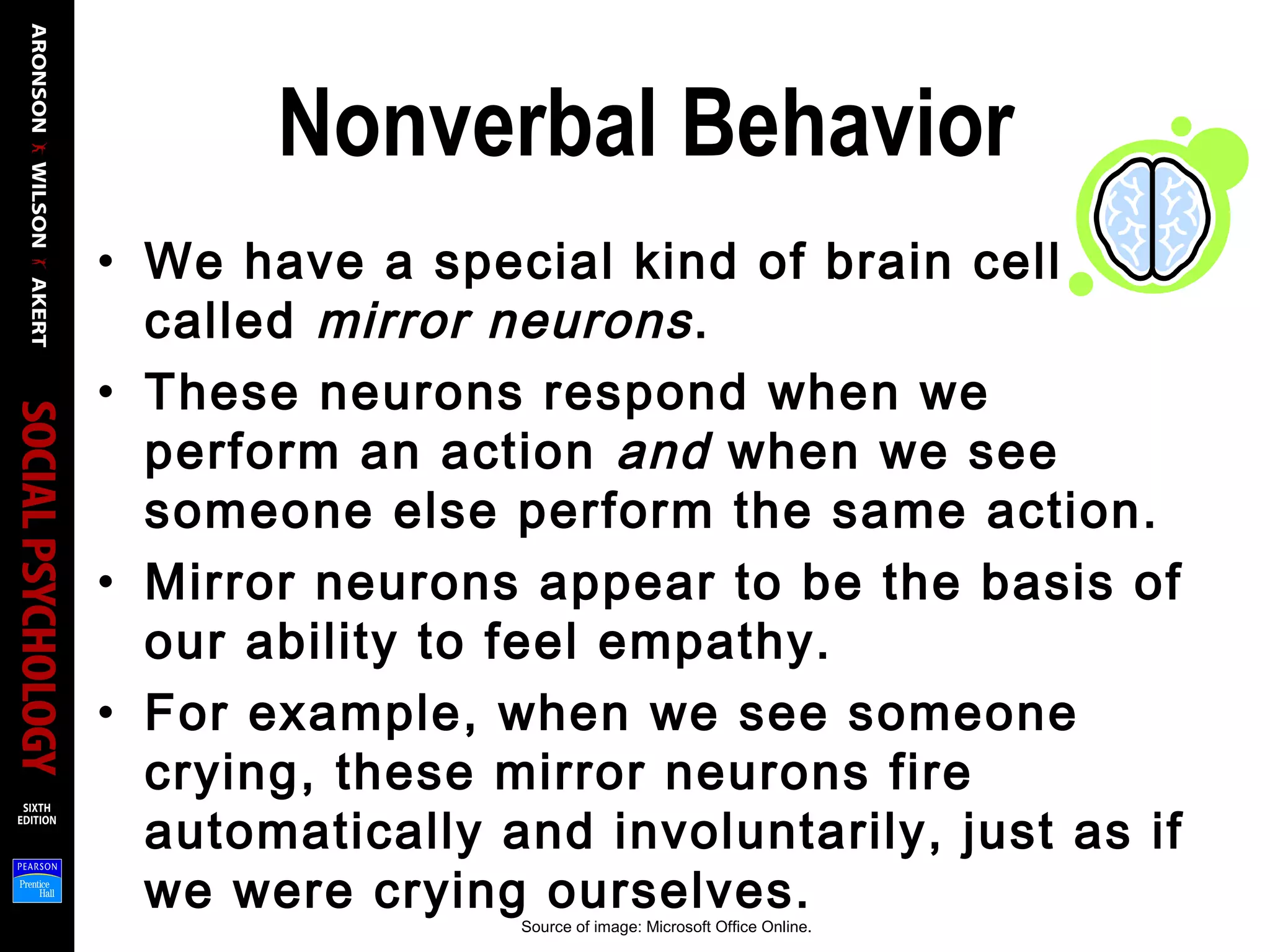
Nonverbal cues include:
• facial expressions
• tone of voice
• gestures
• body position/movement
• the use of touch
• gaze
Nonverbal Behavior
• We have a special kind of brain cell
called mirror neurons.
• These neurons respond when we
perform an action and when we see
someone else perform the same action.
• Mirror neurons appear to be the basis of
our ability to feel empathy.
• For example, when we see someone
crying, these mirror neurons fire
automatically and involuntarily, just as if
we were crying ourselves.
Source of image: Microsoft Office Online.
Nonverbal Behavior
Nonverbal cues serve many functions
in communication.
• You can express “I’m angry” by
narrowing your eyes, lowering your
eyebrows, and setting your mouth in a
thin, straight line.
• You can convey the attitude “I like you”
with smiles and extended eye contact.
• And you communicate your personality
traits, like being an extrovert, with broad
gestures and frequent changes in voice
Nonverbal Behavior
Some nonverbal cues actually
contradict the spoken words.
• Communicating sarcasm is the
classic example of verbal-
nonverbal contradiction.
• Think about how you’d say “I’m so
happy for you” sarcastically.
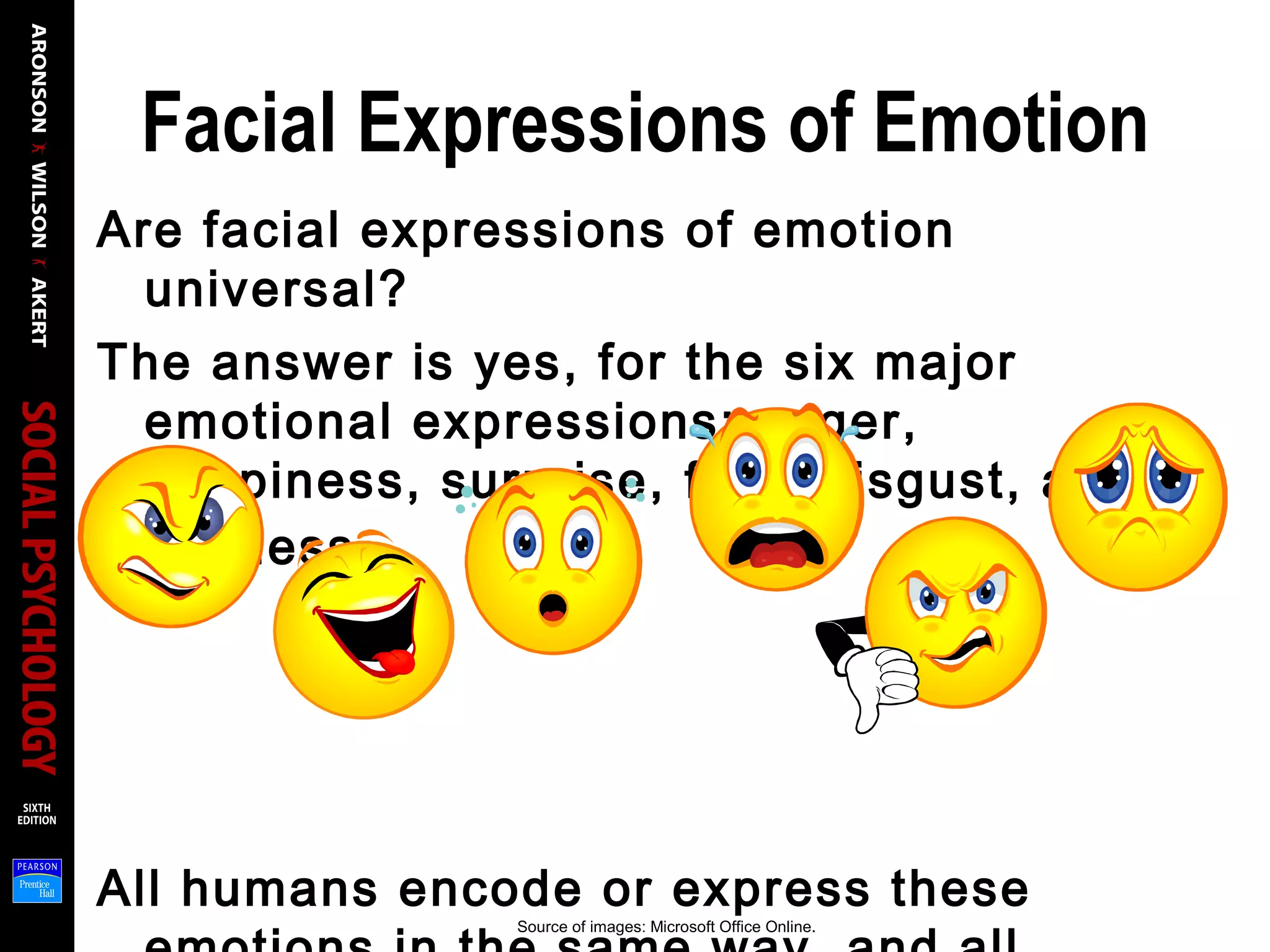
Facial Expressions of Emotion
Are facial expressions of emotion
universal?
The answer is yes, for the six major
emotional expressions: anger,
happiness, surprise, fear, disgust, and
sadness.
All humans encode or express these
Source of images: Microsoft Office Online.
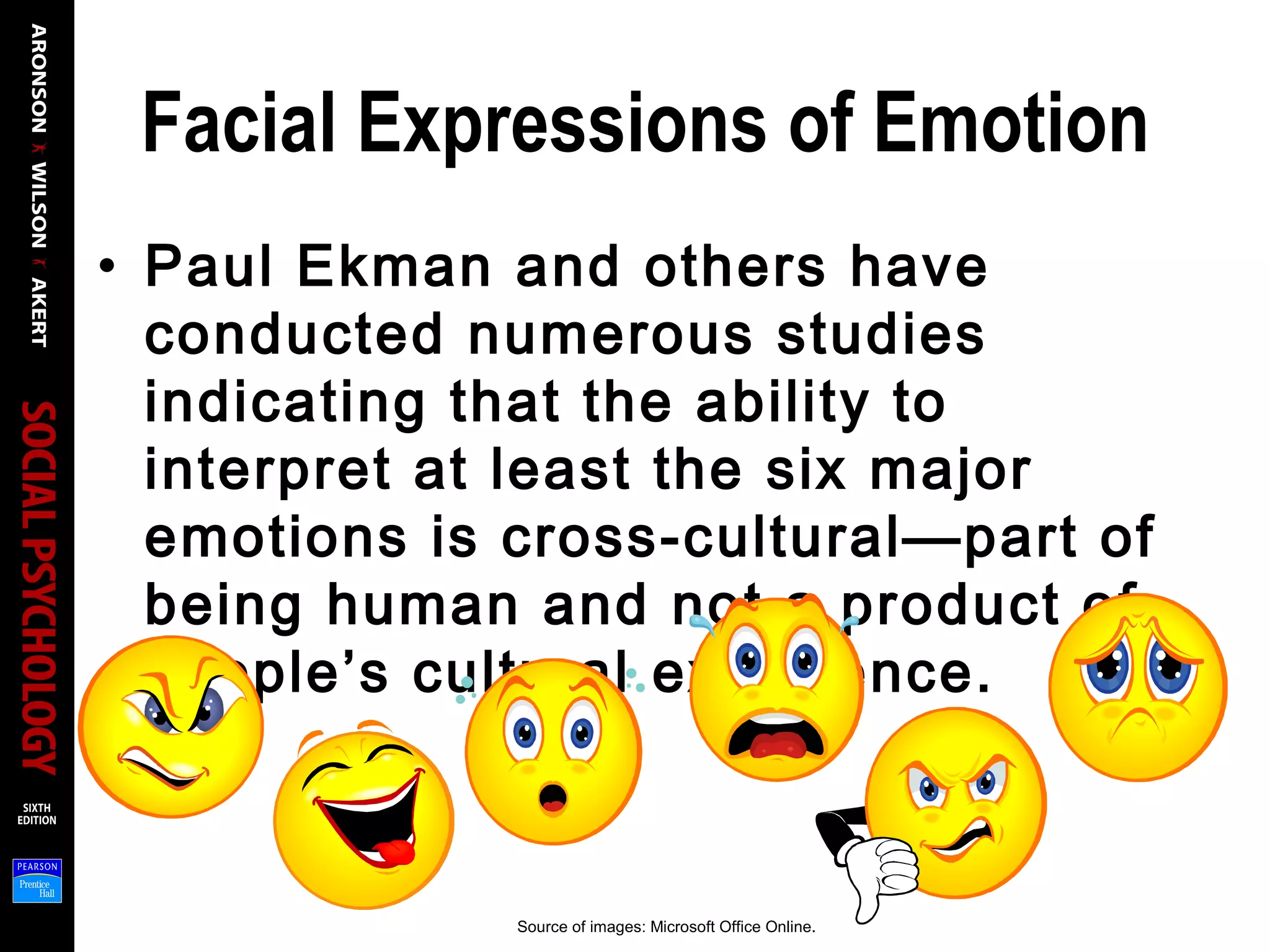
Facial Expressions of Emotion
• Paul Ekman and others have
conducted numerous studies
indicating that the ability to
interpret at least the six major
emotions is cross-cultural—part of
being human and not a product of
people’s cultural experience.
Source of images: Microsoft Office Online.
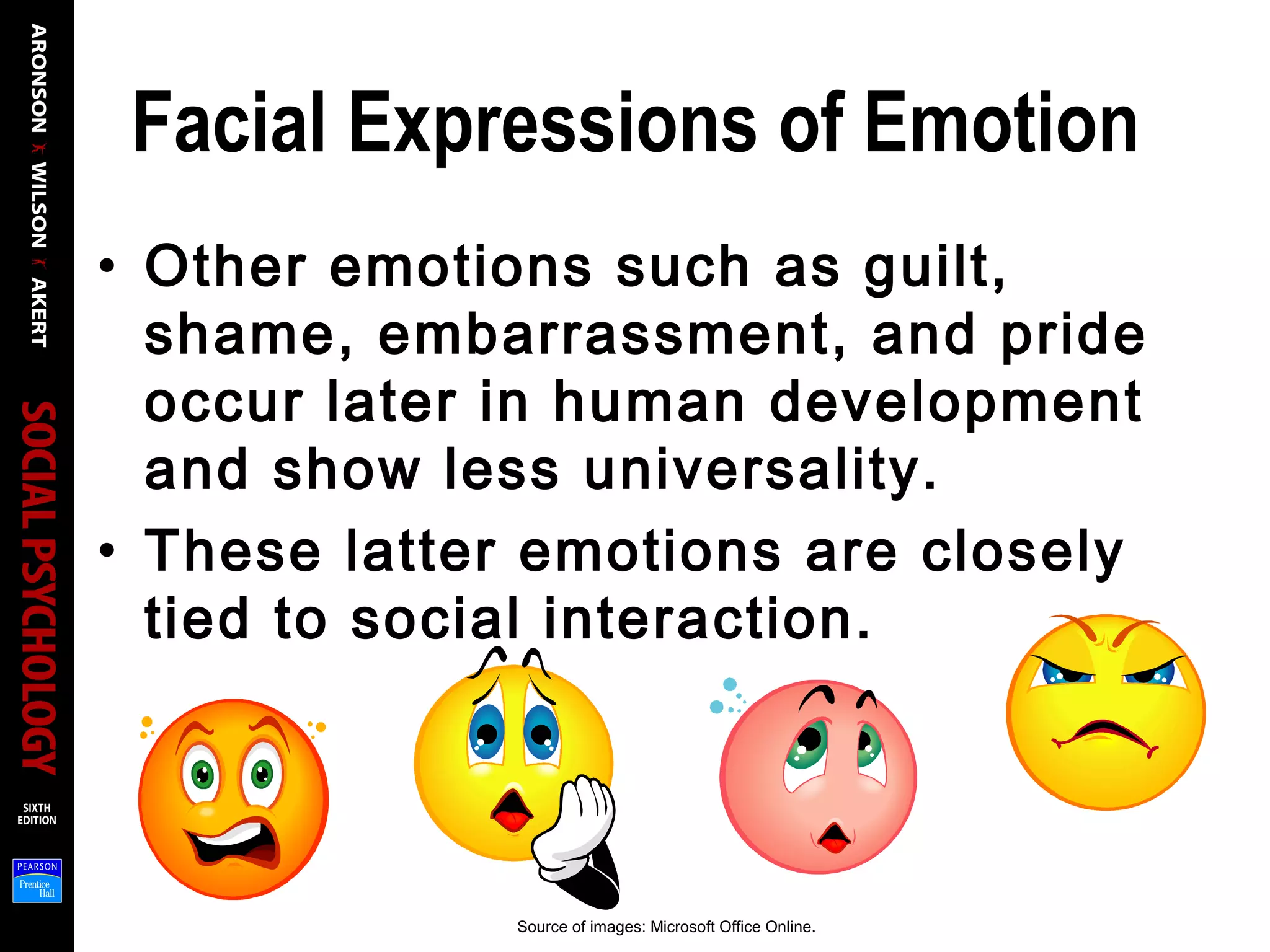
Facial Expressions of Emotion
• Other emotions such as guilt,
shame, embarrassment, and pride
occur later in human development
and show less universality.
• These latter emotions are closely
tied to social interaction.
Source of images: Microsoft Office Online.
Facial Expressions of Emotion
Decoding facial expressions accurately is more
complicated than we have indicated, for three
reasons.
1. Affect blends occur when one part of the face
registers one emotion and another part, a
different emotion.
2. At times people try to appear less emotional than
they are so that no one will know how they really
feel.
3. A third reason why decoding facial expressions
can be inaccurate has to do with culture.
Culture and the Channels of
Nonverbal Communication
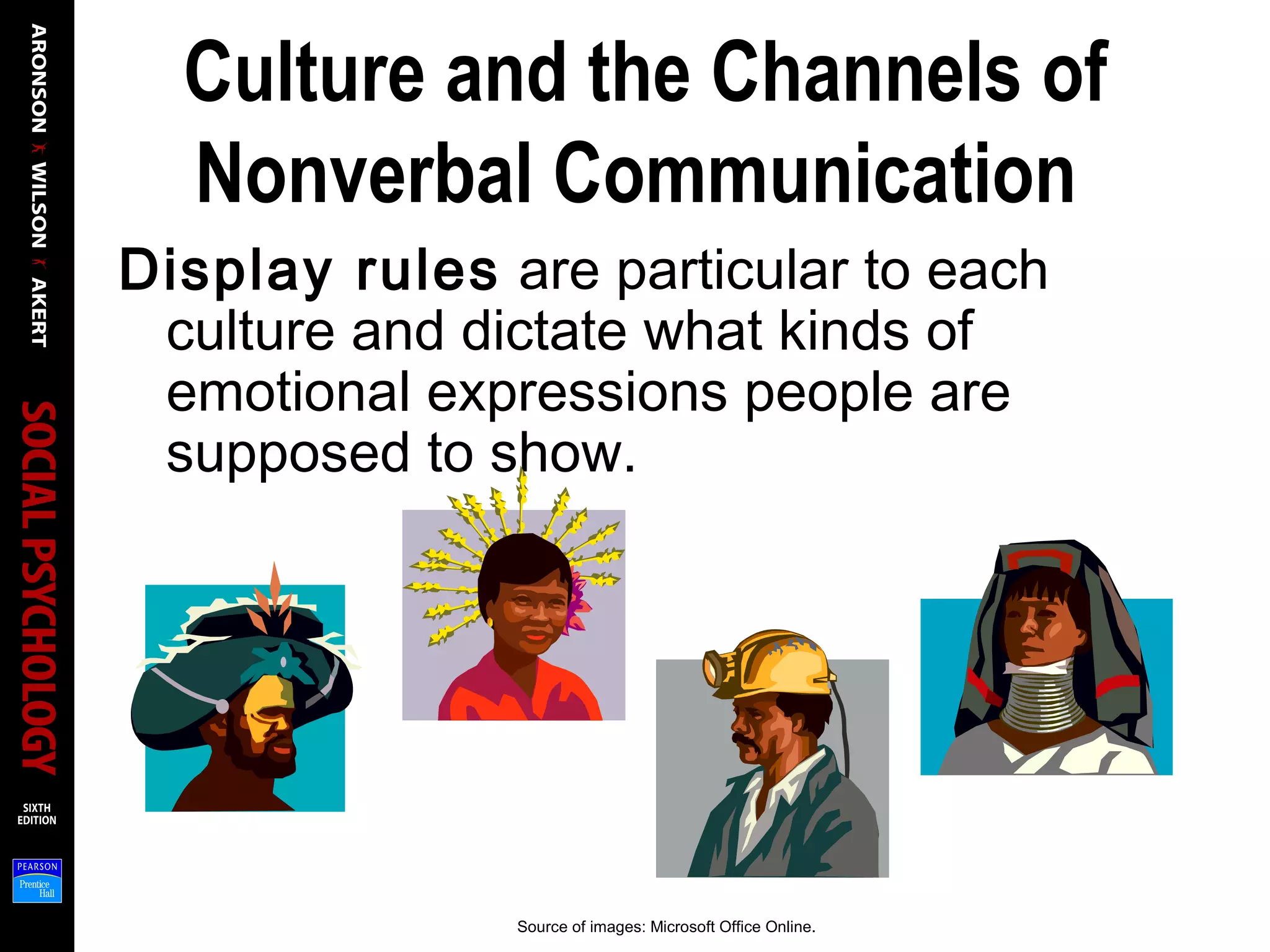
Display rules are particular to each
culture and dictate what kinds of
emotional expressions people are
supposed to show.
Source of images: Microsoft Office Online.
Culture and the Channels of
Nonverbal Communication
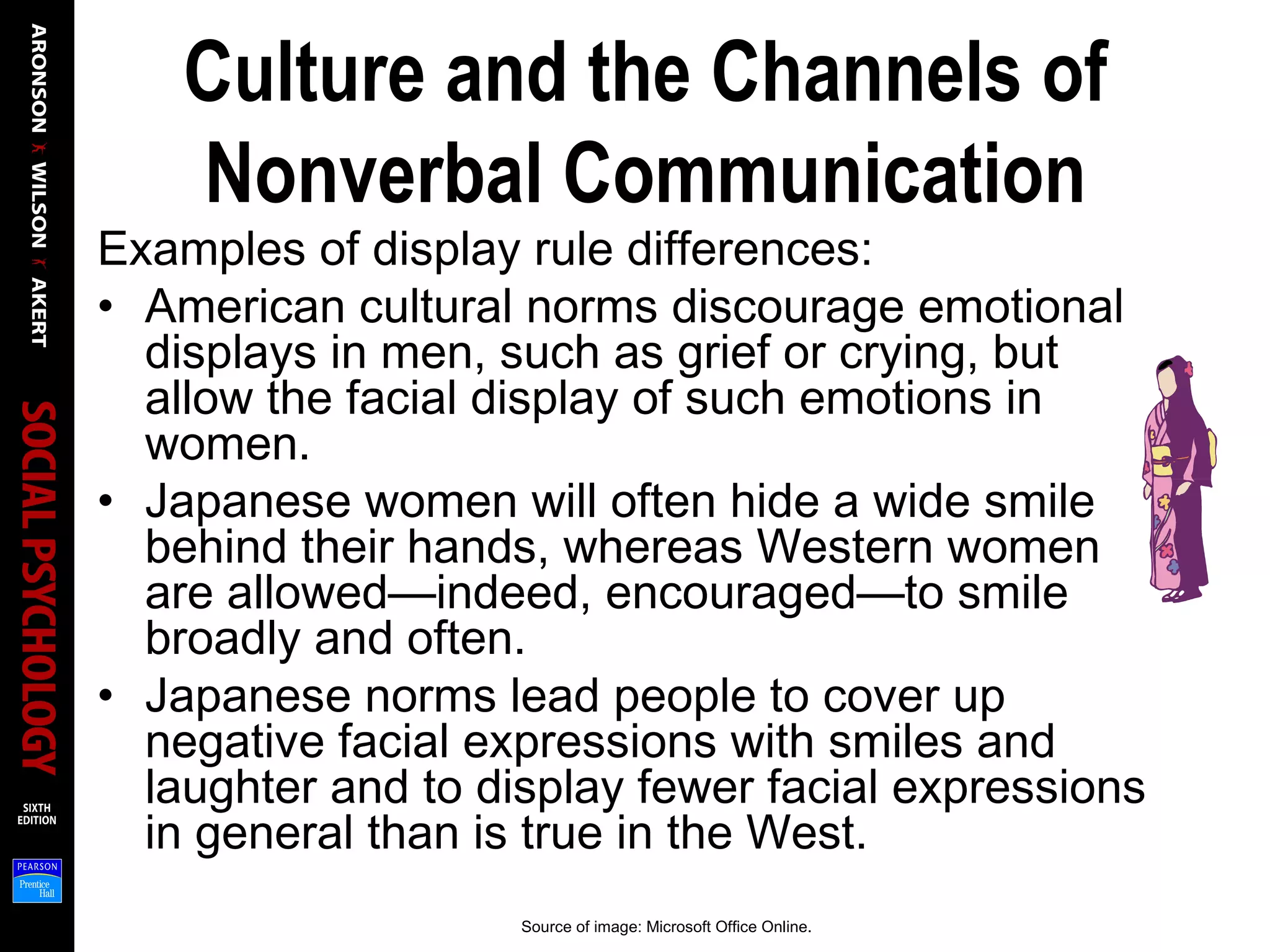
Examples of display rule differences:
• American cultural norms discourage emotional
displays in men, such as grief or crying, but
allow the facial display of such emotions in
women.
• Japanese women will often hide a wide smile
behind their hands, whereas Western women
are allowed—indeed, encouraged—to smile
broadly and often.
• Japanese norms lead people to cover up
negative facial expressions with smiles and
laughter and to display fewer facial expressions
in general than is true in the West.
Source of image: Microsoft Office Online.
Culture and the Channels of
Nonverbal Communication
• Members of American culture become suspicious
when a person doesn’t “look them in the eye” while
speaking, and they find talking to someone who is
wearing dark sunglasses quite disconcerting.
• Cultures vary greatly in what is considered
normative use of personal space. Most Americans
like to have a bubble of open space, a few feet in
radius, surrounding them; in comparison, in some
other cultures, strangers think nothing of standing
right next to each other, to the point of touching.
Culture and the Channels of
Nonverbal Communication
The important point about emblems is that they are not universal.
Each culture has devised its own emblems, and these need not
be understandable to people from other cultures.
Emblems
Nonverbal gestures that have well-understood definitions
within a given culture; they usually have direct verbal
translations, like the “OK” sign.
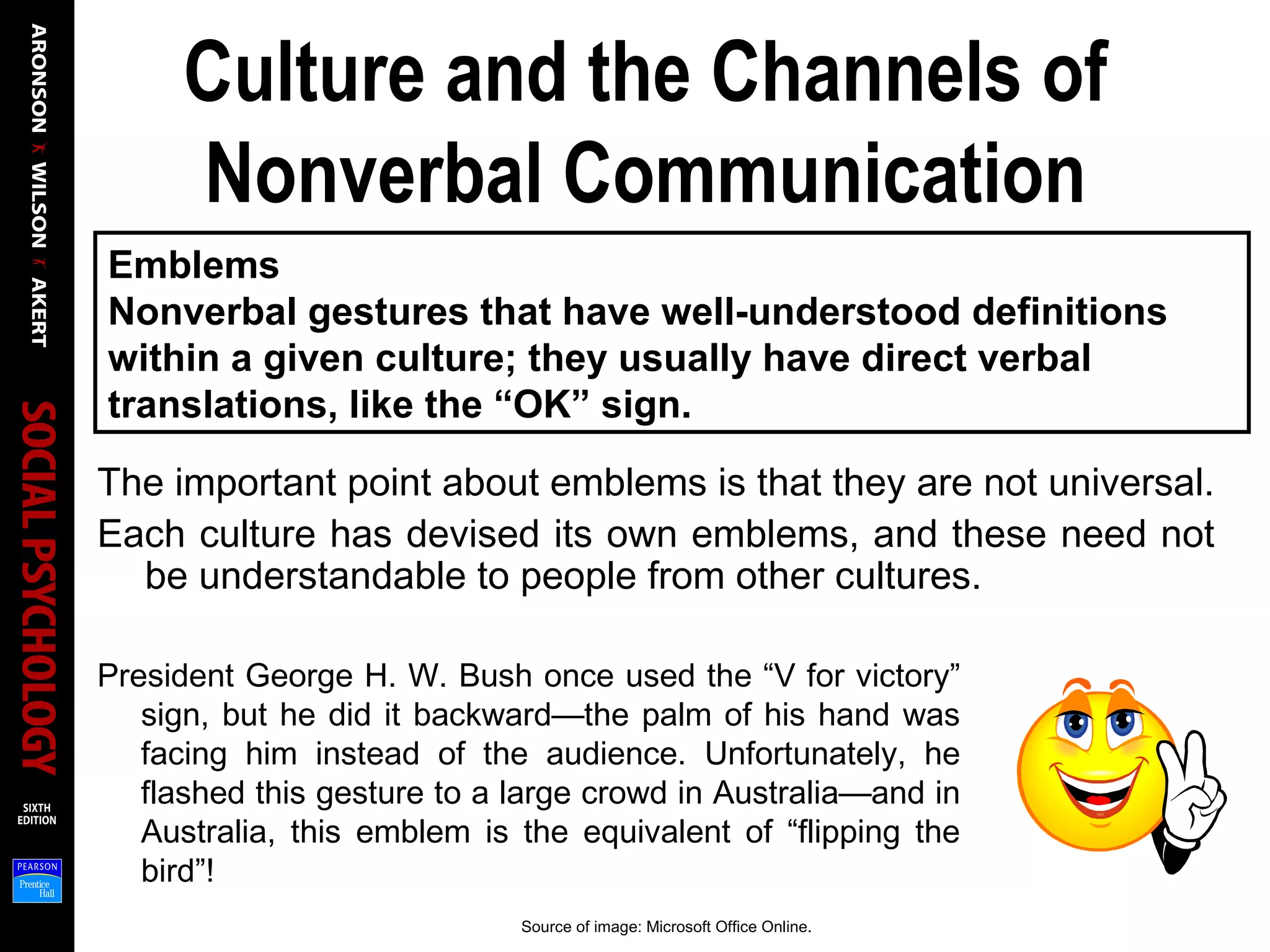
President George H. W. Bush once used the “V for victory”
sign, but he did it backward—the palm of his hand was
facing him instead of the audience. Unfortunately, he
flashed this gesture to a large crowd in Australia—and in
Australia, this emblem is the equivalent of “flipping the
bird”!
Source of image: Microsoft Office Online.
Multichannel Nonverbal
Communication
• Because nonverbal information is
diffused across these many
channels, we can often rely on one
channel to understand what is
going on.
• This increases our ability to make
accurate judgments about others.
Multichannel Nonverbal
Communication
• Except for certain specific situations,
such as talking on the telephone,
everyday life is made up of multichannel
nonverbal social interaction.
• Typically, many nonverbal cues are
available to us when we talk to or
observe other people.
• How do we use this information?
• And how accurately do we use it?
Gender and Nonverbal
Communication
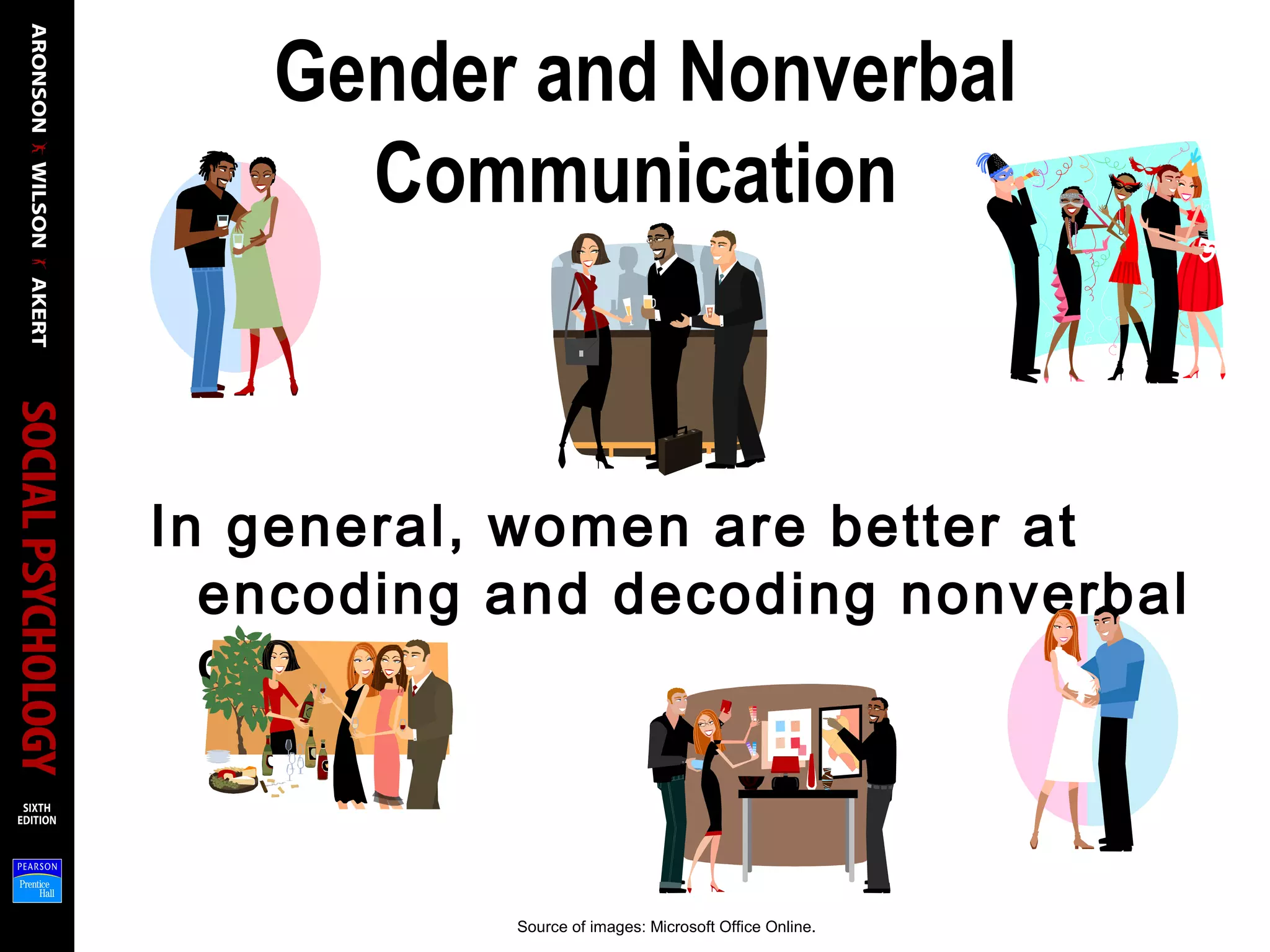
In general, women are better at
encoding and decoding nonverbal
cues.
Source of images: Microsoft Office Online.
Gender and Nonverbal
Communication
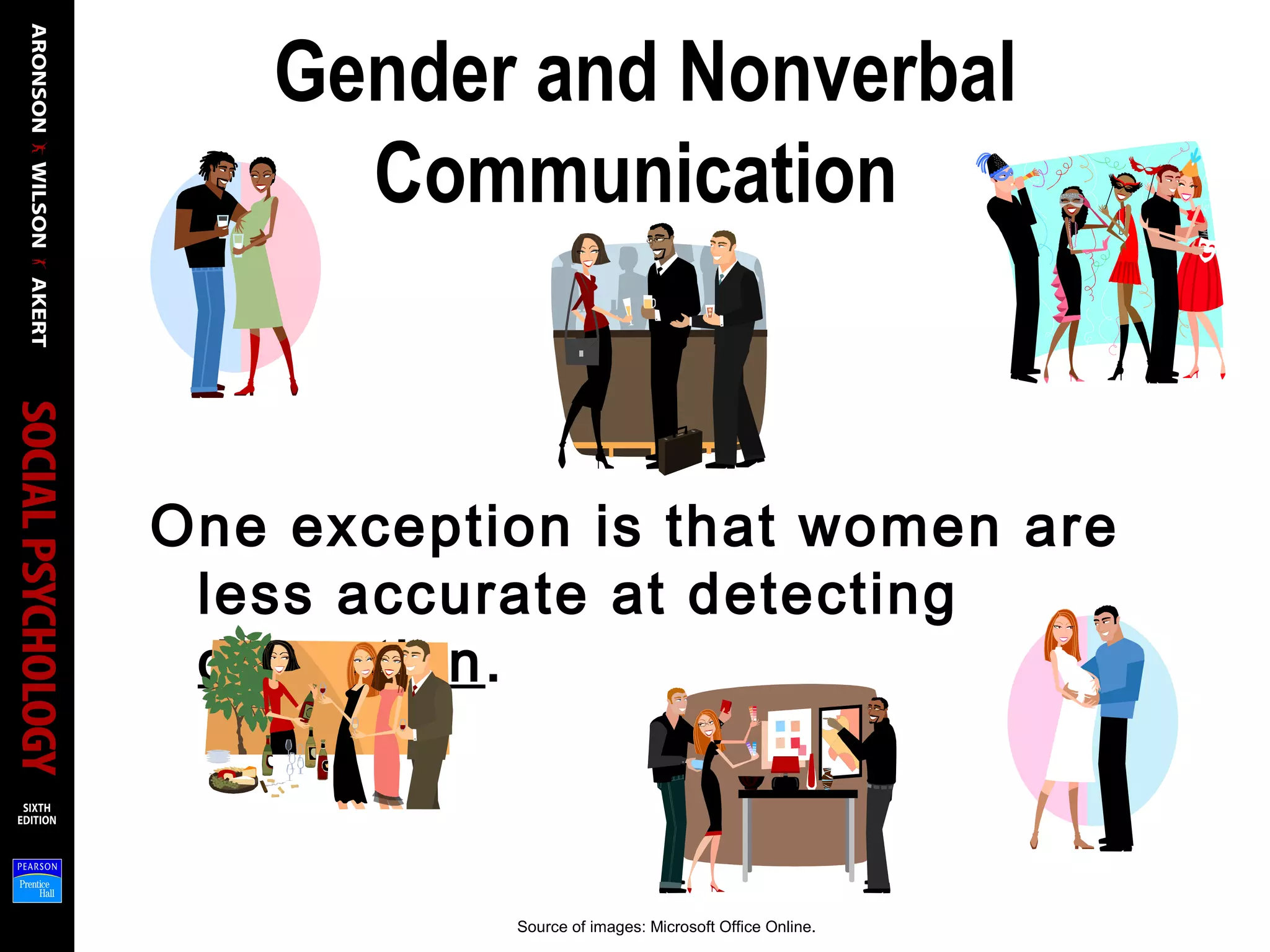
One exception is that women are
less accurate at detecting
deception.
Source of images: Microsoft Office Online.
Gender and Nonverbal
Communication
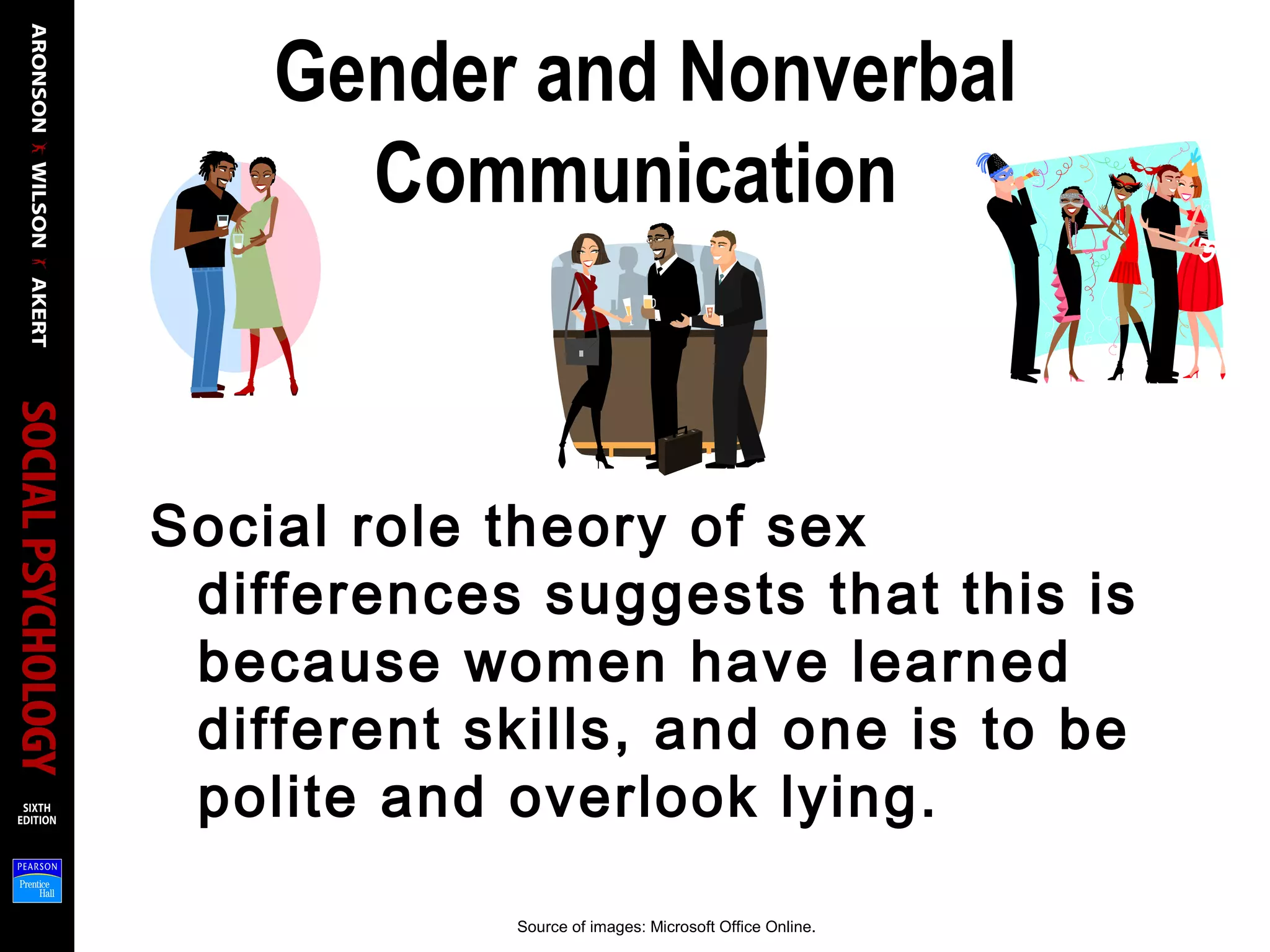
Social role theory of sex
differences suggests that this is
because women have learned
different skills, and one is to be
polite and overlook lying.
Source of images: Microsoft Office Online.
Gender and Nonverbal
Communication
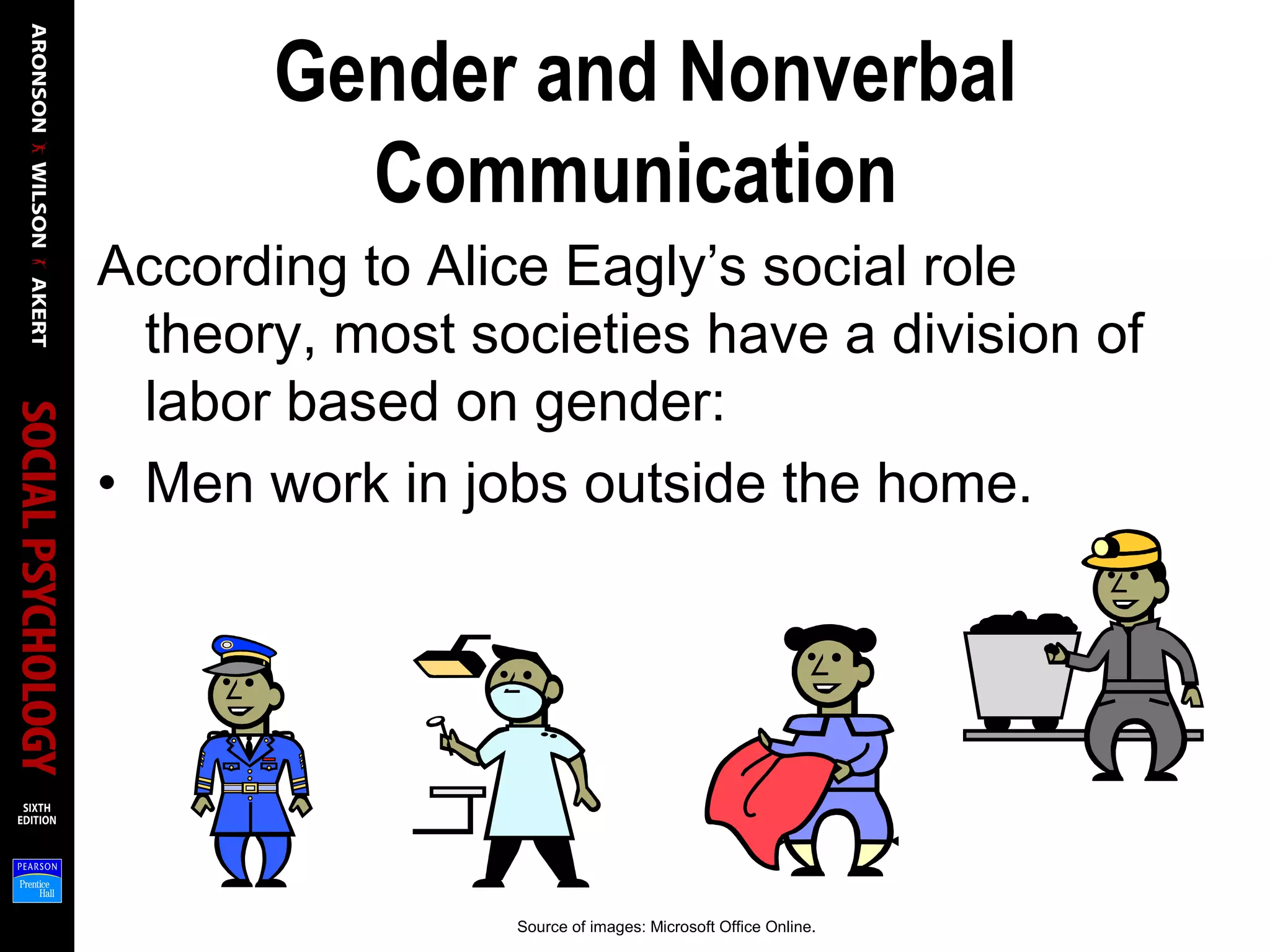
According to Alice Eagly’s social role
theory, most societies have a division of
labor based on gender:
• Men work in jobs outside the home.
Source of images: Microsoft Office Online.
Gender and Nonverbal
Communication
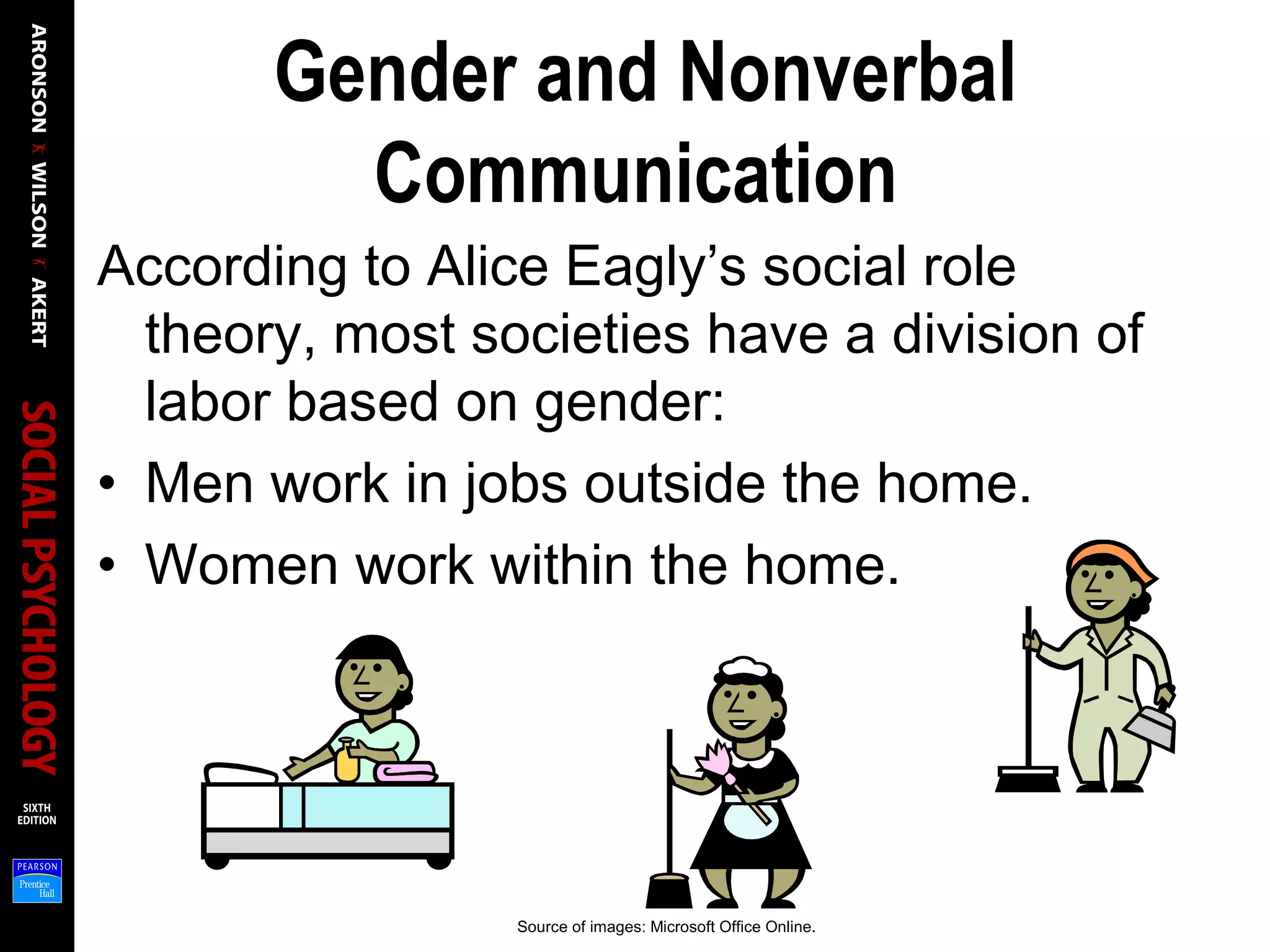
According to Alice Eagly’s social role
theory, most societies have a division of
labor based on gender:
• Men work in jobs outside the home.
• Women work within the home.
Source of images: Microsoft Office Online.
Gender and Nonverbal
Communication
This division of labor has important consequences.
• First, gender-role expectations arise:
Members of the society expect men and women
to have certain attributes that are consistent with
their role. Thus women are expected to be more
nurturing, friendly, expressive, and sensitive than
men because of their primary role as caregivers
to children and elderly family members.
Gender and Nonverbal
Communication
This division of labor has important consequences.
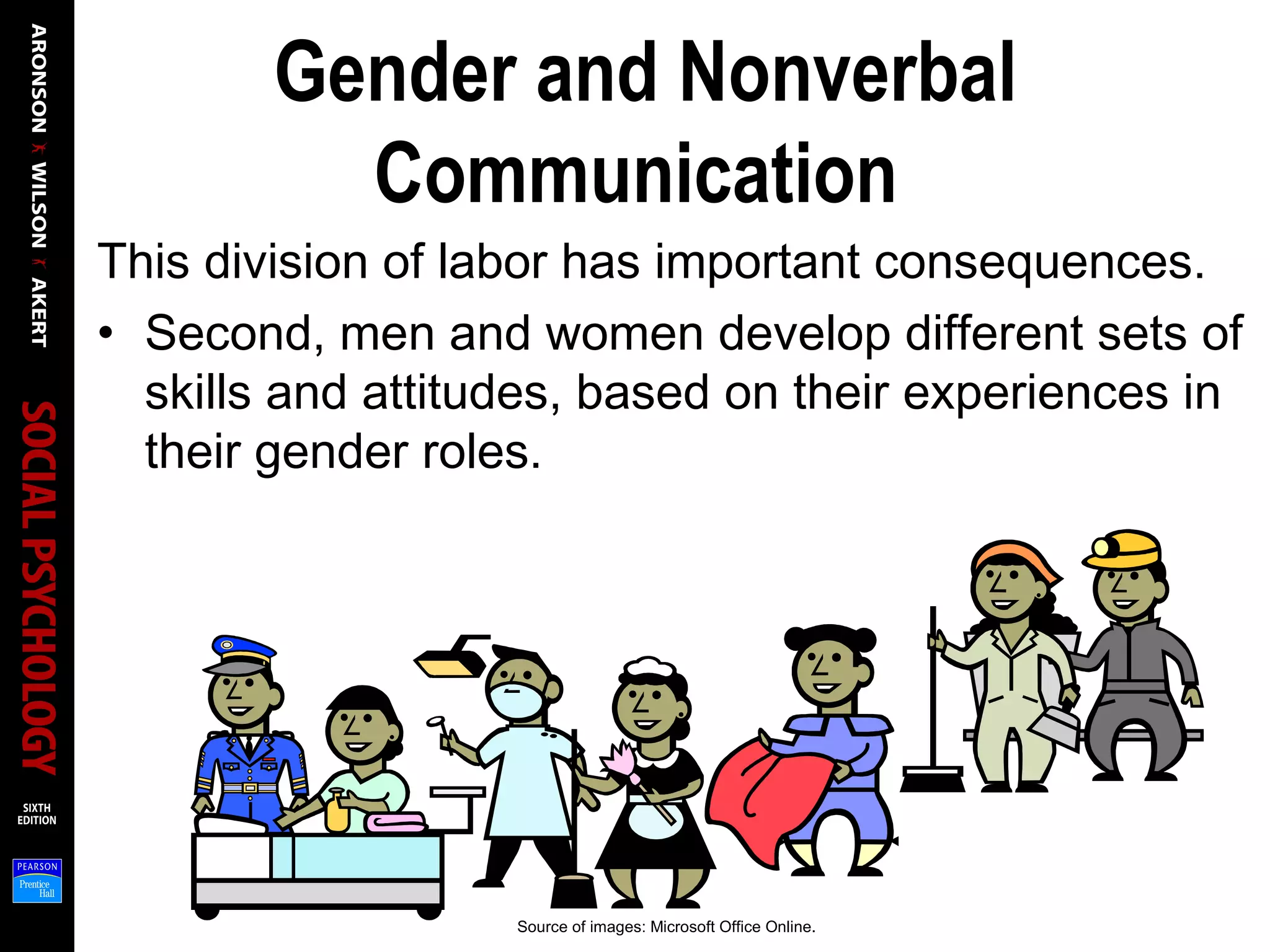
• Second, men and women develop different sets of
skills and attitudes, based on their experiences in
their gender roles.
Source of images: Microsoft Office Online.
Gender and Nonverbal
Communication
This division of labor has important consequences.
• Second, men and women develop different sets of
skills and attitudes, based on their experiences in
their gender roles.
• Finally, because women are less powerful in many
societies and less likely to occupy roles of higher
status, it becomes more important for women to
learn to be accommodating and polite than it is for
men.
Implicit Personality Theories:
Filling in the Blanks.
• To understand other people, we
observe their behavior but we also
infer their feelings, traits, and
motives.
• To do so, we use general notions
or schemas about which
personality traits go together in
one person.
Implicit Personality Theories:
Filling in the Blanks.
Implicit Personality Theory
A type of schema people use to
group various kinds of
personality traits together; for
example, many people believe
that someone who is kind is
generous as well.
• If someone is kind, our implicit personality theory tells
us he or she is probably generous as well.
• Similarly, we assume that a stingy person is also
irritable.
Implicit Personality Theories:
Filling in the Blanks.
But relying on schemas can also
lead us astray.
• We might make the wrong
assumptions about an individual.
• We might even resort to
stereotypical thinking, where our
schema, or stereotype, leads us to
believe that the individual is like all
the other members of his or her
group.
Culture and Implicit Personality
Theories
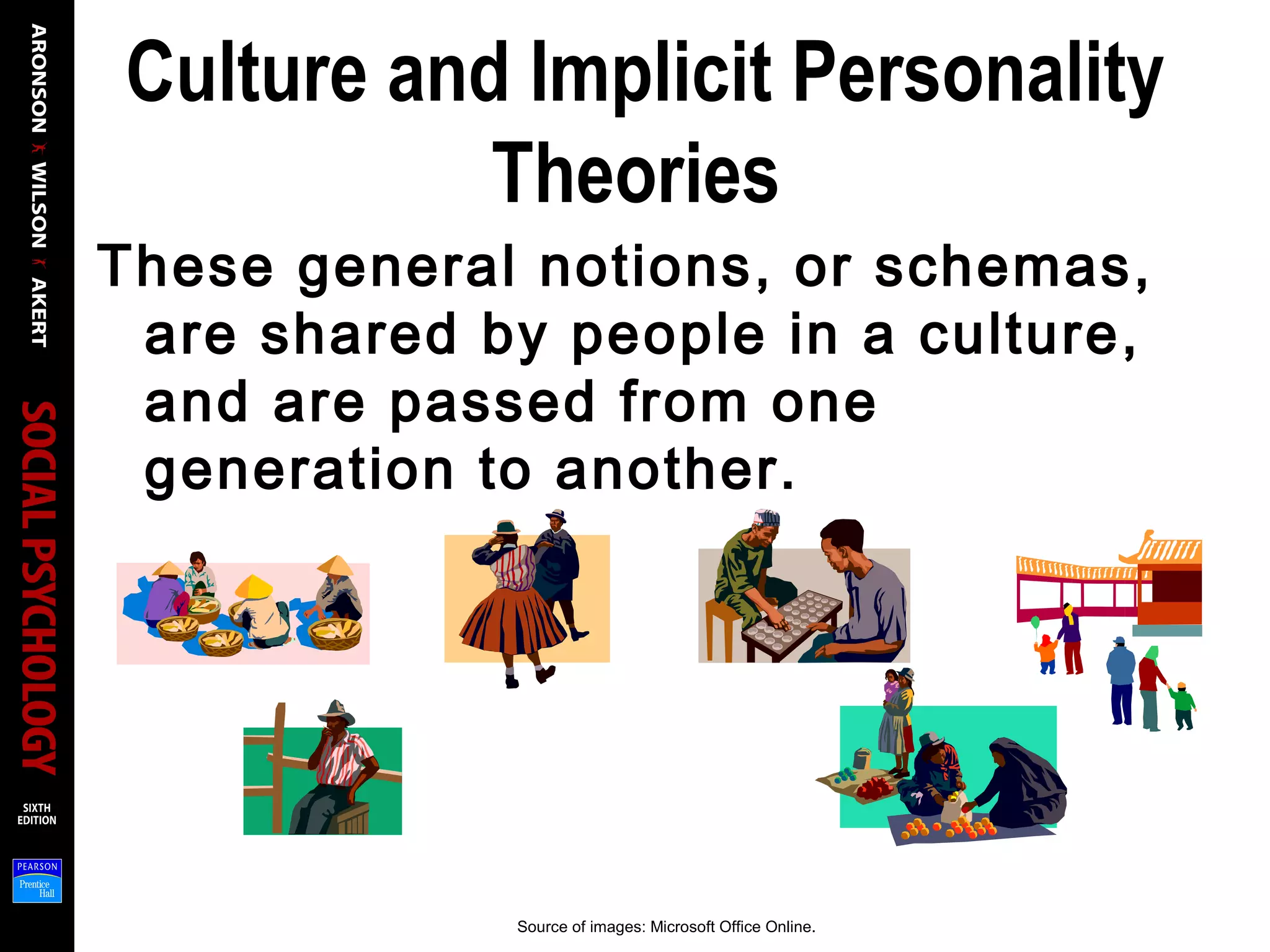
These general notions, or schemas,
are shared by people in a culture,
and are passed from one
generation to another.
Source of images: Microsoft Office Online.
Culture and Implicit Personality
Theories
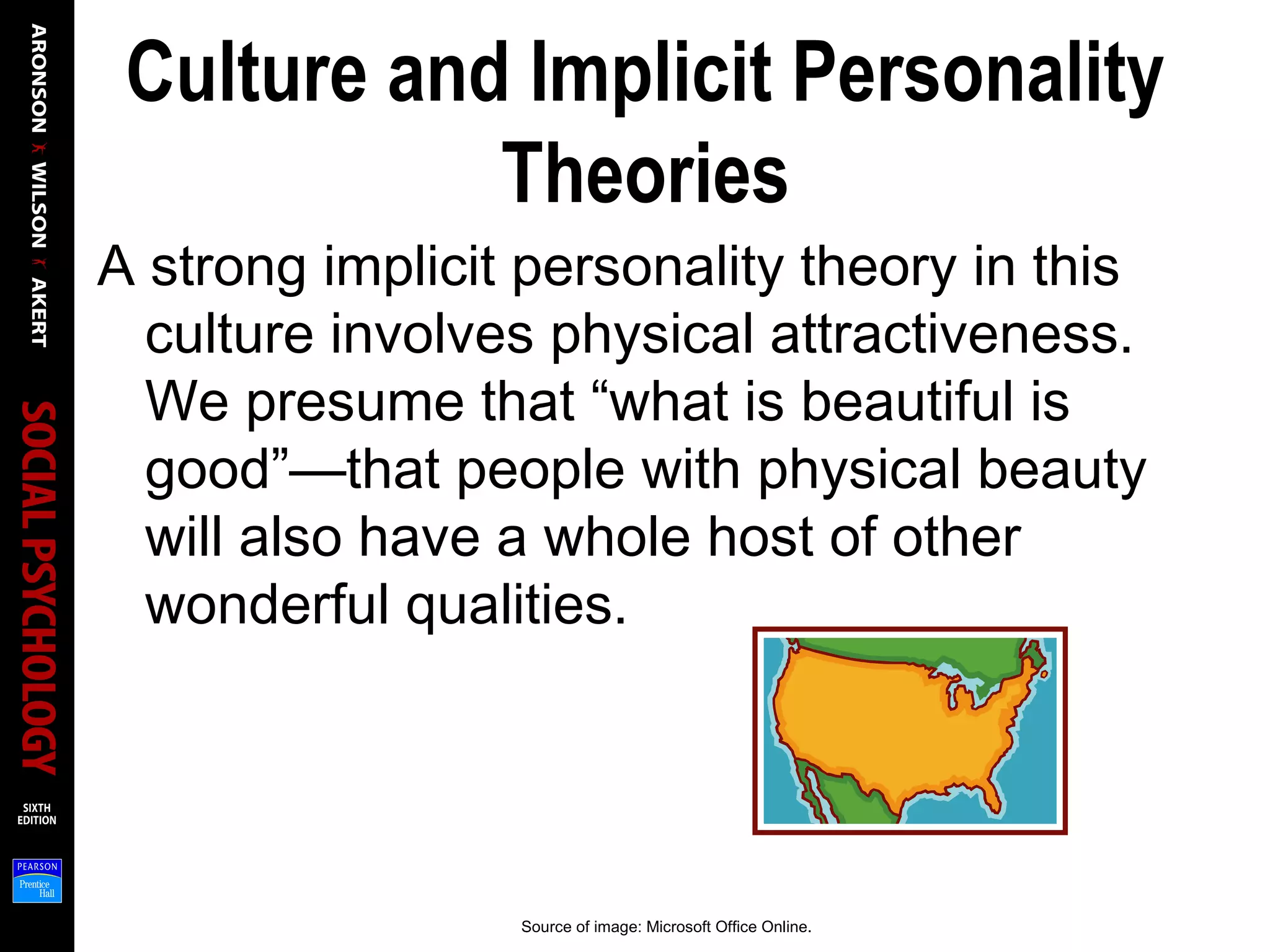
A strong implicit personality theory in this
culture involves physical attractiveness.
We presume that “what is beautiful is
good”—that people with physical beauty
will also have a whole host of other
wonderful qualities.
Source of image: Microsoft Office Online.
Culture and Implicit Personality
Theories
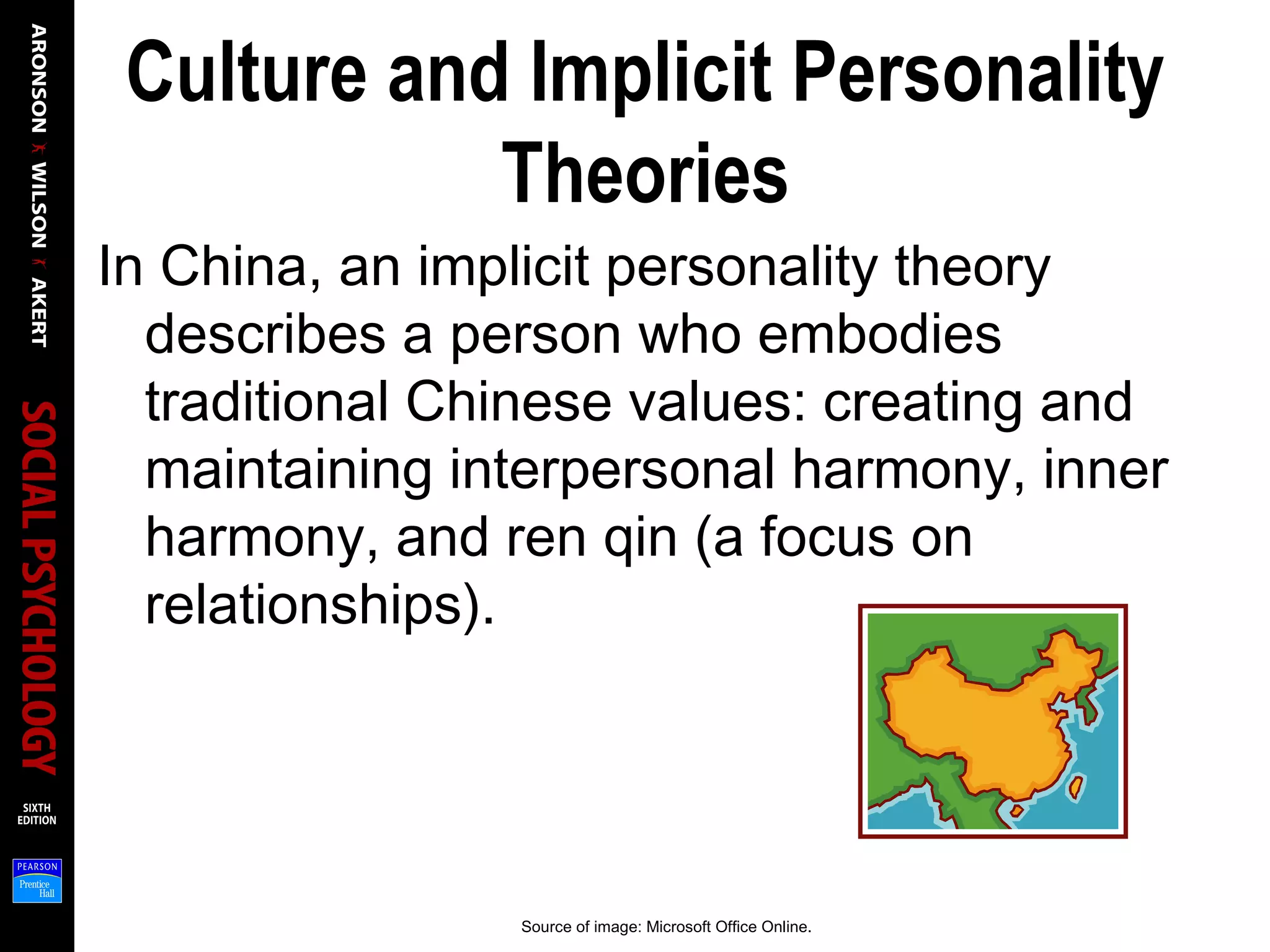
In China, an implicit personality theory
describes a person who embodies
traditional Chinese values: creating and
maintaining interpersonal harmony, inner
harmony, and ren qin (a focus on
relationships).
Source of image: Microsoft Office Online.
Culture and Implicit Personality
Theories
In Western cultures, saying someone
has an “artistic personality” implies
that the person is creative, intense,
and temperamental and has an
unconventional lifestyle.
The Chinese, however, do not have
a schema or implicit personality
theory for an artistic type.
Source of image: Microsoft Office Online.
Culture and Implicit Personality
Theories
Conversely, in China, there are
categories of personality that do
not exist in Western cultures.
For example, a shi gú person is
someone who is worldly, devoted
to his or her family, socially skillful,
and somewhat reserved.
Source of image: Microsoft Office Online.
Causal Attribution:
Answering the “Why” Question
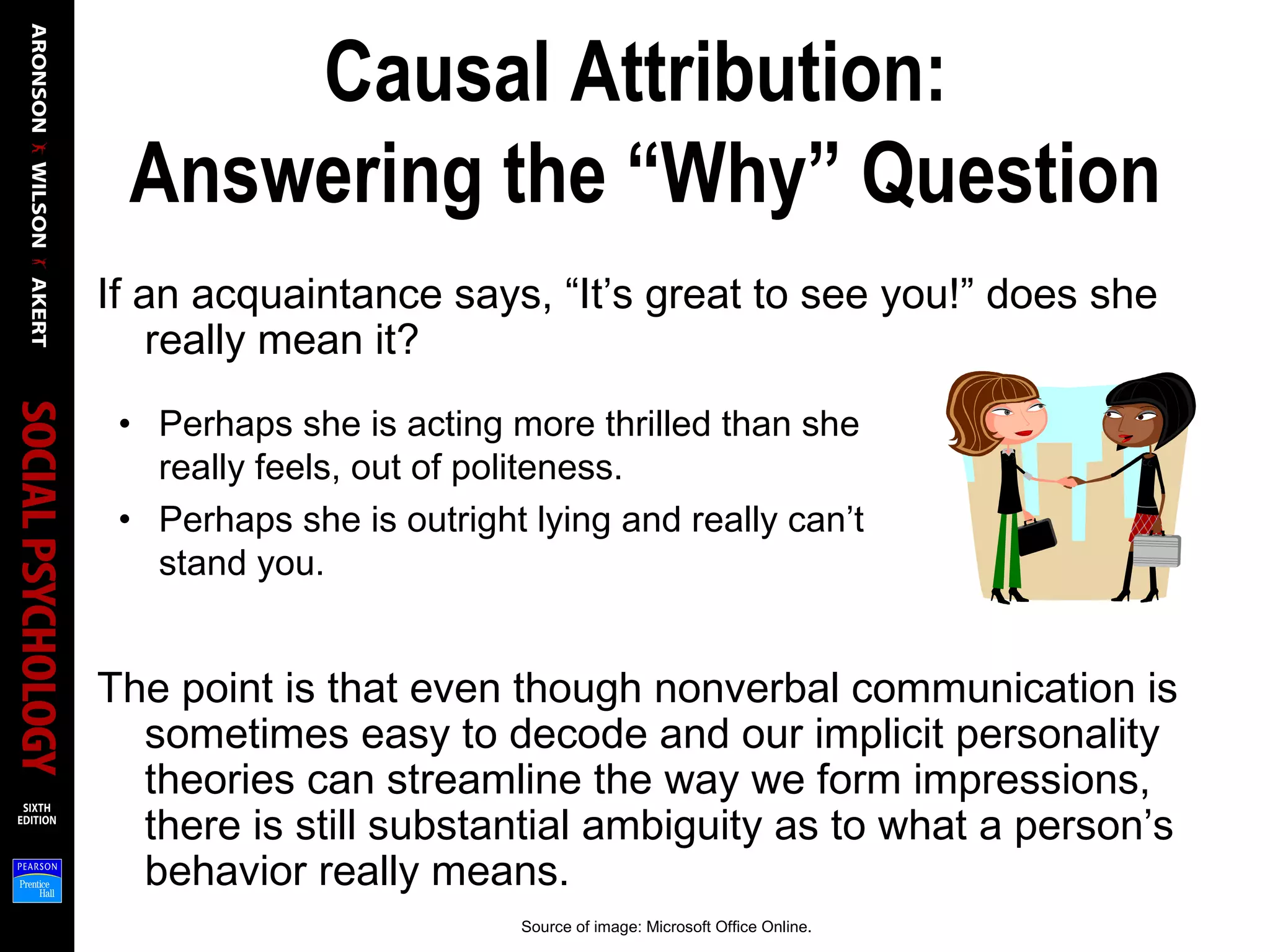
If an acquaintance says, “It’s great to see you!” does she
really mean it?
The point is that even though nonverbal communication is
sometimes easy to decode and our implicit personality
theories can streamline the way we form impressions,
there is still substantial ambiguity as to what a person’s
behavior really means.
• Perhaps she is acting more thrilled than she
really feels, out of politeness.
• Perhaps she is outright lying and really can’t
stand you.
Source of image: Microsoft Office Online.
Causal Attribution:
Answering the “Why” Question
According to attribution theory, we
try to determine why people do
what they do in order to uncover
the feelings and traits that are
behind their actions.
This helps us understand and predict
our social world.
The Nature of the Attribution Process
Fritz Heider (1958) is frequently referred to as the
father of attribution theory.
Heider discussed what he called “naive” or
“commonsense” psychology.
In his view, people were like amateur scientists,
trying to understand other people’s behavior by
piecing together information until they arrived at
a reasonable explanation or cause.
Heider was intrigued by what seemed reasonable
to people and by how they arrived at their
conclusions.
The Nature of the Attribution Process
When trying to decide what causes
people’s behavior, we can make
one of two attributions:
• An internal, dispositional
attribution or
• An external, situational attribution.
Internal Attribution
The inference that a person is
behaving in a certain way
because of something about the
person, such as attitude,
character, or personality.
External Attribution
The inference that a person is behaving a
certain way because of something about
the situation he or she is in.
The assumption is that most people would
respond the same way in that situation.
The Nature of the Attribution Process
Satisfied spouses tend to show one pattern:
• Internal attributions for their partners’ positive behaviors
(e.g., “She helped me because she’s such a generous
person”).
• External attributions for their partners’ negative behaviors
(e.g., “He said something mean because he’s so stressed
at work this week”).
In contrast, spouses in distressed marriages tend to display
the opposite pattern:
• Their partners’ positive behaviors are chalked up to
external causes (e.g., “She helped me because she
wanted to impress our friends”).
• Negative behaviors are attributed to internal causes (e.g.,
“He said something mean because he’s a totally self-
centered jerk”).
The Nature of the Attribution Process
Although either type of attribution is always
possible, Heider (1958) noted that we
tend to see the causes of a person’s
behavior as residing in that person
(internal explanation).
• We are perceptually focused on people—
they are who we notice.
• The situation (the external explanation),
which is often hard to see and hard to
describe, may be overlooked.
The Covariation Model:
Internal versus External Attributions
Harold Kelley’s major contribution to
attribution theory was the idea that we
notice and think about more than one
piece of information when we form an
impression of another person.
Covariation Model
A theory that states that to form an attribution
about what caused a person’s behavior, we
systematically note the pattern between the
presence or absence of possible causal factors
and whether or not the behavior occurs.
The Covariation Model:
Internal versus External Attributions
The covariation model focuses on
observations of behavior across time,
place, actors, and targets.
It examines how the perceiver chooses
either an internal or an external
attribution.
We make such choices by using
information on:
• Consensus,
• Distinctiveness,
• Consistency.
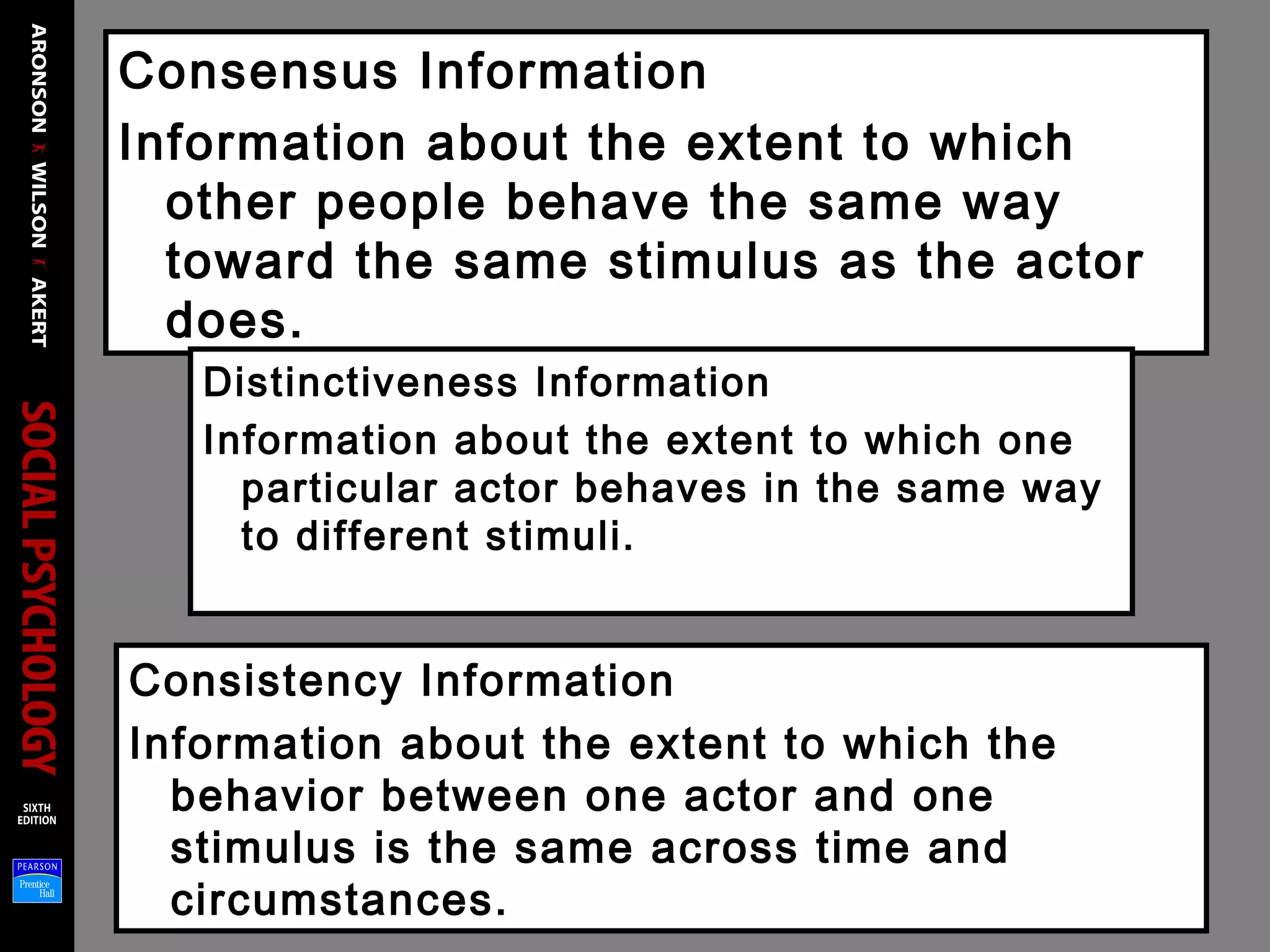
Consensus Information
Information about the extent to which
other people behave the same way
toward the same stimulus as the actor
does.
Distinctiveness Information
Information about the extent to which one
particular actor behaves in the same way
to different stimuli.
Consistency Information
Information about the extent to which the
behavior between one actor and one
stimulus is the same across time and
circumstances.
The Correspondence Bias:
People as Personality Psychologists
Specific errors or biases plague the
attribution process.
One common shortcut is the
correspondence bias:
the tendency to believe that people’s
behavior matches (corresponds to)
their dispositions.
The Correspondence Bias:
People as Personality Psychologists
• The pervasive, fundamental theory or
schema most of us have about human
behavior is that people do what they do
because of the kind of people they are, not
because of the situation they are in.
• When thinking this way, we are more like
personality psychologists, who see behavior
as stemming from internal dispositions and
traits, than like social psychologists, who
focus on the impact of social situations on
behavior.
The Correspondence Bias:
People as Personality Psychologists
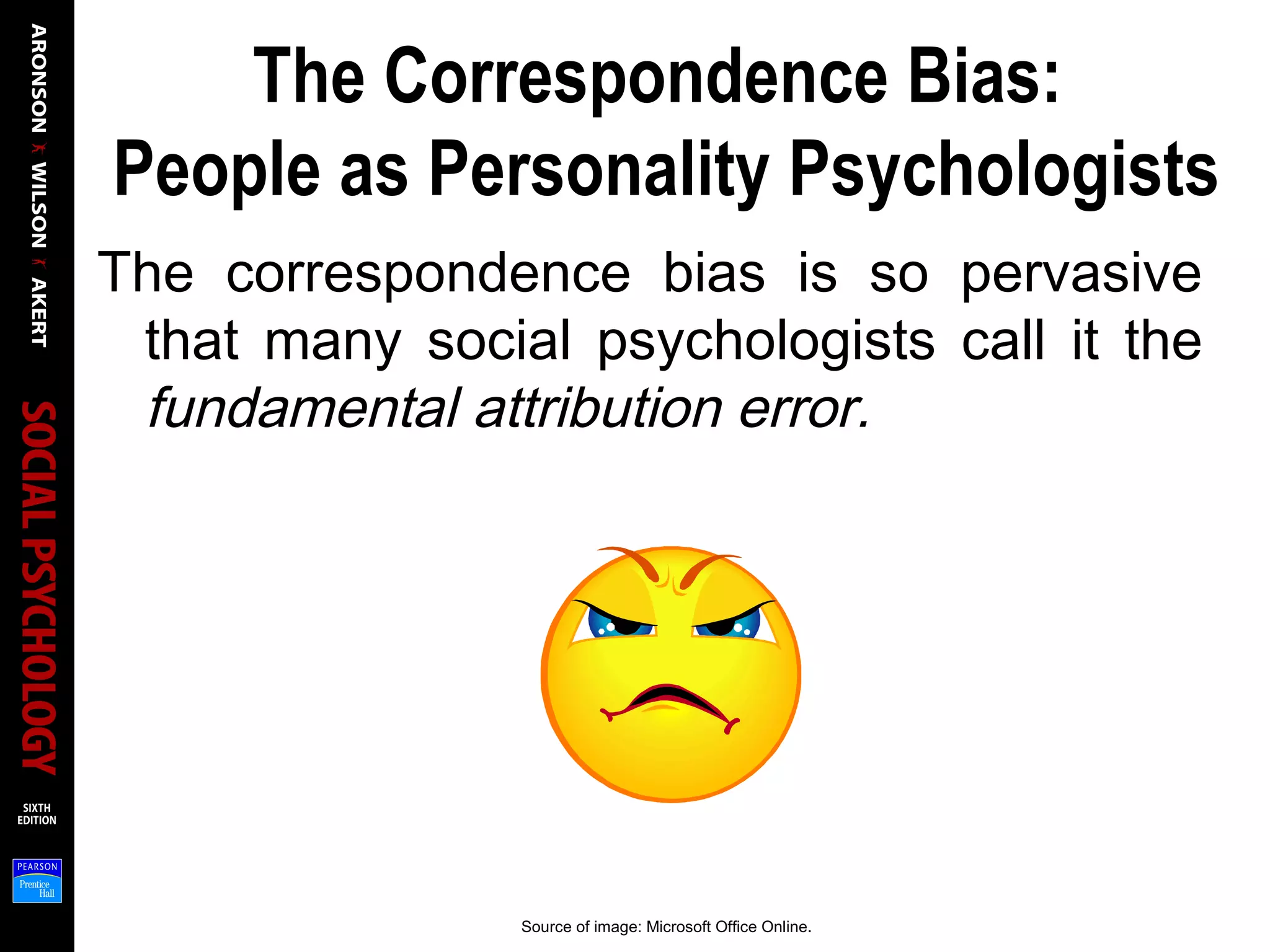
The correspondence bias is so pervasive
that many social psychologists call it the
fundamental attribution error.
Source of image: Microsoft Office Online.
The Correspondence Bias:
People as Personality Psychologists
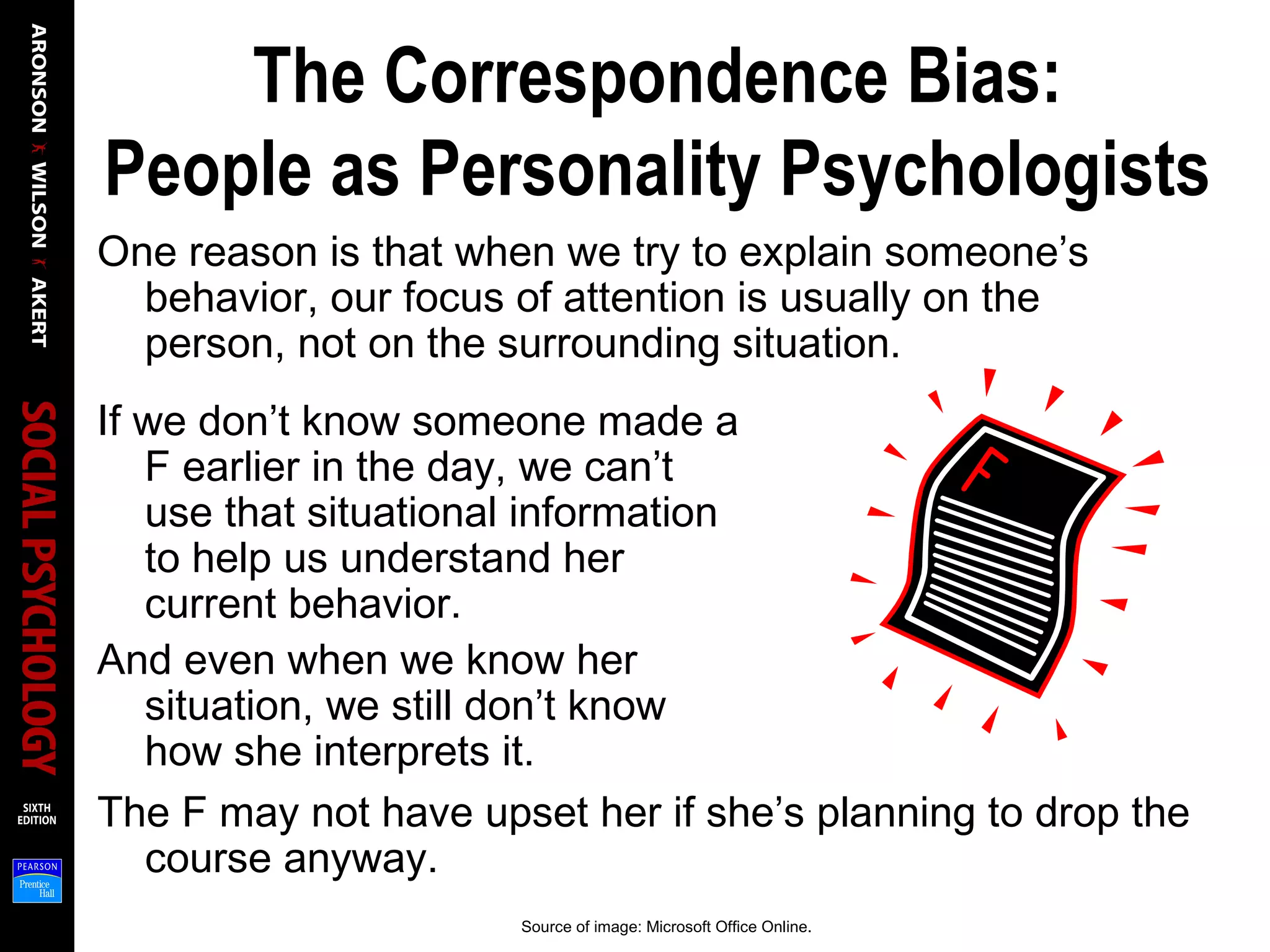
One reason is that when we try to explain someone’s
behavior, our focus of attention is usually on the
person, not on the surrounding situation.
If we don’t know someone made a
F earlier in the day, we can’t
use that situational information
to help us understand her
current behavior.
And even when we know her
situation, we still don’t know
how she interprets it.
The F may not have upset her if she’s planning to drop the
course anyway.
Source of image: Microsoft Office Online.
The Correspondence Bias:
People as Personality Psychologists
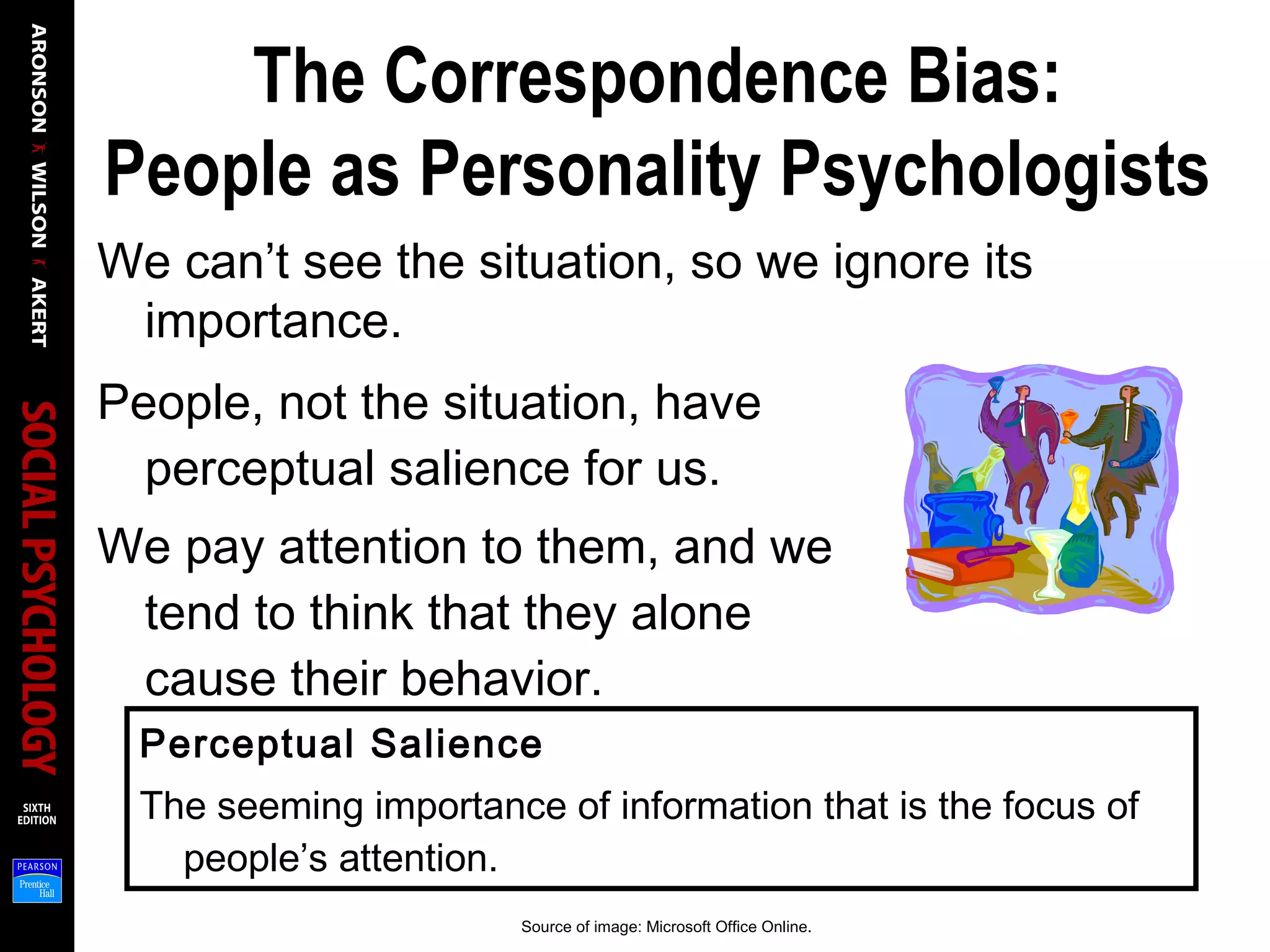
We can’t see the situation, so we ignore its
importance.
People, not the situation, have
perceptual salience for us.
We pay attention to them, and we
tend to think that they alone
cause their behavior.
Perceptual Salience
The seeming importance of information that is the focus of
people’s attention.
Source of image: Microsoft Office Online.
The Correspondence Bias:
People as Personality Psychologists
The culprit is one of the mental shortcuts we discussed
in Chapter 3: the anchoring and adjustment heuristic.
The correspondence bias is
another byproduct of this
shortcut.
When making attributions,
people use the focus of their
attention as a starting point.
Source of image: Microsoft Office Online.
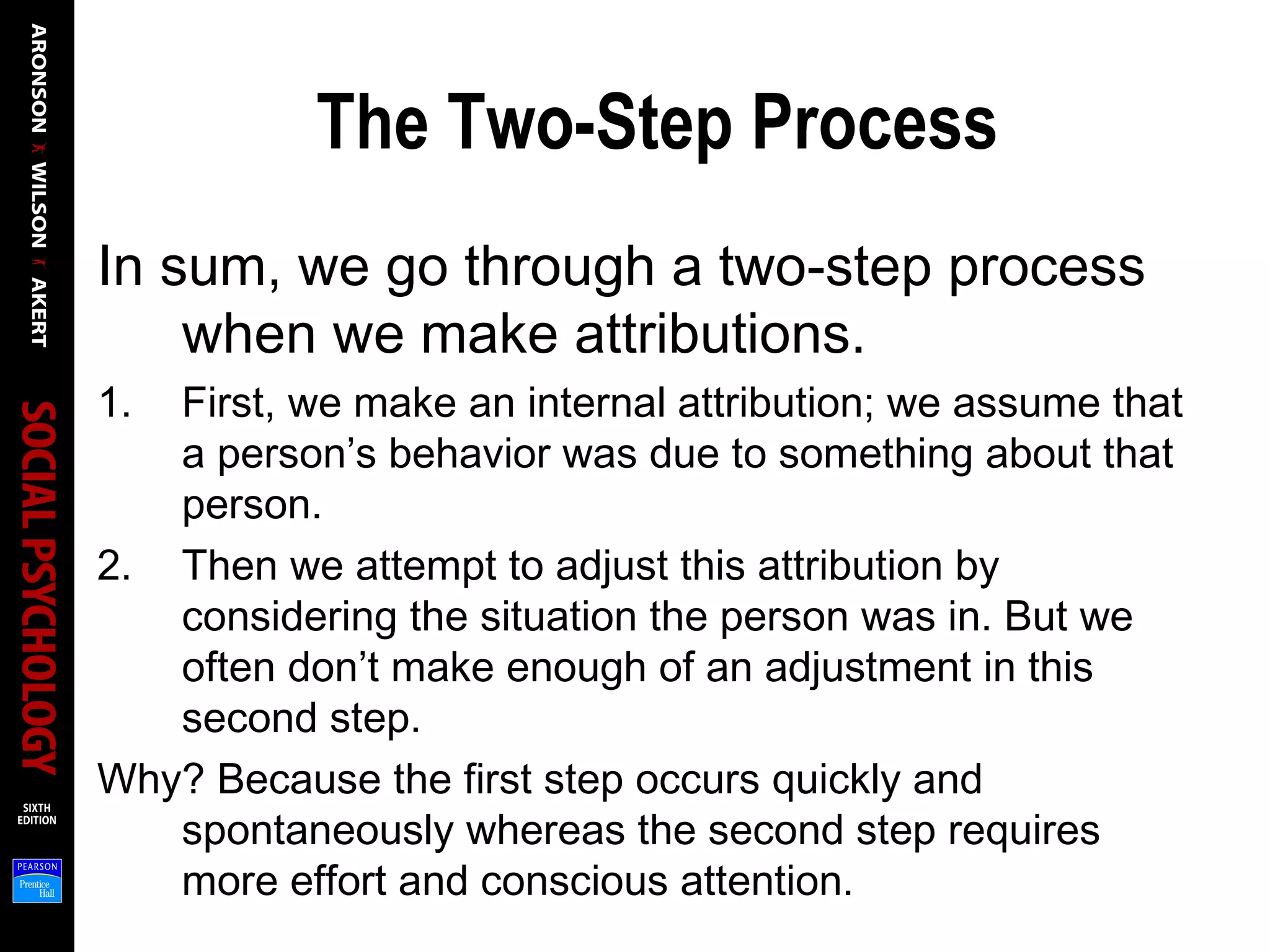
The Two-Step Process
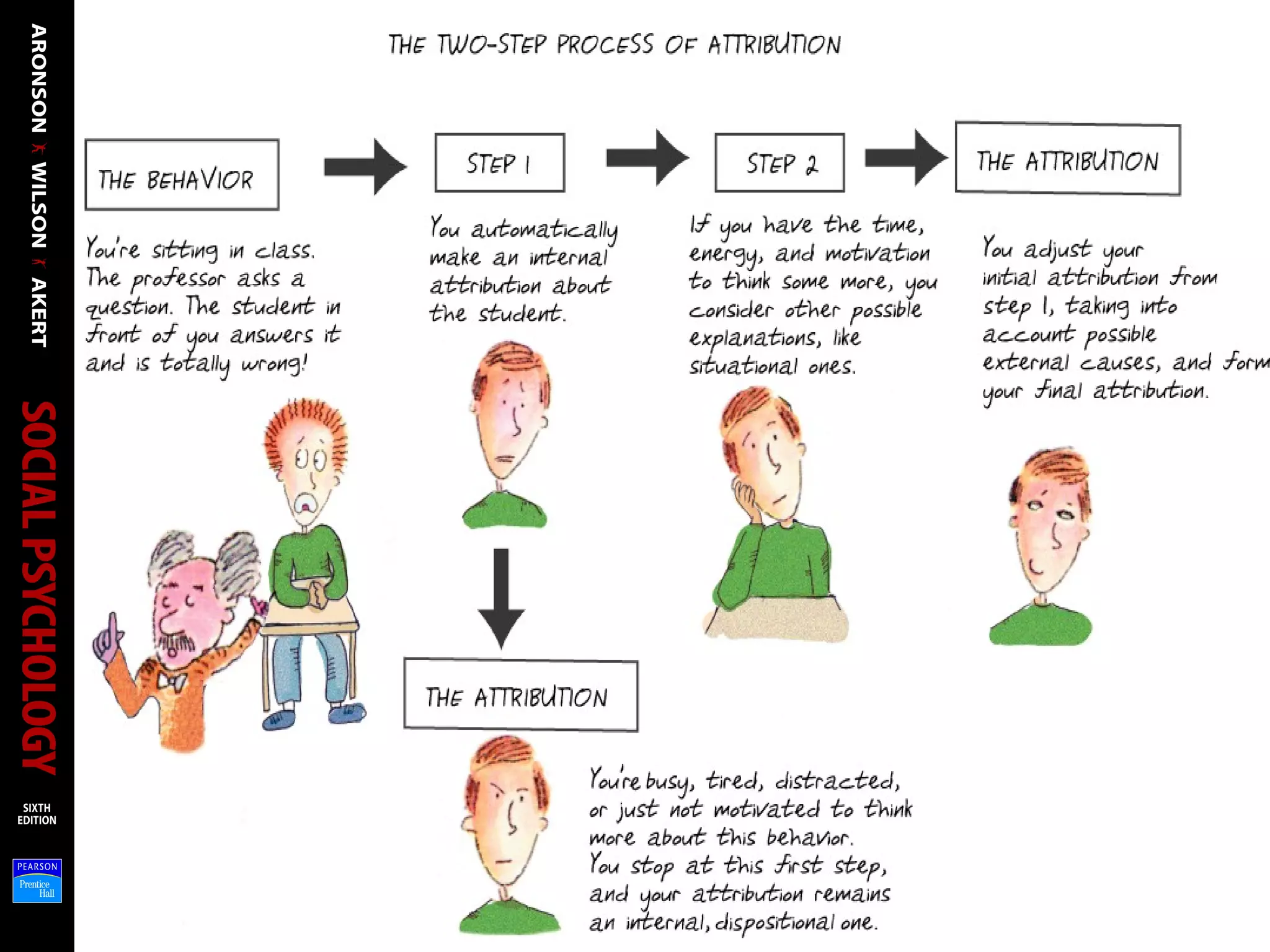
In sum, we go through a two-step process
when we make attributions.
1. First, we make an internal attribution; we assume that
a person’s behavior was due to something about that
person.
2. Then we attempt to adjust this attribution by
considering the situation the person was in. But we
often don’t make enough of an adjustment in this
second step.
The Two-Step Process
In sum, we go through a two-step process
when we make attributions.
1. First, we make an internal attribution; we assume that
a person’s behavior was due to something about that
person.
2. Then we attempt to adjust this attribution by
considering the situation the person was in. But we
often don’t make enough of an adjustment in this
second step.
Why? Because the first step occurs quickly and
spontaneously whereas the second step requires
more effort and conscious attention.
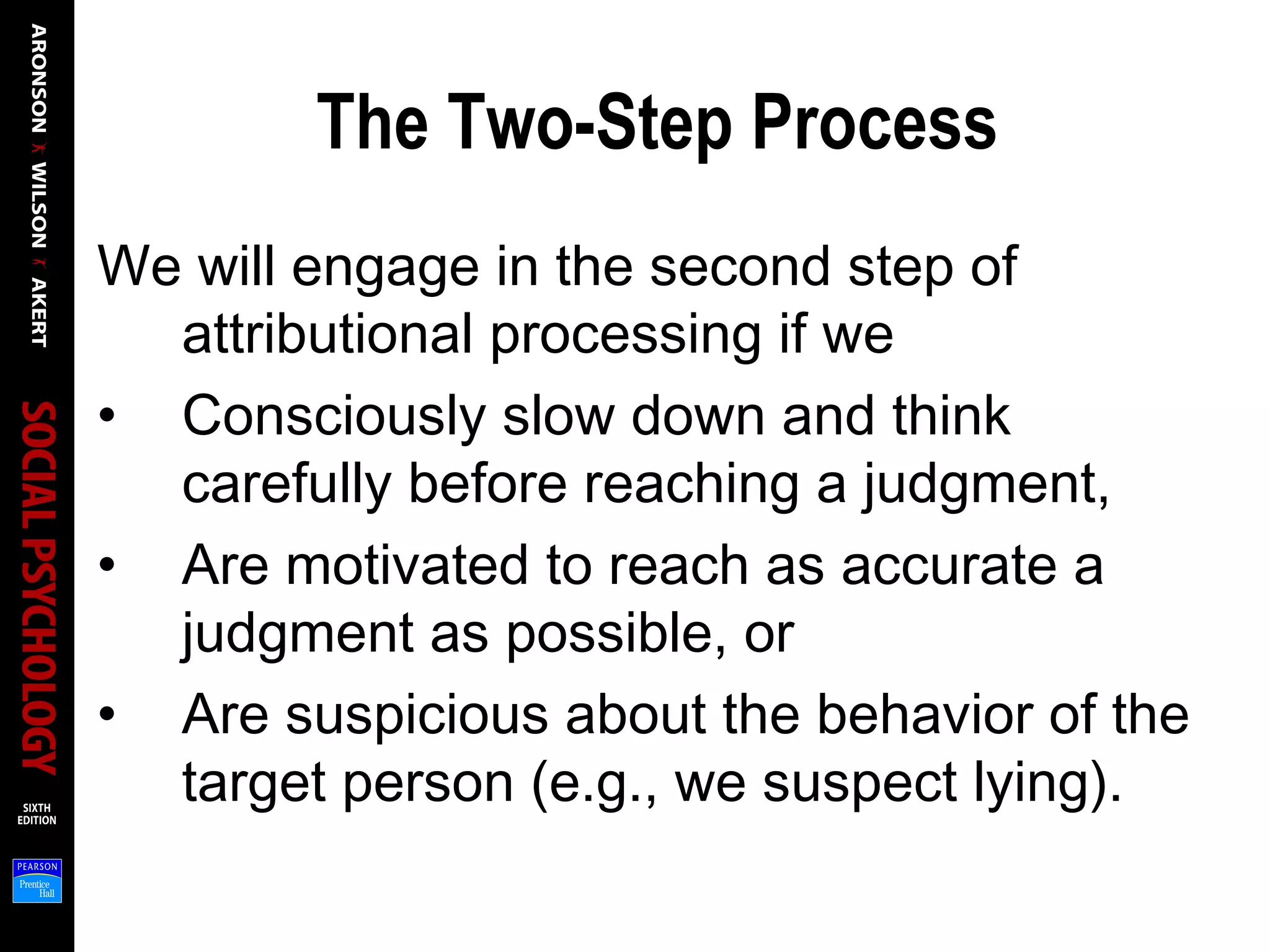
The Two-Step Process
We will engage in the second step of
attributional processing if we
• Consciously slow down and think
carefully before reaching a judgment,
• Are motivated to reach as accurate a
judgment as possible, or
• Are suspicious about the behavior of the
target person (e.g., we suspect lying).
Culture and the Correspondence Bias
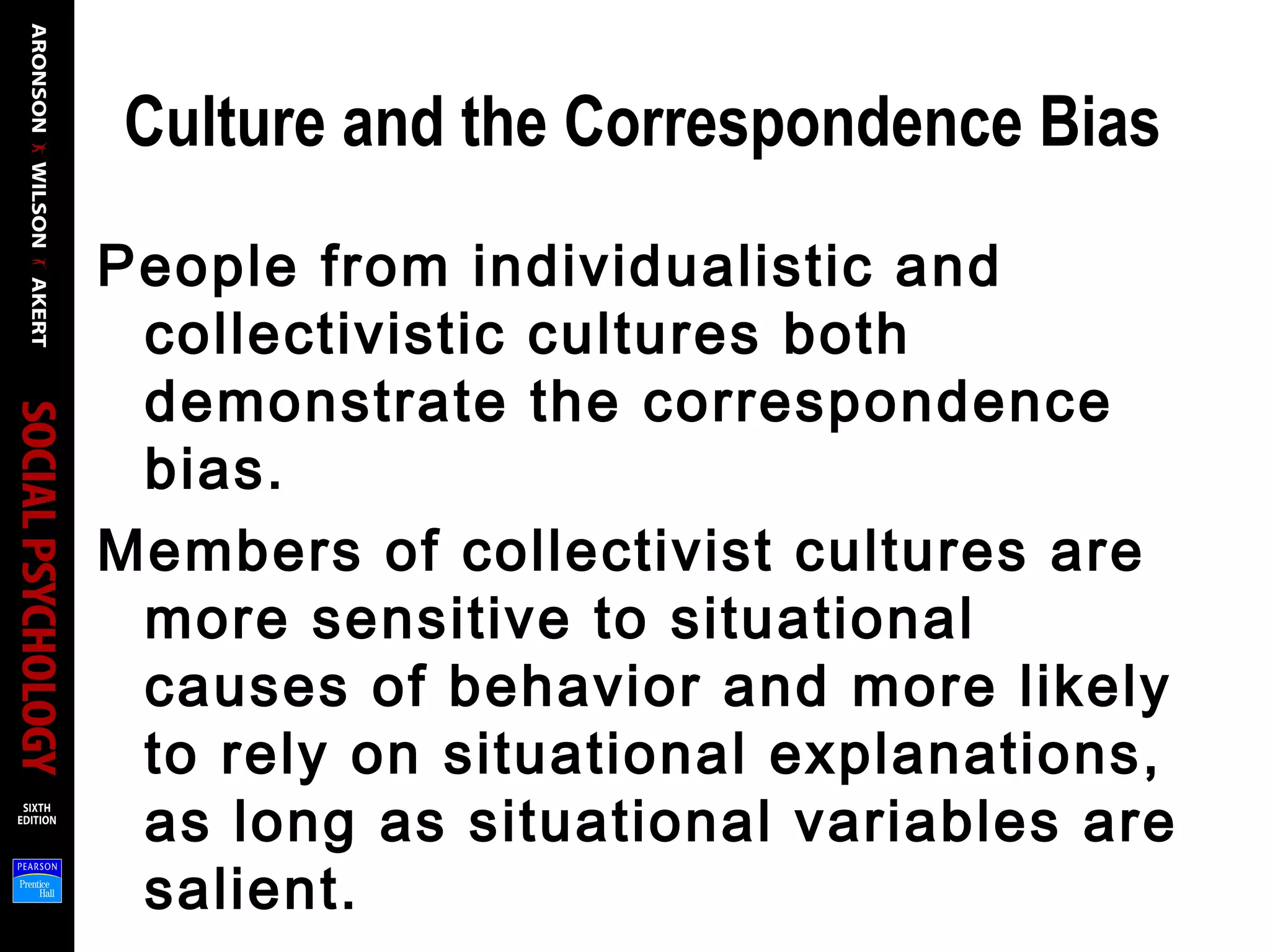
For decades, it was taken for granted that
the correspondence bias was universal:
People everywhere, we thought, applied
this cognitive shortcut when forming
attributions.
Source of image: Microsoft Office Online.
Culture and the Correspondence Bias
People from individualistic and
collectivistic cultures both
demonstrate the correspondence
bias.
Members of collectivist cultures are
more sensitive to situational
causes of behavior and more likely
to rely on situational explanations,
as long as situational variables are
salient.
Culture and the Correspondence Bias
North American and some other Western cultures
stress individual autonomy. A person is
perceived as independent and self-contained;
his or her behavior reflects internal traits,
motives, and values.
In contrast, East Asian cultures such as those in
China, Japan, and Korea stress group
autonomy. The individual derives his or her
sense of self from the social group to which he
or she belongs.
Culture and the Correspondence Bias
It would be a mistake to think that members
of collectivist cultures don’t make
dispositional attributions.
They do—it’s just a matter of degree.
Source of image: Microsoft Office Online.
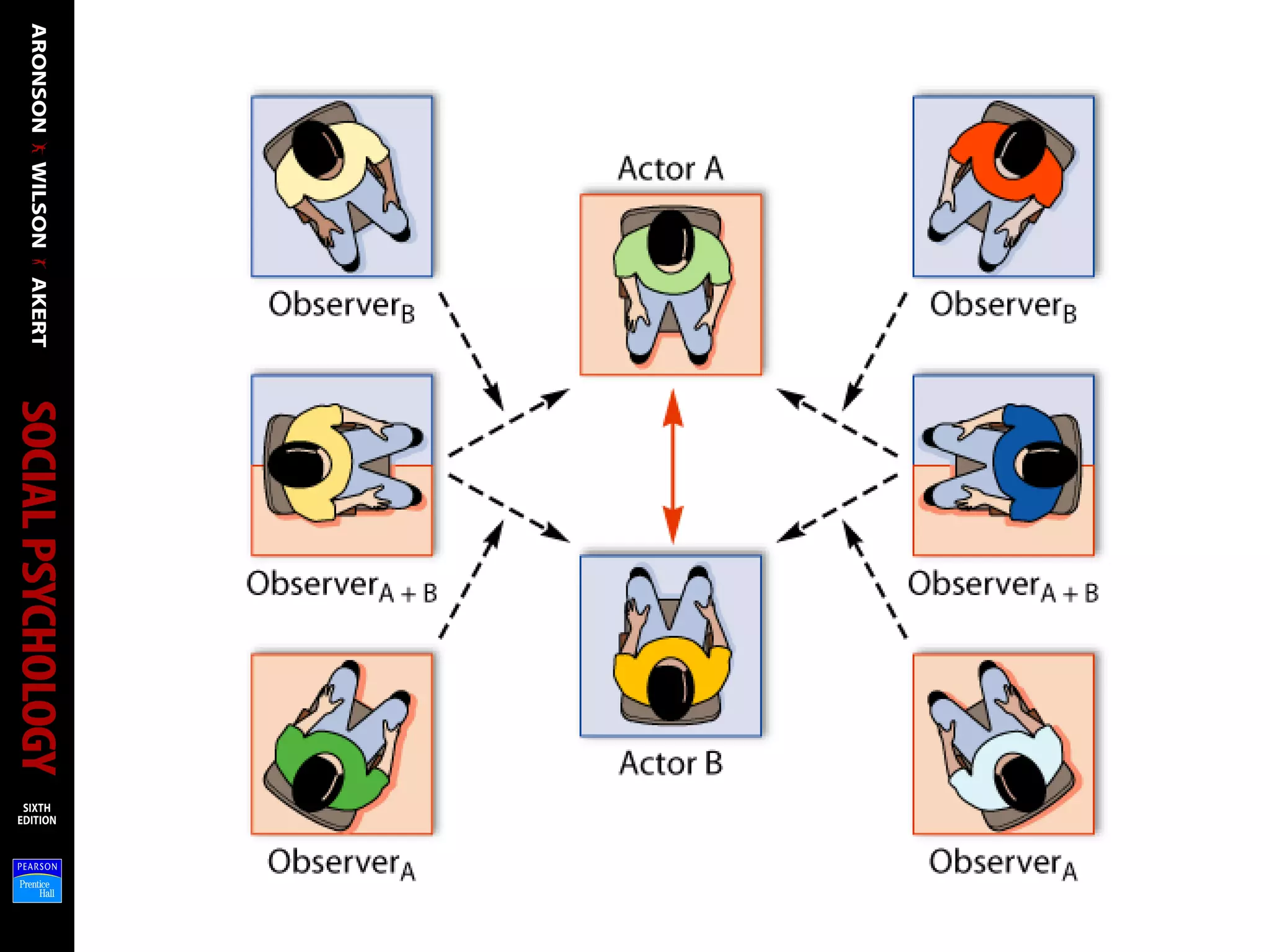
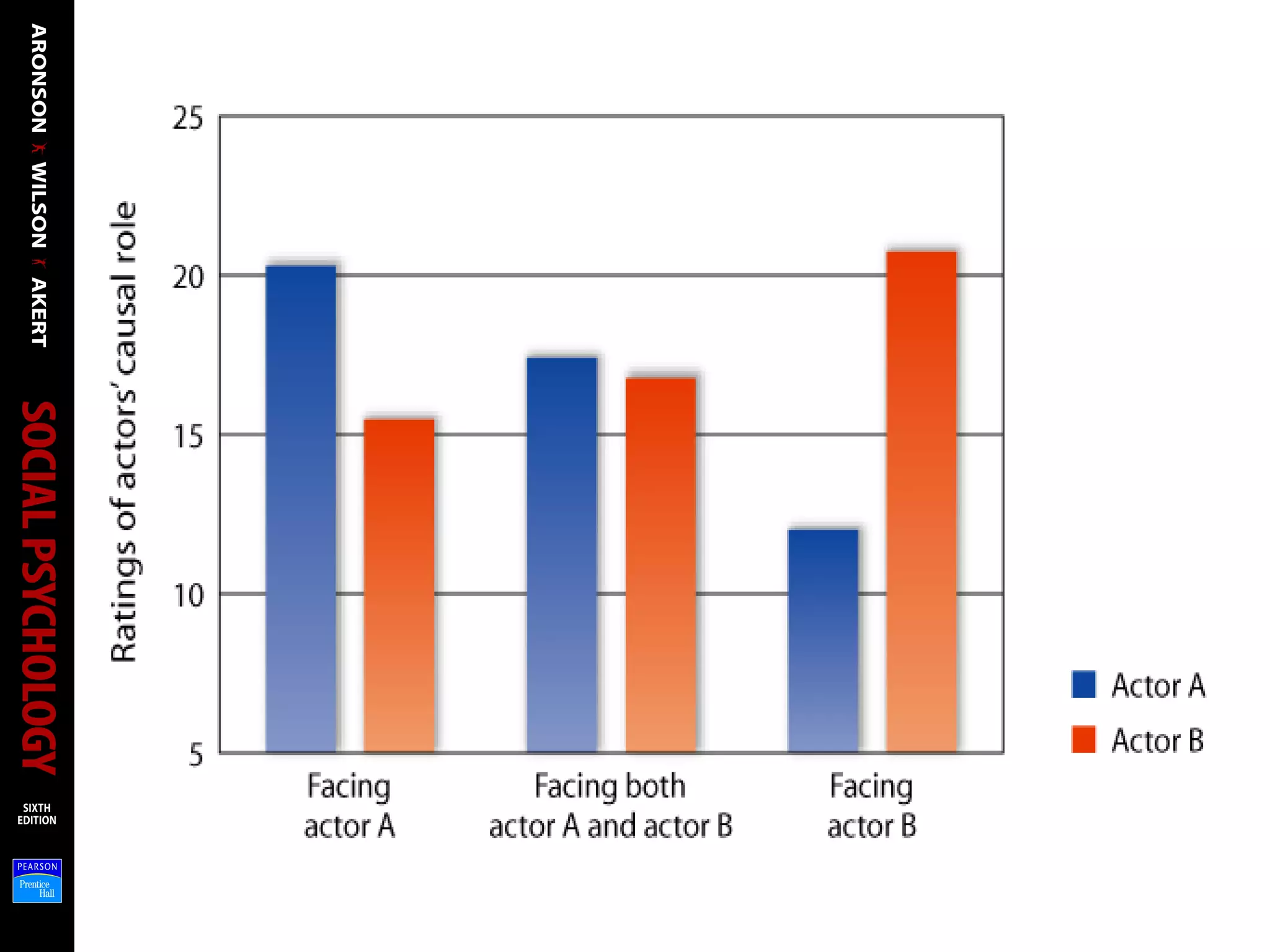
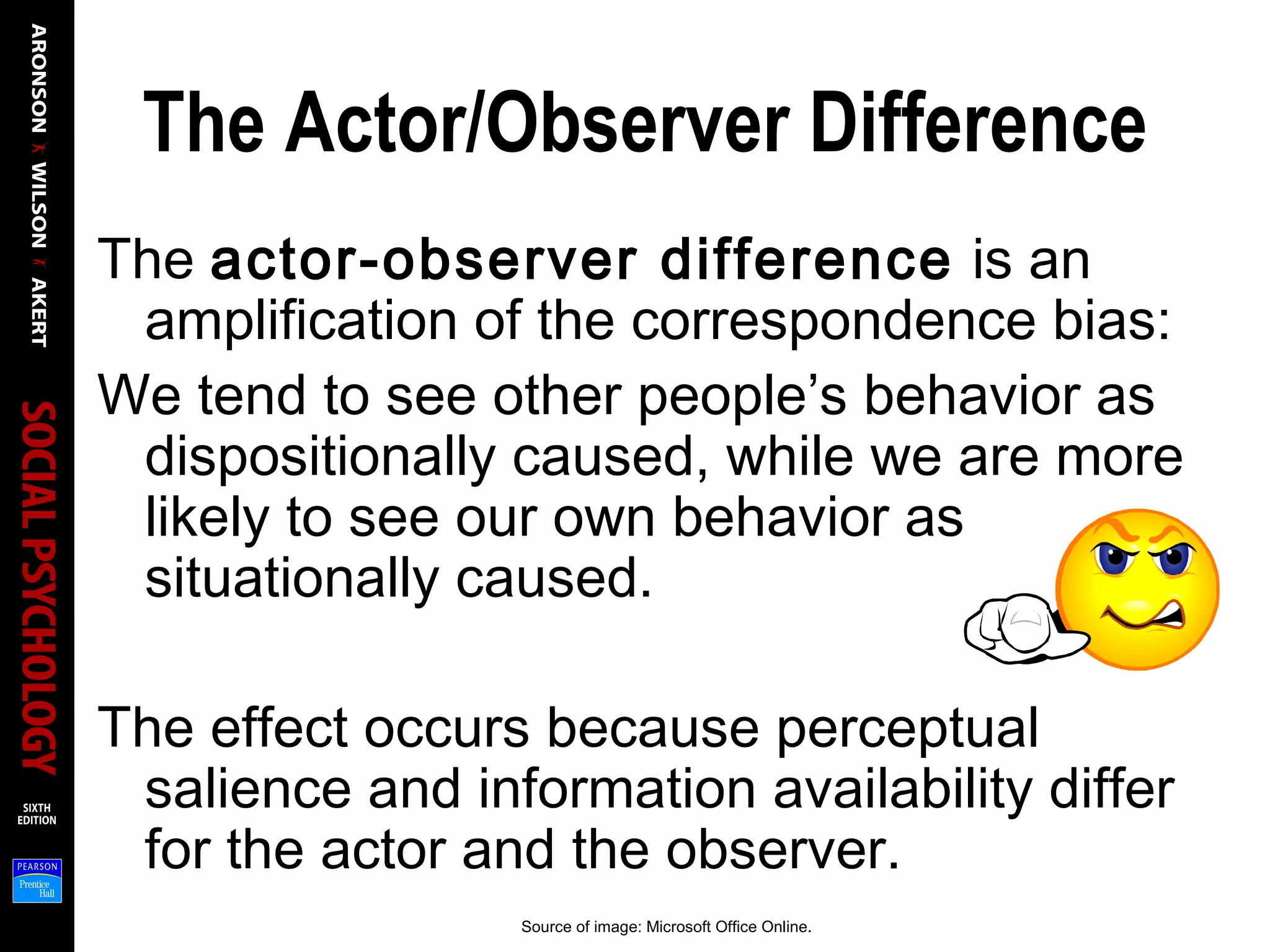
The Actor/Observer Difference
The actor-observer difference is an
amplification of the correspondence bias:
We tend to see other people’s behavior as
dispositionally caused, while we are more
likely to see our own behavior as
situationally caused.
The effect occurs because perceptual
salience and information availability differ
for the actor and the observer.
Source of image: Microsoft Office Online.
The Actor/Observer Difference
Actors have more information about
themselves than observers do.
Actors know how they’ve behaved over
the years; they know what happened to
them that morning.
They are far more aware than observers
are of both the similarities and the
differences in their behavior over time
and across situations terms, actors have
far more consistency and
distinctiveness information about
themselves than observers do.
Self-Serving Attributions
Explanations for one’s successes that
credit internal, dispositional factors and
explanations for one’s failures that blame
external, situational factors.
Defensive Attributions
Explanations for behavior that avoid
feelings of vulnerability and mortality.
Self-Serving Attributions
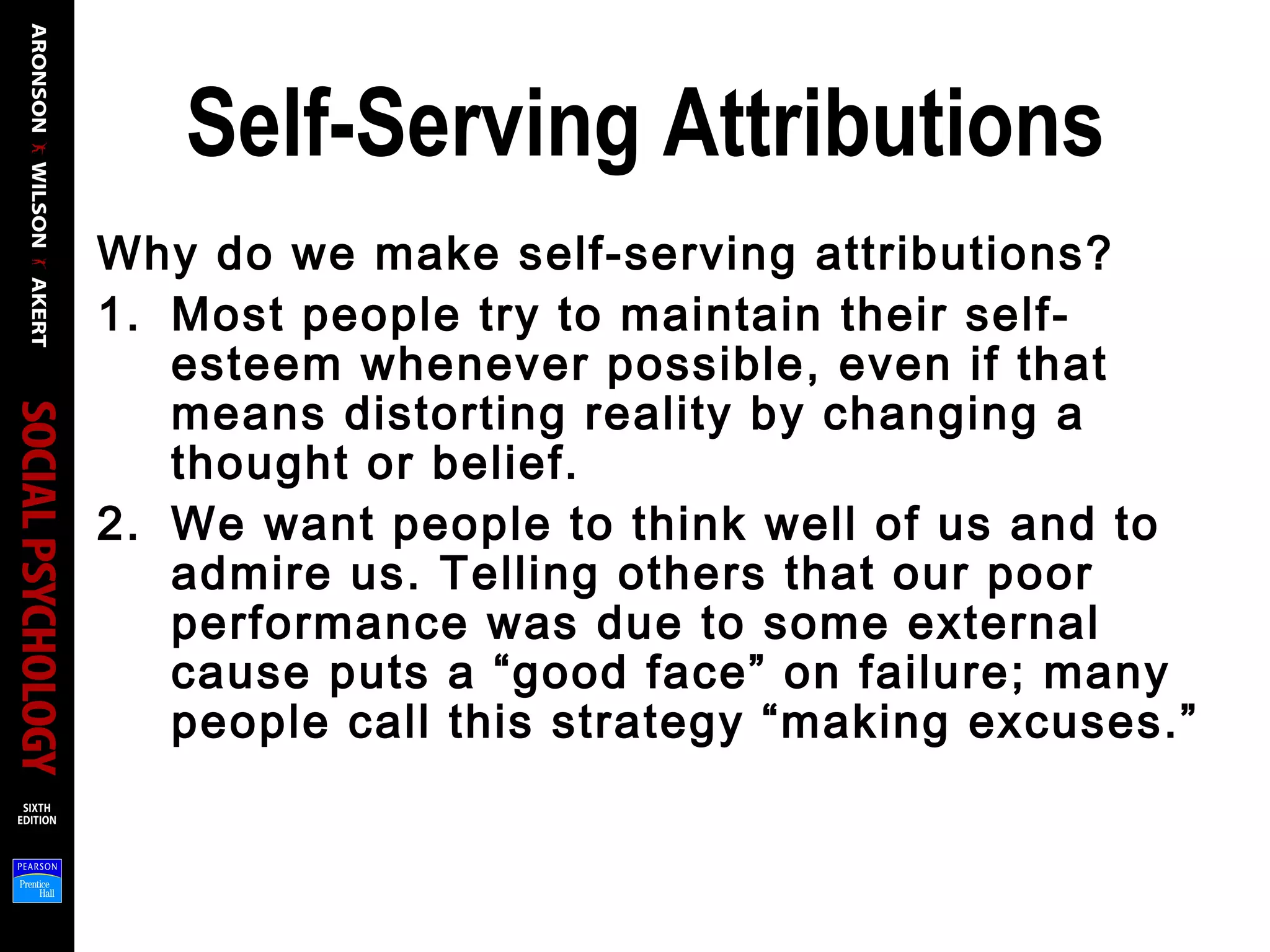
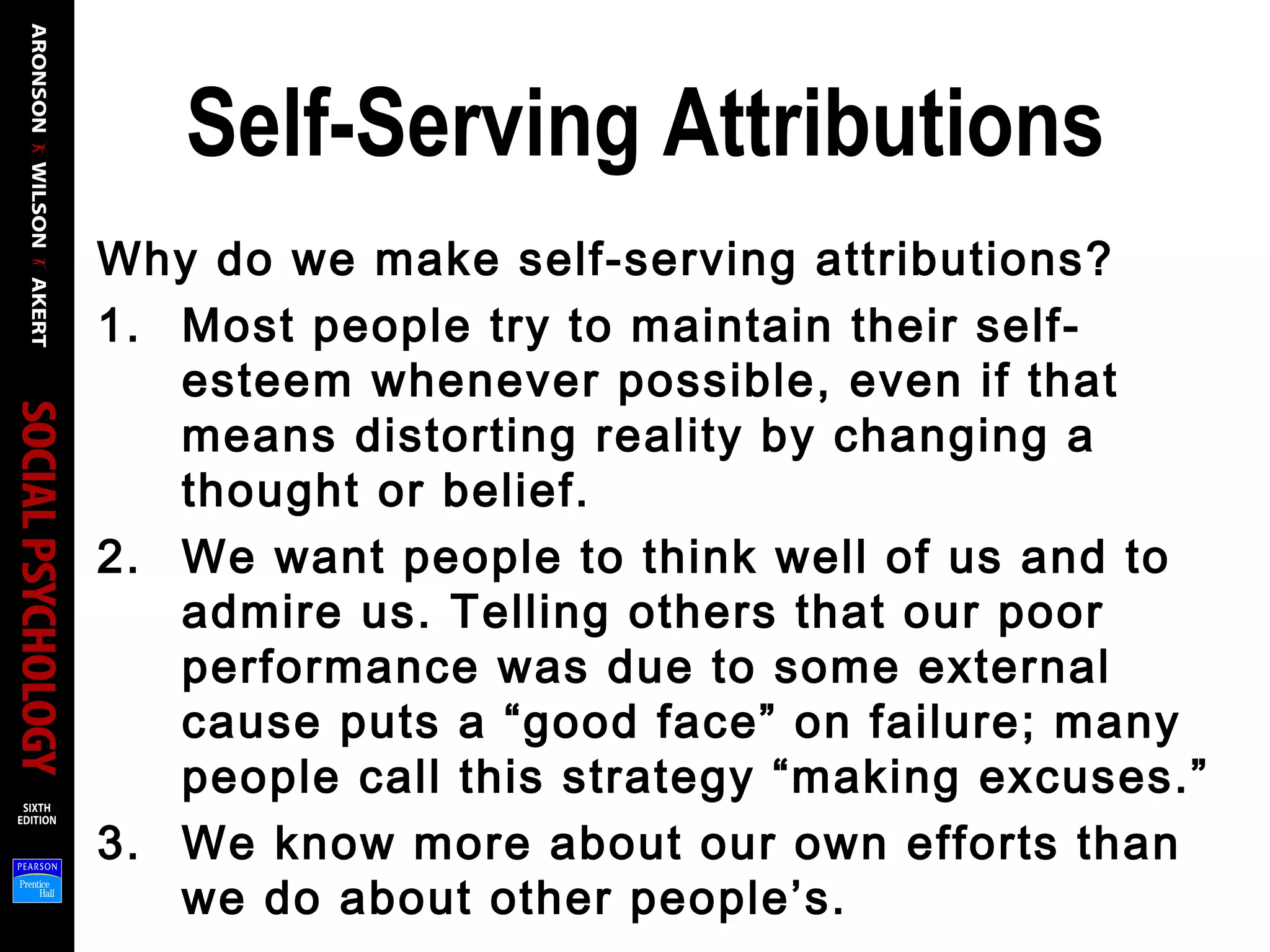
Why do we make self-serving attributions?
1. Most people try to maintain their self-
esteem whenever possible, even if that
means distorting reality by changing a
thought or belief.
• We are particularly likely to engage in self-
serving attributions when we fail at
something and we feel we can’t improve at
it.
• The external attribution truly protects our
self-esteem, as there is little hope we can
do better in the future.
• But if we believe we can improve, we’re
more likely to attribute our current failure to
internal causes and then work on
Self-Serving Attributions
Why do we make self-serving attributions?
1. Most people try to maintain their self-
esteem whenever possible, even if that
means distorting reality by changing a
thought or belief.
2. We want people to think well of us and to
admire us. Telling others that our poor
performance was due to some external
cause puts a “good face” on failure; many
people call this strategy “making excuses.”
Self-Serving Attributions
Why do we make self-serving attributions?
1. Most people try to maintain their self-
esteem whenever possible, even if that
means distorting reality by changing a
thought or belief.
2. We want people to think well of us and to
admire us. Telling others that our poor
performance was due to some external
cause puts a “good face” on failure; many
people call this strategy “making excuses.”
3. We know more about our own efforts than
we do about other people’s.
Self-Serving Attributions
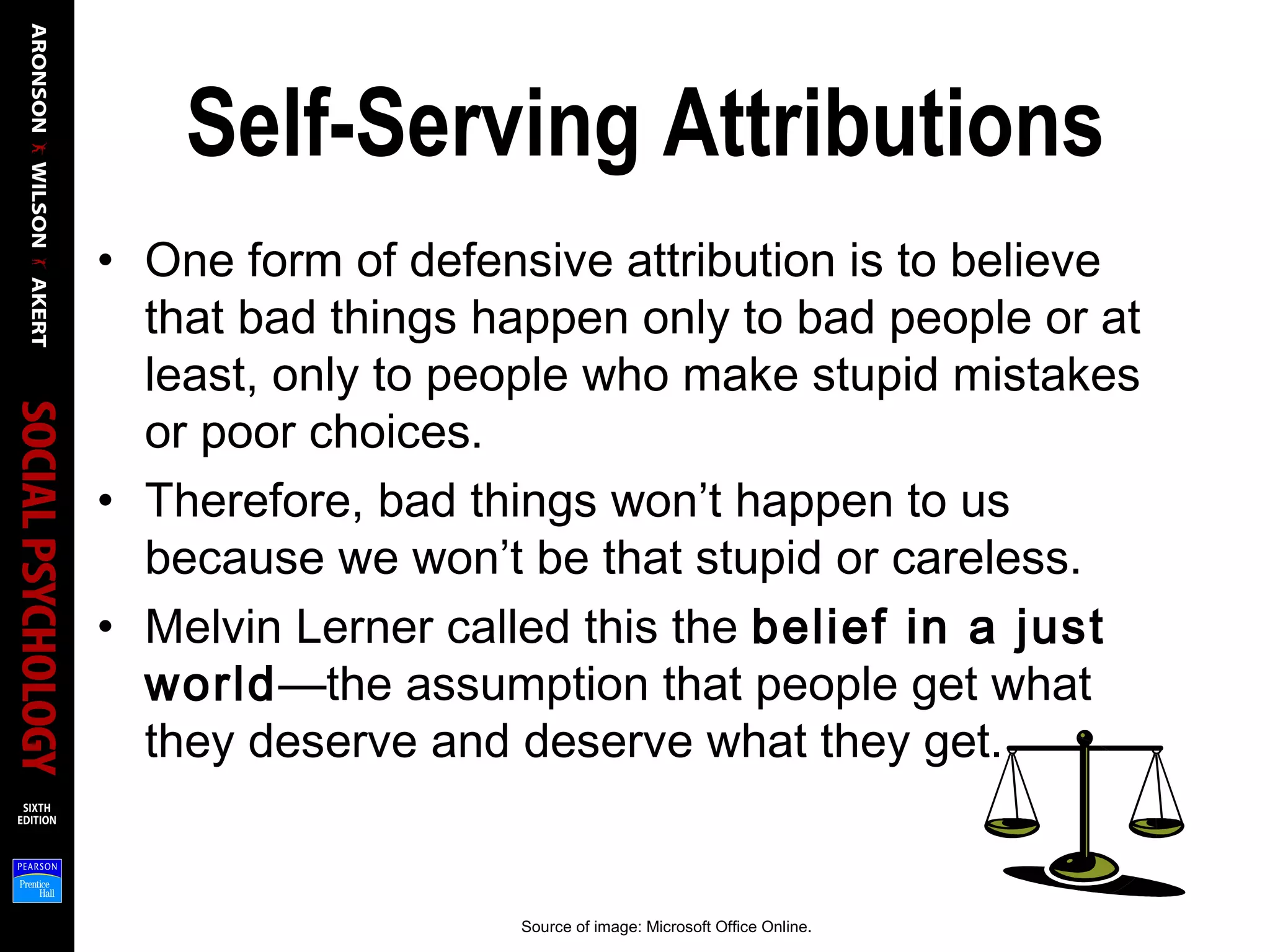
• One form of defensive attribution is to believe
that bad things happen only to bad people or at
least, only to people who make stupid mistakes
or poor choices.
• Therefore, bad things won’t happen to us
because we won’t be that stupid or careless.
• Melvin Lerner called this the belief in a just
world—the assumption that people get what
they deserve and deserve what they get.
Source of image: Microsoft Office Online.
Self-Serving Attributions
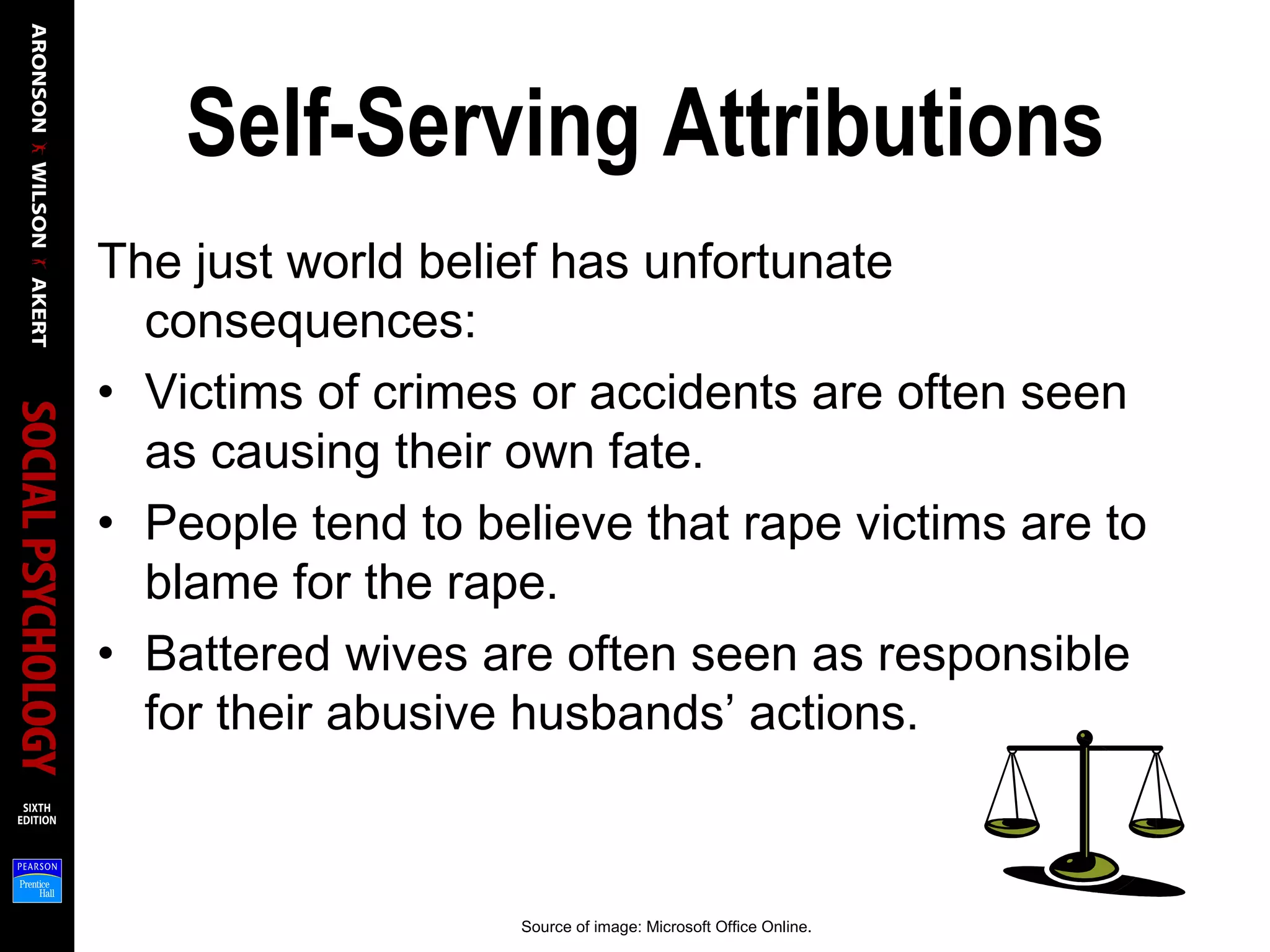
The just world belief has unfortunate
consequences:
• Victims of crimes or accidents are often seen
as causing their own fate.
• People tend to believe that rape victims are to
blame for the rape.
• Battered wives are often seen as responsible
for their abusive husbands’ actions.
Source of image: Microsoft Office Online.
Culture and Other Attributional Biases
There is some evidence for cross-
cultural differences in the Actor-
Observer Effect and in Self-
Serving and Defensive Attributions.
Typically, the difference occurs
between Western, individualistic
cultures and Eastern, collectivistic
cultures.
How Accurate Are Our Attributions
and Impressions?
Our impressions are sometimes wrong because
of the mental shortcuts we use when forming
social judgments.
To improve the accuracy of your attributions,
remember that the mental shortcuts we use,
such as the correspondence bias, can lead us
to the wrong conclusions sometimes.
Even with such biases operating, we are quite
accurate perceivers of other people.
We do very well most of the time.
In fact, most of us are more accurate than we
realize.
How Accurate Are Our Attributions
and Impressions?
Our impressions are sometimes wrong because
of the mental shortcuts we use when forming
social judgments.
To improve the accuracy of your attributions,
remember that the mental shortcuts we use,
such as the correspondence bias, can lead us
to the wrong conclusions sometimes.
Even with such biases operating, we are quite
accurate perceivers of other people.
We do very well most of the time.
In fact, most of us are more accurate than we
realize.
In short, we are capable of
making both stunningly
accurate assessments of
people and horrific
attributional mistakes.
Social Psychology
Elliot Aronson
University of California, Santa Cruz
Timothy D. Wilson
University of Virginia
Robin M. Akert
Wellesley College
slides by Travis Langley
Henderson State University
6th edition

Aronson 6e ch4_perception

  • 1.
    Social Psychology Elliot Aronson Universityof California, Santa Cruz Timothy D. Wilson University of Virginia Robin M. Akert Wellesley College slides by Travis Langley Henderson State University 6th edition
  • 2.
    Chapter 4 Social Perception: HowWe Come to Understand Other People “Things are seldom as they seem. Skim milk masquerades as cream.” – W. S. Gilbert
  • 3.
    Other people arenot easy to figure out. Why are they the way they are? Why do they do what they do? We all have a fundamental fascination with explaining other people’s behavior, but all we have to go on is observable behavior: – What people do – What they say – Facial expressions – Gestures – Tone of voice We can’t know, truly and completely, who they are and what they mean. Instead, we rely on our impressions and personal theories, putting them together as well as we can, hoping they will lead to reasonably accurate and useful conclusions.Source of image: Microsoft Office Online.
  • 4.
    Social PerceptionSocial Perception Thestudy of how we form impressions of and make inferences about other people. Source of image: Microsoft Office Online.
  • 5.
    Nonverbal Behavior • Whatdo we know about people when we first meet them? • We know what we can see and hear, and even though we know we should not judge a book by its cover, this kind of easily observable information is crucial to our first impression. • With no words at all, we can communicate volumes. Source of image: Microsoft Office Online.
  • 6.
    Nonverbal Behavior Nonverbal Communication Theway in which people communicate, intentionally or unintentionally, without words. Nonverbal cues include: • facial expressions • tone of voice • gestures • body position/movement • the use of touch • gaze
  • 7.
    Nonverbal Behavior • Wehave a special kind of brain cell called mirror neurons. • These neurons respond when we perform an action and when we see someone else perform the same action. • Mirror neurons appear to be the basis of our ability to feel empathy. • For example, when we see someone crying, these mirror neurons fire automatically and involuntarily, just as if we were crying ourselves. Source of image: Microsoft Office Online.
  • 8.
    Nonverbal Behavior Nonverbal cuesserve many functions in communication. • You can express “I’m angry” by narrowing your eyes, lowering your eyebrows, and setting your mouth in a thin, straight line. • You can convey the attitude “I like you” with smiles and extended eye contact. • And you communicate your personality traits, like being an extrovert, with broad gestures and frequent changes in voice
  • 9.
    Nonverbal Behavior Some nonverbalcues actually contradict the spoken words. • Communicating sarcasm is the classic example of verbal- nonverbal contradiction. • Think about how you’d say “I’m so happy for you” sarcastically.
  • 10.
    Facial Expressions ofEmotion Are facial expressions of emotion universal? The answer is yes, for the six major emotional expressions: anger, happiness, surprise, fear, disgust, and sadness. All humans encode or express these Source of images: Microsoft Office Online.
  • 11.
    Facial Expressions ofEmotion • Paul Ekman and others have conducted numerous studies indicating that the ability to interpret at least the six major emotions is cross-cultural—part of being human and not a product of people’s cultural experience. Source of images: Microsoft Office Online.
  • 12.
    Facial Expressions ofEmotion • Other emotions such as guilt, shame, embarrassment, and pride occur later in human development and show less universality. • These latter emotions are closely tied to social interaction. Source of images: Microsoft Office Online.
  • 13.
    Facial Expressions ofEmotion Decoding facial expressions accurately is more complicated than we have indicated, for three reasons. 1. Affect blends occur when one part of the face registers one emotion and another part, a different emotion. 2. At times people try to appear less emotional than they are so that no one will know how they really feel. 3. A third reason why decoding facial expressions can be inaccurate has to do with culture.
  • 14.
    Culture and theChannels of Nonverbal Communication Display rules are particular to each culture and dictate what kinds of emotional expressions people are supposed to show. Source of images: Microsoft Office Online.
  • 15.
    Culture and theChannels of Nonverbal Communication Examples of display rule differences: • American cultural norms discourage emotional displays in men, such as grief or crying, but allow the facial display of such emotions in women. • Japanese women will often hide a wide smile behind their hands, whereas Western women are allowed—indeed, encouraged—to smile broadly and often. • Japanese norms lead people to cover up negative facial expressions with smiles and laughter and to display fewer facial expressions in general than is true in the West. Source of image: Microsoft Office Online.
  • 16.
    Culture and theChannels of Nonverbal Communication • Members of American culture become suspicious when a person doesn’t “look them in the eye” while speaking, and they find talking to someone who is wearing dark sunglasses quite disconcerting. • Cultures vary greatly in what is considered normative use of personal space. Most Americans like to have a bubble of open space, a few feet in radius, surrounding them; in comparison, in some other cultures, strangers think nothing of standing right next to each other, to the point of touching.
  • 17.
    Culture and theChannels of Nonverbal Communication The important point about emblems is that they are not universal. Each culture has devised its own emblems, and these need not be understandable to people from other cultures. Emblems Nonverbal gestures that have well-understood definitions within a given culture; they usually have direct verbal translations, like the “OK” sign. President George H. W. Bush once used the “V for victory” sign, but he did it backward—the palm of his hand was facing him instead of the audience. Unfortunately, he flashed this gesture to a large crowd in Australia—and in Australia, this emblem is the equivalent of “flipping the bird”! Source of image: Microsoft Office Online.
  • 18.
    Multichannel Nonverbal Communication • Becausenonverbal information is diffused across these many channels, we can often rely on one channel to understand what is going on. • This increases our ability to make accurate judgments about others.
  • 19.
    Multichannel Nonverbal Communication • Exceptfor certain specific situations, such as talking on the telephone, everyday life is made up of multichannel nonverbal social interaction. • Typically, many nonverbal cues are available to us when we talk to or observe other people. • How do we use this information? • And how accurately do we use it?
  • 20.
    Gender and Nonverbal Communication Ingeneral, women are better at encoding and decoding nonverbal cues. Source of images: Microsoft Office Online.
  • 21.
    Gender and Nonverbal Communication Oneexception is that women are less accurate at detecting deception. Source of images: Microsoft Office Online.
  • 22.
    Gender and Nonverbal Communication Socialrole theory of sex differences suggests that this is because women have learned different skills, and one is to be polite and overlook lying. Source of images: Microsoft Office Online.
  • 23.
    Gender and Nonverbal Communication Accordingto Alice Eagly’s social role theory, most societies have a division of labor based on gender: • Men work in jobs outside the home. Source of images: Microsoft Office Online.
  • 24.
    Gender and Nonverbal Communication Accordingto Alice Eagly’s social role theory, most societies have a division of labor based on gender: • Men work in jobs outside the home. • Women work within the home. Source of images: Microsoft Office Online.
  • 25.
    Gender and Nonverbal Communication Thisdivision of labor has important consequences. • First, gender-role expectations arise: Members of the society expect men and women to have certain attributes that are consistent with their role. Thus women are expected to be more nurturing, friendly, expressive, and sensitive than men because of their primary role as caregivers to children and elderly family members.
  • 26.
    Gender and Nonverbal Communication Thisdivision of labor has important consequences. • Second, men and women develop different sets of skills and attitudes, based on their experiences in their gender roles. Source of images: Microsoft Office Online.
  • 27.
    Gender and Nonverbal Communication Thisdivision of labor has important consequences. • Second, men and women develop different sets of skills and attitudes, based on their experiences in their gender roles. • Finally, because women are less powerful in many societies and less likely to occupy roles of higher status, it becomes more important for women to learn to be accommodating and polite than it is for men.
  • 28.
    Implicit Personality Theories: Fillingin the Blanks. • To understand other people, we observe their behavior but we also infer their feelings, traits, and motives. • To do so, we use general notions or schemas about which personality traits go together in one person.
  • 29.
    Implicit Personality Theories: Fillingin the Blanks. Implicit Personality Theory A type of schema people use to group various kinds of personality traits together; for example, many people believe that someone who is kind is generous as well. • If someone is kind, our implicit personality theory tells us he or she is probably generous as well. • Similarly, we assume that a stingy person is also irritable.
  • 30.
    Implicit Personality Theories: Fillingin the Blanks. But relying on schemas can also lead us astray. • We might make the wrong assumptions about an individual. • We might even resort to stereotypical thinking, where our schema, or stereotype, leads us to believe that the individual is like all the other members of his or her group.
  • 31.
    Culture and ImplicitPersonality Theories These general notions, or schemas, are shared by people in a culture, and are passed from one generation to another. Source of images: Microsoft Office Online.
  • 32.
    Culture and ImplicitPersonality Theories A strong implicit personality theory in this culture involves physical attractiveness. We presume that “what is beautiful is good”—that people with physical beauty will also have a whole host of other wonderful qualities. Source of image: Microsoft Office Online.
  • 33.
    Culture and ImplicitPersonality Theories In China, an implicit personality theory describes a person who embodies traditional Chinese values: creating and maintaining interpersonal harmony, inner harmony, and ren qin (a focus on relationships). Source of image: Microsoft Office Online.
  • 34.
    Culture and ImplicitPersonality Theories In Western cultures, saying someone has an “artistic personality” implies that the person is creative, intense, and temperamental and has an unconventional lifestyle. The Chinese, however, do not have a schema or implicit personality theory for an artistic type. Source of image: Microsoft Office Online.
  • 35.
    Culture and ImplicitPersonality Theories Conversely, in China, there are categories of personality that do not exist in Western cultures. For example, a shi gú person is someone who is worldly, devoted to his or her family, socially skillful, and somewhat reserved. Source of image: Microsoft Office Online.
  • 36.
    Causal Attribution: Answering the“Why” Question If an acquaintance says, “It’s great to see you!” does she really mean it? The point is that even though nonverbal communication is sometimes easy to decode and our implicit personality theories can streamline the way we form impressions, there is still substantial ambiguity as to what a person’s behavior really means. • Perhaps she is acting more thrilled than she really feels, out of politeness. • Perhaps she is outright lying and really can’t stand you. Source of image: Microsoft Office Online.
  • 37.
    Causal Attribution: Answering the“Why” Question According to attribution theory, we try to determine why people do what they do in order to uncover the feelings and traits that are behind their actions. This helps us understand and predict our social world.
  • 38.
    The Nature ofthe Attribution Process Fritz Heider (1958) is frequently referred to as the father of attribution theory. Heider discussed what he called “naive” or “commonsense” psychology. In his view, people were like amateur scientists, trying to understand other people’s behavior by piecing together information until they arrived at a reasonable explanation or cause. Heider was intrigued by what seemed reasonable to people and by how they arrived at their conclusions.
  • 39.
    The Nature ofthe Attribution Process When trying to decide what causes people’s behavior, we can make one of two attributions: • An internal, dispositional attribution or • An external, situational attribution.
  • 40.
    Internal Attribution The inferencethat a person is behaving in a certain way because of something about the person, such as attitude, character, or personality. External Attribution The inference that a person is behaving a certain way because of something about the situation he or she is in. The assumption is that most people would respond the same way in that situation.
  • 41.
    The Nature ofthe Attribution Process Satisfied spouses tend to show one pattern: • Internal attributions for their partners’ positive behaviors (e.g., “She helped me because she’s such a generous person”). • External attributions for their partners’ negative behaviors (e.g., “He said something mean because he’s so stressed at work this week”). In contrast, spouses in distressed marriages tend to display the opposite pattern: • Their partners’ positive behaviors are chalked up to external causes (e.g., “She helped me because she wanted to impress our friends”). • Negative behaviors are attributed to internal causes (e.g., “He said something mean because he’s a totally self- centered jerk”).
  • 42.
    The Nature ofthe Attribution Process Although either type of attribution is always possible, Heider (1958) noted that we tend to see the causes of a person’s behavior as residing in that person (internal explanation). • We are perceptually focused on people— they are who we notice. • The situation (the external explanation), which is often hard to see and hard to describe, may be overlooked.
  • 43.
    The Covariation Model: Internalversus External Attributions Harold Kelley’s major contribution to attribution theory was the idea that we notice and think about more than one piece of information when we form an impression of another person. Covariation Model A theory that states that to form an attribution about what caused a person’s behavior, we systematically note the pattern between the presence or absence of possible causal factors and whether or not the behavior occurs.
  • 44.
    The Covariation Model: Internalversus External Attributions The covariation model focuses on observations of behavior across time, place, actors, and targets. It examines how the perceiver chooses either an internal or an external attribution. We make such choices by using information on: • Consensus, • Distinctiveness, • Consistency.
  • 45.
    Consensus Information Information aboutthe extent to which other people behave the same way toward the same stimulus as the actor does. Distinctiveness Information Information about the extent to which one particular actor behaves in the same way to different stimuli. Consistency Information Information about the extent to which the behavior between one actor and one stimulus is the same across time and circumstances.
  • 46.
    The Correspondence Bias: Peopleas Personality Psychologists Specific errors or biases plague the attribution process. One common shortcut is the correspondence bias: the tendency to believe that people’s behavior matches (corresponds to) their dispositions.
  • 47.
    The Correspondence Bias: Peopleas Personality Psychologists • The pervasive, fundamental theory or schema most of us have about human behavior is that people do what they do because of the kind of people they are, not because of the situation they are in. • When thinking this way, we are more like personality psychologists, who see behavior as stemming from internal dispositions and traits, than like social psychologists, who focus on the impact of social situations on behavior.
  • 48.
    The Correspondence Bias: Peopleas Personality Psychologists The correspondence bias is so pervasive that many social psychologists call it the fundamental attribution error. Source of image: Microsoft Office Online.
  • 49.
    The Correspondence Bias: Peopleas Personality Psychologists One reason is that when we try to explain someone’s behavior, our focus of attention is usually on the person, not on the surrounding situation. If we don’t know someone made a F earlier in the day, we can’t use that situational information to help us understand her current behavior. And even when we know her situation, we still don’t know how she interprets it. The F may not have upset her if she’s planning to drop the course anyway. Source of image: Microsoft Office Online.
  • 50.
    The Correspondence Bias: Peopleas Personality Psychologists We can’t see the situation, so we ignore its importance. People, not the situation, have perceptual salience for us. We pay attention to them, and we tend to think that they alone cause their behavior. Perceptual Salience The seeming importance of information that is the focus of people’s attention. Source of image: Microsoft Office Online.
  • 51.
    The Correspondence Bias: Peopleas Personality Psychologists The culprit is one of the mental shortcuts we discussed in Chapter 3: the anchoring and adjustment heuristic. The correspondence bias is another byproduct of this shortcut. When making attributions, people use the focus of their attention as a starting point. Source of image: Microsoft Office Online.
  • 52.
    The Two-Step Process Insum, we go through a two-step process when we make attributions. 1. First, we make an internal attribution; we assume that a person’s behavior was due to something about that person. 2. Then we attempt to adjust this attribution by considering the situation the person was in. But we often don’t make enough of an adjustment in this second step.
  • 54.
    The Two-Step Process Insum, we go through a two-step process when we make attributions. 1. First, we make an internal attribution; we assume that a person’s behavior was due to something about that person. 2. Then we attempt to adjust this attribution by considering the situation the person was in. But we often don’t make enough of an adjustment in this second step. Why? Because the first step occurs quickly and spontaneously whereas the second step requires more effort and conscious attention.
  • 55.
    The Two-Step Process Wewill engage in the second step of attributional processing if we • Consciously slow down and think carefully before reaching a judgment, • Are motivated to reach as accurate a judgment as possible, or • Are suspicious about the behavior of the target person (e.g., we suspect lying).
  • 58.
    Culture and theCorrespondence Bias For decades, it was taken for granted that the correspondence bias was universal: People everywhere, we thought, applied this cognitive shortcut when forming attributions. Source of image: Microsoft Office Online.
  • 59.
    Culture and theCorrespondence Bias People from individualistic and collectivistic cultures both demonstrate the correspondence bias. Members of collectivist cultures are more sensitive to situational causes of behavior and more likely to rely on situational explanations, as long as situational variables are salient.
  • 60.
    Culture and theCorrespondence Bias North American and some other Western cultures stress individual autonomy. A person is perceived as independent and self-contained; his or her behavior reflects internal traits, motives, and values. In contrast, East Asian cultures such as those in China, Japan, and Korea stress group autonomy. The individual derives his or her sense of self from the social group to which he or she belongs.
  • 61.
    Culture and theCorrespondence Bias It would be a mistake to think that members of collectivist cultures don’t make dispositional attributions. They do—it’s just a matter of degree. Source of image: Microsoft Office Online.
  • 62.
    The Actor/Observer Difference Theactor-observer difference is an amplification of the correspondence bias: We tend to see other people’s behavior as dispositionally caused, while we are more likely to see our own behavior as situationally caused. The effect occurs because perceptual salience and information availability differ for the actor and the observer. Source of image: Microsoft Office Online.
  • 63.
    The Actor/Observer Difference Actorshave more information about themselves than observers do. Actors know how they’ve behaved over the years; they know what happened to them that morning. They are far more aware than observers are of both the similarities and the differences in their behavior over time and across situations terms, actors have far more consistency and distinctiveness information about themselves than observers do.
  • 64.
    Self-Serving Attributions Self-Serving Attributions Explanationsfor one’s successes that credit internal, dispositional factors and explanations for one’s failures that blame external, situational factors. Defensive Attributions Explanations for behavior that avoid feelings of vulnerability and mortality.
  • 65.
    Self-Serving Attributions Why dowe make self-serving attributions? 1. Most people try to maintain their self- esteem whenever possible, even if that means distorting reality by changing a thought or belief. • We are particularly likely to engage in self- serving attributions when we fail at something and we feel we can’t improve at it. • The external attribution truly protects our self-esteem, as there is little hope we can do better in the future. • But if we believe we can improve, we’re more likely to attribute our current failure to internal causes and then work on
  • 66.
    Self-Serving Attributions Why dowe make self-serving attributions? 1. Most people try to maintain their self- esteem whenever possible, even if that means distorting reality by changing a thought or belief. 2. We want people to think well of us and to admire us. Telling others that our poor performance was due to some external cause puts a “good face” on failure; many people call this strategy “making excuses.”
  • 67.
    Self-Serving Attributions Why dowe make self-serving attributions? 1. Most people try to maintain their self- esteem whenever possible, even if that means distorting reality by changing a thought or belief. 2. We want people to think well of us and to admire us. Telling others that our poor performance was due to some external cause puts a “good face” on failure; many people call this strategy “making excuses.” 3. We know more about our own efforts than we do about other people’s.
  • 68.
    Self-Serving Attributions • Oneform of defensive attribution is to believe that bad things happen only to bad people or at least, only to people who make stupid mistakes or poor choices. • Therefore, bad things won’t happen to us because we won’t be that stupid or careless. • Melvin Lerner called this the belief in a just world—the assumption that people get what they deserve and deserve what they get. Source of image: Microsoft Office Online.
  • 69.
    Self-Serving Attributions The justworld belief has unfortunate consequences: • Victims of crimes or accidents are often seen as causing their own fate. • People tend to believe that rape victims are to blame for the rape. • Battered wives are often seen as responsible for their abusive husbands’ actions. Source of image: Microsoft Office Online.
  • 70.
    Culture and OtherAttributional Biases There is some evidence for cross- cultural differences in the Actor- Observer Effect and in Self- Serving and Defensive Attributions. Typically, the difference occurs between Western, individualistic cultures and Eastern, collectivistic cultures.
  • 71.
    How Accurate AreOur Attributions and Impressions? Our impressions are sometimes wrong because of the mental shortcuts we use when forming social judgments. To improve the accuracy of your attributions, remember that the mental shortcuts we use, such as the correspondence bias, can lead us to the wrong conclusions sometimes. Even with such biases operating, we are quite accurate perceivers of other people. We do very well most of the time. In fact, most of us are more accurate than we realize.
  • 72.
    How Accurate AreOur Attributions and Impressions? Our impressions are sometimes wrong because of the mental shortcuts we use when forming social judgments. To improve the accuracy of your attributions, remember that the mental shortcuts we use, such as the correspondence bias, can lead us to the wrong conclusions sometimes. Even with such biases operating, we are quite accurate perceivers of other people. We do very well most of the time. In fact, most of us are more accurate than we realize. In short, we are capable of making both stunningly accurate assessments of people and horrific attributional mistakes.
  • 73.
    Social Psychology Elliot Aronson Universityof California, Santa Cruz Timothy D. Wilson University of Virginia Robin M. Akert Wellesley College slides by Travis Langley Henderson State University 6th edition

Editor's Notes

  • #4 This basic aspect of human cognition has been exploited brilliantly by “reality TV” programmers, who cast television shows with real people, not actors, and place them in unusual or even difficult situations. This new genre of television show has proved a powerhouse. Since the original version of Survivor (2000), reality shows have crowded the top ten list of most watched shows every year. Why are these shows so popular with the American public? Because we enjoy figuring people out.
  • #6 (Ambady & Rosenthal, 1992, 1993; De Paulo & Friedman, 1998; Gifford, 1991, 1994)
  • #8 (Gallese, Fadiga, Fogassi & Rizzolatti, 1996)
  • #9 (Knapp & Hall, 2006)
  • #10 (Knapp & Hall, 2006) Nonverbal cues can also substitute for the verbal message. Hand gestures such as flashing the “OK” sign or drawing a finger across your throat convey clear messages without any words at all (Ekman, 1965).
  • #11 Darwin (1872) argued that such facial expressions then acquired evolutionary significance; being able to communicate such emotional states (e.g., the feeling of disgust, not for food but for another person or a situation) had survival value for the developing species (Hansen & Hansen, 1988; Izard, 1994; McArthur & Baron, 1983).
  • #12 Ekman and Friesen (1971) traveled to New Guinea, where they studied the decoding ability of the South Fore, a preliterate tribe that had had no contact with Western civilization. They told the Fore people brief stories with emotional content and then showed them photographs of American men and women expressing the six emotions; the Fore’s job was to match the facial expressions of emotion to the stories. They were as accurate as Western subjects had been. (Biehl et al., 1997; Ekman, 1993, 1994; Ekman et al., 1987; Elfenbein & Ambady, 2002; Haidt & Keltner, 1999; Izard, 1994)
  • #13 The six major emotions are also the first to appear in human development. Children as young as 6 months to a year express these emotions with the facial expressions we associate with adults. This is true as well for young children who have been blind from birth; they are able to encode the basic emotions even though they have never seen them displayed by adults (Eibl-Eibesfeldt, 1975; Galati, Miceli & Sini, 2001).
  • #14 By suppressing your emotional response, you are not giving your tormentor the satisfaction of knowing he or she has upset you. Psychologists have studied what happens when people suppress their negative facial expressions; their results present an interesting cautionary tale (Gross 1998; Gross & Levenson, 1993, 1997).
  • #15 For decades, Paul Ekman and his colleagues have studied the influence of culture on the facial display of emotions (Ekman & Davidson, 1994; Ekman & Friesen, 1969; Matsumoto & Ekman, 1989; Matsumoto & Kudoh, 1993). They have concluded that display rules are particular to each culture and dictate what kinds of emotional expressions people are supposed to show.
  • #16 (Henley, 1977; La France, Hecht, & Paluck, 2003) (Argyle, 1986; Aune & Aune, 1996; Gudykunst, Ting-Toomey, & Nishida, 1996; Richmond & McCroskey, 1995)
  • #17 (Hall, 1969)
  • #18 (Archer, 1997a)
  • #20 (Archer & Akert, 1998; Rosenthal, Hall, Di Matteo, Rogers, & Archer, 1979)
  • #21 Many studies have found that women are better at both decoding and encoding (Hall, 1979, 1984; Rosenthal & De Paulo, 1979).
  • #22 (De Paulo, Epstein, & Wyer, 1993; Rosenthal & De Paulo, 1979)
  • #23 Given that women are generally superior decoders, why do they lose their advantage when faced with deceit? It may be because women are more polite than men. While women have the ability to decode nonverbal cues of lying, they tend to turn off this skill in the face of deception, in polite deference to the speaker (Rosenthal & De Paulo, 1979).
  • #24 Alice Eagly (1987)
  • #25 Alice Eagly (1987)
  • #26 (Eagly & Karau, 2002).
  • #27 (Barrett, Lane, Sechrest, & Schwartz, 2000)
  • #28 (Deaux & Major, 1987; Henley, 1977) According to Eagly (1987), gender- role expectations and sex-typed skills combine to produce sex differences in social behavior, such as the differences in nonverbal behavior we just discussed. This is exactly what Judith Hall (1979) found in her cross-cultural study of nonverbal behavior .
  • #29 A schema is a mental shortcut: When all we have is a small amount of information, our schemas provide additional information to fill in the gaps (Fiske & Taylor, 1991; Markus & Zajonc, 1985). Thus when we are trying to understand other people, we can use just a few observations of a person as a starting point and then, using our schemas, create a much fuller understanding (Dweck, Chiu, & Hong, 1995; Kim & Rosenberg, 1980). Schemas allow us to form impressions quickly, without having to spend weeks with people to figure out what they are like.
  • #30 (Asch, 1946; Schneider, 1973; Sedikides & Anderson, 1994; Werth & Foerster, 2002)
  • #32 Like other beliefs, implicit personality theories are passed from generation to generation in a society, and one culture’s implicit personality theory may be very different from another’s (Anderson, 1995; Chiu, Morris, Hong, & Menon, 2000; Cousins, 1989; Vonk, 1995).
  • #33 (Dion, Berscheid, & Walster, 1972; Eagly, Ashmore, Makhijani, & Longo, 1991; Jackson, Hunter, & Hodge, 1995)
  • #34 (Cheung et al., 1996)
  • #37 (De Paulo, 1992; De Paulo, Stone, & Lassiter, 1985; Schneider, Hastorf, & Ellsworth, 1979)
  • #38 Why did that acquaintance behave as she did? To answer this “why” question, we will use our immediate observations to form more elegant and complex inferences about what people are really like and what motivates them to act as they do. How we go about answering these questions is the focus of attribution theory, the study of how we infer the causes of other people’s behavior.
  • #39 His influential book defined the field of social perception, and his legacy is still very much evident in current research (Gilbert, 1998a; Ross, 1998).
  • #40 One of Heider’s most valuable contributions is a simple dichotomy: When trying to decide why people behave as they do—for example, why a father has just yelled at his young daughter—we can make one of two attributions. One option is to make an internal attribution, deciding that the cause of the father’s behavior was something about him—his disposition, personality, attitudes, or character—an explanation that assigns the causes of his behavior internally. For example, we might decide that the father has poor parenting skills and disciplines his child in inappropriate ways. Alternatively, we might make an external attribution, deciding that something in the situation, not in the father’s personality or attitudes, caused his behavior. If we conclude that he yelled because his daughter had just stepped into the street without looking, we would be making an external attribution for his behavior.
  • #42 When an intimate relationship becomes troubled, this second pattern of attributions about one’s partner only makes the situation worse and can have dire consequences for the health and future of the relationship (Bradbury & Fincham, 1991; Fincham, Bradbury, Arias, Byrne, & Karney, 1997; Karney & Bradbury, 2000).
  • #43 (Bargh, 1994; Fletcher, Reeder, & Bull, 1990; Gilbert, 1998b; Jones, 1979, 1990; Jones & Davis, 1965; Miller, 1998)
  • #44 Kelley (1967, 1973)
  • #45 Kelley, like Heider before him, assumes that when we are in the process of forming an attribution, we gather information, or data. The data we use, according to Kelley, are how a person’s behavior “covaries” or changes across time, place, different actors, and different targets of the behavior. By discovering covariation in people’s behavior (e.g., your friend refuses to lend you her car; she agrees to lend it to others), you are able to reach a judgment about what caused their behavior.
  • #47 (Fiske & Taylor, 1991; Gilbert, 1998b; Gilbert & Jones, 1986; Gilbert & Malone, 1995; Jones, 1979, 1990)
  • #49 (Heider, 1958; Jones, 1990; Ross, 1977; Ross & Nisbett, 1991)
  • #50 (Baron & Misovich, 1993; Heider, 1944, 1958; Jones & Nisbett, 1972) (Gilbert, 1998b; Gilbert & Malone, 1995)
  • #53 (Gilbert, 1989, 1991, 1993; Krull, 1993)
  • #55 (Gilbert, 1989, 1991, 1993; Krull, 1993)
  • #56 (Burger, 1991; Fein, 1996; Hilton, Fein, & Miller, 1993; Webster, 1993)
  • #59 (Norenzayan, Choi, & Nisbett, 1999)
  • #61 (Markus & Kitayama, 1991; Menon et al., 1999, p. 703)
  • #62 Recent research indicates that a tendency to think dispositionally about others—the correspondence bias—appears in many cultures. However, members of collectivistic cultures are more aware of how the situation affects behavior and more likely to take situational effects into account (Choi, Dalal, Kim-Prieto, & Park, 2003; Choi & Nisbett, 1998; Choi, Nisbett, & Norenzayan, 1999; Krull et al., 1999; Miyamoto & Kitayama, 2002).
  • #63 (Jones & Nisbett, 1972; Hansen, Kimble, & Biers, 2001; Nisbett, Caputo, Legant, & Marecek, 1973; Robins, Spranka, & Mendelson, 1996; Watson, 1982)
  • #64 (Greenwald & Banaji, 1989; Jones & Nisbett, 1972; Krueger, Ham, & Linford, 1996; Malle & Knobe, 1997)
  • #66 (Duval & Silvia, 2002)
  • #67 (Greenberg et al., 1982; Tetlock, 1981; Weary & Arkin, 1981)
  • #68 Let’s imagine the attributional process of another student in the chemistry class, Ron, who did poorly on the midterm. Ron knows that he studied very hard for the midterm, that he typically does well on chemistry tests, and that in general he is a very good student. The D on the chemistry midterm comes as a surprise. The most logical attribution Ron can make is that the test was unfair—the D grade wasn’t due to a lack of ability or effort. The professor, however, knows that some students did well on the test; given the information that is available to the professor, it is logical for him to conclude that Ron, and not the fact that it was a difficult test, was responsible for the poor grade (Miller & Ross, 1975; Nisbett & Ross, 1980).
  • #69 Lerner (1980; 1998) (Hafer, 2000; Hafer & Begue, 2005; Lipkus, Dalbert, & Siegler, 1996)
  • #70 not only do people tend to believe that rape victims are to blame for the rape (Abrams, Viki, Masser, & Bohner, 2003; Bell, Kuriloff, & Lottes, 1994), but battered wives are often seen as responsible for their abusive husbands’ behavior (Summers & Feldman, 1984).
  • #72 (Funder, 1995; Kenny, Albright, Malloy, & Kashy, 1994). (Ambady, Bernieri, & Richeson, 2000; Archer & Akert, 1980; Costanzo & Archer, 1989)