[CHAPTER 1: INTRODUCTION TO MECHANICAL ENGINEERING DESIGN]
GIM-FC 2024
Seab Piseth | pisethseab@gmail.com | 011 70 48 25
Department of Industrial and Mechanical Engineering
Faculty of Electrical Engineering
Institute of Technology of Cambodia
MECHANICAL
CONSTRUCTION
Chapter 1: Introduction to Mechanical Engineering Design
Chapter Outline
 Design
 Mechanical Engineering
Design
 Phases and Interactions of the
Design
 Process Design Tools and
Resources
 The Design Engineer’s
Professional Responsibilities
 Standards and Codes
 Economics
 Safety and Product Liability
 Stress and Strength
 Uncertainty
 Design Factor and Factor
of Safety
 Reliability
 Dimensions and
Tolerances
 Units
 Calculations and
Significant Figures
 Design Topic
Interdependencies
 Power Transmission Case
Study Specifications
Chapter 1: Introduction to Mechanical Engineering Design
Design
 Design is an innovative and highly iterative process.
 Design is a communication-intensive activity in which both
words and pictures are used, and written and oral forms are
employed.
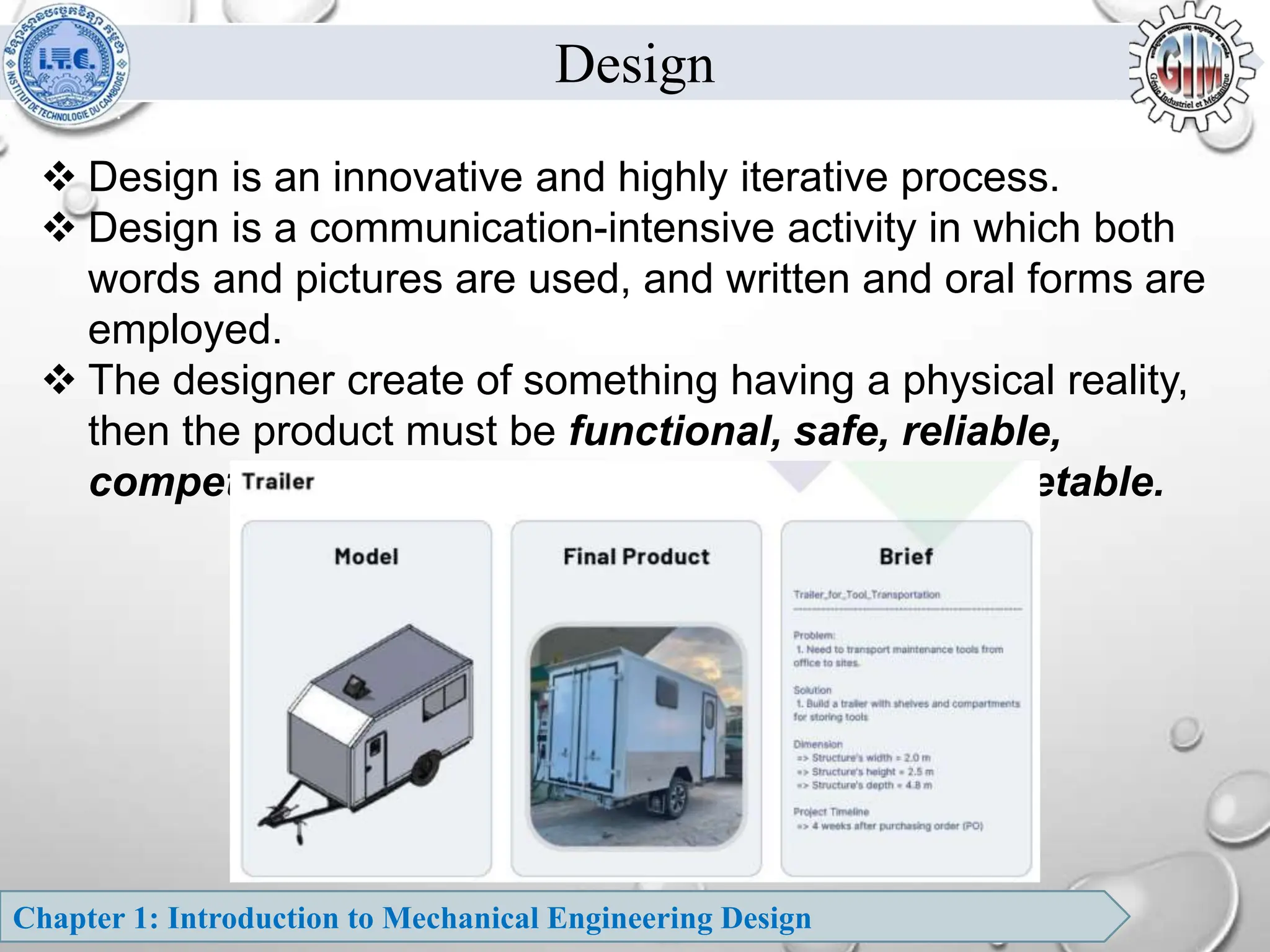
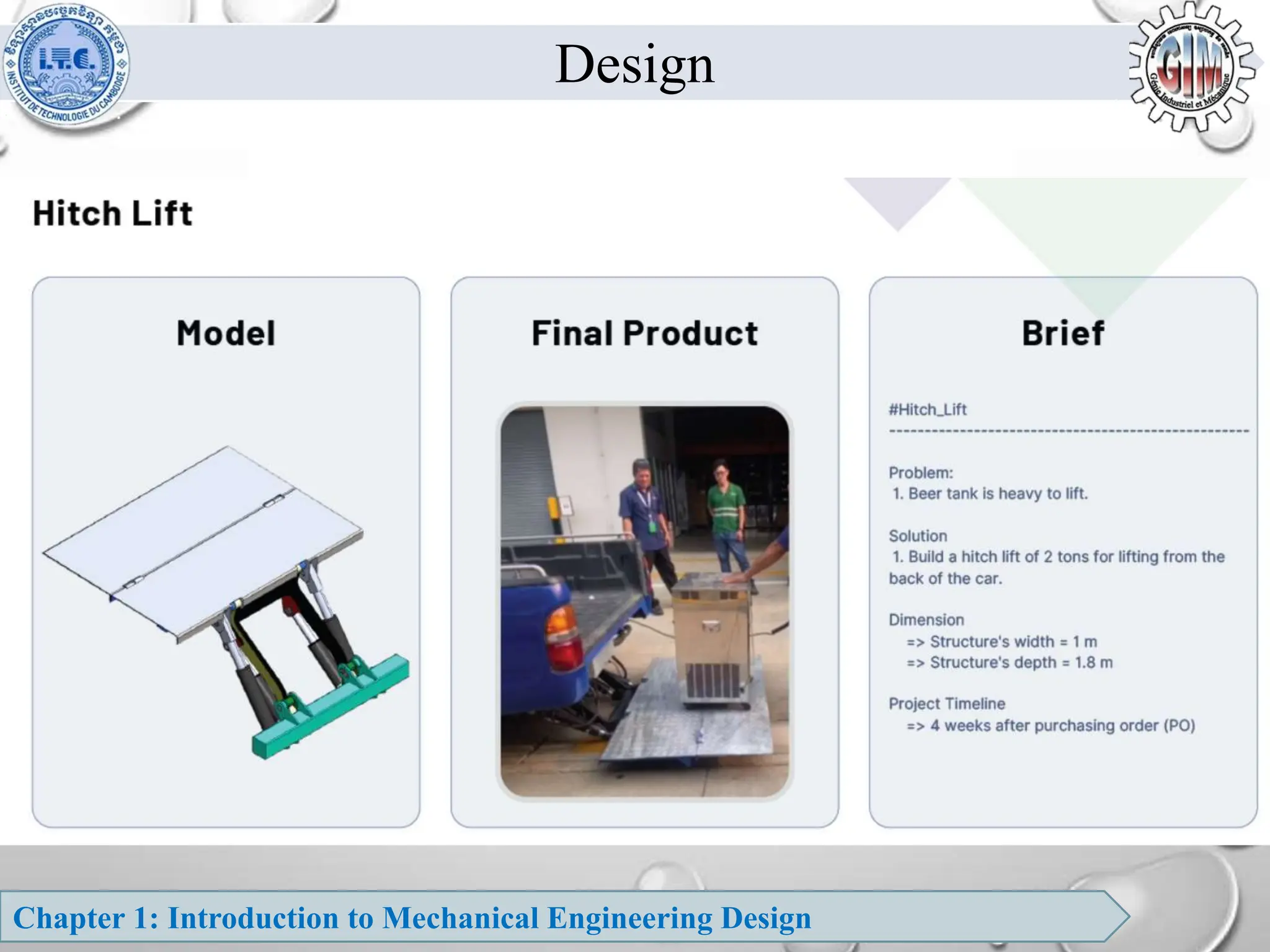
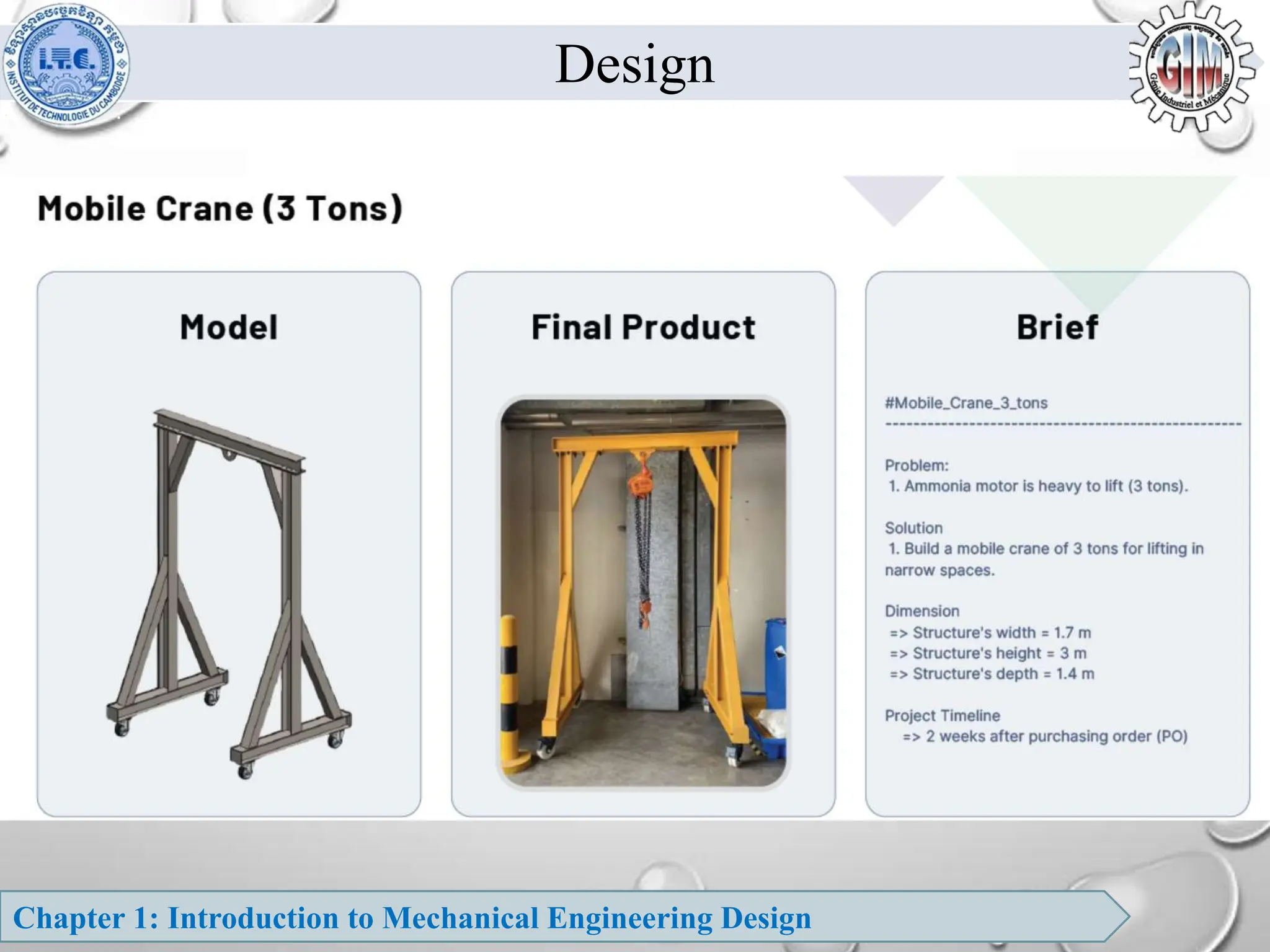
 The designer create of something having a physical reality,
then the product must be functional, safe, reliable,
competitive, usable, manufacturable, and marketable.
Chapter 1: Introduction to Mechanical Engineering Design
Design
Chapter 1: Introduction to Mechanical Engineering Design
Design
Chapter 1: Introduction to Mechanical Engineering Design
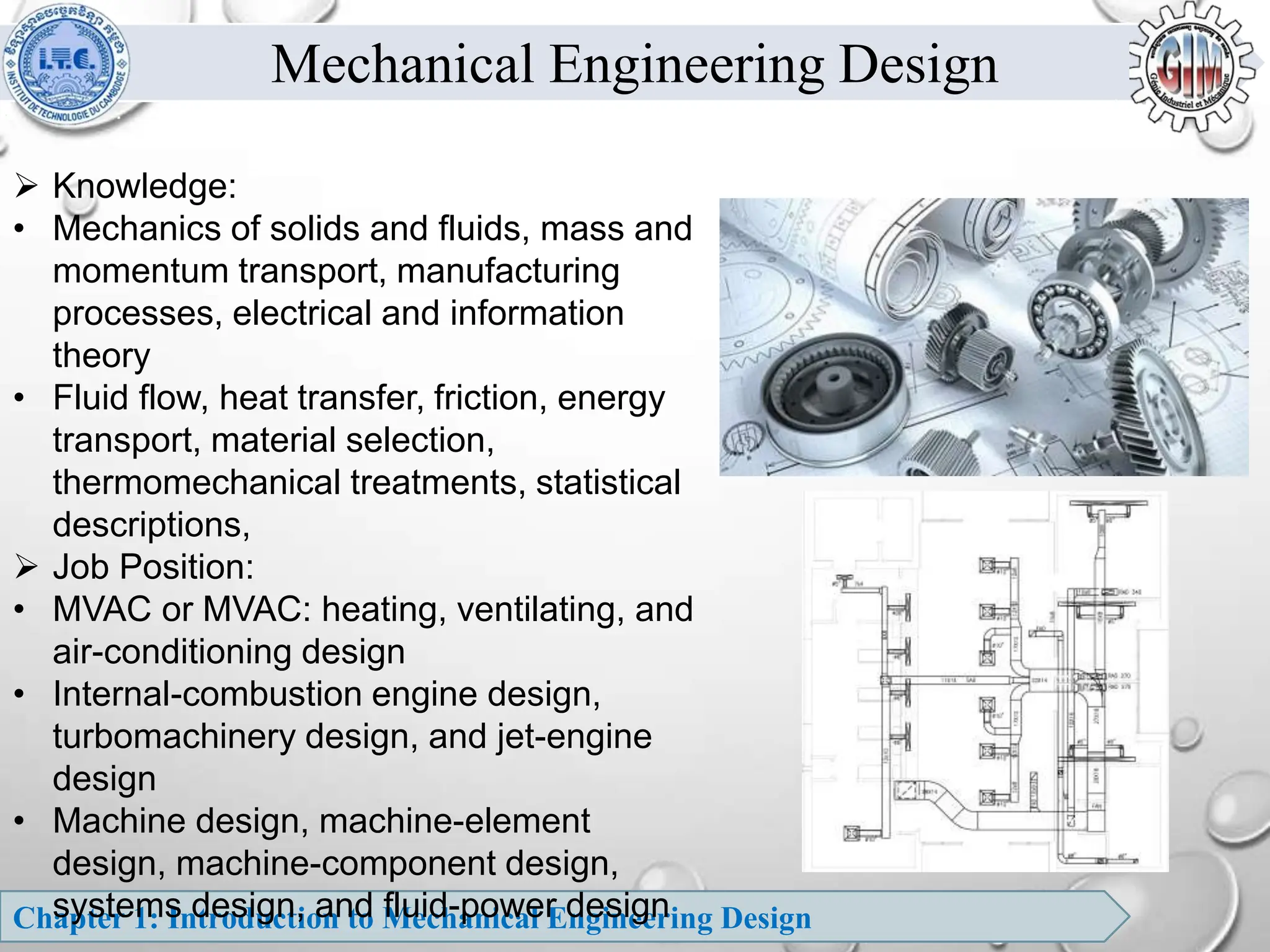
 Knowledge:
• Mechanics of solids and fluids, mass and
momentum transport, manufacturing
processes, electrical and information
theory
• Fluid flow, heat transfer, friction, energy
transport, material selection,
thermomechanical treatments, statistical
descriptions,
 Job Position:
• MVAC or MVAC: heating, ventilating, and
air-conditioning design
• Internal-combustion engine design,
turbomachinery design, and jet-engine
design
• Machine design, machine-element
design, machine-component design,
systems design, and fluid-power design
Mechanical Engineering Design
Chapter 1: Introduction to Mechanical Engineering Design
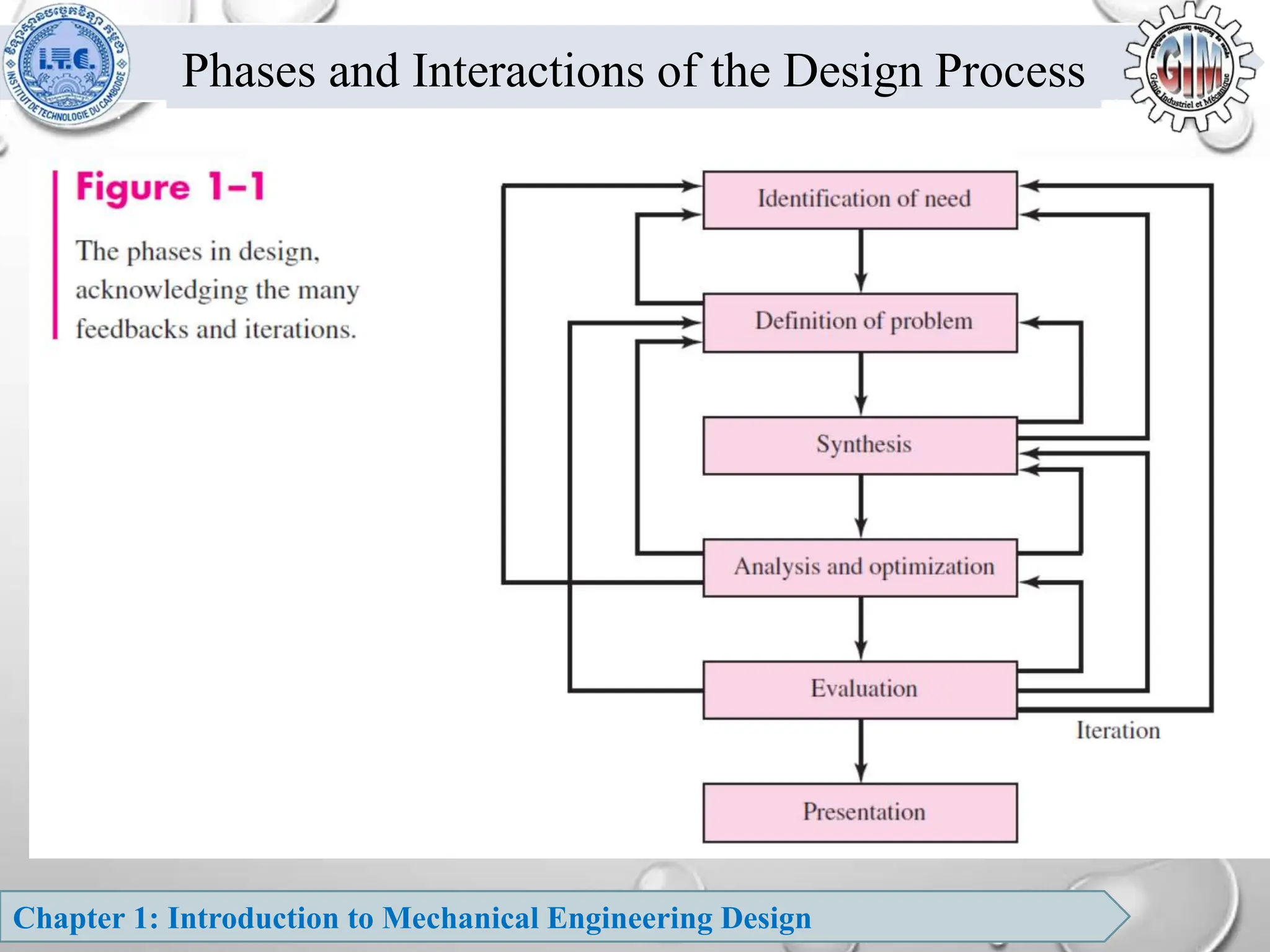
Phases and Interactions of the Design Process
Chapter 1: Introduction to Mechanical Engineering Design
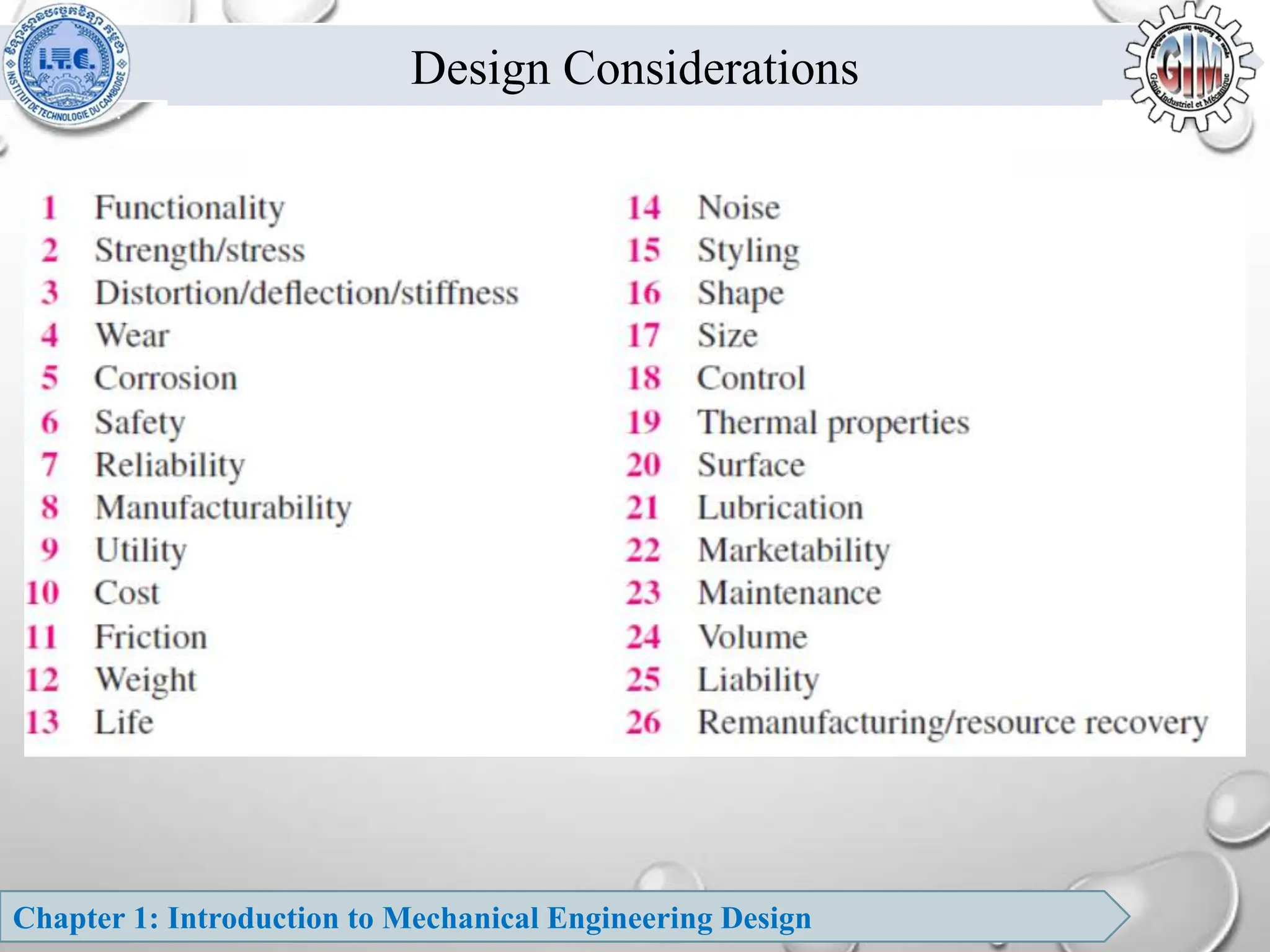
Design Considerations
Chapter 1: Introduction to Mechanical Engineering Design
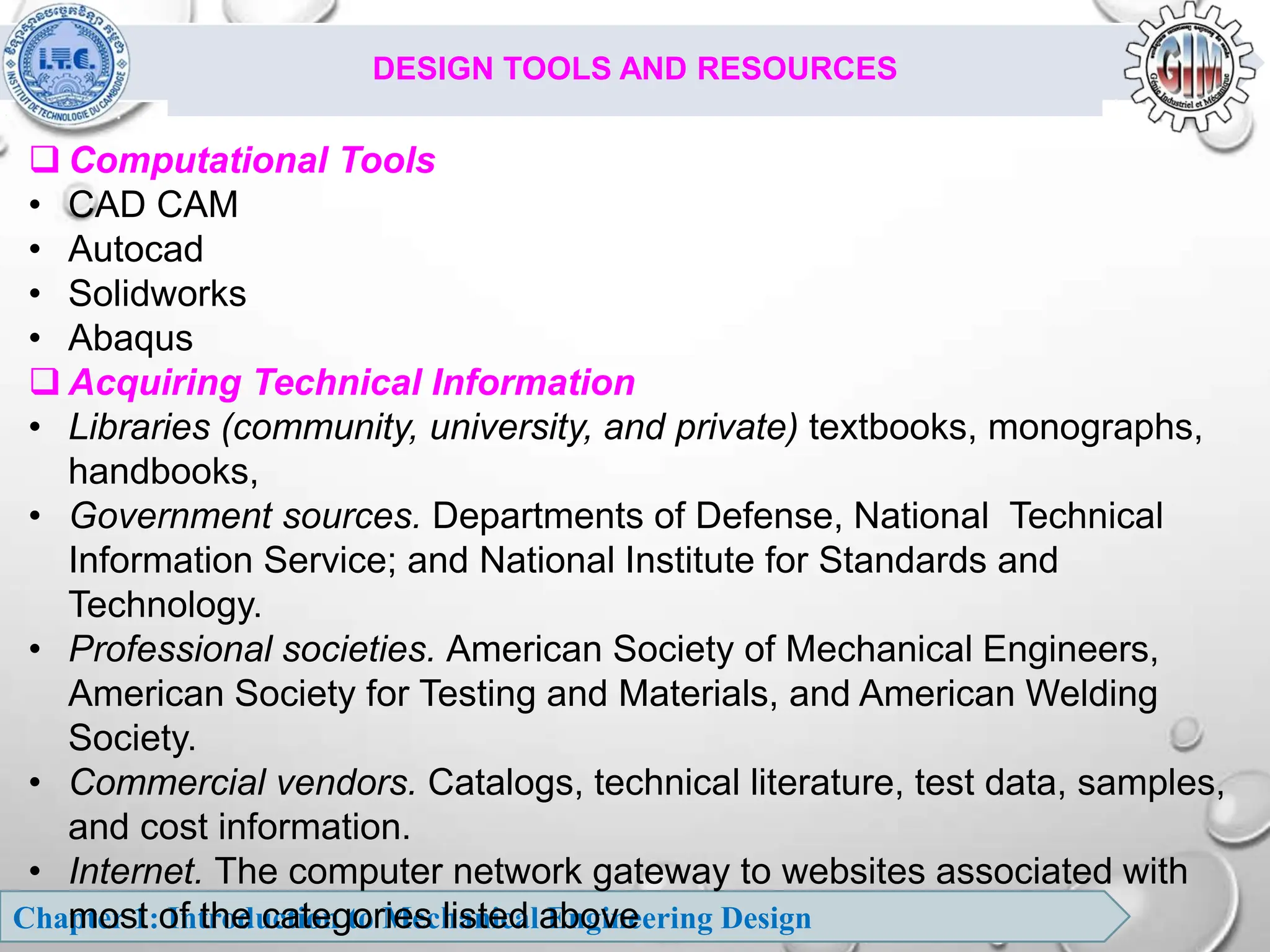
DESIGN TOOLS AND RESOURCES
 Computational Tools
• CAD CAM
• Autocad
• Solidworks
• Abaqus
 Acquiring Technical Information
• Libraries (community, university, and private) textbooks, monographs,
handbooks,
• Government sources. Departments of Defense, National Technical
Information Service; and National Institute for Standards and
Technology.
• Professional societies. American Society of Mechanical Engineers,
American Society for Testing and Materials, and American Welding
Society.
• Commercial vendors. Catalogs, technical literature, test data, samples,
and cost information.
• Internet. The computer network gateway to websites associated with
most of the categories listed above
Chapter 1: Introduction to Mechanical Engineering Design
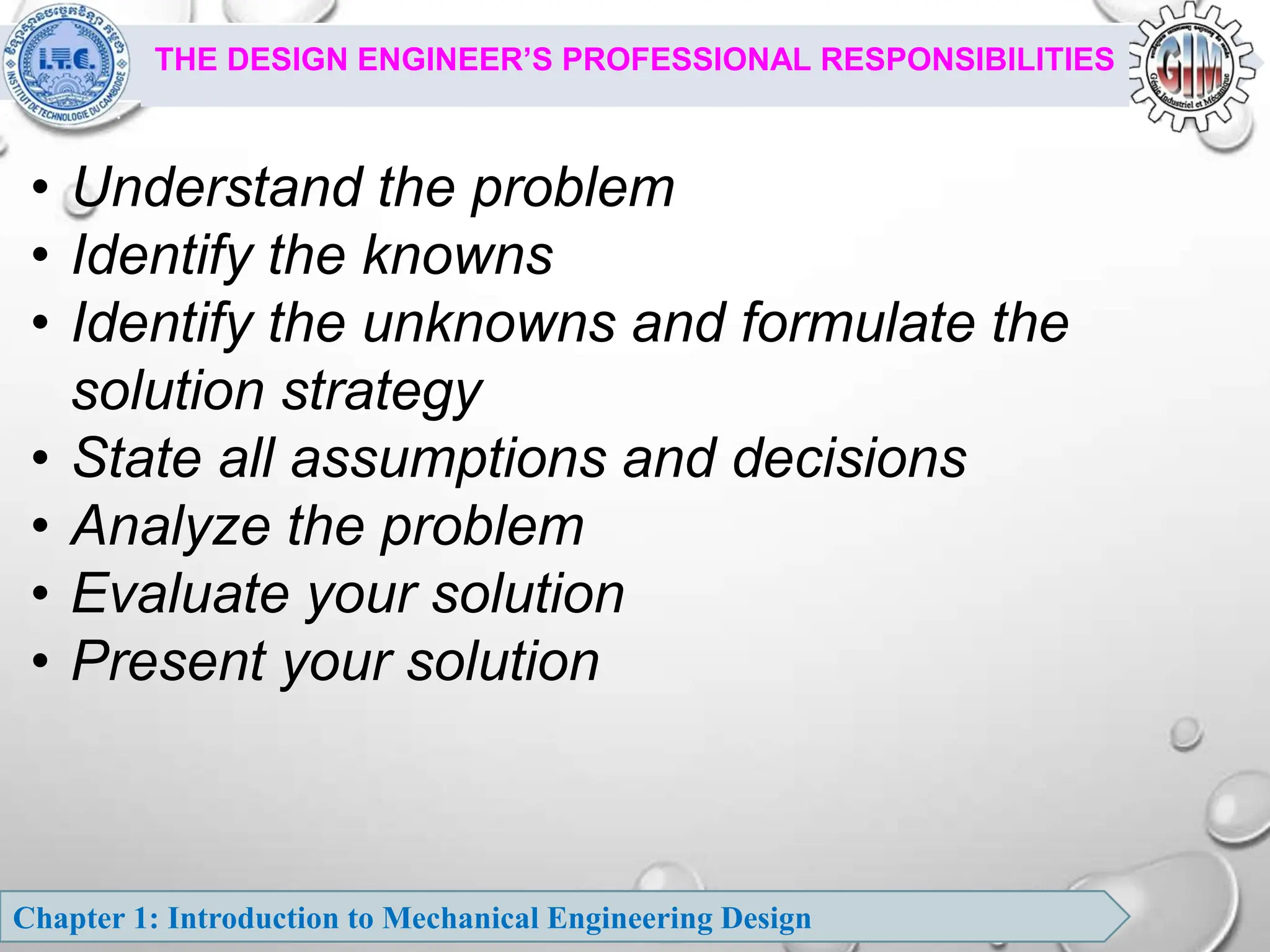
• Understand the problem
• Identify the knowns
• Identify the unknowns and formulate the
solution strategy
• State all assumptions and decisions
• Analyze the problem
• Evaluate your solution
• Present your solution
THE DESIGN ENGINEER’S PROFESSIONAL RESPONSIBILITIES
Chapter 1: Introduction to Mechanical Engineering Design
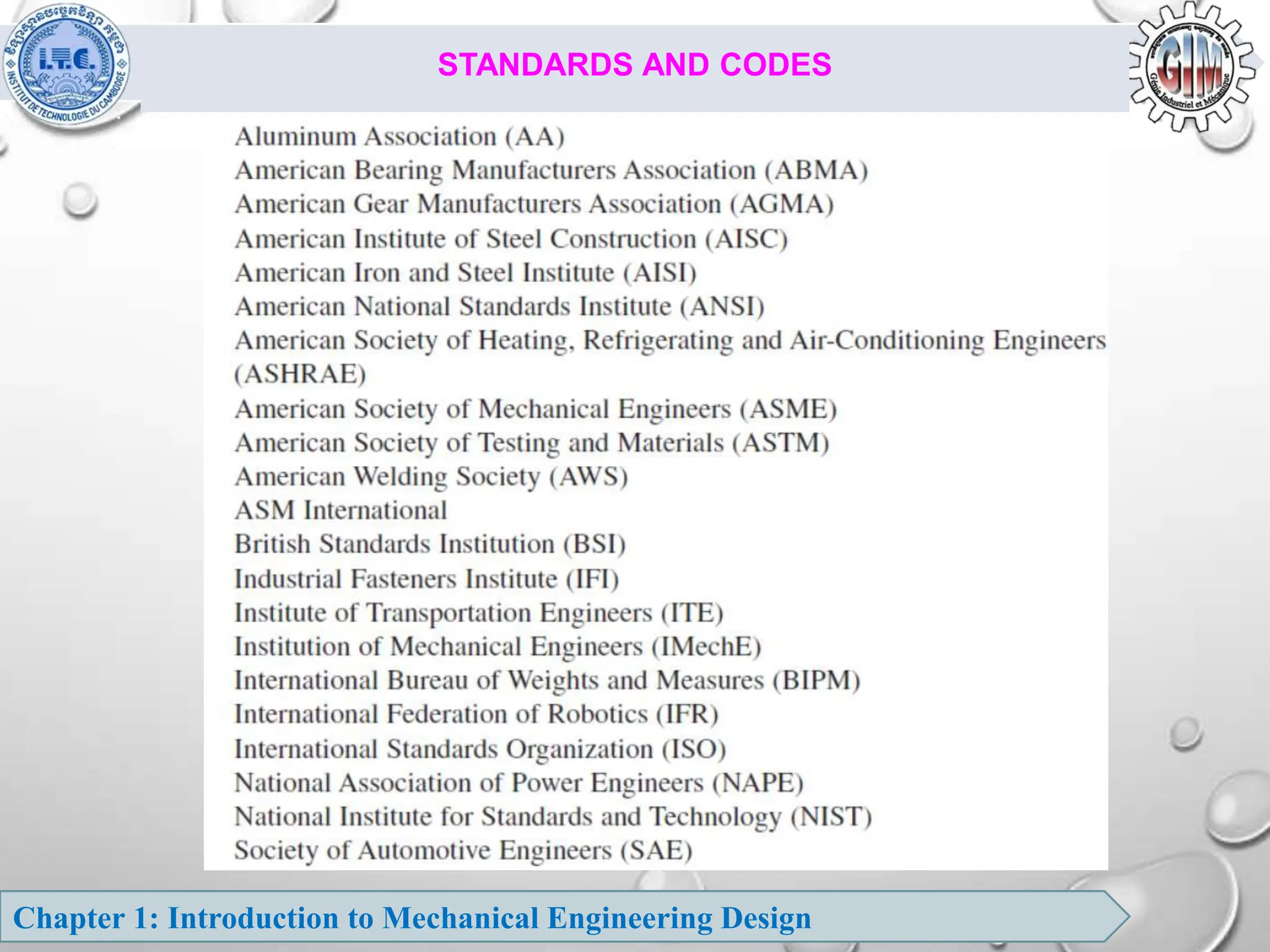
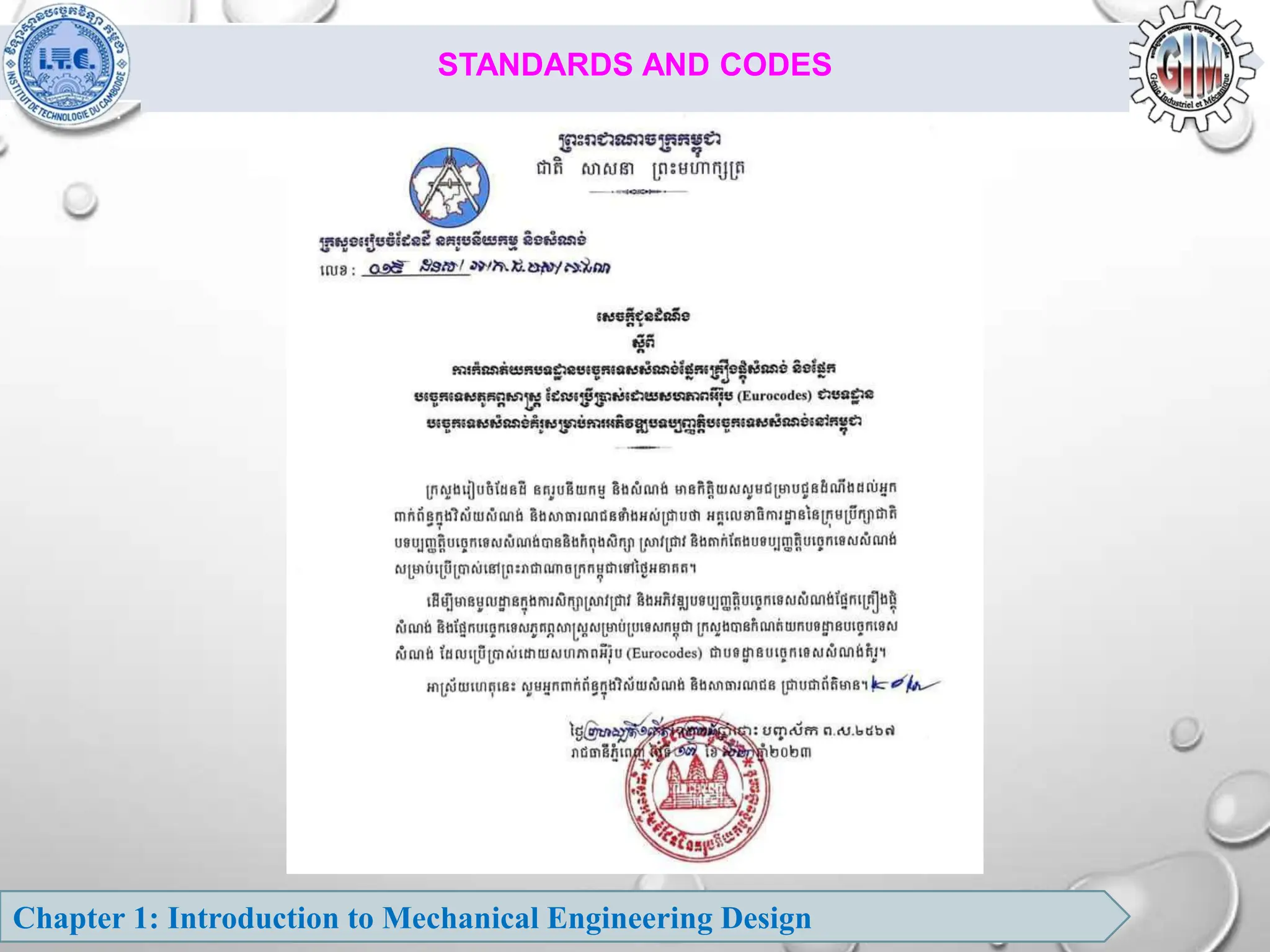
STANDARDS AND CODES
Chapter 1: Introduction to Mechanical Engineering Design
STANDARDS AND CODES
Chapter 1: Introduction to Mechanical Engineering Design
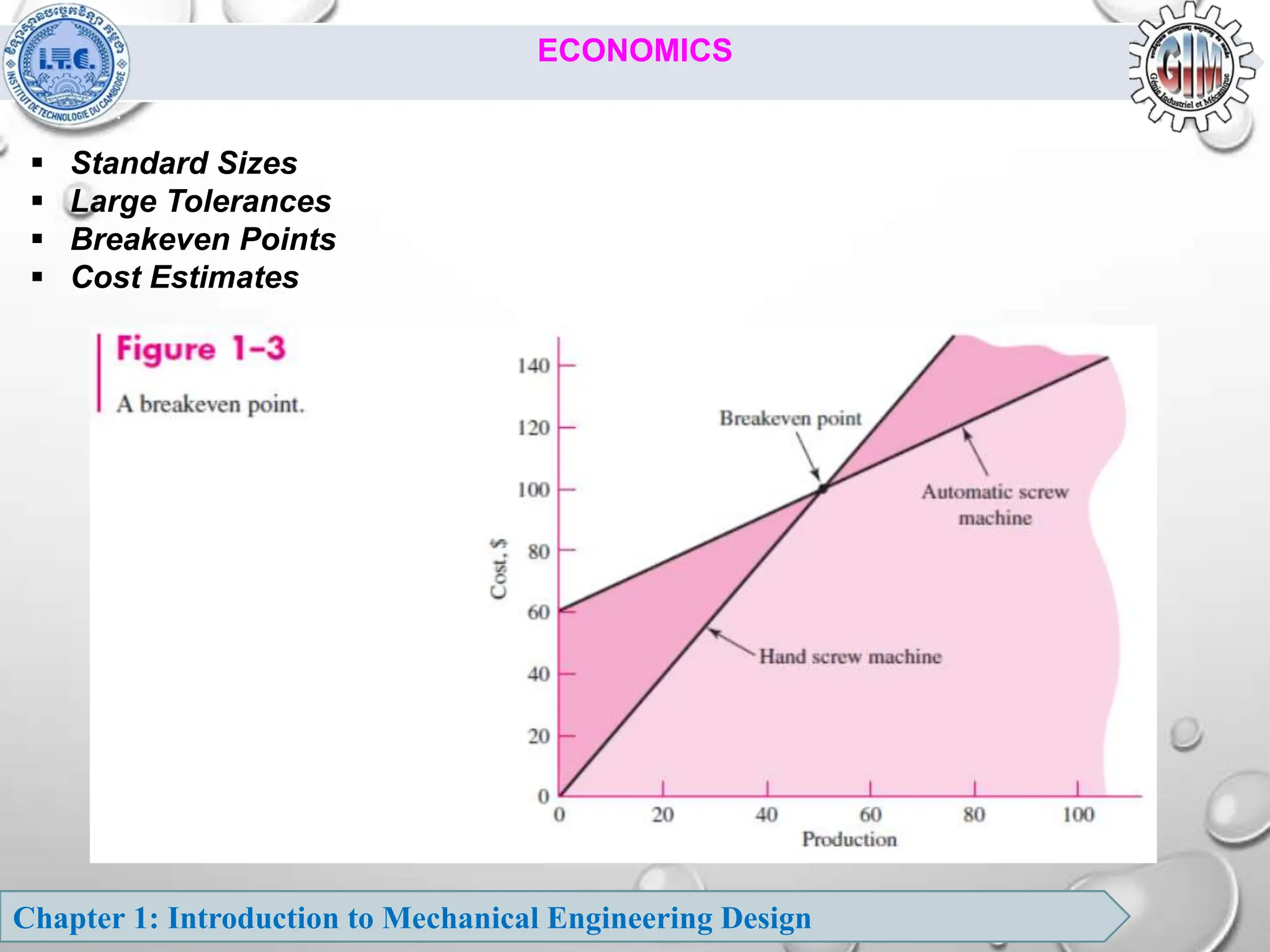
 Standard Sizes
 Large Tolerances
 Breakeven Points
 Cost Estimates
ECONOMICS
Chapter 1: Introduction to Mechanical Engineering Design
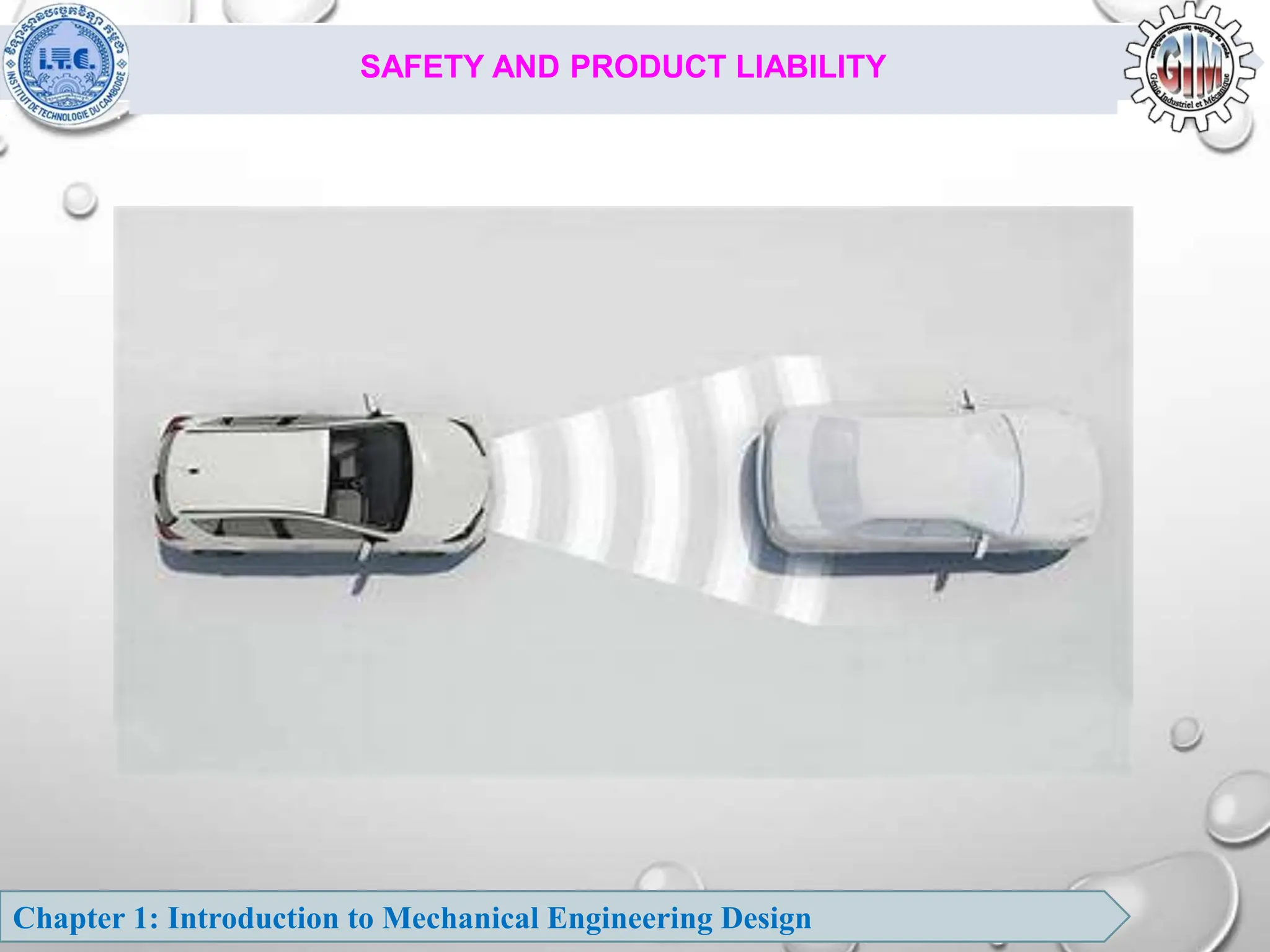
SAFETY AND PRODUCT LIABILITY
Chapter 1: Introduction to Mechanical Engineering Design
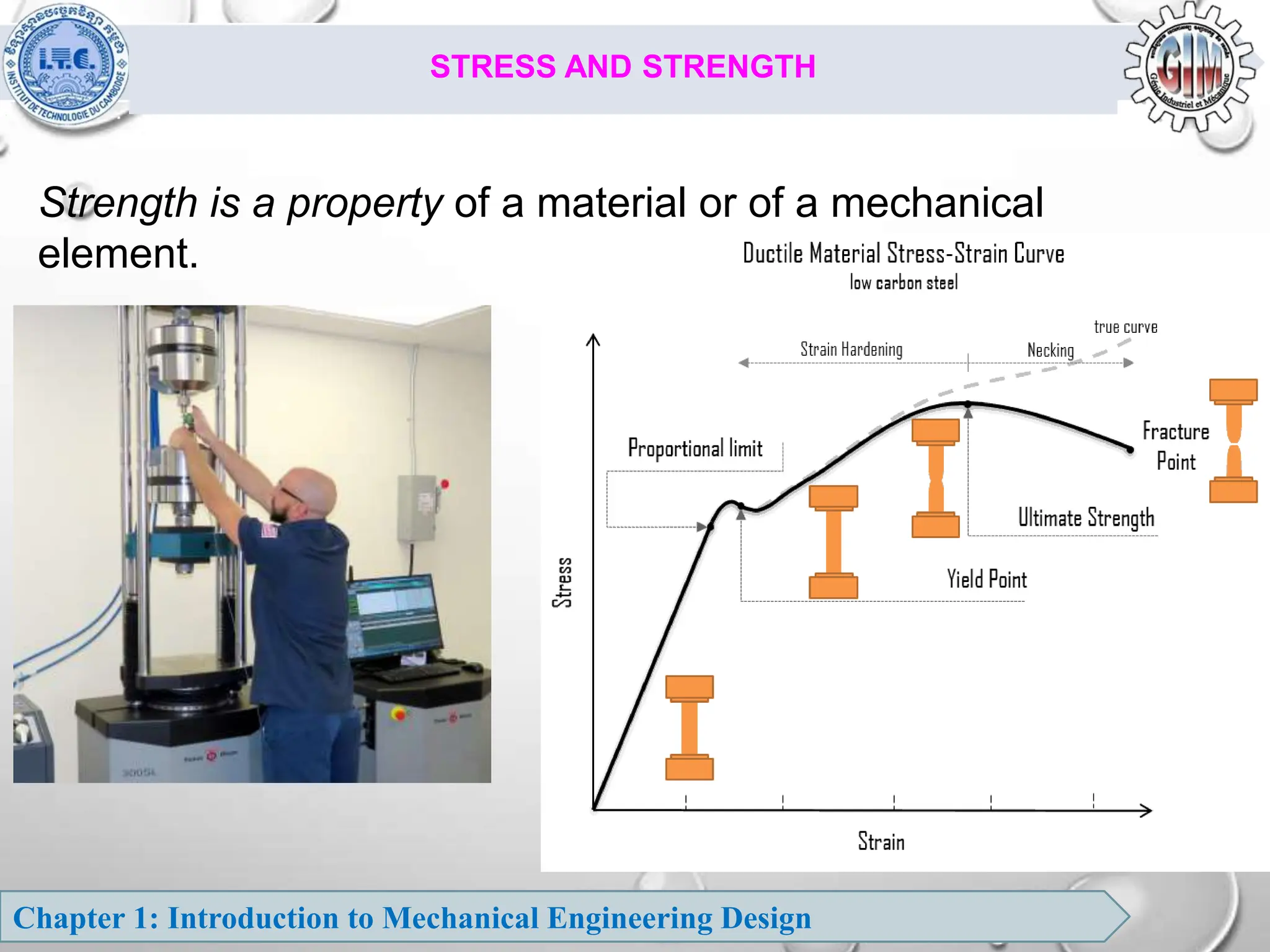
STRESS AND STRENGTH
Strength is a property of a material or of a mechanical
element.
Chapter 1: Introduction to Mechanical Engineering Design
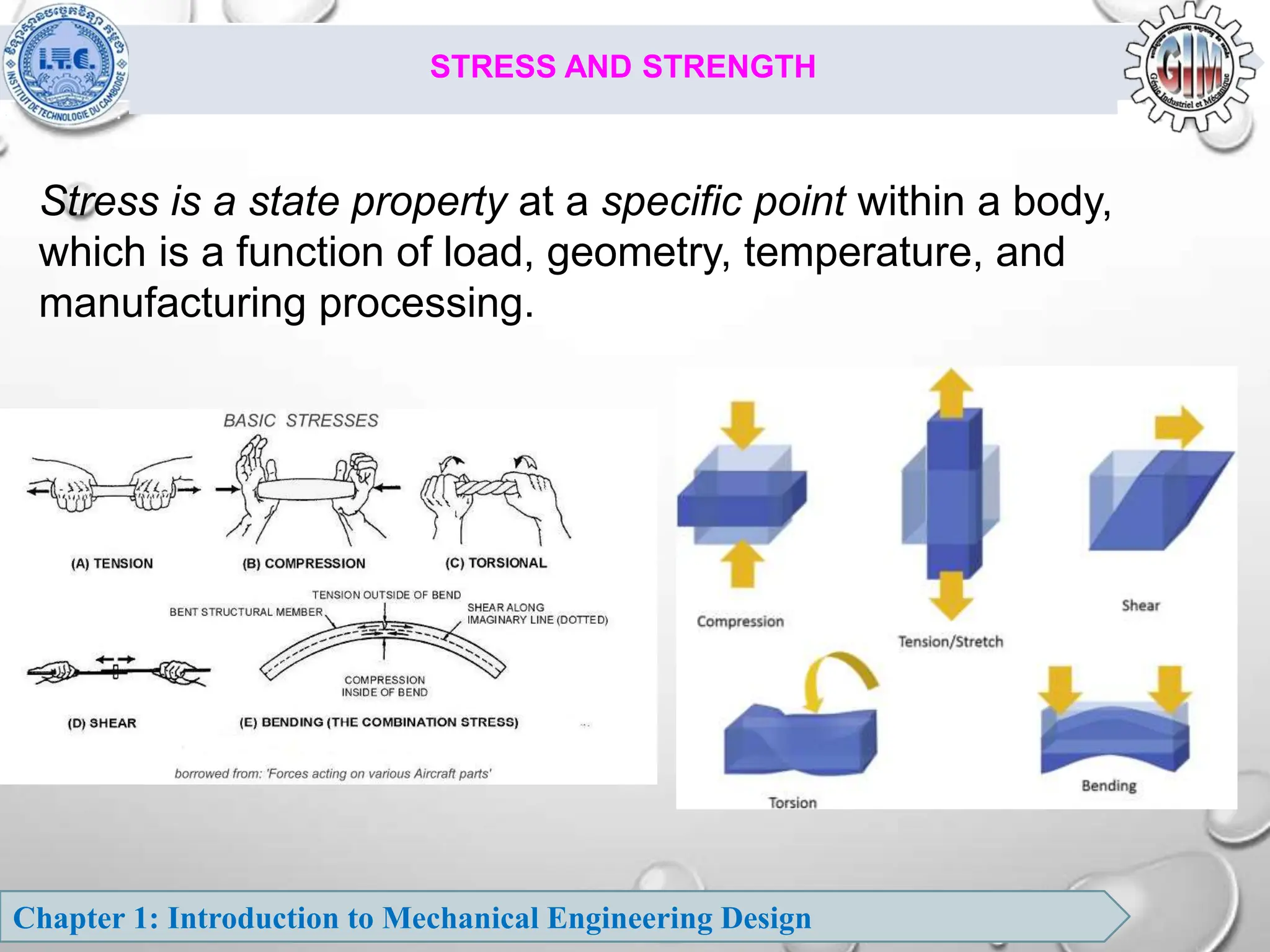
STRESS AND STRENGTH
Stress is a state property at a specific point within a body,
which is a function of load, geometry, temperature, and
manufacturing processing.
Chapter 1: Introduction to Mechanical Engineering Design
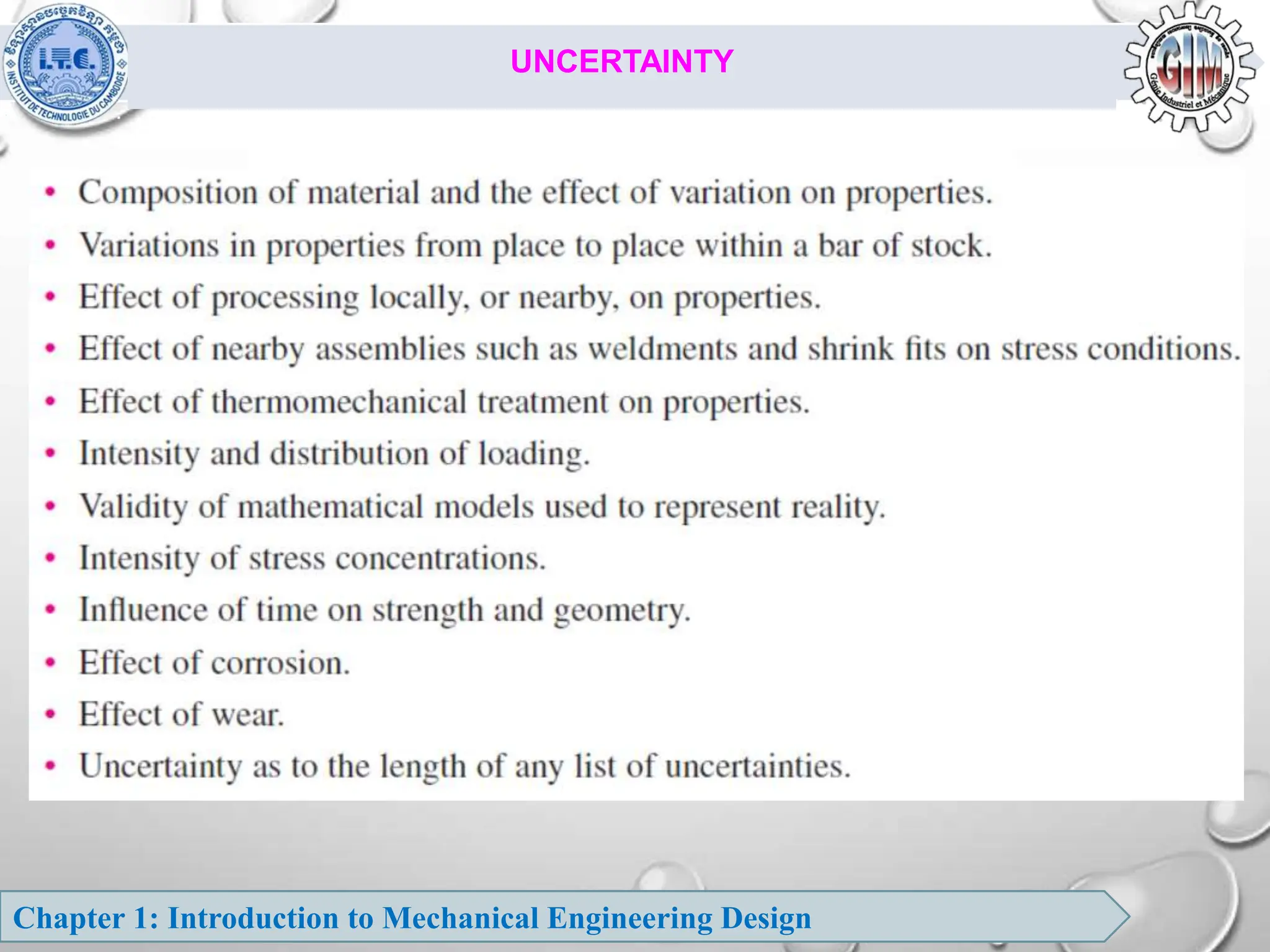
UNCERTAINTY
Chapter 1: Introduction to Mechanical Engineering Design
DESIGN FACTOR AND FACTOR OF SAFETY
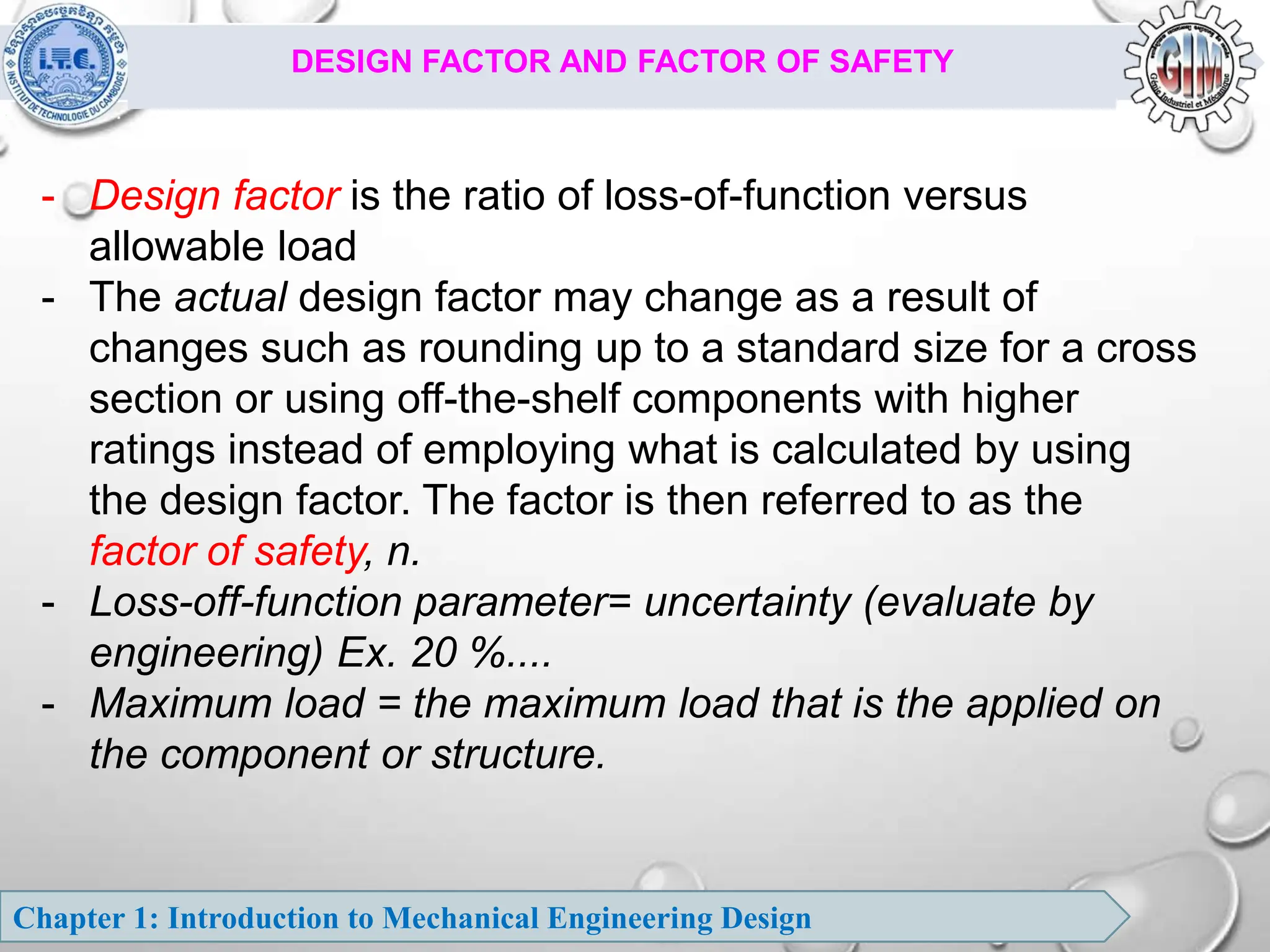
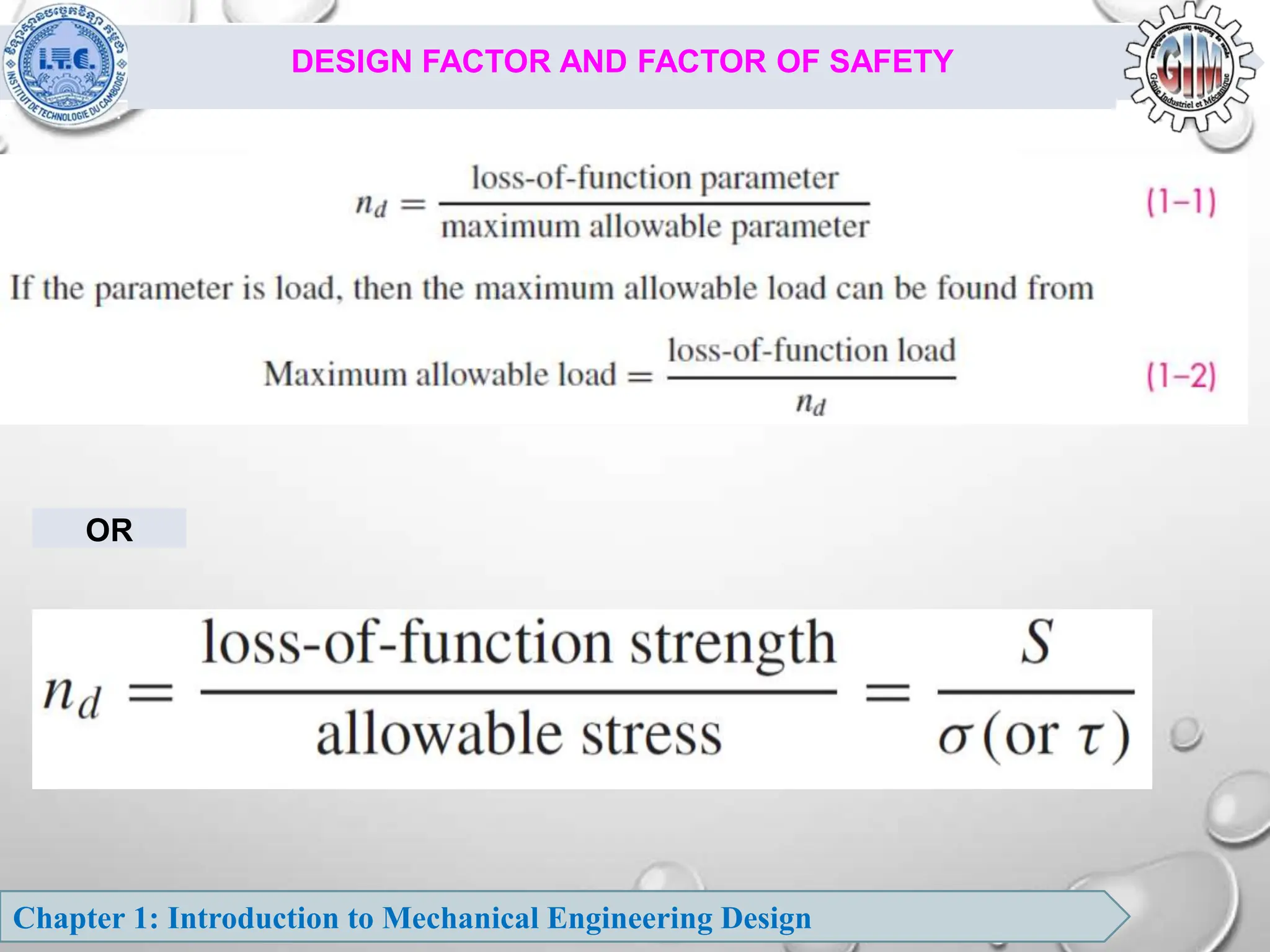
- Design factor is the ratio of loss-of-function versus
allowable load
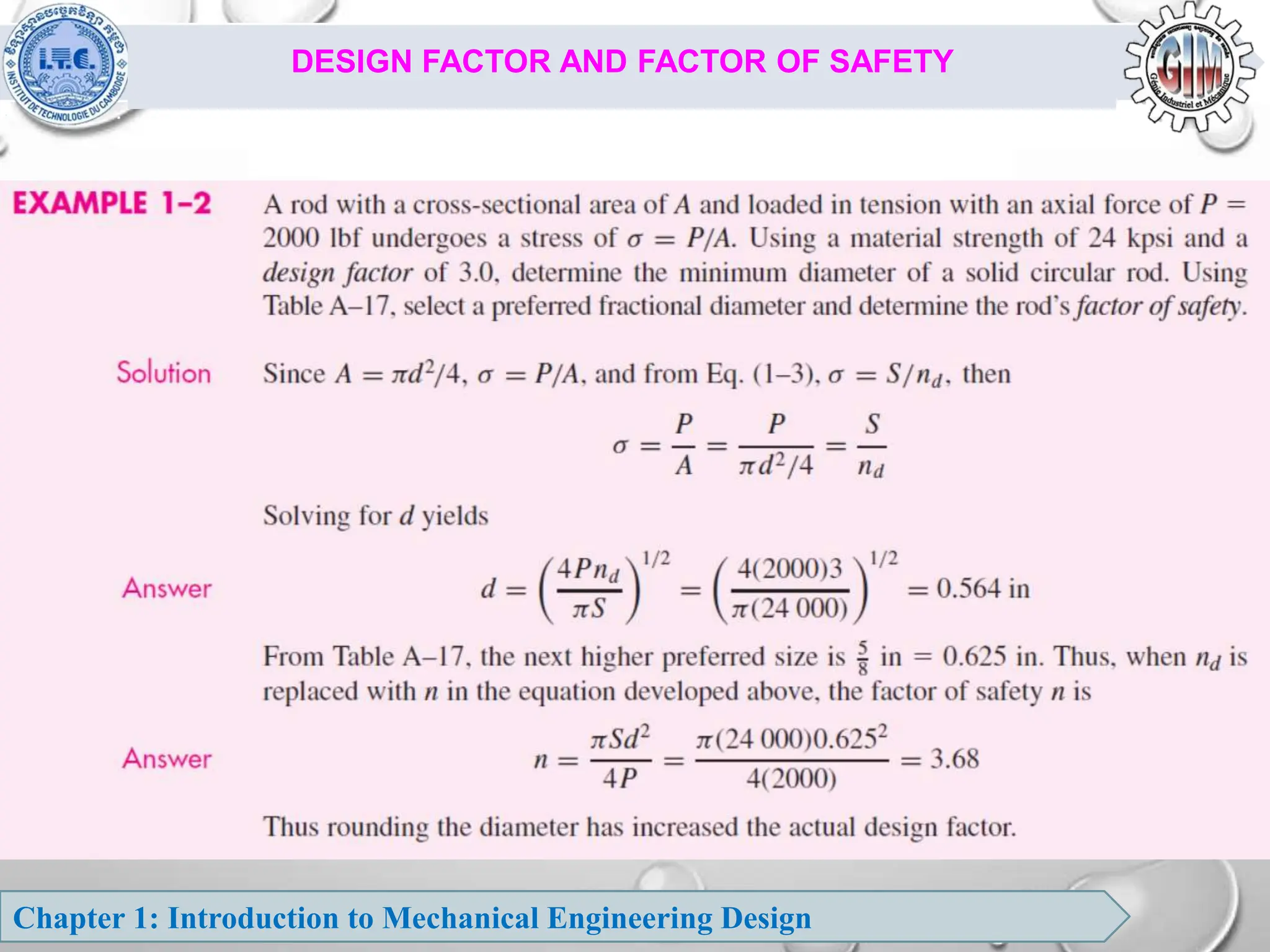
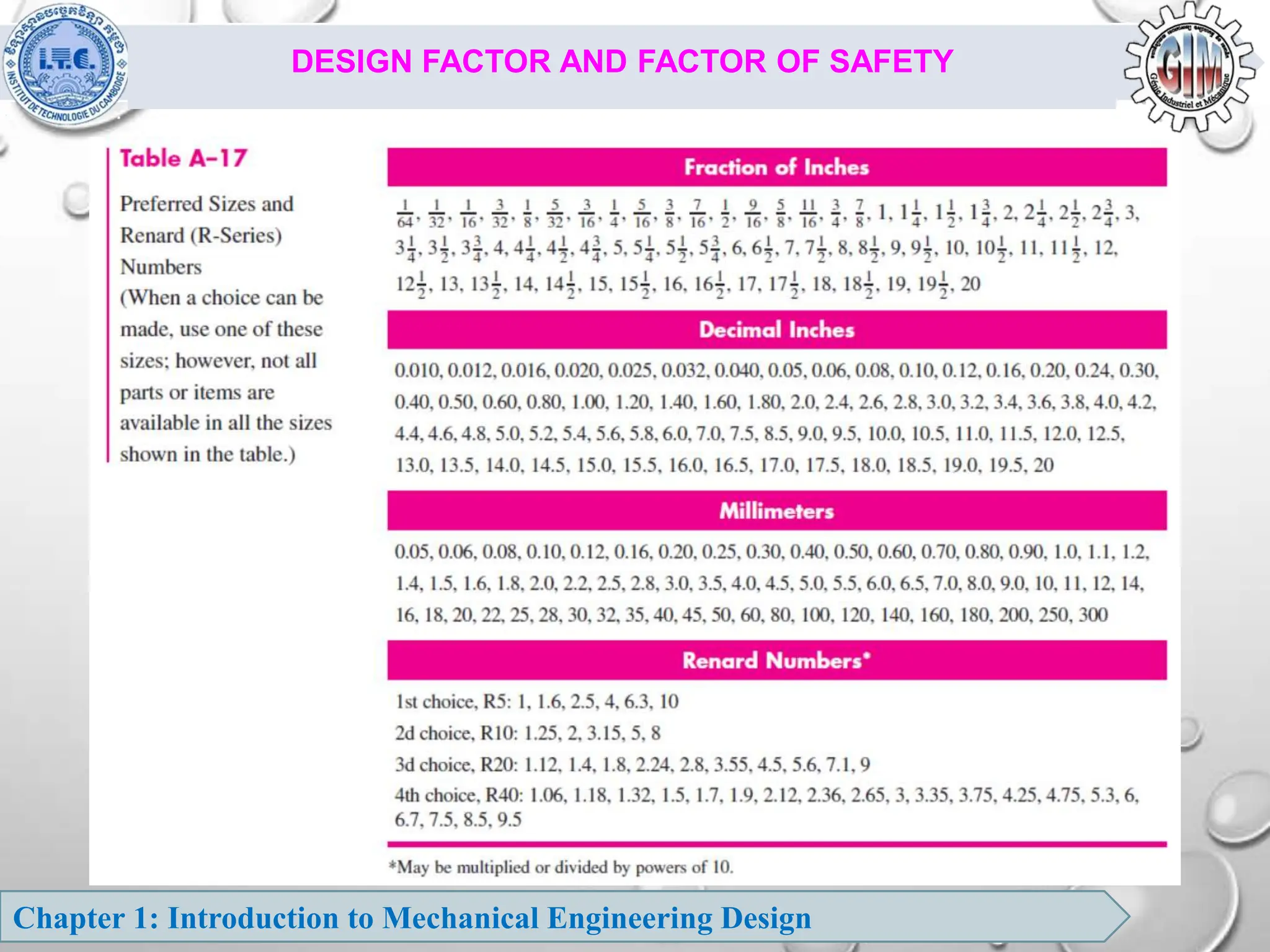
- The actual design factor may change as a result of
changes such as rounding up to a standard size for a cross
section or using off-the-shelf components with higher
ratings instead of employing what is calculated by using
the design factor. The factor is then referred to as the
factor of safety, n.
- Loss-off-function parameter= uncertainty (evaluate by
engineering) Ex. 20 %....
- Maximum load = the maximum load that is the applied on
the component or structure.
Chapter 1: Introduction to Mechanical Engineering Design
DESIGN FACTOR AND FACTOR OF SAFETY
OR
Chapter 1: Introduction to Mechanical Engineering Design
DESIGN FACTOR AND FACTOR OF SAFETY
Chapter 1: Introduction to Mechanical Engineering Design
DESIGN FACTOR AND FACTOR OF SAFETY
Chapter 1: Introduction to Mechanical Engineering Design
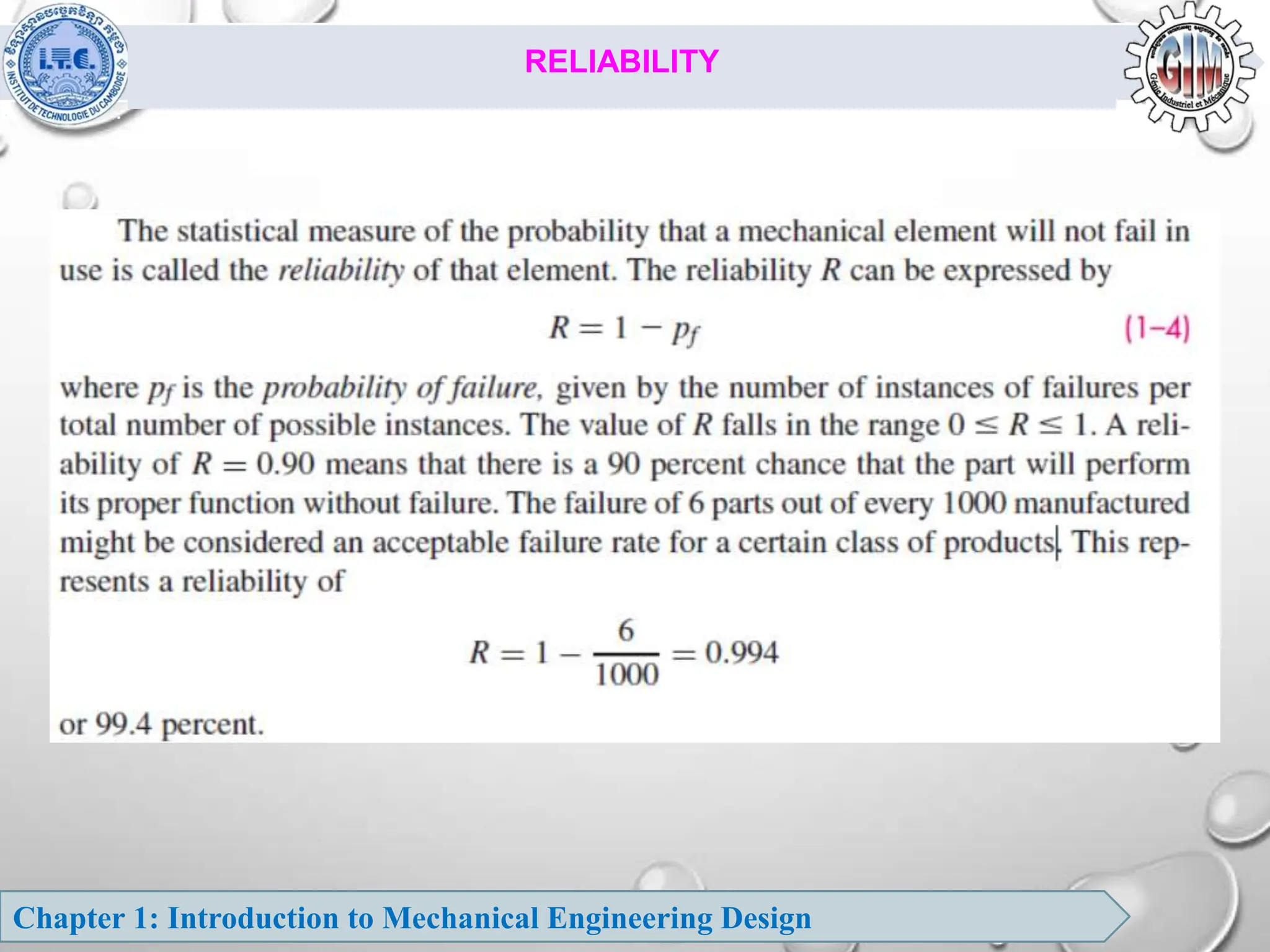
RELIABILITY
Chapter 1: Introduction to Mechanical Engineering Design
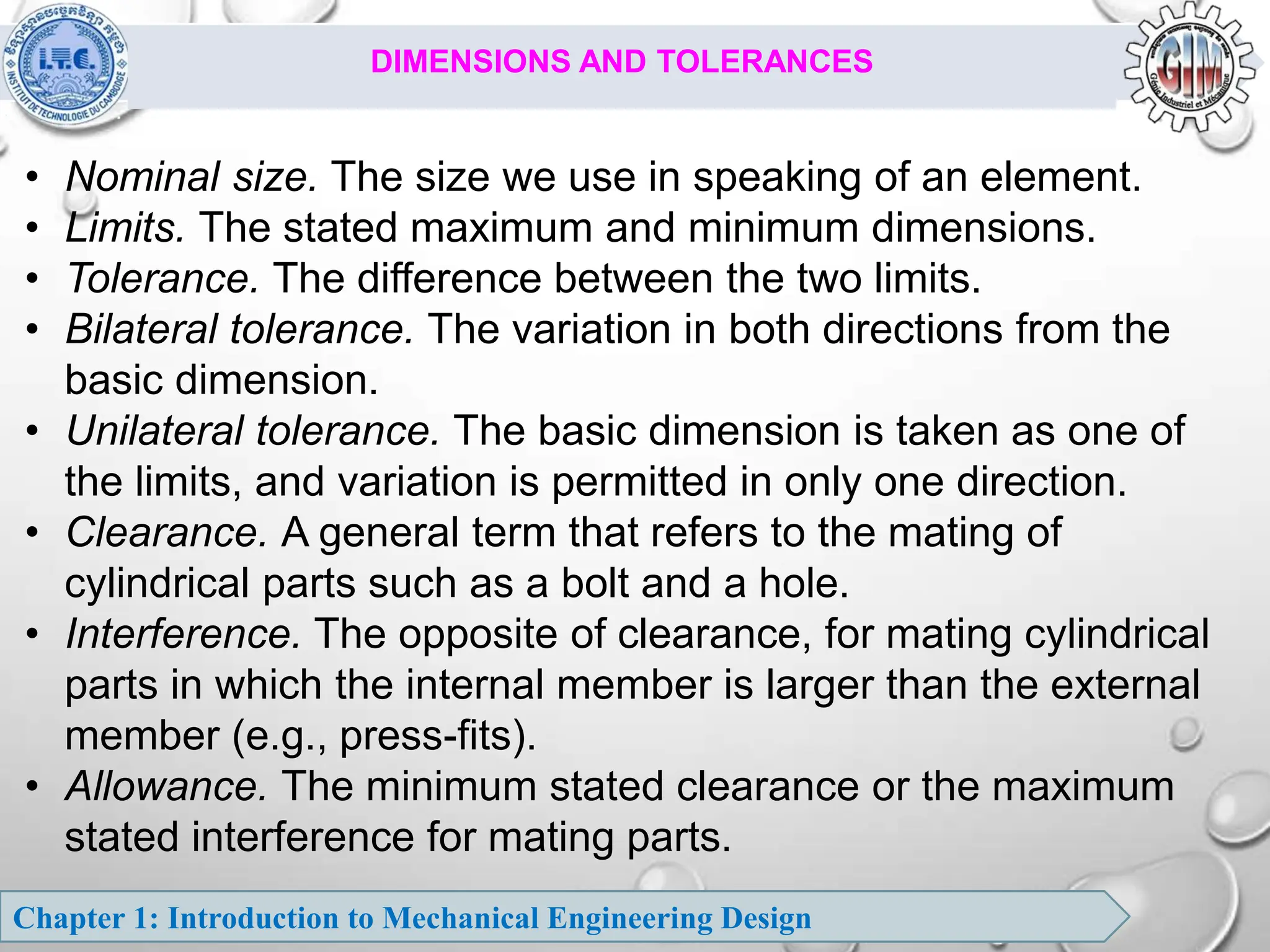
DIMENSIONS AND TOLERANCES
• Nominal size. The size we use in speaking of an element.
• Limits. The stated maximum and minimum dimensions.
• Tolerance. The difference between the two limits.
• Bilateral tolerance. The variation in both directions from the
basic dimension.
• Unilateral tolerance. The basic dimension is taken as one of
the limits, and variation is permitted in only one direction.
• Clearance. A general term that refers to the mating of
cylindrical parts such as a bolt and a hole.
• Interference. The opposite of clearance, for mating cylindrical
parts in which the internal member is larger than the external
member (e.g., press-fits).
• Allowance. The minimum stated clearance or the maximum
stated interference for mating parts.

Chapter 1 Introduction to Mechanical Engineering Design.pptx

  • 1.
    [CHAPTER 1: INTRODUCTIONTO MECHANICAL ENGINEERING DESIGN] GIM-FC 2024 Seab Piseth | pisethseab@gmail.com | 011 70 48 25 Department of Industrial and Mechanical Engineering Faculty of Electrical Engineering Institute of Technology of Cambodia MECHANICAL CONSTRUCTION
  • 2.
    Chapter 1: Introductionto Mechanical Engineering Design Chapter Outline  Design  Mechanical Engineering Design  Phases and Interactions of the Design  Process Design Tools and Resources  The Design Engineer’s Professional Responsibilities  Standards and Codes  Economics  Safety and Product Liability  Stress and Strength  Uncertainty  Design Factor and Factor of Safety  Reliability  Dimensions and Tolerances  Units  Calculations and Significant Figures  Design Topic Interdependencies  Power Transmission Case Study Specifications
  • 3.
    Chapter 1: Introductionto Mechanical Engineering Design Design  Design is an innovative and highly iterative process.  Design is a communication-intensive activity in which both words and pictures are used, and written and oral forms are employed.  The designer create of something having a physical reality, then the product must be functional, safe, reliable, competitive, usable, manufacturable, and marketable.
  • 4.
    Chapter 1: Introductionto Mechanical Engineering Design Design
  • 5.
    Chapter 1: Introductionto Mechanical Engineering Design Design
  • 6.
    Chapter 1: Introductionto Mechanical Engineering Design  Knowledge: • Mechanics of solids and fluids, mass and momentum transport, manufacturing processes, electrical and information theory • Fluid flow, heat transfer, friction, energy transport, material selection, thermomechanical treatments, statistical descriptions,  Job Position: • MVAC or MVAC: heating, ventilating, and air-conditioning design • Internal-combustion engine design, turbomachinery design, and jet-engine design • Machine design, machine-element design, machine-component design, systems design, and fluid-power design Mechanical Engineering Design
  • 7.
    Chapter 1: Introductionto Mechanical Engineering Design Phases and Interactions of the Design Process
  • 8.
    Chapter 1: Introductionto Mechanical Engineering Design Design Considerations
  • 9.
    Chapter 1: Introductionto Mechanical Engineering Design DESIGN TOOLS AND RESOURCES  Computational Tools • CAD CAM • Autocad • Solidworks • Abaqus  Acquiring Technical Information • Libraries (community, university, and private) textbooks, monographs, handbooks, • Government sources. Departments of Defense, National Technical Information Service; and National Institute for Standards and Technology. • Professional societies. American Society of Mechanical Engineers, American Society for Testing and Materials, and American Welding Society. • Commercial vendors. Catalogs, technical literature, test data, samples, and cost information. • Internet. The computer network gateway to websites associated with most of the categories listed above
  • 10.
    Chapter 1: Introductionto Mechanical Engineering Design • Understand the problem • Identify the knowns • Identify the unknowns and formulate the solution strategy • State all assumptions and decisions • Analyze the problem • Evaluate your solution • Present your solution THE DESIGN ENGINEER’S PROFESSIONAL RESPONSIBILITIES
  • 11.
    Chapter 1: Introductionto Mechanical Engineering Design STANDARDS AND CODES
  • 12.
    Chapter 1: Introductionto Mechanical Engineering Design STANDARDS AND CODES
  • 13.
    Chapter 1: Introductionto Mechanical Engineering Design  Standard Sizes  Large Tolerances  Breakeven Points  Cost Estimates ECONOMICS
  • 14.
    Chapter 1: Introductionto Mechanical Engineering Design SAFETY AND PRODUCT LIABILITY
  • 15.
    Chapter 1: Introductionto Mechanical Engineering Design STRESS AND STRENGTH Strength is a property of a material or of a mechanical element.
  • 16.
    Chapter 1: Introductionto Mechanical Engineering Design STRESS AND STRENGTH Stress is a state property at a specific point within a body, which is a function of load, geometry, temperature, and manufacturing processing.
  • 17.
    Chapter 1: Introductionto Mechanical Engineering Design UNCERTAINTY
  • 18.
    Chapter 1: Introductionto Mechanical Engineering Design DESIGN FACTOR AND FACTOR OF SAFETY - Design factor is the ratio of loss-of-function versus allowable load - The actual design factor may change as a result of changes such as rounding up to a standard size for a cross section or using off-the-shelf components with higher ratings instead of employing what is calculated by using the design factor. The factor is then referred to as the factor of safety, n. - Loss-off-function parameter= uncertainty (evaluate by engineering) Ex. 20 %.... - Maximum load = the maximum load that is the applied on the component or structure.
  • 19.
    Chapter 1: Introductionto Mechanical Engineering Design DESIGN FACTOR AND FACTOR OF SAFETY OR
  • 20.
    Chapter 1: Introductionto Mechanical Engineering Design DESIGN FACTOR AND FACTOR OF SAFETY
  • 21.
    Chapter 1: Introductionto Mechanical Engineering Design DESIGN FACTOR AND FACTOR OF SAFETY
  • 22.
    Chapter 1: Introductionto Mechanical Engineering Design RELIABILITY
  • 23.
    Chapter 1: Introductionto Mechanical Engineering Design DIMENSIONS AND TOLERANCES • Nominal size. The size we use in speaking of an element. • Limits. The stated maximum and minimum dimensions. • Tolerance. The difference between the two limits. • Bilateral tolerance. The variation in both directions from the basic dimension. • Unilateral tolerance. The basic dimension is taken as one of the limits, and variation is permitted in only one direction. • Clearance. A general term that refers to the mating of cylindrical parts such as a bolt and a hole. • Interference. The opposite of clearance, for mating cylindrical parts in which the internal member is larger than the external member (e.g., press-fits). • Allowance. The minimum stated clearance or the maximum stated interference for mating parts.