Pichet PINIT
1st teaching
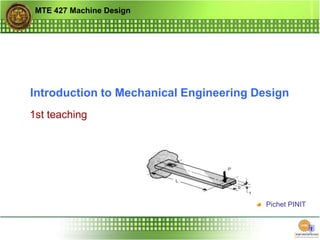
Introduction to Mechanical Engineering Design
MTE 427 Machine Design
What will we learn in this course?
Introduction to Mechanical Engineering Design
Engineering Materials (short version)
Load and Stress Analysis
Deflection and Stiffness
Failure Theories for Static and Dynamic Loading
Design of Machine Elements
Shafts and Its Components
Screws and Fasteners
Mechanical Spring
Roller Contact Bearing
Gears (Spur, Helical, Bevel, and Worm Gears)
Flexible Mechanical Elements
Clutches, Breaks and Coupling
Introduction to Mechanical Engineering Design
What is design?
Design is the application of creativity to planning the optimum solution of
a given problem and the communication of that plan to others.
Given problem
Creativity
Planning
Optimum solution (the best solution for such problem at a time)
Communication
Introduction to Mechanical Engineering Design
What is design?
Design is the application of creativity to planning the optimum solution of
a given problem and the communication of that plan to others.
Given problem
Creativity
Planning
Optimum solution (the best solution for such problem at a time)
Communication
Given problem
Society’s needs
Introduction to Mechanical Engineering Design
What is design?
Design is the application of creativity to planning the optimum solution of
a given problem and the communication of that plan to others.
Given problem
Creativity
Planning
Optimum solution (the best solution for such problem at a time)
Communication
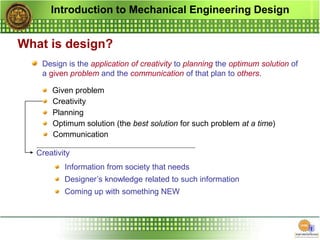
Creativity
Information from society that needs
Designer’s knowledge related to such information
Coming up with something NEW
Introduction to Mechanical Engineering Design
What is design?
Design is the application of creativity to planning the optimum solution of
a given problem and the communication of that plan to others.
Given problem
Creativity
Planning
Optimum solution (the best solution for such problem at a time)
Communication
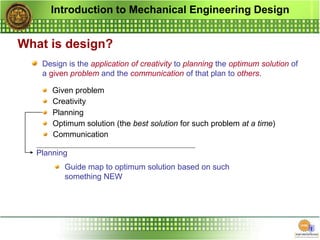
Planning
Guide map to optimum solution based on such
something NEW
Introduction to Mechanical Engineering Design
What is design?
Design is the application of creativity to planning the optimum solution of
a given problem and the communication of that plan to others.
Given problem
Creativity
Planning
Optimum solution (the best solution for such problem at a time)
Communication
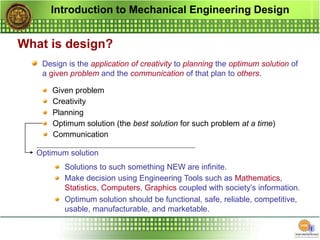
Optimum solution
Solutions to such something NEW are infinite.
Make decision using Engineering Tools such as Mathematics,
Statistics, Computers, Graphics coupled with society’s information.
Optimum solution should be functional, safe, reliable, competitive,
usable, manufacturable, and marketable.
Introduction to Mechanical Engineering Design
What is design?
Design is the application of creativity to planning the optimum solution of
a given problem and the communication of that plan to others.
Given problem
Creativity
Planning
Optimum solution (the best solution for such problem at a time)
Communication
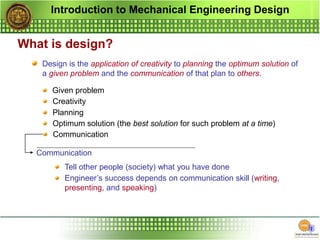
Communication
Tell other people (society) what you have done
Engineer’s success depends on communication skill (writing,
presenting, and speaking)
Introduction to Mechanical Engineering Design
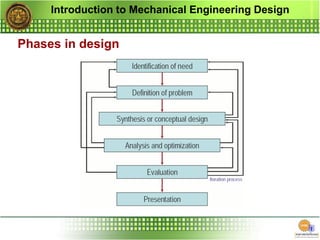
Phases in design
Introduction to Mechanical Engineering Design
What is engineering design?
Design is the application of creativity to planning the optimum solution of
a given engineering problem and the communication of that plan to
others.
What is mechanical engineering design?
Design is the application of creativity to planning the optimum solution of
a given mechanical engineering problem and the communication of that
plan to others.
Focus on mechanical elements.
Focus on engineering problem.
Introduction to Mechanical Engineering Design
Why do we design?
To response such need
What are to be considered when designing?
Functionality, Safety, and Reliability
Strength and Stress
Deflection, Distortion, and Stiffness
Wear, Corrosion, Friction, Thermal, Surface, Noise, and Lubricant
Weight, Shape, Size and Life
Cost, Competition, and Marketability
Much more …
Introduction to Mechanical Engineering Design
Designers’ tools and resources
Computational Tools
Acquiring Technical Information
CAD/CAM/CAE
Libraries
Government sources
Professional societies (Standards: ISO, DIN, JIS, TIS, etc.)
Commercial vendors
Internet (Lots of information )
Introduction to Mechanical Engineering Design
Designing action steps
Understand the problem clearly
Identify what are known
Identify what are unknown and formulate solution strategy
State all assumptions and decisions
Analyze the problem with the solution strategy
Evaluate your solution (Is it sound good for real life?)
Present your solution
As seen in phase design, the design process are interactive and iterative.
Therefore, it may be necessary to repeat some or all of the above steps more
than once if less than satisfactory results are obtained.
Introduction to Mechanical Engineering Design
Economics and environment
Use standard sizes as possible (stock sizes).
Use large tolerances as possible.
Think of mass products (breakeven point).
Think hard of environmental effect.
Safety and product Liability
Manufacturer and designer always take responsibility no matter how
long is the life of a product.
Be careful of excessive promises
Be sure to provide adequate warning and instruction
Designer should always review, test, and control the quality of a product.
Introduction to Mechanical Engineering Design
Stress and strength
Strength is a build-in or inherent property of a material used to
manufacture a product.
Stress is an induced property of a product under a service.
Depending on the choice, the treatment, and the processing
of the material
Depending on the external load applied on the product, geometry,
temperature, etc.
Obtaining by testing (tension test, torsion test, etc.)
Obtaining by analyzing (Mechanics of Materials, Theory of Elasticity,
etc.)
Introduction to Mechanical Engineering Design
Uncertainty concerning stress and strength
Composition of material and effect of variation on properties (Isotropic,
anisotropic, orthotropic materials)
Variation on properties for different places or stocks
Effect of assemblies
Intensity and distribution of loading
Validity of mathematical models used to represent reality (do not forget
your assumptions when making analysis)
Stress concentration
Influence of time (time edge effect, creep)
Effect of corrosion and wear
Much more …
Designers themselves
Introduction to Mechanical Engineering Design
Design factor and factor of safety
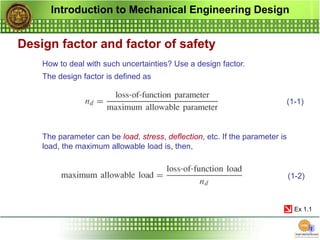
How to deal with such uncertainties? Use a design factor.
The design factor is defined as
(1-1)
(1-2)
The parameter can be load, stress, deflection, etc. If the parameter is
load, the maximum allowable load is, then,
Ex 1.1
Introduction to Mechanical Engineering Design
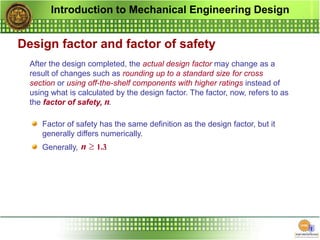
After the design completed, the actual design factor may change as a
result of changes such as rounding up to a standard size for cross
section or using off-the-shelf components with higher ratings instead of
using what is calculated by the design factor. The factor, now, refers to as
the factor of safety, .
n
Factor of safety has the same definition as the design factor, but it
generally differs numerically.
Generally, .
n  1.3
Design factor and factor of safety
Introduction to Mechanical Engineering Design
Design factor and factor of safety
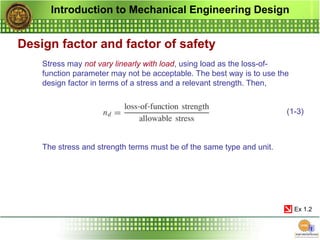
Stress may not vary linearly with load, using load as the loss-of-
function parameter may not be acceptable. The best way is to use the
design factor in terms of a stress and a relevant strength. Then,
(1-3)
The stress and strength terms must be of the same type and unit.
Ex 1.2
Introduction to Mechanical Engineering Design
Units
Use SI unit system (see more details by yourself).
Some useful rules for number:
1924 or 1 924 but not 1,924
0.1924 or 0.192 4 but not 0.192,4 (Decimal point should always be
preceded by a zero for number less than unity.)
192 423.618 50 but not 192,423.61850
Use prefixes for large and small numbers of possible.
Use the right symbols (k means kilo not K)
Introduction to Mechanical Engineering Design
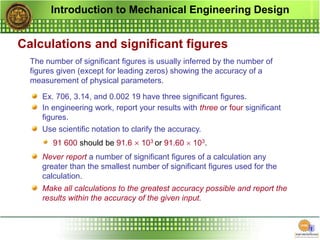
Calculations and significant figures
Ex. 706, 3.14, and 0.002 19 have three significant figures.
The number of significant figures is usually inferred by the number of
figures given (except for leading zeros) showing the accuracy of a
measurement of physical parameters.
In engineering work, report your results with three or four significant
figures.
Use scientific notation to clarify the accuracy.
91 600 should be 91.6  103 or 91.60  103.
Never report a number of significant figures of a calculation any
greater than the smallest number of significant figures used for the
calculation.
Make all calculations to the greatest accuracy possible and report the
results within the accuracy of the given input.
Introduction to Mechanical Engineering Design
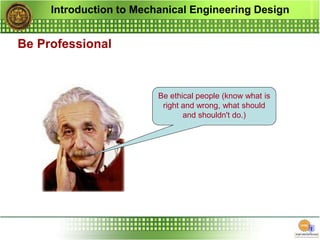
Be Professional
Be ethical people (know what is
right and wrong, what should
and shouldn't do.)
Introduction to Mechanical Engineering Design
Assignment
Read the text book on Load and Stress Analysis.
Introduction to Mechanical Engineering Design
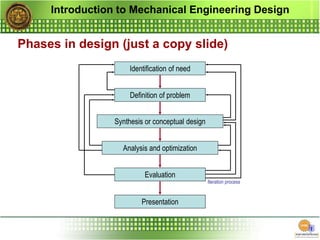
Phases in design (just a copy slide)
Identification of need
Definition of problem
Synthesis or conceptual design
Analysis and optimization
Evaluation
Presentation
Iteration process

Introduction to Mechanical Engineering Design.ppt

  • 1.
    Pichet PINIT 1st teaching Introductionto Mechanical Engineering Design MTE 427 Machine Design
  • 2.
    What will welearn in this course? Introduction to Mechanical Engineering Design Engineering Materials (short version) Load and Stress Analysis Deflection and Stiffness Failure Theories for Static and Dynamic Loading Design of Machine Elements Shafts and Its Components Screws and Fasteners Mechanical Spring Roller Contact Bearing Gears (Spur, Helical, Bevel, and Worm Gears) Flexible Mechanical Elements Clutches, Breaks and Coupling
  • 3.
    Introduction to MechanicalEngineering Design What is design? Design is the application of creativity to planning the optimum solution of a given problem and the communication of that plan to others. Given problem Creativity Planning Optimum solution (the best solution for such problem at a time) Communication
  • 4.
    Introduction to MechanicalEngineering Design What is design? Design is the application of creativity to planning the optimum solution of a given problem and the communication of that plan to others. Given problem Creativity Planning Optimum solution (the best solution for such problem at a time) Communication Given problem Society’s needs
  • 5.
    Introduction to MechanicalEngineering Design What is design? Design is the application of creativity to planning the optimum solution of a given problem and the communication of that plan to others. Given problem Creativity Planning Optimum solution (the best solution for such problem at a time) Communication Creativity Information from society that needs Designer’s knowledge related to such information Coming up with something NEW
  • 6.
    Introduction to MechanicalEngineering Design What is design? Design is the application of creativity to planning the optimum solution of a given problem and the communication of that plan to others. Given problem Creativity Planning Optimum solution (the best solution for such problem at a time) Communication Planning Guide map to optimum solution based on such something NEW
  • 7.
    Introduction to MechanicalEngineering Design What is design? Design is the application of creativity to planning the optimum solution of a given problem and the communication of that plan to others. Given problem Creativity Planning Optimum solution (the best solution for such problem at a time) Communication Optimum solution Solutions to such something NEW are infinite. Make decision using Engineering Tools such as Mathematics, Statistics, Computers, Graphics coupled with society’s information. Optimum solution should be functional, safe, reliable, competitive, usable, manufacturable, and marketable.
  • 8.
    Introduction to MechanicalEngineering Design What is design? Design is the application of creativity to planning the optimum solution of a given problem and the communication of that plan to others. Given problem Creativity Planning Optimum solution (the best solution for such problem at a time) Communication Communication Tell other people (society) what you have done Engineer’s success depends on communication skill (writing, presenting, and speaking)
  • 9.
    Introduction to MechanicalEngineering Design Phases in design
  • 10.
    Introduction to MechanicalEngineering Design What is engineering design? Design is the application of creativity to planning the optimum solution of a given engineering problem and the communication of that plan to others. What is mechanical engineering design? Design is the application of creativity to planning the optimum solution of a given mechanical engineering problem and the communication of that plan to others. Focus on mechanical elements. Focus on engineering problem.
  • 11.
    Introduction to MechanicalEngineering Design Why do we design? To response such need What are to be considered when designing? Functionality, Safety, and Reliability Strength and Stress Deflection, Distortion, and Stiffness Wear, Corrosion, Friction, Thermal, Surface, Noise, and Lubricant Weight, Shape, Size and Life Cost, Competition, and Marketability Much more …
  • 12.
    Introduction to MechanicalEngineering Design Designers’ tools and resources Computational Tools Acquiring Technical Information CAD/CAM/CAE Libraries Government sources Professional societies (Standards: ISO, DIN, JIS, TIS, etc.) Commercial vendors Internet (Lots of information )
  • 13.
    Introduction to MechanicalEngineering Design Designing action steps Understand the problem clearly Identify what are known Identify what are unknown and formulate solution strategy State all assumptions and decisions Analyze the problem with the solution strategy Evaluate your solution (Is it sound good for real life?) Present your solution As seen in phase design, the design process are interactive and iterative. Therefore, it may be necessary to repeat some or all of the above steps more than once if less than satisfactory results are obtained.
  • 14.
    Introduction to MechanicalEngineering Design Economics and environment Use standard sizes as possible (stock sizes). Use large tolerances as possible. Think of mass products (breakeven point). Think hard of environmental effect. Safety and product Liability Manufacturer and designer always take responsibility no matter how long is the life of a product. Be careful of excessive promises Be sure to provide adequate warning and instruction Designer should always review, test, and control the quality of a product.
  • 15.
    Introduction to MechanicalEngineering Design Stress and strength Strength is a build-in or inherent property of a material used to manufacture a product. Stress is an induced property of a product under a service. Depending on the choice, the treatment, and the processing of the material Depending on the external load applied on the product, geometry, temperature, etc. Obtaining by testing (tension test, torsion test, etc.) Obtaining by analyzing (Mechanics of Materials, Theory of Elasticity, etc.)
  • 16.
    Introduction to MechanicalEngineering Design Uncertainty concerning stress and strength Composition of material and effect of variation on properties (Isotropic, anisotropic, orthotropic materials) Variation on properties for different places or stocks Effect of assemblies Intensity and distribution of loading Validity of mathematical models used to represent reality (do not forget your assumptions when making analysis) Stress concentration Influence of time (time edge effect, creep) Effect of corrosion and wear Much more … Designers themselves
  • 17.
    Introduction to MechanicalEngineering Design Design factor and factor of safety How to deal with such uncertainties? Use a design factor. The design factor is defined as (1-1) (1-2) The parameter can be load, stress, deflection, etc. If the parameter is load, the maximum allowable load is, then, Ex 1.1
  • 18.
    Introduction to MechanicalEngineering Design After the design completed, the actual design factor may change as a result of changes such as rounding up to a standard size for cross section or using off-the-shelf components with higher ratings instead of using what is calculated by the design factor. The factor, now, refers to as the factor of safety, . n Factor of safety has the same definition as the design factor, but it generally differs numerically. Generally, . n  1.3 Design factor and factor of safety
  • 19.
    Introduction to MechanicalEngineering Design Design factor and factor of safety Stress may not vary linearly with load, using load as the loss-of- function parameter may not be acceptable. The best way is to use the design factor in terms of a stress and a relevant strength. Then, (1-3) The stress and strength terms must be of the same type and unit. Ex 1.2
  • 20.
    Introduction to MechanicalEngineering Design Units Use SI unit system (see more details by yourself). Some useful rules for number: 1924 or 1 924 but not 1,924 0.1924 or 0.192 4 but not 0.192,4 (Decimal point should always be preceded by a zero for number less than unity.) 192 423.618 50 but not 192,423.61850 Use prefixes for large and small numbers of possible. Use the right symbols (k means kilo not K)
  • 21.
    Introduction to MechanicalEngineering Design Calculations and significant figures Ex. 706, 3.14, and 0.002 19 have three significant figures. The number of significant figures is usually inferred by the number of figures given (except for leading zeros) showing the accuracy of a measurement of physical parameters. In engineering work, report your results with three or four significant figures. Use scientific notation to clarify the accuracy. 91 600 should be 91.6  103 or 91.60  103. Never report a number of significant figures of a calculation any greater than the smallest number of significant figures used for the calculation. Make all calculations to the greatest accuracy possible and report the results within the accuracy of the given input.
  • 22.
    Introduction to MechanicalEngineering Design Be Professional Be ethical people (know what is right and wrong, what should and shouldn't do.)
  • 23.
    Introduction to MechanicalEngineering Design Assignment Read the text book on Load and Stress Analysis.
  • 24.
    Introduction to MechanicalEngineering Design Phases in design (just a copy slide) Identification of need Definition of problem Synthesis or conceptual design Analysis and optimization Evaluation Presentation Iteration process