Chapter 1
Introduction to
Mechanical Engineering
Design
Lecture Slides
The McGraw-Hill Companies © 2012
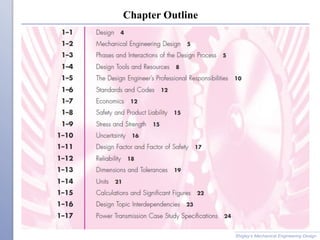
Chapter Outline
Shigley’s Mechanical Engineering Design
Design
 To formulate a plan for the satisfaction of a specified need
 Process requires innovation, iteration, and decision-making
 Communication-intensive
 Products should be
◦ Functional
◦ Safe
◦ Reliable
◦ Competitive
◦ Usable
◦ Manufacturable
◦ Marketable
Shigley’s Mechanical Engineering Design
Mechanical Engineering Design
 Mechanical engineering design involves all the disciplines of
mechanical engineering.
 Example
◦ Journal bearing: fluid flow, heat transfer, friction, energy
transport, material selection, thermomechanical treatments,
statistical descriptions, etc.
Shigley’s Mechanical Engineering Design
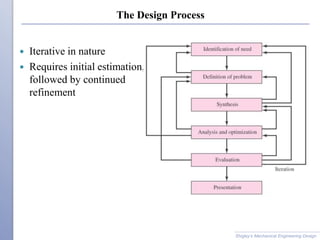
The Design Process
 Iterative in nature
 Requires initial estimation,
followed by continued
refinement
Shigley’s Mechanical Engineering Design
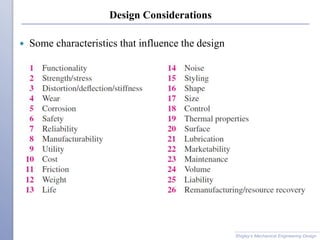
Design Considerations
 Some characteristics that influence the design
Shigley’s Mechanical Engineering Design
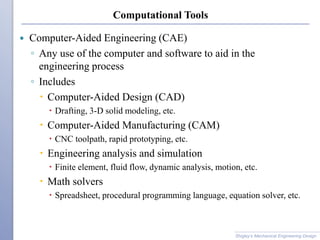
Computational Tools
 Computer-Aided Engineering (CAE)
◦ Any use of the computer and software to aid in the
engineering process
◦ Includes
 Computer-Aided Design (CAD)
 Drafting, 3-D solid modeling, etc.
 Computer-Aided Manufacturing (CAM)
 CNC toolpath, rapid prototyping, etc.
 Engineering analysis and simulation
 Finite element, fluid flow, dynamic analysis, motion, etc.
 Math solvers
 Spreadsheet, procedural programming language, equation solver, etc.
Shigley’s Mechanical Engineering Design
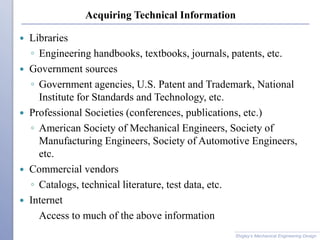
Acquiring Technical Information
 Libraries
◦ Engineering handbooks, textbooks, journals, patents, etc.
 Government sources
◦ Government agencies, U.S. Patent and Trademark, National
Institute for Standards and Technology, etc.
 Professional Societies (conferences, publications, etc.)
◦ American Society of Mechanical Engineers, Society of
Manufacturing Engineers, Society of Automotive Engineers,
etc.
 Commercial vendors
◦ Catalogs, technical literature, test data, etc.
 Internet
Access to much of the above information
Shigley’s Mechanical Engineering Design
A Few Useful Internet Sites
 www.globalspec.com
 www.engnetglobal.com
 www.efunda.com
 www.thomasnet.com
 www.uspto.gov
Shigley’s Mechanical Engineering Design
The Design Engineer’s Professional Responsibilities
 Satisfy the needs of the customer in a competent, responsible,
ethical, and professional manner.
 Some key advise for a professional engineer
◦ Be competent
◦ Keep current in field of practice
◦ Keep good documentation
◦ Ensure good and timely communication
◦ Act professionally and ethically
Shigley’s Mechanical Engineering Design
Ethical Guidelines for Professional Practice
 National Society of Professional Engineers (NSPE) publishes a
Code of Ethics for Engineers and an Engineers’ Creed.
 www.nspe.org/ethics
 Six Fundamental Canons
 Engineers, in the fulfillment of their professional duties, shall:
◦ Hold paramount the safety, health, and welfare of the public.
◦ Perform services only in areas of their competence.
◦ Issue public statements only in an objective and truthful
manner.
◦ Act for each employer or client as faithful agents or trustees.
◦ Avoid deceptive acts.
◦ Conduct themselves honorably, responsibly, ethically, and
lawfully so as to enhance the honor, reputation, and usefulness
of the profession.
Shigley’s Mechanical Engineering Design
NSPE Engineers’ Creed
 As a Professional Engineer I dedicate my professional
knowledge and skill to the advancement and betterment of
human welfare.
 I pledge:
◦ To give the utmost of performance;
◦ To participate in none but honest enterprise;
◦ To live and work according to the laws of man and the highest
standards of professional conduct;
◦ To place service before profit, the honor and standing of the
profession before personal advantage, and the public welfare
above all other considerations.
 In humility and with need for Divine Guidance, I make this
pledge.
Shigley’s Mechanical Engineering Design
Standards and Codes
 Standard
◦ A set of specifications for parts, materials, or processes
◦ Intended to achieve uniformity, efficiency, and a specified
quality
◦ Limits the multitude of variations
 Code
◦ A set of specifications for the analysis, design, manufacture,
and construction of something
◦ To achieve a specified degree of safety, efficiency, and
performance or quality
◦ Does not imply absolute safety
 Various organizations establish and publish standards and codes
for common and/or critical industries
Shigley’s Mechanical Engineering Design
Standards and Codes
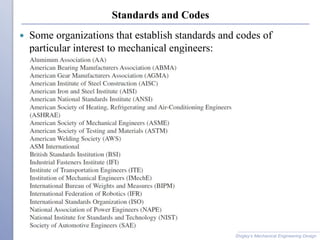
 Some organizations that establish standards and codes of
particular interest to mechanical engineers:
Shigley’s Mechanical Engineering Design
Economics
 Cost is almost always an important factor in
engineering design.
 Use of standard sizes is a first principle of cost
reduction.
 Table A-17 lists some typical preferred sizes.
 Certain common components may be less expensive in
stocked sizes.
Shigley’s Mechanical Engineering Design
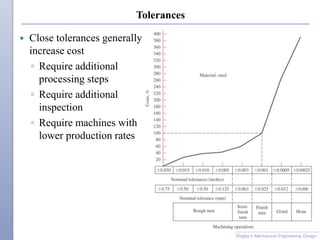
Tolerances
 Close tolerances generally
increase cost
◦ Require additional
processing steps
◦ Require additional
inspection
◦ Require machines with
lower production rates
Shigley’s Mechanical Engineering Design
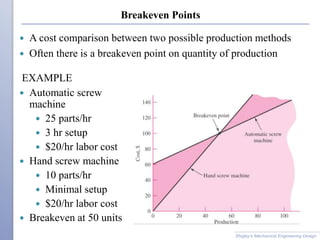
Breakeven Points
 A cost comparison between two possible production methods
 Often there is a breakeven point on quantity of production
Shigley’s Mechanical Engineering Design
 Automatic screw
machine
 25 parts/hr
 3 hr setup
 $20/hr labor cost
 Hand screw machine
 10 parts/hr
 Minimal setup
 $20/hr labor cost
 Breakeven at 50 units
EXAMPLE
Safety and Product Liability
 Strict Liability concept generally prevails in U.S.
 Manufacturer is liable for damage or harm that results because
of a defect.
 Negligence need not be proved.
 Calls for good engineering in analysis and design, quality
control, and comprehensive testing.
Shigley’s Mechanical Engineering Design
Stress and Strength
 Strength
◦ An inherent property of a material or of a mechanical element
◦ Depends on treatment and processing
◦ May or may not be uniform throughout the part
◦ Examples: Ultimate strength, yield strength
 Stress
◦ A state property at a specific point within a body
◦ Primarily a function of load and geometry
◦ Sometimes also a function of temperature and processing
Shigley’s Mechanical Engineering Design
Uncertainty
 Common sources of uncertainty in stress or strength
Shigley’s Mechanical Engineering Design
Uncertainty
 Stochastic method
◦ Based on statistical nature of the design parameters
◦ Focus on the probability of survival of the design’s function
(reliability)
◦ Often limited by availability of statistical data
Shigley’s Mechanical Engineering Design
Uncertainty
 Deterministic method
◦ Establishes a design factor, nd
◦ Based on absolute uncertainties of a loss-of-function
parameter and a maximum allowable parameter
Shigley’s Mechanical Engineering Design
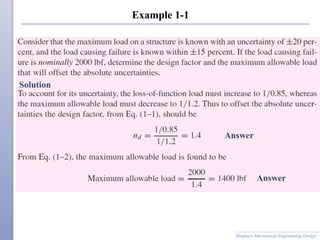
◦ If, for example, the parameter is load, then
Example 1-1
Shigley’s Mechanical Engineering Design
Solution
Answer
Answer
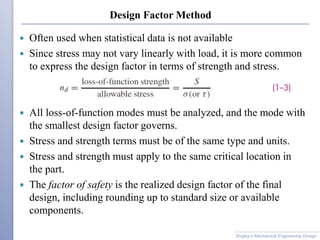
Design Factor Method
 Often used when statistical data is not available
 Since stress may not vary linearly with load, it is more common
to express the design factor in terms of strength and stress.
 All loss-of-function modes must be analyzed, and the mode with
the smallest design factor governs.
 Stress and strength terms must be of the same type and units.
 Stress and strength must apply to the same critical location in
the part.
 The factor of safety is the realized design factor of the final
design, including rounding up to standard size or available
components.
Shigley’s Mechanical Engineering Design
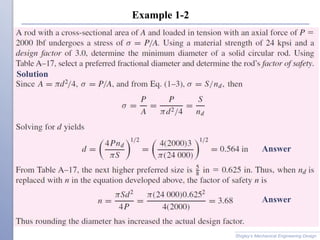
Example 1-2
Shigley’s Mechanical Engineering Design
Solution
Answer
Answer
Reliability
 Reliability, R – The statistical measure of the probability that a
mechanical element will not fail in use
 Probability of Failure, pf – the number of instances of failures
per total number of possible instances
 Example: If 1000 parts are manufactured, with 6 of the parts
failing, the reliability is
Shigley’s Mechanical Engineering Design
or 99.4 %
Reliability
 Series System – a system that is deemed to have failed if any
component within the system fails
 The overall reliability of a series system is the product of the
reliabilities of the individual components.
 Example: A shaft with two bearings having reliabilities of 95%
and 98% has an overall reliability of
R = R1 R2 = 0.95 (0.98) = 0.93 or 93%
Shigley’s Mechanical Engineering Design
1
(1-5)
n
i
i
R R

 
Dimensions and Tolerances
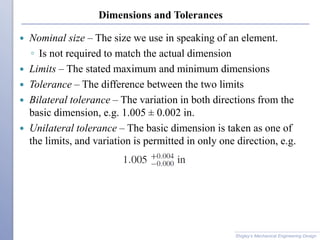
 Nominal size – The size we use in speaking of an element.
◦ Is not required to match the actual dimension
 Limits – The stated maximum and minimum dimensions
 Tolerance – The difference between the two limits
 Bilateral tolerance – The variation in both directions from the
basic dimension, e.g. 1.005 ± 0.002 in.
 Unilateral tolerance – The basic dimension is taken as one of
the limits, and variation is permitted in only one direction, e.g.
Shigley’s Mechanical Engineering Design
Dimensions and Tolerances
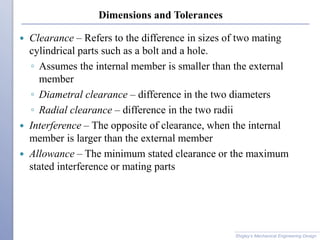
 Clearance – Refers to the difference in sizes of two mating
cylindrical parts such as a bolt and a hole.
◦ Assumes the internal member is smaller than the external
member
◦ Diametral clearance – difference in the two diameters
◦ Radial clearance – difference in the two radii
 Interference – The opposite of clearance, when the internal
member is larger than the external member
 Allowance – The minimum stated clearance or the maximum
stated interference or mating parts
Shigley’s Mechanical Engineering Design
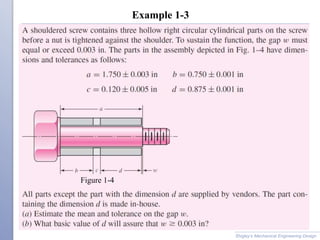
Example 1-3
Shigley’s Mechanical Engineering Design
Figure 1-4
Example 1-3 (Continued)
Shigley’s Mechanical Engineering Design
Solution
Answer
Answer
Answer
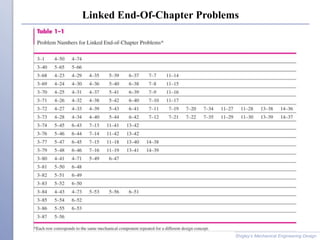
Linked End-Of-Chapter Problems
Shigley’s Mechanical Engineering Design
Power Transmission Case Study Specifications
Shigley’s Mechanical Engineering Design
Power Transmission Case Study Specifications
Shigley’s Mechanical Engineering Design
Power Transmission Case Study Specifications
Shigley’s Mechanical Engineering Design

Chapter 1 (1).ppt

  • 1.
    Chapter 1 Introduction to MechanicalEngineering Design Lecture Slides The McGraw-Hill Companies © 2012
  • 2.
  • 3.
    Design  To formulatea plan for the satisfaction of a specified need  Process requires innovation, iteration, and decision-making  Communication-intensive  Products should be ◦ Functional ◦ Safe ◦ Reliable ◦ Competitive ◦ Usable ◦ Manufacturable ◦ Marketable Shigley’s Mechanical Engineering Design
  • 4.
    Mechanical Engineering Design Mechanical engineering design involves all the disciplines of mechanical engineering.  Example ◦ Journal bearing: fluid flow, heat transfer, friction, energy transport, material selection, thermomechanical treatments, statistical descriptions, etc. Shigley’s Mechanical Engineering Design
  • 5.
    The Design Process Iterative in nature  Requires initial estimation, followed by continued refinement Shigley’s Mechanical Engineering Design
  • 6.
    Design Considerations  Somecharacteristics that influence the design Shigley’s Mechanical Engineering Design
  • 7.
    Computational Tools  Computer-AidedEngineering (CAE) ◦ Any use of the computer and software to aid in the engineering process ◦ Includes  Computer-Aided Design (CAD)  Drafting, 3-D solid modeling, etc.  Computer-Aided Manufacturing (CAM)  CNC toolpath, rapid prototyping, etc.  Engineering analysis and simulation  Finite element, fluid flow, dynamic analysis, motion, etc.  Math solvers  Spreadsheet, procedural programming language, equation solver, etc. Shigley’s Mechanical Engineering Design
  • 8.
    Acquiring Technical Information Libraries ◦ Engineering handbooks, textbooks, journals, patents, etc.  Government sources ◦ Government agencies, U.S. Patent and Trademark, National Institute for Standards and Technology, etc.  Professional Societies (conferences, publications, etc.) ◦ American Society of Mechanical Engineers, Society of Manufacturing Engineers, Society of Automotive Engineers, etc.  Commercial vendors ◦ Catalogs, technical literature, test data, etc.  Internet Access to much of the above information Shigley’s Mechanical Engineering Design
  • 9.
    A Few UsefulInternet Sites  www.globalspec.com  www.engnetglobal.com  www.efunda.com  www.thomasnet.com  www.uspto.gov Shigley’s Mechanical Engineering Design
  • 10.
    The Design Engineer’sProfessional Responsibilities  Satisfy the needs of the customer in a competent, responsible, ethical, and professional manner.  Some key advise for a professional engineer ◦ Be competent ◦ Keep current in field of practice ◦ Keep good documentation ◦ Ensure good and timely communication ◦ Act professionally and ethically Shigley’s Mechanical Engineering Design
  • 11.
    Ethical Guidelines forProfessional Practice  National Society of Professional Engineers (NSPE) publishes a Code of Ethics for Engineers and an Engineers’ Creed.  www.nspe.org/ethics  Six Fundamental Canons  Engineers, in the fulfillment of their professional duties, shall: ◦ Hold paramount the safety, health, and welfare of the public. ◦ Perform services only in areas of their competence. ◦ Issue public statements only in an objective and truthful manner. ◦ Act for each employer or client as faithful agents or trustees. ◦ Avoid deceptive acts. ◦ Conduct themselves honorably, responsibly, ethically, and lawfully so as to enhance the honor, reputation, and usefulness of the profession. Shigley’s Mechanical Engineering Design
  • 12.
    NSPE Engineers’ Creed As a Professional Engineer I dedicate my professional knowledge and skill to the advancement and betterment of human welfare.  I pledge: ◦ To give the utmost of performance; ◦ To participate in none but honest enterprise; ◦ To live and work according to the laws of man and the highest standards of professional conduct; ◦ To place service before profit, the honor and standing of the profession before personal advantage, and the public welfare above all other considerations.  In humility and with need for Divine Guidance, I make this pledge. Shigley’s Mechanical Engineering Design
  • 13.
    Standards and Codes Standard ◦ A set of specifications for parts, materials, or processes ◦ Intended to achieve uniformity, efficiency, and a specified quality ◦ Limits the multitude of variations  Code ◦ A set of specifications for the analysis, design, manufacture, and construction of something ◦ To achieve a specified degree of safety, efficiency, and performance or quality ◦ Does not imply absolute safety  Various organizations establish and publish standards and codes for common and/or critical industries Shigley’s Mechanical Engineering Design
  • 14.
    Standards and Codes Some organizations that establish standards and codes of particular interest to mechanical engineers: Shigley’s Mechanical Engineering Design
  • 15.
    Economics  Cost isalmost always an important factor in engineering design.  Use of standard sizes is a first principle of cost reduction.  Table A-17 lists some typical preferred sizes.  Certain common components may be less expensive in stocked sizes. Shigley’s Mechanical Engineering Design
  • 16.
    Tolerances  Close tolerancesgenerally increase cost ◦ Require additional processing steps ◦ Require additional inspection ◦ Require machines with lower production rates Shigley’s Mechanical Engineering Design
  • 17.
    Breakeven Points  Acost comparison between two possible production methods  Often there is a breakeven point on quantity of production Shigley’s Mechanical Engineering Design  Automatic screw machine  25 parts/hr  3 hr setup  $20/hr labor cost  Hand screw machine  10 parts/hr  Minimal setup  $20/hr labor cost  Breakeven at 50 units EXAMPLE
  • 18.
    Safety and ProductLiability  Strict Liability concept generally prevails in U.S.  Manufacturer is liable for damage or harm that results because of a defect.  Negligence need not be proved.  Calls for good engineering in analysis and design, quality control, and comprehensive testing. Shigley’s Mechanical Engineering Design
  • 19.
    Stress and Strength Strength ◦ An inherent property of a material or of a mechanical element ◦ Depends on treatment and processing ◦ May or may not be uniform throughout the part ◦ Examples: Ultimate strength, yield strength  Stress ◦ A state property at a specific point within a body ◦ Primarily a function of load and geometry ◦ Sometimes also a function of temperature and processing Shigley’s Mechanical Engineering Design
  • 20.
    Uncertainty  Common sourcesof uncertainty in stress or strength Shigley’s Mechanical Engineering Design
  • 21.
    Uncertainty  Stochastic method ◦Based on statistical nature of the design parameters ◦ Focus on the probability of survival of the design’s function (reliability) ◦ Often limited by availability of statistical data Shigley’s Mechanical Engineering Design
  • 22.
    Uncertainty  Deterministic method ◦Establishes a design factor, nd ◦ Based on absolute uncertainties of a loss-of-function parameter and a maximum allowable parameter Shigley’s Mechanical Engineering Design ◦ If, for example, the parameter is load, then
  • 23.
    Example 1-1 Shigley’s MechanicalEngineering Design Solution Answer Answer
  • 24.
    Design Factor Method Often used when statistical data is not available  Since stress may not vary linearly with load, it is more common to express the design factor in terms of strength and stress.  All loss-of-function modes must be analyzed, and the mode with the smallest design factor governs.  Stress and strength terms must be of the same type and units.  Stress and strength must apply to the same critical location in the part.  The factor of safety is the realized design factor of the final design, including rounding up to standard size or available components. Shigley’s Mechanical Engineering Design
  • 25.
    Example 1-2 Shigley’s MechanicalEngineering Design Solution Answer Answer
  • 26.
    Reliability  Reliability, R– The statistical measure of the probability that a mechanical element will not fail in use  Probability of Failure, pf – the number of instances of failures per total number of possible instances  Example: If 1000 parts are manufactured, with 6 of the parts failing, the reliability is Shigley’s Mechanical Engineering Design or 99.4 %
  • 27.
    Reliability  Series System– a system that is deemed to have failed if any component within the system fails  The overall reliability of a series system is the product of the reliabilities of the individual components.  Example: A shaft with two bearings having reliabilities of 95% and 98% has an overall reliability of R = R1 R2 = 0.95 (0.98) = 0.93 or 93% Shigley’s Mechanical Engineering Design 1 (1-5) n i i R R   
  • 28.
    Dimensions and Tolerances Nominal size – The size we use in speaking of an element. ◦ Is not required to match the actual dimension  Limits – The stated maximum and minimum dimensions  Tolerance – The difference between the two limits  Bilateral tolerance – The variation in both directions from the basic dimension, e.g. 1.005 ± 0.002 in.  Unilateral tolerance – The basic dimension is taken as one of the limits, and variation is permitted in only one direction, e.g. Shigley’s Mechanical Engineering Design
  • 29.
    Dimensions and Tolerances Clearance – Refers to the difference in sizes of two mating cylindrical parts such as a bolt and a hole. ◦ Assumes the internal member is smaller than the external member ◦ Diametral clearance – difference in the two diameters ◦ Radial clearance – difference in the two radii  Interference – The opposite of clearance, when the internal member is larger than the external member  Allowance – The minimum stated clearance or the maximum stated interference or mating parts Shigley’s Mechanical Engineering Design
  • 30.
    Example 1-3 Shigley’s MechanicalEngineering Design Figure 1-4
  • 31.
    Example 1-3 (Continued) Shigley’sMechanical Engineering Design Solution Answer Answer Answer
  • 32.
    Linked End-Of-Chapter Problems Shigley’sMechanical Engineering Design
  • 33.
    Power Transmission CaseStudy Specifications Shigley’s Mechanical Engineering Design
  • 34.
    Power Transmission CaseStudy Specifications Shigley’s Mechanical Engineering Design
  • 35.
    Power Transmission CaseStudy Specifications Shigley’s Mechanical Engineering Design