Preformulation
• Preformulation is branch of Pharmaceutical science that
utilizes biopharmaceutical principles in the determination
of physicochemical properties of the drug substance.
• Prior to the development of any dosage form new drug , it
is essential that certain fundamental physical & chemical
properties of drug powder are determined .
• This information may dictate many of subsequent event &
approaches in formulation development.
2
DEFINITION:-
Investigation of physico-chemical properties of
the new drug compound that could affect drug
performance and development of an effective
dosage form”.
Preformulation commences when a newly
synthesized drug shows a sufficient
pharmacologic promise in animal model to
warrant evaluation in man.
3
• The preformulation is the first step in the rational
development of a dosage form of a drug substance
alone and when combined with excipients.
• Objective :
To generate useful information to the formulator
to design an optimum drug delivery system.
4
GOALS OF PREFORMULATION
•To establish the necessary physicochemical
parameters of new drug substances.
•To determine kinetic rate profile.
•To establish physical characteristics.
•To establish compatibility with common
excipients.
5
Physical Description
•It is important to understand the physical
description of a drug substance (whether it is
solid, semisolid or liquid) prior to dosage
form development.
•Most drugs in use today are solid materials
and less number are liquid in nature.
6
Physical Description
• Liquid drugs have two problems in the design of a
dosage form which are:
• 1. The volatility: they must be physically sealed
from the atmosphere to prevent evaporation.
• 2. They cannot generally be formulated into
tablet (the most popular form of oral
medication).
7
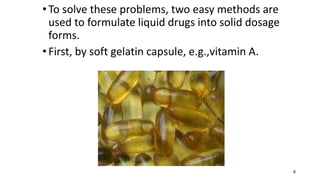
•To solve these problems, two easy methods are
used to formulate liquid drugs into solid dosage
forms.
•First, by soft gelatin capsule, e.g.,vitamin A.
8
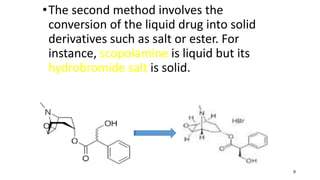
•The second method involves the
conversion of the liquid drug into solid
derivatives such as salt or ester. For
instance, scopolamine is liquid but its
hydrobromide salt is solid.
9
Melting Point
• Each a pure substance has a definite melting
point. If not pure, the substance will exhibit a
change in melting point.
• The pure substances have always higher
melting points than their impure mixtures.
• This phenomenon is called melting point
depression and commonly used to determine
the purity of a drug substance.
10
Organoleptic properties
Unfortunately, many drug substances in use
today are unpalatable and dosage forms
containing such drugs (oral preparations( may
require the addition of flavors and/or colors.
11
COLOR
• Color is generally a function of a drug’s inherent
chemical structure relating to a certain level of
unsaturation.
• Color intensity relates to the extent of conjugated
unsaturation as well as the presence of chromophores.
• Some compound may appear to have color although
structurally saturated.
12
Odour
• The substance may exhibit an inherent odor
characteristic of major functional groups present.
• Odor greatly affects the flavor of a preparation or
food stuff.
Taste
• If taste is considered as unpalatable, consideration is
to be given to the use of a less soluble chemical form
of the drug.
• The odour and taste may be suppressed by using
appropriate flavors and excipients or by coating the
final product.
13
PARTICLE SIZE
•Particle size can influence variety of
important factors :
- Dissolution rate
- Suspendability
- Uniform distribution
- Penetrability
- Lack of grittiness
14
Methods to Determine Particle Size
• Sieving
• Microscopy
• Sedimentation rate method
• Light energy diffraction
• Laser holography
• Cascade impaction
15
Methods to Determine Particle Size
1. Sieving method :
• Range : 50 – 150 µm
• Simple, inexpensive
• If powder is not dry, the apertures get clogged.
2. Microscopy :
• Range : 0.2 – 100 µm
• Particle size can be determined by the use of
calibrated grid background.
• Most direct method.
• Slow & tedious method.
16
Methods to Determine Particle Size
3. Sedimentation method :
• Range : 1 - 200 µm
• Andreasen pipette is used.
4. Cascade impaction :
• The principle that a particle driven by an airstream
will hit a surface in its path, provide that its inertia
is sufficient to overcome the drug force that tends to
keep in it in airstream.
17
Methods to Determine Particle Size
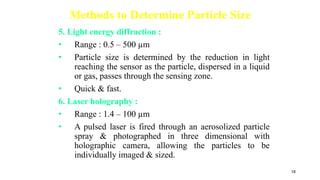
5. Light energy diffraction :
• Range : 0.5 – 500 µm
• Particle size is determined by the reduction in light
reaching the sensor as the particle, dispersed in a liquid
or gas, passes through the sensing zone.
• Quick & fast.
6. Laser holography :
• Range : 1.4 – 100 µm
• A pulsed laser is fired through an aerosolized particle
spray & photographed in three dimensional with
holographic camera, allowing the particles to be
individually imaged & sized.
18
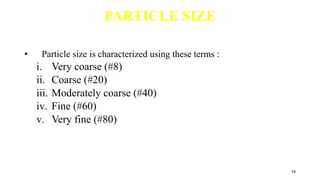
PARTICLE SIZE
• Particle size is characterized using these terms :
i. Very coarse (#8)
ii. Coarse (#20)
iii. Moderately coarse (#40)
iv. Fine (#60)
v. Very fine (#80)
19
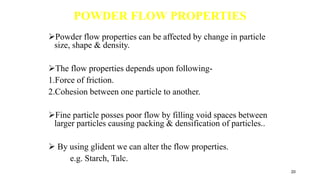
POWDER FLOW PROPERTIES
Powder flow properties can be affected by change in particle
size, shape & density.
The flow properties depends upon following-
1.Force of friction.
2.Cohesion between one particle to another.
Fine particle posses poor flow by filling void spaces between
larger particles causing packing & densification of particles..
 By using glident we can alter the flow properties.
e.g. Starch, Talc.
20
Determination Of Powder Flow Properties
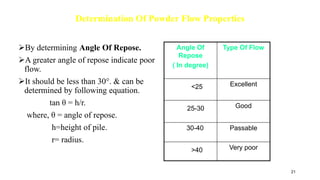
By determining Angle Of Repose.
A greater angle of repose indicate poor
flow.
It should be less than 30°. & can be
determined by following equation.
tan θ = h/r.
where, θ = angle of repose.
h=height of pile.
r= radius.
Angle Of
Repose
( In degree)
Type Of Flow
<25 Excellent
25-30 Good
30-40 Passable
>40 Very poor
21

pref.pptx

  • 2.
    Preformulation • Preformulation isbranch of Pharmaceutical science that utilizes biopharmaceutical principles in the determination of physicochemical properties of the drug substance. • Prior to the development of any dosage form new drug , it is essential that certain fundamental physical & chemical properties of drug powder are determined . • This information may dictate many of subsequent event & approaches in formulation development. 2
  • 3.
    DEFINITION:- Investigation of physico-chemicalproperties of the new drug compound that could affect drug performance and development of an effective dosage form”. Preformulation commences when a newly synthesized drug shows a sufficient pharmacologic promise in animal model to warrant evaluation in man. 3
  • 4.
    • The preformulationis the first step in the rational development of a dosage form of a drug substance alone and when combined with excipients. • Objective : To generate useful information to the formulator to design an optimum drug delivery system. 4
  • 5.
    GOALS OF PREFORMULATION •Toestablish the necessary physicochemical parameters of new drug substances. •To determine kinetic rate profile. •To establish physical characteristics. •To establish compatibility with common excipients. 5
  • 6.
    Physical Description •It isimportant to understand the physical description of a drug substance (whether it is solid, semisolid or liquid) prior to dosage form development. •Most drugs in use today are solid materials and less number are liquid in nature. 6
  • 7.
    Physical Description • Liquiddrugs have two problems in the design of a dosage form which are: • 1. The volatility: they must be physically sealed from the atmosphere to prevent evaporation. • 2. They cannot generally be formulated into tablet (the most popular form of oral medication). 7
  • 8.
    •To solve theseproblems, two easy methods are used to formulate liquid drugs into solid dosage forms. •First, by soft gelatin capsule, e.g.,vitamin A. 8
  • 9.
    •The second methodinvolves the conversion of the liquid drug into solid derivatives such as salt or ester. For instance, scopolamine is liquid but its hydrobromide salt is solid. 9
  • 10.
    Melting Point • Eacha pure substance has a definite melting point. If not pure, the substance will exhibit a change in melting point. • The pure substances have always higher melting points than their impure mixtures. • This phenomenon is called melting point depression and commonly used to determine the purity of a drug substance. 10
  • 11.
    Organoleptic properties Unfortunately, manydrug substances in use today are unpalatable and dosage forms containing such drugs (oral preparations( may require the addition of flavors and/or colors. 11
  • 12.
    COLOR • Color isgenerally a function of a drug’s inherent chemical structure relating to a certain level of unsaturation. • Color intensity relates to the extent of conjugated unsaturation as well as the presence of chromophores. • Some compound may appear to have color although structurally saturated. 12
  • 13.
    Odour • The substancemay exhibit an inherent odor characteristic of major functional groups present. • Odor greatly affects the flavor of a preparation or food stuff. Taste • If taste is considered as unpalatable, consideration is to be given to the use of a less soluble chemical form of the drug. • The odour and taste may be suppressed by using appropriate flavors and excipients or by coating the final product. 13
  • 14.
    PARTICLE SIZE •Particle sizecan influence variety of important factors : - Dissolution rate - Suspendability - Uniform distribution - Penetrability - Lack of grittiness 14
  • 15.
    Methods to DetermineParticle Size • Sieving • Microscopy • Sedimentation rate method • Light energy diffraction • Laser holography • Cascade impaction 15
  • 16.
    Methods to DetermineParticle Size 1. Sieving method : • Range : 50 – 150 µm • Simple, inexpensive • If powder is not dry, the apertures get clogged. 2. Microscopy : • Range : 0.2 – 100 µm • Particle size can be determined by the use of calibrated grid background. • Most direct method. • Slow & tedious method. 16
  • 17.
    Methods to DetermineParticle Size 3. Sedimentation method : • Range : 1 - 200 µm • Andreasen pipette is used. 4. Cascade impaction : • The principle that a particle driven by an airstream will hit a surface in its path, provide that its inertia is sufficient to overcome the drug force that tends to keep in it in airstream. 17
  • 18.
    Methods to DetermineParticle Size 5. Light energy diffraction : • Range : 0.5 – 500 µm • Particle size is determined by the reduction in light reaching the sensor as the particle, dispersed in a liquid or gas, passes through the sensing zone. • Quick & fast. 6. Laser holography : • Range : 1.4 – 100 µm • A pulsed laser is fired through an aerosolized particle spray & photographed in three dimensional with holographic camera, allowing the particles to be individually imaged & sized. 18
  • 19.
    PARTICLE SIZE • Particlesize is characterized using these terms : i. Very coarse (#8) ii. Coarse (#20) iii. Moderately coarse (#40) iv. Fine (#60) v. Very fine (#80) 19
  • 20.
    POWDER FLOW PROPERTIES Powderflow properties can be affected by change in particle size, shape & density. The flow properties depends upon following- 1.Force of friction. 2.Cohesion between one particle to another. Fine particle posses poor flow by filling void spaces between larger particles causing packing & densification of particles..  By using glident we can alter the flow properties. e.g. Starch, Talc. 20
  • 21.
    Determination Of PowderFlow Properties By determining Angle Of Repose. A greater angle of repose indicate poor flow. It should be less than 30°. & can be determined by following equation. tan θ = h/r. where, θ = angle of repose. h=height of pile. r= radius. Angle Of Repose ( In degree) Type Of Flow <25 Excellent 25-30 Good 30-40 Passable >40 Very poor 21