CHAPTER 1

INTRODUCTION TO
MANAGEMENT AND
 ORGANIZATIONS
Who Are Managers?
• Manager
  – Someone who coordinates and oversees the
    work of other people so that organizational
    goals can be accomplished.
• Nonmanagerial employees
  – These organizational members who work
    directly on a job or task and have no one
    reporting to them.
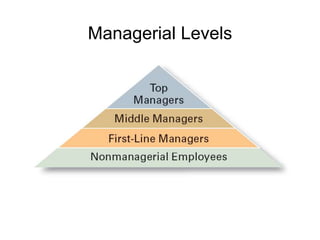
Managerial Levels
Classifying Managers
• First-line Managers
  – Are at the lowest level of management and
    manage the work of non-managerial
    employees.
• Middle Managers
  – Manage the work of first-line managers.
• Top Managers
  – Are responsible for making organization-wide
    decisions and establishing plans and goals
    that affect the entire organization.
What Is Management?
• Coordinating and overseeing the work
  activities of others so that their activities
  are completed efficiently and effectively.
• Managerial Concerns
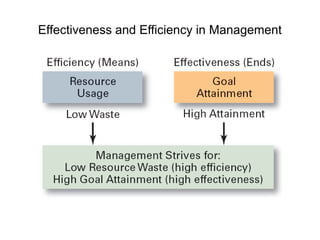
  – Efficiency
     • “Doing things right”
        – Getting the most output for the least inputs
  – Effectiveness
     • “Doing the right things”
        – Attaining organizational goals
Effectiveness and Efficiency in Management
What Do Managers Do?
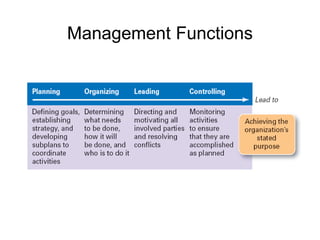
• Functional Approach / Management Functions:
  – Planning
    • Defining goals, establishing strategies to achieve goals,
      developing plans to integrate and coordinate activities.
  – Organizing
    • Arranging and structuring work to accomplish
      organization’s goals.
  – Leading
    • Working with and through people to accomplish goals.
  – Controlling
    • Monitoring, comparing, and correcting the work.
Management Functions
What Do Managers Do? (cont’d)
• Management Roles Approach
  Henry Mitzberg classified the activities of managers
  into 10 management roles.
  I) Interpersonal roles: involves people and other duties
     that are ceremonial or symbolic in nature.
       • Figurehead
       • Leader
       • Liaison
II) Informational roles ( Managing by information): Involve
   collecting, receiving and disseminating information.
     • Monitor
     • Disseminator
     • Spokesperson
III) Decisional roles: Resolve around making choices –
   “Managing action”
     • Entrepreneur
     • Disturbance handler
     • Resource allocator
     • Negotiator
What Do Managers Do? (cont’d)
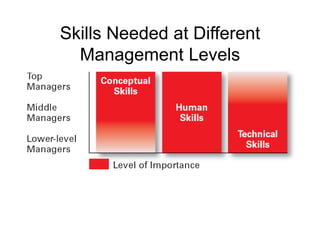
• Skills Approach/ Management Skills
• Robert L. Katz mentioned 3 essential skills
  managers need.
  – Technical skills
     • Job – specific knowledge and techniques needed to
       proficiently perform specific task
  – Human skills
     • The ability to work well with other people individually
       and in a group
  – Conceptual skills
     • The ability to think and conceptualize about abstract
       and complex situations concerning the organization
Skills Needed at Different
  Management Levels
How The Manager’s Job Is
            Changing
• Changes impacting manager’s job:
• 1) Changing technology
• 2) Increased security threats
• 3) Increased emphasis on Organizational
  and Managerial Ethics
• 4) Increased Competitiveness
How The Manager’s Job Is
                Changing
• The Increasing Importance of Customers
  – Customers: the reason that organizations exist
     • Managing customer relationships is the responsibility of
       all managers and employees.
     • Consistent high quality customer service is essential for
       survival.
• Innovation
  – Doing things differently, exploring new territory, and
    taking risks
     • Managers should encourage employees to be aware of
       and act on opportunities for innovation.
What Is An Organization?
• An Organization Defined
  – A deliberate arrangement of people to accomplish
    some specific purpose
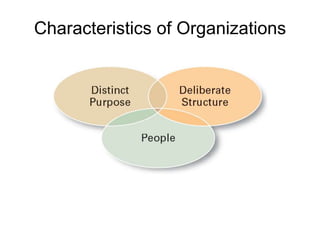
• Common Characteristics of Organizations
  – Have a distinct purpose (goal)
  – Composed of people
  – Have a deliberate structure
  Many of today’s organizations are more
    open, flexible and responsive to changes than
    organizations once were.
Characteristics of Organizations
Why Study Management?
• The Value of Studying Management
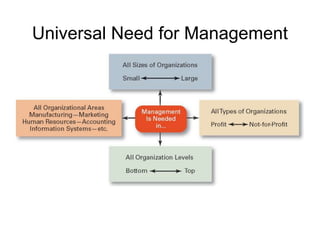
  – (1) The universality of management
     • The reality that management is needed in all
       types and sizes of organizations, at all
       organizational levels, in all organizational areas,
       and in organizations no matter where located.
     • Good management is needed in all
       organizations.
Universal Need for Management
Why Study Management? (cont.)
• The Value of Studying Management
  – (2) The reality of work
     • Employees either manage or are managed.
  – (3) Rewards and challenges of being a manager
     • Management offers challenging, exciting and creative
       opportunities for meaningful and fulfilling work.
     • Successful managers receive significant monetary
       rewards for their efforts.
Challenges of being a manager
• 1) Have to deal with a variety of personalities
• 2) Work with limited resources
• 3) Motivate workers in chaotic and uncertain
  situations.
• 4) Blend knowledge, skills, ambitions and
  experiences of a diverse work group.
• 5) Success depends on others’ work
  performance.
Rewards of being a manager
• 1) Have opportunity to think creatively and use
  imagination.
• 2) Help others find meaning and fulfillment in
  work.
• 3) Meeting and working with a variety of people.
• 4) Receive recognition and status in the
  organization and community.
• 5) Receive appropriate compensation in form of
  salaries and bonuses.
• 6) Play a role in influencing organizational
  outcomes.

Chapter 1

  • 1.
  • 2.
    Who Are Managers? •Manager – Someone who coordinates and oversees the work of other people so that organizational goals can be accomplished. • Nonmanagerial employees – These organizational members who work directly on a job or task and have no one reporting to them.
  • 3.
  • 4.
    Classifying Managers • First-lineManagers – Are at the lowest level of management and manage the work of non-managerial employees. • Middle Managers – Manage the work of first-line managers. • Top Managers – Are responsible for making organization-wide decisions and establishing plans and goals that affect the entire organization.
  • 5.
    What Is Management? •Coordinating and overseeing the work activities of others so that their activities are completed efficiently and effectively. • Managerial Concerns – Efficiency • “Doing things right” – Getting the most output for the least inputs – Effectiveness • “Doing the right things” – Attaining organizational goals
  • 6.
  • 7.
    What Do ManagersDo? • Functional Approach / Management Functions: – Planning • Defining goals, establishing strategies to achieve goals, developing plans to integrate and coordinate activities. – Organizing • Arranging and structuring work to accomplish organization’s goals. – Leading • Working with and through people to accomplish goals. – Controlling • Monitoring, comparing, and correcting the work.
  • 8.
  • 9.
    What Do ManagersDo? (cont’d) • Management Roles Approach Henry Mitzberg classified the activities of managers into 10 management roles. I) Interpersonal roles: involves people and other duties that are ceremonial or symbolic in nature. • Figurehead • Leader • Liaison
  • 10.
    II) Informational roles( Managing by information): Involve collecting, receiving and disseminating information. • Monitor • Disseminator • Spokesperson III) Decisional roles: Resolve around making choices – “Managing action” • Entrepreneur • Disturbance handler • Resource allocator • Negotiator
  • 11.
    What Do ManagersDo? (cont’d) • Skills Approach/ Management Skills • Robert L. Katz mentioned 3 essential skills managers need. – Technical skills • Job – specific knowledge and techniques needed to proficiently perform specific task – Human skills • The ability to work well with other people individually and in a group – Conceptual skills • The ability to think and conceptualize about abstract and complex situations concerning the organization
  • 12.
    Skills Needed atDifferent Management Levels
  • 13.
    How The Manager’sJob Is Changing • Changes impacting manager’s job: • 1) Changing technology • 2) Increased security threats • 3) Increased emphasis on Organizational and Managerial Ethics • 4) Increased Competitiveness
  • 14.
    How The Manager’sJob Is Changing • The Increasing Importance of Customers – Customers: the reason that organizations exist • Managing customer relationships is the responsibility of all managers and employees. • Consistent high quality customer service is essential for survival. • Innovation – Doing things differently, exploring new territory, and taking risks • Managers should encourage employees to be aware of and act on opportunities for innovation.
  • 15.
    What Is AnOrganization? • An Organization Defined – A deliberate arrangement of people to accomplish some specific purpose • Common Characteristics of Organizations – Have a distinct purpose (goal) – Composed of people – Have a deliberate structure Many of today’s organizations are more open, flexible and responsive to changes than organizations once were.
  • 16.
  • 17.
    Why Study Management? •The Value of Studying Management – (1) The universality of management • The reality that management is needed in all types and sizes of organizations, at all organizational levels, in all organizational areas, and in organizations no matter where located. • Good management is needed in all organizations.
  • 18.
  • 19.
    Why Study Management?(cont.) • The Value of Studying Management – (2) The reality of work • Employees either manage or are managed. – (3) Rewards and challenges of being a manager • Management offers challenging, exciting and creative opportunities for meaningful and fulfilling work. • Successful managers receive significant monetary rewards for their efforts.
  • 20.
    Challenges of beinga manager • 1) Have to deal with a variety of personalities • 2) Work with limited resources • 3) Motivate workers in chaotic and uncertain situations. • 4) Blend knowledge, skills, ambitions and experiences of a diverse work group. • 5) Success depends on others’ work performance.
  • 21.
    Rewards of beinga manager • 1) Have opportunity to think creatively and use imagination. • 2) Help others find meaning and fulfillment in work. • 3) Meeting and working with a variety of people. • 4) Receive recognition and status in the organization and community. • 5) Receive appropriate compensation in form of salaries and bonuses. • 6) Play a role in influencing organizational outcomes.