Introduction to Management & Organizations
Who are Managers?
 Managers are found in every type of organization such as
schools, hospitals, government departments, large
corporations etc.
 Some managers are top level managers, while others are
first line managers.
 Organizations need managers in todays uncertain,
complex and chaotic times!
Who are Managers? (continued)
 A Manager is someone who gets things done through
other people.
 In other words, a manager is an organizational member
who coordinates and oversees the work of other people
so that organizational goals can be accomplished.
 A manager’s job is not about personal achievement – it is
more about helping others do their work efficiently!
Who are Managers? (continued)
 Typically, managers are responsible for:
 Making decisions
 Allocating resources
 Directing the activities of others to attain goals
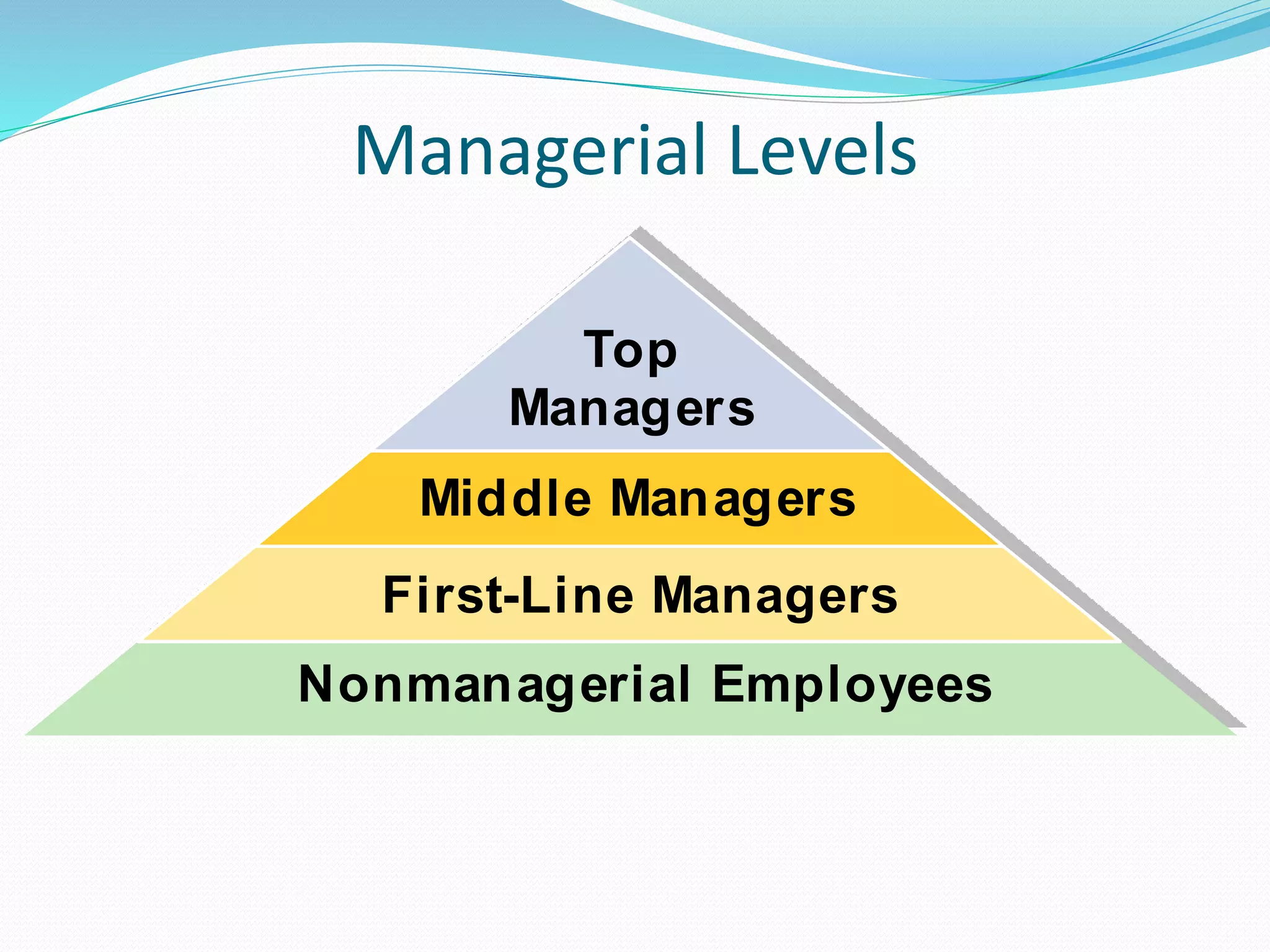
Managerial Levels
Top
Managers
Middle Managers
First-Line Managers
Nonmanagerial Employees
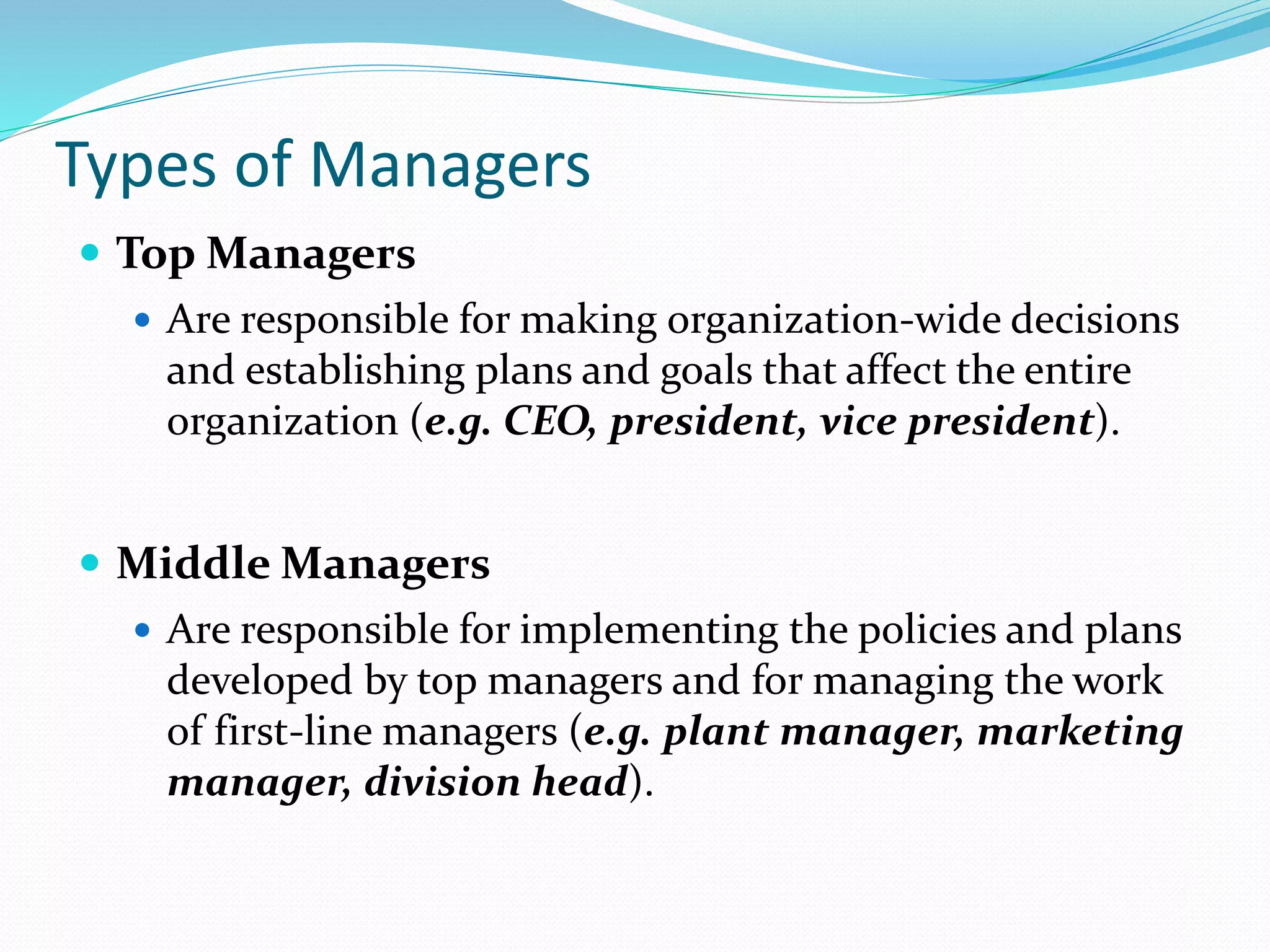
Types of Managers
 Top Managers
 Are responsible for making organization-wide decisions
and establishing plans and goals that affect the entire
organization (e.g. CEO, president, vice president).
 Middle Managers
 Are responsible for implementing the policies and plans
developed by top managers and for managing the work
of first-line managers (e.g. plant manager, marketing
manager, division head).
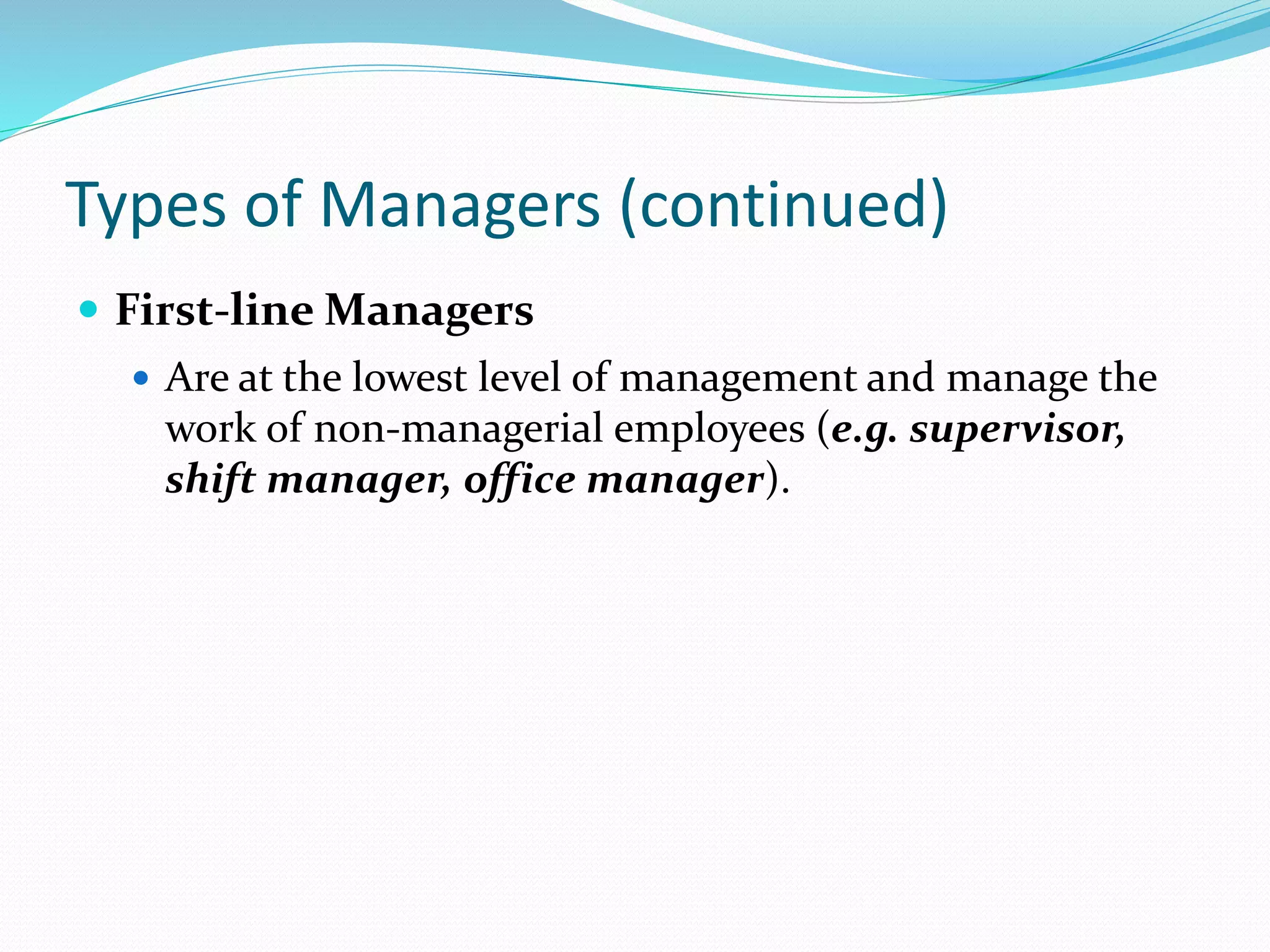
Types of Managers (continued)
 First-line Managers
 Are at the lowest level of management and manage the
work of non-managerial employees (e.g. supervisor,
shift manager, office manager).
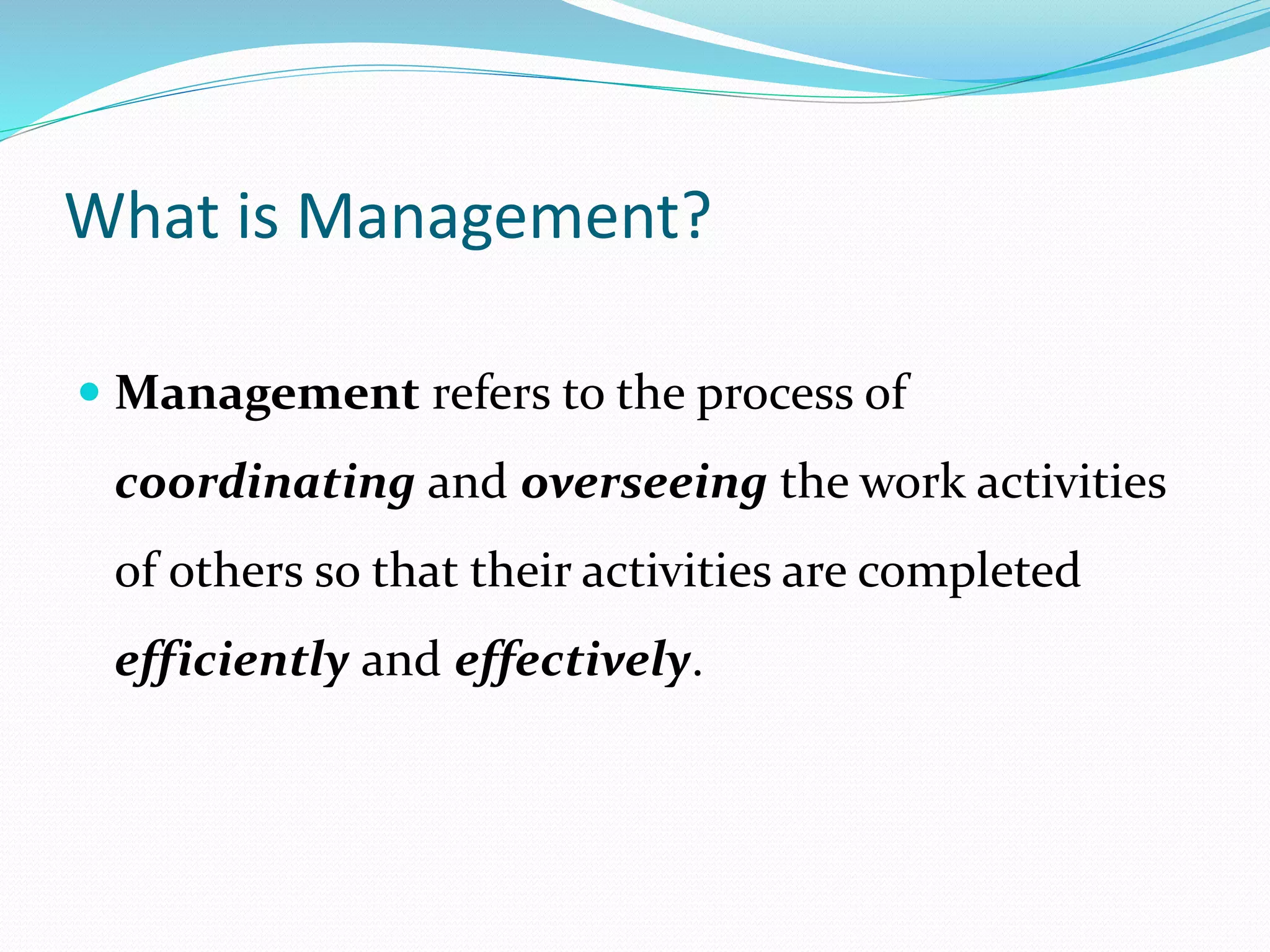
What is Management?
 Management refers to the process of
coordinating and overseeing the work activities
of others so that their activities are completed
efficiently and effectively.
Efficiency and Effectiveness
 Effectiveness is completing activities so that
organizational goals are attained; often described as
“doing the right things”.
 Efficiency is getting the most output from the least
amount of input, the goal of which is to minimize
resource costs.
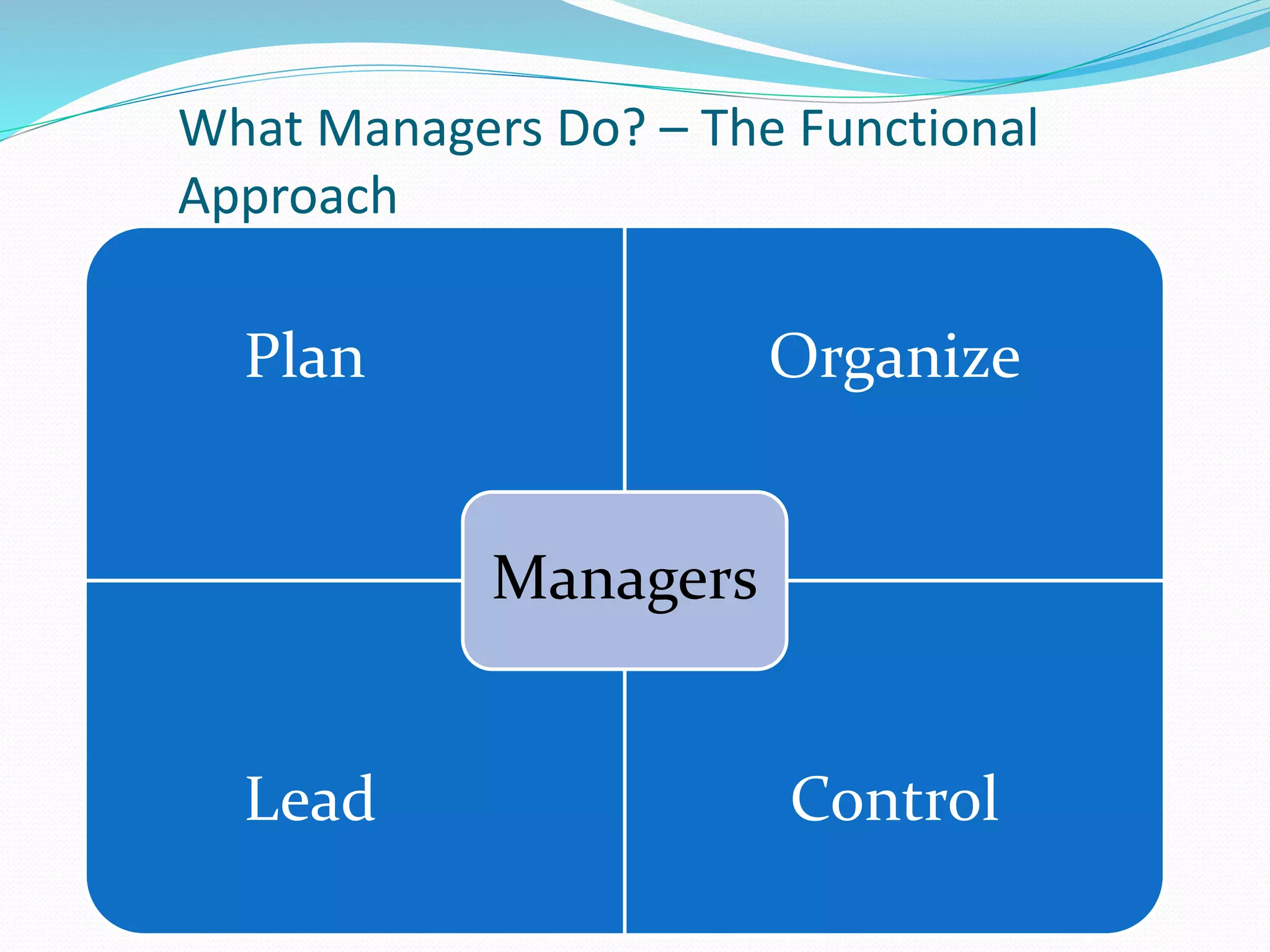
What Managers Do? – The Functional
Approach
1-10
Copyright © 2011 Pearson Education, Inc. publishing as
Prentice Hall
Plan Organize
Lead Control
Managers
Four Management Functions
(continued)
 PLAN
 A process that includes defining goals, establishing
strategy, and developing plans to coordinate activities.
 ORGANIZE
 Determining what tasks are to be done, who is to do
them, how the tasks are to be grouped, who reports to
whom, and where decisions are to be made.
Four Management Functions
(continued)
 LEAD
 A function that includes motivating employees,
directing others, selecting the most effective
communication channels, and resolving conflicts.
 CONTROL
 Monitoring performance, comparing actual
performance with previously set goals, and correcting
any deviation.
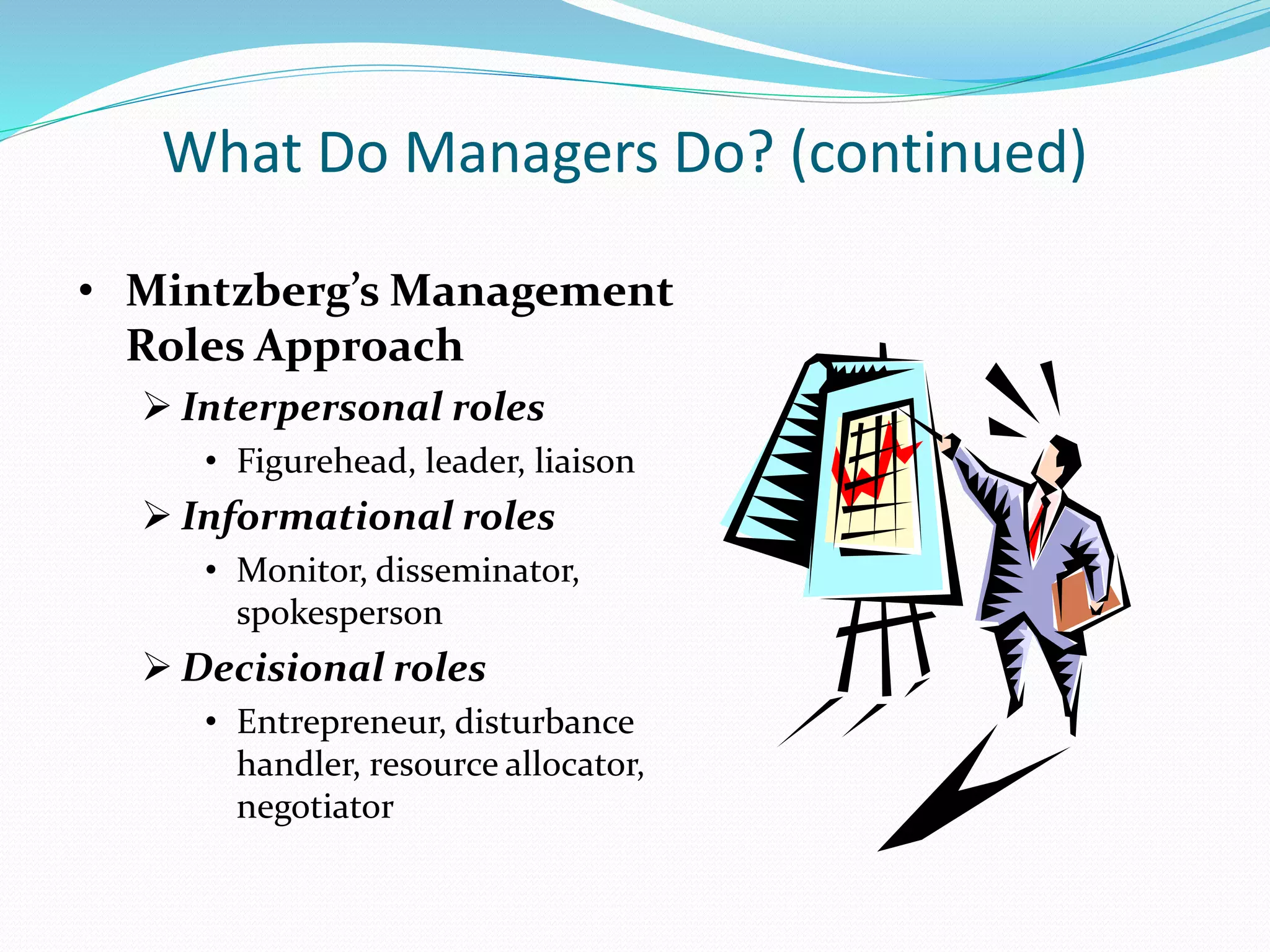
What Do Managers Do? (continued)
• Mintzberg’s Management
Roles Approach
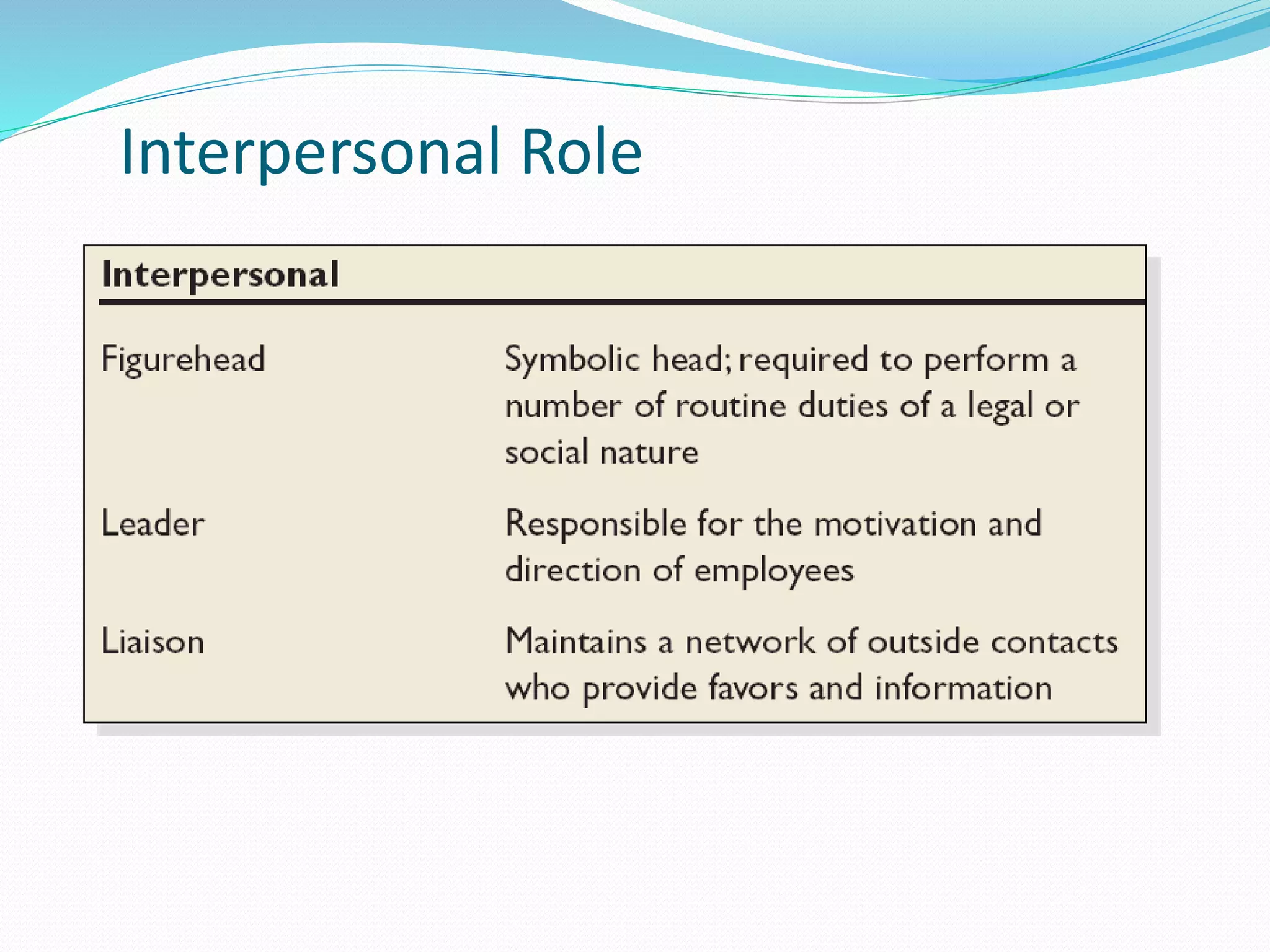
 Interpersonal roles
• Figurehead, leader, liaison
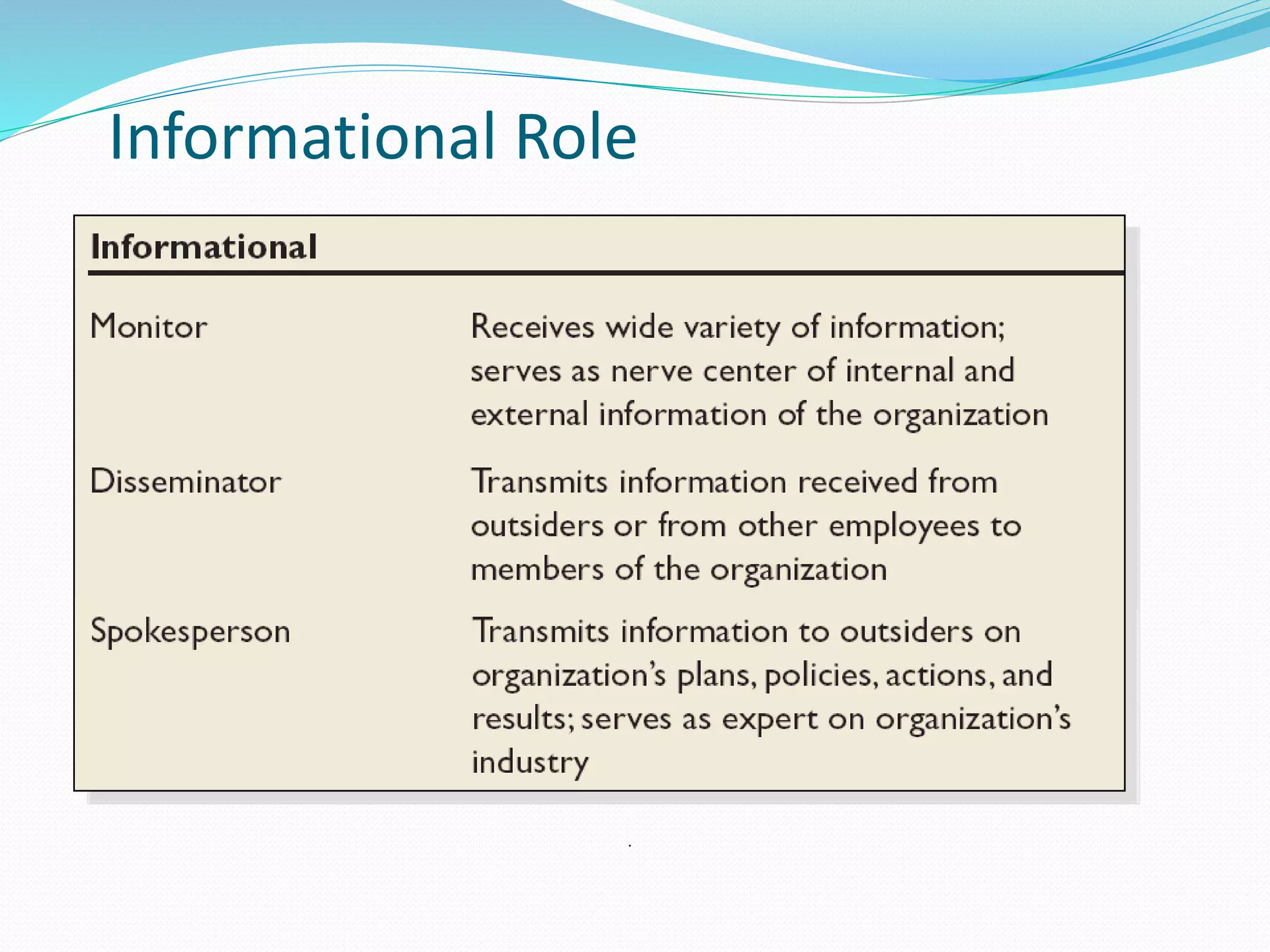
 Informational roles
• Monitor, disseminator,
spokesperson
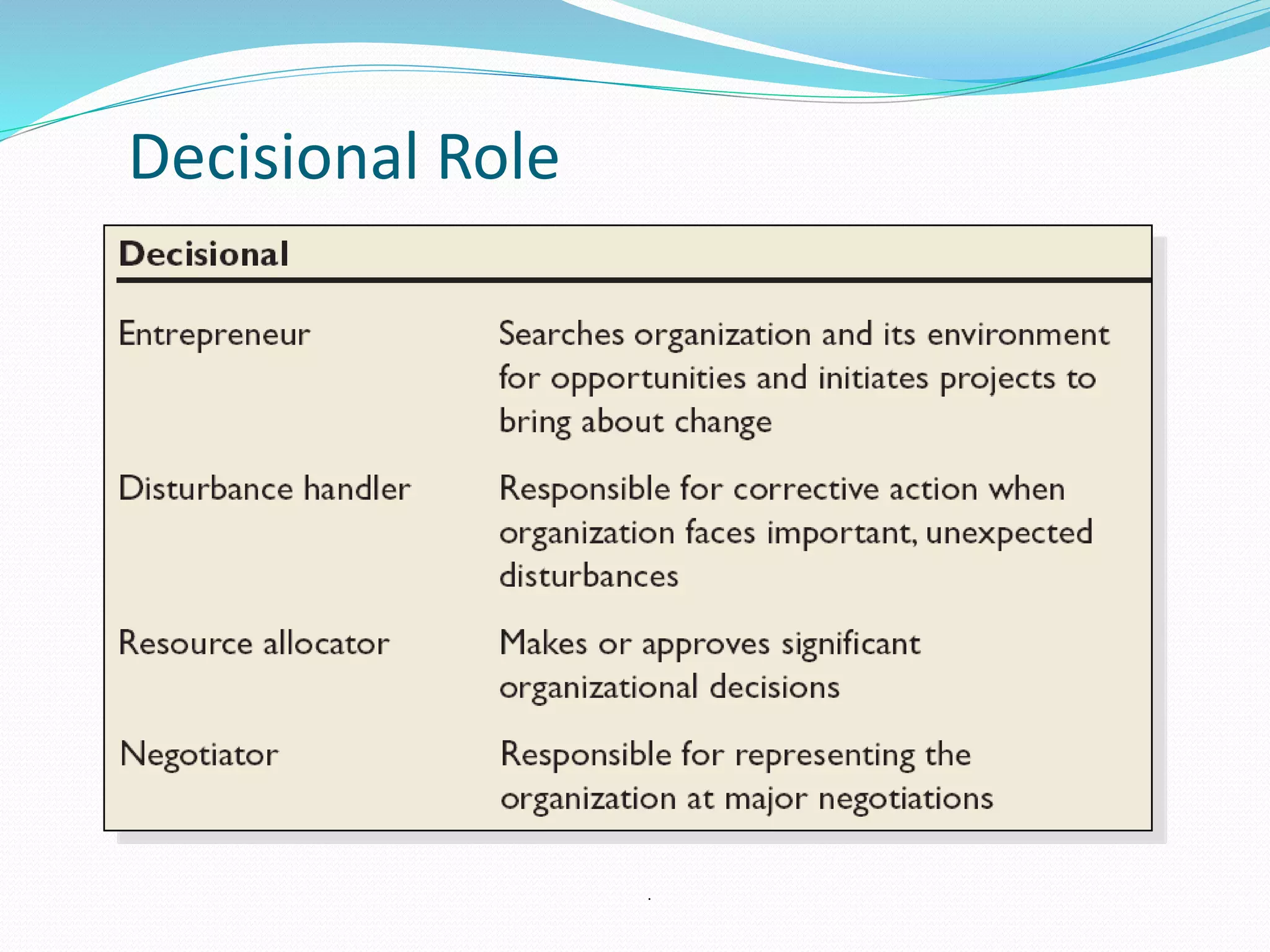
 Decisional roles
• Entrepreneur, disturbance
handler, resource allocator,
negotiator
Interpersonal Role
Informational Role
.
Decisional Role
.
Essential Management Skills
 Technical Skills
 Job specific knowledge needed to proficiently perform
work tasks.
 Human Skills
 The ability to work with, understand, and motivate
other people, both individually and in groups.
 Conceptual Skills
 The mental ability to analyze and diagnose complex
situations.
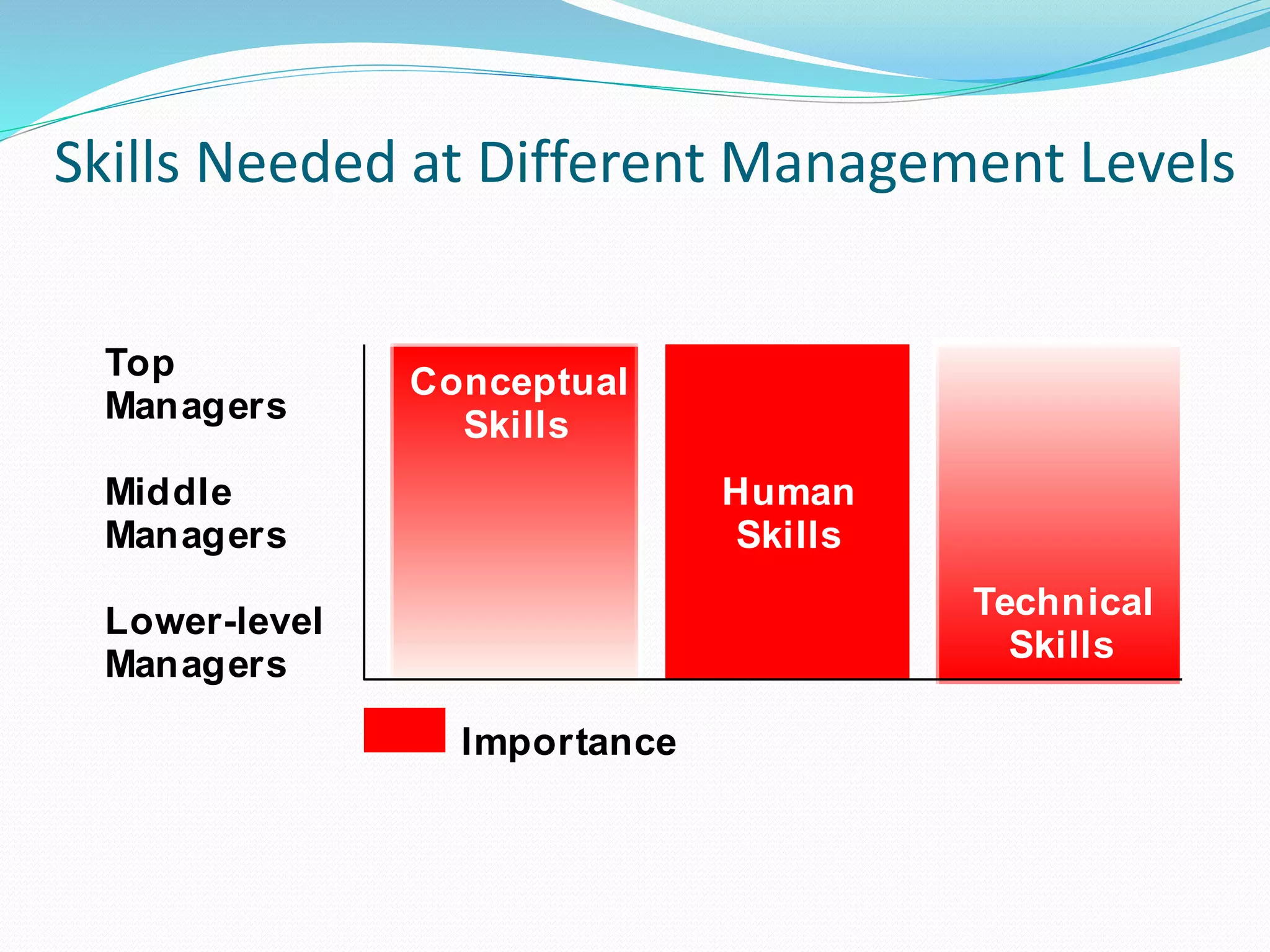
Skills Needed at Different Management Levels
Top
Managers
Middle
Managers
Lower-level
Managers
Importance
Conceptual
Skills
Human
Skills
Technical
Skills
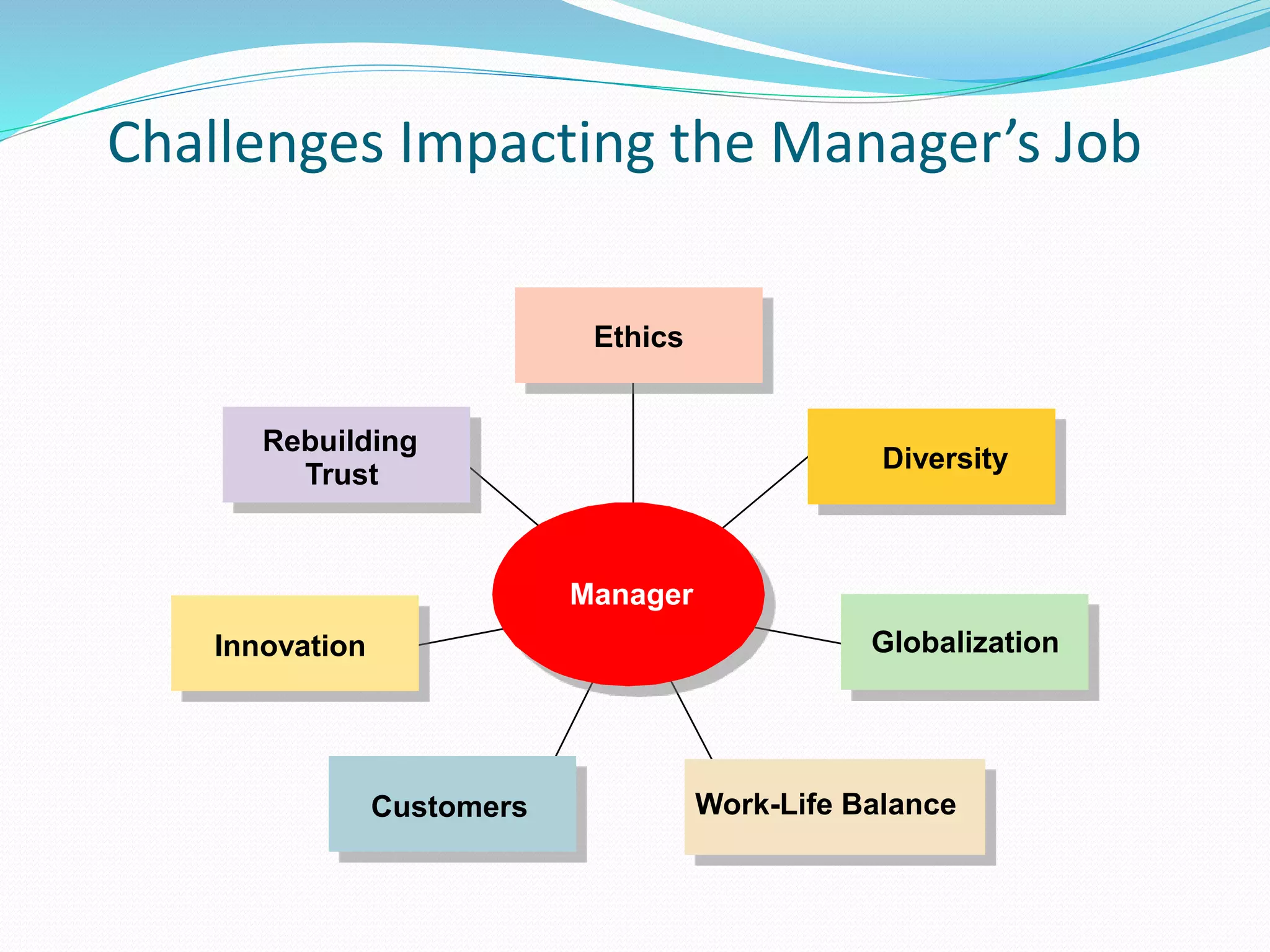
Challenges Impacting the Manager’s Job
Ethics
Manager
Work-Life Balance
Globalization
Diversity
Customers
Innovation
Rebuilding
Trust
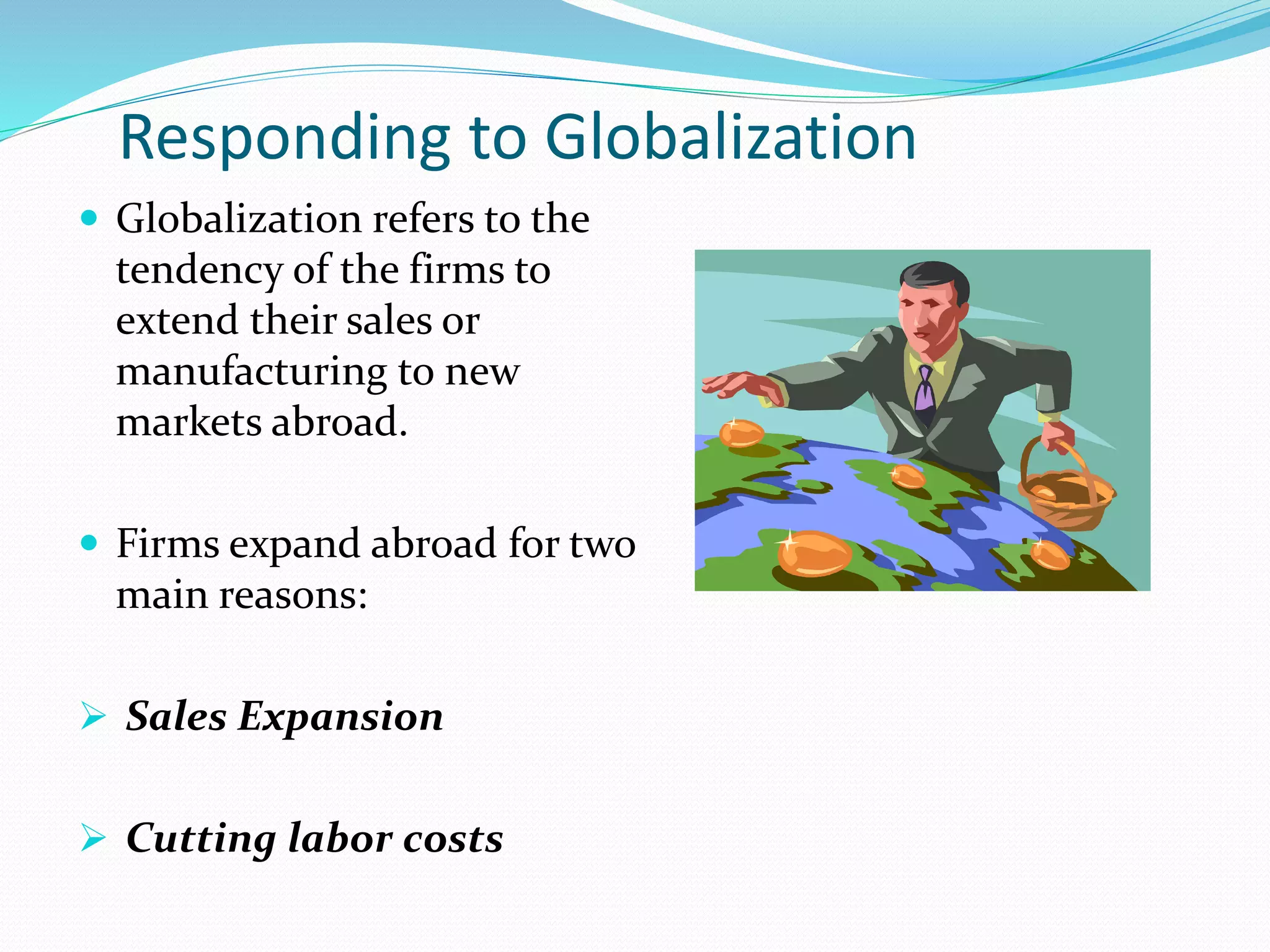
Responding to Globalization
 Globalization refers to the
tendency of the firms to
extend their sales or
manufacturing to new
markets abroad.
 Firms expand abroad for two
main reasons:
 Sales Expansion
 Cutting labor costs
Globalization (continued)
Globalization has changed the manager’s job in
three ways:
 Increased foreign assignments.
 Working with people from different cultures.
 Overseeing movement of jobs to countries with low-cost
labor.
Workforce Diversity
 Workplace diversity means that the people in
organizations are becoming more heterogeneous
in terms of gender, age, race and ethnicity.
Improving Ethical Behaviour
 In an organizational world characterised by cutbacks,
expectations of high worker productivity and tough competition,
employees often feel pressurised to engage in unethical
practices.
 They increasingly find themselves facing ethical dilemmas,
situations in which they are required to define right and wrong
conduct.
 Managers need to take appropriate steps to cultivate an ethical
climate in their organization.
Stimulating Innovation
 Creativity – Generation of novel & useful ideas
 Innovation – Implementation of those ideas
 In other words creativity is an important perquisite for
innovation!
What is An Organization?
• An Organization Defined
It is a deliberate arrangement of people to
accomplish some specific purpose.
• Common Characteristics of Organizations
Have a distinct purpose (goal)
Are composed of people
Have a deliberate structure (e.g. clearly defined
rules, regulations , job descriptions and reporting
relationships).
Why Study Management?
 The value of studying management can be gauged by
looking at three things:
The universality of management
The reality of work
The rewards and challenges of being a manager
Why Study Management?
(continued)
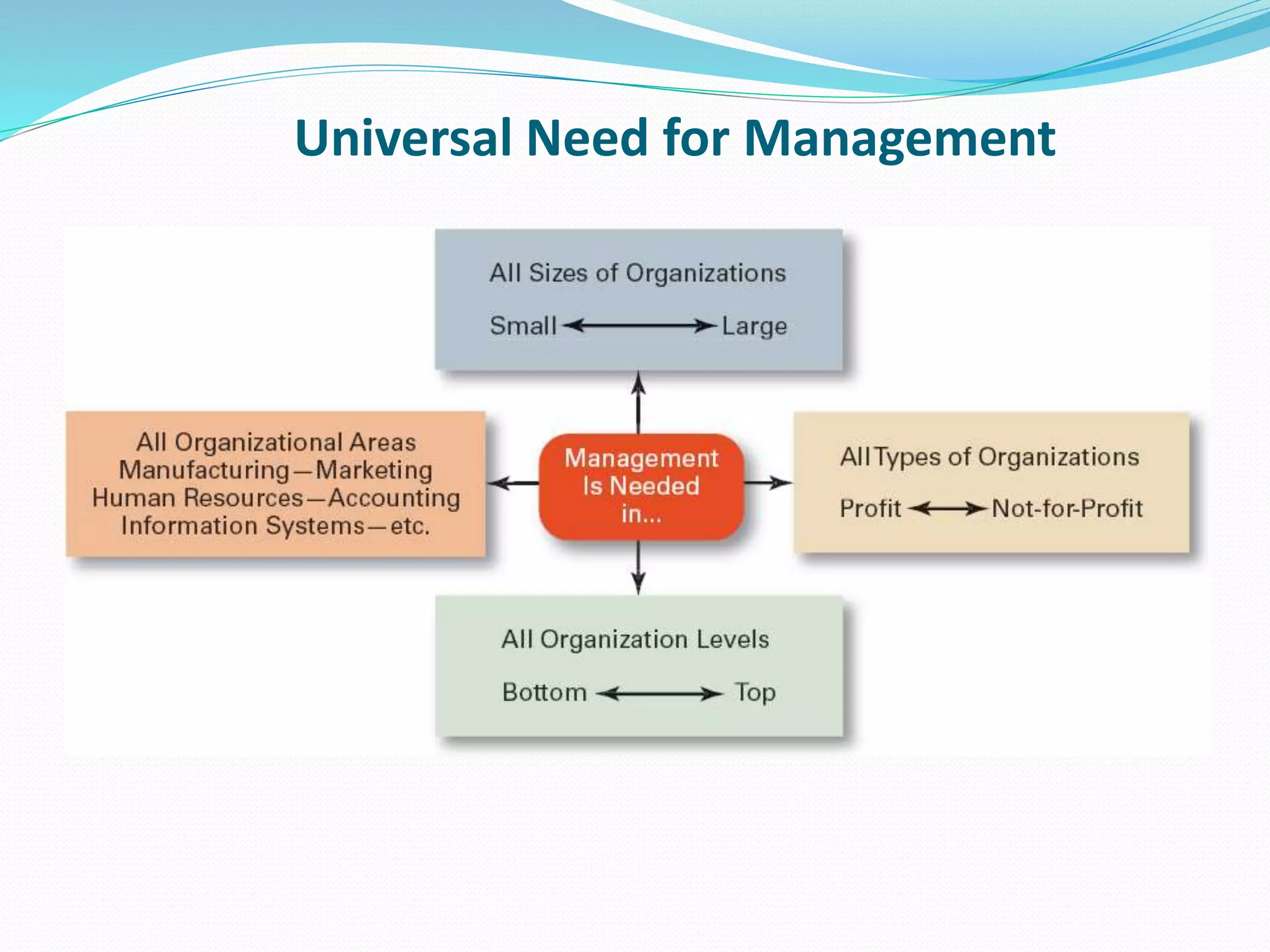
The universality of management
• Good management is needed in all
organizations.
The reality of work
• Employees either manage or are managed.
Universal Need for Management
Why Study Management? (continued)
 Rewards & Challenges of Being a Manager
 Management offers challenging, exciting and
creative opportunities for meaningful and
fulfilling work.
 Successful managers receive significant
monetary rewards for their efforts.
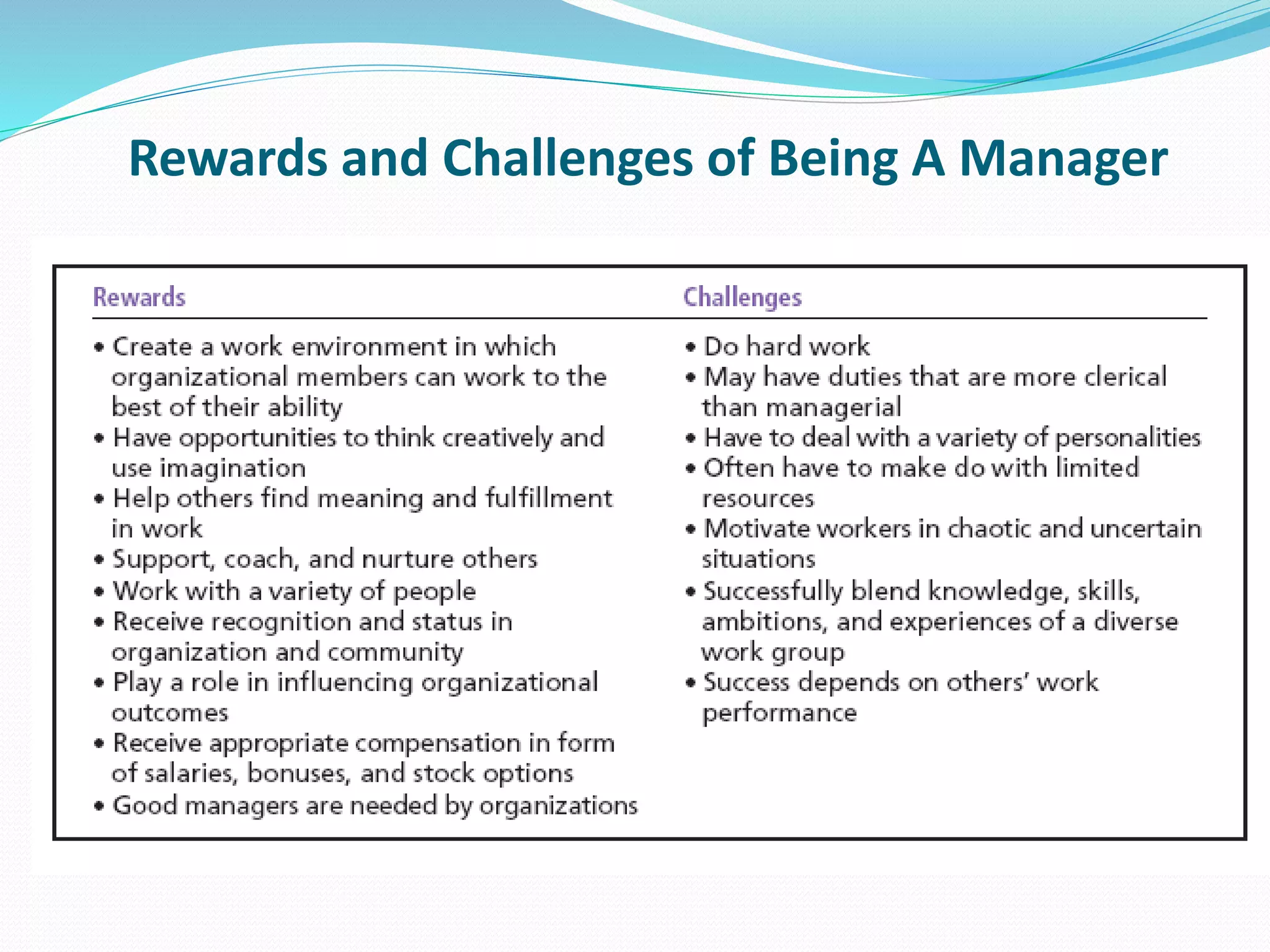
Rewards and Challenges of Being A Manager

introduction to management and organization

  • 1.
  • 2.
    Who are Managers? Managers are found in every type of organization such as schools, hospitals, government departments, large corporations etc.  Some managers are top level managers, while others are first line managers.  Organizations need managers in todays uncertain, complex and chaotic times!
  • 3.
    Who are Managers?(continued)  A Manager is someone who gets things done through other people.  In other words, a manager is an organizational member who coordinates and oversees the work of other people so that organizational goals can be accomplished.  A manager’s job is not about personal achievement – it is more about helping others do their work efficiently!
  • 4.
    Who are Managers?(continued)  Typically, managers are responsible for:  Making decisions  Allocating resources  Directing the activities of others to attain goals
  • 5.
  • 6.
    Types of Managers Top Managers  Are responsible for making organization-wide decisions and establishing plans and goals that affect the entire organization (e.g. CEO, president, vice president).  Middle Managers  Are responsible for implementing the policies and plans developed by top managers and for managing the work of first-line managers (e.g. plant manager, marketing manager, division head).
  • 7.
    Types of Managers(continued)  First-line Managers  Are at the lowest level of management and manage the work of non-managerial employees (e.g. supervisor, shift manager, office manager).
  • 8.
    What is Management? Management refers to the process of coordinating and overseeing the work activities of others so that their activities are completed efficiently and effectively.
  • 9.
    Efficiency and Effectiveness Effectiveness is completing activities so that organizational goals are attained; often described as “doing the right things”.  Efficiency is getting the most output from the least amount of input, the goal of which is to minimize resource costs.
  • 10.
    What Managers Do?– The Functional Approach 1-10 Copyright © 2011 Pearson Education, Inc. publishing as Prentice Hall Plan Organize Lead Control Managers
  • 11.
    Four Management Functions (continued) PLAN  A process that includes defining goals, establishing strategy, and developing plans to coordinate activities.  ORGANIZE  Determining what tasks are to be done, who is to do them, how the tasks are to be grouped, who reports to whom, and where decisions are to be made.
  • 12.
    Four Management Functions (continued) LEAD  A function that includes motivating employees, directing others, selecting the most effective communication channels, and resolving conflicts.  CONTROL  Monitoring performance, comparing actual performance with previously set goals, and correcting any deviation.
  • 13.
    What Do ManagersDo? (continued) • Mintzberg’s Management Roles Approach  Interpersonal roles • Figurehead, leader, liaison  Informational roles • Monitor, disseminator, spokesperson  Decisional roles • Entrepreneur, disturbance handler, resource allocator, negotiator
  • 14.
  • 15.
  • 16.
  • 17.
    Essential Management Skills Technical Skills  Job specific knowledge needed to proficiently perform work tasks.  Human Skills  The ability to work with, understand, and motivate other people, both individually and in groups.  Conceptual Skills  The mental ability to analyze and diagnose complex situations.
  • 18.
    Skills Needed atDifferent Management Levels Top Managers Middle Managers Lower-level Managers Importance Conceptual Skills Human Skills Technical Skills
  • 19.
    Challenges Impacting theManager’s Job Ethics Manager Work-Life Balance Globalization Diversity Customers Innovation Rebuilding Trust
  • 20.
    Responding to Globalization Globalization refers to the tendency of the firms to extend their sales or manufacturing to new markets abroad.  Firms expand abroad for two main reasons:  Sales Expansion  Cutting labor costs
  • 21.
    Globalization (continued) Globalization haschanged the manager’s job in three ways:  Increased foreign assignments.  Working with people from different cultures.  Overseeing movement of jobs to countries with low-cost labor.
  • 22.
    Workforce Diversity  Workplacediversity means that the people in organizations are becoming more heterogeneous in terms of gender, age, race and ethnicity.
  • 23.
    Improving Ethical Behaviour In an organizational world characterised by cutbacks, expectations of high worker productivity and tough competition, employees often feel pressurised to engage in unethical practices.  They increasingly find themselves facing ethical dilemmas, situations in which they are required to define right and wrong conduct.  Managers need to take appropriate steps to cultivate an ethical climate in their organization.
  • 24.
    Stimulating Innovation  Creativity– Generation of novel & useful ideas  Innovation – Implementation of those ideas  In other words creativity is an important perquisite for innovation!
  • 25.
    What is AnOrganization? • An Organization Defined It is a deliberate arrangement of people to accomplish some specific purpose. • Common Characteristics of Organizations Have a distinct purpose (goal) Are composed of people Have a deliberate structure (e.g. clearly defined rules, regulations , job descriptions and reporting relationships).
  • 26.
    Why Study Management? The value of studying management can be gauged by looking at three things: The universality of management The reality of work The rewards and challenges of being a manager
  • 27.
    Why Study Management? (continued) Theuniversality of management • Good management is needed in all organizations. The reality of work • Employees either manage or are managed.
  • 28.
  • 29.
    Why Study Management?(continued)  Rewards & Challenges of Being a Manager  Management offers challenging, exciting and creative opportunities for meaningful and fulfilling work.  Successful managers receive significant monetary rewards for their efforts.
  • 30.
    Rewards and Challengesof Being A Manager