INTRODUCTION
TO MANAGEMENT
Lecture-1
Management & Organization
Learning Outcome
■ Why managers are important to organizations.
■ Who Are Managers and Where Do They Work?
■ Describe the functions, roles, and skills of managers.
■ Describe the factors that are reshaping and redefining
the manager’s job.
■ Explain the value of studying management.
Who Are Managers?
Manager
Someone who coordinates and oversees the work of other
people so that organizational goals can be accomplished.
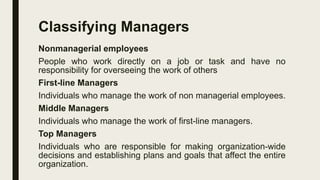
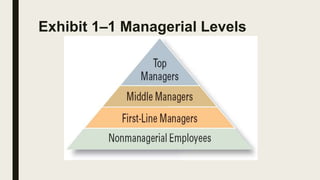
Classifying Managers
Nonmanagerial employees
People who work directly on a job or task and have no
responsibility for overseeing the work of others
First-line Managers
Individuals who manage the work of non managerial employees.
Middle Managers
Individuals who manage the work of first-line managers.
Top Managers
Individuals who are responsible for making organization-wide
decisions and establishing plans and goals that affect the entire
organization.
Exhibit 1–1 Managerial Levels
What Is Management?
■ Management involves coordinating and
overseeing the work activities of others so that
their activities are completed efficiently and
effectively.
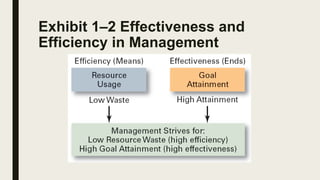
■ Efficiency refers to getting the most output
from the least amount of inputs. “doing
things right”
■ Effectiveness is often described as “doing
the right things”—that is, doing those work
activities that will help the organization reach
its goals
Exhibit 1–2 Effectiveness and
Efficiency in Management
What Do Managers Do?
■ Three approaches to define what managers do:
– Functions they Perform
– Roles they play
– Skills they need
What Do Managers Do?
Functional Approach
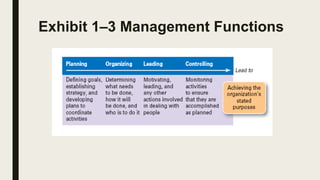
Planning
Defining goals, establishing strategies to achieve goals,
developing plans to integrate and coordinate activities.
Organizing
Arranging and structuring work to accomplish organizational
goals.
Leading
Working with and through people to accomplish goals.
Controlling
Monitoring, comparing, and correcting work.
Exhibit 1–3 Management Functions
What Do Managers Do? (cont’d)
Management Roles Approach (Mintzberg)
Interpersonal roles
■ Figurehead, leader, liaison
Informational roles
■ Monitor, disseminator, spokesperson
Decisional roles
■ Disturbance handler, resource allocator, negotiator
What Do Managers Do? (cont’d)
Interaction
■ with others
■ with the organization
■ with the external context of the organization
Reflection
■ thoughtful thinking
Action
■ practical doing
What Do Managers Do? (cont’d)
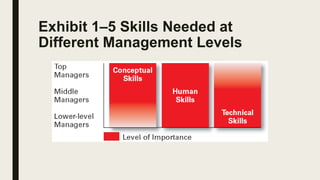
Skills Approach
Technical skills
Knowledge and proficiency in a specific field
Human skills
The ability to work well with other people
Conceptual skills
The ability to think and conceptualize about abstract and
complex situations concerning the organization
Exhibit 1–5 Skills Needed at
Different Management Levels
Exhibit 1–6 Conceptual Skills
■ Using information to solve business problems
■ Identifying of opportunities for innovation
■ Recognizing problem areas and implementing
■ solutions
■ Selecting critical information from masses of
■ data
■ Understanding of business uses of technology
■ Understanding of organization’s business model
Exhibit 1–6 Communication Skills
■ Ability to transform ideas into words and actions
■ Credibility among colleagues, peers, and
■ Subordinates
■ Listening and asking questions
■ Presentation skills; spoken format
■ Presentation skills; written and/or graphic formats
Exhibit 1–6 Effectiveness Skills
■ Contributing to corporate mission/departmental
■ objectives
■ Customer focus
■ Multitasking: working at multiple tasks in parallel
■ Negotiating skills
■ Project management
■ Reviewing operations and implementing improvements
■ Setting and maintaining performance standards internally and
externally
■ Setting priorities for attention and activity
■ Time management
Exhibit 1–6 Interpersonal Skills
■ Coaching and mentoring skills
■ Diversity skills: working with diverse people and
■ cultures
■ Networking within the organization
■ Networking outside the organization
■ Working in teams; cooperation and commitment
How The Manager’s Job Is
Changing
The Increasing Importance of Customers
Customers: the reason that organizations exist
■ Managing customer relationships is the responsibility of
all managers and employees.
■ Consistent high quality customer service is essential for
survival.
Innovation
Doing things differently, exploring new territory, and taking
risks
■ Managers should encourage employees to be aware of
and act on opportunities for innovation.
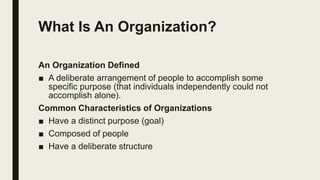
What Is An Organization?
An Organization Defined
■ A deliberate arrangement of people to accomplish some
specific purpose (that individuals independently could not
accomplish alone).
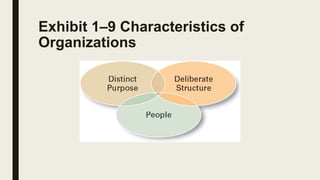
Common Characteristics of Organizations
■ Have a distinct purpose (goal)
■ Composed of people
■ Have a deliberate structure
Exhibit 1–9 Characteristics of
Organizations
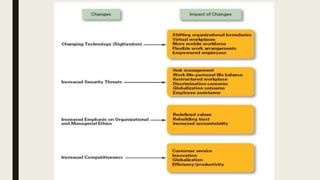
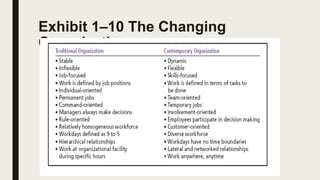
Exhibit 1–10 The Changing
Organization
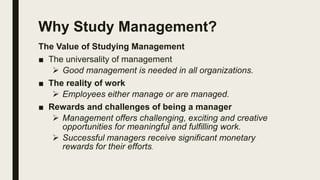
Why Study Management?
The Value of Studying Management
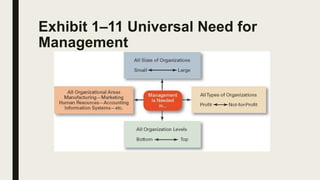
■ The universality of management
 Good management is needed in all organizations.
■ The reality of work
 Employees either manage or are managed.
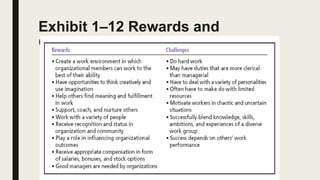
■ Rewards and challenges of being a manager
 Management offers challenging, exciting and creative
opportunities for meaningful and fulfilling work.
 Successful managers receive significant monetary
rewards for their efforts.
Exhibit 1–11 Universal Need for
Management
Exhibit 1–12 Rewards and
Challenges of Being A Manager

POM.pptx

  • 1.
  • 2.
    Learning Outcome ■ Whymanagers are important to organizations. ■ Who Are Managers and Where Do They Work? ■ Describe the functions, roles, and skills of managers. ■ Describe the factors that are reshaping and redefining the manager’s job. ■ Explain the value of studying management.
  • 3.
    Who Are Managers? Manager Someonewho coordinates and oversees the work of other people so that organizational goals can be accomplished.
  • 4.
    Classifying Managers Nonmanagerial employees Peoplewho work directly on a job or task and have no responsibility for overseeing the work of others First-line Managers Individuals who manage the work of non managerial employees. Middle Managers Individuals who manage the work of first-line managers. Top Managers Individuals who are responsible for making organization-wide decisions and establishing plans and goals that affect the entire organization.
  • 5.
  • 6.
    What Is Management? ■Management involves coordinating and overseeing the work activities of others so that their activities are completed efficiently and effectively. ■ Efficiency refers to getting the most output from the least amount of inputs. “doing things right” ■ Effectiveness is often described as “doing the right things”—that is, doing those work activities that will help the organization reach its goals
  • 7.
    Exhibit 1–2 Effectivenessand Efficiency in Management
  • 8.
    What Do ManagersDo? ■ Three approaches to define what managers do: – Functions they Perform – Roles they play – Skills they need
  • 9.
    What Do ManagersDo? Functional Approach Planning Defining goals, establishing strategies to achieve goals, developing plans to integrate and coordinate activities. Organizing Arranging and structuring work to accomplish organizational goals. Leading Working with and through people to accomplish goals. Controlling Monitoring, comparing, and correcting work.
  • 10.
  • 11.
    What Do ManagersDo? (cont’d) Management Roles Approach (Mintzberg) Interpersonal roles ■ Figurehead, leader, liaison Informational roles ■ Monitor, disseminator, spokesperson Decisional roles ■ Disturbance handler, resource allocator, negotiator
  • 12.
    What Do ManagersDo? (cont’d) Interaction ■ with others ■ with the organization ■ with the external context of the organization Reflection ■ thoughtful thinking Action ■ practical doing
  • 13.
    What Do ManagersDo? (cont’d) Skills Approach Technical skills Knowledge and proficiency in a specific field Human skills The ability to work well with other people Conceptual skills The ability to think and conceptualize about abstract and complex situations concerning the organization
  • 14.
    Exhibit 1–5 SkillsNeeded at Different Management Levels
  • 15.
    Exhibit 1–6 ConceptualSkills ■ Using information to solve business problems ■ Identifying of opportunities for innovation ■ Recognizing problem areas and implementing ■ solutions ■ Selecting critical information from masses of ■ data ■ Understanding of business uses of technology ■ Understanding of organization’s business model
  • 16.
    Exhibit 1–6 CommunicationSkills ■ Ability to transform ideas into words and actions ■ Credibility among colleagues, peers, and ■ Subordinates ■ Listening and asking questions ■ Presentation skills; spoken format ■ Presentation skills; written and/or graphic formats
  • 17.
    Exhibit 1–6 EffectivenessSkills ■ Contributing to corporate mission/departmental ■ objectives ■ Customer focus ■ Multitasking: working at multiple tasks in parallel ■ Negotiating skills ■ Project management ■ Reviewing operations and implementing improvements ■ Setting and maintaining performance standards internally and externally ■ Setting priorities for attention and activity ■ Time management
  • 18.
    Exhibit 1–6 InterpersonalSkills ■ Coaching and mentoring skills ■ Diversity skills: working with diverse people and ■ cultures ■ Networking within the organization ■ Networking outside the organization ■ Working in teams; cooperation and commitment
  • 19.
    How The Manager’sJob Is Changing The Increasing Importance of Customers Customers: the reason that organizations exist ■ Managing customer relationships is the responsibility of all managers and employees. ■ Consistent high quality customer service is essential for survival. Innovation Doing things differently, exploring new territory, and taking risks ■ Managers should encourage employees to be aware of and act on opportunities for innovation.
  • 21.
    What Is AnOrganization? An Organization Defined ■ A deliberate arrangement of people to accomplish some specific purpose (that individuals independently could not accomplish alone). Common Characteristics of Organizations ■ Have a distinct purpose (goal) ■ Composed of people ■ Have a deliberate structure
  • 22.
  • 23.
    Exhibit 1–10 TheChanging Organization
  • 24.
    Why Study Management? TheValue of Studying Management ■ The universality of management  Good management is needed in all organizations. ■ The reality of work  Employees either manage or are managed. ■ Rewards and challenges of being a manager  Management offers challenging, exciting and creative opportunities for meaningful and fulfilling work.  Successful managers receive significant monetary rewards for their efforts.
  • 25.
    Exhibit 1–11 UniversalNeed for Management
  • 26.
    Exhibit 1–12 Rewardsand Challenges of Being A Manager