COST AUDIT

BY:
DHIRENDRA KR CHAUDHARY
INTRODUCTION
“It is the detailed checking of the costing system, technique
and accounts to verify their correctness and to ensure
adherence to the objective of cost accountancy.”-ICMA
LONDON
“An audit of efficiency ,minute details of expenditure while
the work is in progress and not a post –mortem .cost audit
is mainly a preventive measure ,a guide for management
policy and decision ,in addition to being barometer of
performance “- ICWAI INDIA
OVERVIEW
♦ India was the first country in South Asia (and perhaps in the

world) to make cost audit mandatory for some of its business
sectors. The Institute of Cost and Works Accountants of India
(ICWAI) refers to cost audit as an audit of efficiency of minute
details of expenditure while the work is in progress and not a
post-mortem examination.

♦ Objectives of cost audit include the determination and control of

cost together with providing data for making judgements and
decisions on various matters, such as operational efficiency.

♦ GOI has added industries involved in the manufacturing of

plantation products together with the petroleum and
telecommunication industries in 2002 to the list of industries
requiring mandatory cost audits.
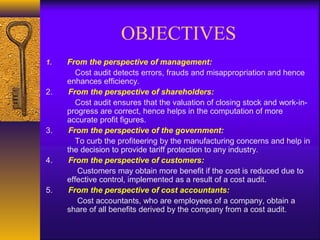
OBJECTIVES
1.

2.

3.

4.

5.

From the perspective of management:
Cost audit detects errors, frauds and misappropriation and hence
enhances efficiency.
From the perspective of shareholders:
Cost audit ensures that the valuation of closing stock and work-inprogress are correct, hence helps in the computation of more
accurate profit figures.
From the perspective of the government:
To curb the profiteering by the manufacturing concerns and help in
the decision to provide tariff protection to any industry.
From the perspective of customers:
Customers may obtain more benefit if the cost is reduced due to
effective control, implemented as a result of a cost audit.
From the perspective of cost accountants:
Cost accountants, who are employees of a company, obtain a
share of all benefits derived by the company from a cost audit.
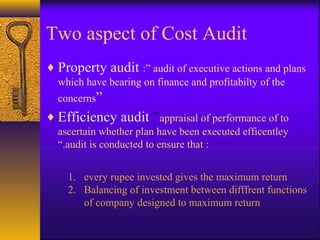
Two aspect of Cost Audit
♦ Property audit :” audit of executive actions and plans
which have bearing on finance and profitabilty of the
concerns”

♦ Efficiency audit:”appraisal of performance of to
ascertain whether plan have been executed efficentley
“.audit is conducted to ensure that :
1. every rupee invested gives the maximum return
2. Balancing of investment between difffrent functions
of company designed to maximum return
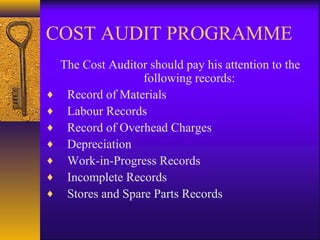
COST AUDIT PROGRAMME
♦
♦
♦
♦
♦
♦
♦

The Cost Auditor should pay his attention to the
following records:
Record of Materials
Labour Records
Record of Overhead Charges
Depreciation
Work-in-Progress Records
Incomplete Records
Stores and Spare Parts Records
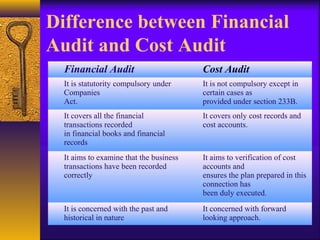
Difference between Financial
Audit and Cost Audit
Financial Audit

Cost Audit

It is statutority compulsory under
Companies
Act.

It is not compulsory except in
certain cases as
provided under section 233B.

It covers all the financial
transactions recorded
in financial books and financial
records

It covers only cost records and
cost accounts.

It aims to examine that the business
transactions have been recorded
correctly

It aims to verification of cost
accounts and
ensures the plan prepared in this
connection has
been duly executed.

It is concerned with the past and
historical in nature

It concerned with forward
looking approach.
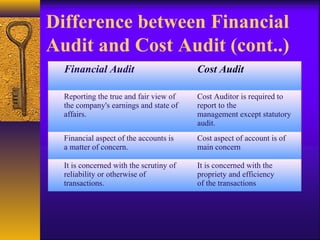
Difference between Financial
Audit and Cost Audit (cont..)
Financial Audit

Cost Audit

Reporting the true and fair view of
the company's earnings and state of
affairs.

Cost Auditor is required to
report to the
management except statutory
audit.

Financial aspect of the accounts is
a matter of concern.

Cost aspect of account is of
main concern

It is concerned with the scrutiny of
reliability or otherwise of
transactions.

It is concerned with the
propriety and efficiency
of the transactions
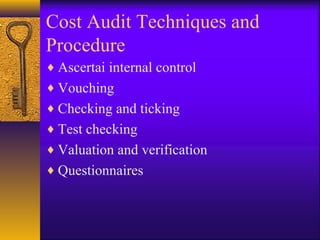
Cost Audit Techniques and
Procedure
♦ Ascertai internal control
♦ Vouching
♦ Checking and ticking
♦ Test checking
♦ Valuation and verification
♦ Questionnaires
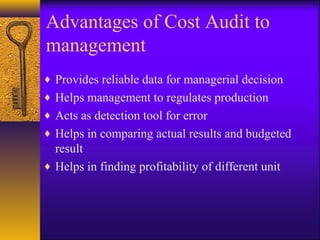
Advantages of Cost Audit to
management
♦ Provides reliable data for managerial decision
♦ Helps management to regulates production
♦ Acts as detection tool for error
♦ Helps in comparing actual results and budgeted

result
♦ Helps in finding profitability of different unit
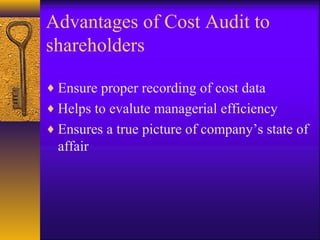
Advantages of Cost Audit to
shareholders
♦ Ensure proper recording of cost data
♦ Helps to evalute managerial efficiency
♦ Ensures a true picture of company’s state of

affair
Advantages of Cost Audit to
consumers
♦ Reveals true cost of production
♦ Justify the price
Advantages of Cost Audit to
Goverment
♦ Helps “tarriff board”
♦ Help to meausre and improve the efficiency

of sick industrial unit
♦ Revael fraundulent intention of
management
♦ Help in pricing various commodities
♦ Helps in tax imposing decision
THANK YOU!

Cost audit

  • 1.
  • 2.
    INTRODUCTION “It is thedetailed checking of the costing system, technique and accounts to verify their correctness and to ensure adherence to the objective of cost accountancy.”-ICMA LONDON “An audit of efficiency ,minute details of expenditure while the work is in progress and not a post –mortem .cost audit is mainly a preventive measure ,a guide for management policy and decision ,in addition to being barometer of performance “- ICWAI INDIA
  • 3.
    OVERVIEW ♦ India wasthe first country in South Asia (and perhaps in the world) to make cost audit mandatory for some of its business sectors. The Institute of Cost and Works Accountants of India (ICWAI) refers to cost audit as an audit of efficiency of minute details of expenditure while the work is in progress and not a post-mortem examination. ♦ Objectives of cost audit include the determination and control of cost together with providing data for making judgements and decisions on various matters, such as operational efficiency. ♦ GOI has added industries involved in the manufacturing of plantation products together with the petroleum and telecommunication industries in 2002 to the list of industries requiring mandatory cost audits.
  • 4.
    OBJECTIVES 1. 2. 3. 4. 5. From the perspectiveof management: Cost audit detects errors, frauds and misappropriation and hence enhances efficiency. From the perspective of shareholders: Cost audit ensures that the valuation of closing stock and work-inprogress are correct, hence helps in the computation of more accurate profit figures. From the perspective of the government: To curb the profiteering by the manufacturing concerns and help in the decision to provide tariff protection to any industry. From the perspective of customers: Customers may obtain more benefit if the cost is reduced due to effective control, implemented as a result of a cost audit. From the perspective of cost accountants: Cost accountants, who are employees of a company, obtain a share of all benefits derived by the company from a cost audit.
  • 5.
    Two aspect ofCost Audit ♦ Property audit :” audit of executive actions and plans which have bearing on finance and profitabilty of the concerns” ♦ Efficiency audit:”appraisal of performance of to ascertain whether plan have been executed efficentley “.audit is conducted to ensure that : 1. every rupee invested gives the maximum return 2. Balancing of investment between difffrent functions of company designed to maximum return
  • 6.
    COST AUDIT PROGRAMME ♦ ♦ ♦ ♦ ♦ ♦ ♦ TheCost Auditor should pay his attention to the following records: Record of Materials Labour Records Record of Overhead Charges Depreciation Work-in-Progress Records Incomplete Records Stores and Spare Parts Records
  • 7.
    Difference between Financial Auditand Cost Audit Financial Audit Cost Audit It is statutority compulsory under Companies Act. It is not compulsory except in certain cases as provided under section 233B. It covers all the financial transactions recorded in financial books and financial records It covers only cost records and cost accounts. It aims to examine that the business transactions have been recorded correctly It aims to verification of cost accounts and ensures the plan prepared in this connection has been duly executed. It is concerned with the past and historical in nature It concerned with forward looking approach.
  • 8.
    Difference between Financial Auditand Cost Audit (cont..) Financial Audit Cost Audit Reporting the true and fair view of the company's earnings and state of affairs. Cost Auditor is required to report to the management except statutory audit. Financial aspect of the accounts is a matter of concern. Cost aspect of account is of main concern It is concerned with the scrutiny of reliability or otherwise of transactions. It is concerned with the propriety and efficiency of the transactions
  • 9.
    Cost Audit Techniquesand Procedure ♦ Ascertai internal control ♦ Vouching ♦ Checking and ticking ♦ Test checking ♦ Valuation and verification ♦ Questionnaires
  • 10.
    Advantages of CostAudit to management ♦ Provides reliable data for managerial decision ♦ Helps management to regulates production ♦ Acts as detection tool for error ♦ Helps in comparing actual results and budgeted result ♦ Helps in finding profitability of different unit
  • 11.
    Advantages of CostAudit to shareholders ♦ Ensure proper recording of cost data ♦ Helps to evalute managerial efficiency ♦ Ensures a true picture of company’s state of affair
  • 12.
    Advantages of CostAudit to consumers ♦ Reveals true cost of production ♦ Justify the price
  • 13.
    Advantages of CostAudit to Goverment ♦ Helps “tarriff board” ♦ Help to meausre and improve the efficiency of sick industrial unit ♦ Revael fraundulent intention of management ♦ Help in pricing various commodities ♦ Helps in tax imposing decision
  • 14.