COST-BENEFIT
COST-BENEFIT
ANALYSIS (CBA)
ANALYSIS (CBA)
CPA Dr. Amos J. Nsanganzelu (PhD, Business Mgt,
Finance & Accounting); MBA (F
Finance & Accounting); MBA (Fi
inance & Strategic Mgt)
nance & Strategic Mgt)
(Maastricht), CPA (T)-ACPA 2471; BCom (Accounting)
(Hons) (UDSM); Adv. Dipl in Transport and Logistics
Mgt (ADLTM) (Dar); Adv. Cert SCM (DIU, Germany);
Fellow of the Chartered Institute of Logistics and
Transport Management (FCILT) (UK)
Costs Terminology
Costs Terminology
• Fixed Costs
 These are costs that remain relatively fixed ( in total )
irrespective of changes in volume of activity/ output
within the relevant planning horizon
• Variable Costs
 These costs vary in relation to unit of output
• Sunk Costs
 These are costs already incurred which cannot be altered
with a current decisions ( e.g., exploration costs can be a
sunk costs if there no results.)
• Relevant Costs
These are costs which will be incurred in a current future
decisions
Definition of Contribution
• Contribution is the difference between sales
Revenue and Variable Costs
• It is the amount remaining after variable costs
have been deducted from sales revenue
• It is not the same as profit since we reach a
figure for contribution after deducting variable
costs and not fixed costs
• Total contribution = Sales Revenue - Variable
Costs
Contribution per Unit
• As well as total contribution it is also useful
to calculate the contribution that each unit
of sales produces
• Contribution per unit is revenue per unit
( Price) minus variable costs per unit.
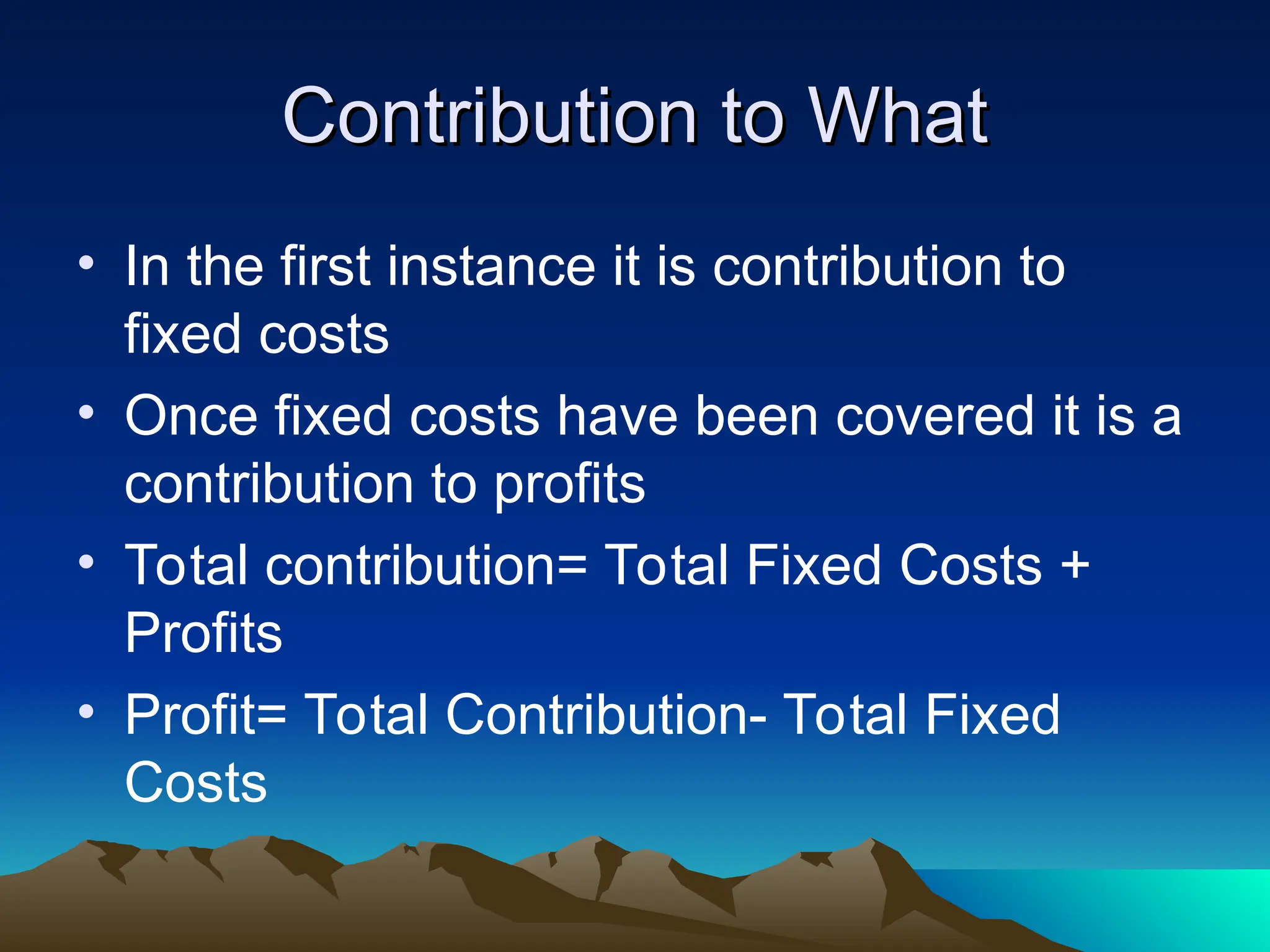
Contribution to What
• In the first instance it is contribution to
fixed costs
• Once fixed costs have been covered it is a
contribution to profits
• Total contribution= Total Fixed Costs +
Profits
• Profit= Total Contribution- Total Fixed
Costs
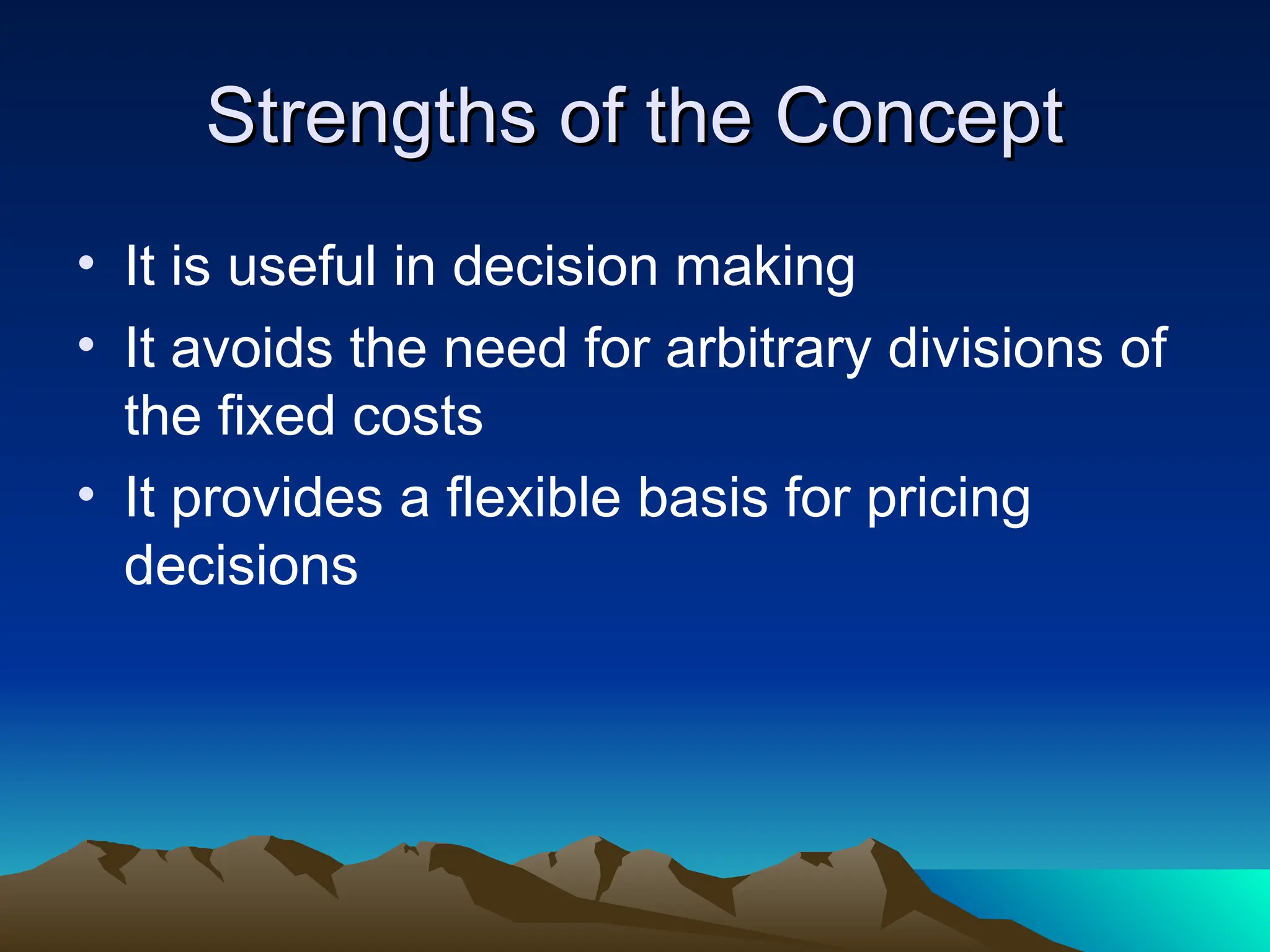
Strengths of the Concept
• It is useful in decision making
• It avoids the need for arbitrary divisions of
the fixed costs
• It provides a flexible basis for pricing
decisions
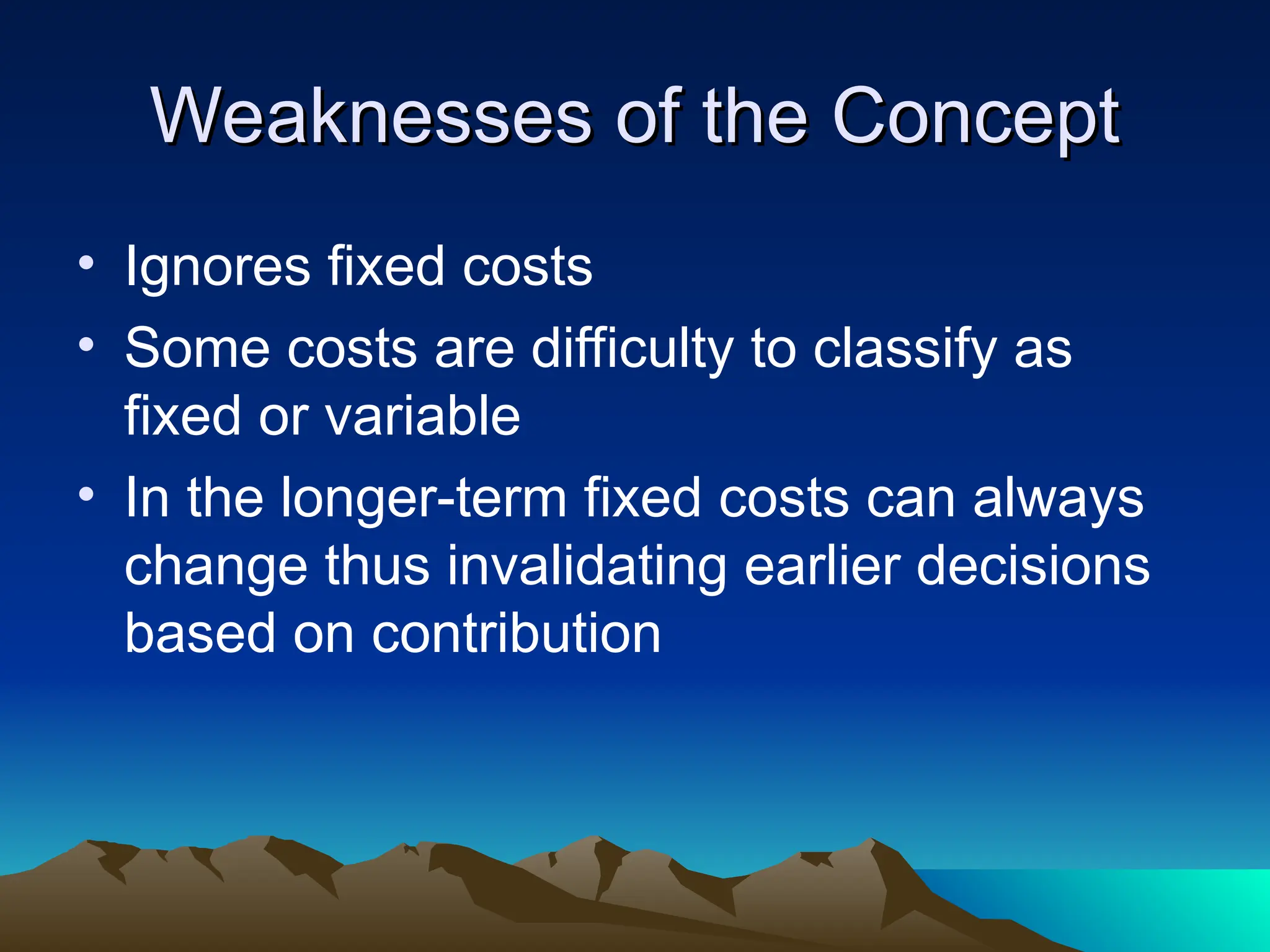
Weaknesses of the Concept
• Ignores fixed costs
• Some costs are difficulty to classify as
fixed or variable
• In the longer-term fixed costs can always
change thus invalidating earlier decisions
based on contribution
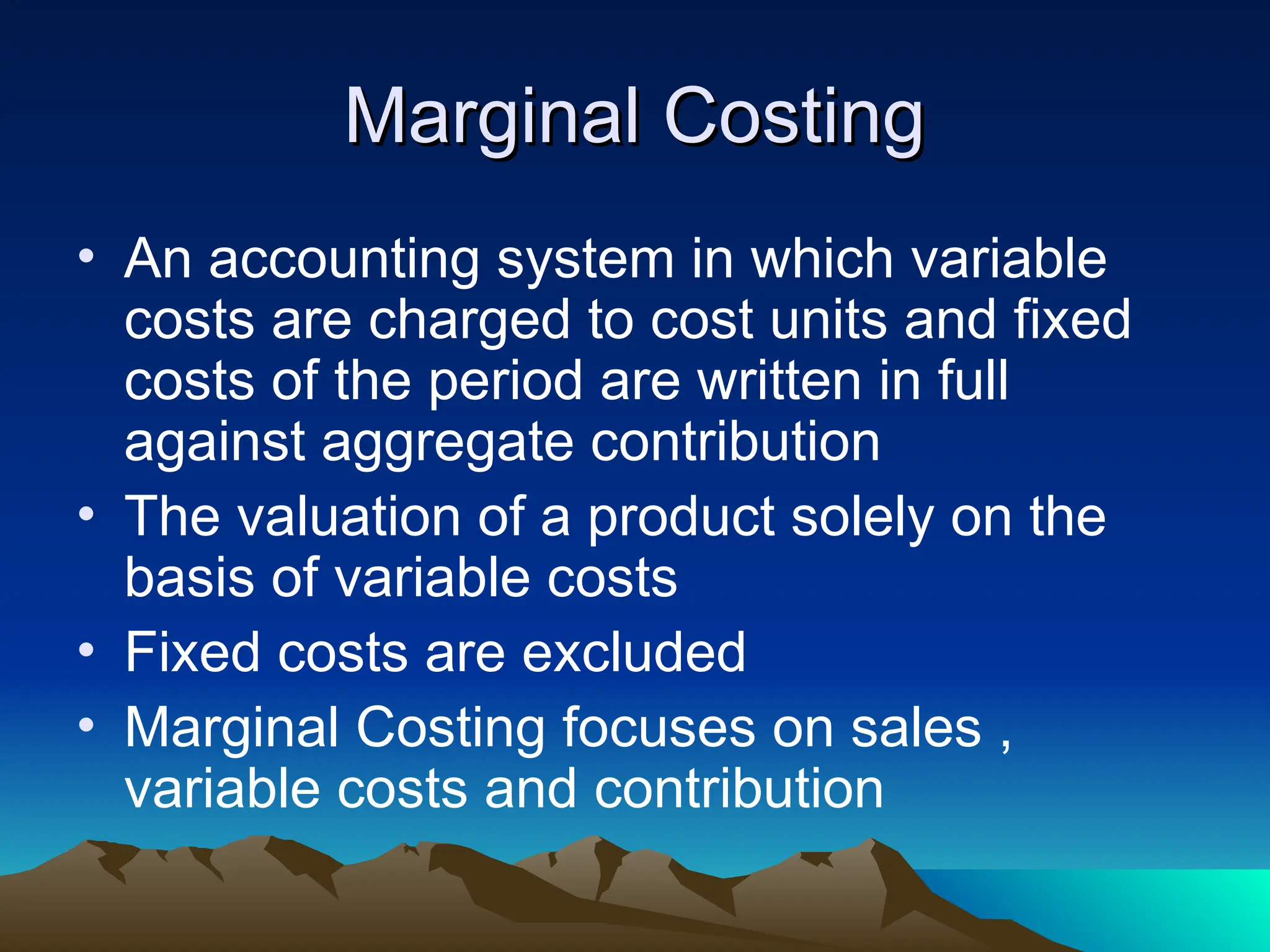
Marginal Costing
Marginal Costing
• An accounting system in which variable
costs are charged to cost units and fixed
costs of the period are written in full
against aggregate contribution
• The valuation of a product solely on the
basis of variable costs
• Fixed costs are excluded
• Marginal Costing focuses on sales ,
variable costs and contribution
Marginal Costing Contd…
• Fixed costs are considered irrelevant for
short run decisions because they are fixed
regardless of the level of output within the
relevant range
• Fixed costs are difficult to allocate
especially in the case of multiproduct firms
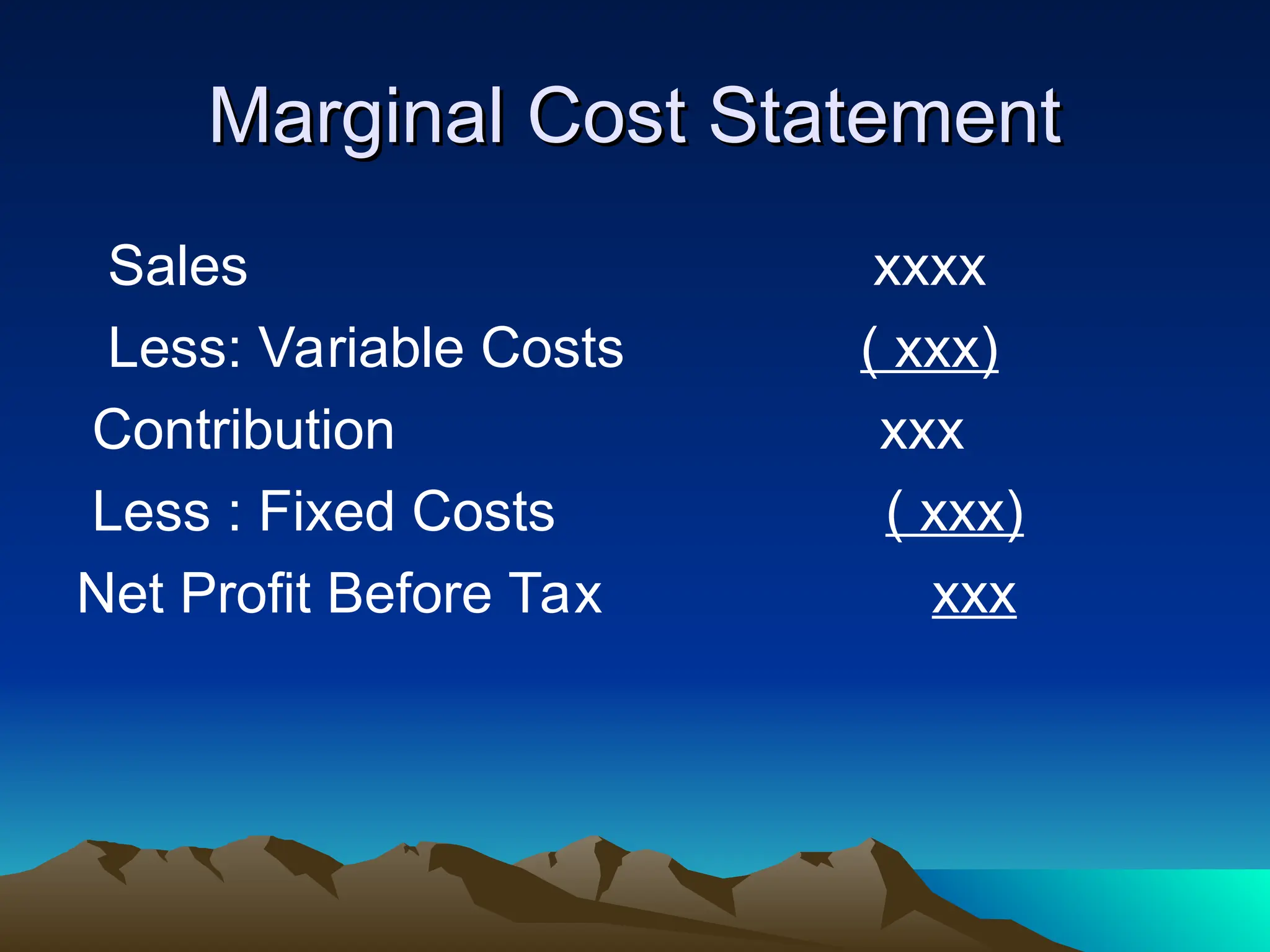
Marginal Cost Statement
Sales xxxx
Less: Variable Costs ( xxx)
Contribution xxx
Less : Fixed Costs ( xxx)
Net Profit Before Tax xxx
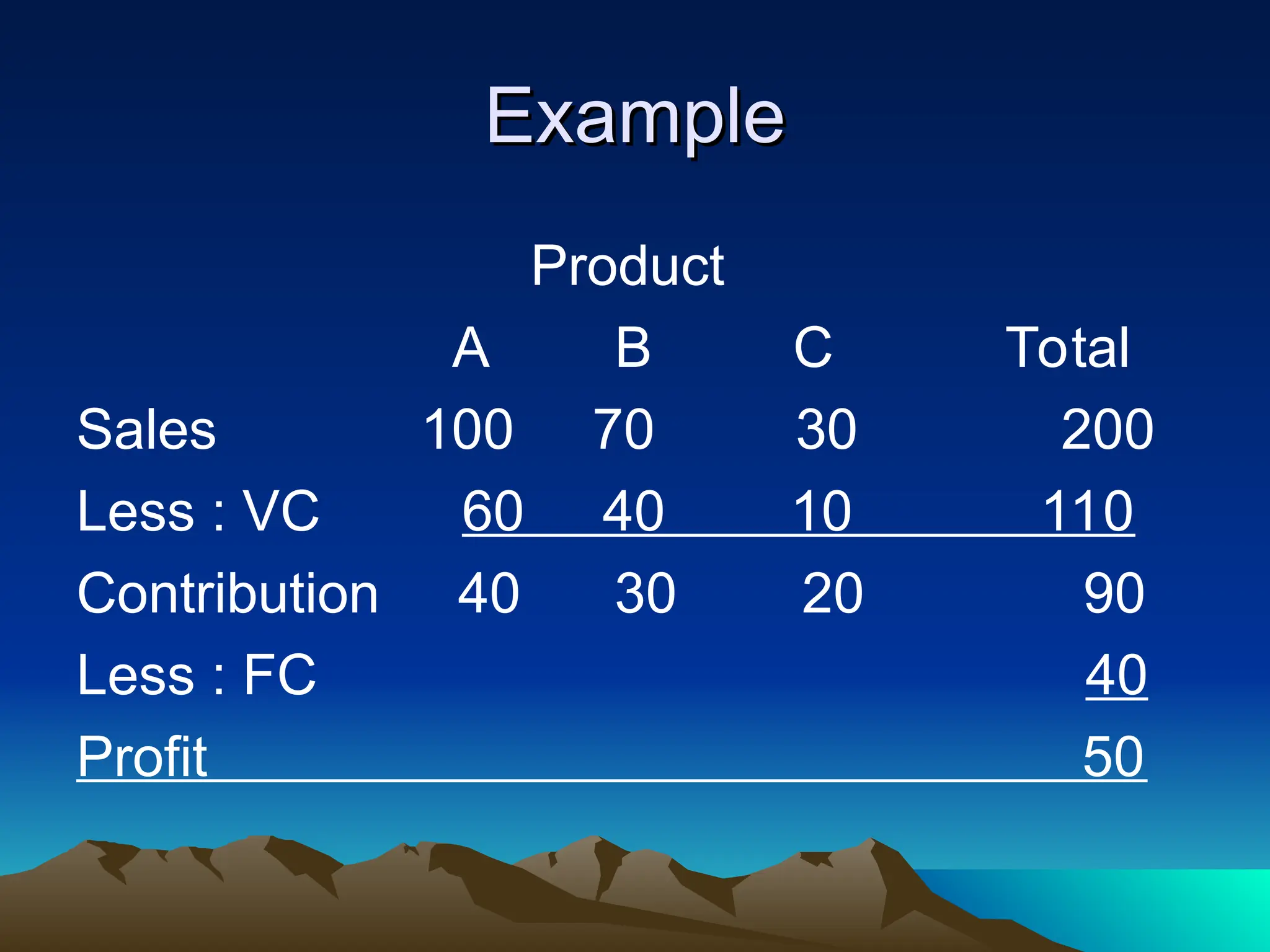
Example
Example
Product
A B C Total
Sales 100 70 30 200
Less : VC 60 40 10 110
Contribution 40 30 20 90
Less : FC 40
Profit 50
WHAT IS SPECIAL IN THIS
EXAMPLE
EXAMPLE
• Fixed costs are not apportioned
• They are not divided up between the three
products
• This is because any sharing out of fixed costs is
arbitrary and often unfair
• Contribution of each identified
• Fixed costs are deducted from total contribution
• This focus on contribution is useful in short term
decision making
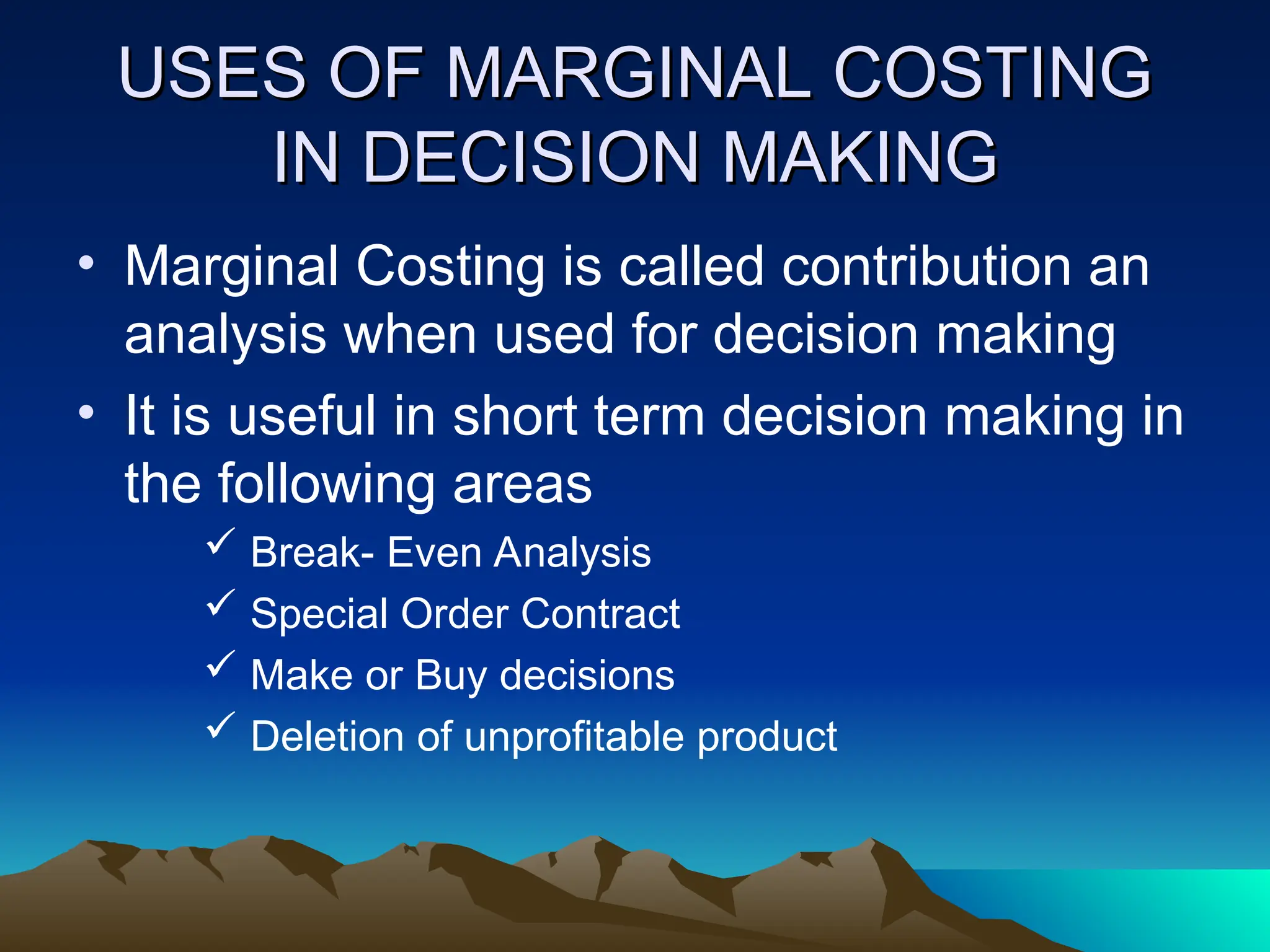
USES OF MARGINAL COSTING
IN DECISION MAKING
IN DECISION MAKING
• Marginal Costing is called contribution an
analysis when used for decision making
• It is useful in short term decision making in
the following areas
 Break- Even Analysis
 Special Order Contract
 Make or Buy decisions
 Deletion of unprofitable product
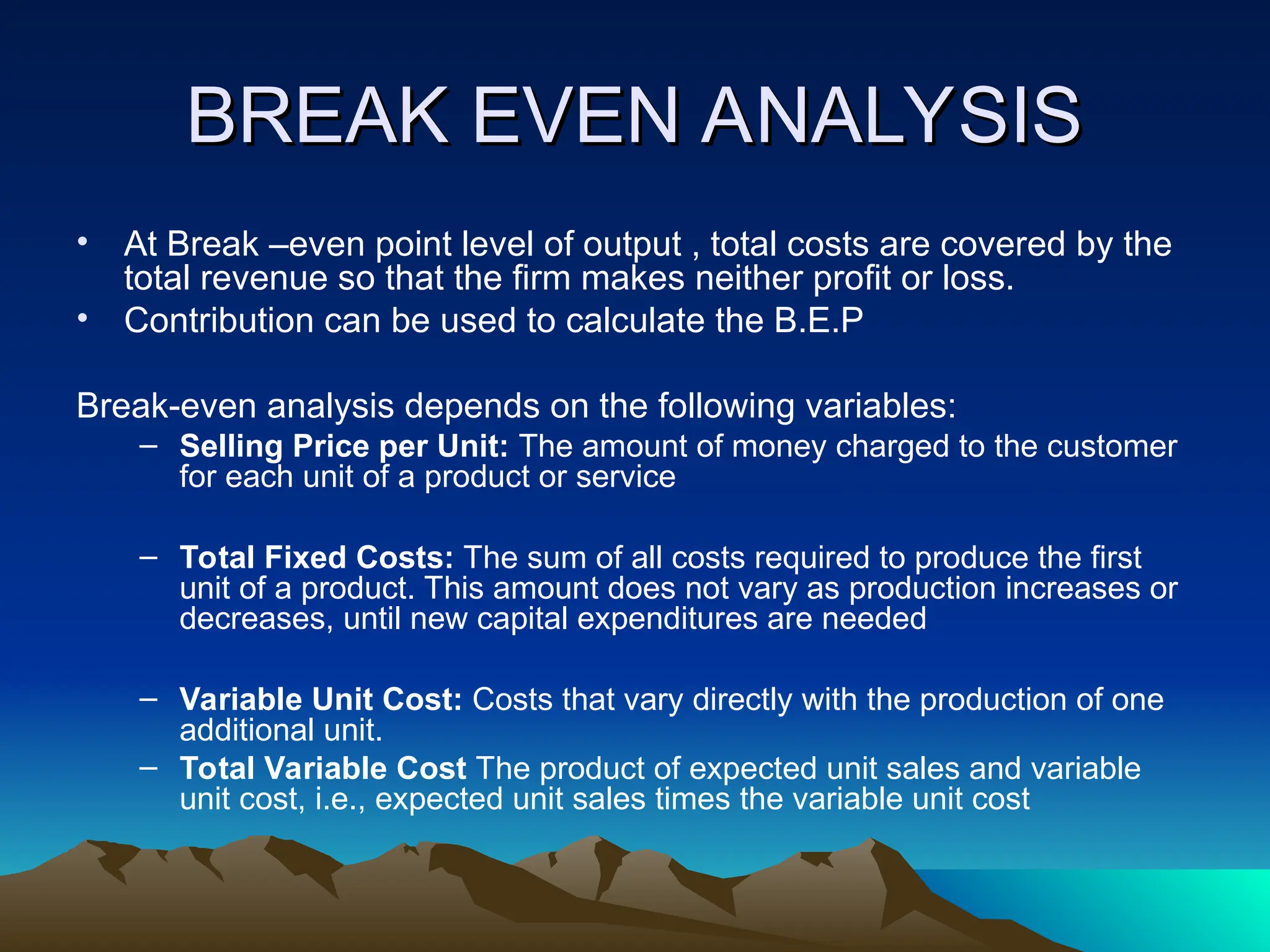
BREAK EVEN ANALYSIS
BREAK EVEN ANALYSIS
• At Break –even point level of output , total costs are covered by the
total revenue so that the firm makes neither profit or loss.
• Contribution can be used to calculate the B.E.P
Break-even analysis depends on the following variables:
– Selling Price per Unit: The amount of money charged to the customer
for each unit of a product or service
– Total Fixed Costs: The sum of all costs required to produce the first
unit of a product. This amount does not vary as production increases or
decreases, until new capital expenditures are needed
– Variable Unit Cost: Costs that vary directly with the production of one
additional unit.
– Total Variable Cost The product of expected unit sales and variable
unit cost, i.e., expected unit sales times the variable unit cost
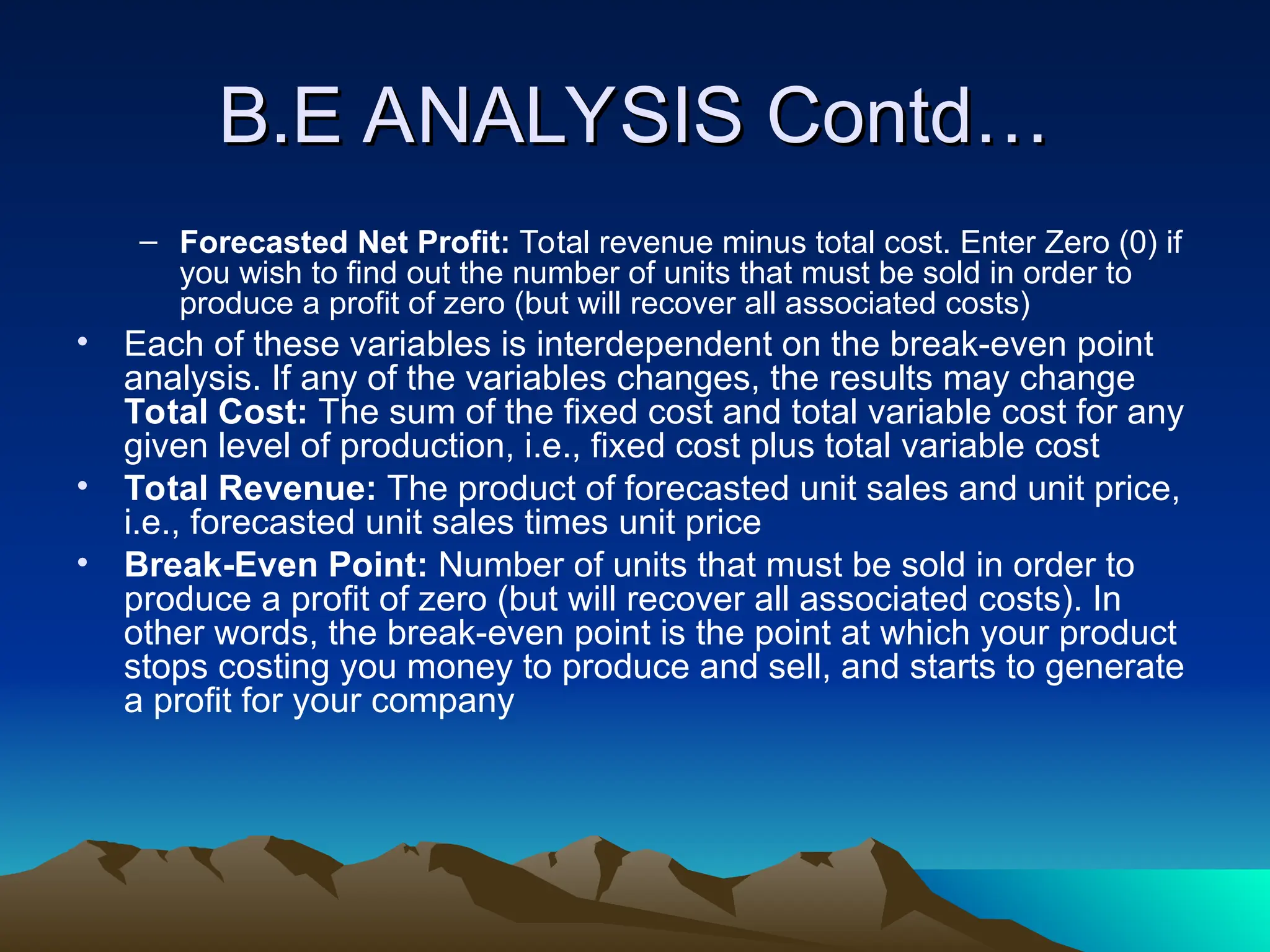
B.E ANALYSIS Contd…
B.E ANALYSIS Contd…
– Forecasted Net Profit: Total revenue minus total cost. Enter Zero (0) if
you wish to find out the number of units that must be sold in order to
produce a profit of zero (but will recover all associated costs)
• Each of these variables is interdependent on the break-even point
analysis. If any of the variables changes, the results may change
Total Cost: The sum of the fixed cost and total variable cost for any
given level of production, i.e., fixed cost plus total variable cost
• Total Revenue: The product of forecasted unit sales and unit price,
i.e., forecasted unit sales times unit price
• Break-Even Point: Number of units that must be sold in order to
produce a profit of zero (but will recover all associated costs). In
other words, the break-even point is the point at which your product
stops costing you money to produce and sell, and starts to generate
a profit for your company
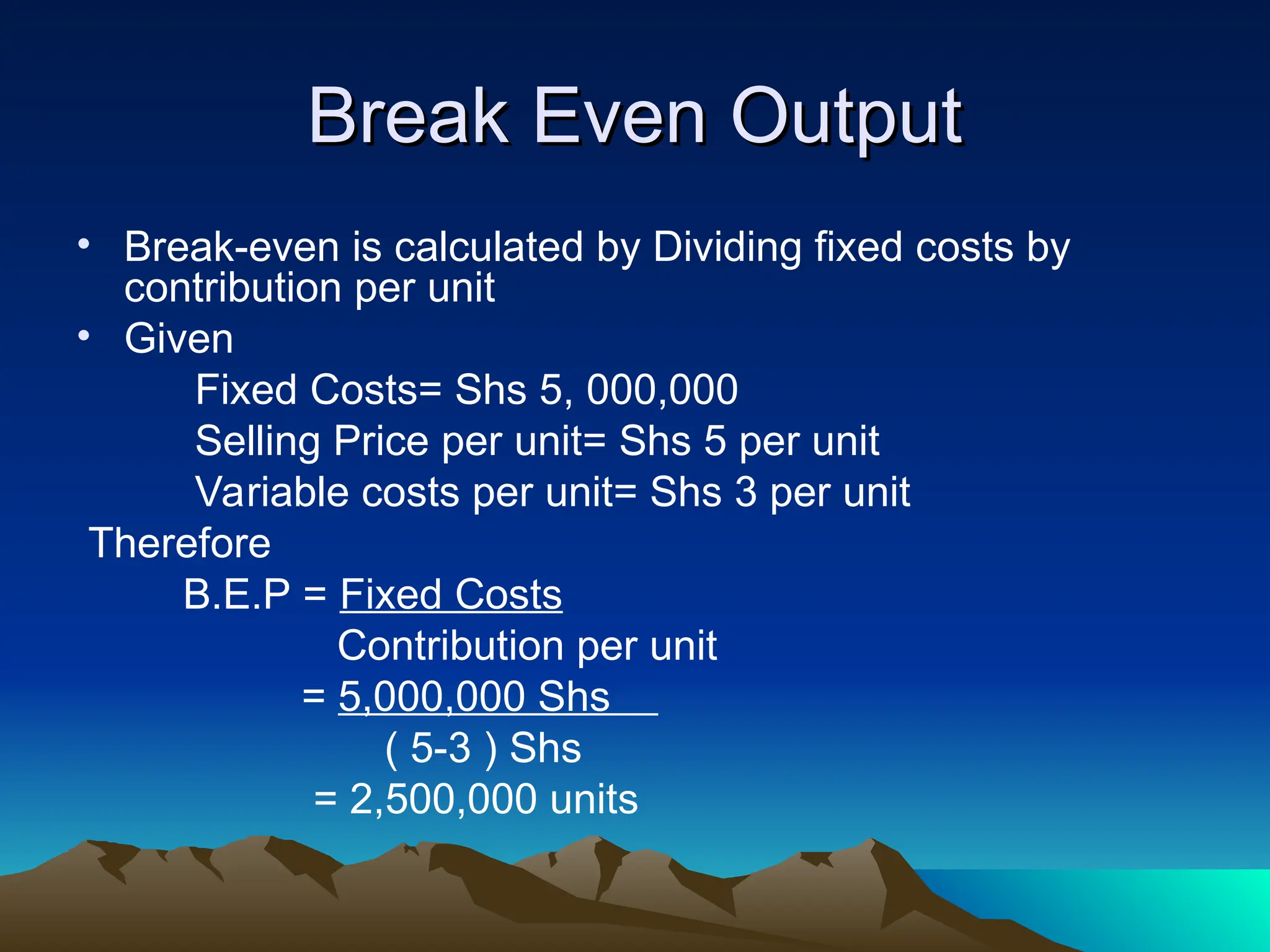
Break Even Output
Break Even Output
• Break-even is calculated by Dividing fixed costs by
contribution per unit
• Given
Fixed Costs= Shs 5, 000,000
Selling Price per unit= Shs 5 per unit
Variable costs per unit= Shs 3 per unit
Therefore
B.E.P = Fixed Costs
Contribution per unit
= 5,000,000 Shs
( 5-3 ) Shs
= 2,500,000 units
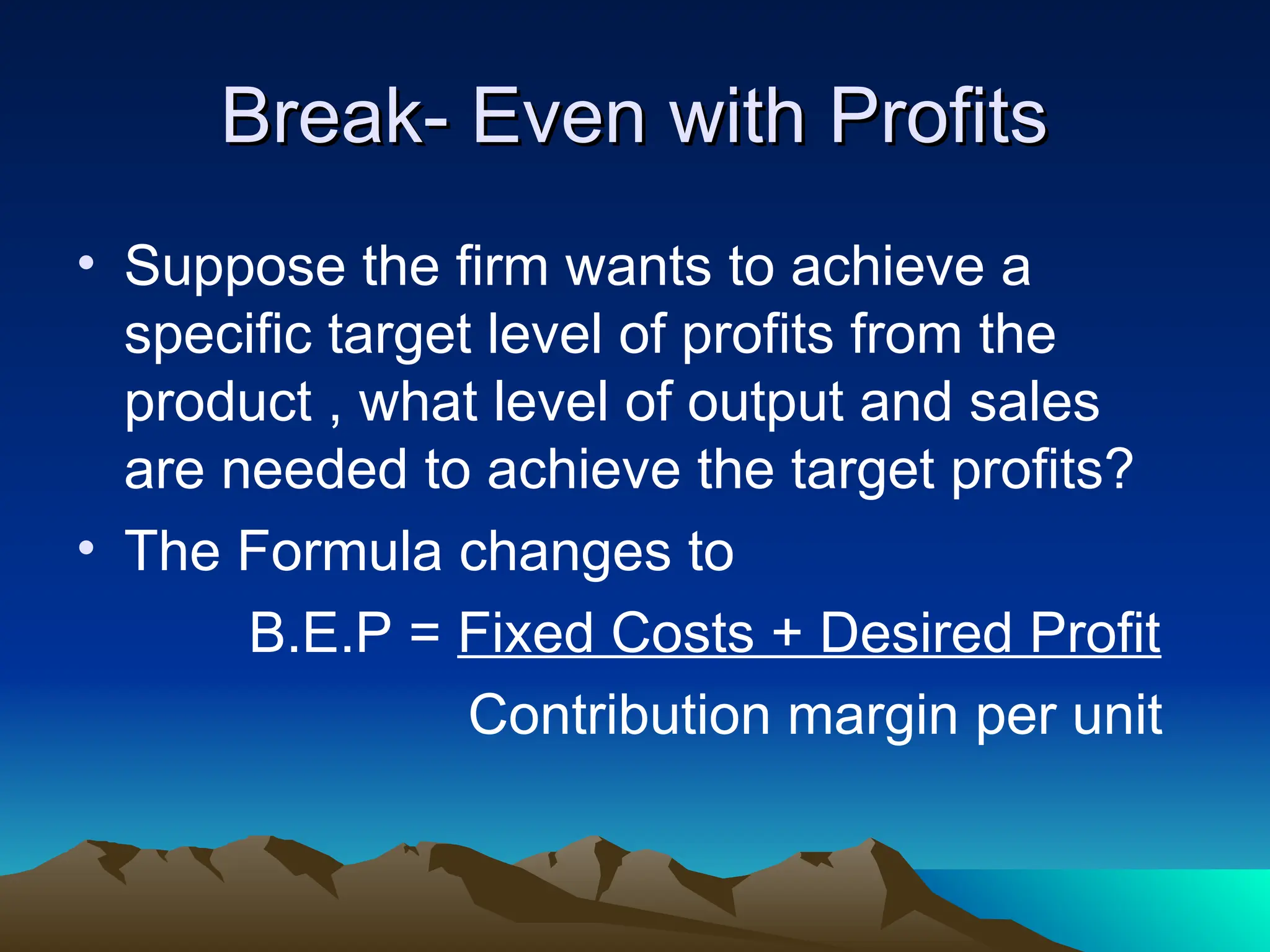
Break- Even with Profits
• Suppose the firm wants to achieve a
specific target level of profits from the
product , what level of output and sales
are needed to achieve the target profits?
• The Formula changes to
B.E.P = Fixed Costs + Desired Profit
Contribution margin per unit
Example
Example
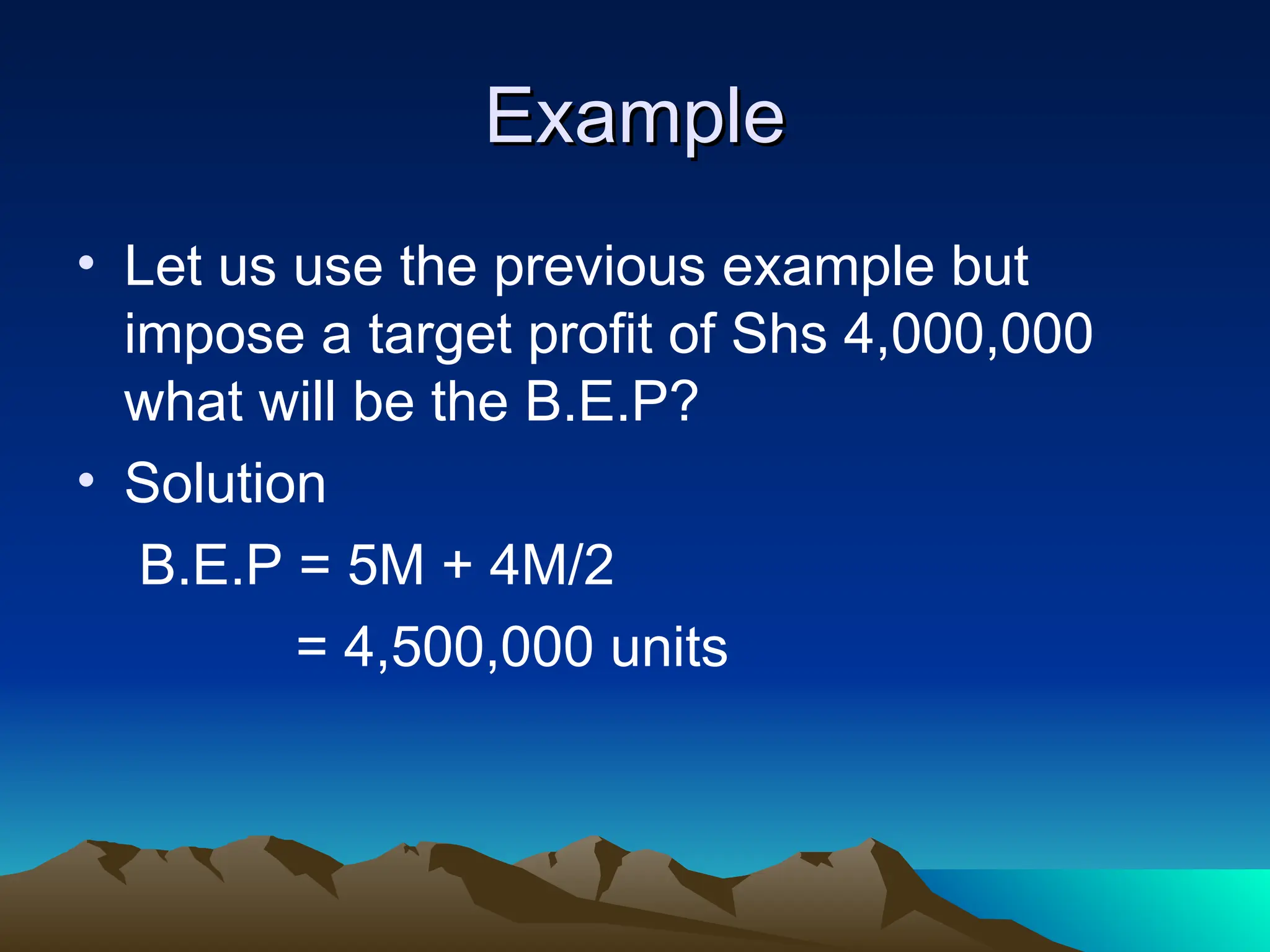
• Let us use the previous example but
impose a target profit of Shs 4,000,000
what will be the B.E.P?
• Solution
B.E.P = 5M + 4M/2
= 4,500,000 units
B.E.P After Tax
B.E.P After Tax
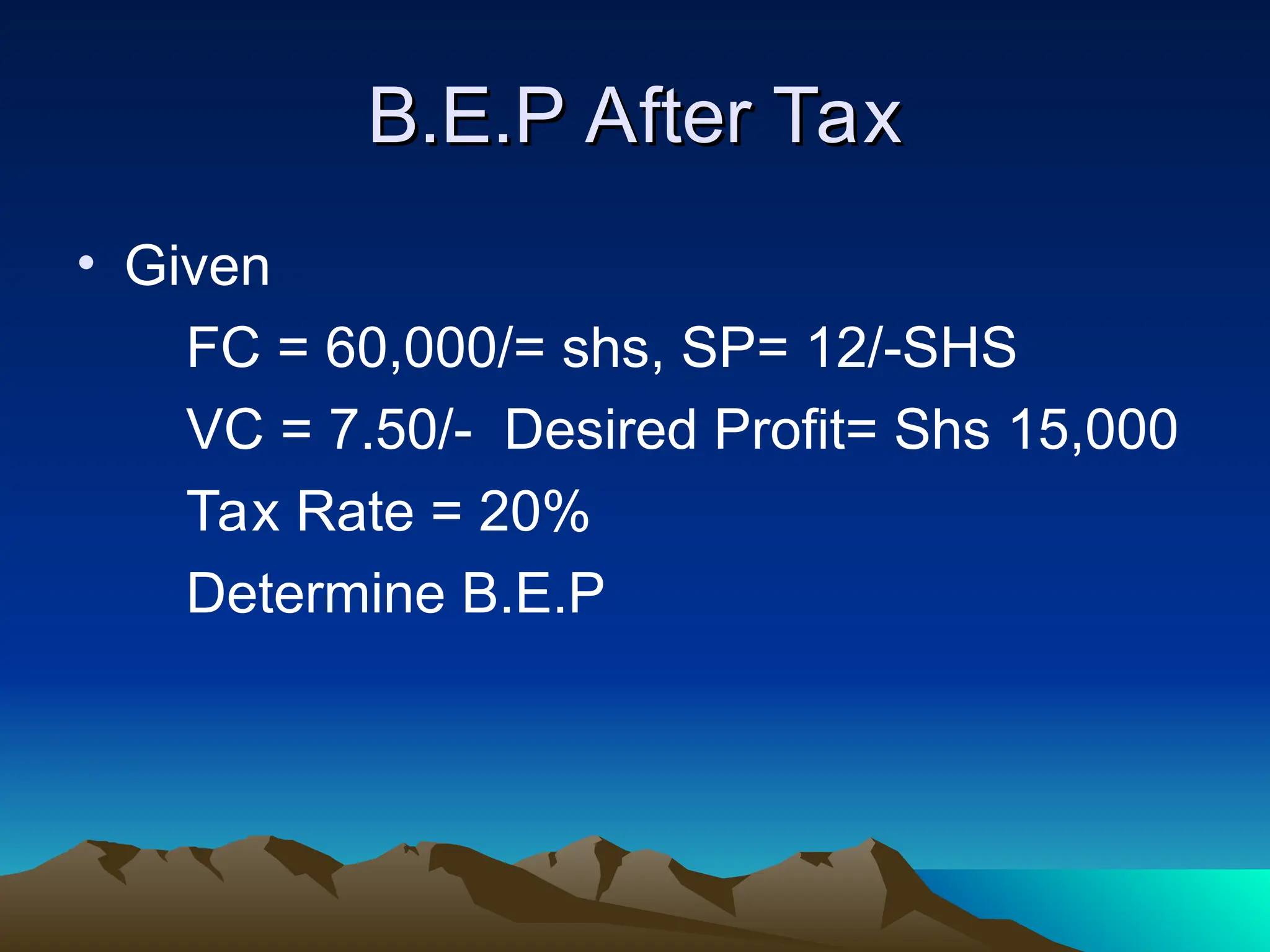
• Given
FC = 60,000/= shs, SP= 12/-SHS
VC = 7.50/- Desired Profit= Shs 15,000
Tax Rate = 20%
Determine B.E.P
Solution
Solution
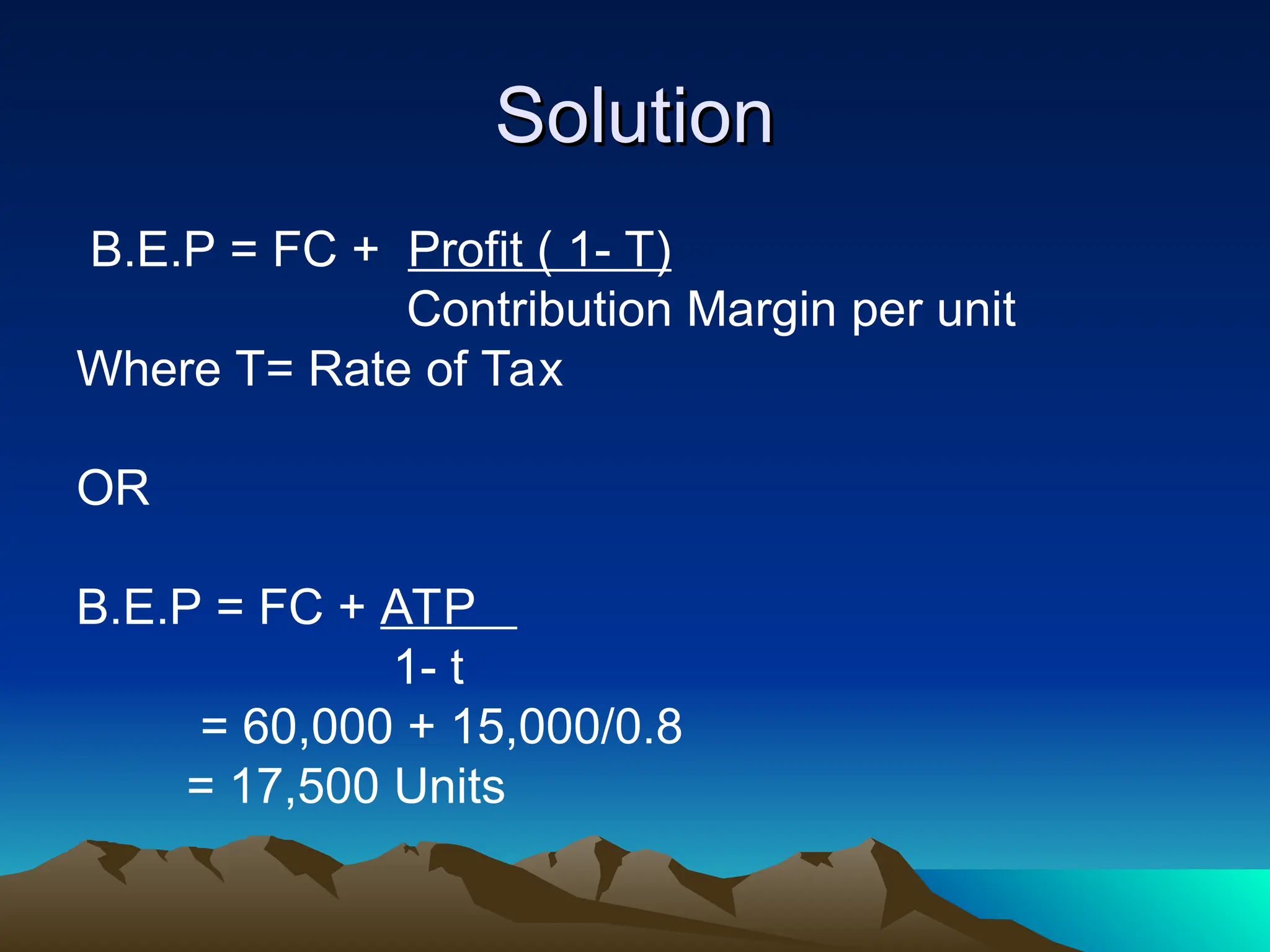
B.E.P = FC + Profit ( 1- T)
Contribution Margin per unit
Where T= Rate of Tax
OR
B.E.P = FC + ATP
1- t
= 60,000 + 15,000/0.8
= 17,500 Units
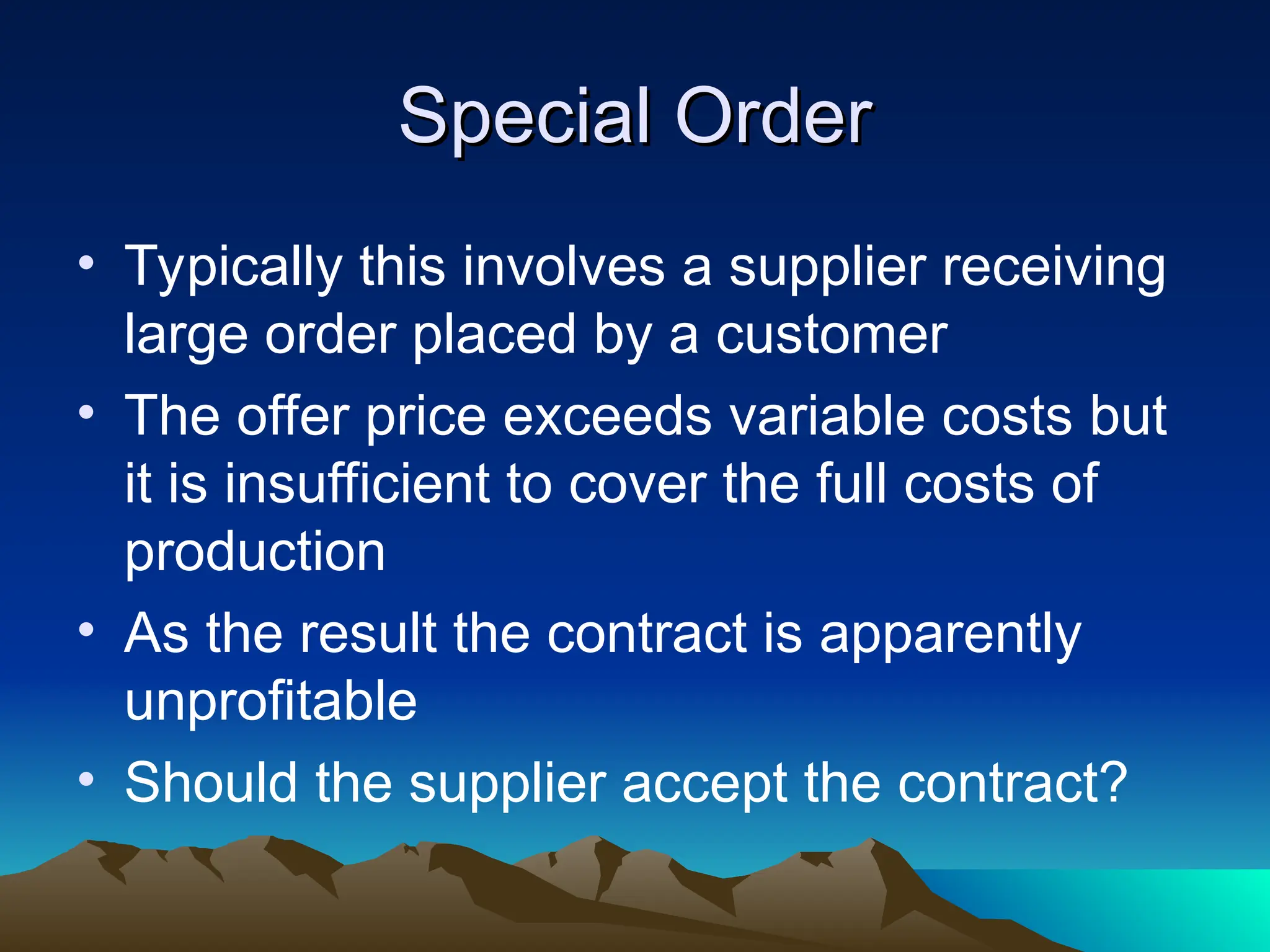
Special Order
Special Order
• Typically this involves a supplier receiving
large order placed by a customer
• The offer price exceeds variable costs but
it is insufficient to cover the full costs of
production
• As the result the contract is apparently
unprofitable
• Should the supplier accept the contract?
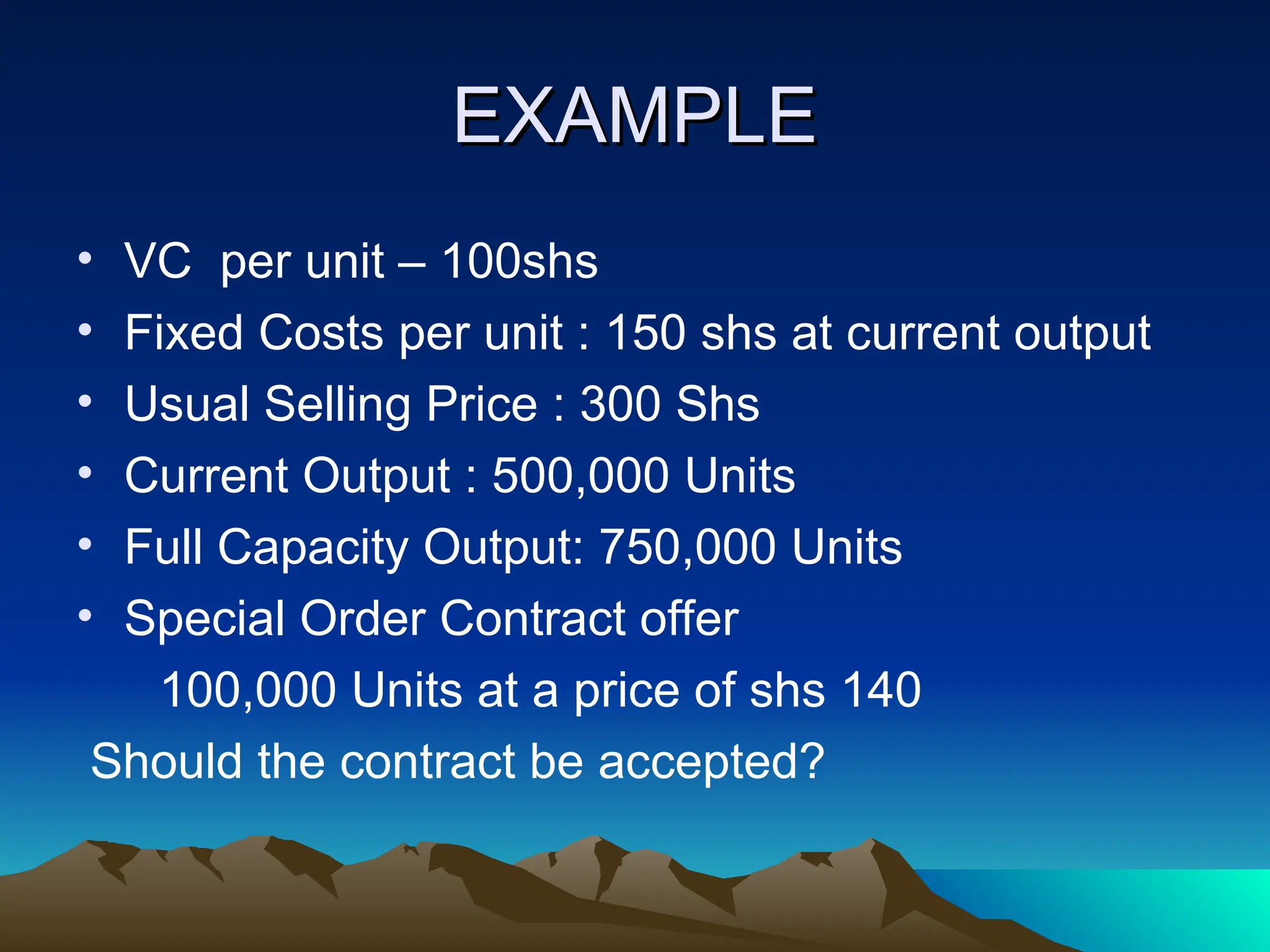
EXAMPLE
EXAMPLE
• VC per unit – 100shs
• Fixed Costs per unit : 150 shs at current output
• Usual Selling Price : 300 Shs
• Current Output : 500,000 Units
• Full Capacity Output: 750,000 Units
• Special Order Contract offer
100,000 Units at a price of shs 140
Should the contract be accepted?
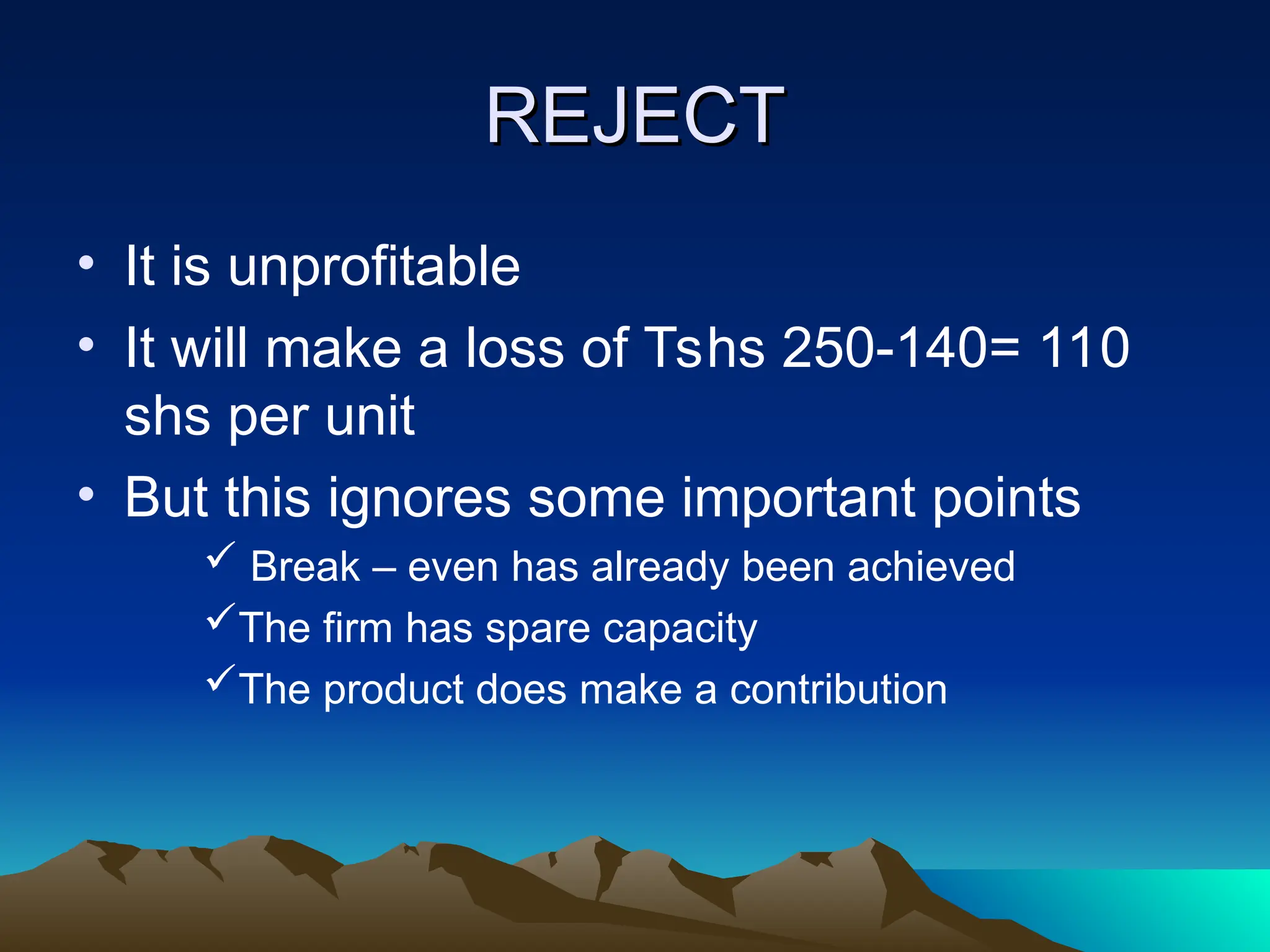
REJECT
REJECT
• It is unprofitable
• It will make a loss of Tshs 250-140= 110
shs per unit
• But this ignores some important points
 Break – even has already been achieved
The firm has spare capacity
The product does make a contribution
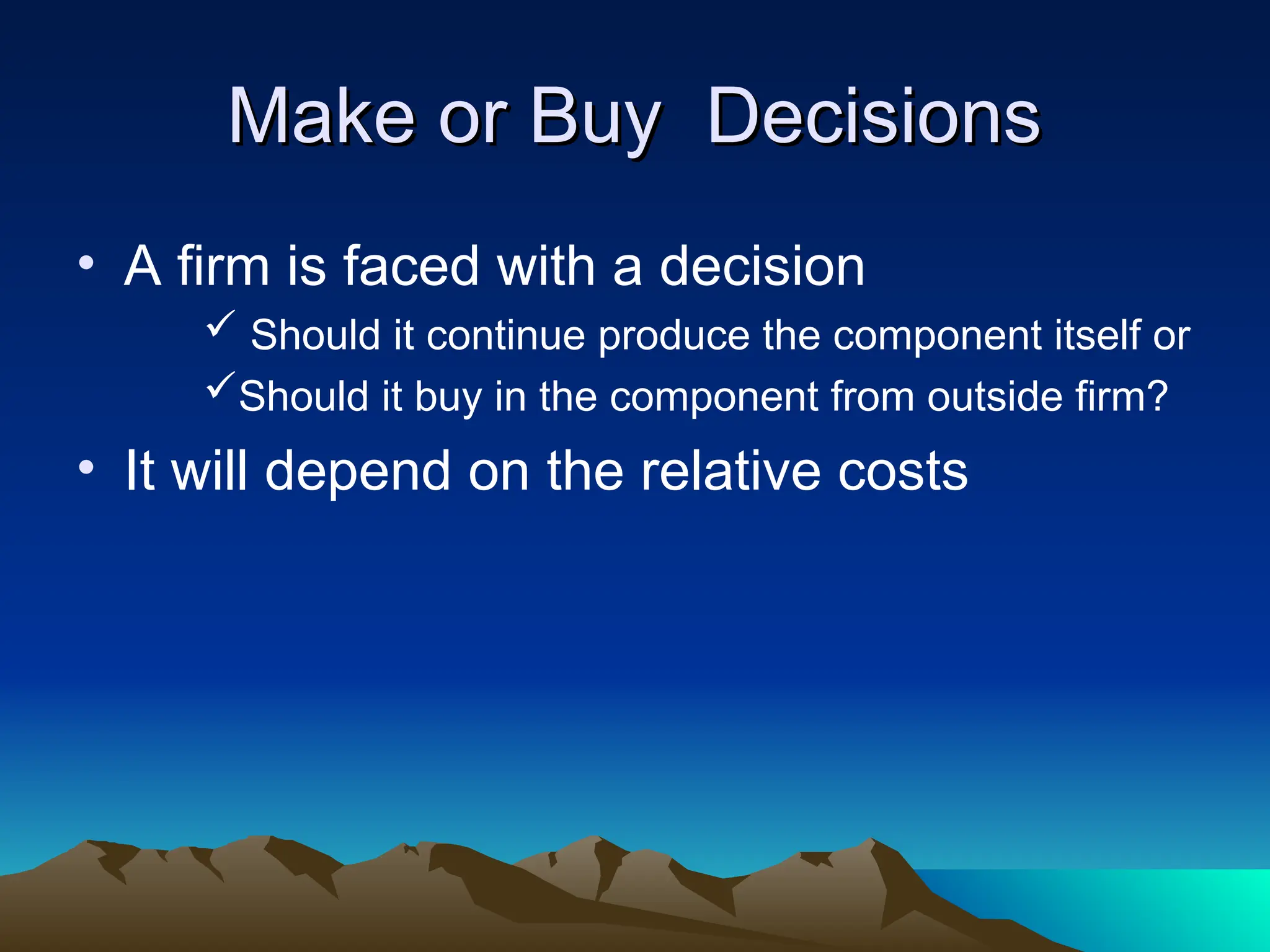
Make or Buy Decisions
• A firm is faced with a decision
 Should it continue produce the component itself or
Should it buy in the component from outside firm?
• It will depend on the relative costs
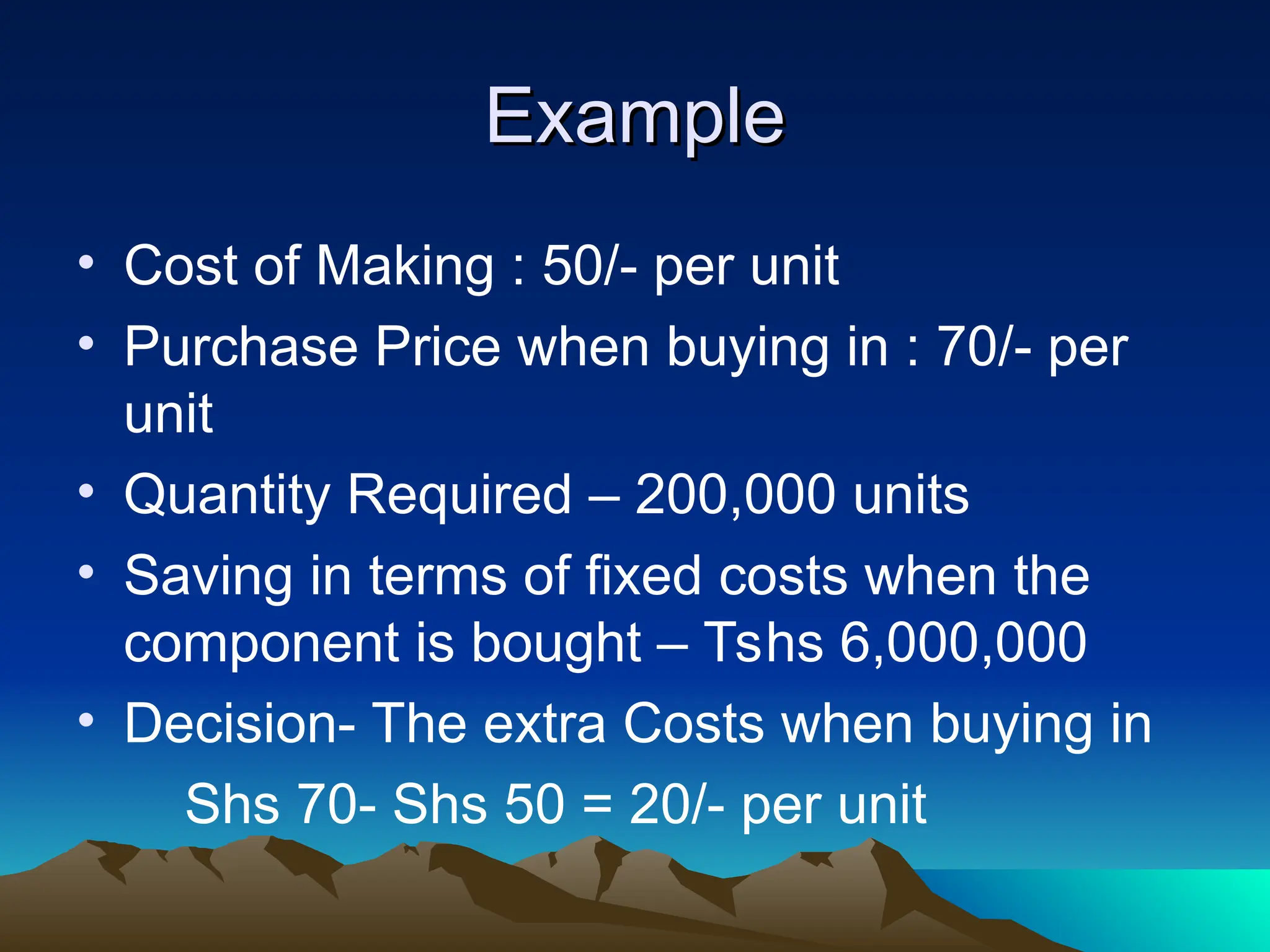
Example
Example
• Cost of Making : 50/- per unit
• Purchase Price when buying in : 70/- per
unit
• Quantity Required – 200,000 units
• Saving in terms of fixed costs when the
component is bought – Tshs 6,000,000
• Decision- The extra Costs when buying in
Shs 70- Shs 50 = 20/- per unit
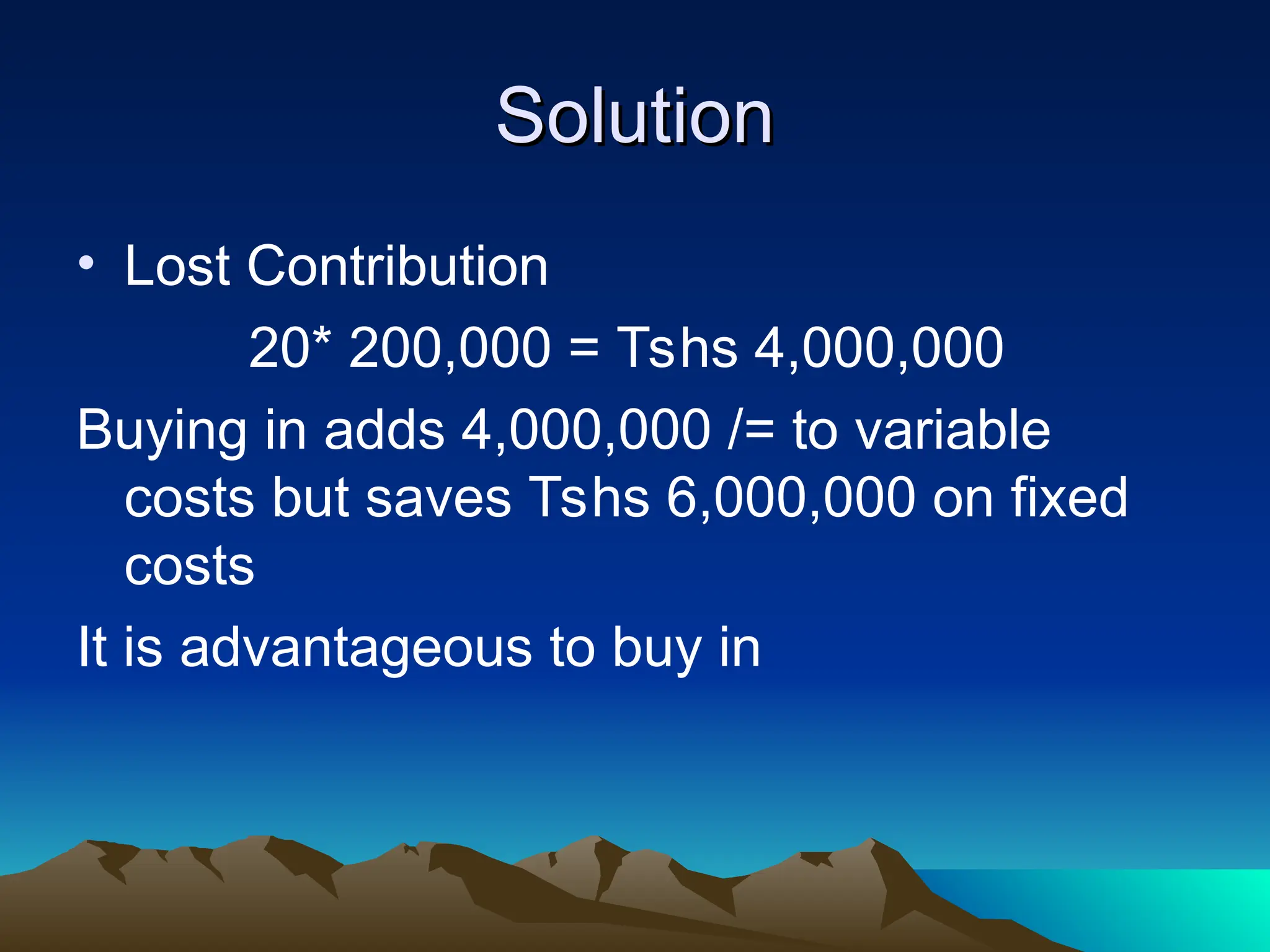
Solution
Solution
• Lost Contribution
20* 200,000 = Tshs 4,000,000
Buying in adds 4,000,000 /= to variable
costs but saves Tshs 6,000,000 on fixed
costs
It is advantageous to buy in

Topic 3-Powerpoint-Cost-Benefit (CB) and CVP Analysis.ppt

  • 1.
    COST-BENEFIT COST-BENEFIT ANALYSIS (CBA) ANALYSIS (CBA) CPADr. Amos J. Nsanganzelu (PhD, Business Mgt, CPA Dr. Amos J. Nsanganzelu (PhD, Business Mgt, Finance & Accounting); MBA (F Finance & Accounting); MBA (Fi inance & Strategic Mgt) nance & Strategic Mgt) (Maastricht), CPA (T)-ACPA 2471; BCom (Accounting) (Maastricht), CPA (T)-ACPA 2471; BCom (Accounting) (Hons) (UDSM); Adv. Dipl in Transport and Logistics (Hons) (UDSM); Adv. Dipl in Transport and Logistics Mgt (ADLTM) (Dar); Adv. Cert SCM (DIU, Germany); Mgt (ADLTM) (Dar); Adv. Cert SCM (DIU, Germany); Fellow of the Chartered Institute of Logistics and Fellow of the Chartered Institute of Logistics and Transport Management (FCILT) (UK) Transport Management (FCILT) (UK)
  • 2.
    Costs Terminology Costs Terminology •Fixed Costs  These are costs that remain relatively fixed ( in total ) irrespective of changes in volume of activity/ output within the relevant planning horizon • Variable Costs  These costs vary in relation to unit of output • Sunk Costs  These are costs already incurred which cannot be altered with a current decisions ( e.g., exploration costs can be a sunk costs if there no results.) • Relevant Costs These are costs which will be incurred in a current future decisions
  • 3.
    Definition of Contribution Definitionof Contribution • Contribution is the difference between sales Revenue and Variable Costs • It is the amount remaining after variable costs have been deducted from sales revenue • It is not the same as profit since we reach a figure for contribution after deducting variable costs and not fixed costs • Total contribution = Sales Revenue - Variable Costs
  • 4.
    Contribution per Unit Contributionper Unit • As well as total contribution it is also useful to calculate the contribution that each unit of sales produces • Contribution per unit is revenue per unit ( Price) minus variable costs per unit.
  • 5.
    Contribution to What Contributionto What • In the first instance it is contribution to fixed costs • Once fixed costs have been covered it is a contribution to profits • Total contribution= Total Fixed Costs + Profits • Profit= Total Contribution- Total Fixed Costs
  • 6.
    Strengths of theConcept Strengths of the Concept • It is useful in decision making • It avoids the need for arbitrary divisions of the fixed costs • It provides a flexible basis for pricing decisions
  • 7.
    Weaknesses of theConcept Weaknesses of the Concept • Ignores fixed costs • Some costs are difficulty to classify as fixed or variable • In the longer-term fixed costs can always change thus invalidating earlier decisions based on contribution
  • 8.
    Marginal Costing Marginal Costing •An accounting system in which variable costs are charged to cost units and fixed costs of the period are written in full against aggregate contribution • The valuation of a product solely on the basis of variable costs • Fixed costs are excluded • Marginal Costing focuses on sales , variable costs and contribution
  • 9.
    Marginal Costing Contd… MarginalCosting Contd… • Fixed costs are considered irrelevant for short run decisions because they are fixed regardless of the level of output within the relevant range • Fixed costs are difficult to allocate especially in the case of multiproduct firms
  • 10.
    Marginal Cost Statement MarginalCost Statement Sales xxxx Less: Variable Costs ( xxx) Contribution xxx Less : Fixed Costs ( xxx) Net Profit Before Tax xxx
  • 11.
    Example Example Product A B CTotal Sales 100 70 30 200 Less : VC 60 40 10 110 Contribution 40 30 20 90 Less : FC 40 Profit 50
  • 12.
    WHAT IS SPECIALIN THIS WHAT IS SPECIAL IN THIS EXAMPLE EXAMPLE • Fixed costs are not apportioned • They are not divided up between the three products • This is because any sharing out of fixed costs is arbitrary and often unfair • Contribution of each identified • Fixed costs are deducted from total contribution • This focus on contribution is useful in short term decision making
  • 13.
    USES OF MARGINALCOSTING USES OF MARGINAL COSTING IN DECISION MAKING IN DECISION MAKING • Marginal Costing is called contribution an analysis when used for decision making • It is useful in short term decision making in the following areas  Break- Even Analysis  Special Order Contract  Make or Buy decisions  Deletion of unprofitable product
  • 14.
    BREAK EVEN ANALYSIS BREAKEVEN ANALYSIS • At Break –even point level of output , total costs are covered by the total revenue so that the firm makes neither profit or loss. • Contribution can be used to calculate the B.E.P Break-even analysis depends on the following variables: – Selling Price per Unit: The amount of money charged to the customer for each unit of a product or service – Total Fixed Costs: The sum of all costs required to produce the first unit of a product. This amount does not vary as production increases or decreases, until new capital expenditures are needed – Variable Unit Cost: Costs that vary directly with the production of one additional unit. – Total Variable Cost The product of expected unit sales and variable unit cost, i.e., expected unit sales times the variable unit cost
  • 15.
    B.E ANALYSIS Contd… B.EANALYSIS Contd… – Forecasted Net Profit: Total revenue minus total cost. Enter Zero (0) if you wish to find out the number of units that must be sold in order to produce a profit of zero (but will recover all associated costs) • Each of these variables is interdependent on the break-even point analysis. If any of the variables changes, the results may change Total Cost: The sum of the fixed cost and total variable cost for any given level of production, i.e., fixed cost plus total variable cost • Total Revenue: The product of forecasted unit sales and unit price, i.e., forecasted unit sales times unit price • Break-Even Point: Number of units that must be sold in order to produce a profit of zero (but will recover all associated costs). In other words, the break-even point is the point at which your product stops costing you money to produce and sell, and starts to generate a profit for your company
  • 16.
    Break Even Output BreakEven Output • Break-even is calculated by Dividing fixed costs by contribution per unit • Given Fixed Costs= Shs 5, 000,000 Selling Price per unit= Shs 5 per unit Variable costs per unit= Shs 3 per unit Therefore B.E.P = Fixed Costs Contribution per unit = 5,000,000 Shs ( 5-3 ) Shs = 2,500,000 units
  • 17.
    Break- Even withProfits Break- Even with Profits • Suppose the firm wants to achieve a specific target level of profits from the product , what level of output and sales are needed to achieve the target profits? • The Formula changes to B.E.P = Fixed Costs + Desired Profit Contribution margin per unit
  • 18.
    Example Example • Let ususe the previous example but impose a target profit of Shs 4,000,000 what will be the B.E.P? • Solution B.E.P = 5M + 4M/2 = 4,500,000 units
  • 19.
    B.E.P After Tax B.E.PAfter Tax • Given FC = 60,000/= shs, SP= 12/-SHS VC = 7.50/- Desired Profit= Shs 15,000 Tax Rate = 20% Determine B.E.P
  • 20.
    Solution Solution B.E.P = FC+ Profit ( 1- T) Contribution Margin per unit Where T= Rate of Tax OR B.E.P = FC + ATP 1- t = 60,000 + 15,000/0.8 = 17,500 Units
  • 21.
    Special Order Special Order •Typically this involves a supplier receiving large order placed by a customer • The offer price exceeds variable costs but it is insufficient to cover the full costs of production • As the result the contract is apparently unprofitable • Should the supplier accept the contract?
  • 22.
    EXAMPLE EXAMPLE • VC perunit – 100shs • Fixed Costs per unit : 150 shs at current output • Usual Selling Price : 300 Shs • Current Output : 500,000 Units • Full Capacity Output: 750,000 Units • Special Order Contract offer 100,000 Units at a price of shs 140 Should the contract be accepted?
  • 23.
    REJECT REJECT • It isunprofitable • It will make a loss of Tshs 250-140= 110 shs per unit • But this ignores some important points  Break – even has already been achieved The firm has spare capacity The product does make a contribution
  • 24.
    Make or BuyDecisions Make or Buy Decisions • A firm is faced with a decision  Should it continue produce the component itself or Should it buy in the component from outside firm? • It will depend on the relative costs
  • 25.
    Example Example • Cost ofMaking : 50/- per unit • Purchase Price when buying in : 70/- per unit • Quantity Required – 200,000 units • Saving in terms of fixed costs when the component is bought – Tshs 6,000,000 • Decision- The extra Costs when buying in Shs 70- Shs 50 = 20/- per unit
  • 26.
    Solution Solution • Lost Contribution 20*200,000 = Tshs 4,000,000 Buying in adds 4,000,000 /= to variable costs but saves Tshs 6,000,000 on fixed costs It is advantageous to buy in