SPM (6e) Step Wise: an introduction to project
planning© The McGraw-Hill Companies, 2017
1
Software Project Management
Unit 1
Chapter 3
Step Wise: An
approach to planning
software projects
“What we learn with
pleasure…..
we never forget...”
Alfred Mercier
13-07-20
SPM (5e) Step Wise: an introduction to project
planning© The McGraw-Hill Companies, 2009
2
SPM (6e) Step Wise: an introduction to project
planning© The McGraw-Hill Companies, 2017
3
‘Step Wise’ - aspirations
• Practicality
• tries to answer the question ‘what do I do
now?’
• Scalability
• useful for small project as well as large
• Range of application
• Accepted techniques
• e.g. borrowed from PRINCE etc
SPM (5e) Step Wise: an introduction to project
planning© The McGraw-Hill Companies, 2017
4
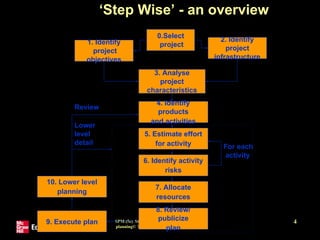
‘Step Wise’ - an overview
0.Select
project
1. Identify
project
objectives
2. Identify
project
infrastructure
3. Analyse
project
characteristics
4. Identify
products
and activities
5. Estimate effort
for activity
8. Review/
publicize
plan
6. Identify activity
risks
7. Allocate
resources
9. Execute plan
10. Lower level
planning
Review
Lower
level
detail
For each
activity
SPM (6e) Step Wise: an introduction to project
planning© The McGraw-Hill Companies, 2017
5
A project scenario: Brightmouth
College Payroll
• College currently has payroll processing carried
out by a services company
• This is very expensive and does not allow detailed
analysis of personnel data to be carried out
• Decision made to bring payroll ‘in-house’ by
acquiring an ‘off-the-shelf’ application
SPM (6e) Step Wise: an introduction to project
planning© The McGraw-Hill Companies, 2017
6
Project scenario - continued
• The use of the off-the-shelf system will require
a new, internal, payroll office to be set up
• There will be a need to develop some software
‘add-ons’: one will take payroll data and
combine it with time-table data to calculate the
staff costs for each course run in the college
• The project manager is Brigette.
SPM (5e) Step Wise: an introduction to project
planning© The McGraw-Hill Companies, 2009
7
14-07-20
SPM (6e) Step Wise: an introduction to project
planning© The McGraw-Hill Companies, 2017
8
Step 1
establish project scope and objectives
• 1.1 Identify objectives and measures of effectiveness
• ‘how do we know if we have succeeded?’
• 1.2 Establish a project authority
• ‘who is the boss?’
• 1.3 Identify all stakeholders in the project and their
interests
• ‘who will be affected/involved in the project?’
SPM (6e) Step Wise: an introduction to project
planning© The McGraw-Hill Companies, 2017
9
Step 1
continued
• 1.4 Modify objectives in the light of stakeholder
analysis
• ‘do we need to do things to win over
stakeholders?’
• 1.5 Establish methods of communication with all
parties
• ‘how do we keep in contact?’
SPM (6e) Step Wise: an introduction to project
planning© The McGraw-Hill Companies, 2017
10
Back to the scenario
• Project authority
- Brigette finds she has two different clients for the
new system:
the finance department &
the personnel office
- A vice principal agrees to be official client, and
monthly meetings are chaired by the VP and
attended by Brigette and the heads of finance and
personnel
- These meetings would also help overcome communication
barriers
SPM (6e) Step Wise: an introduction to project
planning© The McGraw-Hill Companies, 2017
11
Back to the scenario - continued
• Stakeholders
• For example, personnel office would supply
details of new staff, leavers and changes
(e.g. promotions)
• To motivate co-operation Brigette might
ensure new payroll system produces reports
that are useful to personnel staff
SPM (6e) Step Wise: an introduction to project
planning© The McGraw-Hill Companies, 2017
12
Step 2
Establish project infrastructure
• 2.1 Establish link between project and any
strategic plan
• ‘why did they want the project?’
• 2.2 Identify installation standards and procedures
• ‘what standards do we have to follow?’
• 2.3. Identify project team organization
• ‘where do I fit in?’
Education is not the learning of
facts….
But the training of the mind to
think….
-- Albert Einstein
17-07-20
SPM (5e) Step Wise: an introduction to project
planning© The McGraw-Hill Companies, 2009
13
SPM (6e) Step Wise: an introduction to project
planning© The McGraw-Hill Companies, 2017
14
Step 3
Analysis of project characteristics
• 3.1 Distinguish the project as either objective or
product-based.
• Is there more than one way of achieving success?
• 3.2 Analyse other project characteristics (including
quality based ones)
• what is different about this project?
SPM (6e) Step Wise: an introduction to project
planning© The McGraw-Hill Companies, 2017
15
Step 3 continued
• Identify high level project risks
• ‘what could go wrong?’
• ‘what can we do to stop it?’
• Take into account user requirements concerning
implementation
• Select general life cycle approach
• waterfall? Increments? Prototypes?
• Review overall resource estimates
• ‘does all this increase the cost?’
SPM (6e) Step Wise: an introduction to project
planning© The McGraw-Hill Companies, 2017
16
Back to the scenario
• Objectives vs. products
• An objective-based approach has been adopted
• Some risks
• There may not be an off-the-shelf package that
caters for the way payroll is processed at
Brightmouth College
• Answer?
• Brigette decides to obtain details of how main
candidate packages work as soon as possible; also
agreement that if necessary processes will be
changed to fit in with new system.
SPM (6e) Step Wise: an introduction to project
planning© The McGraw-Hill Companies, 2017
17
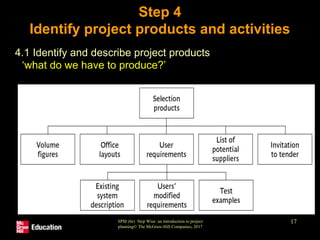
Step 4
Identify project products and activities
• 4.1 Identify and describe project products
‘what do we have to produce?’
SPM (6e) Step Wise: an introduction to project
planning© The McGraw-Hill Companies, 2017
18
Products
• The result of an activity
• Could be (among other things)
• physical thing (‘installed pc’),
• a document (‘logical data structure’)
• a person (‘trained user’)
• a new version of an old product (‘updated
software’)
SPM (6e) Step Wise: an introduction to project
planning© The McGraw-Hill Companies, 2017
19
Products
• The following are NOT normally products:
• activities (e.g. ‘training’)
• events (e.g. ‘interviews completed’)
• resources and actors (e.g. ‘software
developer’) - may be exceptions to this
• Products CAN BE deliverable or intermediate
SPM (6e) Step Wise: an introduction to project
planning© The McGraw-Hill Companies, 2017
20
Product description (PD)
• Product identity
• Description - what is it?
• Derivation - what is it
based on?
• Composition - what
does it contain?
• Format
• Relevant standards
• Quality criteria
Create a PD for ‘test data’
Step 4 continued
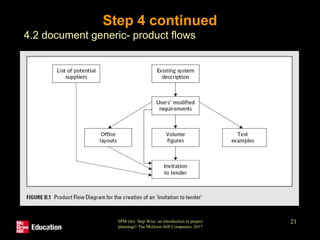
• 4.2 document generic- product flows
SPM (6e) Step Wise: an introduction to project
planning© The McGraw-Hill Companies, 2017
21
SPM (6e) Step Wise: an introduction to project
planning© The McGraw-Hill Companies, 2017
22
Step 4 continued
• 4.3 Recognize product instances
• The PBS (Product breakdown Structure) and PFD
(Product flow diagram) will probably have
identified generic products e.g. ‘software modules’
• It might be possible to identify specific instances
e.g. ‘module A’, ‘module B’ …
• But in many cases this will have to be left to later,
more detailed, planning
SPM (6e) Step Wise: an introduction to project
planning© The McGraw-Hill Companies, 2017
23
Step 4 continued
• 4.4. Produce ideal activity network
• Identify the activities needed to create each
product in the PFD
• More than one activity might be needed to create
a single product
• Hint: Identify activities by verb + noun but avoid
‘produce…’ (too vague)
• Draw up activity network
SPM (6e) Step Wise: an introduction to project
planning© The McGraw-Hill Companies, 2017
24
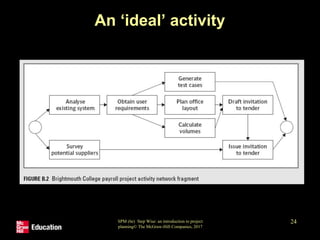
An ‘ideal’ activity
SPM (6e) Step Wise: an introduction to project
planning© The McGraw-Hill Companies, 2017
25
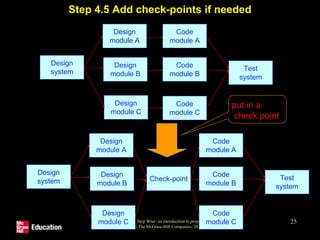
Step 4.5 Add check-points if needed
Design
module A
Design
module B
Design
system
Design
module C
Code
module A
Code
module B
Code
module C
Test
system
Design
module A
Design
module B
Design
system
Design
module C
Code
module A
Code
module B
Code
module C
Test
system
Check-point
put in a
check point
Successful and unsuccessful
people do not vary greatly in
their abilities....
They vary in their desires to
reach their potential…
20-07-20
JYOTSNA ANTHAL
CHAUHAN
SPM (6e) Step Wise: an introduction to project
planning© The McGraw-Hill Companies, 2017
27
Step 5:
Estimate effort for each activity
• 5.1 Carry out bottom-up estimates
• distinguish carefully between effort and elapsed
time
• 5.2. Revise plan to create controllable activities
• break up very long activities into a series of
smaller ones
• bundle up very short activities (create check
lists?)
SPM (6e) Step Wise: an introduction to project
planning© The McGraw-Hill Companies, 2017
28
Step 6
Identify activity risks
• 6.1.Identify and quantify risks for activities
• damage if risk occurs (measure in time lost or
money)
• likelihood if risk occurring
• 6.2. Plan risk reduction and contingency
measures
• risk reduction: activity to stop risk occurring
• contingency: action if risk does occur
SPM (6e) Step Wise: an introduction to project
planning© The McGraw-Hill Companies, 2017
29
• 6.3 Adjust overall plans and estimates to take
account of risks
• e.g. add new activities which reduce risks
associated with other activities e.g. training,
pilot trials, information gathering
SPM (6e) Step Wise: an introduction to project
planning© The McGraw-Hill Companies, 2017
30
Step 7
Allocate resources
• 7.1 Identify and allocate resources to activities
• 7.2 Revise plans and estimates to take into
account resource constraints
• e.g. staff not being available until a later date
• non-project activities
SPM (6e) Step Wise: an introduction to project
planning© The McGraw-Hill Companies, 2017
31
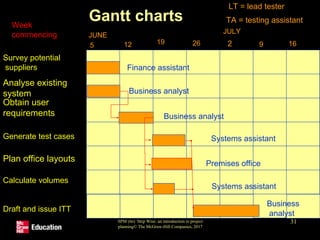
Gantt charts
Obtain user
requirements
Plan office layouts
Week
commencing
5 12 19 26
JUNE
JULY
9 16
Analyse existing
system
2
Draft and issue ITT
Business analyst
Systems assistant
Business
analyst
Premises office
LT = lead tester
TA = testing assistant
Survey potential
suppliers
Generate test cases
Calculate volumes
Business analyst
Finance assistant
Systems assistant
SPM (6e) Step Wise: an introduction to project
planning© The McGraw-Hill Companies, 2017
32
Step 8
Review/publicise plan
• 8.1 Review quality aspects of project plan
• 8.2 Document plan and obtain agreement
Step 9 & 10
Execute plan and create lower
level plans
SPM (6e) Step Wise: an introduction to project
planning© The McGraw-Hill Companies, 2017
33
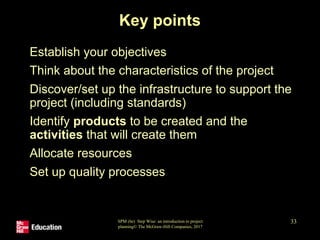
Key points
• Establish your objectives
• Think about the characteristics of the project
• Discover/set up the infrastructure to support the
project (including standards)
• Identify products to be created and the
activities that will create them
• Allocate resources
• Set up quality processes
End of Unit 1
The end of one chapter is just
the beginning of another….
Read on….
The BEST part is always yet
to come…..
SPM (5e) Step Wise: an introduction to project
planning© The McGraw-Hill Companies, 2009
34

Chapter 03 overview-of project planning Step Wise

  • 1.
    SPM (6e) StepWise: an introduction to project planning© The McGraw-Hill Companies, 2017 1 Software Project Management Unit 1 Chapter 3 Step Wise: An approach to planning software projects
  • 2.
    “What we learnwith pleasure….. we never forget...” Alfred Mercier 13-07-20 SPM (5e) Step Wise: an introduction to project planning© The McGraw-Hill Companies, 2009 2
  • 3.
    SPM (6e) StepWise: an introduction to project planning© The McGraw-Hill Companies, 2017 3 ‘Step Wise’ - aspirations • Practicality • tries to answer the question ‘what do I do now?’ • Scalability • useful for small project as well as large • Range of application • Accepted techniques • e.g. borrowed from PRINCE etc
  • 4.
    SPM (5e) StepWise: an introduction to project planning© The McGraw-Hill Companies, 2017 4 ‘Step Wise’ - an overview 0.Select project 1. Identify project objectives 2. Identify project infrastructure 3. Analyse project characteristics 4. Identify products and activities 5. Estimate effort for activity 8. Review/ publicize plan 6. Identify activity risks 7. Allocate resources 9. Execute plan 10. Lower level planning Review Lower level detail For each activity
  • 5.
    SPM (6e) StepWise: an introduction to project planning© The McGraw-Hill Companies, 2017 5 A project scenario: Brightmouth College Payroll • College currently has payroll processing carried out by a services company • This is very expensive and does not allow detailed analysis of personnel data to be carried out • Decision made to bring payroll ‘in-house’ by acquiring an ‘off-the-shelf’ application
  • 6.
    SPM (6e) StepWise: an introduction to project planning© The McGraw-Hill Companies, 2017 6 Project scenario - continued • The use of the off-the-shelf system will require a new, internal, payroll office to be set up • There will be a need to develop some software ‘add-ons’: one will take payroll data and combine it with time-table data to calculate the staff costs for each course run in the college • The project manager is Brigette.
  • 7.
    SPM (5e) StepWise: an introduction to project planning© The McGraw-Hill Companies, 2009 7 14-07-20
  • 8.
    SPM (6e) StepWise: an introduction to project planning© The McGraw-Hill Companies, 2017 8 Step 1 establish project scope and objectives • 1.1 Identify objectives and measures of effectiveness • ‘how do we know if we have succeeded?’ • 1.2 Establish a project authority • ‘who is the boss?’ • 1.3 Identify all stakeholders in the project and their interests • ‘who will be affected/involved in the project?’
  • 9.
    SPM (6e) StepWise: an introduction to project planning© The McGraw-Hill Companies, 2017 9 Step 1 continued • 1.4 Modify objectives in the light of stakeholder analysis • ‘do we need to do things to win over stakeholders?’ • 1.5 Establish methods of communication with all parties • ‘how do we keep in contact?’
  • 10.
    SPM (6e) StepWise: an introduction to project planning© The McGraw-Hill Companies, 2017 10 Back to the scenario • Project authority - Brigette finds she has two different clients for the new system: the finance department & the personnel office - A vice principal agrees to be official client, and monthly meetings are chaired by the VP and attended by Brigette and the heads of finance and personnel - These meetings would also help overcome communication barriers
  • 11.
    SPM (6e) StepWise: an introduction to project planning© The McGraw-Hill Companies, 2017 11 Back to the scenario - continued • Stakeholders • For example, personnel office would supply details of new staff, leavers and changes (e.g. promotions) • To motivate co-operation Brigette might ensure new payroll system produces reports that are useful to personnel staff
  • 12.
    SPM (6e) StepWise: an introduction to project planning© The McGraw-Hill Companies, 2017 12 Step 2 Establish project infrastructure • 2.1 Establish link between project and any strategic plan • ‘why did they want the project?’ • 2.2 Identify installation standards and procedures • ‘what standards do we have to follow?’ • 2.3. Identify project team organization • ‘where do I fit in?’
  • 13.
    Education is notthe learning of facts…. But the training of the mind to think…. -- Albert Einstein 17-07-20 SPM (5e) Step Wise: an introduction to project planning© The McGraw-Hill Companies, 2009 13
  • 14.
    SPM (6e) StepWise: an introduction to project planning© The McGraw-Hill Companies, 2017 14 Step 3 Analysis of project characteristics • 3.1 Distinguish the project as either objective or product-based. • Is there more than one way of achieving success? • 3.2 Analyse other project characteristics (including quality based ones) • what is different about this project?
  • 15.
    SPM (6e) StepWise: an introduction to project planning© The McGraw-Hill Companies, 2017 15 Step 3 continued • Identify high level project risks • ‘what could go wrong?’ • ‘what can we do to stop it?’ • Take into account user requirements concerning implementation • Select general life cycle approach • waterfall? Increments? Prototypes? • Review overall resource estimates • ‘does all this increase the cost?’
  • 16.
    SPM (6e) StepWise: an introduction to project planning© The McGraw-Hill Companies, 2017 16 Back to the scenario • Objectives vs. products • An objective-based approach has been adopted • Some risks • There may not be an off-the-shelf package that caters for the way payroll is processed at Brightmouth College • Answer? • Brigette decides to obtain details of how main candidate packages work as soon as possible; also agreement that if necessary processes will be changed to fit in with new system.
  • 17.
    SPM (6e) StepWise: an introduction to project planning© The McGraw-Hill Companies, 2017 17 Step 4 Identify project products and activities • 4.1 Identify and describe project products ‘what do we have to produce?’
  • 18.
    SPM (6e) StepWise: an introduction to project planning© The McGraw-Hill Companies, 2017 18 Products • The result of an activity • Could be (among other things) • physical thing (‘installed pc’), • a document (‘logical data structure’) • a person (‘trained user’) • a new version of an old product (‘updated software’)
  • 19.
    SPM (6e) StepWise: an introduction to project planning© The McGraw-Hill Companies, 2017 19 Products • The following are NOT normally products: • activities (e.g. ‘training’) • events (e.g. ‘interviews completed’) • resources and actors (e.g. ‘software developer’) - may be exceptions to this • Products CAN BE deliverable or intermediate
  • 20.
    SPM (6e) StepWise: an introduction to project planning© The McGraw-Hill Companies, 2017 20 Product description (PD) • Product identity • Description - what is it? • Derivation - what is it based on? • Composition - what does it contain? • Format • Relevant standards • Quality criteria Create a PD for ‘test data’
  • 21.
    Step 4 continued •4.2 document generic- product flows SPM (6e) Step Wise: an introduction to project planning© The McGraw-Hill Companies, 2017 21
  • 22.
    SPM (6e) StepWise: an introduction to project planning© The McGraw-Hill Companies, 2017 22 Step 4 continued • 4.3 Recognize product instances • The PBS (Product breakdown Structure) and PFD (Product flow diagram) will probably have identified generic products e.g. ‘software modules’ • It might be possible to identify specific instances e.g. ‘module A’, ‘module B’ … • But in many cases this will have to be left to later, more detailed, planning
  • 23.
    SPM (6e) StepWise: an introduction to project planning© The McGraw-Hill Companies, 2017 23 Step 4 continued • 4.4. Produce ideal activity network • Identify the activities needed to create each product in the PFD • More than one activity might be needed to create a single product • Hint: Identify activities by verb + noun but avoid ‘produce…’ (too vague) • Draw up activity network
  • 24.
    SPM (6e) StepWise: an introduction to project planning© The McGraw-Hill Companies, 2017 24 An ‘ideal’ activity
  • 25.
    SPM (6e) StepWise: an introduction to project planning© The McGraw-Hill Companies, 2017 25 Step 4.5 Add check-points if needed Design module A Design module B Design system Design module C Code module A Code module B Code module C Test system Design module A Design module B Design system Design module C Code module A Code module B Code module C Test system Check-point put in a check point
  • 26.
    Successful and unsuccessful peopledo not vary greatly in their abilities.... They vary in their desires to reach their potential… 20-07-20 JYOTSNA ANTHAL CHAUHAN
  • 27.
    SPM (6e) StepWise: an introduction to project planning© The McGraw-Hill Companies, 2017 27 Step 5: Estimate effort for each activity • 5.1 Carry out bottom-up estimates • distinguish carefully between effort and elapsed time • 5.2. Revise plan to create controllable activities • break up very long activities into a series of smaller ones • bundle up very short activities (create check lists?)
  • 28.
    SPM (6e) StepWise: an introduction to project planning© The McGraw-Hill Companies, 2017 28 Step 6 Identify activity risks • 6.1.Identify and quantify risks for activities • damage if risk occurs (measure in time lost or money) • likelihood if risk occurring • 6.2. Plan risk reduction and contingency measures • risk reduction: activity to stop risk occurring • contingency: action if risk does occur
  • 29.
    SPM (6e) StepWise: an introduction to project planning© The McGraw-Hill Companies, 2017 29 • 6.3 Adjust overall plans and estimates to take account of risks • e.g. add new activities which reduce risks associated with other activities e.g. training, pilot trials, information gathering
  • 30.
    SPM (6e) StepWise: an introduction to project planning© The McGraw-Hill Companies, 2017 30 Step 7 Allocate resources • 7.1 Identify and allocate resources to activities • 7.2 Revise plans and estimates to take into account resource constraints • e.g. staff not being available until a later date • non-project activities
  • 31.
    SPM (6e) StepWise: an introduction to project planning© The McGraw-Hill Companies, 2017 31 Gantt charts Obtain user requirements Plan office layouts Week commencing 5 12 19 26 JUNE JULY 9 16 Analyse existing system 2 Draft and issue ITT Business analyst Systems assistant Business analyst Premises office LT = lead tester TA = testing assistant Survey potential suppliers Generate test cases Calculate volumes Business analyst Finance assistant Systems assistant
  • 32.
    SPM (6e) StepWise: an introduction to project planning© The McGraw-Hill Companies, 2017 32 Step 8 Review/publicise plan • 8.1 Review quality aspects of project plan • 8.2 Document plan and obtain agreement Step 9 & 10 Execute plan and create lower level plans
  • 33.
    SPM (6e) StepWise: an introduction to project planning© The McGraw-Hill Companies, 2017 33 Key points • Establish your objectives • Think about the characteristics of the project • Discover/set up the infrastructure to support the project (including standards) • Identify products to be created and the activities that will create them • Allocate resources • Set up quality processes
  • 34.
    End of Unit1 The end of one chapter is just the beginning of another…. Read on…. The BEST part is always yet to come….. SPM (5e) Step Wise: an introduction to project planning© The McGraw-Hill Companies, 2009 34