CHAPTER: 2
CLASSS: VIII
MICROORGANISMS:
FRIEND AND FOE
LEARNING OBJECTIVE
STUENTS WILLL BE ABLE TO:
 Describe microorganisms.
 enlist the types of microorganisms.
 determine the uses of microorganisms
 describe the harmful effects of microorganisms.
 define antibiotics and vaccine
 enlist the names of diseases caused by various
microorganisms.
 differentiate between communicable and non-
communicable disease.
 determine the different methods of preservation of food.
 explain and draw the nitrogen cycle.
MICROORGANISMS
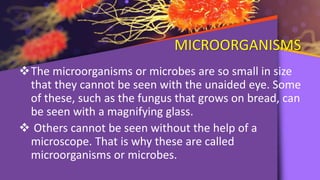
The microorganisms or microbes are so small in size
that they cannot be seen with the unaided eye. Some
of these, such as the fungus that grows on bread, can
be seen with a magnifying glass.
 Others cannot be seen without the help of a
microscope. That is why these are called
microorganisms or microbes.
TYPES OF MICROORGANISMS
• MICROORGANISMS ARE CLASSIFIED INTO FOUR
MAJOR GROUP, THESE GROUPS ARE :
• BACTERIA
• FUNGI
• PROTOZOA
• ALGAE
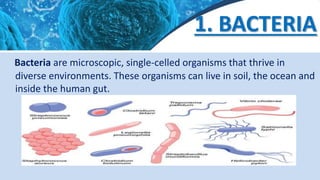
1. BACTERIA
Bacteria are microscopic, single-celled organisms that thrive in
diverse environments. These organisms can live in soil, the ocean and
inside the human gut.
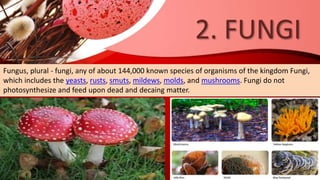
2. FUNGI
Fungus, plural - fungi, any of about 144,000 known species of organisms of the kingdom Fungi,
which includes the yeasts, rusts, smuts, mildews, molds, and mushrooms. Fungi do not
photosynthesize and feed upon dead and decaing matter.
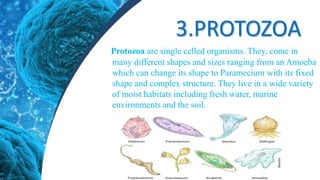
3.PROTOZOA
Protozoa are single celled organisms. They, come in
many different shapes and sizes ranging from an Amoeba
which can change its shape to Paramecium with its fixed
shape and complex structure. They live in a wide variety
of moist habitats including fresh water, marine
environments and the soil.
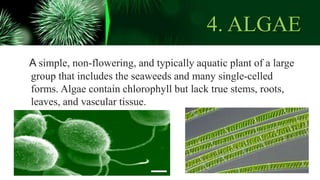
4. ALGAE
A simple, non-flowering, and typically aquatic plant of a large
group that includes the seaweeds and many single-celled
forms. Algae contain chlorophyll but lack true stems, roots,
leaves, and vascular tissue.
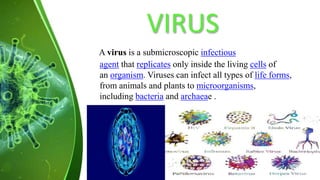
VIRUS
A virus is a submicroscopic infectious
agent that replicates only inside the living cells of
an organism. Viruses can infect all types of life forms,
from animals and plants to microorganisms,
including bacteria and archaeae .
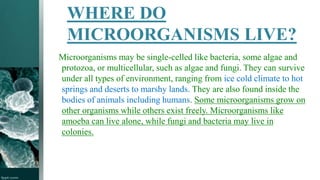
WHERE DO
MICROORGANISMS LIVE?
Microorganisms may be single-celled like bacteria, some algae and
protozoa, or multicellular, such as algae and fungi. They can survive
under all types of environment, ranging from ice cold climate to hot
springs and deserts to marshy lands. They are also found inside the
bodies of animals including humans. Some microorganisms grow on
other organisms while others exist freely. Microorganisms like
amoeba can live alone, while fungi and bacteria may live in
colonies.
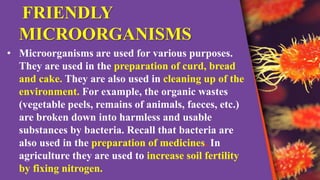
FRIENDLY
MICROORGANISMS
• Microorganisms are used for various purposes.
They are used in the preparation of curd, bread
and cake. They are also used in cleaning up of the
environment. For example, the organic wastes
(vegetable peels, remains of animals, faeces, etc.)
are broken down into harmless and usable
substances by bacteria. Recall that bacteria are
also used in the preparation of medicines. In
agriculture they are used to increase soil fertility
by fixing nitrogen.
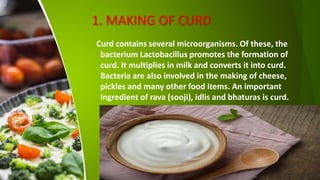
1. MAKING OF CURD
Curd contains several microorganisms. Of these, the
bacterium Lactobacillus promotes the formation of
curd. It multiplies in milk and converts it into curd.
Bacteria are also involved in the making of cheese,
pickles and many other food items. An important
ingredient of rava (sooji), idlis and bhaturas is curd.
MAKING OF BREAD
Yeast reproduces rapidly and produces carbon dioxide
during respiration. Bubbles of the gas fill the dough and
increase its volume. This is the basis of the use of yeast in
the baking industry for making breads, pastries and
cakes.
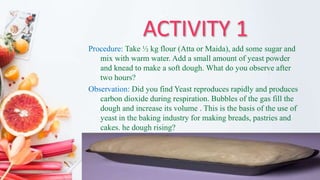
ACTIVITY 1
Procedure: Take ½ kg flour (Atta or Maida), add some sugar and
mix with warm water. Add a small amount of yeast powder
and knead to make a soft dough. What do you observe after
two hours?
Observation: Did you find Yeast reproduces rapidly and produces
carbon dioxide during respiration. Bubbles of the gas fill the
dough and increase its volume . This is the basis of the use of
yeast in the baking industry for making breads, pastries and
cakes. he dough rising?
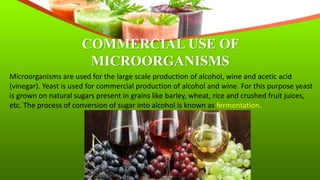
COMMERCIAL USE OF
MICROORGANISMS
Microorganisms are used for the large scale production of alcohol, wine and acetic acid
(vinegar). Yeast is used for commercial production of alcohol and wine. For this purpose yeast
is grown on natural sugars present in grains like barley, wheat, rice and crushed fruit juices,
etc. The process of conversion of sugar into alcohol is known as fermentation.
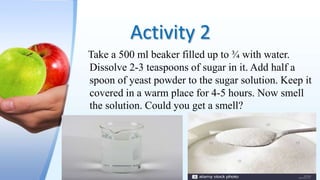
Activity 2
Take a 500 ml beaker filled up to ¾ with water.
Dissolve 2-3 teaspoons of sugar in it. Add half a
spoon of yeast powder to the sugar solution. Keep it
covered in a warm place for 4-5 hours. Now smell
the solution. Could you get a smell?
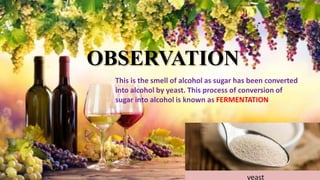
OBSERVATION
yeast
This is the smell of alcohol as sugar has been converted
into alcohol by yeast. This process of conversion of
sugar into alcohol is known as FERMENTATION
MEDICINAL USE OF MICROORGANISMS
• Whenever you fall ill the doctor may give you some antibiotic
tablets, capsules or injections such as of penicillin. The source of
these medicines is microorganisms.
• These medicines kill or stop the growth of the disease-causing
microorganisms. Such medicines are called antibiotics. These
days a number of antibiotics are being produced from bacteria and
fungi. Streptomycin, tetracycline and erythromycin are some of
the commonly known antibiotics which are made from fungi and
bacteria.
• The antibiotics are manufactured by growing specific
microorganisms and are used to cure a variety of diseases.
Antibiotics are even mixed with the feed of livestock and poultry
to check microbial infection in animals. They are also used to
control many plant diseases.
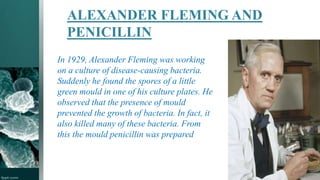
ALEXANDER FLEMING AND
PENICILLIN
In 1929, Alexander Fleming was working
on a culture of disease-causing bacteria.
Suddenly he found the spores of a little
green mould in one of his culture plates. He
observed that the presence of mould
prevented the growth of bacteria. In fact, it
also killed many of these bacteria. From
this the mould penicillin was prepared
USE OF ANTIBIOTICS
 It is important to remember that antibiotics should
be taken only on the advice of a qualified doctor.
Also you must finish the course prescribed by
the doctor. If you take antibiotics when not needed
or in wrong doses, it may make the drug less effective.
 when you might need it in future. Also antibiotics
taken unnecessarily may kill the beneficial bacteria
in the body. Antibiotics, however, are not effective
against cold and flu as these are caused by viruses.
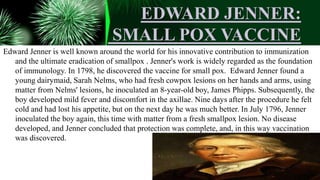
EDWARD JENNER:
SMALL POX VACCINE
Edward Jenner is well known around the world for his innovative contribution to immunization
and the ultimate eradication of smallpox . Jenner's work is widely regarded as the foundation
of immunology. In 1798, he discovered the vaccine for small pox. Edward Jenner found a
young dairymaid, Sarah Nelms, who had fresh cowpox lesions on her hands and arms, using
matter from Nelms' lesions, he inoculated an 8-year-old boy, James Phipps. Subsequently, the
boy developed mild fever and discomfort in the axillae. Nine days after the procedure he felt
cold and had lost his appetite, but on the next day he was much better. In July 1796, Jenner
inoculated the boy again, this time with matter from a fresh smallpox lesion. No disease
developed, and Jenner concluded that protection was complete, and, in this way vaccination
was discovered.
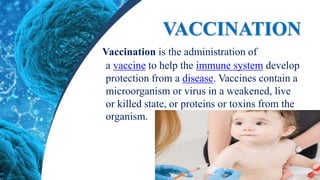
VACCINATION
Vaccination is the administration of
a vaccine to help the immune system develop
protection from a disease. Vaccines contain a
microorganism or virus in a weakened, live
or killed state, or proteins or toxins from the
organism.
WHY DO INFANTS AND CHILDREN
NEED VACCINATION
When a disease-carrying microbe enters our
body, the body produces antibodies to fight the
invader. The body also remembers how to fight
the microbe if it enters again. So, if dead or
weakened microbes are introduced in a healthy
body, the body fights and kills them by producing
suitable antibodies. The antibodies remain in the
body and we are protected from the disease-
causing microbes. This is how a vaccine works.
Several diseases, including cholera, tuberculosis,
smallpox and hepatitis can be prevented by
vaccination.
WHY DO INFANTS AND CHILDREN NEED
VACCINATION
• In your childhood, you must have been given injections to protect
yourself against several diseases. Can you prepare a list of these
diseases? You may take help from your parents. It is essential to
protect all children against these diseases. Necessary vaccines are
available in the nearby hospitals. You might have seen the
advertisement on T.V. and newspapers regarding protection of
children against polio under Pulse Polio Program.
WHY DO INFANTS AND CHILDREN
NEED VACCINATION
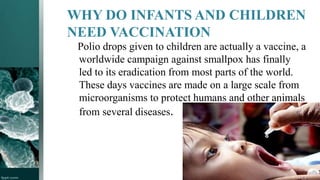
Polio drops given to children are actually a vaccine, a
worldwide campaign against smallpox has finally
led to its eradication from most parts of the world.
These days vaccines are made on a large scale from
microorganisms to protect humans and other animals
from several diseases.
INCREASING SOIL FERTILITY
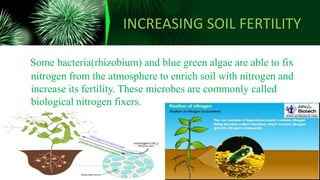
Some bacteria(rhizobium) and blue green algae are able to fix
nitrogen from the atmosphere to enrich soil with nitrogen and
increase its fertility. These microbes are commonly called
biological nitrogen fixers.
Activity 3
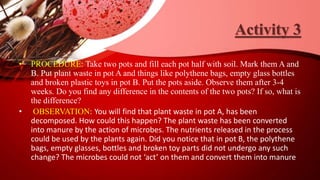
• PROCEDURE: Take two pots and fill each pot half with soil. Mark them A and
B. Put plant waste in pot A and things like polythene bags, empty glass bottles
and broken plastic toys in pot B. Put the pots aside. Observe them after 3-4
weeks. Do you find any difference in the contents of the two pots? If so, what is
the difference?
• OBSERVATION: You will find that plant waste in pot A, has been
decomposed. How could this happen? The plant waste has been converted
into manure by the action of microbes. The nutrients released in the process
could be used by the plants again. Did you notice that in pot B, the polythene
bags, empty glasses, bottles and broken toy parts did not undergo any such
change? The microbes could not ‘act’ on them and convert them into manure
HARMFUL MICROORGANISMS
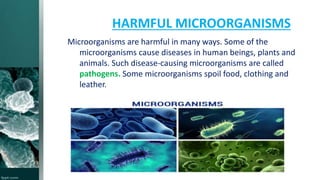
Microorganisms are harmful in many ways. Some of the
microorganisms cause diseases in human beings, plants and
animals. Such disease-causing microorganisms are called
pathogens. Some microorganisms spoil food, clothing and
leather.
Disease Causing Microorganisms In
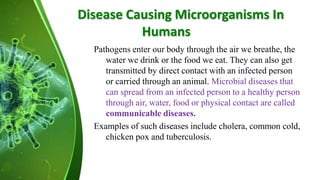
Humans
Pathogens enter our body through the air we breathe, the
water we drink or the food we eat. They can also get
transmitted by direct contact with an infected person
or carried through an animal. Microbial diseases that
can spread from an infected person to a healthy person
through air, water, food or physical contact are called
communicable diseases.
Examples of such diseases include cholera, common cold,
chicken pox and tuberculosis.
Disease Causing Microorganisms In
Humans
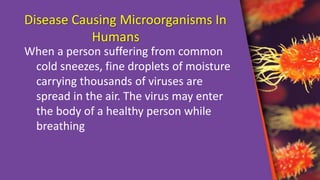
When a person suffering from common
cold sneezes, fine droplets of moisture
carrying thousands of viruses are
spread in the air. The virus may enter
the body of a healthy person while
breathing
Small Insects
(as a carrier of disease)
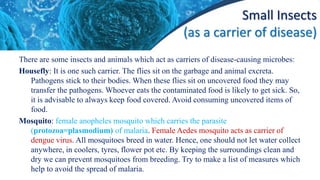
There are some insects and animals which act as carriers of disease-causing microbes:
Housefly: It is one such carrier. The flies sit on the garbage and animal excreta.
Pathogens stick to their bodies. When these flies sit on uncovered food they may
transfer the pathogens. Whoever eats the contaminated food is likely to get sick. So,
it is advisable to always keep food covered. Avoid consuming uncovered items of
food.
Mosquito: female anopheles mosquito which carries the parasite
(protozoa=plasmodium) of malaria. Female Aedes mosquito acts as carrier of
dengue virus. All mosquitoes breed in water. Hence, one should not let water collect
anywhere, in coolers, tyres, flower pot etc. By keeping the surroundings clean and
dry we can prevent mosquitoes from breeding. Try to make a list of measures which
help to avoid the spread of malaria.
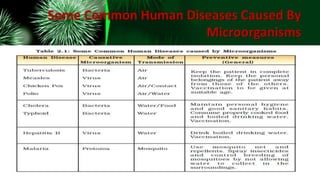
Some Common Human Diseases Caused By
Microorganisms
Disease Causing Microorganisms in Plants
Several microorganisms cause diseases in plants like
wheat, rice, potato, sugarcane, orange, apple and
others. The diseases reduce the yield of crops. They
can be controlled by the use of certain chemicals
which kill the microbes
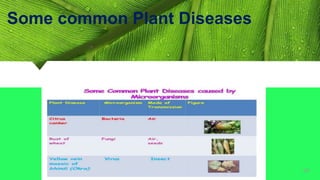
Some common Plant Diseases
34
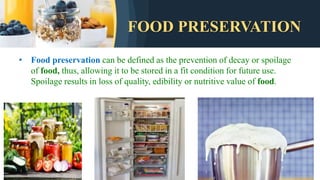
FOOD PRESERVATION
• Food preservation can be defined as the prevention of decay or spoilage
of food, thus, allowing it to be stored in a fit condition for future use.
Spoilage results in loss of quality, edibility or nutritive value of food.
FOOD PRESERVATION
WHY?
Food preservation is essential because it
extends the length of time during which
the food is nutritionally viable and safe to eat.
The substances and chemicals used for the preservation of
the food are called preservatives.
Types:
1. Natural 2. chemicals
salt sodium benzoate
Sugar sodium metabisulfite
Oil
vinegar
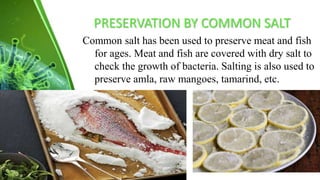
PRESERVATION BY COMMON SALT
Common salt has been used to preserve meat and fish
for ages. Meat and fish are covered with dry salt to
check the growth of bacteria. Salting is also used to
preserve amla, raw mangoes, tamarind, etc.
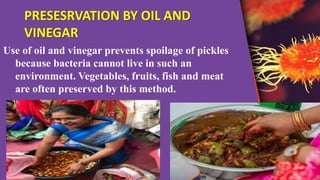
PRESESRVATION BY OIL AND
VINEGAR
Use of oil and vinegar prevents spoilage of pickles
because bacteria cannot live in such an
environment. Vegetables, fruits, fish and meat
are often preserved by this method.
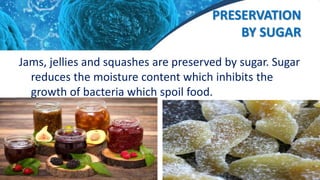
PRESERVATION
BY SUGAR
Jams, jellies and squashes are preserved by sugar. Sugar
reduces the moisture content which inhibits the
growth of bacteria which spoil food.
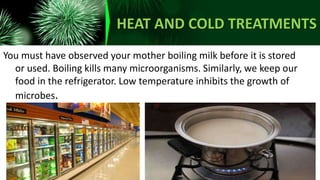
HEAT AND COLD TREATMENTS
You must have observed your mother boiling milk before it is stored
or used. Boiling kills many microorganisms. Similarly, we keep our
food in the refrigerator. Low temperature inhibits the growth of
microbes.
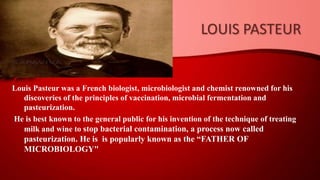
LOUIS PASTEUR
Louis Pasteur was a French biologist, microbiologist and chemist renowned for his
discoveries of the principles of vaccination, microbial fermentation and
pasteurization.
He is best known to the general public for his invention of the technique of treating
milk and wine to stop bacterial contamination, a process now called
pasteurization. He is is popularly known as the “FATHER OF
MICROBIOLOGY"
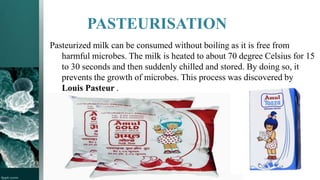
PASTEURISATION
Pasteurized milk can be consumed without boiling as it is free from
harmful microbes. The milk is heated to about 70 degree Celsius for 15
to 30 seconds and then suddenly chilled and stored. By doing so, it
prevents the growth of microbes. This process was discovered by
Louis Pasteur .
STORAGE AND PACKAGING
These days dry fruits and even vegetables are sold in
sealed air tight packets to prevent the attack of
microbes.
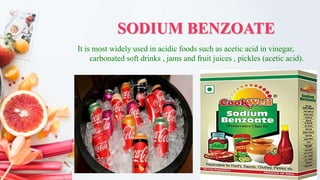
SODIUM BENZOATE
It is most widely used in acidic foods such as acetic acid in vinegar,
carbonated soft drinks , jams and fruit juices , pickles (acetic acid).
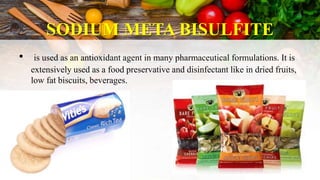
SODIUM META BISULFITE
• is used as an antioxidant agent in many pharmaceutical formulations. It is
extensively used as a food preservative and disinfectant like in dried fruits,
low fat biscuits, beverages.
NITROGEN FIXATION
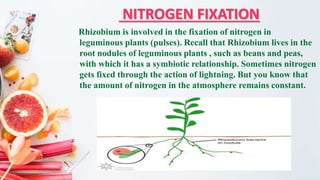
Rhizobium is involved in the fixation of nitrogen in
leguminous plants (pulses). Recall that Rhizobium lives in the
root nodules of leguminous plants , such as beans and peas,
with which it has a symbiotic relationship. Sometimes nitrogen
gets fixed through the action of lightning. But you know that
the amount of nitrogen in the atmosphere remains constant.
NITROGEN CYCLE
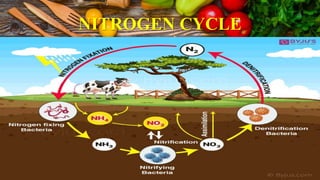
Our atmosphere has 78% nitrogen gas. Nitrogen is one of the essential
constituents of all living organisms as part of proteins, chlorophyll, nucleic
acids and vitamins. The atmospheric nitrogen cannot be taken directly by
plants and animals. Certain bacteria and blue green algae present in the
soil fix nitrogen from the atmosphere and convert into compounds of
nitrogen. Once nitrogen is converted into these usable compounds, it can
be utilised by plants from the soil through their root system. Nitrogen is
then used for the synthesis of plant proteins and other compounds.
Animals feeding on plants get these proteins and other nitrogen
compounds.
When plants and animals die, bacteria and fungi present in the soil convert
the nitrogenous wastes into nitrogenous compounds to be used by plants
again. Certain other bacteria convert some part of them to nitrogen gas
which goes back into the atmosphere. As a result, the percentage of
nitrogen in the atmosphere remains more or less constant.
https://youtu.be/HOpRT8BRGtk
NITROGEN CYCLE
THANK YOU
MONIKA PAL
TGT(SCIENCE)

Microorganisms friend n foe

  • 1.
  • 2.
    LEARNING OBJECTIVE STUENTS WILLLBE ABLE TO:  Describe microorganisms.  enlist the types of microorganisms.  determine the uses of microorganisms  describe the harmful effects of microorganisms.  define antibiotics and vaccine  enlist the names of diseases caused by various microorganisms.  differentiate between communicable and non- communicable disease.  determine the different methods of preservation of food.  explain and draw the nitrogen cycle.
  • 3.
    MICROORGANISMS The microorganisms ormicrobes are so small in size that they cannot be seen with the unaided eye. Some of these, such as the fungus that grows on bread, can be seen with a magnifying glass.  Others cannot be seen without the help of a microscope. That is why these are called microorganisms or microbes.
  • 4.
    TYPES OF MICROORGANISMS •MICROORGANISMS ARE CLASSIFIED INTO FOUR MAJOR GROUP, THESE GROUPS ARE : • BACTERIA • FUNGI • PROTOZOA • ALGAE
  • 5.
    1. BACTERIA Bacteria aremicroscopic, single-celled organisms that thrive in diverse environments. These organisms can live in soil, the ocean and inside the human gut.
  • 6.
    2. FUNGI Fungus, plural- fungi, any of about 144,000 known species of organisms of the kingdom Fungi, which includes the yeasts, rusts, smuts, mildews, molds, and mushrooms. Fungi do not photosynthesize and feed upon dead and decaing matter.
  • 7.
    3.PROTOZOA Protozoa are singlecelled organisms. They, come in many different shapes and sizes ranging from an Amoeba which can change its shape to Paramecium with its fixed shape and complex structure. They live in a wide variety of moist habitats including fresh water, marine environments and the soil.
  • 8.
    4. ALGAE A simple,non-flowering, and typically aquatic plant of a large group that includes the seaweeds and many single-celled forms. Algae contain chlorophyll but lack true stems, roots, leaves, and vascular tissue.
  • 9.
    VIRUS A virus isa submicroscopic infectious agent that replicates only inside the living cells of an organism. Viruses can infect all types of life forms, from animals and plants to microorganisms, including bacteria and archaeae .
  • 10.
    WHERE DO MICROORGANISMS LIVE? Microorganismsmay be single-celled like bacteria, some algae and protozoa, or multicellular, such as algae and fungi. They can survive under all types of environment, ranging from ice cold climate to hot springs and deserts to marshy lands. They are also found inside the bodies of animals including humans. Some microorganisms grow on other organisms while others exist freely. Microorganisms like amoeba can live alone, while fungi and bacteria may live in colonies.
  • 11.
    FRIENDLY MICROORGANISMS • Microorganisms areused for various purposes. They are used in the preparation of curd, bread and cake. They are also used in cleaning up of the environment. For example, the organic wastes (vegetable peels, remains of animals, faeces, etc.) are broken down into harmless and usable substances by bacteria. Recall that bacteria are also used in the preparation of medicines. In agriculture they are used to increase soil fertility by fixing nitrogen.
  • 12.
    1. MAKING OFCURD Curd contains several microorganisms. Of these, the bacterium Lactobacillus promotes the formation of curd. It multiplies in milk and converts it into curd. Bacteria are also involved in the making of cheese, pickles and many other food items. An important ingredient of rava (sooji), idlis and bhaturas is curd.
  • 13.
    MAKING OF BREAD Yeastreproduces rapidly and produces carbon dioxide during respiration. Bubbles of the gas fill the dough and increase its volume. This is the basis of the use of yeast in the baking industry for making breads, pastries and cakes.
  • 14.
    ACTIVITY 1 Procedure: Take½ kg flour (Atta or Maida), add some sugar and mix with warm water. Add a small amount of yeast powder and knead to make a soft dough. What do you observe after two hours? Observation: Did you find Yeast reproduces rapidly and produces carbon dioxide during respiration. Bubbles of the gas fill the dough and increase its volume . This is the basis of the use of yeast in the baking industry for making breads, pastries and cakes. he dough rising?
  • 15.
    COMMERCIAL USE OF MICROORGANISMS Microorganismsare used for the large scale production of alcohol, wine and acetic acid (vinegar). Yeast is used for commercial production of alcohol and wine. For this purpose yeast is grown on natural sugars present in grains like barley, wheat, rice and crushed fruit juices, etc. The process of conversion of sugar into alcohol is known as fermentation.
  • 16.
    Activity 2 Take a500 ml beaker filled up to ¾ with water. Dissolve 2-3 teaspoons of sugar in it. Add half a spoon of yeast powder to the sugar solution. Keep it covered in a warm place for 4-5 hours. Now smell the solution. Could you get a smell?
  • 17.
    OBSERVATION yeast This is thesmell of alcohol as sugar has been converted into alcohol by yeast. This process of conversion of sugar into alcohol is known as FERMENTATION
  • 18.
    MEDICINAL USE OFMICROORGANISMS • Whenever you fall ill the doctor may give you some antibiotic tablets, capsules or injections such as of penicillin. The source of these medicines is microorganisms. • These medicines kill or stop the growth of the disease-causing microorganisms. Such medicines are called antibiotics. These days a number of antibiotics are being produced from bacteria and fungi. Streptomycin, tetracycline and erythromycin are some of the commonly known antibiotics which are made from fungi and bacteria. • The antibiotics are manufactured by growing specific microorganisms and are used to cure a variety of diseases. Antibiotics are even mixed with the feed of livestock and poultry to check microbial infection in animals. They are also used to control many plant diseases.
  • 19.
    ALEXANDER FLEMING AND PENICILLIN In1929, Alexander Fleming was working on a culture of disease-causing bacteria. Suddenly he found the spores of a little green mould in one of his culture plates. He observed that the presence of mould prevented the growth of bacteria. In fact, it also killed many of these bacteria. From this the mould penicillin was prepared
  • 20.
    USE OF ANTIBIOTICS It is important to remember that antibiotics should be taken only on the advice of a qualified doctor. Also you must finish the course prescribed by the doctor. If you take antibiotics when not needed or in wrong doses, it may make the drug less effective.  when you might need it in future. Also antibiotics taken unnecessarily may kill the beneficial bacteria in the body. Antibiotics, however, are not effective against cold and flu as these are caused by viruses.
  • 21.
    EDWARD JENNER: SMALL POXVACCINE Edward Jenner is well known around the world for his innovative contribution to immunization and the ultimate eradication of smallpox . Jenner's work is widely regarded as the foundation of immunology. In 1798, he discovered the vaccine for small pox. Edward Jenner found a young dairymaid, Sarah Nelms, who had fresh cowpox lesions on her hands and arms, using matter from Nelms' lesions, he inoculated an 8-year-old boy, James Phipps. Subsequently, the boy developed mild fever and discomfort in the axillae. Nine days after the procedure he felt cold and had lost his appetite, but on the next day he was much better. In July 1796, Jenner inoculated the boy again, this time with matter from a fresh smallpox lesion. No disease developed, and Jenner concluded that protection was complete, and, in this way vaccination was discovered.
  • 22.
    VACCINATION Vaccination is theadministration of a vaccine to help the immune system develop protection from a disease. Vaccines contain a microorganism or virus in a weakened, live or killed state, or proteins or toxins from the organism.
  • 23.
    WHY DO INFANTSAND CHILDREN NEED VACCINATION When a disease-carrying microbe enters our body, the body produces antibodies to fight the invader. The body also remembers how to fight the microbe if it enters again. So, if dead or weakened microbes are introduced in a healthy body, the body fights and kills them by producing suitable antibodies. The antibodies remain in the body and we are protected from the disease- causing microbes. This is how a vaccine works. Several diseases, including cholera, tuberculosis, smallpox and hepatitis can be prevented by vaccination.
  • 24.
    WHY DO INFANTSAND CHILDREN NEED VACCINATION • In your childhood, you must have been given injections to protect yourself against several diseases. Can you prepare a list of these diseases? You may take help from your parents. It is essential to protect all children against these diseases. Necessary vaccines are available in the nearby hospitals. You might have seen the advertisement on T.V. and newspapers regarding protection of children against polio under Pulse Polio Program.
  • 25.
    WHY DO INFANTSAND CHILDREN NEED VACCINATION Polio drops given to children are actually a vaccine, a worldwide campaign against smallpox has finally led to its eradication from most parts of the world. These days vaccines are made on a large scale from microorganisms to protect humans and other animals from several diseases.
  • 26.
    INCREASING SOIL FERTILITY Somebacteria(rhizobium) and blue green algae are able to fix nitrogen from the atmosphere to enrich soil with nitrogen and increase its fertility. These microbes are commonly called biological nitrogen fixers.
  • 27.
    Activity 3 • PROCEDURE:Take two pots and fill each pot half with soil. Mark them A and B. Put plant waste in pot A and things like polythene bags, empty glass bottles and broken plastic toys in pot B. Put the pots aside. Observe them after 3-4 weeks. Do you find any difference in the contents of the two pots? If so, what is the difference? • OBSERVATION: You will find that plant waste in pot A, has been decomposed. How could this happen? The plant waste has been converted into manure by the action of microbes. The nutrients released in the process could be used by the plants again. Did you notice that in pot B, the polythene bags, empty glasses, bottles and broken toy parts did not undergo any such change? The microbes could not ‘act’ on them and convert them into manure
  • 28.
    HARMFUL MICROORGANISMS Microorganisms areharmful in many ways. Some of the microorganisms cause diseases in human beings, plants and animals. Such disease-causing microorganisms are called pathogens. Some microorganisms spoil food, clothing and leather.
  • 29.
    Disease Causing MicroorganismsIn Humans Pathogens enter our body through the air we breathe, the water we drink or the food we eat. They can also get transmitted by direct contact with an infected person or carried through an animal. Microbial diseases that can spread from an infected person to a healthy person through air, water, food or physical contact are called communicable diseases. Examples of such diseases include cholera, common cold, chicken pox and tuberculosis.
  • 30.
    Disease Causing MicroorganismsIn Humans When a person suffering from common cold sneezes, fine droplets of moisture carrying thousands of viruses are spread in the air. The virus may enter the body of a healthy person while breathing
  • 31.
    Small Insects (as acarrier of disease) There are some insects and animals which act as carriers of disease-causing microbes: Housefly: It is one such carrier. The flies sit on the garbage and animal excreta. Pathogens stick to their bodies. When these flies sit on uncovered food they may transfer the pathogens. Whoever eats the contaminated food is likely to get sick. So, it is advisable to always keep food covered. Avoid consuming uncovered items of food. Mosquito: female anopheles mosquito which carries the parasite (protozoa=plasmodium) of malaria. Female Aedes mosquito acts as carrier of dengue virus. All mosquitoes breed in water. Hence, one should not let water collect anywhere, in coolers, tyres, flower pot etc. By keeping the surroundings clean and dry we can prevent mosquitoes from breeding. Try to make a list of measures which help to avoid the spread of malaria.
  • 32.
    Some Common HumanDiseases Caused By Microorganisms
  • 33.
    Disease Causing Microorganismsin Plants Several microorganisms cause diseases in plants like wheat, rice, potato, sugarcane, orange, apple and others. The diseases reduce the yield of crops. They can be controlled by the use of certain chemicals which kill the microbes
  • 34.
    Some common PlantDiseases 34
  • 35.
    FOOD PRESERVATION • Foodpreservation can be defined as the prevention of decay or spoilage of food, thus, allowing it to be stored in a fit condition for future use. Spoilage results in loss of quality, edibility or nutritive value of food.
  • 36.
    FOOD PRESERVATION WHY? Food preservationis essential because it extends the length of time during which the food is nutritionally viable and safe to eat.
  • 37.
    The substances andchemicals used for the preservation of the food are called preservatives. Types: 1. Natural 2. chemicals salt sodium benzoate Sugar sodium metabisulfite Oil vinegar
  • 38.
    PRESERVATION BY COMMONSALT Common salt has been used to preserve meat and fish for ages. Meat and fish are covered with dry salt to check the growth of bacteria. Salting is also used to preserve amla, raw mangoes, tamarind, etc.
  • 39.
    PRESESRVATION BY OILAND VINEGAR Use of oil and vinegar prevents spoilage of pickles because bacteria cannot live in such an environment. Vegetables, fruits, fish and meat are often preserved by this method.
  • 40.
    PRESERVATION BY SUGAR Jams, jelliesand squashes are preserved by sugar. Sugar reduces the moisture content which inhibits the growth of bacteria which spoil food.
  • 41.
    HEAT AND COLDTREATMENTS You must have observed your mother boiling milk before it is stored or used. Boiling kills many microorganisms. Similarly, we keep our food in the refrigerator. Low temperature inhibits the growth of microbes.
  • 42.
    LOUIS PASTEUR Louis Pasteurwas a French biologist, microbiologist and chemist renowned for his discoveries of the principles of vaccination, microbial fermentation and pasteurization. He is best known to the general public for his invention of the technique of treating milk and wine to stop bacterial contamination, a process now called pasteurization. He is is popularly known as the “FATHER OF MICROBIOLOGY"
  • 43.
    PASTEURISATION Pasteurized milk canbe consumed without boiling as it is free from harmful microbes. The milk is heated to about 70 degree Celsius for 15 to 30 seconds and then suddenly chilled and stored. By doing so, it prevents the growth of microbes. This process was discovered by Louis Pasteur .
  • 44.
    STORAGE AND PACKAGING Thesedays dry fruits and even vegetables are sold in sealed air tight packets to prevent the attack of microbes.
  • 45.
    SODIUM BENZOATE It ismost widely used in acidic foods such as acetic acid in vinegar, carbonated soft drinks , jams and fruit juices , pickles (acetic acid).
  • 46.
    SODIUM META BISULFITE •is used as an antioxidant agent in many pharmaceutical formulations. It is extensively used as a food preservative and disinfectant like in dried fruits, low fat biscuits, beverages.
  • 47.
    NITROGEN FIXATION Rhizobium isinvolved in the fixation of nitrogen in leguminous plants (pulses). Recall that Rhizobium lives in the root nodules of leguminous plants , such as beans and peas, with which it has a symbiotic relationship. Sometimes nitrogen gets fixed through the action of lightning. But you know that the amount of nitrogen in the atmosphere remains constant.
  • 48.
    NITROGEN CYCLE Our atmospherehas 78% nitrogen gas. Nitrogen is one of the essential constituents of all living organisms as part of proteins, chlorophyll, nucleic acids and vitamins. The atmospheric nitrogen cannot be taken directly by plants and animals. Certain bacteria and blue green algae present in the soil fix nitrogen from the atmosphere and convert into compounds of nitrogen. Once nitrogen is converted into these usable compounds, it can be utilised by plants from the soil through their root system. Nitrogen is then used for the synthesis of plant proteins and other compounds. Animals feeding on plants get these proteins and other nitrogen compounds. When plants and animals die, bacteria and fungi present in the soil convert the nitrogenous wastes into nitrogenous compounds to be used by plants again. Certain other bacteria convert some part of them to nitrogen gas which goes back into the atmosphere. As a result, the percentage of nitrogen in the atmosphere remains more or less constant. https://youtu.be/HOpRT8BRGtk
  • 49.
  • 50.