Changing Perceptions  with Social Media Heather Whaling [email_address] prtini.com twitter.com/prTini linkedin.com/in/heatherwhaling
Today’s Schedule 9:30-11:45  Part 1: Intro, Myths, Policies, Tools 11:45 - 12:45 Lunch 1-1:50 Part 2: Getting Social … 2-3 Panel Discussion
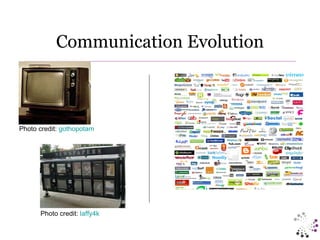
Communication Evolution Photo credit:  gothopotam Photo credit:  laffy4k
Social media:  Channels for interacting, using accessible publishing techniques. Social media use web-based technologies to transform and broadcast monologues allow the creation and exchange of user-generated content.  -- Wikipedia
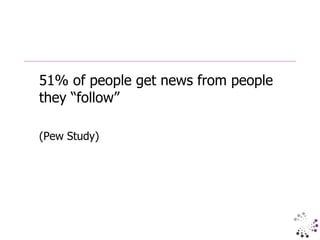
51% of people get news from people they “follow” (Pew Study)
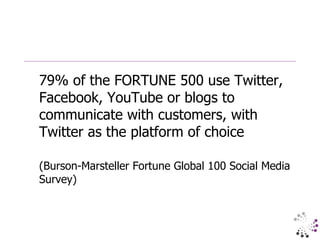
79% of the FORTUNE 500 use Twitter, Facebook, YouTube or blogs to communicate with customers, with Twitter as the platform of choice (Burson-Marsteller Fortune Global 100 Social Media Survey)
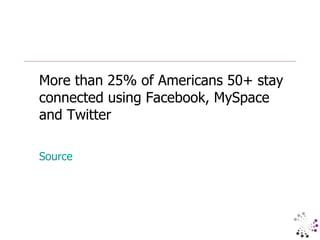
More than 25% of Americans 50+ stay connected using Facebook, MySpace and Twitter Source
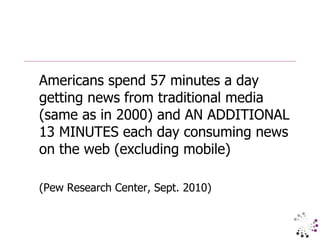
Americans spend 57 minutes a day getting news from traditional media (same as in 2000) and AN ADDITIONAL 13 MINUTES each day consuming news on the web (excluding mobile) (Pew Research Center, Sept. 2010)
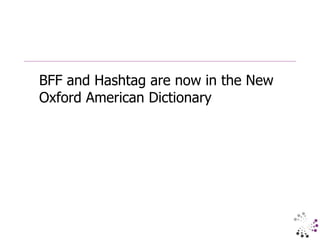
BFF and Hashtag are now in the New Oxford American Dictionary
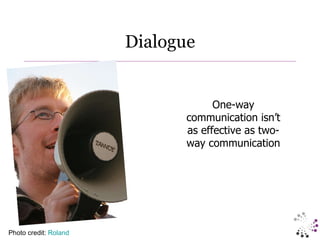
Dialogue Photo credit:  Roland One-way communication isn’t as effective as two-way communication
What Are We Talking About? Social media isn’t: Traditional outreach “digitized” Broadcasting A quick fix Free Stand alone Tools Social media is: Insightful Collaborative Strategic Valuable … when done correctly Relationships Service-oriented
What’s that mean? Interactive vs. Authoritative Personal vs. Institutional “ Narrowcast” vs. Broadcast
Social Media Myths
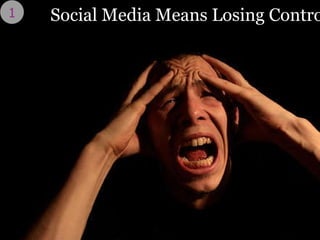
Social Media Means Losing Control 1
It’s Just  a Fad 2
Kids, Hipsters & Geeks Dominate 3 Source
Narcissism Rules  4 Source
Takes too much time 5 Source
Your turn What have you heard about SM? Your Turn:   What have you heard? What are your concerns?
Before Jumping In … What happens if someone says something negative? What HIPPA and legal issues? Do we need a social media policy?
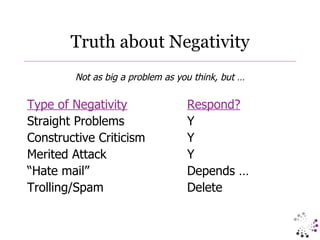
Truth about Negativity Not as big a problem as you think, but … Type of Negativity Respond? Straight Problems Y Constructive Criticism Y Merited Attack Y “ Hate mail” Depends … Trolling/Spam Delete
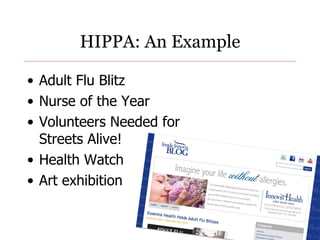
HIPPA HIPAA requires that a patient's identity and personal health information be protected (Protected Health Information, PHI) Prepare content for public consumption Release forms Bottom line: Lots of info to share without sharing client/patient details
HIPPA: An Example Adult Flu Blitz Nurse of the Year Volunteers Needed for Streets Alive! Health Watch Art exhibition
Social Media Policies Always be transparent: Identify yourself and who you work for. Don’t “plant” comments. Be careful with “ghostwriting.” Understand what’s private and what’s public. Be yourself … not a “mouthpiece.” People may assume you’re speaking on behalf of your employer, even when you’re speaking as an individual. Stick to your area of expertise.
Policy Suggestions  (cont.) Respond. Answer questions. Show appreciation.  Welcome feedback and suggestions. Avoid commenting on legal matters and litigation. Avoid participating in a “crisis situation.” Disagreement is ok, as long as it’s respectable. If it’s becoming heated, don’t disengage abruptly. It’s ok to ask for help. Learn from your mistakes.
Moderation Guidelines Pre-moderation -- user name, email address  and  moderation to avoid spam ”The good, the bad, and the ugly” Positive  or  negative content in context of the conversation will be approved Ugly, offensive, denigrating, out-of-context content will be rejected
Intro slide The Tools The Big 3: Facebook, Twitter, Blogs
More than 500 million active users 50% log on at least 1x/day Average user has 130 friends Average user is connected to 80 pages, groups and events 150+ million users access Facebook through mobile devices Let’s take a look …
What to Share? Update the page daily (twice a day is even better) Check twice a day for comments, questions that need responses Be personable. Respond promptly. Address people by name. Ask questions, share articles, events, resources Include photos and video Use “@” tagging. But don’t be spammy. Generate comments, “likes” & sharing
17 million Americans use Twitter Equivalent to combined populations of CT, OR, KY, KS & OK 35% of Twitter users live in urban areas 3x’s more likely to follow brands than Facebook users  25% of Twitter users are African American 53% of users never post updates Let’s take a look … Source
Setting Up Update your profile Add a photo Add Twitter to appropriate email signatures Incorporate on your blog, website, Facebook, enewsletter, etc
Interacting & Engaging Find local people, businesses, news outlets & nonprofits to follow (2-3xs/week) Revew your stream to find messages to reply to or retweet (2 xs/day) Repond to people who @ or DM you (2 xs/day) Be engaging: Ask questions Share relevant, helpful news articles, resources and multimedia Keep listening
Half of all Internet users read blogs 60% by 2014 Blogging vs. Blogger Outreach Types of blog content: Video Photos Written text Infographics
Blogging Tips Posts are not press releases or brochures Read & comment on other blogs Write in language your audience understands (lose the jargon!) Be timely Headlines are critical Build an audience by posting frequently, consistently
…  but those are just some of the tools
Plan Smart. Implement Smarter. Source:  Zack Heller
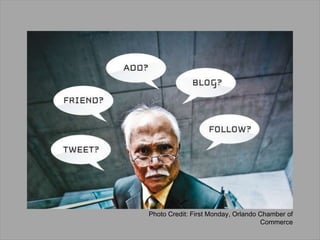
Photo Credit: First Monday, Orlando Chamber of Commerce
• • •  what do you want to accomplish? • • •
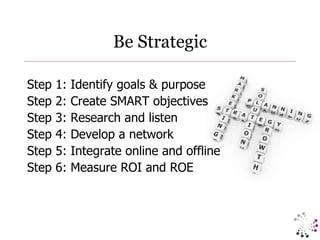
Be Strategic Step 1: Identify goals & purpose Step 2: Create SMART objectives Step 3: Research and listen Step 4: Develop a network Step 5: Integrate online and offline Step 6: Measure ROI and ROE
Step 1: Identify Goals & Purpose Education Advocacy Shape perceptions Recruit volunteers Program/event registration Increase transparency & accountability Create a stronger dialogue with constituents Collaboration Others??
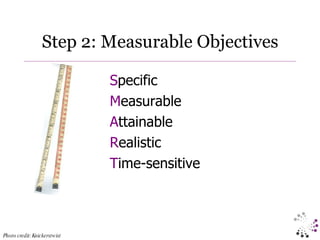
Step 2: Measurable Objectives S pecific M easurable A ttainable R ealistic T ime-sensitive Photo credit: Knickerstwist
• • •  What do you want to do? Who do you want to reach? How will you measure progress? What’s the deadline? • • •
Step 3: Research and Listen Who are you trying to reach? How are they using social media? What are people saying? Where are they saying it? Free online monitoring tools: Google Alerts, BlogSearch Addictomatic.com Netvibes Hootesuite, Tweetdeck Search.Twitter.com/Advanced Nielsen’s BlogPulse “ If you’re always talking, you’re not listening.”  –  Chris Brogan
Step 4: Develop a Network Choose the right tools Start interacting Create interesting content Focus on strategy Cultivate influencers Promote others Be creative  Share, share, share
Step 5: Integrate Online & Offline Cross-promote content Balance traditional communication  and social media Enhance media relations Talk to reporters on social networks HARO Pitchengine.com Use offline tools to drive online efforts …  and visa versa
Step 6: Measure Return on Insight Return on Engagement Twitter followers, lists, retweets and link open-rates Blog comments, traffic, inbound links Facebook fans, wall posts and comments YouTube ratings, embeds on other sites Event registrations Anecdotal evidence  Benchmark & Research
Intro slide: Case studies Case Studies: Who’s Doing it Well?
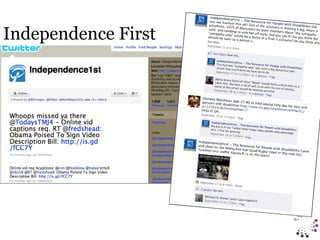
Independence First
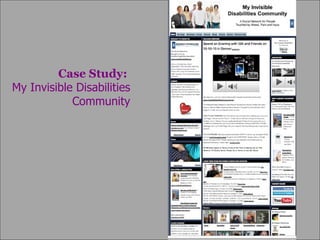
Case Study:  My Invisible Disabilities Community
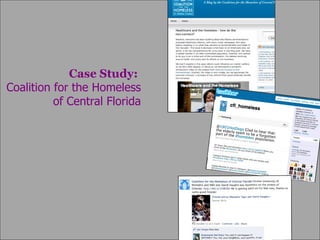
Case Study:  Coalition for the Homeless of Central Florida
Situation: Drastic decrease in food donations Idea: Food drive powered by social media Goal: 400 lbs.  Implementation: Announced online Blog, Twitter, Facebook, Flickr  Result: Raised  1,000+ lbs The Coalition’s  “ Can” Care Challenge
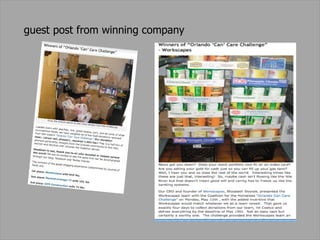
guest post from winning company
Exercise: Content Creation • • •  content creation • • •
Exercise: Writing for different mediums • • •  writing for different mediums • • •
Collaboration. Integration. Social Good. Heather Whaling [email_address] @prTini for slides & resources: bit.ly/OhioPI subscribe to my blog:  bit. ly/prTini

Changing Perceptions with Social Media

  • 1.
    Changing Perceptions with Social Media Heather Whaling [email_address] prtini.com twitter.com/prTini linkedin.com/in/heatherwhaling
  • 2.
    Today’s Schedule 9:30-11:45 Part 1: Intro, Myths, Policies, Tools 11:45 - 12:45 Lunch 1-1:50 Part 2: Getting Social … 2-3 Panel Discussion
  • 3.
    Communication Evolution Photocredit: gothopotam Photo credit: laffy4k
  • 4.
    Social media: Channels for interacting, using accessible publishing techniques. Social media use web-based technologies to transform and broadcast monologues allow the creation and exchange of user-generated content. -- Wikipedia
  • 5.
    51% of peopleget news from people they “follow” (Pew Study)
  • 6.
    79% of theFORTUNE 500 use Twitter, Facebook, YouTube or blogs to communicate with customers, with Twitter as the platform of choice (Burson-Marsteller Fortune Global 100 Social Media Survey)
  • 7.
    More than 25%of Americans 50+ stay connected using Facebook, MySpace and Twitter Source
  • 8.
    Americans spend 57minutes a day getting news from traditional media (same as in 2000) and AN ADDITIONAL 13 MINUTES each day consuming news on the web (excluding mobile) (Pew Research Center, Sept. 2010)
  • 9.
    BFF and Hashtagare now in the New Oxford American Dictionary
  • 10.
    Dialogue Photo credit: Roland One-way communication isn’t as effective as two-way communication
  • 11.
    What Are WeTalking About? Social media isn’t: Traditional outreach “digitized” Broadcasting A quick fix Free Stand alone Tools Social media is: Insightful Collaborative Strategic Valuable … when done correctly Relationships Service-oriented
  • 12.
    What’s that mean?Interactive vs. Authoritative Personal vs. Institutional “ Narrowcast” vs. Broadcast
  • 13.
  • 14.
    Social Media MeansLosing Control 1
  • 15.
    It’s Just a Fad 2
  • 16.
    Kids, Hipsters &Geeks Dominate 3 Source
  • 17.
  • 18.
    Takes too muchtime 5 Source
  • 19.
    Your turn Whathave you heard about SM? Your Turn: What have you heard? What are your concerns?
  • 20.
    Before Jumping In… What happens if someone says something negative? What HIPPA and legal issues? Do we need a social media policy?
  • 21.
    Truth about NegativityNot as big a problem as you think, but … Type of Negativity Respond? Straight Problems Y Constructive Criticism Y Merited Attack Y “ Hate mail” Depends … Trolling/Spam Delete
  • 22.
    HIPPA HIPAA requiresthat a patient's identity and personal health information be protected (Protected Health Information, PHI) Prepare content for public consumption Release forms Bottom line: Lots of info to share without sharing client/patient details
  • 23.
    HIPPA: An ExampleAdult Flu Blitz Nurse of the Year Volunteers Needed for Streets Alive! Health Watch Art exhibition
  • 24.
    Social Media PoliciesAlways be transparent: Identify yourself and who you work for. Don’t “plant” comments. Be careful with “ghostwriting.” Understand what’s private and what’s public. Be yourself … not a “mouthpiece.” People may assume you’re speaking on behalf of your employer, even when you’re speaking as an individual. Stick to your area of expertise.
  • 25.
    Policy Suggestions (cont.) Respond. Answer questions. Show appreciation. Welcome feedback and suggestions. Avoid commenting on legal matters and litigation. Avoid participating in a “crisis situation.” Disagreement is ok, as long as it’s respectable. If it’s becoming heated, don’t disengage abruptly. It’s ok to ask for help. Learn from your mistakes.
  • 26.
    Moderation Guidelines Pre-moderation-- user name, email address and moderation to avoid spam ”The good, the bad, and the ugly” Positive or negative content in context of the conversation will be approved Ugly, offensive, denigrating, out-of-context content will be rejected
  • 27.
    Intro slide TheTools The Big 3: Facebook, Twitter, Blogs
  • 28.
    More than 500million active users 50% log on at least 1x/day Average user has 130 friends Average user is connected to 80 pages, groups and events 150+ million users access Facebook through mobile devices Let’s take a look …
  • 29.
    What to Share?Update the page daily (twice a day is even better) Check twice a day for comments, questions that need responses Be personable. Respond promptly. Address people by name. Ask questions, share articles, events, resources Include photos and video Use “@” tagging. But don’t be spammy. Generate comments, “likes” & sharing
  • 30.
    17 million Americansuse Twitter Equivalent to combined populations of CT, OR, KY, KS & OK 35% of Twitter users live in urban areas 3x’s more likely to follow brands than Facebook users 25% of Twitter users are African American 53% of users never post updates Let’s take a look … Source
  • 31.
    Setting Up Updateyour profile Add a photo Add Twitter to appropriate email signatures Incorporate on your blog, website, Facebook, enewsletter, etc
  • 32.
    Interacting & EngagingFind local people, businesses, news outlets & nonprofits to follow (2-3xs/week) Revew your stream to find messages to reply to or retweet (2 xs/day) Repond to people who @ or DM you (2 xs/day) Be engaging: Ask questions Share relevant, helpful news articles, resources and multimedia Keep listening
  • 33.
    Half of allInternet users read blogs 60% by 2014 Blogging vs. Blogger Outreach Types of blog content: Video Photos Written text Infographics
  • 34.
    Blogging Tips Postsare not press releases or brochures Read & comment on other blogs Write in language your audience understands (lose the jargon!) Be timely Headlines are critical Build an audience by posting frequently, consistently
  • 35.
    … butthose are just some of the tools
  • 36.
    Plan Smart. ImplementSmarter. Source: Zack Heller
  • 37.
    Photo Credit: FirstMonday, Orlando Chamber of Commerce
  • 38.
    • • • what do you want to accomplish? • • •
  • 39.
    Be Strategic Step1: Identify goals & purpose Step 2: Create SMART objectives Step 3: Research and listen Step 4: Develop a network Step 5: Integrate online and offline Step 6: Measure ROI and ROE
  • 40.
    Step 1: IdentifyGoals & Purpose Education Advocacy Shape perceptions Recruit volunteers Program/event registration Increase transparency & accountability Create a stronger dialogue with constituents Collaboration Others??
  • 41.
    Step 2: MeasurableObjectives S pecific M easurable A ttainable R ealistic T ime-sensitive Photo credit: Knickerstwist
  • 42.
    • • • What do you want to do? Who do you want to reach? How will you measure progress? What’s the deadline? • • •
  • 43.
    Step 3: Researchand Listen Who are you trying to reach? How are they using social media? What are people saying? Where are they saying it? Free online monitoring tools: Google Alerts, BlogSearch Addictomatic.com Netvibes Hootesuite, Tweetdeck Search.Twitter.com/Advanced Nielsen’s BlogPulse “ If you’re always talking, you’re not listening.” – Chris Brogan
  • 44.
    Step 4: Developa Network Choose the right tools Start interacting Create interesting content Focus on strategy Cultivate influencers Promote others Be creative Share, share, share
  • 45.
    Step 5: IntegrateOnline & Offline Cross-promote content Balance traditional communication and social media Enhance media relations Talk to reporters on social networks HARO Pitchengine.com Use offline tools to drive online efforts … and visa versa
  • 46.
    Step 6: MeasureReturn on Insight Return on Engagement Twitter followers, lists, retweets and link open-rates Blog comments, traffic, inbound links Facebook fans, wall posts and comments YouTube ratings, embeds on other sites Event registrations Anecdotal evidence Benchmark & Research
  • 47.
    Intro slide: Casestudies Case Studies: Who’s Doing it Well?
  • 48.
  • 49.
    Case Study: My Invisible Disabilities Community
  • 50.
    Case Study: Coalition for the Homeless of Central Florida
  • 51.
    Situation: Drastic decreasein food donations Idea: Food drive powered by social media Goal: 400 lbs. Implementation: Announced online Blog, Twitter, Facebook, Flickr Result: Raised 1,000+ lbs The Coalition’s “ Can” Care Challenge
  • 52.
    guest post fromwinning company
  • 53.
    Exercise: Content Creation• • • content creation • • •
  • 54.
    Exercise: Writing fordifferent mediums • • • writing for different mediums • • •
  • 55.
    Collaboration. Integration. SocialGood. Heather Whaling [email_address] @prTini for slides & resources: bit.ly/OhioPI subscribe to my blog: bit. ly/prTini