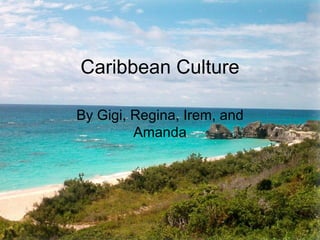
Caribbean Culture By Gigi, Regina, Irem, and Amanda
Education Very important First university founded in 1538 Over 12 colleges today Based on Britain’s Education system Primary education Secondary education More advanced levels offered
Education (cont’d) Equal enrollment of males and females Educational Television Libraries Medical graduate school
School Stats Dominica 73 nursery schools 66 primary schools 9 secondary schools Nursing school University of West Indies Ross University Medical school
Food Fruits and vegetables Exported- north America and Europe oranges, papaya, bananas, watermelon, grapefruit, legumes (‘pod’) Proteins Fish, conch, goat meat, pork, beef Highly spiced foods
Food (cont’d) Fruit beverages “ bush tea” remedy for common cold, asthma, high blood pressure, fever ginger beer, milk with barley Desserts fruit salad many involve coconut and banana black fruitcake- celebrations Cooking methods “ cook-up” dish made with whatever ingredient rice, vegetables, meat
Health Nutrition-related chronic diseases Malnutrition Reduced- increase of protein and calories Diabetes, hypertension coronary heart disease, cancer, obesity Fast-food restaurants Less cereals, grains, fruits, vegetables, and legumes eaten Processed foods- unhealthy
Languages Creole- combination of African and European, developed so that slaves could communicate with plantation owners French Creole- spoken in Haiti, Martinique, Guadeloupe, St. Lucia, Dominica, and French Guyana In Papiamento- blend of Dutch, Portuguese, English, and African In Jamaica- Patwa or Patois
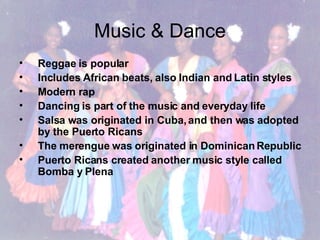
Music & Dance Reggae is popular Includes African beats, also Indian and Latin styles Modern rap Dancing is part of the music and everyday life Salsa was originated in Cuba, and then was adopted by the Puerto Ricans The merengue was originated in Dominican Republic Puerto Ricans created another music style called Bomba y Plena
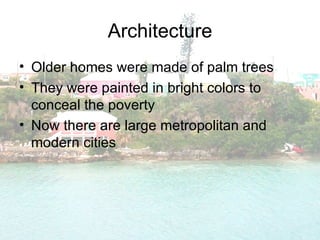
Architecture Older homes were made of palm trees They were painted in bright colors to conceal the poverty Now there are large metropolitan and modern cities
Literature African traditional styles European modernization Cuba influenced Angolan literature Cuban writers, who wrote of experiences in Angola, were mostly white This kept Cuba and Angolan relations close
Art Based on the country’s culture and the cultural movements Many of the artists studied in Europe Cuban artists were receiving more recognition due to political reasons Gallery of Modern Art- famous museum in the Dominican Republic
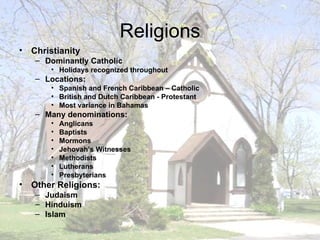
Religions Christianity Dominantly Catholic Holidays recognized throughout Locations: Spanish and French Caribbean – Catholic British and Dutch Caribbean - Protestant Most variance in Bahamas Many denominations: Anglicans Baptists Mormons Jehovah’s Witnesses Methodists Lutherans Presbyterians Other Religions: Judaism  Hinduism Islam
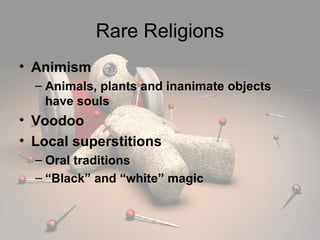
Rare Religions Animism Animals, plants and inanimate objects have souls Voodoo Local superstitions Oral traditions “ Black” and “white” magic
Blended Religions Foreign influence; isolated areas Pocomania (Christanity + Animism) Vodun (Christianity + Benin, Africa) Santeria (Christianity + Yoroban of W. Africa) Rastafarian Movement (Hinduism + African religions)
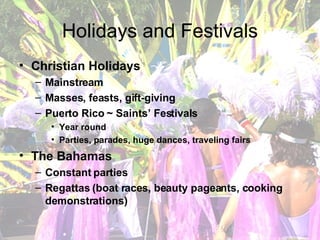
Holidays and Festivals Christian Holidays Mainstream Masses, feasts, gift-giving Puerto Rico ~ Saints’ Festivals Year round Parties, parades, huge dances, traveling fairs The Bahamas Constant parties Regattas (boat races, beauty pageants, cooking demonstrations)
National Holidays Cuba July 26 ~ Remembrance of the National Revolution Feb. 24 ~ Anniversary of Second War for Independence Jamaica 1 st  Mon. in August ~ Independence Day Dominican Republic Feb. 27 ~ Independence Day August 16 ~ Restoration Day November 6 ~ Constitution Day The Bahamas July 10 ~ Independence Day 1 st  Mon. in August ~ Emancipation Day October 12 ~ Discovery Day
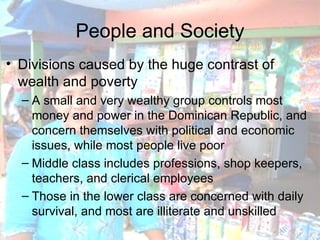
People and Society Divisions caused by the huge contrast of wealth and poverty A small and very wealthy group controls most money and power in the Dominican Republic, and concern themselves with political and economic issues, while most people live poor Middle class includes professions, shop keepers, teachers, and clerical employees Those in the lower class are concerned with daily survival, and most are illiterate and unskilled
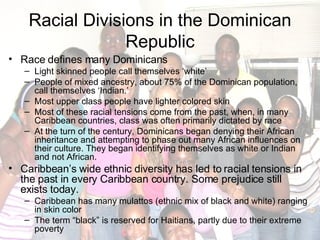
Racial Divisions in the Dominican Republic Race defines many Dominicans Light skinned people call themselves ‘white’ People of mixed ancestry, about 75% of the Dominican population, call themselves ‘Indian.’ Most upper class people have lighter colored skin Most of these racial tensions come from the past, when, in many Caribbean countries, class was often primarily dictated by race At the turn of the century, Dominicans began denying their African inheritance and attempting to phase out many African influences on their culture. They began identifying themselves as white or Indian and not African. Caribbean’s wide ethnic diversity has led to racial tensions in the past in every Caribbean country. Some prejudice still exists today. Caribbean has many mulattos (ethnic mix of black and white) ranging in skin color The term “black” is reserved for Haitians, partly due to their extreme poverty
Women in the Caribbean Most countries have a matriarchal society in the sense that women play a large role in everyday and family life.  Although, men hold most political and economic power Bahamas and many Caribbean islands Women cannot pass citizenship to their spouse If a woman dies, her possessions go to her oldest male relative Domestic violence against women Cuba, Jamaica, and Puerto Rico Women treated equally, make up about 45% of workforce on average Abortions are easy and common Low birth rate; family planning for women encouraged by government Strong sense of female self-reliance Most children grow up with mother and siblings. Father’s work often, and it is not uncommon for the father to have another family.
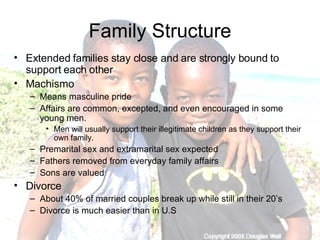
Family Structure Extended families stay close and are strongly bound to support each other Machismo Means masculine pride Affairs are common, excepted, and even encouraged in some young men.  Men will usually support their illegitimate children as they support their own family.  Premarital sex and extramarital sex expected Fathers removed from everyday family affairs Sons are valued  Divorce  About 40% of married couples break up while still in their 20’s Divorce is much easier than in U.S
Lifestyle Dominican Republic and Haiti Most live in unsanitary conditions, with poor health care, poor nutrition, and unorganized or no government support Life expectancy about 67 years Migration to cities becoming more popular, but still mostly rural countries Haiti suffers extreme poverty and thousands immigrate to surrounding Caribbean nations Most common transportation is public buses/vans, only wealthy can afford  cars Jamaica, Bahamas and Cuba Wealthier countries; high life expectancy, high literacy and good healthy care from government Urbanization/Modernizations happening rapidly People move to cities for work, so ghettos are a problem; shortage of affordable housing Urban gangs and violence emerge (high youth population) Unemployment leads to lots of illegal activity
Special thanks to: Google images and Amanda for the use of the pictures our presentation “ Caribbean.”  Encyclopedia Americana .  Encyclopedia Americana . Scholastic Lib. 3 May 2007 <http://ea.grolier.com/>. “ Caribbean Islanders, Diet of.”  Gale Virtual Reference Library . Thomson Gale. Upper Merion Area High School Lib. 4 May 2007 <http://infotrac.galegroup.com/‌itweb/‌?db=GVRL>. “ World Culutures Today.”  The Geenwood Encyclopedia .  Daily Life Through History . Greenwood Publishing Group. 5 May 2007 <http://dailylife.greenwood.com/‌login.asp>.
The End

Caribbean Culture

  • 1.
    Caribbean Culture ByGigi, Regina, Irem, and Amanda
  • 2.
    Education Very importantFirst university founded in 1538 Over 12 colleges today Based on Britain’s Education system Primary education Secondary education More advanced levels offered
  • 3.
    Education (cont’d) Equalenrollment of males and females Educational Television Libraries Medical graduate school
  • 4.
    School Stats Dominica73 nursery schools 66 primary schools 9 secondary schools Nursing school University of West Indies Ross University Medical school
  • 5.
    Food Fruits andvegetables Exported- north America and Europe oranges, papaya, bananas, watermelon, grapefruit, legumes (‘pod’) Proteins Fish, conch, goat meat, pork, beef Highly spiced foods
  • 6.
    Food (cont’d) Fruitbeverages “ bush tea” remedy for common cold, asthma, high blood pressure, fever ginger beer, milk with barley Desserts fruit salad many involve coconut and banana black fruitcake- celebrations Cooking methods “ cook-up” dish made with whatever ingredient rice, vegetables, meat
  • 7.
    Health Nutrition-related chronicdiseases Malnutrition Reduced- increase of protein and calories Diabetes, hypertension coronary heart disease, cancer, obesity Fast-food restaurants Less cereals, grains, fruits, vegetables, and legumes eaten Processed foods- unhealthy
  • 8.
    Languages Creole- combinationof African and European, developed so that slaves could communicate with plantation owners French Creole- spoken in Haiti, Martinique, Guadeloupe, St. Lucia, Dominica, and French Guyana In Papiamento- blend of Dutch, Portuguese, English, and African In Jamaica- Patwa or Patois
  • 9.
    Music & DanceReggae is popular Includes African beats, also Indian and Latin styles Modern rap Dancing is part of the music and everyday life Salsa was originated in Cuba, and then was adopted by the Puerto Ricans The merengue was originated in Dominican Republic Puerto Ricans created another music style called Bomba y Plena
  • 10.
    Architecture Older homeswere made of palm trees They were painted in bright colors to conceal the poverty Now there are large metropolitan and modern cities
  • 11.
    Literature African traditionalstyles European modernization Cuba influenced Angolan literature Cuban writers, who wrote of experiences in Angola, were mostly white This kept Cuba and Angolan relations close
  • 12.
    Art Based onthe country’s culture and the cultural movements Many of the artists studied in Europe Cuban artists were receiving more recognition due to political reasons Gallery of Modern Art- famous museum in the Dominican Republic
  • 13.
    Religions Christianity DominantlyCatholic Holidays recognized throughout Locations: Spanish and French Caribbean – Catholic British and Dutch Caribbean - Protestant Most variance in Bahamas Many denominations: Anglicans Baptists Mormons Jehovah’s Witnesses Methodists Lutherans Presbyterians Other Religions: Judaism Hinduism Islam
  • 14.
    Rare Religions AnimismAnimals, plants and inanimate objects have souls Voodoo Local superstitions Oral traditions “ Black” and “white” magic
  • 15.
    Blended Religions Foreigninfluence; isolated areas Pocomania (Christanity + Animism) Vodun (Christianity + Benin, Africa) Santeria (Christianity + Yoroban of W. Africa) Rastafarian Movement (Hinduism + African religions)
  • 16.
    Holidays and FestivalsChristian Holidays Mainstream Masses, feasts, gift-giving Puerto Rico ~ Saints’ Festivals Year round Parties, parades, huge dances, traveling fairs The Bahamas Constant parties Regattas (boat races, beauty pageants, cooking demonstrations)
  • 17.
    National Holidays CubaJuly 26 ~ Remembrance of the National Revolution Feb. 24 ~ Anniversary of Second War for Independence Jamaica 1 st Mon. in August ~ Independence Day Dominican Republic Feb. 27 ~ Independence Day August 16 ~ Restoration Day November 6 ~ Constitution Day The Bahamas July 10 ~ Independence Day 1 st Mon. in August ~ Emancipation Day October 12 ~ Discovery Day
  • 18.
    People and SocietyDivisions caused by the huge contrast of wealth and poverty A small and very wealthy group controls most money and power in the Dominican Republic, and concern themselves with political and economic issues, while most people live poor Middle class includes professions, shop keepers, teachers, and clerical employees Those in the lower class are concerned with daily survival, and most are illiterate and unskilled
  • 19.
    Racial Divisions inthe Dominican Republic Race defines many Dominicans Light skinned people call themselves ‘white’ People of mixed ancestry, about 75% of the Dominican population, call themselves ‘Indian.’ Most upper class people have lighter colored skin Most of these racial tensions come from the past, when, in many Caribbean countries, class was often primarily dictated by race At the turn of the century, Dominicans began denying their African inheritance and attempting to phase out many African influences on their culture. They began identifying themselves as white or Indian and not African. Caribbean’s wide ethnic diversity has led to racial tensions in the past in every Caribbean country. Some prejudice still exists today. Caribbean has many mulattos (ethnic mix of black and white) ranging in skin color The term “black” is reserved for Haitians, partly due to their extreme poverty
  • 20.
    Women in theCaribbean Most countries have a matriarchal society in the sense that women play a large role in everyday and family life. Although, men hold most political and economic power Bahamas and many Caribbean islands Women cannot pass citizenship to their spouse If a woman dies, her possessions go to her oldest male relative Domestic violence against women Cuba, Jamaica, and Puerto Rico Women treated equally, make up about 45% of workforce on average Abortions are easy and common Low birth rate; family planning for women encouraged by government Strong sense of female self-reliance Most children grow up with mother and siblings. Father’s work often, and it is not uncommon for the father to have another family.
  • 21.
    Family Structure Extendedfamilies stay close and are strongly bound to support each other Machismo Means masculine pride Affairs are common, excepted, and even encouraged in some young men. Men will usually support their illegitimate children as they support their own family. Premarital sex and extramarital sex expected Fathers removed from everyday family affairs Sons are valued Divorce About 40% of married couples break up while still in their 20’s Divorce is much easier than in U.S
  • 22.
    Lifestyle Dominican Republicand Haiti Most live in unsanitary conditions, with poor health care, poor nutrition, and unorganized or no government support Life expectancy about 67 years Migration to cities becoming more popular, but still mostly rural countries Haiti suffers extreme poverty and thousands immigrate to surrounding Caribbean nations Most common transportation is public buses/vans, only wealthy can afford cars Jamaica, Bahamas and Cuba Wealthier countries; high life expectancy, high literacy and good healthy care from government Urbanization/Modernizations happening rapidly People move to cities for work, so ghettos are a problem; shortage of affordable housing Urban gangs and violence emerge (high youth population) Unemployment leads to lots of illegal activity
  • 23.
    Special thanks to:Google images and Amanda for the use of the pictures our presentation “ Caribbean.” Encyclopedia Americana . Encyclopedia Americana . Scholastic Lib. 3 May 2007 <http://ea.grolier.com/>. “ Caribbean Islanders, Diet of.” Gale Virtual Reference Library . Thomson Gale. Upper Merion Area High School Lib. 4 May 2007 <http://infotrac.galegroup.com/‌itweb/‌?db=GVRL>. “ World Culutures Today.” The Geenwood Encyclopedia . Daily Life Through History . Greenwood Publishing Group. 5 May 2007 <http://dailylife.greenwood.com/‌login.asp>.
  • 24.