Chapter 1 Introduction to Global Marketing CHAPTER OUTLINE The development of GM GM: what it is and what it isn’t Importance of GM Reasons for GM Key to global success Global industries The biggest issue in GM Strategic orientation of GM
Domestic  marketing Export marketing International marketing Multinational  marketing Global Marketing THE DEVELOPMENT OF GM
DOMESTIC MARKETING Marketing that is aimed at a single market (firm’s domestic market). Firms face only one set of competitive, economic, and market issues. EXPORT MARKETING When a firm market its products outside its main base of operation and when products are physically shipped from one market to another. Domestic market remains of primary importance. Major challenge  the selection of appropriate markets through marketing research, determination of appropriate product modifications to meet the requirements of exporting market, and development of export channels.
INTERNATIONAL MARKETING Much more directly involved in the local marketing environment  Is likely to have sales subsidiaries  Necessary adaptations to the firm’s domestic marketing strategy Participate in and develop entire marketing strategies for foreign market Major challenge  the need to understand the different environments. MULTINATIONAL MARKETING The result of development of multinational corporation. Maximum amount of localization MNCs operate in several foreign countries as if the firms were local companies Multidomestic strategy  each strategy is tailored to a particular local market Major challenge  to find the best possible adaptation of a complete marketing strategy for an individual country.
GLOBAL MARKETING Opportunities for economies of scale and enhanced competitiveness will be greater if marketing strategies are integrated into a global scale Global marketing strategy  a single strategy for a product, service or company for the entire global market Rather than tailor a strategy perfectly to an individual market, the company settles on one general strategy that can be applied throughout the world while at the same time maintaining flexibility to adapt to local market if necessary.  Major challenge  design marketing strategies that work well across multiple markets
Single country (domestic) marketing Dual country (Export) marketing Multicountry marketing Global marketing
Single Country Marketing Strategy Target market strategy Marketing mix  Product Price Promotion Place Global Marketing Strategy Global market participation Marketing mix development 4 P’s: adapt or standardize? Concentration of marketing activities Coordination of marketing activities Integration of competitive moves GM : WHAT IT IS AND WHAT IT ISN’T
Strategy development comes down to two main issues similar to single country marketing Target market Marketing Mix Global marketing does not mean doing business in all of the 200-plus country markets Global marketing does mean widening business horizons to encompass the world in scanning for opportunity and threat
For US-based companies, 75% of sales potential is outside the US. About 90% of Coca-Cola ’ s operating income is generated outside the US. For Japanese companies, 85% of potential is outside Japan. For German and EU companies, 94% of potential is outside Germany. IMPORTANCE OF GM
Growth  Access to new markets and access to resources Survival Against competitors with lower costs (due to increased access to resources)  –  e.g. India and China Or push (reactive) and pull (proactive) factors REASONS FOR GM
PROACTIVE MOTIVES   1. Profit and growth goals Firms can grow from internationalization experiences from the profitability of export affect the company ’ s attitude towards growing by the means of export (especially when you start to internationalize the perceptions about profitability may be far away form reality) 2. Managerial urge the desire of management towards global marketing activities is often simply a reflection of general entrepreneurial motivation - desire for continuous growth managerial attitudes play a critical role in determining the exporting activities of the firm these decisions are affected by the international background of the managers - those who have more international experiences are more internationally minded
3. Technology competence / unique product If a company produces goods or services which are unique, a competence edge exists which can result in major business success abroad one issue is how long such an advantage will continue?  4. Foreign market opportunities market opportunities act as stimuli only if the firm has or is capable of securing resources necessary to respond to the opportunities in general decision makers are considering only a rather limited number of foreign market opportunities in planning their foreign market entry the market opportunities of similar overseas markets are explored first
5. Economies of scale the benefits of decreasing production costs / unit by increasing production has increased the interest of firms to penetrate to foreign markets to search for this advantage 6. Tax benefits
REACTIVE MOTIVES 1. competitive pressures a firm may fear losing domestic market share to competing firms that have benefited from economies of scale gained by global marketing activities  further, it may fear losing foreign markets permanently to domestic competitors that decide to focus on these markets.  Competitors are an important external factor stimulating internationalization (Coca-Cola & Pepsi) 2.Domestic market: small and saturated  A company may be pushed into exporting because of a small home market potential.  If domestic markets are unable to provide sufficient economies of scale, export markets are automatically included in their market entry srategy.  A saturated domestic market has a similar effect (car manufacturers in USA)
3. Overproduction / excess capacity If domestic sales are below expectations    inventory can be above desired levels    with short-term price cudts export is started.  When domestic markets are normal, global marketing activities may be terminated (Canadian paper and pulp producers).  4. Unsolicited foreign orders Many small companies have become aware of export market opportunities by accident (advertising, exhibition etc.)
5. Extend sales of seasonal products seasonality in demand conditions may be different in domestic market from other international markets this can act as a stimulus for example to market skiing shoes to New Zealand during summer or harvesting machines to Argentina during winter.  6. Proximity to international customers / psychological distance German firms established near Austrian border may not even perceive their marketing to Austria to be international the same situation in Europe exists between Germany and parts of Switzerland, France, and parts of Belgium, Sweden and parts of Finland, Netherlands and parts of Belgium Between USA and Canada (partly with Mexico)
Value creation Competitive advantage Focus KEY TO GLOBAL SUCCESS
VALUE CREATION Value = Benefits/Price Price is a function of money, time, and effort Benefits result from the product, promotion, and distribution 2 methods of value creation Improved benefits Lower prices
COMPETITIVE ADVANTAGE An advantage over competitors gained by offering consumers greater value, either by means of lower prices or by providing greater benefits and service that justifies higher prices. occurs when an organization acquires or develops an attribute or combination of attributes that allows it to outperform its competitors These attributes can include access to natural resources, access to highly trained and skilled personnel human resources, and new technologies such as robotics and information technology A firm is said to have a competitive advantage when it is implementing a value creating strategy not simultaneously being implemented by any current or potential player
FOCUS Concentration and attention on core business and competence Nestle is focused: We are food and beverages. We are not running bicycle shops. Even in food we are not in all fields. There are certain areas we do not touch…..We have no soft drinks because I have said we will either buy Coca-Cola or we leave it alone. This is focus. -  Helmut Maucher
STANDARDIZATION VS. ADOPTATION Globalization (standardization) Developing standardized products marketed worldwide with a standardized marketing mix Essence of mass marketing Global localization (adaptation) Mixing standardization and customization in a way that minimizes costs while maximizing satisfaction Essence of segmentation Think globally, act locally THE BIGGEST ISSUE IN GM
Arabic read right to left Chinese  “ delicious/happiness” The faces of Coca-Cola around the world
Marketing Mix Element  Standardization Localized Product Promotion Place Price Big Mac Brand name Advertising slogan “I’m Loving It” Free-standing Big Mac is $3.10 in U.S. and Turkey McAloo Tikka potato burger (India) Slang ’Macca’s (Australia) MakDo (Philippines) McJoy  magazine, “Hawaii Surfing Hula” promotion (Japan) Home delivery (India) Swiss rail system dining cars $5.21 (Switzerland) $1.31(China) McDONALD ’ S GLOBAL MARKETING
FACTORS LIMITING STANDARDIZATION Market characteristics: Physical environmental condition  climate  cars in Canada.  product use conditions  cars in the states population  decide market size macroeconomic  income level. McDonald’s in China cultural and social  Wal-Mart and Nokia in Korea Language  Nova in Mexico, Starbucks in  인사동 Industry conditions stages of product life cycle the level of local competition
Marketing infrastructure practices in distribution systems availability of outlets  the number of malls, department stores,  and supermarket accessibility of advertising agencies and media Regulatory environment product standards tariffs and taxes  result in different price specific restrictions  mention of competitors’ name (Europe vs.  the States) patent law  pharmaceutical drugs in Indonesia and India
Concept EPRG Schema STRATEGIC ORIENTATION OF GM Domestic market  extension Ethnocentric Multi-domestic  market polycentric Global marketing Regio/geocentric attitude or state of mind of management influence all decision regarding strategies
ETHNOCENTRIC ORIENTATION Home country is superior to others Sees only similarities in other countries Assumes products and practices that succeed at home will be successful everywhere  Leads to a  standardized  or  extension   approach POLYCENTRIC ORIENTATION Each country is unique Each subsidiary develops its own unique business and marketing  strategies Often referred to as  multinational Leads to a  localized  or  adaptation  approach  that assumes products must be adapted to local market conditions
REGIOCENTRIC ORIENTATION A region is the relevant geographic unit Ex: The NAFTA or European Union market Some companies serve markets throughout the world but on a regional basis Ex: General Motors have four groups for four regions – GMAP, GME, GMLAAM, GMNA GEOCENTRIC ORIENTATION Entire world is a potential market Strives for integrated global strategies Also known as a  global  or  transnational company Retains an association with the headquarters country Pursues serving world markets from a single country or sources globally to focus on select country markets Leads to a combination of  extension  and  adaptation elements
Chapter 2 Global Marketing Environment CHAPTER OUTLINE Global economic factors Cultural and social factors Political factors
Uncontrollable factors that affect global marketing: the global economy the cultural and social forces Political and legal forces GLOBAL ENVIRONMENT FACTORS
Components of economic factors International agencies promoting international trade Trade barriers Protection from protectionism ECONOMIC FACTORS
ECONOMIC FACTORS Stage of Economic Development Developed Countries: Mixed economies (Ex: U.S., Japan,  Canada, & Western Europe) Developing Countries: Usually moving towards an  industrialized economy (Ex: Hungary, South Africa, & Pakistan) Economic Infrastructure Economic infrastructure is a country’s communication,  transportation, financial, & distribution systems. Critical for determining how, where, & to whom to market. Coke example in India
Consumer Income and Purchasing Power Marketers must consider the average household incomes of the consumers. Currency Exchange Rates
How purchasing power  differs  around  the world
TRADE BARRIERS Tariffs Taxes on goods moving across an economic or political boundary Can be imposed on imports, export, or goods in trasit. Import tariffs are the most common  Raise the price of imported goods and thereby protect domestic industries from foreign competition Generate tax revenues for the government Quotas Physical limits on the amount of goods that can be imported into a country.  Screen quotas in Korean movie industry
Orderly marketing arrangement and voluntary export restrictions Agreement between countries to share markets by limiting foreign export sales Nontariff barriers Include a wide range of charges, requirements, and restrictions such as surcharges at border crossings, licencing regulations, performance requirements, government subsidies, health and safety regulation, packaging and labeling regulations, and size and weight requirements.  French ban on the advertising bourbons and Scotch, but not on cognac A French tax on car horsepower – target American cars or environmental issue?
Definition of culture Components of culture Classifying the culture CULTURAL AND SOCIAL FACTORS
CULTURAL AND SOCIAL FACTORS Definitions A learned set of ideals, values, and standards that is shared by members of a society Basic characteristics A culture is shared within a society, a defined group of people who depend on each other for survival. Culture is learned Culture is based on symbols, the most important symbols being language.  Culture is integrated: all aspects of culture function as a coordinated whole.  Individual culture do not produce uniform behavior for all members: there are subcultures like gender.
COMPONENTS OF CULTURE aesthetics religion education Personal communication Values and attitude Social structure Manners  And customs culture Physical And  Material environment
CULTURAL INFLUENCES ON MARKETING Religions, history, Family, language,  Arts/entertainment, education Symbols, morals, Rules of behavior, knowledge Selecting and  Prioritizing wants For goods And services behaviors Cultural forces Cultural messages Consumer  Decision process
PERSONAL COMMUNICATION Spoken languages Advertising slogans and company document must be translated carefully so that messages are received precisely as intended.  Language blunders: GM’s chevy Nova. SK.  The feel of the sound: Pocari sweat in Japan Body language  George Bush’s V in Australia Personal space  Mexicans are closer than Anglo-Saxons.
 
RELIGION Many businesspeople ignore the influence but it has profound impact on people Christianity: world’s largest religion Christmas in the States vs. St. Nicolas day in Holland vs. little Christmas in France Christian group boycotting Walt Disney's film Islam: second largest religion Islam prohibits alcohol and pork.  German candy maker “haribo” produced pork-free gummi bear
EDUCATION Can have a major impact on how receptive consumers are to foreign marketing techniques.  Education shapes people’s outlook, desires, and motivation.  The type of employees and executive talent European education emphasizes the mastery of a subject through acquisition on knowledge whereas US approach emphasizes analytical ability and an understanding on concepts. This will lead to different thinking patterns and attitudes.  Literacy One out of five Americans do not understand the directions on an aspirin bottle Affects marketing communication to consumers Influence earning potential of young people
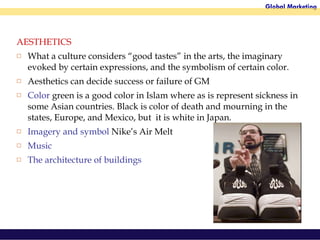
AESTHETICS What a culture considers “good tastes” in the arts, the imaginary evoked by certain expressions, and the symbolism of certain color.  Aesthetics can decide success or failure of GM Color  green is a good color in Islam where as is represent sickness in some Asian countries. Black is color of death and mourning in the states, Europe, and Mexico, but  it is white in Japan.  Imagery and symbol  Nike’s Air Melt Music The architecture of buildings
VALUES AND ATTITUDES Value  ideas, beliefs, and customs to which people are emotionally attached Singapore value hard work and material success whereas Greece value leisure and a modest lifestyle. UK and USA value individual freedom and Japan and Korea value group concensus Attitudes  positive or negative evaluations, feelings, and tendencies that individuals harbor toward objects or concepts. Reflect underlying value Attitude toward time Attitude toward work Attitude toward culture change
MANNERS AND CUSTOMS Manners  appropriate ways of behaving, speaking, and dressing in a culture In Arab culture, one does not extend a hand to greet an older person and does not use left hands. Doing business during meal is ok in the states but not in Mexico.  Customs  appropriate habits or behaviors in specific situations. Gift of knives is not appropriate in Russia, France, or Germany. In Japan, one is not supposed to open in front of gift giver.
SOCIAL STRUCTURE A culture’s fundamental organization, including its groups and institutions, its system of social positions and their relationships, and the process by which its resources are distributed Social group  family (nuclear vs. extended), gender Social status  results in different preference for a job.  Social mobility  the ease with which individuals can move up or down a culture’s social ladder. Caste systems vs. class systems.
PHYSICAL AND MATERIAL ENVIRONMENTS Physical environment Topography  all physical features that characterize the surface of a geographic regions. Scooters cannot be sold in mountainous regions  Korean cars do not need cruise control Climate Siesta in southern Europe Material culture All the technology used in a culture to manufacture goods and provide services Used to measure technological advancement of a nation’s market
Hofstede’s cultural dimensions Hall’s High vs. low context culture CLASSIFYING CULTURE
HOFSTEDE’S CULTURAL DIMENSIONS Individualism vs. Collectivism Self-perception as individual or part of a group Individualism  a loosely knit social framework in which people are supposed to take care of themselves and of their immediate families only Collectivism  people distinguish in-groups and out-groups and feel absolute loyalty to in-groups.  collectivist individualist In society, people are born into extended families or clans who protect them in exchange for loyalty. “ we” consciousness holds sway Identity is based in the social system There is emotional dependence of individuals on organizations and institutions The involvement with organizations is normal In society, everybody is supposed to take care of him/herself and his/her immediate family “ I” consciousness holds sway Identity is based in the individual There is emotional independence of individual form organizations or institutions The involvement with organization is calculative
Power distance The extant to which a society accepts the fact that power in institutions and organizations is distributed unequally Small power distance Large  power distance Inequality in society should be minimized All people should be interdependent Hierarchy means an inequality of roles, established for convenience Superiors consider subordinates to be “people like me” Subordinates considers superiors to be “people like me” Superiors are accessible The use of power should be legitimate and is subject to the judgment as to whether it is good or evil.  There should be an order of inequality in this world in which everybody has a rightful place; high and low are protected by this order A few people should be independent; most should be dependent Hierarchy means existential inequality Superiors consider subordinates to be a different kind of people Subordinates consider superiors as a different kind of people Superiors are inaccessible Power is a basic fact of society that antedates good or evil. Its legitimacy is irrelevant.
Uncertainty avoidance The extent to which a society feels threatened by uncertain and ambiguous situations and tries to avoid these situations by providing greater career stability, establishing more formal rules, not tolerating deviant ideas and behaviors, and believing in absolute truths and the attainment of expertise.  Weak uncertainty avoidance Strong uncertainty avoidance The uncertainty inherent in life is more easily accepted and each day is taken as it comes Ease and lower stress are experienced Time is free Hard work, as such, is not a virtue Aggressive behavior is frowned upon Less showing of emotions is preferred Conflict and competition can be contained on the level f fair play and used constructively The uncertainty inherent in life is felt as a continuous threat that must be fought Higher anxiety and stress and experienced Time is money There is an inner urge to work hard Aggressive behavior of self and others is accepted More showing of emotions is preferred Conflict and competition can unleash aggression and should therefore be avoided
Masculinity vs. femininity Masculinity  value assertiveness, the acquisition of money and things Femininity  value caring for others, the quality of life, or people.  feminine masculine Men needn’t be assertive, but can also assume nurturing roles Sex roles in society are more fluid There should e equality between the sexes Quality of life is important You work in order to live People and environment are important Interdependence is ideal Service provides the motivation One sympathizes with the unfortunate Small and slow are beautiful Men should be assertive. Women should be nurturing Sex roles in society are clearly differentiated Men should dominate in society Performance is what counts You live in order to work Money and things are important Independence is the ideal Ambition provides the drive One admires the successful achiever Big and fast are beautiful.
 
Hall’S CONTEXT FRAMEWORK Low-Context High-Context Information and meaning are explicitly stated in the message Individual “internalizes” meaning and information, so that less is explicitly stated Values Individualism Values Group Sense Values direct verbal interaction and is less able to read nonverbal expressions Values indirect verbal interaction and is more able to read nonverbal expressions Tends to use “logic” to present ideas Tends to use more “feeling” in expressions Tends to emphasize highly structured messages, give details, and place great stress on words Tends to give simple, ambiguous, non-contexting messages Emphasizes linear logic Emphasizes spiral logic
What you say is what you think  - “No, I really mean it…” Silent language’s role is LOW. What you say is not really what you think.  “As I am sure you understand,…” Read between the lines. A b c d e f g h i j k l m n o p A b c d e f g h i j k l m n o p A b c d e f g h i j k l m n o p W b x d y e Silent language’s role is HIGH.
ZER  DEFECTS CONFORMS TO STANDARDS & SPECIFICATIONS Luxury GERMANY : FRANCE : USA  : It  works.   JAPAN : Rapaille: What is “Quality”?
Political factors Dealing with host government Host government actions Political risk assessment Risk reduction strategies Legal factors Patents, trademarks, and copyrights Regulatory trends affecting global marketing POLITICAL AND LEGAL FACTORS
DEALING WITH HOST GOVERNMENT Political climate  stability influences business ex> freedom party in Austria in 2000 Governments Government actions are governed by a lot of reasons from political philosophy, pressure from interest group to self-interest.  Should understand the rationale behind the actions The major goals of government actions Self-preservation Security Prosperity Prestige Ideology Cultural identity POLITICAL FACTORS
Self-preservation Effort to keep sovereignty, which gives a nation complete control within a given geographic area. Branch office of global companies can be a threat because they are controlled or influenced by headquarters  Many countries limit foreign ownership of newspaper, television stations, and radio stations. The need for national security To the extent possible, each entity seeks to maximize the opportunity for continued existence and to minimize threats from the outside infrastructure and essential resources, utilities, the supply of crucial raw materials are usually protected.
Fostering national prosperity A key goal of government is to ensure the material prosperity of its citizens. Host country can favor local industry of foreign competitors for this goal by imposing tariffs or customs duties. Enhancing prestige Government can enhance prestige with many ways; supporting team sports or individual athlete, having a national airlines, or having a leading company.  They can encourage local companies at the expense of a foreign company.  Protecting cultural identity Governments often intervene to protect their country’s cultural identity Entertainment industry is the typical example
HOST GOVERNMENT ACTIONS Jawboning Informal intervention of governments Use this form to prevent an act that, though legal, is perceived to be contradictory to their self interest. “ buy local” restrictions Public sector and government prefer local companies as a supplier Nontariff barriers Used by government mostly to keep imports from freely entering the home market  Quotas and import restriction is the most common.
Subsidies Gifts that host governments dispense with the intention the overall benefits to the economy by far exceed such grants Used to encourage exports and to attract global companies to a certain country.  Operating conditions Host government can have a direct influence on the operations of a foreign subsidiary by imposing specific conditions on the company's operations Local content Local content restrictions means that some part of the manufacturing must be done in the host country.  Ownership conditions Some governments require local nationals become part owners of the foreign company.
Boycotts Politically motivated boycotts tend to be directed at companies of certain origin or companies that engaged in transactions with political enemies Takeovers Any host government –initiated actions that result in a loss of ownership or a loss of direct control by the foreign company. Expropriation  a formal or legal taking over of an operation with  the payment of compensation. Confiscation  expropriation without any compensation.  Domestication  the limiting of certain economic activities to local citizens.
Host government goals and policy actions actions goal Self-preservation security prosperity prestige Ideology Cultural identity Jawboning X X X X X X “ buy local” restrictions X X X Nontariff barriers X X Subsidies X X Operating restrictions X X X X Local content X Ownership conditions X X Boycotts X takerover X X X X
POLITICAL RISK ASSESSMENT Some companies develop risk assessment systems Public or semipublic sources regularly monitor political risk The Economist Intelligence Unit (EIU) The International Country Risk Guide
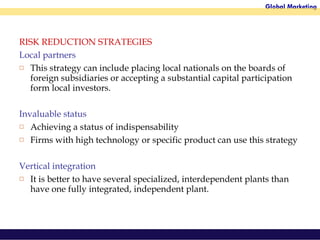
RISK REDUCTION STRATEGIES Local partners This strategy can include placing local nationals on the boards of foreign subsidiaries or accepting a substantial capital participation form local investors. Invaluable status Achieving a status of indispensability  Firms with high technology or specific product can use this strategy Vertical integration It is better to have several specialized, interdependent plants than have one fully integrated, independent plant.
Minimizing fixed investments Can lease the facilities or rely more on outside suppliers. Political risk insurance Both government and private offers the insurance Local borrowing Financing local operations from indigenous banks and maintaining high level of local accounts payable can help firms to be safe
PATENTS, TRADEMARKS, AND COPYRIGHTS Patents and trademarks are used to protect products, process, and symbols. They are issued by each individual country so marketers must register every product in every country in which they intend to trade. Counterfeit and piracy of software, entertainment, and fashion is increasing and  Strategies firms can use include (1) do nothing if the effect is minimal, (2) co-opt the distributors through acquisition or licensing, (3) educate customers about the value of the original product through advertising, (4) investigate and bring legal actions, (5) join coalitions like the International Ani-counterfeiting Coalition, which brings pressure on governments, (6) use advanced technology that are difficult to copy, and (7) continue to enhance the brand with new products, making it difficult for pirates to keep up.  LEGAL FACTORS
REGULATORY TRENDS AFFECTING GM Trade liberalization  more and more countries reduce local manufacturing requirements and tariffs.  Deregulation Many countries began to open up industries such as telecommunications, transportations, airlines, and banking.  Privatization Countries are selling government-owned agencies, organization, and companies to private stockholders or firms.
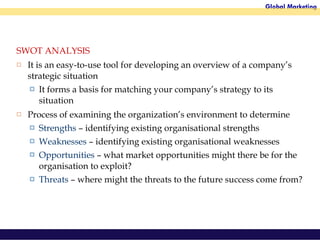
SWOT ANALYSIS It is an easy-to-use tool for developing an overview of a company’s strategic situation It forms a basis for matching your company’s strategy to its situation Process of examining the organization’s environment to determine Strengths  – identifying existing organisational strengths Weaknesses  – identifying existing organisational weaknesses Opportunities   – what market opportunities might there be for the organisation to exploit? Threats  – where might the threats to the future success come from?
EXTERNAL FACTORS Opportunity a chance for firm growth or progress due to a favorable juncture of circumstances in the business environment. Possible Opportunities: Emerging customer needs Quality Improvements Expanding global markets Threat a factor in your company’s external environment that poses a danger to its well-being. Possible Threats: New entry by competitors Changing demographics/shifting demand Emergence of cheaper technologies Regulatory requirements
INTERNAL FACTORS Strengths Positive tangible and intangible attributes, internal to an organization. They are within the organization’s control.  Weakness Factors that are within an organization’s control that detract from its ability to attain the core goal. Which areas might the organization improve?
SWOT MATRIX Internal Factors External Factors Strengths (list key strengths) Weaknesses (list key weaknesses) Opportunities (list key opportunities) SO Strategies: strategies that use strengths to take advantage of opportunities WO Strategies: strategies that alleviate weaknesses and take advantage of opportunities Threats (list key threats) ST Strategies: strategies that use strengths to overcome threats WT Strategies: strategies that alleviate weaknesses and overcome threats
Chapter 3 Understanding Local Customers CHAPTER OUTLINE local buyer behaviors The consumers’ decision process New brands at a local market
The Buyer Decision Process Problem/need recognition information search alternative evaluation purchase post-purchase behavior Seeking  Customers Meeting Customers Keeping Customers
Problem/Need Recognition A problem/Need is when an individual perceives a difference between an ideal and an actual state of affairs New products often lead to tension and a recognized “problem” Types of Needs Functional needs  needs for convenience and quality Social needs  need related to social status Experiential needs  related sensory desires and experience
Search A consumer’s search for alternative ways to solve the problem is closely related to his or her level of involvement with the product category For product with which involvement is high, search tends to be more comprehensive and time consuming For convenience and habit purchases, the decision process is shorter, with little need for extensive searches or alternative evaluations Search intensity is dependent on the perceived availability of the alternative One advantage for product with high global brand awareness is that initial distrust is easier to overcome
External Information Sources person publicity  Advertising S/P Sales  representative Word-of-Mouth Communication Mass media others firm media source
Evaluation of Alternatives When a new product or service is in the “ consideration set ”  A  highly involved  individual will process the available information matching the pros and cons of the alternatives against preferences Consumers can deal with  multi-attribute evaluations  in several ways: They can use gradually less-important features to successively screen out alternatives  A “hierarchical” decision rule ex> Lexicographic model They can consider all features simultaneously: A “compensatory” rule – hard to do. ex> Fishbein’s Mutli-attribute model
What is a Consideration set (or Evoked set)? The set of choices that are salient or kept in mind for purchase.    consumers are aware of a lot of brands in any given product category. However, not all brands are seriously considered for purchase. The consideration set is made up of the brands that are taken seriously by the consumer in his or her purchase decision. How many? Magic number 7 +/- 2(Miller 1956) Marketers’ objective is to  put their products into a consumer’s consideration set  and then  be a strong option in the set
STRATEGIES TO MANAGE CONSUMERS’ CONSIDERATION SET Using a part-list cuing effect When  a part-list is given, consumers actually remember less. ex> Avis “We are # 2. we work harder” campaign Give consumers  a   part-list of competitors  including you so to reduce the number of options in the consideration set
Using an Attraction Effect Inferior brand’s ability to increase the attractiveness of another alternatives Bread maker  $275 Bread maker  $350 add  a decoy brand  to make the  existing brand more attractive to consumers
Using a Compromise Effect Consumers tend to choose intermediate brands to reduce risks (expensive brands have high financial risk and cheap brands have high performance risk). \  165,620 \ 278,000 \  829,000 Make your brand as  a compromise brand  so to increase the chance of being chosen.
Using a Framing Effect presenting the same option in different formats can alter people's decisions. “ 75% lean meat”  “ 25% fat”  Frame your message with  a positive expression  (emphasize what consumers gain from the purchase).
Fishbein’s Multi-Attribute Model Consumers choose the brand on the base of  the importance of attributes and the evaluation of each attribute for specific brand.  Score = Sum (importance X evaluation) Lexicographic model The most common form that customers use Consumers consider the most important attributes first and choose the best evaluated brand on that attribute.
Cosmetic
Choice The final choice of which alternative to select or try is typically influenced by social norms and by situational factors Social Norms Where group pressures to comply are strong social norms influence is expected to override multiattributed evaluation  The social norms can be usefully analyzed by the extended Fishbein model The social norms involve two aspects Social forces Motivation to comply
OUTCOMES OF BUYER’S DECISION PROCESS The main question about the outcomes revolves around the degree of customer satisfaction. Customer satisfaction  is particularly important in  mature  markets where choices are many and the needs are already well met. Satisfaction engenders  loyalty  to the brand and to the company. Because buying is typically a risky choice between different brands, the marketer has to make sure that the customer does not encounter  cognitive dissonance , a sense of possibly making the wrong choice.
Expectation disconfirmation theory Customers satisfaction/dissatisfaction comes from the comparison between expectancy consumers have before purchase and the evaluation from the actual experience. Expectation Actual performance Gap Ex = PF : confirmation     Ex>PF : negative disconfirmation     Ex<PF: positive disconfirmation  
A strong brand simplifies the process Reduce information search Reduces perceived risk Places a brand in the evoked consideration set more easily Brand loyalty means decisions go fast
Chapter 4 Global Marketing Strategies CHAPTER OUTLINE Segmentation Targeting  Positioning
Segmentation criteria Segmentation and analysis on each segment Target market and marketing goals Competitiveness analysis and Positioning Positioning evaluation and repositioning S egmentation T argeting P ositioning STP STRATEGY
The typical way of approaching global marketing strategy is similar to the so-called S-T-P framework: Market segmentation Dividing a market into smaller groups of buyers with distinct needs, characteristics, or behaviors requiring separate products or marketing mixes. Target marketing Evaluating each segment’s attractiveness and selecting one or more to enter. Market positioning Setting the competitive positioning for the product and creating a detailed marketing mix.
SEGMENTATION It is impossible that one product satisfy every customer’s every need! Therefore, it is more efficient to provide a product which satisfies one need to a group of people with similar need Understand market Choose segmentation Method and criteria identify the  Characteristics of Each segment
No Market Segmentation
Segmentation by Sex
Segmentation by Age
Two stages of global segmentation It is common to distinguish two stages of global segmentation Macro-segmentation  the division of a number of countries into subgroups of more similar clusters Micro-segmentation   the identification of local segments which are similar across the countries in a cluster. The micro-segmentation techniques used in local marketing are also useful in global segmentation
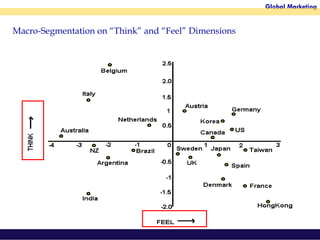
MACRO SEGMENTATION clustering of countries on the basis of common characteristics deemed to be important for marketing purposes, e.g. data on: Population size Population character Disposable income levels Educational background Primary languages Level of development Rate of growth in GNP Infrastructure Political affiliation
0 .9 .8 ,7 .6 .5 .4 .3 .2 .1 0 -.1 -.2 -.1 0 .1 .2 .3 .4 .5 .6 .7 .8 .9 1.0 • SOT •  UKI NOR • •  SWE •  DEN FIN• •  SWI •  AUS • NET • GER • NEZ •  BEL •  AUT •  COL •  CHI •  VEN •  SPA •  BRA •  PER •  MEX PUE • • FRA ITA• •  ARG PHI • •  THI •  ISR •  JAP •  MAC •  IND • PAK Factor VI  Religion TUR • Protestant Catholic Factor III Standard of  Living Macro-Segmentation on Standard of Living and Religion
Macro-Segmentation on “Think” and “Feel” Dimensions
TRADITIONALIST 18% HOMEBODY 14% RATIONALIST 23% PLEASURIST 17% STRIVER 15% TRENDSETTER 13% 6 PAN-EUROPEAN LIFESTYLE SEGMENTS Relative size of segments in percent, of the European Market, as developed by the RISC research agency Macro-Segmentation Based on Lifestyle
MICRO SEGMENTATION Major segmentation variables Geographic:  Region of country City or metro size Density or climate Demographic:  Age, gender, family size, family life cycle, income, occupation, education, race, religion, etc. The most common and easiest way of segmentation
Mattel’s Barbie Hasbro’s G. I. Joe
Psychographic:  Social class, Lifestyle (VALS, LOV, AIO), Personality Behavioral:  Occasion:  Benefits Sought User Status : non-users, light users, heavy users No single way to segment a market. May combine more than one variable to better define segments.
AIO 활동 activity 관심  interest 의견  opinion 일 취미 사회활동 휴가 오락 클럽회원활동 지역사회활동 쇼핑 스포츠 가족 가정 직업 지역사회 여가활동 유행 음식 대중매체 업적 자기자신에 대한 의견 사회적 이슈 정치 사업 경제 교육 상품 미래 문화
VALS  질문항목 예제 I am often interested in theories. I like outrageous people and things. 3. I like a lot of variety in my life. 4. I love to make things I can use everyday. 5. I follow the latest trends and fashions. 6. Just as the Bible says, the world literally was created in six days 7. I like being in charge of a group. 8. I like to learn about art, culture, and history. 9. I often crave excitement. 10. I am really interested only in a few things. 11. I would rather make something than buy it. 12. I dress more fashionably than most people.
 
Benefit Segmentation of the Snack Food Market Nutritional snakers Weight watchers Guilty snackers Party snackers Indiscriminate snackers Economical snackers % 22 14 9 15 15 18 Benefit sought Nutritious No artificial Low calorie Quick energy Good tasting  Low calorie Good to serve Goes well with beverage Good tasting Satisfies hunger Low price Best value Demographics Have young children Younger single females nonurban teens Larger families Psychographics controlled Outdoor High anxiety sociable hedonistic Price-oriented Consumption light light heavy average heavy Average Types of snack Fruits vegetable Yogurt vegetables Yogurt Cookies candy Nuts Chips pretzels Candy Ice cream cookies No specific
Segmentation by Personality Factors Type of drinker Personality type Drinking patterns Reparative drinker Sensitive and responsive to needs of others, adapts to these needs by sacrificing own aspirations, well adjusted to this situation Drinks at end of day, usually with a few close friends, controlled drinker, seldom drunk, drinking is self reward for sacrifices made to others. Social drinker Driven by own ambitions, attempts to manipulate others to get what he wants, not yet attained level of aspirations, but expects to. Drinks heaviest on weekends, in larger groups in social settings, drinks as menas of acceptance of and by others, controlled drinker Indulgent drinker Considers self a failure, bales environment and others Heavy drinker, drinks in isolation as a form of escape Oceanic drinker Considers self a failure but blames own shortcomings Also heavy drinker and drink to escape recognition of shortcoming, doesn’t drink alone
Requisites for segmentation Measurable & Accessible Actionable & Relevant Homogeneous within a segment  Heterogeneous between segments
TARGETING Targeting a market or country should be done strategically.  The factors to consider include market, competition, and interfirm factors.  The choice of target countries should also consider the tradeoff between focus and diversification. market competition interfirm market size potential product life cycle present competitors Future competitors Objective resources Competency
Fit to the firm Market size Competition  Day time user 직장인의 휴식 Low Small  High couple Low Big Extremely High Stay over Foreign tourist High Big Medium Local tourist High Small Medium 사교모임 ,  유흥 ,  취객 대상 High Small Medium Coffee shop Social purpose Low Big Extremely high Business purpose Low Medium Extremely High Sauna High Big High club regular Low Big Medium high Group users Low Big Medium high restaurant regular Low Big Extremely high Group users Low Big Extremely high Special occasion service  결혼식 ,  가족 모임 ,  사은회 ,  세미나 ,  연말 모임 등 Low Big Extremely high
규모 Group Tour 28% of foreign tourists Budget backpakers 26% of foreign tourists Business travles 43% of foreign tourists 특성 mostly Asians older people price sensitive younger people stay for a long time price insensitive mostly use business  hotels 자사와의 Fit high high 경쟁강도 Medium low 예상 비용 low low low high high
Diversification Strategy In developing a global strategy, some companies make a conscious effort to be a player in different countries and different market segments. Difficulties in one market segment or country can be offset by gains elsewhere. Focus Strategy Markets and segments can be given more attention and markets positions fortified.  This is particularly advantageous when the country or segment competitive rivalry is intense.
Diversification vs Focus
Integrated global business strategies
POSITIONING Product’s position is the way the product is defined by  consumers  on important attributes, or as the place the product occupies in consumers’ minds  relative to competing products. Perceptual position maps can help define a brand’s position relative to competitors. Unique positioning is achieved through differentiation Types of positioning Positioning by attributes: Reebok Image positioning Positioning by occasions: Kisses, Conditions  Positioning by users: Nike, Johnson’s baby lotion Positioning by competition: Hazzys, Bean Pole Repositioning: Johnson’s baby lotion, Arm & Hammer baking soda
Full positioning of the brand is called the brand’s  value proposition. Potential value propositions include: More for More providing the most upscale product or service and charge a higher price Ex> Ritz Carlton, Mont Blanc More for the Same Can attack competitors’ “more for more” strategies ex> Lexus vs. Mercedes Benz The Same for Less Sell the same product with less price Ex> amazon.com, Dell, Walmart Less for Much Less Meeting customers’ lower performance requirements at a much lower price ex> Southwest Airlines, Daiso More for Less The winning proposition but hard to achieve and sustain
Hypothetical Competitive Positioning Map for Selected Retailers
Healthy drink Ionic drink Female drink Sports drink Thirst quencher masculine Product Space Map(Positioning Map) A B I 1 C I 2 D sporty masculine Size of a circle  =market size healty feminine
American Soap Market scent weak moisturizing strong moisturizing weak scent strong 1 2 7 4 5 3 6 8 Tone Zest Dove Lux Dial Lifebuoy Lava Coast Phase 3 Safeguard
Korean Car Market 보수적 중장년층에 소구 고급 / 품위 실용적 현대적 스포티 청년층에 소구 EF 소나타 에쿠스 체어맨 오피러스 그랜져  XG 아토스 비스토 마티즈 라노스 리오 티뷰론 SM3 엑센트 BMW 매그너스 아반떼  XD SM5 라세티
Position Map -  Korean Actor
Chapter 5 Global Products and Services CHAPTER OUTLINE product life cycle  product standardization localization vs. adaptation strategic choices for new markets global service marketing global brand strategy
Place Mix Product Mix Price Mix Promotion  Mix Providing the best  price Providing the best product Providing accessibility  to target customers Provide product  information and  persuade customers
Augmented product concept Core benefit Formal product augmentation package brand style installation delivery payment methods warranty
Product Life Cycle Model (PLC)
sales cost profit MKT objectives product price low  High cost per customer Negative Awareness and trial basic product cost-plus  distribution selective distribution communication Increase awareness for early adopters and dealers Introduction stage
Rapid growth Cost per customers gets lower Profit increases Maximize market share product extensions, service, warranty Market penetration intensive distribution Increase awareness of mass market Growth stage sales cost profit MKT objectives product price distribution communication
The biggest lowest High profits Keep market share and maximize profit Diversify Brands and models competitive more intensive distribution Emphasize difference from your competitors Mature stage sales cost profit MKT objectives product price distribution communication
decreases lowest decreases milk the brand Remove weak items Keep or reduce price Select a few channels Keep hard-core loyal customers  Decline stage sales cost profit MKT objectives product price distribution communication
Diffusion of New Products
PRODUCT STANDARDIZATION Although there is increasing demand for local variety as economic growth takes place and as anti-globalization sentiment spreads, global products and brands are usually standardized in some ways. Global product examples Gillette razor blades Sony television sets Benetton sweaters Regional products and brands are unique to a particular trading region Honda’s European car model “Concerto” Mcdonalds’
Advantages of standardization Cost Reduction Improved Quality Enhanced Customer  Preference Global Customers Global Segments  Disadvantages of standardization Off-Target Lack of Uniqueness Vulnerability to Trade Barriers Strong Local Competitors
LOCALIZATION  Refers to the changes required for a product or service to function in a new country (ex: fax machines fitted with new types of telephone jacks for use in a foreign country). Localization avoids having potential customers reject a product outright. A standardized product still needs to be localized to function properly. ADAPTATION When products are changed to match customer tastes or preferences. Adaptation gives customers a positive reason for choosing a given product.
PREFER REJECT Line shows likelihood of Purchase Uniform Localized Adapted + - Uniform vs Adapted Product
Fully standardized Fully adapted Incremental manufacturing cost Combined costs Cost of lost sales Optimal Level of Standardization
What to standardize? 100% standardization is rare Usually starts with a  core product  as the foundation Various features are added, these may differ according to the country market Can also involve  modular design , where various features are packaged as modules, different assembly combinations in different markets Pitfalls of standardization Overstandardization: Standardization compromises the positioning strategy Narrow Vision: Goals should not be narrow and inflexible Rigid Implementation: Some flexibility in implementation needs to be retained by local units
EUROPE ASIA LATIN AMERICA NORTH AMERICA Honda City Honda Element Honda Fit Honda Stream Honda’s Non-Global Car Models
EUROPE ASIA LATIN AMERICA NORTH AMERICA Goodyear Eagle F1 Goodyear Eagle F1 Goodyear Eagle F1 Goodyear Eagle F1 Goodyear’s Globally Uniform Tires
STRATEGIC CHOICES FOR A NEW MARKET Strategy one: product extension-communication extension Marketing a standardized product with the same communication strategy around the world.  The most cost effective  Not feasible for all kinds of products Strategy two: product extension-communications adaptations Marketing a standardized product with a different communication strategy in each country Can use when the sociocultural event surrounding the product differs by country but the use conditions are identical
Strategy three: product adaptation-communication extension Marketing an adapted product with the same communication strategy Used when adaptation of the product is unavoidable Sometimes product formulation can be changed without the customer knowing it.  Strategy four: product adaptation – communication adaptation  Marketing an adapted product with different communication strategy in each country Because this strategy cost a lot, each market has to be of sufficient volume to succeed Strategy five: product invention Usually used when consumers cannot afford the product Typically redesign original product for a lower level of complexity to gain low price
Accounting Advertising Banking Broadcasting Computer services Consulting Data processing Design & engineering Distribution Education Entertainment Health care Insurance Investment banking Leasing Legal Services Lodging Media Reservation systems Restaurants Tourism Telecommunications Transportation Utilities SERVICE INDUSTRIES
Services are different from products in following characteristics Intangibility  you cannot easily touch a service Heterogeneity  the service is not exactly the same each time Inseparability   services are produced when they are consumed Perishability  you cannot store a service
The Service “Product” Core service is what the customer is really buying. For example, an oil change and tune-up for your car provides trouble-free operation Formal service package specifics services offered to the customers including price, service features, the packaging, and guarantees Augmented service: the totality of the benefits a customer receives or experiences they have when buying the product.  Generic benefits Provider’s behavior Physical surroundings Provider’s  appearance Brand image Features Quality Packaging After-sales support Price Warranty Core  service Formal service package Augmented service
Three factors that influence the globalization potential of services Stage in the Life Cycle  – potential is highest during the maturity stage because then the service is fully developed and can be blueprinted. Infrastructure barriers  – service applicability depends on availability of infrastructure, as when, for example, warehouse stores require customers to take home large items in their own cars. Idiosyncratic Home Markets  – special regulations induce domestic service providers to develop practices that are not applicable elsewhere, as when, for example, advertising agencies in Japan produce television programs whose sponsorship the agency controls.
Service quality Desired Service   highest or ideal quality Predicted or Expected Service   lies somewhere between the desired & the adequate service Adequate Service   forms the lower limit below which the service quality is unacceptable Perceived Service  must lie between the desired & the adequate service levels to make sure customer is satisfied
Desired Service Predicted/Expected Service Adequate Service (Perceived Service low) Surprise Acceptable Dissatisfaction Zone of tolerance Performance Gap Service Quality: The Gap and the Zone of Tolerance (Perceived Service high) Inadequate Service
SERVQUAL - the dimensions of service quality Reliability  ability to perform the promised service dependably and accurately Assurance   Knowledge and courtesy of employees and their ability to convey trust and confidence (Competence, courtesy, credibility and security of the service) Tangibles  Appearance of physical facilities, equipment, personnel, and communication materials Empathy  Caring, individualized attention the firm provides its customers (Access to organization’s representatives, communication and understanding the customer) Responsiveness  Willingness to help customers and provide prompt service
Culture and service quality Since services are intangible, service quality is more difficult to quantify, allowing for a more subjective view Different cultures have different habits and preferences and therefore different definitions of service quality So culture affects perceived service quality & customer satisfaction strongly  And what is considered high service quality in one country is not necessarily high in another country ex>  France: quality = luxury  German: quality = conforms to the standard and specification Japan = zero defect USA = working well
Asking Listening Japanese Americans Expressing doubt Expressing sympathy Explain what cannot be done Explain what can be done Defending company policy Apologize for company policy Responsibility of the buyer Responsibility of the seller “ We’ll fix it, but…” “ I’m very sorry” Low customer satisfaction High customer satisfaction Personal Service Quality: Differences in Complaint Handling
BRANDS are symbols associated with a product or service that identifies legally the maker of the product. Brands are copyrighted and are then legally protected. The copyright needs to be registered in each country where the brand is sold for the protection to hold. As a competitive advantage, a strong brand can be a sustainable advantage – but needs forceful enforcement against piracy and imitators. BRAND STRATEGY
The concept of a “brand” has been extended beyond the domain of products and services; Brands are now used for entertainment celebrities,  sports teams and stars,  art institutions  and even places and nations. The country-of-origin factor is a reflection of the nation’s brand equity.
Dimensions of nations as brands Culture & Heritage, Exports  Governance  Immigration & Investment  People  and Tourism     The six dimensions together define the national brand as perceived in the world.
 
 
Why brands are important Products are increasingly standardized. “ Benchmarking” means competitors monitor each others’ products. Imitative targeting of new product development makes product differentiation difficult to sustain. Customers learn that quality and features are comparable across competitors. End result: One of the few sustainable competitive advantages is the brand.
Branding Strategies To brand or not to brand? - ‘generic brand’ Manufacturer brand vs. Dealer brand - ‘private brand (PB)’ Individual brand vs. Family brand - ‘brand extension’ - same brand name for different product categories (ex)  풀무원 ,  식물나라 , Arm & Hammer - advantage: minimize launching cost - disadvantage: failure affects other brands   (ex)  샘표 캔커피 , Bic stockings, Levi Tailored classic
Private Brands
GLOBAL BRANDS Brands associated with global products which are well known in all major markets of the world Ex> Sony, Mercedes-Benz REGIONAL BRANDS  Brands which are uniform across a region  Ex> P&G’s Pert in N America, Vidale Sassoon in Asia, Acura is Honda Legend in Asia LOCAL BRANDS  Brands found in only one or two markets Ex> Jever Pilsener in Germany, Fortnum & Mason in the U. K. A &W Rootbeer in the Us. And Pocari Sweat in Japan and Korea The typical multination firm has a “portfolio” of brands, some of which are global, some are regional, and some local only.
Typical Global Brand Portfolios
Global brand equity Customer Brand Equity is the value of the positive associations that consumers have with a product’s brand name. These associations often involve emotional attachments, affinity, positive brand image, and brand identity. They also involve cognitive factors such as familiarity, knowledge and perceived quality, as well as social factors including peer group acceptance. When these associations turn negative (as in anti-globalization sentiments against global brands) the brand equity can go down very quickly.
Financial brand equity the monetary value of a brand in terms of net revenues the brand is expected to generate over time, across all country markets. Financial brand equity is sometimes called “hard equity” – while customer brand equity is “soft” equity. For “hard equity” global reach of the brand matters more, since the value is computed as a sum across markets and segments. For “soft equity”, affinity to the individual consumer matters more.
Advantage of global brands Demand spillover  The name is familiar because of media spillover, satellite communications, word-of-mouth etc.  Global customers  People travel to many countries and multinational customers  operate in many locations, making the global brand a natural choice everywhere.  Scale economies  any spending on product improvements and advertising can be leveraged across more markets. Disadvantage of global brands Negative spillover  Bad news travel faster across country markets Product line spillover  Negative spillover affects also other products with the same brand name.  Brand loyalty  Local brand loyalties can be strong.
Role of brands: cultural differences JAPAN US EUROPE  IMAGE RISK REDUCTION RECOGNITION/ENVY “ FEEL GOOD” TIME SAVER ACHIEVEMENT EMOTIONAL PEER DOMINATION HIGH ASPIRATIONS “ BELONGING” DISTINCT PEER RECOGNITION   INDIVIDUAL _________________________ ________________________   ______________________ “ VALUE ADDED” AFFECT CONVENIENT AND SURE   CALCULATED SOCIAL    VALUE __________________________ ________________________   ______________________ DEFINES THE GROUP IDENTIFIES THE INDIVIDUAL   HIGH-LOW STATUS
Chapter 6 Global Communication Strategies CHAPTER OUTLINE Advertising strategies Sales force strategies Sales promotion strategies
One of 4 “p’s” Major objectives to convey and persuade customers that the product’s differentiated value compared to the competing products Promotion Strategies
Advertising Global Marketing Communication Sales  Promotion Public  Relations Personal Selling Sponsorship Marketing Promotional Mix – Integrated Marketing Communication
Message Decisions Target  Audience Media Budget Strategy Objectives Communication Decisions
Product Characteristics Stage in product life cycle Target market characteristics Type of buying decision Available funds Push & pull strategies Factors influencing Promotional Mix
Corporate level advertising - Corporate Identity Program Product level advertising - pioneering (informative) advertising Telling the market about a new product / suggesting new uses for a product/ explaining how the product works - competitive (persuasive) advertising Building brand preference / encouraging switching to your brand - reminder advertising Keeping the product in customers’ minds during off-seasons /    maintaining top-of-mind product awareness Advertising
 
Ad appeals Informational appeal Aims at fulfilling functional needs Aims at fulfilling social/ experiential needs Emotional/experiential appeal testimonials comparative ads two-sides slice of life price-oriented teasers lifestyle patriotic appeals dramatic appeal to fear, sex, or humor
Teaser Campaign
Image ads
Humanity appeals 삼성  기업광고
Patriotic ads
Fantasy ads
Dramatization
Humor ads
Fear appeals
Sex appeals
Testimonial 저도 미용실 가서 몇 시간씩 트리트먼트  받고 싶고 그렇거든요 .  시간도 만만치 않고… 몇 분만 해주어도 미용실 가서 영양팩  받은 느낌이에요 . Pantene                                                                             
Comparative ads http://www.dailymotion.com/video/xogii_pub-pepsi-vs-coca-cola_ads
Two-sided
Slice of Life LG Maestro P&G Fabreeze
ELM: Elaboration Likelihood Model Petty & Cacioppo 1980s Advertisement Involved? Able? Central Route Peripheral Route Yes No Peripheral Cues: - endorsement - repetition - emotional appeals Central Cues: - cognitive appeals - focus on message
Peripheral Route Evaluation cues used by consumers extrinsic cues  Brand name Country-of-origin situational variables models Delivery methods
Model effects Source Credibility Credible models are more persuasive credibility = expertise + trustworthiness How to increase credibility Adopt expert as a model Build intimate relationship with viewers Argument that contradicts the firm’s immediate gains ex> Don’t eat fast food campaign by French McDonald’s    Breast feed campaign by Nestle
Source Attractiveness Physical attractiveness of the model influence the persuasion positively.  ex> Nixon vs. Kennedy Similarity The similarity between a model and a viewer influence the persuasion positively.
The Effects of Delivery Methods The number of argument The more argument, the more persuasive Repetition  Repetition increases focus, understanding, and memory whereas decreases persuasion mere exposure effect vs. advertising wear-out Substantive variation, cosmetic variation can prevent the wearout effects Ex>  SK Telecom  현대 생활 백서 .  삼양라면 . Empas.
Medium Newspaper T.V. D.M. Radio Magazine Outdoor Advantage Flexible, Timely, Local  market Disadvantage Short life Few “pass-along” Good attention Wide reach Expensive Fleeting exposure Expensive “ Junk mail” image Audio only Fleeting exposure Long lead time No audience selectivity Very short exposure Audience selectivity Personalization Wide reach Low cost Audience selectivity Long life and “pass-along” Repeat exposure Low cost Advertising Medium
Global advertising  Media advertising that is more or less uniform across many countries, often, but not necessarily, in media vehicles with global reach Advantages Consistency of brand communications Media spill over Cost savings Improved production Leveraging a great idea Disadvantages Images and symbols might not be locally acceptable Appropriate media might not be available Product usage is not the same Local creativity is stifled
Global Ad categories IDENTICAL ADS  ads are identical, usually with localization only in terms of language voice-over changes & simple copy translations  PROTOTYPE ADVERTISING  the same ads, but the voice-over may be changed to avoid language & cultural problems, & the ad may be re-shot with local celebrities  PATTERN STANDARDIZATION  similar but less structured global approach, wherein the positioning theme is unified & some alternative creative concepts are planned, but execution differs between markets
Brand Name same Theme same Visual same Positioning same Actors same Words same Language (local) Media same Materials same Slogan same Brand Name same Theme same Visual same Positioning same Actors not same Words not same Language (local) Media not same Materials not all same Slogan same PROTOTYPE ADVERTISING PATTERN STANDARDIZATION
VISUAL PROCESSING Low literacy Younger Segments Low Involvement products High context societies VERBAL PROCESSING High Literacy Older segments High involvement products Low context societies TV commercials   Magazines    Newspapers  Radio Ads Cultures and Visual vs Verbal Processing
Personal Selling Two-way, personal communication between salespeople and individual customers The most efficient but most expensive promotion method. Common for industrial goods. Salesperson- an individual acting for a company by performing one or more of the following activities: prospecting, communicating, servicing, and information gathering.  Steps in the selling process Prospecting and qualifying preapproach approach Presentation and demonstration Handling objections closing Follow-up
Global Personal Selling Culture affects the “people skill’s of the global marketer Differing human relations -  e.g. the role of a salesperson is looked down on by hierarchical cultures Degree of market development -  e.g. level of customer sophistication Differing regulatory environments -  e.g. salesperson costs escalate in countries where fringe benefits are high Geographic and physical dimensions  - e.g. climate, transportation conditions, population density Good salesmanship varies across countries Personal selling is usually the least global of all marketing activities
Sales Promotions Short-term incentives to encourage the purchase or sale of a product or service Whereas advertising offers reasons to buy a product, sales promotion offers reasons to buy now.  Types: consumer promotions, business promotions, trade promotions, sales force promotions
Types of consumer promotions Coupon : certificate that gives buyers a saving when they purchase a specified product Sample: a small amount of a product offered to consumers for trial Cash refund offer : offer to refund part of the purchase price of a product to consumers who send a “proof of purchase” to the manufacturers Price pack (cents-off deal): reduced price that is marked by the producer directly on the label or package Premium: good offered either free or at low cost as an incentive to buy a product Point-of-purchase (POP) : display and demonstration that takes place at the point of purchase or sale
Activities related to forming and managing images. – seek for understanding and acceptance from viewers. Include both internal and external activities Internal activities Provide information through Internal publications (e.g. newsletters and intranets) Manage corporate culture External activities Manage global identity Provide information to consumers and stakeholders.  Crisis management Public Relations (PR)
Sponsorship marketing Event marketing : sponsors events such as sports and culture. ex> mecenat  Cause related marketing : sponsors a specific cause
Chapter 7 Global Pricing Strategies CHAPTER OUTLINE Pricing processes Types of pricing strategies
Identify pricing objectives Forecast demand Forecast cost Analyze competitors’ price Set the pricing strategies Process of Setting Up Pricing Strategies
Survival set the price to barely compensate the cost Short-term strategy to avoid  exit from the market Maximize profits Skimming pricing Maximize sales Usually achieved through low price Market penetration pricing PRICING OBJECTIVES
Things to consider:  unique value Customers' awareness of substitutes difficult to compare alternatives price relative to income inventory effect Things to consider:  cost structure at different levels of production experience curves FORECAST DEMAND FORECAST COST
Cost Consumer Demand Competition Standards for pricing strategies: 3Cs
Cost based pricing strategies Cost plus, markup pricing Target return investment: achieve target ROI through breakeven analysis Customer-based pricing strategies Perceived value : ex> PSM Yield maximization pricing: different price for different market Ex> online vs. offline.
Skimming Pricing - High price    low  price - aim to maximize short-term profit - High-end market /Early market - high demand, low competition Penetration Pricing - low price    high price - aim to maximize short-term sales - Med/low-end market / majority market   - low demand, high  competition Competition-based pricing
Unit sales Time in local market Profitability Time in local market Penetration price Penetration price Skimming price Skimming price Skimming vs. Penetration Pricing
PSM Model Overview A method to set the price according to what customers perceive the quality of the product.  Easy to handle.  Outcome from the model Price Indifference Point Optimal Pricing Point Range of Acceptable prices
The Questions Cheap At what price on the scale would you consider the product or service to be cheap? 상품의 가격이 어느 정도면 적당히 싸다고 생각하십니까 ? Expensive At what price on the scale would you consider the product or service to be expensive? 상품의 가격이 어느 정도면 비싸지만 이용해볼 만하다고 생각하십니까 ? Too Expensive At what price would you consider the product or service to be so expensive that it is beyond considering buying? 상품의 가격이 어느 정도면 아무리 품질이 좋아도 너무 비싸서 이용하지 않겠다고 생각하십니까 ? Too Cheap At what price do you consider the product or service to be so cheap that you would question the quality? 상품의 가격이 어느 정도면 품질이 의심스러울 만큼 싸서 이용하지 않겠다고 생각하십니까 ?
Define Product Establish Baseline Price Range Survey 4 Questions Plot Cumulative Frequency Indifference Price Optimal Price Point Range of Acceptable Prices Process
Plotting Cumulative Frequency Cheap Descending: Expensive Ascending Too Expensive Ascending Too Cheap Descending
Indifference Point Price at which an equal number of respondents feel it is Cheap and Expensive. Reverse ‘Cheap” & “Expensive” to get “Not Cheap”  & “ Not Expensive” Because respondents can not relate to “Not Cheap”; but can related to “Cheap” and reverse is “Not Cheap”
Optimal Price
Acceptable Prices Range (APR) Point of Marginal Cheapness Point of Marginal Expensiveness
Chapter 8 Global Distribution Strategies CHAPTER OUTLINE Distribution objectives and functions Distribution structure
Distributive Objectives Minimize total distribution costs for a given service output Determine the target segments and the best channels for each segment Objectives may vary with product characteristics e.g. perishables, bulky products, non-standard items, products    requiring installation & maintenance
Distribution channel functions Information : gathering and distributing marketing research and intelligence information Promotion: developing and spreading persuasive communications about an offer Contact: finding and communicating with prospective buyers Matching: shaping and fitting the offer to the buyer’s needs Negotiation: reaching an agreement on price and other terms of the offer so that ownership or possession can be transferred Physical distribution: transporting and storing goods Financing: acquiring and using funds to cover the costs of the channel work Risk taking: assuming the risks of carrying out the channel work
Number of Channel Levels manufacturer consumer manufacturer consumer manufacturer consumer manufacturer consumer retailer retailer retailer wholesaler wholesaler jobber Direct channels : has no intermediary levels Indirect channels channel strategies are decided by  cost  (efficiency) and  control  (effectiveness)
Vertical Marketing Systems Conventional distribution channels : a channel of one or more independent producers, wholesalers, and retailers, each a separate business seeking to maximize its own profits even at the expense of profits for the system as a whole Vertical marketing systems: a distribution channel structure in which producers, wholesalers, and retailers act as a unified system. One channel member owns the others, has contracts with them, or has so much power that they all corporate.
Type Corporate VMS A vertical marketing system that combines successive stages of production and distribution under single ownership-channel leadership is established through common ownership Contractual VMS A vertical marketing system in which independent firms at different levels of production and distribution join together through contracts to obtain more economies or sale impact than they could achieve alone Wholesaler-sponsored voluntary channels Retailer corporatives Franchise organizations
Horizontal Marketing Systems A channel arrangement in which two or more companies at one level join together to follow a new marketing opportunities E.g. Nestle jointly sells General Mills cereal brands in markets    outside North America.  Hybrid Marketing Systems Multichannel distribution system in which a single firm sets up two or more marketing channels to reach one or more customer segments
Exclusive Distribution Giving a limited number of dealers the exclusive rights to distribute the company’s products in their territories E.g. New automobiles and prestige women’s clothing Intensive distribution Stocking the product in as many outlets as possible E.g. For everyday life products Selective distribution The use of more than one, but fewer than all, of the intermediaries who are willing to carry the company’s products E.g. home appliances Numbers of marketing intermediaries
Types of retailers Specialty Store Department Store Supermarket Convenient Store Discount Store MWC (Membership Warehouse Club) Category Killer Factory Outlet Telemarketer – Homeshopping Channel Internet Shop

Global Marketing KIC

  • 1.
    Chapter 1 Introductionto Global Marketing CHAPTER OUTLINE The development of GM GM: what it is and what it isn’t Importance of GM Reasons for GM Key to global success Global industries The biggest issue in GM Strategic orientation of GM
  • 2.
    Domestic marketingExport marketing International marketing Multinational marketing Global Marketing THE DEVELOPMENT OF GM
  • 3.
    DOMESTIC MARKETING Marketingthat is aimed at a single market (firm’s domestic market). Firms face only one set of competitive, economic, and market issues. EXPORT MARKETING When a firm market its products outside its main base of operation and when products are physically shipped from one market to another. Domestic market remains of primary importance. Major challenge the selection of appropriate markets through marketing research, determination of appropriate product modifications to meet the requirements of exporting market, and development of export channels.
  • 4.
    INTERNATIONAL MARKETING Muchmore directly involved in the local marketing environment Is likely to have sales subsidiaries Necessary adaptations to the firm’s domestic marketing strategy Participate in and develop entire marketing strategies for foreign market Major challenge the need to understand the different environments. MULTINATIONAL MARKETING The result of development of multinational corporation. Maximum amount of localization MNCs operate in several foreign countries as if the firms were local companies Multidomestic strategy each strategy is tailored to a particular local market Major challenge to find the best possible adaptation of a complete marketing strategy for an individual country.
  • 5.
    GLOBAL MARKETING Opportunitiesfor economies of scale and enhanced competitiveness will be greater if marketing strategies are integrated into a global scale Global marketing strategy a single strategy for a product, service or company for the entire global market Rather than tailor a strategy perfectly to an individual market, the company settles on one general strategy that can be applied throughout the world while at the same time maintaining flexibility to adapt to local market if necessary. Major challenge design marketing strategies that work well across multiple markets
  • 6.
    Single country (domestic)marketing Dual country (Export) marketing Multicountry marketing Global marketing
  • 7.
    Single Country MarketingStrategy Target market strategy Marketing mix Product Price Promotion Place Global Marketing Strategy Global market participation Marketing mix development 4 P’s: adapt or standardize? Concentration of marketing activities Coordination of marketing activities Integration of competitive moves GM : WHAT IT IS AND WHAT IT ISN’T
  • 8.
    Strategy development comesdown to two main issues similar to single country marketing Target market Marketing Mix Global marketing does not mean doing business in all of the 200-plus country markets Global marketing does mean widening business horizons to encompass the world in scanning for opportunity and threat
  • 9.
    For US-based companies,75% of sales potential is outside the US. About 90% of Coca-Cola ’ s operating income is generated outside the US. For Japanese companies, 85% of potential is outside Japan. For German and EU companies, 94% of potential is outside Germany. IMPORTANCE OF GM
  • 10.
    Growth Accessto new markets and access to resources Survival Against competitors with lower costs (due to increased access to resources) – e.g. India and China Or push (reactive) and pull (proactive) factors REASONS FOR GM
  • 11.
    PROACTIVE MOTIVES 1. Profit and growth goals Firms can grow from internationalization experiences from the profitability of export affect the company ’ s attitude towards growing by the means of export (especially when you start to internationalize the perceptions about profitability may be far away form reality) 2. Managerial urge the desire of management towards global marketing activities is often simply a reflection of general entrepreneurial motivation - desire for continuous growth managerial attitudes play a critical role in determining the exporting activities of the firm these decisions are affected by the international background of the managers - those who have more international experiences are more internationally minded
  • 12.
    3. Technology competence/ unique product If a company produces goods or services which are unique, a competence edge exists which can result in major business success abroad one issue is how long such an advantage will continue? 4. Foreign market opportunities market opportunities act as stimuli only if the firm has or is capable of securing resources necessary to respond to the opportunities in general decision makers are considering only a rather limited number of foreign market opportunities in planning their foreign market entry the market opportunities of similar overseas markets are explored first
  • 13.
    5. Economies ofscale the benefits of decreasing production costs / unit by increasing production has increased the interest of firms to penetrate to foreign markets to search for this advantage 6. Tax benefits
  • 14.
    REACTIVE MOTIVES 1.competitive pressures a firm may fear losing domestic market share to competing firms that have benefited from economies of scale gained by global marketing activities further, it may fear losing foreign markets permanently to domestic competitors that decide to focus on these markets. Competitors are an important external factor stimulating internationalization (Coca-Cola & Pepsi) 2.Domestic market: small and saturated A company may be pushed into exporting because of a small home market potential. If domestic markets are unable to provide sufficient economies of scale, export markets are automatically included in their market entry srategy. A saturated domestic market has a similar effect (car manufacturers in USA)
  • 15.
    3. Overproduction /excess capacity If domestic sales are below expectations  inventory can be above desired levels  with short-term price cudts export is started. When domestic markets are normal, global marketing activities may be terminated (Canadian paper and pulp producers). 4. Unsolicited foreign orders Many small companies have become aware of export market opportunities by accident (advertising, exhibition etc.)
  • 16.
    5. Extend salesof seasonal products seasonality in demand conditions may be different in domestic market from other international markets this can act as a stimulus for example to market skiing shoes to New Zealand during summer or harvesting machines to Argentina during winter. 6. Proximity to international customers / psychological distance German firms established near Austrian border may not even perceive their marketing to Austria to be international the same situation in Europe exists between Germany and parts of Switzerland, France, and parts of Belgium, Sweden and parts of Finland, Netherlands and parts of Belgium Between USA and Canada (partly with Mexico)
  • 17.
    Value creation Competitiveadvantage Focus KEY TO GLOBAL SUCCESS
  • 18.
    VALUE CREATION Value= Benefits/Price Price is a function of money, time, and effort Benefits result from the product, promotion, and distribution 2 methods of value creation Improved benefits Lower prices
  • 19.
    COMPETITIVE ADVANTAGE Anadvantage over competitors gained by offering consumers greater value, either by means of lower prices or by providing greater benefits and service that justifies higher prices. occurs when an organization acquires or develops an attribute or combination of attributes that allows it to outperform its competitors These attributes can include access to natural resources, access to highly trained and skilled personnel human resources, and new technologies such as robotics and information technology A firm is said to have a competitive advantage when it is implementing a value creating strategy not simultaneously being implemented by any current or potential player
  • 20.
    FOCUS Concentration andattention on core business and competence Nestle is focused: We are food and beverages. We are not running bicycle shops. Even in food we are not in all fields. There are certain areas we do not touch…..We have no soft drinks because I have said we will either buy Coca-Cola or we leave it alone. This is focus. - Helmut Maucher
  • 21.
    STANDARDIZATION VS. ADOPTATIONGlobalization (standardization) Developing standardized products marketed worldwide with a standardized marketing mix Essence of mass marketing Global localization (adaptation) Mixing standardization and customization in a way that minimizes costs while maximizing satisfaction Essence of segmentation Think globally, act locally THE BIGGEST ISSUE IN GM
  • 22.
    Arabic read rightto left Chinese “ delicious/happiness” The faces of Coca-Cola around the world
  • 23.
    Marketing Mix Element Standardization Localized Product Promotion Place Price Big Mac Brand name Advertising slogan “I’m Loving It” Free-standing Big Mac is $3.10 in U.S. and Turkey McAloo Tikka potato burger (India) Slang ’Macca’s (Australia) MakDo (Philippines) McJoy magazine, “Hawaii Surfing Hula” promotion (Japan) Home delivery (India) Swiss rail system dining cars $5.21 (Switzerland) $1.31(China) McDONALD ’ S GLOBAL MARKETING
  • 24.
    FACTORS LIMITING STANDARDIZATIONMarket characteristics: Physical environmental condition climate cars in Canada. product use conditions cars in the states population decide market size macroeconomic income level. McDonald’s in China cultural and social Wal-Mart and Nokia in Korea Language Nova in Mexico, Starbucks in 인사동 Industry conditions stages of product life cycle the level of local competition
  • 25.
    Marketing infrastructure practicesin distribution systems availability of outlets the number of malls, department stores, and supermarket accessibility of advertising agencies and media Regulatory environment product standards tariffs and taxes result in different price specific restrictions mention of competitors’ name (Europe vs. the States) patent law pharmaceutical drugs in Indonesia and India
  • 26.
    Concept EPRG SchemaSTRATEGIC ORIENTATION OF GM Domestic market extension Ethnocentric Multi-domestic market polycentric Global marketing Regio/geocentric attitude or state of mind of management influence all decision regarding strategies
  • 27.
    ETHNOCENTRIC ORIENTATION Homecountry is superior to others Sees only similarities in other countries Assumes products and practices that succeed at home will be successful everywhere Leads to a standardized or extension approach POLYCENTRIC ORIENTATION Each country is unique Each subsidiary develops its own unique business and marketing strategies Often referred to as multinational Leads to a localized or adaptation approach that assumes products must be adapted to local market conditions
  • 28.
    REGIOCENTRIC ORIENTATION Aregion is the relevant geographic unit Ex: The NAFTA or European Union market Some companies serve markets throughout the world but on a regional basis Ex: General Motors have four groups for four regions – GMAP, GME, GMLAAM, GMNA GEOCENTRIC ORIENTATION Entire world is a potential market Strives for integrated global strategies Also known as a global or transnational company Retains an association with the headquarters country Pursues serving world markets from a single country or sources globally to focus on select country markets Leads to a combination of extension and adaptation elements
  • 29.
    Chapter 2 GlobalMarketing Environment CHAPTER OUTLINE Global economic factors Cultural and social factors Political factors
  • 30.
    Uncontrollable factors thataffect global marketing: the global economy the cultural and social forces Political and legal forces GLOBAL ENVIRONMENT FACTORS
  • 31.
    Components of economicfactors International agencies promoting international trade Trade barriers Protection from protectionism ECONOMIC FACTORS
  • 32.
    ECONOMIC FACTORS Stageof Economic Development Developed Countries: Mixed economies (Ex: U.S., Japan, Canada, & Western Europe) Developing Countries: Usually moving towards an industrialized economy (Ex: Hungary, South Africa, & Pakistan) Economic Infrastructure Economic infrastructure is a country’s communication, transportation, financial, & distribution systems. Critical for determining how, where, & to whom to market. Coke example in India
  • 33.
    Consumer Income andPurchasing Power Marketers must consider the average household incomes of the consumers. Currency Exchange Rates
  • 34.
    How purchasing power differs around the world
  • 35.
    TRADE BARRIERS TariffsTaxes on goods moving across an economic or political boundary Can be imposed on imports, export, or goods in trasit. Import tariffs are the most common Raise the price of imported goods and thereby protect domestic industries from foreign competition Generate tax revenues for the government Quotas Physical limits on the amount of goods that can be imported into a country. Screen quotas in Korean movie industry
  • 36.
    Orderly marketing arrangementand voluntary export restrictions Agreement between countries to share markets by limiting foreign export sales Nontariff barriers Include a wide range of charges, requirements, and restrictions such as surcharges at border crossings, licencing regulations, performance requirements, government subsidies, health and safety regulation, packaging and labeling regulations, and size and weight requirements. French ban on the advertising bourbons and Scotch, but not on cognac A French tax on car horsepower – target American cars or environmental issue?
  • 37.
    Definition of cultureComponents of culture Classifying the culture CULTURAL AND SOCIAL FACTORS
  • 38.
    CULTURAL AND SOCIALFACTORS Definitions A learned set of ideals, values, and standards that is shared by members of a society Basic characteristics A culture is shared within a society, a defined group of people who depend on each other for survival. Culture is learned Culture is based on symbols, the most important symbols being language. Culture is integrated: all aspects of culture function as a coordinated whole. Individual culture do not produce uniform behavior for all members: there are subcultures like gender.
  • 39.
    COMPONENTS OF CULTUREaesthetics religion education Personal communication Values and attitude Social structure Manners And customs culture Physical And Material environment
  • 40.
    CULTURAL INFLUENCES ONMARKETING Religions, history, Family, language, Arts/entertainment, education Symbols, morals, Rules of behavior, knowledge Selecting and Prioritizing wants For goods And services behaviors Cultural forces Cultural messages Consumer Decision process
  • 41.
    PERSONAL COMMUNICATION Spokenlanguages Advertising slogans and company document must be translated carefully so that messages are received precisely as intended. Language blunders: GM’s chevy Nova. SK. The feel of the sound: Pocari sweat in Japan Body language George Bush’s V in Australia Personal space Mexicans are closer than Anglo-Saxons.
  • 42.
  • 43.
    RELIGION Many businesspeopleignore the influence but it has profound impact on people Christianity: world’s largest religion Christmas in the States vs. St. Nicolas day in Holland vs. little Christmas in France Christian group boycotting Walt Disney's film Islam: second largest religion Islam prohibits alcohol and pork. German candy maker “haribo” produced pork-free gummi bear
  • 44.
    EDUCATION Can havea major impact on how receptive consumers are to foreign marketing techniques. Education shapes people’s outlook, desires, and motivation. The type of employees and executive talent European education emphasizes the mastery of a subject through acquisition on knowledge whereas US approach emphasizes analytical ability and an understanding on concepts. This will lead to different thinking patterns and attitudes. Literacy One out of five Americans do not understand the directions on an aspirin bottle Affects marketing communication to consumers Influence earning potential of young people
  • 45.
    AESTHETICS What aculture considers “good tastes” in the arts, the imaginary evoked by certain expressions, and the symbolism of certain color. Aesthetics can decide success or failure of GM Color green is a good color in Islam where as is represent sickness in some Asian countries. Black is color of death and mourning in the states, Europe, and Mexico, but it is white in Japan. Imagery and symbol Nike’s Air Melt Music The architecture of buildings
  • 46.
    VALUES AND ATTITUDESValue ideas, beliefs, and customs to which people are emotionally attached Singapore value hard work and material success whereas Greece value leisure and a modest lifestyle. UK and USA value individual freedom and Japan and Korea value group concensus Attitudes positive or negative evaluations, feelings, and tendencies that individuals harbor toward objects or concepts. Reflect underlying value Attitude toward time Attitude toward work Attitude toward culture change
  • 47.
    MANNERS AND CUSTOMSManners appropriate ways of behaving, speaking, and dressing in a culture In Arab culture, one does not extend a hand to greet an older person and does not use left hands. Doing business during meal is ok in the states but not in Mexico. Customs appropriate habits or behaviors in specific situations. Gift of knives is not appropriate in Russia, France, or Germany. In Japan, one is not supposed to open in front of gift giver.
  • 48.
    SOCIAL STRUCTURE Aculture’s fundamental organization, including its groups and institutions, its system of social positions and their relationships, and the process by which its resources are distributed Social group family (nuclear vs. extended), gender Social status results in different preference for a job. Social mobility the ease with which individuals can move up or down a culture’s social ladder. Caste systems vs. class systems.
  • 49.
    PHYSICAL AND MATERIALENVIRONMENTS Physical environment Topography all physical features that characterize the surface of a geographic regions. Scooters cannot be sold in mountainous regions Korean cars do not need cruise control Climate Siesta in southern Europe Material culture All the technology used in a culture to manufacture goods and provide services Used to measure technological advancement of a nation’s market
  • 50.
    Hofstede’s cultural dimensionsHall’s High vs. low context culture CLASSIFYING CULTURE
  • 51.
    HOFSTEDE’S CULTURAL DIMENSIONSIndividualism vs. Collectivism Self-perception as individual or part of a group Individualism a loosely knit social framework in which people are supposed to take care of themselves and of their immediate families only Collectivism people distinguish in-groups and out-groups and feel absolute loyalty to in-groups. collectivist individualist In society, people are born into extended families or clans who protect them in exchange for loyalty. “ we” consciousness holds sway Identity is based in the social system There is emotional dependence of individuals on organizations and institutions The involvement with organizations is normal In society, everybody is supposed to take care of him/herself and his/her immediate family “ I” consciousness holds sway Identity is based in the individual There is emotional independence of individual form organizations or institutions The involvement with organization is calculative
  • 52.
    Power distance Theextant to which a society accepts the fact that power in institutions and organizations is distributed unequally Small power distance Large power distance Inequality in society should be minimized All people should be interdependent Hierarchy means an inequality of roles, established for convenience Superiors consider subordinates to be “people like me” Subordinates considers superiors to be “people like me” Superiors are accessible The use of power should be legitimate and is subject to the judgment as to whether it is good or evil. There should be an order of inequality in this world in which everybody has a rightful place; high and low are protected by this order A few people should be independent; most should be dependent Hierarchy means existential inequality Superiors consider subordinates to be a different kind of people Subordinates consider superiors as a different kind of people Superiors are inaccessible Power is a basic fact of society that antedates good or evil. Its legitimacy is irrelevant.
  • 53.
    Uncertainty avoidance Theextent to which a society feels threatened by uncertain and ambiguous situations and tries to avoid these situations by providing greater career stability, establishing more formal rules, not tolerating deviant ideas and behaviors, and believing in absolute truths and the attainment of expertise. Weak uncertainty avoidance Strong uncertainty avoidance The uncertainty inherent in life is more easily accepted and each day is taken as it comes Ease and lower stress are experienced Time is free Hard work, as such, is not a virtue Aggressive behavior is frowned upon Less showing of emotions is preferred Conflict and competition can be contained on the level f fair play and used constructively The uncertainty inherent in life is felt as a continuous threat that must be fought Higher anxiety and stress and experienced Time is money There is an inner urge to work hard Aggressive behavior of self and others is accepted More showing of emotions is preferred Conflict and competition can unleash aggression and should therefore be avoided
  • 54.
    Masculinity vs. femininityMasculinity value assertiveness, the acquisition of money and things Femininity value caring for others, the quality of life, or people. feminine masculine Men needn’t be assertive, but can also assume nurturing roles Sex roles in society are more fluid There should e equality between the sexes Quality of life is important You work in order to live People and environment are important Interdependence is ideal Service provides the motivation One sympathizes with the unfortunate Small and slow are beautiful Men should be assertive. Women should be nurturing Sex roles in society are clearly differentiated Men should dominate in society Performance is what counts You live in order to work Money and things are important Independence is the ideal Ambition provides the drive One admires the successful achiever Big and fast are beautiful.
  • 55.
  • 56.
    Hall’S CONTEXT FRAMEWORKLow-Context High-Context Information and meaning are explicitly stated in the message Individual “internalizes” meaning and information, so that less is explicitly stated Values Individualism Values Group Sense Values direct verbal interaction and is less able to read nonverbal expressions Values indirect verbal interaction and is more able to read nonverbal expressions Tends to use “logic” to present ideas Tends to use more “feeling” in expressions Tends to emphasize highly structured messages, give details, and place great stress on words Tends to give simple, ambiguous, non-contexting messages Emphasizes linear logic Emphasizes spiral logic
  • 57.
    What you sayis what you think - “No, I really mean it…” Silent language’s role is LOW. What you say is not really what you think. “As I am sure you understand,…” Read between the lines. A b c d e f g h i j k l m n o p A b c d e f g h i j k l m n o p A b c d e f g h i j k l m n o p W b x d y e Silent language’s role is HIGH.
  • 58.
    ZER DEFECTSCONFORMS TO STANDARDS & SPECIFICATIONS Luxury GERMANY : FRANCE : USA : It works. JAPAN : Rapaille: What is “Quality”?
  • 59.
    Political factors Dealingwith host government Host government actions Political risk assessment Risk reduction strategies Legal factors Patents, trademarks, and copyrights Regulatory trends affecting global marketing POLITICAL AND LEGAL FACTORS
  • 60.
    DEALING WITH HOSTGOVERNMENT Political climate stability influences business ex> freedom party in Austria in 2000 Governments Government actions are governed by a lot of reasons from political philosophy, pressure from interest group to self-interest. Should understand the rationale behind the actions The major goals of government actions Self-preservation Security Prosperity Prestige Ideology Cultural identity POLITICAL FACTORS
  • 61.
    Self-preservation Effort tokeep sovereignty, which gives a nation complete control within a given geographic area. Branch office of global companies can be a threat because they are controlled or influenced by headquarters Many countries limit foreign ownership of newspaper, television stations, and radio stations. The need for national security To the extent possible, each entity seeks to maximize the opportunity for continued existence and to minimize threats from the outside infrastructure and essential resources, utilities, the supply of crucial raw materials are usually protected.
  • 62.
    Fostering national prosperityA key goal of government is to ensure the material prosperity of its citizens. Host country can favor local industry of foreign competitors for this goal by imposing tariffs or customs duties. Enhancing prestige Government can enhance prestige with many ways; supporting team sports or individual athlete, having a national airlines, or having a leading company. They can encourage local companies at the expense of a foreign company. Protecting cultural identity Governments often intervene to protect their country’s cultural identity Entertainment industry is the typical example
  • 63.
    HOST GOVERNMENT ACTIONSJawboning Informal intervention of governments Use this form to prevent an act that, though legal, is perceived to be contradictory to their self interest. “ buy local” restrictions Public sector and government prefer local companies as a supplier Nontariff barriers Used by government mostly to keep imports from freely entering the home market Quotas and import restriction is the most common.
  • 64.
    Subsidies Gifts thathost governments dispense with the intention the overall benefits to the economy by far exceed such grants Used to encourage exports and to attract global companies to a certain country. Operating conditions Host government can have a direct influence on the operations of a foreign subsidiary by imposing specific conditions on the company's operations Local content Local content restrictions means that some part of the manufacturing must be done in the host country. Ownership conditions Some governments require local nationals become part owners of the foreign company.
  • 65.
    Boycotts Politically motivatedboycotts tend to be directed at companies of certain origin or companies that engaged in transactions with political enemies Takeovers Any host government –initiated actions that result in a loss of ownership or a loss of direct control by the foreign company. Expropriation a formal or legal taking over of an operation with the payment of compensation. Confiscation expropriation without any compensation. Domestication the limiting of certain economic activities to local citizens.
  • 66.
    Host government goalsand policy actions actions goal Self-preservation security prosperity prestige Ideology Cultural identity Jawboning X X X X X X “ buy local” restrictions X X X Nontariff barriers X X Subsidies X X Operating restrictions X X X X Local content X Ownership conditions X X Boycotts X takerover X X X X
  • 67.
    POLITICAL RISK ASSESSMENTSome companies develop risk assessment systems Public or semipublic sources regularly monitor political risk The Economist Intelligence Unit (EIU) The International Country Risk Guide
  • 68.
    RISK REDUCTION STRATEGIESLocal partners This strategy can include placing local nationals on the boards of foreign subsidiaries or accepting a substantial capital participation form local investors. Invaluable status Achieving a status of indispensability Firms with high technology or specific product can use this strategy Vertical integration It is better to have several specialized, interdependent plants than have one fully integrated, independent plant.
  • 69.
    Minimizing fixed investmentsCan lease the facilities or rely more on outside suppliers. Political risk insurance Both government and private offers the insurance Local borrowing Financing local operations from indigenous banks and maintaining high level of local accounts payable can help firms to be safe
  • 70.
    PATENTS, TRADEMARKS, ANDCOPYRIGHTS Patents and trademarks are used to protect products, process, and symbols. They are issued by each individual country so marketers must register every product in every country in which they intend to trade. Counterfeit and piracy of software, entertainment, and fashion is increasing and Strategies firms can use include (1) do nothing if the effect is minimal, (2) co-opt the distributors through acquisition or licensing, (3) educate customers about the value of the original product through advertising, (4) investigate and bring legal actions, (5) join coalitions like the International Ani-counterfeiting Coalition, which brings pressure on governments, (6) use advanced technology that are difficult to copy, and (7) continue to enhance the brand with new products, making it difficult for pirates to keep up. LEGAL FACTORS
  • 71.
    REGULATORY TRENDS AFFECTINGGM Trade liberalization more and more countries reduce local manufacturing requirements and tariffs. Deregulation Many countries began to open up industries such as telecommunications, transportations, airlines, and banking. Privatization Countries are selling government-owned agencies, organization, and companies to private stockholders or firms.
  • 72.
    SWOT ANALYSIS Itis an easy-to-use tool for developing an overview of a company’s strategic situation It forms a basis for matching your company’s strategy to its situation Process of examining the organization’s environment to determine Strengths – identifying existing organisational strengths Weaknesses – identifying existing organisational weaknesses Opportunities – what market opportunities might there be for the organisation to exploit? Threats – where might the threats to the future success come from?
  • 73.
    EXTERNAL FACTORS Opportunitya chance for firm growth or progress due to a favorable juncture of circumstances in the business environment. Possible Opportunities: Emerging customer needs Quality Improvements Expanding global markets Threat a factor in your company’s external environment that poses a danger to its well-being. Possible Threats: New entry by competitors Changing demographics/shifting demand Emergence of cheaper technologies Regulatory requirements
  • 74.
    INTERNAL FACTORS StrengthsPositive tangible and intangible attributes, internal to an organization. They are within the organization’s control. Weakness Factors that are within an organization’s control that detract from its ability to attain the core goal. Which areas might the organization improve?
  • 75.
    SWOT MATRIX InternalFactors External Factors Strengths (list key strengths) Weaknesses (list key weaknesses) Opportunities (list key opportunities) SO Strategies: strategies that use strengths to take advantage of opportunities WO Strategies: strategies that alleviate weaknesses and take advantage of opportunities Threats (list key threats) ST Strategies: strategies that use strengths to overcome threats WT Strategies: strategies that alleviate weaknesses and overcome threats
  • 76.
    Chapter 3 UnderstandingLocal Customers CHAPTER OUTLINE local buyer behaviors The consumers’ decision process New brands at a local market
  • 77.
    The Buyer DecisionProcess Problem/need recognition information search alternative evaluation purchase post-purchase behavior Seeking Customers Meeting Customers Keeping Customers
  • 78.
    Problem/Need Recognition Aproblem/Need is when an individual perceives a difference between an ideal and an actual state of affairs New products often lead to tension and a recognized “problem” Types of Needs Functional needs needs for convenience and quality Social needs need related to social status Experiential needs related sensory desires and experience
  • 79.
    Search A consumer’ssearch for alternative ways to solve the problem is closely related to his or her level of involvement with the product category For product with which involvement is high, search tends to be more comprehensive and time consuming For convenience and habit purchases, the decision process is shorter, with little need for extensive searches or alternative evaluations Search intensity is dependent on the perceived availability of the alternative One advantage for product with high global brand awareness is that initial distrust is easier to overcome
  • 80.
    External Information Sourcesperson publicity Advertising S/P Sales representative Word-of-Mouth Communication Mass media others firm media source
  • 81.
    Evaluation of AlternativesWhen a new product or service is in the “ consideration set ” A highly involved individual will process the available information matching the pros and cons of the alternatives against preferences Consumers can deal with multi-attribute evaluations in several ways: They can use gradually less-important features to successively screen out alternatives A “hierarchical” decision rule ex> Lexicographic model They can consider all features simultaneously: A “compensatory” rule – hard to do. ex> Fishbein’s Mutli-attribute model
  • 82.
    What is aConsideration set (or Evoked set)? The set of choices that are salient or kept in mind for purchase.  consumers are aware of a lot of brands in any given product category. However, not all brands are seriously considered for purchase. The consideration set is made up of the brands that are taken seriously by the consumer in his or her purchase decision. How many? Magic number 7 +/- 2(Miller 1956) Marketers’ objective is to put their products into a consumer’s consideration set and then be a strong option in the set
  • 83.
    STRATEGIES TO MANAGECONSUMERS’ CONSIDERATION SET Using a part-list cuing effect When a part-list is given, consumers actually remember less. ex> Avis “We are # 2. we work harder” campaign Give consumers a part-list of competitors including you so to reduce the number of options in the consideration set
  • 84.
    Using an AttractionEffect Inferior brand’s ability to increase the attractiveness of another alternatives Bread maker $275 Bread maker $350 add a decoy brand to make the existing brand more attractive to consumers
  • 85.
    Using a CompromiseEffect Consumers tend to choose intermediate brands to reduce risks (expensive brands have high financial risk and cheap brands have high performance risk). \ 165,620 \ 278,000 \ 829,000 Make your brand as a compromise brand so to increase the chance of being chosen.
  • 86.
    Using a FramingEffect presenting the same option in different formats can alter people's decisions. “ 75% lean meat” “ 25% fat” Frame your message with a positive expression (emphasize what consumers gain from the purchase).
  • 87.
    Fishbein’s Multi-Attribute ModelConsumers choose the brand on the base of the importance of attributes and the evaluation of each attribute for specific brand. Score = Sum (importance X evaluation) Lexicographic model The most common form that customers use Consumers consider the most important attributes first and choose the best evaluated brand on that attribute.
  • 88.
  • 89.
    Choice The finalchoice of which alternative to select or try is typically influenced by social norms and by situational factors Social Norms Where group pressures to comply are strong social norms influence is expected to override multiattributed evaluation The social norms can be usefully analyzed by the extended Fishbein model The social norms involve two aspects Social forces Motivation to comply
  • 90.
    OUTCOMES OF BUYER’SDECISION PROCESS The main question about the outcomes revolves around the degree of customer satisfaction. Customer satisfaction is particularly important in mature markets where choices are many and the needs are already well met. Satisfaction engenders loyalty to the brand and to the company. Because buying is typically a risky choice between different brands, the marketer has to make sure that the customer does not encounter cognitive dissonance , a sense of possibly making the wrong choice.
  • 91.
    Expectation disconfirmation theoryCustomers satisfaction/dissatisfaction comes from the comparison between expectancy consumers have before purchase and the evaluation from the actual experience. Expectation Actual performance Gap Ex = PF : confirmation  Ex>PF : negative disconfirmation  Ex<PF: positive disconfirmation 
  • 92.
    A strong brandsimplifies the process Reduce information search Reduces perceived risk Places a brand in the evoked consideration set more easily Brand loyalty means decisions go fast
  • 93.
    Chapter 4 GlobalMarketing Strategies CHAPTER OUTLINE Segmentation Targeting Positioning
  • 94.
    Segmentation criteria Segmentationand analysis on each segment Target market and marketing goals Competitiveness analysis and Positioning Positioning evaluation and repositioning S egmentation T argeting P ositioning STP STRATEGY
  • 95.
    The typical wayof approaching global marketing strategy is similar to the so-called S-T-P framework: Market segmentation Dividing a market into smaller groups of buyers with distinct needs, characteristics, or behaviors requiring separate products or marketing mixes. Target marketing Evaluating each segment’s attractiveness and selecting one or more to enter. Market positioning Setting the competitive positioning for the product and creating a detailed marketing mix.
  • 96.
    SEGMENTATION It isimpossible that one product satisfy every customer’s every need! Therefore, it is more efficient to provide a product which satisfies one need to a group of people with similar need Understand market Choose segmentation Method and criteria identify the Characteristics of Each segment
  • 97.
  • 98.
  • 99.
  • 100.
    Two stages ofglobal segmentation It is common to distinguish two stages of global segmentation Macro-segmentation the division of a number of countries into subgroups of more similar clusters Micro-segmentation the identification of local segments which are similar across the countries in a cluster. The micro-segmentation techniques used in local marketing are also useful in global segmentation
  • 101.
    MACRO SEGMENTATION clusteringof countries on the basis of common characteristics deemed to be important for marketing purposes, e.g. data on: Population size Population character Disposable income levels Educational background Primary languages Level of development Rate of growth in GNP Infrastructure Political affiliation
  • 102.
    0 .9 .8,7 .6 .5 .4 .3 .2 .1 0 -.1 -.2 -.1 0 .1 .2 .3 .4 .5 .6 .7 .8 .9 1.0 • SOT • UKI NOR • • SWE • DEN FIN• • SWI • AUS • NET • GER • NEZ • BEL • AUT • COL • CHI • VEN • SPA • BRA • PER • MEX PUE • • FRA ITA• • ARG PHI • • THI • ISR • JAP • MAC • IND • PAK Factor VI Religion TUR • Protestant Catholic Factor III Standard of Living Macro-Segmentation on Standard of Living and Religion
  • 103.
    Macro-Segmentation on “Think”and “Feel” Dimensions
  • 104.
    TRADITIONALIST 18% HOMEBODY14% RATIONALIST 23% PLEASURIST 17% STRIVER 15% TRENDSETTER 13% 6 PAN-EUROPEAN LIFESTYLE SEGMENTS Relative size of segments in percent, of the European Market, as developed by the RISC research agency Macro-Segmentation Based on Lifestyle
  • 105.
    MICRO SEGMENTATION Majorsegmentation variables Geographic: Region of country City or metro size Density or climate Demographic: Age, gender, family size, family life cycle, income, occupation, education, race, religion, etc. The most common and easiest way of segmentation
  • 106.
  • 107.
    Psychographic: Socialclass, Lifestyle (VALS, LOV, AIO), Personality Behavioral: Occasion: Benefits Sought User Status : non-users, light users, heavy users No single way to segment a market. May combine more than one variable to better define segments.
  • 108.
    AIO 활동 activity관심 interest 의견 opinion 일 취미 사회활동 휴가 오락 클럽회원활동 지역사회활동 쇼핑 스포츠 가족 가정 직업 지역사회 여가활동 유행 음식 대중매체 업적 자기자신에 대한 의견 사회적 이슈 정치 사업 경제 교육 상품 미래 문화
  • 109.
    VALS 질문항목예제 I am often interested in theories. I like outrageous people and things. 3. I like a lot of variety in my life. 4. I love to make things I can use everyday. 5. I follow the latest trends and fashions. 6. Just as the Bible says, the world literally was created in six days 7. I like being in charge of a group. 8. I like to learn about art, culture, and history. 9. I often crave excitement. 10. I am really interested only in a few things. 11. I would rather make something than buy it. 12. I dress more fashionably than most people.
  • 110.
  • 111.
    Benefit Segmentation ofthe Snack Food Market Nutritional snakers Weight watchers Guilty snackers Party snackers Indiscriminate snackers Economical snackers % 22 14 9 15 15 18 Benefit sought Nutritious No artificial Low calorie Quick energy Good tasting Low calorie Good to serve Goes well with beverage Good tasting Satisfies hunger Low price Best value Demographics Have young children Younger single females nonurban teens Larger families Psychographics controlled Outdoor High anxiety sociable hedonistic Price-oriented Consumption light light heavy average heavy Average Types of snack Fruits vegetable Yogurt vegetables Yogurt Cookies candy Nuts Chips pretzels Candy Ice cream cookies No specific
  • 112.
    Segmentation by PersonalityFactors Type of drinker Personality type Drinking patterns Reparative drinker Sensitive and responsive to needs of others, adapts to these needs by sacrificing own aspirations, well adjusted to this situation Drinks at end of day, usually with a few close friends, controlled drinker, seldom drunk, drinking is self reward for sacrifices made to others. Social drinker Driven by own ambitions, attempts to manipulate others to get what he wants, not yet attained level of aspirations, but expects to. Drinks heaviest on weekends, in larger groups in social settings, drinks as menas of acceptance of and by others, controlled drinker Indulgent drinker Considers self a failure, bales environment and others Heavy drinker, drinks in isolation as a form of escape Oceanic drinker Considers self a failure but blames own shortcomings Also heavy drinker and drink to escape recognition of shortcoming, doesn’t drink alone
  • 113.
    Requisites for segmentationMeasurable & Accessible Actionable & Relevant Homogeneous within a segment Heterogeneous between segments
  • 114.
    TARGETING Targeting amarket or country should be done strategically. The factors to consider include market, competition, and interfirm factors. The choice of target countries should also consider the tradeoff between focus and diversification. market competition interfirm market size potential product life cycle present competitors Future competitors Objective resources Competency
  • 115.
    Fit to thefirm Market size Competition Day time user 직장인의 휴식 Low Small High couple Low Big Extremely High Stay over Foreign tourist High Big Medium Local tourist High Small Medium 사교모임 , 유흥 , 취객 대상 High Small Medium Coffee shop Social purpose Low Big Extremely high Business purpose Low Medium Extremely High Sauna High Big High club regular Low Big Medium high Group users Low Big Medium high restaurant regular Low Big Extremely high Group users Low Big Extremely high Special occasion service 결혼식 , 가족 모임 , 사은회 , 세미나 , 연말 모임 등 Low Big Extremely high
  • 116.
    규모 Group Tour28% of foreign tourists Budget backpakers 26% of foreign tourists Business travles 43% of foreign tourists 특성 mostly Asians older people price sensitive younger people stay for a long time price insensitive mostly use business hotels 자사와의 Fit high high 경쟁강도 Medium low 예상 비용 low low low high high
  • 117.
    Diversification Strategy Indeveloping a global strategy, some companies make a conscious effort to be a player in different countries and different market segments. Difficulties in one market segment or country can be offset by gains elsewhere. Focus Strategy Markets and segments can be given more attention and markets positions fortified. This is particularly advantageous when the country or segment competitive rivalry is intense.
  • 118.
  • 119.
  • 120.
    POSITIONING Product’s positionis the way the product is defined by consumers on important attributes, or as the place the product occupies in consumers’ minds relative to competing products. Perceptual position maps can help define a brand’s position relative to competitors. Unique positioning is achieved through differentiation Types of positioning Positioning by attributes: Reebok Image positioning Positioning by occasions: Kisses, Conditions Positioning by users: Nike, Johnson’s baby lotion Positioning by competition: Hazzys, Bean Pole Repositioning: Johnson’s baby lotion, Arm & Hammer baking soda
  • 121.
    Full positioning ofthe brand is called the brand’s value proposition. Potential value propositions include: More for More providing the most upscale product or service and charge a higher price Ex> Ritz Carlton, Mont Blanc More for the Same Can attack competitors’ “more for more” strategies ex> Lexus vs. Mercedes Benz The Same for Less Sell the same product with less price Ex> amazon.com, Dell, Walmart Less for Much Less Meeting customers’ lower performance requirements at a much lower price ex> Southwest Airlines, Daiso More for Less The winning proposition but hard to achieve and sustain
  • 122.
    Hypothetical Competitive PositioningMap for Selected Retailers
  • 123.
    Healthy drink Ionicdrink Female drink Sports drink Thirst quencher masculine Product Space Map(Positioning Map) A B I 1 C I 2 D sporty masculine Size of a circle =market size healty feminine
  • 124.
    American Soap Marketscent weak moisturizing strong moisturizing weak scent strong 1 2 7 4 5 3 6 8 Tone Zest Dove Lux Dial Lifebuoy Lava Coast Phase 3 Safeguard
  • 125.
    Korean Car Market보수적 중장년층에 소구 고급 / 품위 실용적 현대적 스포티 청년층에 소구 EF 소나타 에쿠스 체어맨 오피러스 그랜져 XG 아토스 비스토 마티즈 라노스 리오 티뷰론 SM3 엑센트 BMW 매그너스 아반떼 XD SM5 라세티
  • 126.
    Position Map - Korean Actor
  • 127.
    Chapter 5 GlobalProducts and Services CHAPTER OUTLINE product life cycle product standardization localization vs. adaptation strategic choices for new markets global service marketing global brand strategy
  • 128.
    Place Mix ProductMix Price Mix Promotion Mix Providing the best price Providing the best product Providing accessibility to target customers Provide product information and persuade customers
  • 129.
    Augmented product conceptCore benefit Formal product augmentation package brand style installation delivery payment methods warranty
  • 130.
    Product Life CycleModel (PLC)
  • 131.
    sales cost profitMKT objectives product price low High cost per customer Negative Awareness and trial basic product cost-plus distribution selective distribution communication Increase awareness for early adopters and dealers Introduction stage
  • 132.
    Rapid growth Costper customers gets lower Profit increases Maximize market share product extensions, service, warranty Market penetration intensive distribution Increase awareness of mass market Growth stage sales cost profit MKT objectives product price distribution communication
  • 133.
    The biggest lowestHigh profits Keep market share and maximize profit Diversify Brands and models competitive more intensive distribution Emphasize difference from your competitors Mature stage sales cost profit MKT objectives product price distribution communication
  • 134.
    decreases lowest decreasesmilk the brand Remove weak items Keep or reduce price Select a few channels Keep hard-core loyal customers Decline stage sales cost profit MKT objectives product price distribution communication
  • 135.
  • 136.
    PRODUCT STANDARDIZATION Althoughthere is increasing demand for local variety as economic growth takes place and as anti-globalization sentiment spreads, global products and brands are usually standardized in some ways. Global product examples Gillette razor blades Sony television sets Benetton sweaters Regional products and brands are unique to a particular trading region Honda’s European car model “Concerto” Mcdonalds’
  • 137.
    Advantages of standardizationCost Reduction Improved Quality Enhanced Customer Preference Global Customers Global Segments Disadvantages of standardization Off-Target Lack of Uniqueness Vulnerability to Trade Barriers Strong Local Competitors
  • 138.
    LOCALIZATION Refersto the changes required for a product or service to function in a new country (ex: fax machines fitted with new types of telephone jacks for use in a foreign country). Localization avoids having potential customers reject a product outright. A standardized product still needs to be localized to function properly. ADAPTATION When products are changed to match customer tastes or preferences. Adaptation gives customers a positive reason for choosing a given product.
  • 139.
    PREFER REJECT Lineshows likelihood of Purchase Uniform Localized Adapted + - Uniform vs Adapted Product
  • 140.
    Fully standardized Fullyadapted Incremental manufacturing cost Combined costs Cost of lost sales Optimal Level of Standardization
  • 141.
    What to standardize?100% standardization is rare Usually starts with a core product as the foundation Various features are added, these may differ according to the country market Can also involve modular design , where various features are packaged as modules, different assembly combinations in different markets Pitfalls of standardization Overstandardization: Standardization compromises the positioning strategy Narrow Vision: Goals should not be narrow and inflexible Rigid Implementation: Some flexibility in implementation needs to be retained by local units
  • 142.
    EUROPE ASIA LATINAMERICA NORTH AMERICA Honda City Honda Element Honda Fit Honda Stream Honda’s Non-Global Car Models
  • 143.
    EUROPE ASIA LATINAMERICA NORTH AMERICA Goodyear Eagle F1 Goodyear Eagle F1 Goodyear Eagle F1 Goodyear Eagle F1 Goodyear’s Globally Uniform Tires
  • 144.
    STRATEGIC CHOICES FORA NEW MARKET Strategy one: product extension-communication extension Marketing a standardized product with the same communication strategy around the world. The most cost effective Not feasible for all kinds of products Strategy two: product extension-communications adaptations Marketing a standardized product with a different communication strategy in each country Can use when the sociocultural event surrounding the product differs by country but the use conditions are identical
  • 145.
    Strategy three: productadaptation-communication extension Marketing an adapted product with the same communication strategy Used when adaptation of the product is unavoidable Sometimes product formulation can be changed without the customer knowing it. Strategy four: product adaptation – communication adaptation Marketing an adapted product with different communication strategy in each country Because this strategy cost a lot, each market has to be of sufficient volume to succeed Strategy five: product invention Usually used when consumers cannot afford the product Typically redesign original product for a lower level of complexity to gain low price
  • 146.
    Accounting Advertising BankingBroadcasting Computer services Consulting Data processing Design & engineering Distribution Education Entertainment Health care Insurance Investment banking Leasing Legal Services Lodging Media Reservation systems Restaurants Tourism Telecommunications Transportation Utilities SERVICE INDUSTRIES
  • 147.
    Services are differentfrom products in following characteristics Intangibility you cannot easily touch a service Heterogeneity the service is not exactly the same each time Inseparability services are produced when they are consumed Perishability you cannot store a service
  • 148.
    The Service “Product”Core service is what the customer is really buying. For example, an oil change and tune-up for your car provides trouble-free operation Formal service package specifics services offered to the customers including price, service features, the packaging, and guarantees Augmented service: the totality of the benefits a customer receives or experiences they have when buying the product. Generic benefits Provider’s behavior Physical surroundings Provider’s appearance Brand image Features Quality Packaging After-sales support Price Warranty Core service Formal service package Augmented service
  • 149.
    Three factors thatinfluence the globalization potential of services Stage in the Life Cycle – potential is highest during the maturity stage because then the service is fully developed and can be blueprinted. Infrastructure barriers – service applicability depends on availability of infrastructure, as when, for example, warehouse stores require customers to take home large items in their own cars. Idiosyncratic Home Markets – special regulations induce domestic service providers to develop practices that are not applicable elsewhere, as when, for example, advertising agencies in Japan produce television programs whose sponsorship the agency controls.
  • 150.
    Service quality DesiredService highest or ideal quality Predicted or Expected Service lies somewhere between the desired & the adequate service Adequate Service forms the lower limit below which the service quality is unacceptable Perceived Service must lie between the desired & the adequate service levels to make sure customer is satisfied
  • 151.
    Desired Service Predicted/ExpectedService Adequate Service (Perceived Service low) Surprise Acceptable Dissatisfaction Zone of tolerance Performance Gap Service Quality: The Gap and the Zone of Tolerance (Perceived Service high) Inadequate Service
  • 152.
    SERVQUAL - thedimensions of service quality Reliability ability to perform the promised service dependably and accurately Assurance Knowledge and courtesy of employees and their ability to convey trust and confidence (Competence, courtesy, credibility and security of the service) Tangibles Appearance of physical facilities, equipment, personnel, and communication materials Empathy Caring, individualized attention the firm provides its customers (Access to organization’s representatives, communication and understanding the customer) Responsiveness Willingness to help customers and provide prompt service
  • 153.
    Culture and servicequality Since services are intangible, service quality is more difficult to quantify, allowing for a more subjective view Different cultures have different habits and preferences and therefore different definitions of service quality So culture affects perceived service quality & customer satisfaction strongly And what is considered high service quality in one country is not necessarily high in another country ex> France: quality = luxury German: quality = conforms to the standard and specification Japan = zero defect USA = working well
  • 154.
    Asking Listening JapaneseAmericans Expressing doubt Expressing sympathy Explain what cannot be done Explain what can be done Defending company policy Apologize for company policy Responsibility of the buyer Responsibility of the seller “ We’ll fix it, but…” “ I’m very sorry” Low customer satisfaction High customer satisfaction Personal Service Quality: Differences in Complaint Handling
  • 155.
    BRANDS are symbolsassociated with a product or service that identifies legally the maker of the product. Brands are copyrighted and are then legally protected. The copyright needs to be registered in each country where the brand is sold for the protection to hold. As a competitive advantage, a strong brand can be a sustainable advantage – but needs forceful enforcement against piracy and imitators. BRAND STRATEGY
  • 156.
    The concept ofa “brand” has been extended beyond the domain of products and services; Brands are now used for entertainment celebrities, sports teams and stars, art institutions and even places and nations. The country-of-origin factor is a reflection of the nation’s brand equity.
  • 157.
    Dimensions of nationsas brands Culture & Heritage, Exports Governance Immigration & Investment People and Tourism  The six dimensions together define the national brand as perceived in the world.
  • 158.
  • 159.
  • 160.
    Why brands areimportant Products are increasingly standardized. “ Benchmarking” means competitors monitor each others’ products. Imitative targeting of new product development makes product differentiation difficult to sustain. Customers learn that quality and features are comparable across competitors. End result: One of the few sustainable competitive advantages is the brand.
  • 161.
    Branding Strategies Tobrand or not to brand? - ‘generic brand’ Manufacturer brand vs. Dealer brand - ‘private brand (PB)’ Individual brand vs. Family brand - ‘brand extension’ - same brand name for different product categories (ex) 풀무원 , 식물나라 , Arm & Hammer - advantage: minimize launching cost - disadvantage: failure affects other brands (ex) 샘표 캔커피 , Bic stockings, Levi Tailored classic
  • 162.
  • 163.
    GLOBAL BRANDS Brandsassociated with global products which are well known in all major markets of the world Ex> Sony, Mercedes-Benz REGIONAL BRANDS Brands which are uniform across a region Ex> P&G’s Pert in N America, Vidale Sassoon in Asia, Acura is Honda Legend in Asia LOCAL BRANDS Brands found in only one or two markets Ex> Jever Pilsener in Germany, Fortnum & Mason in the U. K. A &W Rootbeer in the Us. And Pocari Sweat in Japan and Korea The typical multination firm has a “portfolio” of brands, some of which are global, some are regional, and some local only.
  • 164.
  • 165.
    Global brand equityCustomer Brand Equity is the value of the positive associations that consumers have with a product’s brand name. These associations often involve emotional attachments, affinity, positive brand image, and brand identity. They also involve cognitive factors such as familiarity, knowledge and perceived quality, as well as social factors including peer group acceptance. When these associations turn negative (as in anti-globalization sentiments against global brands) the brand equity can go down very quickly.
  • 166.
    Financial brand equitythe monetary value of a brand in terms of net revenues the brand is expected to generate over time, across all country markets. Financial brand equity is sometimes called “hard equity” – while customer brand equity is “soft” equity. For “hard equity” global reach of the brand matters more, since the value is computed as a sum across markets and segments. For “soft equity”, affinity to the individual consumer matters more.
  • 167.
    Advantage of globalbrands Demand spillover The name is familiar because of media spillover, satellite communications, word-of-mouth etc. Global customers People travel to many countries and multinational customers operate in many locations, making the global brand a natural choice everywhere. Scale economies any spending on product improvements and advertising can be leveraged across more markets. Disadvantage of global brands Negative spillover Bad news travel faster across country markets Product line spillover Negative spillover affects also other products with the same brand name. Brand loyalty Local brand loyalties can be strong.
  • 168.
    Role of brands:cultural differences JAPAN US EUROPE IMAGE RISK REDUCTION RECOGNITION/ENVY “ FEEL GOOD” TIME SAVER ACHIEVEMENT EMOTIONAL PEER DOMINATION HIGH ASPIRATIONS “ BELONGING” DISTINCT PEER RECOGNITION INDIVIDUAL _________________________ ________________________ ______________________ “ VALUE ADDED” AFFECT CONVENIENT AND SURE CALCULATED SOCIAL VALUE __________________________ ________________________ ______________________ DEFINES THE GROUP IDENTIFIES THE INDIVIDUAL HIGH-LOW STATUS
  • 169.
    Chapter 6 GlobalCommunication Strategies CHAPTER OUTLINE Advertising strategies Sales force strategies Sales promotion strategies
  • 170.
    One of 4“p’s” Major objectives to convey and persuade customers that the product’s differentiated value compared to the competing products Promotion Strategies
  • 171.
    Advertising Global MarketingCommunication Sales Promotion Public Relations Personal Selling Sponsorship Marketing Promotional Mix – Integrated Marketing Communication
  • 172.
    Message Decisions Target Audience Media Budget Strategy Objectives Communication Decisions
  • 173.
    Product Characteristics Stagein product life cycle Target market characteristics Type of buying decision Available funds Push & pull strategies Factors influencing Promotional Mix
  • 174.
    Corporate level advertising- Corporate Identity Program Product level advertising - pioneering (informative) advertising Telling the market about a new product / suggesting new uses for a product/ explaining how the product works - competitive (persuasive) advertising Building brand preference / encouraging switching to your brand - reminder advertising Keeping the product in customers’ minds during off-seasons / maintaining top-of-mind product awareness Advertising
  • 175.
  • 176.
    Ad appeals Informationalappeal Aims at fulfilling functional needs Aims at fulfilling social/ experiential needs Emotional/experiential appeal testimonials comparative ads two-sides slice of life price-oriented teasers lifestyle patriotic appeals dramatic appeal to fear, sex, or humor
  • 177.
  • 178.
  • 179.
  • 180.
  • 181.
  • 182.
  • 183.
  • 184.
  • 185.
  • 186.
    Testimonial 저도 미용실가서 몇 시간씩 트리트먼트 받고 싶고 그렇거든요 . 시간도 만만치 않고… 몇 분만 해주어도 미용실 가서 영양팩 받은 느낌이에요 . Pantene                                                                             
  • 187.
  • 188.
  • 189.
    Slice of LifeLG Maestro P&G Fabreeze
  • 190.
    ELM: Elaboration LikelihoodModel Petty & Cacioppo 1980s Advertisement Involved? Able? Central Route Peripheral Route Yes No Peripheral Cues: - endorsement - repetition - emotional appeals Central Cues: - cognitive appeals - focus on message
  • 191.
    Peripheral Route Evaluationcues used by consumers extrinsic cues Brand name Country-of-origin situational variables models Delivery methods
  • 192.
    Model effects SourceCredibility Credible models are more persuasive credibility = expertise + trustworthiness How to increase credibility Adopt expert as a model Build intimate relationship with viewers Argument that contradicts the firm’s immediate gains ex> Don’t eat fast food campaign by French McDonald’s Breast feed campaign by Nestle
  • 193.
    Source Attractiveness Physicalattractiveness of the model influence the persuasion positively. ex> Nixon vs. Kennedy Similarity The similarity between a model and a viewer influence the persuasion positively.
  • 194.
    The Effects ofDelivery Methods The number of argument The more argument, the more persuasive Repetition Repetition increases focus, understanding, and memory whereas decreases persuasion mere exposure effect vs. advertising wear-out Substantive variation, cosmetic variation can prevent the wearout effects Ex> SK Telecom 현대 생활 백서 . 삼양라면 . Empas.
  • 195.
    Medium Newspaper T.V.D.M. Radio Magazine Outdoor Advantage Flexible, Timely, Local market Disadvantage Short life Few “pass-along” Good attention Wide reach Expensive Fleeting exposure Expensive “ Junk mail” image Audio only Fleeting exposure Long lead time No audience selectivity Very short exposure Audience selectivity Personalization Wide reach Low cost Audience selectivity Long life and “pass-along” Repeat exposure Low cost Advertising Medium
  • 196.
    Global advertising Media advertising that is more or less uniform across many countries, often, but not necessarily, in media vehicles with global reach Advantages Consistency of brand communications Media spill over Cost savings Improved production Leveraging a great idea Disadvantages Images and symbols might not be locally acceptable Appropriate media might not be available Product usage is not the same Local creativity is stifled
  • 197.
    Global Ad categoriesIDENTICAL ADS ads are identical, usually with localization only in terms of language voice-over changes & simple copy translations PROTOTYPE ADVERTISING the same ads, but the voice-over may be changed to avoid language & cultural problems, & the ad may be re-shot with local celebrities PATTERN STANDARDIZATION similar but less structured global approach, wherein the positioning theme is unified & some alternative creative concepts are planned, but execution differs between markets
  • 198.
    Brand Name sameTheme same Visual same Positioning same Actors same Words same Language (local) Media same Materials same Slogan same Brand Name same Theme same Visual same Positioning same Actors not same Words not same Language (local) Media not same Materials not all same Slogan same PROTOTYPE ADVERTISING PATTERN STANDARDIZATION
  • 199.
    VISUAL PROCESSING Lowliteracy Younger Segments Low Involvement products High context societies VERBAL PROCESSING High Literacy Older segments High involvement products Low context societies TV commercials Magazines Newspapers Radio Ads Cultures and Visual vs Verbal Processing
  • 200.
    Personal Selling Two-way,personal communication between salespeople and individual customers The most efficient but most expensive promotion method. Common for industrial goods. Salesperson- an individual acting for a company by performing one or more of the following activities: prospecting, communicating, servicing, and information gathering. Steps in the selling process Prospecting and qualifying preapproach approach Presentation and demonstration Handling objections closing Follow-up
  • 201.
    Global Personal SellingCulture affects the “people skill’s of the global marketer Differing human relations - e.g. the role of a salesperson is looked down on by hierarchical cultures Degree of market development - e.g. level of customer sophistication Differing regulatory environments - e.g. salesperson costs escalate in countries where fringe benefits are high Geographic and physical dimensions - e.g. climate, transportation conditions, population density Good salesmanship varies across countries Personal selling is usually the least global of all marketing activities
  • 202.
    Sales Promotions Short-termincentives to encourage the purchase or sale of a product or service Whereas advertising offers reasons to buy a product, sales promotion offers reasons to buy now. Types: consumer promotions, business promotions, trade promotions, sales force promotions
  • 203.
    Types of consumerpromotions Coupon : certificate that gives buyers a saving when they purchase a specified product Sample: a small amount of a product offered to consumers for trial Cash refund offer : offer to refund part of the purchase price of a product to consumers who send a “proof of purchase” to the manufacturers Price pack (cents-off deal): reduced price that is marked by the producer directly on the label or package Premium: good offered either free or at low cost as an incentive to buy a product Point-of-purchase (POP) : display and demonstration that takes place at the point of purchase or sale
  • 204.
    Activities related toforming and managing images. – seek for understanding and acceptance from viewers. Include both internal and external activities Internal activities Provide information through Internal publications (e.g. newsletters and intranets) Manage corporate culture External activities Manage global identity Provide information to consumers and stakeholders. Crisis management Public Relations (PR)
  • 205.
    Sponsorship marketing Eventmarketing : sponsors events such as sports and culture. ex> mecenat Cause related marketing : sponsors a specific cause
  • 206.
    Chapter 7 GlobalPricing Strategies CHAPTER OUTLINE Pricing processes Types of pricing strategies
  • 207.
    Identify pricing objectivesForecast demand Forecast cost Analyze competitors’ price Set the pricing strategies Process of Setting Up Pricing Strategies
  • 208.
    Survival set theprice to barely compensate the cost Short-term strategy to avoid exit from the market Maximize profits Skimming pricing Maximize sales Usually achieved through low price Market penetration pricing PRICING OBJECTIVES
  • 209.
    Things to consider: unique value Customers' awareness of substitutes difficult to compare alternatives price relative to income inventory effect Things to consider: cost structure at different levels of production experience curves FORECAST DEMAND FORECAST COST
  • 210.
    Cost Consumer DemandCompetition Standards for pricing strategies: 3Cs
  • 211.
    Cost based pricingstrategies Cost plus, markup pricing Target return investment: achieve target ROI through breakeven analysis Customer-based pricing strategies Perceived value : ex> PSM Yield maximization pricing: different price for different market Ex> online vs. offline.
  • 212.
    Skimming Pricing -High price  low price - aim to maximize short-term profit - High-end market /Early market - high demand, low competition Penetration Pricing - low price  high price - aim to maximize short-term sales - Med/low-end market / majority market - low demand, high competition Competition-based pricing
  • 213.
    Unit sales Timein local market Profitability Time in local market Penetration price Penetration price Skimming price Skimming price Skimming vs. Penetration Pricing
  • 214.
    PSM Model OverviewA method to set the price according to what customers perceive the quality of the product. Easy to handle. Outcome from the model Price Indifference Point Optimal Pricing Point Range of Acceptable prices
  • 215.
    The Questions CheapAt what price on the scale would you consider the product or service to be cheap? 상품의 가격이 어느 정도면 적당히 싸다고 생각하십니까 ? Expensive At what price on the scale would you consider the product or service to be expensive? 상품의 가격이 어느 정도면 비싸지만 이용해볼 만하다고 생각하십니까 ? Too Expensive At what price would you consider the product or service to be so expensive that it is beyond considering buying? 상품의 가격이 어느 정도면 아무리 품질이 좋아도 너무 비싸서 이용하지 않겠다고 생각하십니까 ? Too Cheap At what price do you consider the product or service to be so cheap that you would question the quality? 상품의 가격이 어느 정도면 품질이 의심스러울 만큼 싸서 이용하지 않겠다고 생각하십니까 ?
  • 216.
    Define Product EstablishBaseline Price Range Survey 4 Questions Plot Cumulative Frequency Indifference Price Optimal Price Point Range of Acceptable Prices Process
  • 217.
    Plotting Cumulative FrequencyCheap Descending: Expensive Ascending Too Expensive Ascending Too Cheap Descending
  • 218.
    Indifference Point Priceat which an equal number of respondents feel it is Cheap and Expensive. Reverse ‘Cheap” & “Expensive” to get “Not Cheap” & “ Not Expensive” Because respondents can not relate to “Not Cheap”; but can related to “Cheap” and reverse is “Not Cheap”
  • 219.
  • 220.
    Acceptable Prices Range(APR) Point of Marginal Cheapness Point of Marginal Expensiveness
  • 221.
    Chapter 8 GlobalDistribution Strategies CHAPTER OUTLINE Distribution objectives and functions Distribution structure
  • 222.
    Distributive Objectives Minimizetotal distribution costs for a given service output Determine the target segments and the best channels for each segment Objectives may vary with product characteristics e.g. perishables, bulky products, non-standard items, products requiring installation & maintenance
  • 223.
    Distribution channel functionsInformation : gathering and distributing marketing research and intelligence information Promotion: developing and spreading persuasive communications about an offer Contact: finding and communicating with prospective buyers Matching: shaping and fitting the offer to the buyer’s needs Negotiation: reaching an agreement on price and other terms of the offer so that ownership or possession can be transferred Physical distribution: transporting and storing goods Financing: acquiring and using funds to cover the costs of the channel work Risk taking: assuming the risks of carrying out the channel work
  • 224.
    Number of ChannelLevels manufacturer consumer manufacturer consumer manufacturer consumer manufacturer consumer retailer retailer retailer wholesaler wholesaler jobber Direct channels : has no intermediary levels Indirect channels channel strategies are decided by cost (efficiency) and control (effectiveness)
  • 225.
    Vertical Marketing SystemsConventional distribution channels : a channel of one or more independent producers, wholesalers, and retailers, each a separate business seeking to maximize its own profits even at the expense of profits for the system as a whole Vertical marketing systems: a distribution channel structure in which producers, wholesalers, and retailers act as a unified system. One channel member owns the others, has contracts with them, or has so much power that they all corporate.
  • 226.
    Type Corporate VMSA vertical marketing system that combines successive stages of production and distribution under single ownership-channel leadership is established through common ownership Contractual VMS A vertical marketing system in which independent firms at different levels of production and distribution join together through contracts to obtain more economies or sale impact than they could achieve alone Wholesaler-sponsored voluntary channels Retailer corporatives Franchise organizations
  • 227.
    Horizontal Marketing SystemsA channel arrangement in which two or more companies at one level join together to follow a new marketing opportunities E.g. Nestle jointly sells General Mills cereal brands in markets outside North America. Hybrid Marketing Systems Multichannel distribution system in which a single firm sets up two or more marketing channels to reach one or more customer segments
  • 228.
    Exclusive Distribution Givinga limited number of dealers the exclusive rights to distribute the company’s products in their territories E.g. New automobiles and prestige women’s clothing Intensive distribution Stocking the product in as many outlets as possible E.g. For everyday life products Selective distribution The use of more than one, but fewer than all, of the intermediaries who are willing to carry the company’s products E.g. home appliances Numbers of marketing intermediaries
  • 229.
    Types of retailersSpecialty Store Department Store Supermarket Convenient Store Discount Store MWC (Membership Warehouse Club) Category Killer Factory Outlet Telemarketer – Homeshopping Channel Internet Shop

Editor's Notes

  • #8 Because countries and people are different, marketing practices that work in one country will not necessarily work in another. Customer preferences, competitors, channels of distribution, and communication may differ. Global marketers must realize the extent to which plans and programs may be extended or need adaptation. The way a company addresses this task is a reflection of its global marketing strategy (GMS). Standardization versus adaptation is the extent to which each marketing mix element can be executed in the same or different ways in various country markets. Concentration of marketing activities is the extent to which marketing mix activities are performed in one or a few country locations. Coordination of marketing activities refers to the extent to which marketing mix activities are planned and executed interdependently around the globe. Integration of competitive moves is the extent to which a firm ’ s competitive marketing tactics are interdependent in different parts of the world.
  • #9 The discipline of marketing is universal. It is natural, however, that marketing practices will vary from country to country, for the simple reason that the countries and peoples of the world are different. These differences mean that a marketing approach that has proven successful in one country will not necessarily succeed in another country. Customer preferences, competitors, channels of distribution, and communication media may differ. An important task in global marketing is learning to recognize the extent to which marketing plans and programs can be extended worldwide, as well as the extent to which they must be adapted.
  • #23 The design is basically the same but the name is frequently transliterated into local languages. The Arabic label is read right to left; the Chinese label translates “ delicious/happiness. ”
  • #28 Ethnocentric orientation leads to a standardized or extension approach. Foreign operations are typically viewed as being secondary or subordinate to the country in which the company is headquartered. Sometimes valuable managerial knowledge and experience in local markets may go unnoticed. Manufacturing firms may view foreign markets as dumping grounds with little or no marketing research conducted, manufacturing modifications made or attention paid to customer needs and wants. Example: In Nissan ’ s early days of exporting to the United States, the company shipped cars for the mild Japanese winters. Executives assumed that when the weather turned cold, Americans would put a blanket over their cars just like Japanese would. Nissan ’ s spokesperson said, “ We tried for a long time to design cars in Japan and shove them down the American consumer ’ s throat. That didn ’ t work very well. ” Michael Mondavi, former CEO of the wine company said, “ Robert Mondavi was a local winery that thought locally, grew locally, produced locally, and sold globally. . . . To be a truly global company, I believe it ’ s imperative to grow and produce great wines in the world in the best wine-growing regions, regardless of the country or the borders. ”
  • #29 At GM, executives were given considerable autonomy in designing autos for their regions. One result was the use of 270 different radios being installed around the world.
  • #73 While this step is basically the SWOT analysis that many of us have become accustomed to hearing about, it is the engine which drives the strategic management and planning processes. It is impossible for a business to know where it wants to go if it doesn ’ t know where it is currently at in relation to itself, its products, and other businesses which affect it. These other businesses will not only include competitors, but will also include product substitutes, complementary businesses, etc.
  • #132 Introduction. In this stage marketers spend heavily on promotions to inform the target market about the new product&apos;s benefits. Low or negative profits may encourage the company to price the product high to help offset expenses. companies can concentrate on skimming strategies to generate high profits now or on penetration strategies to build market share and dominant the market for larger profits once the market stabilizes. Product Life Cycle Strategies Product Life-Cycle Strategies This CTR relates to the material on pp. 289 and 293.
  • #133 Product Life-Cycle Strategies This CTR relates to the material on pp. 289-290 and 293. Product Life-Cycle Strategies Growth. In this stage the company experiences both increasing sales and competition. Promotion costs are spread over larger volume and strategic decisions focus on growth strategies. Strategies include adding new features, improving quality, increasing distribution, and entering new market segments.
  • #134 Product Life Cycle Strategies Maturity. In this stage the company must manage slower growth over a longer period of time. Strategic decisions made in the growth stage may limit choices now. Marketing managers must proactively seek advantage by either market modification to increase consumption, product modification to attract new users (quality, feature, and style improvements), or marketing mix modification in an attempt to improve competitive position. Product Life-Cycle Strategies This CTR relates to the material on pp. 290-292 and 293.
  • #135 Product Life-Cycle Strategies This CTR relates to the material on pp. 292-293. Product Life Cycle Strategies Decline. In this stage the costs of managing the product may eventually exceed profits. Rate of decline is a major factor in setting strategy. Management may maintain the brand as competitors drop out, harvest the brand by reducing costs of support for short term profit increases, or drop the product (divest) altogether.