© Nigel Slack and Michael Lewis 2003
Quality
Performance
objectives
Dependability
Development
and
Organization
Speed
Flexibility
Cost
Resource Usage
MarketCompetitiveness
Decision areas
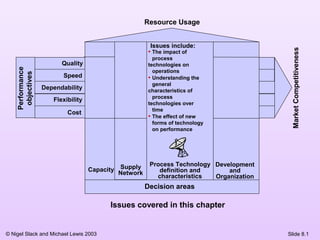
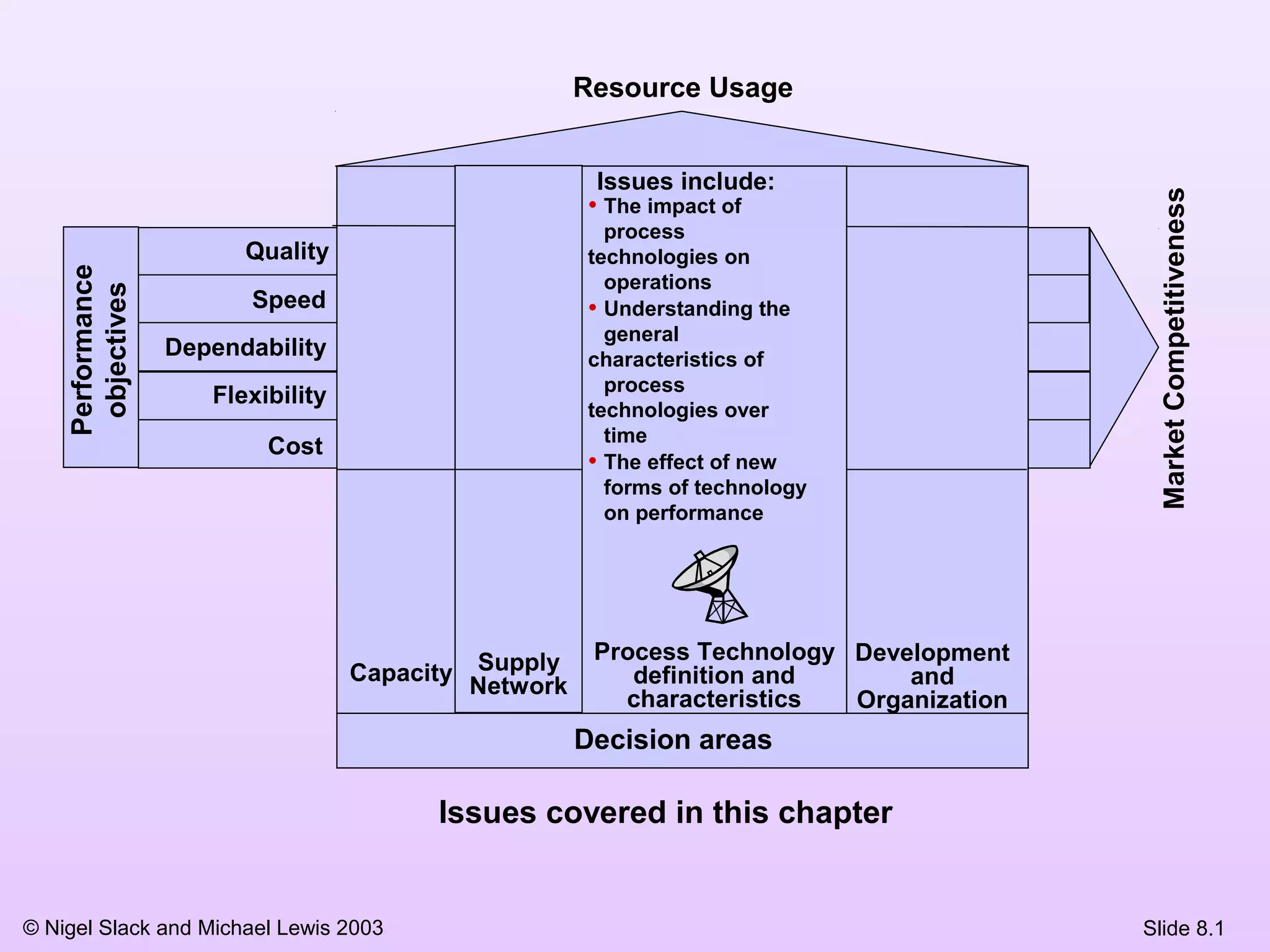
Issues covered in this chapter
Capacity Supply
Network
Process Technology
definition and
characteristics
Issues include:
• The impact of
process
technologies on
operations
• Understanding the
general
characteristics of
process
technologies over
time
• The effect of new
forms of technology
on performance
Slide 8.1
© Nigel Slack and Michael Lewis 2003
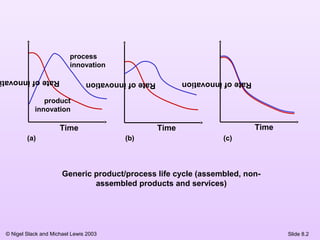
product
innovation
process
innovation
Rateofinnovat Rateofinnovation
Time Time Time
Generic product/process life cycle (assembled, non-
assembled products and services)
Rateofinnovation
(a) (b) (c)
Slide 8.2
© Nigel Slack and Michael Lewis 2003
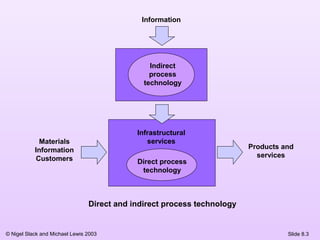
Information
Indirect
process
technology
Infrastructural
services
Direct process
technology
Materials
Information
Customers
Products and
services
Direct and indirect process technology
Slide 8.3
© Nigel Slack and Michael Lewis 2003
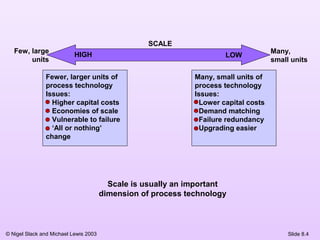
SCALE
LOWHIGH
Many, small units of
process technology
Issues:
Lower capital costs
Demand matching
Failure redundancy
Upgrading easier
Fewer, larger units of
process technology
Issues:
Higher capital costs
Economies of scale
Vulnerable to failure
‘All or nothing’
change
Scale is usually an important
dimension of process technology
Many,
small units
Few, large
units
Slide 8.4
© Nigel Slack and Michael Lewis 2003
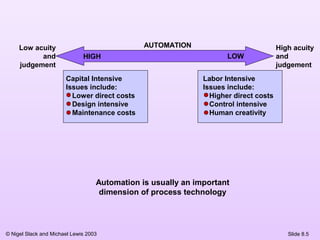
AUTOMATION
HIGH LOW
Labor Intensive
Issues include:
Higher direct costs
Control intensive
Human creativity
Capital Intensive
Issues include:
Lower direct costs
Design intensive
Maintenance costs
Automation is usually an important
dimension of process technology
Low acuity
and
judgement
High acuity
and
judgement
Slide 8.5
© Nigel Slack and Michael Lewis 2003
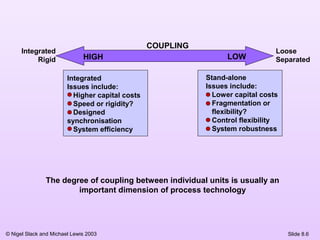
COUPLING
HIGH LOW
The degree of coupling between individual units is usually an
important dimension of process technology
Integrated
Rigid
Loose
Separated
Stand-alone
Issues include:
Lower capital costs
Fragmentation or
flexibility?
Control flexibility
System robustness
Integrated
Issues include:
Higher capital costs
Speed or rigidity?
Designed
synchronisation
System efficiency
Slide 8.6
© Nigel Slack and Michael Lewis 2003
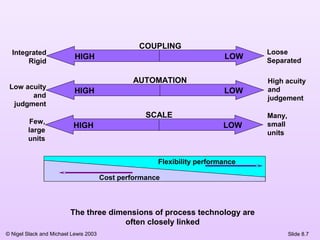
The three dimensions of process technology are
often closely linked
COUPLING
HIGH LOW
Integrated
Rigid
Loose
Separated
AUTOMATION
HIGH LOW
Low acuity
and
judgment
High acuity
and
judgement
SCALE
HIGH LOW
Few,
large
units
Many,
small
units
Flexibility performance
Cost performance
Slide 8.7
© Nigel Slack and Michael Lewis 2003
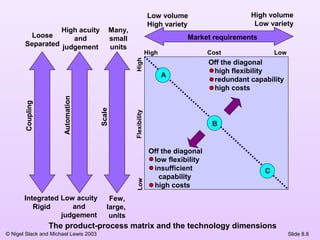
The product-process matrix and the technology dimensions
Market requirements
Low volume
High variety
High volume
Low variety
High Cost Low
LowFlexibilityHigh
A
B
C
Off the diagonal
high flexibility
redundant capability
high costs
Off the diagonal
low flexibility
insufficient
capability
high costs
Coupling
Automation
Scale
Loose
Separated
High acuity
and
judgement
Many,
small
units
Integrated
Rigid
Low acuity
and
judgement
Few,
large,
units
Slide 8.8
© Nigel Slack and Michael Lewis 2003
Moving down the diagonal of the product-process
matrix in retail banking
[1] [2]
[3]
Increasingscale
Increasingautomation
Increasingcoupling
Low volume
High variety
High volume
Low variety
Low volume
High variety
High volume
Low variety
[2]
Slide 8.9
Individual
branches
Voucher
processing
centers
© Nigel Slack and Michael Lewis 2003
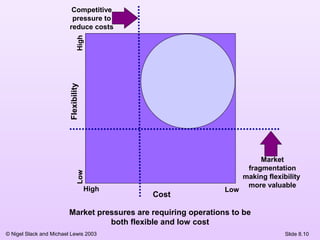
Low
Flexibility
High
High Low
Cost
Market
fragmentation
making flexibility
more valuable
Competitive
pressure to
reduce costs
Market pressures are requiring operations to be
both flexible and low cost
Slide 8.10
© Nigel Slack and Michael Lewis 2003
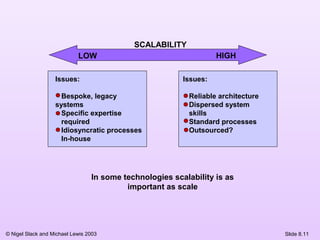
SCALABILITY
LOW HIGH
Issues:
Bespoke, legacy
systems
Specific expertise
required
Idiosyncratic processes
In-house
Issues:
Reliable architecture
Dispersed system
skills
Standard processes
Outsourced?
In some technologies scalability is as
important as scale
Slide 8.11
© Nigel Slack and Michael Lewis 2003
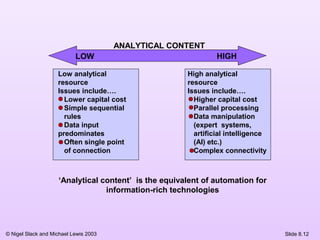
ANALYTICAL CONTENT
LOW HIGH
Low analytical
resource
Issues include….
Lower capital cost
Simple sequential
rules
Data input
predominates
Often single point
of connection
High analytical
resource
Issues include….
Higher capital cost
Parallel processing
Data manipulation
(expert systems,
artificial intelligence
(AI) etc.)
Complex connectivity
‘Analytical content’ is the equivalent of automation for
information-rich technologies
Slide 8.12
© Nigel Slack and Michael Lewis 2003
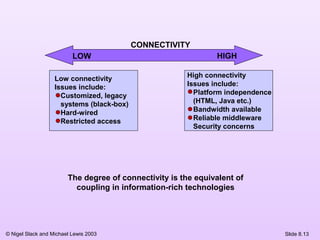
CONNECTIVITY
LOW HIGH
Low connectivity
Issues include:
Customized, legacy
systems (black-box)
Hard-wired
Restricted access
High connectivity
Issues include:
Platform independence
(HTML, Java etc.)
Bandwidth available
Reliable middleware
Security concerns
The degree of connectivity is the equivalent of
coupling in information-rich technologies
Slide 8.13
© Nigel Slack and Michael Lewis 2003
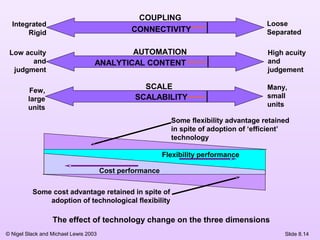
The effect of technology change on the three dimensions
COUPLING
Integrated
Rigid
Loose
Separated
AUTOMATIONLow acuity
and
judgment
High acuity
and
judgement
SCALEFew,
large
units
Many,
small
units
Flexibility performance
Cost performance
CONNECTIVITY
ANALYTICAL CONTENT
SCALABILITY
Some flexibility advantage retained
in spite of adoption of ‘efficient’
technology
Some cost advantage retained in spite of
adoption of technological flexibility
Slide 8.14
© Nigel Slack and Michael Lewis 2003
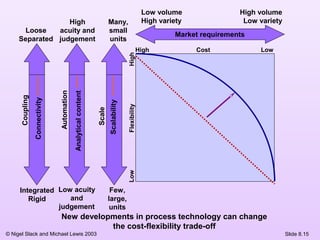
New developments in process technology can change
the cost-flexibility trade-off
Market requirements
Low volume
High variety
High volume
Low variety
High Cost Low
LowFlexibilityHigh
Coupling
Automation
Scale
Loose
Separated
High
acuity and
judgement
Many,
small
units
Integrated
Rigid
Low acuity
and
judgement
Few,
large,
units
Connectivity
Analyticalcontent
Scalability
Slide 8.15

Chap08

  • 1.
    © Nigel Slackand Michael Lewis 2003 Quality Performance objectives Dependability Development and Organization Speed Flexibility Cost Resource Usage MarketCompetitiveness Decision areas Issues covered in this chapter Capacity Supply Network Process Technology definition and characteristics Issues include: • The impact of process technologies on operations • Understanding the general characteristics of process technologies over time • The effect of new forms of technology on performance Slide 8.1
  • 2.
    © Nigel Slackand Michael Lewis 2003 product innovation process innovation Rateofinnovat Rateofinnovation Time Time Time Generic product/process life cycle (assembled, non- assembled products and services) Rateofinnovation (a) (b) (c) Slide 8.2
  • 3.
    © Nigel Slackand Michael Lewis 2003 Information Indirect process technology Infrastructural services Direct process technology Materials Information Customers Products and services Direct and indirect process technology Slide 8.3
  • 4.
    © Nigel Slackand Michael Lewis 2003 SCALE LOWHIGH Many, small units of process technology Issues: Lower capital costs Demand matching Failure redundancy Upgrading easier Fewer, larger units of process technology Issues: Higher capital costs Economies of scale Vulnerable to failure ‘All or nothing’ change Scale is usually an important dimension of process technology Many, small units Few, large units Slide 8.4
  • 5.
    © Nigel Slackand Michael Lewis 2003 AUTOMATION HIGH LOW Labor Intensive Issues include: Higher direct costs Control intensive Human creativity Capital Intensive Issues include: Lower direct costs Design intensive Maintenance costs Automation is usually an important dimension of process technology Low acuity and judgement High acuity and judgement Slide 8.5
  • 6.
    © Nigel Slackand Michael Lewis 2003 COUPLING HIGH LOW The degree of coupling between individual units is usually an important dimension of process technology Integrated Rigid Loose Separated Stand-alone Issues include: Lower capital costs Fragmentation or flexibility? Control flexibility System robustness Integrated Issues include: Higher capital costs Speed or rigidity? Designed synchronisation System efficiency Slide 8.6
  • 7.
    © Nigel Slackand Michael Lewis 2003 The three dimensions of process technology are often closely linked COUPLING HIGH LOW Integrated Rigid Loose Separated AUTOMATION HIGH LOW Low acuity and judgment High acuity and judgement SCALE HIGH LOW Few, large units Many, small units Flexibility performance Cost performance Slide 8.7
  • 8.
    © Nigel Slackand Michael Lewis 2003 The product-process matrix and the technology dimensions Market requirements Low volume High variety High volume Low variety High Cost Low LowFlexibilityHigh A B C Off the diagonal high flexibility redundant capability high costs Off the diagonal low flexibility insufficient capability high costs Coupling Automation Scale Loose Separated High acuity and judgement Many, small units Integrated Rigid Low acuity and judgement Few, large, units Slide 8.8
  • 9.
    © Nigel Slackand Michael Lewis 2003 Moving down the diagonal of the product-process matrix in retail banking [1] [2] [3] Increasingscale Increasingautomation Increasingcoupling Low volume High variety High volume Low variety Low volume High variety High volume Low variety [2] Slide 8.9 Individual branches Voucher processing centers
  • 10.
    © Nigel Slackand Michael Lewis 2003 Low Flexibility High High Low Cost Market fragmentation making flexibility more valuable Competitive pressure to reduce costs Market pressures are requiring operations to be both flexible and low cost Slide 8.10
  • 11.
    © Nigel Slackand Michael Lewis 2003 SCALABILITY LOW HIGH Issues: Bespoke, legacy systems Specific expertise required Idiosyncratic processes In-house Issues: Reliable architecture Dispersed system skills Standard processes Outsourced? In some technologies scalability is as important as scale Slide 8.11
  • 12.
    © Nigel Slackand Michael Lewis 2003 ANALYTICAL CONTENT LOW HIGH Low analytical resource Issues include…. Lower capital cost Simple sequential rules Data input predominates Often single point of connection High analytical resource Issues include…. Higher capital cost Parallel processing Data manipulation (expert systems, artificial intelligence (AI) etc.) Complex connectivity ‘Analytical content’ is the equivalent of automation for information-rich technologies Slide 8.12
  • 13.
    © Nigel Slackand Michael Lewis 2003 CONNECTIVITY LOW HIGH Low connectivity Issues include: Customized, legacy systems (black-box) Hard-wired Restricted access High connectivity Issues include: Platform independence (HTML, Java etc.) Bandwidth available Reliable middleware Security concerns The degree of connectivity is the equivalent of coupling in information-rich technologies Slide 8.13
  • 14.
    © Nigel Slackand Michael Lewis 2003 The effect of technology change on the three dimensions COUPLING Integrated Rigid Loose Separated AUTOMATIONLow acuity and judgment High acuity and judgement SCALEFew, large units Many, small units Flexibility performance Cost performance CONNECTIVITY ANALYTICAL CONTENT SCALABILITY Some flexibility advantage retained in spite of adoption of ‘efficient’ technology Some cost advantage retained in spite of adoption of technological flexibility Slide 8.14
  • 15.
    © Nigel Slackand Michael Lewis 2003 New developments in process technology can change the cost-flexibility trade-off Market requirements Low volume High variety High volume Low variety High Cost Low LowFlexibilityHigh Coupling Automation Scale Loose Separated High acuity and judgement Many, small units Integrated Rigid Low acuity and judgement Few, large, units Connectivity Analyticalcontent Scalability Slide 8.15