Quality Performance objectives Dependability Development and Organization (organisation and role) Speed Flexibility Cost Resource Usage Market Competitiveness Decision areas Issues covered in this chapter Capacity Supply Network Process Technology Issues include: Organizational structure  and operations  effectiveness The role and  contribution of the  operations function Connecting operations  with the external  environment The role of central  operations Slide 10.1
Efficient operation Flexible response Servicing a range of market positions Development and deployment of tangible resources The objectives of organisational design OPERATIONS RESOURCES MARKET REQUIREMENTS Organisational structure Development and deployment of intangible resources Development and deployment of boundary resources  Slide 10.2
Group  Headquarters Marketing Operations Finance U-form organi z ations give prominence to functional groupings of resources Dept.A Dept.C Dept.B Dept.A Dept.C Dept.B Dept.A Dept.C Dept.B Slide 10.3
Group  Headquarters The M form separates the organi z ation’s resources into separate divisions Marketing etc. Operations Marketing etc. Operations Marketing etc. Operations Slide 10.4 Division A Division B Division C
Group  Headquarters Matrix form structures the organi z ation's resources so that they have two (or more) levels of responsibility Division A Division B Division C Marketing Operations Human resources Finance Slide 10.5
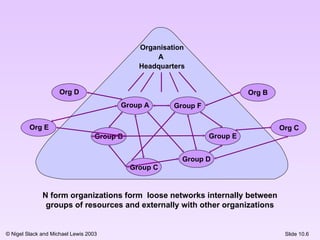
Organisation A  Headquarters N form organi z ations form  loose networks internally between groups of resources and externally with other organi z ations Group A Group F Group D Group E  Group C Group B Org D Org E Org B Org C Slide 10.6
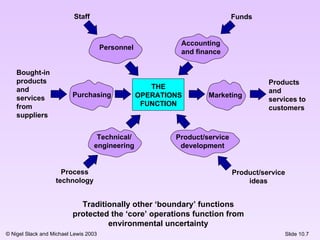
Personnel Accounting and finance Purchasing Marketing Technical/ engineering Product/service development THE OPERATIONS FUNCTION Products and services to customers Bought-in products and services from suppliers Staff Funds Process technology Product/service ideas Traditionally other ‘boundary’ functions protected the ‘core’ operations function from environmental uncertainty Slide 10.7
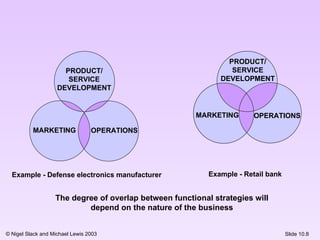
PRODUCT/ SERVICE DEVELOPMENT MARKETING OPERATIONS PRODUCT/ SERVICE DEVELOPMENT MARKETING OPERATIONS Example - Defen s e electronics manufacturer Example - Retail bank The degree of overlap between functional strategies will depend on the nature of the business Slide 10.8
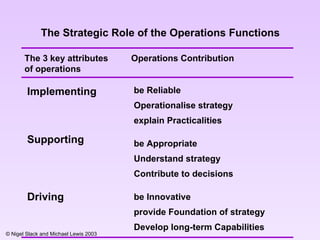
The 3 key attributes  of operations Operations Contribution Implementing Supporting Driving be  Reliable Operationalise strategy explain Practicalities be Appropriate Understand strategy Contribute to decisions be Innovative provide Foundation of strategy Develop long-term Capabilities The Strategic Role of the Operations Functions
Head office ‘ Stand-alone’ influence Head  office ‘ Linkage’ influence Head office Operation A Operation A Operation A Central function s  and services  influence Head office Corporate development Specialist function B Specialist function A Four ways in which corporate head office can add value Source:  Adapted from Goold, M. ,  Campbell, A. and Alexander, M. (1994)  Corporate Level Strategy , Wiley, N.Y. Operation A Operation A Operation A Operation A Operation A Operation A Operation A Operation A Operation A Slide 10.9
Market requirements Operations resources Bottom up Trainer Instructing operations in the development and deployment of their capabilities through standardised improvement methods Roles:  Central operations -   Teacher/consultant Business operations   -   Pupil/Client Governor Controlling the performance of the operations by setting clear priorities and measuring performance against targets Roles:  Central operations -   Messenger/Judge Business operations   -  R ecipient/Defendant Facilitator Enabling operations in the development and deployment of their capabilities through shared advice, support and learning. Roles:  Central operations   - Mentor Business operations  -  Member of a    c ommunity Curator Nurturing the performance of the operations by collecting performance data and distributing comparative performance information Roles:  Central operations - Recorder/Analyst Business operations   -Source of information Top down Programmatic Emergent Capabilities Performance A typology of the ‘Central   Operations’ function Slide 10.10
Market requirements Operations resources Bottom up Top down TRAINER GOVERNOR FACILIATOR CURATOR Programmatic Capabilities  Focus Performance Focus Information relationships for the four types of central operations functions Emergent Dominant Subservient Predominantly one-way Predominantly two-way Strong Weak Power Communication Relationship Slide 10.11
Top management Events Graphics ..Etc. Project A Project B Project C Slide 10.12 The Thought Space Partnership Organizational Structure
Product/service  development Product/service  development (CREATIVITY) Product/service  development Marketing Operations Marketing Operations Marketing Operations Some  manufacturing Mass  services Professional  services Product/service  development Product/service  development Product/service  development Marketing Operations Marketing Operations Some  manufacturing Mass  services Professional  services Thought Space - Increasing overlap between operations and the other core functions (COMMERCIALISM) (COMPETENCE) Slide 10.13
Top Management Thought Space -  N form organisations form  loose networks internally between groups of resources and externally with other organi z ations Graphics Events Marketing 3D Design   Accounts Technical Solutions  Client D Client  E Client  B Client  C Slide 10.14

Chap10

  • 1.
    Quality Performance objectivesDependability Development and Organization (organisation and role) Speed Flexibility Cost Resource Usage Market Competitiveness Decision areas Issues covered in this chapter Capacity Supply Network Process Technology Issues include: Organizational structure and operations effectiveness The role and contribution of the operations function Connecting operations with the external environment The role of central operations Slide 10.1
  • 2.
    Efficient operation Flexibleresponse Servicing a range of market positions Development and deployment of tangible resources The objectives of organisational design OPERATIONS RESOURCES MARKET REQUIREMENTS Organisational structure Development and deployment of intangible resources Development and deployment of boundary resources Slide 10.2
  • 3.
    Group HeadquartersMarketing Operations Finance U-form organi z ations give prominence to functional groupings of resources Dept.A Dept.C Dept.B Dept.A Dept.C Dept.B Dept.A Dept.C Dept.B Slide 10.3
  • 4.
    Group HeadquartersThe M form separates the organi z ation’s resources into separate divisions Marketing etc. Operations Marketing etc. Operations Marketing etc. Operations Slide 10.4 Division A Division B Division C
  • 5.
    Group HeadquartersMatrix form structures the organi z ation's resources so that they have two (or more) levels of responsibility Division A Division B Division C Marketing Operations Human resources Finance Slide 10.5
  • 6.
    Organisation A Headquarters N form organi z ations form loose networks internally between groups of resources and externally with other organi z ations Group A Group F Group D Group E Group C Group B Org D Org E Org B Org C Slide 10.6
  • 7.
    Personnel Accounting andfinance Purchasing Marketing Technical/ engineering Product/service development THE OPERATIONS FUNCTION Products and services to customers Bought-in products and services from suppliers Staff Funds Process technology Product/service ideas Traditionally other ‘boundary’ functions protected the ‘core’ operations function from environmental uncertainty Slide 10.7
  • 8.
    PRODUCT/ SERVICE DEVELOPMENTMARKETING OPERATIONS PRODUCT/ SERVICE DEVELOPMENT MARKETING OPERATIONS Example - Defen s e electronics manufacturer Example - Retail bank The degree of overlap between functional strategies will depend on the nature of the business Slide 10.8
  • 9.
    The 3 keyattributes of operations Operations Contribution Implementing Supporting Driving be Reliable Operationalise strategy explain Practicalities be Appropriate Understand strategy Contribute to decisions be Innovative provide Foundation of strategy Develop long-term Capabilities The Strategic Role of the Operations Functions
  • 10.
    Head office ‘Stand-alone’ influence Head office ‘ Linkage’ influence Head office Operation A Operation A Operation A Central function s and services influence Head office Corporate development Specialist function B Specialist function A Four ways in which corporate head office can add value Source: Adapted from Goold, M. , Campbell, A. and Alexander, M. (1994) Corporate Level Strategy , Wiley, N.Y. Operation A Operation A Operation A Operation A Operation A Operation A Operation A Operation A Operation A Slide 10.9
  • 11.
    Market requirements Operationsresources Bottom up Trainer Instructing operations in the development and deployment of their capabilities through standardised improvement methods Roles: Central operations - Teacher/consultant Business operations - Pupil/Client Governor Controlling the performance of the operations by setting clear priorities and measuring performance against targets Roles: Central operations - Messenger/Judge Business operations - R ecipient/Defendant Facilitator Enabling operations in the development and deployment of their capabilities through shared advice, support and learning. Roles: Central operations - Mentor Business operations - Member of a c ommunity Curator Nurturing the performance of the operations by collecting performance data and distributing comparative performance information Roles: Central operations - Recorder/Analyst Business operations -Source of information Top down Programmatic Emergent Capabilities Performance A typology of the ‘Central Operations’ function Slide 10.10
  • 12.
    Market requirements Operationsresources Bottom up Top down TRAINER GOVERNOR FACILIATOR CURATOR Programmatic Capabilities Focus Performance Focus Information relationships for the four types of central operations functions Emergent Dominant Subservient Predominantly one-way Predominantly two-way Strong Weak Power Communication Relationship Slide 10.11
  • 13.
    Top management EventsGraphics ..Etc. Project A Project B Project C Slide 10.12 The Thought Space Partnership Organizational Structure
  • 14.
    Product/service developmentProduct/service development (CREATIVITY) Product/service development Marketing Operations Marketing Operations Marketing Operations Some manufacturing Mass services Professional services Product/service development Product/service development Product/service development Marketing Operations Marketing Operations Some manufacturing Mass services Professional services Thought Space - Increasing overlap between operations and the other core functions (COMMERCIALISM) (COMPETENCE) Slide 10.13
  • 15.
    Top Management ThoughtSpace - N form organisations form loose networks internally between groups of resources and externally with other organi z ations Graphics Events Marketing 3D Design Accounts Technical Solutions Client D Client E Client B Client C Slide 10.14