Digital Image Processing
Elements of Visual Perception
Digital Image Processing
2
Elements of Visual Perception
Structure of the human eye
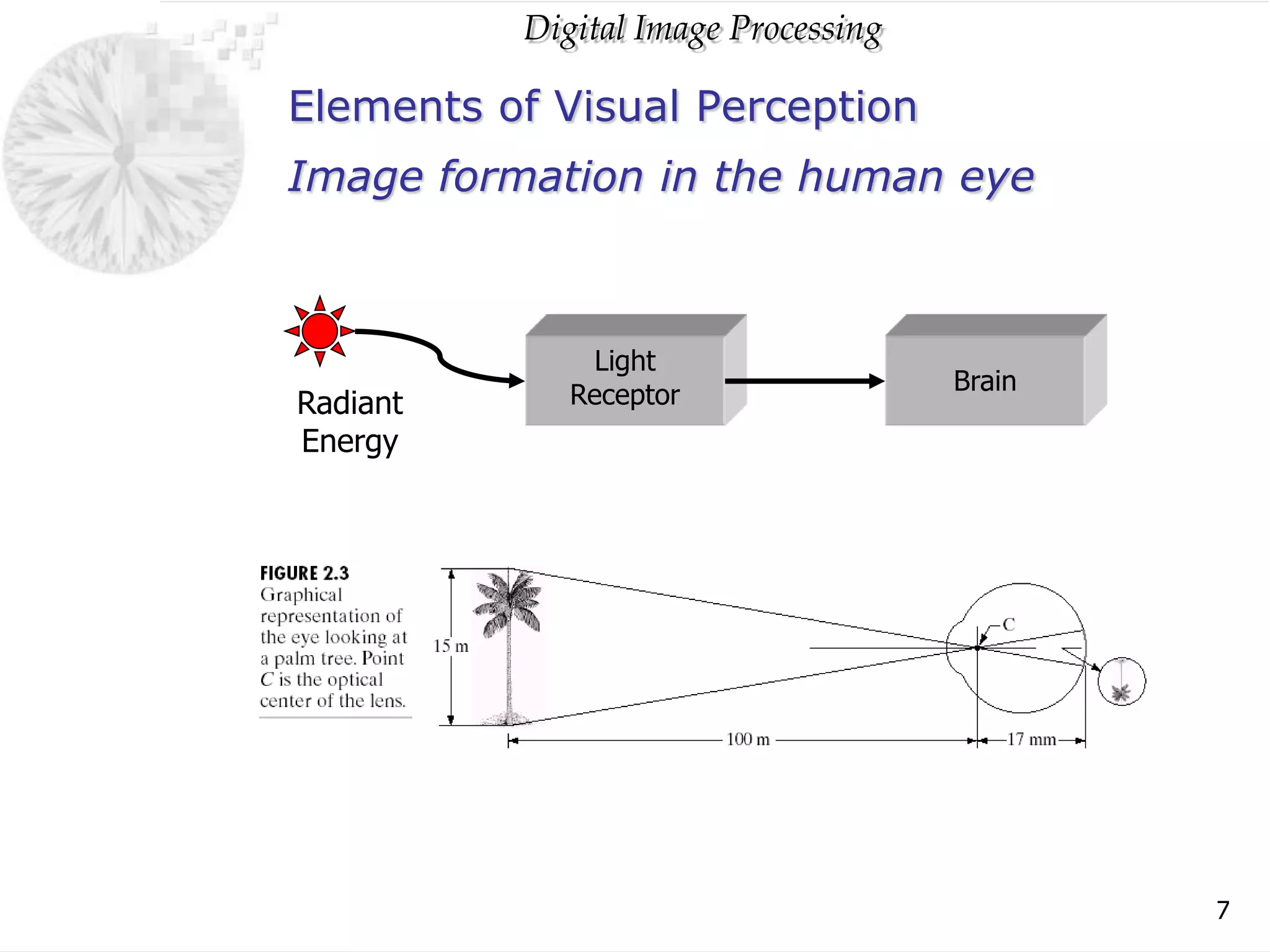
Image formation in the human eye
Brightness adaptation and discrimination
Outline
Digital Image Processing
3
Elements of Visual Perception
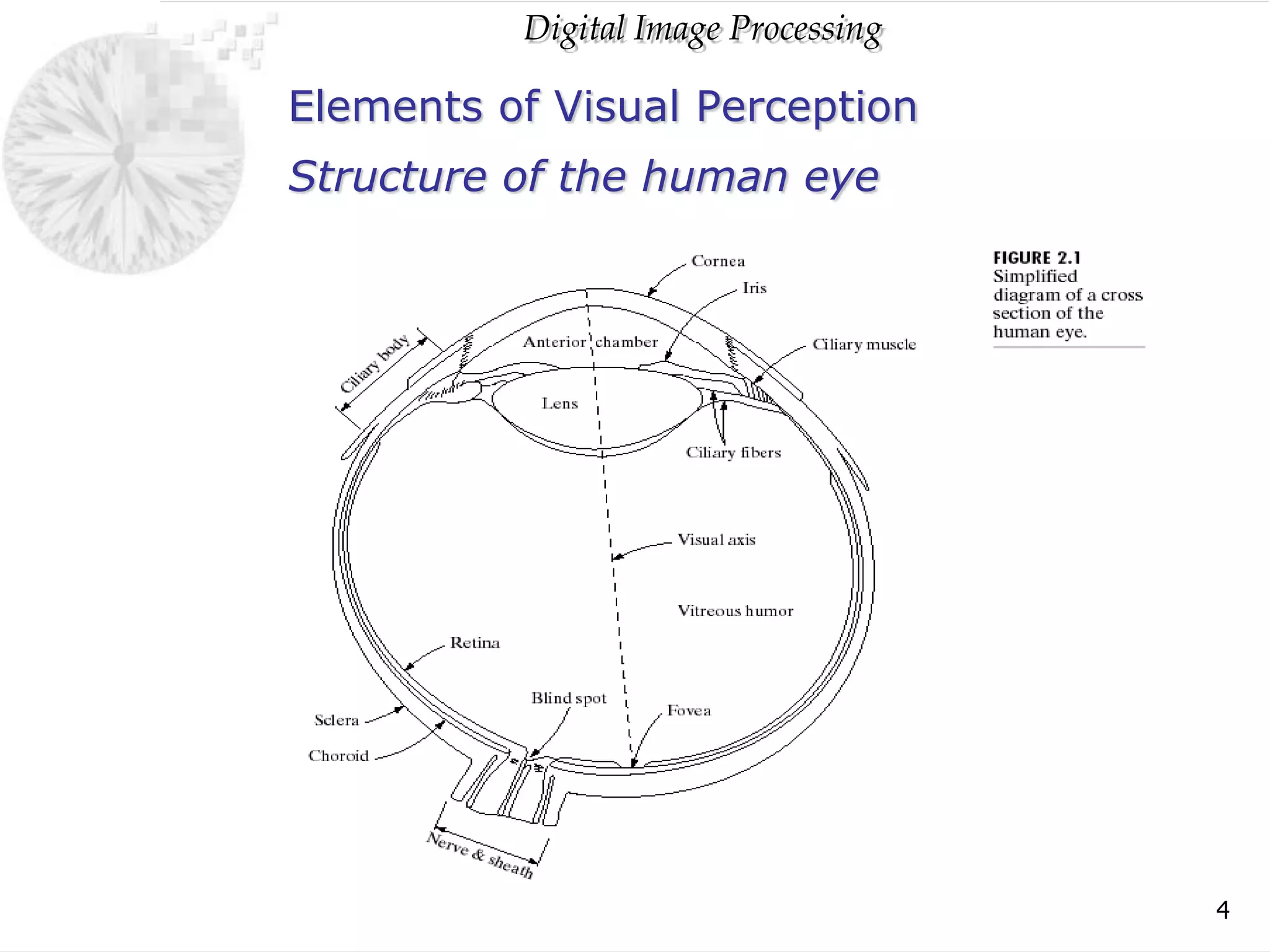
The cornea and sclera outer cover
The choroid
Ciliary body
Iris diaphragm
Lens
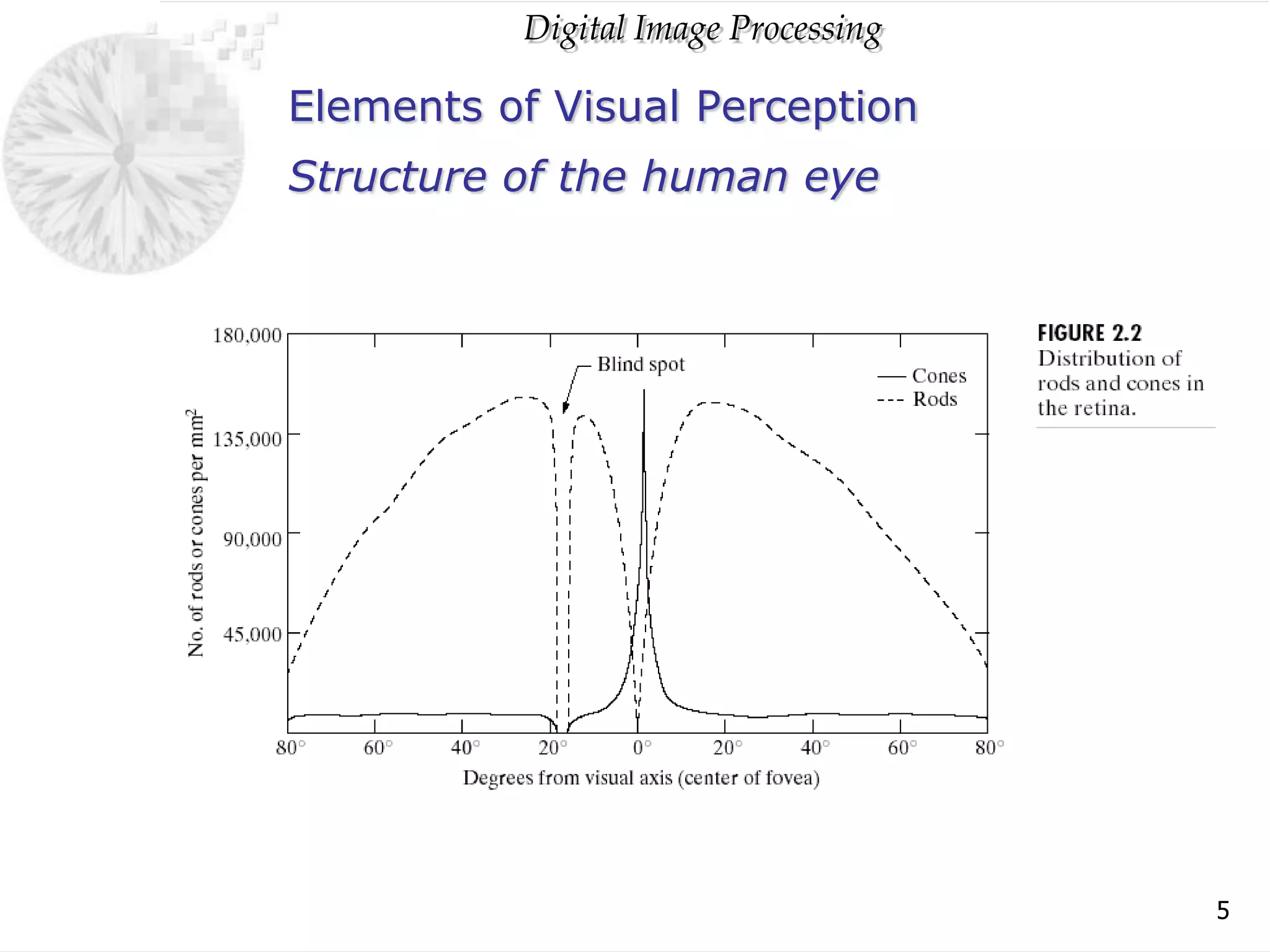
The retina (two kinds of receptors)
Cones vision (photopic/bright-light vision) : centered at fovea, highly
sensitive to color
Rods (scotopic/dim-light vision) : general view
Blind spot
Structure of the human eye
Digital Image Processing
4
Elements of Visual Perception
Structure of the human eye
Digital Image Processing
5
Elements of Visual Perception
Structure of the human eye
Digital Image Processing
6
Elements of Visual Perception
Flexible lens: the principle difference from an ordinary
optical lens.
Controlled by the tension in the fibers of the ciliary body
To focus on distant objects – flattened
To focus on objects near eye – thicker
Near-sighted and far-sighted
Image formation in the human eye
Digital Image Processing
7
Elements of Visual Perception
Image formation in the human eye
Light
Receptor Brain
Radiant
Energy
Digital Image Processing
8
Elements of Visual Perception
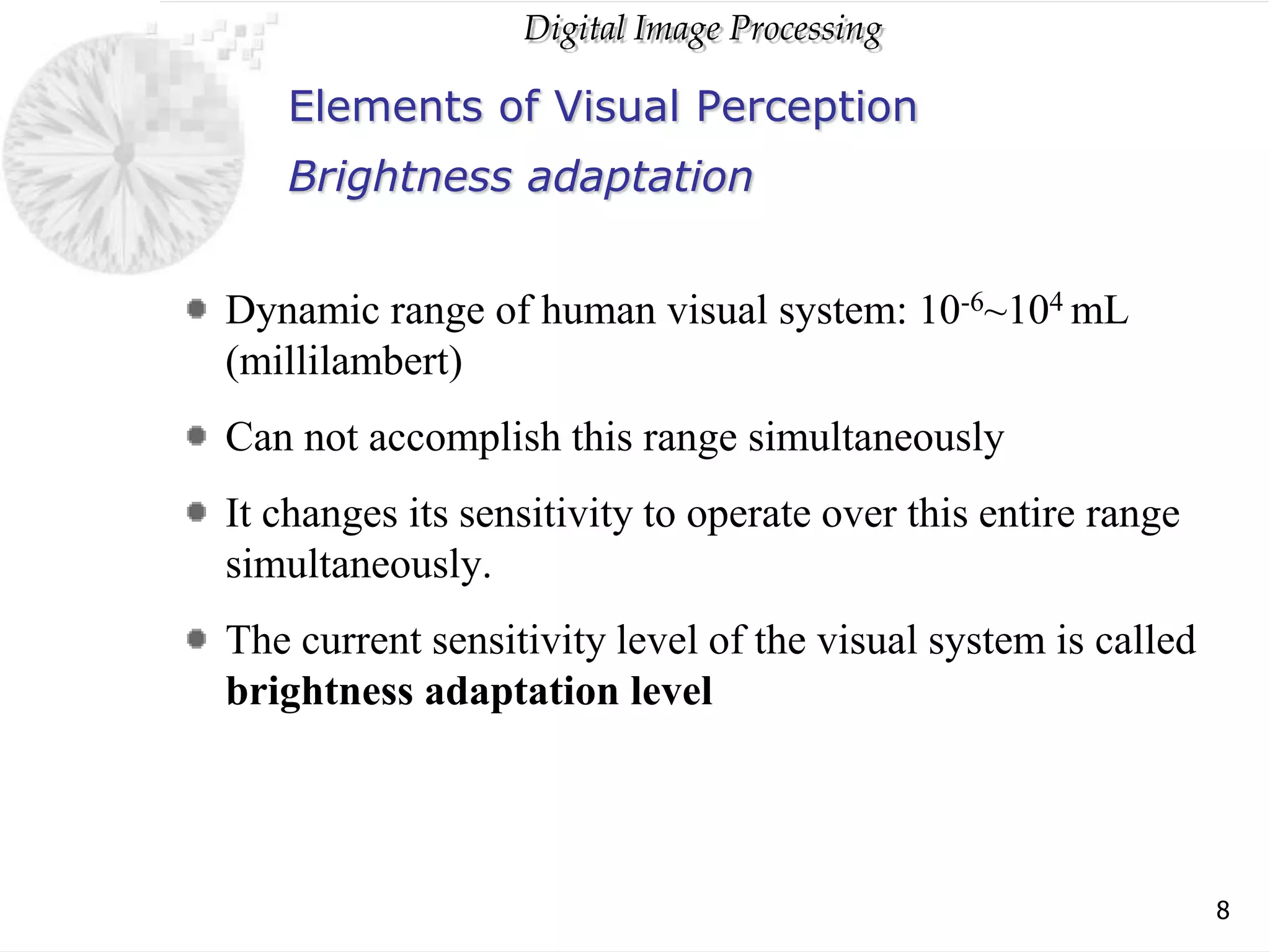
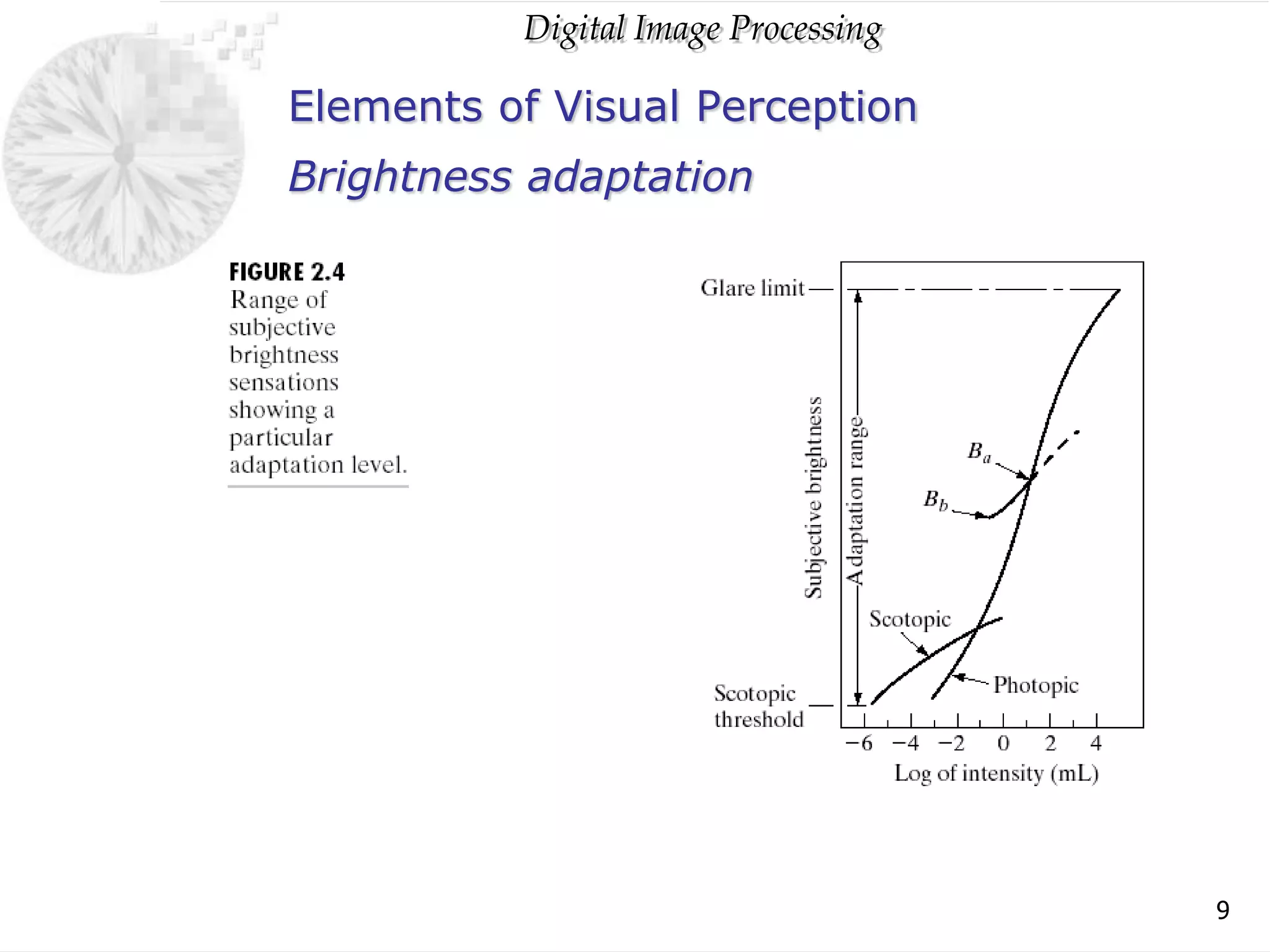
Dynamic range of human visual system: 10-6~104 mL
(millilambert)
Can not accomplish this range simultaneously
It changes its sensitivity to operate over this entire range
simultaneously.
The current sensitivity level of the visual system is called
brightness adaptation level
Brightness adaptation
Digital Image Processing
9
Elements of Visual Perception
Brightness adaptation
Digital Image Processing
10
Elements of Visual Perception
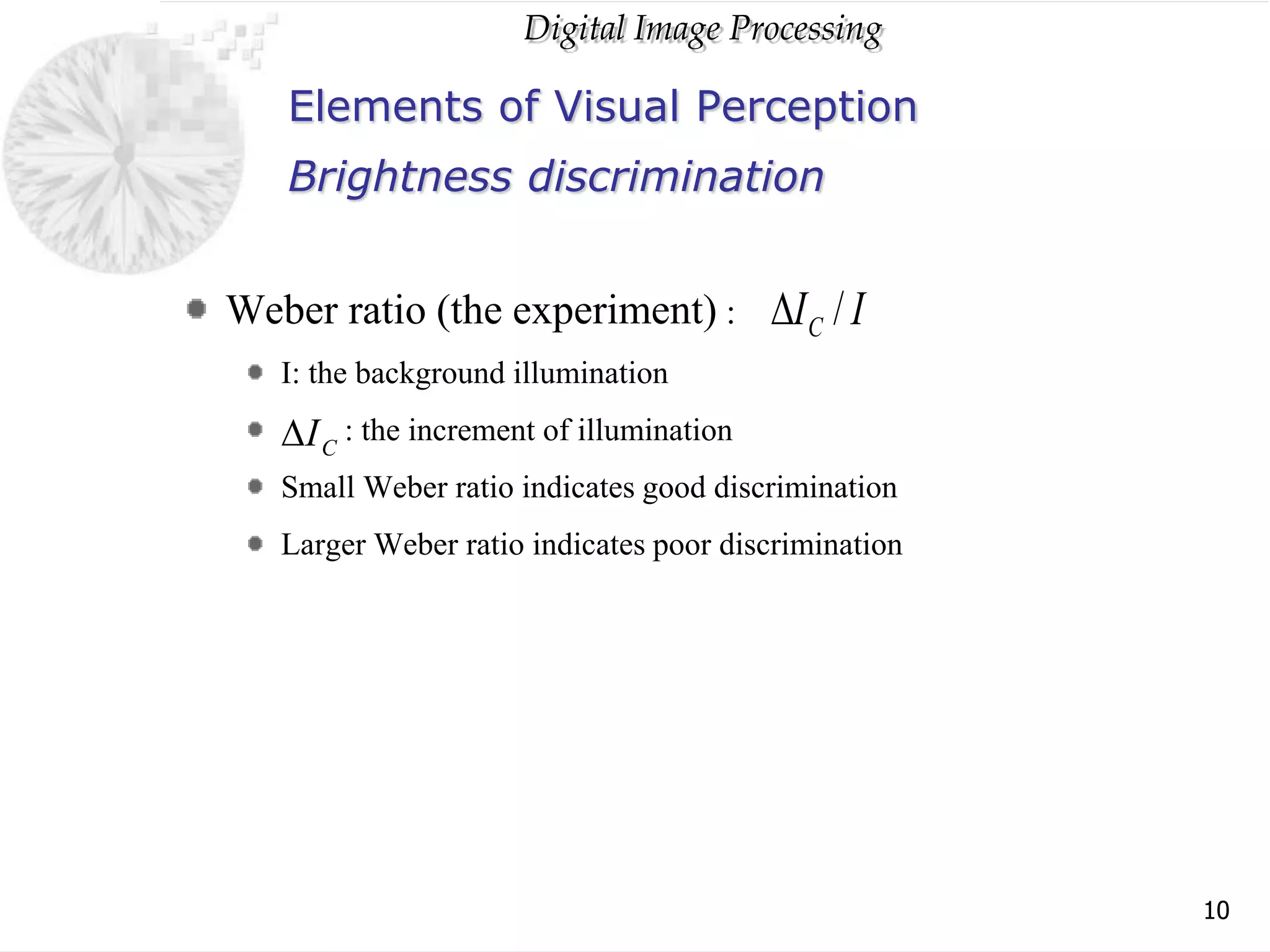
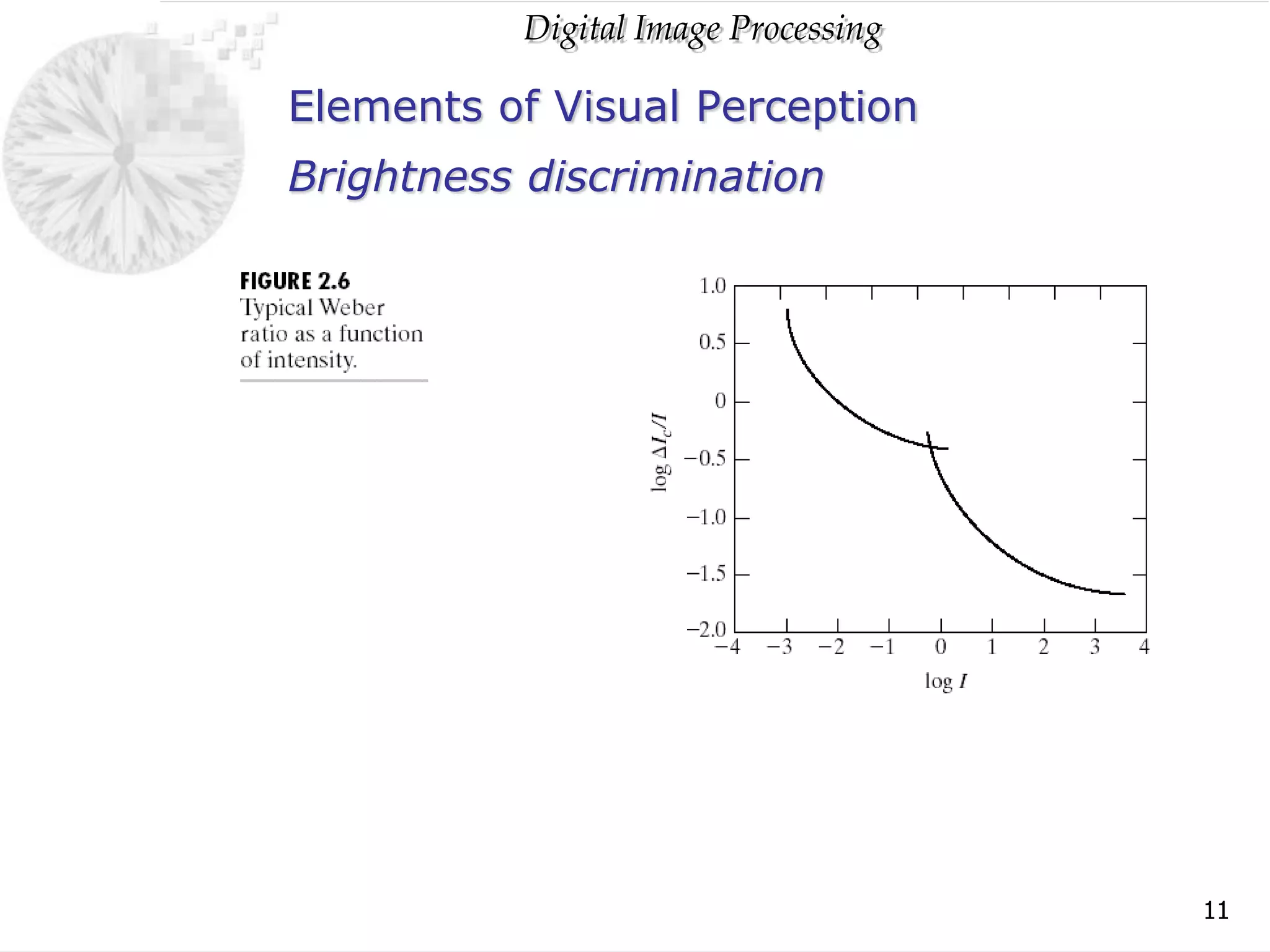
Weber ratio (the experiment) :
I: the background illumination
: the increment of illumination
Small Weber ratio indicates good discrimination
Larger Weber ratio indicates poor discrimination
Brightness discrimination
I
IC /

C
I

Digital Image Processing
11
Elements of Visual Perception
Brightness discrimination
Digital Image Processing
12
Elements of Visual Perception
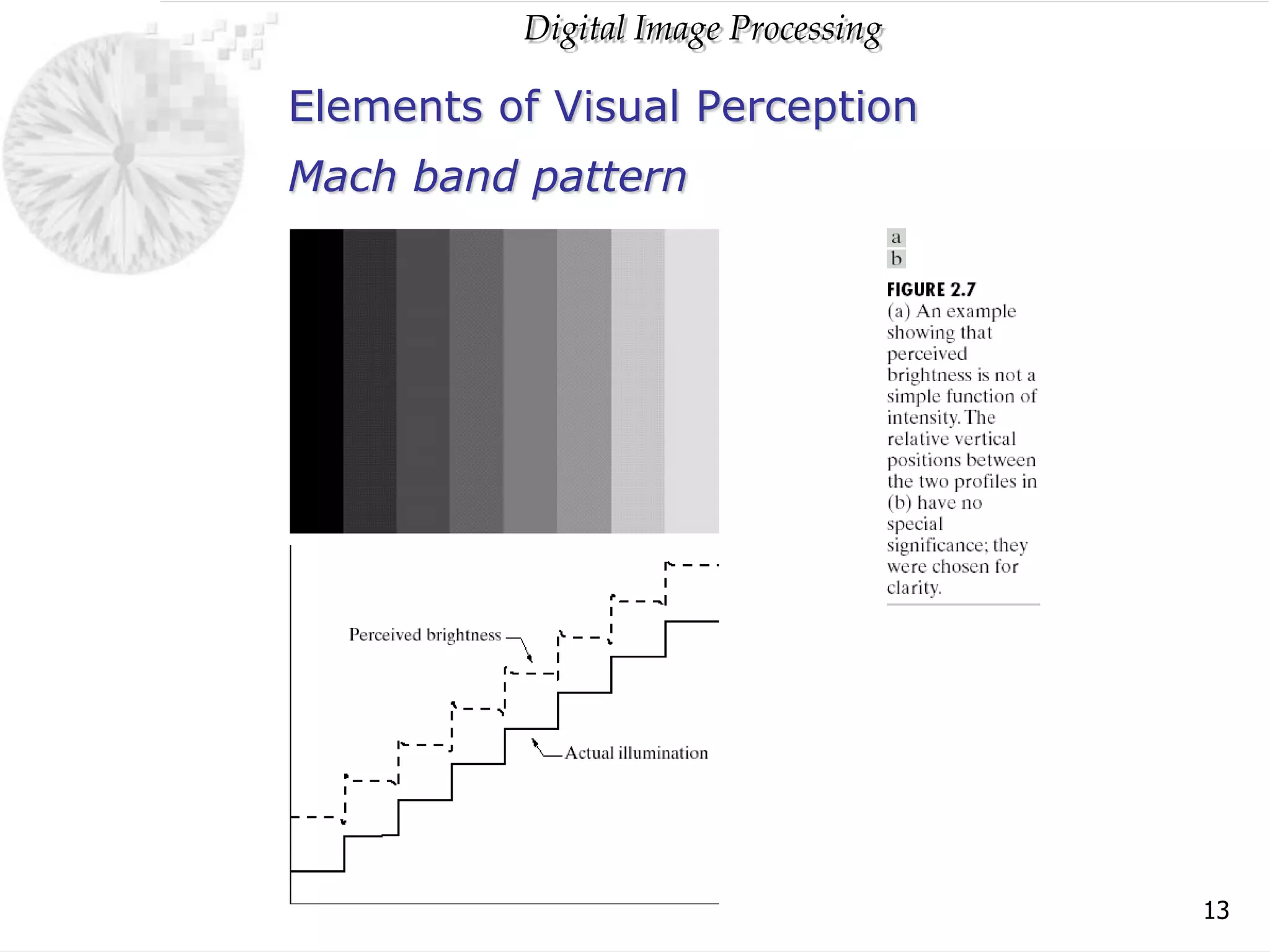
The perceived brightness is not a simple function of
intensity
Mach band pattern
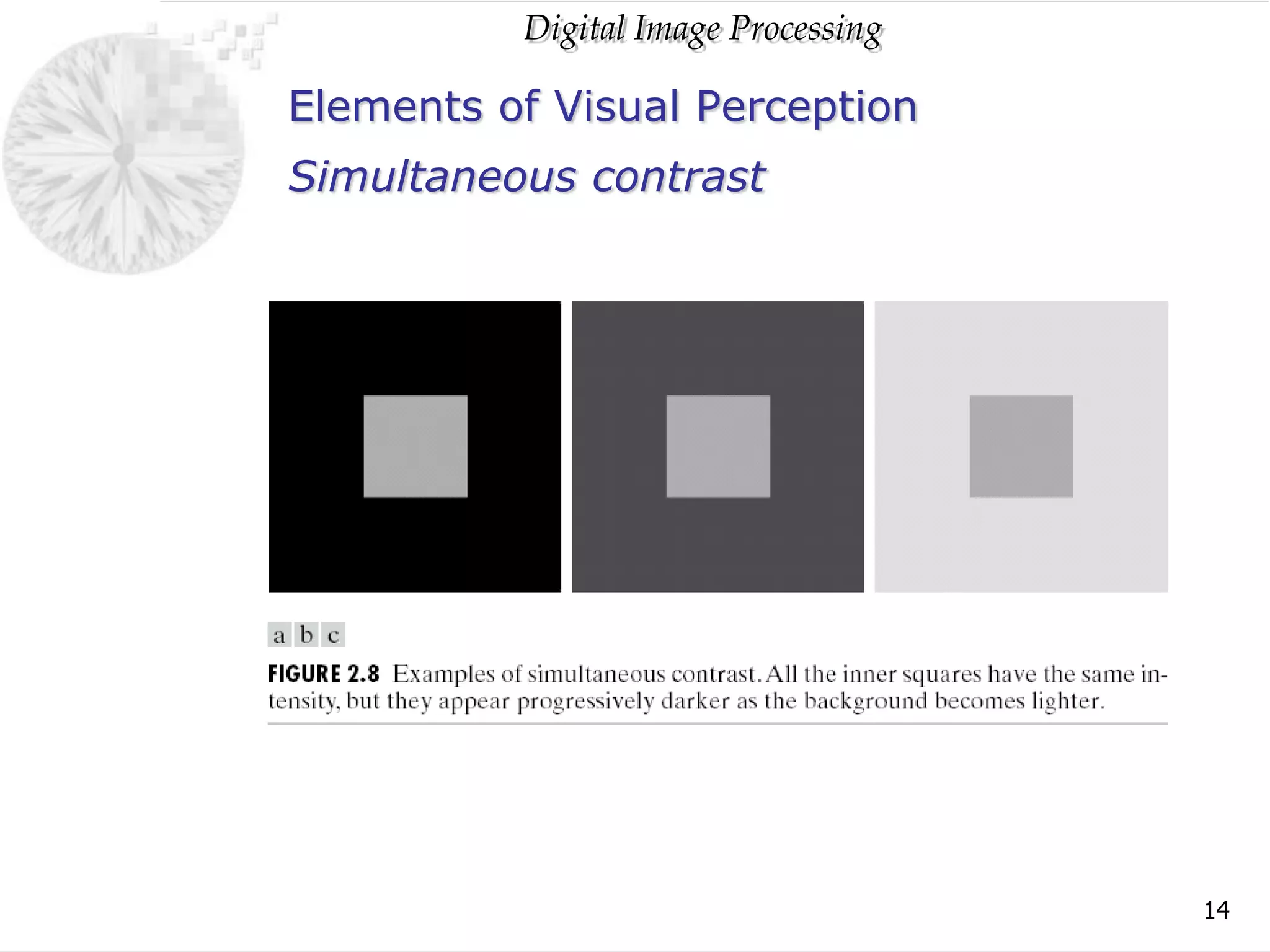
Simultaneous contrast
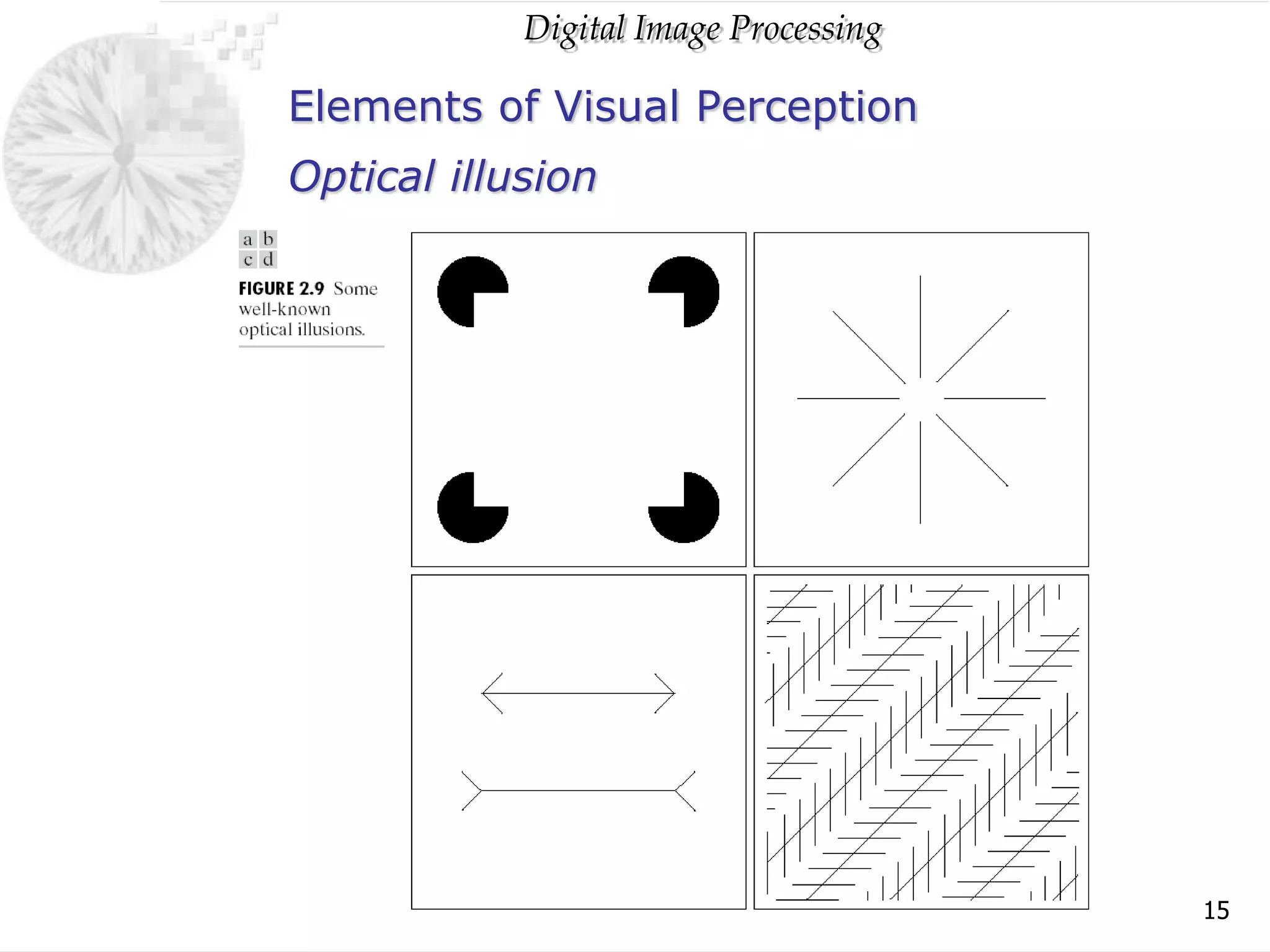
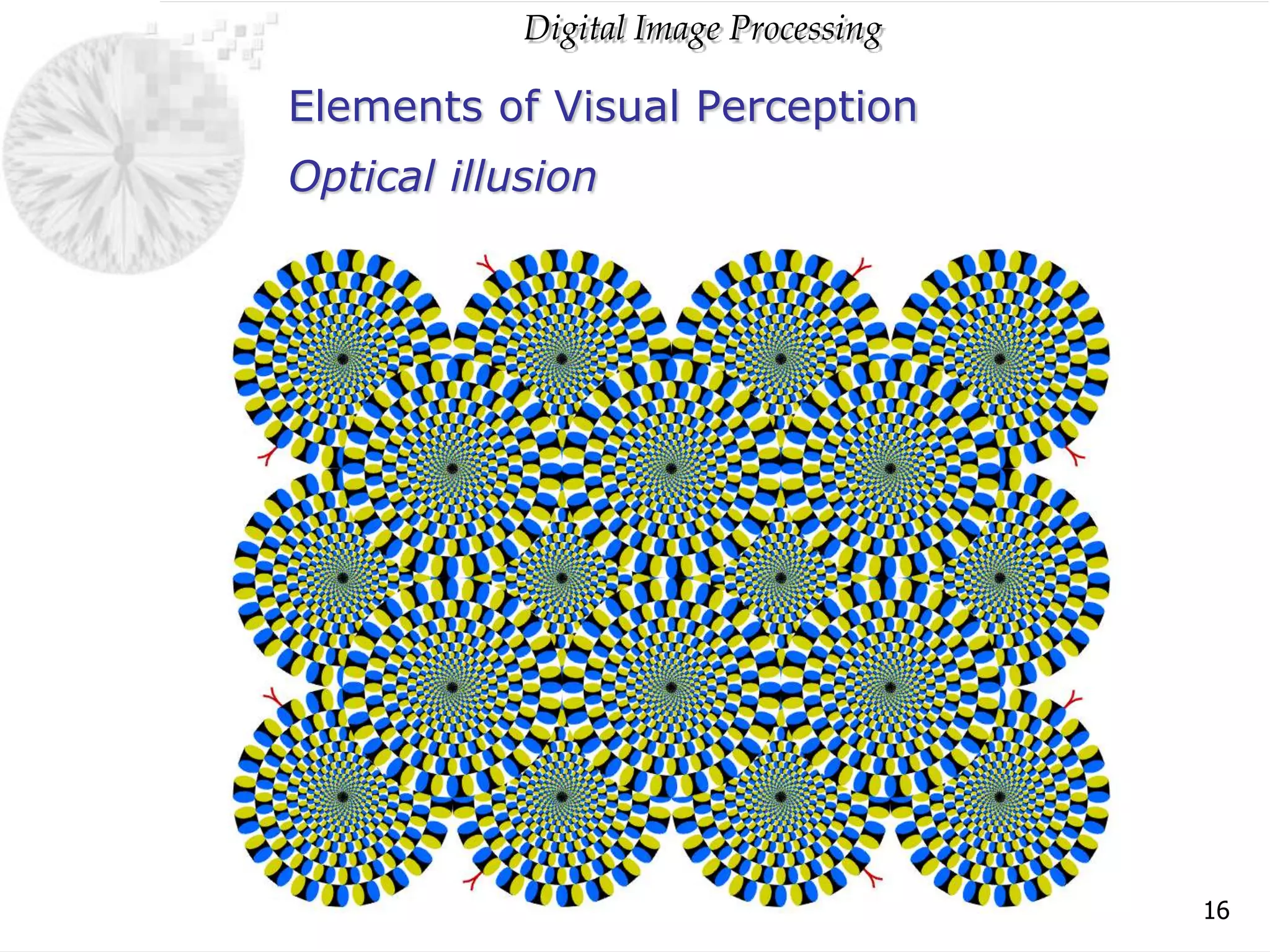
Optical illusion
Psycho-visual effects
Digital Image Processing
13
Elements of Visual Perception
Mach band pattern
Digital Image Processing
14
Elements of Visual Perception
Simultaneous contrast
Digital Image Processing
15
Elements of Visual Perception
Optical illusion
Digital Image Processing
16
Elements of Visual Perception
Optical illusion
Digital Image Processing
17
Elements of Visual Perception
Optical illusion
Digital Image Processing
Sampling, Quantization and Other Simple
Operations
Digital Image Processing
19
Sampling, Quantization, and Operations
Image formation model
Uniform sampling
Uniform quantization
Digital image representation
Relationships between pixels
Arithmetic operations
Logical operations
Outline
Digital Image Processing
20
Sampling, Quantization and Other Simple
Operations
 
0 ,
f x y
  
 
,
f x y
 
,
i x y
may be characterized by two components :
Illumination: Reflectance:  
,
r x y
     
, , ,
f x y i x y r x y

 
0 ,
i x y
    
0 , 1
r x y
 
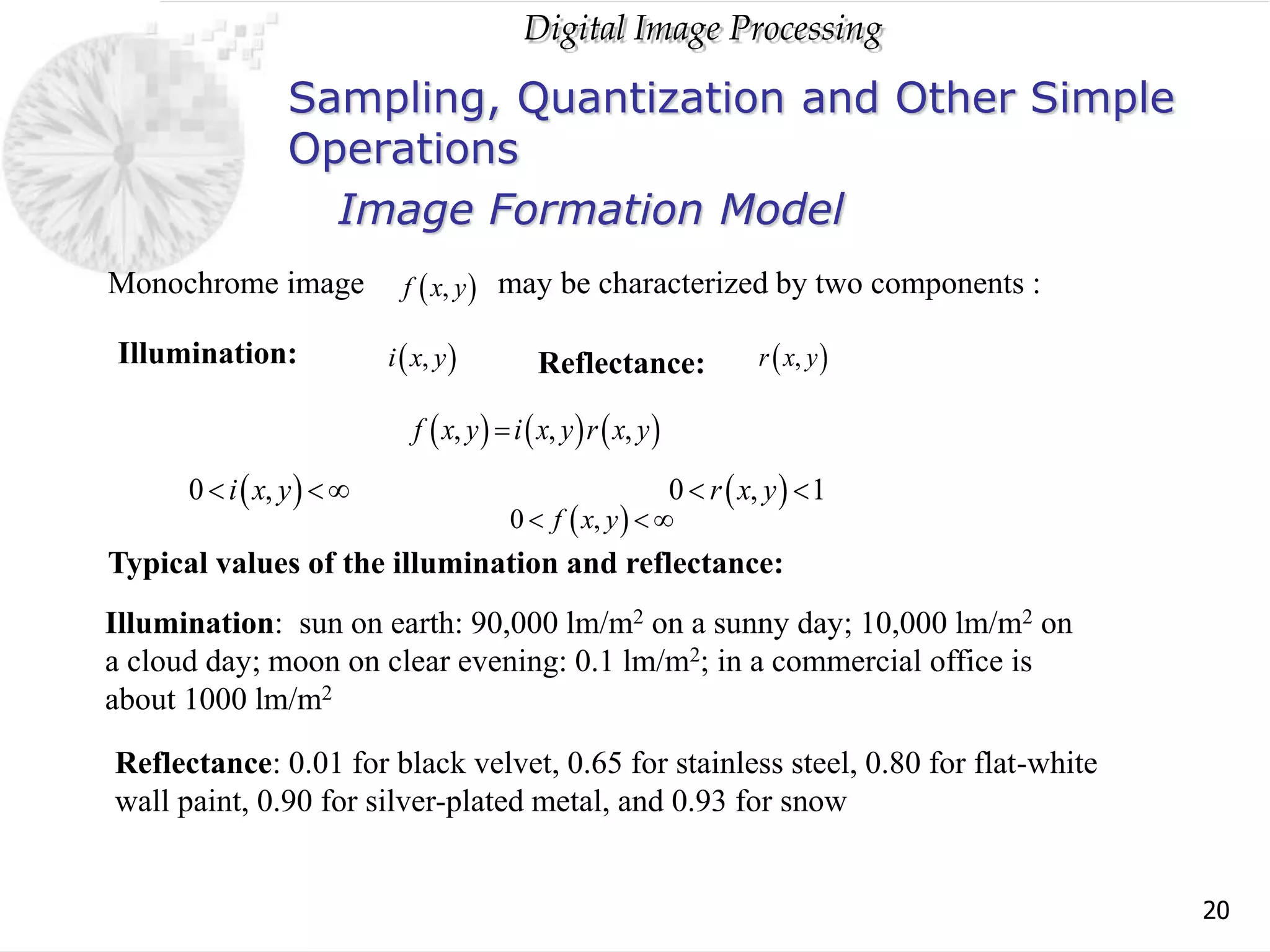
Monochrome image
Typical values of the illumination and reflectance:
Illumination: sun on earth: 90,000 lm/m2 on a sunny day; 10,000 lm/m2 on
a cloud day; moon on clear evening: 0.1 lm/m2; in a commercial office is
about 1000 lm/m2
Reflectance: 0.01 for black velvet, 0.65 for stainless steel, 0.80 for flat-white
wall paint, 0.90 for silver-plated metal, and 0.93 for snow
Image Formation Model
Digital Image Processing
21
Sampling, Quantization, and Operations
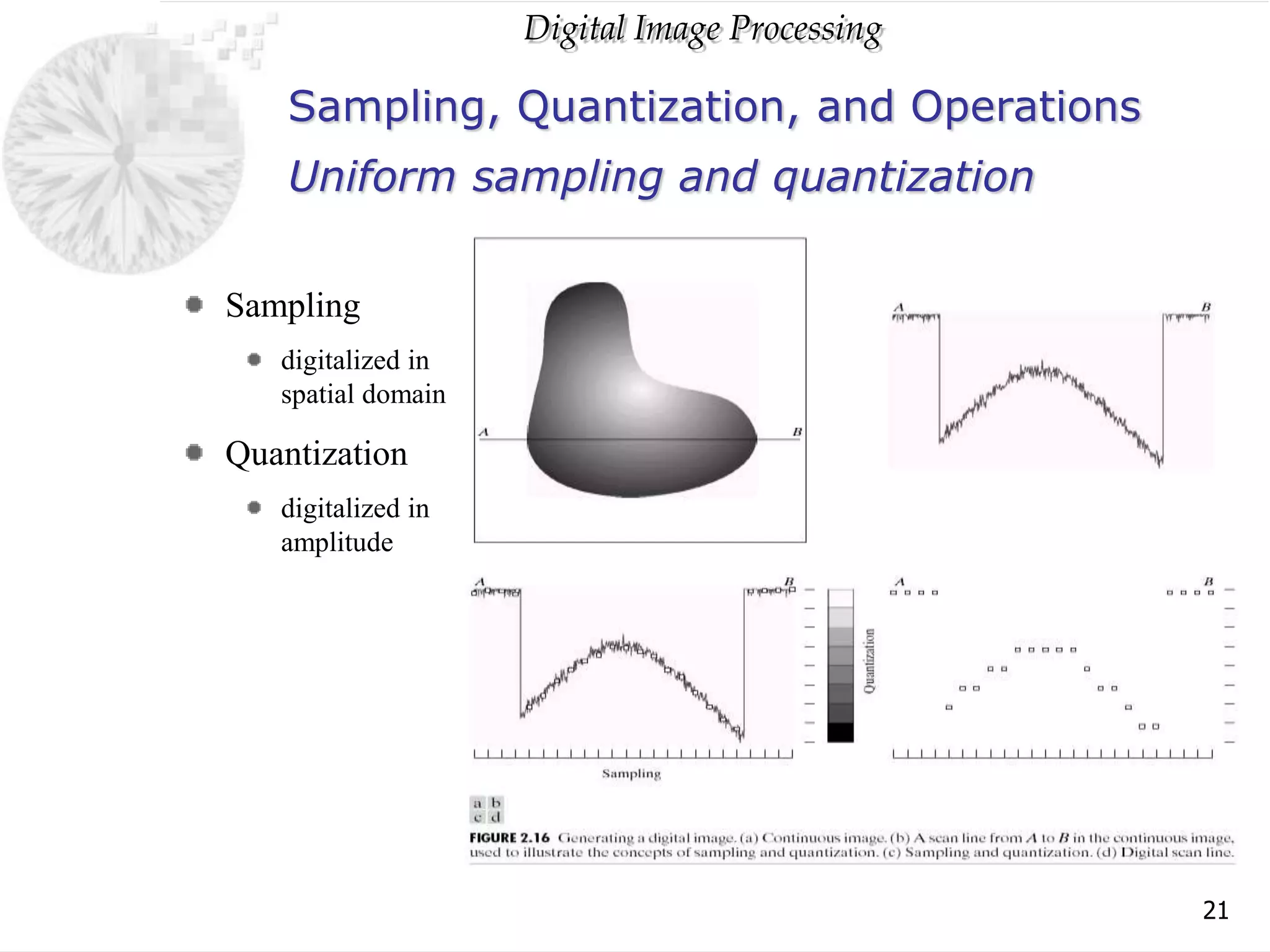
Sampling
digitalized in
spatial domain
Quantization
digitalized in
amplitude
Uniform sampling and quantization
Digital Image Processing
22
Sampling, Quantization, and Operations
Uniform sampling and quantization
Digital Image Processing
23
Sampling, Quantization, and Operations
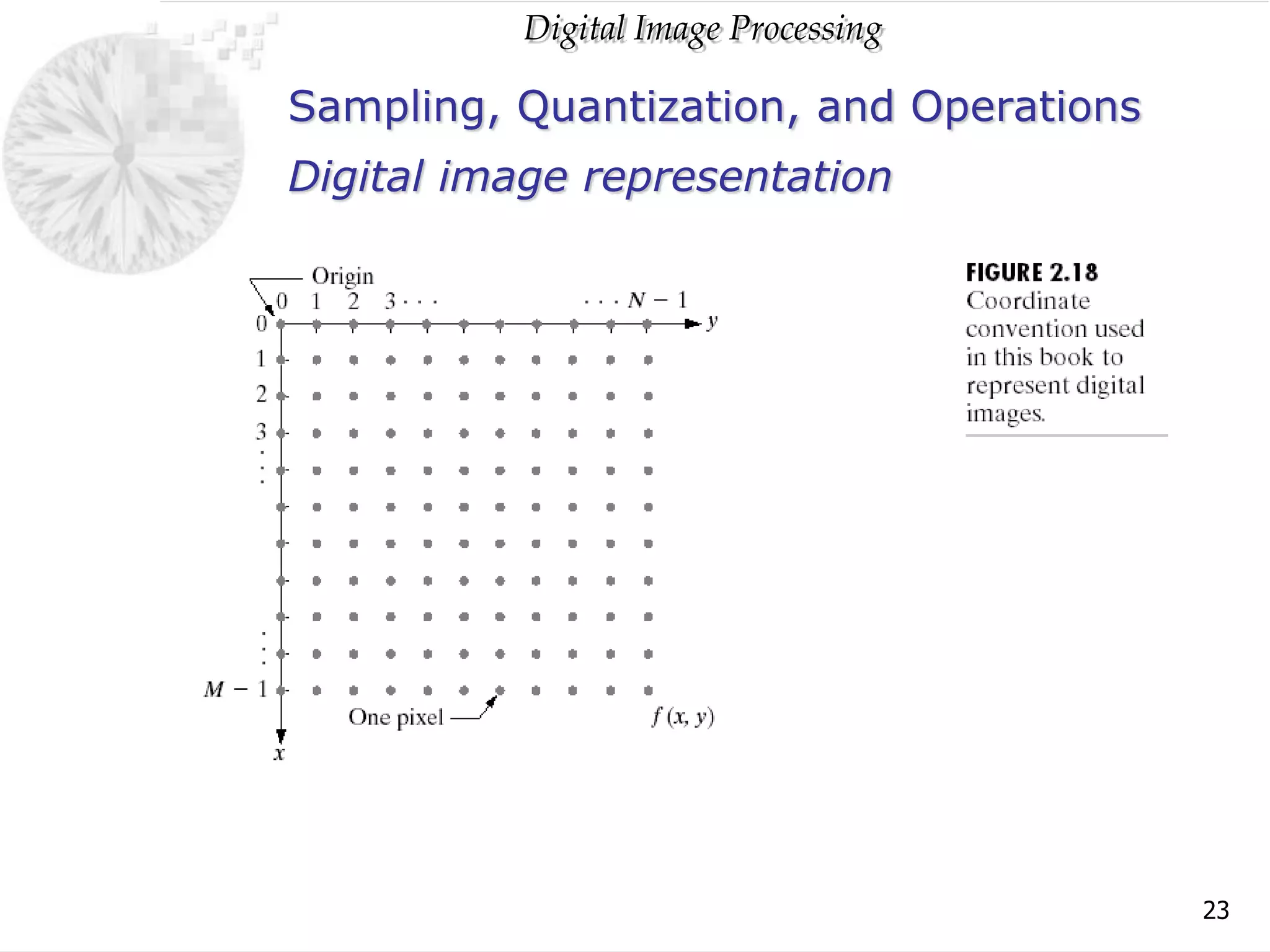
Digital image representation
Digital Image Processing
24
Sampling, Quantization, and Operations
Spatial resolution : the more pixels in a fixed range, the
higher the resolution
Gray-level resolution : the more bits, the higher the
resolution
Image resolution
Digital Image Processing
25
Sampling, Quantization, and Operations
Both applied to digital image
Zooming
Creation of new pixel locations
Assignment of gray levels to those new locations
Pixel replication, when increasing the size of an image an integer times
Nearest neighbor interpolation
Bilinear interpolation
Bicubic interpolation
Shrinking
Image zooming and shrinking
Digital Image Processing
26
Sampling, Quantization, and Operations
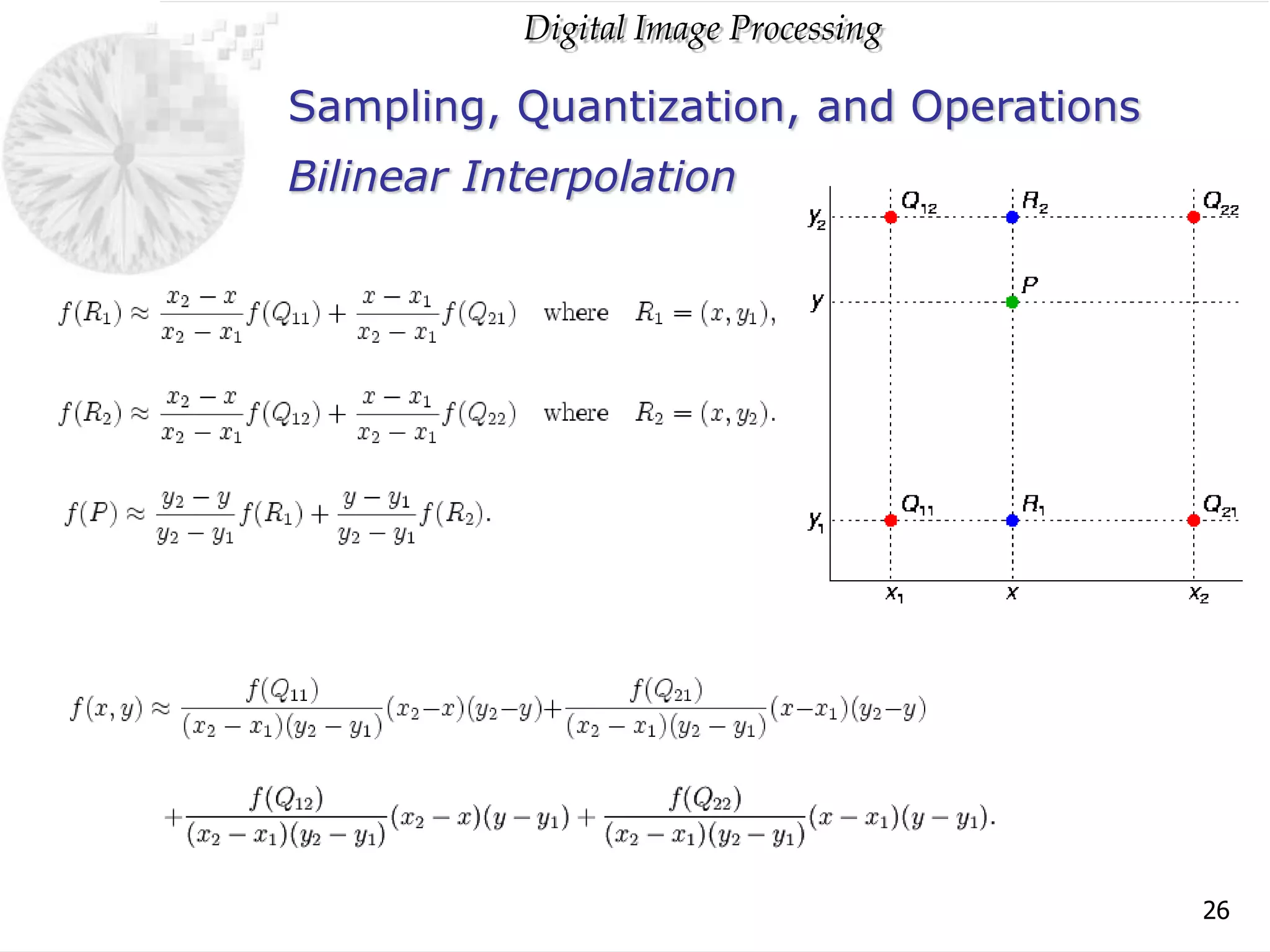
Bilinear Interpolation
Digital Image Processing
27
Sampling, Quantization, and Operations
Neighbors of a pixel
4-neighbors
diagonal-neighbors
8-neighbors
Adjacency
4-adjacency
8-adjacency
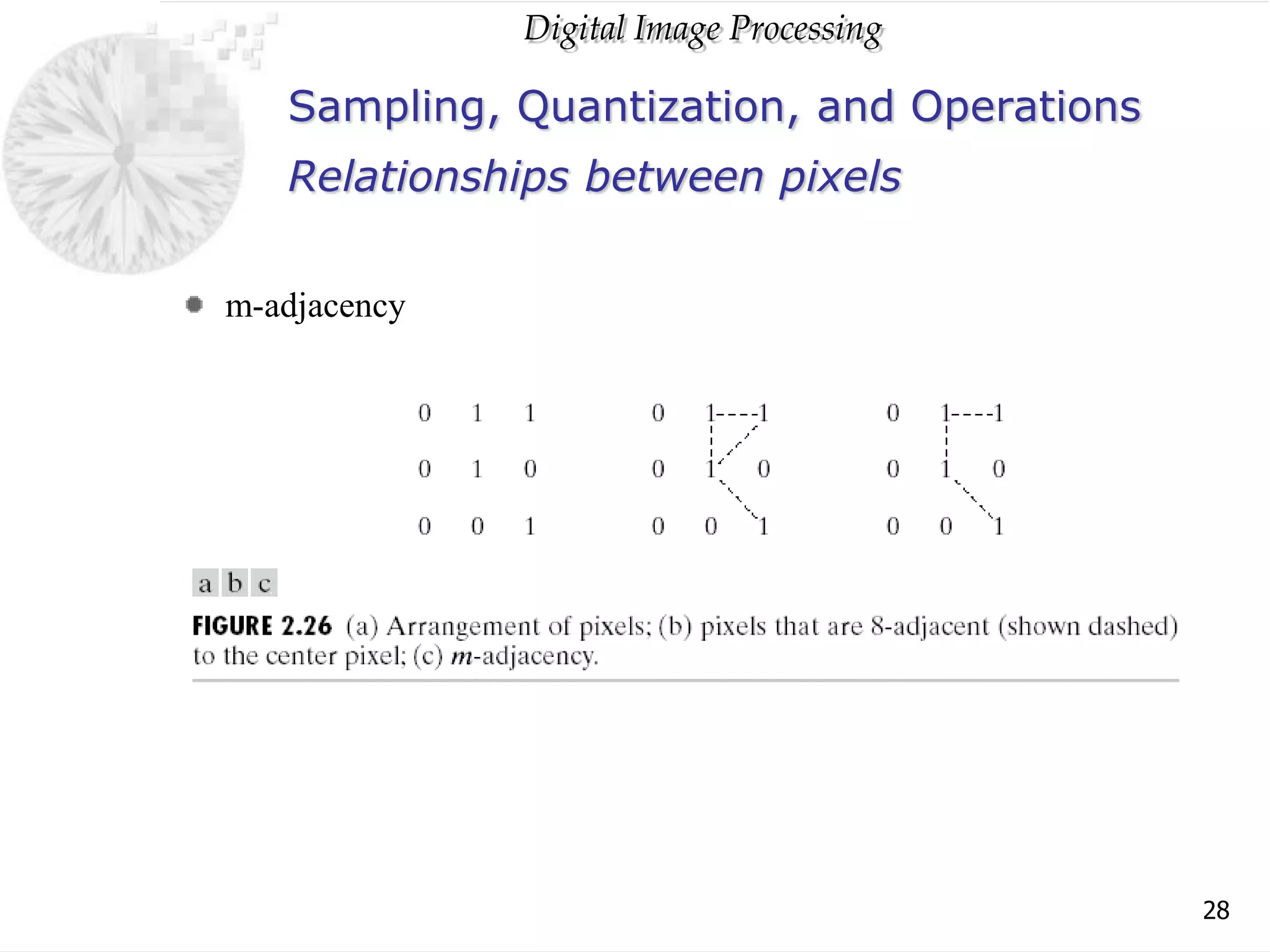
m-adjacency
Relationships between pixels
(i-1,j-
1)
(i-1,j)
(i-
1,j+1)
(i,j-1) (i,j)
(i,j+1
)
(i+1,j
-1)
(i+1,j
)
(i+1,j
+1)
Digital Image Processing
28
Sampling, Quantization, and Operations
m-adjacency
Relationships between pixels
Digital Image Processing
29
Sampling, Quantization, and Operations
Path: 4, 8, and m-paths
A sequence of distinct pixels from pixel p to q.
Connectivity
Connect set: only has one connected component.
Region
Region is a connected set.
Boundary
The set of pixels in the region which has one or more neighbors that are
not in the region.
Relationships between pixels
Digital Image Processing
30
Sampling, Quantization, and Operations
Addition
Subtraction
Multiplication
Division
Arithmetic operations
Digital Image Processing
31
Sampling, Quantization, and Operations
AND
OR
Complement (NOT)
XOR
Logical operations

Chap01 visual perception

  • 1.
  • 2.
    Digital Image Processing 2 Elementsof Visual Perception Structure of the human eye Image formation in the human eye Brightness adaptation and discrimination Outline
  • 3.
    Digital Image Processing 3 Elementsof Visual Perception The cornea and sclera outer cover The choroid Ciliary body Iris diaphragm Lens The retina (two kinds of receptors) Cones vision (photopic/bright-light vision) : centered at fovea, highly sensitive to color Rods (scotopic/dim-light vision) : general view Blind spot Structure of the human eye
  • 4.
    Digital Image Processing 4 Elementsof Visual Perception Structure of the human eye
  • 5.
    Digital Image Processing 5 Elementsof Visual Perception Structure of the human eye
  • 6.
    Digital Image Processing 6 Elementsof Visual Perception Flexible lens: the principle difference from an ordinary optical lens. Controlled by the tension in the fibers of the ciliary body To focus on distant objects – flattened To focus on objects near eye – thicker Near-sighted and far-sighted Image formation in the human eye
  • 7.
    Digital Image Processing 7 Elementsof Visual Perception Image formation in the human eye Light Receptor Brain Radiant Energy
  • 8.
    Digital Image Processing 8 Elementsof Visual Perception Dynamic range of human visual system: 10-6~104 mL (millilambert) Can not accomplish this range simultaneously It changes its sensitivity to operate over this entire range simultaneously. The current sensitivity level of the visual system is called brightness adaptation level Brightness adaptation
  • 9.
    Digital Image Processing 9 Elementsof Visual Perception Brightness adaptation
  • 10.
    Digital Image Processing 10 Elementsof Visual Perception Weber ratio (the experiment) : I: the background illumination : the increment of illumination Small Weber ratio indicates good discrimination Larger Weber ratio indicates poor discrimination Brightness discrimination I IC /  C I 
  • 11.
    Digital Image Processing 11 Elementsof Visual Perception Brightness discrimination
  • 12.
    Digital Image Processing 12 Elementsof Visual Perception The perceived brightness is not a simple function of intensity Mach band pattern Simultaneous contrast Optical illusion Psycho-visual effects
  • 13.
    Digital Image Processing 13 Elementsof Visual Perception Mach band pattern
  • 14.
    Digital Image Processing 14 Elementsof Visual Perception Simultaneous contrast
  • 15.
    Digital Image Processing 15 Elementsof Visual Perception Optical illusion
  • 16.
    Digital Image Processing 16 Elementsof Visual Perception Optical illusion
  • 17.
    Digital Image Processing 17 Elementsof Visual Perception Optical illusion
  • 18.
    Digital Image Processing Sampling,Quantization and Other Simple Operations
  • 19.
    Digital Image Processing 19 Sampling,Quantization, and Operations Image formation model Uniform sampling Uniform quantization Digital image representation Relationships between pixels Arithmetic operations Logical operations Outline
  • 20.
    Digital Image Processing 20 Sampling,Quantization and Other Simple Operations   0 , f x y      , f x y   , i x y may be characterized by two components : Illumination: Reflectance:   , r x y       , , , f x y i x y r x y    0 , i x y      0 , 1 r x y   Monochrome image Typical values of the illumination and reflectance: Illumination: sun on earth: 90,000 lm/m2 on a sunny day; 10,000 lm/m2 on a cloud day; moon on clear evening: 0.1 lm/m2; in a commercial office is about 1000 lm/m2 Reflectance: 0.01 for black velvet, 0.65 for stainless steel, 0.80 for flat-white wall paint, 0.90 for silver-plated metal, and 0.93 for snow Image Formation Model
  • 21.
    Digital Image Processing 21 Sampling,Quantization, and Operations Sampling digitalized in spatial domain Quantization digitalized in amplitude Uniform sampling and quantization
  • 22.
    Digital Image Processing 22 Sampling,Quantization, and Operations Uniform sampling and quantization
  • 23.
    Digital Image Processing 23 Sampling,Quantization, and Operations Digital image representation
  • 24.
    Digital Image Processing 24 Sampling,Quantization, and Operations Spatial resolution : the more pixels in a fixed range, the higher the resolution Gray-level resolution : the more bits, the higher the resolution Image resolution
  • 25.
    Digital Image Processing 25 Sampling,Quantization, and Operations Both applied to digital image Zooming Creation of new pixel locations Assignment of gray levels to those new locations Pixel replication, when increasing the size of an image an integer times Nearest neighbor interpolation Bilinear interpolation Bicubic interpolation Shrinking Image zooming and shrinking
  • 26.
    Digital Image Processing 26 Sampling,Quantization, and Operations Bilinear Interpolation
  • 27.
    Digital Image Processing 27 Sampling,Quantization, and Operations Neighbors of a pixel 4-neighbors diagonal-neighbors 8-neighbors Adjacency 4-adjacency 8-adjacency m-adjacency Relationships between pixels (i-1,j- 1) (i-1,j) (i- 1,j+1) (i,j-1) (i,j) (i,j+1 ) (i+1,j -1) (i+1,j ) (i+1,j +1)
  • 28.
    Digital Image Processing 28 Sampling,Quantization, and Operations m-adjacency Relationships between pixels
  • 29.
    Digital Image Processing 29 Sampling,Quantization, and Operations Path: 4, 8, and m-paths A sequence of distinct pixels from pixel p to q. Connectivity Connect set: only has one connected component. Region Region is a connected set. Boundary The set of pixels in the region which has one or more neighbors that are not in the region. Relationships between pixels
  • 30.
    Digital Image Processing 30 Sampling,Quantization, and Operations Addition Subtraction Multiplication Division Arithmetic operations
  • 31.
    Digital Image Processing 31 Sampling,Quantization, and Operations AND OR Complement (NOT) XOR Logical operations