Motivation
Highly Motivated Employees Are
Critical to Business Success
Motivation:
The set of forces that
cause people to behave
in certain ways
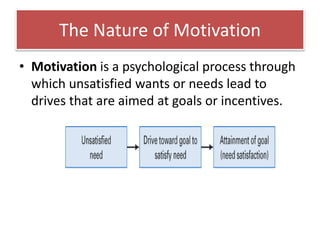
The Nature of Motivation
• Motivation is a psychological process through
which unsatisfied wants or needs lead to
drives that are aimed at goals or incentives.
Theory X and Theory Y
Maslow’s theory of Human Needs
What is leadership?
How Good Are Your Leadership Skills?
Score Comment
18-34
You need to work hard on your leadership skills. The good news is that if
you use more of these skills at work, at home, and in the community,
you'll be a real asset to the people around you. You can do it – and now
is a great time to start!
35-52
You're doing OK as a leader, but you have the potential to do much
better. While you've built the foundation of effective leadership, this is
your opportunity to improve your skills, and become the best you can
be. Examine the areas where you lost points, and determine what you
can do to develop skills in these areas.
53-90
Excellent! You're well on your way to becoming a good leader. However,
you can never be too good at leadership or too experienced – so look at
the areas where you didn't score maximum points, and figure out what
you can do to improve your performance.
Leadership-Managerial meaning
Leadership is a function of an interaction
between the leader, the follower, and the
situation
Leadership is the process where a person
influences the behavior of an individual or a
group and inspires, motivates and directs
their activities to achieve common goals
IMPORTANCE OF LEADERSHIP
1. Inspires employees
2. Secures cooperation
3. Creates confidence
4. Provides good working climate
What is power?
13
Sources of Power
Reward
Power
Legitimate
Power
Coercive
Power
Expert
Power
Earned
Power
Enable managers to be
leaders & influence
subordinates to
achieve goals
Leadership Styles
1. Directive, Autocratic or Authoritarian Style
2. Participative or Democratic Style
3. Laissez-Faire or Free – Rein Leadership
Style
Other leadership styles
Transformational leader
Visionary leader
Transactional leaders
Charismatic leadership
Leadership Models/Theories
Traits Approach to
Leadership
Behavioral Approach to
Leadership
Situational Approach to
Leadership
Leadership Traits
Trait theory or Great person theory
effective leaders possess a similar
set of traits or characteristics
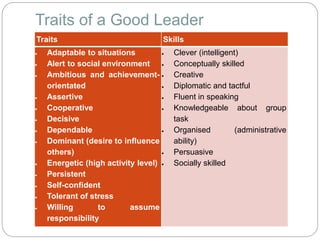
Traits of a Good Leader
Traits Skills
 Adaptable to situations
 Alert to social environment
 Ambitious and achievement-
orientated
 Assertive
 Cooperative
 Decisive
 Dependable
 Dominant (desire to influence
others)
 Energetic (high activity level)
 Persistent
 Self-confident
 Tolerant of stress
 Willing to assume
responsibility
 Clever (intelligent)
 Conceptually skilled
 Creative
 Diplomatic and tactful
 Fluent in speaking
 Knowledgeable about group
task
 Organised (administrative
ability)
 Persuasive
 Socially skilled
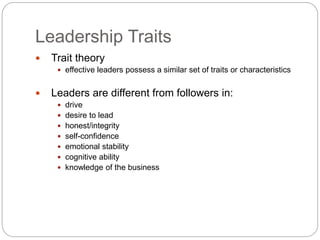
Leadership Traits
 Trait theory
 effective leaders possess a similar set of traits or characteristics
 Leaders are different from followers in:
 drive
 desire to lead
 honest/integrity
 self-confidence
 emotional stability
 cognitive ability
 knowledge of the business
McCall and Lombardo researched both
success and failure identified four primary traits
by which leaders could succeed or 'derail':
 Emotional stability and composure
 Admitting error & Good interpersonal skills
 Intellectual breadth
Behavioral Approaches to
Leadership
Behavioral Approaches to
Leadership
The Ohio State studies identified two
major sets of leader behaviors:
Initiating-structure behavior
Consideration behavior
Behavioral Approaches to
Leadership (cont’d)
The University of Michigan studies
identified the behavioral
characteristics of effective
leaders:
Job-centered behavior
Employee-centered
behavior
Blake/Mouton Leadership Grid
Situational Approaches to
Leadership
Contingency or situational
theories examines the fit
between the leader and the
situation
.
Fiedler's Contingency Model
Step 1: Identify your leadership style
Unfriendly 1 2 3 4 5 6 7 8 Friendly
Unpleasant 1 2 3 4 5 6 7 8 Pleasant
Rejecting 1 2 3 4 5 6 7 8 Accepting
Tense 1 2 3 4 5 6 7 8 Relaxed
Cold 1 2 3 4 5 6 7 8 Warm
Boring 1 2 3 4 5 6 7 8 Interesting
Backbiting 1 2 3 4 5 6 7 8 Loyal
Uncooperative 1 2 3 4 5 6 7 8 Cooperative
Hostile 1 2 3 4 5 6 7 8 Supportive
Guarded 1 2 3 4 5 6 7 8 Open
Insincere 1 2 3 4 5 6 7 8 Sincere
Unkind 1 2 3 4 5 6 7 8 Kind
Inconsiderate 1 2 3 4 5 6 7 8 Considerate
Untrustworthy 1 2 3 4 5 6 7 8 Trustworthy
Gloomy 1 2 3 4 5 6 7 8 Cheerful
Quarrelsome 1 2 3 4 5 6 7 8 Harmonious
Figure 1: Least-Preferred Co-Worker Scale
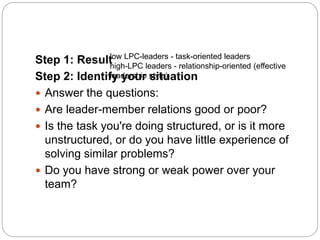
Step 1: Result
Step 2: Identify your situation
 Answer the questions:
 Are leader-member relations good or poor?
 Is the task you're doing structured, or is it more
unstructured, or do you have little experience of
solving similar problems?
 Do you have strong or weak power over your
team?
low LPC-leaders - task-oriented leaders
high-LPC leaders - relationship-oriented (effective
leadership style)
Step 3: Determine the most effective leadership style
Situational Approach
-Hersey-Blanchard's situational
model
Task behavior
Relationship
behavior
(Low) (High)
(High)
High Task
and low
relationship
Low
Relationship
and
Low task
High
relationship
And
low task
High Task
And
High
relationship
Style of Leader
The Path-Goal Theory by Robert
House
Work
Situation
Follower
lacks self-
confidence
Lack of job
challenge
Improper
procedures and
poor decisions
Ambiguous job
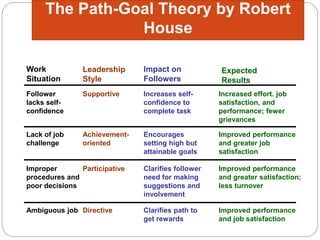
The Path-Goal Theory by Robert
House
Work
Situation
Follower
lacks self-
confidence
Supportive
Achievement-
oriented
Participative
Directive
Leadership
Style
Impact on
Followers
Expected
Results
Lack of job
challenge
Improper
procedures and
poor decisions
Ambiguous job
Increases self-
confidence to
complete task
Encourages
setting high but
attainable goals
Clarifies follower
need for making
suggestions and
involvement
Clarifies path to
get rewards
Increased effort. job
satisfaction, and
performance; fewer
grievances
Improved performance
and greater job
satisfaction
Improved performance
and greater satisfaction;
less turnover
Improved performance
and job satisfaction
Recent Trends in Leadership Approaches
Strategic leadership
Crisis Leadership
Ethical leadership
Crisis Management
&
Leadership
Crisis Management
Crisis management is the process by which an
organization deals with a major unpredictable
event that threatens to harm the organization, its
stakeholders, or the general public
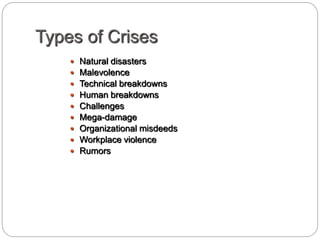
Types of Crises
 Natural disasters
 Malevolence
 Technical breakdowns
 Human breakdowns
 Challenges
 Mega-damage
 Organizational misdeeds
 Workplace violence
 Rumors
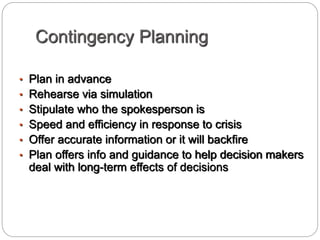
Contingency Planning
• Plan in advance
• Rehearse via simulation
• Stipulate who the spokesperson is
• Speed and efficiency in response to crisis
• Offer accurate information or it will backfire
• Plan offers info and guidance to help decision makers
deal with long-term effects of decisions
Leadership Traits for Managing Crisis
 Flexibility
 Tenaciousness
 Empathy
 Transparency
 Compassion
 Communication
 Decisiveness
 Conflict resolution
 Clear vision
 Passion
 Protection
 Understanding
 Problem solving
 Negotiation
 Case Study #1: Southwest Airlines
 How can an airline survive a government order to ground its entire fleet
and shut down for days? After 9/11, all U.S. airlines were faced with this
same crisis. One that succeeded through the difficulty was Southwest
Airlines, already known for its outstanding customer service.
Southwest’s passengers, flight attendants, pilots and ground crews were
stranded all across the country after the terrorist attacks. But unlike their
competition, Southwest’s leadership did more than just sit and wait.
They encouraged employees to leverage their trademark fun approach
to business and to help stranded customers enjoy themselves at the
movies or the local bowling alley. And when the ramifications of the
shutdown forced other airlines to cut staff, Southwest’s then-CEO,
James Parker, announced just three days after 9/11 that the company
would be keeping all of its employees, as well as issuing a profit-sharing
payment.
 Leadership characteristics like crisis management, creative problem
solving and a strong belief in the company’s vision saw Southwest
through this unimaginable situation. The CEO also protected his staff,
which ultimately led to a stronger airline.
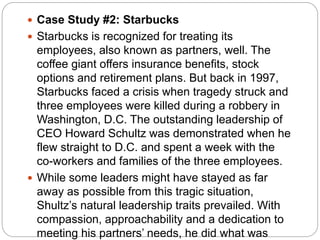
 Case Study #2: Starbucks
 Starbucks is recognized for treating its
employees, also known as partners, well. The
coffee giant offers insurance benefits, stock
options and retirement plans. But back in 1997,
Starbucks faced a crisis when tragedy struck and
three employees were killed during a robbery in
Washington, D.C. The outstanding leadership of
CEO Howard Schultz was demonstrated when he
flew straight to D.C. and spent a week with the
co-workers and families of the three employees.
 While some leaders might have stayed as far
away as possible from this tragic situation,
Shultz’s natural leadership traits prevailed. With
compassion, approachability and a dedication to
meeting his partners’ needs, he did what was
 Case Study #3: Toro
 Toro, the lawn equipment manufacturer, is accustomed to lawsuits, due to the
inherent hazards associated with using its machinery. During the late 1980s, the
company was facing major financial troubles and put Ken Melrose in place as
CEO. One of his first successes was reducing the company’s cost of lawsuits by
implementing a new mediation policy, and invoking an important leadership trait:
empathy.
 Prior to Melrose’s tenure, Toro faced about 50 lawsuits every year involving
serious injuries. He decided to switch to mediation to address product liability
claims. This approach included sending a company representative to meet with
people injured by Toro products, as well as their families. The goal was to see
what went wrong, express the firm’s sympathy and attend to the family’s needs.
One result of the new mediation policy was a 95% rate of resolving the
company’s claims, along with significant cost savings.
 Great leaders recognize problems and do what it takes to overcome them. They
are open and empathetic, and let their values guide their actions.
7-leadership.pptx

7-leadership.pptx

  • 1.
  • 3.
    Highly Motivated EmployeesAre Critical to Business Success Motivation: The set of forces that cause people to behave in certain ways
  • 4.
    The Nature ofMotivation • Motivation is a psychological process through which unsatisfied wants or needs lead to drives that are aimed at goals or incentives.
  • 5.
    Theory X andTheory Y
  • 6.
  • 7.
  • 8.
    How Good AreYour Leadership Skills?
  • 9.
    How Good AreYour Leadership Skills? Score Comment 18-34 You need to work hard on your leadership skills. The good news is that if you use more of these skills at work, at home, and in the community, you'll be a real asset to the people around you. You can do it – and now is a great time to start! 35-52 You're doing OK as a leader, but you have the potential to do much better. While you've built the foundation of effective leadership, this is your opportunity to improve your skills, and become the best you can be. Examine the areas where you lost points, and determine what you can do to develop skills in these areas. 53-90 Excellent! You're well on your way to becoming a good leader. However, you can never be too good at leadership or too experienced – so look at the areas where you didn't score maximum points, and figure out what you can do to improve your performance.
  • 11.
    Leadership-Managerial meaning Leadership isa function of an interaction between the leader, the follower, and the situation Leadership is the process where a person influences the behavior of an individual or a group and inspires, motivates and directs their activities to achieve common goals
  • 12.
    IMPORTANCE OF LEADERSHIP 1.Inspires employees 2. Secures cooperation 3. Creates confidence 4. Provides good working climate
  • 13.
  • 14.
    Sources of Power Reward Power Legitimate Power Coercive Power Expert Power Earned Power Enablemanagers to be leaders & influence subordinates to achieve goals
  • 15.
    Leadership Styles 1. Directive,Autocratic or Authoritarian Style 2. Participative or Democratic Style 3. Laissez-Faire or Free – Rein Leadership Style
  • 16.
    Other leadership styles Transformationalleader Visionary leader Transactional leaders Charismatic leadership
  • 17.
  • 18.
    Leadership Models/Theories Traits Approachto Leadership Behavioral Approach to Leadership Situational Approach to Leadership
  • 19.
    Leadership Traits Trait theoryor Great person theory effective leaders possess a similar set of traits or characteristics
  • 20.
    Traits of aGood Leader Traits Skills  Adaptable to situations  Alert to social environment  Ambitious and achievement- orientated  Assertive  Cooperative  Decisive  Dependable  Dominant (desire to influence others)  Energetic (high activity level)  Persistent  Self-confident  Tolerant of stress  Willing to assume responsibility  Clever (intelligent)  Conceptually skilled  Creative  Diplomatic and tactful  Fluent in speaking  Knowledgeable about group task  Organised (administrative ability)  Persuasive  Socially skilled
  • 21.
    Leadership Traits  Traittheory  effective leaders possess a similar set of traits or characteristics  Leaders are different from followers in:  drive  desire to lead  honest/integrity  self-confidence  emotional stability  cognitive ability  knowledge of the business
  • 22.
    McCall and Lombardoresearched both success and failure identified four primary traits by which leaders could succeed or 'derail':  Emotional stability and composure  Admitting error & Good interpersonal skills  Intellectual breadth
  • 23.
  • 24.
    Behavioral Approaches to Leadership TheOhio State studies identified two major sets of leader behaviors: Initiating-structure behavior Consideration behavior
  • 25.
    Behavioral Approaches to Leadership(cont’d) The University of Michigan studies identified the behavioral characteristics of effective leaders: Job-centered behavior Employee-centered behavior
  • 26.
  • 27.
    Situational Approaches to Leadership Contingencyor situational theories examines the fit between the leader and the situation .
  • 28.
    Fiedler's Contingency Model Step1: Identify your leadership style Unfriendly 1 2 3 4 5 6 7 8 Friendly Unpleasant 1 2 3 4 5 6 7 8 Pleasant Rejecting 1 2 3 4 5 6 7 8 Accepting Tense 1 2 3 4 5 6 7 8 Relaxed Cold 1 2 3 4 5 6 7 8 Warm Boring 1 2 3 4 5 6 7 8 Interesting Backbiting 1 2 3 4 5 6 7 8 Loyal Uncooperative 1 2 3 4 5 6 7 8 Cooperative Hostile 1 2 3 4 5 6 7 8 Supportive Guarded 1 2 3 4 5 6 7 8 Open Insincere 1 2 3 4 5 6 7 8 Sincere Unkind 1 2 3 4 5 6 7 8 Kind Inconsiderate 1 2 3 4 5 6 7 8 Considerate Untrustworthy 1 2 3 4 5 6 7 8 Trustworthy Gloomy 1 2 3 4 5 6 7 8 Cheerful Quarrelsome 1 2 3 4 5 6 7 8 Harmonious Figure 1: Least-Preferred Co-Worker Scale
  • 29.
    Step 1: Result Step2: Identify your situation  Answer the questions:  Are leader-member relations good or poor?  Is the task you're doing structured, or is it more unstructured, or do you have little experience of solving similar problems?  Do you have strong or weak power over your team? low LPC-leaders - task-oriented leaders high-LPC leaders - relationship-oriented (effective leadership style)
  • 30.
    Step 3: Determinethe most effective leadership style
  • 31.
    Situational Approach -Hersey-Blanchard's situational model Taskbehavior Relationship behavior (Low) (High) (High) High Task and low relationship Low Relationship and Low task High relationship And low task High Task And High relationship Style of Leader
  • 32.
    The Path-Goal Theoryby Robert House Work Situation Follower lacks self- confidence Lack of job challenge Improper procedures and poor decisions Ambiguous job
  • 33.
    The Path-Goal Theoryby Robert House Work Situation Follower lacks self- confidence Supportive Achievement- oriented Participative Directive Leadership Style Impact on Followers Expected Results Lack of job challenge Improper procedures and poor decisions Ambiguous job Increases self- confidence to complete task Encourages setting high but attainable goals Clarifies follower need for making suggestions and involvement Clarifies path to get rewards Increased effort. job satisfaction, and performance; fewer grievances Improved performance and greater job satisfaction Improved performance and greater satisfaction; less turnover Improved performance and job satisfaction
  • 34.
    Recent Trends inLeadership Approaches Strategic leadership Crisis Leadership Ethical leadership
  • 35.
  • 36.
    Crisis Management Crisis managementis the process by which an organization deals with a major unpredictable event that threatens to harm the organization, its stakeholders, or the general public
  • 37.
    Types of Crises Natural disasters  Malevolence  Technical breakdowns  Human breakdowns  Challenges  Mega-damage  Organizational misdeeds  Workplace violence  Rumors
  • 38.
    Contingency Planning • Planin advance • Rehearse via simulation • Stipulate who the spokesperson is • Speed and efficiency in response to crisis • Offer accurate information or it will backfire • Plan offers info and guidance to help decision makers deal with long-term effects of decisions
  • 39.
    Leadership Traits forManaging Crisis  Flexibility  Tenaciousness  Empathy  Transparency  Compassion  Communication  Decisiveness  Conflict resolution  Clear vision  Passion  Protection  Understanding  Problem solving  Negotiation
  • 40.
     Case Study#1: Southwest Airlines  How can an airline survive a government order to ground its entire fleet and shut down for days? After 9/11, all U.S. airlines were faced with this same crisis. One that succeeded through the difficulty was Southwest Airlines, already known for its outstanding customer service. Southwest’s passengers, flight attendants, pilots and ground crews were stranded all across the country after the terrorist attacks. But unlike their competition, Southwest’s leadership did more than just sit and wait. They encouraged employees to leverage their trademark fun approach to business and to help stranded customers enjoy themselves at the movies or the local bowling alley. And when the ramifications of the shutdown forced other airlines to cut staff, Southwest’s then-CEO, James Parker, announced just three days after 9/11 that the company would be keeping all of its employees, as well as issuing a profit-sharing payment.  Leadership characteristics like crisis management, creative problem solving and a strong belief in the company’s vision saw Southwest through this unimaginable situation. The CEO also protected his staff, which ultimately led to a stronger airline.
  • 41.
     Case Study#2: Starbucks  Starbucks is recognized for treating its employees, also known as partners, well. The coffee giant offers insurance benefits, stock options and retirement plans. But back in 1997, Starbucks faced a crisis when tragedy struck and three employees were killed during a robbery in Washington, D.C. The outstanding leadership of CEO Howard Schultz was demonstrated when he flew straight to D.C. and spent a week with the co-workers and families of the three employees.  While some leaders might have stayed as far away as possible from this tragic situation, Shultz’s natural leadership traits prevailed. With compassion, approachability and a dedication to meeting his partners’ needs, he did what was
  • 42.
     Case Study#3: Toro  Toro, the lawn equipment manufacturer, is accustomed to lawsuits, due to the inherent hazards associated with using its machinery. During the late 1980s, the company was facing major financial troubles and put Ken Melrose in place as CEO. One of his first successes was reducing the company’s cost of lawsuits by implementing a new mediation policy, and invoking an important leadership trait: empathy.  Prior to Melrose’s tenure, Toro faced about 50 lawsuits every year involving serious injuries. He decided to switch to mediation to address product liability claims. This approach included sending a company representative to meet with people injured by Toro products, as well as their families. The goal was to see what went wrong, express the firm’s sympathy and attend to the family’s needs. One result of the new mediation policy was a 95% rate of resolving the company’s claims, along with significant cost savings.  Great leaders recognize problems and do what it takes to overcome them. They are open and empathetic, and let their values guide their actions.